Morfologia das tempestades el´etricas na Am´erica do
Sul
Evandro M. Anselmo
Institute of Astronomy, Geophysics and Atmospheric Science of University of S˜ao Paulo
(IAG-USP), S˜ao Paulo-SP, Brazil.
IAG/USP – 2015
Introduction
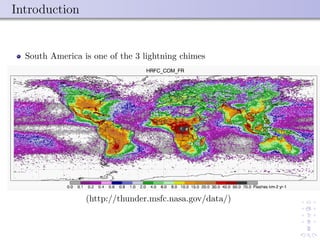
South America is one of the 3 lightning chimes
(http://thunder.msfc.nasa.gov/data/)
Introduction
Infrastructure planning requires knowledge about thunderstorm position,
frequency and lightning efficient production
Objectives
Create a thunderstorm database based on TRMM measurements
Determine the annual cycle and diurnal cycle of thunderstorms in South
America
Determine the geographical distribution of lightning flashes and
thunderstorms
Evaluate the thunderstorms severity.
Tropical Rainfall Measuring Mission – TRMM
Launched in November 28th, 1997. Orbit with inclination of 35◦
and
altitude of 350 km (August, 2011, the altitude was change for 402.5 km)
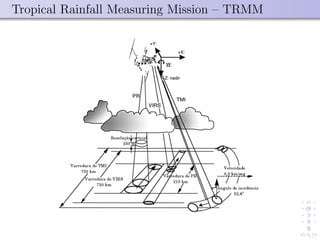
Sensors: Precipitation Radar – PR, TRMM Microwave Imager – TMI,
Visible and Infrared Scanner – VIRS, Lightning Imaging Sensor – LIS,
Clouds and the Earth’s Radiant Energy System – CERES.
Goal: Estimate rainfall over the tropics and subsequently latent heat flux1
1KUMMEROW, C.; BARNES, W.; KOZU, T.; SHIUE, J.; SIMPSON, J. The tropical rainfall measuring mission
(TRMM) sensor package. J. Atmos. Oceanic Technol., v. 15, p. 809–817, 1998
Tropical Rainfall Measuring Mission – TRMM
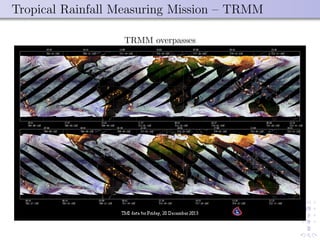
TRMM overpasses
Tropical Rainfall Measuring Mission – TRMM
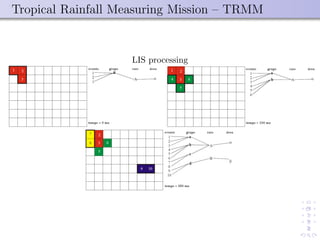
LIS processing
Data and Methodology
TRMM:
TRMM orbital v7 files: LIS, VIRS (1B01), and PR (2A25), between
1998–2011 ( 30TB of data).
During this period we had 79,932 TRMM orbits, but only 63,613 were
over South America (SA) 40◦
S–10◦
N and 90◦
–30◦
W.
NCEP RII:
NCEP RII reanalysis from 1998-2011: geopotential height and
temperature at 17 pressure levels. This data is used to convert TRMM PR
altitudes levels in temperature.
Defining thunderstorms:
Thunderstorms have been defined as clouds with brightness temperature
below 258 K at the 1B01 10.8 µm channel and had at least one LIS
lightning flash [Morales and Anagnostou, 2003]2
.
2Morales, C. A., and E. N. Anagnostou, Extending the capabilities of high-frequency rainfall estimation from
geostationary-based satellite infrared via a network of long-range lightning observations, J. Hydrometeor, 4,
141–159, 2003.
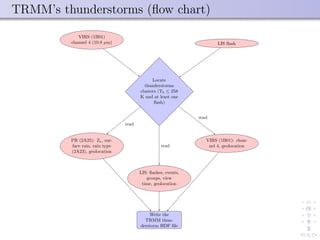
TRMM’s thunderstorms (flow chart)
Locate
thunderstorms
clusters (Tb ≤ 258
K and at least one
flash)
VIRS (1B01)
channel 4 (10.8 µm) LIS flash
PR (2A25): Ze, sur-
face rain, rain type
(2A23), geolocation
LIS: flashes, events,
groups, view
time, geolocation
VIRS (1B01): chan-
nel 4, geolocation
Write the
TRMM thun-
derstorm HDF file
read
read
read
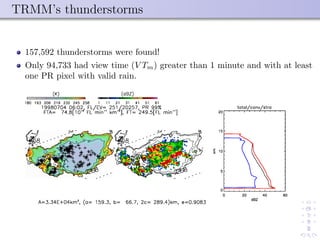
TRMM’s thunderstorms
157,592 thunderstorms were found!
Only 94,733 had view time (V Tm) greater than 1 minute and with at least
one PR pixel with valid rain.
The onset of the South American thunderstorms
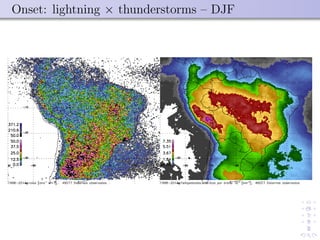
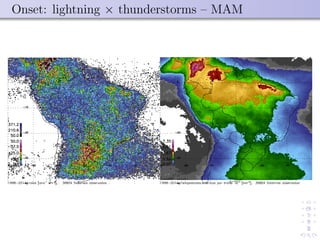
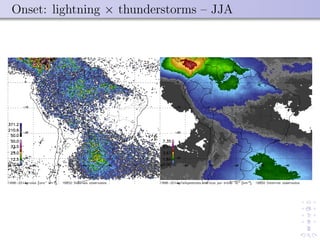
Where the thunderstorms are more often in SA?
Where are the places with high lightning densities that corresponds with
the highest density of thunderstorms?
How long does the thunderstorm season last in SA?
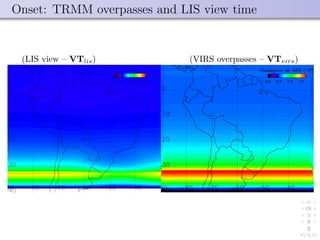
Onset: TRMM overpasses and LIS view time
(LIS view – VTlis) (VIRS overpasses – VTvirs)
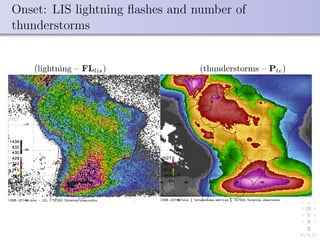
Onset: LIS lightning flashes and number of
thunderstorms
(lightning – FLlis) (thunderstorms – Pte)
Onset: Defining densities ratios
lightning [km−2
year−1
]
DEfl =
FLlis
VTlisAg
31557600 (1)
thunderstorms per orbit [km−2
]
DEte =
Pte
VTvirsAg
(2)
lightning per thunderstorms [km−2
year−1
]
DErt =
FLlis
VTlisAgPte
31557600 (3)
Where the thunderstorms are more often in SA?
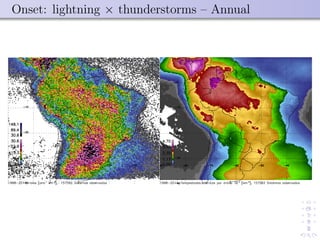
Onset: lightning × thunderstorms – Annual
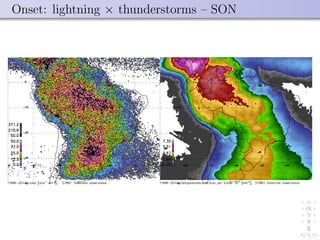
Onset: lightning × thunderstorms – SON
Onset: lightning × thunderstorms – DJF
Onset: lightning × thunderstorms – MAM
Onset: lightning × thunderstorms – JJA
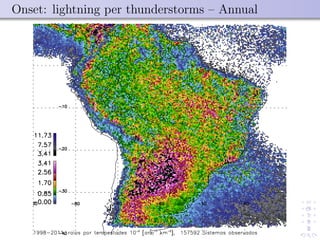
Where are the places with high lightning densities that
corresponds with the highest density of thunderstorms?
Onset: lightning per thunderstorms – Annual
How long does the thunderstorm season last in SA?
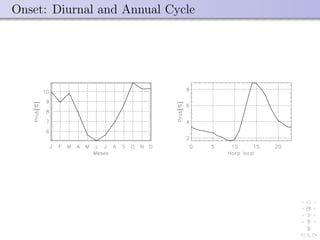
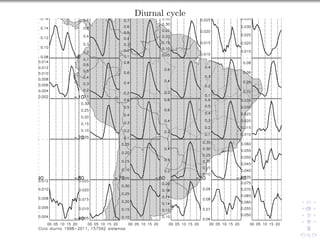
Onset: Diurnal and Annual Cycle
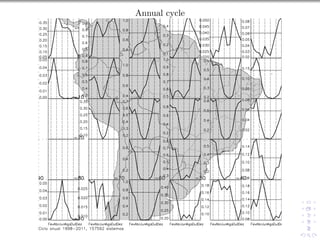
Annual cycle
Diurnal cycle
Thunderstorms Severity
Thunderstorms Severity: Defining severity index
Flash rate (FT) is defined as the ratio of number of lightning flashes (Nfl)
by the mean view time (V Tm) in the thunderstorm area extracted.
FT =
Nfl
V Tm
60 [min−1
] (4)
Flash rate normalized by thunderstorm area (FTA) is defined as the ratio
of number of lightning flashes (Nfl) by the mean view time (V Tm) and
thunderstorm area (At).
FTA =
Nfl
V TmAt
60 [min−1
km−2
] (5)
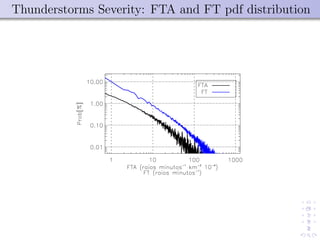
Thunderstorms Severity: FTA and FT pdf distribution
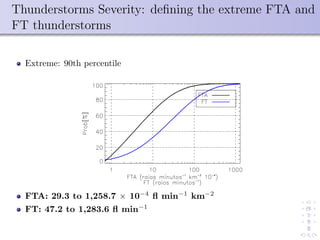
Thunderstorms Severity: defining the extreme FTA and
FT thunderstorms
Extreme: 90th percentile
FTA: 29.3 to 1,258.7 × 10−4
fl min−1
km−2
FT: 47.2 to 1,283.6 fl min−1
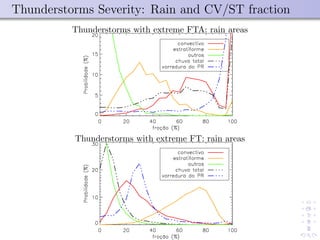
Thunderstorms Severity: Rain and CV/ST fraction
Thunderstorms with extreme FTA: rain areas
Thunderstorms with extreme FT: rain areas
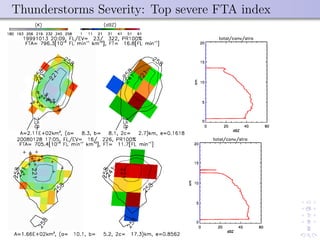
Thunderstorms Severity: Top severe FTA index
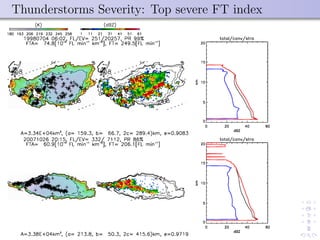
Thunderstorms Severity: Top severe FT index
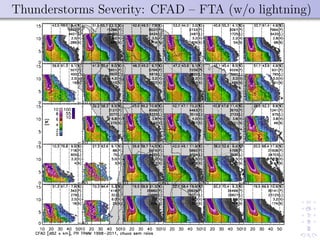
Thunderstorms Severity: CFAD – FTA (w/o lightning)
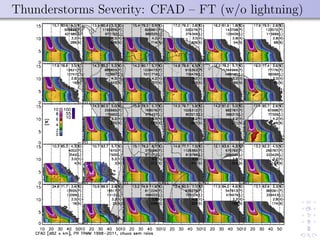
Thunderstorms Severity: CFAD – FT (w/o lightning)
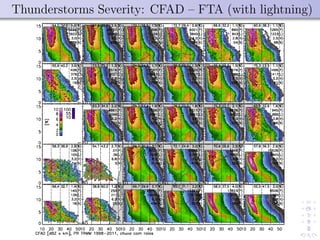
Thunderstorms Severity: CFAD – FTA (with lightning)
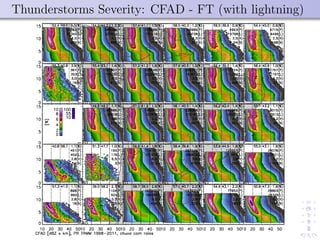
Thunderstorms Severity: CFAD - FT (with lightning)
Thunderstorms Severity: CFADs
FTA pixels are taller than FT.
FTA pixels have higher Zc values than FT, especially above 5 km.
Thunderstorms Severity: temperature dependency
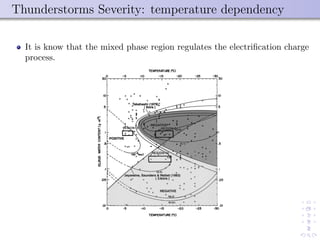
It is know that the mixed phase region regulates the electrification charge
process.
Thunderstorms Severity: temperature dependency
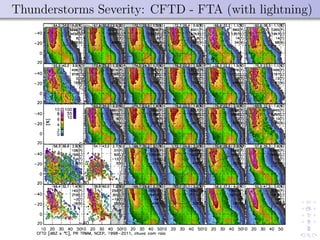
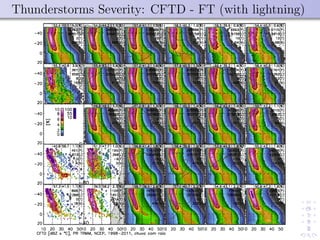
As a consequence, we converted the PR altitude levels into temperature
levels based on RII reanalysis.
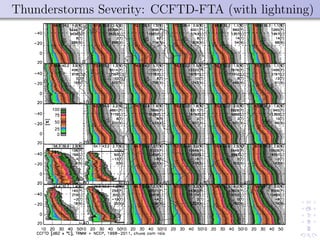
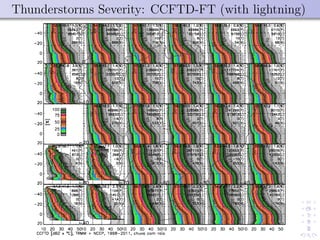
Now we created the Contoured Frequency by Temperature Diagram
(CFTD) in addition to the cumulative CFTD (CCFTD).
Thunderstorms Severity: CFTD - FTA (with lightning)
Thunderstorms Severity: CFTD - FT (with lightning)
Thunderstorms Severity: CCFTD-FTA (with lightning)
Thunderstorms Severity: CCFTD-FT (with lightning)
Thunderstorms Severity: Rate of Zc change with
temperature
Above 0◦
C we might have ice and supercooled water droplets.
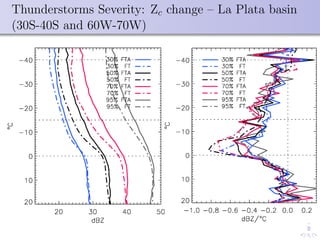
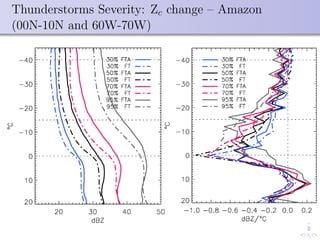
The rate of change of Zc with temperature might give an idea about of
extend of mixed phase layer.
We computed this rate for 30%, 50%, 70% and 95%.
We compare tropical versus sub-tropical regions (Amazon × La Plata
basin)
Thunderstorms Severity: Zc change – La Plata basin
(30S-40S and 60W-70W)
Thunderstorms Severity: Zc change – Amazon
(00N-10N and 60W-70W)
Thunderstorms Severity: identifying the efficient and
severe regions
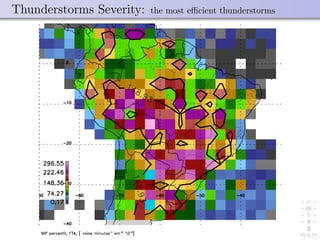
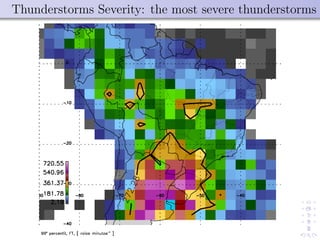
For each grid box with 2.5◦
× 2.5◦
we obtained the FTA and FT pdf.
For each grid box, we extracted the 99th percentile value.
Based on 99th percentile FTA and FT values, we build a spatial
distribution map that show where are the most efficient (FTA) and severe
(FT).
Thunderstorms Severity: the most efficient thunderstorms
Thunderstorms Severity: the most severe thunderstorms
Thunderstorms Severity: where are the most efficient
and severe thunderstorms
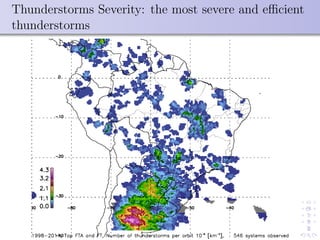
Find the thunderstorms that have FTA and FT above 90th percentile.
Compute the geographical densities of these thunderstorms (normalized by
TRMM overpasses).
Thunderstorms Severity: the most severe and efficient
thunderstorms
Conclusions
This study characterized the severe thunderstorms over South America by
employing 14 years of TRMM measurements.
The thunderstorms were characterized by integrating TRMM LIS, PR and
VIRS measurements.
A total of 157,592 electrified clouds have been observed in South America
(40S-10N and 90W-30W).
For the severe thunderstorms database, only 94,733 thunderstorms were
used. Those thunderstorms had LIS view time greater and equal to 60
seconds and at least one valid PR raining pixel .
The onset of the thunderstorms
Diurnal cycle:
40% of thunderstorm occurred between 13h–17h
(LT)
In the ocean, we found one maximum at 20h (LT)
and another between 4–5 (LT)
The nocturnal peak of thunderstorms were found in
extreme North of Andes Mountains (Paramillo
National Natural Park, Maracaibo lake). 630
systems where observed in 14 years, only between 0h
e 00:59h
The thunderstorms were more frequent in center of
South America (10◦
–0◦
S and 70◦
–50◦
W and
20◦
–10◦
S and 60◦
–50◦
W), between 14h–16h (LT).
Onset:
Annual cycle:
Thunderstorms season in South America was
between October and March with two peaks:
January and October.
Northeast of South America (0◦
–10◦
N and 70◦
–50◦
W) the peak of thunderstorm was found in August.
In South of South America (40◦
–20◦
S and 70◦
–60◦
W, Plata basin) was found a shorter thunderstorm
season with 2 months.
The longer season was found in Colombia and West
of Venezuela with 9 months.
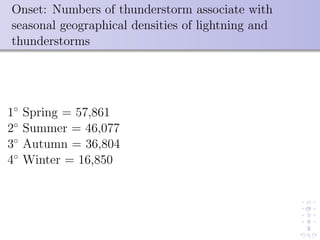
Onset: Numbers of thunderstorm associate with
seasonal geographical densities of lightning and
thunderstorms
1◦
Spring = 57,861
2◦
Summer = 46,077
3◦
Autumn = 36,804
4◦
Winter = 16,850
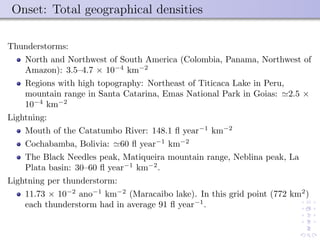
Onset: Total geographical densities
Thunderstorms:
North and Northwest of South America (Colombia, Panama, Northwest of
Amazon): 3.5–4.7 × 10⁻⁴
km−2
Regions with high topography: Northeast of Titicaca Lake in Peru,
mountain range in Santa Catarina, Emas National Park in Goias: 2.5 ×
10−4
km−2
Lightning:
Mouth of the Catatumbo River: 148.1 fl year−1
km−2
Cochabamba, Bolivia: 60 fl year−1
km−2
The Black Needles peak, Matiqueira mountain range, Neblina peak, La
Plata basin: 30–60 fl year−1
km−2
.
Lightning per thunderstorm:
11.73 × 10⁻²
ano−1
km−2
(Maracaibo lake). In this grid point (772 km2
)
each thunderstorm had in average 91 fl year−1
.
Severity of Thunderstorms in South America
Two groups of severe systems are found:
FTA 29.3 to 1,258.7 × 10−4
fl min−1
km−2
FT 47.2 to 1,283.6 fl min−1
(above category 3 of Cecil et al. [2005] and
Zipser et al. [2006])
Cloud top Tb: FTA thunderstorms are 10 K colder than FT
thunderstorms
Convective × Stratiform rain fraction: FTA thunderstorms have 72%
of convective rain fraction and 32% stratiform and FT systems 22%
convective and 65% stratiform.
Lightning × non Lightning pixels (CFAD): profiles with lightning
pixels have higher Zc values, and are taller. In the layer between 5 and 7
km height, the Zc difference can reach 5 to 10 dBZ. At lower levels
(2–3km) Zc is above 50 dBZ compared to 40 dBZ for non-lightning pixels;
Lightning pixels (CFAD): FTA thunderstorms show 1-3 dBZ higher Zc
values than FT systems, specially above 5 km height;
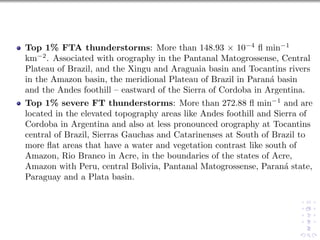
Top 1% FTA thunderstorms: More than 148.93 × 10⁻⁴
fl min−1
km−2
. Associated with orography in the Pantanal Matogrossense, Central
Plateau of Brazil, and the Xingu and Araguaia basin and Tocantins rivers
in the Amazon basin, the meridional Plateau of Brazil in Paran´a basin
and the Andes foothill – eastward of the Sierra of Cordoba in Argentina.
Top 1% severe FT thunderstorms: More than 272.88 fl min−1
and are
located in the elevated topography areas like Andes foothill and Sierra of
Cordoba in Argentina and also at less pronounced orography at Tocantins
central of Brazil, Sierras Gauchas and Catarinenses at South of Brazil to
more flat areas that have a water and vegetation contrast like south of
Amazon, Rio Branco in Acre, in the boundaries of the states of Acre,
Amazon with Peru, central Bolivia, Pantanal Matogrossense, Paran´a state,
Paraguay and a Plata basin.
Severity: Temperature dependence – CFTD
Zc distribution: FTA thunderstorms show broader Zc distribution than
FT systems for the same temperature level, specially above 0◦
C and they
have 1–3 dBZ higher Zc values;
Latitudinal variation: FT thunderstorm show an enhancement of the
collision-coalescence process towards the sub-tropics.
Zc change: the maximum Zc decrease with temperature for FTA(FT)
thunderstorms is at -2◦
C (0◦
C) and -12◦
C(-8◦
C) for 50% and 95%
levels profiles respectively in the Amazon and -6◦
C(-2◦
C) and -14◦
C (-6◦
C) for 50% and 95% respectively for the La Plata Basin.
ACKNOWLEDGEMENTS
This work is part of PhD project that is supported by CNPq grant
140842/2011-0.
This work is partially supported by CAPES PROEX program and
COELCE.
I would like to thank MSFCNASA for providing LIS data set and
GSFCNASA for providing TRMM dataset.
Finally I would like to thank Dra. Rachel Albrecht for the LIS lightning
and view time reprocessed dataset.

defesaEvandro

  • 1.
    Morfologia das tempestadesel´etricas na Am´erica do Sul Evandro M. Anselmo Institute of Astronomy, Geophysics and Atmospheric Science of University of S˜ao Paulo (IAG-USP), S˜ao Paulo-SP, Brazil. IAG/USP – 2015
  • 2.
    Introduction South America isone of the 3 lightning chimes (http://thunder.msfc.nasa.gov/data/)
  • 3.
    Introduction Infrastructure planning requiresknowledge about thunderstorm position, frequency and lightning efficient production
  • 4.
    Objectives Create a thunderstormdatabase based on TRMM measurements Determine the annual cycle and diurnal cycle of thunderstorms in South America Determine the geographical distribution of lightning flashes and thunderstorms Evaluate the thunderstorms severity.
  • 5.
    Tropical Rainfall MeasuringMission – TRMM Launched in November 28th, 1997. Orbit with inclination of 35◦ and altitude of 350 km (August, 2011, the altitude was change for 402.5 km) Sensors: Precipitation Radar – PR, TRMM Microwave Imager – TMI, Visible and Infrared Scanner – VIRS, Lightning Imaging Sensor – LIS, Clouds and the Earth’s Radiant Energy System – CERES. Goal: Estimate rainfall over the tropics and subsequently latent heat flux1 1KUMMEROW, C.; BARNES, W.; KOZU, T.; SHIUE, J.; SIMPSON, J. The tropical rainfall measuring mission (TRMM) sensor package. J. Atmos. Oceanic Technol., v. 15, p. 809–817, 1998
  • 6.
  • 7.
    Tropical Rainfall MeasuringMission – TRMM TRMM overpasses
  • 8.
    Tropical Rainfall MeasuringMission – TRMM LIS processing
  • 9.
    Data and Methodology TRMM: TRMMorbital v7 files: LIS, VIRS (1B01), and PR (2A25), between 1998–2011 ( 30TB of data). During this period we had 79,932 TRMM orbits, but only 63,613 were over South America (SA) 40◦ S–10◦ N and 90◦ –30◦ W. NCEP RII: NCEP RII reanalysis from 1998-2011: geopotential height and temperature at 17 pressure levels. This data is used to convert TRMM PR altitudes levels in temperature. Defining thunderstorms: Thunderstorms have been defined as clouds with brightness temperature below 258 K at the 1B01 10.8 µm channel and had at least one LIS lightning flash [Morales and Anagnostou, 2003]2 . 2Morales, C. A., and E. N. Anagnostou, Extending the capabilities of high-frequency rainfall estimation from geostationary-based satellite infrared via a network of long-range lightning observations, J. Hydrometeor, 4, 141–159, 2003.
  • 10.
    TRMM’s thunderstorms (flowchart) Locate thunderstorms clusters (Tb ≤ 258 K and at least one flash) VIRS (1B01) channel 4 (10.8 µm) LIS flash PR (2A25): Ze, sur- face rain, rain type (2A23), geolocation LIS: flashes, events, groups, view time, geolocation VIRS (1B01): chan- nel 4, geolocation Write the TRMM thun- derstorm HDF file read read read
  • 11.
    TRMM’s thunderstorms 157,592 thunderstormswere found! Only 94,733 had view time (V Tm) greater than 1 minute and with at least one PR pixel with valid rain.
  • 12.
    The onset ofthe South American thunderstorms Where the thunderstorms are more often in SA? Where are the places with high lightning densities that corresponds with the highest density of thunderstorms? How long does the thunderstorm season last in SA?
  • 13.
    Onset: TRMM overpassesand LIS view time (LIS view – VTlis) (VIRS overpasses – VTvirs)
  • 14.
    Onset: LIS lightningflashes and number of thunderstorms (lightning – FLlis) (thunderstorms – Pte)
  • 15.
    Onset: Defining densitiesratios lightning [km−2 year−1 ] DEfl = FLlis VTlisAg 31557600 (1) thunderstorms per orbit [km−2 ] DEte = Pte VTvirsAg (2) lightning per thunderstorms [km−2 year−1 ] DErt = FLlis VTlisAgPte 31557600 (3)
  • 16.
    Where the thunderstormsare more often in SA?
  • 17.
    Onset: lightning ×thunderstorms – Annual
  • 18.
    Onset: lightning ×thunderstorms – SON
  • 19.
    Onset: lightning ×thunderstorms – DJF
  • 20.
    Onset: lightning ×thunderstorms – MAM
  • 21.
    Onset: lightning ×thunderstorms – JJA
  • 22.
    Where are theplaces with high lightning densities that corresponds with the highest density of thunderstorms?
  • 23.
    Onset: lightning perthunderstorms – Annual
  • 24.
    How long doesthe thunderstorm season last in SA?
  • 25.
    Onset: Diurnal andAnnual Cycle
  • 26.
  • 27.
  • 28.
  • 29.
    Thunderstorms Severity: Definingseverity index Flash rate (FT) is defined as the ratio of number of lightning flashes (Nfl) by the mean view time (V Tm) in the thunderstorm area extracted. FT = Nfl V Tm 60 [min−1 ] (4) Flash rate normalized by thunderstorm area (FTA) is defined as the ratio of number of lightning flashes (Nfl) by the mean view time (V Tm) and thunderstorm area (At). FTA = Nfl V TmAt 60 [min−1 km−2 ] (5)
  • 30.
    Thunderstorms Severity: FTAand FT pdf distribution
  • 31.
    Thunderstorms Severity: definingthe extreme FTA and FT thunderstorms Extreme: 90th percentile FTA: 29.3 to 1,258.7 × 10−4 fl min−1 km−2 FT: 47.2 to 1,283.6 fl min−1
  • 32.
    Thunderstorms Severity: Rainand CV/ST fraction Thunderstorms with extreme FTA: rain areas Thunderstorms with extreme FT: rain areas
  • 33.
  • 34.
  • 35.
    Thunderstorms Severity: CFAD– FTA (w/o lightning)
  • 36.
    Thunderstorms Severity: CFAD– FT (w/o lightning)
  • 37.
    Thunderstorms Severity: CFAD– FTA (with lightning)
  • 38.
    Thunderstorms Severity: CFAD- FT (with lightning)
  • 39.
    Thunderstorms Severity: CFADs FTApixels are taller than FT. FTA pixels have higher Zc values than FT, especially above 5 km.
  • 40.
    Thunderstorms Severity: temperaturedependency It is know that the mixed phase region regulates the electrification charge process.
  • 41.
    Thunderstorms Severity: temperaturedependency As a consequence, we converted the PR altitude levels into temperature levels based on RII reanalysis. Now we created the Contoured Frequency by Temperature Diagram (CFTD) in addition to the cumulative CFTD (CCFTD).
  • 42.
    Thunderstorms Severity: CFTD- FTA (with lightning)
  • 43.
    Thunderstorms Severity: CFTD- FT (with lightning)
  • 44.
  • 45.
  • 46.
    Thunderstorms Severity: Rateof Zc change with temperature Above 0◦ C we might have ice and supercooled water droplets. The rate of change of Zc with temperature might give an idea about of extend of mixed phase layer. We computed this rate for 30%, 50%, 70% and 95%. We compare tropical versus sub-tropical regions (Amazon × La Plata basin)
  • 47.
    Thunderstorms Severity: Zcchange – La Plata basin (30S-40S and 60W-70W)
  • 48.
    Thunderstorms Severity: Zcchange – Amazon (00N-10N and 60W-70W)
  • 49.
    Thunderstorms Severity: identifyingthe efficient and severe regions For each grid box with 2.5◦ × 2.5◦ we obtained the FTA and FT pdf. For each grid box, we extracted the 99th percentile value. Based on 99th percentile FTA and FT values, we build a spatial distribution map that show where are the most efficient (FTA) and severe (FT).
  • 50.
    Thunderstorms Severity: themost efficient thunderstorms
  • 51.
    Thunderstorms Severity: themost severe thunderstorms
  • 52.
    Thunderstorms Severity: whereare the most efficient and severe thunderstorms Find the thunderstorms that have FTA and FT above 90th percentile. Compute the geographical densities of these thunderstorms (normalized by TRMM overpasses).
  • 53.
    Thunderstorms Severity: themost severe and efficient thunderstorms
  • 54.
    Conclusions This study characterizedthe severe thunderstorms over South America by employing 14 years of TRMM measurements. The thunderstorms were characterized by integrating TRMM LIS, PR and VIRS measurements. A total of 157,592 electrified clouds have been observed in South America (40S-10N and 90W-30W). For the severe thunderstorms database, only 94,733 thunderstorms were used. Those thunderstorms had LIS view time greater and equal to 60 seconds and at least one valid PR raining pixel .
  • 55.
    The onset ofthe thunderstorms Diurnal cycle: 40% of thunderstorm occurred between 13h–17h (LT) In the ocean, we found one maximum at 20h (LT) and another between 4–5 (LT) The nocturnal peak of thunderstorms were found in extreme North of Andes Mountains (Paramillo National Natural Park, Maracaibo lake). 630 systems where observed in 14 years, only between 0h e 00:59h The thunderstorms were more frequent in center of South America (10◦ –0◦ S and 70◦ –50◦ W and 20◦ –10◦ S and 60◦ –50◦ W), between 14h–16h (LT).
  • 56.
    Onset: Annual cycle: Thunderstorms seasonin South America was between October and March with two peaks: January and October. Northeast of South America (0◦ –10◦ N and 70◦ –50◦ W) the peak of thunderstorm was found in August. In South of South America (40◦ –20◦ S and 70◦ –60◦ W, Plata basin) was found a shorter thunderstorm season with 2 months. The longer season was found in Colombia and West of Venezuela with 9 months.
  • 57.
    Onset: Numbers ofthunderstorm associate with seasonal geographical densities of lightning and thunderstorms 1◦ Spring = 57,861 2◦ Summer = 46,077 3◦ Autumn = 36,804 4◦ Winter = 16,850
  • 58.
    Onset: Total geographicaldensities Thunderstorms: North and Northwest of South America (Colombia, Panama, Northwest of Amazon): 3.5–4.7 × 10⁻⁴ km−2 Regions with high topography: Northeast of Titicaca Lake in Peru, mountain range in Santa Catarina, Emas National Park in Goias: 2.5 × 10⁻⁴ km−2 Lightning: Mouth of the Catatumbo River: 148.1 fl year−1 km−2 Cochabamba, Bolivia: 60 fl year−1 km−2 The Black Needles peak, Matiqueira mountain range, Neblina peak, La Plata basin: 30–60 fl year−1 km−2 . Lightning per thunderstorm: 11.73 × 10⁻² ano−1 km−2 (Maracaibo lake). In this grid point (772 km2 ) each thunderstorm had in average 91 fl year−1 .
  • 59.
    Severity of Thunderstormsin South America Two groups of severe systems are found: FTA 29.3 to 1,258.7 × 10−4 fl min−1 km−2 FT 47.2 to 1,283.6 fl min−1 (above category 3 of Cecil et al. [2005] and Zipser et al. [2006]) Cloud top Tb: FTA thunderstorms are 10 K colder than FT thunderstorms Convective × Stratiform rain fraction: FTA thunderstorms have 72% of convective rain fraction and 32% stratiform and FT systems 22% convective and 65% stratiform. Lightning × non Lightning pixels (CFAD): profiles with lightning pixels have higher Zc values, and are taller. In the layer between 5 and 7 km height, the Zc difference can reach 5 to 10 dBZ. At lower levels (2–3km) Zc is above 50 dBZ compared to 40 dBZ for non-lightning pixels; Lightning pixels (CFAD): FTA thunderstorms show 1-3 dBZ higher Zc values than FT systems, specially above 5 km height;
  • 60.
    Top 1% FTAthunderstorms: More than 148.93 × 10⁻⁴ fl min−1 km−2 . Associated with orography in the Pantanal Matogrossense, Central Plateau of Brazil, and the Xingu and Araguaia basin and Tocantins rivers in the Amazon basin, the meridional Plateau of Brazil in Paran´a basin and the Andes foothill – eastward of the Sierra of Cordoba in Argentina. Top 1% severe FT thunderstorms: More than 272.88 fl min−1 and are located in the elevated topography areas like Andes foothill and Sierra of Cordoba in Argentina and also at less pronounced orography at Tocantins central of Brazil, Sierras Gauchas and Catarinenses at South of Brazil to more flat areas that have a water and vegetation contrast like south of Amazon, Rio Branco in Acre, in the boundaries of the states of Acre, Amazon with Peru, central Bolivia, Pantanal Matogrossense, Paran´a state, Paraguay and a Plata basin.
  • 61.
    Severity: Temperature dependence– CFTD Zc distribution: FTA thunderstorms show broader Zc distribution than FT systems for the same temperature level, specially above 0◦ C and they have 1–3 dBZ higher Zc values; Latitudinal variation: FT thunderstorm show an enhancement of the collision-coalescence process towards the sub-tropics. Zc change: the maximum Zc decrease with temperature for FTA(FT) thunderstorms is at -2◦ C (0◦ C) and -12◦ C(-8◦ C) for 50% and 95% levels profiles respectively in the Amazon and -6◦ C(-2◦ C) and -14◦ C (-6◦ C) for 50% and 95% respectively for the La Plata Basin.
  • 62.
    ACKNOWLEDGEMENTS This work ispart of PhD project that is supported by CNPq grant 140842/2011-0. This work is partially supported by CAPES PROEX program and COELCE. I would like to thank MSFCNASA for providing LIS data set and GSFCNASA for providing TRMM dataset. Finally I would like to thank Dra. Rachel Albrecht for the LIS lightning and view time reprocessed dataset.