-Fair Comment, Consent and Apology


By Hariharan Kumar
   BA LLB Sec-B
    20120177
   A defamatory statement is
    one which tends to lower a
    person in the estimation of
    right-thinking members of
    society. -Lord Atkins

   In India, the existing law is a
    reasonable restriction on
    the fundamental right to
    speech and expression.
   Fair Comment

   Justification by Truth

   Consent

   Apology

   Privilege
   The right of fair comment and bona fide comment
    on a matter of public interest is a right which it is
    the duty of courts carefully to guard and literally to
    interpret.

   The Defence is known as ‘Honest Opinion’ in New
    Zealand, Australia and Ireland.

   Test laid down in the Telnikoff v Matusevich case.
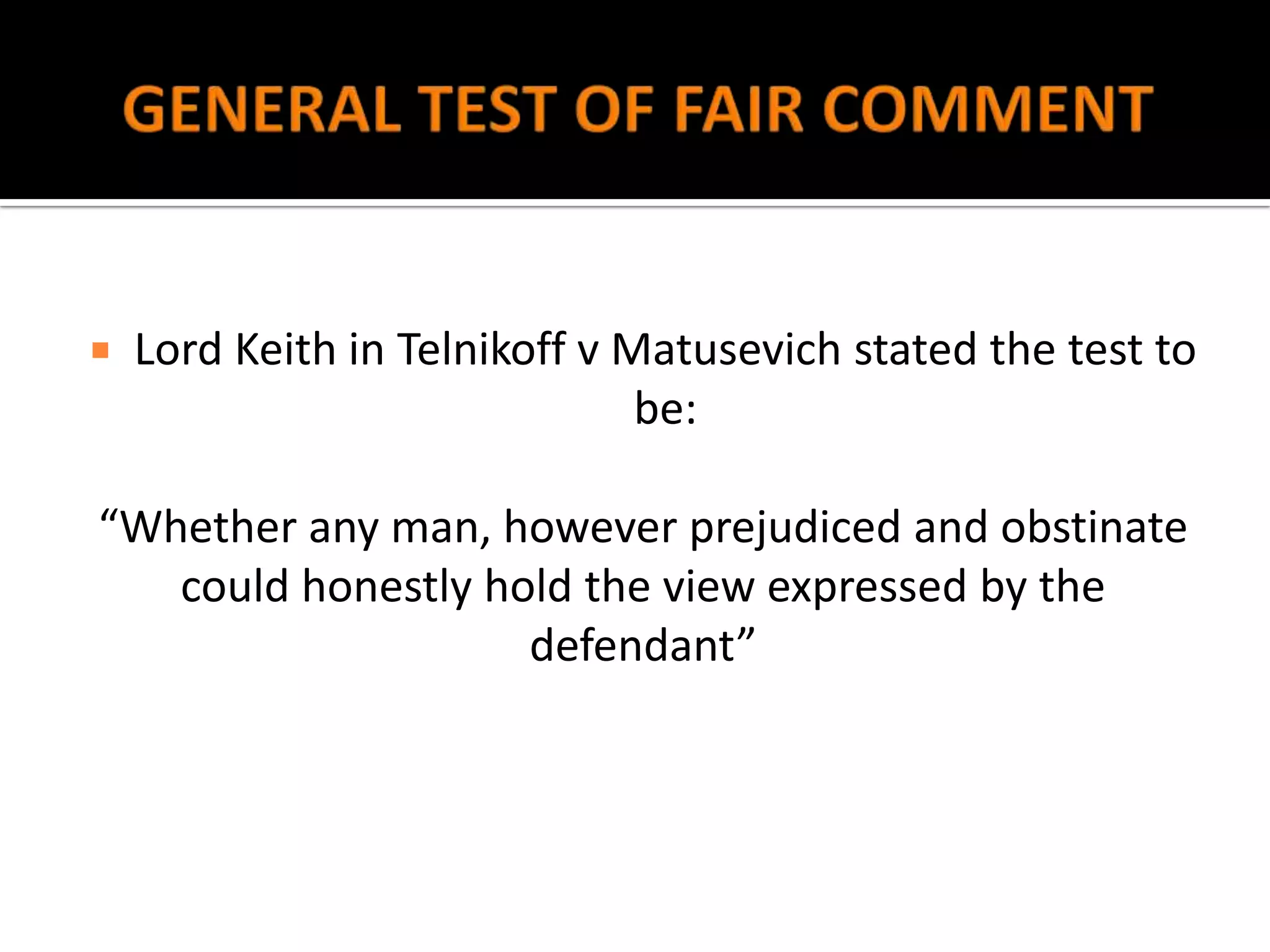
   Lord Keith in Telnikoff v Matusevich stated the test to
                               be:

“Whether any man, however prejudiced and obstinate
   could honestly hold the view expressed by the
                    defendant”
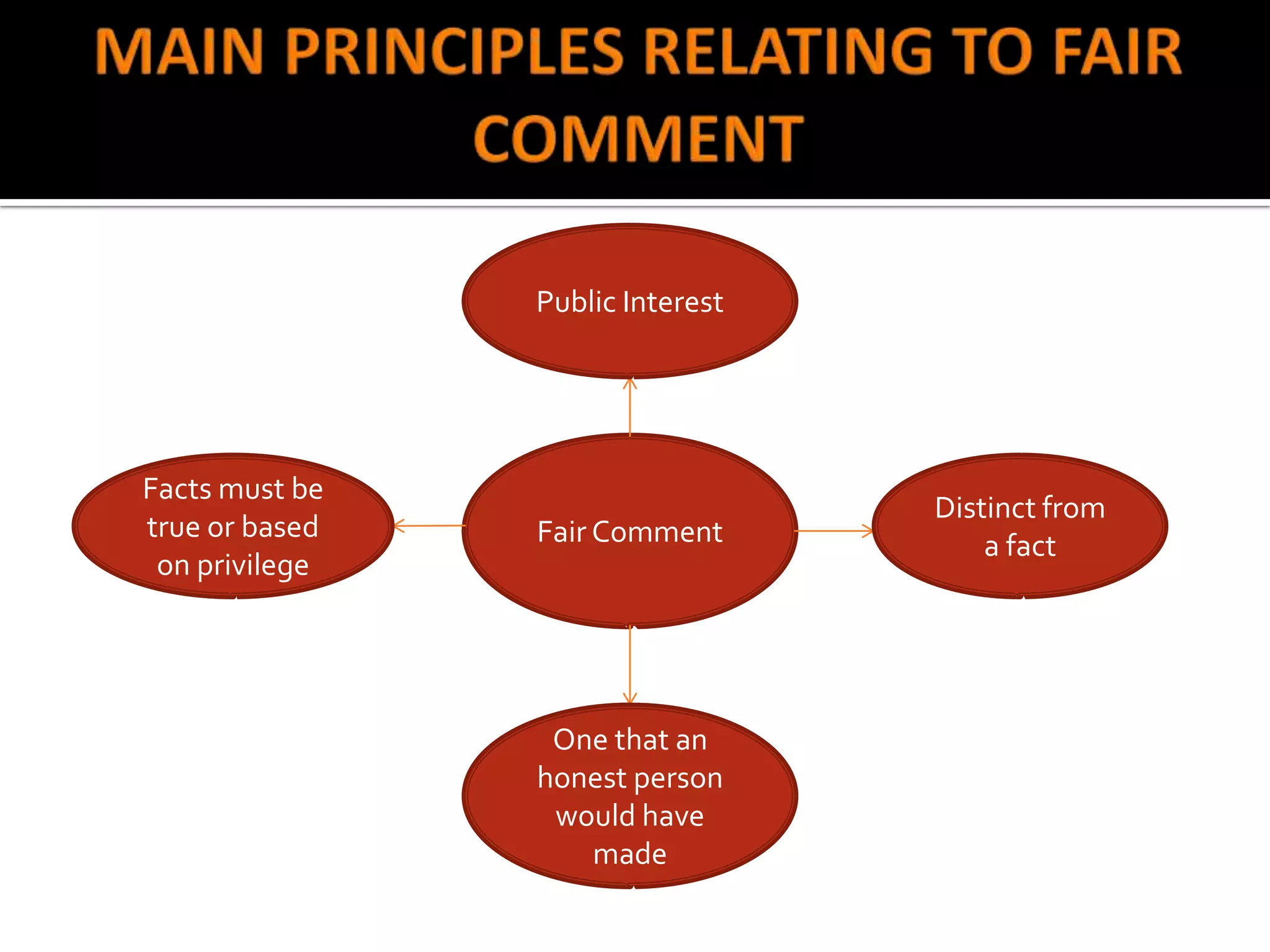
Public Interest


Facts must be
                                  Distinct from
true or based   Fair Comment          a fact
 on privilege


                 One that an
                honest person
                 would have
                   made
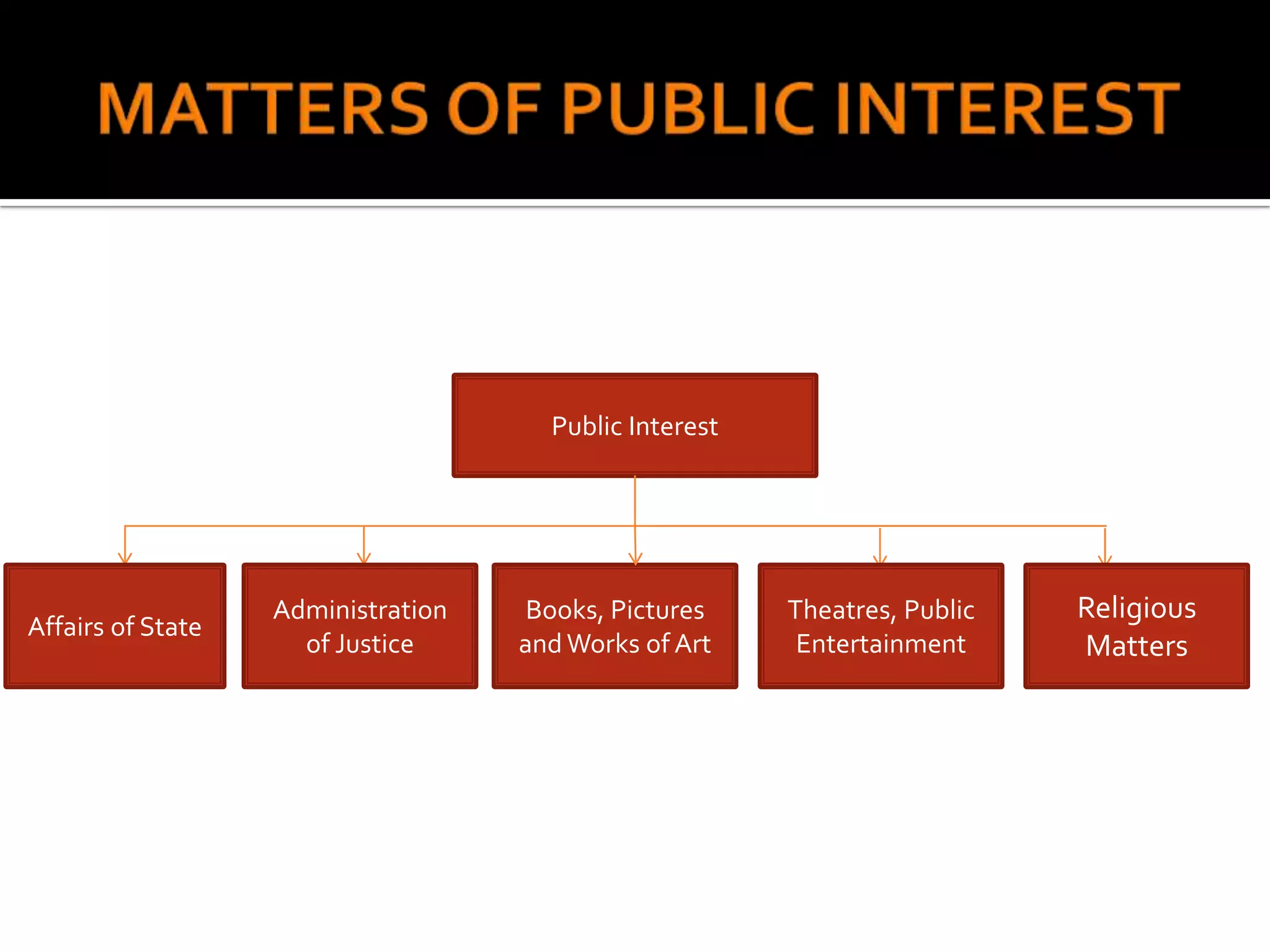
Public Interest


                   Administration    Books, Pictures    Theatres, Public   Religious
Affairs of State
                     of Justice     and Works of Art     Entertainment     Matters
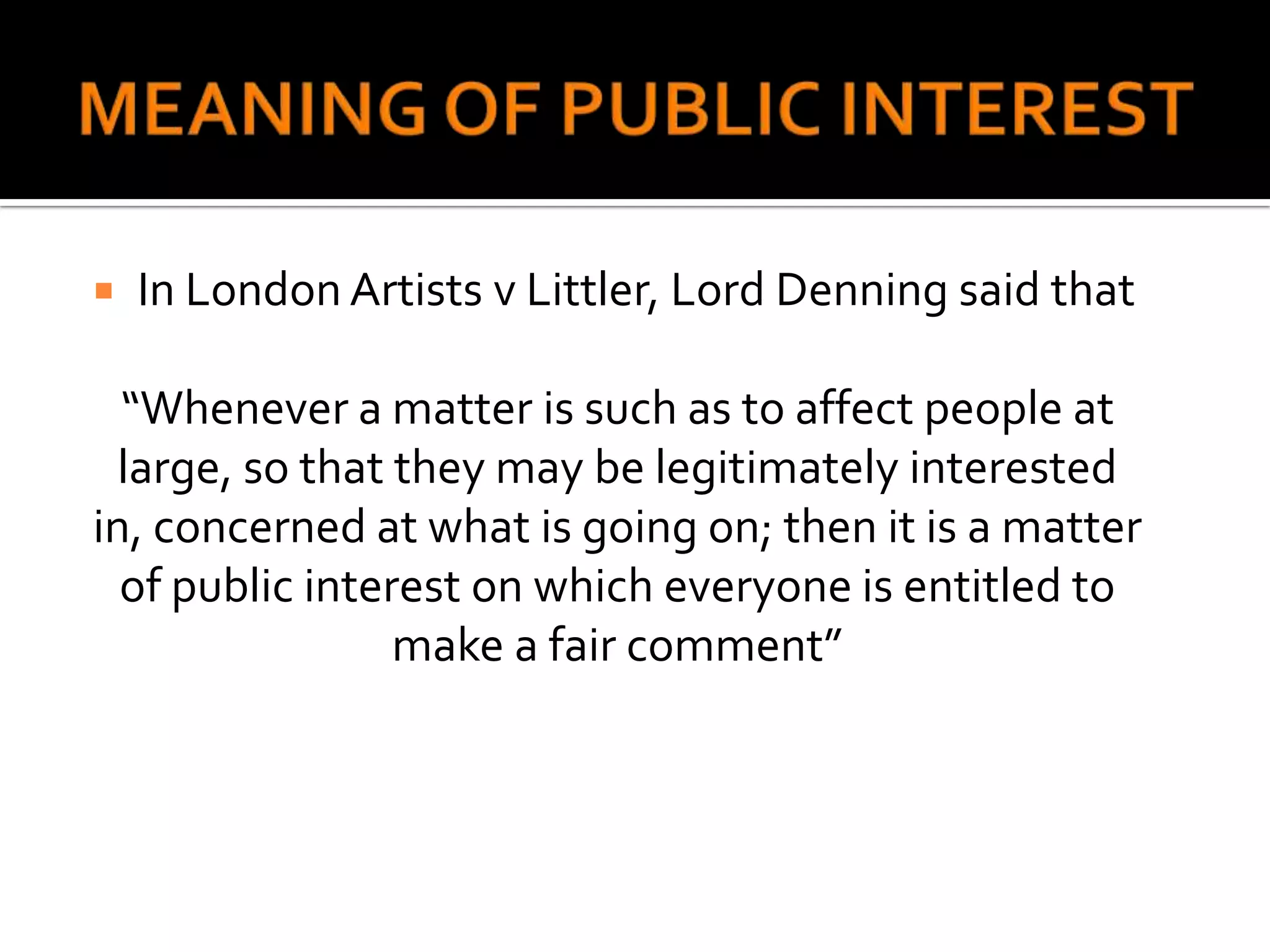
   In London Artists v Littler, Lord Denning said that

  “Whenever a matter is such as to affect people at
  large, so that they may be legitimately interested
in, concerned at what is going on; then it is a matter
  of public interest on which everyone is entitled to
                 make a fair comment”
   “A comment is taken to be something which can
    reasonably      be     inferred      to    be     a
    deduction, conclusion, criticism, judgment, remark
    or observation.”
                          - Cussen J in Clarke v Norton
   In Cohen v Daily Telegraph Ltd, Lord Denning
                     stated that:

      “In order to make good a plea of fair
 comment, the comment must be on the fact
existing at that time. No man can comment on
     facts which may happen in the future”
   A comment can be fair only if there is no malice
    in it

   The best test in relation to malice has been laid
    down by Lord Porter in Turner v Metro Goldwyn
    Mayer Pictures. It is as follows:

 “Would any honest man, however prejudiced he
might be, or however exaggerated or obstinate his
       views, have written this criticism?”
   When plaintiff consents to the publication of
    defamatory matter about him or her, then this
    consent is a complete defence to a defamatory
    action.

   Consent to a defamatory statement would
    relinquish all rights to claim damages.
   The defence of apology
    is provided by the Libel
    Act, 1843 and
    Defamation Act, 1952.

   This defence must be
    accompanied by a
    payment of money into
    the Court.
   Bell v Northern Constitution Ltd.

  Andrews CJ held that it was gross negligence for a
 newspaper to publish the announcement of a birth
without making any inquiry as to the authenticity of a
          notice received by telephone.
Thank You. Questions are welcome.


               W

Defences to defamation ppt

  • 1.
    -Fair Comment, Consentand Apology By Hariharan Kumar BA LLB Sec-B 20120177
  • 2.
    A defamatory statement is one which tends to lower a person in the estimation of right-thinking members of society. -Lord Atkins  In India, the existing law is a reasonable restriction on the fundamental right to speech and expression.
  • 3.
    Fair Comment  Justification by Truth  Consent  Apology  Privilege
  • 4.
    The right of fair comment and bona fide comment on a matter of public interest is a right which it is the duty of courts carefully to guard and literally to interpret.  The Defence is known as ‘Honest Opinion’ in New Zealand, Australia and Ireland.  Test laid down in the Telnikoff v Matusevich case.
  • 5.
    Lord Keith in Telnikoff v Matusevich stated the test to be: “Whether any man, however prejudiced and obstinate could honestly hold the view expressed by the defendant”
  • 6.
    Public Interest Facts mustbe Distinct from true or based Fair Comment a fact on privilege One that an honest person would have made
  • 7.
    Public Interest Administration Books, Pictures Theatres, Public Religious Affairs of State of Justice and Works of Art Entertainment Matters
  • 8.
    In London Artists v Littler, Lord Denning said that “Whenever a matter is such as to affect people at large, so that they may be legitimately interested in, concerned at what is going on; then it is a matter of public interest on which everyone is entitled to make a fair comment”
  • 9.
    “A comment is taken to be something which can reasonably be inferred to be a deduction, conclusion, criticism, judgment, remark or observation.” - Cussen J in Clarke v Norton
  • 10.
    In Cohen v Daily Telegraph Ltd, Lord Denning stated that: “In order to make good a plea of fair comment, the comment must be on the fact existing at that time. No man can comment on facts which may happen in the future”
  • 11.
    A comment can be fair only if there is no malice in it  The best test in relation to malice has been laid down by Lord Porter in Turner v Metro Goldwyn Mayer Pictures. It is as follows: “Would any honest man, however prejudiced he might be, or however exaggerated or obstinate his views, have written this criticism?”
  • 12.
    When plaintiff consents to the publication of defamatory matter about him or her, then this consent is a complete defence to a defamatory action.  Consent to a defamatory statement would relinquish all rights to claim damages.
  • 13.
    The defence of apology is provided by the Libel Act, 1843 and Defamation Act, 1952.  This defence must be accompanied by a payment of money into the Court.
  • 14.
    Bell v Northern Constitution Ltd. Andrews CJ held that it was gross negligence for a newspaper to publish the announcement of a birth without making any inquiry as to the authenticity of a notice received by telephone.
  • 15.
    Thank You. Questionsare welcome. W

Editor's Notes

  • #3 conferred by art 19(1) (a) of the Indian Constitution and is saved by cl (2) of art 19. SEERVAI, Constitutional Law of India, 3rd Edition, Vol I, p 495; S.N.M Abdi v Prafulla K Mahanta, AIR 2002 Gau 75, p. 76
  • #5 Opinion by Lord Keith of Kinkel“whether any man, however prejudiced and obstinate, could honestly hold the view expressed by the defendant”
  • #15 Andrews CJ held that it was gross negligence for a newspaper to publish the announcement of a birth without making any inquiry as to the authenticity of a notice received by telephone. The defendant in this case then tendered an apology to the plaintiff.