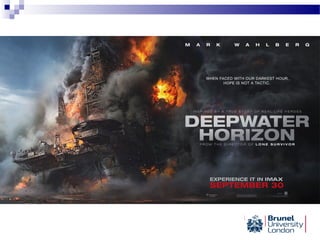
Deepwater Horizon
Disaster 2010
Shahbaz Sardar
1633648
Deepwater Horizon Disaster 2010
 On April 20, 2010 explosion and subsequent fire on
the Deepwater Horizon.
 Its was owned and operated by Transocean and were
drilling for BP in the Macondo Prospect oil field about
60 km southeast off the Louisiana coast.
 The explosion and subsequent fire resulted in the sinking
of the Deepwater Horizon and the deaths of 11 workers;
17 others were injured and also caused a
massive offshore oil spill.
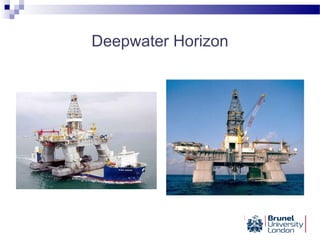
Deepwater Horizon
 Deepwater Horizon was an ultra-deep
water, dynamically positioned, semi-
submersible offshore drilling rig.
 Built in 2001 in South Korea by Hyundai Heavy
Industries.
 The rig owner, Transocean, had a "strong overall" safety
record with no major incidents for 7 years.
 Deepwater Horizon was a 5th
gen state of the art facility.
 In September 2009, the rig drilled the deepest oil well in
history at a vertical depth of 10,683 m and measured
depth of 10,685 m.
Blowout
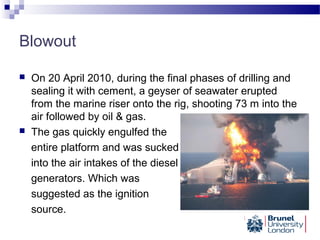
 On 20 April 2010, during the final phases of drilling and
sealing it with cement, a geyser of seawater erupted
from the marine riser onto the rig, shooting 73 m into the
air followed by oil & gas.
 The gas quickly engulfed the
entire platform and was sucked
into the air intakes of the diesel
generators. Which was
suggested as the ignition
source.
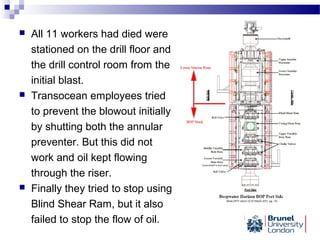
 All 11 workers had died were
stationed on the drill floor and
the drill control room from the
initial blast.
 Transocean employees tried
to prevent the blowout initially
by shutting both the annular
preventer. But this did not
work and oil kept flowing
through the riser.
 Finally they tried to stop using
Blind Shear Ram, but it also
failed to stop the flow of oil.
Oil Spill
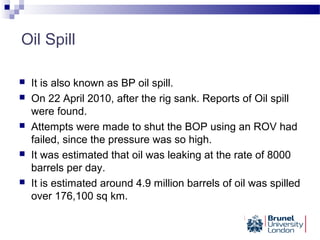
 It is also known as BP oil spill.
 On 22 April 2010, after the rig sank. Reports of Oil spill
were found.
 Attempts were made to shut the BOP using an ROV had
failed, since the pressure was so high.
 It was estimated that oil was leaking at the rate of 8000
barrels per day.
 It is estimated around 4.9 million barrels of oil was spilled
over 176,100 sq km.
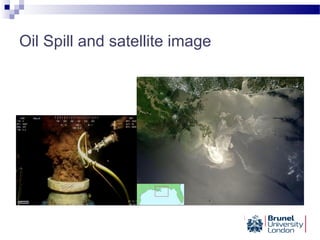
Oil Spill and satellite image
Investigation into explosion
 Small diameter hole obstructed dirt circulation.
 Valves to prevent cement backflow did not close.
 Cementing inadequate.
 Pressure test wrongly interpreted.
 Rising oil and gas not monitored.
 Fail-safe on seabed wellhead was unable to close.
Lawsuits
 On April 21, 2011, BP filed $40 billion worth of lawsuits
against rig owner Transocean, cementer Halliburton and
blowout-preventer manufacturer Cameron.
 The oil firm alleged that failed safety systems and
irresponsible behaviour of contractors had led to the
explosion, including claims that Halliburton "negligently"
failed to use cement-modelling software OptiCem
properly to analyse safe well requirements.
 In July 2015 BP cost for the clean-up, environmental and
economic damages and penalties has reached $54bn.
Deepwater horizon 2010

Deepwater horizon 2010

  • 1.
  • 2.
    Deepwater Horizon Disaster2010  On April 20, 2010 explosion and subsequent fire on the Deepwater Horizon.  Its was owned and operated by Transocean and were drilling for BP in the Macondo Prospect oil field about 60 km southeast off the Louisiana coast.  The explosion and subsequent fire resulted in the sinking of the Deepwater Horizon and the deaths of 11 workers; 17 others were injured and also caused a massive offshore oil spill.
  • 3.
  • 4.
     Deepwater Horizonwas an ultra-deep water, dynamically positioned, semi- submersible offshore drilling rig.  Built in 2001 in South Korea by Hyundai Heavy Industries.  The rig owner, Transocean, had a "strong overall" safety record with no major incidents for 7 years.  Deepwater Horizon was a 5th gen state of the art facility.  In September 2009, the rig drilled the deepest oil well in history at a vertical depth of 10,683 m and measured depth of 10,685 m.
  • 5.
    Blowout  On 20April 2010, during the final phases of drilling and sealing it with cement, a geyser of seawater erupted from the marine riser onto the rig, shooting 73 m into the air followed by oil & gas.  The gas quickly engulfed the entire platform and was sucked into the air intakes of the diesel generators. Which was suggested as the ignition source.
  • 6.
     All 11workers had died were stationed on the drill floor and the drill control room from the initial blast.  Transocean employees tried to prevent the blowout initially by shutting both the annular preventer. But this did not work and oil kept flowing through the riser.  Finally they tried to stop using Blind Shear Ram, but it also failed to stop the flow of oil.
  • 7.
    Oil Spill  Itis also known as BP oil spill.  On 22 April 2010, after the rig sank. Reports of Oil spill were found.  Attempts were made to shut the BOP using an ROV had failed, since the pressure was so high.  It was estimated that oil was leaking at the rate of 8000 barrels per day.  It is estimated around 4.9 million barrels of oil was spilled over 176,100 sq km.
  • 8.
    Oil Spill andsatellite image
  • 9.
    Investigation into explosion Small diameter hole obstructed dirt circulation.  Valves to prevent cement backflow did not close.  Cementing inadequate.  Pressure test wrongly interpreted.  Rising oil and gas not monitored.  Fail-safe on seabed wellhead was unable to close.
  • 10.
    Lawsuits  On April21, 2011, BP filed $40 billion worth of lawsuits against rig owner Transocean, cementer Halliburton and blowout-preventer manufacturer Cameron.  The oil firm alleged that failed safety systems and irresponsible behaviour of contractors had led to the explosion, including claims that Halliburton "negligently" failed to use cement-modelling software OptiCem properly to analyse safe well requirements.  In July 2015 BP cost for the clean-up, environmental and economic damages and penalties has reached $54bn.