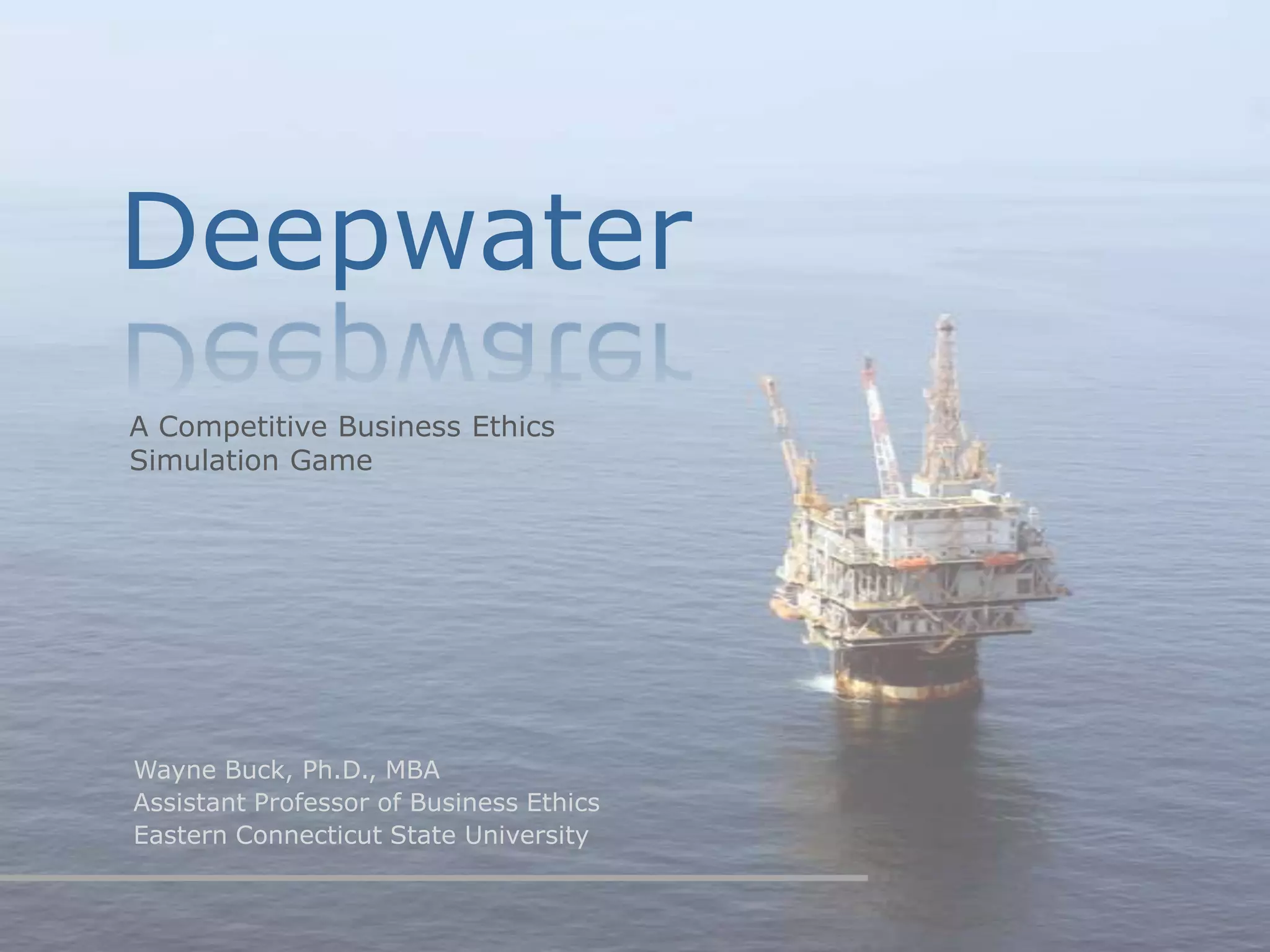
Deepwater
A Competitive Business Ethics
Simulation Game


Wayne Buck, Ph.D., MBA
Assistant Professor of Business Ethics
Eastern Connecticut State University
What is Deepwater?
A Competitive Simulation Game
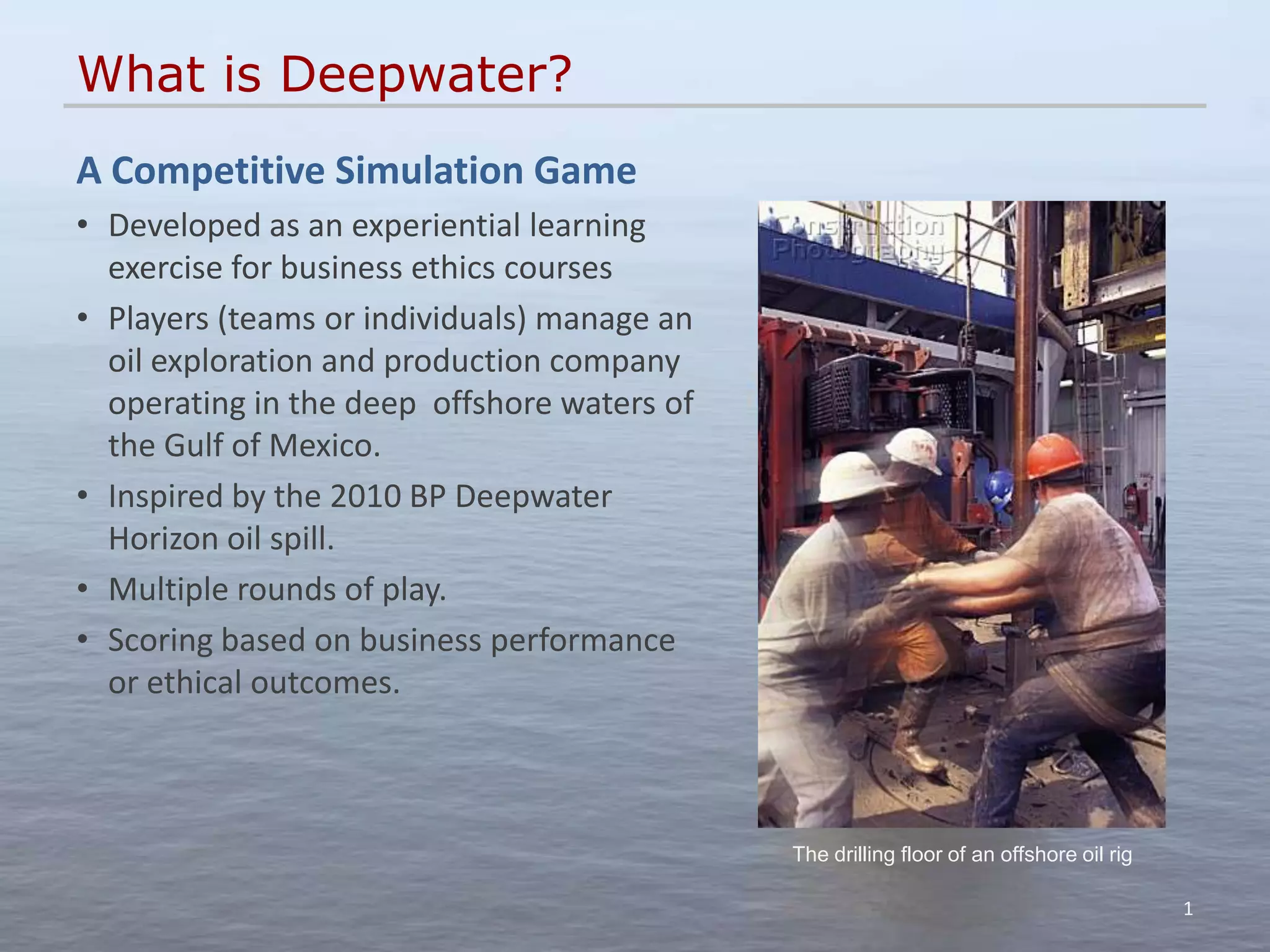
• Developed as an experiential learning
  exercise for business ethics courses
• Players (teams or individuals) manage an
  oil exploration and production company
  operating in the deep offshore waters of
  the Gulf of Mexico.
• Inspired by the 2010 BP Deepwater
  Horizon oil spill.
• Multiple rounds of play.
• Scoring based on business performance
  or ethical outcomes.


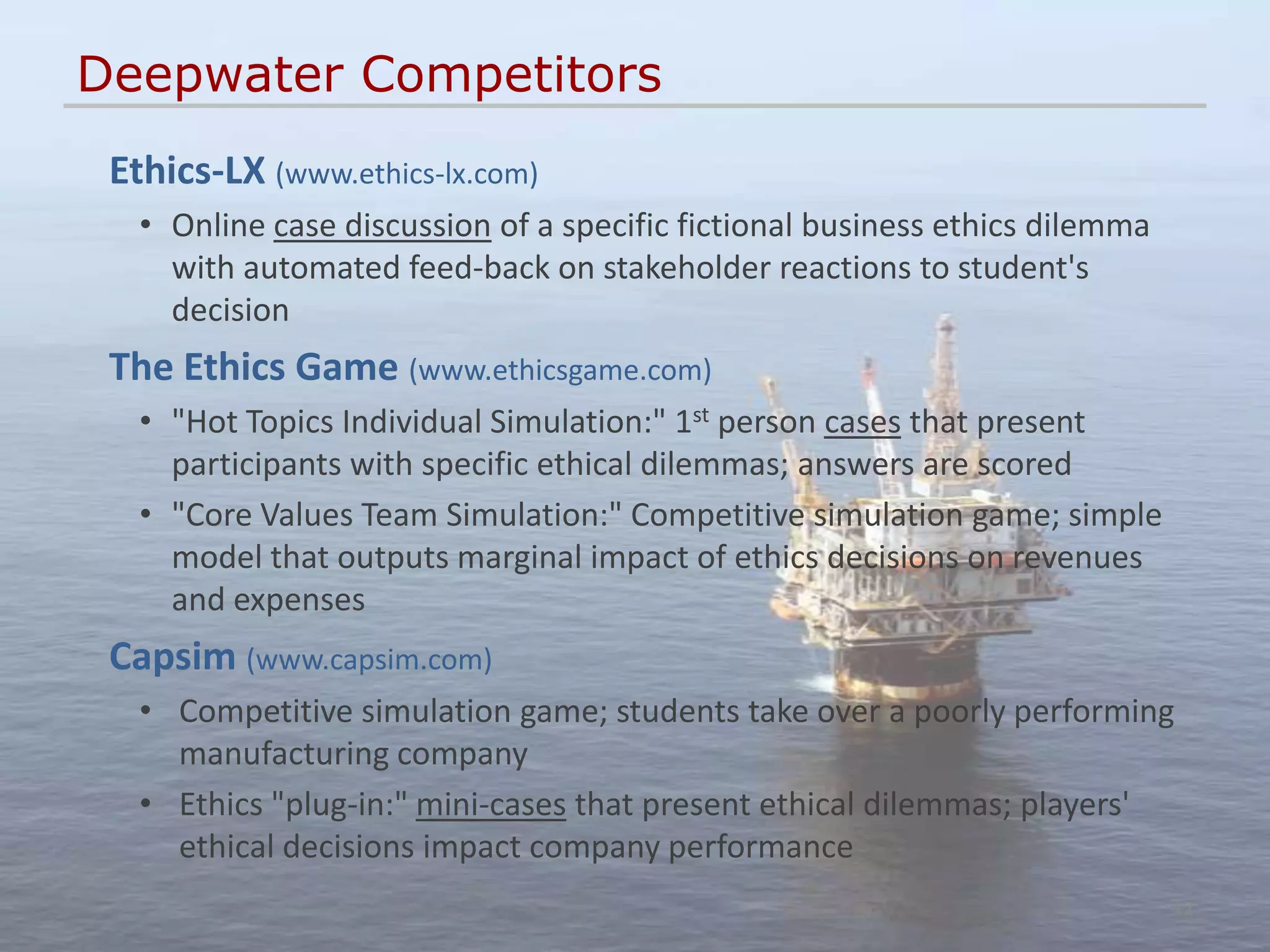
                                             The drilling floor of an offshore oil rig

                                                                                         1
What is Deepwater?
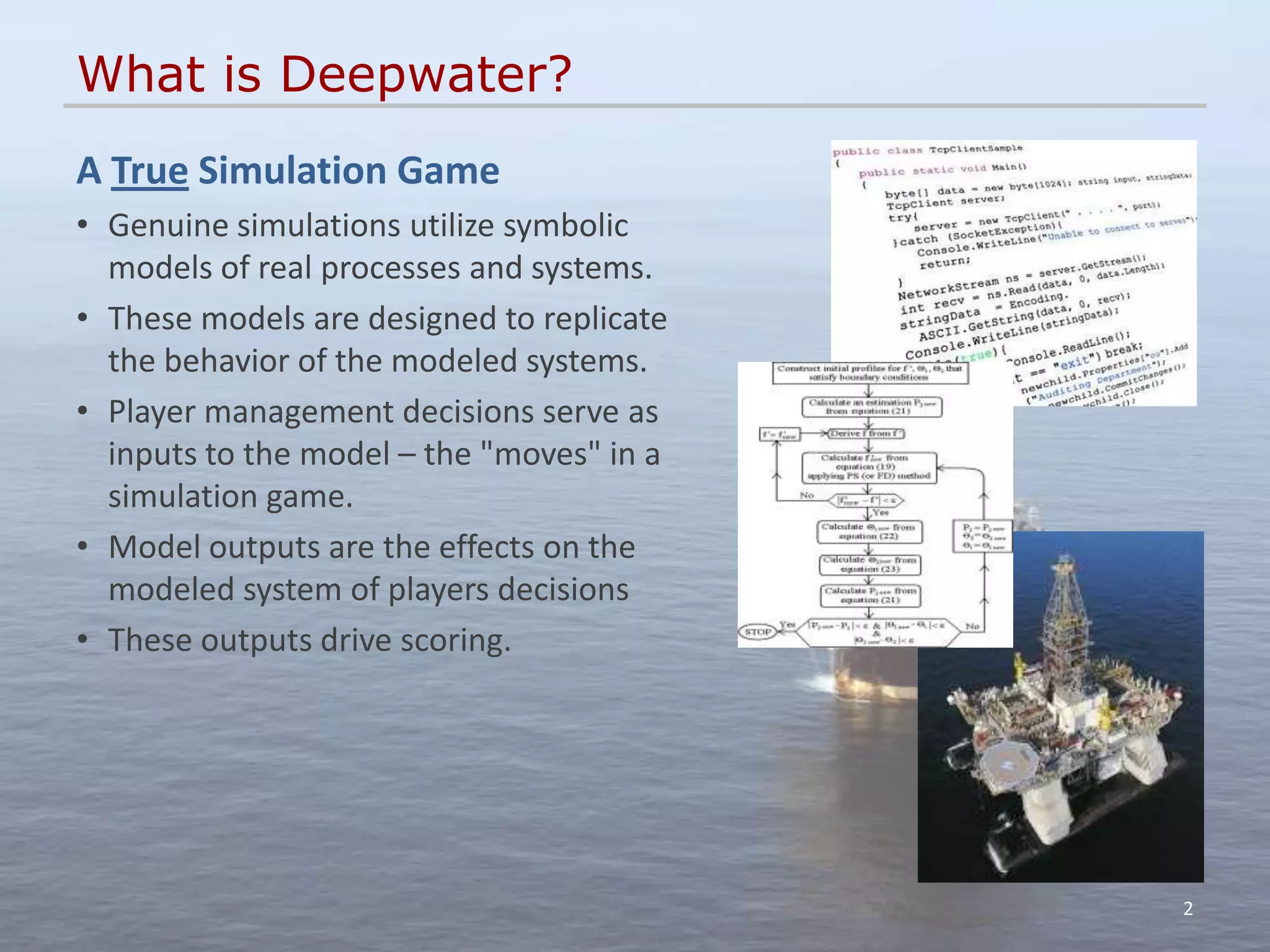
A True Simulation Game
• Genuine simulations utilize symbolic
  models of real processes and systems.
• These models are designed to replicate
  the behavior of the modeled systems.
• Player management decisions serve as
  inputs to the model – the "moves" in a
  simulation game.
• Model outputs are the effects on the
  modeled system of players decisions
• These outputs drive scoring.


                                           2
What is Deepwater?
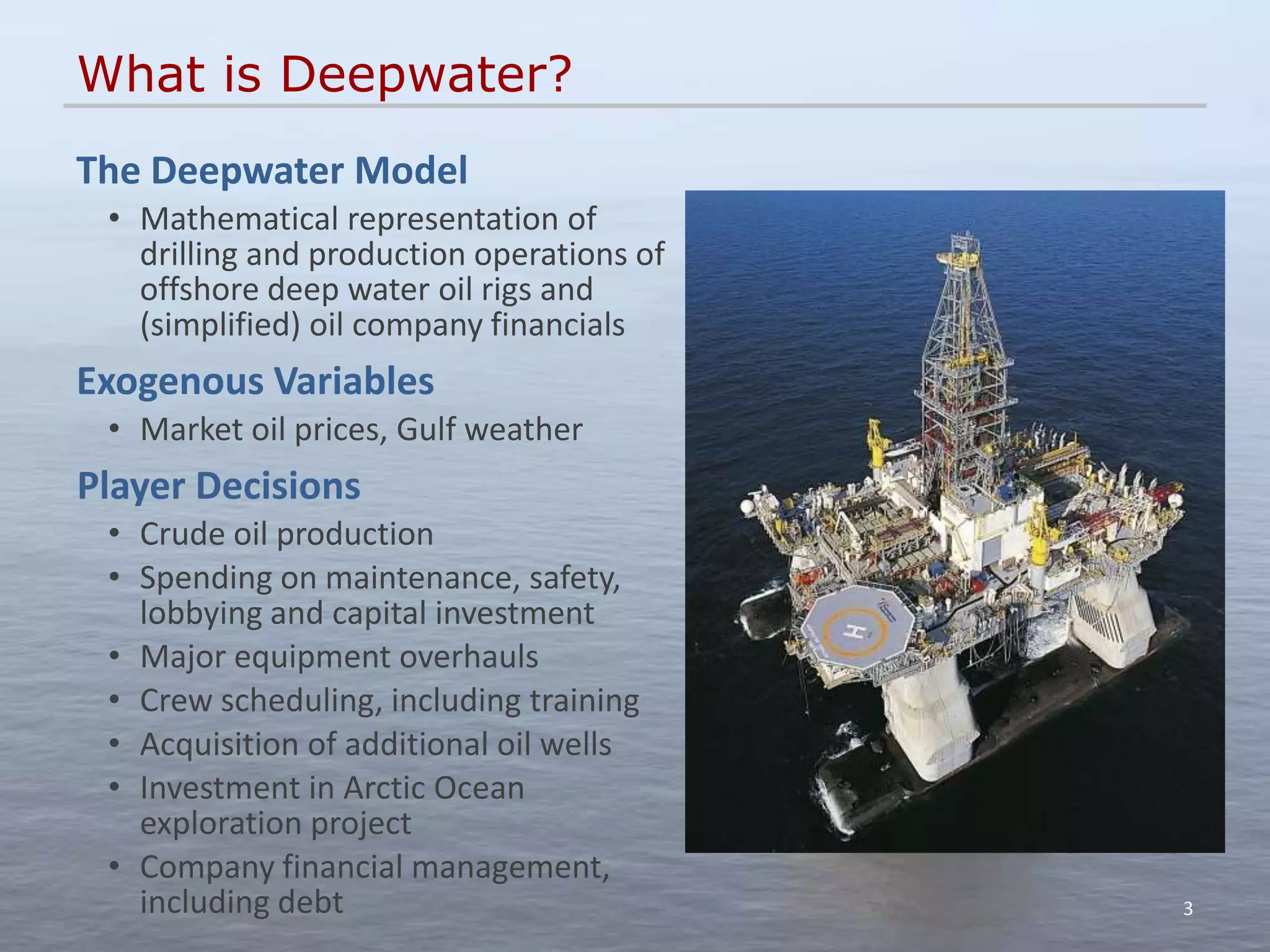
The Deepwater Model
 • Mathematical representation of
   drilling and production operations of
   offshore deep water oil rigs and
   (simplified) oil company financials
Exogenous Variables
 • Market oil prices, Gulf weather
Player Decisions
 • Crude oil production
 • Spending on maintenance, safety,
   lobbying and capital investment
 • Major equipment overhauls
 • Crew scheduling, including training
 • Acquisition of additional oil wells
 • Investment in Arctic Ocean
   exploration project
 • Company financial management,
   including debt                          3
What is Deepwater?
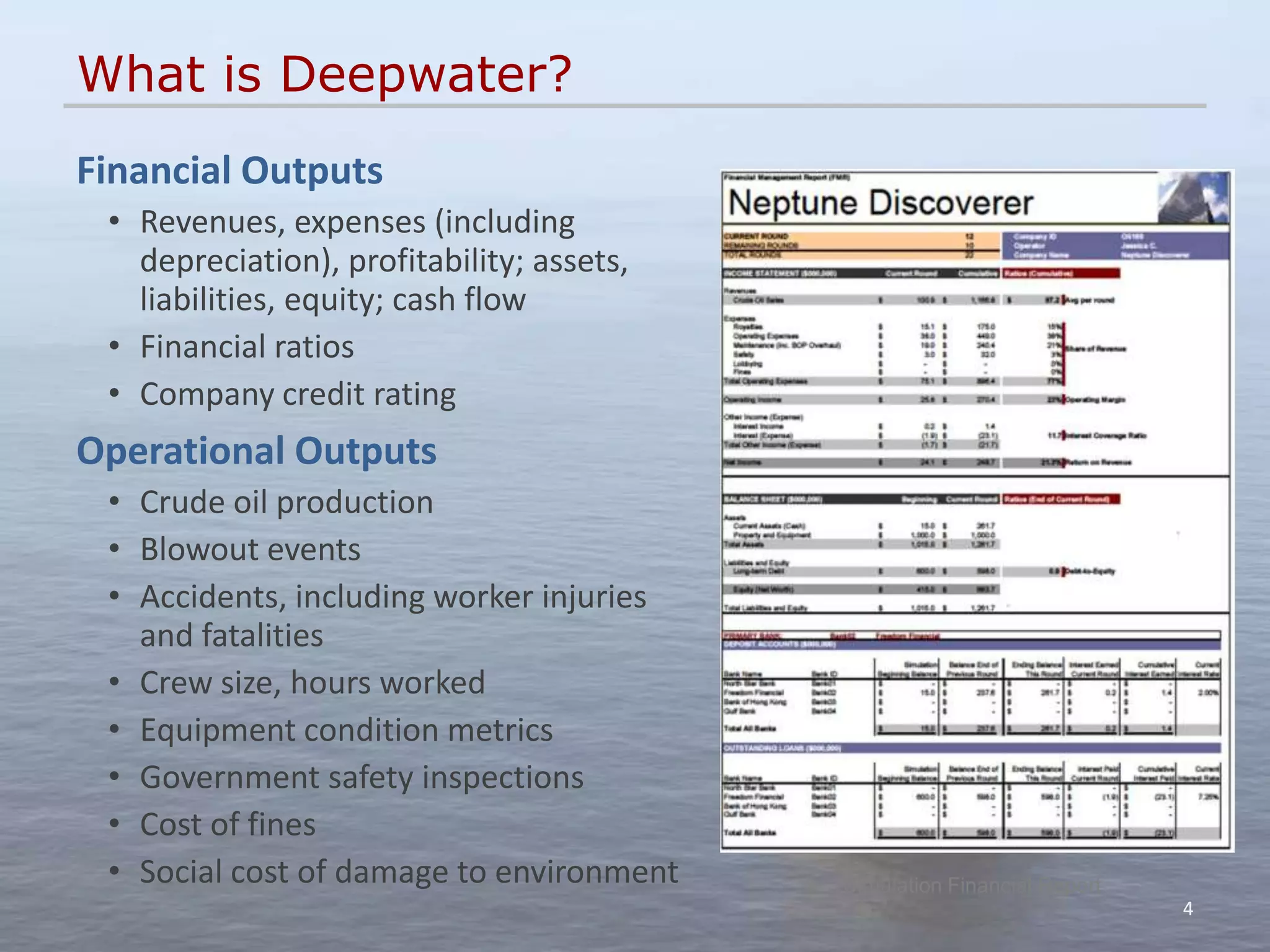
Financial Outputs
 • Revenues, expenses (including
   depreciation), profitability; assets,
   liabilities, equity; cash flow
 • Financial ratios
 • Company credit rating
Operational Outputs
 • Crude oil production
 • Blowout events
 • Accidents, including worker injuries
   and fatalities
 • Crew size, hours worked
 • Equipment condition metrics
 • Government safety inspections
 • Cost of fines
 • Social cost of damage to environment    Simulation Financial Report
                                                                         4
What is Deepwater?
Not a Typical Strategic Simulation
 • Risk oriented, not market oriented
 • Outcomes driven by operating
   decisions, not market demand
 • Key model outputs are harms to
   others:
     –   Oil well blowouts
     –   Worker injuries and fatalities
     –   Safety violations
     –   Environmental damage
     –   Social harm
 • Outcomes determined by
   probabilistic model, not mechanistic
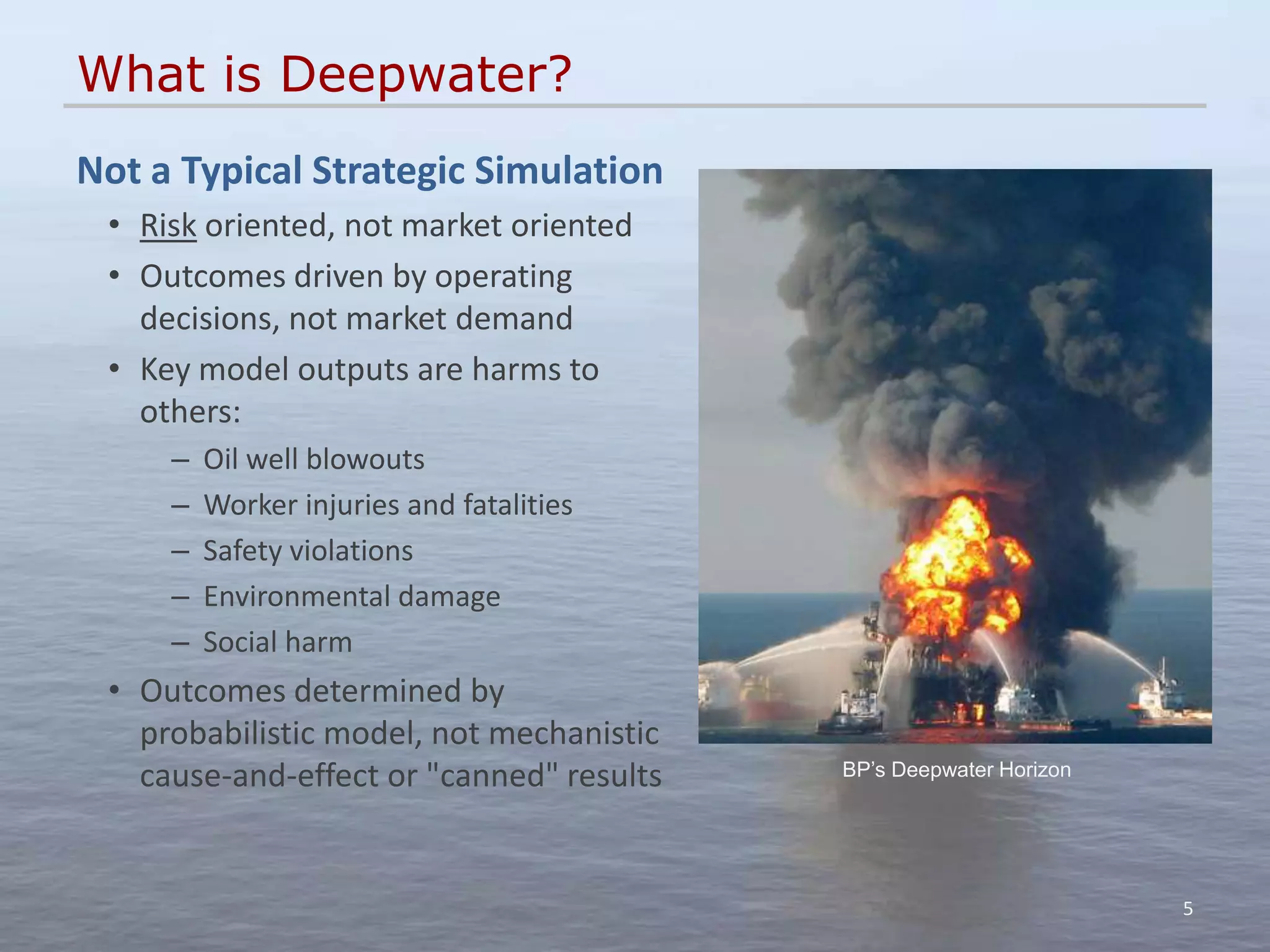
   cause-and-effect or "canned" results   BP’s Deepwater Horizon


                                                                   5
What is Deepwater?
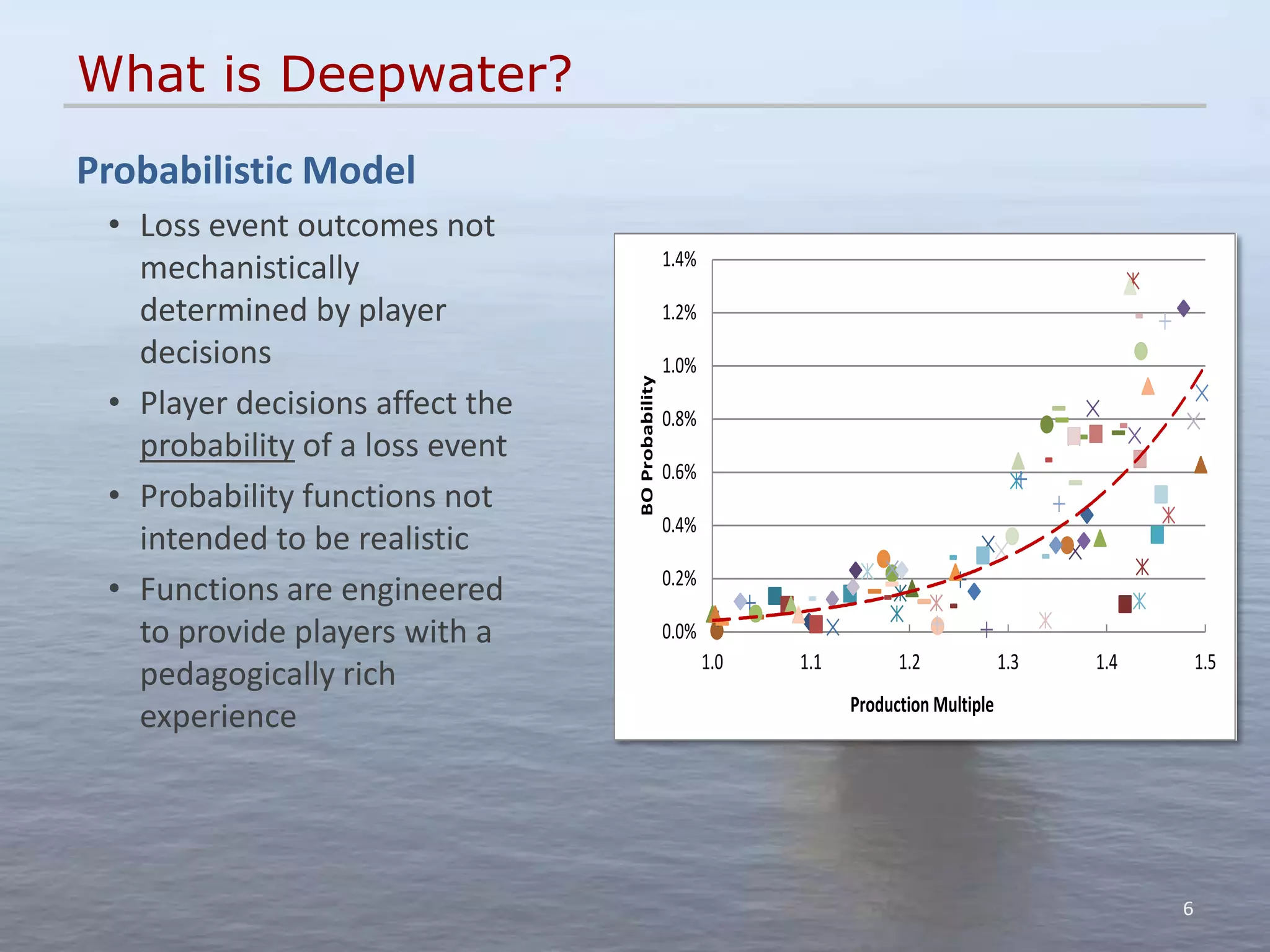
Probabilistic Model
 • Loss event outcomes not
                                                  1.4%
   mechanistically
   determined by player                           1.2%
   decisions                                      1.0%


                                 BO Probability
 • Player decisions affect the                    0.8%
   probability of a loss event
                                                  0.6%
 • Probability functions not
                                                  0.4%
   intended to be realistic
                                                  0.2%
 • Functions are engineered
   to provide players with a                      0.0%
                                                         1.0   1.1         1.2             1.3   1.4       1.5
   pedagogically rich
                                                                     Production Multiple
   experience


                                                                                                       6
What is Deepwater?
The Ethical Challenge
• No arbitrary, ad hoc ethical dilemmas.
• Players make ordinary, day-to-day
  business decisions in a hazardous
  industry trying to balance pursuit of
  profit against risk of harm to workers,
  the environment and society.
• Deepwater immerses players in the
  complexities of business decision-
  making while managing morally perilous
  business activities.
• Deepwater exposes players to the
  uncertainties and ambiguities of
  business decision-making.


                                            7
What is Deepwater?
The Benefits
• In Deepwater, players experience the
  conflict between profit-making and
  doing the right thing.
• The multi-round approach provides rich
  opportunities for reflection, both in-class
  and through journaling.
• Deepwater prepares players to handle
  the ethical complexities of business
  decision-making and sharpens their
  perception of ethical risk.
• Because of the possible dramatic
  consequences if something goes wrong,
  Deepwater doesn't tell players that
  relativism is wrong, it shows them.

                                                8
What is Deepwater?
The Benefits (cont.)
• At the same time, Deepwater
  demonstrates to players that it is not
  easy to decide what is right and wrong –
  and that it is not easy actually to act
  ethically.
• Deepwater awakens and nurtures
  players' moral imaginations.
• Deepwater prepares players to cope
  with moral misfortune – the reality that
  "it rains on the just and the unjust alike."
• Deepwater develops players skills at
  spotting, understanding and reacting to
  emerging ethical challenges
• Deepwater discourages overly simplistic
  explanations of moral failure in business.
                                                 9
Deepwater Development
Player Comments
 "I loved this simulation. I thought it was
 a great project to teach us ethics and
 responsibility. I was always excited to
 come to class and see where my rig
 ranked and was always hoping that my
 rig didn’t blowout. I was put in many
 situations where I found myself thinking
 about what to do, be ethical or make
 money. Sometimes I think that I was a
 little unethical mostly towards the end
 when increasing the rigs profits was
 crucial to stay in the game and earn the
 extra points onto our final grade."


                                              10
Deepwater Development
Player Comments (cont.)
 "People think there is good or evil with
 no in-between - but this exercise puts us
 in that in-between position. We can see
 how managers make decisions to benefit
 themselves (because we might make
 decisions to benefit our grade while we
 are producing way too much oil and
 injuring employees or blowing out) and
 why they make these decisions."

 "Sometimes you can't understand why a
 certain person made that bad decision
 until you are that person."


                                             11
Deepwater Competitors
 Ethics-LX (www.ethics-lx.com)
   • Online case discussion of a specific fictional business ethics dilemma
     with automated feed-back on stakeholder reactions to student's
     decision
 The Ethics Game (www.ethicsgame.com)
   • "Hot Topics Individual Simulation:" 1st person cases that present
     participants with specific ethical dilemmas; answers are scored
   • "Core Values Team Simulation:" Competitive simulation game; simple
     model that outputs marginal impact of ethics decisions on revenues
     and expenses
 Capsim (www.capsim.com)
   • Competitive simulation game; students take over a poorly performing
     manufacturing company
   • Ethics "plug-in:" mini-cases that present ethical dilemmas; players'
     ethical decisions impact company performance
                                                                              12
Biography

            13
Dr. Wayne F. Buck
Academic Snapshot
• Assistant Professor of Business Ethics
  Eastern Connecticut State University
• Teaching focus: Business ethics,
  corporate strategy, entrepreneurship
• Research focus: Constructing a new
  framework for understanding corporate
  moral failure by adapting a systems
  theoretic analysis framework from
  industry safety engineering originally
  developed at MIT.
• Research focus: Developing effective
  business ethics simulation games


                                           14
Dr. Wayne F. Buck
Education
•   M.B.A., Wharton School of Business
•   Ph.D., Yale University
•   M.A., Southern Illinois University
•   B.A., California State University,
    Northridge
Previous Academic Positions
•   Yale University
•   Carleton College
•   Southern Connecticut State University
•   University of New Haven
•   St. Joseph College
•   Albertus Magnus College


                                            15
Dr. Wayne F. Buck
Business Experience
•   Partner & COO, MarketStance
•   Principal, Second Stage Consulting
•   Managing Director, RedKey Education
•   AVP, Conning & Company
•   Director of Market Research, Aetna
•   Consultant, Center for Applied Research
•   Investment Services Officer, Connecticut
    Savings Bank
Not-for-Profit Experience
• Founder and Executive Director, Film Fest
  New Haven


                                               16
For more information, contact:

Dr. Wayne Buck
(203) 623-9482
wayne@businessethicssimulation.com
www.businessethicssimulation.com


                                     17

Deepwater: Business Ethics Simulation

  • 1.
    Deepwater A Competitive BusinessEthics Simulation Game Wayne Buck, Ph.D., MBA Assistant Professor of Business Ethics Eastern Connecticut State University
  • 2.
    What is Deepwater? ACompetitive Simulation Game • Developed as an experiential learning exercise for business ethics courses • Players (teams or individuals) manage an oil exploration and production company operating in the deep offshore waters of the Gulf of Mexico. • Inspired by the 2010 BP Deepwater Horizon oil spill. • Multiple rounds of play. • Scoring based on business performance or ethical outcomes. The drilling floor of an offshore oil rig 1
  • 3.
    What is Deepwater? ATrue Simulation Game • Genuine simulations utilize symbolic models of real processes and systems. • These models are designed to replicate the behavior of the modeled systems. • Player management decisions serve as inputs to the model – the "moves" in a simulation game. • Model outputs are the effects on the modeled system of players decisions • These outputs drive scoring. 2
  • 4.
    What is Deepwater? TheDeepwater Model • Mathematical representation of drilling and production operations of offshore deep water oil rigs and (simplified) oil company financials Exogenous Variables • Market oil prices, Gulf weather Player Decisions • Crude oil production • Spending on maintenance, safety, lobbying and capital investment • Major equipment overhauls • Crew scheduling, including training • Acquisition of additional oil wells • Investment in Arctic Ocean exploration project • Company financial management, including debt 3
  • 5.
    What is Deepwater? FinancialOutputs • Revenues, expenses (including depreciation), profitability; assets, liabilities, equity; cash flow • Financial ratios • Company credit rating Operational Outputs • Crude oil production • Blowout events • Accidents, including worker injuries and fatalities • Crew size, hours worked • Equipment condition metrics • Government safety inspections • Cost of fines • Social cost of damage to environment Simulation Financial Report 4
  • 6.
    What is Deepwater? Nota Typical Strategic Simulation • Risk oriented, not market oriented • Outcomes driven by operating decisions, not market demand • Key model outputs are harms to others: – Oil well blowouts – Worker injuries and fatalities – Safety violations – Environmental damage – Social harm • Outcomes determined by probabilistic model, not mechanistic cause-and-effect or "canned" results BP’s Deepwater Horizon 5
  • 7.
    What is Deepwater? ProbabilisticModel • Loss event outcomes not 1.4% mechanistically determined by player 1.2% decisions 1.0% BO Probability • Player decisions affect the 0.8% probability of a loss event 0.6% • Probability functions not 0.4% intended to be realistic 0.2% • Functions are engineered to provide players with a 0.0% 1.0 1.1 1.2 1.3 1.4 1.5 pedagogically rich Production Multiple experience 6
  • 8.
    What is Deepwater? TheEthical Challenge • No arbitrary, ad hoc ethical dilemmas. • Players make ordinary, day-to-day business decisions in a hazardous industry trying to balance pursuit of profit against risk of harm to workers, the environment and society. • Deepwater immerses players in the complexities of business decision- making while managing morally perilous business activities. • Deepwater exposes players to the uncertainties and ambiguities of business decision-making. 7
  • 9.
    What is Deepwater? TheBenefits • In Deepwater, players experience the conflict between profit-making and doing the right thing. • The multi-round approach provides rich opportunities for reflection, both in-class and through journaling. • Deepwater prepares players to handle the ethical complexities of business decision-making and sharpens their perception of ethical risk. • Because of the possible dramatic consequences if something goes wrong, Deepwater doesn't tell players that relativism is wrong, it shows them. 8
  • 10.
    What is Deepwater? TheBenefits (cont.) • At the same time, Deepwater demonstrates to players that it is not easy to decide what is right and wrong – and that it is not easy actually to act ethically. • Deepwater awakens and nurtures players' moral imaginations. • Deepwater prepares players to cope with moral misfortune – the reality that "it rains on the just and the unjust alike." • Deepwater develops players skills at spotting, understanding and reacting to emerging ethical challenges • Deepwater discourages overly simplistic explanations of moral failure in business. 9
  • 11.
    Deepwater Development Player Comments "I loved this simulation. I thought it was a great project to teach us ethics and responsibility. I was always excited to come to class and see where my rig ranked and was always hoping that my rig didn’t blowout. I was put in many situations where I found myself thinking about what to do, be ethical or make money. Sometimes I think that I was a little unethical mostly towards the end when increasing the rigs profits was crucial to stay in the game and earn the extra points onto our final grade." 10
  • 12.
    Deepwater Development Player Comments(cont.) "People think there is good or evil with no in-between - but this exercise puts us in that in-between position. We can see how managers make decisions to benefit themselves (because we might make decisions to benefit our grade while we are producing way too much oil and injuring employees or blowing out) and why they make these decisions." "Sometimes you can't understand why a certain person made that bad decision until you are that person." 11
  • 13.
    Deepwater Competitors Ethics-LX(www.ethics-lx.com) • Online case discussion of a specific fictional business ethics dilemma with automated feed-back on stakeholder reactions to student's decision The Ethics Game (www.ethicsgame.com) • "Hot Topics Individual Simulation:" 1st person cases that present participants with specific ethical dilemmas; answers are scored • "Core Values Team Simulation:" Competitive simulation game; simple model that outputs marginal impact of ethics decisions on revenues and expenses Capsim (www.capsim.com) • Competitive simulation game; students take over a poorly performing manufacturing company • Ethics "plug-in:" mini-cases that present ethical dilemmas; players' ethical decisions impact company performance 12
  • 14.
  • 15.
    Dr. Wayne F.Buck Academic Snapshot • Assistant Professor of Business Ethics Eastern Connecticut State University • Teaching focus: Business ethics, corporate strategy, entrepreneurship • Research focus: Constructing a new framework for understanding corporate moral failure by adapting a systems theoretic analysis framework from industry safety engineering originally developed at MIT. • Research focus: Developing effective business ethics simulation games 14
  • 16.
    Dr. Wayne F.Buck Education • M.B.A., Wharton School of Business • Ph.D., Yale University • M.A., Southern Illinois University • B.A., California State University, Northridge Previous Academic Positions • Yale University • Carleton College • Southern Connecticut State University • University of New Haven • St. Joseph College • Albertus Magnus College 15
  • 17.
    Dr. Wayne F.Buck Business Experience • Partner & COO, MarketStance • Principal, Second Stage Consulting • Managing Director, RedKey Education • AVP, Conning & Company • Director of Market Research, Aetna • Consultant, Center for Applied Research • Investment Services Officer, Connecticut Savings Bank Not-for-Profit Experience • Founder and Executive Director, Film Fest New Haven 16
  • 18.
    For more information,contact: Dr. Wayne Buck (203) 623-9482 wayne@businessethicssimulation.com www.businessethicssimulation.com 17