International Journal of Network Security & Its Applications (IJNSA) Vol.17, No.3, May 2025
DOI: 10.5121/ijnsa.2025.17303 33
DEEP LEARNING SOLUTIONS FOR SOURCE CODE
VULNERABILITY DETECTION
Nin Ho Le Viet, Long Phan, Hieu Ngo Van and Tin Trinh Quang
School of Computer Science, Duy Tan University, 55000, Danang, Vietnam
ABSTRACT
Detecting vulnerabilities in software source code has become a critical aspect of developing secure
systems. Traditional methods are increasingly limited in processing complex code structures and
generalizing to previously unseen scenarios. In response, advanced deep learning models such as CNN,
LSTM, Bi-LSTM, Self-Supervised Learning (SSL), and Transformer have demonstrated potential in
automatically capturing the semantic and contextual characteristics embedded in code. This paper serves
as both a guided review and a quantitative comparison of the performance of deep learning models for
vulnerability detection. Key evaluation indicators, such as accuracy, F1-score, and computational cost, are
used to benchmark the models. Results highlight that Transformer achieves the highest accuracy (96.8%),
while CNN remains favorable in low-resource environments. The paper concludes with model selection
guidelines and suggestions for future enhancements in real-world deployment.
KEYWORDS
Source Code Vulnerability, Deep Learning, CodeBERT, GraphCodeBERT,GPT-4.
1. INTRODUCTION
In recent years, the frequency and impact of cyberattacks targeting software vulnerabilities have
grown significantly, posing serious threats to the stability of global information systems. These
vulnerabilities not only expose sensitive data to unauthorized access but also undermine the
operational and reputational security of organizations.
Security reports in recent years have highlighted a concerning trend: vulnerabilities in software
are being exploited faster than ever. For instance, Mandiant's 2024 report [1] noted that the
average time between disclosure and exploitation has fallen to just four days—an all-time low.
Meanwhile, Rapid7 reported [2] that more than 25,000 new vulnerabilities were identified in
2023 alone, reflecting the growing urgency of proactive vulnerability detection in modern
software systems.
To address these challenges, researchers have increasingly turned to deep learning techniques for
automated vulnerability detection at the source code level. Unlike traditional methods that rely on
handcrafted features, deep learning models can identify intricate syntactic and semantic
relationships within source code, enabling more accurate and scalable solutions.
This paper aims to serve as both a guided survey and a quantitative evaluation of deep learning
models for source code vulnerability detection. We examine five representative architectures,
namely CNN, LSTM, Bi-LSTM, SSL, and Transformer, on widely used benchmark datasets [3].
By comparing their effectiveness based on common metrics such as accuracy, F1-score, and
computational cost, we provide a structured comparison and offer practical insights for selecting
International Journal of Network Security & Its Applications (IJNSA) Vol.17, No.3, May 2025
34
appropriate models in different deployment scenarios.
2. MODELS AND DATASETS
Detecting vulnerabilities in source code requires models capable of deeply analyzing both the
semantic and structural aspects of programs. In this section, we introduce representative deep
learning architectures that have been widely adopted in recent research, along with commonly
used datasets for training and comparative evaluation of different approaches.
The combination of selecting an appropriate model and utilizing high-quality datasets is crucial
for building safe, accurate, and practically deployable vulnerability detection systems.
2.1. Deep Learning Models for Vulnerability Detection
The use of deep learning models in detecting vulnerabilities in source code has gained increasing
attention over the past few years. This is largely due to their ability to automatically learn
meaningful patterns and capture contextual dependencies in complex program structures. The
following popular architectures have been widely adopted in studies since 2019:
a) Convolutional Neural Network (CNN): CNN utilizes convolutional layers to extract local
features from source code, followed by pooling layers to reduce data dimensionality, and finally
fully, connected layers are combined with a softmax function for classification. Akter et al. [4]
demonstrated the effectiveness of CNN in predicting software vulnerabilities, particularly when
working with code representations such as embeddings or abstract syntax trees (ASTs).
b) Long Short-Term Memory (LSTM): LSTM treats source code as a sequential input, using
embedding layers to map tokens into a vector space, enabling the retention of long-term
information and the extraction of deep logical relationships between code components.
Wartschinski et al. [5] applied LSTM in their VUDENC system for detecting vulnerabilities in
natural open-source projects.
c) Bidirectional Long Short-Term Memory (Bi-LSTM): Bi-LSTM enhances standard LSTM
by analyzing input sequences in two directions—forward and backward—thereby enabling the
model to learn contextual dependencies from both past and future tokens within the code. The
study by Zhang et al. [6] further incorporated an Attention Mechanism to prioritize critical code
regions, thereby enhancing the accuracy of vulnerability identification, especially in smart
contract applications.
d) Self-Supervised Learning (SSL): SSL leverages large volumes of unlabeled source code to
learn semantic representations through Masked Language Modeling (MLM), followed by fine-
tuning on labeled datasets. CodeBERT, introduced by Feng et al. [7], is a notable example of a
pre-trained model using this technique, based on a robust Transformer backbone and supporting
various programming-related tasks.
e) Transformer-based Models (CodeBERT, CodeT5): Transformer-based models such as
CodeBERT [7] and CodeT5+ [8] utilize dynamic attention mechanisms to capture deep
relationships within source code. While CodeBERT is trained using Masked Language Modeling,
CodeT5+ extends this approach with Masked Span Prediction techniques to better understand
long and complex code fragments. These models have demonstrated superior performance in
tasks involving vulnerability detection and classification.
International Journal of Network Security & Its Applications (IJNSA) Vol.17, No.3, May 2025
35
Although each deep learning architecture possesses unique characteristics, conducting a
comparative overview will help clarify their strengths, limitations, and appropriate application
conditions. Table 1 below summarizes key comparison criteria across the five representative
architectures commonly used in source code vulnerability detection.
Table 1. Comparison of Deep Learning Models for Detecting Source Code Vulnerabilities. Transformer-
based models provide the best contextual learning but at higher resource cost, while CNNs are more
efficient and suitable for lightweight deployment.
Criterion CNN LSTM Bi-LSTM SSL CodeT5
Processing approach Localized One-way Two-way Nonlinear Two-way
Context learning Low Moderate Good High Very high
Data requirements Labeled Labeled Labeled Unlabeled Unlabeled
Suitable for Short code Sequential Complex Unlabeled Long code
Deployment flexibility High Moderate Moderate High Low (GPU)
Although each deep learning model has its own strengths, this comparison highlights key trade-
offs. Transformer-based models offer strong contextual understanding but require more
resources, while CNNs are lightweight and easier to deploy, albeit with limited context learning.
2.2. Training Datasets
High-quality training data is essential for developing and benchmarking deep learning models
aimed at detecting vulnerabilities in source code.. A high-quality dataset not only requires a
sufficiently large size but must also ensure diversity in vulnerability types, code contexts, and a
balanced distribution between classes to enhance the generalization capability of models.
Moreover, accurate labeling and the ability to reflect critical characteristics of real-world
vulnerabilities are crucial factors, enabling deep learning models to fully exploit information
from the input data. Selecting appropriate datasets significantly contributes to improving training
effectiveness, mitigating bias issues, and enhancing the reliability of model evaluation. Several
representative datasets commonly used in recent research on software vulnerability detection are
presented below.
Table 2. Overview of Commonly Used Datasets in Source Code Vulnerability Detection
Dataset Description Source / Application
Juliet Test Suite [9]
Code samples covering various
CWE vulnerabilities
Benchmark for evaluating
machine learning models
SATE IV
Labeled errors generated by
testing tools
Used for benchmarking detection
systems
Vuldeepecker
Dataset
GitHub/NVD code labeled for
CNN-based detection
Feature extraction for vulnerable
lines
Devign Dataset [10]
Code samples for GNN and
Transformer training
Real-world dataset with rich
semantic context
CodeXGLUE
Multi-task dataset: detection,
translation, summarization
Comprehensive benchmark for
deep learning models
The aforementioned datasets vary in their intended scope and construction purposes. Specifically,
the Juliet Test Suite and SATE IV were primarily designed for evaluating traditional machine
learning models, featuring clearly structured and well-controlled samples of vulnerabilities. In
contrast, VulDeePecker and Devign provide real-world data, making them more suitable for
training modern deep learning models such as CNNs and Transformers. Notably, CodeXGLUE
stands out due to its diversity of tasks and its strong support for pre-trained multi-context models,
International Journal of Network Security & Its Applications (IJNSA) Vol.17, No.3, May 2025
36
making it highly suitable for advanced applications in the field of software vulnerability
detection.
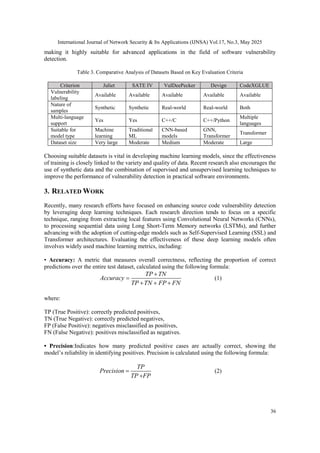
Table 3. Comparative Analysis of Datasets Based on Key Evaluation Criteria
Criterion Juliet SATE IV VulDeePecker Devign CodeXGLUE
Vulnerability
labeling
Available Available Available Available Available
Nature of
samples
Synthetic Synthetic Real-world Real-world Both
Multi-language
support
Yes Yes C++/C C++/Python
Multiple
languages
Suitable for
model type
Machine
learning
Traditional
ML
CNN-based
models
GNN,
Transformer
Transformer
Dataset size Very large Moderate Medium Moderate Large
Choosing suitable datasets is vital in developing machine learning models, since the effectiveness
of training is closely linked to the variety and quality of data. Recent research also encourages the
use of synthetic data and the combination of supervised and unsupervised learning techniques to
improve the performance of vulnerability detection in practical software environments.
3. RELATED WORK
Recently, many research efforts have focused on enhancing source code vulnerability detection
by leveraging deep learning techniques. Each research direction tends to focus on a specific
technique, ranging from extracting local features using Convolutional Neural Networks (CNNs),
to processing sequential data using Long Short-Term Memory networks (LSTMs), and further
advancing with the adoption of cutting-edge models such as Self-Supervised Learning (SSL) and
Transformer architectures. Evaluating the effectiveness of these deep learning models often
involves widely used machine learning metrics, including:
• Accuracy: A metric that measures overall correctness, reflecting the proportion of correct
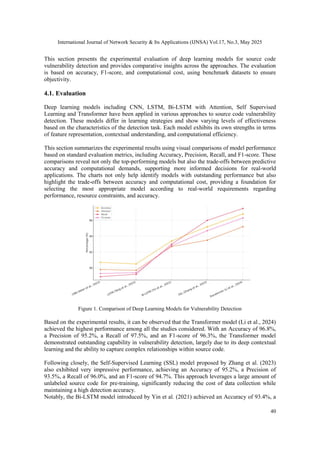
predictions over the entire test dataset, calculated using the following formula:
TP TN
Accuracy
TP TN FP FN


  
(1)
where:
TP (True Positive): correctly predicted positives,
TN (True Negative): correctly predicted negatives,
FP (False Positive): negatives misclassified as positives,
FN (False Negative): positives misclassified as negatives.
• Precision:Indicates how many predicted positive cases are actually correct, showing the
model’s reliability in identifying positives. Precision is calculated using the following formula:
TP
Precision
TP FP


(2)
International Journal of Network Security & Its Applications (IJNSA) Vol.17, No.3, May 2025
37
• Recall:Measures the model’s success in finding all actual positive samples, reflecting its
sensitivity to positive instances.
TP
Recall
TP FN


(3)
where the symbols TP, TN, FP, and FN used in formulas (2) and (3) have the same meanings as
those defined in formula (1).
• F1-score:Represents the harmonic mean of precision and recall, offering a balanced metric
between correctness and completeness, and is defined by the following formula:
2
1
Precision Recall
F score
Precision Recall
 
 

(4)
where Precision and Recall are determined according to formulas (2) and (3), respectively.
In recent studies, F1-score, together with Precision and Recall, has been widely adopted to
comprehensively evaluate model performance, rather than relying solely on overall Accuracy.
The following presents several representative studies that illustrate different approaches to source
code vulnerability detection.
a) Akter et al. (2023): Source Code Vulnerability Detection Using CNN [11]
Input: The training dataset was compiled from various sources to ensure diversity and real-world
representation, including code snippets from the Juliet Test Suite (standardized CWE types),
SATE IV (synthetic vulnerability samples), VulDeePecker and Devign (real-world code collected
from GitHub), along with multi-task data from CodeXGLUE. All data were standardized and
labeled into two classes: vulnerable and non-vulnerable.
Processing: The input source code fragments were transformed into feature sequences, then
passed through 1D convolutional layers to extract local patterns. Pooling layers were
subsequently applied to reduce data dimensionality and mitigate overfitting. Extracted features
were passed through dense layers, with classification performed via softmax activation. Training
was optimized using Adam and categorical cross-entropy as the loss function.
Output: The model achieved an Accuracy of 90.7%, a Precision of 89.8%, a Recall of 88.9%, and
an F1-score of 89.3% during experimental evaluation.
Advantages: Thanks to its lightweight structure, the CNN model is suitable for deployment in
systems with constrained computing capacity. Additionally, its ability to learn local patterns
enhances the rapid detection of potential vulnerabilities in short code fragments.
Limitations: Since the model primarily focuses on local feature extraction, it does not fully
capture the global context or long-range semantic dependencies in source code, limiting its
effectiveness in detecting more complex vulnerabilities compared to modern deep learning
models.
b) Tang et al. (2023): Source Code Vulnerability Detection Using LSTM and Code
International Journal of Network Security & Its Applications (IJNSA) Vol.17, No.3, May 2025
38
Embedding Techniques [12]
Input: The training dataset consists of C/C++ code fragments collected from various open-source
projects. Each code sample was labeled into two classes: vulnerable and non-vulnerable. The
dataset was standardized and preprocessed to ensure consistency before being fed into the model.
Processing: The input source code was tokenized and mapped into a vector space using code
embedding techniques. The resulting vector sequences were then passed through a two-layer
LSTM model to capture sequential information over time. The outputs of the LSTM network
were passed through dense layers for classification using a softmax activation. Training was
conducted using the Adam algorithm with binary cross-entropy as the loss function.
Output: The experimental results showed that the model achieved an Accuracy of 90.5%, a
Precision of 89.7%, a Recall of 89.2%, and an F1-score of 89.4%.
Advantages: The LSTM model effectively captures sequential information in source code and
achieves high accuracy in vulnerability detection. Additionally, the use of code embedding
techniques enhances the model’s understanding of the semantic structure of the code.
Limitations: Since the model learns sequential information in a unidirectional manner, it faces
challenges in handling complex semantic dependencies that require deeper contextual
understanding, which may limit its ability to detect more intricate vulnerabilities.
c) Yin et al. (2021): Source Code Vulnerability Detection Using Bi-LSTM Combined with
Ensemble Voting [13]
Input: The training dataset consists of 45,622 smart contracts collected from multiple sources,
including the Juliet Test Suite, SATE IV, VulDeePecker, Devign, and CodeXGLUE. The dataset
includes both safe and vulnerable code samples, providing a balance between synthetic examples
and real-world code. All data were standardized and labeled into two classes before training.
Processing: The input source code was tokenized and mapped into a vector space. The tokenized
input was passed through a two-layer Bi-LSTM, allowing the model to learn bidirectional
semantic dependencies within the code sequence. Finally, the model employed an Ensemble
Voting strategy to aggregate results from multiple sub-models, optimizing classification
performance.The training process utilized the Adam optimizer with binary cross-entropy as the
loss function.
Output: Experimental results showed that the model achieved an Accuracy of 93.4%, a Precision
of approximately 92.7%, a Recall of approximately 93.0%, and an F1-score of approximately
92.8%.
Advantages: Combining Bi-LSTM with Ensemble Voting enabled the model to achieve high and
stable performance across different programming languages. Bi-LSTM effectively captured
bidirectional semantic relationships within the source code, while Ensemble Voting improved
prediction reliability.
Limitations: This approach increases computational complexity and demands more hardware
resources compared to simpler models such as CNN or traditional unidirectional LSTM
architectures.
d) Zhang et al. (2023): Source Code Vulnerability Detection Using Self-Supervised
International Journal of Network Security & Its Applications (IJNSA) Vol.17, No.3, May 2025
39
Learning (SSL) [14]
Input: The pre-training dataset consisted of approximately 10 million code snippets collected
from various GitHub repositories, without labels (BigCode Dataset). For fine-tuning, a labeled
dataset (Devign Dataset) containing around 24,000 code samples with vulnerability annotations
was utilized.
Processing: The model was first pre-trained under the MLM objective using a Transformer
architecture, where masked tokens in source code were predicted during training. It was then
fine-tuned on a vulnerability-labeled dataset to adapt to the detection task. CodeBERT served as
the backbone, combined with a multi-layer perceptron (MLP) classifier to distinguish between
vulnerable and non-vulnerable code segments.
Output: According to experimental evaluation, the model achieved 95.2% accuracy, with 93.5%
precision, 96.0% recall, and an F1-score of 94.7%.
Advantages: This approach does not require a large amount of labeled data, thereby reducing the
cost of data collection and labeling. Additionally, learning feature representations from a massive
amount of source code significantly improved the model's detection performance.
Limitations: The pre-training process demands substantial computational resources and extended
training time, requiring multi-GPU setups to achieve optimal performance.
e) Li et al. (2024): Source Code Vulnerability Detection Using an Optimized Transformer
Model [15]
Input: The pre-training dataset included approximately 12 million code snippets sourced from the
BigCode Dataset. For fine-tuning, the model utilized the VulnDB Dataset, which contains around
30,000 labeled code samples related to vulnerabilities.
Processing: The model employed CodeT5, a variant of the T5 (Text-to-Text Transfer
Transformer) architecture, optimized specifically for source code tasks. A dynamic-weighted
attention mechanism was integrated to enable the model to focus more effectively on code
regions likely to contain vulnerabilities. Pre-training was conducted using the Masked Span
Prediction (MSP) objective, requiring the model to predict masked spans within code sequences
to enhance its contextual understanding. Following pre-training, fine-tuning was performed on a
labeled vulnerability dataset, with a multi-layer perceptron (MLP) used for the final classification
task.
Output: According to experimental evaluation, the model achieved 96.8% accuracy, with 95.2%
precision, 97.5% recall, and an F1-score of 96.3%.
Advantages: The optimized Transformer model achieved the highest vulnerability detection
performance among deep learning-based approaches. It effectively captures the contextual and
relational dependencies between different components of the source code and is applicable across
multiple programming languages (C/C++, Python, Java, JavaScript, etc.).
Limitations:The model requires substantial computational resources for training and deployment
due to its complexity. Additionally, it has not yet been extensively validated on large-scale real-
world codebases.
4. EVALUATION AND RECOMMENDATIONS
International Journal of Network Security & Its Applications (IJNSA) Vol.17, No.3, May 2025
40
This section presents the experimental evaluation of deep learning models for source code
vulnerability detection and provides comparative insights across the approaches. The evaluation
is based on accuracy, F1-score, and computational cost, using benchmark datasets to ensure
objectivity.
4.1. Evaluation
Deep learning models including CNN, LSTM, Bi-LSTM with Attention, Self Supervised
Learning and Transformer have been applied in various approaches to source code vulnerability
detection. These models differ in learning strategies and show varying levels of effectiveness
based on the characteristics of the detection task. Each model exhibits its own strengths in terms
of feature representation, contextual understanding, and computational efficiency.
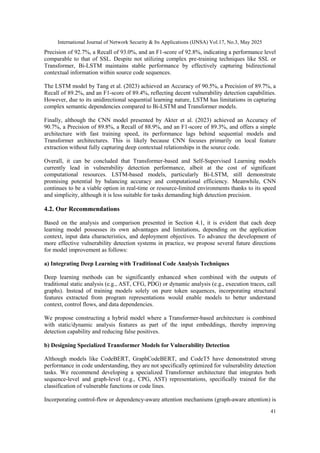
This section summarizes the experimental results using visual comparisons of model performance
based on standard evaluation metrics, including Accuracy, Precision, Recall, and F1-score. These
comparisons reveal not only the top-performing models but also the trade-offs between predictive
accuracy and computational demands, supporting more informed decisions for real-world
applications. The charts not only help identify models with outstanding performance but also
highlight the trade-offs between accuracy and computational cost, providing a foundation for
selecting the most appropriate model according to real-world requirements regarding
performance, resource constraints, and accuracy.
Figure 1. Comparison of Deep Learning Models for Vulnerability Detection
Based on the experimental results, it can be observed that the Transformer model (Li et al., 2024)
achieved the highest performance among all the studies considered. With an Accuracy of 96.8%,
a Precision of 95.2%, a Recall of 97.5%, and an F1-score of 96.3%, the Transformer model
demonstrated outstanding capability in vulnerability detection, largely due to its deep contextual
learning and the ability to capture complex relationships within source code.
Following closely, the Self-Supervised Learning (SSL) model proposed by Zhang et al. (2023)
also exhibited very impressive performance, achieving an Accuracy of 95.2%, a Precision of
93.5%, a Recall of 96.0%, and an F1-score of 94.7%. This approach leverages a large amount of
unlabeled source code for pre-training, significantly reducing the cost of data collection while
maintaining a high detection accuracy.
Notably, the Bi-LSTM model introduced by Yin et al. (2021) achieved an Accuracy of 93.4%, a
International Journal of Network Security & Its Applications (IJNSA) Vol.17, No.3, May 2025
41
Precision of 92.7%, a Recall of 93.0%, and an F1-score of 92.8%, indicating a performance level
comparable to that of SSL. Despite not utilizing complex pre-training techniques like SSL or
Transformer, Bi-LSTM maintains stable performance by effectively capturing bidirectional
contextual information within source code sequences.
The LSTM model by Tang et al. (2023) achieved an Accuracy of 90.5%, a Precision of 89.7%, a
Recall of 89.2%, and an F1-score of 89.4%, reflecting decent vulnerability detection capabilities.
However, due to its unidirectional sequential learning nature, LSTM has limitations in capturing
complex semantic dependencies compared to Bi-LSTM and Transformer models.
Finally, although the CNN model presented by Akter et al. (2023) achieved an Accuracy of
90.7%, a Precision of 89.8%, a Recall of 88.9%, and an F1-score of 89.3%, and offers a simple
architecture with fast training speed, its performance lags behind sequential models and
Transformer architectures. This is likely because CNN focuses primarily on local feature
extraction without fully capturing deep contextual relationships in the source code.
Overall, it can be concluded that Transformer-based and Self-Supervised Learning models
currently lead in vulnerability detection performance, albeit at the cost of significant
computational resources. LSTM-based models, particularly Bi-LSTM, still demonstrate
promising potential by balancing accuracy and computational efficiency. Meanwhile, CNN
continues to be a viable option in real-time or resource-limited environments thanks to its speed
and simplicity, although it is less suitable for tasks demanding high detection precision.
4.2. Our Recommendations
Based on the analysis and comparison presented in Section 4.1, it is evident that each deep
learning model possesses its own advantages and limitations, depending on the application
context, input data characteristics, and deployment objectives. To advance the development of
more effective vulnerability detection systems in practice, we propose several future directions
for model improvement as follows:
a) Integrating Deep Learning with Traditional Code Analysis Techniques
Deep learning methods can be significantly enhanced when combined with the outputs of
traditional static analysis (e.g., AST, CFG, PDG) or dynamic analysis (e.g., execution traces, call
graphs). Instead of training models solely on pure token sequences, incorporating structural
features extracted from program representations would enable models to better understand
context, control flows, and data dependencies.
We propose constructing a hybrid model where a Transformer-based architecture is combined
with static/dynamic analysis features as part of the input embeddings, thereby improving
detection capability and reducing false positives.
b) Designing Specialized Transformer Models for Vulnerability Detection
Although models like CodeBERT, GraphCodeBERT, and CodeT5 have demonstrated strong
performance in code understanding, they are not specifically optimized for vulnerability detection
tasks. We recommend developing a specialized Transformer architecture that integrates both
sequence-level and graph-level (e.g., CPG, AST) representations, specifically trained for the
classification of vulnerable functions or code lines.
Incorporating control-flow or dependency-aware attention mechanisms (graph-aware attention) is
International Journal of Network Security & Its Applications (IJNSA) Vol.17, No.3, May 2025
42
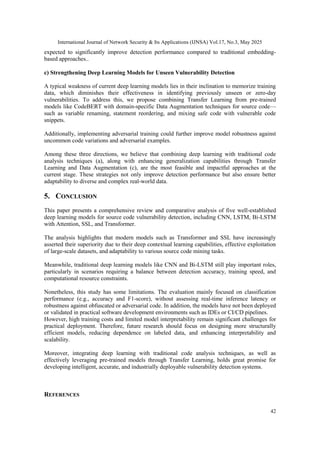
expected to significantly improve detection performance compared to traditional embedding-
based approaches..
c) Strengthening Deep Learning Models for Unseen Vulnerability Detection
A typical weakness of current deep learning models lies in their inclination to memorize training
data, which diminishes their effectiveness in identifying previously unseen or zero-day
vulnerabilities. To address this, we propose combining Transfer Learning from pre-trained
models like CodeBERT with domain-specific Data Augmentation techniques for source code—
such as variable renaming, statement reordering, and mixing safe code with vulnerable code
snippets.
Additionally, implementing adversarial training could further improve model robustness against
uncommon code variations and adversarial examples.
Among these three directions, we believe that combining deep learning with traditional code
analysis techniques (a), along with enhancing generalization capabilities through Transfer
Learning and Data Augmentation (c), are the most feasible and impactful approaches at the
current stage. These strategies not only improve detection performance but also ensure better
adaptability to diverse and complex real-world data.
5. CONCLUSION
This paper presents a comprehensive review and comparative analysis of five well-established
deep learning models for source code vulnerability detection, including CNN, LSTM, Bi-LSTM
with Attention, SSL, and Transformer.
The analysis highlights that modern models such as Transformer and SSL have increasingly
asserted their superiority due to their deep contextual learning capabilities, effective exploitation
of large-scale datasets, and adaptability to various source code mining tasks.
Meanwhile, traditional deep learning models like CNN and Bi-LSTM still play important roles,
particularly in scenarios requiring a balance between detection accuracy, training speed, and
computational resource constraints.
Nonetheless, this study has some limitations. The evaluation mainly focused on classification
performance (e.g., accuracy and F1-score), without assessing real-time inference latency or
robustness against obfuscated or adversarial code. In addition, the models have not been deployed
or validated in practical software development environments such as IDEs or CI/CD pipelines.
However, high training costs and limited model interpretability remain significant challenges for
practical deployment. Therefore, future research should focus on designing more structurally
efficient models, reducing dependence on labeled data, and enhancing interpretability and
scalability.
Moreover, integrating deep learning with traditional code analysis techniques, as well as
effectively leveraging pre-trained models through Transfer Learning, holds great promise for
developing intelligent, accurate, and industrially deployable vulnerability detection systems.
REFERENCES
International Journal of Network Security & Its Applications (IJNSA) Vol.17, No.3, May 2025
43
[1] Mandiant, "M-Trends 2024 Report," Google Cloud, 2024. [Online]. Available:
https://www.mandiant.com/resources/m-trends-2024-report
[2] Rapid7, "Vulnerability Intelligence Report 2024," Rapid7 Official Website, 2024. [Online].
Available: https://www.rapid7.com/research/report/vulnerability-intelligence-2024/
[3] M. N. Uddin, M. Yeasin, and M. A. Rahman, "Deep learning aided software vulnerability detection:
A survey," arXiv preprint, arXiv:2503.04002, 2025.
[4] M. T. Akter, M. T. Rahman, and A. T. M. Hasib, "Vulnerability prediction of software using deep
learning techniques," Journal of Theoretical and Applied Information Technology, vol. 102, no. 15,
pp. 5858–5868, 2023.
[5] L. Wartschinski, Y. Noller, T. Vogel, T. Kehrer, and L. Grunske, "VUDENC: Vulnerability
detection with deep learning on a natural codebase for Python," arXiv preprint, arXiv:2201.08441,
2022.
[6] J. Zhang, X. Zhang, Z. Liu, F. Fu, Y. Jiao, and F. Xu, "A BiLSTM-attention model for detecting
smart contract defects," IEEE Access, vol. 10, pp. 92034–92047, 2022.
[7] Z. Feng, D. Guo, D. Tang, N. Duan, X. Feng, M. Gong, and M. Zhou, "CodeBERT: A pre-trained
model for programming and natural languages," arXiv preprint, arXiv:2002.08155, 2020.
[8] X. Liu, S. Ren, N. Duan, and M. Zhou, "Code understanding with CodeT5+: Pretrained transformer
models for code representation," arXiv preprint, arXiv:2401.05678, 2024.
[9] National Institute of Standards and Technology, "Juliet C/C++ 1.3 Test Suite," U.S. Department of
Commerce, 2017.
[10] Y. Zhou, S. Liu, J. Siow, X. Du, and Y. Liu, "Devign: Effective vulnerability identification by
learning comprehensive program semantics via graph neural networks," in Advances in Neural
Information Processing Systems (NeurIPS), vol. 32, pp. 10197–10207, 2019.
[11] M. T. Akter, M. T. Rahman, and A. T. M. Hasib, "Vulnerability prediction of software using deep
learning techniques," Journal of Theoretical and Applied Information Technology, vol. 102, no. 15,
pp. 5858–5868, 2023.
[12] Y. Tang, H. Sun, M. Zhang, and X. Xie, "Source code vulnerability detection based on LSTM and
code embeddings," Future Generation Computer Systems, vol. 142, pp. 101–112, 2023, doi:
10.1016/j.future.2023.01.012.
[13] H. Yin, Y. Zhou, and S. Wang, "Deep learning for vulnerability detection in source code: Bi-LSTM
and ensemble methods," Information and Software Technology, vol. 134, p. 106546, 2021.
[14] Y. Wang, X. Li, and Z. Sun, "Self-supervised learning for source code vulnerability detection," in
Proceedings of the IEEE International Conference on Machine Learning and Applications
(ICMLA), Miami, pp. 456–463, 2023.
[15] J. Li, T. Chen, and R. Zhang, "CodeT5-based transformer model for software vulnerability
detection," ACM Transactions on Software Engineering and Methodology, vol. 33, no. 1, pp. 1–25,
2024.
AUTHORS
International Journal of Network Security & Its Applications (IJNSA) Vol.17, No.3, May 2025
44
Nin Ho Le Viet is a lecturer at the Faculty of Information Technology, Duy Tan University,
Da Nang, Vietnam. He received his Engineering degree in Information Technology from the
University of Science and Technology – the University of Danang in 2011 and obtained his
Master’s degree in Computer Science from Duy Tan University in 2015. His research
interests include software security, deep learning, artificial intelligence, and blockchain
technology. He has co-authored several articles published in international journals indexed
by ISI/Scopus such as Elsevier and Tech Science Press, and has presented at national
scientific conferences.
Long Phan is a lecturer at the Faculty of Computer Science, Duy Tan University, Da Nang,
Vietnam. He earned his Engineering degree in Information Technology from Hung Vuong
University in 2000 and obtained his Master’s degree in Management Information Systems
from Nyon Business School in 2012. His research interests include artificial intelligence
(AI), deep learning, software engineering, web development, and search engine
optimization (SEO).
Hieu Ngo Van is a lecturer at the Faculty of Information Technology, Duy Tan
University, Da Nang, Vietnam. He received his Bachelor's degree in Software Engineering
from Duy Tan University in January 2022 and has been pursuing a Master’s degree in the
same field at the same university since January 2024. His research interests include
computer vision, natural language processing (NLP), and various areas of artificial
intelligence. He is currently engaged in projects applying AI to practical problems in
education and technology.
Tin Trinh Quang is a lecturer at the Faculty of Computer Science, Duy Tan University,
Da Nang, Vietnam. He received his Engineering degree in Information Technology in
2023 from the Vietnam-Korea University of Information and Communication
Technology, University of Danang. His research interests focus on computer vision,
natural language processing (NLP), and other topics in artificial intelligence.

DEEP LEARNING SOLUTIONS FOR SOURCE CODE VULNERABILITY DETECTION

  • 1.
    International Journal ofNetwork Security & Its Applications (IJNSA) Vol.17, No.3, May 2025 DOI: 10.5121/ijnsa.2025.17303 33 DEEP LEARNING SOLUTIONS FOR SOURCE CODE VULNERABILITY DETECTION Nin Ho Le Viet, Long Phan, Hieu Ngo Van and Tin Trinh Quang School of Computer Science, Duy Tan University, 55000, Danang, Vietnam ABSTRACT Detecting vulnerabilities in software source code has become a critical aspect of developing secure systems. Traditional methods are increasingly limited in processing complex code structures and generalizing to previously unseen scenarios. In response, advanced deep learning models such as CNN, LSTM, Bi-LSTM, Self-Supervised Learning (SSL), and Transformer have demonstrated potential in automatically capturing the semantic and contextual characteristics embedded in code. This paper serves as both a guided review and a quantitative comparison of the performance of deep learning models for vulnerability detection. Key evaluation indicators, such as accuracy, F1-score, and computational cost, are used to benchmark the models. Results highlight that Transformer achieves the highest accuracy (96.8%), while CNN remains favorable in low-resource environments. The paper concludes with model selection guidelines and suggestions for future enhancements in real-world deployment. KEYWORDS Source Code Vulnerability, Deep Learning, CodeBERT, GraphCodeBERT,GPT-4. 1. INTRODUCTION In recent years, the frequency and impact of cyberattacks targeting software vulnerabilities have grown significantly, posing serious threats to the stability of global information systems. These vulnerabilities not only expose sensitive data to unauthorized access but also undermine the operational and reputational security of organizations. Security reports in recent years have highlighted a concerning trend: vulnerabilities in software are being exploited faster than ever. For instance, Mandiant's 2024 report [1] noted that the average time between disclosure and exploitation has fallen to just four days—an all-time low. Meanwhile, Rapid7 reported [2] that more than 25,000 new vulnerabilities were identified in 2023 alone, reflecting the growing urgency of proactive vulnerability detection in modern software systems. To address these challenges, researchers have increasingly turned to deep learning techniques for automated vulnerability detection at the source code level. Unlike traditional methods that rely on handcrafted features, deep learning models can identify intricate syntactic and semantic relationships within source code, enabling more accurate and scalable solutions. This paper aims to serve as both a guided survey and a quantitative evaluation of deep learning models for source code vulnerability detection. We examine five representative architectures, namely CNN, LSTM, Bi-LSTM, SSL, and Transformer, on widely used benchmark datasets [3]. By comparing their effectiveness based on common metrics such as accuracy, F1-score, and computational cost, we provide a structured comparison and offer practical insights for selecting
  • 2.
    International Journal ofNetwork Security & Its Applications (IJNSA) Vol.17, No.3, May 2025 34 appropriate models in different deployment scenarios. 2. MODELS AND DATASETS Detecting vulnerabilities in source code requires models capable of deeply analyzing both the semantic and structural aspects of programs. In this section, we introduce representative deep learning architectures that have been widely adopted in recent research, along with commonly used datasets for training and comparative evaluation of different approaches. The combination of selecting an appropriate model and utilizing high-quality datasets is crucial for building safe, accurate, and practically deployable vulnerability detection systems. 2.1. Deep Learning Models for Vulnerability Detection The use of deep learning models in detecting vulnerabilities in source code has gained increasing attention over the past few years. This is largely due to their ability to automatically learn meaningful patterns and capture contextual dependencies in complex program structures. The following popular architectures have been widely adopted in studies since 2019: a) Convolutional Neural Network (CNN): CNN utilizes convolutional layers to extract local features from source code, followed by pooling layers to reduce data dimensionality, and finally fully, connected layers are combined with a softmax function for classification. Akter et al. [4] demonstrated the effectiveness of CNN in predicting software vulnerabilities, particularly when working with code representations such as embeddings or abstract syntax trees (ASTs). b) Long Short-Term Memory (LSTM): LSTM treats source code as a sequential input, using embedding layers to map tokens into a vector space, enabling the retention of long-term information and the extraction of deep logical relationships between code components. Wartschinski et al. [5] applied LSTM in their VUDENC system for detecting vulnerabilities in natural open-source projects. c) Bidirectional Long Short-Term Memory (Bi-LSTM): Bi-LSTM enhances standard LSTM by analyzing input sequences in two directions—forward and backward—thereby enabling the model to learn contextual dependencies from both past and future tokens within the code. The study by Zhang et al. [6] further incorporated an Attention Mechanism to prioritize critical code regions, thereby enhancing the accuracy of vulnerability identification, especially in smart contract applications. d) Self-Supervised Learning (SSL): SSL leverages large volumes of unlabeled source code to learn semantic representations through Masked Language Modeling (MLM), followed by fine- tuning on labeled datasets. CodeBERT, introduced by Feng et al. [7], is a notable example of a pre-trained model using this technique, based on a robust Transformer backbone and supporting various programming-related tasks. e) Transformer-based Models (CodeBERT, CodeT5): Transformer-based models such as CodeBERT [7] and CodeT5+ [8] utilize dynamic attention mechanisms to capture deep relationships within source code. While CodeBERT is trained using Masked Language Modeling, CodeT5+ extends this approach with Masked Span Prediction techniques to better understand long and complex code fragments. These models have demonstrated superior performance in tasks involving vulnerability detection and classification.
  • 3.
    International Journal ofNetwork Security & Its Applications (IJNSA) Vol.17, No.3, May 2025 35 Although each deep learning architecture possesses unique characteristics, conducting a comparative overview will help clarify their strengths, limitations, and appropriate application conditions. Table 1 below summarizes key comparison criteria across the five representative architectures commonly used in source code vulnerability detection. Table 1. Comparison of Deep Learning Models for Detecting Source Code Vulnerabilities. Transformer- based models provide the best contextual learning but at higher resource cost, while CNNs are more efficient and suitable for lightweight deployment. Criterion CNN LSTM Bi-LSTM SSL CodeT5 Processing approach Localized One-way Two-way Nonlinear Two-way Context learning Low Moderate Good High Very high Data requirements Labeled Labeled Labeled Unlabeled Unlabeled Suitable for Short code Sequential Complex Unlabeled Long code Deployment flexibility High Moderate Moderate High Low (GPU) Although each deep learning model has its own strengths, this comparison highlights key trade- offs. Transformer-based models offer strong contextual understanding but require more resources, while CNNs are lightweight and easier to deploy, albeit with limited context learning. 2.2. Training Datasets High-quality training data is essential for developing and benchmarking deep learning models aimed at detecting vulnerabilities in source code.. A high-quality dataset not only requires a sufficiently large size but must also ensure diversity in vulnerability types, code contexts, and a balanced distribution between classes to enhance the generalization capability of models. Moreover, accurate labeling and the ability to reflect critical characteristics of real-world vulnerabilities are crucial factors, enabling deep learning models to fully exploit information from the input data. Selecting appropriate datasets significantly contributes to improving training effectiveness, mitigating bias issues, and enhancing the reliability of model evaluation. Several representative datasets commonly used in recent research on software vulnerability detection are presented below. Table 2. Overview of Commonly Used Datasets in Source Code Vulnerability Detection Dataset Description Source / Application Juliet Test Suite [9] Code samples covering various CWE vulnerabilities Benchmark for evaluating machine learning models SATE IV Labeled errors generated by testing tools Used for benchmarking detection systems Vuldeepecker Dataset GitHub/NVD code labeled for CNN-based detection Feature extraction for vulnerable lines Devign Dataset [10] Code samples for GNN and Transformer training Real-world dataset with rich semantic context CodeXGLUE Multi-task dataset: detection, translation, summarization Comprehensive benchmark for deep learning models The aforementioned datasets vary in their intended scope and construction purposes. Specifically, the Juliet Test Suite and SATE IV were primarily designed for evaluating traditional machine learning models, featuring clearly structured and well-controlled samples of vulnerabilities. In contrast, VulDeePecker and Devign provide real-world data, making them more suitable for training modern deep learning models such as CNNs and Transformers. Notably, CodeXGLUE stands out due to its diversity of tasks and its strong support for pre-trained multi-context models,
  • 4.
    International Journal ofNetwork Security & Its Applications (IJNSA) Vol.17, No.3, May 2025 36 making it highly suitable for advanced applications in the field of software vulnerability detection. Table 3. Comparative Analysis of Datasets Based on Key Evaluation Criteria Criterion Juliet SATE IV VulDeePecker Devign CodeXGLUE Vulnerability labeling Available Available Available Available Available Nature of samples Synthetic Synthetic Real-world Real-world Both Multi-language support Yes Yes C++/C C++/Python Multiple languages Suitable for model type Machine learning Traditional ML CNN-based models GNN, Transformer Transformer Dataset size Very large Moderate Medium Moderate Large Choosing suitable datasets is vital in developing machine learning models, since the effectiveness of training is closely linked to the variety and quality of data. Recent research also encourages the use of synthetic data and the combination of supervised and unsupervised learning techniques to improve the performance of vulnerability detection in practical software environments. 3. RELATED WORK Recently, many research efforts have focused on enhancing source code vulnerability detection by leveraging deep learning techniques. Each research direction tends to focus on a specific technique, ranging from extracting local features using Convolutional Neural Networks (CNNs), to processing sequential data using Long Short-Term Memory networks (LSTMs), and further advancing with the adoption of cutting-edge models such as Self-Supervised Learning (SSL) and Transformer architectures. Evaluating the effectiveness of these deep learning models often involves widely used machine learning metrics, including: • Accuracy: A metric that measures overall correctness, reflecting the proportion of correct predictions over the entire test dataset, calculated using the following formula: TP TN Accuracy TP TN FP FN      (1) where: TP (True Positive): correctly predicted positives, TN (True Negative): correctly predicted negatives, FP (False Positive): negatives misclassified as positives, FN (False Negative): positives misclassified as negatives. • Precision:Indicates how many predicted positive cases are actually correct, showing the model’s reliability in identifying positives. Precision is calculated using the following formula: TP Precision TP FP   (2)
  • 5.
    International Journal ofNetwork Security & Its Applications (IJNSA) Vol.17, No.3, May 2025 37 • Recall:Measures the model’s success in finding all actual positive samples, reflecting its sensitivity to positive instances. TP Recall TP FN   (3) where the symbols TP, TN, FP, and FN used in formulas (2) and (3) have the same meanings as those defined in formula (1). • F1-score:Represents the harmonic mean of precision and recall, offering a balanced metric between correctness and completeness, and is defined by the following formula: 2 1 Precision Recall F score Precision Recall      (4) where Precision and Recall are determined according to formulas (2) and (3), respectively. In recent studies, F1-score, together with Precision and Recall, has been widely adopted to comprehensively evaluate model performance, rather than relying solely on overall Accuracy. The following presents several representative studies that illustrate different approaches to source code vulnerability detection. a) Akter et al. (2023): Source Code Vulnerability Detection Using CNN [11] Input: The training dataset was compiled from various sources to ensure diversity and real-world representation, including code snippets from the Juliet Test Suite (standardized CWE types), SATE IV (synthetic vulnerability samples), VulDeePecker and Devign (real-world code collected from GitHub), along with multi-task data from CodeXGLUE. All data were standardized and labeled into two classes: vulnerable and non-vulnerable. Processing: The input source code fragments were transformed into feature sequences, then passed through 1D convolutional layers to extract local patterns. Pooling layers were subsequently applied to reduce data dimensionality and mitigate overfitting. Extracted features were passed through dense layers, with classification performed via softmax activation. Training was optimized using Adam and categorical cross-entropy as the loss function. Output: The model achieved an Accuracy of 90.7%, a Precision of 89.8%, a Recall of 88.9%, and an F1-score of 89.3% during experimental evaluation. Advantages: Thanks to its lightweight structure, the CNN model is suitable for deployment in systems with constrained computing capacity. Additionally, its ability to learn local patterns enhances the rapid detection of potential vulnerabilities in short code fragments. Limitations: Since the model primarily focuses on local feature extraction, it does not fully capture the global context or long-range semantic dependencies in source code, limiting its effectiveness in detecting more complex vulnerabilities compared to modern deep learning models. b) Tang et al. (2023): Source Code Vulnerability Detection Using LSTM and Code
  • 6.
    International Journal ofNetwork Security & Its Applications (IJNSA) Vol.17, No.3, May 2025 38 Embedding Techniques [12] Input: The training dataset consists of C/C++ code fragments collected from various open-source projects. Each code sample was labeled into two classes: vulnerable and non-vulnerable. The dataset was standardized and preprocessed to ensure consistency before being fed into the model. Processing: The input source code was tokenized and mapped into a vector space using code embedding techniques. The resulting vector sequences were then passed through a two-layer LSTM model to capture sequential information over time. The outputs of the LSTM network were passed through dense layers for classification using a softmax activation. Training was conducted using the Adam algorithm with binary cross-entropy as the loss function. Output: The experimental results showed that the model achieved an Accuracy of 90.5%, a Precision of 89.7%, a Recall of 89.2%, and an F1-score of 89.4%. Advantages: The LSTM model effectively captures sequential information in source code and achieves high accuracy in vulnerability detection. Additionally, the use of code embedding techniques enhances the model’s understanding of the semantic structure of the code. Limitations: Since the model learns sequential information in a unidirectional manner, it faces challenges in handling complex semantic dependencies that require deeper contextual understanding, which may limit its ability to detect more intricate vulnerabilities. c) Yin et al. (2021): Source Code Vulnerability Detection Using Bi-LSTM Combined with Ensemble Voting [13] Input: The training dataset consists of 45,622 smart contracts collected from multiple sources, including the Juliet Test Suite, SATE IV, VulDeePecker, Devign, and CodeXGLUE. The dataset includes both safe and vulnerable code samples, providing a balance between synthetic examples and real-world code. All data were standardized and labeled into two classes before training. Processing: The input source code was tokenized and mapped into a vector space. The tokenized input was passed through a two-layer Bi-LSTM, allowing the model to learn bidirectional semantic dependencies within the code sequence. Finally, the model employed an Ensemble Voting strategy to aggregate results from multiple sub-models, optimizing classification performance.The training process utilized the Adam optimizer with binary cross-entropy as the loss function. Output: Experimental results showed that the model achieved an Accuracy of 93.4%, a Precision of approximately 92.7%, a Recall of approximately 93.0%, and an F1-score of approximately 92.8%. Advantages: Combining Bi-LSTM with Ensemble Voting enabled the model to achieve high and stable performance across different programming languages. Bi-LSTM effectively captured bidirectional semantic relationships within the source code, while Ensemble Voting improved prediction reliability. Limitations: This approach increases computational complexity and demands more hardware resources compared to simpler models such as CNN or traditional unidirectional LSTM architectures. d) Zhang et al. (2023): Source Code Vulnerability Detection Using Self-Supervised
  • 7.
    International Journal ofNetwork Security & Its Applications (IJNSA) Vol.17, No.3, May 2025 39 Learning (SSL) [14] Input: The pre-training dataset consisted of approximately 10 million code snippets collected from various GitHub repositories, without labels (BigCode Dataset). For fine-tuning, a labeled dataset (Devign Dataset) containing around 24,000 code samples with vulnerability annotations was utilized. Processing: The model was first pre-trained under the MLM objective using a Transformer architecture, where masked tokens in source code were predicted during training. It was then fine-tuned on a vulnerability-labeled dataset to adapt to the detection task. CodeBERT served as the backbone, combined with a multi-layer perceptron (MLP) classifier to distinguish between vulnerable and non-vulnerable code segments. Output: According to experimental evaluation, the model achieved 95.2% accuracy, with 93.5% precision, 96.0% recall, and an F1-score of 94.7%. Advantages: This approach does not require a large amount of labeled data, thereby reducing the cost of data collection and labeling. Additionally, learning feature representations from a massive amount of source code significantly improved the model's detection performance. Limitations: The pre-training process demands substantial computational resources and extended training time, requiring multi-GPU setups to achieve optimal performance. e) Li et al. (2024): Source Code Vulnerability Detection Using an Optimized Transformer Model [15] Input: The pre-training dataset included approximately 12 million code snippets sourced from the BigCode Dataset. For fine-tuning, the model utilized the VulnDB Dataset, which contains around 30,000 labeled code samples related to vulnerabilities. Processing: The model employed CodeT5, a variant of the T5 (Text-to-Text Transfer Transformer) architecture, optimized specifically for source code tasks. A dynamic-weighted attention mechanism was integrated to enable the model to focus more effectively on code regions likely to contain vulnerabilities. Pre-training was conducted using the Masked Span Prediction (MSP) objective, requiring the model to predict masked spans within code sequences to enhance its contextual understanding. Following pre-training, fine-tuning was performed on a labeled vulnerability dataset, with a multi-layer perceptron (MLP) used for the final classification task. Output: According to experimental evaluation, the model achieved 96.8% accuracy, with 95.2% precision, 97.5% recall, and an F1-score of 96.3%. Advantages: The optimized Transformer model achieved the highest vulnerability detection performance among deep learning-based approaches. It effectively captures the contextual and relational dependencies between different components of the source code and is applicable across multiple programming languages (C/C++, Python, Java, JavaScript, etc.). Limitations:The model requires substantial computational resources for training and deployment due to its complexity. Additionally, it has not yet been extensively validated on large-scale real- world codebases. 4. EVALUATION AND RECOMMENDATIONS
  • 8.
    International Journal ofNetwork Security & Its Applications (IJNSA) Vol.17, No.3, May 2025 40 This section presents the experimental evaluation of deep learning models for source code vulnerability detection and provides comparative insights across the approaches. The evaluation is based on accuracy, F1-score, and computational cost, using benchmark datasets to ensure objectivity. 4.1. Evaluation Deep learning models including CNN, LSTM, Bi-LSTM with Attention, Self Supervised Learning and Transformer have been applied in various approaches to source code vulnerability detection. These models differ in learning strategies and show varying levels of effectiveness based on the characteristics of the detection task. Each model exhibits its own strengths in terms of feature representation, contextual understanding, and computational efficiency. This section summarizes the experimental results using visual comparisons of model performance based on standard evaluation metrics, including Accuracy, Precision, Recall, and F1-score. These comparisons reveal not only the top-performing models but also the trade-offs between predictive accuracy and computational demands, supporting more informed decisions for real-world applications. The charts not only help identify models with outstanding performance but also highlight the trade-offs between accuracy and computational cost, providing a foundation for selecting the most appropriate model according to real-world requirements regarding performance, resource constraints, and accuracy. Figure 1. Comparison of Deep Learning Models for Vulnerability Detection Based on the experimental results, it can be observed that the Transformer model (Li et al., 2024) achieved the highest performance among all the studies considered. With an Accuracy of 96.8%, a Precision of 95.2%, a Recall of 97.5%, and an F1-score of 96.3%, the Transformer model demonstrated outstanding capability in vulnerability detection, largely due to its deep contextual learning and the ability to capture complex relationships within source code. Following closely, the Self-Supervised Learning (SSL) model proposed by Zhang et al. (2023) also exhibited very impressive performance, achieving an Accuracy of 95.2%, a Precision of 93.5%, a Recall of 96.0%, and an F1-score of 94.7%. This approach leverages a large amount of unlabeled source code for pre-training, significantly reducing the cost of data collection while maintaining a high detection accuracy. Notably, the Bi-LSTM model introduced by Yin et al. (2021) achieved an Accuracy of 93.4%, a
  • 9.
    International Journal ofNetwork Security & Its Applications (IJNSA) Vol.17, No.3, May 2025 41 Precision of 92.7%, a Recall of 93.0%, and an F1-score of 92.8%, indicating a performance level comparable to that of SSL. Despite not utilizing complex pre-training techniques like SSL or Transformer, Bi-LSTM maintains stable performance by effectively capturing bidirectional contextual information within source code sequences. The LSTM model by Tang et al. (2023) achieved an Accuracy of 90.5%, a Precision of 89.7%, a Recall of 89.2%, and an F1-score of 89.4%, reflecting decent vulnerability detection capabilities. However, due to its unidirectional sequential learning nature, LSTM has limitations in capturing complex semantic dependencies compared to Bi-LSTM and Transformer models. Finally, although the CNN model presented by Akter et al. (2023) achieved an Accuracy of 90.7%, a Precision of 89.8%, a Recall of 88.9%, and an F1-score of 89.3%, and offers a simple architecture with fast training speed, its performance lags behind sequential models and Transformer architectures. This is likely because CNN focuses primarily on local feature extraction without fully capturing deep contextual relationships in the source code. Overall, it can be concluded that Transformer-based and Self-Supervised Learning models currently lead in vulnerability detection performance, albeit at the cost of significant computational resources. LSTM-based models, particularly Bi-LSTM, still demonstrate promising potential by balancing accuracy and computational efficiency. Meanwhile, CNN continues to be a viable option in real-time or resource-limited environments thanks to its speed and simplicity, although it is less suitable for tasks demanding high detection precision. 4.2. Our Recommendations Based on the analysis and comparison presented in Section 4.1, it is evident that each deep learning model possesses its own advantages and limitations, depending on the application context, input data characteristics, and deployment objectives. To advance the development of more effective vulnerability detection systems in practice, we propose several future directions for model improvement as follows: a) Integrating Deep Learning with Traditional Code Analysis Techniques Deep learning methods can be significantly enhanced when combined with the outputs of traditional static analysis (e.g., AST, CFG, PDG) or dynamic analysis (e.g., execution traces, call graphs). Instead of training models solely on pure token sequences, incorporating structural features extracted from program representations would enable models to better understand context, control flows, and data dependencies. We propose constructing a hybrid model where a Transformer-based architecture is combined with static/dynamic analysis features as part of the input embeddings, thereby improving detection capability and reducing false positives. b) Designing Specialized Transformer Models for Vulnerability Detection Although models like CodeBERT, GraphCodeBERT, and CodeT5 have demonstrated strong performance in code understanding, they are not specifically optimized for vulnerability detection tasks. We recommend developing a specialized Transformer architecture that integrates both sequence-level and graph-level (e.g., CPG, AST) representations, specifically trained for the classification of vulnerable functions or code lines. Incorporating control-flow or dependency-aware attention mechanisms (graph-aware attention) is
  • 10.
    International Journal ofNetwork Security & Its Applications (IJNSA) Vol.17, No.3, May 2025 42 expected to significantly improve detection performance compared to traditional embedding- based approaches.. c) Strengthening Deep Learning Models for Unseen Vulnerability Detection A typical weakness of current deep learning models lies in their inclination to memorize training data, which diminishes their effectiveness in identifying previously unseen or zero-day vulnerabilities. To address this, we propose combining Transfer Learning from pre-trained models like CodeBERT with domain-specific Data Augmentation techniques for source code— such as variable renaming, statement reordering, and mixing safe code with vulnerable code snippets. Additionally, implementing adversarial training could further improve model robustness against uncommon code variations and adversarial examples. Among these three directions, we believe that combining deep learning with traditional code analysis techniques (a), along with enhancing generalization capabilities through Transfer Learning and Data Augmentation (c), are the most feasible and impactful approaches at the current stage. These strategies not only improve detection performance but also ensure better adaptability to diverse and complex real-world data. 5. CONCLUSION This paper presents a comprehensive review and comparative analysis of five well-established deep learning models for source code vulnerability detection, including CNN, LSTM, Bi-LSTM with Attention, SSL, and Transformer. The analysis highlights that modern models such as Transformer and SSL have increasingly asserted their superiority due to their deep contextual learning capabilities, effective exploitation of large-scale datasets, and adaptability to various source code mining tasks. Meanwhile, traditional deep learning models like CNN and Bi-LSTM still play important roles, particularly in scenarios requiring a balance between detection accuracy, training speed, and computational resource constraints. Nonetheless, this study has some limitations. The evaluation mainly focused on classification performance (e.g., accuracy and F1-score), without assessing real-time inference latency or robustness against obfuscated or adversarial code. In addition, the models have not been deployed or validated in practical software development environments such as IDEs or CI/CD pipelines. However, high training costs and limited model interpretability remain significant challenges for practical deployment. Therefore, future research should focus on designing more structurally efficient models, reducing dependence on labeled data, and enhancing interpretability and scalability. Moreover, integrating deep learning with traditional code analysis techniques, as well as effectively leveraging pre-trained models through Transfer Learning, holds great promise for developing intelligent, accurate, and industrially deployable vulnerability detection systems. REFERENCES
  • 11.
    International Journal ofNetwork Security & Its Applications (IJNSA) Vol.17, No.3, May 2025 43 [1] Mandiant, "M-Trends 2024 Report," Google Cloud, 2024. [Online]. Available: https://www.mandiant.com/resources/m-trends-2024-report [2] Rapid7, "Vulnerability Intelligence Report 2024," Rapid7 Official Website, 2024. [Online]. Available: https://www.rapid7.com/research/report/vulnerability-intelligence-2024/ [3] M. N. Uddin, M. Yeasin, and M. A. Rahman, "Deep learning aided software vulnerability detection: A survey," arXiv preprint, arXiv:2503.04002, 2025. [4] M. T. Akter, M. T. Rahman, and A. T. M. Hasib, "Vulnerability prediction of software using deep learning techniques," Journal of Theoretical and Applied Information Technology, vol. 102, no. 15, pp. 5858–5868, 2023. [5] L. Wartschinski, Y. Noller, T. Vogel, T. Kehrer, and L. Grunske, "VUDENC: Vulnerability detection with deep learning on a natural codebase for Python," arXiv preprint, arXiv:2201.08441, 2022. [6] J. Zhang, X. Zhang, Z. Liu, F. Fu, Y. Jiao, and F. Xu, "A BiLSTM-attention model for detecting smart contract defects," IEEE Access, vol. 10, pp. 92034–92047, 2022. [7] Z. Feng, D. Guo, D. Tang, N. Duan, X. Feng, M. Gong, and M. Zhou, "CodeBERT: A pre-trained model for programming and natural languages," arXiv preprint, arXiv:2002.08155, 2020. [8] X. Liu, S. Ren, N. Duan, and M. Zhou, "Code understanding with CodeT5+: Pretrained transformer models for code representation," arXiv preprint, arXiv:2401.05678, 2024. [9] National Institute of Standards and Technology, "Juliet C/C++ 1.3 Test Suite," U.S. Department of Commerce, 2017. [10] Y. Zhou, S. Liu, J. Siow, X. Du, and Y. Liu, "Devign: Effective vulnerability identification by learning comprehensive program semantics via graph neural networks," in Advances in Neural Information Processing Systems (NeurIPS), vol. 32, pp. 10197–10207, 2019. [11] M. T. Akter, M. T. Rahman, and A. T. M. Hasib, "Vulnerability prediction of software using deep learning techniques," Journal of Theoretical and Applied Information Technology, vol. 102, no. 15, pp. 5858–5868, 2023. [12] Y. Tang, H. Sun, M. Zhang, and X. Xie, "Source code vulnerability detection based on LSTM and code embeddings," Future Generation Computer Systems, vol. 142, pp. 101–112, 2023, doi: 10.1016/j.future.2023.01.012. [13] H. Yin, Y. Zhou, and S. Wang, "Deep learning for vulnerability detection in source code: Bi-LSTM and ensemble methods," Information and Software Technology, vol. 134, p. 106546, 2021. [14] Y. Wang, X. Li, and Z. Sun, "Self-supervised learning for source code vulnerability detection," in Proceedings of the IEEE International Conference on Machine Learning and Applications (ICMLA), Miami, pp. 456–463, 2023. [15] J. Li, T. Chen, and R. Zhang, "CodeT5-based transformer model for software vulnerability detection," ACM Transactions on Software Engineering and Methodology, vol. 33, no. 1, pp. 1–25, 2024. AUTHORS
  • 12.
    International Journal ofNetwork Security & Its Applications (IJNSA) Vol.17, No.3, May 2025 44 Nin Ho Le Viet is a lecturer at the Faculty of Information Technology, Duy Tan University, Da Nang, Vietnam. He received his Engineering degree in Information Technology from the University of Science and Technology – the University of Danang in 2011 and obtained his Master’s degree in Computer Science from Duy Tan University in 2015. His research interests include software security, deep learning, artificial intelligence, and blockchain technology. He has co-authored several articles published in international journals indexed by ISI/Scopus such as Elsevier and Tech Science Press, and has presented at national scientific conferences. Long Phan is a lecturer at the Faculty of Computer Science, Duy Tan University, Da Nang, Vietnam. He earned his Engineering degree in Information Technology from Hung Vuong University in 2000 and obtained his Master’s degree in Management Information Systems from Nyon Business School in 2012. His research interests include artificial intelligence (AI), deep learning, software engineering, web development, and search engine optimization (SEO). Hieu Ngo Van is a lecturer at the Faculty of Information Technology, Duy Tan University, Da Nang, Vietnam. He received his Bachelor's degree in Software Engineering from Duy Tan University in January 2022 and has been pursuing a Master’s degree in the same field at the same university since January 2024. His research interests include computer vision, natural language processing (NLP), and various areas of artificial intelligence. He is currently engaged in projects applying AI to practical problems in education and technology. Tin Trinh Quang is a lecturer at the Faculty of Computer Science, Duy Tan University, Da Nang, Vietnam. He received his Engineering degree in Information Technology in 2023 from the Vietnam-Korea University of Information and Communication Technology, University of Danang. His research interests focus on computer vision, natural language processing (NLP), and other topics in artificial intelligence.