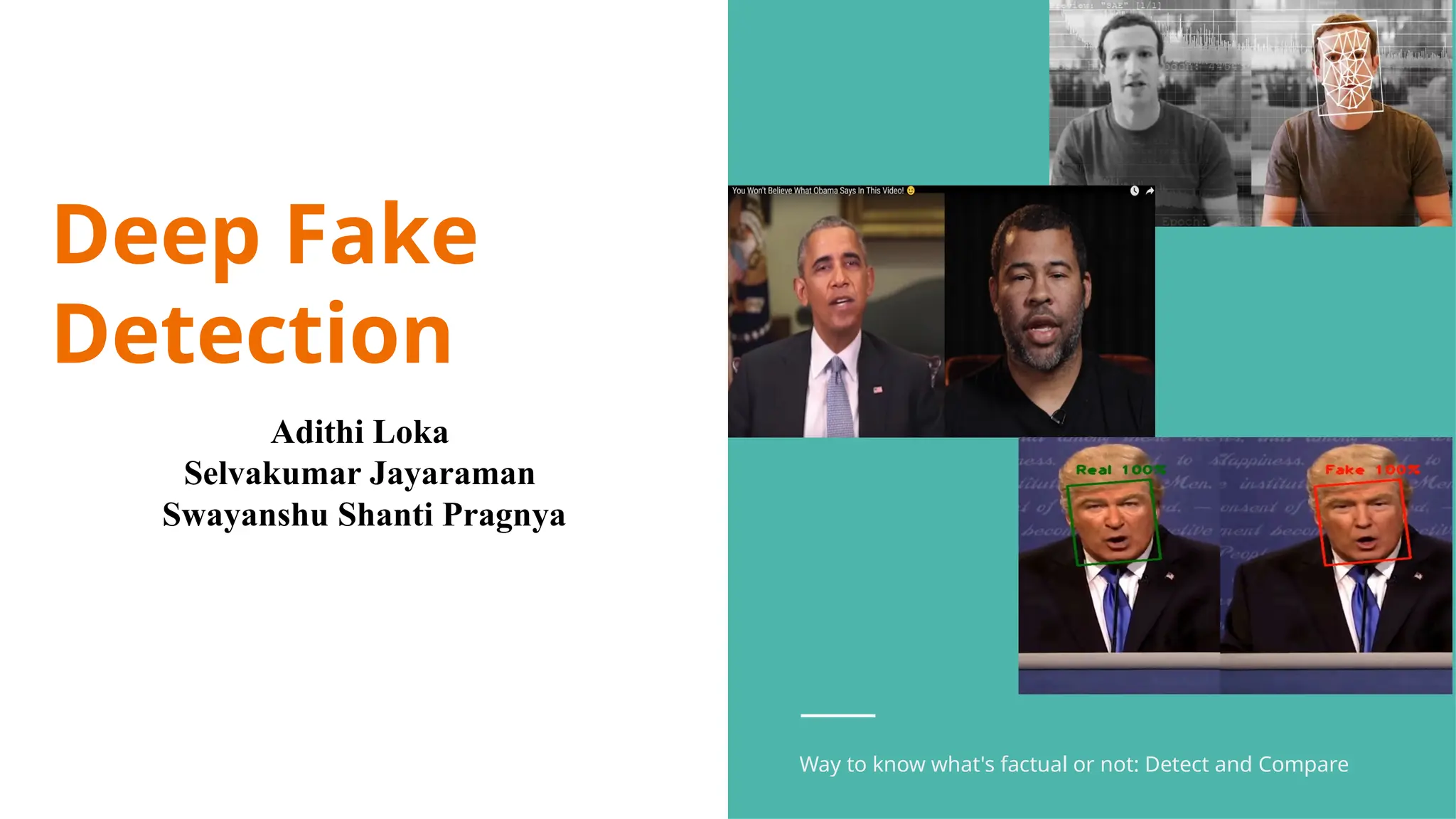
Deep Fake
Detection
Adithi Loka
Selvakumar Jayaraman
Swayanshu Shanti Pragnya
Way to know what's factual or not: Detect and Compare
Problem Statement
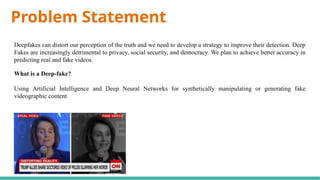
Deepfakes can distort our perception of the truth and we need to develop a strategy to improve their detection. Deep
Fakes are increasingly detrimental to privacy, social security, and democracy. We plan to achieve better accuracy in
predicting real and fake videos.
What is a Deep-fake?
Using Artificial Intelligence and Deep Neural Networks for synthetically manipulating or generating fake
videographic content
Examples-
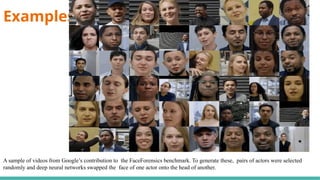
A sample of videos from Google’s contribution to the FaceForensics benchmark. To generate these, pairs of actors were selected
randomly and deep neural networks swapped the face of one actor onto the head of another.
Motivation
-Deepfakes are increasingly detrimental to privacy, social security, and democracy.
-We plan to achieve better accuracy for classifying real and fake videos.
Example-
Recently a video on social media has shown that a high ranked U.S legislator declared his own support for
an enormous tax increase. At this point, people might tend to react accordingly because the video is exactly
the same as the person by looks and voice.
This way, DeepFake content can be used to manipulate people’s opinions. So, Deepfakes detection plays a
prominent role in identifying fake content on social media.
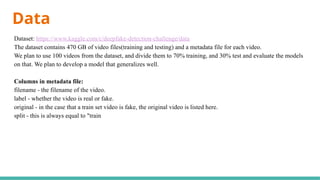
Data
Dataset: https://www.kaggle.com/c/deepfake-detection-challenge/data
The dataset contains 470 GB of video files(training and testing) and a metadata file for each video.
We plan to use 100 videos from the dataset, and divide them to 70% training, and 30% test and evaluate the models
on that. We plan to develop a model that generalizes well.
Columns in metadata file:
filename - the filename of the video.
label - whether the video is real or fake.
original - in the case that a train set video is fake, the original video is listed here.
split - this is always equal to "train
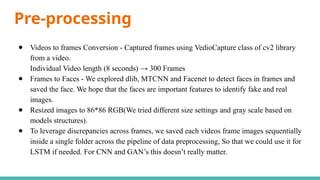
Pre-processing
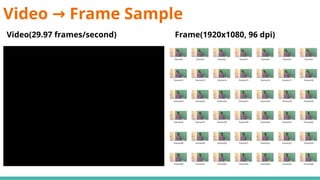
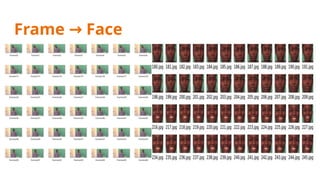
● Videos to frames Conversion - Captured frames using VedioCapture class of cv2 library
from a video.
Individual Video length (8 seconds) → 300 Frames
● Frames to Faces - We explored dlib, MTCNN and Facenet to detect faces in frames and
saved the face. We hope that the faces are important features to identify fake and real
images.
● Resized images to 86*86 RGB(We tried different size settings and gray scale based on
models structures).
● To leverage discrepancies across frames, we saved each videos frame images sequentially
inside a single folder across the pipeline of data preprocessing, So that we could use it for
LSTM if needed. For CNN and GAN’s this doesn’t really matter.
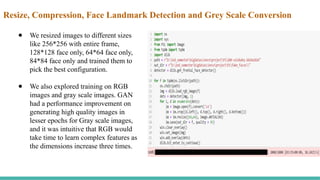
Resize, Compression, Face Landmark Detection and Grey Scale Conversion
● We resized images to different sizes
like 256*256 with entire frame,
128*128 face only, 64*64 face only,
84*84 face only and trained them to
pick the best configuration.
● We also explored training on RGB
images and gray scale images. GAN
had a performance improvement on
generating high quality images in
lesser epochs for Gray scale images,
and it was intuitive that RGB would
take time to learn complex features as
the dimensions increase three times.
Video Frame Sample
→
Video(29.97 frames/second) Frame(1920x1080, 96 dpi)
Frame Face
→
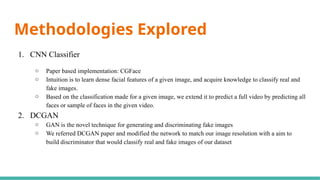
Methodologies Explored
1. CNN Classifier
○ Paper based implementation: CGFace
○ Intuition is to learn dense facial features of a given image, and acquire knowledge to classify real and
fake images.
○ Based on the classification made for a given image, we extend it to predict a full video by predicting all
faces or sample of faces in the given video.
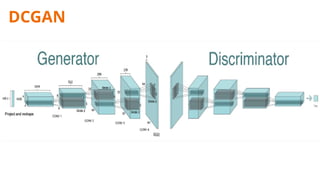
2. DCGAN
○ GAN is the novel technique for generating and discriminating fake images
○ We referred DCGAN paper and modified the network to match our image resolution with a aim to
build discriminator that would classify real and fake images of our dataset
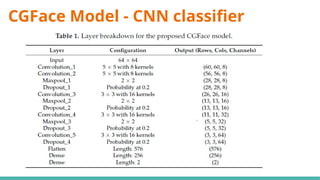
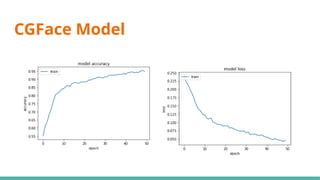
CGFace Model - CNN classifier
CGFace Model Explanation
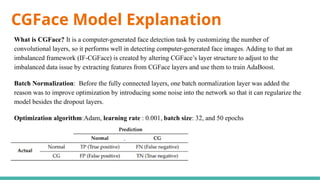
What is CGFace? It is a computer-generated face detection task by customizing the number of
convolutional layers, so it performs well in detecting computer-generated face images. Adding to that an
imbalanced framework (IF-CGFace) is created by altering CGFace’s layer structure to adjust to the
imbalanced data issue by extracting features from CGFace layers and use them to train AdaBoost.
Batch Normalization: Before the fully connected layers, one batch normalization layer was added the
reason was to improve optimization by introducing some noise into the network so that it can regularize the
model besides the dropout layers.
Optimization algorithm:Adam, learning rate : 0.001, batch size: 32, and 50 epochs
DCGAN
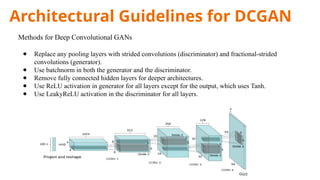
Architectural Guidelines for DCGAN
Methods for Deep Convolutional GANs
● Replace any pooling layers with strided convolutions (discriminator) and fractional-strided
convolutions (generator).
● Use batchnorm in both the generator and the discriminator.
● Remove fully connected hidden layers for deeper architectures.
● Use ReLU activation in generator for all layers except for the output, which uses Tanh.
● Use LeakyReLU activation in the discriminator for all layers.
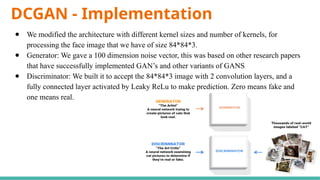
DCGAN - Implementation
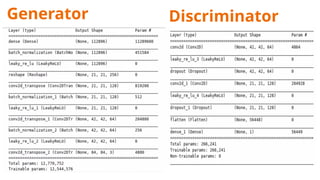
● We modified the architecture with different kernel sizes and number of kernels, for
processing the face image that we have of size 84*84*3.
● Generator: We gave a 100 dimension noise vector, this was based on other research papers
that have successfully implemented GAN’s and other variants of GANS
● Discriminator: We built it to accept the 84*84*3 image with 2 convolution layers, and a
fully connected layer activated by Leaky ReLu to make prediction. Zero means fake and
one means real.
Generator Discriminator
Method that we could not
implement
❏ Meta learning based CNN classifier
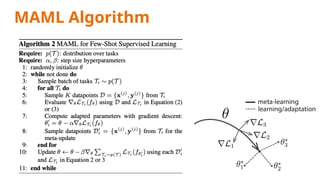
● We hoped that we could build a MAML based CNN classifier that uses previous knowledge of similar tasks,
learnt during meta training process and could generalize well to the new task with lesser samples.
● We tried different dataset as similar tasks - Male vs Female, Human vs Horse, etc., in a hope that model will
learn facial features and it would be easy to adapt to Real vs Fake class.
Problem?
● We could not find much of data, and so we did not see much of improvement in meta learning. Finally we
modified entire imagenet dataset as 2-way for meta training process(even though it does not have human
features) in a hope that model would learn binary classification of images and it could be extended. But it did
not work well too, it was memory extensive and the vm instance terminated many times during training.
MAML Algorithm
Tools
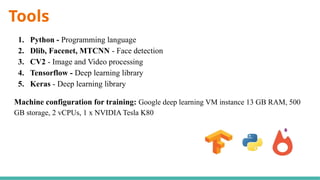
1. Python - Programming language
2. Dlib, Facenet, MTCNN - Face detection
3. CV2 - Image and Video processing
4. Tensorflow - Deep learning library
5. Keras - Deep learning library
Machine configuration for training: Google deep learning VM instance 13 GB RAM, 500
GB storage, 2 vCPUs, 1 x NVIDIA Tesla K80
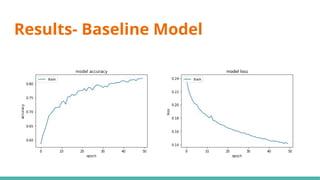
Results- Baseline Model
CGFace Model
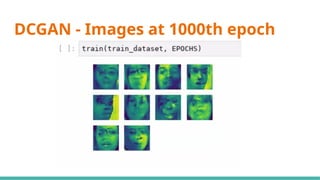
DCGAN - Images at 1000th epoch
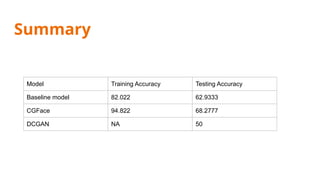
Summary
Model Training Accuracy Testing Accuracy
Baseline model 82.022 62.9333
CGFace 94.822 68.2777
DCGAN NA 50
Lessons Learned
● We hoped meta learning would require less parameter tuning and simple models would
perform well. But our assumption turns out to be wrong as for meta-training to go well, we
might have to tune the parameters well and we might have to do it dynamically too to
achieve best performance.
● We learnt that MAML++ approach overcomes this limitation to a certain extent.
● For GAN’s to perform well with high dimensional images, and to train directly on videos
using conv3d layers, we need a lot of computing resources.
● For videos, a single epoch could take up to days.
● It is always a best practice to save weights and create checkpoints during training, we
learned it the hard way as we lost our gan weights once which was trained for 2500+
epochs.
References
1. CGFace - https://www.mdpi.com/2076-3417/8/12/2610/htm
2. DCGAN - https://arxiv.org/pdf/1511.06434.pdf
3. MAML - https://arxiv.org/pdf/1703.03400.pdf
4. Blink detection network using CNN and LSTM - https://arxiv.org/pdf/1806.02877.pdf
5. Recurrent Convolutional Strategies for Face Manipulation Detection in Videos -
https://arxiv.org/pdf/1905.00582.pdf
6. Deep Learning Based Computer Generated Face Identification Using Convolutional Neural
Network(CGFace) - https://www.mdpi.com/2076-3417/8/12/2610/htm
7. MesoNet: a Compact Facial Video Forgery Detection Network -
https://hal-upec-upem.archives-ouvertes.fr/hal-01867298/document

deep fake detection deep fake detection a

  • 1.
    Deep Fake Detection Adithi Loka SelvakumarJayaraman Swayanshu Shanti Pragnya Way to know what's factual or not: Detect and Compare
  • 2.
    Problem Statement Deepfakes candistort our perception of the truth and we need to develop a strategy to improve their detection. Deep Fakes are increasingly detrimental to privacy, social security, and democracy. We plan to achieve better accuracy in predicting real and fake videos. What is a Deep-fake? Using Artificial Intelligence and Deep Neural Networks for synthetically manipulating or generating fake videographic content
  • 3.
    Examples- A sample ofvideos from Google’s contribution to the FaceForensics benchmark. To generate these, pairs of actors were selected randomly and deep neural networks swapped the face of one actor onto the head of another.
  • 4.
    Motivation -Deepfakes are increasinglydetrimental to privacy, social security, and democracy. -We plan to achieve better accuracy for classifying real and fake videos. Example- Recently a video on social media has shown that a high ranked U.S legislator declared his own support for an enormous tax increase. At this point, people might tend to react accordingly because the video is exactly the same as the person by looks and voice. This way, DeepFake content can be used to manipulate people’s opinions. So, Deepfakes detection plays a prominent role in identifying fake content on social media.
  • 5.
    Data Dataset: https://www.kaggle.com/c/deepfake-detection-challenge/data The datasetcontains 470 GB of video files(training and testing) and a metadata file for each video. We plan to use 100 videos from the dataset, and divide them to 70% training, and 30% test and evaluate the models on that. We plan to develop a model that generalizes well. Columns in metadata file: filename - the filename of the video. label - whether the video is real or fake. original - in the case that a train set video is fake, the original video is listed here. split - this is always equal to "train
  • 6.
    Pre-processing ● Videos toframes Conversion - Captured frames using VedioCapture class of cv2 library from a video. Individual Video length (8 seconds) → 300 Frames ● Frames to Faces - We explored dlib, MTCNN and Facenet to detect faces in frames and saved the face. We hope that the faces are important features to identify fake and real images. ● Resized images to 86*86 RGB(We tried different size settings and gray scale based on models structures). ● To leverage discrepancies across frames, we saved each videos frame images sequentially inside a single folder across the pipeline of data preprocessing, So that we could use it for LSTM if needed. For CNN and GAN’s this doesn’t really matter.
  • 7.
    Resize, Compression, FaceLandmark Detection and Grey Scale Conversion ● We resized images to different sizes like 256*256 with entire frame, 128*128 face only, 64*64 face only, 84*84 face only and trained them to pick the best configuration. ● We also explored training on RGB images and gray scale images. GAN had a performance improvement on generating high quality images in lesser epochs for Gray scale images, and it was intuitive that RGB would take time to learn complex features as the dimensions increase three times.
  • 8.
    Video Frame Sample → Video(29.97frames/second) Frame(1920x1080, 96 dpi)
  • 9.
  • 10.
    Methodologies Explored 1. CNNClassifier ○ Paper based implementation: CGFace ○ Intuition is to learn dense facial features of a given image, and acquire knowledge to classify real and fake images. ○ Based on the classification made for a given image, we extend it to predict a full video by predicting all faces or sample of faces in the given video. 2. DCGAN ○ GAN is the novel technique for generating and discriminating fake images ○ We referred DCGAN paper and modified the network to match our image resolution with a aim to build discriminator that would classify real and fake images of our dataset
  • 11.
    CGFace Model -CNN classifier
  • 12.
    CGFace Model Explanation Whatis CGFace? It is a computer-generated face detection task by customizing the number of convolutional layers, so it performs well in detecting computer-generated face images. Adding to that an imbalanced framework (IF-CGFace) is created by altering CGFace’s layer structure to adjust to the imbalanced data issue by extracting features from CGFace layers and use them to train AdaBoost. Batch Normalization: Before the fully connected layers, one batch normalization layer was added the reason was to improve optimization by introducing some noise into the network so that it can regularize the model besides the dropout layers. Optimization algorithm:Adam, learning rate : 0.001, batch size: 32, and 50 epochs
  • 13.
  • 14.
    Architectural Guidelines forDCGAN Methods for Deep Convolutional GANs ● Replace any pooling layers with strided convolutions (discriminator) and fractional-strided convolutions (generator). ● Use batchnorm in both the generator and the discriminator. ● Remove fully connected hidden layers for deeper architectures. ● Use ReLU activation in generator for all layers except for the output, which uses Tanh. ● Use LeakyReLU activation in the discriminator for all layers.
  • 15.
    DCGAN - Implementation ●We modified the architecture with different kernel sizes and number of kernels, for processing the face image that we have of size 84*84*3. ● Generator: We gave a 100 dimension noise vector, this was based on other research papers that have successfully implemented GAN’s and other variants of GANS ● Discriminator: We built it to accept the 84*84*3 image with 2 convolution layers, and a fully connected layer activated by Leaky ReLu to make prediction. Zero means fake and one means real.
  • 16.
  • 17.
    Method that wecould not implement ❏ Meta learning based CNN classifier ● We hoped that we could build a MAML based CNN classifier that uses previous knowledge of similar tasks, learnt during meta training process and could generalize well to the new task with lesser samples. ● We tried different dataset as similar tasks - Male vs Female, Human vs Horse, etc., in a hope that model will learn facial features and it would be easy to adapt to Real vs Fake class. Problem? ● We could not find much of data, and so we did not see much of improvement in meta learning. Finally we modified entire imagenet dataset as 2-way for meta training process(even though it does not have human features) in a hope that model would learn binary classification of images and it could be extended. But it did not work well too, it was memory extensive and the vm instance terminated many times during training.
  • 18.
  • 19.
    Tools 1. Python -Programming language 2. Dlib, Facenet, MTCNN - Face detection 3. CV2 - Image and Video processing 4. Tensorflow - Deep learning library 5. Keras - Deep learning library Machine configuration for training: Google deep learning VM instance 13 GB RAM, 500 GB storage, 2 vCPUs, 1 x NVIDIA Tesla K80
  • 20.
  • 21.
  • 22.
    DCGAN - Imagesat 1000th epoch
  • 23.
    Summary Model Training AccuracyTesting Accuracy Baseline model 82.022 62.9333 CGFace 94.822 68.2777 DCGAN NA 50
  • 24.
    Lessons Learned ● Wehoped meta learning would require less parameter tuning and simple models would perform well. But our assumption turns out to be wrong as for meta-training to go well, we might have to tune the parameters well and we might have to do it dynamically too to achieve best performance. ● We learnt that MAML++ approach overcomes this limitation to a certain extent. ● For GAN’s to perform well with high dimensional images, and to train directly on videos using conv3d layers, we need a lot of computing resources. ● For videos, a single epoch could take up to days. ● It is always a best practice to save weights and create checkpoints during training, we learned it the hard way as we lost our gan weights once which was trained for 2500+ epochs.
  • 25.
    References 1. CGFace -https://www.mdpi.com/2076-3417/8/12/2610/htm 2. DCGAN - https://arxiv.org/pdf/1511.06434.pdf 3. MAML - https://arxiv.org/pdf/1703.03400.pdf 4. Blink detection network using CNN and LSTM - https://arxiv.org/pdf/1806.02877.pdf 5. Recurrent Convolutional Strategies for Face Manipulation Detection in Videos - https://arxiv.org/pdf/1905.00582.pdf 6. Deep Learning Based Computer Generated Face Identification Using Convolutional Neural Network(CGFace) - https://www.mdpi.com/2076-3417/8/12/2610/htm 7. MesoNet: a Compact Facial Video Forgery Detection Network - https://hal-upec-upem.archives-ouvertes.fr/hal-01867298/document