DHANALAKASHMI SRINIVASAN
COLLEGE OF ENGINEERING AND
TECHNOLOGY
ELECTRONICS AND COMMUNICATION ENGINEERING
EC3711 Summer Internship
AI BASED DEEPFAKE DETECTION SYSTEM
Name : Vignesh D
Reg.No :310521106072
Company Name : VEI TECHNOLOGIES
Organization Overview
Title - Artificial Intelligence.
Organization - VEI Technology of Private Limited.
Place -Mudichur , Chennai
Date - 15-07-2024 to 16-08-2024
• Deepfakes are synthetic media—whether in the form of videos, images, or audio
—created using deep learning techniques, particularly Generative Adversarial
Networks (GANs), to manipulate or fabricate content.
• These manipulated media often appear disturbingly realistic and can be used for
malicious purposes such as spreading misinformation, creating fake news, or
committing identity theft.
Project Overview
• The rise of deepfake technology has led to a significant challenge in verifying the
authenticity of digital content.
• In an age where media is consumed rapidly and frequently on social platforms,
distinguishing real from fake content is becoming more difficult.
• Traditional methods for detecting deepfakes are either inefficient, manual, or
prone to error.
• This makes it necessary to develop more accurate, scalable, and automated
solutions using AI and machine learning
Problem Statement
❖ To design and implement an advanced deepfake detection system capable
of accurately identifying manipulated or synthetic media (images, videos,
or audio) using state-of-the-art machine learning techniques. The system
aims to enhance digital content integrity, mitigate misinformation, and
provide a reliable tool for applications in cybersecurity, media verification,
and law enforcement.
Objective of the Project
• Deepfakes have become a potent tool for creating and spreading
misinformation, which can have far-reaching consequences in society,
especially in areas like politics, elections, and public discourse.
• News Integrity
• Trust in Digital
Project Significance
• The methodology for developing an AI-Based Deepfake Detection System is
divided into several key stages:
• data collection
• preprocessing
• feature extraction
• model development
• training and
• evaluation
Methodology for AI-Based Deepfake Detection System
Objective: Gather datasets containing both real and deepfake media
(images, videos, audio).
• Tools/Technologies:
1. Public datasets like DeepFake Detection Challenge (DFDC),
FaceForensics++, Google’s DeepFake Dataset, and CelebA (for
facial images).
2. Web scraping tools
Data Collection and Dataset Selection
• Objective: Clean and prepare data for model input. This includes face
detection and alignment, audio preprocessing, and splitting the data into
training and testing sets.
• Tools/Technologies:
1. OpenCV and dlib for face detection
2. Librosa and PyDub for audio
3. NumPy and Pandas
Data Preprocessing
• Objective: Extract relevant features from both visual and audio data that
can be used by machine learning models for classification.
• Tools/Technologies:
1. Convolutional Neural Networks (CNNs)
2. Pre-trained models like VGG16, ResNet50
3. Spectrogram analysis using Librosa to extract audio.
Feature Extraction
• Objective: Train deep learning models to detect deepfakes by leveraging
extracted features from video and audio.
• Tools/Technologies:
1. Deep Learning Frameworks
2. Convolutional Neural Networks (CNNs
3. Recurrent Neural Networks (RNNs) or LSTMs
4. Transfer Learning
Model Selection and Training
• Objective: Evaluate the performance of the trained model using standard
metrics such as accuracy, precision, recall, and F1-score.
• Tools/Technologies:
1. Scikit-learn
2. TensorBoard
Model Evaluation
Objective: Deploy the trained model for real-time media analysis via a user-
friendly interface.
Tools/Technologies:
• Flask/Django
• TensorFlow.js
• Cloud Platforms
Real-Time Deployment and Application
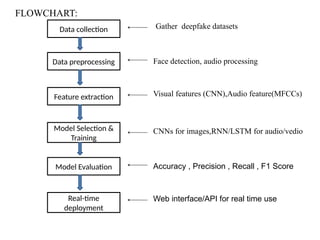
Gather deepfake datasets
Data preprocessing
Feature extraction
Model Selection &
Training
Model Evaluation
Real-time
deployment
Data collection
Face detection, audio processing
Visual features (CNN),Audio feature(MFCCs)
CNNs for images,RNN/LSTM for audio/vedio
Accuracy , Precision , Recall , F1 Score
Web interface/API for real time use
FLOWCHART:
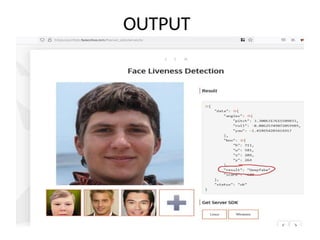
OUTPUT
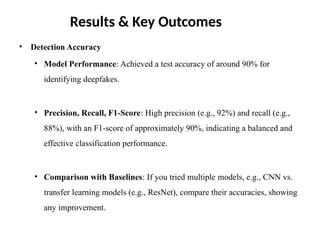
• Detection Accuracy
• Model Performance: Achieved a test accuracy of around 90% for
identifying deepfakes.
• Precision, Recall, F1-Score: High precision (e.g., 92%) and recall (e.g.,
88%), with an F1-score of approximately 90%, indicating a balanced and
effective classification performance.
• Comparison with Baselines: If you tried multiple models, e.g., CNN vs.
transfer learning models (e.g., ResNet), compare their accuracies, showing
any improvement.
Results & Key Outcomes
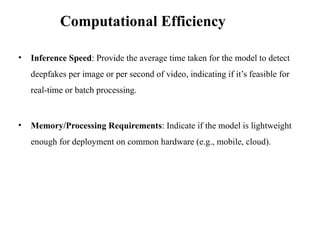
• Inference Speed: Provide the average time taken for the model to detect
deepfakes per image or per second of video, indicating if it’s feasible for
real-time or batch processing.
• Memory/Processing Requirements: Indicate if the model is lightweight
enough for deployment on common hardware (e.g., mobile, cloud).
Computational Efficiency
• This project successfully developed an AI-based deepfake detection
system with promising accuracy, showcasing the potential of deep
learning to counter the challenges posed by deepfakes.
• The model performed well on standard datasets, effectively
distinguishing between real and fake media, but encountered some
limitations with high-quality deepfakes.
Conclusion
• Enhanced Model Architectures: Implement advanced models like
transfer learning or hybrid techniques to improve accuracy and robustness.
• Real-time Detection: Optimize the model for real-time deployment in
applications like social media monitoring or video conferencing.
• Cross-Domain Testing: Expand testing to diverse datasets and deepfake
types, ensuring the model generalizes well across different sources and
environments.
Future Scope
Thank you for
your time

t.pptx is a ppt for DDS and software applications

  • 1.
    DHANALAKASHMI SRINIVASAN COLLEGE OFENGINEERING AND TECHNOLOGY ELECTRONICS AND COMMUNICATION ENGINEERING EC3711 Summer Internship AI BASED DEEPFAKE DETECTION SYSTEM Name : Vignesh D Reg.No :310521106072 Company Name : VEI TECHNOLOGIES
  • 2.
    Organization Overview Title -Artificial Intelligence. Organization - VEI Technology of Private Limited. Place -Mudichur , Chennai Date - 15-07-2024 to 16-08-2024
  • 3.
    • Deepfakes aresynthetic media—whether in the form of videos, images, or audio —created using deep learning techniques, particularly Generative Adversarial Networks (GANs), to manipulate or fabricate content. • These manipulated media often appear disturbingly realistic and can be used for malicious purposes such as spreading misinformation, creating fake news, or committing identity theft. Project Overview
  • 4.
    • The riseof deepfake technology has led to a significant challenge in verifying the authenticity of digital content. • In an age where media is consumed rapidly and frequently on social platforms, distinguishing real from fake content is becoming more difficult. • Traditional methods for detecting deepfakes are either inefficient, manual, or prone to error. • This makes it necessary to develop more accurate, scalable, and automated solutions using AI and machine learning Problem Statement
  • 5.
    ❖ To designand implement an advanced deepfake detection system capable of accurately identifying manipulated or synthetic media (images, videos, or audio) using state-of-the-art machine learning techniques. The system aims to enhance digital content integrity, mitigate misinformation, and provide a reliable tool for applications in cybersecurity, media verification, and law enforcement. Objective of the Project
  • 6.
    • Deepfakes havebecome a potent tool for creating and spreading misinformation, which can have far-reaching consequences in society, especially in areas like politics, elections, and public discourse. • News Integrity • Trust in Digital Project Significance
  • 7.
    • The methodologyfor developing an AI-Based Deepfake Detection System is divided into several key stages: • data collection • preprocessing • feature extraction • model development • training and • evaluation Methodology for AI-Based Deepfake Detection System
  • 8.
    Objective: Gather datasetscontaining both real and deepfake media (images, videos, audio). • Tools/Technologies: 1. Public datasets like DeepFake Detection Challenge (DFDC), FaceForensics++, Google’s DeepFake Dataset, and CelebA (for facial images). 2. Web scraping tools Data Collection and Dataset Selection
  • 9.
    • Objective: Cleanand prepare data for model input. This includes face detection and alignment, audio preprocessing, and splitting the data into training and testing sets. • Tools/Technologies: 1. OpenCV and dlib for face detection 2. Librosa and PyDub for audio 3. NumPy and Pandas Data Preprocessing
  • 10.
    • Objective: Extractrelevant features from both visual and audio data that can be used by machine learning models for classification. • Tools/Technologies: 1. Convolutional Neural Networks (CNNs) 2. Pre-trained models like VGG16, ResNet50 3. Spectrogram analysis using Librosa to extract audio. Feature Extraction
  • 11.
    • Objective: Traindeep learning models to detect deepfakes by leveraging extracted features from video and audio. • Tools/Technologies: 1. Deep Learning Frameworks 2. Convolutional Neural Networks (CNNs 3. Recurrent Neural Networks (RNNs) or LSTMs 4. Transfer Learning Model Selection and Training
  • 12.
    • Objective: Evaluatethe performance of the trained model using standard metrics such as accuracy, precision, recall, and F1-score. • Tools/Technologies: 1. Scikit-learn 2. TensorBoard Model Evaluation
  • 13.
    Objective: Deploy thetrained model for real-time media analysis via a user- friendly interface. Tools/Technologies: • Flask/Django • TensorFlow.js • Cloud Platforms Real-Time Deployment and Application
  • 14.
    Gather deepfake datasets Datapreprocessing Feature extraction Model Selection & Training Model Evaluation Real-time deployment Data collection Face detection, audio processing Visual features (CNN),Audio feature(MFCCs) CNNs for images,RNN/LSTM for audio/vedio Accuracy , Precision , Recall , F1 Score Web interface/API for real time use FLOWCHART:
  • 15.
  • 16.
    • Detection Accuracy •Model Performance: Achieved a test accuracy of around 90% for identifying deepfakes. • Precision, Recall, F1-Score: High precision (e.g., 92%) and recall (e.g., 88%), with an F1-score of approximately 90%, indicating a balanced and effective classification performance. • Comparison with Baselines: If you tried multiple models, e.g., CNN vs. transfer learning models (e.g., ResNet), compare their accuracies, showing any improvement. Results & Key Outcomes
  • 17.
    • Inference Speed:Provide the average time taken for the model to detect deepfakes per image or per second of video, indicating if it’s feasible for real-time or batch processing. • Memory/Processing Requirements: Indicate if the model is lightweight enough for deployment on common hardware (e.g., mobile, cloud). Computational Efficiency
  • 18.
    • This projectsuccessfully developed an AI-based deepfake detection system with promising accuracy, showcasing the potential of deep learning to counter the challenges posed by deepfakes. • The model performed well on standard datasets, effectively distinguishing between real and fake media, but encountered some limitations with high-quality deepfakes. Conclusion
  • 19.
    • Enhanced ModelArchitectures: Implement advanced models like transfer learning or hybrid techniques to improve accuracy and robustness. • Real-time Detection: Optimize the model for real-time deployment in applications like social media monitoring or video conferencing. • Cross-Domain Testing: Expand testing to diverse datasets and deepfake types, ensuring the model generalizes well across different sources and environments. Future Scope
  • 20.