November 4, 2016
DEEPDGA: ADVERSARIALLY-TUNED
DOMAIN GENERATION AND DETECTION
Bobby Filar -> @filar
Hyrum Anderson
Jonathan Woodbridge
AISec2016
Outline
§ Motivation
§ Background
§ DeepDGA Architecture
§ Experiment(s) Setup
§ Results
§ Future Work
2
Motivations
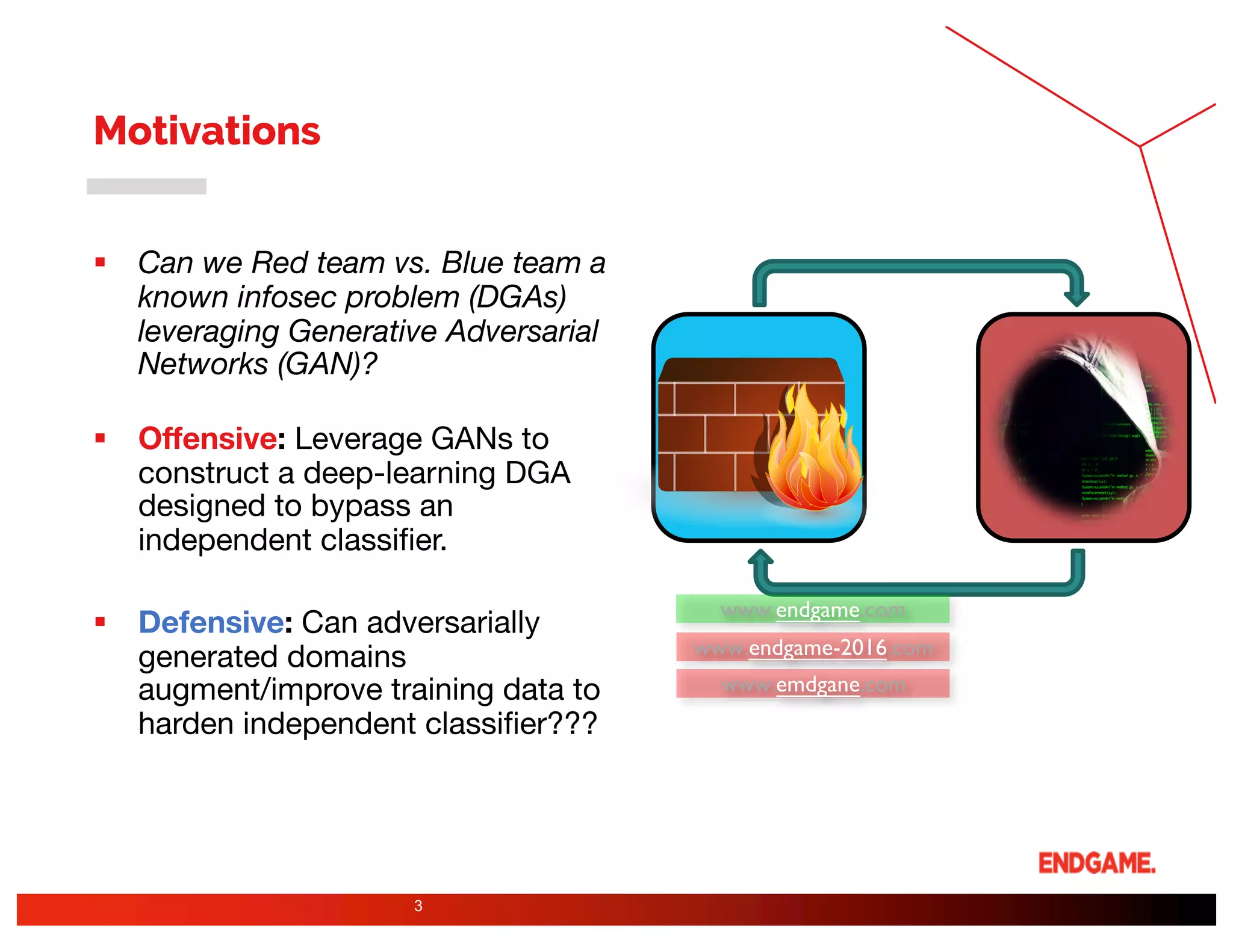
§ Can we Red team vs. Blue team a
known infosec problem (DGAs)
leveraging Generative Adversarial
Networks (GAN)?
§ Offensive: Leverage GANs to
construct a deep-learning DGA
designed to bypass an
independent classifier.
§ Defensive: Can adversarially
generated domains
augment/improve training data to
harden independent classifier???
3
www.endgame.com
www.endgame-2016.com
www.emdgane.com
Related Work
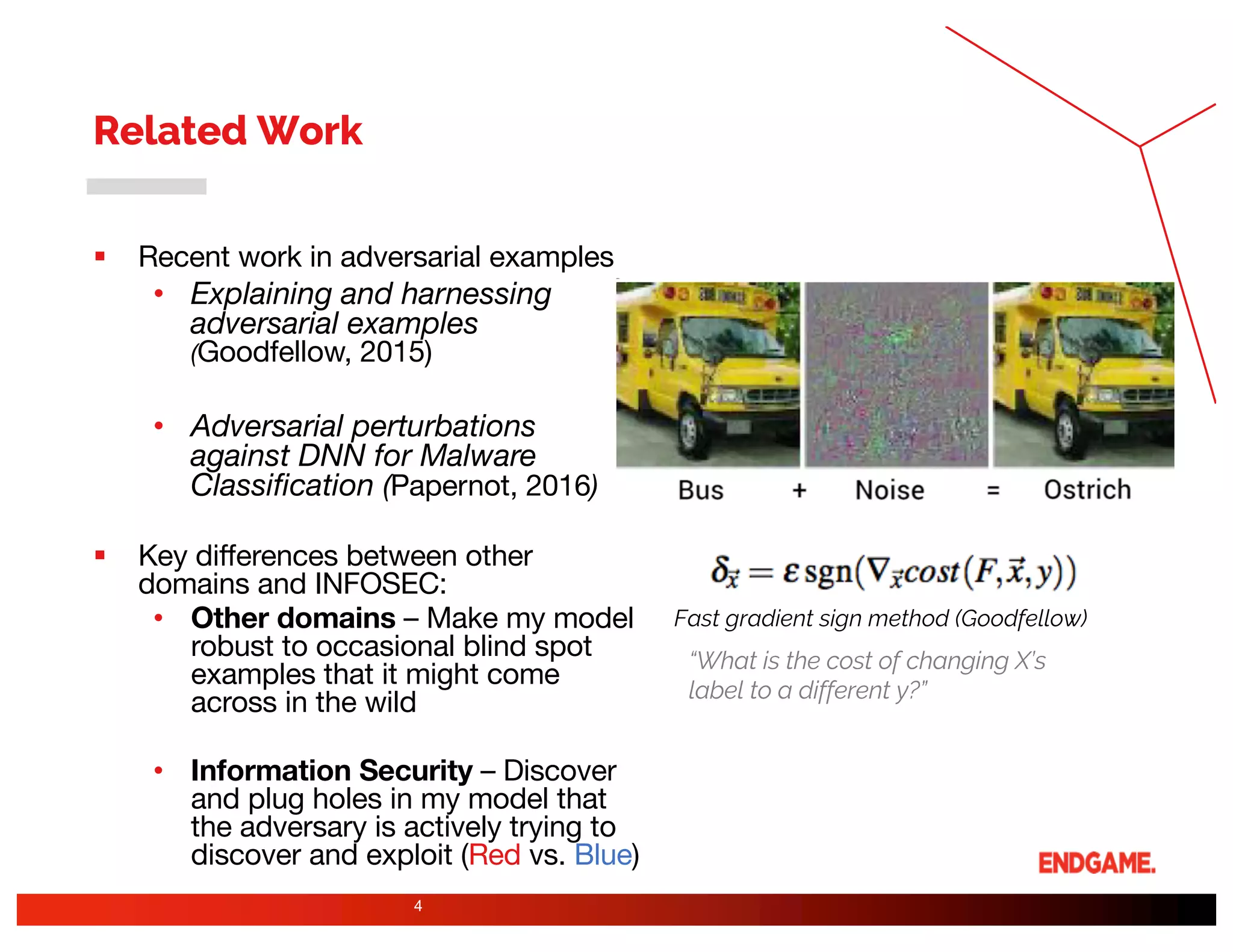
§ Recent work in adversarial examples
• Explaining and harnessing
adversarial examples
(Goodfellow, 2015)
• Adversarial perturbations
against DNN for Malware
Classification (Papernot, 2016)
§ Key differences between other
domains and INFOSEC:
• Other domains – Make my model
robust to occasional blind spot
examples that it might come
across in the wild
• Information Security – Discover
and plug holes in my model that
the adversary is actively trying to
discover and exploit (Red vs. Blue)
4
Fast gradient sign method (Goodfellow)
“What is the cost of changing X’s
label to a different y?”
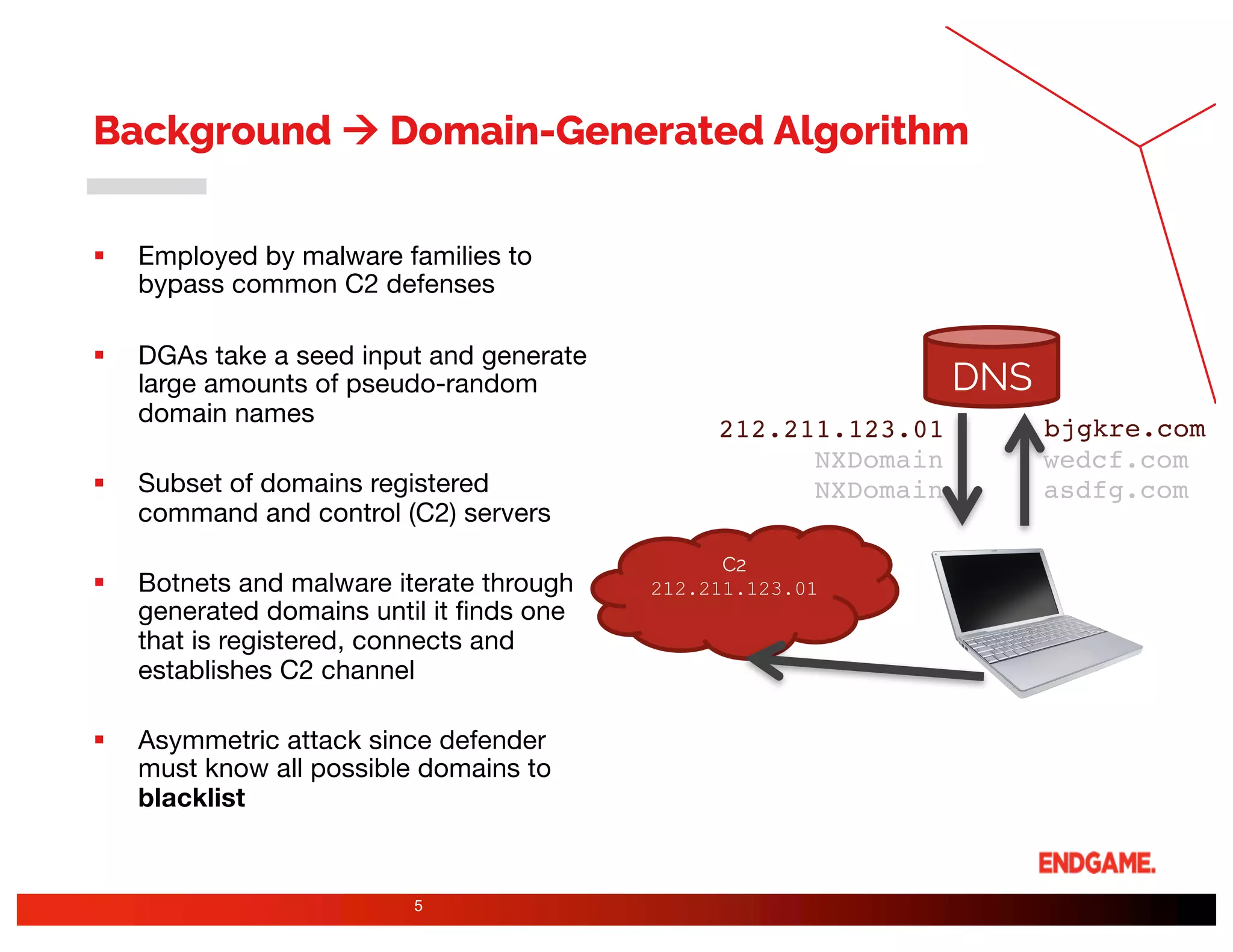
Background à Domain-Generated Algorithm
§ Employed by malware families to
bypass common C2 defenses
§ DGAs take a seed input and generate
large amounts of pseudo-random
domain names
§ Subset of domains registered
command and control (C2) servers
§ Botnets and malware iterate through
generated domains until it finds one
that is registered, connects and
establishes C2 channel
§ Asymmetric attack since defender
must know all possible domains to
blacklist
5
DNS
C2
212.211.123.01
bjgkre.com212.211.123.01
NXDomain wedcf.com
NXDomain asdfg.com
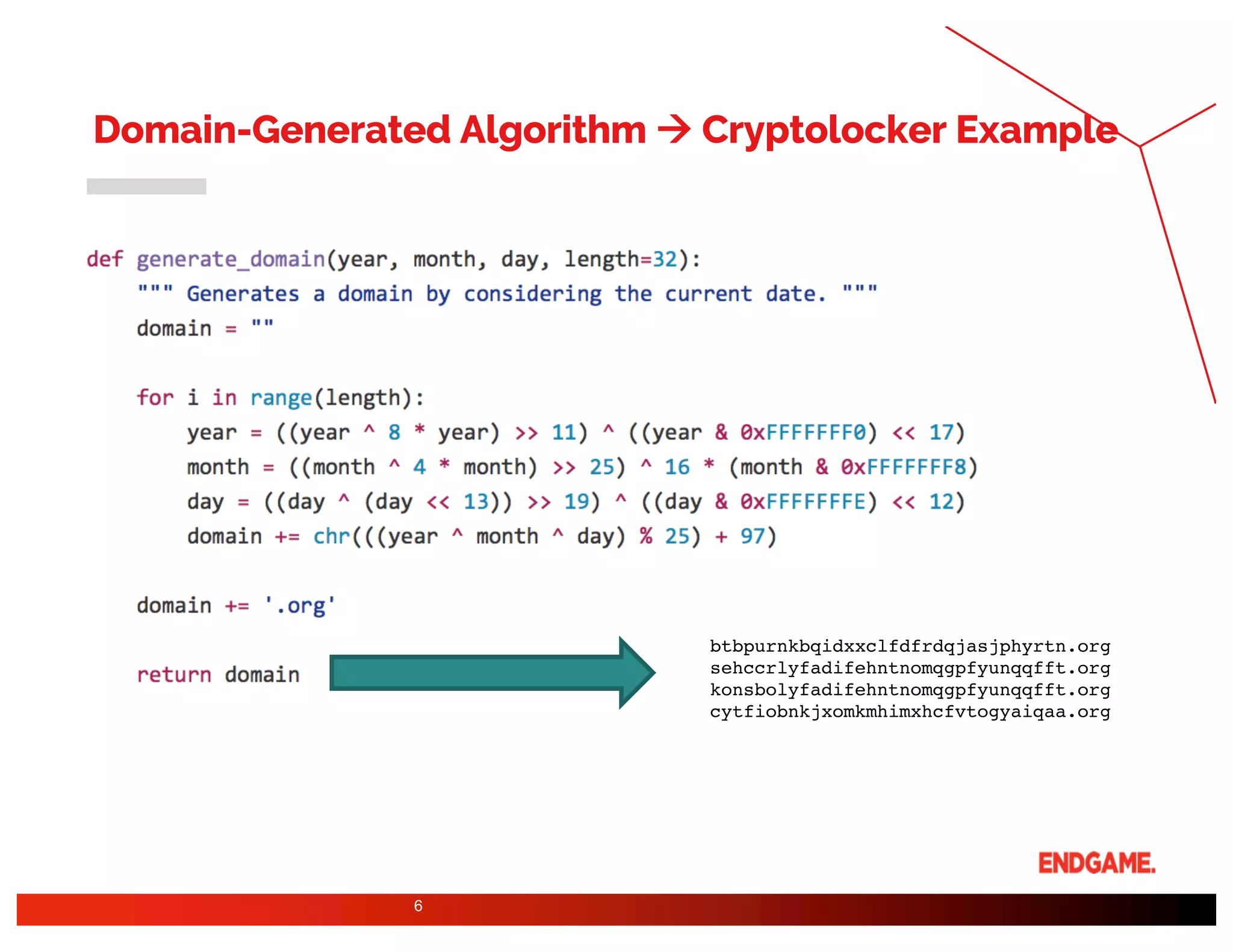
Domain-Generated Algorithm à Cryptolocker Example
btbpurnkbqidxxclfdfrdqjasjphyrtn.org
sehccrlyfadifehntnomqgpfyunqqfft.org
konsbolyfadifehntnomqgpfyunqqfft.org
cytfiobnkjxomkmhimxhcfvtogyaiqaa.org
6
Domain-Generated Algorithm à Character Distributions
7
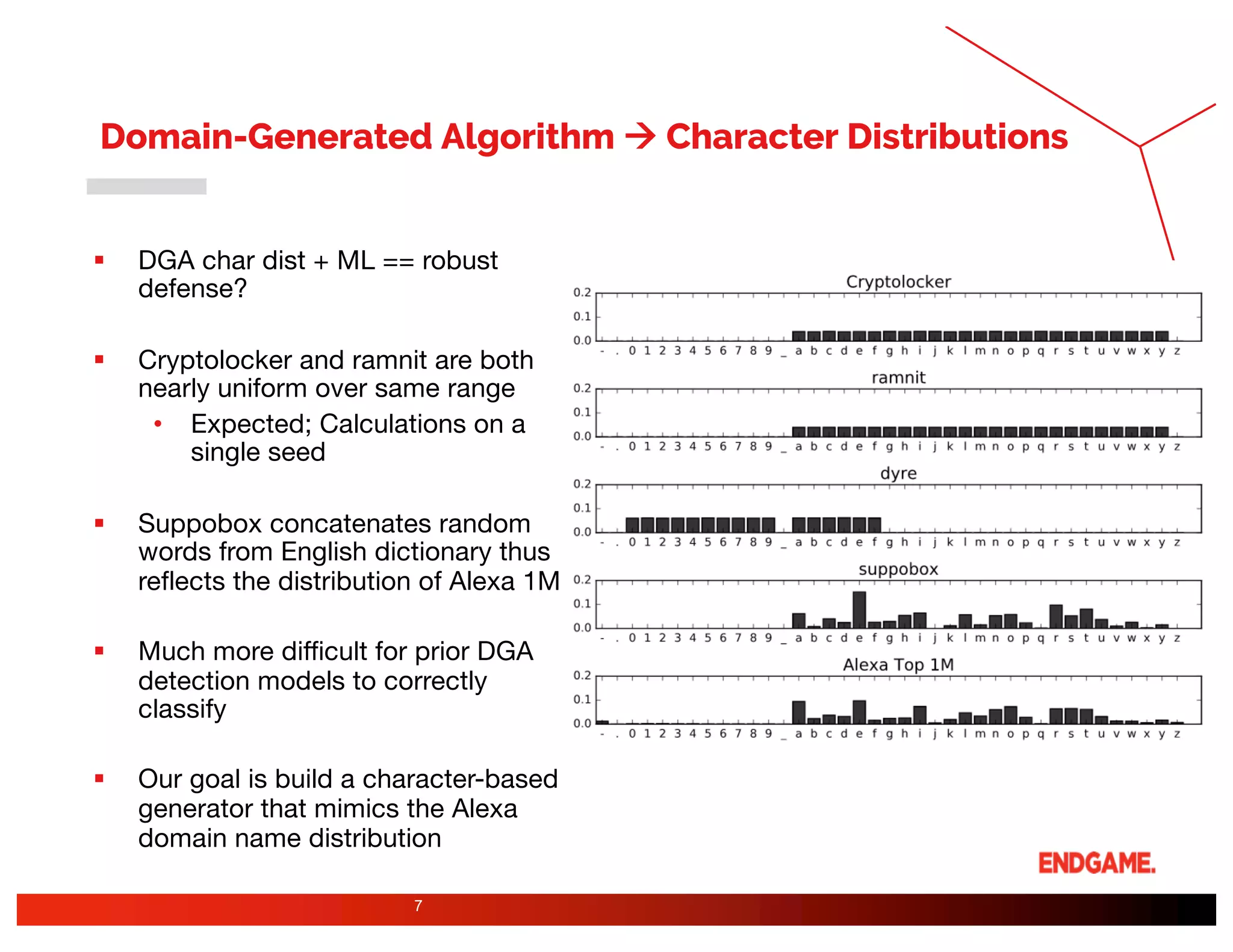
§ DGA char dist + ML == robust
defense?
§ Cryptolocker and ramnit are both
nearly uniform over same range
• Expected; Calculations on a
single seed
§ Suppobox concatenates random
words from English dictionary thus
reflects the distribution of Alexa 1M
§ Much more difficult for prior DGA
detection models to correctly
classify
§ Our goal is build a character-based
generator that mimics the Alexa
domain name distribution
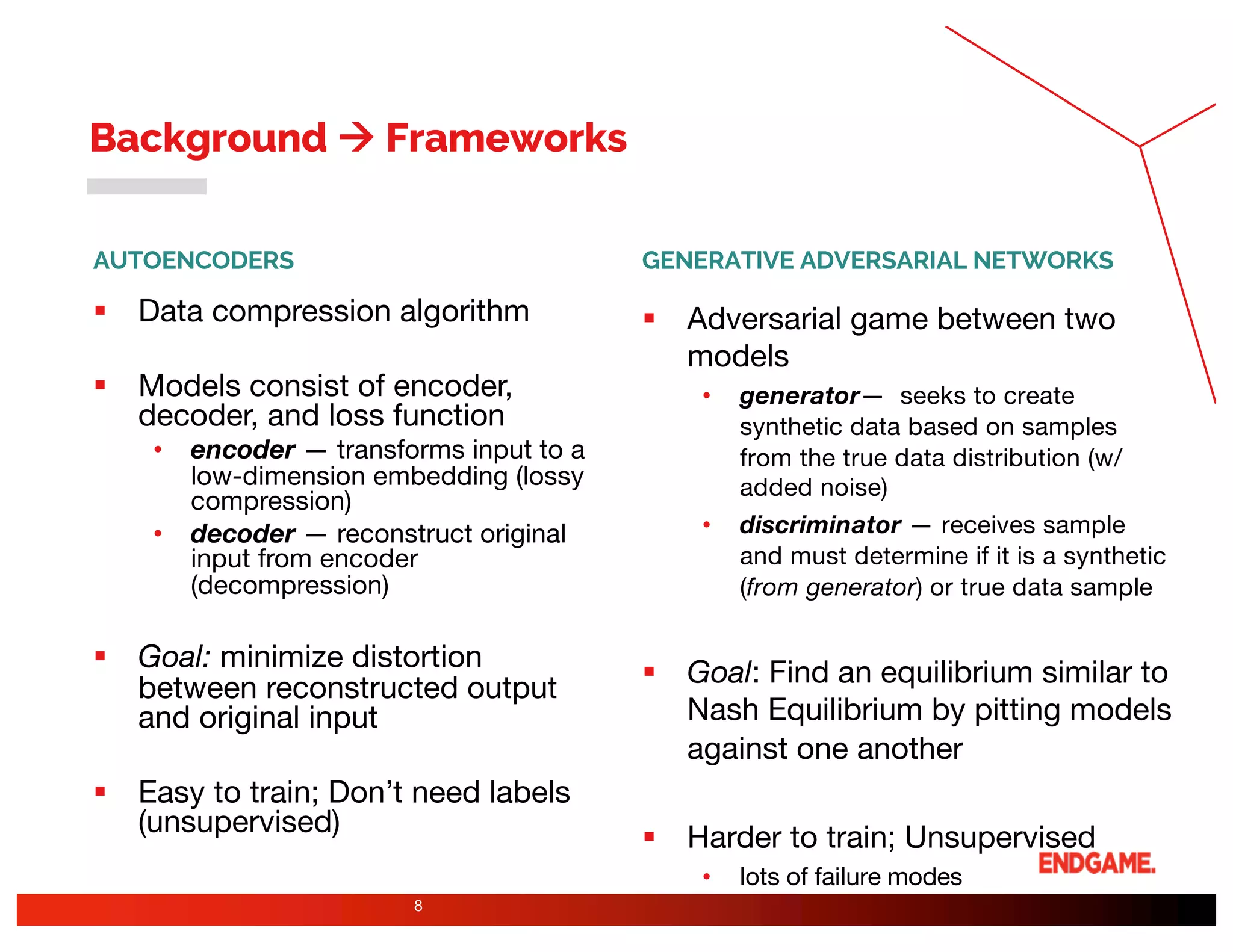
AUTOENCODERS
§ Data compression algorithm
§ Models consist of encoder,
decoder, and loss function
• encoder — transforms input to a
low-dimension embedding (lossy
compression)
• decoder — reconstruct original
input from encoder
(decompression)
§ Goal: minimize distortion
between reconstructed output
and original input
§ Easy to train; Don’t need labels
(unsupervised)
GENERATIVE ADVERSARIAL NETWORKS
§ Adversarial game between two
models
• generator— seeks to create
synthetic data based on samples
from the true data distribution (w/
added noise)
• discriminator — receives sample
and must determine if it is a synthetic
(from generator) or true data sample
§ Goal: Find an equilibrium similar to
Nash Equilibrium by pitting models
against one another
§ Harder to train; Unsupervised
• lots of failure modes
8
Background à Frameworks
DeepDGA Architecture
DeepDGA à Autoencoder à Encoder
§ Encoder architecture taken from [Kim et
al, 2015], found useful in character-level
language modeling
§ Embedding learns linear mapping for
each valid domain character (20
dimension space)
§ Convolutions filters applied to capture
character combos (bi/trigrams)
§ Max-pooling over-time & over-filter
• Gather fixed-representation
§ Highway Network à LSTM
10
Learn the right representation of Alexa domains
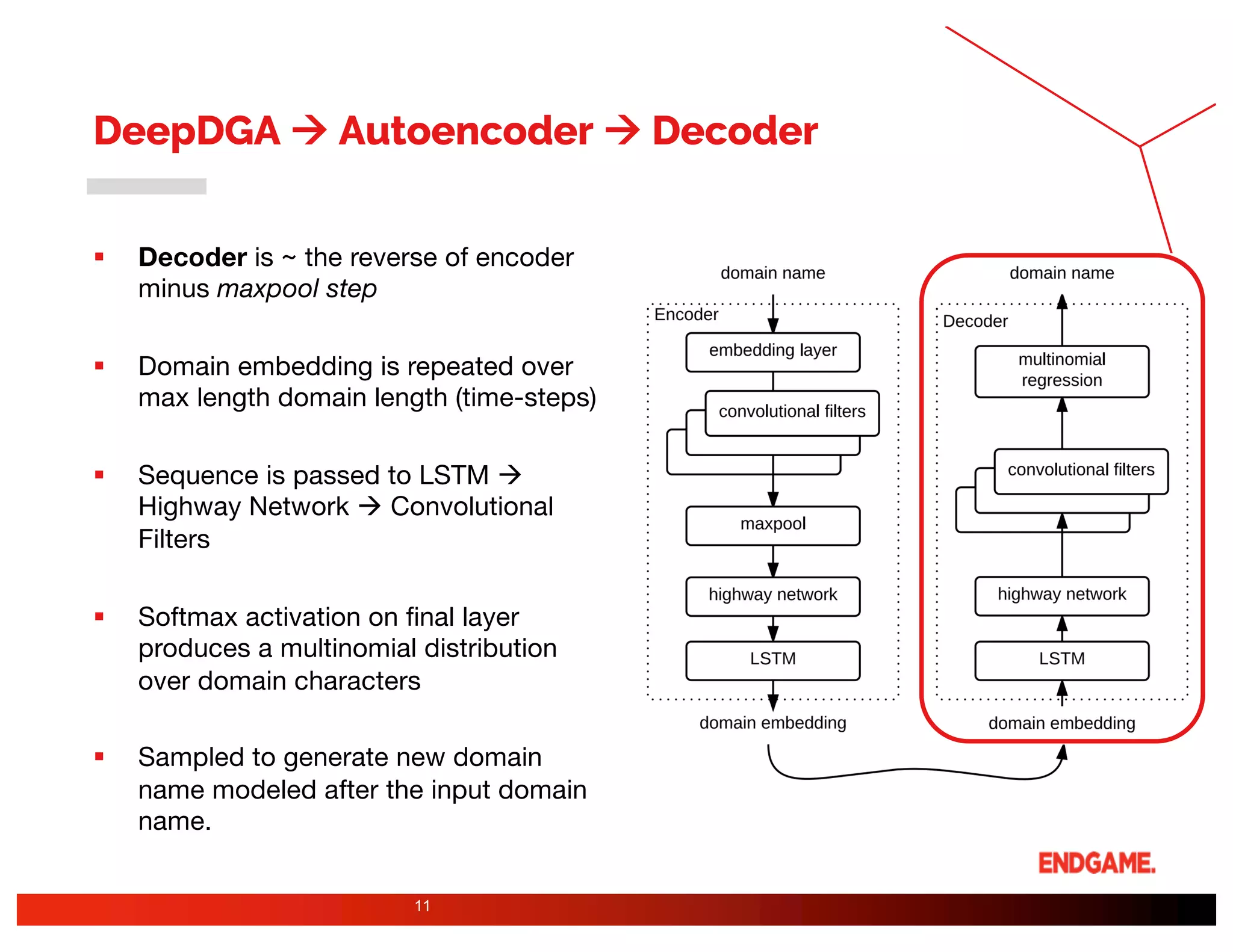
DeepDGA à Autoencoder à Decoder
§ Decoder is ~ the reverse of encoder
minus maxpool step
§ Domain embedding is repeated over
max length domain length (time-steps)
§ Sequence is passed to LSTM à
Highway Network à Convolutional
Filters
§ Softmax activation on final layer
produces a multinomial distribution
over domain characters
§ Sampled to generate new domain
name modeled after the input domain
name.
11
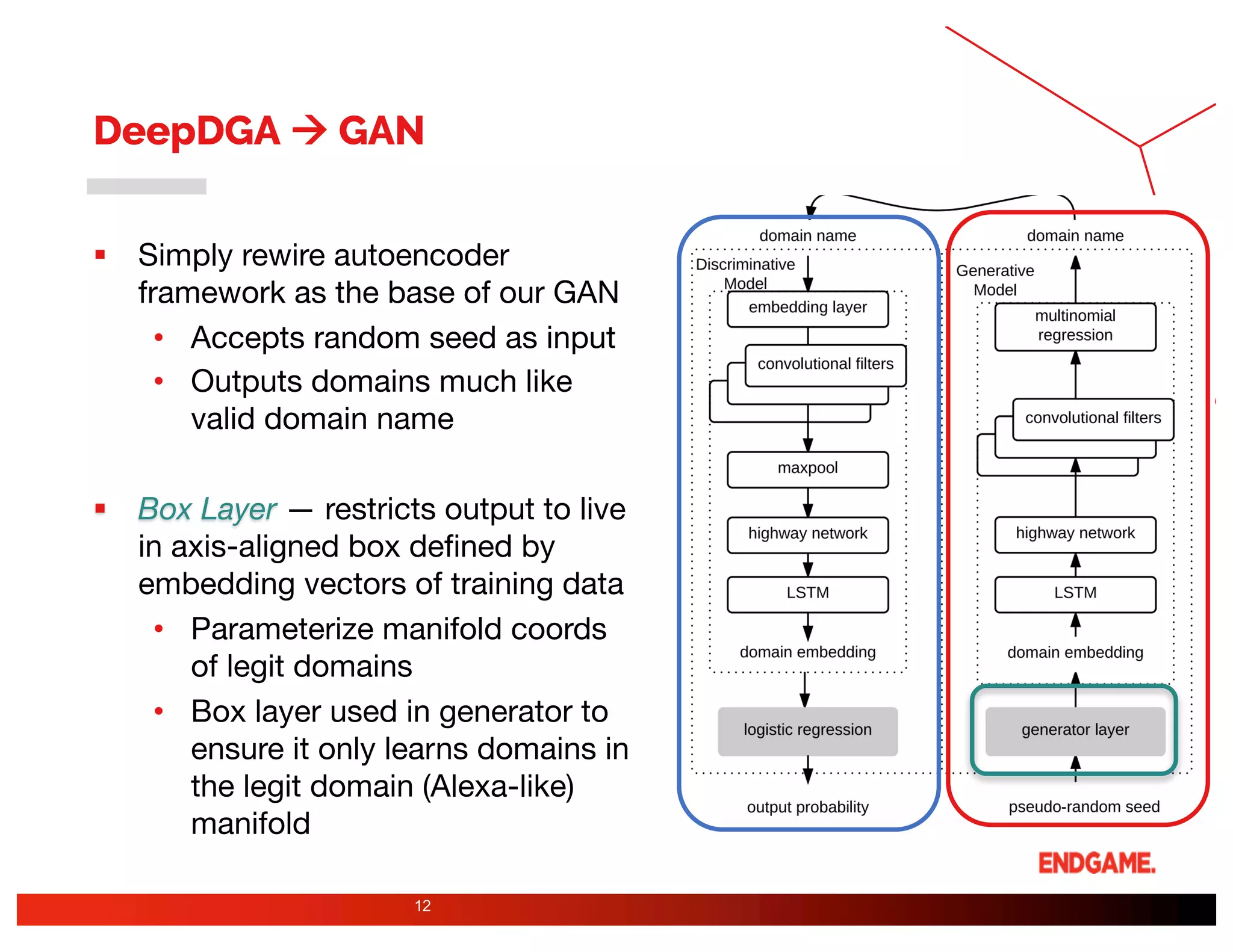
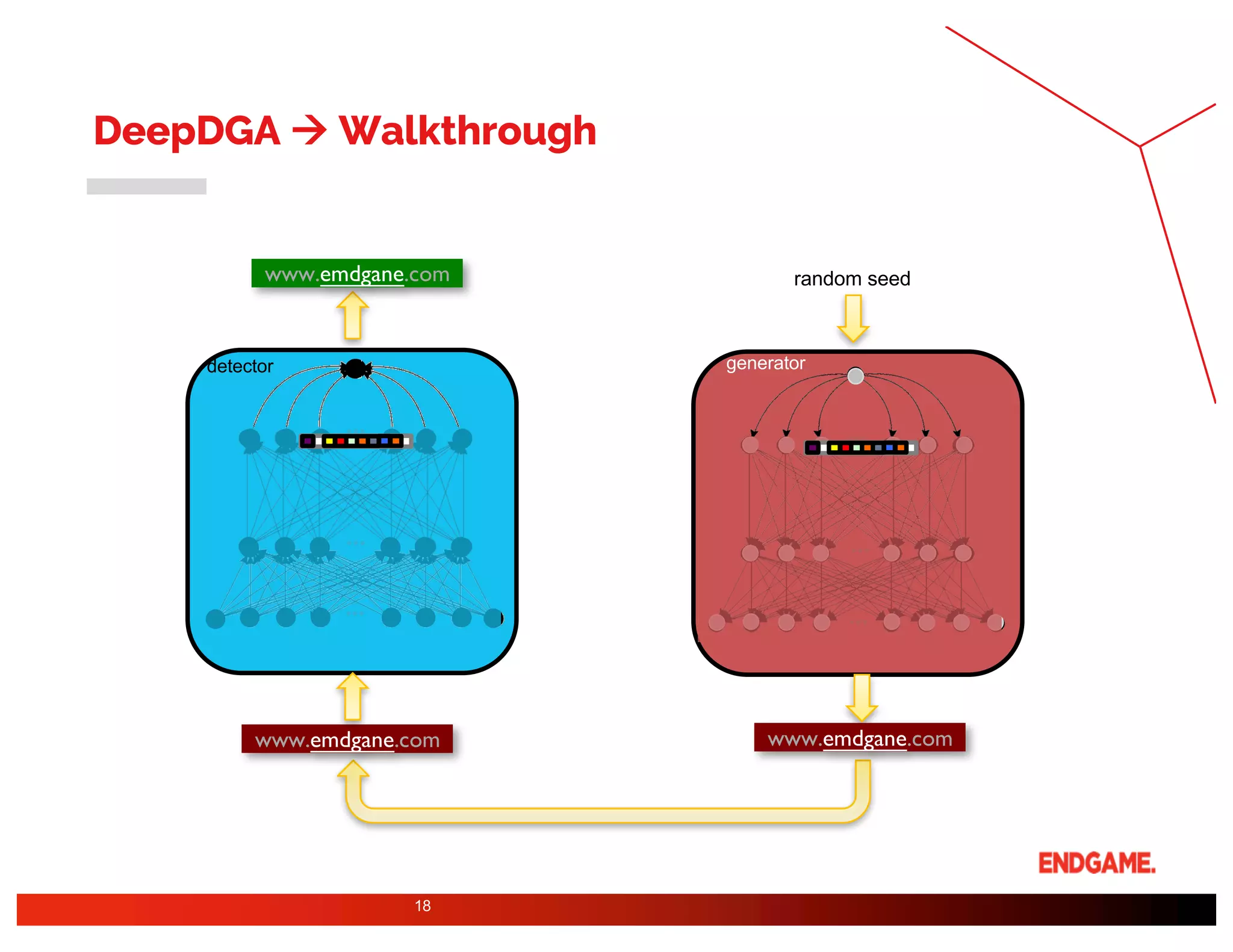
DeepDGA à GAN
§ Simply rewire autoencoder
framework as the base of our GAN
• Accepts random seed as input
• Outputs domains much like
valid domain name
§ Box Layer — restricts output to live
in axis-aligned box defined by
embedding vectors of training data
• Parameterize manifold coords
of legit domains
• Box layer used in generator to
ensure it only learns domains in
the legit domain (Alexa-like)
manifold
12
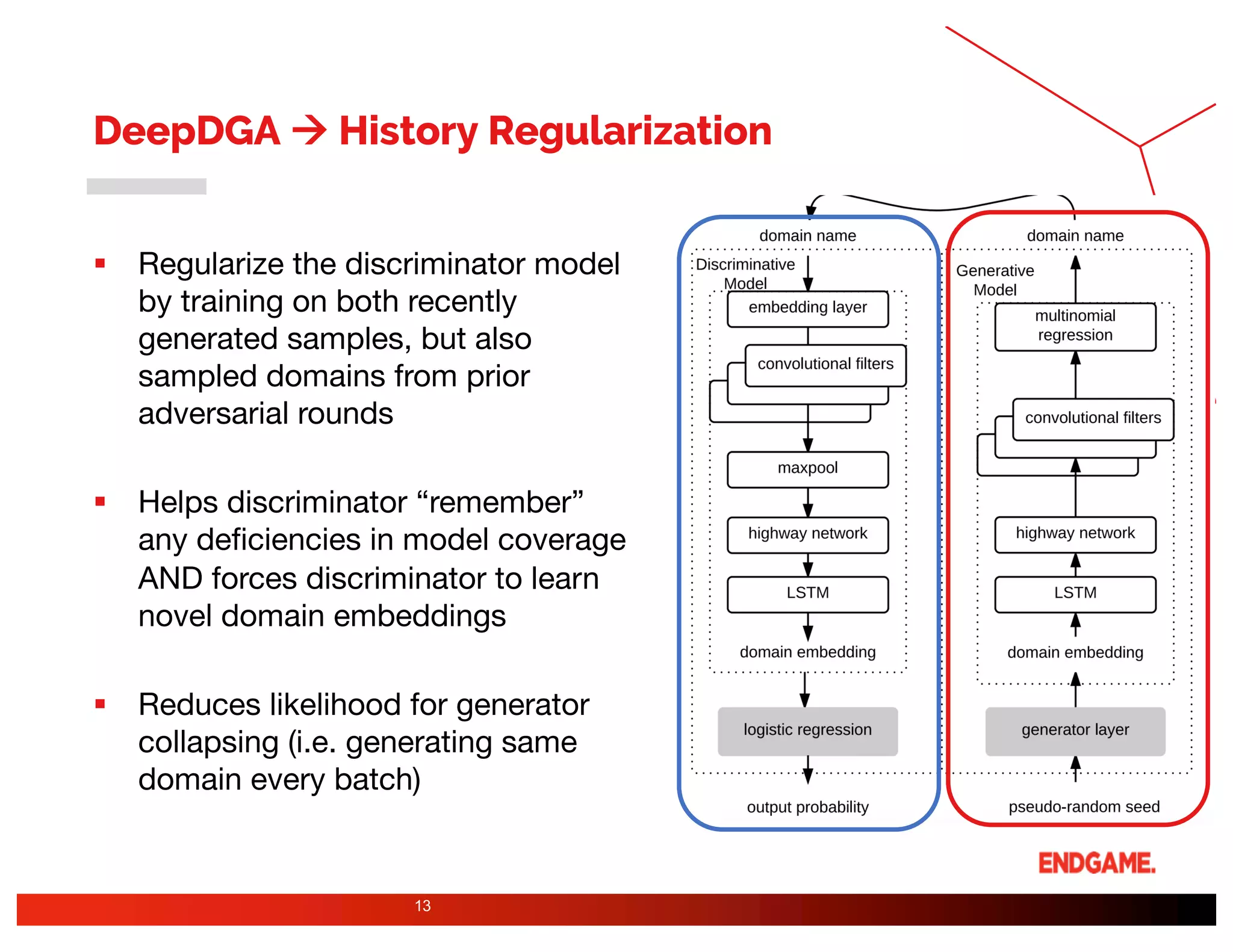
DeepDGA à History Regularization
§ Regularize the discriminator model
by training on both recently
generated samples, but also
sampled domains from prior
adversarial rounds
§ Helps discriminator “remember”
any deficiencies in model coverage
AND forces discriminator to learn
novel domain embeddings
§ Reduces likelihood for generator
collapsing (i.e. generating same
domain every batch)
13
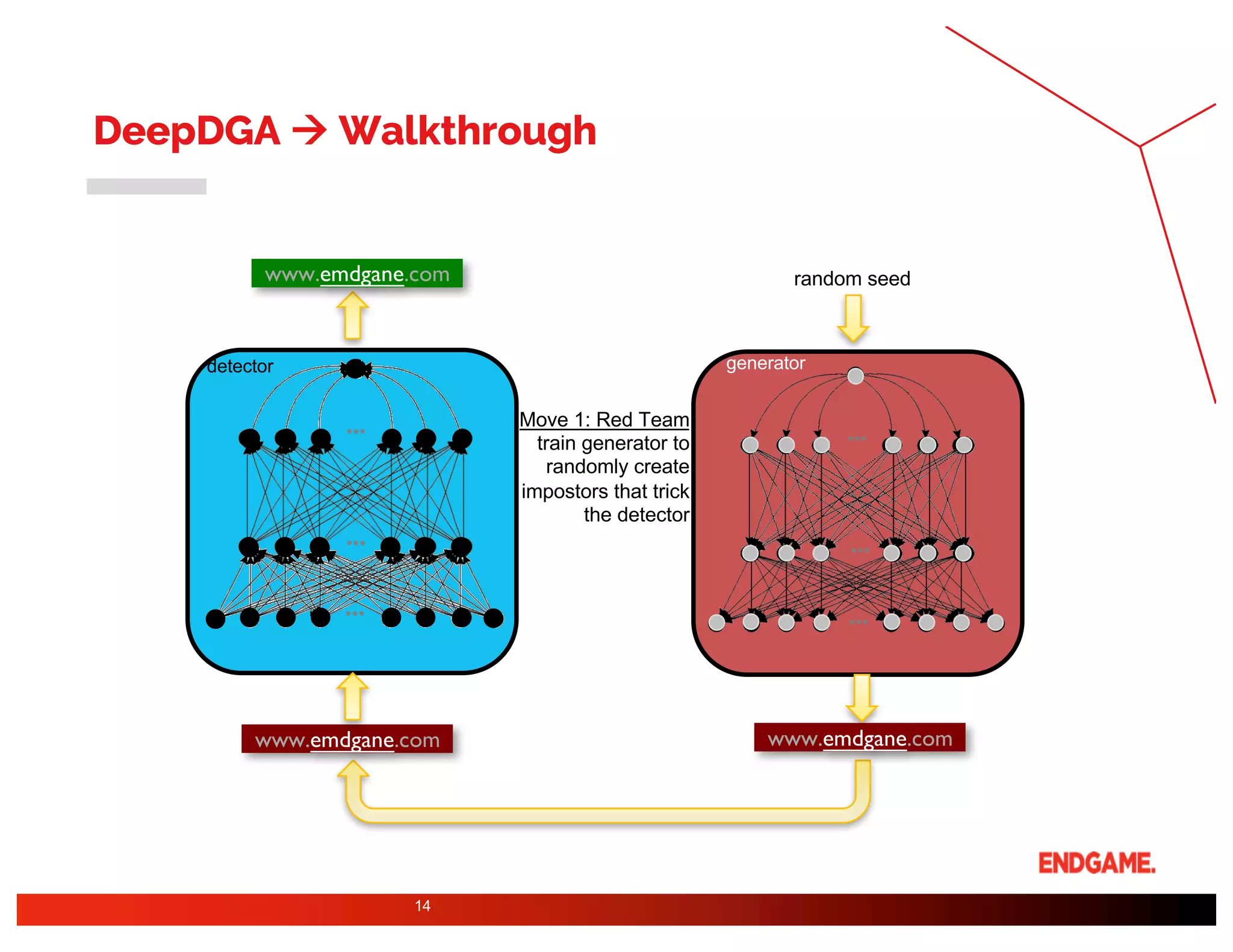
DeepDGA à Walkthrough
14
0.1
…
x
…
…
…
…
…
random seed
www.emdgane.comwww.emdgane.com
www.emdgane.com
generatordetector
Move 1: Red Team
train generator to
randomly create
impostors that trick
the detector
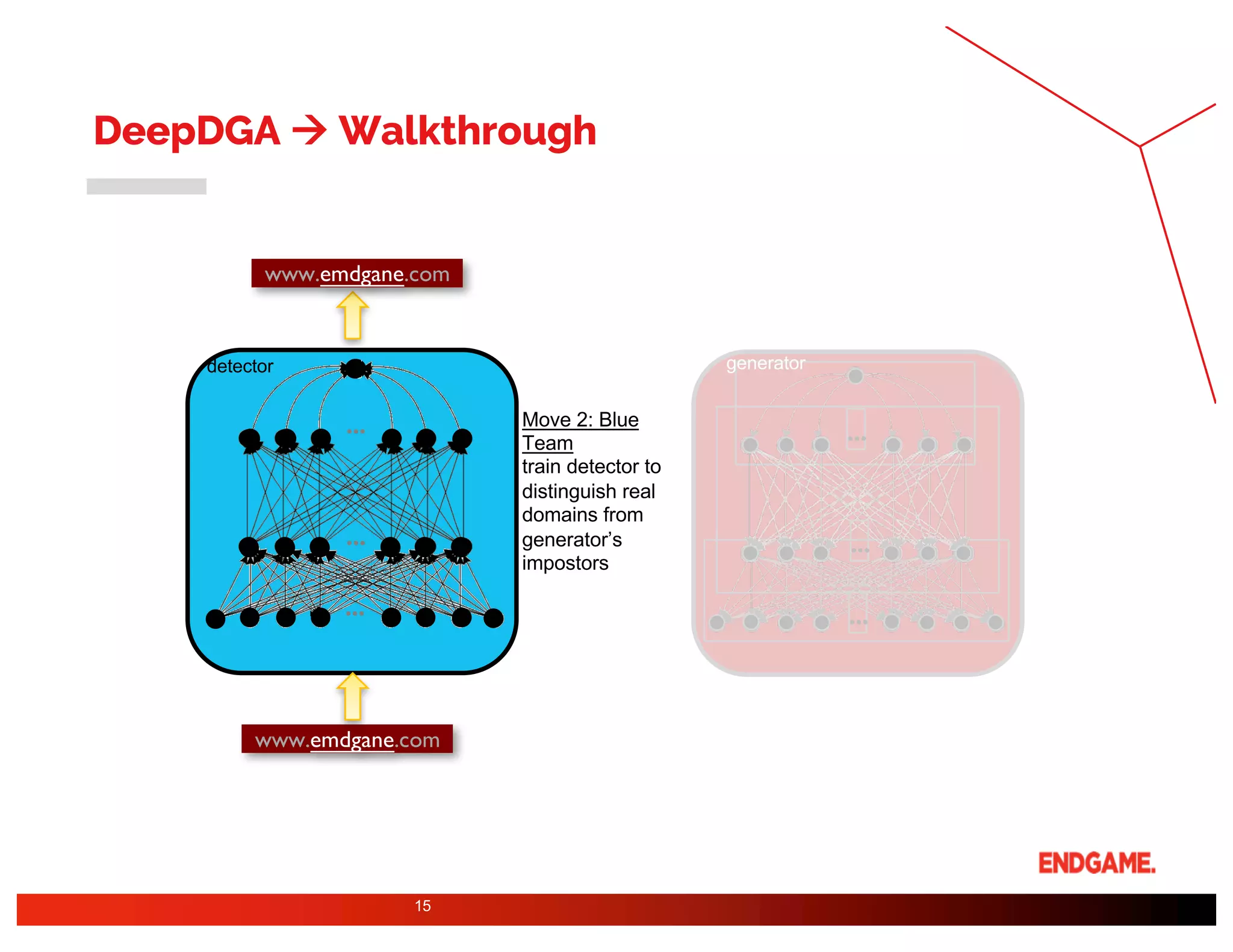
DeepDGA à Walkthrough
15
0.1
…
x
…
…
…
…
…
www.emdgane.com
www.emdgane.com
generatordetector
Move 2: Blue
Team
train detector to
distinguish real
domains from
generator’s
impostors
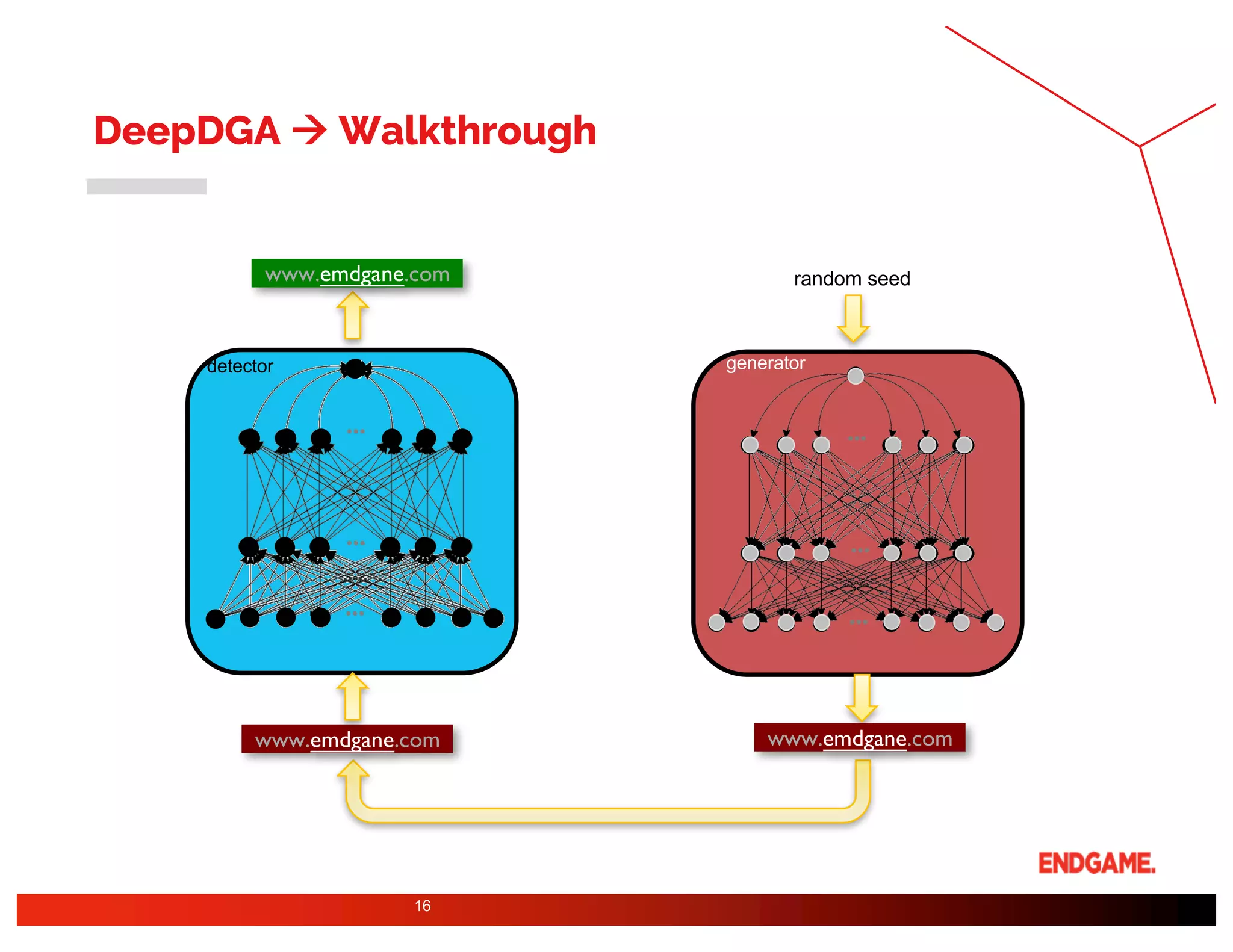
DeepDGA à Walkthrough
16
0.1
…
x
…
…
…
…
…
random seed
www.emdgane.comwww.emdgane.com
www.emdgane.com
generatordetector
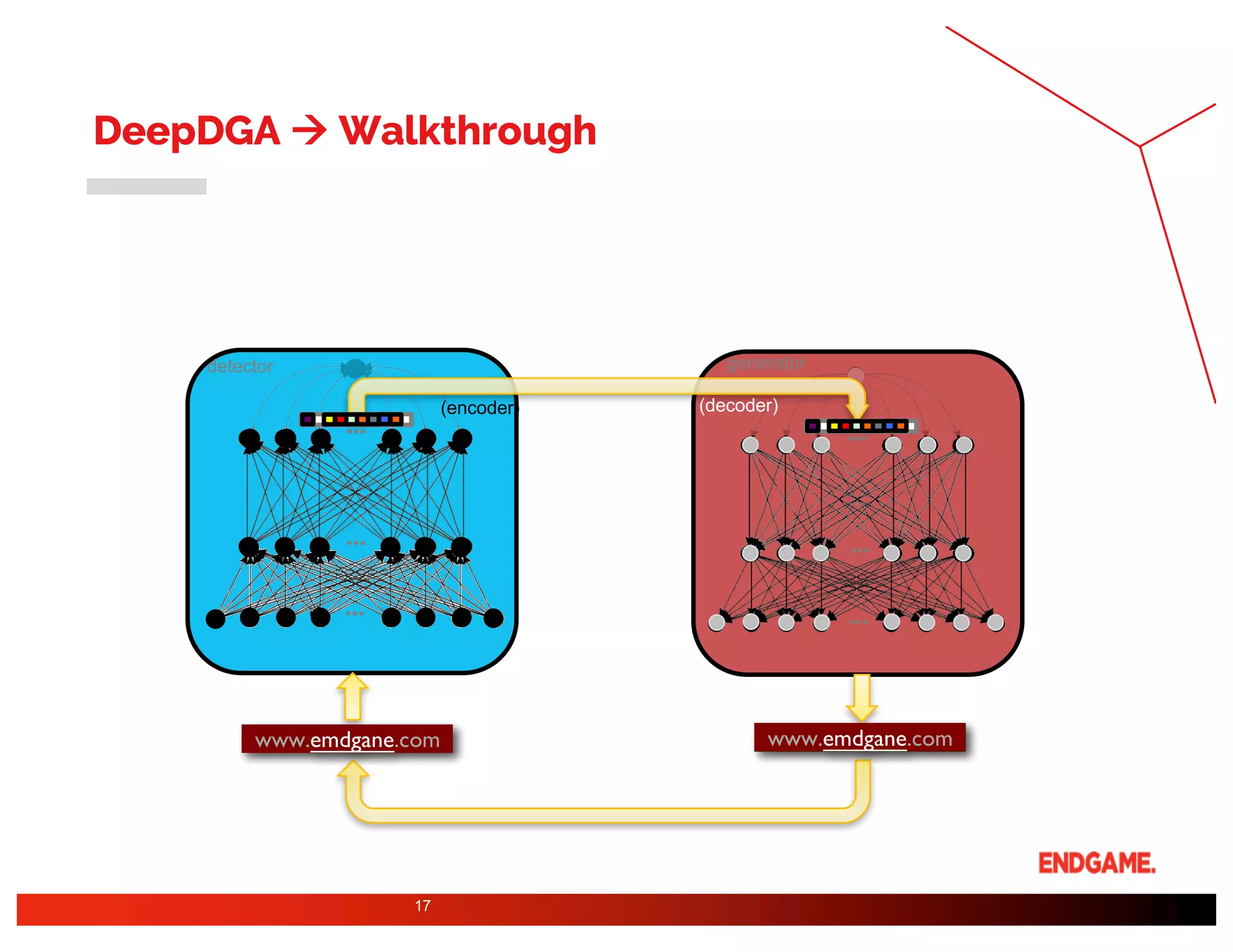
DeepDGA à Walkthrough
17
www.endgame.comwww.endgame.com
0.1
…
x
…
…
…
…
…
detector generator
www.emdgane.comwww.emdgane.com
(encoder) (decoder)
DeepDGA à Walkthrough
0.1
…
x
…
…
…
…
…
random seed
www.emdgane.comwww.emdgane.com
www.emdgane.com
generatordetector
18
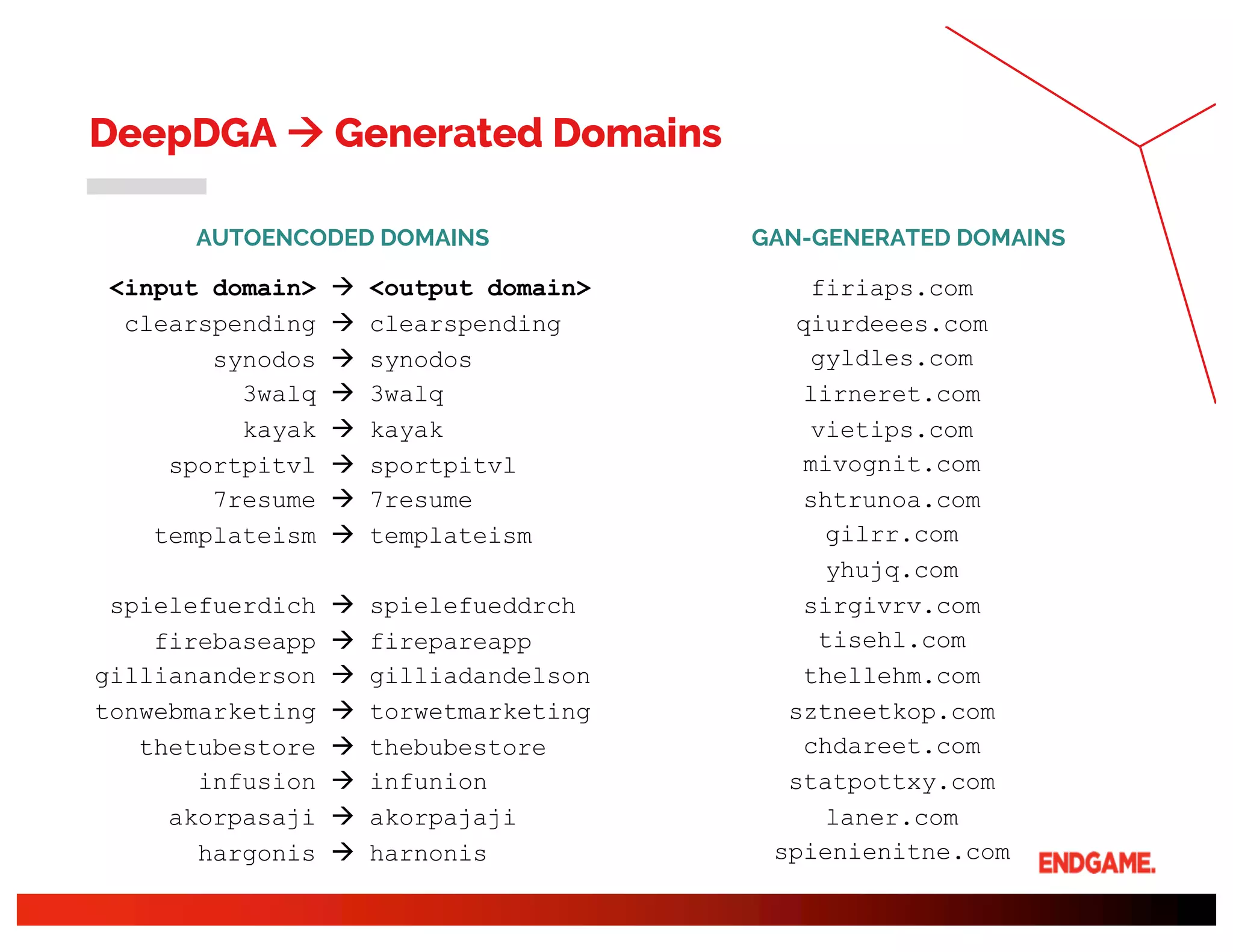
AUTOENCODED DOMAINS
<input domain> à <output domain>
clearspending à clearspending
synodos à synodos
3walq à 3walq
kayak à kayak
sportpitvl à sportpitvl
7resume à 7resume
templateism à templateism
spielefuerdich à spielefueddrch
firebaseapp à firepareapp
gilliananderson à gilliadandelson
tonwebmarketing à torwetmarketing
thetubestore à thebubestore
infusion à infunion
akorpasaji à akorpajaji
hargonis à harnonis
GAN-GENERATED DOMAINS
firiaps.com
qiurdeees.com
gyldles.com
lirneret.com
vietips.com
mivognit.com
shtrunoa.com
gilrr.com
yhujq.com
sirgivrv.com
tisehl.com
thellehm.com
sztneetkop.com
chdareet.com
statpottxy.com
laner.com
spienienitne.com
19
DeepDGA à Generated Domains
Experiment Setup &
Results
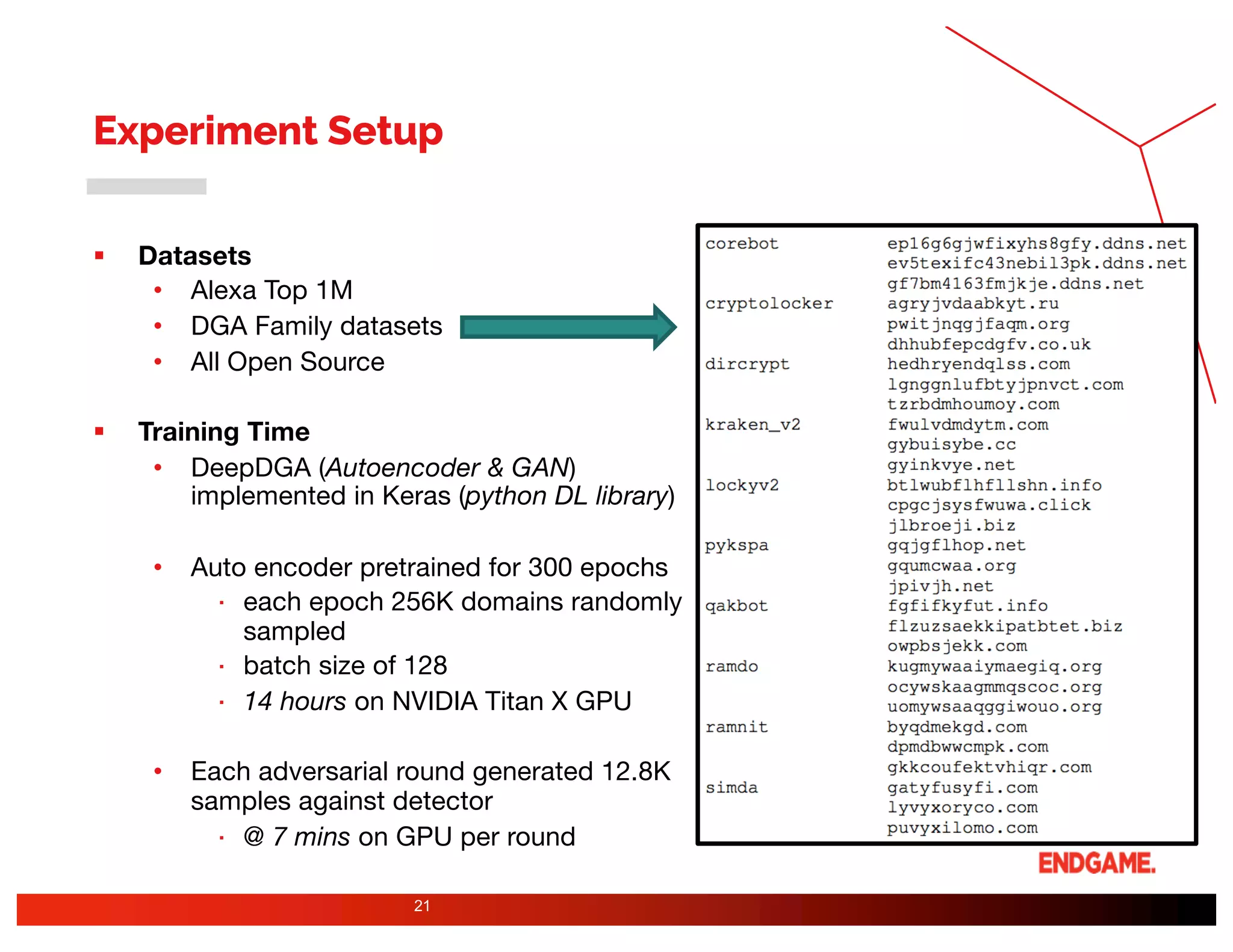
Experiment Setup
§ Datasets
• Alexa Top 1M
• DGA Family datasets
• All Open Source
§ Training Time
• DeepDGA (Autoencoder & GAN)
implemented in Keras (python DL library)
• Auto encoder pretrained for 300 epochs
· each epoch 256K domains randomly
sampled
· batch size of 128
· 14 hours on NVIDIA Titan X GPU
• Each adversarial round generated 12.8K
samples against detector
· @ 7 mins on GPU per round
21
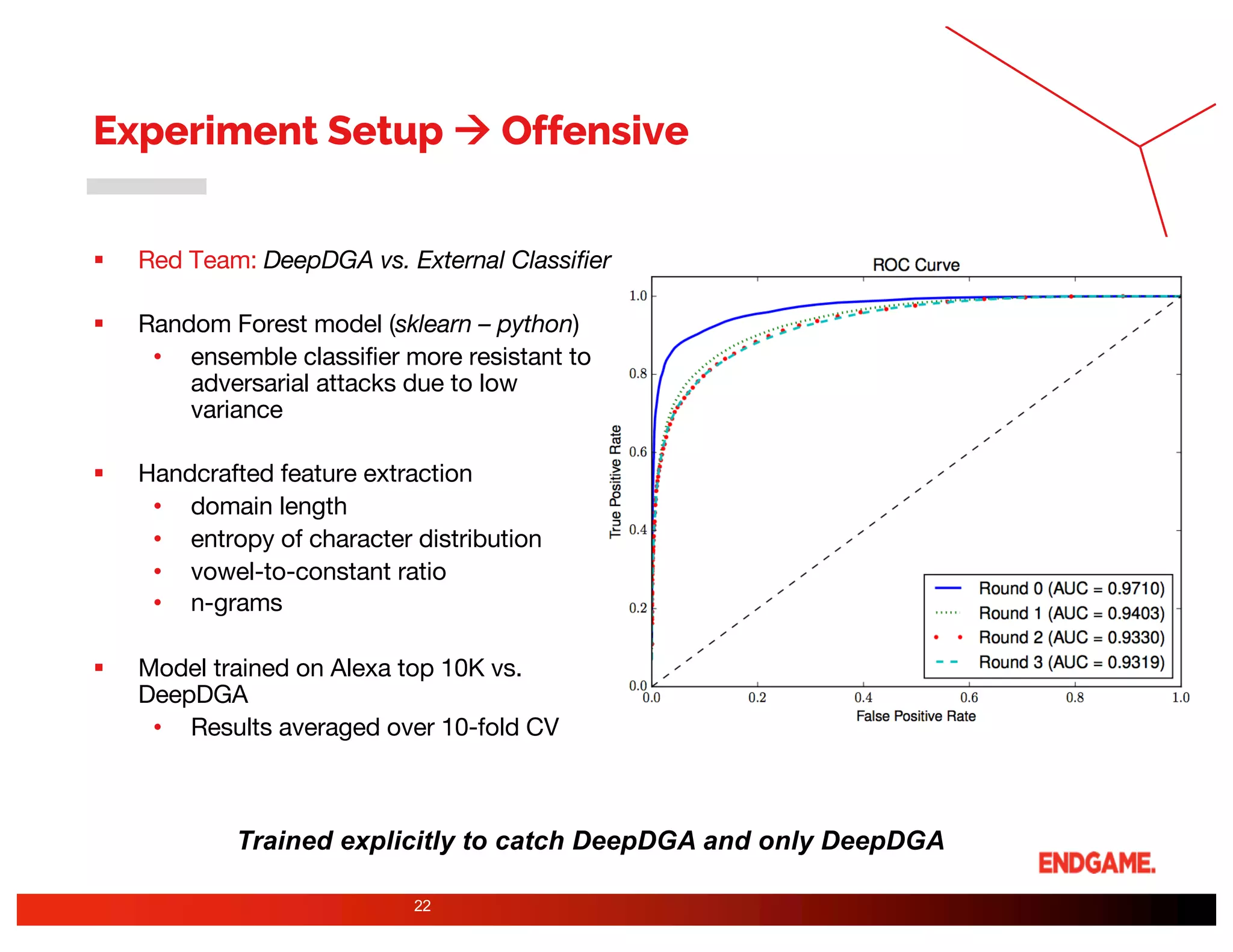
Experiment Setup à Offensive
§ Red Team: DeepDGA vs. External Classifier
§ Random Forest model (sklearn – python)
• ensemble classifier more resistant to
adversarial attacks due to low
variance
§ Handcrafted feature extraction
• domain length
• entropy of character distribution
• vowel-to-constant ratio
• n-grams
§ Model trained on Alexa top 10K vs.
DeepDGA
• Results averaged over 10-fold CV
22
Trained explicitly to catch DeepDGA and only DeepDGA
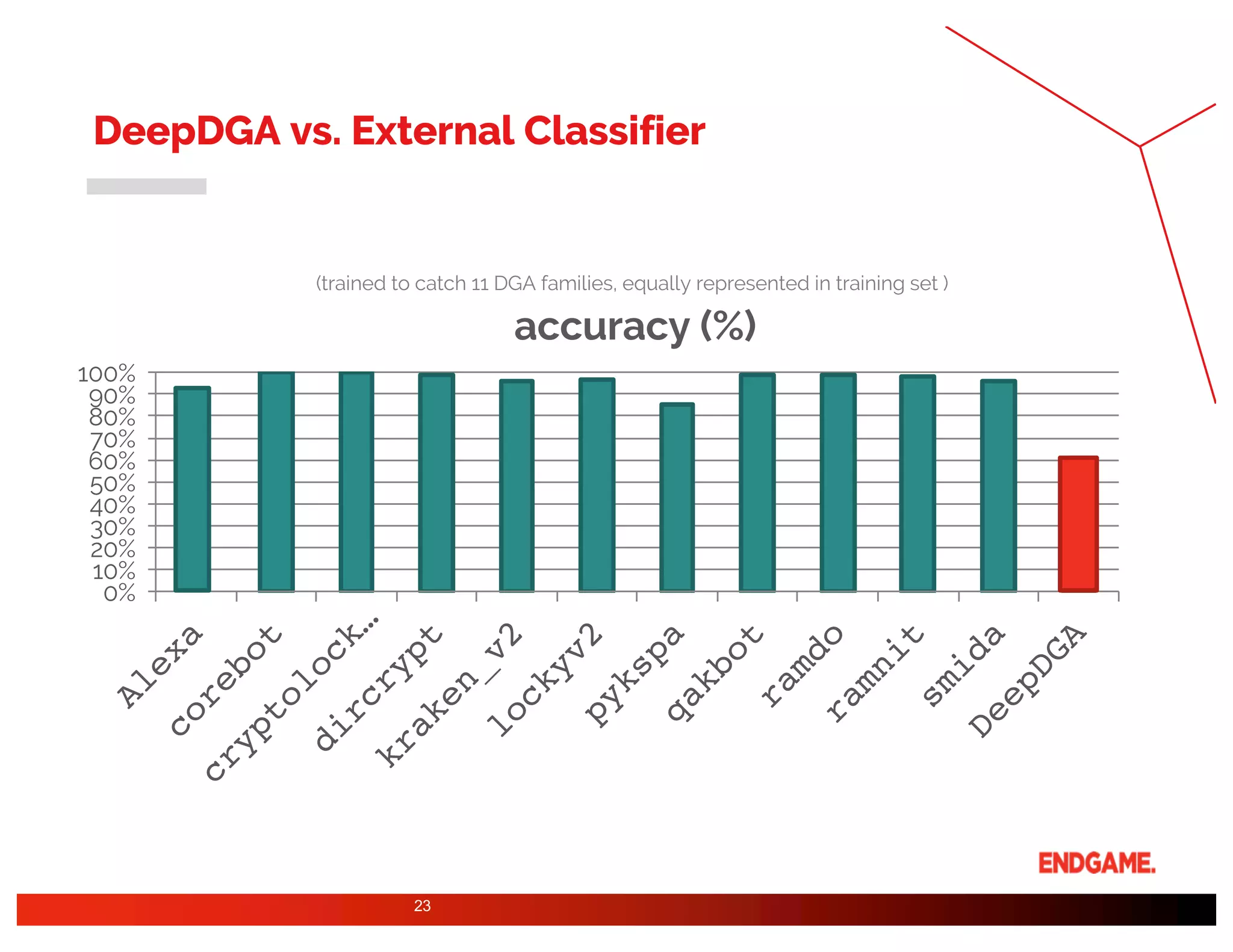
DeepDGA vs. External Classifier
23
0%
10%
20%
30%
40%
50%
60%
70%
80%
90%
100%
accuracy (%)
(trained to catch 11 DGA families, equally represented in training set )
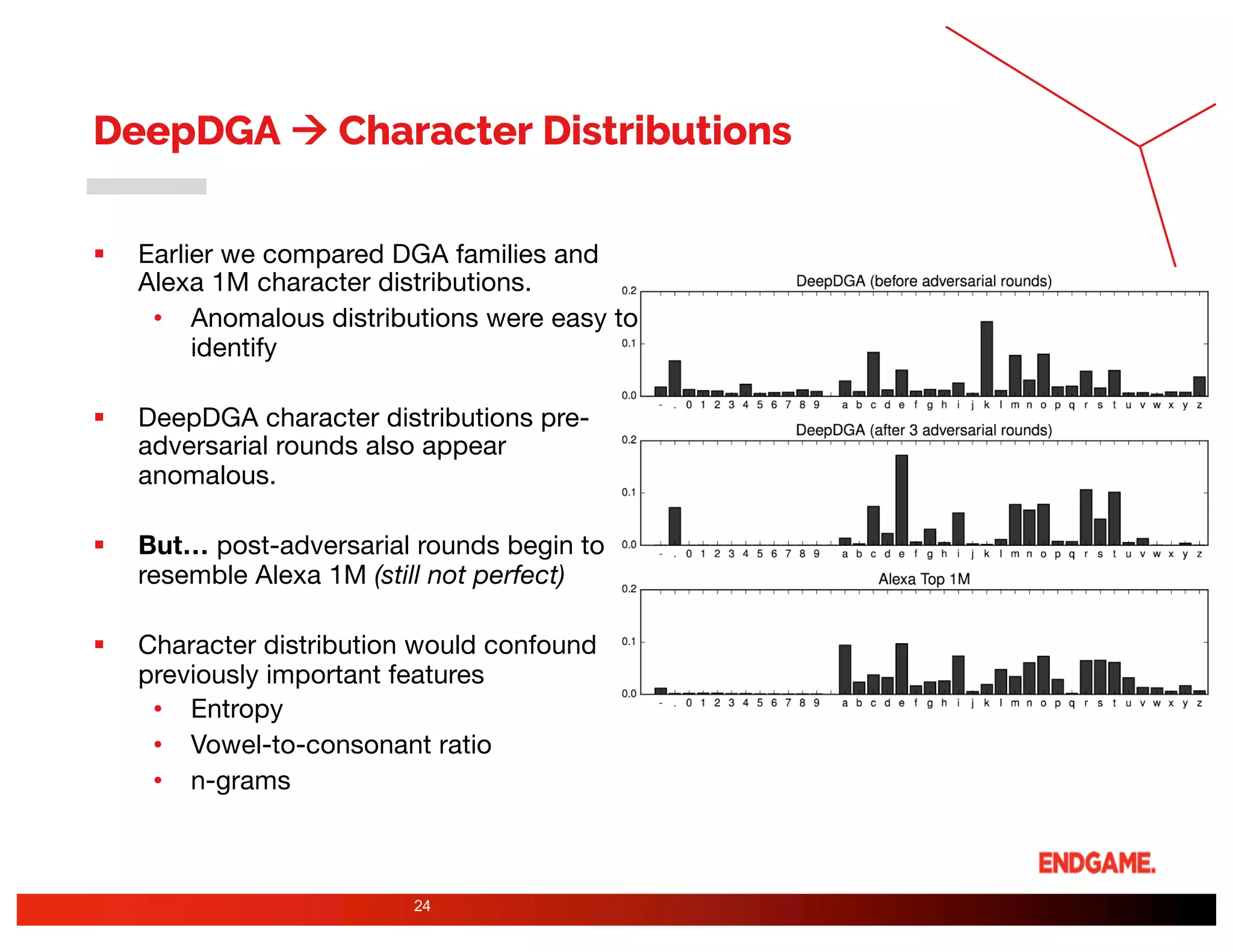
DeepDGA à Character Distributions
§ Earlier we compared DGA families and
Alexa 1M character distributions.
• Anomalous distributions were easy to
identify
§ DeepDGA character distributions pre-
adversarial rounds also appear
anomalous.
§ But… post-adversarial rounds begin to
resemble Alexa 1M (still not perfect)
§ Character distribution would confound
previously important features
• Entropy
• Vowel-to-consonant ratio
• n-grams
24
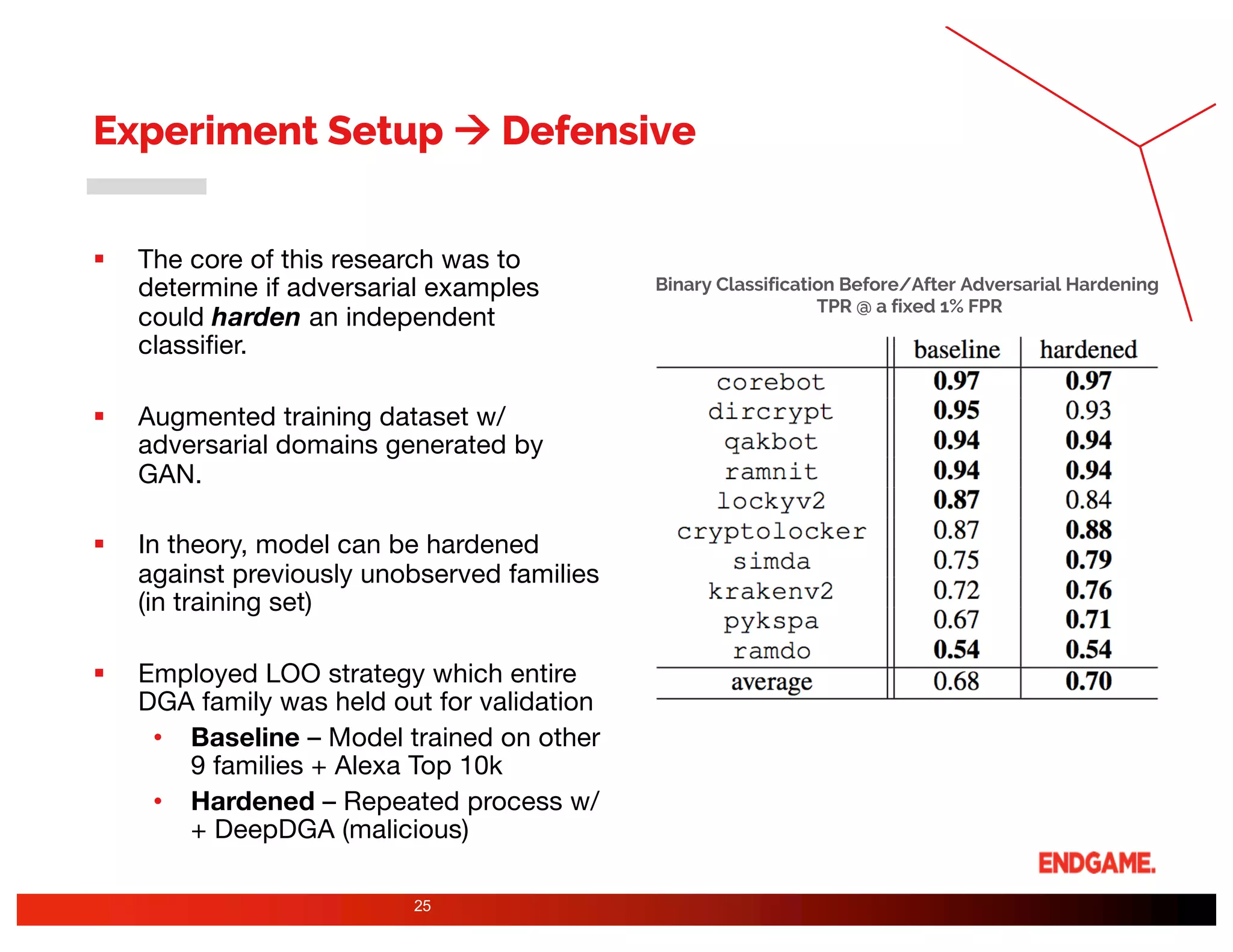
Experiment Setup à Defensive
§ The core of this research was to
determine if adversarial examples
could harden an independent
classifier.
§ Augmented training dataset w/
adversarial domains generated by
GAN.
§ In theory, model can be hardened
against previously unobserved families
(in training set)
§ Employed LOO strategy which entire
DGA family was held out for validation
• Baseline – Model trained on other
9 families + Alexa Top 10k
• Hardened – Repeated process w/
+ DeepDGA (malicious)
25
Binary Classification Before/After Adversarial Hardening
TPR @ a fixed 1% FPR
Summary
§ Contributions
• Present the first known Deep Learning architecture to pseudo-randomly
generate domain names
• Demonstrate that adversarially-crafted domains names targeting a DL model
are also adversarial for an independent external classifier
• At least experimentally, those same adversarial samples can be used to
augment a training set and harden an independent classifier
§ Hard problems
• GANs are hard! à Adversarial game construction
• Carefully watch FP rate
· A dataset overloaded w/ augmented DGAs can increase the FP rate
· Model tries to learn that these “realistic” domain names are possibly
malicious
§ Future Work
• Network – improving domain name generation (DGA) and detection
• Strengthen Malware Classification models
· Malicious WinAPI sequences
· Adversarially-tuned static feature vectors
26
Questions?

Deep DGA: Adversarially-Tuned Domain Generation and Detection

  • 1.
    November 4, 2016 DEEPDGA:ADVERSARIALLY-TUNED DOMAIN GENERATION AND DETECTION Bobby Filar -> @filar Hyrum Anderson Jonathan Woodbridge AISec2016
  • 2.
    Outline § Motivation § Background §DeepDGA Architecture § Experiment(s) Setup § Results § Future Work 2
  • 3.
    Motivations § Can weRed team vs. Blue team a known infosec problem (DGAs) leveraging Generative Adversarial Networks (GAN)? § Offensive: Leverage GANs to construct a deep-learning DGA designed to bypass an independent classifier. § Defensive: Can adversarially generated domains augment/improve training data to harden independent classifier??? 3 www.endgame.com www.endgame-2016.com www.emdgane.com
  • 4.
    Related Work § Recentwork in adversarial examples • Explaining and harnessing adversarial examples (Goodfellow, 2015) • Adversarial perturbations against DNN for Malware Classification (Papernot, 2016) § Key differences between other domains and INFOSEC: • Other domains – Make my model robust to occasional blind spot examples that it might come across in the wild • Information Security – Discover and plug holes in my model that the adversary is actively trying to discover and exploit (Red vs. Blue) 4 Fast gradient sign method (Goodfellow) “What is the cost of changing X’s label to a different y?”
  • 5.
    Background à Domain-GeneratedAlgorithm § Employed by malware families to bypass common C2 defenses § DGAs take a seed input and generate large amounts of pseudo-random domain names § Subset of domains registered command and control (C2) servers § Botnets and malware iterate through generated domains until it finds one that is registered, connects and establishes C2 channel § Asymmetric attack since defender must know all possible domains to blacklist 5 DNS C2 212.211.123.01 bjgkre.com212.211.123.01 NXDomain wedcf.com NXDomain asdfg.com
  • 6.
    Domain-Generated Algorithm àCryptolocker Example btbpurnkbqidxxclfdfrdqjasjphyrtn.org sehccrlyfadifehntnomqgpfyunqqfft.org konsbolyfadifehntnomqgpfyunqqfft.org cytfiobnkjxomkmhimxhcfvtogyaiqaa.org 6
  • 7.
    Domain-Generated Algorithm àCharacter Distributions 7 § DGA char dist + ML == robust defense? § Cryptolocker and ramnit are both nearly uniform over same range • Expected; Calculations on a single seed § Suppobox concatenates random words from English dictionary thus reflects the distribution of Alexa 1M § Much more difficult for prior DGA detection models to correctly classify § Our goal is build a character-based generator that mimics the Alexa domain name distribution
  • 8.
    AUTOENCODERS § Data compressionalgorithm § Models consist of encoder, decoder, and loss function • encoder — transforms input to a low-dimension embedding (lossy compression) • decoder — reconstruct original input from encoder (decompression) § Goal: minimize distortion between reconstructed output and original input § Easy to train; Don’t need labels (unsupervised) GENERATIVE ADVERSARIAL NETWORKS § Adversarial game between two models • generator— seeks to create synthetic data based on samples from the true data distribution (w/ added noise) • discriminator — receives sample and must determine if it is a synthetic (from generator) or true data sample § Goal: Find an equilibrium similar to Nash Equilibrium by pitting models against one another § Harder to train; Unsupervised • lots of failure modes 8 Background à Frameworks
  • 9.
  • 10.
    DeepDGA à Autoencoderà Encoder § Encoder architecture taken from [Kim et al, 2015], found useful in character-level language modeling § Embedding learns linear mapping for each valid domain character (20 dimension space) § Convolutions filters applied to capture character combos (bi/trigrams) § Max-pooling over-time & over-filter • Gather fixed-representation § Highway Network à LSTM 10 Learn the right representation of Alexa domains
  • 11.
    DeepDGA à Autoencoderà Decoder § Decoder is ~ the reverse of encoder minus maxpool step § Domain embedding is repeated over max length domain length (time-steps) § Sequence is passed to LSTM à Highway Network à Convolutional Filters § Softmax activation on final layer produces a multinomial distribution over domain characters § Sampled to generate new domain name modeled after the input domain name. 11
  • 12.
    DeepDGA à GAN §Simply rewire autoencoder framework as the base of our GAN • Accepts random seed as input • Outputs domains much like valid domain name § Box Layer — restricts output to live in axis-aligned box defined by embedding vectors of training data • Parameterize manifold coords of legit domains • Box layer used in generator to ensure it only learns domains in the legit domain (Alexa-like) manifold 12
  • 13.
    DeepDGA à HistoryRegularization § Regularize the discriminator model by training on both recently generated samples, but also sampled domains from prior adversarial rounds § Helps discriminator “remember” any deficiencies in model coverage AND forces discriminator to learn novel domain embeddings § Reduces likelihood for generator collapsing (i.e. generating same domain every batch) 13
  • 14.
    DeepDGA à Walkthrough 14 0.1 … x … … … … … randomseed www.emdgane.comwww.emdgane.com www.emdgane.com generatordetector Move 1: Red Team train generator to randomly create impostors that trick the detector
  • 15.
    DeepDGA à Walkthrough 15 0.1 … x … … … … … www.emdgane.com www.emdgane.com generatordetector Move2: Blue Team train detector to distinguish real domains from generator’s impostors
  • 16.
    DeepDGA à Walkthrough 16 0.1 … x … … … … … randomseed www.emdgane.comwww.emdgane.com www.emdgane.com generatordetector
  • 17.
  • 18.
    DeepDGA à Walkthrough 0.1 … x … … … … … randomseed www.emdgane.comwww.emdgane.com www.emdgane.com generatordetector 18
  • 19.
    AUTOENCODED DOMAINS <input domain>à <output domain> clearspending à clearspending synodos à synodos 3walq à 3walq kayak à kayak sportpitvl à sportpitvl 7resume à 7resume templateism à templateism spielefuerdich à spielefueddrch firebaseapp à firepareapp gilliananderson à gilliadandelson tonwebmarketing à torwetmarketing thetubestore à thebubestore infusion à infunion akorpasaji à akorpajaji hargonis à harnonis GAN-GENERATED DOMAINS firiaps.com qiurdeees.com gyldles.com lirneret.com vietips.com mivognit.com shtrunoa.com gilrr.com yhujq.com sirgivrv.com tisehl.com thellehm.com sztneetkop.com chdareet.com statpottxy.com laner.com spienienitne.com 19 DeepDGA à Generated Domains
  • 20.
  • 21.
    Experiment Setup § Datasets •Alexa Top 1M • DGA Family datasets • All Open Source § Training Time • DeepDGA (Autoencoder & GAN) implemented in Keras (python DL library) • Auto encoder pretrained for 300 epochs · each epoch 256K domains randomly sampled · batch size of 128 · 14 hours on NVIDIA Titan X GPU • Each adversarial round generated 12.8K samples against detector · @ 7 mins on GPU per round 21
  • 22.
    Experiment Setup àOffensive § Red Team: DeepDGA vs. External Classifier § Random Forest model (sklearn – python) • ensemble classifier more resistant to adversarial attacks due to low variance § Handcrafted feature extraction • domain length • entropy of character distribution • vowel-to-constant ratio • n-grams § Model trained on Alexa top 10K vs. DeepDGA • Results averaged over 10-fold CV 22 Trained explicitly to catch DeepDGA and only DeepDGA
  • 23.
    DeepDGA vs. ExternalClassifier 23 0% 10% 20% 30% 40% 50% 60% 70% 80% 90% 100% accuracy (%) (trained to catch 11 DGA families, equally represented in training set )
  • 24.
    DeepDGA à CharacterDistributions § Earlier we compared DGA families and Alexa 1M character distributions. • Anomalous distributions were easy to identify § DeepDGA character distributions pre- adversarial rounds also appear anomalous. § But… post-adversarial rounds begin to resemble Alexa 1M (still not perfect) § Character distribution would confound previously important features • Entropy • Vowel-to-consonant ratio • n-grams 24
  • 25.
    Experiment Setup àDefensive § The core of this research was to determine if adversarial examples could harden an independent classifier. § Augmented training dataset w/ adversarial domains generated by GAN. § In theory, model can be hardened against previously unobserved families (in training set) § Employed LOO strategy which entire DGA family was held out for validation • Baseline – Model trained on other 9 families + Alexa Top 10k • Hardened – Repeated process w/ + DeepDGA (malicious) 25 Binary Classification Before/After Adversarial Hardening TPR @ a fixed 1% FPR
  • 26.
    Summary § Contributions • Presentthe first known Deep Learning architecture to pseudo-randomly generate domain names • Demonstrate that adversarially-crafted domains names targeting a DL model are also adversarial for an independent external classifier • At least experimentally, those same adversarial samples can be used to augment a training set and harden an independent classifier § Hard problems • GANs are hard! à Adversarial game construction • Carefully watch FP rate · A dataset overloaded w/ augmented DGAs can increase the FP rate · Model tries to learn that these “realistic” domain names are possibly malicious § Future Work • Network – improving domain name generation (DGA) and detection • Strengthen Malware Classification models · Malicious WinAPI sequences · Adversarially-tuned static feature vectors 26
  • 27.