DE
DEVELOPMENT ASSESMENT PROCESS AND ASSESMENT
CENTRE PROPOSAL
Presented by Emma, Ana, Michelle & Evans
1
What will be covered today?
Our understanding of your requirements
Project Plan
First steps prior screening and assessment
Screening method
Assessment methods
Assessment Centre
Development Programme
2
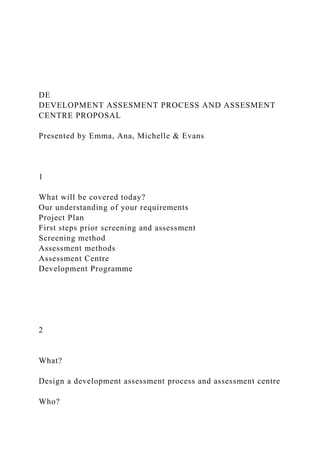
What?
Design a development assessment process and assessment centre
Who?
High-potential talent
Why?
12-months intensive development programme
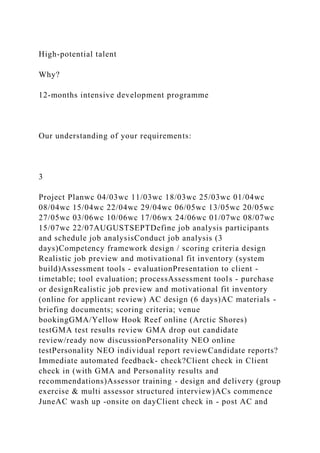
Our understanding of your requirements:
3
Project Planwc 04/03wc 11/03wc 18/03wc 25/03wc 01/04wc
08/04wc 15/04wc 22/04wc 29/04wc 06/05wc 13/05wc 20/05wc
27/05wc 03/06wc 10/06wc 17/06wx 24/06wc 01/07wc 08/07wc
15/07wc 22/07AUGUSTSEPTDefine job analysis participants
and schedule job analysisConduct job analysis (3
days)Competency framework design / scoring criteria design
Realistic job preview and motivational fit inventory (system
build)Assessment tools - evaluationPresentation to client -
timetable; tool evaluation; processAssessment tools - purchase
or designRealistic job preview and motivational fit inventory
(online for applicant review) AC design (6 days)AC materials -
briefing documents; scoring criteria; venue
bookingGMA/Yellow Hook Reef online (Arctic Shores)
testGMA test results review GMA drop out candidate
review/ready now discussionPersonality NEO online
testPersonality NEO individual report reviewCandidate reports?
Immediate automated feedback- check?Client check in Client
check in (with GMA and Personality results and
recommendations)Assessor training - design and delivery (group
exercise & multi assessor structured interview)ACs commence
JuneAC wash up -onsite on dayClient check in - post AC and
wash up - applicant review Offer managementNon-successful
candidate management - career chat - other development
routes/optionsMobility support (visa, cultural sensitivity
training; bank account; accommodation; buddy; maps; insurance
etc)Monthly coaching timetable - diarise with individuals and
coachesStart Date
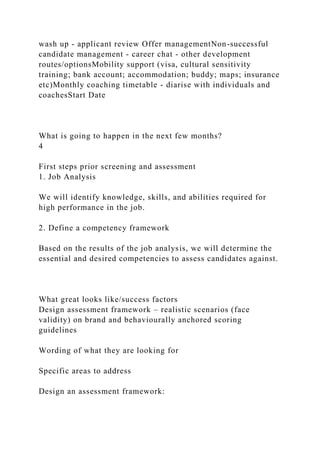
What is going to happen in the next few months?
4
First steps prior screening and assessment
1. Job Analysis
We will identify knowledge, skills, and abilities required for
high performance in the job.
2. Define a competency framework
Based on the results of the job analysis, we will determine the
essential and desired competencies to assess candidates against.
What great looks like/success factors
Design assessment framework – realistic scenarios (face
validity) on brand and behaviourally anchored scoring
guidelines
Wording of what they are looking for
Specific areas to address
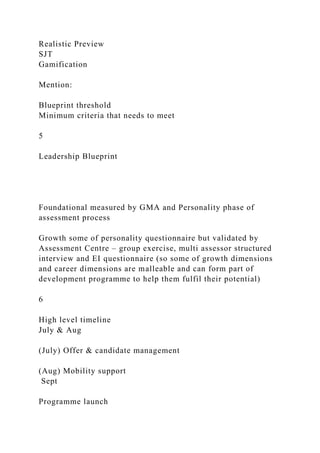
Design an assessment framework:
Realistic Preview
SJT
Gamification
Mention:
Blueprint threshold
Minimum criteria that needs to meet
5
Leadership Blueprint
Foundational measured by GMA and Personality phase of
assessment process
Growth some of personality questionnaire but validated by
Assessment Centre – group exercise, multi assessor structured
interview and EI questionnaire (so some of growth dimensions
and career dimensions are malleable and can form part of
development programme to help them fulfil their potential)
6
High level timeline
July & Aug
(July) Offer & candidate management
(Aug) Mobility support
Sept
Programme launch
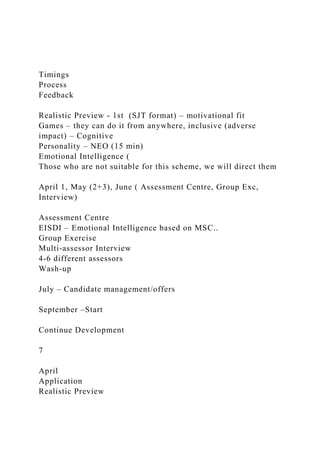
Timings
Process
Feedback
Realistic Preview - 1st (SJT format) – motivational fit
Games – they can do it from anywhere, inclusive (adverse
impact) – Cognitive
Personality – NEO (15 min)
Emotional Intelligence (
Those who are not suitable for this scheme, we will direct them
April 1, May (2+3), June ( Assessment Centre, Group Exc,
Interview)
Assessment Centre
EISDI – Emotional Intelligence based on MSC..
Group Exercise
Multi-assessor Interview
4-6 different assessors
Wash-up
July – Candidate management/offers
September –Start
Continue Development
7
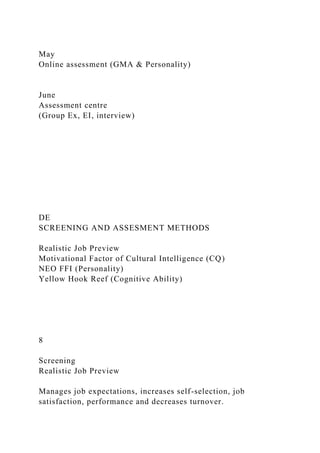
April
Application
Realistic Preview
May
Online assessment (GMA & Personality)
June
Assessment centre
(Group Ex, EI, interview)
DE
SCREENING AND ASSESMENT METHODS
Realistic Job Preview
Motivational Factor of Cultural Intelligence (CQ)
NEO FFI (Personality)
Yellow Hook Reef (Cognitive Ability)
8
Screening
Realistic Job Preview
Manages job expectations, increases self-selection, job
satisfaction, performance and decreases turnover.
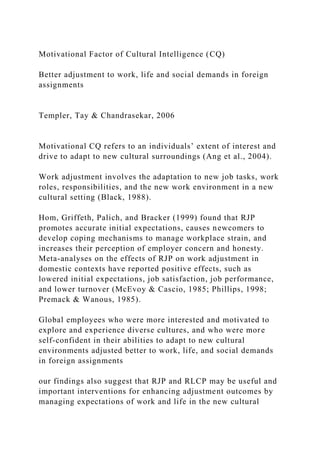
Motivational Factor of Cultural Intelligence (CQ)
Better adjustment to work, life and social demands in foreign
assignments
Templer, Tay & Chandrasekar, 2006
Motivational CQ refers to an individuals’ extent of interest and
drive to adapt to new cultural surroundings (Ang et al., 2004).
Work adjustment involves the adaptation to new job tasks, work
roles, responsibilities, and the new work environment in a new
cultural setting (Black, 1988).
Hom, Griffeth, Palich, and Bracker (1999) found that RJP
promotes accurate initial expectations, causes newcomers to
develop coping mechanisms to manage workplace strain, and
increases their perception of employer concern and honesty.
Meta-analyses on the effects of RJP on work adjustment in
domestic contexts have reported positive effects, such as
lowered initial expectations, job satisfaction, job performance,
and lower turnover (McEvoy & Cascio, 1985; Phillips, 1998;
Premack & Wanous, 1985).
Global employees who were more interested and motivated to
explore and experience diverse cultures, and who were more
self-confident in their abilities to adapt to new cultural
environments adjusted better to work, life, and social demands
in foreign assignments
our findings also suggest that RJP and RLCP may be useful and
important interventions for enhancing adjustment outcomes by
managing expectations of work and life in the new cultural
environment. J
9
Why Personality?
Results can indicate who will perform well
They also indicate how well an individual will learn
The results are transferable across countries
Ones et al., 2007; Poortinga et al., 2002
One of the benefits of measuring personality is that the scores it
produces are indicative of both how well an individual is likely
to perform in their given role, as well as how well suited they
are to acquire new knowledge through training.
In other words, this test will highlight who is not only likely to
produce good results for the company, but also who is best
suited to gain the most from this programme.
In addition to this, the scores and conclusions about an
individuals aptitude are transferable across countries and
cultures, and so are indicative of likely success when placed on
the international postings.
10
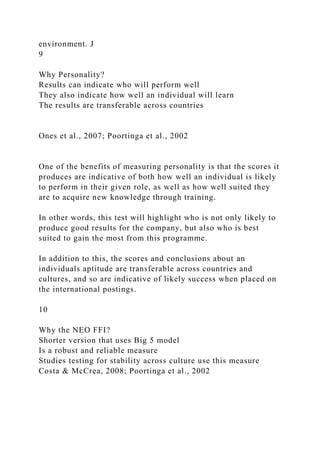
Why the NEO FFI?
Shorter version that uses Big 5 model
Is a robust and reliable measure
Studies testing for stability across culture use this measure
Costa & McCrea, 2008; Poortinga et al., 2002
There are many theories and tests of personality. However, the
research behind the strengths on the last slide typically use what
is called the Big 5 model. In order to take advantage of those
strengths, we will use the same model. Specifically we will use
the NEO short form measure as this is the shortest test available
to measure personality that stems from this model.
Importantly, despite being short, this test has been repeatedly
found to be robust and an accurate measure of personality.
In addition to this, it was the tool that was used when research
investigated the cross-cultural transference. This means that we
can recommend this measure to you with a high amount of
confidence that it is the most suitable tool to use for this
assessment programme.
11
Why cognitive ability (GMA)?
Results can indicate who will perform well
They also indicate how well an individual will learn
To be called “ability to learn and solve problems” during
assessment
Bertua et al., 2005; Schmidt & Hunter, 2004; Tews et al., 2011
One of the benefits of measuring cognitive ability is that, like
personality, it too can highlight who is likely to both perform
well and learn well. Importantly, the practical value of this test
works in addition to what personality offers
In other words, this test reveals more information about who
will perform and learn best than personality information could
indicate on its own.
It should be noted that in order to increase the apparent
appropriateness of this test, that it is referred to as an
assessment of their “ability to learn and solve problems” rather
than an “intelligence”.
This phrasing places an emphasis on the developable skills that
relate to the job, and assist candidates in recognising it’s direct
relation to the assessment process.
12
Why Yellow Hook Reef?
Gamified format
Appropriate length
Measures 3 core components of GMA
Reportedly robust and ...
… doesn’t produce adversity
https://www.arcticshores.com/yellow-hook-reef/
Out of a variety of different formats available, the gamified
version allows candidates to remain engaged in the assessment
process.
Of the pool of gamified cognitive ability tests out there, this
test assesses three of the fundamental facets of cognitive ability
while also remaining concise, taking 17minutes per aptitude,
meaning that the whole testing procedure for cognitive ability
takes less than an hour.
We have been assured by Arctic Shores that not only are the
tests suitable for assessment, but they are robust and that when
compared to other alternatives, that this test produces
dramatically diminished adversity effects. Allow me to assure
you that in addition to this, I will have personally assessed that
report before employing Yellow Hook Reef so that we can
provide you with an assessment for cognitive ability that we can
total confidence in.
13
Development Assessment Centre
Applicant process
Benefits of AC
Inclusive – automated where possible and all global employees
Fair
Robust
Adverse impact
Face validity
Incremental validity
Multi-assessor structured interview panel
Qualitative, meaningful feedback for applicants
Put blueprint graphic in instead of this one??
ACs predictive validities: general .37; job perf .36; managerial
potential .53
Adverse impact avoided for gender, age and minatory status
Controlling for common method bias
High face validity
Good predictive validity
Predict potential better than performance
Assumptions:
Pilot year
Opportunity to build framework and assessment process
(evaluate and potentially to scale in future when successful or
business or investment grows) and for better recruitment tools
when looking externally
Approach provides great opportunity to drive engagement and
set tone of development culture/investing in people
Realistic preview opportunity for us to share our story and
includes motivational fit inventory so candidates can self-select
(confidentially)
Biodata – CV/application forms/feedback/performance reviews
Automated cognitive ability and personality test provide
“screening” opportunity for us to only progress those that meet
our pre-defined selection criteria (threshold) for cog ability
(benefit we get to know a lot more about our people and can
advise on activities, stretch roles, assignments, secondments,
other development interventions that would make more sense –
if not this programme) EVERYONE a WINNER i.e. no losers
What we test for at AC can be malleable/developable and
becomes part of the initimate knowledge we develop – PDP,
coach, stretch assignments, networking opportunity with
international colleagues
14
Applicant screening – threshold scores (max to advance to next
stage 12)
GMA & Personality online testing (open to all applicants)
Open application, nomination/invitation & realistic preview
(open to all applicants)
Assessment centre – group exercise; EISDI & interview (12)
Development AC draft timetableDevelopment Assessment
Centre Draft Timetable12 candidatesMorning6 assessors09:30 -
10:00Welcome and logistics2 centre managersCandidate Group
1Candidate Group 210:00 - 11:00Group Exercise (15 min
briefing; 45 min task)Cand 1Cand 7Cand 2Cand 8Candidate
Group 1 (6)Assessor Group B (3)Cand 3Cand 9Cand 4Cand
10Candidate Group 2 (6)Assessor Group A (3)Cand 5Cand
11Cand 6Cand 1211:15 - 11:45EISDIAfternoonAssessor Group
AAssessor Group BCandidate Group 1 and Assessor Group
ACandidate Group 2 and Assessor Group BAD12:00 -
12:45Interview 1BE13:00 - 13:45Interview 2CF14:00 -
14:45Interview 315:00 - 15:45Interview 416:00 -
16:45Interview 517:00 - 17:45Interview 618:00Candidates
leave18:00 - 19:30Assessor wash-up
Notes:
Multi-assessor panel structured interview with International
(South America, Asia and UK mix) assessors
Every assessor gets to observe/interview every candidate
Structured interview
Structured rating criteria provided
Objective and fair
Consistent
Assessors fully briefed
Interview questions designed to probe – commercial awareness,
strategic thinking, influencing/communication style, flexibility,
ability to navigate ambiguity (goal setting)
Experience based questions more strongly predict job
performance
Interviews can predict constructs: GMA; Exp: GPA; Big 5;
social skills
Reliabilities of .77 (Conway et al 1995 – reviewed 160
empirical studies when observers watched the same interview)
EISDI
Self report but validated by activities in AC GE and interview
Quick (24 item measure and they all use likert scales) allowed
30mins
EI currently most influential model of social intelligence
(needed further up org you go)
Malleable and part of PDP
EI and job perf .24-.30
Incremental validity (EI, Big 5 and GMA) 0.2-0.35
Group Exercise designed to capture competencies identified
during job analysis/stakeholder interviews/success stories and
should represent KSAOs that predict outcomes and anchored in
observable behaviours – rating criteria to include observed
positive and negative indicators
Problem solving, analytical skills, teamwork, influencing style
15
DE
POST-ASSESSMENT
Offer Management
Candidate Management
Mobility/Cultural Sensitivity Training
Coaching Schedule
60 mins per month/per individual
16
End Slide (Summary maybe?)
17

DEDEVELOPMENT ASSESMENT PROCESS AND ASSESMENT CENTRE PROPO.docx

  • 1.
    DE DEVELOPMENT ASSESMENT PROCESSAND ASSESMENT CENTRE PROPOSAL Presented by Emma, Ana, Michelle & Evans 1 What will be covered today? Our understanding of your requirements Project Plan First steps prior screening and assessment Screening method Assessment methods Assessment Centre Development Programme 2 What? Design a development assessment process and assessment centre Who?
  • 2.
    High-potential talent Why? 12-months intensivedevelopment programme Our understanding of your requirements: 3 Project Planwc 04/03wc 11/03wc 18/03wc 25/03wc 01/04wc 08/04wc 15/04wc 22/04wc 29/04wc 06/05wc 13/05wc 20/05wc 27/05wc 03/06wc 10/06wc 17/06wx 24/06wc 01/07wc 08/07wc 15/07wc 22/07AUGUSTSEPTDefine job analysis participants and schedule job analysisConduct job analysis (3 days)Competency framework design / scoring criteria design Realistic job preview and motivational fit inventory (system build)Assessment tools - evaluationPresentation to client - timetable; tool evaluation; processAssessment tools - purchase or designRealistic job preview and motivational fit inventory (online for applicant review) AC design (6 days)AC materials - briefing documents; scoring criteria; venue bookingGMA/Yellow Hook Reef online (Arctic Shores) testGMA test results review GMA drop out candidate review/ready now discussionPersonality NEO online testPersonality NEO individual report reviewCandidate reports? Immediate automated feedback- check?Client check in Client check in (with GMA and Personality results and recommendations)Assessor training - design and delivery (group exercise & multi assessor structured interview)ACs commence JuneAC wash up -onsite on dayClient check in - post AC and
  • 3.
    wash up -applicant review Offer managementNon-successful candidate management - career chat - other development routes/optionsMobility support (visa, cultural sensitivity training; bank account; accommodation; buddy; maps; insurance etc)Monthly coaching timetable - diarise with individuals and coachesStart Date What is going to happen in the next few months? 4 First steps prior screening and assessment 1. Job Analysis We will identify knowledge, skills, and abilities required for high performance in the job. 2. Define a competency framework Based on the results of the job analysis, we will determine the essential and desired competencies to assess candidates against. What great looks like/success factors Design assessment framework – realistic scenarios (face validity) on brand and behaviourally anchored scoring guidelines Wording of what they are looking for Specific areas to address Design an assessment framework:
  • 4.
    Realistic Preview SJT Gamification Mention: Blueprint threshold Minimumcriteria that needs to meet 5 Leadership Blueprint Foundational measured by GMA and Personality phase of assessment process Growth some of personality questionnaire but validated by Assessment Centre – group exercise, multi assessor structured interview and EI questionnaire (so some of growth dimensions and career dimensions are malleable and can form part of development programme to help them fulfil their potential) 6 High level timeline July & Aug (July) Offer & candidate management (Aug) Mobility support Sept Programme launch
  • 5.
    Timings Process Feedback Realistic Preview -1st (SJT format) – motivational fit Games – they can do it from anywhere, inclusive (adverse impact) – Cognitive Personality – NEO (15 min) Emotional Intelligence ( Those who are not suitable for this scheme, we will direct them April 1, May (2+3), June ( Assessment Centre, Group Exc, Interview) Assessment Centre EISDI – Emotional Intelligence based on MSC.. Group Exercise Multi-assessor Interview 4-6 different assessors Wash-up July – Candidate management/offers September –Start Continue Development 7 April Application Realistic Preview
  • 6.
    May Online assessment (GMA& Personality) June Assessment centre (Group Ex, EI, interview) DE SCREENING AND ASSESMENT METHODS Realistic Job Preview Motivational Factor of Cultural Intelligence (CQ) NEO FFI (Personality) Yellow Hook Reef (Cognitive Ability) 8 Screening Realistic Job Preview Manages job expectations, increases self-selection, job satisfaction, performance and decreases turnover.
  • 7.
    Motivational Factor ofCultural Intelligence (CQ) Better adjustment to work, life and social demands in foreign assignments Templer, Tay & Chandrasekar, 2006 Motivational CQ refers to an individuals’ extent of interest and drive to adapt to new cultural surroundings (Ang et al., 2004). Work adjustment involves the adaptation to new job tasks, work roles, responsibilities, and the new work environment in a new cultural setting (Black, 1988). Hom, Griffeth, Palich, and Bracker (1999) found that RJP promotes accurate initial expectations, causes newcomers to develop coping mechanisms to manage workplace strain, and increases their perception of employer concern and honesty. Meta-analyses on the effects of RJP on work adjustment in domestic contexts have reported positive effects, such as lowered initial expectations, job satisfaction, job performance, and lower turnover (McEvoy & Cascio, 1985; Phillips, 1998; Premack & Wanous, 1985). Global employees who were more interested and motivated to explore and experience diverse cultures, and who were more self-confident in their abilities to adapt to new cultural environments adjusted better to work, life, and social demands in foreign assignments our findings also suggest that RJP and RLCP may be useful and important interventions for enhancing adjustment outcomes by managing expectations of work and life in the new cultural
  • 8.
    environment. J 9 Why Personality? Resultscan indicate who will perform well They also indicate how well an individual will learn The results are transferable across countries Ones et al., 2007; Poortinga et al., 2002 One of the benefits of measuring personality is that the scores it produces are indicative of both how well an individual is likely to perform in their given role, as well as how well suited they are to acquire new knowledge through training. In other words, this test will highlight who is not only likely to produce good results for the company, but also who is best suited to gain the most from this programme. In addition to this, the scores and conclusions about an individuals aptitude are transferable across countries and cultures, and so are indicative of likely success when placed on the international postings. 10 Why the NEO FFI? Shorter version that uses Big 5 model Is a robust and reliable measure Studies testing for stability across culture use this measure Costa & McCrea, 2008; Poortinga et al., 2002
  • 9.
    There are manytheories and tests of personality. However, the research behind the strengths on the last slide typically use what is called the Big 5 model. In order to take advantage of those strengths, we will use the same model. Specifically we will use the NEO short form measure as this is the shortest test available to measure personality that stems from this model. Importantly, despite being short, this test has been repeatedly found to be robust and an accurate measure of personality. In addition to this, it was the tool that was used when research investigated the cross-cultural transference. This means that we can recommend this measure to you with a high amount of confidence that it is the most suitable tool to use for this assessment programme. 11 Why cognitive ability (GMA)? Results can indicate who will perform well They also indicate how well an individual will learn To be called “ability to learn and solve problems” during assessment Bertua et al., 2005; Schmidt & Hunter, 2004; Tews et al., 2011 One of the benefits of measuring cognitive ability is that, like personality, it too can highlight who is likely to both perform well and learn well. Importantly, the practical value of this test works in addition to what personality offers In other words, this test reveals more information about who will perform and learn best than personality information could indicate on its own. It should be noted that in order to increase the apparent
  • 10.
    appropriateness of thistest, that it is referred to as an assessment of their “ability to learn and solve problems” rather than an “intelligence”. This phrasing places an emphasis on the developable skills that relate to the job, and assist candidates in recognising it’s direct relation to the assessment process. 12 Why Yellow Hook Reef? Gamified format Appropriate length Measures 3 core components of GMA Reportedly robust and ... … doesn’t produce adversity https://www.arcticshores.com/yellow-hook-reef/ Out of a variety of different formats available, the gamified version allows candidates to remain engaged in the assessment process. Of the pool of gamified cognitive ability tests out there, this test assesses three of the fundamental facets of cognitive ability while also remaining concise, taking 17minutes per aptitude, meaning that the whole testing procedure for cognitive ability takes less than an hour. We have been assured by Arctic Shores that not only are the tests suitable for assessment, but they are robust and that when compared to other alternatives, that this test produces dramatically diminished adversity effects. Allow me to assure you that in addition to this, I will have personally assessed that report before employing Yellow Hook Reef so that we can provide you with an assessment for cognitive ability that we can
  • 11.
    total confidence in. 13 DevelopmentAssessment Centre Applicant process Benefits of AC Inclusive – automated where possible and all global employees Fair Robust Adverse impact Face validity Incremental validity Multi-assessor structured interview panel Qualitative, meaningful feedback for applicants Put blueprint graphic in instead of this one?? ACs predictive validities: general .37; job perf .36; managerial potential .53 Adverse impact avoided for gender, age and minatory status Controlling for common method bias High face validity Good predictive validity Predict potential better than performance Assumptions: Pilot year Opportunity to build framework and assessment process (evaluate and potentially to scale in future when successful or business or investment grows) and for better recruitment tools when looking externally
  • 12.
    Approach provides greatopportunity to drive engagement and set tone of development culture/investing in people Realistic preview opportunity for us to share our story and includes motivational fit inventory so candidates can self-select (confidentially) Biodata – CV/application forms/feedback/performance reviews Automated cognitive ability and personality test provide “screening” opportunity for us to only progress those that meet our pre-defined selection criteria (threshold) for cog ability (benefit we get to know a lot more about our people and can advise on activities, stretch roles, assignments, secondments, other development interventions that would make more sense – if not this programme) EVERYONE a WINNER i.e. no losers What we test for at AC can be malleable/developable and becomes part of the initimate knowledge we develop – PDP, coach, stretch assignments, networking opportunity with international colleagues 14 Applicant screening – threshold scores (max to advance to next stage 12) GMA & Personality online testing (open to all applicants) Open application, nomination/invitation & realistic preview (open to all applicants) Assessment centre – group exercise; EISDI & interview (12)
  • 13.
    Development AC drafttimetableDevelopment Assessment Centre Draft Timetable12 candidatesMorning6 assessors09:30 - 10:00Welcome and logistics2 centre managersCandidate Group 1Candidate Group 210:00 - 11:00Group Exercise (15 min briefing; 45 min task)Cand 1Cand 7Cand 2Cand 8Candidate Group 1 (6)Assessor Group B (3)Cand 3Cand 9Cand 4Cand 10Candidate Group 2 (6)Assessor Group A (3)Cand 5Cand 11Cand 6Cand 1211:15 - 11:45EISDIAfternoonAssessor Group AAssessor Group BCandidate Group 1 and Assessor Group ACandidate Group 2 and Assessor Group BAD12:00 - 12:45Interview 1BE13:00 - 13:45Interview 2CF14:00 - 14:45Interview 315:00 - 15:45Interview 416:00 - 16:45Interview 517:00 - 17:45Interview 618:00Candidates leave18:00 - 19:30Assessor wash-up Notes: Multi-assessor panel structured interview with International (South America, Asia and UK mix) assessors Every assessor gets to observe/interview every candidate Structured interview Structured rating criteria provided Objective and fair Consistent Assessors fully briefed Interview questions designed to probe – commercial awareness, strategic thinking, influencing/communication style, flexibility, ability to navigate ambiguity (goal setting) Experience based questions more strongly predict job performance Interviews can predict constructs: GMA; Exp: GPA; Big 5;
  • 14.
    social skills Reliabilities of.77 (Conway et al 1995 – reviewed 160 empirical studies when observers watched the same interview) EISDI Self report but validated by activities in AC GE and interview Quick (24 item measure and they all use likert scales) allowed 30mins EI currently most influential model of social intelligence (needed further up org you go) Malleable and part of PDP EI and job perf .24-.30 Incremental validity (EI, Big 5 and GMA) 0.2-0.35 Group Exercise designed to capture competencies identified during job analysis/stakeholder interviews/success stories and should represent KSAOs that predict outcomes and anchored in observable behaviours – rating criteria to include observed positive and negative indicators Problem solving, analytical skills, teamwork, influencing style 15 DE POST-ASSESSMENT Offer Management Candidate Management Mobility/Cultural Sensitivity Training Coaching Schedule 60 mins per month/per individual
  • 15.