Deconstructivism The Topics
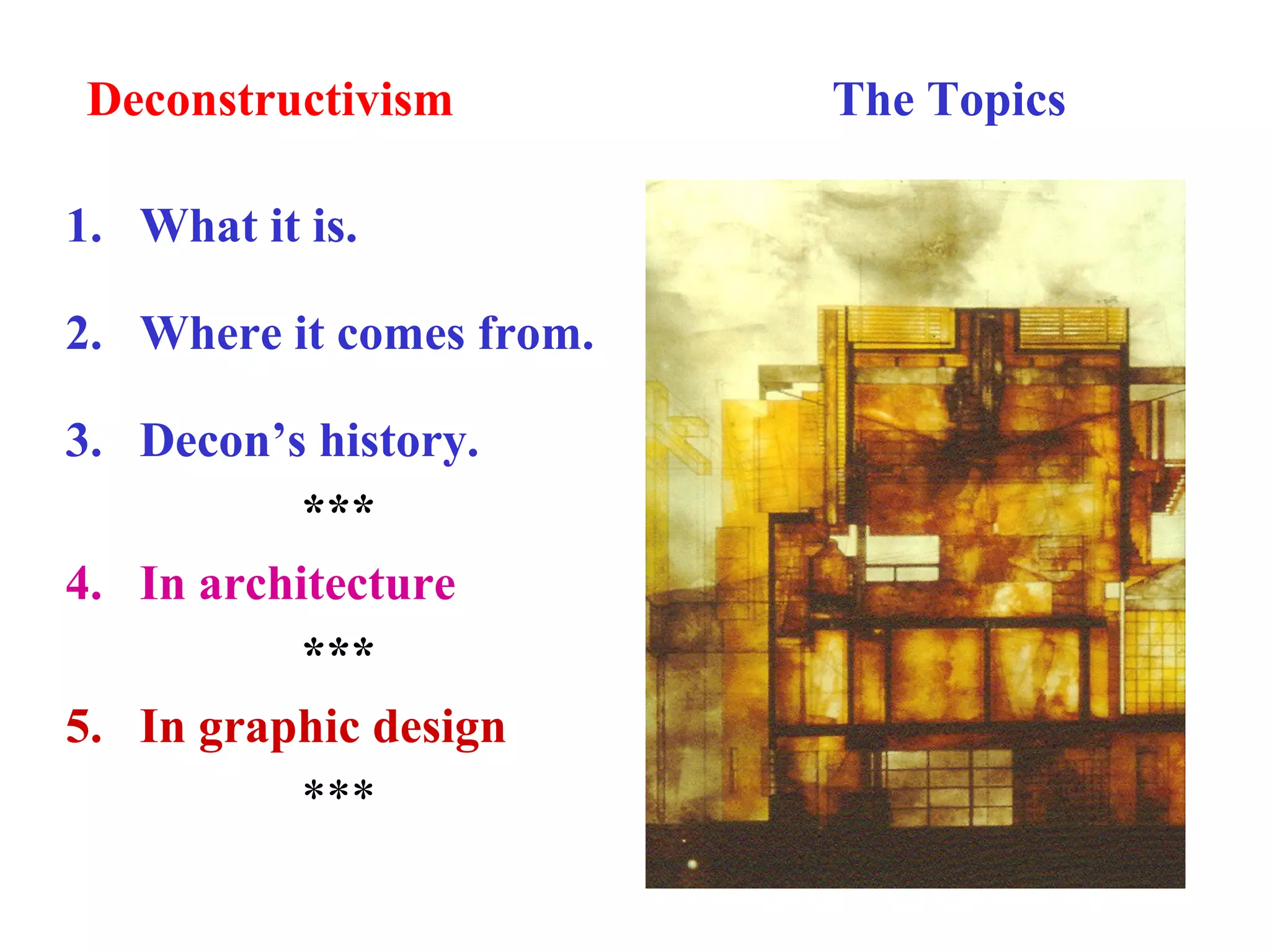
1. What it is.
2. Where it comes from.
3. Decon’s history.
***
4. In architecture
***
5. In graphic design
***
Deconstructivism What it is
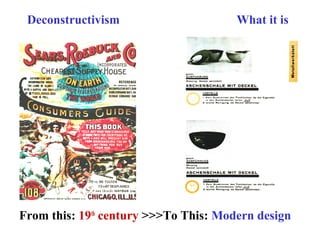
From this: 19th
century >>>To This: Modern design
Deconstructivism What it is
Modern Design emerges in the 1920s in Architecture,
Graphics and Product Design.
NOTE THE DATES:
Early Modernism (1917-1950): The Bauhaus
Modernism (1950-1970): The International Style
Postmodernism (1970-Now): Postmodernism
Deconstructivism
is part of the Postmodern period
Deconstructivism What it is
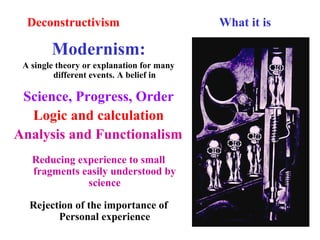
Modernism:
A single theory or explanation for many
different events. A belief in
Science, Progress, Order
Logic and calculation
Analysis and Functionalism
Reducing experience to small
fragments easily understood by
science
Rejection of the importance of
Personal experience
Deconstructivism What it is
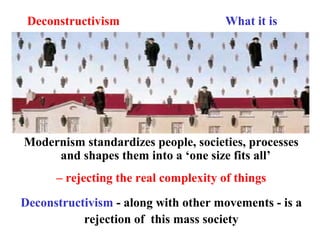
Modernism standardizes people, societies, processes
and shapes them into a ‘one size fits all’
– rejecting the real complexity of things
Deconstructivism - along with other movements - is a
rejection of this mass society
Deconstructivism What it is
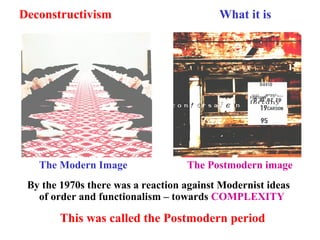
The Modern Image The Postmodern image
By the 1970s there was a reaction against Modernist ideas
of order and functionalism – towards COMPLEXITY
This was called the Postmodern period
Deconstructivism What it is
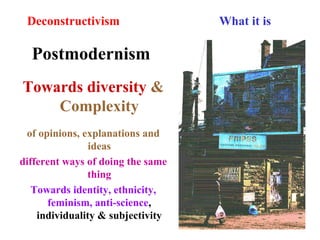
Postmodernism
Towards diversity &
Complexity
of opinions, explanations and
ideas
different ways of doing the same
thing
Towards identity, ethnicity,
feminism, anti-science,
individuality & subjectivity
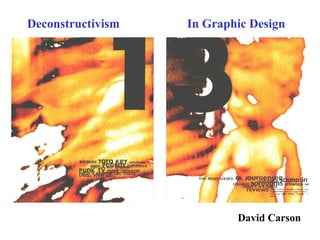
Deconstructivism What it is
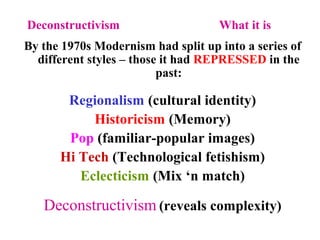
By the 1970s Modernism had split up into a series of
different styles – those it had REPRESSED in the
past:
Regionalism (cultural identity)
Historicism (Memory)
Pop (familiar-popular images)
Hi Tech (Technological fetishism)
Eclecticism (Mix ‘n match)
Deconstructivism (reveals complexity)
Deconstructivism What it is
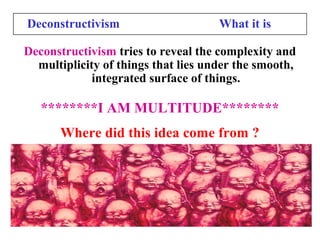
Deconstructivism tries to reveal the complexity and
multiplicity of things that lies under the smooth,
integrated surface of things.
********I AM MULTITUDE********
Where did this idea come from ?
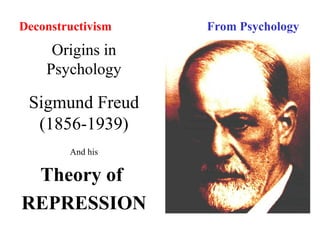
Deconstructivism From Psychology
Origins in
Psychology
Sigmund Freud
(1856-1939)
And his
Theory of
REPRESSION
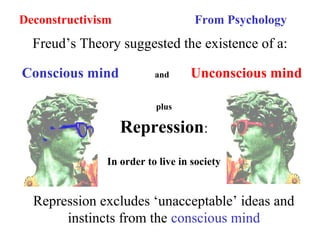
Deconstructivism From Psychology
Freud’s Theory suggested the existence of a:
Conscious mind and Unconscious mind
plus
Repression:
In order to live in society
Repression excludes ‘unacceptable’ ideas and
instincts from the conscious mind
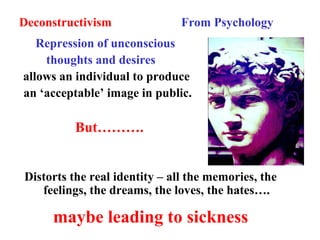
Deconstructivism From Psychology
Repression of unconscious
thoughts and desires
allows an individual to produce
an ‘acceptable’ image in public.
But……….
Distorts the real identity – all the memories, the
feelings, the dreams, the loves, the hates….
maybe leading to sickness
Deconstructivism From Psychology
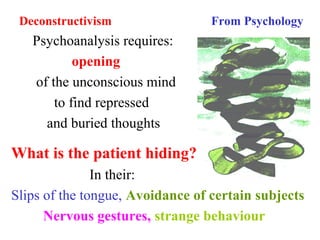
Psychoanalysis requires:
opening
of the unconscious mind
to find repressed
and buried thoughts
What is the patient hiding?
In their:
Slips of the tongue, Avoidance of certain subjects
Nervous gestures, strange behaviour
Deconstructivism From Psychology
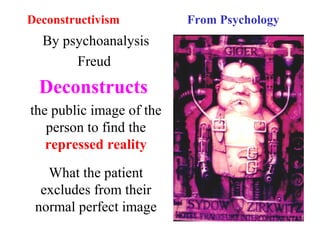
By psychoanalysis
Freud
Deconstructs
the public image of the
person to find the
repressed reality
What the patient
excludes from their
normal perfect image
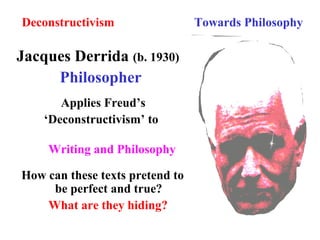
Deconstructivism Towards Philosophy
Jacques Derrida (b. 1930)
Philosopher
Applies Freud’s
‘Deconstructivism’ to
Writing and Philosophy
How can these texts pretend to
be perfect and true?
What are they hiding?
Deconstructivism Towards Philosophy
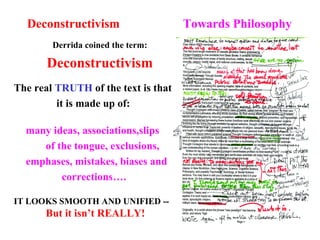
Derrida coined the term:
Deconstructivism
The real TRUTH of the text is that
it is made up of:
many ideas, associations,slips
of the tongue, exclusions,
emphases, mistakes, biases and
corrections….
IT LOOKS SMOOTH AND UNIFIED --
But it isn’t REALLY!
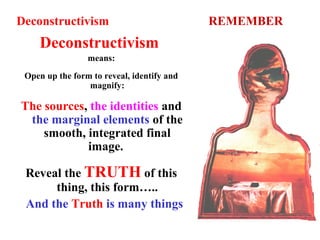
Deconstructivism REMEMBER
Deconstructivism
means:
Open up the form to reveal, identify and
magnify:
The sources, the identities and
the marginal elements of the
smooth, integrated final
image.
Reveal the TRUTH of this
thing, this form…..
And the Truth is many things
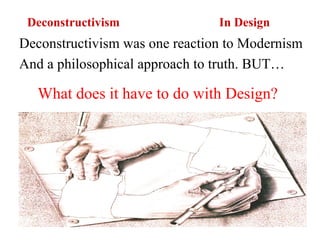
Deconstructivism In Design
Deconstructivism was one reaction to Modernism
And a philosophical approach to truth. BUT…
What does it have to do with Design?
Deconstructivism In Design
DESIGN IS A LANGUAGE
It involves
Selection and Combination
Of forms
To Represent a group of functions
Sometimes these functions are complex and
the forms chosen have to express that.
Merging different forms is Design
Deconstructivism In Design
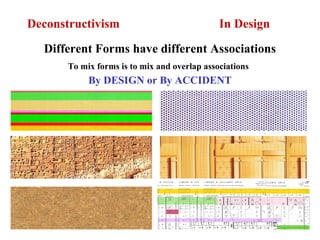
Different Forms have different Associations
To mix forms is to mix and overlap associations
By DESIGN or By ACCIDENT
Deconstructivism In Design
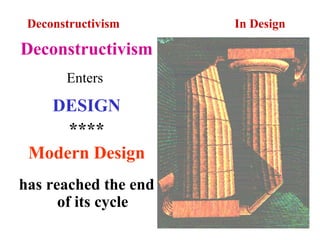
Deconstructivism
Enters
DESIGN
****
Modern Design
has reached the end
of its cycle
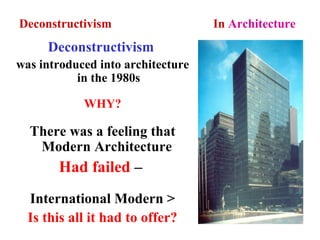
Deconstructivism In Architecture
Deconstructivism
was introduced into architecture
in the 1980s
WHY?
There was a feeling that
Modern Architecture
Had failed –
International Modern >
Is this all it had to offer?
Deconstructivism In Architecture
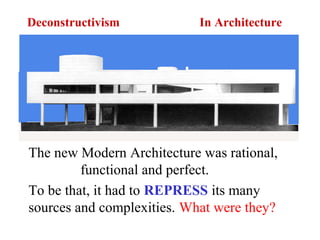
The new Modern Architecture was rational,
functional and perfect.
To be that, it had to REPRESS its many
sources and complexities. What were they?
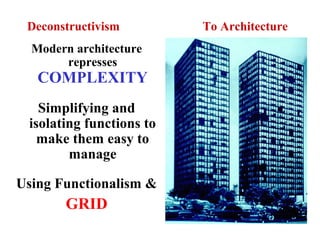
Deconstructivism To Architecture
Modern architecture
represses
COMPLEXITY
Simplifying and
isolating functions to
make them easy to
manage
Using Functionalism &
GRID
Deconstructivism In Architecture
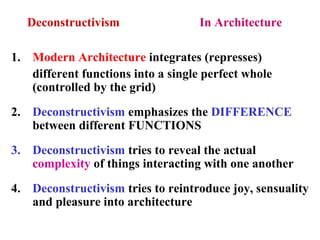
1. Modern Architecture integrates (represses)
different functions into a single perfect whole
(controlled by the grid)
2. Deconstructivism emphasizes the DIFFERENCE
between different FUNCTIONS
3. Deconstructivism tries to reveal the actual
complexity of things interacting with one another
4. Deconstructivism tries to reintroduce joy, sensuality
and pleasure into architecture
Deconstructivism In Architecture
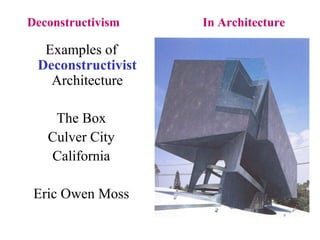
Examples of
Deconstructivist
Architecture
The Box
Culver City
California
Eric Owen Moss
Deconstructivism In Architecture
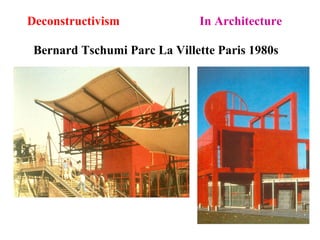
Bernard Tschumi Parc La Villette Paris 1980s
Deconstructivism In Architecture
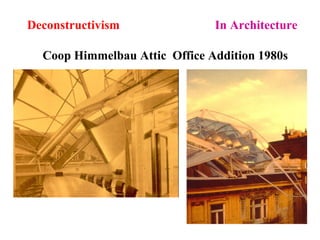
Coop Himmelbau Attic Office Addition 1980s
Deconstructivism In Architecture
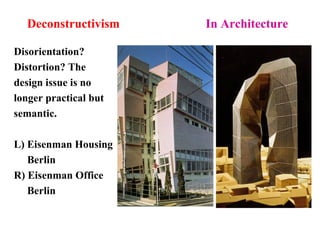
Disorientation?
Distortion? The
design issue is no
longer practical but
semantic.
L) Eisenman Housing
Berlin
R) Eisenman Office
Berlin
Deconstructivism In Architecture
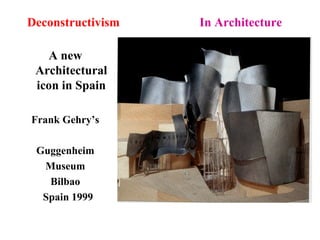
A new
Architectural
icon in Spain
Frank Gehry’s
Guggenheim
Museum
Bilbao
Spain 1999
Deconstructivism In Architecture
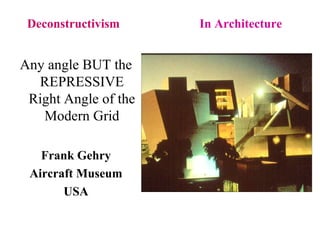
Any angle BUT the
REPRESSIVE
Right Angle of the
Modern Grid
Frank Gehry
Aircraft Museum
USA
Deconstructivism In Graphic Design
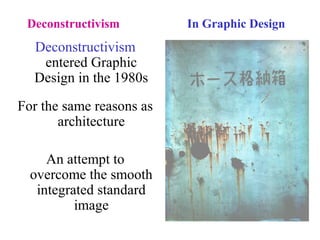
Deconstructivism
entered Graphic
Design in the 1980s
For the same reasons as
architecture
An attempt to
overcome the smooth
integrated standard
image
Deconstructivism In Graphic Design
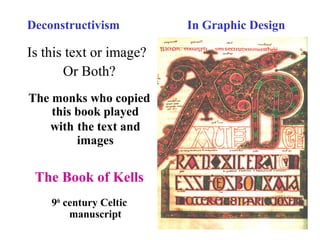
Is this text or image?
Or Both?
The monks who copied
this book played
with the text and
images
The Book of Kells
9th
century Celtic
manuscript
Deconstructivism In Graphic design
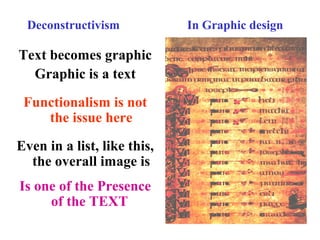
Text becomes graphic
Graphic is a text
Functionalism is not
the issue here
Even in a list, like this,
the overall image is
Is one of the Presence
of the TEXT
Deconstructivism In Graphic Design
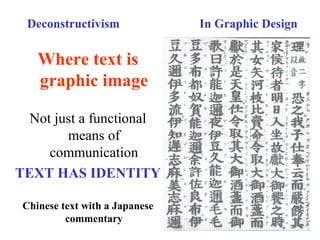
Where text is
graphic image
Not just a functional
means of
communication
TEXT HAS IDENTITY
Chinese text with a Japanese
commentary
Deconstructivism
Typical Concepts:
1. Changing type sizes and fonts (Diversity)
2. Unusual or custom fonts (Individuality)
3. Richly cluttered pages (Complexity)
4. Stripped down pages (No overall order)
5. Mistakes revealed (Truth & Authenticity)
Deconstructivism In Graphic Design
Deconstructivism
More Typical Concepts:
6. No Grid (Freedom as against Order)
7. Big Ideas (Beyond Functionalism)
8. Accepting the Ambiguous (the Unsaid)
9. Possibility of Other Meanings (Uncontrolled)
10. Multiple Messages (Plurality)
Deconstructivism In Graphic Design
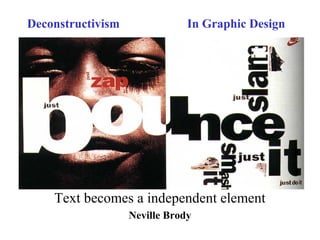
Text becomes a independent element
Neville Brody
Deconstructivism In Graphic design
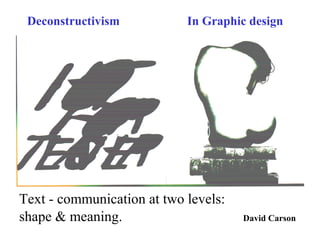
Text - communication at two levels:
shape & meaning. David Carson
Deconstructivism In Graphic Design
Deconstructivist Techniques:
1. Clash (of images and text types)
2. Collision and overlap (of sub grids & elements)
3. Disruption (of assumptions and stereotypes)
4. Disintegration (of overall image & viewpoint)
5. Fracturing (of wholeness & unity)
6. Each element is an independent reality
7. Each element reveals what it really is
8. Free-floating elements within the frame
Deconstructivism In Graphic Design
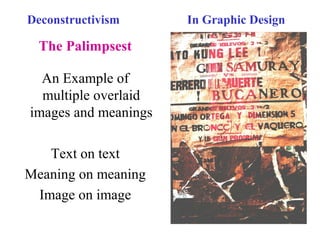
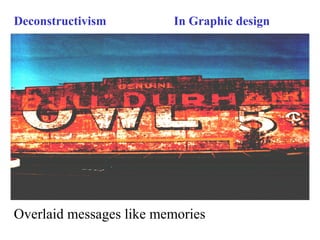
The Palimpsest
An Example of
multiple overlaid
images and meanings
Text on text
Meaning on meaning
Image on image
Deconstructivism In Graphic Design
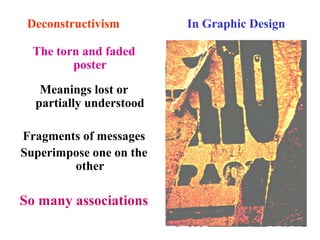
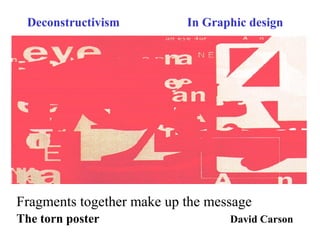
The torn and faded
poster
Meanings lost or
partially understood
Fragments of messages
Superimpose one on the
other
So many associations
Deconstructivism In Graphic Design
Deconstructivist attitudes:
1. Play…….. the creative search – the random
2. Humour…the clash of assumptions
3. Irony……. the double meaning
4. Parody….. exaggeration of character
5. Pastiche... The obvious fake – (humour)
6. Contention..Challenging the stereotypes
7. De-Centering..No dominant message
8. Ambiguity & complexity…reality
Deconstructivism In Graphic design
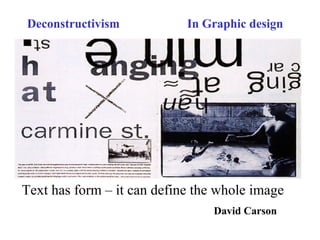
Text has form – it can define the whole image
David Carson
Deconstructivism In Graphic Design
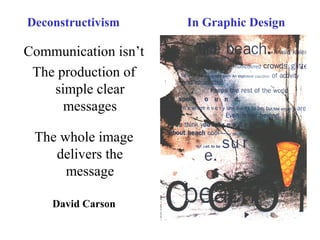
Communication isn’t
The production of
simple clear
messages
The whole image
delivers the
message
David Carson
Deconstructivism In Graphic Design
“…Against those columns of text, neatly boxed
pictures, steady relationships of headline, body
copy and captions, numbered leaves…..
These free form inked sheets are more akin to
paintings than publication design.
The reliable features that dominate our daily diet
of print are here:
questioned, played with, broken or ignored…”
Deconstructivism In Graphic design
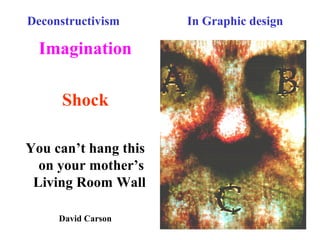
Imagination
Shock
You can’t hang this
on your mother’s
Living Room Wall
David Carson
Deconstructivism In Graphic design
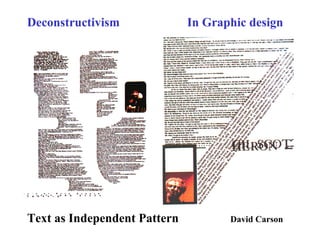
Text as Independent Pattern David Carson
Deconstructivism In Graphic design
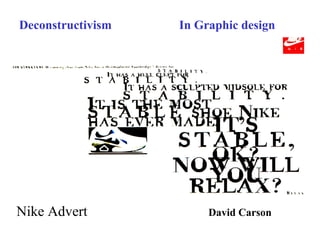
Nike Advert David Carson
Deconstructivism In Graphic design
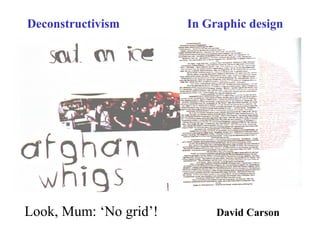
Look, Mum: ‘No grid’! David Carson
Deconstructivism In Graphic design
Fragments together make up the message
The torn poster David Carson
Deconstructivism In Graphic design
Overlaid messages like memories
Deconstructivism In Graphic Design
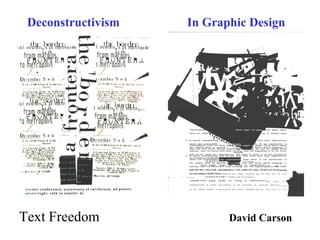
Text Freedom David Carson
Deconstructivism In Graphic Design
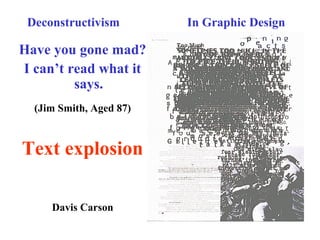
Have you gone mad?
I can’t read what it
says.
(Jim Smith, Aged 87)
Text explosion
Davis Carson
Deconstructivism In Graphic Design
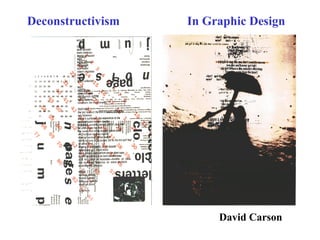
David Carson
Deconstructivism In Graphic design
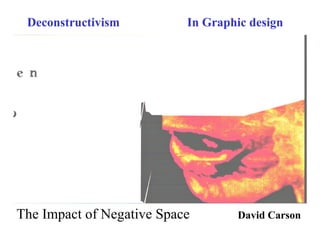
The Impact of Negative Space David Carson
Deconstructivism In Graphic Design
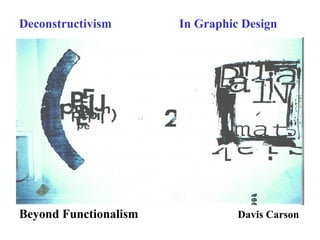
Beyond Functionalism Davis Carson
Deconstructivism In Graphic Design
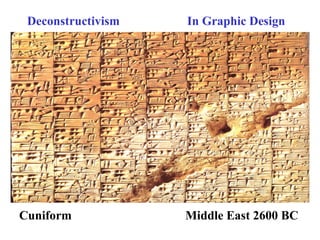
Cuniform Middle East 2600 BC
Deconstructivism In Graphic Design
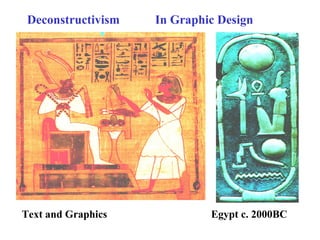
Text and Graphics Egypt c. 2000BC
Deconstructivism In Graphic Design
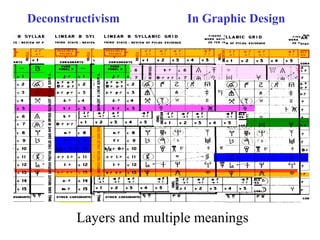
Layers and multiple meanings
Deconstructivism In Graphic Design
David Carson
Deconstructivism In Graphic design
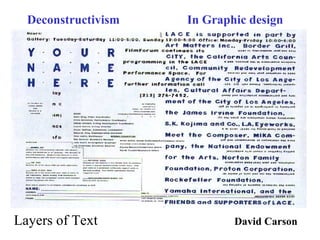
Layers of Text David Carson
Deconstructivism
That’s It!
Thank you for
your attention
Have a nice day!
Alex Brown

Decon graphics lecture

  • 1.
    Deconstructivism The Topics 1.What it is. 2. Where it comes from. 3. Decon’s history. *** 4. In architecture *** 5. In graphic design ***
  • 2.
    Deconstructivism What itis From this: 19th century >>>To This: Modern design
  • 3.
    Deconstructivism What itis Modern Design emerges in the 1920s in Architecture, Graphics and Product Design. NOTE THE DATES: Early Modernism (1917-1950): The Bauhaus Modernism (1950-1970): The International Style Postmodernism (1970-Now): Postmodernism Deconstructivism is part of the Postmodern period
  • 4.
    Deconstructivism What itis Modernism: A single theory or explanation for many different events. A belief in Science, Progress, Order Logic and calculation Analysis and Functionalism Reducing experience to small fragments easily understood by science Rejection of the importance of Personal experience
  • 5.
    Deconstructivism What itis Modernism standardizes people, societies, processes and shapes them into a ‘one size fits all’ – rejecting the real complexity of things Deconstructivism - along with other movements - is a rejection of this mass society
  • 6.
    Deconstructivism What itis The Modern Image The Postmodern image By the 1970s there was a reaction against Modernist ideas of order and functionalism – towards COMPLEXITY This was called the Postmodern period
  • 7.
    Deconstructivism What itis Postmodernism Towards diversity & Complexity of opinions, explanations and ideas different ways of doing the same thing Towards identity, ethnicity, feminism, anti-science, individuality & subjectivity
  • 8.
    Deconstructivism What itis By the 1970s Modernism had split up into a series of different styles – those it had REPRESSED in the past: Regionalism (cultural identity) Historicism (Memory) Pop (familiar-popular images) Hi Tech (Technological fetishism) Eclecticism (Mix ‘n match) Deconstructivism (reveals complexity)
  • 9.
    Deconstructivism What itis Deconstructivism tries to reveal the complexity and multiplicity of things that lies under the smooth, integrated surface of things. ********I AM MULTITUDE******** Where did this idea come from ?
  • 10.
    Deconstructivism From Psychology Originsin Psychology Sigmund Freud (1856-1939) And his Theory of REPRESSION
  • 11.
    Deconstructivism From Psychology Freud’sTheory suggested the existence of a: Conscious mind and Unconscious mind plus Repression: In order to live in society Repression excludes ‘unacceptable’ ideas and instincts from the conscious mind
  • 12.
    Deconstructivism From Psychology Repressionof unconscious thoughts and desires allows an individual to produce an ‘acceptable’ image in public. But………. Distorts the real identity – all the memories, the feelings, the dreams, the loves, the hates…. maybe leading to sickness
  • 13.
    Deconstructivism From Psychology Psychoanalysisrequires: opening of the unconscious mind to find repressed and buried thoughts What is the patient hiding? In their: Slips of the tongue, Avoidance of certain subjects Nervous gestures, strange behaviour
  • 14.
    Deconstructivism From Psychology Bypsychoanalysis Freud Deconstructs the public image of the person to find the repressed reality What the patient excludes from their normal perfect image
  • 15.
    Deconstructivism Towards Philosophy JacquesDerrida (b. 1930) Philosopher Applies Freud’s ‘Deconstructivism’ to Writing and Philosophy How can these texts pretend to be perfect and true? What are they hiding?
  • 16.
    Deconstructivism Towards Philosophy Derridacoined the term: Deconstructivism The real TRUTH of the text is that it is made up of: many ideas, associations,slips of the tongue, exclusions, emphases, mistakes, biases and corrections…. IT LOOKS SMOOTH AND UNIFIED -- But it isn’t REALLY!
  • 17.
    Deconstructivism REMEMBER Deconstructivism means: Open upthe form to reveal, identify and magnify: The sources, the identities and the marginal elements of the smooth, integrated final image. Reveal the TRUTH of this thing, this form….. And the Truth is many things
  • 18.
    Deconstructivism In Design Deconstructivismwas one reaction to Modernism And a philosophical approach to truth. BUT… What does it have to do with Design?
  • 19.
    Deconstructivism In Design DESIGNIS A LANGUAGE It involves Selection and Combination Of forms To Represent a group of functions Sometimes these functions are complex and the forms chosen have to express that. Merging different forms is Design
  • 20.
    Deconstructivism In Design DifferentForms have different Associations To mix forms is to mix and overlap associations By DESIGN or By ACCIDENT
  • 21.
  • 22.
    Deconstructivism In Architecture Deconstructivism wasintroduced into architecture in the 1980s WHY? There was a feeling that Modern Architecture Had failed – International Modern > Is this all it had to offer?
  • 23.
    Deconstructivism In Architecture Thenew Modern Architecture was rational, functional and perfect. To be that, it had to REPRESS its many sources and complexities. What were they?
  • 24.
    Deconstructivism To Architecture Modernarchitecture represses COMPLEXITY Simplifying and isolating functions to make them easy to manage Using Functionalism & GRID
  • 25.
    Deconstructivism In Architecture 1.Modern Architecture integrates (represses) different functions into a single perfect whole (controlled by the grid) 2. Deconstructivism emphasizes the DIFFERENCE between different FUNCTIONS 3. Deconstructivism tries to reveal the actual complexity of things interacting with one another 4. Deconstructivism tries to reintroduce joy, sensuality and pleasure into architecture
  • 26.
    Deconstructivism In Architecture Examplesof Deconstructivist Architecture The Box Culver City California Eric Owen Moss
  • 27.
    Deconstructivism In Architecture BernardTschumi Parc La Villette Paris 1980s
  • 28.
    Deconstructivism In Architecture CoopHimmelbau Attic Office Addition 1980s
  • 29.
    Deconstructivism In Architecture Disorientation? Distortion?The design issue is no longer practical but semantic. L) Eisenman Housing Berlin R) Eisenman Office Berlin
  • 30.
    Deconstructivism In Architecture Anew Architectural icon in Spain Frank Gehry’s Guggenheim Museum Bilbao Spain 1999
  • 31.
    Deconstructivism In Architecture Anyangle BUT the REPRESSIVE Right Angle of the Modern Grid Frank Gehry Aircraft Museum USA
  • 32.
    Deconstructivism In GraphicDesign Deconstructivism entered Graphic Design in the 1980s For the same reasons as architecture An attempt to overcome the smooth integrated standard image
  • 33.
    Deconstructivism In GraphicDesign Is this text or image? Or Both? The monks who copied this book played with the text and images The Book of Kells 9th century Celtic manuscript
  • 34.
    Deconstructivism In Graphicdesign Text becomes graphic Graphic is a text Functionalism is not the issue here Even in a list, like this, the overall image is Is one of the Presence of the TEXT
  • 35.
    Deconstructivism In GraphicDesign Where text is graphic image Not just a functional means of communication TEXT HAS IDENTITY Chinese text with a Japanese commentary
  • 36.
    Deconstructivism Typical Concepts: 1. Changingtype sizes and fonts (Diversity) 2. Unusual or custom fonts (Individuality) 3. Richly cluttered pages (Complexity) 4. Stripped down pages (No overall order) 5. Mistakes revealed (Truth & Authenticity) Deconstructivism In Graphic Design
  • 37.
    Deconstructivism In GraphicDesign Deconstructivism More Typical Concepts: 6. No Grid (Freedom as against Order) 7. Big Ideas (Beyond Functionalism) 8. Accepting the Ambiguous (the Unsaid) 9. Possibility of Other Meanings (Uncontrolled) 10. Multiple Messages (Plurality)
  • 38.
    Deconstructivism In GraphicDesign Text becomes a independent element Neville Brody
  • 39.
    Deconstructivism In Graphicdesign Text - communication at two levels: shape & meaning. David Carson
  • 40.
    Deconstructivism In GraphicDesign Deconstructivist Techniques: 1. Clash (of images and text types) 2. Collision and overlap (of sub grids & elements) 3. Disruption (of assumptions and stereotypes) 4. Disintegration (of overall image & viewpoint) 5. Fracturing (of wholeness & unity) 6. Each element is an independent reality 7. Each element reveals what it really is 8. Free-floating elements within the frame
  • 41.
    Deconstructivism In GraphicDesign The Palimpsest An Example of multiple overlaid images and meanings Text on text Meaning on meaning Image on image
  • 42.
    Deconstructivism In GraphicDesign The torn and faded poster Meanings lost or partially understood Fragments of messages Superimpose one on the other So many associations
  • 43.
    Deconstructivism In GraphicDesign Deconstructivist attitudes: 1. Play…….. the creative search – the random 2. Humour…the clash of assumptions 3. Irony……. the double meaning 4. Parody….. exaggeration of character 5. Pastiche... The obvious fake – (humour) 6. Contention..Challenging the stereotypes 7. De-Centering..No dominant message 8. Ambiguity & complexity…reality
  • 44.
    Deconstructivism In Graphicdesign Text has form – it can define the whole image David Carson
  • 45.
    Deconstructivism In GraphicDesign Communication isn’t The production of simple clear messages The whole image delivers the message David Carson
  • 46.
    Deconstructivism In GraphicDesign “…Against those columns of text, neatly boxed pictures, steady relationships of headline, body copy and captions, numbered leaves….. These free form inked sheets are more akin to paintings than publication design. The reliable features that dominate our daily diet of print are here: questioned, played with, broken or ignored…”
  • 47.
    Deconstructivism In Graphicdesign Imagination Shock You can’t hang this on your mother’s Living Room Wall David Carson
  • 48.
    Deconstructivism In Graphicdesign Text as Independent Pattern David Carson
  • 49.
    Deconstructivism In Graphicdesign Nike Advert David Carson
  • 50.
    Deconstructivism In Graphicdesign Look, Mum: ‘No grid’! David Carson
  • 51.
    Deconstructivism In Graphicdesign Fragments together make up the message The torn poster David Carson
  • 52.
    Deconstructivism In Graphicdesign Overlaid messages like memories
  • 53.
    Deconstructivism In GraphicDesign Text Freedom David Carson
  • 54.
    Deconstructivism In GraphicDesign Have you gone mad? I can’t read what it says. (Jim Smith, Aged 87) Text explosion Davis Carson
  • 55.
    Deconstructivism In GraphicDesign David Carson
  • 56.
    Deconstructivism In Graphicdesign The Impact of Negative Space David Carson
  • 57.
    Deconstructivism In GraphicDesign Beyond Functionalism Davis Carson
  • 58.
    Deconstructivism In GraphicDesign Cuniform Middle East 2600 BC
  • 59.
    Deconstructivism In GraphicDesign Text and Graphics Egypt c. 2000BC
  • 60.
    Deconstructivism In GraphicDesign Layers and multiple meanings
  • 61.
    Deconstructivism In GraphicDesign David Carson
  • 62.
    Deconstructivism In Graphicdesign Layers of Text David Carson
  • 63.
    Deconstructivism That’s It! Thank youfor your attention Have a nice day! Alex Brown