QUANTUM ENTANGLEMENT
-EINSTEIN’S “SPOOKY ACTION
AT A DISTANCE”
Einstein discussing quantum mechanics
with Neil Bohr
ENTANGLEMENT
AND THE
COLLAPSE OF THE
WAVE FUNCTION
ENTANGLEMENT
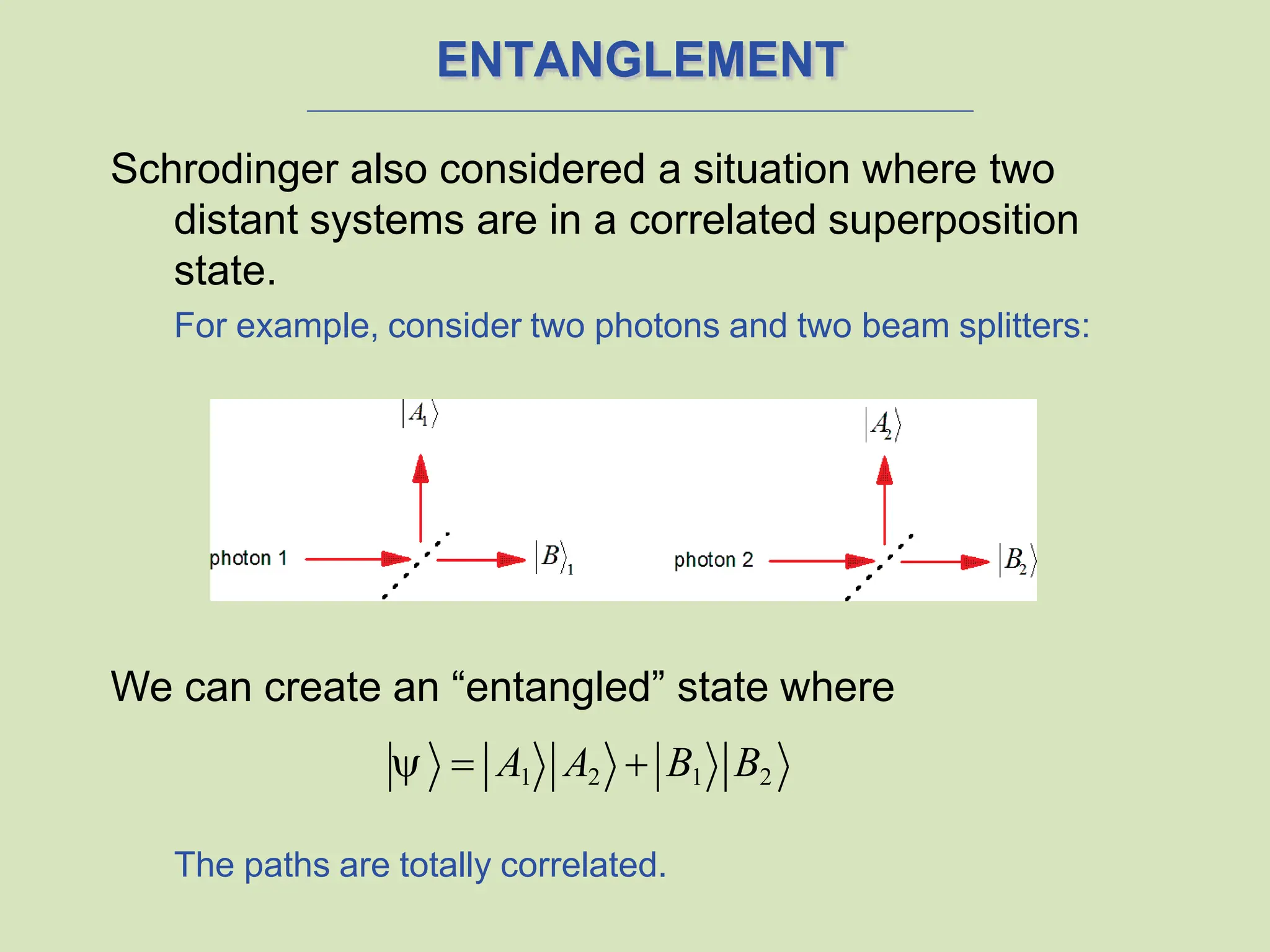
Schrodinger also considered a situation where two
distant systems are in a correlated superposition
state.
For example, consider two photons and two beam splitters:
We can create an “entangled” state where
  A1 A2  B1 B2
The paths are totally correlated.
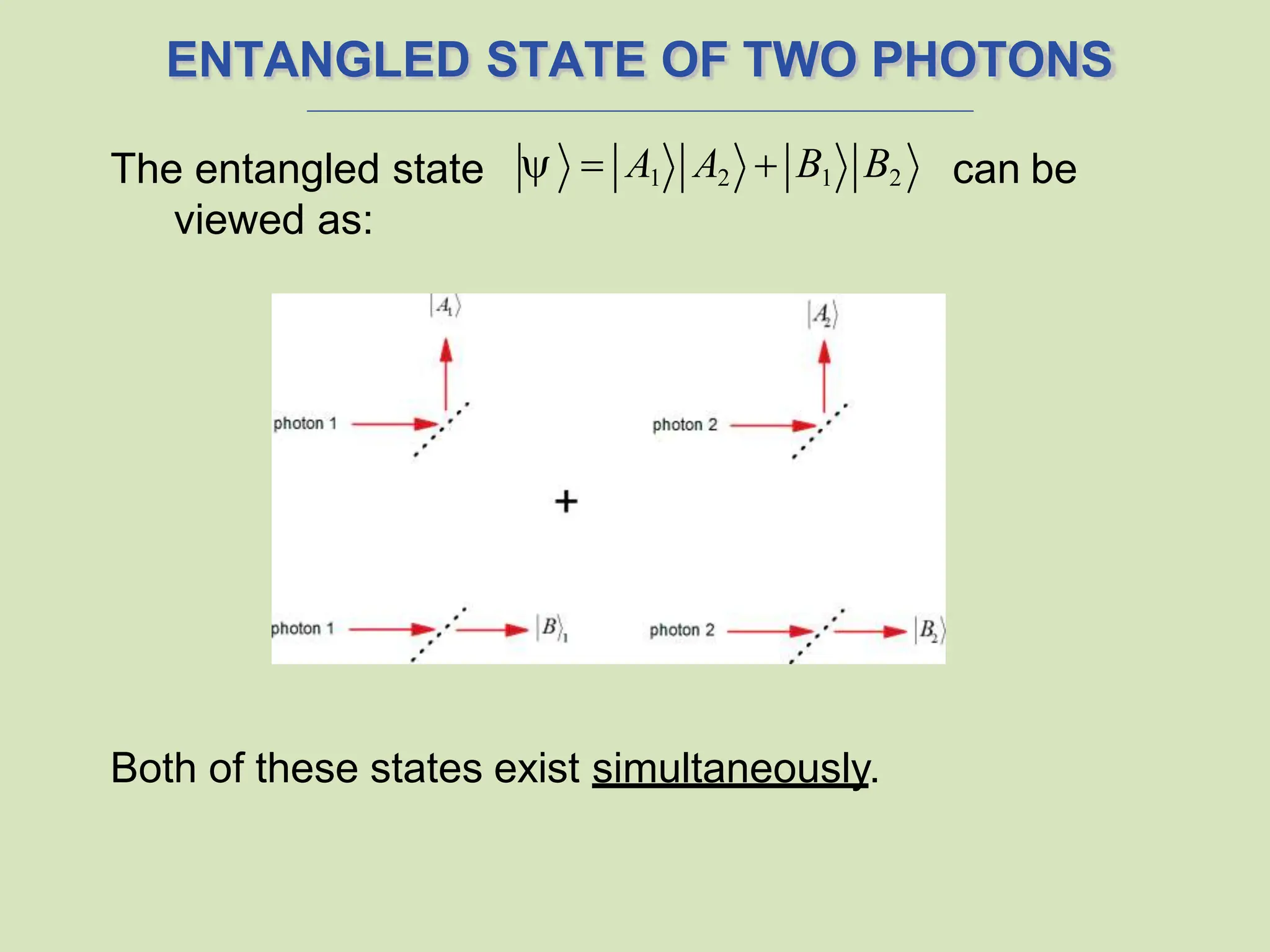
ENTANGLED STATE OF TWO PHOTONS
The entangled state can be
viewed as:
Both of these states exist simultaneously.
  A1 A2  B1 B2
COLLAPSE OF THE WAVE FUNCTION
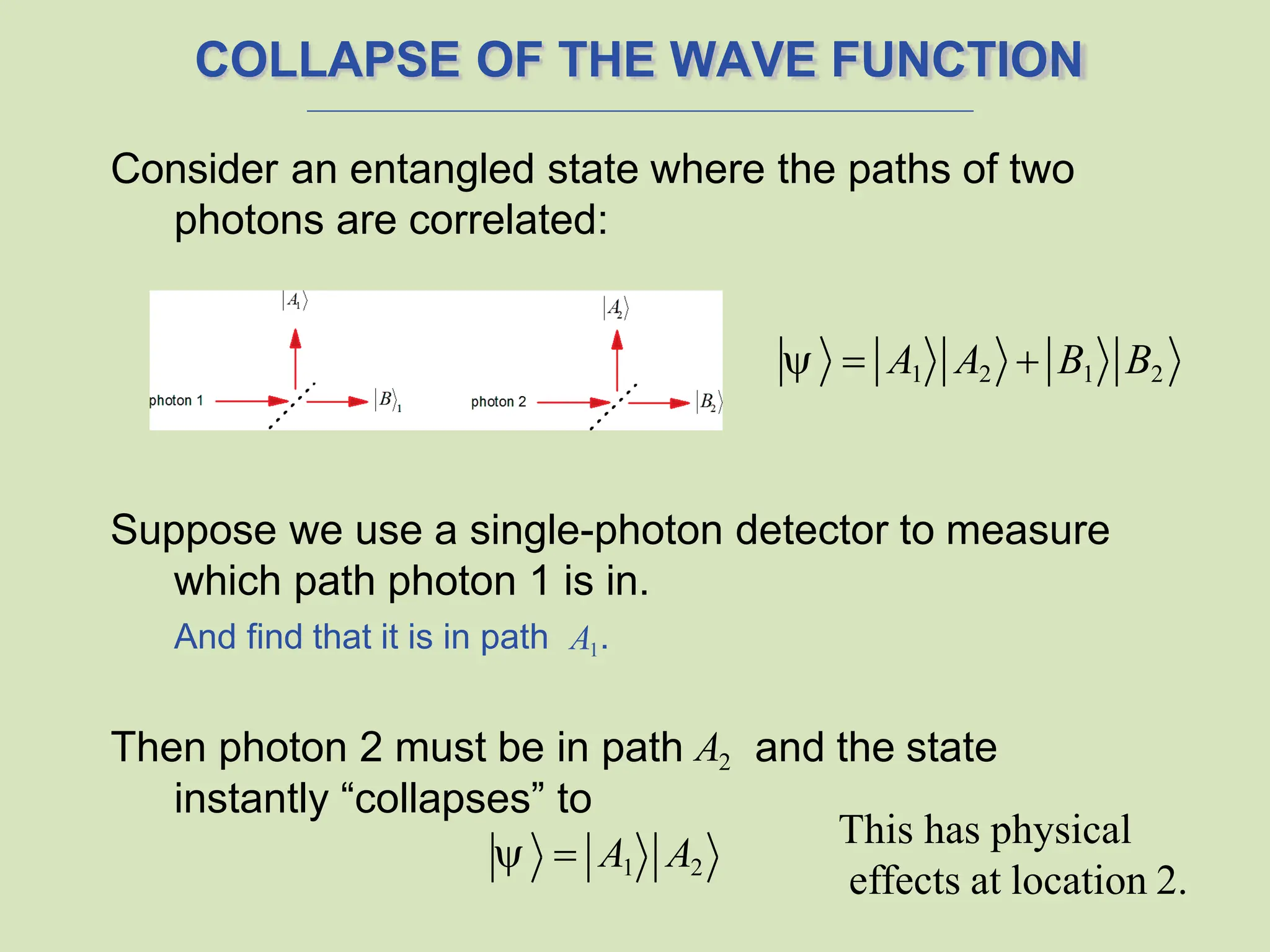
Consider an entangled state where the paths of two
photons are correlated:
  A1 A2  B1 B2
Suppose we use a single-photon detector to measure
which path photon 1 is in.
And find that it is in path A1.
Then photon 2 must be in path A2 and the state
instantly “collapses” to
  A1 A2
This has physical
effects at location 2.
NONLOCAL INTERFERENCE
How do we know that both states in an entangled state
really exist at the same time?
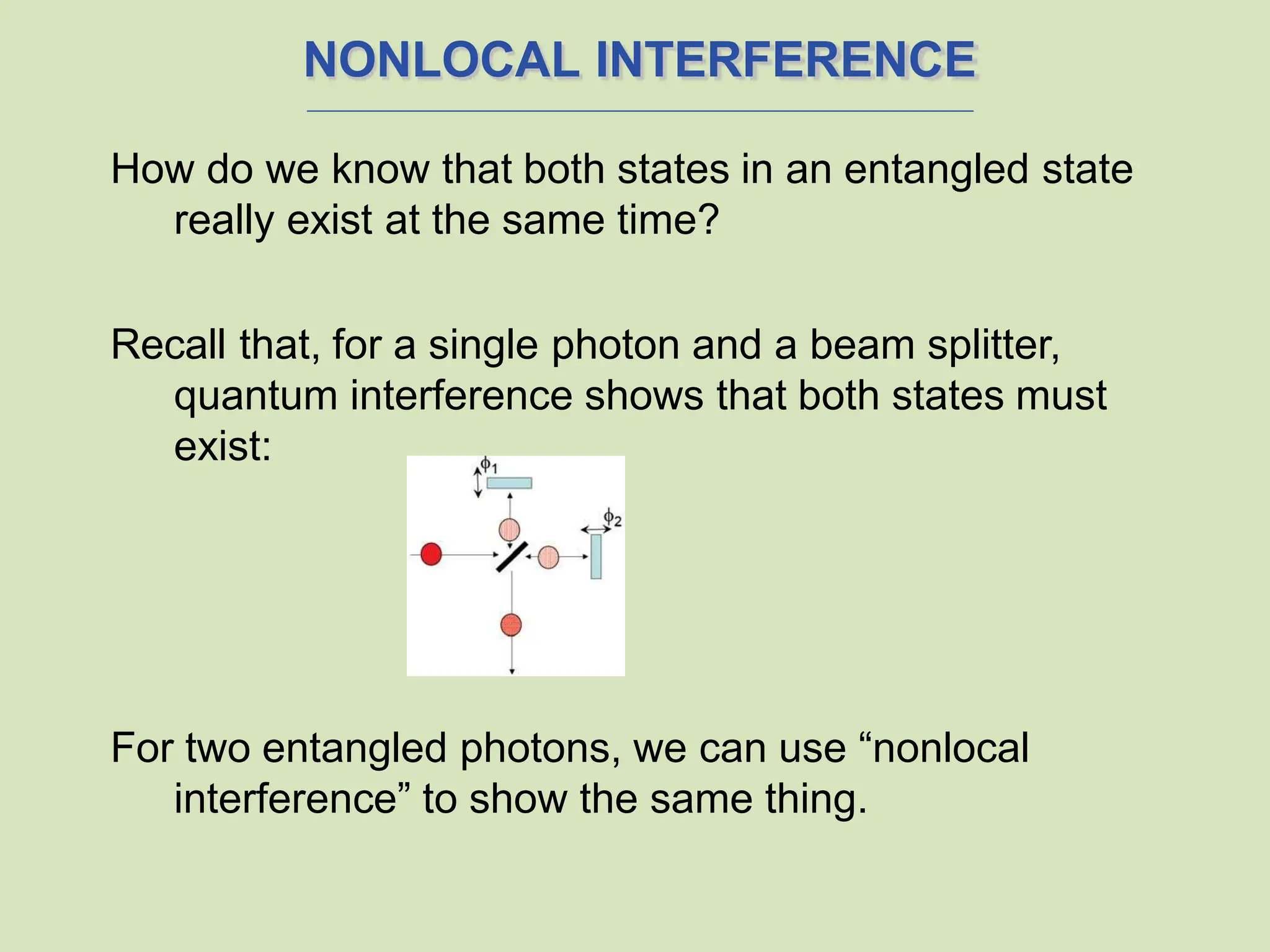
Recall that, for a single photon and a beam splitter,
quantum interference shows that both states must
exist:
For two entangled photons, we can use “nonlocal
interference” to show the same thing.
NONLOCAL INTERFERENCE
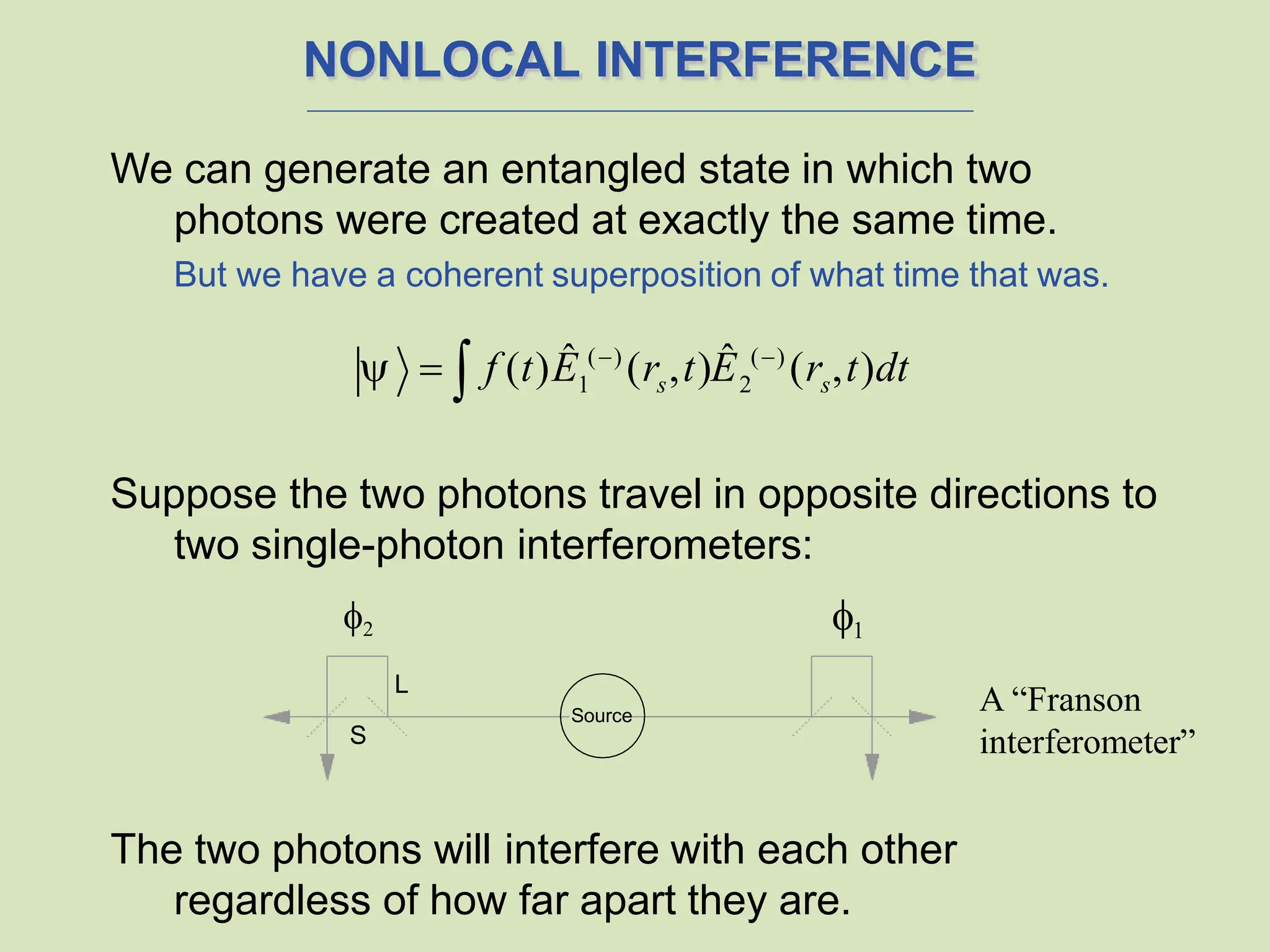
We can generate an entangled state in which two
photons were created at exactly the same time.
But we have a coherent superposition of what time that was.
Suppose the two photons travel in opposite directions to
two single-photon interferometers:
The two photons will interfere with each other
regardless of how far apart they are.
1 s 2 s
  f (t)Ê ()
(r ,t)Ê ()
(r ,t)dt

L
S
1
2
Source
A “Franson
interferometer”
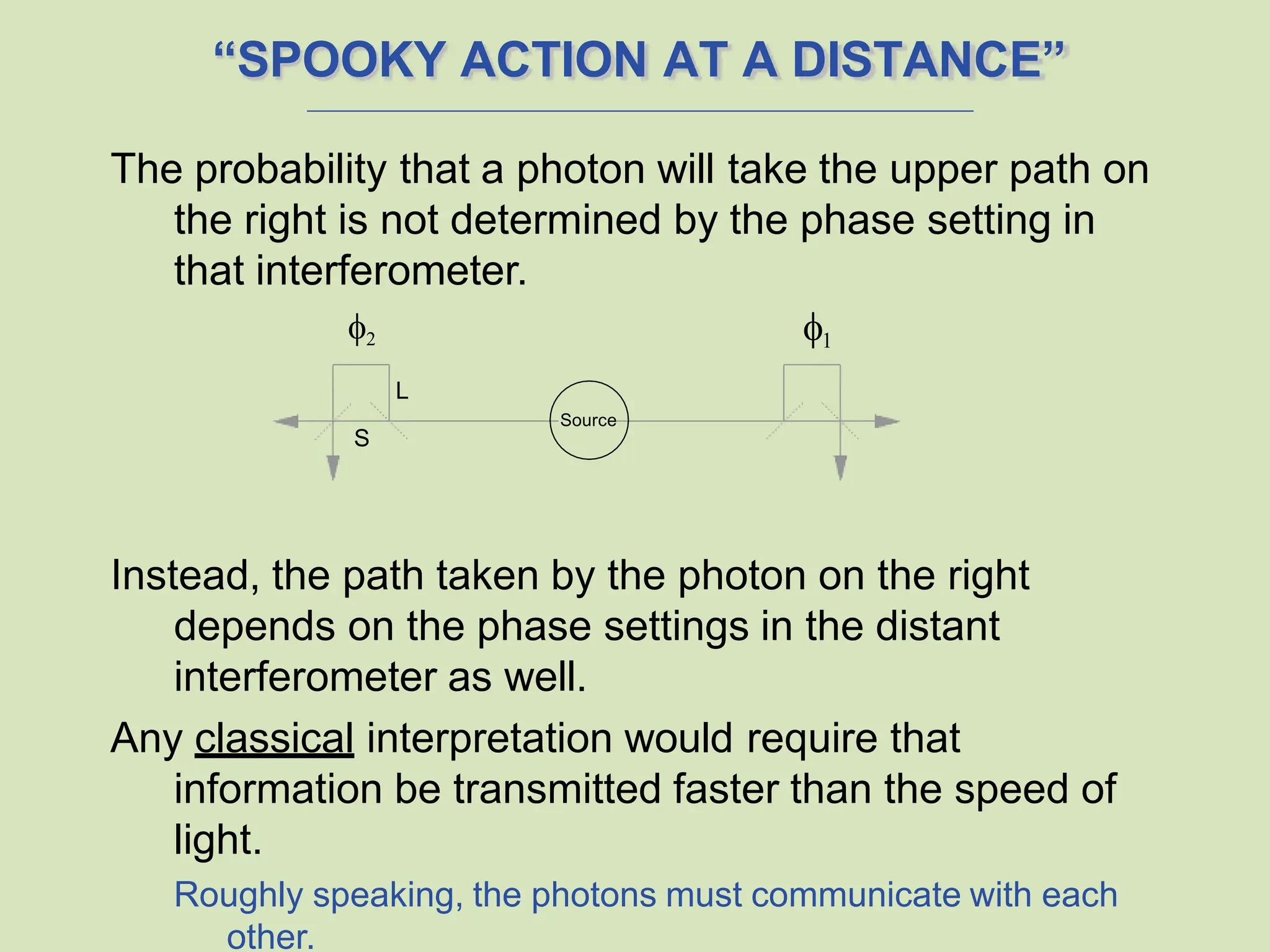
“SPOOKY ACTION AT A DISTANCE”
The probability that a photon will take the upper path on
the right is not determined by the phase setting in
that interferometer.
Instead, the path taken by the photon on the right
depends on the phase settings in the distant
interferometer as well.
Any classical interpretation would require that
information be transmitted faster than the speed of
light.
Roughly speaking, the photons must communicate with each
other.
L
S
1
2
Source
NONLOCAL INTERFEROMETRY1
We know that the two photons are emitted at the same
time.1:
If we only accept events in which the photons arrive at the
same time, there are two possibilities.
They both took the long path ( L1L2) or the short paths ( S1S2 )
There is no contribution from L1S2 .
or S1L2
rate proportional to .
Interference between L1L2 and gives a coincidence
L
S
1
2
Source
S1S2
2
1 2
cos [(  ) / 2]
This violates Bell’s inequality.
1. J. D. Franson, Phys. Rev. Lett. 62, 2205-2208 (1989).
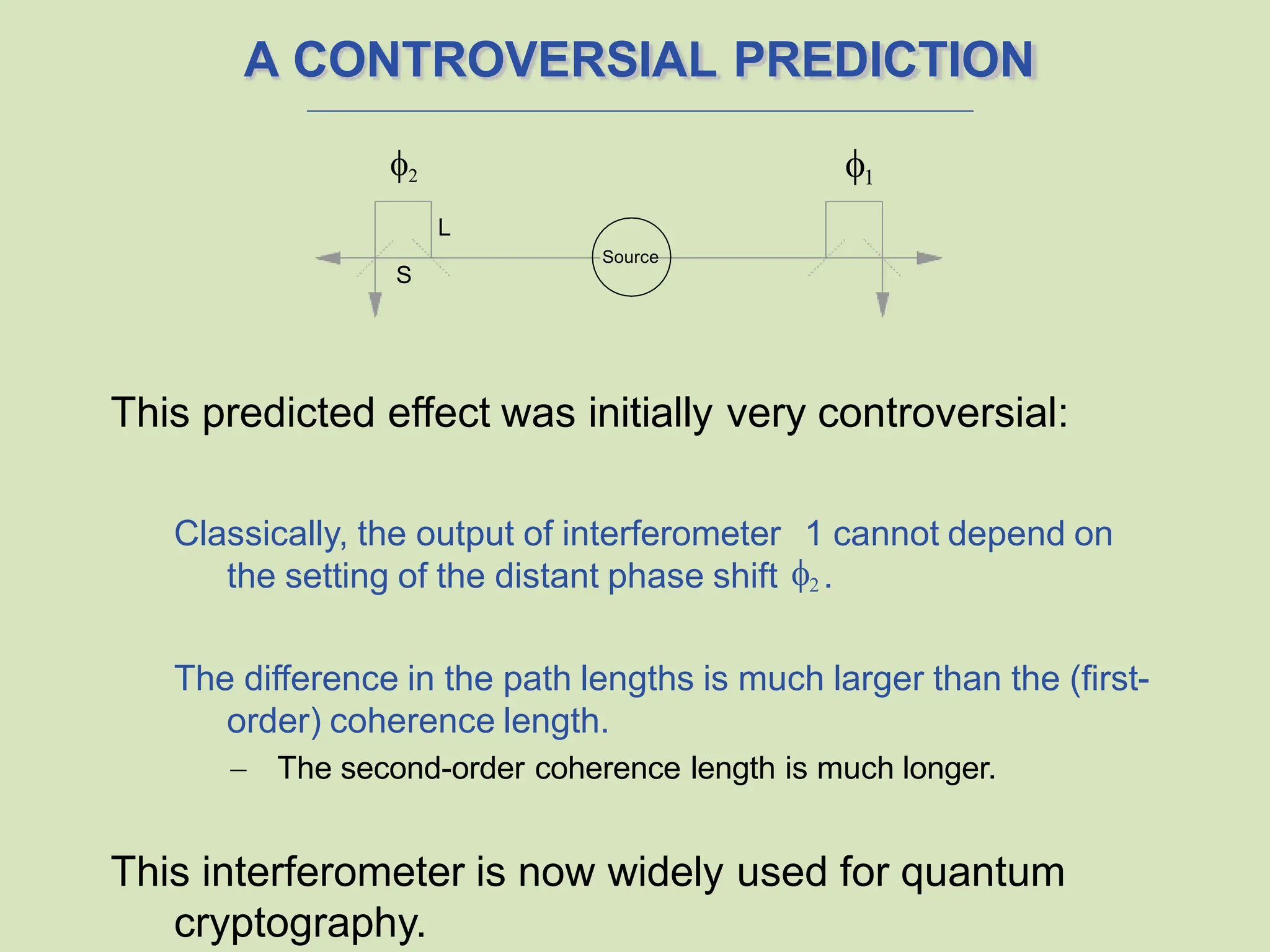
A CONTROVERSIAL PREDICTION
This predicted effect was initially very controversial:
Classically, the output of interferometer 1 cannot depend on
the setting of the distant phase shift 2 .
The difference in the path lengths is much larger than the (first-
order) coherence length.
 The second-order coherence length is much longer.
This interferometer is now widely used for quantum
cryptography.
L
S
1
2
Source
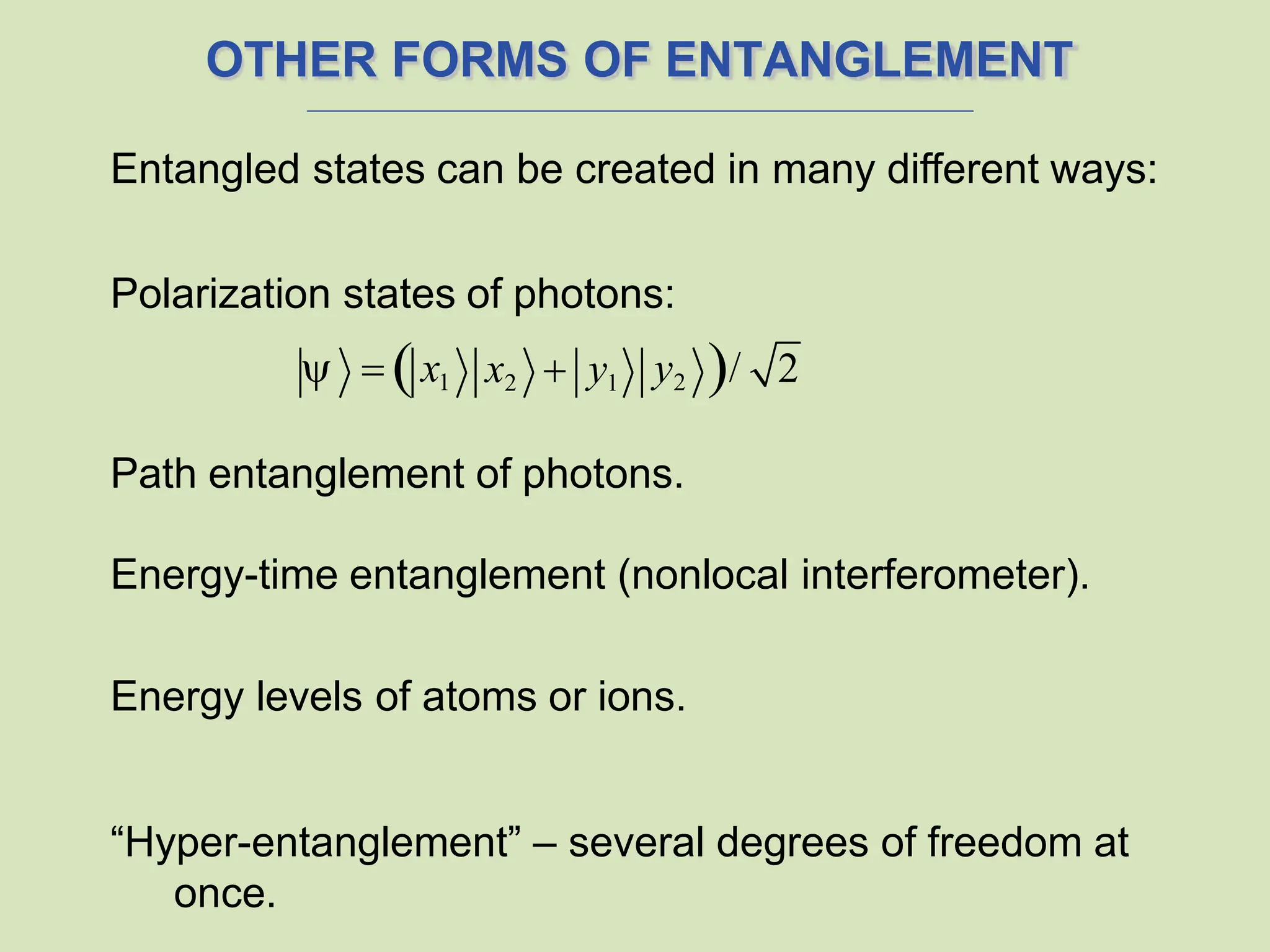
OTHER FORMS OF ENTANGLEMENT
Entangled states can be created in many different ways:
Polarization states of photons:
Path entanglement of photons.
Energy-time entanglement (nonlocal interferometer).
Energy levels of atoms or ions.
“Hyper-entanglement” – several degrees of freedom at
once.
  x1 y2 /
x2  y1 2
EINSTEIN-PODOLSKY-ROSEN
PARADOX
HIDDEN-VARIABLE
THEORIES
EINSTEIN-PODOLSKY-ROSEN
PARADOX1
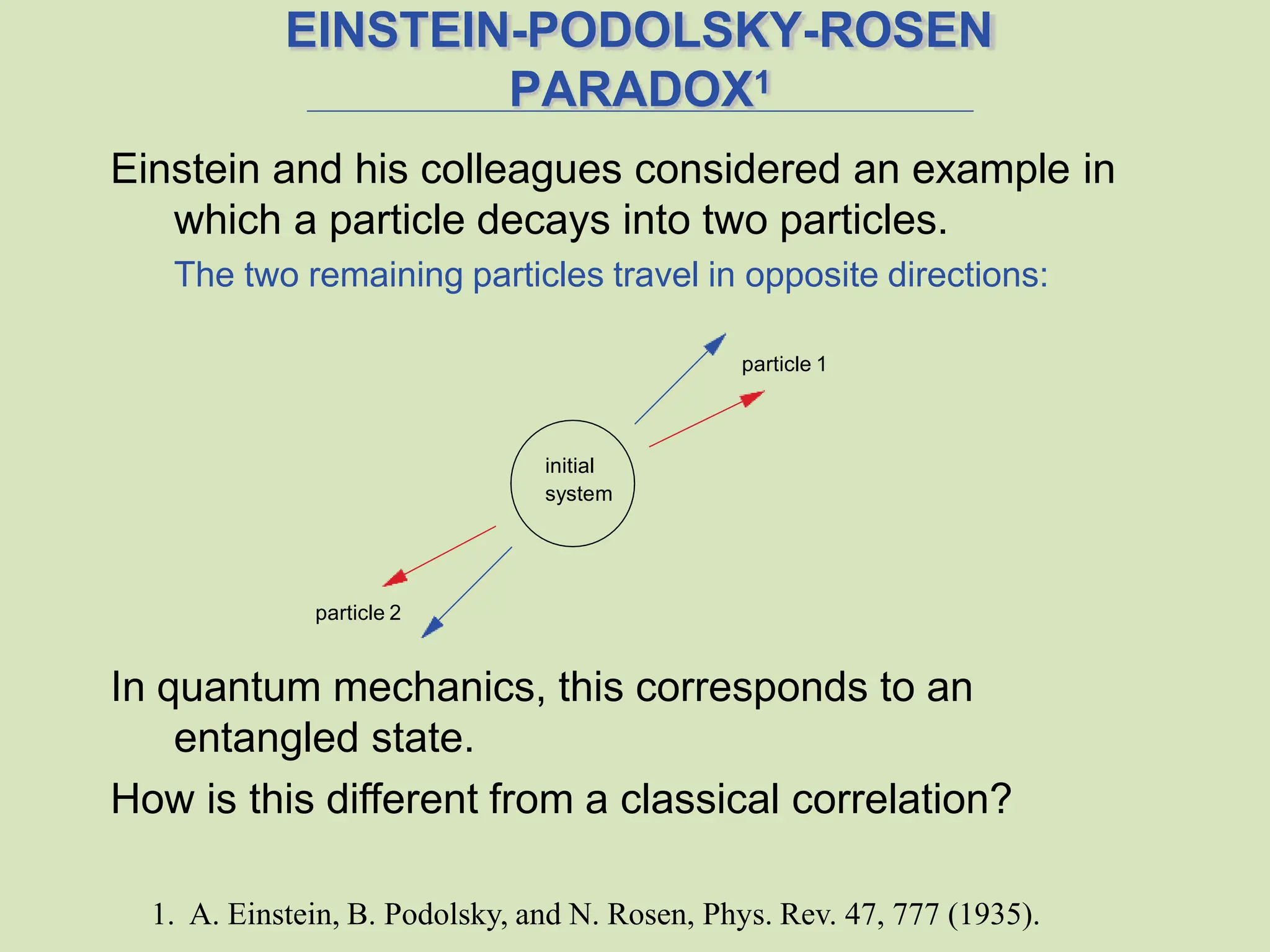
Einstein and his colleagues considered an example in
which a particle decays into two particles.
The two remaining particles travel in opposite directions:
In quantum mechanics, this corresponds to an
entangled state.
How is this different from a classical correlation?
1. A. Einstein, B. Podolsky, and N. Rosen, Phys. Rev. 47, 777 (1935).
initial
system
particle 1
particle 2
EINSTEIN-PODOLSKY-ROSEN
PARADOX
EPR argued that quantum mechanics is an incomplete
theory.
Element of reality – “If, without in any way disturbing a system,
we can predict with certainty the value of a physical
quantity, then there exists an element of physical reality
corresponding to this physical quantity.”
Complete theory - For a theory to be complete, “every element
of the physical reality must have a counter-part in the
physical theory.
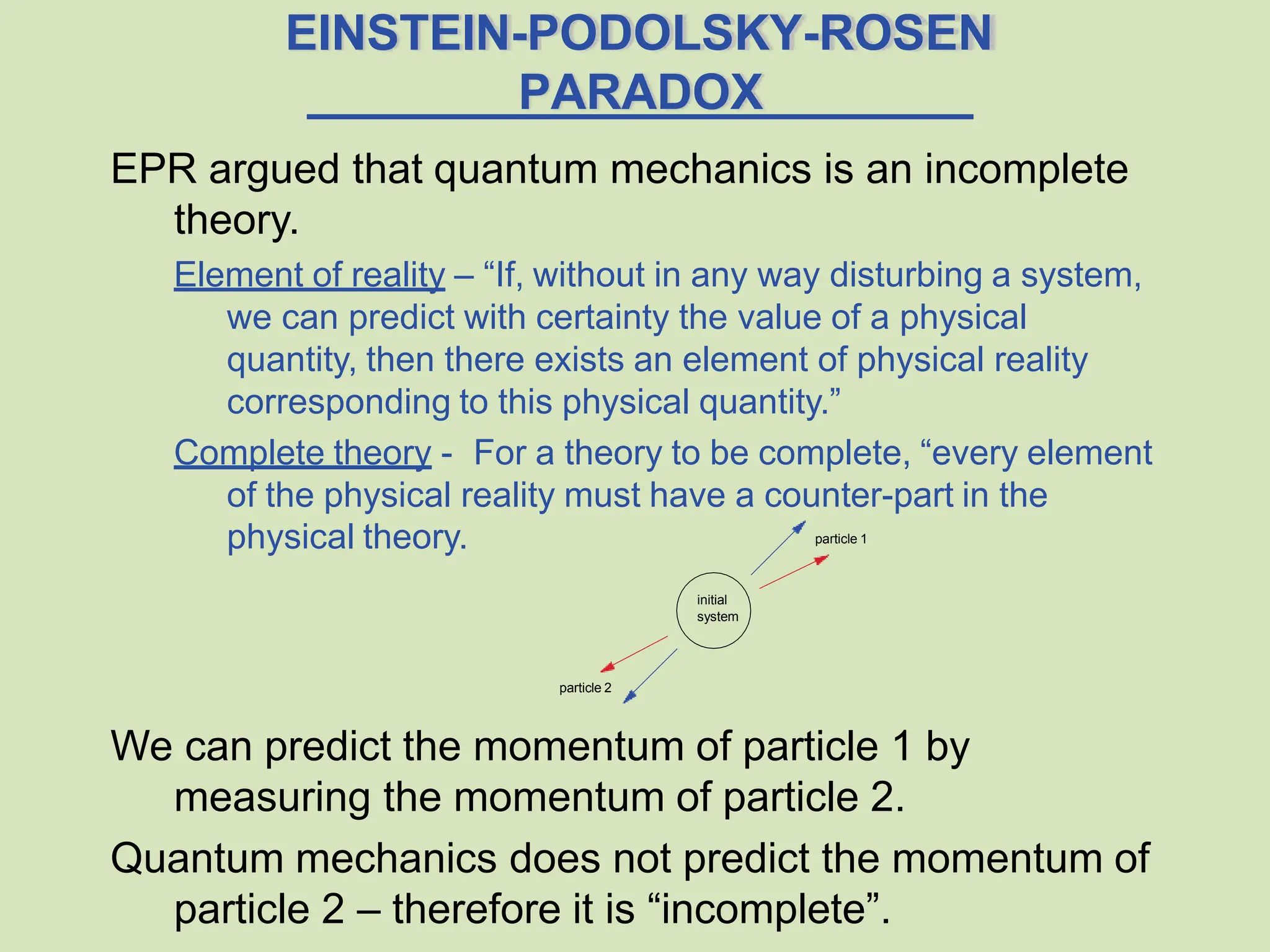
We can predict the momentum of particle 1 by
measuring the momentum of particle 2.
Quantum mechanics does not predict the momentum of
particle 2 – therefore it is “incomplete”.
initial
system
particle 1
particle 2
HIDDEN-VARIABLE THEORIES
How do we know that the state of the particles wasn’t
determined all along?
More generally, each particle could carry a set of
information with it that determines the results of any
measurements.
Theories of that kind are known as hidden-variable theories.
“Realism” – Nature has certain properties that exist
regardless of whether or not we measure them.
Einstein: “Does the moon really exist if no one is looking at it?”
“Locality” – What happens at one location can have no
immediate effect on a system at a distant location.
“Local realistic theories”
BELL’S INEQUALITY (1964)
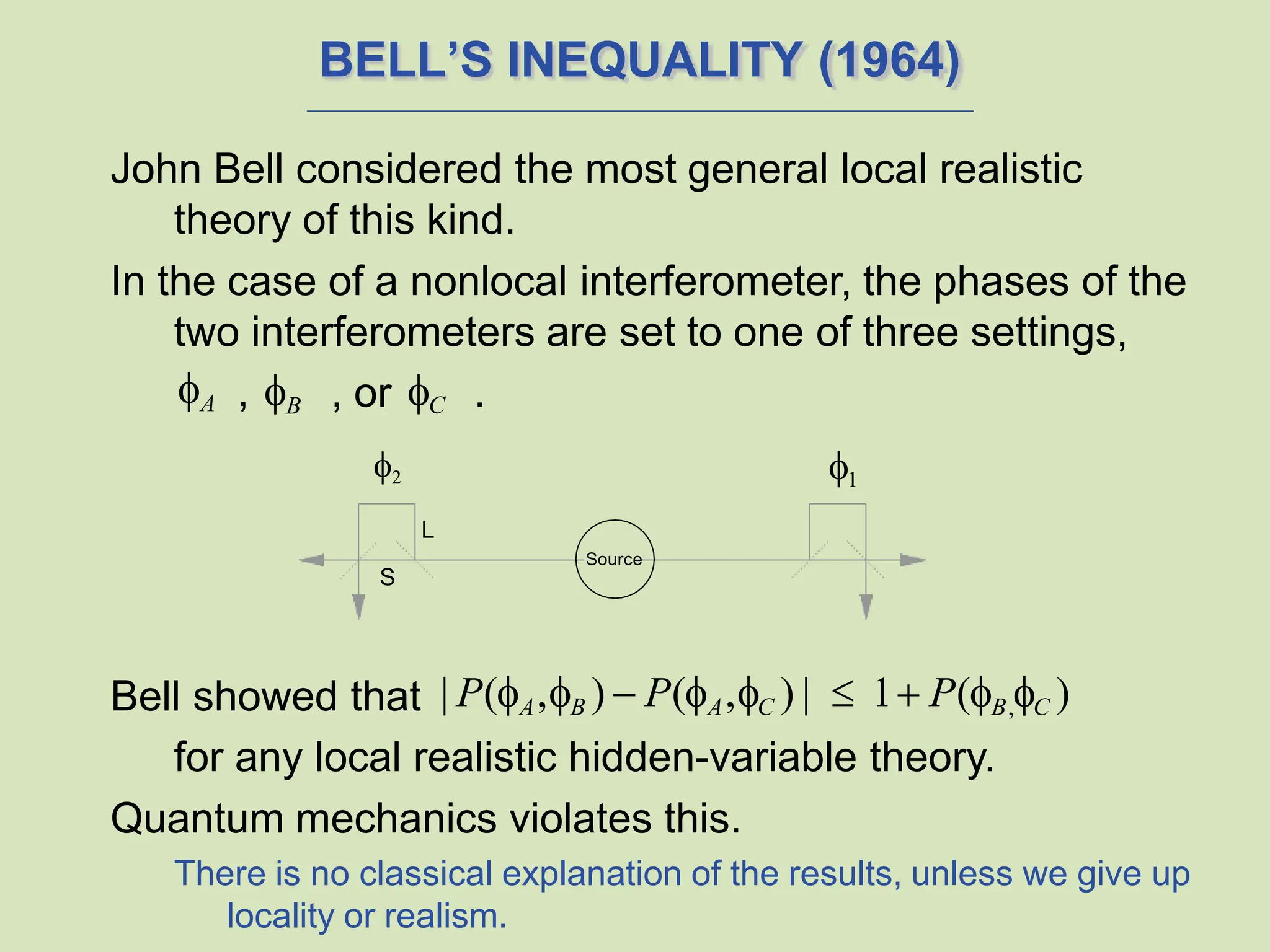
John Bell considered the most general local realistic
theory of this kind.
In the case of a nonlocal interferometer, the phases of the
two interferometers are set to one of three settings,
, B
Bell showed that | P(A,B )  P(A,C ) |  1 P(B,C )
for any local realistic hidden-variable theory.
Quantum mechanics violates this.
There is no classical explanation of the results, unless we give up
locality or realism.
A , or C .
2
L
S
1
Source
EXPERIMENTS BASED ON BELL’S
INEQUALITY
Bell’s inequality shows that Einstein’s objections to
quantum mechanics were not just a matter of
interpretation.
The predictions of quantum mechanics are different from any
hidden-variable (local realistic) theory.
These experiments also generated renewed interest in
entanglement.
This eventually led to possible practical applications
based on entanglement.
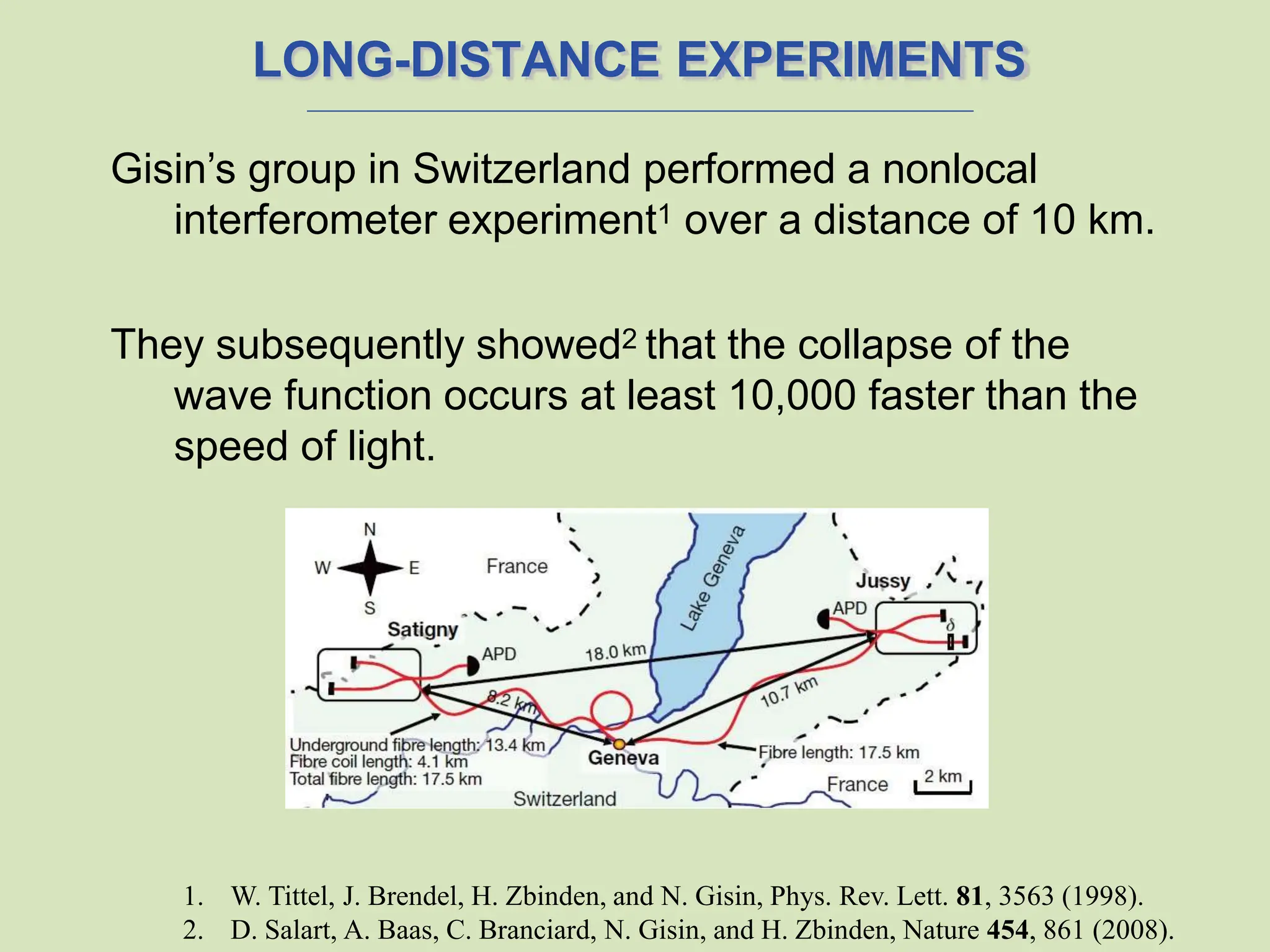
LONG-DISTANCE EXPERIMENTS
Gisin’s group in Switzerland performed a nonlocal
interferometer experiment1 over a distance of 10 km.
They subsequently showed2 that the collapse of the
wave function occurs at least 10,000 faster than the
speed of light.
1. W. Tittel, J. Brendel, H. Zbinden, and N. Gisin, Phys. Rev. Lett. 81, 3563 (1998).
2. D. Salart, A. Baas, C. Branciard, N. Gisin, and H. Zbinden, Nature 454, 861 (2008).
PRACTICAL APPLICATIONS
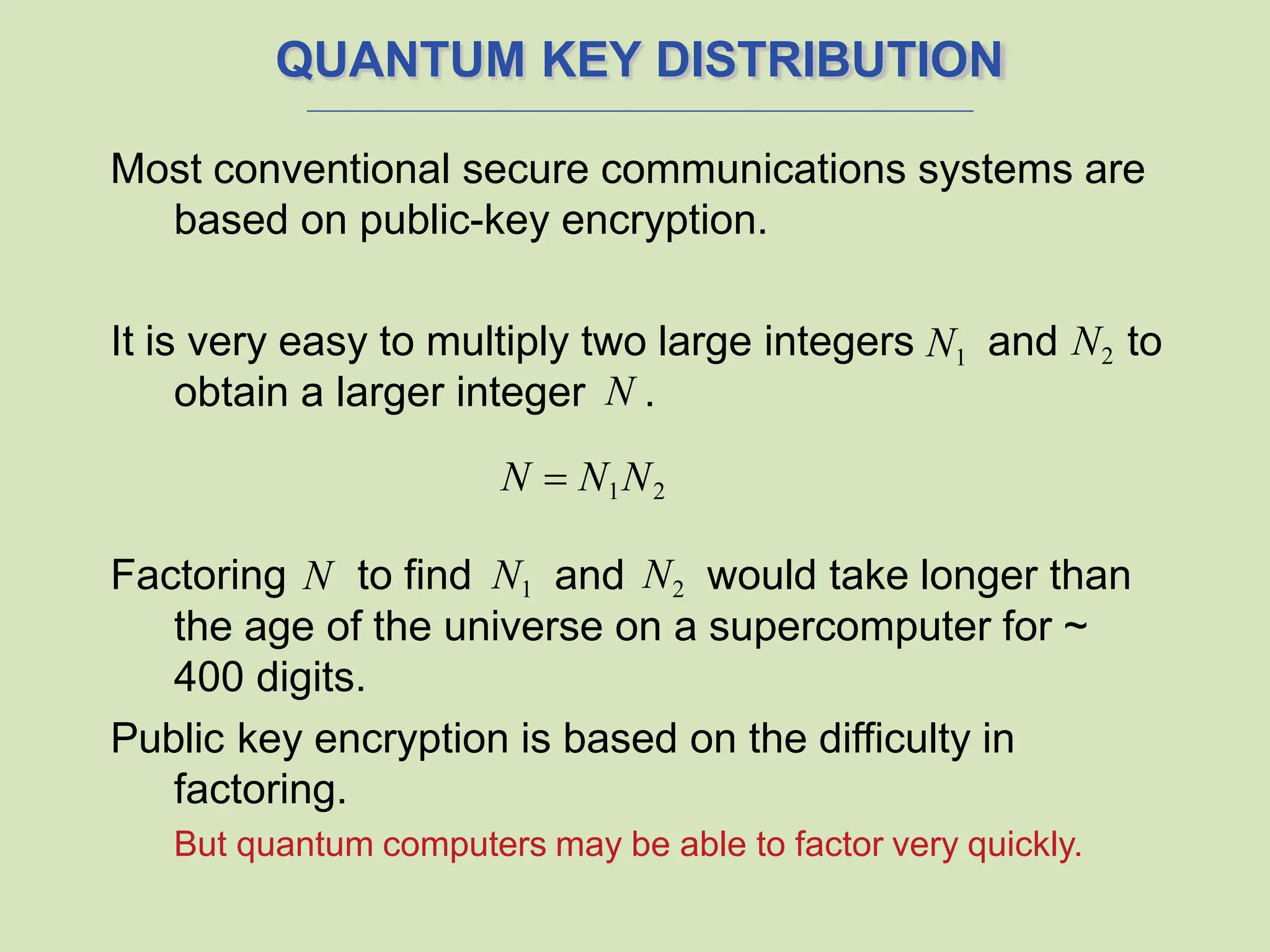
QUANTUM KEY DISTRIBUTION
Most conventional secure communications systems are
based on public-key encryption.
It is very easy to multiply two large integers N1
obtain a larger integer N .
N  N1N2
and N2 to
Factoring N to find N1 and N2 would take longer than
the age of the universe on a supercomputer for ~
400 digits.
Public key encryption is based on the difficulty in
factoring.
But quantum computers may be able to factor very quickly.
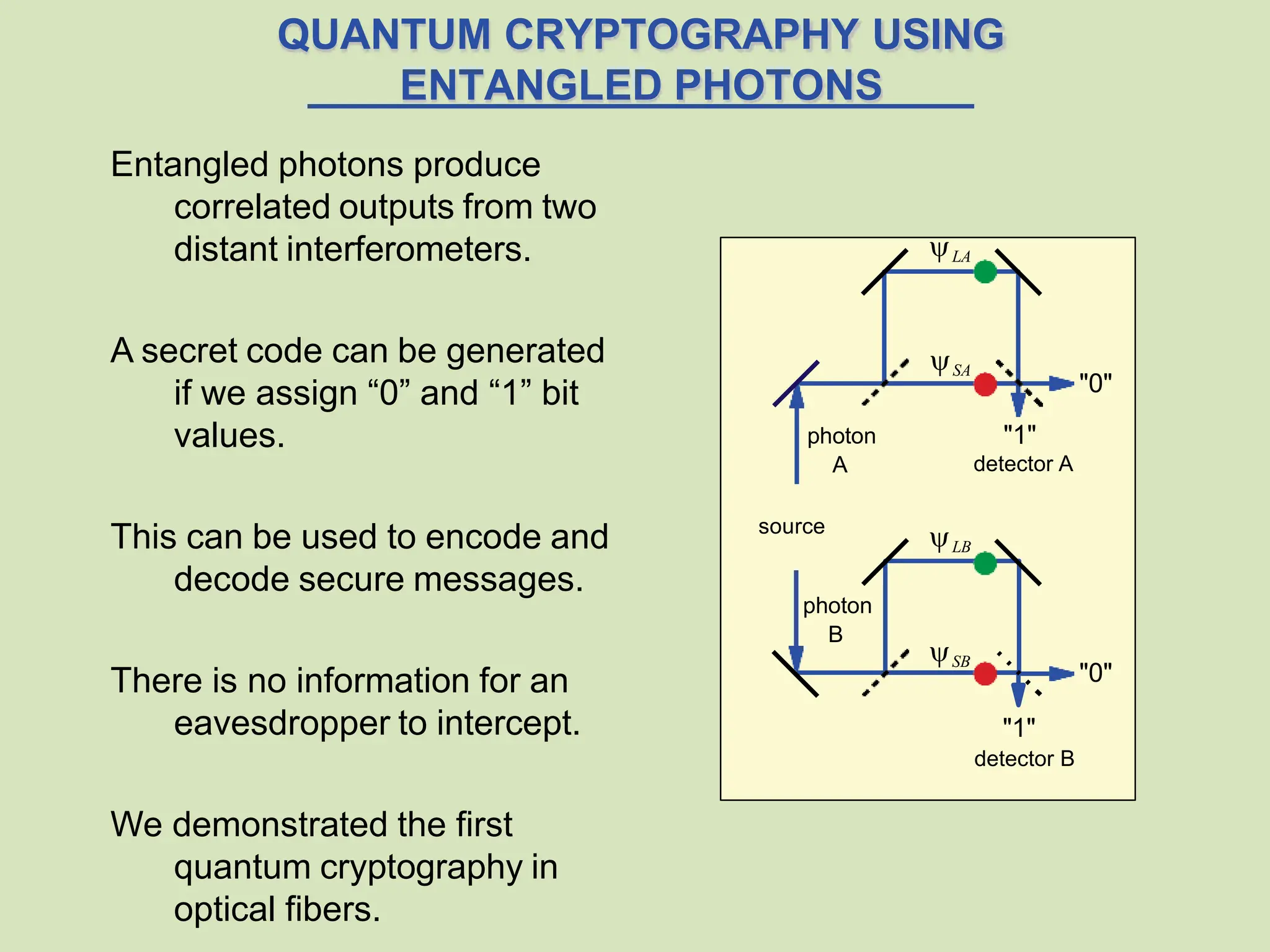
QUANTUM CRYPTOGRAPHY USING
ENTANGLED PHOTONS
Entangled photons produce
correlated outputs from two
distant interferometers.
A secret code can be generated
if we assign “0” and “1” bit
values.
This can be used to encode and
decode secure messages.
There is no information for an
eavesdropper to intercept.
We demonstrated the first
quantum cryptography in
optical fibers.
source
photon
A
photon
B
LA
LB
SB
SA
"0"
"0"
"1"
detector B
"1"
detector A
QUANTUM COMPUTING
Quantum computers are expected to be able to solve
problems that would be impossible on a
conventional computer.
Factoring (Shor’s algorithm).
Sorting through a large data base.
Quantum image processing?
In a quantum computer, the bits, or qubits, can be in a
superposition state:
  0  ei
1
Possible qubits:
Photons
Atoms
Electron spins
Superconductors (Josephson junctions)
POWER OF A QUANTUM COMPUTER
Consider a quantum processor that executes a specific
algorithm.
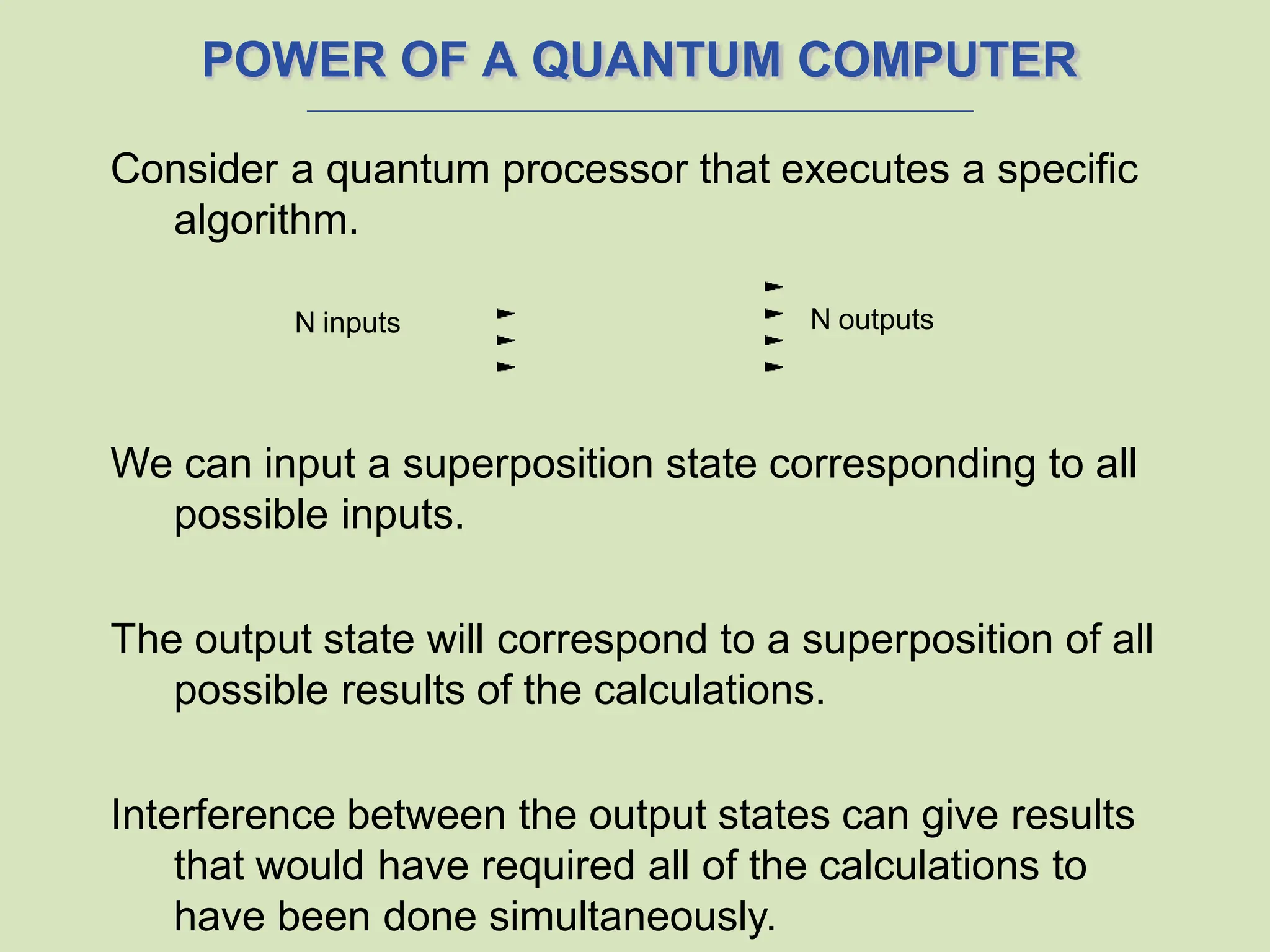
We can input a superposition state corresponding to all
possible inputs.
The output state will correspond to a superposition of all
possible results of the calculations.
Interference between the output states can give results
that would have required all of the calculations to
have been done simultaneously.
N inputs N outputs
QUANTUM COMPUTING USING
SINGLE PHOTONS
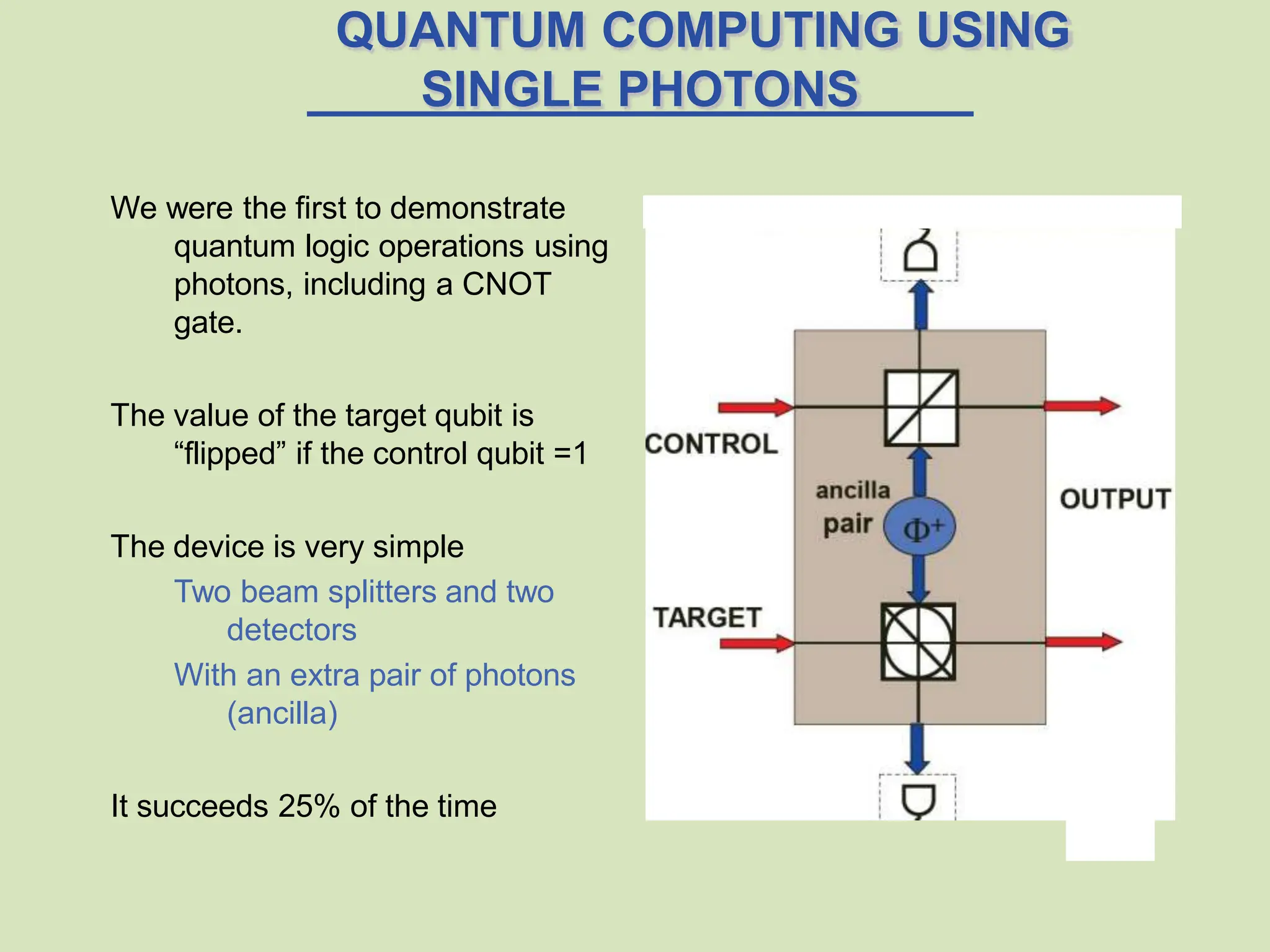
We were the first to demonstrate
quantum logic operations using
photons, including a CNOT
gate.
The value of the target qubit is
“flipped” if the control qubit =1
The device is very simple
Two beam splitters and two
detectors
With an extra pair of photons
(ancilla)
It succeeds 25% of the time
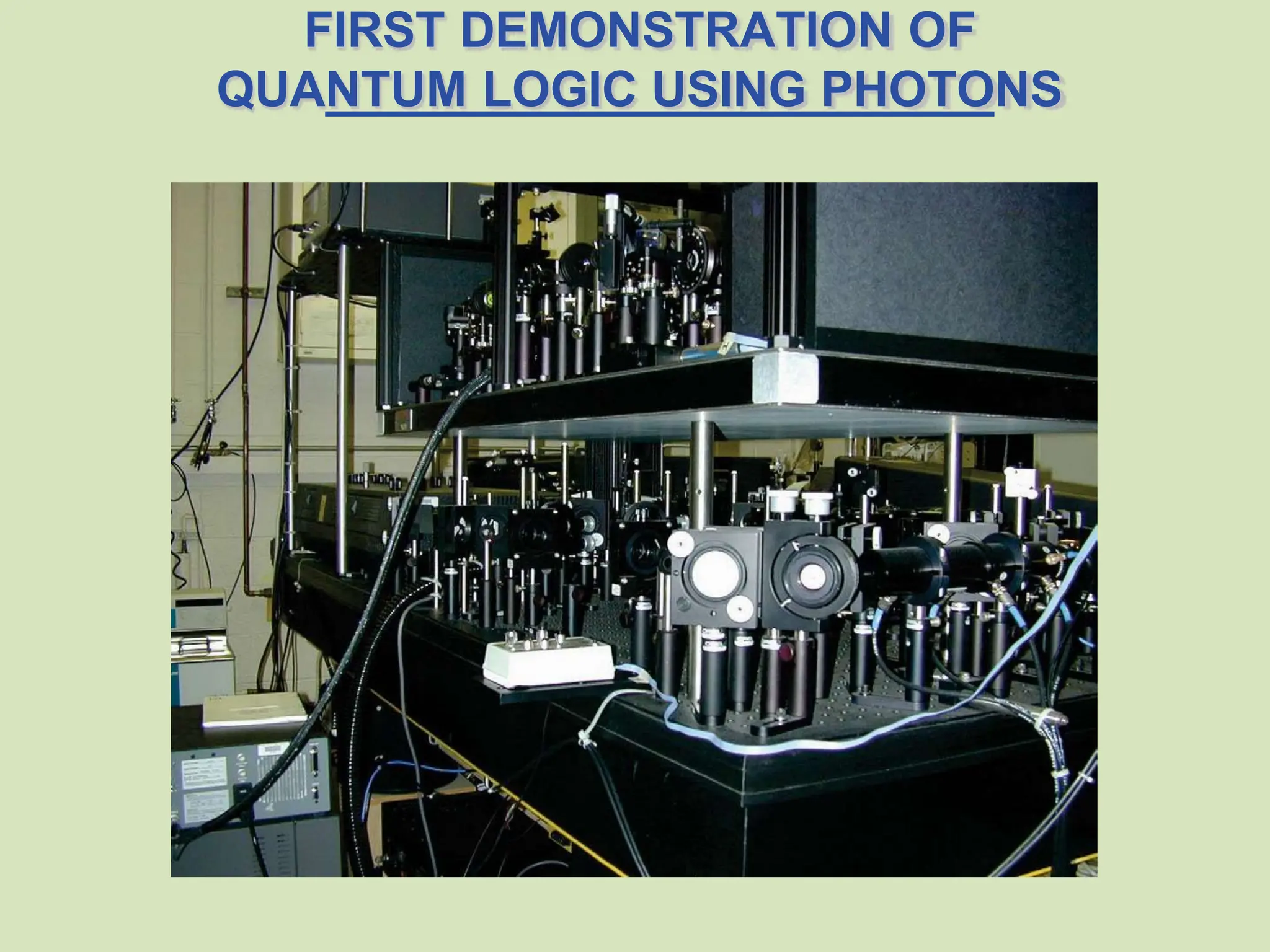
FIRST DEMONSTRATION OF
QUANTUM LOGIC USING PHOTONS

Quantum entanglement is one of the most intriguing and counterintuitive phenomena in the realm of quantum mechanics.

  • 1.
  • 2.
    Einstein discussing quantummechanics with Neil Bohr
  • 3.
  • 4.
    ENTANGLEMENT Schrodinger also considereda situation where two distant systems are in a correlated superposition state. For example, consider two photons and two beam splitters: We can create an “entangled” state where   A1 A2  B1 B2 The paths are totally correlated.
  • 5.
    ENTANGLED STATE OFTWO PHOTONS The entangled state can be viewed as: Both of these states exist simultaneously.   A1 A2  B1 B2
  • 6.
    COLLAPSE OF THEWAVE FUNCTION Consider an entangled state where the paths of two photons are correlated:   A1 A2  B1 B2 Suppose we use a single-photon detector to measure which path photon 1 is in. And find that it is in path A1. Then photon 2 must be in path A2 and the state instantly “collapses” to   A1 A2 This has physical effects at location 2.
  • 7.
    NONLOCAL INTERFERENCE How dowe know that both states in an entangled state really exist at the same time? Recall that, for a single photon and a beam splitter, quantum interference shows that both states must exist: For two entangled photons, we can use “nonlocal interference” to show the same thing.
  • 8.
    NONLOCAL INTERFERENCE We cangenerate an entangled state in which two photons were created at exactly the same time. But we have a coherent superposition of what time that was. Suppose the two photons travel in opposite directions to two single-photon interferometers: The two photons will interfere with each other regardless of how far apart they are. 1 s 2 s   f (t)Ê () (r ,t)Ê () (r ,t)dt  L S 1 2 Source A “Franson interferometer”
  • 9.
    “SPOOKY ACTION ATA DISTANCE” The probability that a photon will take the upper path on the right is not determined by the phase setting in that interferometer. Instead, the path taken by the photon on the right depends on the phase settings in the distant interferometer as well. Any classical interpretation would require that information be transmitted faster than the speed of light. Roughly speaking, the photons must communicate with each other. L S 1 2 Source
  • 10.
    NONLOCAL INTERFEROMETRY1 We knowthat the two photons are emitted at the same time.1: If we only accept events in which the photons arrive at the same time, there are two possibilities. They both took the long path ( L1L2) or the short paths ( S1S2 ) There is no contribution from L1S2 . or S1L2 rate proportional to . Interference between L1L2 and gives a coincidence L S 1 2 Source S1S2 2 1 2 cos [(  ) / 2] This violates Bell’s inequality. 1. J. D. Franson, Phys. Rev. Lett. 62, 2205-2208 (1989).
  • 11.
    A CONTROVERSIAL PREDICTION Thispredicted effect was initially very controversial: Classically, the output of interferometer 1 cannot depend on the setting of the distant phase shift 2 . The difference in the path lengths is much larger than the (first- order) coherence length.  The second-order coherence length is much longer. This interferometer is now widely used for quantum cryptography. L S 1 2 Source
  • 12.
    OTHER FORMS OFENTANGLEMENT Entangled states can be created in many different ways: Polarization states of photons: Path entanglement of photons. Energy-time entanglement (nonlocal interferometer). Energy levels of atoms or ions. “Hyper-entanglement” – several degrees of freedom at once.   x1 y2 / x2  y1 2
  • 13.
  • 14.
    EINSTEIN-PODOLSKY-ROSEN PARADOX1 Einstein and hiscolleagues considered an example in which a particle decays into two particles. The two remaining particles travel in opposite directions: In quantum mechanics, this corresponds to an entangled state. How is this different from a classical correlation? 1. A. Einstein, B. Podolsky, and N. Rosen, Phys. Rev. 47, 777 (1935). initial system particle 1 particle 2
  • 15.
    EINSTEIN-PODOLSKY-ROSEN PARADOX EPR argued thatquantum mechanics is an incomplete theory. Element of reality – “If, without in any way disturbing a system, we can predict with certainty the value of a physical quantity, then there exists an element of physical reality corresponding to this physical quantity.” Complete theory - For a theory to be complete, “every element of the physical reality must have a counter-part in the physical theory. We can predict the momentum of particle 1 by measuring the momentum of particle 2. Quantum mechanics does not predict the momentum of particle 2 – therefore it is “incomplete”. initial system particle 1 particle 2
  • 16.
    HIDDEN-VARIABLE THEORIES How dowe know that the state of the particles wasn’t determined all along? More generally, each particle could carry a set of information with it that determines the results of any measurements. Theories of that kind are known as hidden-variable theories. “Realism” – Nature has certain properties that exist regardless of whether or not we measure them. Einstein: “Does the moon really exist if no one is looking at it?” “Locality” – What happens at one location can have no immediate effect on a system at a distant location. “Local realistic theories”
  • 17.
    BELL’S INEQUALITY (1964) JohnBell considered the most general local realistic theory of this kind. In the case of a nonlocal interferometer, the phases of the two interferometers are set to one of three settings, , B Bell showed that | P(A,B )  P(A,C ) |  1 P(B,C ) for any local realistic hidden-variable theory. Quantum mechanics violates this. There is no classical explanation of the results, unless we give up locality or realism. A , or C . 2 L S 1 Source
  • 18.
    EXPERIMENTS BASED ONBELL’S INEQUALITY Bell’s inequality shows that Einstein’s objections to quantum mechanics were not just a matter of interpretation. The predictions of quantum mechanics are different from any hidden-variable (local realistic) theory. These experiments also generated renewed interest in entanglement. This eventually led to possible practical applications based on entanglement.
  • 19.
    LONG-DISTANCE EXPERIMENTS Gisin’s groupin Switzerland performed a nonlocal interferometer experiment1 over a distance of 10 km. They subsequently showed2 that the collapse of the wave function occurs at least 10,000 faster than the speed of light. 1. W. Tittel, J. Brendel, H. Zbinden, and N. Gisin, Phys. Rev. Lett. 81, 3563 (1998). 2. D. Salart, A. Baas, C. Branciard, N. Gisin, and H. Zbinden, Nature 454, 861 (2008).
  • 20.
  • 21.
    QUANTUM KEY DISTRIBUTION Mostconventional secure communications systems are based on public-key encryption. It is very easy to multiply two large integers N1 obtain a larger integer N . N  N1N2 and N2 to Factoring N to find N1 and N2 would take longer than the age of the universe on a supercomputer for ~ 400 digits. Public key encryption is based on the difficulty in factoring. But quantum computers may be able to factor very quickly.
  • 22.
    QUANTUM CRYPTOGRAPHY USING ENTANGLEDPHOTONS Entangled photons produce correlated outputs from two distant interferometers. A secret code can be generated if we assign “0” and “1” bit values. This can be used to encode and decode secure messages. There is no information for an eavesdropper to intercept. We demonstrated the first quantum cryptography in optical fibers. source photon A photon B LA LB SB SA "0" "0" "1" detector B "1" detector A
  • 23.
    QUANTUM COMPUTING Quantum computersare expected to be able to solve problems that would be impossible on a conventional computer. Factoring (Shor’s algorithm). Sorting through a large data base. Quantum image processing? In a quantum computer, the bits, or qubits, can be in a superposition state:   0  ei 1 Possible qubits: Photons Atoms Electron spins Superconductors (Josephson junctions)
  • 24.
    POWER OF AQUANTUM COMPUTER Consider a quantum processor that executes a specific algorithm. We can input a superposition state corresponding to all possible inputs. The output state will correspond to a superposition of all possible results of the calculations. Interference between the output states can give results that would have required all of the calculations to have been done simultaneously. N inputs N outputs
  • 25.
    QUANTUM COMPUTING USING SINGLEPHOTONS We were the first to demonstrate quantum logic operations using photons, including a CNOT gate. The value of the target qubit is “flipped” if the control qubit =1 The device is very simple Two beam splitters and two detectors With an extra pair of photons (ancilla) It succeeds 25% of the time
  • 26.
    FIRST DEMONSTRATION OF QUANTUMLOGIC USING PHOTONS