
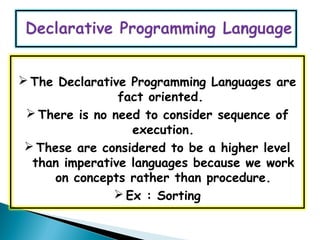


 The Declarative Programming Languages are
fact oriented.
 There is no need to consider sequence of
execution.
 These are considered to be a higher level
than imperative languages because we work
on concepts rather than procedure.
 Ex : Sorting
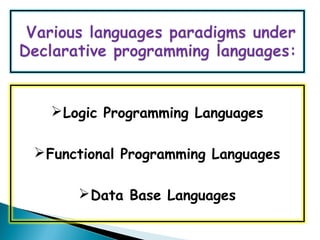
Logic Programming Languages
Functional Programming Languages
Data Base Languages
 The Logic Programming Languages uses a form
of symbolic logic as its programming.
 Logic is the science or reasoning that includes
such methods that are used for solving
problems rather than those solved by intuition.
 Here, the program consists of a series of a set
of statements that describe what is true about
the desired result.
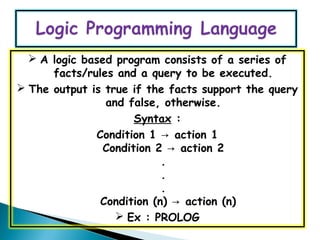
 A logic based program consists of a series of
facts/rules and a query to be executed.
 The output is true if the facts support the query
and false, otherwise.
Syntax :
Condition 1 action 1→
Condition 2 action 2→
.
.
.
Condition (n) action (n)→
 Ex : PROLOG
 The functional programming language does all its
computations on the evaluation of functions or
the applications of functions.
Hence, functional languages are also called
application languages.
 Syntax :
Function n(……(function 2(function,(data))……)
 Ex : LISP (List processing language)
The Database Languages included the following:
 DDL (Data Definition language) : It is used to
describe a new collection of facts or data.
 DML (Data Manipulation language) : It is used to
interact with existing databases.
Ex: Insertion, deletion & modification of data.
 DCL (Data Control language) : It is used to
control data. It includes :
 Commit
 Rollback
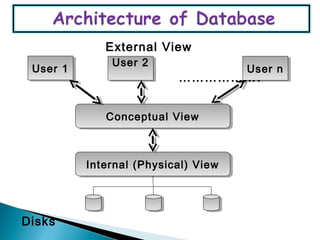
External View
……………….
Disks
User 1User 1 User 2User 2
User nUser n
Conceptual ViewConceptual View
Internal (Physical) ViewInternal (Physical) View
Declarative programming language

Declarative programming language

  • 2.
     The DeclarativeProgramming Languages are fact oriented.  There is no need to consider sequence of execution.  These are considered to be a higher level than imperative languages because we work on concepts rather than procedure.  Ex : Sorting
  • 3.
    Logic Programming Languages FunctionalProgramming Languages Data Base Languages
  • 4.
     The LogicProgramming Languages uses a form of symbolic logic as its programming.  Logic is the science or reasoning that includes such methods that are used for solving problems rather than those solved by intuition.  Here, the program consists of a series of a set of statements that describe what is true about the desired result.
  • 5.
     A logicbased program consists of a series of facts/rules and a query to be executed.  The output is true if the facts support the query and false, otherwise. Syntax : Condition 1 action 1→ Condition 2 action 2→ . . . Condition (n) action (n)→  Ex : PROLOG
  • 6.
     The functionalprogramming language does all its computations on the evaluation of functions or the applications of functions. Hence, functional languages are also called application languages.  Syntax : Function n(……(function 2(function,(data))……)  Ex : LISP (List processing language)
  • 7.
    The Database Languagesincluded the following:  DDL (Data Definition language) : It is used to describe a new collection of facts or data.  DML (Data Manipulation language) : It is used to interact with existing databases. Ex: Insertion, deletion & modification of data.  DCL (Data Control language) : It is used to control data. It includes :  Commit  Rollback
  • 8.
    External View ………………. Disks User 1User1 User 2User 2 User nUser n Conceptual ViewConceptual View Internal (Physical) ViewInternal (Physical) View