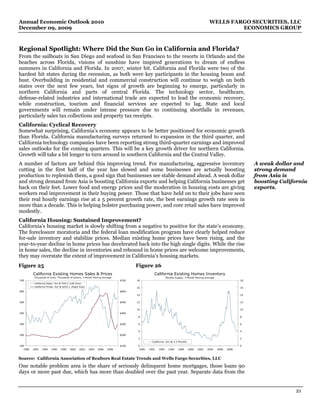
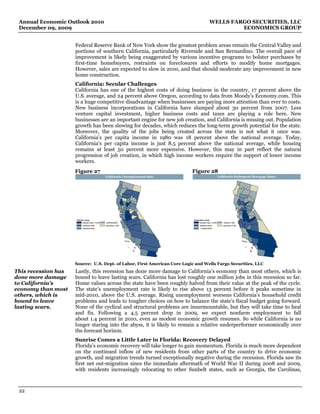
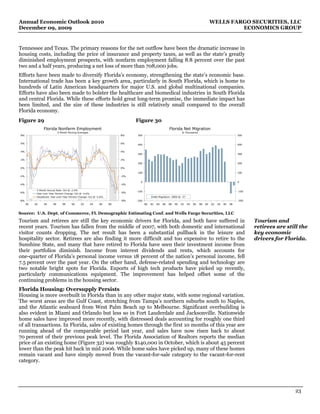
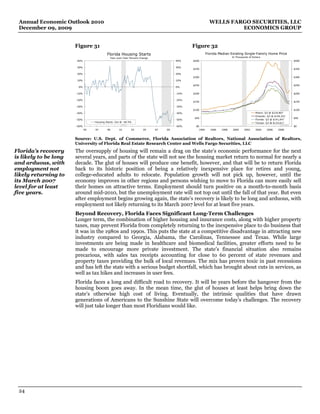
December 09, 2009


Economics Group

Special Commentary


Annual Economic Outlook 2010


Rebalancing the U.S. Economy
      for a New Course


Dear Valued Clients,
We hope your ship has found a safe harbor in which to weather the
gale of what was the worst recession in a half century.
While the recession may be behind us, 2010 will not be all fair winds
and following seas. The coming year may provide some opportunities
in which to venture out from port. However, we would urge you to
stay close to shore as the coming year has many risks lurking just
over the horizon for those who choose to head far out to sea.
Please read on as we explore the challenges and opportunities that
will face your business, and the U.S. and global economies in the year
ahead.
-Wells Fargo Economics Group


 This report is available on wellsfargo.com/research and on Bloomberg WFEC
Annual Economic Outlook 2010                                        WELLS FARGO SECURITIES, LLC
December 09, 2009                                                            ECONOMICS GROUP


                               This Page Intentionally Left Blank


2
Annual Economic Outlook 2010                                                                                                             WELLS FARGO SECURITIES, LLC
December 09, 2009                                                                                                                                 ECONOMICS GROUP


Executive Summary: Charting the New Course
Trading was fundamentally transformed by the European Age of Discovery, which was pioneered
by Portuguese navigators, such as Bartolomeu Dias and Vasco da Gama, who set sail down the
West African coast, eventually making it to India by the end of the 16th century. The new course
broke the stranglehold that the Ottoman Turks had on the overland spice trade and the
considerable wealth that it provided. Ferdinand Magellan and Juan Elcano further altered world
navigation by 1522 when their expedition circumnavigated the globe. In the 21st century, financial
trading has been permanently altered by the global crisis associated with subprime mortgages,
structured products and credit default swaps. Yet, there still exists an imperative need to finance
economic activity.
Our economic ship has been thrown off course and is still listing. We face three problems. First,                                                                    Our economic ship
how can we right our ship with new and traditional policy tools to regain a sense of stability in the                                                                has been thrown
economy? Second, what is our new course and at what speed can our ship move forward? Finally,                                                                        off course and is
how has our destination changed in terms of growth, inflation, employment and the dollar?                                                                            still listing.
Figure 1                                                                         Figure 2
                               Real GDP                                                     Real Personal Consumption Expenditures
                 Bars = CAGR   Line = Yr/Yr Percent Change                                          Bars = CAGR    Line = Yr/Yr Percent Change
10.0%                                                                    10.0%   8.0%                                                                        8.0%
                         GDPR - CAGR: Q3 @ 2.8%
 8.0%                    GDPR - Yr/Yr Percent Change: Q3 @ -2.5%         8.0%
                                                                                 6.0%                                                                        6.0%
                                                                                                                                                  Forecast
 6.0%                                                                    6.0%
                                                              Forecast           4.0%                                                                        4.0%
 4.0%                                                                    4.0%


 2.0%                                                                    2.0%    2.0%                                                                        2.0%


 0.0%                                                                    0.0%    0.0%                                                                        0.0%

-2.0%                                                                    -2.0%
                                                                                 -2.0%                                                                       -2.0%
-4.0%                                                                    -4.0%

                                                                                 -4.0%                                                                       -4.0%
-6.0%                                                                    -6.0%                  PCE - CAGR: Q3 @ 2.9%
                                                                                                PCE - Yr/Yr Percent Change: Q3 @ -0.1%
-8.0%                                                                    -8.0%   -6.0%                                                                       -6.0%
        2000   2002     2004       2006       2008           2010                        2000   2002       2004         2006      2008           2010


Source: U.S. Department of Commerce and Wells Fargo Securities, LLC
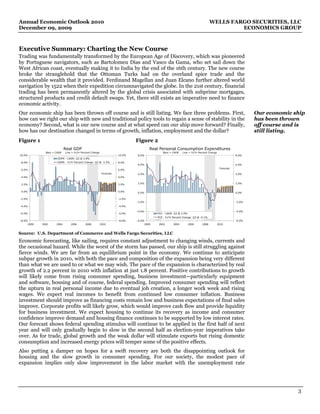
Economic forecasting, like sailing, requires constant adjustment to changing winds, currents and
the occasional hazard. While the worst of the storm has passed, our ship is still struggling against
fierce winds. We are far from an equilibrium point in the economy. We continue to anticipate
subpar growth in 2010, with both the pace and composition of the expansion being very different
than what we are used to or what we may wish. The pace of the expansion is characterized by real
growth of 2.2 percent in 2010 with inflation at just 1.8 percent. Positive contributions to growth
will likely come from rising consumer spending, business investment—particularly equipment
and software, housing and of course, federal spending. Improved consumer spending will reflect
the upturn in real personal income due to eventual job creation, a longer work week and rising
wages. We expect real incomes to benefit from continued low consumer inflation. Business
investment should improve as financing costs remain low and business expectations of final sales
improve. Corporate profits will likely grow, which would improve cash flow and provide liquidity
for business investment. We expect housing to continue its recovery as income and consumer
confidence improve demand and housing finance continues to be supported by low interest rates.
Our forecast shows federal spending stimulus will continue to be applied in the first half of next
year and will only gradually begin to slow in the second half as election-year imperatives take
over. As for trade, global growth and the weak dollar will stimulate exports but rising domestic
consumption and increased energy prices will temper some of the positive effects.
Also putting a damper on hopes for a swift recovery are both the disappointing outlook for
housing and the slow growth in consumer spending. For our society, the modest pace of
expansion implies only slow improvement in the labor market with the unemployment rate


                                                                                                                                                                                   3
Annual Economic Outlook 2010                                                                                         WELLS FARGO SECURITIES, LLC
 December 09, 2009                                                                                                             ECONOMICS GROUP


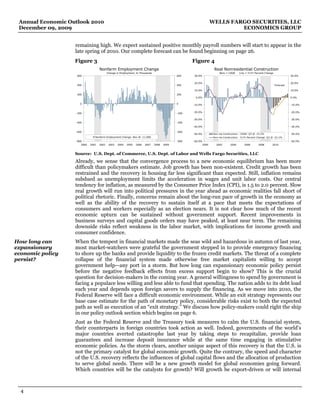
                   remaining high. We expect sustained positive monthly payroll numbers will start to appear in the
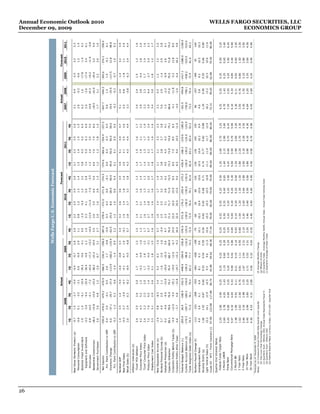
                   late spring of 2010. Our complete forecast can be found beginning on page 26.
                   Figure 3                                                                           Figure 4
                                     Nonfarm Employment Change                                                         Real Nonresidential Construction
                                            Change in Employment, In Thousands                                              Bars = CAGR     Line = Yr/Yr Percent Change
                    600                                                                        600    30.0%                                                                          30.0%


                                                                                                      20.0%                                                                          20.0%
                    400                                                                        400                                                                        Forecast

                                                                                                      10.0%                                                                          10.0%
                    200                                                                        200
                                                                                                       0.0%                                                                          0.0%

                     0                                                                         0      -10.0%                                                                         -10.0%


                   -200                                                                        -200   -20.0%                                                                         -20.0%


                                                                                                      -30.0%                                                                         -30.0%
                   -400                                                                        -400
                                                                                                      -40.0%                                                                         -40.0%

                   -600                                                                        -600
                                                                                                      -50.0%           Non-res Construction - CAGR: Q3 @ -15.2%                      -50.0%
                                 Nonfarm Employment Change: Nov @ -11,000                                              Non-res Construction - Yr/Yr Percent Change: Q3 @ -22.1%
                   -800                                                                        -800   -60.0%                                                                         -60.0%
                       2000   2001   2002    2003   2004   2005   2006   2007    2008   2009                   2000      2002       2004        2006       2008        2010


                   Source: U.S. Dept. of Commerce, U.S. Dept. of Labor and Wells Fargo Securities, LLC
                   Already, we sense that the convergence process to a new economic equilibrium has been more
                   difficult than policymakers estimate. Job growth has been non-existent. Credit growth has been
                   restrained and the recovery in housing far less significant than expected. Still, inflation remains
                   subdued as unemployment limits the acceleration in wages and unit labor costs. Our central
                   tendency for inflation, as measured by the Consumer Price Index (CPI), is 1.5 to 2.0 percent. Slow
                   real growth will run into political pressures in the year ahead as economic realities fall short of
                   political rhetoric. Finally, concerns remain about the long-run pace of growth in the economy as
                   well as the ability of the recovery to sustain itself at a pace that meets the expectations of
                   consumers and workers especially as an election nears. It is not clear how much of the recent
                   economic upturn can be sustained without government support. Recent improvements in
                   business surveys and capital goods orders may have peaked, at least near term. The remaining
                   downside risks reflect weakness in the labor market, with implications for income growth and
                   consumer confidence.
How long can       When the tempest in financial markets made the seas wild and hazardous in autumn of last year,
expansionary       most market-watchers were grateful the government stepped in to provide emergency financing
economic policy    to shore up the banks and provide liquidity to the frozen credit markets. The threat of a complete
persist?           collapse of the financial system made otherwise free market capitalists willing to accept
                   government help—any port in a storm. But how long can expansionary economic policy persist
                   before the negative feedback effects from excess support begin to show? This is the crucial
                   question for decision-makers in the coming year. A general willingness to spend by government is
                   facing a populace less willing and less able to fund that spending. The nation adds to its debt load
                   each year and depends upon foreign savers to supply the financing. As we move into 2010, the
                   Federal Reserve will face a difficult economic environment. While an exit strategy represents our
                   base case estimate for the path of monetary policy, considerable risks exist to both the expected
                   path as well as execution of an “exit strategy.” We discuss how policy-makers could right the ship
                   in our policy outlook section which begins on page 6.
                   Just as the Federal Reserve and the Treasury took measures to calm the U.S. financial system,
                   their counterparts in foreign countries took action as well. Indeed, governments of the world’s
                   major countries averted catastrophe last year by taking steps to recapitalize, provide loan
                   guarantees and increase deposit insurance while at the same time engaging in stimulative
                   economic policies. As the storm clears, another unique aspect of this recovery is that the U.S. is
                   not the primary catalyst for global economic growth. Quite the contrary, the speed and character
                   of the U.S. recovery reflects the influences of global capital flows and the allocation of production
                   to serve global needs. There will be a new growth model for global economies going forward.
                   Which countries will be the catalysts for growth? Will growth be export-driven or will internal


  4
Annual Economic Outlook 2010                                                      WELLS FARGO SECURITIES, LLC
December 09, 2009                                                                          ECONOMICS GROUP


economic growth take the lead? We consider the new course and speed for the global recovery in
our international outlook section on page 12. We also consider whether the dollar will continue to
play the role of the world’s most important reserve currency.
Real estate markets around the country have seen some modest improvement in recent months,           The recovery in
but much of that improvement can be attributed to tax rebates that effectively subsidize the cost    residential real
of housing. The residential real estate market is not actually making way. The recovery in this      estate seems to
sector seems to have more to do with government subsidies than it does with a resurgent private      have more to do
demand for real estate. Federal government support, with massive purchases of mortgage-backed        with government
securities by the Federal Reserve is helping drive down mortgage rates even as a tax-credit for      subsidies than with
first-time homebuyers lifts demand. This has created a sense of stability; but what happens when     resurgent demand.
that support is withdrawn? Is the housing recovery self-sustaining in any way? Meanwhile,
commercial real estate remains in the midst of the storm. Nonresidential construction has pulled
back significantly as many commercial projects have been delayed or canceled outright as
financing has become much harder to secure. The ongoing correction in both residential and
commercial real estate continues to hang over the economy as the rising tide of defaults and
foreclosures of residential and commercial properties continue to put stress on the financial
system. Supply and demand fundamentals are still deteriorating. In our real estate section on
page 16, we discuss our view that residential construction may grow modestly through continued
support from the government, while the commercial real estate sector will continue to deteriorate.
California and Florida were two of the hardest hit states during the recession, as both were key
participants in the housing boom and bust. Overbuilding in residential and commercial
construction will continue to weigh on both states over the next few years but signs of growth are
beginning to emerge, particularly in northern California and parts of central Florida. Find out if
fairer winds are headed for California and Florida in our regional spotlight section on page 21.
Just as the Portuguese explorers found a new route to wealth in East Asia, so too must the
U.S. economy chart a new course to prosperity in today’s changing global financial markets. In
this outlook, we explore how that new course is likely to take shape in the coming year and we
describe some of the hazards that might be encountered along the way.


                                                                                                                    5
Annual Economic Outlook 2010                                                       WELLS FARGO SECURITIES, LLC
 December 09, 2009                                                                           ECONOMICS GROUP


                      Economic Policy: Implications of Massive Government Spending
A willingness to      When the ship is heading into uncharted waters, it is no time to raise sails and pick up speed.
spend by the          How long can expansionary economic policy persist before the negative feedback effects from
government is         excess support begin to show? This is the crucial question for decision-makers in the coming year.
facing a populace     What are the real and financial implications—both short- and long-term—of our current path of
increasingly less     spending and taxes? A general willingness to spend by government is facing a populace
willing and able to   increasingly less willing and able to fund that spending. Unable or unwilling to reconcile the
fund that spending.   spending/revenue imbalance, the nation adds to its debt load each year and depends on foreign
                      savers to supply the financing.
                      Fiscal Policy: Party Is Over, Bills Coming Due
                      Fiscal year 2009 for the United States government ended this past September with the closing
                      bell sounding to the sour tune of a $1.438 trillion deficit. Some perspective: $ 1.4 trillion is equal
                      to more than $4,500 for every person living in the United States. Many measures of debt have
                      never been as high during peacetime—wartime spikes in debt levels were temporary, however,
                      and therefore did not permanently damage economic growth prospects. In contrast, the current
                      path of indebtedness shows a permanent venture into economically unfavorable territory. While
                      the United States is certainly not in the worst position compared to other developed economies,
                      its fiscal situation does not leave room for complacency or free spending, especially given our
                      dependence on foreign capital inflows. This presents a real challenge to policymakers who would
                      like a fresh start, but cannot disinherit past spending.
                      Elevated spending and diminished revenues, always a dangerous duo, are byproducts of the
                      financial crisis and economic downturn as well as the fiscal policy response. During any recession,
                      government spending tends to increase in the short run to help fill the gap left by private
                      spending. Concomitantly, receipts fall off because personal income and corporate profits decline,
                      reflecting shrinking payrolls and declining business sales, respectively. However, the severity of
                      the recent economic malaise, compounded by the increasing entitlement imbalance, has driven
                      the deficit to new heights. In parsing the deficit, stimulus spending through TARP and the
                      American Recovery and Reinvestment Act constituted only 24 percent of the 2009 budget
                      deficit—substantial, but not the whole story. 1 Unusually large increases in healthcare and income
                      security spending also contributed. With more than 7 million jobs lost, unemployment claims
                      skyrocketed; in addition, more individuals began to meet eligibility requirements for entitlement
                      programs, such as food stamps and Medicaid, and these programs felt the pressure. More than
                      just the economic cycle, the demographic, secular pressures on government spending will become
                      increasingly evident.
                      End in Sight? Economic Recovery Alone Will not Restore a Balanced Budget
                      Cyclical recovery indicates that the nation’s debt will accumulate more slowly in the years
                      immediately following the recession simply due to a reduction in emergency spending and
                      stimulus as well as a recovery in tax revenue. Yet, the more meaningful long-run factor of
                      entitlements will serve to accelerate the severity and immediacy of the deficit problem. Indeed,
                      fiscal 2010 has already begun, and its fiscal deficit will exceed $1 trillion, barring major near-term
                      changes. Despite the diminishing effects of short-term deficit drivers, the recession and the
                      financial crisis, a quick return to fiscal sustainability is off the table.
                      Federal entitlement programs, Medicare and Social Security, already pose serious threats to fiscal
                      sustainability. A new national healthcare program will raise additional concerns about long-term
                      funding of more entitlements. Our election cycle provides an incentive for policymakers to
                      concern themselves with only short-run benefits rather than the long-run costs of policy
                      initiatives—a classic time inconsistency problem. 2

                      1 Joint Statement of Tim Geithner and Peter Orszag on Budget Results for Fiscal Year 2009. Oct. 16,
                      2009.
                      2 In economics, time inconsistency refers to the observation that policymakers today can and often do

                      change policy over time although economic agents commit today to policies that they expect are
                      permanent. See Kydland, Fynn E., and Edward Prescott (1977): “Rules Rather than Discretion: The
                      Inconsistency of Optimal Plans,” Journal of Political Economy, 85 (3): 473-491.


  6
Annual Economic Outlook 2010                                                                                                               WELLS FARGO SECURITIES, LLC
December 09, 2009                                                                                                                                   ECONOMICS GROUP


Knowing the areas that will only become more problematic, it would seem that the solution would
already be close at hand. However, balancing the budget and addressing the fundamental issues
has eluded political decision-makers for generations. Through the next decade, the national debt
is expected to relentlessly increase. The decisions that are made over that time horizon, however,
will have important implications for the sustainability of federal budget deficits in the global
context. From our viewpoint, current fiscal policy, if continued at its present pace, is inconsistent
with the direction of interest rates, inflation and exchange rates. As we view current policy as
unsustainable, then so are the market prices associated with that policy.
Righting the Ship: Some Unpleasant Monetarist Arithmetic

                     “You cannot escape the responsibility of tomorrow by evading it today."
                                                                      Abraham Lincoln
With the ship of state listing badly due to fiscal deficits, even small steps toward averting fiscal                                                                 While federal
disaster would be most welcome. The longer the nation delays addressing its unsustainable fiscal                                                                     spending has
path, the worse the day of reckoning. While federal spending has helped fill the gap left by the                                                                     helped fill the gap
private sector over the past year, stimulus-induced growth is not self-sustaining; growth                                                                            left by the private
artificially pulled forward merely takes away from future growth. Take, for example, a (relatively                                                                   sector over the past
small) program such as “cash-for-clunkers”—this spurred sales and production in the auto sector                                                                      year, stimulus-
at the expense of sales and production down the road. Clearly, a long history of deficits cannot be                                                                  induced growth is
overcome in a year or even a presidential term, but this is not an excuse to turn a blind eye to the                                                                 not self-sustaining.
ever-expanding problem.
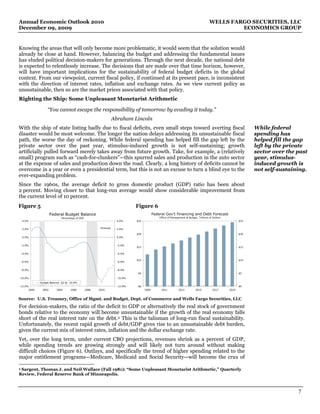
Since the 1960s, the average deficit to gross domestic product (GDP) ratio has been about
2 percent. Moving closer to that long-run average would show considerable improvement from
the current level of 10 percent.
Figure 5                                                                         Figure 6
                        Federal Budget Balance                                                Federal Gov't Financing and Debt Forecast
                               Percentage of GDP                                                  Office of Management & Budget, Trillions of Dollars
 4.0%                                                                   4.0%     $25                                                                           $25


 2.0%                                                      Forecast     2.0%

                                                                                 $20                                                                           $20
 0.0%                                                                   0.0%


 -2.0%                                                                  -2.0%
                                                                                 $15                                                                           $15

 -4.0%                                                                  -4.0%

                                                                                 $10                                                                           $10
 -6.0%                                                                  -6.0%


 -8.0%                                                                  -8.0%
                                                                                 $5                                                                            $5

-10.0%                                                                  -10.0%
                Budget Balance: Q3 @ -10.0%
-12.0%                                                                  -12.0%   $0                                                                            $0
         2000    2002      2004       2006         2008   2010                         2009        2011          2013           2015          2017      2019


Source: U.S. Treasury, Office of Mgmt. and Budget, Dept. of Commerce and Wells Fargo Securities, LLC
For decision-makers, the ratio of the deficit to GDP or alternatively the real stock of government
bonds relative to the economy will become unsustainable if the growth of the real economy falls
short of the real interest rate on the debt. 3 This is the talisman of long-run fiscal sustainability.
Unfortunately, the recent rapid growth of debt/GDP gives rise to an unsustainable debt burden,
given the current mix of interest rates, inflation and the dollar exchange rate.
Yet, over the long term, under current CBO projections, revenues shrink as a percent of GDP,
while spending trends are growing strongly and will likely not turn around without making
difficult choices (Figure 6). Outlays, and specifically the trend of higher spending related to the
major entitlement programs—Medicare, Medicaid and Social Security—will become the crux of

3 Sargent, Thomas J. and Neil Wallace (Fall 1981): “Some Unpleasant Monetarist Arithmetic,” Quarterly

Review, Federal Reserve Bank of Minneapolis.


                                                                                                                                                                                     7
Annual Economic Outlook 2010                                                                                           WELLS FARGO SECURITIES, LLC
 December 09, 2009                                                                                                               ECONOMICS GROUP


                      future budgetary challenges. The retirement of the Baby Boom generation will exert pressure on
                      both Social Security and Medicare as they begin drawing on benefits. Healthcare cost increases,
                      which significantly outpace inflation, reinforce the upward pressure on spending. It is widely
                      recognized that these programs are at the heart of the problem due to their unsustainable
                      growth. 4
                      Deficits, Dollar and Dependence: Does the Government Have a Teaser Rate Loan?
                      While U.S. indebtedness has risen this year to one of the most inauspicious levels in history, the
                      confounding reliance on global capital flows for deficit financing makes the debt/growth
                      imbalance truly ominous. The deficit is financed through public borrowing, and thus far, the
                      nation has been able to borrow from both the domestic and the foreign public at relatively low
                      interest rates, making debt servicing (interest expense) a manageable budget item. Fortunately,
                      high global saving rates and the demand for virtually default-risk free investments, such as
                      Treasury notes, have produced low borrowing rates for the United States. In addition, countries
                      with large current account surpluses have stored a large share of their wealth in dollar
                      denominated assets, further supporting demand for U.S. debt. The Federal Reserve and U.S.
                      households hold meaningful quantities of Treasury securities; however, the lion’s share of U.S.
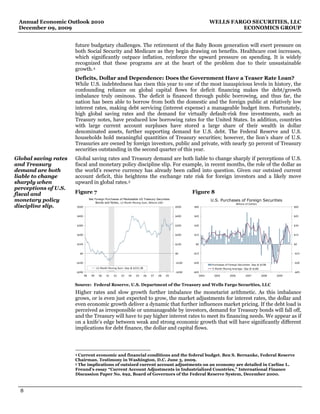
                      Treasuries are owned by foreign investors, public and private, with nearly 50 percent of Treasury
                      securities outstanding in the second quarter of this year.
Global saving rates   Global saving rates and Treasury demand are both liable to change sharply if perceptions of U.S.
and Treasury          fiscal and monetary policy discipline slip. For example, in recent months, the role of the dollar as
demand are both       the world’s reserve currency has already been called into question. Given our outsized current
liable to change      account deficit, this heightens the exchange rate risk for foreign investors and a likely move
sharply when          upward in global rates. 5
perceptions of U.S.
fiscal and            Figure 7                                                                               Figure 8
monetary policy                       Net Foreign Purchases of Marketable US Treasury Securities
                                           Bonds and Notes, 12-Month Moving Sum, Billions USD
                                                                                                                        U.S. Purchases of Foreign Securities
                                                                                                                                             Billions of Dollars
discipline slip.          $500                                                                       $500    $60                                                                 $60


                          $400                                                                       $400    $45                                                                 $45


                          $300                                                                       $300    $30                                                                 $30


                          $200                                                                       $200    $15                                                                 $15


                          $100                                                                       $100     $0                                                                 $0


                           $0                                                                        $0      -$15                                                                -$15


                      -$100                                                                          -$100   -$30                                                                -$30
                                                                                                                        Purchases of Foreign Securities: Sep @ $15B
                                            12-Month Moving Sum: Sep @ $333.3B                                          3-Month Moving Average: Sep @ $16B
                      -$200                                                                          -$200   -$45                                                                -$45
                                 98    99     00   01   02    03   04   05       06   07   08   09               2004    2005         2006           2007          2008   2009


                      Source: Federal Reserve, U.S. Department of the Treasury and Wells Fargo Securities, LLC
                      Higher rates and slow growth further imbalance the monetarist arithmetic. As this imbalance
                      grows, or is even just expected to grow, the market adjustments for interest rates, the dollar and
                      even economic growth deliver a dynamic that further influences market pricing. If the debt load is
                      perceived as irresponsible or unmanageable by investors, demand for Treasury bonds will fall off,
                      and the Treasury will have to pay higher interest rates to meet its financing needs. We appear as if
                      on a knife’s edge between weak and strong economic growth that will have significantly different
                      implications for debt finance, the dollar and capital flows.


                      4 Current economic and financial conditions and the federal budget. Ben S. Bernanke, Federal Reserve
                      Chairman. Testimony in Washington, D.C. June 3, 2009.
                      5 The implications of outsized current account adjustments on an economy are detailed in Carline L.

                      Freund’s essay “Current Account Adjustments in Industrialized Countries,” International Finance
                      Discussion Paper No. 692, Board of Governors of the Federal Reserve System, December 2000.


  8
Annual Economic Outlook 2010                                                         WELLS FARGO SECURITIES, LLC
December 09, 2009                                                                             ECONOMICS GROUP


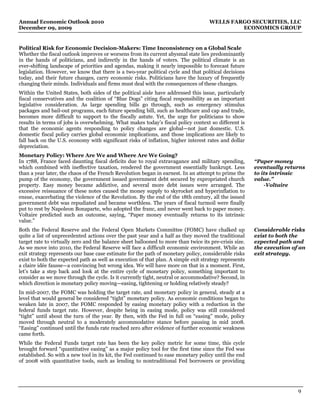
Political Risk for Economic Decision-Makers: Time Inconsistency on a Global Scale
Whether the fiscal outlook improves or worsens from its current abysmal state lies predominantly
in the hands of politicians, and indirectly in the hands of voters. The political climate is an
ever-shifting landscape of priorities and agendas, making it nearly impossible to forecast future
legislation. However, we know that there is a two-year political cycle and that political decisions
today, and their future changes, carry economic risks. Politicians have the luxury of frequently
changing their minds. Individuals and firms must deal with the consequences of these changes.
Within the United States, both sides of the political aisle have addressed this issue, particularly
fiscal conservatives and the coalition of “Blue Dogs” citing fiscal responsibility as an important
legislative consideration. As large spending bills go through, such as emergency stimulus
packages and bail-out programs, each future spending bill, such as healthcare and cap and trade,
becomes more difficult to support to the fiscally astute. Yet, the urge for politicians to show
results in terms of jobs is overwhelming. What makes today’s fiscal policy context so different is
that the economic agents responding to policy changes are global—not just domestic. U.S.
domestic fiscal policy carries global economic implications, and those implications are likely to
fall back on the U.S. economy with significant risks of inflation, higher interest rates and dollar
depreciation.
Monetary Policy: Where Are We and Where Are We Going?
In 1788, France faced daunting fiscal deficits due to royal extravagance and military spending,         “Paper money
which combined with ineffective taxation, rendered the government essentially bankrupt. Less            eventually returns
than a year later, the chaos of the French Revolution began in earnest. In an attempt to prime the      to its intrinsic
pump of the economy, the government issued government debt secured by expropriated church               value.”
property. Easy money became addictive, and several more debt issues were arranged. The                      -Voltaire
excessive reissuance of these notes caused the money supply to skyrocket and hyperinflation to
ensue, exacerbating the violence of the Revolution. By the end of the 18th century, all the issued
government debt was repudiated and became worthless. The years of fiscal turmoil were finally
put to rest by Napoleon Bonaparte, who adopted the franc, and never went back to paper money.
Voltaire predicted such an outcome, saying, “Paper money eventually returns to its intrinsic
value.”
Both the Federal Reserve and the Federal Open Markets Committee (FOMC) have chalked up                  Considerable risks
quite a list of unprecedented actions over the past year and a half as they moved the traditional       exist to both the
target rate to virtually zero and the balance sheet ballooned to more than twice its pre-crisis size.   expected path and
As we move into 2010, the Federal Reserve will face a difficult economic environment. While an          the execution of an
exit strategy represents our base case estimate for the path of monetary policy, considerable risks     exit strategy.
exist to both the expected path as well as execution of that plan. A simple exit strategy represents
a claire idée fausse—a convincing but wrong idea. We will have more on that in a moment. First,
let’s take a step back and look at the entire cycle of monetary policy, something important to
consider as we move through the cycle. Is it currently tight, neutral or accommodative? Second, in
which direction is monetary policy moving—easing, tightening or holding relatively steady?
In mid-2007, the FOMC was holding the target rate, and monetary policy in general, steady at a
level that would general be considered “tight” monetary policy. As economic conditions began to
weaken late in 2007, the FOMC responded by easing monetary policy with a reduction in the
federal funds target rate. However, despite being in easing mode, policy was still considered
“tight” until about the turn of the year. By then, with the Fed in full on “easing” mode, policy
moved through neutral to a moderately accommodative stance before pausing in mid 2008.
“Easing” continued until the funds rate reached zero after evidence of further economic weakness
came forth.
While the Federal Funds target rate has been the key policy metric for some time, this cycle
brought forward “quantitative easing” as a major policy tool for the first time since the Fed was
established. So with a new tool in its kit, the Fed continued to ease monetary policy until the end
of 2008 with quantitative tools, such as lending to nontraditional Fed borrowers or providing


                                                                                                                        9
Annual Economic Outlook 2010                                                                             WELLS FARGO SECURITIES, LLC
 December 09, 2009                                                                                                 ECONOMICS GROUP


                       loans through an auction process. In the last few months of 2008, the Federal Reserve System’s
                       balance sheet ballooned. 6
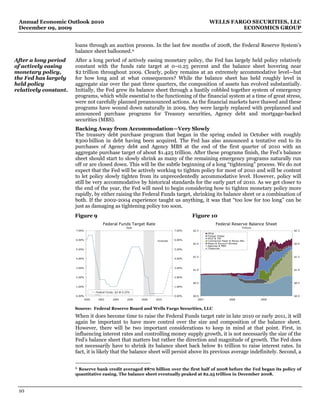
After a long period    After a long period of actively easing monetary policy, the Fed has largely held policy relatively
of actively easing     constant with the funds rate target at 0–0.25 percent and the balance sheet hovering near
monetary policy,       $2 trillion throughout 2009. Clearly, policy remains at an extremely accommodative level—but
the Fed has largely    for how long and at what consequences? While the balance sheet has held roughly level in
held policy            aggregate size over the past three quarters, the composition of assets has evolved substantially.
relatively constant.   Initially, the Fed grew its balance sheet through a hastily cobbled together system of emergency
                       programs, which while essential to the functioning of the financial system at a time of great stress,
                       were not carefully planned preannounced actions. As the financial markets have thawed and these
                       programs have wound down naturally in 2009, they were largely replaced with preplanned and
                       announced purchase programs for Treasury securities, Agency debt and mortgage-backed
                       securities (MBS).
                       Backing Away from Accommodation—Very Slowly
                       The treasury debt purchase program that began in the spring ended in October with roughly
                       $300 billion in debt having been acquired. The Fed has also announced a tentative end to its
                       purchases of Agency debt and Agency MBS at the end of the first quarter of 2010 with an
                       aggregate purchase target of about $1.425 trillion. After these programs finish, the Fed’s balance
                       sheet should start to slowly shrink as many of the remaining emergency programs naturally run
                       off or are closed down. This will be the subtle beginning of a long “tightening” process. We do not
                       expect that the Fed will be actively working to tighten policy for most of 2010 and will be content
                       to let policy slowly tighten from its unprecedentedly accommodative level. However, policy will
                       still be very accommodative by historical standards for the early part of 2010. As we get closer to
                       the end of the year, the Fed will need to begin considering how to tighten monetary policy more
                       rapidly, by either raising the Federal Funds target, shrinking its balance sheet or a combination of
                       both. If the 2002-2004 experience taught us anything, it was that “too low for too long” can be
                       just as damaging as tightening policy too soon.
                       Figure 9                                                                Figure 10
                                           Federal Funds Target Rate                                           Federal Reserve Balance Sheet
                                                            Rate                                                                   Trillions
                       7.00%                                                           7.00%   $2.5                                                   $2.5
                                                                                                         Other
                                                                                                         Foreign Swaps
                                                                                                         PDCF & TAF
                       6.00%                                                Forecast   6.00%             Commercial Paper & Money Mkt.
                                                                                               $2.0      Repos & Discount Window                      $2.0
                                                                                                         Agencies & MBS
                       5.00%                                                           5.00%             Treasuries


                                                                                               $1.5                                                   $1.5
                       4.00%                                                           4.00%


                       3.00%                                                           3.00%
                                                                                               $1.0                                                   $1.0


                       2.00%                                                           2.00%

                                                                                               $0.5                                                   $0.5
                       1.00%                                                           1.00%

                                      Federal Funds: Q3 @ 0.25%
                       0.00%                                                           0.00%   $0.0                                                   $0.0
                               2000    2002       2004       2006   2008   2010                   2007                   2008                  2009


                       Source: Federal Reserve Board and Wells Fargo Securities, LLC
                       When it does become time to raise the Federal Funds target rate in late 2010 or early 2011, it will
                       again be important to have more control over the size and composition of the balance sheet.
                       However, there will be two important considerations to keep in mind at that point. First, in
                       influencing interest rates and controlling money supply growth, it is not necessarily the size of the
                       Fed’s balance sheet that matters but rather the direction and magnitude of growth. The Fed does
                       not necessarily have to shrink its balance sheet back below $1 trillion to raise interest rates. In
                       fact, it is likely that the balance sheet will persist above its previous average indefinitely. Second, a


                       6 Reserve bank credit averaged $870 billion over the first half of 2008 before the Fed began its policy of
                       quantitative easing. The balance sheet eventually peaked at $2.25 trillion in December 2008.


 10
Annual Economic Outlook 2010                                                             WELLS FARGO SECURITIES, LLC
December 09, 2009                                                                                 ECONOMICS GROUP


key change will give the Fed some extra flexibility in removing quantitative easing while pushing
up short-term interest rates—the ability to pay interest on banks’ reserve balances held at the Fed.
In mid-2008 as the FOMC was reducing the target rate, but still trying to maintain a target, the
Fed did not yet have the authority to pay interest on its reserves. 7 With this authority, the FOMC
has another way to influence short-term interest rates without altering the money supply and its
balance sheet. Once begun, tightening may be quicker than many market participants expect with
the Fed raising the target rate and shrinking the size of its balance sheet at the same time. This
will likely be the major story for 2011 and even into 2012.
An Easy Exit Strategy?                                                                                   Once begun,
While an exit strategy represents our base case estimate for the path of monetary policy,                tightening may
considerable risks exist to both the expected path as well as execution. A simple exit strategy          be quicker than
represents a claire idée fausse—a convincing but wrong idea. First and foremost, the economy             many market
remains extremely fragile and any unexpected hiccups could necessitate an easing of policy or an         participants
extension of the accommodative period. Next, in the coming year, Chairman Bernanke and the               expect.
rest of the board will likely face a torrent of political scrutiny. Much will be directed toward the
Fed's role as a supervisor of bank holding companies, but this scrutiny could easily creep into
Congressional scrutiny of monetary policy if the Fed's independence is not diligently protected.
Adding to these issues will be the reconfirmation hearing for Chairman Bernanke to another
four-year term as chairman, which has just begun. By midyear, Vice Chairman Kohn will also be
up for reappointment. The amount of time that both men will potentially spend on Capital Hill
answering questions about past and future Fed policy could be considerable. Finally, the massive
deficit that the federal government continues to run could eventual prove problematic for the
independence of monetary policy. If fiscal policy remains as loose as it currently is into 2011, the
Fed may have to tighten more aggressively than would otherwise be necessary to offset outsized
fiscal deficits. The interaction of expansive fiscal and tighter monetary policy will generate greater
volatility for rates, the dollar and the economy.


7   Emergency Economic Stabilization Act of 2008 authorized interest payments as of Oct. 1, 2008.


                                                                                                                           11
Annual Economic Outlook 2010                                                                                  WELLS FARGO SECURITIES, LLC
 December 09, 2009                                                                                                      ECONOMICS GROUP


                       Global Catastrophe Averted: But How Do We Set Sail Going Forward?
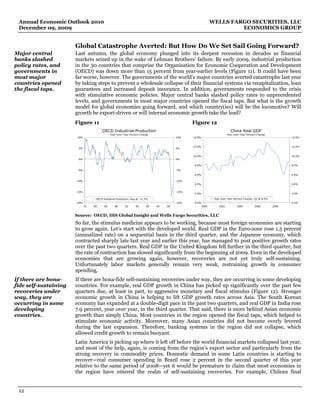
Major central          Last autumn, the global economy plunged into its deepest recession in decades as financial
banks slashed          markets seized up in the wake of Lehman Brothers’ failure. By early 2009, industrial production
policy rates, and      in the 30 countries that comprise the Organisation for Economic Cooperation and Development
governments in         (OECD) was down more than 15 percent from year-earlier levels (Figure 11). It could have been
most major             far worse, however. The governments of the world’s major countries averted catastrophe last year
countries opened       by taking steps to prevent a wholesale collapse of their financial systems via recapitalization, loan
the fiscal taps.       guarantees and increased deposit insurance. In addition, governments responded to the crisis
                       with stimulative economic policies. Major central banks slashed policy rates to unprecedented
                       levels, and governments in most major countries opened the fiscal taps. But what is the growth
                       model for global economies going forward, and which country(ies) will be the locomotive? Will
                       growth be export-driven or will internal economic growth take the lead?
                       Figure 11                                                                Figure 12
                                        OECD Industrial Production                                                          China Real GDP
                                               Year-over-Year Percent Change                                              Year-over-Year Percent Change
                       10%                                                               10%    14.0%                                                             14.0%


                                                                                                12.0%                                                             12.0%
                        5%                                                               5%


                                                                                                10.0%                                                             10.0%
                        0%                                                               0%

                                                                                                8.0%                                                              8.0%
                        -5%                                                              -5%
                                                                                                6.0%                                                              6.0%

                       -10%                                                              -10%
                                                                                                4.0%                                                              4.0%


                       -15%                                                              -15%
                                                                                                2.0%                                                              2.0%

                                    OECD Industrial Production: Aug @ -11.3%                                    Year-over-Year Percent Change: Q3 @ 8.9%
                       -20%                                                              -20%   0.0%                                                              0.0%
                              76   80     84      88      92      96      00   04   08                  2000       2002          2004          2006        2008


                       Source: OECD, IHS Global Insight and Wells Fargo Securities, LLC
                       So far, the stimulus medicine appears to be working, because most foreign economies are starting
                       to grow again. Let’s start with the developed world. Real GDP in the Euro-zone rose 1.5 percent
                       (annualized rate) on a sequential basis in the third quarter, and the Japanese economy, which
                       contracted sharply late last year and earlier this year, has managed to post positive growth rates
                       over the past two quarters. Real GDP in the United Kingdom fell further in the third quarter, but
                       the rate of contraction has slowed significantly from the beginning of 2009. Even in the developed
                       economies that are growing again, however, recoveries are not yet truly self-sustaining.
                       Unfortunately labor markets generally remain very weak, restraining growth in consumer
                       spending.
If there are bona-     If there are bona-fide self-sustaining recoveries under way, they are occurring in some developing
fide self-sustaining   countries. For example, real GDP growth in China has picked up significantly over the past few
recoveries under       quarters due, at least in part, to aggressive monetary and fiscal stimulus (Figure 12). Stronger
way, they are          economic growth in China is helping to lift GDP growth rates across Asia. The South Korean
occurring in some      economy has expanded at a double-digit pace in the past two quarters, and real GDP in India rose
developing             7.9 percent, year over year, in the third quarter. That said, there is more behind Asian economic
countries.             growth than simply China. Most countries in the region opened the fiscal taps, which helped to
                       stimulate economic activity. Moreover, many Asian countries did not become overly levered
                       during the last expansion. Therefore, banking systems in the region did not collapse, which
                       allowed credit growth to remain buoyant.
                       Latin America is picking up where it left off before the world financial markets collapsed last year,
                       and most of the help, again, is coming from the region’s export sector and particularly from the
                       strong recovery in commodity prices. Domestic demand in some Latin countries is starting to
                       recover—real consumer spending in Brazil rose 2 percent in the second quarter of this year
                       relative to the same period of 2008—yet it would be premature to claim that most economies in
                       the region have entered the realm of self-sustaining recoveries. For example, Chilean final


 12
Annual Economic Outlook 2010                                                                                                     WELLS FARGO SECURITIES, LLC
December 09, 2009                                                                                                                         ECONOMICS GROUP


domestic demand in the third quarter was still down 4 percent on a year-earlier basis, and Mexico
lags even further behind the rest of the Latin region due, at least in part, to its extensive trade
links with the U.S. economy and its dependence on the U.S. consumer and auto demand.
Clear Sailing for Strong Global Recovery in 2010? Probably Not
Looking into 2010, we project that the major economies of the world will remain in expansion                                                           The pace of
mode, but we believe that the pace of recovery will remain frustratingly slow. As with the United                                                      recovery for major
States, consumers in some large foreign economies—the United Kingdom and Spain spring to                                                               economies will
mind—went on a borrowing binge earlier this decade. We project that growth in consumer                                                                 remain
spending will remain restrained in these economies as consumers delever and repair balance                                                             frustratingly slow.
sheets that have been battered by falling house prices and financial asset losses. Our forecast calls
for real GDP to grow a bit more than 2 percent in the advanced economies of the world next year.
If realized, our forecast would be a welcome relief from the 3 percent contraction that was
suffered in 2009. However, 2 percent growth would feel sluggish compared to the 3 percent
annual growth rate that the advanced economies of the world averaged during the 2004-2007
period.
Turning to the developing world, most Asian economies should achieve solid growth rates next
year as momentum from the self-sustaining recoveries that have already taken hold in the region
should carry over into next year. Although most governments should remove some policy
stimulus in 2010, governments do not need to slam on the brakes thanks to benign inflation.
Growth in Latin America should also strengthen next year, but not to the same extent as in
developing Asia. If growth in the rest of the world should falter, which we do not anticipate, Latin
economies would also suffer a relapse in growth that would manifest itself through downward
pressure on commodity prices. Mexico will likely continue to lag the rest of Latin America,
because the sluggish recovery we project for the United States should restrain growth south of the
border.
Medium Term: High Saving Rates Mean Strong Growth in the Developing World
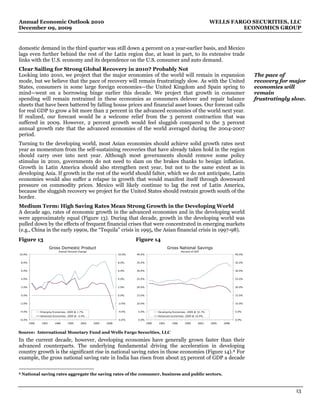
A decade ago, rates of economic growth in the advanced economies and in the developing world
were approximately equal (Figure 13). During that decade, growth in the developing world was
pulled down by the effects of frequent financial crises that were concentrated in emerging markets
(e.g., China in the early 1990s, the “Tequila” crisis in 1995, the Asian financial crisis in 1997-98).
Figure 13                                                                    Figure 14
                         Gross Domestic Product                                                    Gross National Savings
                               Annual Percent Change                                                         Percent of GDP
10.0%                                                                10.0%   40.0%                                                             40.0%


    8.0%                                                             8.0%    35.0%                                                             35.0%


    6.0%                                                             6.0%    30.0%                                                             30.0%


    4.0%                                                             4.0%    25.0%                                                             25.0%


    2.0%                                                             2.0%    20.0%                                                             20.0%


    0.0%                                                             0.0%    15.0%                                                             15.0%


-2.0%                                                                -2.0%   10.0%                                                             10.0%


-4.0%             Emerging Economies: 2009 @ 1.7%                    -4.0%   5.0%           Developing Economies: 2009 @ 32.7%                 5.0%
                  Advanced Economies: 2009 @ -3.4%                                          Advanced economies: 2009 @ 16.9%
-6.0%                                                                -6.0%   0.0%                                                              0.0%
           1990   1993      1996     1999      2002    2005   2008                   1990   1993      1996      1999      2002   2005   2008


Source: International Monetary Fund and Wells Fargo Securities, LLC
In the current decade, however, developing economies have generally grown faster than their
advanced counterparts. The underlying fundamental driving the acceleration in developing
country growth is the significant rise in national saving rates in those economies (Figure 14). 8 For
example, the gross national saving rate in India has risen from about 25 percent of GDP a decade

8   National saving rates aggregate the saving rates of the consumer, business and public sectors.


                                                                                                                                                                      13
Annual Economic Outlook 2010                                                                                       WELLS FARGO SECURITIES, LLC
December 09, 2009                                                                                                           ECONOMICS GROUP


                  ago to more than 35 percent today. The national saving rate in China has shot up to nearly
                  50 percent. High saving rates are important, because they finance rapid rates of capital
                  accumulation that drive long-run economic growth. 9
                  On a secular basis, we believe that the developing world will continue to grow faster than
                  advanced economies for a number of years, because we do not expect to see a significant decline
                  in national saving rates in most developing economies. Indeed, we would not argue with the
                  forecast of the International Monetary Fund that developing Asia will grow more than 8 percent
                  per annum in the medium term (i.e., three to five years from now). 10 In the IMF’s view, Latin
                  America will achieve 4 percent growth in the medium term, significantly less than the projection
                  for developing Asia, but stronger than the 3 percent per annum rate that the region averaged
                  between 1980 and 2008. Unless national saving rates in Latin America rise significantly—they
                  have been stable around 20 percent of GDP over the past few decades—the region will grow
                  slower on a trend basis than developing Asia. The IMF projects that the advanced economies
                  should grow about 2.5 percent per annum in the medium term. Although personal saving rates
                  likely will rise in many advanced economies over the next few years, gaping budget deficits mean
                  that it will be difficult for national saving rates to rise significantly.
                  Figure 15                                                                              Figure 16
                           Composition of Foreign Reserve Holdings                                               U.S. Trade Weighted Dollar Major Index
                                                 Trillions of U.S. Dollars                                                             March 1973=100
                  $7.0                                                                            $7.0   115                                                                    115
                                Other
                                Japanese Yen                                                             110                                                                    110
                  $6.0          Euro                                                              $6.0
                                U.S. Dollar                                                              105                                                                    105

                  $5.0                                                                            $5.0   100                                                                    100

                                                                                                         95                                                                     95
                  $4.0                                                                            $4.0
                                                                                                         90                                                                     90
                  $3.0                                                                            $3.0
                                                                                                         85                                                                     85


                  $2.0                                                                            $2.0   80                                                                     80

                                                                                                         75                                                                     75
                  $1.0                                                                            $1.0
                                                                                                         70                                                                     70
                                                                                                                    Major Currency Index: Dec @ 73.2
                  $0.0                                                                            $0.0   65                                                                     65
                         2000     2001    2002   2003     2004      2005     2006   2007   2008           2000   2001   2002   2003   2004   2005   2006   2007   2008   2009


                  Source: International Monetary Fund, Federal Reserve Board and Wells Fargo Securities, LLC
                  Is the Dollar Doomed as a Reserve Currency?
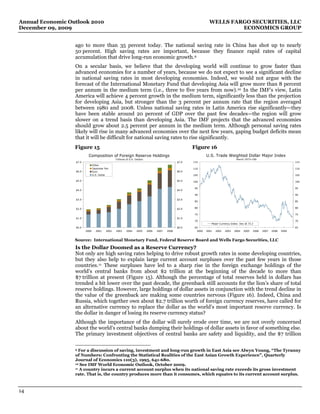
                  Not only are high saving rates helping to drive robust growth rates in some developing countries,
                  but they also help to explain large current account surpluses over the past few years in those
                  countries. 11 These surpluses have led to a sharp rise in the foreign exchange holdings of the
                  world’s central banks from about $2 trillion at the beginning of the decade to more than
                  $7 trillion at present (Figure 15). Although the percentage of total reserves held in dollars has
                  trended a bit lower over the past decade, the greenback still accounts for the lion’s share of total
                  reserve holdings. However, large holdings of dollar assets in conjunction with the trend decline in
                  the value of the greenback are making some countries nervous (Figure 16). Indeed, China and
                  Russia, which together own about $2.7 trillion worth of foreign currency reserves, have called for
                  an alternative currency to replace the dollar as the world’s most important reserve currency. Is
                  the dollar in danger of losing its reserve currency status?
                  Although the importance of the dollar will surely erode over time, we are not overly concerned
                  about the world’s central banks dumping their holdings of dollar assets in favor of something else.
                  The primary investment objectives of central banks are safety and liquidity, and the $7 trillion

                  9 For a discussion of saving, investment and long-run growth in East Asia see Alwyn Young, “The Tyranny
                  of Numbers: Confronting the Statistical Realities of the East Asian Growth Experience”, Quarterly
                  Journal of Economics 110(3), 1995, 641-680.
                  10 See IMF World Economic Outlook, October 2009.
                  11 A country incurs a current account surplus when its national saving rate exceeds its gross investment

                  rate. That is, the country produces more than it consumes, which equates to its current account surplus.


14
Annual Economic Outlook 2010                                                          WELLS FARGO SECURITIES, LLC
December 09, 2009                                                                              ECONOMICS GROUP


worth of marketable Treasury securities outstanding, all of which are AAA rated, offers central
banks the largest, safest and most liquid financial market in the world.
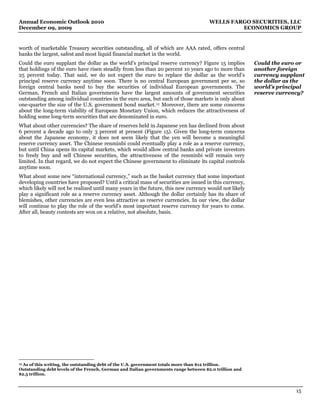
Could the euro supplant the dollar as the world’s principal reserve currency? Figure 15 implies         Could the euro or
that holdings of the euro have risen steadily from less than 20 percent 10 years ago to more than       another foreign
25 percent today. That said, we do not expect the euro to replace the dollar as the world’s             currency supplant
principal reserve currency anytime soon. There is no central European government per se, so             the dollar as the
foreign central banks need to buy the securities of individual European governments. The                world’s principal
German, French and Italian governments have the largest amounts of government securities                reserve currency?
outstanding among individual countries in the euro area, but each of those markets is only about
one-quarter the size of the U.S. government bond market. 12 Moreover, there are some concerns
about the long-term viability of European Monetary Union, which reduces the attractiveness of
holding some long-term securities that are denominated in euro.
What about other currencies? The share of reserves held in Japanese yen has declined from about
6 percent a decade ago to only 3 percent at present (Figure 15). Given the long-term concerns
about the Japanese economy, it does not seem likely that the yen will become a meaningful
reserve currency asset. The Chinese renminbi could eventually play a role as a reserve currency,
but until China opens its capital markets, which would allow central banks and private investors
to freely buy and sell Chinese securities, the attractiveness of the renminbi will remain very
limited. In that regard, we do not expect the Chinese government to eliminate its capital controls
anytime soon.
What about some new “international currency,” such as the basket currency that some important
developing countries have proposed? Until a critical mass of securities are issued in this currency,
which likely will not be realized until many years in the future, this new currency would not likely
play a significant role as a reserve currency asset. Although the dollar certainly has its share of
blemishes, other currencies are even less attractive as reserve currencies. In our view, the dollar
will continue to play the role of the world’s most important reserve currency for years to come.
After all, beauty contests are won on a relative, not absolute, basis.


12As of this writing, the outstanding debt of the U.S. government totals more than $12 trillion.
Outstanding debt levels of the French, German and Italian governments range between $2.0 trillion and
$2.5 trillion.


                                                                                                                      15
Annual Economic Outlook 2010                                                                                   WELLS FARGO SECURITIES, LLC
 December 09, 2009                                                                                                       ECONOMICS GROUP


                   Residential Real Estate: Fair Seas or the Calm before Another Storm?
                   Residential construction finally found its way to fairer winds this year. Is this merely a short-lived
                   improvement or the calm before a second storm? Federal government support has created a sense
                   of stability in housing. Massive purchases of mortgage-backed securities by the Federal Reserve
                   are helping drive down mortgage rates and an $8,000 tax-credit for first-time homebuyers helped
                   lift demand. But what happens when that support is withdrawn? Is the housing recovery
                   self-sustaining? A possible warning sign is that sales and new construction, which both improved
                   during the spring and summer, faltered more recently as the tax credit was set to expire.
The fundamentals   While the tax credit was eventually extended and expanded, we expect this program to have
of supply and      diminishing returns. 13 Our forecast looks for a weak rebound in residential construction
demand for the     compared to prior economic recoveries. The current plan calls for the tax incentives to end in
housing sector     June. Housing starts should get at least a modest boost through April, which is just when the peak
remain extremely   home-buying season tends to ramp up. Sales and new construction will likely be pulled forward
challenging.       into the early part of 2010 and will then fall back a bit in the spring. The fundamentals of supply
                   and demand for the housing sector remain extremely challenging. On the supply side, excess
                   supply remains close to 2 million units. As for demand, potential buyers are being held back by
                   concerns about employment and income prospects on real disposable income. Meanwhile, credit
                   remains more difficult to qualify for and appraisals are much more conservative today.
                   Temporary band-aid programs helped limit the housing downdraft but come at the cost of larger
                   federal deficits. If these programs do not lead to a sustained improvement in underlying demand,
                   there will be little follow through. We do not see the extension and expansion of the first-time
                   homebuyer tax credit as influencing the ultimate timing of a sustainable recovery in the housing
                   market. The demand for new and existing homes will not pick up on a sustainable basis until
                   employment and income conditions improve. While this may technically begin to happen as soon
                   as the middle of next year, employment conditions will not likely improve enough to generate a
                   strong and sustainable recovery in home sales until spring 2011. There are simply too many
                   households experiencing extreme financial stress to allow the conditions necessary for a stronger
                   recovery to take hold.
                   Figure 17                                                                    Figure 18
                                       Existing Home Resales                                                                        Housing Starts
                                   Seasonally Adjusted Annual Rate - In Millions                                                      Millions of Units
                   7.5                                                                    7.5   2.4                                                                                      2.4


                   7.0                                                                    7.0   2.1                                                                                      2.1
                                                                                                                                                                              Forecast
                                                                                                1.8                                                                                      1.8
                   6.5                                                                    6.5

                                                                                                1.5                                                                                      1.5
                   6.0                                                                    6.0
                                                                                                1.2                                                                                      1.2
                   5.5                                                                    5.5
                                                                                                0.9                                                                                      0.9

                   5.0                                                                    5.0
                                                                                                0.6                                                                                      0.6

                   4.5                                                                    4.5   0.3                                                                                      0.3
                             Existing Home Sales: Oct @ 6.10 Million
                   4.0                                                                    4.0   0.0                                                                                      0.0
                      1999     2001          2003          2005          2007      2009               80   82   84   86   88   90    92   94   96   98    00   02   04   06   08   10


                   Source: U.S. Department of Commerce, National Association of Realtors and Wells Fargo Securities, LLC


                   13The economic concept of diminishing returns is that at a certain point, each additional input applied to
                   a process will generate less additional output than the prior unit.


 16
Annual Economic Outlook 2010                                                                                                       WELLS FARGO SECURITIES, LLC
December 09, 2009                                                                                                                           ECONOMICS GROUP


Remodeling Older Homes: Get a Lemon, Make Lemonade
When you can’t afford to move then you remodel or upgrade your existing home. Spending for
residential additions and alterations has been one notable bright spot. Spending is being driven
by the high volume of foreclosure sales, many of which are being bought by investors. Foreclosed
homes are then repaired and remodeled. Many homes are being divided into duplexes and
triplexes and being put up for rent, which is one reason why the number of vacant homes for rent
spiked upward in recent months. In addition, spending to weatherize homes has increased,
thanks in part to tax incentives.
The volatility in home sales and new construction during the first half of 2010 will likely to give                                                   Improvement in
way to a modest improvement in underlying demand during the second half of the year. For all of                                                       sales and new
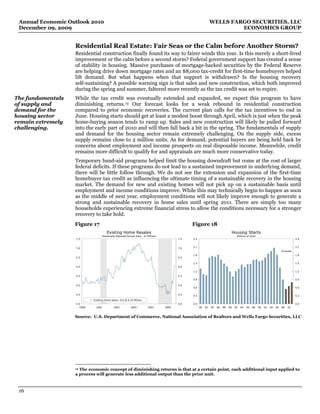
2010, we expect sales of new homes to rise 15 percent and sales of existing homes (Figure 17) to                                                      construction
rise around 6 percent. Our forecast also shows new home construction picking up next year, with                                                       should take place
starts of single-family homes (Figure 18) rising close to 20 percent and marginal gains for                                                           in 2011, but we do
construction of multifamily properties. We look for more improvement in sales and new                                                                 not look for a
construction to take place in 2011 but do not look for a strong recovery to take hold in the housing                                                  strong recovery to
sector until 2012 or later.                                                                                                                           take hold in the
                                                                                                                                                      housing sector
Strange Brew: High Prices, More Foreclosures
                                                                                                                                                      until 2012 or later.
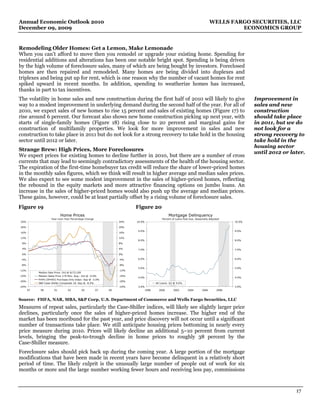
We expect prices for existing homes to decline further in 2010, but there are a number of cross
currents that may lead to seemingly contradictory assessments of the health of the housing sector.
The expiration of the first-time homebuyer tax credit will reduce the share of lower-priced homes
in the monthly sales figures, which we think will result in higher average and median sales prices.
We also expect to see some modest improvement in the sales of higher-priced homes, reflecting
the rebound in the equity markets and more attractive financing options on jumbo loans. An
increase in the sales of higher-priced homes would also push up the average and median prices.
These gains, however, could be at least partially offset by a rising volume of foreclosure sales.
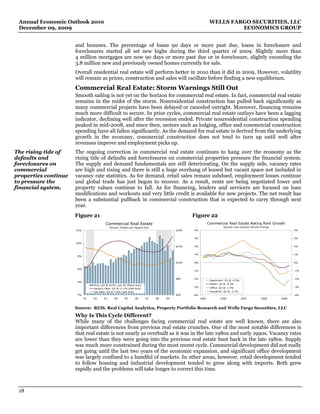
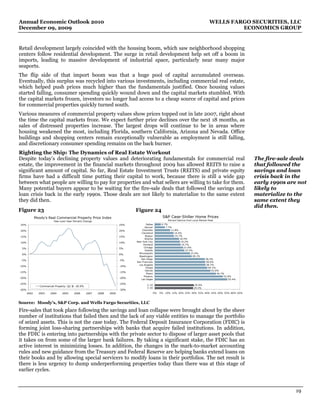
Figure 19                                                                Figure 20
                             Home Prices                                                         Mortgage Delinquency
                     Year-over-Year Percentage Change                                       Percent of Loans Past Due, Seasonally Adjusted
24%                                                               24%    10.0%                                                                10.0%

20%                                                               20%
                                                                         9.0%                                                                 9.0%
16%                                                               16%

12%                                                               12%
                                                                         8.0%                                                                 8.0%
 8%                                                               8%

 4%                                                               4%     7.0%                                                                 7.0%
 0%                                                               0%

 -4%                                                              -4%    6.0%                                                                 6.0%

 -8%                                                              -8%
                                                                         5.0%                                                                 5.0%
-12%                                                              -12%
            Median Sale Price: Oct @ $173,100
-16%        Median Sales Price 3-M Mov. Avg.: Oct @ -9.0%         -16%
                                                                         4.0%                                                                 4.0%
            FHFA (OFHEO) Purchase Only Index: Sep @ -3.0%
-20%                                                              -20%
            S&P Case-Shiller Composite 10: Sep @ -8.5%                                  All Loans: Q3 @ 9.6%
-24%                                                              -24%   3.0%                                                                 3.0%
       97    99         01        03         05         07   09                  1998     2000       2002       2004        2006       2008


Source: FHFA, NAR, MBA, S&P Corp, U.S. Department of Commerce and Wells Fargo Securities, LLC
Measures of repeat sales, particularly the Case-Shiller indices, will likely see slightly larger price
declines, particularly once the sales of higher-priced homes increase. The higher end of the
market has been moribund for the past year, and price discovery will not occur until a significant
number of transactions take place. We still anticipate housing prices bottoming in nearly every
price measure during 2010. Prices will likely decline an additional 5–10 percent from current
levels, bringing the peak-to-trough decline in home prices to roughly 38 percent by the
Case-Shiller measure.
Foreclosure sales should pick back up during the coming year. A large portion of the mortgage
modifications that have been made in recent years have become delinquent in a relatively short
period of time. The likely culprit is the unusually large number of people out of work for six
months or more and the large number working fewer hours and receiving less pay, commissions


                                                                                                                                                                      17
Annual Economic Outlook 2010                                                                                   WELLS FARGO SECURITIES, LLC
 December 09, 2009                                                                                                       ECONOMICS GROUP


                      and bonuses. The percentage of loans 90 days or more past due, loans in foreclosure and
                      foreclosures started all set new highs during the third quarter of 2009. Slightly more than
                      4 million mortgages are now 90 days or more past due or in foreclosure, slightly exceeding the
                      3.8 million new and previously owned homes currently for sale.
                      Overall residential real estate will perform better in 2010 than it did in 2009. However, volatility
                      will remain as prices, construction and sales will vacillate before finding a new equilibrium.
                      Commercial Real Estate: Storm Warnings Still Out
                      Smooth sailing is not yet on the horizon for commercial real estate. In fact, commercial real estate
                      remains in the midst of the storm. Nonresidential construction has pulled back significantly as
                      many commercial projects have been delayed or canceled outright. Moreover, financing remains
                      much more difficult to secure. In prior cycles, commercial real estate outlays have been a lagging
                      indicator, declining well after the recession ended. Private nonresidential construction spending
                      peaked in mid-2008, and since then, sectors such as lodging, office and commercial construction
                      spending have all fallen significantly. As the demand for real estate is derived from the underlying
                      growth in the economy, commercial construction does not tend to turn up until well after
                      revenues improve and employment picks up.
The rising tide of    The ongoing correction in commercial real estate continues to hang over the economy as the
defaults and          rising tide of defaults and foreclosures on commercial properties pressure the financial system.
foreclosures on       The supply and demand fundamentals are still deteriorating. On the supply side, vacancy rates
commercial            are high and rising and there is still a huge overhang of leased but vacant space not included in
properties continue   vacancy rate statistics. As for demand, retail sales remain subdued, employment losses continue
to pressure the       and global trade has just begun to recover. As a result, rents are being negotiated lower and
financial system.     property values continue to fall. As for financing, lenders and servicers are focused on loan
                      modifications and workouts and very little credit is available for new projects. The net result has
                      been a substantial pullback in commercial construction that is expected to carry through next
                      year.
                      Figure 21                                                                   Figure 22
                                          Commercial Real Estate                                               Commercial Real Estate Asking Rent Growth
                                              Percent, Dollars per Square Foot                                            Quarter-over-Quarter Percent Change
                      12%                                                                  $180   4%                                                                   4%


                                                                                                  3%                                                                   3%

                      10%
                                                                                           $140   2%                                                                   2%


                                                                                                  1%                                                                   1%
                       8%

                                                                                           $100   0%                                                                   0%

                       6%
                                                                                                  -1%                                                                  -1%


                                                                                           $60    -2%                                                                  -2%
                                                                                                                Apartment: Q3 @ -0.5%
                       4%
                                 Price: Q3 @ $130.1 per SF (Right Axis)                                         Retail: Q3 @ -0.3%
                                                                                                  -3%           Office: Q3 @ -1.0%                                     -3%
                                 Vacancy Rate: Q3 @ 11.1% (Left Axis)
                                 Cap Rate: Q3 @ 7.8% (Left Axis)                                                Industrial: Q3 @ -2.1%
                       2%                                                                  $20    -4%                                                                  -4%
                            01   02      03       04      05      06       07    08   09                2005            2006             2007         2008      2009


                      Source: REIS, Real Capital Analytics, Property Portfolio Research and Wells Fargo Securities, LLC
                      Why Is This Cycle Different?
                      While many of the challenges facing commercial real estate are well known, there are also
                      important differences from previous real estate crunches. One of the most notable differences is
                      that real estate is not nearly as overbuilt as it was in the late 1980s and early 1990s. Vacancy rates
                      are lower than they were going into the previous real estate bust back in the late 1980s. Supply
                      was much more constrained during the most recent cycle. Commercial development did not really
                      get going until the last two years of the economic expansion, and significant office development
                      was largely confined to a handful of markets. In other areas, however, retail development tended
                      to follow housing and industrial development tended to grow along with imports. Both grew
                      rapidly and the problems will take longer to correct this time.


 18
Annual Economic Outlook 2010                                                                                                                 WELLS FARGO SECURITIES, LLC
December 09, 2009                                                                                                                                     ECONOMICS GROUP


Retail development largely coincided with the housing boom, which saw neighborhood shopping
centers follow residential development. The surge in retail development help set off a boom in
imports, leading to massive development of industrial space, particularly near many major
seaports.
The flip side of that import boom was that a huge pool of capital accumulated overseas.
Eventually, this surplus was recycled into various investments, including commercial real estate,
which helped push prices much higher than the fundamentals justified. Once housing values
started falling, consumer spending quickly wound down and the capital markets stumbled. With
the capital markets frozen, investors no longer had access to a cheap source of capital and prices
for commercial properties quickly turned south.
Various measures of commercial property values show prices topped out in late 2007, right about
the time the capital markets froze. We expect further price declines over the next 18 months, as
sales of distressed properties increase. The largest drops will continue to be in areas where
housing weakened the most, including Florida, southern California, Arizona and Nevada. Office
buildings and shopping centers remain exceptionally vulnerable as employment is still falling,
and discretionary consumer spending remains on the back burner.
Righting the Ship: The Dynamics of Real Estate Workout
Despite today’s declining property values and deteriorating fundamentals for commercial real                                                                       The fire-sale deals
estate, the improvement in the financial markets throughout 2009 has allowed REITS to raise a                                                                      that followed the
significant amount of capital. So far, Real Estate Investment Trusts (REITS) and private equity                                                                    savings and loan
firms have had a difficult time putting their capital to work, because there is still a wide gap                                                                   crisis back in the
between what people are willing to pay for properties and what sellers are willing to take for them.                                                               early 1990s are not
Many potential buyers appear to be waiting for the fire-sale deals that followed the savings and                                                                   likely to
loan crisis back in the early 1990s. Those deals are not likely to materialize to the same extent                                                                  materialize to the
they did then.                                                                                                                                                     same extent they
                                                                                                                                                                   did then.
Figure 23                                                                       Figure 24
              Moody's Real Commercial Property Price Index                                             S&P Case-Shiller Home Prices
                           Year-over-Year Percent Change                                                   Percent Decline from Local Market Peak

25%                                                                      25%            Dallas         4.7%
                                                                                       Denver             7.7%
20%                                                                      20%         Charlotte                11.8%
                                                                                    Cleveland                    14.4%
15%                                                                      15%           Boston                    14.7%
                                                                                       Atlanta                       18.5%
10%                                                                      10%    New York City                         19.2%
                                                                                      Portland                        19.7%
 5%                                                                      5%           Chicago                           21.6%
                                                                                       Seattle                           22.5%
                                                                                  Minneapolis                                27.0%
 0%                                                                      0%
                                                                                  Washington                                  28.1%
                                                                                   San Diego                                              38.2%
 -5%                                                                     -5%
                                                                                San Francisco                                             38.6%
                                                                                  Los Angeles                                             38.7%
-10%                                                                     -10%
                                                                                       Tampa                                                40.1%
                                                                                       Detroit                                                42.6%
-15%                                                                     -15%
                                                                                        Miami                                                     46.7%
                                                                                      Phoenix                                                          52.0%
-20%                                                                     -20%
                                                                                    Las Vegas                                                              55.4%

-25%                                                                     -25%            C-10                                    29.9%
                 Commercial Property: Q2 @ -26.9%
                                                                                         C-20                                   29.3%
-30%                                                                     -30%
       2002     2003    2004     2005     2006      2007   2008   2009                           0%   5% 10% 15% 20% 25% 30% 35% 40% 45% 50% 55% 60% 65%


Source: Moody’s, S&P Corp. and Wells Fargo Securities, LLC
Fire-sales that took place following the savings and loan collapse were brought about by the sheer
number of institutions that failed then and the lack of any viable entities to manage the portfolio
of seized assets. This is not the case today. The Federal Deposit Insurance Corporation (FDIC) is
forming joint loss-sharing partnerships with banks that acquire failed institutions. In addition,
the FDIC is entering into partnerships with the private sector to dispose of larger asset pools that
it takes on from some of the larger bank failures. By taking a significant stake, the FDIC has an
active interest in minimizing losses. In addition, the changes in the mark-to-market accounting
rules and new guidance from the Treasury and Federal Reserve are helping banks extend loans on
their books and by allowing special servicers to modify loans in their portfolios. The net result is
there is less urgency to dump underperforming properties today than there was at this stage of
earlier cycles.


                                                                                                                                                                                  19
Annual Economic Outlook 2010                                                  WELLS FARGO SECURITIES, LLC
 December 09, 2009                                                                      ECONOMICS GROUP


                    Credit: Lenders Lowering the Boom
Most transactions   Credit for commercial real estate properties continues to be one of the main obstacles facing the
today are being     industry. Most transactions today are being financed by mortgage assumptions with many
financed by         borrowers also relying on seller financing and cash. The issuance of commercial mortgage-backed
mortgage            securities (CMBS) remains at a near standstill and even more pressing is the estimated
assumptions with    $100 billion-$150 billion in CMBS loans that may face difficulty being refinanced in the next
many borrowers      three years. While insurance companies, which hold roughly 10 percent of commercial mortgages
also relying on     outstanding, have opened their doors to refinance high-quality loans with low loan-to-value
seller financing    ratios, there are still a large number of highly leveraged loans in the market. Indeed, the inability
and cash.           to refinance many of these loans will lead to even higher delinquency rates.
                    Another recurring fear is that commercial real estate loans sitting on the books of banks will
                    trigger another round of bankruptcies. Thus far, many banks have been able to extend debt as
                    long as interest payments are made. Moreover, new tax rules recently implemented by the
                    Treasury should help to quell massive write-downs. In addition, to help revive the ailing
                    commercial real estate industry, existing and newly created CMBS loans became eligible for TALF
                    funding in June. Although spreads have narrowed significantly since reaching their peak, the
                    commercial real estate market still has a long road ahead.
                    Outlook: Trimming the Sails, Waiting for Clearer Skies
                    We expect construction activity to pull back further over the next 18 months but look for declines
                    to gradually taper off. Building activity did not get as elevated as in past building cycles and will
                    likely correct somewhat less. Unfortunately, property values rose much more in many markets
                    than in previous cycles and will likely decline even further. Moreover, the depth of the recession
                    means that demand for commercial properties fell much more than in previous downturns. All
                    property types have seen demand fall substantially and this will continue to restrain new
                    development. One offsetting factor has been rising investment in alternative energy projects,
                    many of which will move forward in 2010. We expect nonresidential construction to fall
                    11.9 percent in 2010, weighing on real GDP growth for the year.


 20
Annual Economic Outlook 2010                                                                                                                  WELLS FARGO SECURITIES, LLC
December 09, 2009                                                                                                                                      ECONOMICS GROUP


Regional Spotlight: Where Did the Sun Go in California and Florida?
From the sailboats in San Diego and seafood in San Francisco to the resorts in Orlando and the
beaches across Florida, visions of sunshine have inspired generations to dream of endless
summers in California and Florida. In 2007, winter hit. California and Florida were two of the
hardest hit states during the recession, as both were key participants in the housing boom and
bust. Overbuilding in residential and commercial construction will continue to weigh on both
states over the next few years, but signs of growth are beginning to emerge, particularly in
northern California and parts of central Florida. The technology sector, healthcare,
defense-related industries and international trade are expected to lead the economic recovery,
while construction, tourism and financial services are expected to lag. State and local
governments will remain under intense pressure due to continuing shortfalls in revenues,
particularly sales tax collections and property tax receipts.
California: Cyclical Recovery
Somewhat surprising, California’s economy appears to be better positioned for economic growth
than Florida. California manufacturing surveys returned to expansion in the third quarter, and
California technology companies have been reporting strong third-quarter earnings and improved
sales outlooks for the coming quarters. This will be a key growth driver for northern California.
Growth will take a bit longer to turn around in southern California and the Central Valley.
A number of factors are behind this improving trend. For manufacturing, aggressive inventory                                                                           A weak dollar and
cutting in the first half of the year has slowed and some businesses are actually boosting                                                                             strong demand
production to replenish them, a good sign that businesses see stable demand ahead. A weak dollar                                                                       from Asia is
and strong demand from Asia is boosting California exports and helping California businesses get                                                                       boosting California
back on their feet. Lower food and energy prices and the moderation in housing costs are giving                                                                        exports.
workers real improvement in their buying power. Those that have held on to their jobs have seen
their real hourly earnings rise at a 5 percent growth rate, the best earnings growth rate seen in
more than a decade. This is helping bolster purchasing power, and core retail sales have improved
modestly.
California Housing: Sustained Improvement?
California’s housing market is slowly shifting from a negative to positive for the state’s economy.
The foreclosure moratoria and the federal loan modification program have clearly helped reduce
for-sale inventory and stabilize prices. Median existing home prices have been rising, and the
year-to-year decline in home prices has decelerated back into the high single digits. While the rise
in home sales, the decline in inventories and rebound in home prices are welcome improvements,
they may overstate the extent of improvement in California’s housing markets.
Figure 25                                                                             Figure 26
          California Existing Homes Sales & Prices                                               California Existing Homes Inventory
          Thousands of Units, Thousands of Dollars, 3-Month Moving Average                                  Months Supply, 3-Month Moving Average
700                                                                            $700   18                                                                          18
           California Sales: Oct @ 540.2 (Left Axis)
           California Prices: Oct @ $293.1 (Right Axis)                               16                                                                          16
600                                                                            $600
                                                                                      14                                                                          14


500                                                                            $500   12                                                                          12


                                                                                      10                                                                          10
400                                                                            $400
                                                                                      8                                                                           8


300                                                                            $300   6                                                                           6


                                                                                      4                                                                           4
200                                                                            $200
                                                                                      2                                                                           2
                                                                                                California: Oct @ 4.2 Months
100                                                                            $100   0                                                                           0
   1990   1992   1994    1996    1998     2000    2002    2004   2006   2008           1990   1992   1994     1996   1998      2000   2002   2004   2006   2008


Source: California Association of Realtors Real Estate Trends and Wells Fargo Securities, LLC
One notable problem area is the share of seriously delinquent home mortgages, those loans 90
days or more past due, which has more than doubled over the past year. Separate data from the


                                                                                                                                                                                     21
Annual Economic Outlook 2010                                                                  WELLS FARGO SECURITIES, LLC
 December 09, 2009                                                                                      ECONOMICS GROUP


                     Federal Reserve Bank of New York show the greatest problem areas remain the Central Valley and
                     portions of southern California, particularly Riverside and San Bernardino. The overall pace of
                     improvement is likely being exaggerated by various incentive programs to bolster purchases by
                     first-time homebuyers, restraints on foreclosures and efforts to modify home mortgages.
                     However, sales are expected to slow in 2010, and that should moderate any improvement in new
                     home construction.
                     California: Secular Challenges
                     California has one of the highest costs of doing business in the country, 17 percent above the
                     U.S. average, and 24 percent above Oregon, according to data from Moody’s Economy.com. This
                     is a huge competitive disadvantage when businesses are paying more attention than ever to costs.
                     New business incorporations in California have slumped about 30 percent from 2007. Less
                     venture capital investment, higher business costs and taxes are playing a role here. New
                     businesses are an important engine for new job creation, and California is missing out. Population
                     growth has been slowing for decades, which reduces the long-term growth potential for the state.
                     Moreover, the quality of the jobs being created across the state is not what it once was.
                     California's per capita income in 1980 was 18 percent above the national average. Today,
                     California's per capita income is just 8.5 percent above the national average, while housing
                     remains at least 50 percent more expensive. However, this may in part reflect the natural
                     progression of job creation, in which high income workers require the support of lower income
                     workers.
                     Figure 27                                                Figure 28
                                               California Unemployment Rate                             California Delinquent Mortgage Rates


                     October 2009                                             September 2009
                          Greater than 17.0%   5.0% to10.0%                        Greater than 14.0%      4.0% to 7.0%
                          14.0%to17
                                  .0%          Less than 5.0%                      10.0%to14
                                                                                           .0%             Less than 4.0%
                          10.0%to14
                                  .0%                                              7.0%to10
                                                                                          .0%


                     Source: U.S. Dept. of Labor, First American Core Logic and Wells Fargo Securities, LLC
This recession has   Lastly, this recession has done more damage to California’s economy than most others, which is
done more damage     bound to leave lasting scars. California has lost roughly one million jobs in this recession so far.
to California’s      Home values across the state have been roughly halved from their value at the peak of the cycle.
economy than most    The state’s unemployment rate is likely to rise above 13 percent before it peaks sometime in
others, which is     mid-2010, above the U.S. average. Rising unemployment worsens California’s household credit
bound to leave       problems and leads to tougher choices on how to balance the state’s fiscal budget going forward.
lasting scars.       None of the cyclical and structural problems are insurmountable, but they will take time to heal
                     and fix. Following a 4.5 percent drop in 2009, we expect nonfarm employment to fall
                     about 1.4 percent in 2010, even as modest economic growth resumes. So while California is no
                     longer staring into the abyss, it is likely to remain a relative underperformer economically over
                     the forecast horizon.
                     Sunrise Comes a Little Later in Florida: Recovery Delayed
                     Florida’s economic recovery will take longer to gain momentum. Florida is much more dependent
                     on the continued inflow of new residents from other parts of the country to drive economic
                     growth, and migration trends turned exceptionally negative during the recession. Florida saw its
                     first net out-migration since the immediate aftermath of World War II during 2008 and 2009,
                     with residents increasingly relocating to other Sunbelt states, such as Georgia, the Carolinas,


 22
Annual Economic Outlook 2010                                                                                                                 WELLS FARGO SECURITIES, LLC
December 09, 2009                                                                                                                                     ECONOMICS GROUP


Tennessee and Texas. The primary reasons for the net outflow have been the dramatic increase in
housing costs, including the price of insurance and property taxes, as well as the state’s greatly
diminished employment prospects, with nonfarm employment falling 8.8 percent over the past
two and a half years, producing a net loss of more than 708,000 jobs.
Efforts have been made to diversify Florida’s economy, strengthening the state’s economic base.
International trade has been a key growth area, particularly in South Florida, which is home to
hundreds of Latin American headquarters for major U.S. and global multinational companies.
Efforts have also been made to bolster the healthcare and biomedical industries in South Florida
and central Florida. While these efforts hold great long-term promise, the immediate impact has
been limited, and the size of these industries is still relatively small compared to the overall
Florida economy.
Figure 29                                                                      Figure 30
                 Florida Nonfarm Employment                                                               Florida Net Migration
                              3-Month Moving Averages                                                               In Thousands
8%                                                                       8%    500                                                                               500


6%                                                                       6%    400                                                                               400

4%                                                                       4%
                                                                               300                                                                               300

2%                                                                       2%
                                                                               200                                                                               200

0%                                                                       0%
                                                                               100                                                                               100
-2%                                                                      -2%

                                                                                 0                                                                               0
-4%                                                                      -4%

            3-Month Annual Rate: Oct @ -2.0%                                   -100                                                                              -100
-6%         Year-over-Year Percent Change: Oct @ -4.6%                   -6%
            Household: Year-over-Year Percent Change: Oct @ -5.6%                           Net Migration: 2009 @ -37
-8%                                                                      -8%   -200                                                                              -200
      90   92    94      96      98     00     02       04   06     08                80   82   84   86   88   90   92   94   96   98   00   02   04   06   08


Source: U.S. Dept. of Commerce, FL Demographic Estimating Conf. and Wells Fargo Securities, LLC
Tourism and retirees are still the key economic drivers for Florida, and both have suffered in                                                                          Tourism and
recent years. Tourism has fallen from the middle of 2007, with both domestic and international                                                                          retirees are still the
visitor counts dropping. The net result has been a substantial pullback in the leisure and                                                                              key economic
hospitality sector. Retirees are also finding it more difficult and too expensive to retire to the                                                                      drivers for Florida.
Sunshine State, and many that have retired to Florida have seen their investment income from
their portfolios diminish. Income from interest dividends and rents, which accounts for
one-quarter of Florida’s personal income versus 18 percent of the nation’s personal income, fell
7.5 percent over the past year. On the other hand, defense-related spending and technology are
two notable bright spots for Florida. Exports of high tech products have picked up recently,
particularly communications equipment. The improvement has helped offset some of the
continuing problems in the housing sector.
Florida Housing: Oversupply Persists
Housing is more overbuilt in Florida than in any other major state, with some regional variation.
The worst areas are the Gulf Coast, stretching from Tampa’s northern suburbs south to Naples,
and the Atlantic seaboard from West Palm Beach up to Melbourne. Significant overbuilding is
also evident in Miami and Orlando but less so in Fort Lauderdale and Jacksonville. Nationwide
home sales have improved more recently, with distressed deals accounting for roughly one third
of all transactions. In Florida, sales of existing homes through the first 10 months of this year are
running ahead of the comparable period last year, and sales have now risen back to about
70 percent of their previous peak level. The Florida Association of Realtors reports the median
price of an existing home (Figure 32) was roughly $140,000 in October, which is about 45 percent
lower than the peak hit back in mid 2006. While home sales have picked up, many of these homes
remain vacant and have simply moved from the vacant-for-sale category to the vacant-for-rent
category.


                                                                                                                                                                                         23
Annual Economic Outlook 2010                                                                              WELLS FARGO SECURITIES, LLC
 December 09, 2009                                                                                                  ECONOMICS GROUP


                       Figure 31                                                               Figure 32
                                            Florida Housing Starts                                       Florida Median Existing Single-Family Home Price
                                              Year-over-Year Percent Change                                              In Thousands of Dollars
                       40%                                                              40%    $400                                                                  $400

                       30%                                                              30%
                                                                                               $350                                                                  $350

                       20%                                                              20%
                                                                                               $300                                                                  $300
                       10%                                                              10%

                                                                                               $250                                                                  $250
                        0%                                                              0%

                       -10%                                                             -10%   $200                                                                  $200

                       -20%                                                             -20%
                                                                                               $150                                                                  $150

                       -30%                                                             -30%
                                                                                               $100                                                                  $100
                       -40%                                                             -40%                                                Miami: Q3 @ $219,807
                                                                                                                                            Orlando: Q3 @ $154,521
                                                                                               $50                                                                   $50
                       -50%                                                             -50%                                                Florida: Q3 @ $141,647
                                   Housing Starts: Oct @ -40.5%                                                                             Tampa: Q3 @ $133,617
                       -60%                                                             -60%    $0                                                                   $0
                              95   97       99       01       03       05     07   09             1994     1996   1998   2000     2002      2004    2006    2008


                       Source: U.S. Dept. of Commerce, Florida Association of Realtors, National Association of Realtors,
                       University of Florida Real Estate Research Center and Wells Fargo Securities, LLC
Florida’s recovery     The oversupply of housing will remain a drag on the state’s economic performance for the next
is likely to be long   several years, and parts of the state will not see the housing market return to normal for nearly a
and arduous, with      decade. The glut of houses will produce one benefit, however, and that will be to return Florida
employment not         back to its historic position of being a relatively inexpensive place for retires and young,
likely returning to    college-educated adults to relocate. Population growth will not pick up, however, until the
its March 2007         economy improves in other regions and persons wishing to move to Florida can more easily sell
level for at least     their homes on attractive terms. Employment should turn positive on a month-to-month basis
five years.            around mid-2010, but the unemployment rate will not top out until the fall of that year. But even
                       after employment begins growing again, the state’s recovery is likely to be long and arduous, with
                       employment not likely returning to its March 2007 level for at least five years.
                       Beyond Recovery, Florida Faces Significant Long-Term Challenges
                       Longer term, the combination of higher housing and insurance costs, along with higher property
                       taxes, may prevent Florida from completely returning to the inexpensive place to do business that
                       it was in the 1980s and 1990s. This puts the state at a competitive disadvantage in attracting new
                       industry compared to Georgia, Alabama, the Carolinas, Tennessee and Texas. While large
                       investments are being made in healthcare and biomedical facilities, greater efforts need to be
                       made to encourage more private investment. The state’s financial situation also remains
                       precarious, with sales tax receipts accounting for close to 60 percent of state revenues and
                       property taxes providing the bulk of local revenues. The mix has proven toxic in past recessions
                       and has left the state with a serious budget shortfall, which has brought about cuts in services, as
                       well as tax hikes and increases in user fees.
                       Florida faces a long and difficult road to recovery. It will be years before the hangover from the
                       housing boom goes away. In the mean time, the glut of houses at least helps bring down the
                       state’s otherwise high cost of living. Eventually, the intrinsic qualities that have drawn
                       generations of Americans to the Sunshine State will overcome today’s challenges. The recovery
                       will just take longer than most Floridians would like.


 24
Annual Economic Outlook 2010                                        WELLS FARGO SECURITIES, LLC
December 09, 2009                                                            ECONOMICS GROUP


                               This Page Intentionally Left Blank


                                                                                             25
26
                                                                                                                       Wells Fargo U.S. Economic Forecast

                                                                                  Actual                                                                                   Forecast                                                  Actual                    Forecast
                                                                   2008                                        2009                                          2010                                     2011                   2007         2008        2009      2010       2011
                                                 1Q         2Q            3Q       4Q        1Q         2Q            3Q       4Q          1Q         2Q            3Q       4Q        1Q       2Q           3Q      4Q
                                                                                                                                                                                                                                                                                    December 09, 2009


     Real Gross Domestic Product (a)            -0.7        1.5           -2.7     -5.4      -6.4       -0.7          2.8      2.6         2.2        2.5           2.4      2.0       2.1      2.2          2.5     2.6      2.1             0.4     -2.5       2.2        2.3
       Personal Consumption                     -0.6        0.1           -3.5     -3.1      0.6        -0.9          2.9      1.1         0.8        1.2           1.3      1.4       1.5      1.4          1.5     1.5      2.6             -0.2    -0.6       1.2        1.4
       Business Fixed Investment                 1.9        1.4           -6.1    -19.4     -39.2       -9.6          -4.1     0.0        -2.4        -0.4          1.5      3.2       5.8      4.5          5.5     6.4      6.2             1.6     -17.8      -1.4       4.2
         Equipment and Software                 -0.5        -5.0          -9.4    -25.9     -36.4       -4.9          2.3      1.6         5.3        4.1           5.0      5.8       7.4      5.5          6.3     6.9      2.6             -2.6    -17.4      3.4        6.1
         Structures                              6.8       14.5           -0.1     -7.2     -43.6      -17.3      -15.2      -14.0        -12.0      -11.0          -7.0     -3.5      1.5      2.0          3.5     5.0     14.9             10.3    -19.2     -11.9      -0.8
       Residential Construction                 -28.2      -15.8      -15.9       -23.2     -38.2      -23.2          19.5     3.5         2.0        3.5           4.0      5.0       6.0      7.0          7.5     8.0     -18.5        -22.9       -20.4      3.2        5.9
       Government Purchases                      2.6        3.6           4.8      1.2       -2.6       6.7           3.1      2.7         2.0        1.6           2.9      1.5       1.2      1.2          1.8     1.0      1.7             3.1      2.2       2.6        1.6
                                                                                                                                                                                                                                                                                    Annual Economic Outlook 2010


       Net Exports                             -550.9     -476.0      -479.2      -470.9   -386.5     -330.4      -358.0     -387.6      -378.4     -372.0      -371.8      -374.5    -374.6   -366.6    -354.9     -337.5   -647.7       -494.3     -365.6     -374.2    -358.4
         Pct. Point Contribution to GDP          0.4        2.4           -0.1     0.5       2.6        1.7           -0.8    -0.9         0.3        0.2           0.0      -0.1      0.0      0.2          0.3     0.5      0.6             1.2      1.0       -0.1       0.1
       Inventory Change                          0.6       -37.1      -29.7       -37.4    -113.9     -160.2      -133.4     -62.5        -25.0       8.0           28.0     40.0      45.0     50.0         50.0    50.0    19.5         -25.9      -117.5      12.8      48.8
         Pct. Point Contribution to GDP         -0.2        -1.3          0.3      -0.6      -2.4       -1.4          0.9      2.2         1.2        1.0           0.6      0.4       0.1      0.1          0.0     0.0      -0.3            -0.3    -0.7       1.0        0.3

     Nominal GDP                                 1.0        3.5           1.4      -5.4      -4.6       -0.8          3.3      3.4         3.2        3.6           3.6      3.5       3.9      4.1          4.4     4.7      5.1             2.6     -1.4       3.2        3.9
     Real Final Sales                           -0.5        2.7           -2.9     -4.7      -4.1       0.7           1.9     -0.1         1.0        1.4           1.8      1.6       2.0      2.1          2.5     2.6      2.5             0.8     -1.8       1.1        2.0
     Retail Sales (b)                            2.6        2.4           0.3      -8.2      -8.9       -9.5          -6.8     0.7         2.8        3.7           3.3      3.8       4.3      4.5          4.4     4.4      3.3             -0.8    -6.3       3.4        4.4

     Inflation Indicators (b)
       "Core" PCE Deflator                       2.4        2.5           2.6      2.0       1.7        1.6           1.3      1.5         1.4        1.3           1.3      1.3       1.4      1.5          1.6     1.7      2.4             2.4      1.5       1.3        1.6
       Consumer Price Index                      4.2        4.3           5.2      1.5       -0.2       -0.9          -1.6     1.3         2.1        2.1           1.6      1.4       1.7      1.9          2.1     2.2      2.9             3.8     -0.4       1.8        2.0
       "Core" Consumer Price Index               2.4        2.3           2.5      2.0       1.7        1.8           1.5      1.7         1.6        1.4           1.3      1.3       1.4      1.5          1.7     1.9      2.3             2.3      1.7       1.4        1.6
       Producer Price Index                      7.2        7.6           9.5      1.4       -2.2       -4.0          -5.1     0.7         2.7        2.8           2.1      2.0       2.2      2.2          2.4     2.4      3.9             6.4     -2.7       2.4        2.3
       Employment Cost Index                     3.3        3.1           2.9      2.6       2.1        1.8           1.5      1.6         1.9        1.6           1.6      1.7       1.8      1.7          1.6     1.6      3.4             3.0      1.8       1.2        1.7

     Real Disposable Income (a)                 -2.4        9.8           -8.5     3.4       0.2        6.2           -1.5     0.7         1.0        1.4           1.7      1.9       2.1      2.1          2.3     2.5      2.2             0.5      1.2       1.2        2.0
     Nominal Personal Income (b)                 3.7        4.0           2.9      1.1       -1.6       -2.0          -1.6    -0.4         2.5        2.5           3.2      3.5       3.8      3.8          3.7     3.8      5.6             2.9     -1.4       2.9        3.8
     Industrial Production (a)                   0.2        -4.6          -9.0    -13.0     -19.0      -10.3          5.6      4.7         2.3        3.1           2.8      4.2       4.5      4.3          4.3     4.1      1.5             -2.2    -9.9       2.6        4.1
     Capacity Utilization                       80.1       78.9           76.9     74.2      70.4       68.7          69.9    70.9        71.2        71.7          71.9     72.5      73.3     73.9         74.6    75.1    80.6             77.6    70.0       71.8      74.2
     Corporate Profits Before Taxes (b)         -4.9       -12.0          -5.4    -25.1     -19.0      -12.6          -6.7    24.0        22.0        16.0          10.0     8.5       8.0      7.5          8.0     8.5      -4.1        -11.8       -5.2       13.8       8.0
     Corporate Profits After Taxes               6.6        -3.7          4.8     -15.8     -19.7      -15.3          -9.2    34.0        32.0        20.0          15.0     9.0       8.5      9.0          10.5    11.0     -4.0            -2.0    -4.4       18.2       9.8

     Federal Budget Balance (c)                -205.9       26.9      -168.9      -332.5   -448.9     -304.9      -330.8     -376.6      -571.8     -176.2      -255.4      -275.2    -436.9   -168.3    -219.6     -180.0   -161.5       -454.8     -1417.1   -1380.0    -1100.0
     Current Account Balance (d)               -179.3     -187.7      -184.2      -154.9   -104.5      -98.8      -110.0     -125.0      -130.0     -130.0      -130.0      -135.0    -130.0   -130.0    -125.0     -125.0   -726.6       -706.1     -438.2     -525.0    -510.0
     Trade Weighted Dollar Index (e)            70.3        71.0          76.1     79.4      83.2       77.7          74.3    72.9        73.9        76.4          79.1     81.6      82.9     83.2         83.4    83.2    73.3             79.4    72.9       81.6      83.2

     Nonfarm Payroll Change (f)                 -113       -153        -208       -553      -691        -428       -199        -79         -60         20           60       120       130      130          145     155      96              -257    -349        35       140
     Unemployment Rate                           4.9        5.4           6.1      6.9       8.1        9.3           9.6     10.1        10.2        10.4          10.6     10.6      10.5     10.4         10.2    9.9      4.6             5.8      9.3       10.5      10.3
     Housing Starts (g)                         1.06        1.02          0.87     0.66      0.53       0.54          0.59    0.56        0.60        0.65          0.68     0.71      0.74     0.77         0.82    0.88    1.34             0.90    0.55       0.66      0.80
     Light Vehicle Sales (h)                    15.2       14.1           12.9     10.5      9.5        9.6           11.5    10.6        10.5        10.5          10.5     10.8      11.1     11.4         11.7    12.0    16.1             13.2    10.3       10.6      11.6
     Crude Oil - WTI - Front Contract (i)       97.90     123.98      117.98      58.74     43.08      59.62      68.30      77.34        78.00      82.00      79.00       79.00     80.00    80.00     80.00      80.00    72.31        99.65      62.08      79.50     80.00

     Quarter-End Interest Rates
       Federal Funds Target Rate                2.25       2.00           2.00     0.25      0.25       0.25          0.25    0.25        0.25        0.25          0.25     0.50      1.25     2.00         2.75    3.25    4.25             0.25    0.25       0.50      3.25
       3 Month LIBOR                            2.69       2.78           4.05     1.43      1.19       0.60          0.29    0.25        0.30        0.35          0.40     0.65      1.40     2.15         2.90    3.40    4.70             1.43    0.25       0.65      3.40
       Prime Rate                               5.25       5.00           5.00     3.25      3.25       3.25          3.25    3.25        3.25        3.25          3.25     3.50      4.25     5.00         5.75    6.25    7.25             3.25    3.25       3.50      6.25
       Conventional Mortgage Rate               5.97       6.32           6.04     5.33      5.00       5.42          5.06    4.85        5.00        5.20          5.20     5.30      5.40     5.50         5.70    5.90    6.10             5.33    4.85       5.30      5.90
       3 Month Bill                             1.38       1.90           0.92     0.11      0.21       0.19          0.14    0.05        0.10        0.20          0.20     0.60      1.20     1.90         2.60    3.20    3.36             0.11    0.05       0.60      3.20
       2 Year Note                              1.62       2.63           2.00     0.76      0.81       1.11          0.95    0.80        1.00        1.20          1.30     1.50      1.80     2.20         2.70    3.30    3.05             0.76    0.80       1.50      3.30
       5 Year Note                              2.46       3.34           2.98     1.55      1.67       2.54          2.31    2.10        2.20        2.40          2.60     2.80      2.90     3.10         3.30    3.50    3.45             1.55    2.10       2.80      3.50
       10 Year Note                             3.45       3.99           3.85     2.25      2.71       3.53          3.31    3.35        3.40        3.40          3.50     3.60      3.80     3.90         4.10    4.30    4.04             2.25    3.35       3.60      4.30
       30 Year Bond                             4.30       4.53           4.31     2.69      3.56       4.32          4.03    4.35        4.40        4.40          4.40     4.40      4.40     4.50         4.70    4.90    4.45             2.69    4.35       4.40      4.90
     Forecast as of: December 9, 2009
     Notes: (a) C ompound Annual Growth Rate Quarter-over-Quarter                          (f) Average Monthly C hange
            (b) Year-over-Year Percentage C hange                                          (g) Millions of Units
            (c) Quarterly Sum - Billions USD; Annual Data Represents Fiscal Yr.            (h) Quarterly Data - Average Monthly SAAR; Annual Data - Actual Total Vehicles Sold
            (d) Quarterly Sum - Billions USD                                               (i) Quarterly Average of Daily C lose
            (e) Federal Reserve Major C urrency Index, 1973=100 - Quarter End
                                                                                                                                                                                                                                                                                             ECONOMICS GROUP
                                                                                                                                                                                                                                                                                    WELLS FARGO SECURITIES, LLC
December 09, 2009


                                                                   Wells Fargo International Economic Forecast
                                               (Year-over-Year Perc ent Change)
                                                                                                     GDP                           CPI
                                                                                        2009         2010      2011     2009       2010     2011
                                               Global (PPP weights)                         - 0.8%      3.8%    4.0%      2.7%      3.8%      4.0%
                                               Global (Market Exchange Rates)               - 2.0%      2.6%    2.8%     n/a       n/a       n/ a
                                                                                                                                                                                            Annual Economic Outlook 2010


                                                                       1
                                               Advanc ed Economies                          - 3.3%      2.3%    2.5%     - 0.3%     1.3%      1.7%
                                                United St at es                             - 2.5%      2.2%    2.3%     - 0.4%      1.8%     2.0%
                                                Eurozone                                    - 3.9%      1.9%    2.5%       0.3%      1.3%     1.6%
                                                United Kingdom                              - 4.6%      1.7%    2.3%       2.1%      2.3%     1.6%
                                                Japan                                       - 5.3%      2.3%    1.6%     - 1.4%    - 0.9%     0.5%
                                                Korea                                         0.4%      5.2%    3.6%       2.8%      2.6%     2.9%
                                                Canada                                      - 2.5%      2.3%    2.8%       0.3%      1.8%     1.9%

                                                                           1
                                               Developing Economies                           2.3%      5.5%    5.9%       6.4%     6.7%      6.8%
                                                China                                         8.2%      8.8%    9.1%     - 0.8%     1.9%      2.6%
                                                India                                         7.0%      8.1%    8.3%     11.1%     10.1%      7.7%
                                                Mexic o                                     - 6.9%      2.8%    3.1%       5.3%     3.5%      3.7%
                                                Brazil                                        0.0%      2.8%    3.5%       4.9%     4.8%      4.8%
                                                Russia                                      - 7.9%      2.7%    3.1%     11.8%      7.3%      9.2%
                                               Forecas t as of: D ecember 9, 2009
                                               1
                                               Aggregated Using PPP Weights


                                                                 Wel ls Fargo International Interest Rate Forecast
     (End of Quarter Rates)
                                                             3- Month LIBOR                                                                      10- Year Bond
                                     2009                    2010                                    2011             2009                      2010                         2011
                                      Q4      Q1         Q2        Q3               Q4          Q1          Q2         Q4         Q1        Q2        Q3         Q4      Q1         Q2
     U.S.                             0.25%   0.30%      0.35%     0.40%            0.65%       1.40%       2.15%      3.35%      3.40%     3.40%      3.50%     3.60%   3.80%      3.90%
     Japan                            0.30%   0.30%      0.30%     0.30%            0.30%       0.30%       0.30%      1.35%      1.30%     1.35%      1.45%     1.50%   1.55%      1.70%
     Euroland                         0.70%   0.70%      1.00%     1.40%            2.00%       2.75%       3.20%      3.25%      3.30%     3.60%      3.90%     4.25%   4.40%      4.45%
     U.K.                             0.60%   0.60%      0.65%     0.90%            1.45%       2.20%       3.20%      3.65%      3.70%     3.90%      4.20%     4.50%   4.60%      4.75%
     Canada                           0.50%   0.50%      0.60%     1.00%            2.00%       3.00%       3.75%      3.30%      3.40%     3.60%      4.00%     4.30%   4.40%      4.45%
     Forec ast as of: December 9, 2009
                                                                                                                                                                                                     ECONOMICS GROUP


27
                                                                                                                                                                                            WELLS FARGO SECURITIES, LLC
Wells Fargo Securities, LLC Economics Group


Diane Schumaker-Krieg            Global Head of Research (704) 715-8437         diane.schumaker@wachovia.com
                                 & Economics             (212) 214-5070

John E. Silvia, Ph.D.            Chief Economist            (704) 374-7034       john.silvia@wachovia.com
Mark Vitner                      Senior Economist           (704) 383-5635       mark.vitner@wachovia.com
Jay Bryson, Ph.D.                Global Economist           (704) 383-3518      jay.bryson@wachovia.com
Scott Anderson, Ph.D.            Senior Economist           (612) 667-9281      scott.a.anderson@wellsfargo.com
Eugenio Aleman, Ph.D.            Senior Economist           (612) 667- 0168      eugenio.j.aleman@wellsfargo.com
Sam Bullard                      Economist                  (704) 383-7372      sam.bullard@wachovia.com
Anika Khan                       Economist                  (704) 715-0575      anika.khan@wachovia.com
Azhar Iqbal                      Econometrician             (704) 383-6805      azhar.iqbal@wachovia.com
Adam G. York                     Economist                  (704) 715-9660      adam.york@wachovia.com
Ed Kashmarek                     Economist                  (612) 667-0479      ed.kashmarek@wellsfargo.com
Tim Quinlan                      Economic Analyst           (704) 374-4407      tim.quinlan@wachovia.com
Kim Whelan                       Economic Analyst           (704) 715-8457      kim.whelan@wachovia.com
Yasmine Kamaruddin               Economic Analyst           (704) 374-2992       yasmine.kamaruddin@wachovia.com


Wells Fargo Securities Economics Group publications are produced by Wells Fargo Securities, LLC, a U.S broker-dealer
registered with the U.S. Securities and Exchange Commission, the Financial Industry Regulatory Authority, and the
Securities Investor Protection Corp. Wells Fargo Securities, LLC, distributes these publications directly and through
subsidiaries including, but not limited to, Wells Fargo & Company, Wachovia Bank N.A., Wells Fargo Bank N.A,
Wells Fargo Advisors, LLC, and Wells Fargo Securities International Limited. The information and opinions herein are
for general information use only. Wells Fargo Securities, LLC does not guarantee their accuracy or completeness, nor
does Wells Fargo Securities, LLC assume any liability for any loss that may result from the reliance by any person upon
any such information or opinions. Such information and opinions are subject to change without notice, are for general
information only and are not intended as an offer or solicitation with respect to the purchase or sales of any security or
as personalized investment advice. Wells Fargo Securities, LLC is a separate legal entity and distinct from affiliated
banks and is a wholly owned subsidiary of Wells Fargo & Company © 2009 Wells Fargo Securities, LLC.


                               SECURITIES: NOT FDIC-INSURED/NOT BANK-GUARANTEED/MAY LOSE VALUE

Deck 2010 Annual Outlook

  • 1.
    December 09, 2009 EconomicsGroup Special Commentary Annual Economic Outlook 2010 Rebalancing the U.S. Economy for a New Course Dear Valued Clients, We hope your ship has found a safe harbor in which to weather the gale of what was the worst recession in a half century. While the recession may be behind us, 2010 will not be all fair winds and following seas. The coming year may provide some opportunities in which to venture out from port. However, we would urge you to stay close to shore as the coming year has many risks lurking just over the horizon for those who choose to head far out to sea. Please read on as we explore the challenges and opportunities that will face your business, and the U.S. and global economies in the year ahead. -Wells Fargo Economics Group This report is available on wellsfargo.com/research and on Bloomberg WFEC
  • 2.
    Annual Economic Outlook2010 WELLS FARGO SECURITIES, LLC December 09, 2009 ECONOMICS GROUP This Page Intentionally Left Blank 2
  • 3.
    Annual Economic Outlook2010 WELLS FARGO SECURITIES, LLC December 09, 2009 ECONOMICS GROUP Executive Summary: Charting the New Course Trading was fundamentally transformed by the European Age of Discovery, which was pioneered by Portuguese navigators, such as Bartolomeu Dias and Vasco da Gama, who set sail down the West African coast, eventually making it to India by the end of the 16th century. The new course broke the stranglehold that the Ottoman Turks had on the overland spice trade and the considerable wealth that it provided. Ferdinand Magellan and Juan Elcano further altered world navigation by 1522 when their expedition circumnavigated the globe. In the 21st century, financial trading has been permanently altered by the global crisis associated with subprime mortgages, structured products and credit default swaps. Yet, there still exists an imperative need to finance economic activity. Our economic ship has been thrown off course and is still listing. We face three problems. First, Our economic ship how can we right our ship with new and traditional policy tools to regain a sense of stability in the has been thrown economy? Second, what is our new course and at what speed can our ship move forward? Finally, off course and is how has our destination changed in terms of growth, inflation, employment and the dollar? still listing. Figure 1 Figure 2 Real GDP Real Personal Consumption Expenditures Bars = CAGR Line = Yr/Yr Percent Change Bars = CAGR Line = Yr/Yr Percent Change 10.0% 10.0% 8.0% 8.0% GDPR - CAGR: Q3 @ 2.8% 8.0% GDPR - Yr/Yr Percent Change: Q3 @ -2.5% 8.0% 6.0% 6.0% Forecast 6.0% 6.0% Forecast 4.0% 4.0% 4.0% 4.0% 2.0% 2.0% 2.0% 2.0% 0.0% 0.0% 0.0% 0.0% -2.0% -2.0% -2.0% -2.0% -4.0% -4.0% -4.0% -4.0% -6.0% -6.0% PCE - CAGR: Q3 @ 2.9% PCE - Yr/Yr Percent Change: Q3 @ -0.1% -8.0% -8.0% -6.0% -6.0% 2000 2002 2004 2006 2008 2010 2000 2002 2004 2006 2008 2010 Source: U.S. Department of Commerce and Wells Fargo Securities, LLC Economic forecasting, like sailing, requires constant adjustment to changing winds, currents and the occasional hazard. While the worst of the storm has passed, our ship is still struggling against fierce winds. We are far from an equilibrium point in the economy. We continue to anticipate subpar growth in 2010, with both the pace and composition of the expansion being very different than what we are used to or what we may wish. The pace of the expansion is characterized by real growth of 2.2 percent in 2010 with inflation at just 1.8 percent. Positive contributions to growth will likely come from rising consumer spending, business investment—particularly equipment and software, housing and of course, federal spending. Improved consumer spending will reflect the upturn in real personal income due to eventual job creation, a longer work week and rising wages. We expect real incomes to benefit from continued low consumer inflation. Business investment should improve as financing costs remain low and business expectations of final sales improve. Corporate profits will likely grow, which would improve cash flow and provide liquidity for business investment. We expect housing to continue its recovery as income and consumer confidence improve demand and housing finance continues to be supported by low interest rates. Our forecast shows federal spending stimulus will continue to be applied in the first half of next year and will only gradually begin to slow in the second half as election-year imperatives take over. As for trade, global growth and the weak dollar will stimulate exports but rising domestic consumption and increased energy prices will temper some of the positive effects. Also putting a damper on hopes for a swift recovery are both the disappointing outlook for housing and the slow growth in consumer spending. For our society, the modest pace of expansion implies only slow improvement in the labor market with the unemployment rate 3
  • 4.
    Annual Economic Outlook2010 WELLS FARGO SECURITIES, LLC December 09, 2009 ECONOMICS GROUP remaining high. We expect sustained positive monthly payroll numbers will start to appear in the late spring of 2010. Our complete forecast can be found beginning on page 26. Figure 3 Figure 4 Nonfarm Employment Change Real Nonresidential Construction Change in Employment, In Thousands Bars = CAGR Line = Yr/Yr Percent Change 600 600 30.0% 30.0% 20.0% 20.0% 400 400 Forecast 10.0% 10.0% 200 200 0.0% 0.0% 0 0 -10.0% -10.0% -200 -200 -20.0% -20.0% -30.0% -30.0% -400 -400 -40.0% -40.0% -600 -600 -50.0% Non-res Construction - CAGR: Q3 @ -15.2% -50.0% Nonfarm Employment Change: Nov @ -11,000 Non-res Construction - Yr/Yr Percent Change: Q3 @ -22.1% -800 -800 -60.0% -60.0% 2000 2001 2002 2003 2004 2005 2006 2007 2008 2009 2000 2002 2004 2006 2008 2010 Source: U.S. Dept. of Commerce, U.S. Dept. of Labor and Wells Fargo Securities, LLC Already, we sense that the convergence process to a new economic equilibrium has been more difficult than policymakers estimate. Job growth has been non-existent. Credit growth has been restrained and the recovery in housing far less significant than expected. Still, inflation remains subdued as unemployment limits the acceleration in wages and unit labor costs. Our central tendency for inflation, as measured by the Consumer Price Index (CPI), is 1.5 to 2.0 percent. Slow real growth will run into political pressures in the year ahead as economic realities fall short of political rhetoric. Finally, concerns remain about the long-run pace of growth in the economy as well as the ability of the recovery to sustain itself at a pace that meets the expectations of consumers and workers especially as an election nears. It is not clear how much of the recent economic upturn can be sustained without government support. Recent improvements in business surveys and capital goods orders may have peaked, at least near term. The remaining downside risks reflect weakness in the labor market, with implications for income growth and consumer confidence. How long can When the tempest in financial markets made the seas wild and hazardous in autumn of last year, expansionary most market-watchers were grateful the government stepped in to provide emergency financing economic policy to shore up the banks and provide liquidity to the frozen credit markets. The threat of a complete persist? collapse of the financial system made otherwise free market capitalists willing to accept government help—any port in a storm. But how long can expansionary economic policy persist before the negative feedback effects from excess support begin to show? This is the crucial question for decision-makers in the coming year. A general willingness to spend by government is facing a populace less willing and less able to fund that spending. The nation adds to its debt load each year and depends upon foreign savers to supply the financing. As we move into 2010, the Federal Reserve will face a difficult economic environment. While an exit strategy represents our base case estimate for the path of monetary policy, considerable risks exist to both the expected path as well as execution of an “exit strategy.” We discuss how policy-makers could right the ship in our policy outlook section which begins on page 6. Just as the Federal Reserve and the Treasury took measures to calm the U.S. financial system, their counterparts in foreign countries took action as well. Indeed, governments of the world’s major countries averted catastrophe last year by taking steps to recapitalize, provide loan guarantees and increase deposit insurance while at the same time engaging in stimulative economic policies. As the storm clears, another unique aspect of this recovery is that the U.S. is not the primary catalyst for global economic growth. Quite the contrary, the speed and character of the U.S. recovery reflects the influences of global capital flows and the allocation of production to serve global needs. There will be a new growth model for global economies going forward. Which countries will be the catalysts for growth? Will growth be export-driven or will internal 4
  • 5.
    Annual Economic Outlook2010 WELLS FARGO SECURITIES, LLC December 09, 2009 ECONOMICS GROUP economic growth take the lead? We consider the new course and speed for the global recovery in our international outlook section on page 12. We also consider whether the dollar will continue to play the role of the world’s most important reserve currency. Real estate markets around the country have seen some modest improvement in recent months, The recovery in but much of that improvement can be attributed to tax rebates that effectively subsidize the cost residential real of housing. The residential real estate market is not actually making way. The recovery in this estate seems to sector seems to have more to do with government subsidies than it does with a resurgent private have more to do demand for real estate. Federal government support, with massive purchases of mortgage-backed with government securities by the Federal Reserve is helping drive down mortgage rates even as a tax-credit for subsidies than with first-time homebuyers lifts demand. This has created a sense of stability; but what happens when resurgent demand. that support is withdrawn? Is the housing recovery self-sustaining in any way? Meanwhile, commercial real estate remains in the midst of the storm. Nonresidential construction has pulled back significantly as many commercial projects have been delayed or canceled outright as financing has become much harder to secure. The ongoing correction in both residential and commercial real estate continues to hang over the economy as the rising tide of defaults and foreclosures of residential and commercial properties continue to put stress on the financial system. Supply and demand fundamentals are still deteriorating. In our real estate section on page 16, we discuss our view that residential construction may grow modestly through continued support from the government, while the commercial real estate sector will continue to deteriorate. California and Florida were two of the hardest hit states during the recession, as both were key participants in the housing boom and bust. Overbuilding in residential and commercial construction will continue to weigh on both states over the next few years but signs of growth are beginning to emerge, particularly in northern California and parts of central Florida. Find out if fairer winds are headed for California and Florida in our regional spotlight section on page 21. Just as the Portuguese explorers found a new route to wealth in East Asia, so too must the U.S. economy chart a new course to prosperity in today’s changing global financial markets. In this outlook, we explore how that new course is likely to take shape in the coming year and we describe some of the hazards that might be encountered along the way. 5
  • 6.
    Annual Economic Outlook2010 WELLS FARGO SECURITIES, LLC December 09, 2009 ECONOMICS GROUP Economic Policy: Implications of Massive Government Spending A willingness to When the ship is heading into uncharted waters, it is no time to raise sails and pick up speed. spend by the How long can expansionary economic policy persist before the negative feedback effects from government is excess support begin to show? This is the crucial question for decision-makers in the coming year. facing a populace What are the real and financial implications—both short- and long-term—of our current path of increasingly less spending and taxes? A general willingness to spend by government is facing a populace willing and able to increasingly less willing and able to fund that spending. Unable or unwilling to reconcile the fund that spending. spending/revenue imbalance, the nation adds to its debt load each year and depends on foreign savers to supply the financing. Fiscal Policy: Party Is Over, Bills Coming Due Fiscal year 2009 for the United States government ended this past September with the closing bell sounding to the sour tune of a $1.438 trillion deficit. Some perspective: $ 1.4 trillion is equal to more than $4,500 for every person living in the United States. Many measures of debt have never been as high during peacetime—wartime spikes in debt levels were temporary, however, and therefore did not permanently damage economic growth prospects. In contrast, the current path of indebtedness shows a permanent venture into economically unfavorable territory. While the United States is certainly not in the worst position compared to other developed economies, its fiscal situation does not leave room for complacency or free spending, especially given our dependence on foreign capital inflows. This presents a real challenge to policymakers who would like a fresh start, but cannot disinherit past spending. Elevated spending and diminished revenues, always a dangerous duo, are byproducts of the financial crisis and economic downturn as well as the fiscal policy response. During any recession, government spending tends to increase in the short run to help fill the gap left by private spending. Concomitantly, receipts fall off because personal income and corporate profits decline, reflecting shrinking payrolls and declining business sales, respectively. However, the severity of the recent economic malaise, compounded by the increasing entitlement imbalance, has driven the deficit to new heights. In parsing the deficit, stimulus spending through TARP and the American Recovery and Reinvestment Act constituted only 24 percent of the 2009 budget deficit—substantial, but not the whole story. 1 Unusually large increases in healthcare and income security spending also contributed. With more than 7 million jobs lost, unemployment claims skyrocketed; in addition, more individuals began to meet eligibility requirements for entitlement programs, such as food stamps and Medicaid, and these programs felt the pressure. More than just the economic cycle, the demographic, secular pressures on government spending will become increasingly evident. End in Sight? Economic Recovery Alone Will not Restore a Balanced Budget Cyclical recovery indicates that the nation’s debt will accumulate more slowly in the years immediately following the recession simply due to a reduction in emergency spending and stimulus as well as a recovery in tax revenue. Yet, the more meaningful long-run factor of entitlements will serve to accelerate the severity and immediacy of the deficit problem. Indeed, fiscal 2010 has already begun, and its fiscal deficit will exceed $1 trillion, barring major near-term changes. Despite the diminishing effects of short-term deficit drivers, the recession and the financial crisis, a quick return to fiscal sustainability is off the table. Federal entitlement programs, Medicare and Social Security, already pose serious threats to fiscal sustainability. A new national healthcare program will raise additional concerns about long-term funding of more entitlements. Our election cycle provides an incentive for policymakers to concern themselves with only short-run benefits rather than the long-run costs of policy initiatives—a classic time inconsistency problem. 2 1 Joint Statement of Tim Geithner and Peter Orszag on Budget Results for Fiscal Year 2009. Oct. 16, 2009. 2 In economics, time inconsistency refers to the observation that policymakers today can and often do change policy over time although economic agents commit today to policies that they expect are permanent. See Kydland, Fynn E., and Edward Prescott (1977): “Rules Rather than Discretion: The Inconsistency of Optimal Plans,” Journal of Political Economy, 85 (3): 473-491. 6
  • 7.
    Annual Economic Outlook2010 WELLS FARGO SECURITIES, LLC December 09, 2009 ECONOMICS GROUP Knowing the areas that will only become more problematic, it would seem that the solution would already be close at hand. However, balancing the budget and addressing the fundamental issues has eluded political decision-makers for generations. Through the next decade, the national debt is expected to relentlessly increase. The decisions that are made over that time horizon, however, will have important implications for the sustainability of federal budget deficits in the global context. From our viewpoint, current fiscal policy, if continued at its present pace, is inconsistent with the direction of interest rates, inflation and exchange rates. As we view current policy as unsustainable, then so are the market prices associated with that policy. Righting the Ship: Some Unpleasant Monetarist Arithmetic “You cannot escape the responsibility of tomorrow by evading it today." Abraham Lincoln With the ship of state listing badly due to fiscal deficits, even small steps toward averting fiscal While federal disaster would be most welcome. The longer the nation delays addressing its unsustainable fiscal spending has path, the worse the day of reckoning. While federal spending has helped fill the gap left by the helped fill the gap private sector over the past year, stimulus-induced growth is not self-sustaining; growth left by the private artificially pulled forward merely takes away from future growth. Take, for example, a (relatively sector over the past small) program such as “cash-for-clunkers”—this spurred sales and production in the auto sector year, stimulus- at the expense of sales and production down the road. Clearly, a long history of deficits cannot be induced growth is overcome in a year or even a presidential term, but this is not an excuse to turn a blind eye to the not self-sustaining. ever-expanding problem. Since the 1960s, the average deficit to gross domestic product (GDP) ratio has been about 2 percent. Moving closer to that long-run average would show considerable improvement from the current level of 10 percent. Figure 5 Figure 6 Federal Budget Balance Federal Gov't Financing and Debt Forecast Percentage of GDP Office of Management & Budget, Trillions of Dollars 4.0% 4.0% $25 $25 2.0% Forecast 2.0% $20 $20 0.0% 0.0% -2.0% -2.0% $15 $15 -4.0% -4.0% $10 $10 -6.0% -6.0% -8.0% -8.0% $5 $5 -10.0% -10.0% Budget Balance: Q3 @ -10.0% -12.0% -12.0% $0 $0 2000 2002 2004 2006 2008 2010 2009 2011 2013 2015 2017 2019 Source: U.S. Treasury, Office of Mgmt. and Budget, Dept. of Commerce and Wells Fargo Securities, LLC For decision-makers, the ratio of the deficit to GDP or alternatively the real stock of government bonds relative to the economy will become unsustainable if the growth of the real economy falls short of the real interest rate on the debt. 3 This is the talisman of long-run fiscal sustainability. Unfortunately, the recent rapid growth of debt/GDP gives rise to an unsustainable debt burden, given the current mix of interest rates, inflation and the dollar exchange rate. Yet, over the long term, under current CBO projections, revenues shrink as a percent of GDP, while spending trends are growing strongly and will likely not turn around without making difficult choices (Figure 6). Outlays, and specifically the trend of higher spending related to the major entitlement programs—Medicare, Medicaid and Social Security—will become the crux of 3 Sargent, Thomas J. and Neil Wallace (Fall 1981): “Some Unpleasant Monetarist Arithmetic,” Quarterly Review, Federal Reserve Bank of Minneapolis. 7
  • 8.
    Annual Economic Outlook2010 WELLS FARGO SECURITIES, LLC December 09, 2009 ECONOMICS GROUP future budgetary challenges. The retirement of the Baby Boom generation will exert pressure on both Social Security and Medicare as they begin drawing on benefits. Healthcare cost increases, which significantly outpace inflation, reinforce the upward pressure on spending. It is widely recognized that these programs are at the heart of the problem due to their unsustainable growth. 4 Deficits, Dollar and Dependence: Does the Government Have a Teaser Rate Loan? While U.S. indebtedness has risen this year to one of the most inauspicious levels in history, the confounding reliance on global capital flows for deficit financing makes the debt/growth imbalance truly ominous. The deficit is financed through public borrowing, and thus far, the nation has been able to borrow from both the domestic and the foreign public at relatively low interest rates, making debt servicing (interest expense) a manageable budget item. Fortunately, high global saving rates and the demand for virtually default-risk free investments, such as Treasury notes, have produced low borrowing rates for the United States. In addition, countries with large current account surpluses have stored a large share of their wealth in dollar denominated assets, further supporting demand for U.S. debt. The Federal Reserve and U.S. households hold meaningful quantities of Treasury securities; however, the lion’s share of U.S. Treasuries are owned by foreign investors, public and private, with nearly 50 percent of Treasury securities outstanding in the second quarter of this year. Global saving rates Global saving rates and Treasury demand are both liable to change sharply if perceptions of U.S. and Treasury fiscal and monetary policy discipline slip. For example, in recent months, the role of the dollar as demand are both the world’s reserve currency has already been called into question. Given our outsized current liable to change account deficit, this heightens the exchange rate risk for foreign investors and a likely move sharply when upward in global rates. 5 perceptions of U.S. fiscal and Figure 7 Figure 8 monetary policy Net Foreign Purchases of Marketable US Treasury Securities Bonds and Notes, 12-Month Moving Sum, Billions USD U.S. Purchases of Foreign Securities Billions of Dollars discipline slip. $500 $500 $60 $60 $400 $400 $45 $45 $300 $300 $30 $30 $200 $200 $15 $15 $100 $100 $0 $0 $0 $0 -$15 -$15 -$100 -$100 -$30 -$30 Purchases of Foreign Securities: Sep @ $15B 12-Month Moving Sum: Sep @ $333.3B 3-Month Moving Average: Sep @ $16B -$200 -$200 -$45 -$45 98 99 00 01 02 03 04 05 06 07 08 09 2004 2005 2006 2007 2008 2009 Source: Federal Reserve, U.S. Department of the Treasury and Wells Fargo Securities, LLC Higher rates and slow growth further imbalance the monetarist arithmetic. As this imbalance grows, or is even just expected to grow, the market adjustments for interest rates, the dollar and even economic growth deliver a dynamic that further influences market pricing. If the debt load is perceived as irresponsible or unmanageable by investors, demand for Treasury bonds will fall off, and the Treasury will have to pay higher interest rates to meet its financing needs. We appear as if on a knife’s edge between weak and strong economic growth that will have significantly different implications for debt finance, the dollar and capital flows. 4 Current economic and financial conditions and the federal budget. Ben S. Bernanke, Federal Reserve Chairman. Testimony in Washington, D.C. June 3, 2009. 5 The implications of outsized current account adjustments on an economy are detailed in Carline L. Freund’s essay “Current Account Adjustments in Industrialized Countries,” International Finance Discussion Paper No. 692, Board of Governors of the Federal Reserve System, December 2000. 8
  • 9.
    Annual Economic Outlook2010 WELLS FARGO SECURITIES, LLC December 09, 2009 ECONOMICS GROUP Political Risk for Economic Decision-Makers: Time Inconsistency on a Global Scale Whether the fiscal outlook improves or worsens from its current abysmal state lies predominantly in the hands of politicians, and indirectly in the hands of voters. The political climate is an ever-shifting landscape of priorities and agendas, making it nearly impossible to forecast future legislation. However, we know that there is a two-year political cycle and that political decisions today, and their future changes, carry economic risks. Politicians have the luxury of frequently changing their minds. Individuals and firms must deal with the consequences of these changes. Within the United States, both sides of the political aisle have addressed this issue, particularly fiscal conservatives and the coalition of “Blue Dogs” citing fiscal responsibility as an important legislative consideration. As large spending bills go through, such as emergency stimulus packages and bail-out programs, each future spending bill, such as healthcare and cap and trade, becomes more difficult to support to the fiscally astute. Yet, the urge for politicians to show results in terms of jobs is overwhelming. What makes today’s fiscal policy context so different is that the economic agents responding to policy changes are global—not just domestic. U.S. domestic fiscal policy carries global economic implications, and those implications are likely to fall back on the U.S. economy with significant risks of inflation, higher interest rates and dollar depreciation. Monetary Policy: Where Are We and Where Are We Going? In 1788, France faced daunting fiscal deficits due to royal extravagance and military spending, “Paper money which combined with ineffective taxation, rendered the government essentially bankrupt. Less eventually returns than a year later, the chaos of the French Revolution began in earnest. In an attempt to prime the to its intrinsic pump of the economy, the government issued government debt secured by expropriated church value.” property. Easy money became addictive, and several more debt issues were arranged. The -Voltaire excessive reissuance of these notes caused the money supply to skyrocket and hyperinflation to ensue, exacerbating the violence of the Revolution. By the end of the 18th century, all the issued government debt was repudiated and became worthless. The years of fiscal turmoil were finally put to rest by Napoleon Bonaparte, who adopted the franc, and never went back to paper money. Voltaire predicted such an outcome, saying, “Paper money eventually returns to its intrinsic value.” Both the Federal Reserve and the Federal Open Markets Committee (FOMC) have chalked up Considerable risks quite a list of unprecedented actions over the past year and a half as they moved the traditional exist to both the target rate to virtually zero and the balance sheet ballooned to more than twice its pre-crisis size. expected path and As we move into 2010, the Federal Reserve will face a difficult economic environment. While an the execution of an exit strategy represents our base case estimate for the path of monetary policy, considerable risks exit strategy. exist to both the expected path as well as execution of that plan. A simple exit strategy represents a claire idée fausse—a convincing but wrong idea. We will have more on that in a moment. First, let’s take a step back and look at the entire cycle of monetary policy, something important to consider as we move through the cycle. Is it currently tight, neutral or accommodative? Second, in which direction is monetary policy moving—easing, tightening or holding relatively steady? In mid-2007, the FOMC was holding the target rate, and monetary policy in general, steady at a level that would general be considered “tight” monetary policy. As economic conditions began to weaken late in 2007, the FOMC responded by easing monetary policy with a reduction in the federal funds target rate. However, despite being in easing mode, policy was still considered “tight” until about the turn of the year. By then, with the Fed in full on “easing” mode, policy moved through neutral to a moderately accommodative stance before pausing in mid 2008. “Easing” continued until the funds rate reached zero after evidence of further economic weakness came forth. While the Federal Funds target rate has been the key policy metric for some time, this cycle brought forward “quantitative easing” as a major policy tool for the first time since the Fed was established. So with a new tool in its kit, the Fed continued to ease monetary policy until the end of 2008 with quantitative tools, such as lending to nontraditional Fed borrowers or providing 9
  • 10.
    Annual Economic Outlook2010 WELLS FARGO SECURITIES, LLC December 09, 2009 ECONOMICS GROUP loans through an auction process. In the last few months of 2008, the Federal Reserve System’s balance sheet ballooned. 6 After a long period After a long period of actively easing monetary policy, the Fed has largely held policy relatively of actively easing constant with the funds rate target at 0–0.25 percent and the balance sheet hovering near monetary policy, $2 trillion throughout 2009. Clearly, policy remains at an extremely accommodative level—but the Fed has largely for how long and at what consequences? While the balance sheet has held roughly level in held policy aggregate size over the past three quarters, the composition of assets has evolved substantially. relatively constant. Initially, the Fed grew its balance sheet through a hastily cobbled together system of emergency programs, which while essential to the functioning of the financial system at a time of great stress, were not carefully planned preannounced actions. As the financial markets have thawed and these programs have wound down naturally in 2009, they were largely replaced with preplanned and announced purchase programs for Treasury securities, Agency debt and mortgage-backed securities (MBS). Backing Away from Accommodation—Very Slowly The treasury debt purchase program that began in the spring ended in October with roughly $300 billion in debt having been acquired. The Fed has also announced a tentative end to its purchases of Agency debt and Agency MBS at the end of the first quarter of 2010 with an aggregate purchase target of about $1.425 trillion. After these programs finish, the Fed’s balance sheet should start to slowly shrink as many of the remaining emergency programs naturally run off or are closed down. This will be the subtle beginning of a long “tightening” process. We do not expect that the Fed will be actively working to tighten policy for most of 2010 and will be content to let policy slowly tighten from its unprecedentedly accommodative level. However, policy will still be very accommodative by historical standards for the early part of 2010. As we get closer to the end of the year, the Fed will need to begin considering how to tighten monetary policy more rapidly, by either raising the Federal Funds target, shrinking its balance sheet or a combination of both. If the 2002-2004 experience taught us anything, it was that “too low for too long” can be just as damaging as tightening policy too soon. Figure 9 Figure 10 Federal Funds Target Rate Federal Reserve Balance Sheet Rate Trillions 7.00% 7.00% $2.5 $2.5 Other Foreign Swaps PDCF & TAF 6.00% Forecast 6.00% Commercial Paper & Money Mkt. $2.0 Repos & Discount Window $2.0 Agencies & MBS 5.00% 5.00% Treasuries $1.5 $1.5 4.00% 4.00% 3.00% 3.00% $1.0 $1.0 2.00% 2.00% $0.5 $0.5 1.00% 1.00% Federal Funds: Q3 @ 0.25% 0.00% 0.00% $0.0 $0.0 2000 2002 2004 2006 2008 2010 2007 2008 2009 Source: Federal Reserve Board and Wells Fargo Securities, LLC When it does become time to raise the Federal Funds target rate in late 2010 or early 2011, it will again be important to have more control over the size and composition of the balance sheet. However, there will be two important considerations to keep in mind at that point. First, in influencing interest rates and controlling money supply growth, it is not necessarily the size of the Fed’s balance sheet that matters but rather the direction and magnitude of growth. The Fed does not necessarily have to shrink its balance sheet back below $1 trillion to raise interest rates. In fact, it is likely that the balance sheet will persist above its previous average indefinitely. Second, a 6 Reserve bank credit averaged $870 billion over the first half of 2008 before the Fed began its policy of quantitative easing. The balance sheet eventually peaked at $2.25 trillion in December 2008. 10
  • 11.
    Annual Economic Outlook2010 WELLS FARGO SECURITIES, LLC December 09, 2009 ECONOMICS GROUP key change will give the Fed some extra flexibility in removing quantitative easing while pushing up short-term interest rates—the ability to pay interest on banks’ reserve balances held at the Fed. In mid-2008 as the FOMC was reducing the target rate, but still trying to maintain a target, the Fed did not yet have the authority to pay interest on its reserves. 7 With this authority, the FOMC has another way to influence short-term interest rates without altering the money supply and its balance sheet. Once begun, tightening may be quicker than many market participants expect with the Fed raising the target rate and shrinking the size of its balance sheet at the same time. This will likely be the major story for 2011 and even into 2012. An Easy Exit Strategy? Once begun, While an exit strategy represents our base case estimate for the path of monetary policy, tightening may considerable risks exist to both the expected path as well as execution. A simple exit strategy be quicker than represents a claire idée fausse—a convincing but wrong idea. First and foremost, the economy many market remains extremely fragile and any unexpected hiccups could necessitate an easing of policy or an participants extension of the accommodative period. Next, in the coming year, Chairman Bernanke and the expect. rest of the board will likely face a torrent of political scrutiny. Much will be directed toward the Fed's role as a supervisor of bank holding companies, but this scrutiny could easily creep into Congressional scrutiny of monetary policy if the Fed's independence is not diligently protected. Adding to these issues will be the reconfirmation hearing for Chairman Bernanke to another four-year term as chairman, which has just begun. By midyear, Vice Chairman Kohn will also be up for reappointment. The amount of time that both men will potentially spend on Capital Hill answering questions about past and future Fed policy could be considerable. Finally, the massive deficit that the federal government continues to run could eventual prove problematic for the independence of monetary policy. If fiscal policy remains as loose as it currently is into 2011, the Fed may have to tighten more aggressively than would otherwise be necessary to offset outsized fiscal deficits. The interaction of expansive fiscal and tighter monetary policy will generate greater volatility for rates, the dollar and the economy. 7 Emergency Economic Stabilization Act of 2008 authorized interest payments as of Oct. 1, 2008. 11
  • 12.
    Annual Economic Outlook2010 WELLS FARGO SECURITIES, LLC December 09, 2009 ECONOMICS GROUP Global Catastrophe Averted: But How Do We Set Sail Going Forward? Major central Last autumn, the global economy plunged into its deepest recession in decades as financial banks slashed markets seized up in the wake of Lehman Brothers’ failure. By early 2009, industrial production policy rates, and in the 30 countries that comprise the Organisation for Economic Cooperation and Development governments in (OECD) was down more than 15 percent from year-earlier levels (Figure 11). It could have been most major far worse, however. The governments of the world’s major countries averted catastrophe last year countries opened by taking steps to prevent a wholesale collapse of their financial systems via recapitalization, loan the fiscal taps. guarantees and increased deposit insurance. In addition, governments responded to the crisis with stimulative economic policies. Major central banks slashed policy rates to unprecedented levels, and governments in most major countries opened the fiscal taps. But what is the growth model for global economies going forward, and which country(ies) will be the locomotive? Will growth be export-driven or will internal economic growth take the lead? Figure 11 Figure 12 OECD Industrial Production China Real GDP Year-over-Year Percent Change Year-over-Year Percent Change 10% 10% 14.0% 14.0% 12.0% 12.0% 5% 5% 10.0% 10.0% 0% 0% 8.0% 8.0% -5% -5% 6.0% 6.0% -10% -10% 4.0% 4.0% -15% -15% 2.0% 2.0% OECD Industrial Production: Aug @ -11.3% Year-over-Year Percent Change: Q3 @ 8.9% -20% -20% 0.0% 0.0% 76 80 84 88 92 96 00 04 08 2000 2002 2004 2006 2008 Source: OECD, IHS Global Insight and Wells Fargo Securities, LLC So far, the stimulus medicine appears to be working, because most foreign economies are starting to grow again. Let’s start with the developed world. Real GDP in the Euro-zone rose 1.5 percent (annualized rate) on a sequential basis in the third quarter, and the Japanese economy, which contracted sharply late last year and earlier this year, has managed to post positive growth rates over the past two quarters. Real GDP in the United Kingdom fell further in the third quarter, but the rate of contraction has slowed significantly from the beginning of 2009. Even in the developed economies that are growing again, however, recoveries are not yet truly self-sustaining. Unfortunately labor markets generally remain very weak, restraining growth in consumer spending. If there are bona- If there are bona-fide self-sustaining recoveries under way, they are occurring in some developing fide self-sustaining countries. For example, real GDP growth in China has picked up significantly over the past few recoveries under quarters due, at least in part, to aggressive monetary and fiscal stimulus (Figure 12). Stronger way, they are economic growth in China is helping to lift GDP growth rates across Asia. The South Korean occurring in some economy has expanded at a double-digit pace in the past two quarters, and real GDP in India rose developing 7.9 percent, year over year, in the third quarter. That said, there is more behind Asian economic countries. growth than simply China. Most countries in the region opened the fiscal taps, which helped to stimulate economic activity. Moreover, many Asian countries did not become overly levered during the last expansion. Therefore, banking systems in the region did not collapse, which allowed credit growth to remain buoyant. Latin America is picking up where it left off before the world financial markets collapsed last year, and most of the help, again, is coming from the region’s export sector and particularly from the strong recovery in commodity prices. Domestic demand in some Latin countries is starting to recover—real consumer spending in Brazil rose 2 percent in the second quarter of this year relative to the same period of 2008—yet it would be premature to claim that most economies in the region have entered the realm of self-sustaining recoveries. For example, Chilean final 12
  • 13.
    Annual Economic Outlook2010 WELLS FARGO SECURITIES, LLC December 09, 2009 ECONOMICS GROUP domestic demand in the third quarter was still down 4 percent on a year-earlier basis, and Mexico lags even further behind the rest of the Latin region due, at least in part, to its extensive trade links with the U.S. economy and its dependence on the U.S. consumer and auto demand. Clear Sailing for Strong Global Recovery in 2010? Probably Not Looking into 2010, we project that the major economies of the world will remain in expansion The pace of mode, but we believe that the pace of recovery will remain frustratingly slow. As with the United recovery for major States, consumers in some large foreign economies—the United Kingdom and Spain spring to economies will mind—went on a borrowing binge earlier this decade. We project that growth in consumer remain spending will remain restrained in these economies as consumers delever and repair balance frustratingly slow. sheets that have been battered by falling house prices and financial asset losses. Our forecast calls for real GDP to grow a bit more than 2 percent in the advanced economies of the world next year. If realized, our forecast would be a welcome relief from the 3 percent contraction that was suffered in 2009. However, 2 percent growth would feel sluggish compared to the 3 percent annual growth rate that the advanced economies of the world averaged during the 2004-2007 period. Turning to the developing world, most Asian economies should achieve solid growth rates next year as momentum from the self-sustaining recoveries that have already taken hold in the region should carry over into next year. Although most governments should remove some policy stimulus in 2010, governments do not need to slam on the brakes thanks to benign inflation. Growth in Latin America should also strengthen next year, but not to the same extent as in developing Asia. If growth in the rest of the world should falter, which we do not anticipate, Latin economies would also suffer a relapse in growth that would manifest itself through downward pressure on commodity prices. Mexico will likely continue to lag the rest of Latin America, because the sluggish recovery we project for the United States should restrain growth south of the border. Medium Term: High Saving Rates Mean Strong Growth in the Developing World A decade ago, rates of economic growth in the advanced economies and in the developing world were approximately equal (Figure 13). During that decade, growth in the developing world was pulled down by the effects of frequent financial crises that were concentrated in emerging markets (e.g., China in the early 1990s, the “Tequila” crisis in 1995, the Asian financial crisis in 1997-98). Figure 13 Figure 14 Gross Domestic Product Gross National Savings Annual Percent Change Percent of GDP 10.0% 10.0% 40.0% 40.0% 8.0% 8.0% 35.0% 35.0% 6.0% 6.0% 30.0% 30.0% 4.0% 4.0% 25.0% 25.0% 2.0% 2.0% 20.0% 20.0% 0.0% 0.0% 15.0% 15.0% -2.0% -2.0% 10.0% 10.0% -4.0% Emerging Economies: 2009 @ 1.7% -4.0% 5.0% Developing Economies: 2009 @ 32.7% 5.0% Advanced Economies: 2009 @ -3.4% Advanced economies: 2009 @ 16.9% -6.0% -6.0% 0.0% 0.0% 1990 1993 1996 1999 2002 2005 2008 1990 1993 1996 1999 2002 2005 2008 Source: International Monetary Fund and Wells Fargo Securities, LLC In the current decade, however, developing economies have generally grown faster than their advanced counterparts. The underlying fundamental driving the acceleration in developing country growth is the significant rise in national saving rates in those economies (Figure 14). 8 For example, the gross national saving rate in India has risen from about 25 percent of GDP a decade 8 National saving rates aggregate the saving rates of the consumer, business and public sectors. 13
  • 14.
    Annual Economic Outlook2010 WELLS FARGO SECURITIES, LLC December 09, 2009 ECONOMICS GROUP ago to more than 35 percent today. The national saving rate in China has shot up to nearly 50 percent. High saving rates are important, because they finance rapid rates of capital accumulation that drive long-run economic growth. 9 On a secular basis, we believe that the developing world will continue to grow faster than advanced economies for a number of years, because we do not expect to see a significant decline in national saving rates in most developing economies. Indeed, we would not argue with the forecast of the International Monetary Fund that developing Asia will grow more than 8 percent per annum in the medium term (i.e., three to five years from now). 10 In the IMF’s view, Latin America will achieve 4 percent growth in the medium term, significantly less than the projection for developing Asia, but stronger than the 3 percent per annum rate that the region averaged between 1980 and 2008. Unless national saving rates in Latin America rise significantly—they have been stable around 20 percent of GDP over the past few decades—the region will grow slower on a trend basis than developing Asia. The IMF projects that the advanced economies should grow about 2.5 percent per annum in the medium term. Although personal saving rates likely will rise in many advanced economies over the next few years, gaping budget deficits mean that it will be difficult for national saving rates to rise significantly. Figure 15 Figure 16 Composition of Foreign Reserve Holdings U.S. Trade Weighted Dollar Major Index Trillions of U.S. Dollars March 1973=100 $7.0 $7.0 115 115 Other Japanese Yen 110 110 $6.0 Euro $6.0 U.S. Dollar 105 105 $5.0 $5.0 100 100 95 95 $4.0 $4.0 90 90 $3.0 $3.0 85 85 $2.0 $2.0 80 80 75 75 $1.0 $1.0 70 70 Major Currency Index: Dec @ 73.2 $0.0 $0.0 65 65 2000 2001 2002 2003 2004 2005 2006 2007 2008 2000 2001 2002 2003 2004 2005 2006 2007 2008 2009 Source: International Monetary Fund, Federal Reserve Board and Wells Fargo Securities, LLC Is the Dollar Doomed as a Reserve Currency? Not only are high saving rates helping to drive robust growth rates in some developing countries, but they also help to explain large current account surpluses over the past few years in those countries. 11 These surpluses have led to a sharp rise in the foreign exchange holdings of the world’s central banks from about $2 trillion at the beginning of the decade to more than $7 trillion at present (Figure 15). Although the percentage of total reserves held in dollars has trended a bit lower over the past decade, the greenback still accounts for the lion’s share of total reserve holdings. However, large holdings of dollar assets in conjunction with the trend decline in the value of the greenback are making some countries nervous (Figure 16). Indeed, China and Russia, which together own about $2.7 trillion worth of foreign currency reserves, have called for an alternative currency to replace the dollar as the world’s most important reserve currency. Is the dollar in danger of losing its reserve currency status? Although the importance of the dollar will surely erode over time, we are not overly concerned about the world’s central banks dumping their holdings of dollar assets in favor of something else. The primary investment objectives of central banks are safety and liquidity, and the $7 trillion 9 For a discussion of saving, investment and long-run growth in East Asia see Alwyn Young, “The Tyranny of Numbers: Confronting the Statistical Realities of the East Asian Growth Experience”, Quarterly Journal of Economics 110(3), 1995, 641-680. 10 See IMF World Economic Outlook, October 2009. 11 A country incurs a current account surplus when its national saving rate exceeds its gross investment rate. That is, the country produces more than it consumes, which equates to its current account surplus. 14
  • 15.
    Annual Economic Outlook2010 WELLS FARGO SECURITIES, LLC December 09, 2009 ECONOMICS GROUP worth of marketable Treasury securities outstanding, all of which are AAA rated, offers central banks the largest, safest and most liquid financial market in the world. Could the euro supplant the dollar as the world’s principal reserve currency? Figure 15 implies Could the euro or that holdings of the euro have risen steadily from less than 20 percent 10 years ago to more than another foreign 25 percent today. That said, we do not expect the euro to replace the dollar as the world’s currency supplant principal reserve currency anytime soon. There is no central European government per se, so the dollar as the foreign central banks need to buy the securities of individual European governments. The world’s principal German, French and Italian governments have the largest amounts of government securities reserve currency? outstanding among individual countries in the euro area, but each of those markets is only about one-quarter the size of the U.S. government bond market. 12 Moreover, there are some concerns about the long-term viability of European Monetary Union, which reduces the attractiveness of holding some long-term securities that are denominated in euro. What about other currencies? The share of reserves held in Japanese yen has declined from about 6 percent a decade ago to only 3 percent at present (Figure 15). Given the long-term concerns about the Japanese economy, it does not seem likely that the yen will become a meaningful reserve currency asset. The Chinese renminbi could eventually play a role as a reserve currency, but until China opens its capital markets, which would allow central banks and private investors to freely buy and sell Chinese securities, the attractiveness of the renminbi will remain very limited. In that regard, we do not expect the Chinese government to eliminate its capital controls anytime soon. What about some new “international currency,” such as the basket currency that some important developing countries have proposed? Until a critical mass of securities are issued in this currency, which likely will not be realized until many years in the future, this new currency would not likely play a significant role as a reserve currency asset. Although the dollar certainly has its share of blemishes, other currencies are even less attractive as reserve currencies. In our view, the dollar will continue to play the role of the world’s most important reserve currency for years to come. After all, beauty contests are won on a relative, not absolute, basis. 12As of this writing, the outstanding debt of the U.S. government totals more than $12 trillion. Outstanding debt levels of the French, German and Italian governments range between $2.0 trillion and $2.5 trillion. 15
  • 16.
    Annual Economic Outlook2010 WELLS FARGO SECURITIES, LLC December 09, 2009 ECONOMICS GROUP Residential Real Estate: Fair Seas or the Calm before Another Storm? Residential construction finally found its way to fairer winds this year. Is this merely a short-lived improvement or the calm before a second storm? Federal government support has created a sense of stability in housing. Massive purchases of mortgage-backed securities by the Federal Reserve are helping drive down mortgage rates and an $8,000 tax-credit for first-time homebuyers helped lift demand. But what happens when that support is withdrawn? Is the housing recovery self-sustaining? A possible warning sign is that sales and new construction, which both improved during the spring and summer, faltered more recently as the tax credit was set to expire. The fundamentals While the tax credit was eventually extended and expanded, we expect this program to have of supply and diminishing returns. 13 Our forecast looks for a weak rebound in residential construction demand for the compared to prior economic recoveries. The current plan calls for the tax incentives to end in housing sector June. Housing starts should get at least a modest boost through April, which is just when the peak remain extremely home-buying season tends to ramp up. Sales and new construction will likely be pulled forward challenging. into the early part of 2010 and will then fall back a bit in the spring. The fundamentals of supply and demand for the housing sector remain extremely challenging. On the supply side, excess supply remains close to 2 million units. As for demand, potential buyers are being held back by concerns about employment and income prospects on real disposable income. Meanwhile, credit remains more difficult to qualify for and appraisals are much more conservative today. Temporary band-aid programs helped limit the housing downdraft but come at the cost of larger federal deficits. If these programs do not lead to a sustained improvement in underlying demand, there will be little follow through. We do not see the extension and expansion of the first-time homebuyer tax credit as influencing the ultimate timing of a sustainable recovery in the housing market. The demand for new and existing homes will not pick up on a sustainable basis until employment and income conditions improve. While this may technically begin to happen as soon as the middle of next year, employment conditions will not likely improve enough to generate a strong and sustainable recovery in home sales until spring 2011. There are simply too many households experiencing extreme financial stress to allow the conditions necessary for a stronger recovery to take hold. Figure 17 Figure 18 Existing Home Resales Housing Starts Seasonally Adjusted Annual Rate - In Millions Millions of Units 7.5 7.5 2.4 2.4 7.0 7.0 2.1 2.1 Forecast 1.8 1.8 6.5 6.5 1.5 1.5 6.0 6.0 1.2 1.2 5.5 5.5 0.9 0.9 5.0 5.0 0.6 0.6 4.5 4.5 0.3 0.3 Existing Home Sales: Oct @ 6.10 Million 4.0 4.0 0.0 0.0 1999 2001 2003 2005 2007 2009 80 82 84 86 88 90 92 94 96 98 00 02 04 06 08 10 Source: U.S. Department of Commerce, National Association of Realtors and Wells Fargo Securities, LLC 13The economic concept of diminishing returns is that at a certain point, each additional input applied to a process will generate less additional output than the prior unit. 16
  • 17.
    Annual Economic Outlook2010 WELLS FARGO SECURITIES, LLC December 09, 2009 ECONOMICS GROUP Remodeling Older Homes: Get a Lemon, Make Lemonade When you can’t afford to move then you remodel or upgrade your existing home. Spending for residential additions and alterations has been one notable bright spot. Spending is being driven by the high volume of foreclosure sales, many of which are being bought by investors. Foreclosed homes are then repaired and remodeled. Many homes are being divided into duplexes and triplexes and being put up for rent, which is one reason why the number of vacant homes for rent spiked upward in recent months. In addition, spending to weatherize homes has increased, thanks in part to tax incentives. The volatility in home sales and new construction during the first half of 2010 will likely to give Improvement in way to a modest improvement in underlying demand during the second half of the year. For all of sales and new 2010, we expect sales of new homes to rise 15 percent and sales of existing homes (Figure 17) to construction rise around 6 percent. Our forecast also shows new home construction picking up next year, with should take place starts of single-family homes (Figure 18) rising close to 20 percent and marginal gains for in 2011, but we do construction of multifamily properties. We look for more improvement in sales and new not look for a construction to take place in 2011 but do not look for a strong recovery to take hold in the housing strong recovery to sector until 2012 or later. take hold in the housing sector Strange Brew: High Prices, More Foreclosures until 2012 or later. We expect prices for existing homes to decline further in 2010, but there are a number of cross currents that may lead to seemingly contradictory assessments of the health of the housing sector. The expiration of the first-time homebuyer tax credit will reduce the share of lower-priced homes in the monthly sales figures, which we think will result in higher average and median sales prices. We also expect to see some modest improvement in the sales of higher-priced homes, reflecting the rebound in the equity markets and more attractive financing options on jumbo loans. An increase in the sales of higher-priced homes would also push up the average and median prices. These gains, however, could be at least partially offset by a rising volume of foreclosure sales. Figure 19 Figure 20 Home Prices Mortgage Delinquency Year-over-Year Percentage Change Percent of Loans Past Due, Seasonally Adjusted 24% 24% 10.0% 10.0% 20% 20% 9.0% 9.0% 16% 16% 12% 12% 8.0% 8.0% 8% 8% 4% 4% 7.0% 7.0% 0% 0% -4% -4% 6.0% 6.0% -8% -8% 5.0% 5.0% -12% -12% Median Sale Price: Oct @ $173,100 -16% Median Sales Price 3-M Mov. Avg.: Oct @ -9.0% -16% 4.0% 4.0% FHFA (OFHEO) Purchase Only Index: Sep @ -3.0% -20% -20% S&P Case-Shiller Composite 10: Sep @ -8.5% All Loans: Q3 @ 9.6% -24% -24% 3.0% 3.0% 97 99 01 03 05 07 09 1998 2000 2002 2004 2006 2008 Source: FHFA, NAR, MBA, S&P Corp, U.S. Department of Commerce and Wells Fargo Securities, LLC Measures of repeat sales, particularly the Case-Shiller indices, will likely see slightly larger price declines, particularly once the sales of higher-priced homes increase. The higher end of the market has been moribund for the past year, and price discovery will not occur until a significant number of transactions take place. We still anticipate housing prices bottoming in nearly every price measure during 2010. Prices will likely decline an additional 5–10 percent from current levels, bringing the peak-to-trough decline in home prices to roughly 38 percent by the Case-Shiller measure. Foreclosure sales should pick back up during the coming year. A large portion of the mortgage modifications that have been made in recent years have become delinquent in a relatively short period of time. The likely culprit is the unusually large number of people out of work for six months or more and the large number working fewer hours and receiving less pay, commissions 17
  • 18.
    Annual Economic Outlook2010 WELLS FARGO SECURITIES, LLC December 09, 2009 ECONOMICS GROUP and bonuses. The percentage of loans 90 days or more past due, loans in foreclosure and foreclosures started all set new highs during the third quarter of 2009. Slightly more than 4 million mortgages are now 90 days or more past due or in foreclosure, slightly exceeding the 3.8 million new and previously owned homes currently for sale. Overall residential real estate will perform better in 2010 than it did in 2009. However, volatility will remain as prices, construction and sales will vacillate before finding a new equilibrium. Commercial Real Estate: Storm Warnings Still Out Smooth sailing is not yet on the horizon for commercial real estate. In fact, commercial real estate remains in the midst of the storm. Nonresidential construction has pulled back significantly as many commercial projects have been delayed or canceled outright. Moreover, financing remains much more difficult to secure. In prior cycles, commercial real estate outlays have been a lagging indicator, declining well after the recession ended. Private nonresidential construction spending peaked in mid-2008, and since then, sectors such as lodging, office and commercial construction spending have all fallen significantly. As the demand for real estate is derived from the underlying growth in the economy, commercial construction does not tend to turn up until well after revenues improve and employment picks up. The rising tide of The ongoing correction in commercial real estate continues to hang over the economy as the defaults and rising tide of defaults and foreclosures on commercial properties pressure the financial system. foreclosures on The supply and demand fundamentals are still deteriorating. On the supply side, vacancy rates commercial are high and rising and there is still a huge overhang of leased but vacant space not included in properties continue vacancy rate statistics. As for demand, retail sales remain subdued, employment losses continue to pressure the and global trade has just begun to recover. As a result, rents are being negotiated lower and financial system. property values continue to fall. As for financing, lenders and servicers are focused on loan modifications and workouts and very little credit is available for new projects. The net result has been a substantial pullback in commercial construction that is expected to carry through next year. Figure 21 Figure 22 Commercial Real Estate Commercial Real Estate Asking Rent Growth Percent, Dollars per Square Foot Quarter-over-Quarter Percent Change 12% $180 4% 4% 3% 3% 10% $140 2% 2% 1% 1% 8% $100 0% 0% 6% -1% -1% $60 -2% -2% Apartment: Q3 @ -0.5% 4% Price: Q3 @ $130.1 per SF (Right Axis) Retail: Q3 @ -0.3% -3% Office: Q3 @ -1.0% -3% Vacancy Rate: Q3 @ 11.1% (Left Axis) Cap Rate: Q3 @ 7.8% (Left Axis) Industrial: Q3 @ -2.1% 2% $20 -4% -4% 01 02 03 04 05 06 07 08 09 2005 2006 2007 2008 2009 Source: REIS, Real Capital Analytics, Property Portfolio Research and Wells Fargo Securities, LLC Why Is This Cycle Different? While many of the challenges facing commercial real estate are well known, there are also important differences from previous real estate crunches. One of the most notable differences is that real estate is not nearly as overbuilt as it was in the late 1980s and early 1990s. Vacancy rates are lower than they were going into the previous real estate bust back in the late 1980s. Supply was much more constrained during the most recent cycle. Commercial development did not really get going until the last two years of the economic expansion, and significant office development was largely confined to a handful of markets. In other areas, however, retail development tended to follow housing and industrial development tended to grow along with imports. Both grew rapidly and the problems will take longer to correct this time. 18
  • 19.
    Annual Economic Outlook2010 WELLS FARGO SECURITIES, LLC December 09, 2009 ECONOMICS GROUP Retail development largely coincided with the housing boom, which saw neighborhood shopping centers follow residential development. The surge in retail development help set off a boom in imports, leading to massive development of industrial space, particularly near many major seaports. The flip side of that import boom was that a huge pool of capital accumulated overseas. Eventually, this surplus was recycled into various investments, including commercial real estate, which helped push prices much higher than the fundamentals justified. Once housing values started falling, consumer spending quickly wound down and the capital markets stumbled. With the capital markets frozen, investors no longer had access to a cheap source of capital and prices for commercial properties quickly turned south. Various measures of commercial property values show prices topped out in late 2007, right about the time the capital markets froze. We expect further price declines over the next 18 months, as sales of distressed properties increase. The largest drops will continue to be in areas where housing weakened the most, including Florida, southern California, Arizona and Nevada. Office buildings and shopping centers remain exceptionally vulnerable as employment is still falling, and discretionary consumer spending remains on the back burner. Righting the Ship: The Dynamics of Real Estate Workout Despite today’s declining property values and deteriorating fundamentals for commercial real The fire-sale deals estate, the improvement in the financial markets throughout 2009 has allowed REITS to raise a that followed the significant amount of capital. So far, Real Estate Investment Trusts (REITS) and private equity savings and loan firms have had a difficult time putting their capital to work, because there is still a wide gap crisis back in the between what people are willing to pay for properties and what sellers are willing to take for them. early 1990s are not Many potential buyers appear to be waiting for the fire-sale deals that followed the savings and likely to loan crisis back in the early 1990s. Those deals are not likely to materialize to the same extent materialize to the they did then. same extent they did then. Figure 23 Figure 24 Moody's Real Commercial Property Price Index S&P Case-Shiller Home Prices Year-over-Year Percent Change Percent Decline from Local Market Peak 25% 25% Dallas 4.7% Denver 7.7% 20% 20% Charlotte 11.8% Cleveland 14.4% 15% 15% Boston 14.7% Atlanta 18.5% 10% 10% New York City 19.2% Portland 19.7% 5% 5% Chicago 21.6% Seattle 22.5% Minneapolis 27.0% 0% 0% Washington 28.1% San Diego 38.2% -5% -5% San Francisco 38.6% Los Angeles 38.7% -10% -10% Tampa 40.1% Detroit 42.6% -15% -15% Miami 46.7% Phoenix 52.0% -20% -20% Las Vegas 55.4% -25% -25% C-10 29.9% Commercial Property: Q2 @ -26.9% C-20 29.3% -30% -30% 2002 2003 2004 2005 2006 2007 2008 2009 0% 5% 10% 15% 20% 25% 30% 35% 40% 45% 50% 55% 60% 65% Source: Moody’s, S&P Corp. and Wells Fargo Securities, LLC Fire-sales that took place following the savings and loan collapse were brought about by the sheer number of institutions that failed then and the lack of any viable entities to manage the portfolio of seized assets. This is not the case today. The Federal Deposit Insurance Corporation (FDIC) is forming joint loss-sharing partnerships with banks that acquire failed institutions. In addition, the FDIC is entering into partnerships with the private sector to dispose of larger asset pools that it takes on from some of the larger bank failures. By taking a significant stake, the FDIC has an active interest in minimizing losses. In addition, the changes in the mark-to-market accounting rules and new guidance from the Treasury and Federal Reserve are helping banks extend loans on their books and by allowing special servicers to modify loans in their portfolios. The net result is there is less urgency to dump underperforming properties today than there was at this stage of earlier cycles. 19
  • 20.
    Annual Economic Outlook2010 WELLS FARGO SECURITIES, LLC December 09, 2009 ECONOMICS GROUP Credit: Lenders Lowering the Boom Most transactions Credit for commercial real estate properties continues to be one of the main obstacles facing the today are being industry. Most transactions today are being financed by mortgage assumptions with many financed by borrowers also relying on seller financing and cash. The issuance of commercial mortgage-backed mortgage securities (CMBS) remains at a near standstill and even more pressing is the estimated assumptions with $100 billion-$150 billion in CMBS loans that may face difficulty being refinanced in the next many borrowers three years. While insurance companies, which hold roughly 10 percent of commercial mortgages also relying on outstanding, have opened their doors to refinance high-quality loans with low loan-to-value seller financing ratios, there are still a large number of highly leveraged loans in the market. Indeed, the inability and cash. to refinance many of these loans will lead to even higher delinquency rates. Another recurring fear is that commercial real estate loans sitting on the books of banks will trigger another round of bankruptcies. Thus far, many banks have been able to extend debt as long as interest payments are made. Moreover, new tax rules recently implemented by the Treasury should help to quell massive write-downs. In addition, to help revive the ailing commercial real estate industry, existing and newly created CMBS loans became eligible for TALF funding in June. Although spreads have narrowed significantly since reaching their peak, the commercial real estate market still has a long road ahead. Outlook: Trimming the Sails, Waiting for Clearer Skies We expect construction activity to pull back further over the next 18 months but look for declines to gradually taper off. Building activity did not get as elevated as in past building cycles and will likely correct somewhat less. Unfortunately, property values rose much more in many markets than in previous cycles and will likely decline even further. Moreover, the depth of the recession means that demand for commercial properties fell much more than in previous downturns. All property types have seen demand fall substantially and this will continue to restrain new development. One offsetting factor has been rising investment in alternative energy projects, many of which will move forward in 2010. We expect nonresidential construction to fall 11.9 percent in 2010, weighing on real GDP growth for the year. 20
  • 21.
    Annual Economic Outlook2010 WELLS FARGO SECURITIES, LLC December 09, 2009 ECONOMICS GROUP Regional Spotlight: Where Did the Sun Go in California and Florida? From the sailboats in San Diego and seafood in San Francisco to the resorts in Orlando and the beaches across Florida, visions of sunshine have inspired generations to dream of endless summers in California and Florida. In 2007, winter hit. California and Florida were two of the hardest hit states during the recession, as both were key participants in the housing boom and bust. Overbuilding in residential and commercial construction will continue to weigh on both states over the next few years, but signs of growth are beginning to emerge, particularly in northern California and parts of central Florida. The technology sector, healthcare, defense-related industries and international trade are expected to lead the economic recovery, while construction, tourism and financial services are expected to lag. State and local governments will remain under intense pressure due to continuing shortfalls in revenues, particularly sales tax collections and property tax receipts. California: Cyclical Recovery Somewhat surprising, California’s economy appears to be better positioned for economic growth than Florida. California manufacturing surveys returned to expansion in the third quarter, and California technology companies have been reporting strong third-quarter earnings and improved sales outlooks for the coming quarters. This will be a key growth driver for northern California. Growth will take a bit longer to turn around in southern California and the Central Valley. A number of factors are behind this improving trend. For manufacturing, aggressive inventory A weak dollar and cutting in the first half of the year has slowed and some businesses are actually boosting strong demand production to replenish them, a good sign that businesses see stable demand ahead. A weak dollar from Asia is and strong demand from Asia is boosting California exports and helping California businesses get boosting California back on their feet. Lower food and energy prices and the moderation in housing costs are giving exports. workers real improvement in their buying power. Those that have held on to their jobs have seen their real hourly earnings rise at a 5 percent growth rate, the best earnings growth rate seen in more than a decade. This is helping bolster purchasing power, and core retail sales have improved modestly. California Housing: Sustained Improvement? California’s housing market is slowly shifting from a negative to positive for the state’s economy. The foreclosure moratoria and the federal loan modification program have clearly helped reduce for-sale inventory and stabilize prices. Median existing home prices have been rising, and the year-to-year decline in home prices has decelerated back into the high single digits. While the rise in home sales, the decline in inventories and rebound in home prices are welcome improvements, they may overstate the extent of improvement in California’s housing markets. Figure 25 Figure 26 California Existing Homes Sales & Prices California Existing Homes Inventory Thousands of Units, Thousands of Dollars, 3-Month Moving Average Months Supply, 3-Month Moving Average 700 $700 18 18 California Sales: Oct @ 540.2 (Left Axis) California Prices: Oct @ $293.1 (Right Axis) 16 16 600 $600 14 14 500 $500 12 12 10 10 400 $400 8 8 300 $300 6 6 4 4 200 $200 2 2 California: Oct @ 4.2 Months 100 $100 0 0 1990 1992 1994 1996 1998 2000 2002 2004 2006 2008 1990 1992 1994 1996 1998 2000 2002 2004 2006 2008 Source: California Association of Realtors Real Estate Trends and Wells Fargo Securities, LLC One notable problem area is the share of seriously delinquent home mortgages, those loans 90 days or more past due, which has more than doubled over the past year. Separate data from the 21
  • 22.
    Annual Economic Outlook2010 WELLS FARGO SECURITIES, LLC December 09, 2009 ECONOMICS GROUP Federal Reserve Bank of New York show the greatest problem areas remain the Central Valley and portions of southern California, particularly Riverside and San Bernardino. The overall pace of improvement is likely being exaggerated by various incentive programs to bolster purchases by first-time homebuyers, restraints on foreclosures and efforts to modify home mortgages. However, sales are expected to slow in 2010, and that should moderate any improvement in new home construction. California: Secular Challenges California has one of the highest costs of doing business in the country, 17 percent above the U.S. average, and 24 percent above Oregon, according to data from Moody’s Economy.com. This is a huge competitive disadvantage when businesses are paying more attention than ever to costs. New business incorporations in California have slumped about 30 percent from 2007. Less venture capital investment, higher business costs and taxes are playing a role here. New businesses are an important engine for new job creation, and California is missing out. Population growth has been slowing for decades, which reduces the long-term growth potential for the state. Moreover, the quality of the jobs being created across the state is not what it once was. California's per capita income in 1980 was 18 percent above the national average. Today, California's per capita income is just 8.5 percent above the national average, while housing remains at least 50 percent more expensive. However, this may in part reflect the natural progression of job creation, in which high income workers require the support of lower income workers. Figure 27 Figure 28 California Unemployment Rate California Delinquent Mortgage Rates October 2009 September 2009 Greater than 17.0% 5.0% to10.0% Greater than 14.0% 4.0% to 7.0% 14.0%to17 .0% Less than 5.0% 10.0%to14 .0% Less than 4.0% 10.0%to14 .0% 7.0%to10 .0% Source: U.S. Dept. of Labor, First American Core Logic and Wells Fargo Securities, LLC This recession has Lastly, this recession has done more damage to California’s economy than most others, which is done more damage bound to leave lasting scars. California has lost roughly one million jobs in this recession so far. to California’s Home values across the state have been roughly halved from their value at the peak of the cycle. economy than most The state’s unemployment rate is likely to rise above 13 percent before it peaks sometime in others, which is mid-2010, above the U.S. average. Rising unemployment worsens California’s household credit bound to leave problems and leads to tougher choices on how to balance the state’s fiscal budget going forward. lasting scars. None of the cyclical and structural problems are insurmountable, but they will take time to heal and fix. Following a 4.5 percent drop in 2009, we expect nonfarm employment to fall about 1.4 percent in 2010, even as modest economic growth resumes. So while California is no longer staring into the abyss, it is likely to remain a relative underperformer economically over the forecast horizon. Sunrise Comes a Little Later in Florida: Recovery Delayed Florida’s economic recovery will take longer to gain momentum. Florida is much more dependent on the continued inflow of new residents from other parts of the country to drive economic growth, and migration trends turned exceptionally negative during the recession. Florida saw its first net out-migration since the immediate aftermath of World War II during 2008 and 2009, with residents increasingly relocating to other Sunbelt states, such as Georgia, the Carolinas, 22
  • 23.
    Annual Economic Outlook2010 WELLS FARGO SECURITIES, LLC December 09, 2009 ECONOMICS GROUP Tennessee and Texas. The primary reasons for the net outflow have been the dramatic increase in housing costs, including the price of insurance and property taxes, as well as the state’s greatly diminished employment prospects, with nonfarm employment falling 8.8 percent over the past two and a half years, producing a net loss of more than 708,000 jobs. Efforts have been made to diversify Florida’s economy, strengthening the state’s economic base. International trade has been a key growth area, particularly in South Florida, which is home to hundreds of Latin American headquarters for major U.S. and global multinational companies. Efforts have also been made to bolster the healthcare and biomedical industries in South Florida and central Florida. While these efforts hold great long-term promise, the immediate impact has been limited, and the size of these industries is still relatively small compared to the overall Florida economy. Figure 29 Figure 30 Florida Nonfarm Employment Florida Net Migration 3-Month Moving Averages In Thousands 8% 8% 500 500 6% 6% 400 400 4% 4% 300 300 2% 2% 200 200 0% 0% 100 100 -2% -2% 0 0 -4% -4% 3-Month Annual Rate: Oct @ -2.0% -100 -100 -6% Year-over-Year Percent Change: Oct @ -4.6% -6% Household: Year-over-Year Percent Change: Oct @ -5.6% Net Migration: 2009 @ -37 -8% -8% -200 -200 90 92 94 96 98 00 02 04 06 08 80 82 84 86 88 90 92 94 96 98 00 02 04 06 08 Source: U.S. Dept. of Commerce, FL Demographic Estimating Conf. and Wells Fargo Securities, LLC Tourism and retirees are still the key economic drivers for Florida, and both have suffered in Tourism and recent years. Tourism has fallen from the middle of 2007, with both domestic and international retirees are still the visitor counts dropping. The net result has been a substantial pullback in the leisure and key economic hospitality sector. Retirees are also finding it more difficult and too expensive to retire to the drivers for Florida. Sunshine State, and many that have retired to Florida have seen their investment income from their portfolios diminish. Income from interest dividends and rents, which accounts for one-quarter of Florida’s personal income versus 18 percent of the nation’s personal income, fell 7.5 percent over the past year. On the other hand, defense-related spending and technology are two notable bright spots for Florida. Exports of high tech products have picked up recently, particularly communications equipment. The improvement has helped offset some of the continuing problems in the housing sector. Florida Housing: Oversupply Persists Housing is more overbuilt in Florida than in any other major state, with some regional variation. The worst areas are the Gulf Coast, stretching from Tampa’s northern suburbs south to Naples, and the Atlantic seaboard from West Palm Beach up to Melbourne. Significant overbuilding is also evident in Miami and Orlando but less so in Fort Lauderdale and Jacksonville. Nationwide home sales have improved more recently, with distressed deals accounting for roughly one third of all transactions. In Florida, sales of existing homes through the first 10 months of this year are running ahead of the comparable period last year, and sales have now risen back to about 70 percent of their previous peak level. The Florida Association of Realtors reports the median price of an existing home (Figure 32) was roughly $140,000 in October, which is about 45 percent lower than the peak hit back in mid 2006. While home sales have picked up, many of these homes remain vacant and have simply moved from the vacant-for-sale category to the vacant-for-rent category. 23
  • 24.
    Annual Economic Outlook2010 WELLS FARGO SECURITIES, LLC December 09, 2009 ECONOMICS GROUP Figure 31 Figure 32 Florida Housing Starts Florida Median Existing Single-Family Home Price Year-over-Year Percent Change In Thousands of Dollars 40% 40% $400 $400 30% 30% $350 $350 20% 20% $300 $300 10% 10% $250 $250 0% 0% -10% -10% $200 $200 -20% -20% $150 $150 -30% -30% $100 $100 -40% -40% Miami: Q3 @ $219,807 Orlando: Q3 @ $154,521 $50 $50 -50% -50% Florida: Q3 @ $141,647 Housing Starts: Oct @ -40.5% Tampa: Q3 @ $133,617 -60% -60% $0 $0 95 97 99 01 03 05 07 09 1994 1996 1998 2000 2002 2004 2006 2008 Source: U.S. Dept. of Commerce, Florida Association of Realtors, National Association of Realtors, University of Florida Real Estate Research Center and Wells Fargo Securities, LLC Florida’s recovery The oversupply of housing will remain a drag on the state’s economic performance for the next is likely to be long several years, and parts of the state will not see the housing market return to normal for nearly a and arduous, with decade. The glut of houses will produce one benefit, however, and that will be to return Florida employment not back to its historic position of being a relatively inexpensive place for retires and young, likely returning to college-educated adults to relocate. Population growth will not pick up, however, until the its March 2007 economy improves in other regions and persons wishing to move to Florida can more easily sell level for at least their homes on attractive terms. Employment should turn positive on a month-to-month basis five years. around mid-2010, but the unemployment rate will not top out until the fall of that year. But even after employment begins growing again, the state’s recovery is likely to be long and arduous, with employment not likely returning to its March 2007 level for at least five years. Beyond Recovery, Florida Faces Significant Long-Term Challenges Longer term, the combination of higher housing and insurance costs, along with higher property taxes, may prevent Florida from completely returning to the inexpensive place to do business that it was in the 1980s and 1990s. This puts the state at a competitive disadvantage in attracting new industry compared to Georgia, Alabama, the Carolinas, Tennessee and Texas. While large investments are being made in healthcare and biomedical facilities, greater efforts need to be made to encourage more private investment. The state’s financial situation also remains precarious, with sales tax receipts accounting for close to 60 percent of state revenues and property taxes providing the bulk of local revenues. The mix has proven toxic in past recessions and has left the state with a serious budget shortfall, which has brought about cuts in services, as well as tax hikes and increases in user fees. Florida faces a long and difficult road to recovery. It will be years before the hangover from the housing boom goes away. In the mean time, the glut of houses at least helps bring down the state’s otherwise high cost of living. Eventually, the intrinsic qualities that have drawn generations of Americans to the Sunshine State will overcome today’s challenges. The recovery will just take longer than most Floridians would like. 24
  • 25.
    Annual Economic Outlook2010 WELLS FARGO SECURITIES, LLC December 09, 2009 ECONOMICS GROUP This Page Intentionally Left Blank 25
  • 26.
    26 Wells Fargo U.S. Economic Forecast Actual Forecast Actual Forecast 2008 2009 2010 2011 2007 2008 2009 2010 2011 1Q 2Q 3Q 4Q 1Q 2Q 3Q 4Q 1Q 2Q 3Q 4Q 1Q 2Q 3Q 4Q December 09, 2009 Real Gross Domestic Product (a) -0.7 1.5 -2.7 -5.4 -6.4 -0.7 2.8 2.6 2.2 2.5 2.4 2.0 2.1 2.2 2.5 2.6 2.1 0.4 -2.5 2.2 2.3 Personal Consumption -0.6 0.1 -3.5 -3.1 0.6 -0.9 2.9 1.1 0.8 1.2 1.3 1.4 1.5 1.4 1.5 1.5 2.6 -0.2 -0.6 1.2 1.4 Business Fixed Investment 1.9 1.4 -6.1 -19.4 -39.2 -9.6 -4.1 0.0 -2.4 -0.4 1.5 3.2 5.8 4.5 5.5 6.4 6.2 1.6 -17.8 -1.4 4.2 Equipment and Software -0.5 -5.0 -9.4 -25.9 -36.4 -4.9 2.3 1.6 5.3 4.1 5.0 5.8 7.4 5.5 6.3 6.9 2.6 -2.6 -17.4 3.4 6.1 Structures 6.8 14.5 -0.1 -7.2 -43.6 -17.3 -15.2 -14.0 -12.0 -11.0 -7.0 -3.5 1.5 2.0 3.5 5.0 14.9 10.3 -19.2 -11.9 -0.8 Residential Construction -28.2 -15.8 -15.9 -23.2 -38.2 -23.2 19.5 3.5 2.0 3.5 4.0 5.0 6.0 7.0 7.5 8.0 -18.5 -22.9 -20.4 3.2 5.9 Government Purchases 2.6 3.6 4.8 1.2 -2.6 6.7 3.1 2.7 2.0 1.6 2.9 1.5 1.2 1.2 1.8 1.0 1.7 3.1 2.2 2.6 1.6 Annual Economic Outlook 2010 Net Exports -550.9 -476.0 -479.2 -470.9 -386.5 -330.4 -358.0 -387.6 -378.4 -372.0 -371.8 -374.5 -374.6 -366.6 -354.9 -337.5 -647.7 -494.3 -365.6 -374.2 -358.4 Pct. Point Contribution to GDP 0.4 2.4 -0.1 0.5 2.6 1.7 -0.8 -0.9 0.3 0.2 0.0 -0.1 0.0 0.2 0.3 0.5 0.6 1.2 1.0 -0.1 0.1 Inventory Change 0.6 -37.1 -29.7 -37.4 -113.9 -160.2 -133.4 -62.5 -25.0 8.0 28.0 40.0 45.0 50.0 50.0 50.0 19.5 -25.9 -117.5 12.8 48.8 Pct. Point Contribution to GDP -0.2 -1.3 0.3 -0.6 -2.4 -1.4 0.9 2.2 1.2 1.0 0.6 0.4 0.1 0.1 0.0 0.0 -0.3 -0.3 -0.7 1.0 0.3 Nominal GDP 1.0 3.5 1.4 -5.4 -4.6 -0.8 3.3 3.4 3.2 3.6 3.6 3.5 3.9 4.1 4.4 4.7 5.1 2.6 -1.4 3.2 3.9 Real Final Sales -0.5 2.7 -2.9 -4.7 -4.1 0.7 1.9 -0.1 1.0 1.4 1.8 1.6 2.0 2.1 2.5 2.6 2.5 0.8 -1.8 1.1 2.0 Retail Sales (b) 2.6 2.4 0.3 -8.2 -8.9 -9.5 -6.8 0.7 2.8 3.7 3.3 3.8 4.3 4.5 4.4 4.4 3.3 -0.8 -6.3 3.4 4.4 Inflation Indicators (b) "Core" PCE Deflator 2.4 2.5 2.6 2.0 1.7 1.6 1.3 1.5 1.4 1.3 1.3 1.3 1.4 1.5 1.6 1.7 2.4 2.4 1.5 1.3 1.6 Consumer Price Index 4.2 4.3 5.2 1.5 -0.2 -0.9 -1.6 1.3 2.1 2.1 1.6 1.4 1.7 1.9 2.1 2.2 2.9 3.8 -0.4 1.8 2.0 "Core" Consumer Price Index 2.4 2.3 2.5 2.0 1.7 1.8 1.5 1.7 1.6 1.4 1.3 1.3 1.4 1.5 1.7 1.9 2.3 2.3 1.7 1.4 1.6 Producer Price Index 7.2 7.6 9.5 1.4 -2.2 -4.0 -5.1 0.7 2.7 2.8 2.1 2.0 2.2 2.2 2.4 2.4 3.9 6.4 -2.7 2.4 2.3 Employment Cost Index 3.3 3.1 2.9 2.6 2.1 1.8 1.5 1.6 1.9 1.6 1.6 1.7 1.8 1.7 1.6 1.6 3.4 3.0 1.8 1.2 1.7 Real Disposable Income (a) -2.4 9.8 -8.5 3.4 0.2 6.2 -1.5 0.7 1.0 1.4 1.7 1.9 2.1 2.1 2.3 2.5 2.2 0.5 1.2 1.2 2.0 Nominal Personal Income (b) 3.7 4.0 2.9 1.1 -1.6 -2.0 -1.6 -0.4 2.5 2.5 3.2 3.5 3.8 3.8 3.7 3.8 5.6 2.9 -1.4 2.9 3.8 Industrial Production (a) 0.2 -4.6 -9.0 -13.0 -19.0 -10.3 5.6 4.7 2.3 3.1 2.8 4.2 4.5 4.3 4.3 4.1 1.5 -2.2 -9.9 2.6 4.1 Capacity Utilization 80.1 78.9 76.9 74.2 70.4 68.7 69.9 70.9 71.2 71.7 71.9 72.5 73.3 73.9 74.6 75.1 80.6 77.6 70.0 71.8 74.2 Corporate Profits Before Taxes (b) -4.9 -12.0 -5.4 -25.1 -19.0 -12.6 -6.7 24.0 22.0 16.0 10.0 8.5 8.0 7.5 8.0 8.5 -4.1 -11.8 -5.2 13.8 8.0 Corporate Profits After Taxes 6.6 -3.7 4.8 -15.8 -19.7 -15.3 -9.2 34.0 32.0 20.0 15.0 9.0 8.5 9.0 10.5 11.0 -4.0 -2.0 -4.4 18.2 9.8 Federal Budget Balance (c) -205.9 26.9 -168.9 -332.5 -448.9 -304.9 -330.8 -376.6 -571.8 -176.2 -255.4 -275.2 -436.9 -168.3 -219.6 -180.0 -161.5 -454.8 -1417.1 -1380.0 -1100.0 Current Account Balance (d) -179.3 -187.7 -184.2 -154.9 -104.5 -98.8 -110.0 -125.0 -130.0 -130.0 -130.0 -135.0 -130.0 -130.0 -125.0 -125.0 -726.6 -706.1 -438.2 -525.0 -510.0 Trade Weighted Dollar Index (e) 70.3 71.0 76.1 79.4 83.2 77.7 74.3 72.9 73.9 76.4 79.1 81.6 82.9 83.2 83.4 83.2 73.3 79.4 72.9 81.6 83.2 Nonfarm Payroll Change (f) -113 -153 -208 -553 -691 -428 -199 -79 -60 20 60 120 130 130 145 155 96 -257 -349 35 140 Unemployment Rate 4.9 5.4 6.1 6.9 8.1 9.3 9.6 10.1 10.2 10.4 10.6 10.6 10.5 10.4 10.2 9.9 4.6 5.8 9.3 10.5 10.3 Housing Starts (g) 1.06 1.02 0.87 0.66 0.53 0.54 0.59 0.56 0.60 0.65 0.68 0.71 0.74 0.77 0.82 0.88 1.34 0.90 0.55 0.66 0.80 Light Vehicle Sales (h) 15.2 14.1 12.9 10.5 9.5 9.6 11.5 10.6 10.5 10.5 10.5 10.8 11.1 11.4 11.7 12.0 16.1 13.2 10.3 10.6 11.6 Crude Oil - WTI - Front Contract (i) 97.90 123.98 117.98 58.74 43.08 59.62 68.30 77.34 78.00 82.00 79.00 79.00 80.00 80.00 80.00 80.00 72.31 99.65 62.08 79.50 80.00 Quarter-End Interest Rates Federal Funds Target Rate 2.25 2.00 2.00 0.25 0.25 0.25 0.25 0.25 0.25 0.25 0.25 0.50 1.25 2.00 2.75 3.25 4.25 0.25 0.25 0.50 3.25 3 Month LIBOR 2.69 2.78 4.05 1.43 1.19 0.60 0.29 0.25 0.30 0.35 0.40 0.65 1.40 2.15 2.90 3.40 4.70 1.43 0.25 0.65 3.40 Prime Rate 5.25 5.00 5.00 3.25 3.25 3.25 3.25 3.25 3.25 3.25 3.25 3.50 4.25 5.00 5.75 6.25 7.25 3.25 3.25 3.50 6.25 Conventional Mortgage Rate 5.97 6.32 6.04 5.33 5.00 5.42 5.06 4.85 5.00 5.20 5.20 5.30 5.40 5.50 5.70 5.90 6.10 5.33 4.85 5.30 5.90 3 Month Bill 1.38 1.90 0.92 0.11 0.21 0.19 0.14 0.05 0.10 0.20 0.20 0.60 1.20 1.90 2.60 3.20 3.36 0.11 0.05 0.60 3.20 2 Year Note 1.62 2.63 2.00 0.76 0.81 1.11 0.95 0.80 1.00 1.20 1.30 1.50 1.80 2.20 2.70 3.30 3.05 0.76 0.80 1.50 3.30 5 Year Note 2.46 3.34 2.98 1.55 1.67 2.54 2.31 2.10 2.20 2.40 2.60 2.80 2.90 3.10 3.30 3.50 3.45 1.55 2.10 2.80 3.50 10 Year Note 3.45 3.99 3.85 2.25 2.71 3.53 3.31 3.35 3.40 3.40 3.50 3.60 3.80 3.90 4.10 4.30 4.04 2.25 3.35 3.60 4.30 30 Year Bond 4.30 4.53 4.31 2.69 3.56 4.32 4.03 4.35 4.40 4.40 4.40 4.40 4.40 4.50 4.70 4.90 4.45 2.69 4.35 4.40 4.90 Forecast as of: December 9, 2009 Notes: (a) C ompound Annual Growth Rate Quarter-over-Quarter (f) Average Monthly C hange (b) Year-over-Year Percentage C hange (g) Millions of Units (c) Quarterly Sum - Billions USD; Annual Data Represents Fiscal Yr. (h) Quarterly Data - Average Monthly SAAR; Annual Data - Actual Total Vehicles Sold (d) Quarterly Sum - Billions USD (i) Quarterly Average of Daily C lose (e) Federal Reserve Major C urrency Index, 1973=100 - Quarter End ECONOMICS GROUP WELLS FARGO SECURITIES, LLC
  • 27.
    December 09, 2009 Wells Fargo International Economic Forecast (Year-over-Year Perc ent Change) GDP CPI 2009 2010 2011 2009 2010 2011 Global (PPP weights) - 0.8% 3.8% 4.0% 2.7% 3.8% 4.0% Global (Market Exchange Rates) - 2.0% 2.6% 2.8% n/a n/a n/ a Annual Economic Outlook 2010 1 Advanc ed Economies - 3.3% 2.3% 2.5% - 0.3% 1.3% 1.7% United St at es - 2.5% 2.2% 2.3% - 0.4% 1.8% 2.0% Eurozone - 3.9% 1.9% 2.5% 0.3% 1.3% 1.6% United Kingdom - 4.6% 1.7% 2.3% 2.1% 2.3% 1.6% Japan - 5.3% 2.3% 1.6% - 1.4% - 0.9% 0.5% Korea 0.4% 5.2% 3.6% 2.8% 2.6% 2.9% Canada - 2.5% 2.3% 2.8% 0.3% 1.8% 1.9% 1 Developing Economies 2.3% 5.5% 5.9% 6.4% 6.7% 6.8% China 8.2% 8.8% 9.1% - 0.8% 1.9% 2.6% India 7.0% 8.1% 8.3% 11.1% 10.1% 7.7% Mexic o - 6.9% 2.8% 3.1% 5.3% 3.5% 3.7% Brazil 0.0% 2.8% 3.5% 4.9% 4.8% 4.8% Russia - 7.9% 2.7% 3.1% 11.8% 7.3% 9.2% Forecas t as of: D ecember 9, 2009 1 Aggregated Using PPP Weights Wel ls Fargo International Interest Rate Forecast (End of Quarter Rates) 3- Month LIBOR 10- Year Bond 2009 2010 2011 2009 2010 2011 Q4 Q1 Q2 Q3 Q4 Q1 Q2 Q4 Q1 Q2 Q3 Q4 Q1 Q2 U.S. 0.25% 0.30% 0.35% 0.40% 0.65% 1.40% 2.15% 3.35% 3.40% 3.40% 3.50% 3.60% 3.80% 3.90% Japan 0.30% 0.30% 0.30% 0.30% 0.30% 0.30% 0.30% 1.35% 1.30% 1.35% 1.45% 1.50% 1.55% 1.70% Euroland 0.70% 0.70% 1.00% 1.40% 2.00% 2.75% 3.20% 3.25% 3.30% 3.60% 3.90% 4.25% 4.40% 4.45% U.K. 0.60% 0.60% 0.65% 0.90% 1.45% 2.20% 3.20% 3.65% 3.70% 3.90% 4.20% 4.50% 4.60% 4.75% Canada 0.50% 0.50% 0.60% 1.00% 2.00% 3.00% 3.75% 3.30% 3.40% 3.60% 4.00% 4.30% 4.40% 4.45% Forec ast as of: December 9, 2009 ECONOMICS GROUP 27 WELLS FARGO SECURITIES, LLC
  • 28.
    Wells Fargo Securities,LLC Economics Group Diane Schumaker-Krieg Global Head of Research (704) 715-8437 diane.schumaker@wachovia.com & Economics (212) 214-5070 John E. Silvia, Ph.D. Chief Economist (704) 374-7034 john.silvia@wachovia.com Mark Vitner Senior Economist (704) 383-5635 mark.vitner@wachovia.com Jay Bryson, Ph.D. Global Economist (704) 383-3518 jay.bryson@wachovia.com Scott Anderson, Ph.D. Senior Economist (612) 667-9281 scott.a.anderson@wellsfargo.com Eugenio Aleman, Ph.D. Senior Economist (612) 667- 0168 eugenio.j.aleman@wellsfargo.com Sam Bullard Economist (704) 383-7372 sam.bullard@wachovia.com Anika Khan Economist (704) 715-0575 anika.khan@wachovia.com Azhar Iqbal Econometrician (704) 383-6805 azhar.iqbal@wachovia.com Adam G. York Economist (704) 715-9660 adam.york@wachovia.com Ed Kashmarek Economist (612) 667-0479 ed.kashmarek@wellsfargo.com Tim Quinlan Economic Analyst (704) 374-4407 tim.quinlan@wachovia.com Kim Whelan Economic Analyst (704) 715-8457 kim.whelan@wachovia.com Yasmine Kamaruddin Economic Analyst (704) 374-2992 yasmine.kamaruddin@wachovia.com Wells Fargo Securities Economics Group publications are produced by Wells Fargo Securities, LLC, a U.S broker-dealer registered with the U.S. Securities and Exchange Commission, the Financial Industry Regulatory Authority, and the Securities Investor Protection Corp. Wells Fargo Securities, LLC, distributes these publications directly and through subsidiaries including, but not limited to, Wells Fargo & Company, Wachovia Bank N.A., Wells Fargo Bank N.A, Wells Fargo Advisors, LLC, and Wells Fargo Securities International Limited. The information and opinions herein are for general information use only. Wells Fargo Securities, LLC does not guarantee their accuracy or completeness, nor does Wells Fargo Securities, LLC assume any liability for any loss that may result from the reliance by any person upon any such information or opinions. Such information and opinions are subject to change without notice, are for general information only and are not intended as an offer or solicitation with respect to the purchase or sales of any security or as personalized investment advice. Wells Fargo Securities, LLC is a separate legal entity and distinct from affiliated banks and is a wholly owned subsidiary of Wells Fargo & Company © 2009 Wells Fargo Securities, LLC. SECURITIES: NOT FDIC-INSURED/NOT BANK-GUARANTEED/MAY LOSE VALUE