* Corresponding author. Tel: +98-912-6101812 
E-mail addresses: m.a.azarmehr@gmail.com (M. A. Azarmehr) 
© 2012 Growing Science Ltd. All rights reserved. 
doi: 10.5267/j.msl.2011.10.004 
Management Science Letters 2 (2012) 43–54 
Contents lists available at GrowingScience 
Management Science Letters 
homepage: www.GrowingScience.com/msl 
Sourcing and pricing strategies for two retailers in a decentralized supply chain system under 
supply disruption 
M.A. Azarmehra*, S. Rezapoura and R. Tavakkoli-Moghaddamb 
aDepartment of Industrial Engineering, Ouromieh University of Technology, Ouromieh, Iran 
bDepartment of Industrial Engineering, College of Engineering, University of Tehran, Tehran, Iran 
A R T I C L E I N F O A B S T R A C T 
Article history: 
Received July 20, 2011 
Received in Revised form 
September, 22, 2011 
Accepted 4 October 2011 
Available online 
6 October 2011 
This paper presents the decentralized supply chain with two suppliers and two competing 
retailers. It also investigates the sourcing and pricing strategies of two retailers in a 
decentralized supply chain system under a supply disruption environment. These retailers face 
their individual stochastic demand markets; however, they compete with each other through a 
two-stage price and service operation. The interactive dynamics among retailers is 
characterized, including the existence and uniqueness of the Nash equilibrium in service and 
price games demonstrated. 
© 2012 Growing Science Ltd. All rights reserved. 
Keywords: 
Decentralized supply chain 
Competition 
Sourcing and pricing strategies 
Supply disruption 
1. Introduction 
It is important to consider an appropriate response against different risks in business since the 
intensification of global competition in the world, which is constantly changing. One of the important 
issues in supply chain management identifying competitors is risk and disruption management. The 
environment is often disrupted by some haphazard events, such as the promotion of sale, the raw 
material shortage, the new tax or tariff policy, machine breakdown, and so on. It is important to know 
how the supply chain can benefit under different disruptions. For example, in 2002, the US 
government raised imported steel tariffs by up to 30%, causing a big raw material cost disruption to 
automotive parts producers in the US (Stundza, 2002) or in the late 1990s, both Nokia and Ericsson 
depended on the supply of computer chips for their mobile phones from Philips Electronics Inc. in 
New Mexico. In March 2000, a fire caused by lightning rendered Philips unable to supply the chips 
for several weeks. Adopting different disruption management approaches resulted in vastly different 
destinies for the two communication companies. Nokia gained 3% for its mobile phones global 
market share from 27 to 30% in the year of 2000. However, Ericsson retreated from the phone
44 
handset production market in January 2001 with a loss of 1.68 billion dollars for its mobile phone 
division (Latour, 2001). 
In this paper, we study the decentralized of a supply chain including two suppliers and two retailers. 
In a decentralized supply chain with long-term competition between independent retailers facing 
random demands and buying from two suppliers, we investigate how should retail prices and service 
levels be specified in such a way that the profits of each retailer is maximized. We assume that a 
retailer faces stochastic demand functions, which depend on his/her own retail price and service level 
as well as all other retailers. We first compute the optimal order quantity for suppliers then obtain the 
optimal equilibrium service levels and price for retailers. The remainder of the paper is organized as 
follows. Section 2 reviews the related literature. Section 3 describes our basic model. Numerical 
examples are provided in Section 4. Conclusions and suggestions for future research are given in 
Section 5. 
2. Literature review 
Competitive strategies and risk management have been important issues in the study of supply chain 
management. The supply chain risk management has been extensively studied over the past decade. 
We can divide articles in the field of competition into two categories, namely competition inside and 
competition between chains. There are many articles in the field of competition inside chain. 
In the normal operation, our competition schedule is closely related to Tsay and Agrawal (2000) who 
studied a distribution system, in which a manufacturer supplies a common product to two retailers 
who use price and service quality to directly compete for end customers in a deterministic setting. 
Bernstein and Federgruen (2003) studied a two-echelon supply chain with one supplier, multiple 
competing retailers, fixed-ordering costs, and deterministic demand, which depend on the firm’s 
prices. They also used a non-cooperative game theory to study coordination mechanisms. Moreover, 
Bernstein and Federgruen (2007) considered coordination mechanisms for supply chains under price 
and service competition. They treat service competition in the same way as price competition, with 
both affecting the deterministic portion of the demand and found that perfect coordination can be 
achieved if a whole sale price is combined with a backlogging penalty, and the sign of the penalty can 
be either positive or negative. There are a few articles in the field of competition outside chain. 
McGuire and Staelin (1983) considered two single-item manufacturers each selling through exclusive 
retailers, with partial substitutability between the products (i.e., the manufacturers compete in the 
retail markets). They explored additional channel management strategies and characterized 
coordination mechanisms. 
Wu et al. (2009) considered a problem with a single buyer and n sellers. The buyer enters into option 
contracts with the sellers, and each contract fixes a price and a capacity. Then, the buyer observes the 
market price and demand and decides to exercise some of the contracts or to make purchases at a 
market price. The paper shows that option contracts coordinate this supply chain. Zhao and Shi 
(2011) considered two competing supply chains, each with multiple upstream suppliers producing 
complementary products and selling to a single buyer (e.g., assembler or retailer), who then sells the 
finished assembled product to a market that involves both demand uncertainty and competition. Its 
main research questions focus on what supply chain structure (integration vs. decentralization) and 
which contracting strategy a business should choose. Xiao and Yang (2008) developed a price– 
service competition model of two supply chains to investigate the optimal decisions of players under 
demand uncertainty. Each supply chain consists of one risk-neutral supplier and one risk-averse 
retailer who make decisions on both price and its service level. 
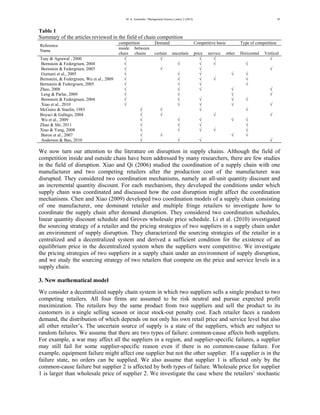
For ease of reference, we shall provide a summary of the articles reviewed in the field of the chain 
competition in Table 1.
M. A. Azarmehr / Management Science Letters 2 (2012) 
45 
Table 1 
Summary of the articles reviewed in the field of chain competition 
Reference 
Name 
competition Demand Competitive basis Type of competition 
inside 
chain 
between 
chains certain uncertain price service other Horizontal Vertical 
Tsay & Agrawal , 2000 √ √ √ √ √ 
Bernstein & Federgruen, 2004 √ √ √ √ √ 
Bernstein & Federgruen, 2003 √ √ √ √ 
Gurnani et al., 2005 √ √ √ √ √ 
Bernstein, & Federgruen, Wu et al., 2009 √ √ √ √ √ 
Bernstein & Federgruen, 2005 √ √ √ √ 
Zhao, 2008 √ √ √ √ √ 
Leng & Parlar, 2009 √ √ √ √ 
Bernstein & Federgruen, 2004 √ √ √ √ √ 
Xiao et al., 2010 √ √ √ √ √ 
McGuire & Staelin, 1983 √ √ √ √ 
Boyaci & Gallego, 2004 √ √ √ √ 
Wu et al., 2009 √ √ √ √ √ 
Zhao & Shi, 2011 √ √ √ √ 
Xiao & Yang, 2008 √ √ √ √ √ 
Baron et al., 2007 √ √ √ √ 
Anderson & Bao, 2010 √ √ √ √ 
We now turn our attention to the literature on disruption in supply chains. Although the field of 
competition inside and outside chain have been addressed by many researchers, there are few studies 
in the field of disruption. Xiao and Qi (2006) studied the coordination of a supply chain with one 
manufacturer and two competing retailers after the production cost of the manufacturer was 
disrupted. They considered two coordination mechanisms, namely an all-unit quantity discount and 
an incremental quantity discount. For each mechanism, they developed the conditions under which 
supply chain was coordinated and discussed how the cost disruption might affect the coordination 
mechanisms. Chen and Xiao (2009) developed two coordination models of a supply chain consisting 
of one manufacturer, one dominant retailer and multiple fringe retailers to investigate how to 
coordinate the supply chain after demand disruption. They considered two coordination schedules, 
linear quantity discount schedule and Groves wholesale price schedule. Li et al. (2010) investigated 
the sourcing strategy of a retailer and the pricing strategies of two suppliers in a supply chain under 
an environment of supply disruption. They characterized the sourcing strategies of the retailer in a 
centralized and a decentralized system and derived a sufficient condition for the existence of an 
equilibrium price in the decentralized system when the suppliers were competitive. We investigate 
the pricing strategies of two suppliers in a supply chain under an environment of supply disruption, 
and we study the sourcing strategy of two retailers that compete on the price and service levels in a 
supply chain. 
3. New mathematical model 
We consider a decentralized supply chain system in which two suppliers sells a single product to two 
competing retailers. All four firms are assumed to be risk neutral and pursue expected profit 
maximization. The retailers buy the same product from two suppliers and sell the product to its 
customers in a single selling season or incur stock-out penalty cost. Each retailer faces a random 
demand, the distribution of which depends on not only his own retail price and service level but also 
all other retailer’s. The uncertain source of supply is a state of the suppliers, which are subject to 
random failures. We assume that there are two types of failure: common-cause affects both suppliers. 
For example, a war may affect all the suppliers in a region, and supplier-specific failures, a supplier 
may still fail for some supplier-specific reason even if there is no common-cause failure. For 
example, equipment failure might affect one supplier but not the other supplier. If a supplier is in the 
failure state, no orders can be supplied. We also assume that supplier 1 is affected only by the 
common-cause failure but supplier 2 is affected by both types of failure. Wholesale price for supplier 
1 is larger than wholesale price of supplier 2. We investigate the case where the retailers’ stochastic
46 
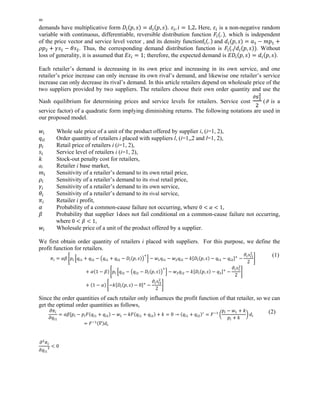
demands have multiplicative form ܦ௜ሺ݌, ݏሻ ൌ ݀௜ሺ݌, ݏሻ. ߝ௜, ݅ ൌ 1,2. Here, ߝ௜ is a non-negative random 
variable with continuous, differentiable, reversible distribution function ܨ௜ሺ. ሻ, which is independent 
of the price vector and service level vector , and its density functionf୧ሺ. ሻ and ݀௜ሺ݌, ݏሻ ൌ ܽଵ െ ݉݌ଵ ൅ 
ߩ݌ଶ ൅ ߛݏଵ െ ߠݏଶ. Thus, the corresponding demand distribution function is ܨ௜ሺ./݀௜ሺ݌, ݏሻሻ. Without 
loss of generality, it is assumed that ܧߝ௜ ൌ 1; therefore, the expected demand is ܧܦ௜ሺ݌, ݏሻ ൌ ݀௜ሺ݌, ݏሻ. 
Each retailer’s demand is decreasing in its own price and increasing in its own service, and one 
retailer’s price increase can only increase its own rival’s demand, and likewise one retailer’s service 
increase can only decrease its rival’s demand. In this article retailers depend on wholesale price of the 
two suppliers provided by two suppliers. The retailers choose their own order quantity and use the 
Nash equilibrium for determining prices and service levels for retailers. Service cost 
ߴୱభమ 
ଶ (Ԃ is a 
service factor) of a quadratic form implying diminishing returns. The following notations are used in 
our proposed model. 
ݓ௜ Whole sale price of a unit of the product offered by supplier i, (i=1, 2), 
ݍ௜௟ Order quantity of retailers i placed with suppliers l, (i=1,,2 and l=1, 2), 
݌௜ Retail price of retailers i (i=1, 2), 
ݏ௜ Service level of retailers i (i=1, 2), 
݇ Stock-out penalty cost for retailers, 
ai Retailer i base market, 
݉௜ Sensitivity of a retailer’s demand to its own retail price, 
ߩ௜ Sensitivity of a retailer’s demand to its rival retail price, 
ߛ௜ Sensitivity of a retailer’s demand to its own service, 
ߠ௜ Sensitivity of a retailer’s demand to its rival service, 
ߨ௜ Retailer i profit, 
ߙ Probability of a common-cause failure not occurring, where 0 ൏ ߙ ൏ 1, 
ߚ Probability that supplier 1does not fail conditional on a common-cause failure not occurring, 
where 0 ൏ ߚ ൏ 1, 
ݓ௜ Wholesale price of a unit of the product offered by a supplier. 
We first obtain order quantity of retailers i placed with suppliers. For this purpose, we define the 
profit function for retailers. 
ߨ௜ ൌ ߙߚ ቈ݌௜ 
ቂݍ௜ଵ ൅ ݍ௜ଶ െ ൫ݍ௜ଵ ൅ ݍ௜ଶ െ ܦ௜ሺ݌, ݏሻ൯ାቃ െ ݓଵݍ௜ଵ െ ݓଶݍ௜ଶ െ ݇ሾܦ௜ሺ݌, ݏሻ െ ݍ௜ଵ െ ݍ௜ଶሿା െ 
ଶ 
2 
ߴ௜ݏ௜ଵ 
቉ 
൅ ߙሺ1 െ ߚሻ ቈ݌௜ ቂݍ௜ଶ െ ൫ݍ௜ଶ െ ܦ௜ሺ݌, ݏሻ൯ାቃ െ ݓଶݍ௜ଶ െ ݇ሾܦ௜ሺ݌, ݏሻ െ ݍଶሿା െ 
ଶ 
2 
ߴ௜ݏଵ 
቉ 
൅ ሺ1 െ ߙሻ ቈെ݇ሾܦ௜ሺ݌, ݏሻ െ 0ሿା െ 
ଶ 
2 
ߴ௜ݏ௜ଵ 
቉ 
(1) 
Since the order quantities of each retailer only influences the profit function of that retailer, so we can 
get the optimal order quantities as follows, 
߲ߨ௜ 
߲ݍ௜ଵ 
ൌ ߙߚሾ݌௜ 
െ ݌௜ܨሺݍ௜ଵ ൅ ݍ௜ଶሻ െ ݓଵ െ ݇ܨሺݍ௜ଵ ൅ ݍ௜ଶሻ ൅ ݇ ൌ 0 ՜ ሺݍ௜ଵ ൅ ݍ௜ଶሻכ ൌ ܨିଵ ൬ 
݌௜ െ ݓଵ ൅ ݇ 
݌௜ ൅ ݇ 
൰ ݀௜ 
ൌ ܨିଵሺߘሻ݀௜ 
(2) 
߲ଶߨ௜ 
߲ݍ௜ଵ 
ଶ ൏ 0
M. A. Azarmehr / Management Science Letters 2 (2012) 
47 
߲ߨ௜ 
߲ݍ௜ଶ 
ൌ ߙߚሾ݌௜ െ ݓଵ െ ݌௜ܨሺݍ௜ଵ ൅ ݍ௜ଶሻ െ ݇ܨሺݍ௜ଵ ൅ ݍ௜ଶሻ ൅ ݇ሿ ൅ ߙሺ1 െ ߚሻሾ݌௜ െ ݓଶ െ ݌௜ܨሺݍ௜ଶሻ െ ݇ܨሺݍ௜ଶሻ ൅ ݇ሿ 
൅ ሺ1 െ ߙሻሾ0ሿ ൌ 0 ՜ ݍଶכ 
ൌ ܨିଵ ൬ 
ߙሺ݌ଵ െ ݓଶ ൅ ݇ሻ െ ߙߚሺ݌ଵ െ ݓଵ ൅ ݇ሻ 
ߙሺ1 െ ߚሻሺ݌ଵ ൅ ݇ሻ 
൰ ݀௜ ൌ ܨିଵሺΔሻ݀௜ 
(3) 
߲ଶߨ௜ 
߲ݍ௜ଶ 
ଶ ൏ 0 
Thus, ߨ௜ is strictly concave in ݍଶכ 
and ሺݍ௜ଵ ൅ ݍ௜ଶሻכ. Then, replacing the optimal order quantities into 
Eq. (1) yields the following, 
ߨ௥ሺ݌, ݏሻ ൌ ߙߚ ቈሺ݌ଵ ൅ ݇ሻ ቈܨିଵሺߘሻ݀௜ െ න ܨ ൬ 
ݐ 
݀௜ 
൰ 
ிషభሺఇሻௗ೔ 
଴ 
቉ െ ݇݀௜ െ ݓଵሺܨିଵሺߘሻെܨିଵሺΔሻሻ݀௜ െ ݓଶܨିଵሺΔሻ݀௜ െ 
ଶ 
2 
ߴݏଵ 
቉ 
൅ ߙሺ1 െ ߚሻ ቈሺ݌ଵ ൅ ݇ሻ ቈܨିଵሺΔሻ݀௜ െ න ܨ ൬ 
ݐ 
݀௜ 
൰ 
ிషభሺΔሻௗ೔ 
଴ 
቉ െ ݇݀௜ െ ݓଶܨିଵሺΔሻ݀௜ െ 
ଶ 
2 
ߴݏଵ 
቉ ൅ ሺ1 െ ߙሻ 
ൌ ቈߙߚሺ݌ଵ ൅ ݇ሻ න ݐ݂ ൬ 
ݐ 
݀௜ 
൰ 
ிషభሺఇሻ 
଴ 
൅ ߙሺ1 െ ߚሻሺ݌ଵ ൅ ݇ሻ න ݐ݂ ൬ 
ݐ 
݀௜ 
൰ 
ிషభሺΔሻ 
଴ 
െ ݇቉ ݀௜ െ 
ଶ 
2 
ߴݏଵ 
ൌ ܳሺ݌௜ሻ݀௜ሺ݌௜, ݏሻ െ 
ଶ 
2 
ߴݏ௜ 
(4) 
In this paper, we assume that all retailers simultaneously determine their private retail prices and 
service levels. We first get the equilibrium service level based on equilibrium price, and then 
determine equilibrium price. The equilibrium service level based on the Nash equilibrium is equal 
with the following formula, 
߲ߨ௥ 
ൌ ߛܳሺ݌௜ሻ െ ՜ ߲ݏ௜ 
ߴݏଵ ݏ௜ 
כ ൌ 
ߛܳሺ݌௜ሻ 
ߴ (5) 
߲ଶߨ௥ 
߲ݏ௜ 
ଶ ൌ െߴ 
It implies that profit function is strictly concave for any given retail price vector p and all other 
retailers’ service level. Therefore, we have a unique equilibrium service level. After obtaining the 
equilibrium of service level the retailer i expected demand function can be reduced as: 
݀௜ሺ݌௜ሻ ൌ ܽ௜ െ ݉௜݌௜ ൅ ߩ௜݌௝ ൅ 
ߛ௜ 
ଶܳሺ݌௜ሻ 
ߴ௜ 
െ ߠ௜ 
ߛ௜ܳ൫݌௝൯ 
ߴ௜ 
(6) 
and, we can replace the profit function as: 
ߨ௜ሺ݌ሻ ൌ ܳሺ݌௜ሻ݀௜ሺ݌ሻ െ 
ߛଶܳଶሺ݌௜ሻ 
2 ߴ (7) 
To obtain the equilibrium price and service level, we must first solve the below system based on the 
Nash equilibrium. 
߲ߨଵ௥ 
߲݌ଵ 
ൌ 0 
߲ߨଶ௥ 
߲݌ଶ 
ൌ 0 
ప 
݌Then based on Eq. (6), the equilibrium level of service is obtained. 
However, because of the difficulty of solving the exact value of the derivative to obtain the 
equilibrium wholesale price and then to examine the price equilibrium behavior between retailers, we 
need the following assumptions. 
Assumption 1: For all i =1, 2, ..., N, the retail price ݌௜ is defined on ሾݓ௜ െ ݇,ഥ], where ݌ഥప is the 
maximum price such ݀௜ሺ݌ሻ|௣೔ୀത௣തതഢ ൌ 0
48 
Assumption 2: డௗ೔ሺ௣೔ሻ 
డ௣೔ 
൑ 0, డௗ೔ሺ௣೔ሻ 
డ௣ೕ 
൒ 0, ݅ ് ݆ 
Consequently, the following theorems are based on the above assumptions. 
Proposition 1: There is the unique Nash equilibrium strategy of the game for the retail price. 
Proof: From Eq. (7), first we take the derivative of the function of the wholesale price, based on the 
Nash equilibrium. 
߲ߨ௜ 
߲݌௜ 
ൌ ߙߚ 
ۏێێێێۍ 
ቂܨିଵሺߘሻ݀௜ െ ൫ܨିଵሺߘሻ݀௜ െ ܦሺ݌, ݏሻ൯ାቃ ൅ ሺ݌ଵ ൅ ݇ሻ 
כ 
ۏێێێێۍ 
െ݉ܨିଵሺߘሻ ൅ 
1 
߲ܨ൫ܨିଵሺߘሻ൯ 
߲݌ଵ 
݀௜ െ 
ۏێێێۍ 
ܨ൫ܨିଵሺߘሻ൯ כ 
ۏێێۍ 
1 
߲ܨ൫ܨିଵሺߘሻ൯ 
߲݌ଵ 
ےۑۑې 
כ ݀௜ െ ݉ܨିଵሺߘሻ 
ےۑۑۑې 
ےۑۑۑۑې 
൅ ݉݇ 
െ ݓଵሺ 
1 
ܨ′൫ܨିଵሺߘሻ൯ 
െ 
1 
ሻ݀௜ ൅ ݓଵ൫ܨିଵሺߘሻ െ ܨିଵሺΔሻ൯݉ ൅ ݉ݓଶܨିଵሺΔሻ െ ݓଶ݀௜ 
ܨ′൫ܨିଵሺΔሻ൯ 
ےۑۑۑۑې 
1 
߲݌ଵ ߲ܨ൫ܨିଵሺΔሻ൯ 
൅ ߙሺ1 െ ߚሻ 
ۏێێێێۍ 
ቂܨିଵሺΔሻ݀௜ െ ൫ܨିଵሺΔሻ݀௜ െ ܦሺ݌, ݏሻ൯ାቃ ൅ ሺ݌ଵ ൅ ݇ሻ 
כ 
ۏێێێێۍ 
െ݉ܨିଵሺΔሻ ൅ 
1 
߲ܨ൫ܨିଵሺΔሻ൯ 
߲݌ଵ 
݀௜ െ 
ۏێێێۍ 
ܨ൫ܨିଵሺΔሻ൯ כ 
ۏێێۍ 
1 
߲ܨ൫ܨିଵሺΔሻ൯ 
߲݌ଵ 
ےۑۑې 
כ ݀௜ െ ݉ܨିଵሺΔሻ 
ےۑۑۑۑې 
ےۑۑۑې 
൅ ݉݇ 
൅ ݉ݓଶܨିଵሺΔሻ െ ݓଶ݀௜ 
ےۑۑۑۑې 
1 
߲݌ଵ ߲ܨ൫ܨିଵሺΔሻ൯ 
൅ ሺ1 െ ߙሻሾ݉݇ሿ 
Based on Assumption 1, we have: 
min ݌௜ ൌ ݓଵ െ ݇ 
݈݅݉ 
௣՜௪భି௞ &௣ୀ௪మି௞ 
߲ߨ௥ 
߲݌ଵ 
ൌ ߙߚ 
ۏێێۍ 
ሺ݌ଵ ൅ ݇ െ ݓଶሻ 
ۏێێۍ 
1 
߲ܨ൫ܨିଵሺ0ሻ൯ 
߲݌ଵ 
݀௜ 
ےۑۑې 
൅ ݉݇ 
ےۑۑې 
൅ ߙሺ1 െ ߚሻ 
ۏێێۍ 
ሺ݌ଵ ൅ ݇ െ ݓଶሻ כ 
ۏێێۍ 
1 
߲ܨ൫ܨିଵሺ0ሻ൯ 
߲݌ଵ 
݀௜ 
ےۑۑې 
൅ ݉݇ 
ےۑۑې 
൅ ሺ1 െ ߙሻሾ݉݇ሿ ൌ ߙ 
ۏێێۍ 
ሺ݌ଵ ൅ ݇ െ ݓଶሻ כ 
ۏێێۍ 
1 
߲ܨ൫ܨିଵሺ0ሻ൯ 
߲݌ଵ 
݀௜ 
ےۑۑې 
൅ ݉݇ 
ےۑۑې 
൅ ሺ1 െ ߙሻሾ݉݇ሿ ൌ ݉݇ ൒ 0 
݉ܽݔ ݀݅ሺ݌തሻ ൌ 0
M. A. Azarmehr / Management Science Letters 2 (2012) 
49 
߲ߨ௥ 
߲݌௜ 
ൌ ܳ′ 
௜ሺ݌ሻ݀௜ሺ݌, ݏሻ െ ݉ܳ௜ 
ሺ݌ሻ, ݈݅݉ 
௣՜௣ҧ 
߲ߨ௥ 
߲݌௜ 
ൌ െ݉ܳሺ݌ሻ ൑ 0 
Since డగೝ 
డ௣೔ 
is continuous and based on the above relationships, there is a retail equilibrium price that is 
డగೝ 
డ௣೔ 
ൌ 0. After a supply disruption has occurred, in different conditions, the optimal strategy of the 
decentralized supply chain is as follows. 
1-If ߙ൫݌1 െ ݓ2൯ ൅ ߙ݇ െ ߙߚ൫݇ ൅ ݌1൯ ൬݌1െݓ2൅݇ 
݇൅݌1 
൰ െ ߙሺ1 െ ߚሻ൫݇ ൅ ݌1൯ܨ൫ݍ2൯ ൅ ݇ ൑ و 0 ߙߚሾ݌1 െ ݌1ܨ൫ݍ1 ൅ ݍ2൯ െ 
ݓ1 െ ݇ܨ൫ݍ1 ൅ ݍ2൯ ൅ ݇ ൑ 0 both supplier 1 and supplier 2 are placed with zero order quantity and 
retailers pay penalty cost. 
2-If ߙ൫݌1 െ ݓ2൯ ൅ ߙ݇ െ ߙߚ൫݇ ൅ ݌1൯ ൬݌1െݓ2൅݇ 
݇൅݌1 
൰ െ ߙሺ1 െ ߚሻ൫݇ ൅ ݌1൯ܨ൫ݍ2൯ ൅ ݇ ൒ و 0 ߙߚሾ݌1 െ ݌1ܨ൫ݍ1 ൅ ݍ2൯ െ 
ݓ1 െ ݇ܨ൫ݍ1 ൅ ݍ2൯ ൅ ݇ ൑ 0 , the total optimal quantity order from retailer 1 is equal the optimal quantity 
ordered from supplier 2. 
3- If ݓଶ ൑ ݓଵ and ߙ൫݌1 െ ݓ2൯ ൅ ߙ݇ െ ߙߚ൫݇ ൅ ݌1൯ ൬݌1െݓ2൅݇ 
݇൅݌1 
൰ െ ߙሺ1 െ ߚሻ൫݇ ൅ ݌1൯ܨ൫ݍ2൯ ൅ ݇ ൒ 0 the optimal 
2 
quantity ordered Ԃfrom supplier 1 is zero and the total optimal quantity order from retailer 1 is equal 
the optimal quantity ordered from supplier 2. 
4- If ܽ1 ൌ ܽ2, ݉1 ൌ ݉2, ߛൌ ߛ, ߴ1 2 1 ൌ ߴ2, ߠ1 ൌ ߠ2, ߩൌ ߩ, retailers have the same price and service level. 
1 25- If ܽଵ ് ܽଶ, ݉ଵ ൌ ݉ଶ, ߛଵ ൌ ߛଶ , ߴଵ ൌ ߴଶ, ߠଵ ൌ ߠଶ, ߩଵ ൌ ߩଶ, each of the retailers that have a greater base 
market, that retailer has a greater price and service levels. 
4. Computational analysis 
In this section, we present numerical examples to illustrate the theoretical results and analyze the 
changes of variables in different scenarios. We study example created by all possible combinations of 
the following parameters: α=0.8, β=0.7, k=3, w1=7, w2=8, a1=a2=30, m1=m2=0.7, γ1=γ2=0.4, Ԃ1= =4, 
θ1=θ2=0.4 and ρ1=ρ2=0.6. First, we determine the optimum amount of order quantity, but to avoid the 
complicated formulas and solve them, we approximate the exact equation with the following linear 
equation by using linear regression method: 
ݍ௜ଶ ൌ ሺ0.806 ൅ 0.0035݌௜ሻ݀௜ 
ݍ௜ଵ ൌ ሺ0.326 െ 0.0009݌௜ሻ݀௜ 
Accordingly, the amount of profit for retailers based on the following formula will be as follows, 
ߨ௥ሺ݌ሻ ൌ ܳሺ݌௜ሻ݀௜ሺ݌ሻ െ 
ߛ௜ 
ଶܳଶሺ݌௜ሻ 
2 ߴ௜ 
߲ߨ௥ଵ 
߲݌ଵ 
ൌ ܳ′ሺ݌ଵሻ݀௜ሺ݌ଵሻ െ ݉ଵܳሺ݌ଵሻ 
߲ߨ௥ଶ 
߲݌ଶ 
ൌ ܳ′ሺ݌ଶሻ݀௜ሺ݌ଶሻ െ ݉ଶܳሺ݌ଶሻ 
݀௜ሺ݌௜ሻ ൌܽ௜ 
െ ݉௜݌௜ ൅ ߩ௜݌௝ ൅ 
ߛ௜ 
ଶܳሺ݌௜ሻ 
ߴ௜ 
െ ߠ௜ 
ߛ௜ܳ൫݌௝൯ 
ߴ௜
50 
ிషభሺఇሻ 
ܳሺ݌௜ሻ ൌ ߙߚሺ݌௜ ൅ ݇ሻ ቈන ݐ݂ሺݐሻ 
଴ 
ிషభሺΔሻ 
቉ ൅ ߙሺ1 െ ߚሻሺ݌௜ ൅ ݇ሻ ቈන ݐ݂ሺݐሻ 
଴ 
቉ െ ݇ 
ிషభሺఇሻ 
ܳ′ሺ݌௜ሻ ൌ ߙߚ ቈන ݐ݂ሺݐሻ 
଴ 
ிషభሺΔሻ 
൅ ሺ1 െ ߘሻܨିଵሺߘሻ቉ ൅ ߙሺ1 െ ߚሻ ቈන ݐ݂ሺݐሻ 
଴ 
൅ ሺ1 െ ΔሻܨିଵሺΔሻ቉ 
0 ൑ ݀௜ሺ݌௜ሻ ൑ ܽ 
ߨ௜ ൌ 0.56 ቈ݌௜ 
ቂ1.1320 ൅ 0.0026݌௜ െ ൫1.1320 ൅ 0.0026݌௜ െ ܦ௜ሺ݌, ݏሻ൯ାቃ െ ݓଵሺ0.326 െ 0.0009݌௜ሻ െ ݓଶሺ0.8060 
൅ 0.0035݌௜ሻ െ 3ሾܦ௜ሺ݌, ݏሻ െ 1.1320 െ 0.0026݌ሿା െ 
ଶ 
2 
ߴݏଵ 
൨ 
൅ 0.24 ቈ݌ଵ ቂ0.8060 ൅ 0.0035݌௜ െ ൫0.8060 ൅ 0.0035݌௜ െ ܦ௜ሺ݌, ݏሻ൯ାቃ െ 8ሺ0.8060 ൅ 0.0035݌௜ሻ 
െ 3ሾܦሺ݌, ݏሻ െ 0.8060 െ 0.0035݌௜ሿା െ 
ଶ 
2 
ߴݏଵ 
൨ ൅ 0.2 ቈെ3ሾܦ௜ሺ݌, ݏሻ െ 0ሿା െ 
ଶ 
2 
ߴݏଵ 
቉ 
After the profit function, we determine the equilibrium price and level of service. Thus, first to obtain 
the equilibrium retail prices, base on the Nash equilibrium, we derive the profit function with respect 
to retail price: 
߲ߨ௥ଵ 
ൌ ܳ′ሺ݌ଵሻ݀௜ሺ݌ଵሻ െ ݉ܳሺ݌ଵሻ 
߲݌ଵ 
ܳሺ݌௜ሻ ൌ 0.56ሺ݌௜ ൅ 3ሻ ቈ 
1 
√2ߨ 
න ݐ݁ିଵଶ 
௧మ 
ሺଵ.ଵଷଶ଴ା଴.଴଴ଶ଺௣೔ሻ 
଴ 
1 
√2ߨ 
቉ ൅ 0.24ሺ݌௜ ൅ 3ሻ ቈ 
න ݐ݁ିଵଶ 
௧మ 
ሺ଴.଼଴଺଴ା଴.଴଴ଷହ௣೔ሻ 
଴ 
቉ െ 3 
ൌ 
1 
√2ߨ 
ቈ0.56ሺ݌௜ ൅ 3ሻ ൤1 െ ݁ିଵଶ 
ሺሺଵ.ଵଷଶ଴ା଴.଴଴ଶ଺௣೔ሻమ൨ ൅ 0.24ሺ݌௜ ൅ 3ሻ ൤1 െ ݁ିଵଶ 
ሺ଴.଼଴଺଴ା଴.଴଴ଷହ௣೔ሻమ ൨቉ െ 3 
ܳ′ሺ݌௜ሻ ൌ 0.56 ቈ 
1 
√2ߨ 
න ݐ݁ିଵଶ 
௧మ ൅ ൬1 െ 
݌௜ െ 4 
݌௜ ൅ 3 
൰ כ ሺሺ1.1320 ൅ 0.0026݌௜ሻ 
ሺሺଵ.ଵଷଶ଴ା଴.଴଴ଶ଺௣೔ሻ 
଴ 
቉ 
1 
√2ߨ 
൅ 0.24 ቈ 
න ݐ݁ିଵଶ 
௧మ 
ሺ଴଼଴଺଴ା଴.଴଴ଷହ௣೔ሻ 
଴ 
൅ ሺ1 െ 
0.8ሺ݌௜ െ 5ሻ െ 0.56ሺ݌௜ െ 4ሻ 
0.24ሺ݌௜ ൅ 3ሻ 
ሻሺ0.8060 ൅ 0.0035݌௜ሻ ቉ 
߲ߨ௥௜ 
߲݌௜ 
ൌ ቎0.56 ቈ 
1 
√2ߨ 
න ݐ݁ିଵଶ 
௧మ ൅ ൬1 െ 
݌௜ െ 4 
݌௜ ൅ 3 
൰ כ ሺሺ1.1320 ൅ 0.0026݌௜ሻ 
ሺሺଵ.ଵଷଶ଴ା଴.଴଴ଶ଺௣೔ሻ 
଴ 
቉ 
1 
√2ߨ 
൅ 0.24 ቈ 
න ݐ݁ିଵଶ 
௧మ 
ሺ଴଼଴଺଴ା଴.଴଴ଷହ௣೔ሻ 
଴ 
൅ ቆ1 െ 
0.8ሺ݌௜ െ 5ሻ െ 0.56ሺ݌௜ െ 4ሻ 
0.24ሺ݌௜ ൅ 3ሻ ቇ ሺ0.8060 ൅ 0.0035݌௜ሻ ቉൩ ݀௜ሺ݌ଵሻ 
1 
√2ߨ 
െ ݉௜ ቈ0.56ሺ݌௜ ൅ 3ሻ ቈ 
න ݐ݁ିଵଶ 
௧మ 
ሺଵ.ଵଷଶ଴ା଴.଴଴ଶ଺௣೔ሻ 
଴ 
1 
√2ߨ 
቉ ൅ 0.24ሺ݌௜ ൅ 3ሻ ቈ 
න ݐ݁ିଵଶ 
௧మ 
ሺ଴.଼଴଺଴ା଴.଴଴ଷହ௣೔ሻ 
଴ 
቉ 
െ 3 ൌ 
1 
√2ߨ 
ቈ0.56ሺ݌௜ ൅ 3ሻ ൤1 െ ݁ିଵଶ 
ሺሺଵ.ଵଷଶ଴ା଴.଴଴ଶ଺௣೔ሻమ൨ ൅ 0.24ሺ݌௜ ൅ 3ሻ ൤1 െ ݁ିଵଶ 
ሺ଴.଼଴଺଴ା଴.଴଴ଷହ௣೔ሻమ ൨቉ െ 3቉ 
To obtain the optimum price and service level, we must first solve the below system based on game 
theory to help get the optimum amount of the price:
߲ 
߲ 
߲ 
߲ 
ߨଵ௥ 
߲݌ଵ 
Tg 
A 
S 
A ar 
bpr 
e 
TCl 
e 
m000000 
F 
Tp 
wi 
m 
ൌ 0, 
ߨଶ௥ 
߲݌ଶ 
ൌ 0. 
To obtain the 
ame theory t 
e equilibrium 
to help get th 
M. A. Azarmehr / Mana 
m price and 
he equilibriu 
and P2=68 
ݏ௜ 
P1=68.73 
According to 
1=0.9165 and 
As shown in 
re equal to a 
oth will be 
rice and ser 
etailer’s dem 
Table 2 
Computational 
evels 
a1=a2=30, γ1 
m1=m2 p1 
.2 Int 
.3 Int 
.4 239 
.5 126 
.6 88.3 
.7 68.7 
Fig. 1. Impac 
Table 2 show 
rice on price 
when retail p 
mpact of bas 
agement Science Letters 
service leve 
um amount o 
8.7 
, the service 
כ ൌ ఊொሺ௣೔ሻ 
ణଵ 
d S2=0.9165 
the sensitiv 
all variables 
equal. We a 
rvice levels 
mand to its ow 
el, we must 
of the price: 
e level retaile 
vity analysis 
s of demand 
analyze the 
of a retailer 
wn retail pri 
l result the im 
1= γ2=0.4, Ԃ1= 
p2 
int 
int 
9.5 239.5 
6.6 126.6 
35 88.35 
73 68.73 
2 (2012) 
first solve th 
ers are as fol 
in the prev 
d function fo 
above case 
r. In the firs 
ice on price a 
mpact of sens 
= Ԃ2=4, θ1= θ2 
s1 
int 
int 
5.69244 
2.27868 
1.34265 
0.916508 
ct of sensitiv 
ws an increa 
e and service 
price is less t 
se market on 
llows: 
vious chapter 
or other reta 
by changing 
st phase, we 
and service l 
sitivity of reta 
2=0.4, ρ1= ρ2= 
vity of their d 
se of the sen 
e levels. If w 
than w1-k, th 
n price and se 
he below sy 
r, when all v 
ailer, the reta 
g the variab 
e examine t 
levels: 
ailer’s deman 
=0.6 
s2 
int 
int 
5.69244 
2.27868 
1.34265 
0.916508 
demand retai 
nsitivity of 
we look caref 
he service le 
ervice levels 
m1=m2 
0.8 
0.9 
1 
2 
4 
20 
ystem based 
variables of 
ailer's price 
bles and sho 
the impact o 
nd to its own 
iler to its ow 
their retailer 
fully into fig 
evel is negati 
s: 
f demand fun 
and service 
ow the chang 
of sensitivity 
retail price o 
p1 p2 
56.69 56 
48.49 48 
42.55 42 
20.3 20 
10.88 10 
3.474 3. 
n price and s 
2 s1 
6.69 0.674 
8.49 0.517 
2.55 0.408 
0.3 0.034 
0.88 -0.10 
474 -0.21 
wn retail pric 
r’s demand 
gures of Tab 
ive. In the s 
ce on price an 
with respect 
ble 1 and Fig 
econd phase 
s2 
4248 0.674 
7856 0.517 
8982 0.408 
4639 0.034 
775 -0.10 
294 -0.21 
nd service le 
t to its own 
g. 1, it is clea 
e, we examin 
51 
on 
nction 
level 
ges in 
y of a 
service 
4248 
7856 
8982 
4639 
0775 
1294 
evels 
retail 
ar that 
ne the
52 
2 
Table 3 
Computation 
m1=m2=0.7, 
1=a2 p1 
TC 
a 
1 
2 
5 
10 
20 
Tr 
e 
se 
T 
C 
F 
Tf 
o 
it 
ch 
al result the 
γ1= γ2=0.4, Ԃ 
15.4 
18.6 
26.2 
0 36.5 
0 53.5 
Table 3 show 
etail price is 
ensitivity of 
Table 4 
Computation 
m1 p 
0.2 in 
0.3 in 
0.4 131 
0.5 99 
0.6 80 
0.7 68 
Fig. 3. Impac 
Table 4 show 
or both the r 
ts coefficient 
hanges in th 
p2 
47 15.47 
64 18.64 
29 26.29 
5 36.5 
55 53.55 
Fi 
impact of ba 
1= Ԃ2=4, θ1= 
ws an increas 
less than w1 
f retailer 1 de 
al result the 
m2=0 
p1 p2 
nt int 
nt int 
1.61 97.2 
9.65 82.9 
0.96 74.3 
8.73 68.7 
ct of the sen 
ws when only 
retailer decre 
t are is reduc 
he probability 
ase market o 
θ2=0.4, ρ1= ρ2 
s1 
-0.03957 
0.0088 
0.13 
0.3019 
0.6135 
g. 2. Impact 
se on the ba 
1-k, the servi 
emand to its 
impact of se 
0.7, a1= a2=30 
s1 
int 
int 
2 2.411 
9 1.6 
7 1.17 
3 0.91650 
sitivity of re 
y a retailer’s 
eases. Howev 
ced more tha 
y of the disru 
s2 
on price and 
2=0.6 
7 -0.03957 
0.0088 
0.13 
0.3019 
0.6135 
of base mar 
ase market, p 
ice level is n 
own retail p 
ensitivity of 
0, γ1= γ2=0.4, 
s2 
int 
int 
1 1.547 
1.22 
1.03 
08 0.9165 
etailer 1 dem 
s demand to 
ver, as the re 
an the arriva 
uption. 
a1=a2 
7 30 
40 
70 
120 
- 
service leve 
p1 p 
68.73 
83.02 
123.47 
188.07 
- 
rket on price 
price and ser 
negative. In t 
price on price 
els 
p2 s1 
68.73 0 
83.02 1 
123.47 2 
188.07 4 
- - 
e and service 
rvice levels 
the third pha 
e and servic 
retailer 1 de 
Ԃ1= Ԃ2=4, θ1= 
m1 
0.8 
0.9 
7 12 
4 
08 20 
1 s2 
.9165 0.9 
.2233 1.2 
.1971 2.1 
.035 4.0 
e levels 
reduced. It i 
ase, we exam 
e levels: 
emand to its 
= θ2=0.4, ρ1= 
mand to its ow 
its own reta 
etail price an 
al retailer. In 
p1 
60 
53.47 
48.35 
26.12 
14.815 
4.6 
own retail p 
ρ2=0.6 
wn retail pric 
ail price chan 
nd service le 
n the final ph 
p2 
64.65 
61.6 
59.15 
48.38 
42.71 
37.45 
ce on price a 
nges, price a 
evels for that 
hase, we exam 
- 
9165 
2233 
1971 
035 
is clear that 
mine the imp 
price 
when 
pact of 
s1 
0.74 0 
0.612 0 
0.515 0 
0.127 0 
-0.05 0 
-0.19 0 
s2 
0.832 
0.77 
0.722 
0.515 
0.412 
0.318 
and service l 
and service 
t retailer inc 
mine the eff 
levels 
levels 
rease, 
fect of
Table T 
5 
Computation 
evels 
m1= m2=0.7, 
C le 
5 
In 
su 
df 
a 
tw 
og 
mod th 
lo 
R 
A 
B 
B 
B 
α 
0.1 
0.3 
0.5 
0.7 
0.8 
0.95 
al result the 
a1= a2=30, γ1 
Fig. 4 
. Conclusio 
n this paper, 
upply chain 
disruption. W 
aced their in 
wo-stage ope 
f the chain h 
ame theory, 
might prefer 
ut penalty c 
decades, and 
he chain, fo 
ocating risk 
References 
Anderson, E. 
European 
Bernstein, F., 
with comp 
Bernstein, F. 
service com 
Bernstein, F. 
demand un 
M. A. Azarmehr / Mana 
impact of ch 
= γ2=0.4, Ԃ1= 
ρ2=0.6, β=0.7 
ρ1= ρ 
p1 
142.51 
87.22 
75.4 
70.32 
68.73 
66.98 
. Impact of c 
ns and furth 
, we have co 
. In this sup 
We have inve 
ndividual sto 
eration of th 
have followe 
a model ha 
to supply hi 
cost but not t 
according to 
r future stud 
s in chain fo 
J., & Bao, Y 
Journal of O 
, & Federgru 
peting retaile 
and Federgr 
mpetition. M 
, & Federgr 
ncertainty. M 
p2 
142.51 
87.22 
75.4 
70.32 
68.73 
66.98 
agement Science Letters 
hanges in the 
= Ԃ2=4, θ1= θ2 
changes in th 
her researc 
onsidered tw 
pply chain, 
estigated the 
ochastic dem 
he price and 
ed for the ma 
as presented 
is/her own o 
to order from 
o not been c 
dies, researc 
or elements o 
Y. (2010). P 
Operational 
uen, A. (200 
ers. Operatio 
ruen, A. (20 
Manufacturin 
ruen, A. (20 
Management 
s1 
2.7085 
1.317 
1.057 
0.9496 
0.9165 
0.88 
2 (2012) 
e probability 
2=0.4, 
he probabilit 
h 
wo suppliers 
there have 
e sourcing a 
mand markets 
the service. 
aximum prof 
to achieve b 
order quantity 
m suppliers. 
completely i 
chers can ev 
of the supply 
rice competi 
Research, 2 
03) Pricing a 
ons Research 
007) Coordin 
ng Service O 
05) Decentr 
t Science, 51 
s2 
2.7085 
1.317 
1.057 
0.9496 
0.9165 
0.88 
y of the disru 
m1= m2=0.7 
ty of the disr 
and two com 
been two re 
and pricing 
s. Retailers h 
Because th 
fit to themse 
balance. Acc 
y from one s 
. Because ris 
nvestigated 
valuate disru 
y chain. 
ition with in 
200, 227-234 
and replenis 
h, 51(3), 409 
nation mecha 
Operations M 
ralized supp 
(1), 18–29. 
uption on pri 
7, a1= a2=30, γ 
1= θ2=0.4, ρ1= 
Ԃ2=4, θ1 
β p1 
0.1 69.21 
0.3 69.12 
0.5 69 
0.7 68.73 
0.8 68.52 
20 4.6 
ruption on p 
mpeting reta 
etailers unde 
strategies fo 
have compet 
e chain has 
elves; therefo 
cording to v 
supplier or t 
sk managem 
risk in a sup 
uption in pr 
ntegrated and 
4. 
shment strate 
9–426. 
anisms for s 
Management, 
ly chains w 
p2 
69.21 
2 69.12 
69 
68.73 
2 68.52 
37.45 
ice and serv 
γ1= γ2=0.4, Ԃ1 
= ρ2=0.6, β=0.8 
price and serv 
ailers in the d 
er an enviro 
or them. The 
ted with eac 
been decent 
fore, in this s 
various condi 
two supplier 
ment was con 
pply chain fo 
oduction, sa 
d decentraliz 
egies in a di 
supply chain 
, 9(3), 242–2 
ith competin 
s1 
0.712 
0.782 
0.851 
0.916 
0.9476 0 
-0.19 
vice levels 
decentralized 
onment of s 
ese retailers 
ch other thro 
tralized, mem 
study based o 
itions, the re 
rs or to pay s 
nsidered in r 
for all eleme 
ales, network 
zed supply ch 
istribution sy 
ns under pric 
262. 
ng retailers 
53 
ice 
1= 
8 
s2 
0.712 
0.782 
0.851 
0.916 
0.9476 
0.318 
d of a 
supply 
s have 
ough a 
mbers 
on the 
etailer 
stock-recent 
nts of 
k and 
hains. 
ystem 
ce and 
under
54 
Bernstein, F., & Federgruen, A. (2004) Dynamic inventory and pricing models for competing 
retailers. Naval Research Logistics, 51(2), 258-274. 
Boyaci, T., & Gallego, G. (2004) Supply chain coordination in a market with customer service 
competition. Production and Operations Management, 13(1), 3–22. 
Baron, O., Berman, O., & Wu, D. (2007). Bargaining in the supply chain and its implication to 
coordination of supply chains in an industry, Working paper, Joseph L. Rotman School of 
Management, University of Toronto. 
Bernstein, F., & Federgruen, A. (2004) A general equilibrium model for industries with price and 
service competition. Operations Research, 52(6), 868–886. 
Chen, K., & Xiao, T. (2009) Demand disruption and coordination of the supply chain with a 
dominant retailer. European Journal of Operational Research, 197, 225–234. 
Gurnani, H., Erkoc, M., & Luo, Y. (2007) Impact of product pricing and timing of investment 
decisions. European Journal of Operational Research, 180, 228–248. 
McGuire, T.W., & Staelin, R. (1983) An industry equilibrium analysis of downstream vertical 
integration, Marketing Science, 2(2), 161–191. 
Leng, M., & Parlar, M. (2009). Lead-time reduction in a two-level supply chain Non-cooperative 
equilibrium vs. coordination with a profit-sharing contract. International Journal of Production 
Economics, 118, 521–544. 
Latour, A. (2001). A trial by fire: A blaze in Albuquerque sets-off major crisis for cell phone giants 
Nokia handles supply shock with aplomb as Ericsson gets burned. The Wall Street Journal, 
January 29. 
Li, J., Wang, S., & Cheng, T.C.E. (2010). Competition and cooperation in a single-retailer two-supplier 
supply chain with supply disruption. International Journal of Production Economics, 124, 
137–150. 
Wu, D., Baron, O., & Berman, O. (2009). Bargaining in competing supply chains with uncertainty. 
European Journal of Operational Research, 197(2), 548-556. 
Zhao, X., & Shi, C. (2011). Structuring and contracting in competing supply chains. International 
Journal of Production Economics, 134(2), 434-446. 
Stundza, T. (2002). Auto parts makers blame tariffs for high-priced steel. Purchasing, 131(12), 48B1. 
Tsay, A.A., & Agrawal, N. (2000). Channel dynamics under price and service competition. 
Manufacturing Service Operations Management, 2(4), 372–391. 
Xiao, T. and Yang, D. (2008) Price and service competition of supply chains with risk-averse retailers 
under demand uncertainty. International Journal Production Economics, 114, 187–200. 
Xiao, T.J., & Qi, X. (2006). Price competition, cost and demand disruptions and coordination of a 
supply chain with one manufacturer and two competing retailers. Omega, 36, 741–753. 
Xiao, T., Jin, J., Chen, G., Shi, J., & Xie, M. (2010) Ordering, wholesale pricing and lead-time 
decisions in a three-stage supply chain under demand uncertainty. Computers & Industrial 
Engineering, 59(4), 840-852. 
Zhao, X. (2008). Coordinating a supply chain system with retailers under both price and inventory 
competition. Production and Operations Management, 17(5), 532–542.

Decentralized supply chain system

  • 1.
    * Corresponding author.Tel: +98-912-6101812 E-mail addresses: m.a.azarmehr@gmail.com (M. A. Azarmehr) © 2012 Growing Science Ltd. All rights reserved. doi: 10.5267/j.msl.2011.10.004 Management Science Letters 2 (2012) 43–54 Contents lists available at GrowingScience Management Science Letters homepage: www.GrowingScience.com/msl Sourcing and pricing strategies for two retailers in a decentralized supply chain system under supply disruption M.A. Azarmehra*, S. Rezapoura and R. Tavakkoli-Moghaddamb aDepartment of Industrial Engineering, Ouromieh University of Technology, Ouromieh, Iran bDepartment of Industrial Engineering, College of Engineering, University of Tehran, Tehran, Iran A R T I C L E I N F O A B S T R A C T Article history: Received July 20, 2011 Received in Revised form September, 22, 2011 Accepted 4 October 2011 Available online 6 October 2011 This paper presents the decentralized supply chain with two suppliers and two competing retailers. It also investigates the sourcing and pricing strategies of two retailers in a decentralized supply chain system under a supply disruption environment. These retailers face their individual stochastic demand markets; however, they compete with each other through a two-stage price and service operation. The interactive dynamics among retailers is characterized, including the existence and uniqueness of the Nash equilibrium in service and price games demonstrated. © 2012 Growing Science Ltd. All rights reserved. Keywords: Decentralized supply chain Competition Sourcing and pricing strategies Supply disruption 1. Introduction It is important to consider an appropriate response against different risks in business since the intensification of global competition in the world, which is constantly changing. One of the important issues in supply chain management identifying competitors is risk and disruption management. The environment is often disrupted by some haphazard events, such as the promotion of sale, the raw material shortage, the new tax or tariff policy, machine breakdown, and so on. It is important to know how the supply chain can benefit under different disruptions. For example, in 2002, the US government raised imported steel tariffs by up to 30%, causing a big raw material cost disruption to automotive parts producers in the US (Stundza, 2002) or in the late 1990s, both Nokia and Ericsson depended on the supply of computer chips for their mobile phones from Philips Electronics Inc. in New Mexico. In March 2000, a fire caused by lightning rendered Philips unable to supply the chips for several weeks. Adopting different disruption management approaches resulted in vastly different destinies for the two communication companies. Nokia gained 3% for its mobile phones global market share from 27 to 30% in the year of 2000. However, Ericsson retreated from the phone
  • 2.
    44 handset productionmarket in January 2001 with a loss of 1.68 billion dollars for its mobile phone division (Latour, 2001). In this paper, we study the decentralized of a supply chain including two suppliers and two retailers. In a decentralized supply chain with long-term competition between independent retailers facing random demands and buying from two suppliers, we investigate how should retail prices and service levels be specified in such a way that the profits of each retailer is maximized. We assume that a retailer faces stochastic demand functions, which depend on his/her own retail price and service level as well as all other retailers. We first compute the optimal order quantity for suppliers then obtain the optimal equilibrium service levels and price for retailers. The remainder of the paper is organized as follows. Section 2 reviews the related literature. Section 3 describes our basic model. Numerical examples are provided in Section 4. Conclusions and suggestions for future research are given in Section 5. 2. Literature review Competitive strategies and risk management have been important issues in the study of supply chain management. The supply chain risk management has been extensively studied over the past decade. We can divide articles in the field of competition into two categories, namely competition inside and competition between chains. There are many articles in the field of competition inside chain. In the normal operation, our competition schedule is closely related to Tsay and Agrawal (2000) who studied a distribution system, in which a manufacturer supplies a common product to two retailers who use price and service quality to directly compete for end customers in a deterministic setting. Bernstein and Federgruen (2003) studied a two-echelon supply chain with one supplier, multiple competing retailers, fixed-ordering costs, and deterministic demand, which depend on the firm’s prices. They also used a non-cooperative game theory to study coordination mechanisms. Moreover, Bernstein and Federgruen (2007) considered coordination mechanisms for supply chains under price and service competition. They treat service competition in the same way as price competition, with both affecting the deterministic portion of the demand and found that perfect coordination can be achieved if a whole sale price is combined with a backlogging penalty, and the sign of the penalty can be either positive or negative. There are a few articles in the field of competition outside chain. McGuire and Staelin (1983) considered two single-item manufacturers each selling through exclusive retailers, with partial substitutability between the products (i.e., the manufacturers compete in the retail markets). They explored additional channel management strategies and characterized coordination mechanisms. Wu et al. (2009) considered a problem with a single buyer and n sellers. The buyer enters into option contracts with the sellers, and each contract fixes a price and a capacity. Then, the buyer observes the market price and demand and decides to exercise some of the contracts or to make purchases at a market price. The paper shows that option contracts coordinate this supply chain. Zhao and Shi (2011) considered two competing supply chains, each with multiple upstream suppliers producing complementary products and selling to a single buyer (e.g., assembler or retailer), who then sells the finished assembled product to a market that involves both demand uncertainty and competition. Its main research questions focus on what supply chain structure (integration vs. decentralization) and which contracting strategy a business should choose. Xiao and Yang (2008) developed a price– service competition model of two supply chains to investigate the optimal decisions of players under demand uncertainty. Each supply chain consists of one risk-neutral supplier and one risk-averse retailer who make decisions on both price and its service level. For ease of reference, we shall provide a summary of the articles reviewed in the field of the chain competition in Table 1.
  • 3.
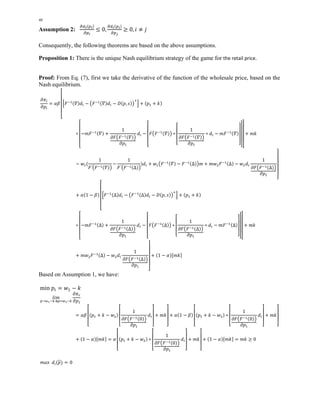
    M. A. Azarmehr/ Management Science Letters 2 (2012) 45 Table 1 Summary of the articles reviewed in the field of chain competition Reference Name competition Demand Competitive basis Type of competition inside chain between chains certain uncertain price service other Horizontal Vertical Tsay & Agrawal , 2000 √ √ √ √ √ Bernstein & Federgruen, 2004 √ √ √ √ √ Bernstein & Federgruen, 2003 √ √ √ √ Gurnani et al., 2005 √ √ √ √ √ Bernstein, & Federgruen, Wu et al., 2009 √ √ √ √ √ Bernstein & Federgruen, 2005 √ √ √ √ Zhao, 2008 √ √ √ √ √ Leng & Parlar, 2009 √ √ √ √ Bernstein & Federgruen, 2004 √ √ √ √ √ Xiao et al., 2010 √ √ √ √ √ McGuire & Staelin, 1983 √ √ √ √ Boyaci & Gallego, 2004 √ √ √ √ Wu et al., 2009 √ √ √ √ √ Zhao & Shi, 2011 √ √ √ √ Xiao & Yang, 2008 √ √ √ √ √ Baron et al., 2007 √ √ √ √ Anderson & Bao, 2010 √ √ √ √ We now turn our attention to the literature on disruption in supply chains. Although the field of competition inside and outside chain have been addressed by many researchers, there are few studies in the field of disruption. Xiao and Qi (2006) studied the coordination of a supply chain with one manufacturer and two competing retailers after the production cost of the manufacturer was disrupted. They considered two coordination mechanisms, namely an all-unit quantity discount and an incremental quantity discount. For each mechanism, they developed the conditions under which supply chain was coordinated and discussed how the cost disruption might affect the coordination mechanisms. Chen and Xiao (2009) developed two coordination models of a supply chain consisting of one manufacturer, one dominant retailer and multiple fringe retailers to investigate how to coordinate the supply chain after demand disruption. They considered two coordination schedules, linear quantity discount schedule and Groves wholesale price schedule. Li et al. (2010) investigated the sourcing strategy of a retailer and the pricing strategies of two suppliers in a supply chain under an environment of supply disruption. They characterized the sourcing strategies of the retailer in a centralized and a decentralized system and derived a sufficient condition for the existence of an equilibrium price in the decentralized system when the suppliers were competitive. We investigate the pricing strategies of two suppliers in a supply chain under an environment of supply disruption, and we study the sourcing strategy of two retailers that compete on the price and service levels in a supply chain. 3. New mathematical model We consider a decentralized supply chain system in which two suppliers sells a single product to two competing retailers. All four firms are assumed to be risk neutral and pursue expected profit maximization. The retailers buy the same product from two suppliers and sell the product to its customers in a single selling season or incur stock-out penalty cost. Each retailer faces a random demand, the distribution of which depends on not only his own retail price and service level but also all other retailer’s. The uncertain source of supply is a state of the suppliers, which are subject to random failures. We assume that there are two types of failure: common-cause affects both suppliers. For example, a war may affect all the suppliers in a region, and supplier-specific failures, a supplier may still fail for some supplier-specific reason even if there is no common-cause failure. For example, equipment failure might affect one supplier but not the other supplier. If a supplier is in the failure state, no orders can be supplied. We also assume that supplier 1 is affected only by the common-cause failure but supplier 2 is affected by both types of failure. Wholesale price for supplier 1 is larger than wholesale price of supplier 2. We investigate the case where the retailers’ stochastic
  • 4.
    46 demands havemultiplicative form ܦ௜ሺ݌, ݏሻ ൌ ݀௜ሺ݌, ݏሻ. ߝ௜, ݅ ൌ 1,2. Here, ߝ௜ is a non-negative random variable with continuous, differentiable, reversible distribution function ܨ௜ሺ. ሻ, which is independent of the price vector and service level vector , and its density functionf୧ሺ. ሻ and ݀௜ሺ݌, ݏሻ ൌ ܽଵ െ ݉݌ଵ ൅ ߩ݌ଶ ൅ ߛݏଵ െ ߠݏଶ. Thus, the corresponding demand distribution function is ܨ௜ሺ./݀௜ሺ݌, ݏሻሻ. Without loss of generality, it is assumed that ܧߝ௜ ൌ 1; therefore, the expected demand is ܧܦ௜ሺ݌, ݏሻ ൌ ݀௜ሺ݌, ݏሻ. Each retailer’s demand is decreasing in its own price and increasing in its own service, and one retailer’s price increase can only increase its own rival’s demand, and likewise one retailer’s service increase can only decrease its rival’s demand. In this article retailers depend on wholesale price of the two suppliers provided by two suppliers. The retailers choose their own order quantity and use the Nash equilibrium for determining prices and service levels for retailers. Service cost ߴୱభమ ଶ (Ԃ is a service factor) of a quadratic form implying diminishing returns. The following notations are used in our proposed model. ݓ௜ Whole sale price of a unit of the product offered by supplier i, (i=1, 2), ݍ௜௟ Order quantity of retailers i placed with suppliers l, (i=1,,2 and l=1, 2), ݌௜ Retail price of retailers i (i=1, 2), ݏ௜ Service level of retailers i (i=1, 2), ݇ Stock-out penalty cost for retailers, ai Retailer i base market, ݉௜ Sensitivity of a retailer’s demand to its own retail price, ߩ௜ Sensitivity of a retailer’s demand to its rival retail price, ߛ௜ Sensitivity of a retailer’s demand to its own service, ߠ௜ Sensitivity of a retailer’s demand to its rival service, ߨ௜ Retailer i profit, ߙ Probability of a common-cause failure not occurring, where 0 ൏ ߙ ൏ 1, ߚ Probability that supplier 1does not fail conditional on a common-cause failure not occurring, where 0 ൏ ߚ ൏ 1, ݓ௜ Wholesale price of a unit of the product offered by a supplier. We first obtain order quantity of retailers i placed with suppliers. For this purpose, we define the profit function for retailers. ߨ௜ ൌ ߙߚ ቈ݌௜ ቂݍ௜ଵ ൅ ݍ௜ଶ െ ൫ݍ௜ଵ ൅ ݍ௜ଶ െ ܦ௜ሺ݌, ݏሻ൯ାቃ െ ݓଵݍ௜ଵ െ ݓଶݍ௜ଶ െ ݇ሾܦ௜ሺ݌, ݏሻ െ ݍ௜ଵ െ ݍ௜ଶሿା െ ଶ 2 ߴ௜ݏ௜ଵ ቉ ൅ ߙሺ1 െ ߚሻ ቈ݌௜ ቂݍ௜ଶ െ ൫ݍ௜ଶ െ ܦ௜ሺ݌, ݏሻ൯ାቃ െ ݓଶݍ௜ଶ െ ݇ሾܦ௜ሺ݌, ݏሻ െ ݍଶሿା െ ଶ 2 ߴ௜ݏଵ ቉ ൅ ሺ1 െ ߙሻ ቈെ݇ሾܦ௜ሺ݌, ݏሻ െ 0ሿା െ ଶ 2 ߴ௜ݏ௜ଵ ቉ (1) Since the order quantities of each retailer only influences the profit function of that retailer, so we can get the optimal order quantities as follows, ߲ߨ௜ ߲ݍ௜ଵ ൌ ߙߚሾ݌௜ െ ݌௜ܨሺݍ௜ଵ ൅ ݍ௜ଶሻ െ ݓଵ െ ݇ܨሺݍ௜ଵ ൅ ݍ௜ଶሻ ൅ ݇ ൌ 0 ՜ ሺݍ௜ଵ ൅ ݍ௜ଶሻכ ൌ ܨିଵ ൬ ݌௜ െ ݓଵ ൅ ݇ ݌௜ ൅ ݇ ൰ ݀௜ ൌ ܨିଵሺߘሻ݀௜ (2) ߲ଶߨ௜ ߲ݍ௜ଵ ଶ ൏ 0
  • 5.
    M. A. Azarmehr/ Management Science Letters 2 (2012) 47 ߲ߨ௜ ߲ݍ௜ଶ ൌ ߙߚሾ݌௜ െ ݓଵ െ ݌௜ܨሺݍ௜ଵ ൅ ݍ௜ଶሻ െ ݇ܨሺݍ௜ଵ ൅ ݍ௜ଶሻ ൅ ݇ሿ ൅ ߙሺ1 െ ߚሻሾ݌௜ െ ݓଶ െ ݌௜ܨሺݍ௜ଶሻ െ ݇ܨሺݍ௜ଶሻ ൅ ݇ሿ ൅ ሺ1 െ ߙሻሾ0ሿ ൌ 0 ՜ ݍଶכ ൌ ܨିଵ ൬ ߙሺ݌ଵ െ ݓଶ ൅ ݇ሻ െ ߙߚሺ݌ଵ െ ݓଵ ൅ ݇ሻ ߙሺ1 െ ߚሻሺ݌ଵ ൅ ݇ሻ ൰ ݀௜ ൌ ܨିଵሺΔሻ݀௜ (3) ߲ଶߨ௜ ߲ݍ௜ଶ ଶ ൏ 0 Thus, ߨ௜ is strictly concave in ݍଶכ and ሺݍ௜ଵ ൅ ݍ௜ଶሻכ. Then, replacing the optimal order quantities into Eq. (1) yields the following, ߨ௥ሺ݌, ݏሻ ൌ ߙߚ ቈሺ݌ଵ ൅ ݇ሻ ቈܨିଵሺߘሻ݀௜ െ න ܨ ൬ ݐ ݀௜ ൰ ிషభሺఇሻௗ೔ ଴ ቉ െ ݇݀௜ െ ݓଵሺܨିଵሺߘሻെܨିଵሺΔሻሻ݀௜ െ ݓଶܨିଵሺΔሻ݀௜ െ ଶ 2 ߴݏଵ ቉ ൅ ߙሺ1 െ ߚሻ ቈሺ݌ଵ ൅ ݇ሻ ቈܨିଵሺΔሻ݀௜ െ න ܨ ൬ ݐ ݀௜ ൰ ிషభሺΔሻௗ೔ ଴ ቉ െ ݇݀௜ െ ݓଶܨିଵሺΔሻ݀௜ െ ଶ 2 ߴݏଵ ቉ ൅ ሺ1 െ ߙሻ ൌ ቈߙߚሺ݌ଵ ൅ ݇ሻ න ݐ݂ ൬ ݐ ݀௜ ൰ ிషభሺఇሻ ଴ ൅ ߙሺ1 െ ߚሻሺ݌ଵ ൅ ݇ሻ න ݐ݂ ൬ ݐ ݀௜ ൰ ிషభሺΔሻ ଴ െ ݇቉ ݀௜ െ ଶ 2 ߴݏଵ ൌ ܳሺ݌௜ሻ݀௜ሺ݌௜, ݏሻ െ ଶ 2 ߴݏ௜ (4) In this paper, we assume that all retailers simultaneously determine their private retail prices and service levels. We first get the equilibrium service level based on equilibrium price, and then determine equilibrium price. The equilibrium service level based on the Nash equilibrium is equal with the following formula, ߲ߨ௥ ൌ ߛܳሺ݌௜ሻ െ ՜ ߲ݏ௜ ߴݏଵ ݏ௜ כ ൌ ߛܳሺ݌௜ሻ ߴ (5) ߲ଶߨ௥ ߲ݏ௜ ଶ ൌ െߴ It implies that profit function is strictly concave for any given retail price vector p and all other retailers’ service level. Therefore, we have a unique equilibrium service level. After obtaining the equilibrium of service level the retailer i expected demand function can be reduced as: ݀௜ሺ݌௜ሻ ൌ ܽ௜ െ ݉௜݌௜ ൅ ߩ௜݌௝ ൅ ߛ௜ ଶܳሺ݌௜ሻ ߴ௜ െ ߠ௜ ߛ௜ܳ൫݌௝൯ ߴ௜ (6) and, we can replace the profit function as: ߨ௜ሺ݌ሻ ൌ ܳሺ݌௜ሻ݀௜ሺ݌ሻ െ ߛଶܳଶሺ݌௜ሻ 2 ߴ (7) To obtain the equilibrium price and service level, we must first solve the below system based on the Nash equilibrium. ߲ߨଵ௥ ߲݌ଵ ൌ 0 ߲ߨଶ௥ ߲݌ଶ ൌ 0 ప ݌Then based on Eq. (6), the equilibrium level of service is obtained. However, because of the difficulty of solving the exact value of the derivative to obtain the equilibrium wholesale price and then to examine the price equilibrium behavior between retailers, we need the following assumptions. Assumption 1: For all i =1, 2, ..., N, the retail price ݌௜ is defined on ሾݓ௜ െ ݇,ഥ], where ݌ഥప is the maximum price such ݀௜ሺ݌ሻ|௣೔ୀത௣തതഢ ൌ 0
  • 6.
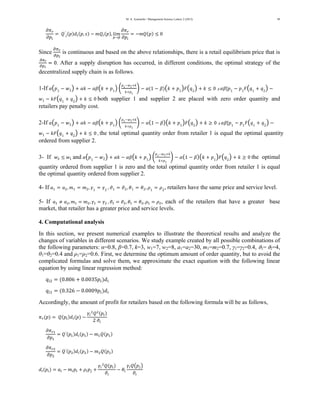
    48 Assumption 2:డௗ೔ሺ௣೔ሻ డ௣೔ ൑ 0, డௗ೔ሺ௣೔ሻ డ௣ೕ ൒ 0, ݅ ് ݆ Consequently, the following theorems are based on the above assumptions. Proposition 1: There is the unique Nash equilibrium strategy of the game for the retail price. Proof: From Eq. (7), first we take the derivative of the function of the wholesale price, based on the Nash equilibrium. ߲ߨ௜ ߲݌௜ ൌ ߙߚ ۏێێێێۍ ቂܨିଵሺߘሻ݀௜ െ ൫ܨିଵሺߘሻ݀௜ െ ܦሺ݌, ݏሻ൯ାቃ ൅ ሺ݌ଵ ൅ ݇ሻ כ ۏێێێێۍ െ݉ܨିଵሺߘሻ ൅ 1 ߲ܨ൫ܨିଵሺߘሻ൯ ߲݌ଵ ݀௜ െ ۏێێێۍ ܨ൫ܨିଵሺߘሻ൯ כ ۏێێۍ 1 ߲ܨ൫ܨିଵሺߘሻ൯ ߲݌ଵ ےۑۑې כ ݀௜ െ ݉ܨିଵሺߘሻ ےۑۑۑې ےۑۑۑۑې ൅ ݉݇ െ ݓଵሺ 1 ܨ′൫ܨିଵሺߘሻ൯ െ 1 ሻ݀௜ ൅ ݓଵ൫ܨିଵሺߘሻ െ ܨିଵሺΔሻ൯݉ ൅ ݉ݓଶܨିଵሺΔሻ െ ݓଶ݀௜ ܨ′൫ܨିଵሺΔሻ൯ ےۑۑۑۑې 1 ߲݌ଵ ߲ܨ൫ܨିଵሺΔሻ൯ ൅ ߙሺ1 െ ߚሻ ۏێێێێۍ ቂܨିଵሺΔሻ݀௜ െ ൫ܨିଵሺΔሻ݀௜ െ ܦሺ݌, ݏሻ൯ାቃ ൅ ሺ݌ଵ ൅ ݇ሻ כ ۏێێێێۍ െ݉ܨିଵሺΔሻ ൅ 1 ߲ܨ൫ܨିଵሺΔሻ൯ ߲݌ଵ ݀௜ െ ۏێێێۍ ܨ൫ܨିଵሺΔሻ൯ כ ۏێێۍ 1 ߲ܨ൫ܨିଵሺΔሻ൯ ߲݌ଵ ےۑۑې כ ݀௜ െ ݉ܨିଵሺΔሻ ےۑۑۑۑې ےۑۑۑې ൅ ݉݇ ൅ ݉ݓଶܨିଵሺΔሻ െ ݓଶ݀௜ ےۑۑۑۑې 1 ߲݌ଵ ߲ܨ൫ܨିଵሺΔሻ൯ ൅ ሺ1 െ ߙሻሾ݉݇ሿ Based on Assumption 1, we have: min ݌௜ ൌ ݓଵ െ ݇ ݈݅݉ ௣՜௪భି௞ &௣ୀ௪మି௞ ߲ߨ௥ ߲݌ଵ ൌ ߙߚ ۏێێۍ ሺ݌ଵ ൅ ݇ െ ݓଶሻ ۏێێۍ 1 ߲ܨ൫ܨିଵሺ0ሻ൯ ߲݌ଵ ݀௜ ےۑۑې ൅ ݉݇ ےۑۑې ൅ ߙሺ1 െ ߚሻ ۏێێۍ ሺ݌ଵ ൅ ݇ െ ݓଶሻ כ ۏێێۍ 1 ߲ܨ൫ܨିଵሺ0ሻ൯ ߲݌ଵ ݀௜ ےۑۑې ൅ ݉݇ ےۑۑې ൅ ሺ1 െ ߙሻሾ݉݇ሿ ൌ ߙ ۏێێۍ ሺ݌ଵ ൅ ݇ െ ݓଶሻ כ ۏێێۍ 1 ߲ܨ൫ܨିଵሺ0ሻ൯ ߲݌ଵ ݀௜ ےۑۑې ൅ ݉݇ ےۑۑې ൅ ሺ1 െ ߙሻሾ݉݇ሿ ൌ ݉݇ ൒ 0 ݉ܽݔ ݀݅ሺ݌തሻ ൌ 0
  • 7.
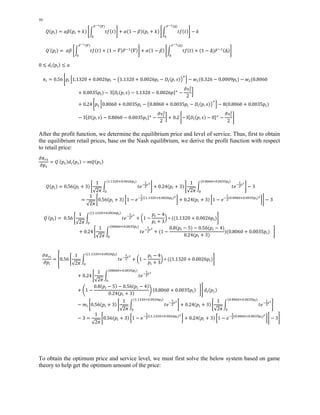
    M. A. Azarmehr/ Management Science Letters 2 (2012) 49 ߲ߨ௥ ߲݌௜ ൌ ܳ′ ௜ሺ݌ሻ݀௜ሺ݌, ݏሻ െ ݉ܳ௜ ሺ݌ሻ, ݈݅݉ ௣՜௣ҧ ߲ߨ௥ ߲݌௜ ൌ െ݉ܳሺ݌ሻ ൑ 0 Since డగೝ డ௣೔ is continuous and based on the above relationships, there is a retail equilibrium price that is డగೝ డ௣೔ ൌ 0. After a supply disruption has occurred, in different conditions, the optimal strategy of the decentralized supply chain is as follows. 1-If ߙ൫݌1 െ ݓ2൯ ൅ ߙ݇ െ ߙߚ൫݇ ൅ ݌1൯ ൬݌1െݓ2൅݇ ݇൅݌1 ൰ െ ߙሺ1 െ ߚሻ൫݇ ൅ ݌1൯ܨ൫ݍ2൯ ൅ ݇ ൑ و 0 ߙߚሾ݌1 െ ݌1ܨ൫ݍ1 ൅ ݍ2൯ െ ݓ1 െ ݇ܨ൫ݍ1 ൅ ݍ2൯ ൅ ݇ ൑ 0 both supplier 1 and supplier 2 are placed with zero order quantity and retailers pay penalty cost. 2-If ߙ൫݌1 െ ݓ2൯ ൅ ߙ݇ െ ߙߚ൫݇ ൅ ݌1൯ ൬݌1െݓ2൅݇ ݇൅݌1 ൰ െ ߙሺ1 െ ߚሻ൫݇ ൅ ݌1൯ܨ൫ݍ2൯ ൅ ݇ ൒ و 0 ߙߚሾ݌1 െ ݌1ܨ൫ݍ1 ൅ ݍ2൯ െ ݓ1 െ ݇ܨ൫ݍ1 ൅ ݍ2൯ ൅ ݇ ൑ 0 , the total optimal quantity order from retailer 1 is equal the optimal quantity ordered from supplier 2. 3- If ݓଶ ൑ ݓଵ and ߙ൫݌1 െ ݓ2൯ ൅ ߙ݇ െ ߙߚ൫݇ ൅ ݌1൯ ൬݌1െݓ2൅݇ ݇൅݌1 ൰ െ ߙሺ1 െ ߚሻ൫݇ ൅ ݌1൯ܨ൫ݍ2൯ ൅ ݇ ൒ 0 the optimal 2 quantity ordered Ԃfrom supplier 1 is zero and the total optimal quantity order from retailer 1 is equal the optimal quantity ordered from supplier 2. 4- If ܽ1 ൌ ܽ2, ݉1 ൌ ݉2, ߛൌ ߛ, ߴ1 2 1 ൌ ߴ2, ߠ1 ൌ ߠ2, ߩൌ ߩ, retailers have the same price and service level. 1 25- If ܽଵ ് ܽଶ, ݉ଵ ൌ ݉ଶ, ߛଵ ൌ ߛଶ , ߴଵ ൌ ߴଶ, ߠଵ ൌ ߠଶ, ߩଵ ൌ ߩଶ, each of the retailers that have a greater base market, that retailer has a greater price and service levels. 4. Computational analysis In this section, we present numerical examples to illustrate the theoretical results and analyze the changes of variables in different scenarios. We study example created by all possible combinations of the following parameters: α=0.8, β=0.7, k=3, w1=7, w2=8, a1=a2=30, m1=m2=0.7, γ1=γ2=0.4, Ԃ1= =4, θ1=θ2=0.4 and ρ1=ρ2=0.6. First, we determine the optimum amount of order quantity, but to avoid the complicated formulas and solve them, we approximate the exact equation with the following linear equation by using linear regression method: ݍ௜ଶ ൌ ሺ0.806 ൅ 0.0035݌௜ሻ݀௜ ݍ௜ଵ ൌ ሺ0.326 െ 0.0009݌௜ሻ݀௜ Accordingly, the amount of profit for retailers based on the following formula will be as follows, ߨ௥ሺ݌ሻ ൌ ܳሺ݌௜ሻ݀௜ሺ݌ሻ െ ߛ௜ ଶܳଶሺ݌௜ሻ 2 ߴ௜ ߲ߨ௥ଵ ߲݌ଵ ൌ ܳ′ሺ݌ଵሻ݀௜ሺ݌ଵሻ െ ݉ଵܳሺ݌ଵሻ ߲ߨ௥ଶ ߲݌ଶ ൌ ܳ′ሺ݌ଶሻ݀௜ሺ݌ଶሻ െ ݉ଶܳሺ݌ଶሻ ݀௜ሺ݌௜ሻ ൌܽ௜ െ ݉௜݌௜ ൅ ߩ௜݌௝ ൅ ߛ௜ ଶܳሺ݌௜ሻ ߴ௜ െ ߠ௜ ߛ௜ܳ൫݌௝൯ ߴ௜
  • 8.
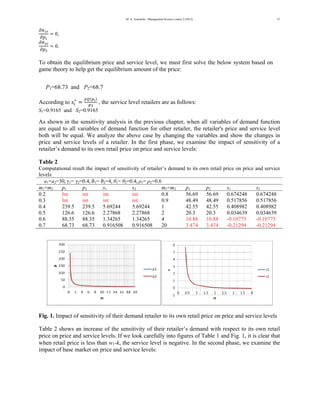
    50 ிషభሺఇሻ ܳሺ݌௜ሻൌ ߙߚሺ݌௜ ൅ ݇ሻ ቈන ݐ݂ሺݐሻ ଴ ிషభሺΔሻ ቉ ൅ ߙሺ1 െ ߚሻሺ݌௜ ൅ ݇ሻ ቈන ݐ݂ሺݐሻ ଴ ቉ െ ݇ ிషభሺఇሻ ܳ′ሺ݌௜ሻ ൌ ߙߚ ቈන ݐ݂ሺݐሻ ଴ ிషభሺΔሻ ൅ ሺ1 െ ߘሻܨିଵሺߘሻ቉ ൅ ߙሺ1 െ ߚሻ ቈන ݐ݂ሺݐሻ ଴ ൅ ሺ1 െ ΔሻܨିଵሺΔሻ቉ 0 ൑ ݀௜ሺ݌௜ሻ ൑ ܽ ߨ௜ ൌ 0.56 ቈ݌௜ ቂ1.1320 ൅ 0.0026݌௜ െ ൫1.1320 ൅ 0.0026݌௜ െ ܦ௜ሺ݌, ݏሻ൯ାቃ െ ݓଵሺ0.326 െ 0.0009݌௜ሻ െ ݓଶሺ0.8060 ൅ 0.0035݌௜ሻ െ 3ሾܦ௜ሺ݌, ݏሻ െ 1.1320 െ 0.0026݌ሿା െ ଶ 2 ߴݏଵ ൨ ൅ 0.24 ቈ݌ଵ ቂ0.8060 ൅ 0.0035݌௜ െ ൫0.8060 ൅ 0.0035݌௜ െ ܦ௜ሺ݌, ݏሻ൯ାቃ െ 8ሺ0.8060 ൅ 0.0035݌௜ሻ െ 3ሾܦሺ݌, ݏሻ െ 0.8060 െ 0.0035݌௜ሿା െ ଶ 2 ߴݏଵ ൨ ൅ 0.2 ቈെ3ሾܦ௜ሺ݌, ݏሻ െ 0ሿା െ ଶ 2 ߴݏଵ ቉ After the profit function, we determine the equilibrium price and level of service. Thus, first to obtain the equilibrium retail prices, base on the Nash equilibrium, we derive the profit function with respect to retail price: ߲ߨ௥ଵ ൌ ܳ′ሺ݌ଵሻ݀௜ሺ݌ଵሻ െ ݉ܳሺ݌ଵሻ ߲݌ଵ ܳሺ݌௜ሻ ൌ 0.56ሺ݌௜ ൅ 3ሻ ቈ 1 √2ߨ න ݐ݁ିଵଶ ௧మ ሺଵ.ଵଷଶ଴ା଴.଴଴ଶ଺௣೔ሻ ଴ 1 √2ߨ ቉ ൅ 0.24ሺ݌௜ ൅ 3ሻ ቈ න ݐ݁ିଵଶ ௧మ ሺ଴.଼଴଺଴ା଴.଴଴ଷହ௣೔ሻ ଴ ቉ െ 3 ൌ 1 √2ߨ ቈ0.56ሺ݌௜ ൅ 3ሻ ൤1 െ ݁ିଵଶ ሺሺଵ.ଵଷଶ଴ା଴.଴଴ଶ଺௣೔ሻమ൨ ൅ 0.24ሺ݌௜ ൅ 3ሻ ൤1 െ ݁ିଵଶ ሺ଴.଼଴଺଴ା଴.଴଴ଷହ௣೔ሻమ ൨቉ െ 3 ܳ′ሺ݌௜ሻ ൌ 0.56 ቈ 1 √2ߨ න ݐ݁ିଵଶ ௧మ ൅ ൬1 െ ݌௜ െ 4 ݌௜ ൅ 3 ൰ כ ሺሺ1.1320 ൅ 0.0026݌௜ሻ ሺሺଵ.ଵଷଶ଴ା଴.଴଴ଶ଺௣೔ሻ ଴ ቉ 1 √2ߨ ൅ 0.24 ቈ න ݐ݁ିଵଶ ௧మ ሺ଴଼଴଺଴ା଴.଴଴ଷହ௣೔ሻ ଴ ൅ ሺ1 െ 0.8ሺ݌௜ െ 5ሻ െ 0.56ሺ݌௜ െ 4ሻ 0.24ሺ݌௜ ൅ 3ሻ ሻሺ0.8060 ൅ 0.0035݌௜ሻ ቉ ߲ߨ௥௜ ߲݌௜ ൌ ቎0.56 ቈ 1 √2ߨ න ݐ݁ିଵଶ ௧మ ൅ ൬1 െ ݌௜ െ 4 ݌௜ ൅ 3 ൰ כ ሺሺ1.1320 ൅ 0.0026݌௜ሻ ሺሺଵ.ଵଷଶ଴ା଴.଴଴ଶ଺௣೔ሻ ଴ ቉ 1 √2ߨ ൅ 0.24 ቈ න ݐ݁ିଵଶ ௧మ ሺ଴଼଴଺଴ା଴.଴଴ଷହ௣೔ሻ ଴ ൅ ቆ1 െ 0.8ሺ݌௜ െ 5ሻ െ 0.56ሺ݌௜ െ 4ሻ 0.24ሺ݌௜ ൅ 3ሻ ቇ ሺ0.8060 ൅ 0.0035݌௜ሻ ቉൩ ݀௜ሺ݌ଵሻ 1 √2ߨ െ ݉௜ ቈ0.56ሺ݌௜ ൅ 3ሻ ቈ න ݐ݁ିଵଶ ௧మ ሺଵ.ଵଷଶ଴ା଴.଴଴ଶ଺௣೔ሻ ଴ 1 √2ߨ ቉ ൅ 0.24ሺ݌௜ ൅ 3ሻ ቈ න ݐ݁ିଵଶ ௧మ ሺ଴.଼଴଺଴ା଴.଴଴ଷହ௣೔ሻ ଴ ቉ െ 3 ൌ 1 √2ߨ ቈ0.56ሺ݌௜ ൅ 3ሻ ൤1 െ ݁ିଵଶ ሺሺଵ.ଵଷଶ଴ା଴.଴଴ଶ଺௣೔ሻమ൨ ൅ 0.24ሺ݌௜ ൅ 3ሻ ൤1 െ ݁ିଵଶ ሺ଴.଼଴଺଴ା଴.଴଴ଷହ௣೔ሻమ ൨቉ െ 3቉ To obtain the optimum price and service level, we must first solve the below system based on game theory to help get the optimum amount of the price:
  • 9.
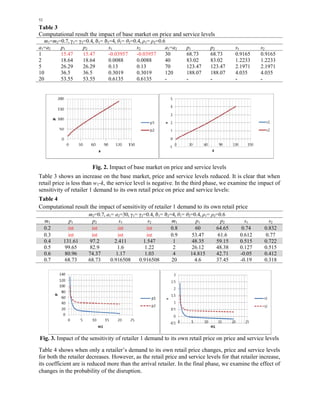
    ߲ ߲ ߲ ߲ ߨଵ௥ ߲݌ଵ Tg A S A ar bpr e TCl e m000000 F Tp wi m ൌ 0, ߨଶ௥ ߲݌ଶ ൌ 0. To obtain the ame theory t e equilibrium to help get th M. A. Azarmehr / Mana m price and he equilibriu and P2=68 ݏ௜ P1=68.73 According to 1=0.9165 and As shown in re equal to a oth will be rice and ser etailer’s dem Table 2 Computational evels a1=a2=30, γ1 m1=m2 p1 .2 Int .3 Int .4 239 .5 126 .6 88.3 .7 68.7 Fig. 1. Impac Table 2 show rice on price when retail p mpact of bas agement Science Letters service leve um amount o 8.7 , the service כ ൌ ఊொሺ௣೔ሻ ణଵ d S2=0.9165 the sensitiv all variables equal. We a rvice levels mand to its ow el, we must of the price: e level retaile vity analysis s of demand analyze the of a retailer wn retail pri l result the im 1= γ2=0.4, Ԃ1= p2 int int 9.5 239.5 6.6 126.6 35 88.35 73 68.73 2 (2012) first solve th ers are as fol in the prev d function fo above case r. In the firs ice on price a mpact of sens = Ԃ2=4, θ1= θ2 s1 int int 5.69244 2.27868 1.34265 0.916508 ct of sensitiv ws an increa e and service price is less t se market on llows: vious chapter or other reta by changing st phase, we and service l sitivity of reta 2=0.4, ρ1= ρ2= vity of their d se of the sen e levels. If w than w1-k, th n price and se he below sy r, when all v ailer, the reta g the variab e examine t levels: ailer’s deman =0.6 s2 int int 5.69244 2.27868 1.34265 0.916508 demand retai nsitivity of we look caref he service le ervice levels m1=m2 0.8 0.9 1 2 4 20 ystem based variables of ailer's price bles and sho the impact o nd to its own iler to its ow their retailer fully into fig evel is negati s: f demand fun and service ow the chang of sensitivity retail price o p1 p2 56.69 56 48.49 48 42.55 42 20.3 20 10.88 10 3.474 3. n price and s 2 s1 6.69 0.674 8.49 0.517 2.55 0.408 0.3 0.034 0.88 -0.10 474 -0.21 wn retail pric r’s demand gures of Tab ive. In the s ce on price an with respect ble 1 and Fig econd phase s2 4248 0.674 7856 0.517 8982 0.408 4639 0.034 775 -0.10 294 -0.21 nd service le t to its own g. 1, it is clea e, we examin 51 on nction level ges in y of a service 4248 7856 8982 4639 0775 1294 evels retail ar that ne the
  • 10.
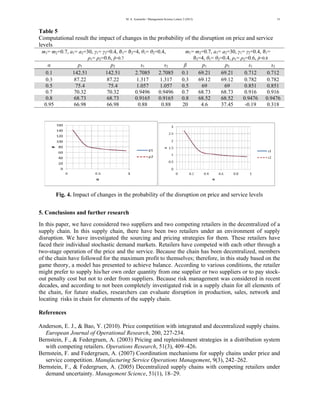
    52 2 Table3 Computation m1=m2=0.7, 1=a2 p1 TC a 1 2 5 10 20 Tr e se T C F Tf o it ch al result the γ1= γ2=0.4, Ԃ 15.4 18.6 26.2 0 36.5 0 53.5 Table 3 show etail price is ensitivity of Table 4 Computation m1 p 0.2 in 0.3 in 0.4 131 0.5 99 0.6 80 0.7 68 Fig. 3. Impac Table 4 show or both the r ts coefficient hanges in th p2 47 15.47 64 18.64 29 26.29 5 36.5 55 53.55 Fi impact of ba 1= Ԃ2=4, θ1= ws an increas less than w1 f retailer 1 de al result the m2=0 p1 p2 nt int nt int 1.61 97.2 9.65 82.9 0.96 74.3 8.73 68.7 ct of the sen ws when only retailer decre t are is reduc he probability ase market o θ2=0.4, ρ1= ρ2 s1 -0.03957 0.0088 0.13 0.3019 0.6135 g. 2. Impact se on the ba 1-k, the servi emand to its impact of se 0.7, a1= a2=30 s1 int int 2 2.411 9 1.6 7 1.17 3 0.91650 sitivity of re y a retailer’s eases. Howev ced more tha y of the disru s2 on price and 2=0.6 7 -0.03957 0.0088 0.13 0.3019 0.6135 of base mar ase market, p ice level is n own retail p ensitivity of 0, γ1= γ2=0.4, s2 int int 1 1.547 1.22 1.03 08 0.9165 etailer 1 dem s demand to ver, as the re an the arriva uption. a1=a2 7 30 40 70 120 - service leve p1 p 68.73 83.02 123.47 188.07 - rket on price price and ser negative. In t price on price els p2 s1 68.73 0 83.02 1 123.47 2 188.07 4 - - e and service rvice levels the third pha e and servic retailer 1 de Ԃ1= Ԃ2=4, θ1= m1 0.8 0.9 7 12 4 08 20 1 s2 .9165 0.9 .2233 1.2 .1971 2.1 .035 4.0 e levels reduced. It i ase, we exam e levels: emand to its = θ2=0.4, ρ1= mand to its ow its own reta etail price an al retailer. In p1 60 53.47 48.35 26.12 14.815 4.6 own retail p ρ2=0.6 wn retail pric ail price chan nd service le n the final ph p2 64.65 61.6 59.15 48.38 42.71 37.45 ce on price a nges, price a evels for that hase, we exam - 9165 2233 1971 035 is clear that mine the imp price when pact of s1 0.74 0 0.612 0 0.515 0 0.127 0 -0.05 0 -0.19 0 s2 0.832 0.77 0.722 0.515 0.412 0.318 and service l and service t retailer inc mine the eff levels levels rease, fect of
  • 11.
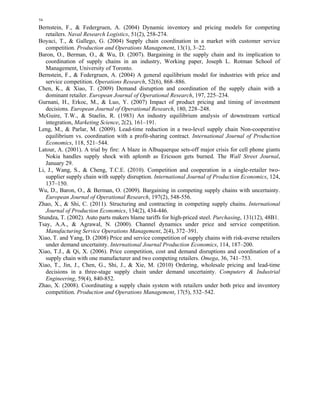
    Table T 5 Computation evels m1= m2=0.7, C le 5 In su df a tw og mod th lo R A B B B α 0.1 0.3 0.5 0.7 0.8 0.95 al result the a1= a2=30, γ1 Fig. 4 . Conclusio n this paper, upply chain disruption. W aced their in wo-stage ope f the chain h ame theory, might prefer ut penalty c decades, and he chain, fo ocating risk References Anderson, E. European Bernstein, F., with comp Bernstein, F. service com Bernstein, F. demand un M. A. Azarmehr / Mana impact of ch = γ2=0.4, Ԃ1= ρ2=0.6, β=0.7 ρ1= ρ p1 142.51 87.22 75.4 70.32 68.73 66.98 . Impact of c ns and furth , we have co . In this sup We have inve ndividual sto eration of th have followe a model ha to supply hi cost but not t according to r future stud s in chain fo J., & Bao, Y Journal of O , & Federgru peting retaile and Federgr mpetition. M , & Federgr ncertainty. M p2 142.51 87.22 75.4 70.32 68.73 66.98 agement Science Letters hanges in the = Ԃ2=4, θ1= θ2 changes in th her researc onsidered tw pply chain, estigated the ochastic dem he price and ed for the ma as presented is/her own o to order from o not been c dies, researc or elements o Y. (2010). P Operational uen, A. (200 ers. Operatio ruen, A. (20 Manufacturin ruen, A. (20 Management s1 2.7085 1.317 1.057 0.9496 0.9165 0.88 2 (2012) e probability 2=0.4, he probabilit h wo suppliers there have e sourcing a mand markets the service. aximum prof to achieve b order quantity m suppliers. completely i chers can ev of the supply rice competi Research, 2 03) Pricing a ons Research 007) Coordin ng Service O 05) Decentr t Science, 51 s2 2.7085 1.317 1.057 0.9496 0.9165 0.88 y of the disru m1= m2=0.7 ty of the disr and two com been two re and pricing s. Retailers h Because th fit to themse balance. Acc y from one s . Because ris nvestigated valuate disru y chain. ition with in 200, 227-234 and replenis h, 51(3), 409 nation mecha Operations M ralized supp (1), 18–29. uption on pri 7, a1= a2=30, γ 1= θ2=0.4, ρ1= Ԃ2=4, θ1 β p1 0.1 69.21 0.3 69.12 0.5 69 0.7 68.73 0.8 68.52 20 4.6 ruption on p mpeting reta etailers unde strategies fo have compet e chain has elves; therefo cording to v supplier or t sk managem risk in a sup uption in pr ntegrated and 4. shment strate 9–426. anisms for s Management, ly chains w p2 69.21 2 69.12 69 68.73 2 68.52 37.45 ice and serv γ1= γ2=0.4, Ԃ1 = ρ2=0.6, β=0.8 price and serv ailers in the d er an enviro or them. The ted with eac been decent fore, in this s various condi two supplier ment was con pply chain fo oduction, sa d decentraliz egies in a di supply chain , 9(3), 242–2 ith competin s1 0.712 0.782 0.851 0.916 0.9476 0 -0.19 vice levels decentralized onment of s ese retailers ch other thro tralized, mem study based o itions, the re rs or to pay s nsidered in r for all eleme ales, network zed supply ch istribution sy ns under pric 262. ng retailers 53 ice 1= 8 s2 0.712 0.782 0.851 0.916 0.9476 0.318 d of a supply s have ough a mbers on the etailer stock-recent nts of k and hains. ystem ce and under
  • 12.
    54 Bernstein, F.,& Federgruen, A. (2004) Dynamic inventory and pricing models for competing retailers. Naval Research Logistics, 51(2), 258-274. Boyaci, T., & Gallego, G. (2004) Supply chain coordination in a market with customer service competition. Production and Operations Management, 13(1), 3–22. Baron, O., Berman, O., & Wu, D. (2007). Bargaining in the supply chain and its implication to coordination of supply chains in an industry, Working paper, Joseph L. Rotman School of Management, University of Toronto. Bernstein, F., & Federgruen, A. (2004) A general equilibrium model for industries with price and service competition. Operations Research, 52(6), 868–886. Chen, K., & Xiao, T. (2009) Demand disruption and coordination of the supply chain with a dominant retailer. European Journal of Operational Research, 197, 225–234. Gurnani, H., Erkoc, M., & Luo, Y. (2007) Impact of product pricing and timing of investment decisions. European Journal of Operational Research, 180, 228–248. McGuire, T.W., & Staelin, R. (1983) An industry equilibrium analysis of downstream vertical integration, Marketing Science, 2(2), 161–191. Leng, M., & Parlar, M. (2009). Lead-time reduction in a two-level supply chain Non-cooperative equilibrium vs. coordination with a profit-sharing contract. International Journal of Production Economics, 118, 521–544. Latour, A. (2001). A trial by fire: A blaze in Albuquerque sets-off major crisis for cell phone giants Nokia handles supply shock with aplomb as Ericsson gets burned. The Wall Street Journal, January 29. Li, J., Wang, S., & Cheng, T.C.E. (2010). Competition and cooperation in a single-retailer two-supplier supply chain with supply disruption. International Journal of Production Economics, 124, 137–150. Wu, D., Baron, O., & Berman, O. (2009). Bargaining in competing supply chains with uncertainty. European Journal of Operational Research, 197(2), 548-556. Zhao, X., & Shi, C. (2011). Structuring and contracting in competing supply chains. International Journal of Production Economics, 134(2), 434-446. Stundza, T. (2002). Auto parts makers blame tariffs for high-priced steel. Purchasing, 131(12), 48B1. Tsay, A.A., & Agrawal, N. (2000). Channel dynamics under price and service competition. Manufacturing Service Operations Management, 2(4), 372–391. Xiao, T. and Yang, D. (2008) Price and service competition of supply chains with risk-averse retailers under demand uncertainty. International Journal Production Economics, 114, 187–200. Xiao, T.J., & Qi, X. (2006). Price competition, cost and demand disruptions and coordination of a supply chain with one manufacturer and two competing retailers. Omega, 36, 741–753. Xiao, T., Jin, J., Chen, G., Shi, J., & Xie, M. (2010) Ordering, wholesale pricing and lead-time decisions in a three-stage supply chain under demand uncertainty. Computers & Industrial Engineering, 59(4), 840-852. Zhao, X. (2008). Coordinating a supply chain system with retailers under both price and inventory competition. Production and Operations Management, 17(5), 532–542.