MEDICAL CERTIFICATION
OF
CAUSE OF DEATH(MCCD)
DRVARUNMODGIL,ASST PROF
DEPTTOFFORENSICMEDICINE
DAYANANDMEDICALCOLLGE
DEATH…
“Complete, permanent and irreversible stoppage of
respiration, circulation and brain functions”
Legal definition: (under section 46 IPC=s. 2(6) B.N.S
2023)
“Permanent disappearance of all Evidence of life at any time after
live-birth has taken place”
(Section 2(b) of “The registration of births and deaths act, 1969”)
DEATH-PROCESS/PHASES
Somatic death
Molecular death
Brain Death:
Beating heart,
Breathing by artificial means,
absence of encephalic electrical activity.
criteria for brain death..
Philadelphia protocol(1969)
Minnesota criteria(1971)
Harvard Criteria(1968)
CIRCULATION TESTS
•Magnus test
•Diaphanous test
•I card's test
•Finger nail test
•Application of heat
•Cutting a small artery
•ECG
RESPIRATION STOPPAGE TEST
Apnoea test
Winslow test
Stethoscope
Mirror test
BRAIN-STEM DEATH
CERTIFICATION
Pupillary reflex
Oculocephalic reflex
Vestibulo ocular reflex(caloric response)
Corneal reflex
Grimace reflex
Gag reflex
REGISTRATION OF BIRTH &
DEATHS ACT (RBD), 1969
Death certification
IMP PROVISIONS
•Section 10(3)
•Section 17(1)
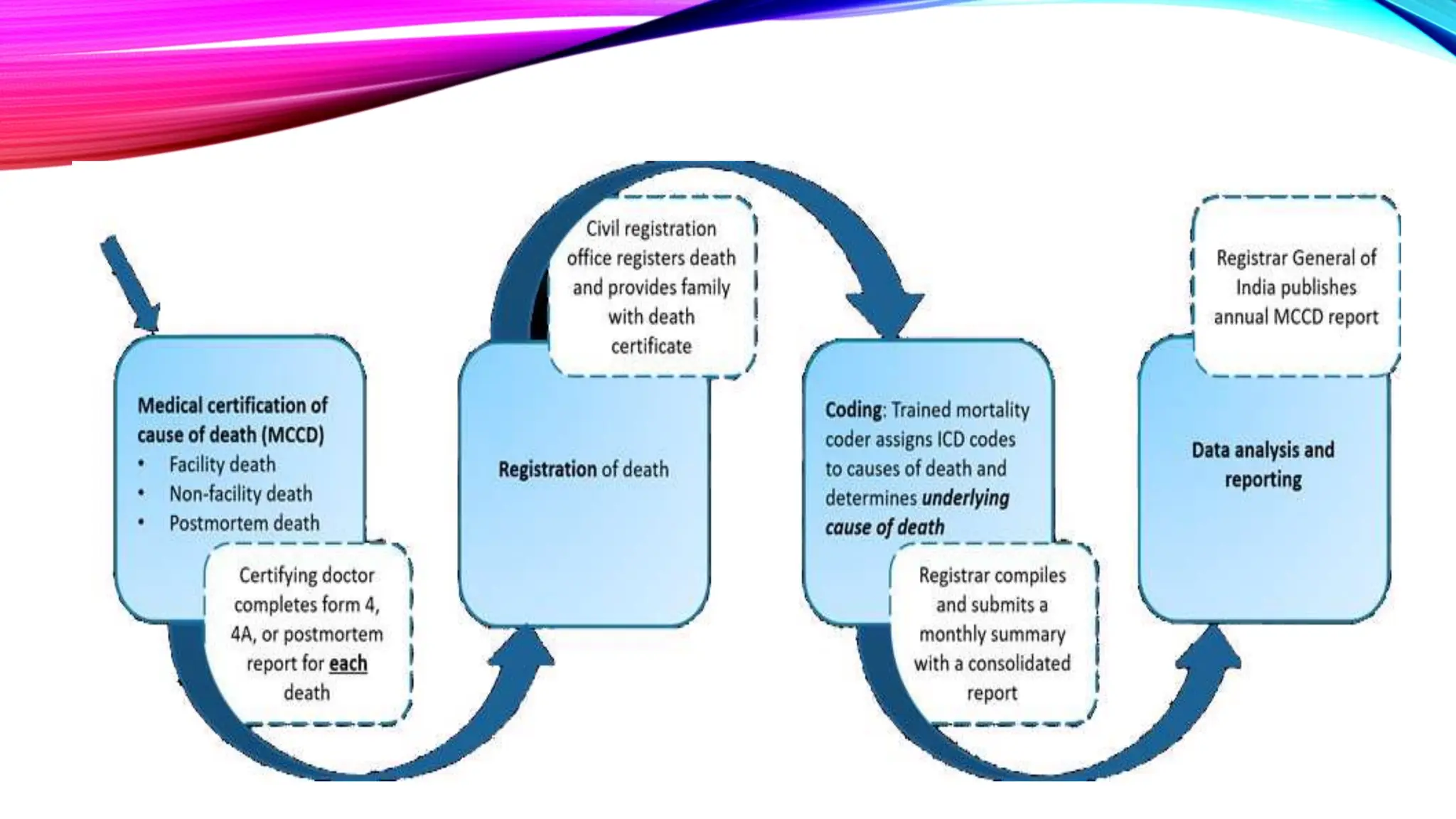
WHAT IS DEATH CERTIFICATION?
•Death is not a moment
•Medical Certification of Cause of Death Scheme is
an important tool of obtaining authentic and
scientific information regarding causes of mortality
SHOULD KNOW…
• Cause of death
• Underlying cause of death
• Mechanism of death
• Manner of death
• Mode of death
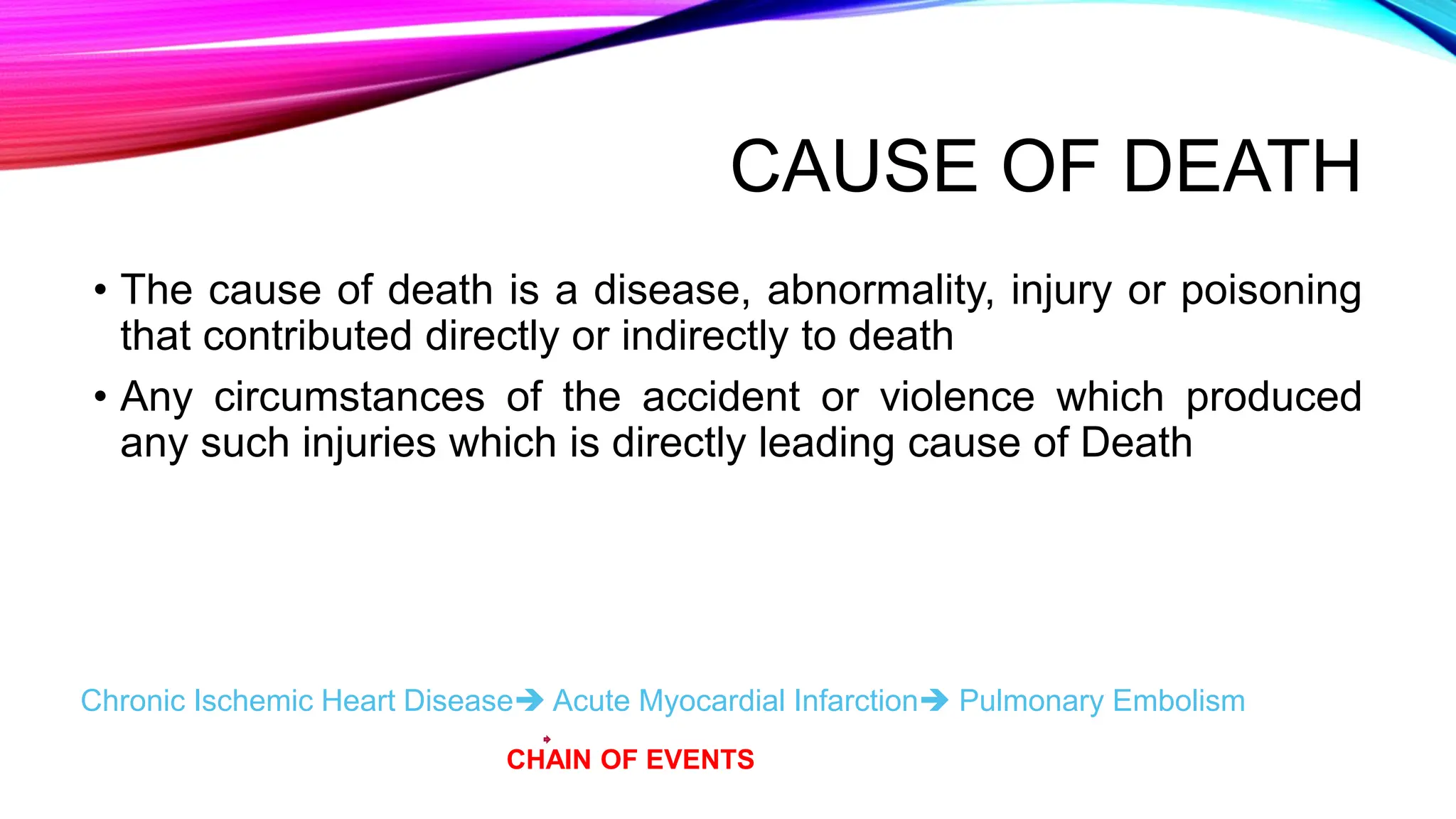
CAUSE OF DEATH
• The cause of death is a disease, abnormality, injury or poisoning
that contributed directly or indirectly to death
• Any circumstances of the accident or violence which produced
any such injuries which is directly leading cause of Death
Chronic Ischemic Heart Disease Acute Myocardial Infarction Pulmonary Embolism
CHAIN OF EVENTS
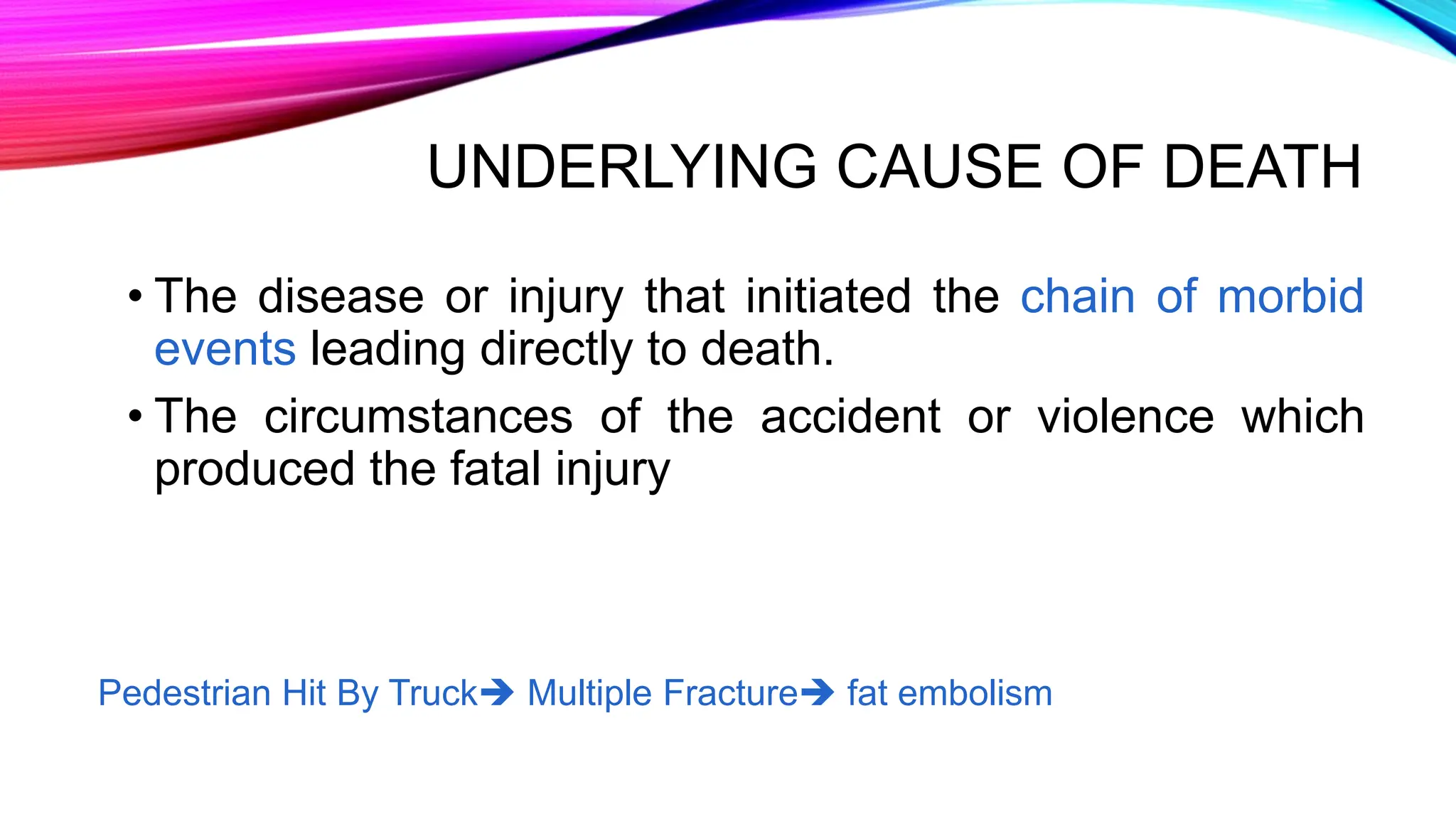
UNDERLYING CAUSE OF DEATH
• The disease or injury that initiated the chain of morbid
events leading directly to death.
• The circumstances of the accident or violence which
produced the fatal injury
Pedestrian Hit By Truck Multiple Fracture fat embolism
MECHANISM OF DEATH
•Physiological or biochemical derangement
produced by the cause of death that results in
death
•Hemorrhage, Septicemia, And Cardiac Arrhythmia
MANNER OF DEATH
It is way, fashion or circumstances of death.
Natural– when due to disease
• Cardiovascular condition e.g. MI
• Respiratory condition e.g. Asthma, COPD
• Tumor of brain with sudden hemorrhage
• Tumor of brain producing pressure
• Metabolic disorders e.g. uremia
Unnatural
• Accidental head injuries e.g. RTA
• Homicidal head injuries e.g. stab, lacerated, incised, firearm
• Suicidal head injuries e.g. firearm injury
• Poisoning e.g. Opium, alcohol
MODE OF DEATH
It is stoppage or failure of vital system
• Coma :- failure of function of brain
• Syncope :- failure of function of heart
• Asphyxia :- failure of function of respiratory system
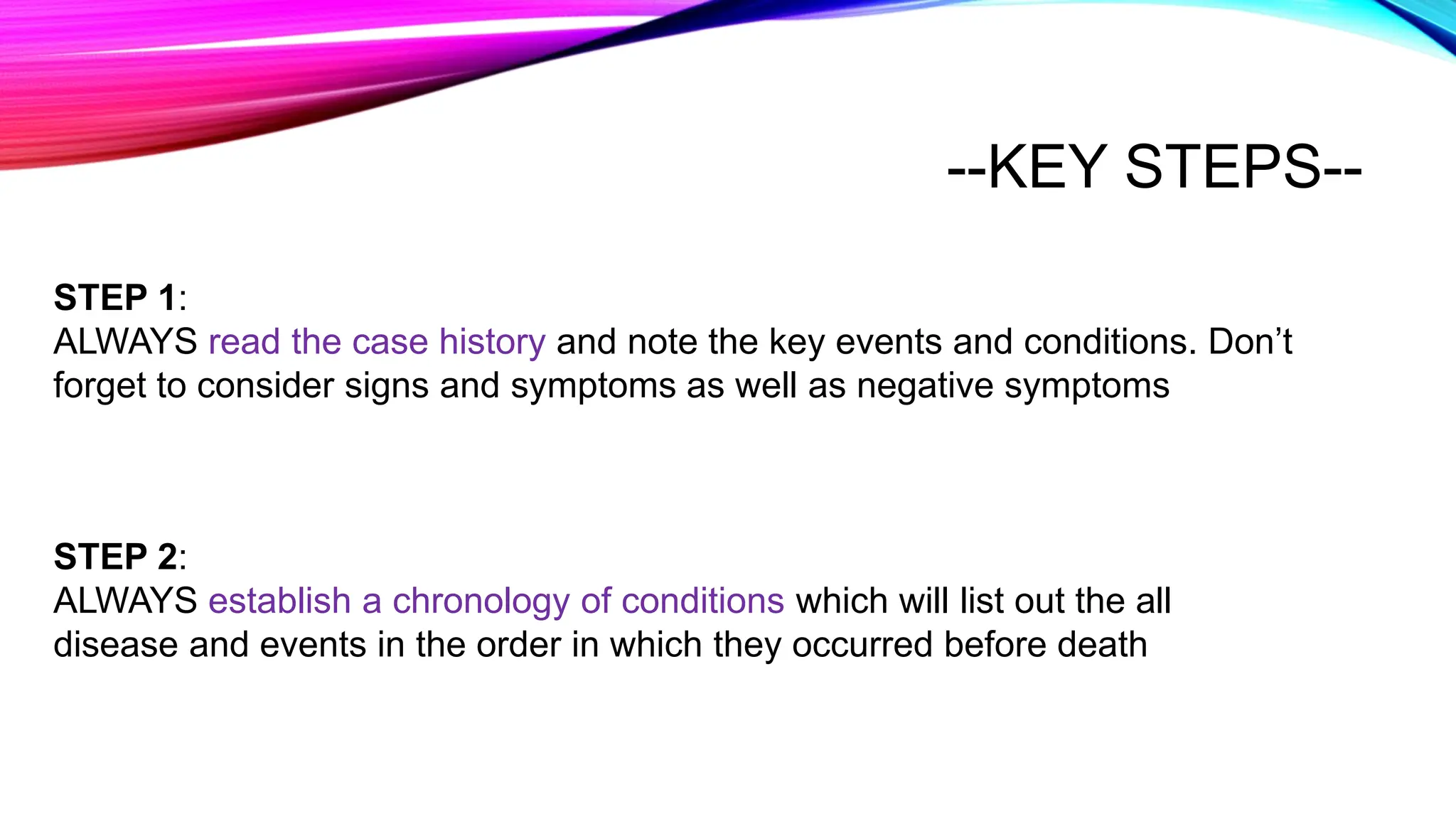
--KEY STEPS--
STEP 1:
ALWAYS read the case history and note the key events and conditions. Don’t
forget to consider signs and symptoms as well as negative symptoms
STEP 2:
ALWAYS establish a chronology of conditions which will list out the all
disease and events in the order in which they occurred before death
STEP 3:
ALWAYS determine the underlying cause of death(COD) which is the disease or
injury that started the chains of the events the lead to death of the individual
Remember to always check which disease, injury or event came first
STEP 4:
ALWAYS try to use ICD- 10 terminology, which is clear and universally accepted,
when recording the underlying COD
This also help avoid confusion between similar terms and abbreviations
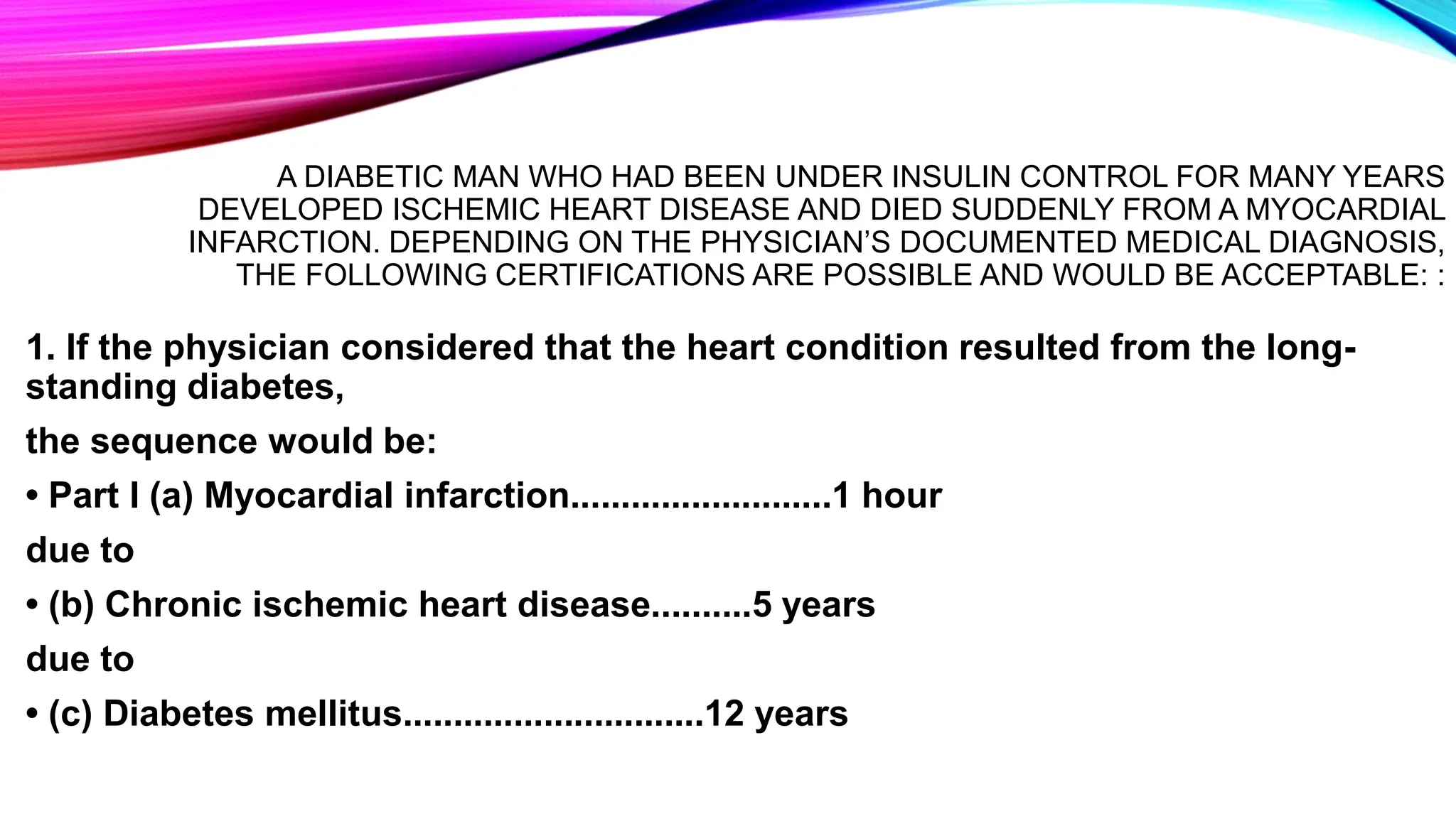
A DIABETIC MAN WHO HAD BEEN UNDER INSULIN CONTROL FOR MANY YEARS
DEVELOPED ISCHEMIC HEART DISEASE AND DIED SUDDENLY FROM A MYOCARDIAL
INFARCTION. DEPENDING ON THE PHYSICIAN’S DOCUMENTED MEDICAL DIAGNOSIS,
THE FOLLOWING CERTIFICATIONS ARE POSSIBLE AND WOULD BE ACCEPTABLE: :
1. If the physician considered that the heart condition resulted from the long-
standing diabetes,
the sequence would be:
• Part I (a) Myocardial infarction..........................1 hour
due to
• (b) Chronic ischemic heart disease..........5 years
due to
• (c) Diabetes mellitus..............................12 years
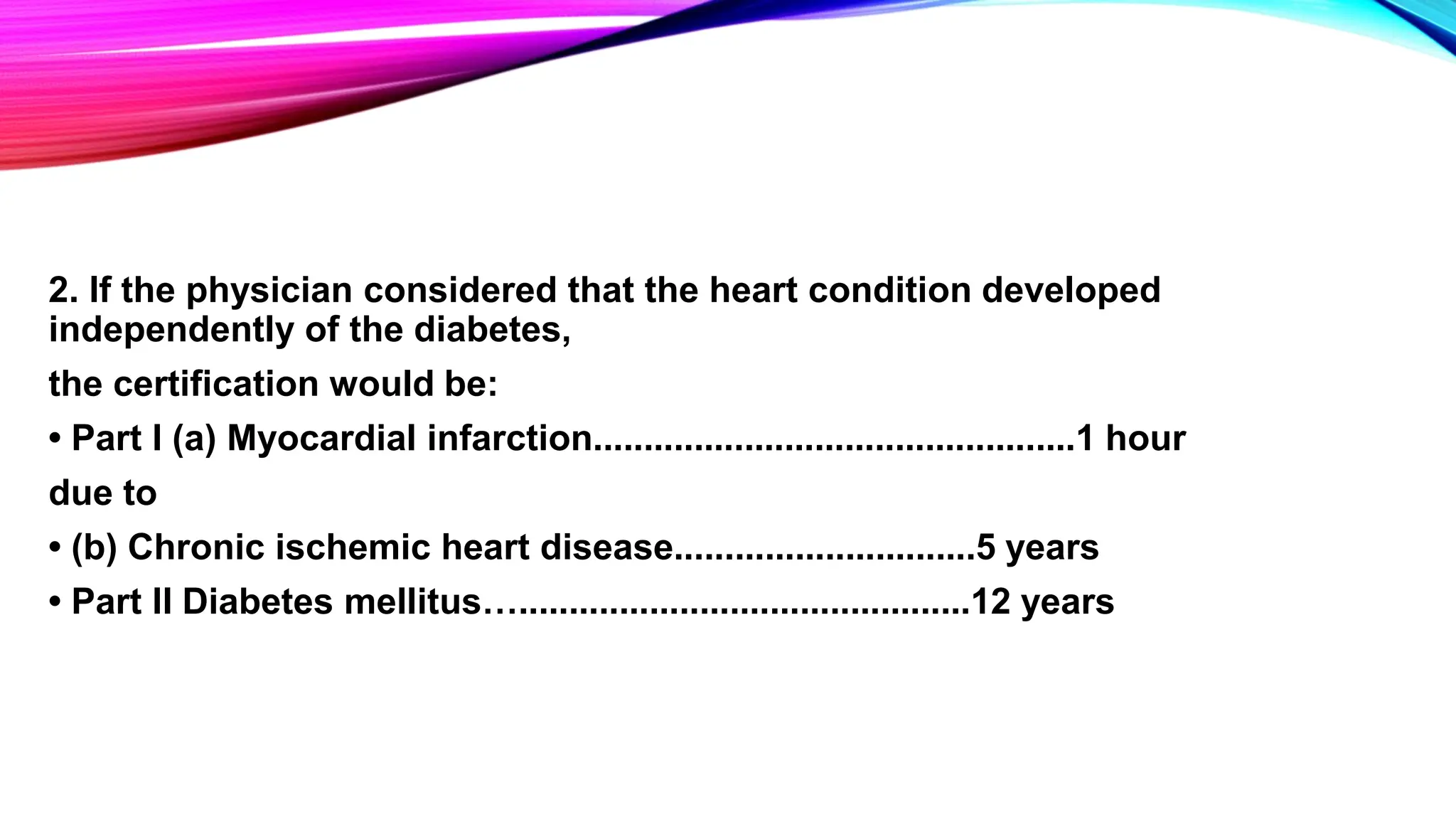
2. If the physician considered that the heart condition developed
independently of the diabetes,
the certification would be:
• Part I (a) Myocardial infarction................................................1 hour
due to
• (b) Chronic ischemic heart disease..............................5 years
• Part II Diabetes mellitus….............................................12 years
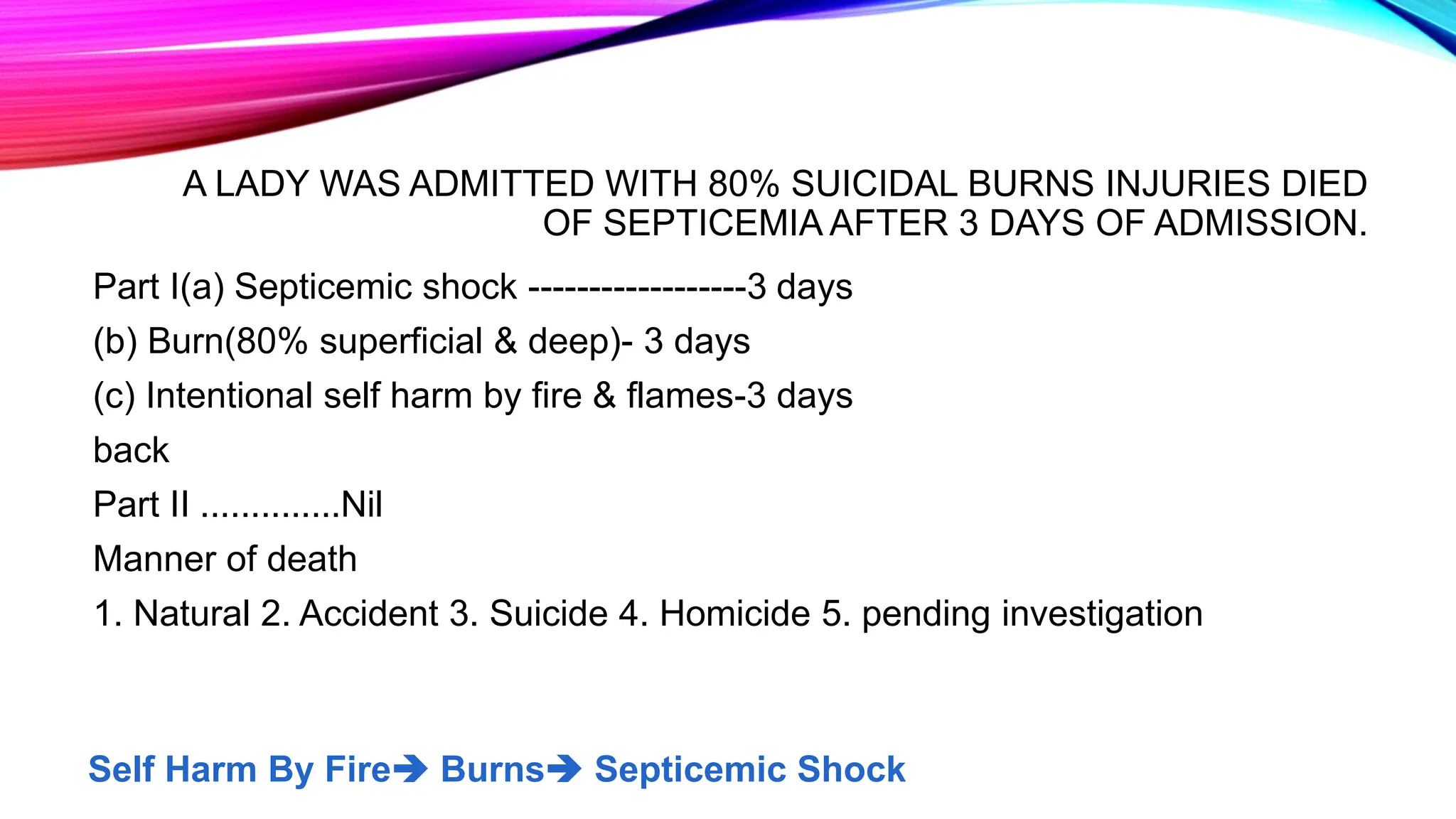
A LADY WAS ADMITTED WITH 80% SUICIDAL BURNS INJURIES DIED
OF SEPTICEMIA AFTER 3 DAYS OF ADMISSION.
Part I(a) Septicemic shock ------------------3 days
(b) Burn(80% superficial & deep)- 3 days
(c) Intentional self harm by fire & flames-3 days
back
Part II ..............Nil
Manner of death
1. Natural 2. Accident 3. Suicide 4. Homicide 5. pending investigation
Self Harm By Fire Burns Septicemic Shock
CASE
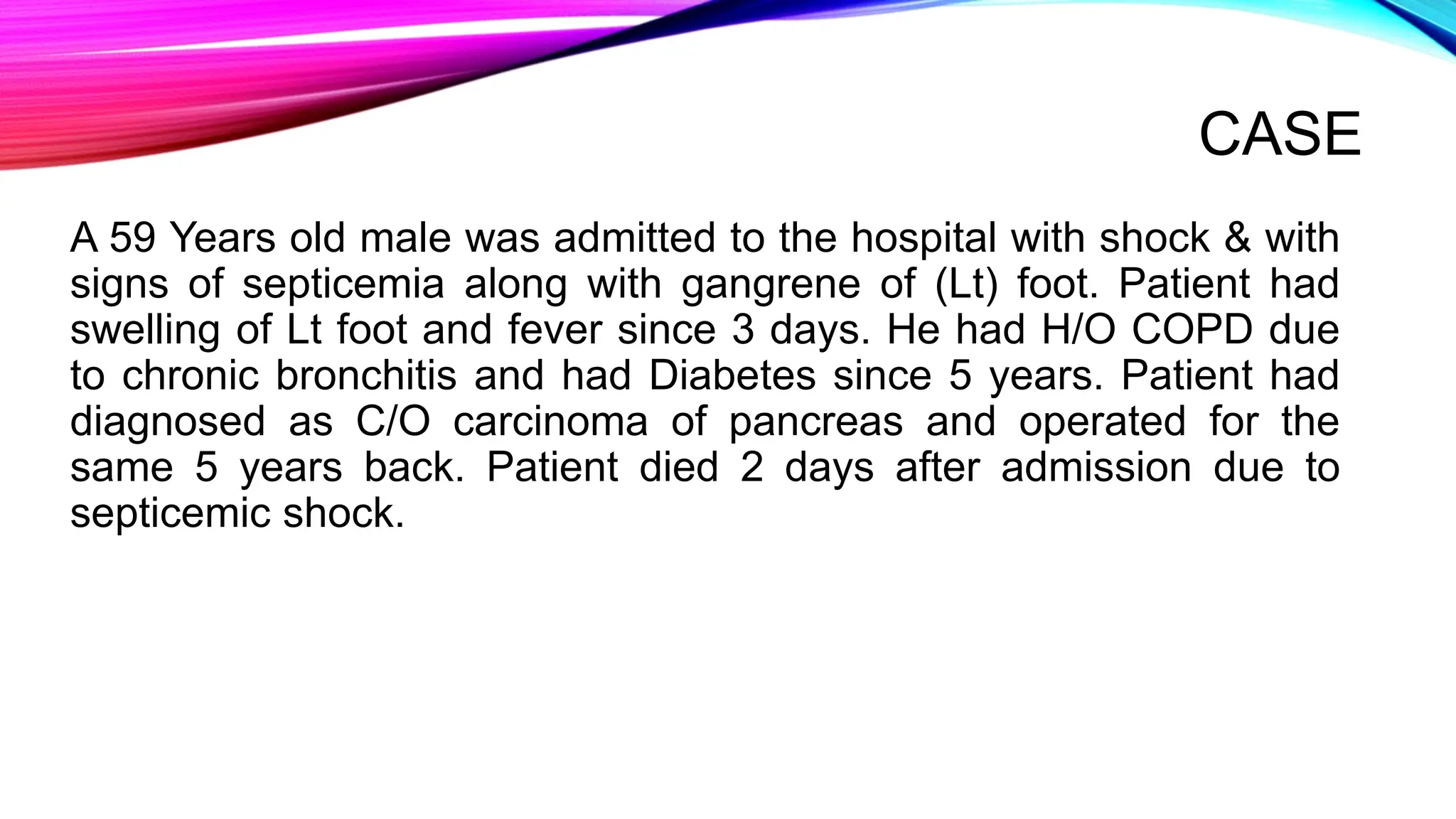
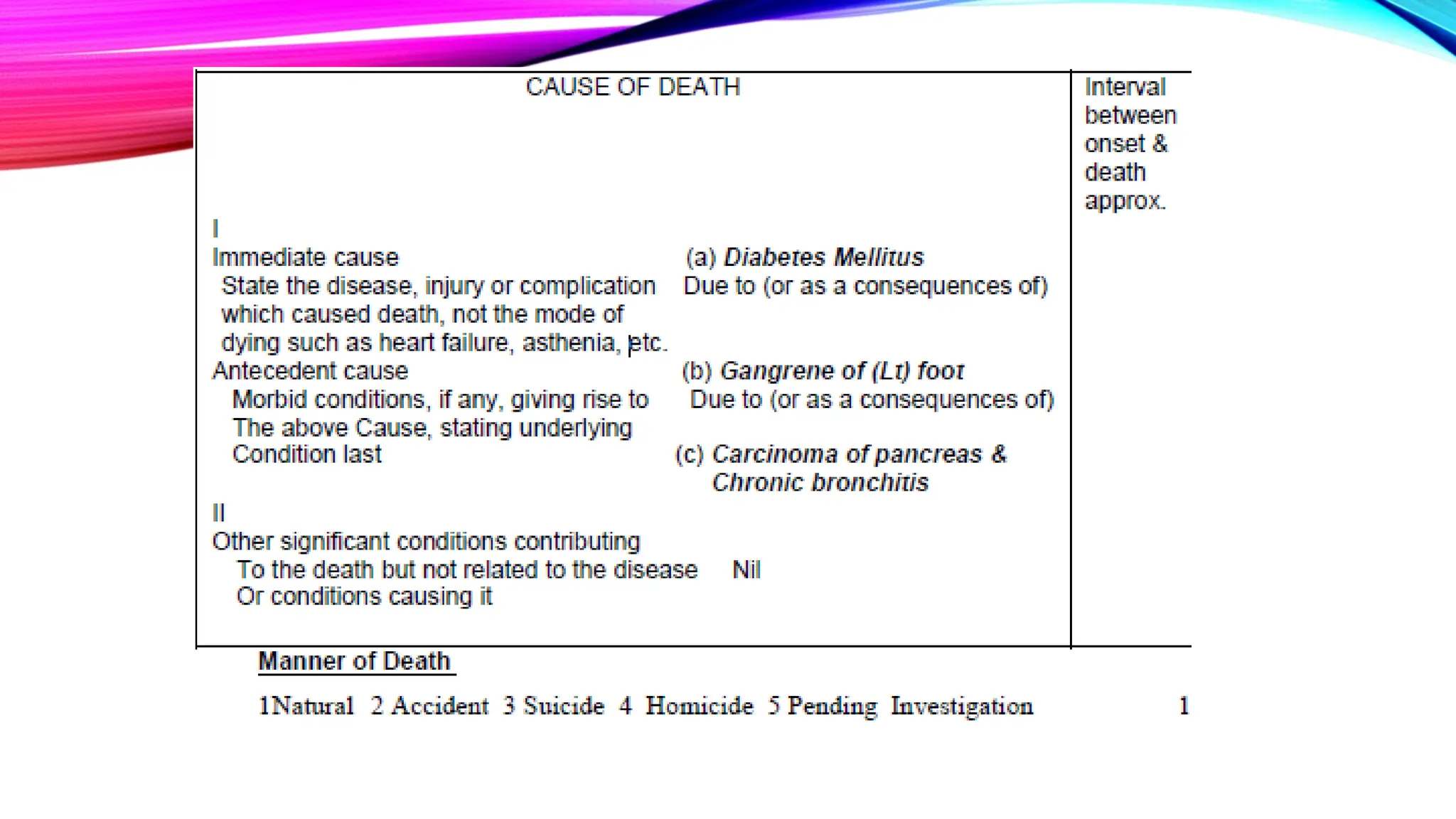
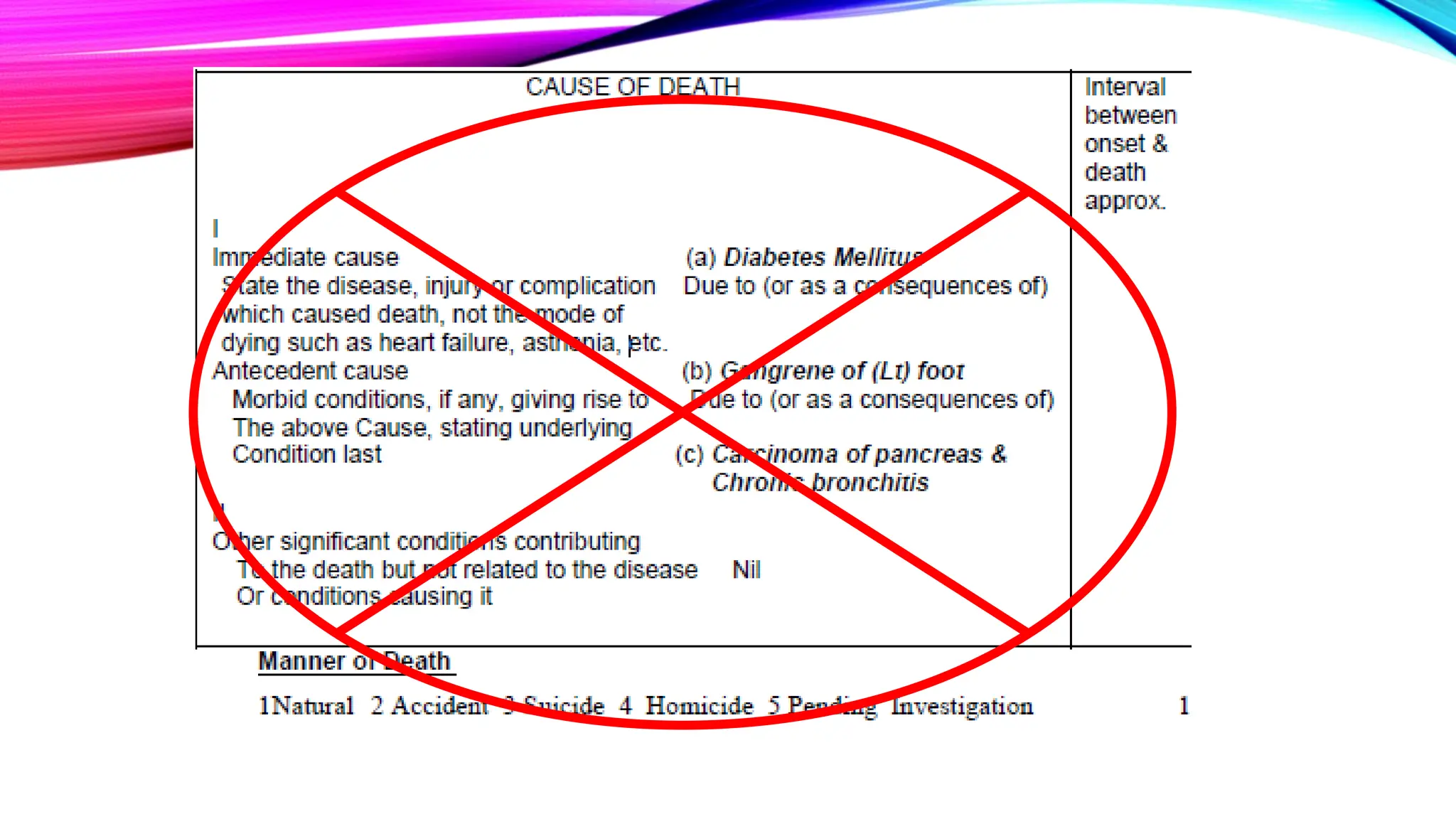
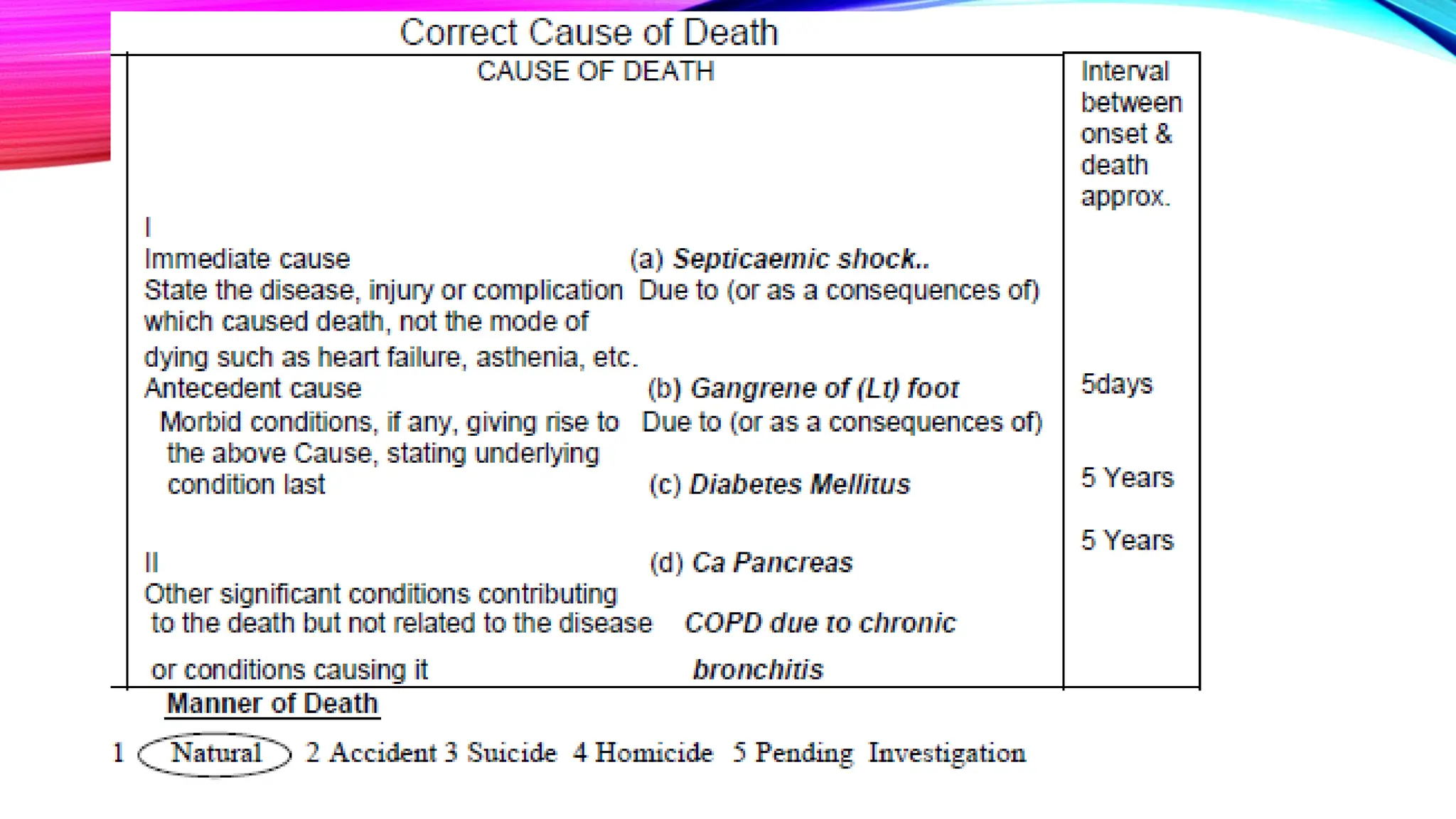
A 59 Years old male was admitted to the hospital with shock & with
signs of septicemia along with gangrene of (Lt) foot. Patient had
swelling of Lt foot and fever since 3 days. He had H/O COPD due
to chronic bronchitis and had Diabetes since 5 years. Patient had
diagnosed as C/O carcinoma of pancreas and operated for the
same 5 years back. Patient died 2 days after admission due to
septicemic shock.
CASE
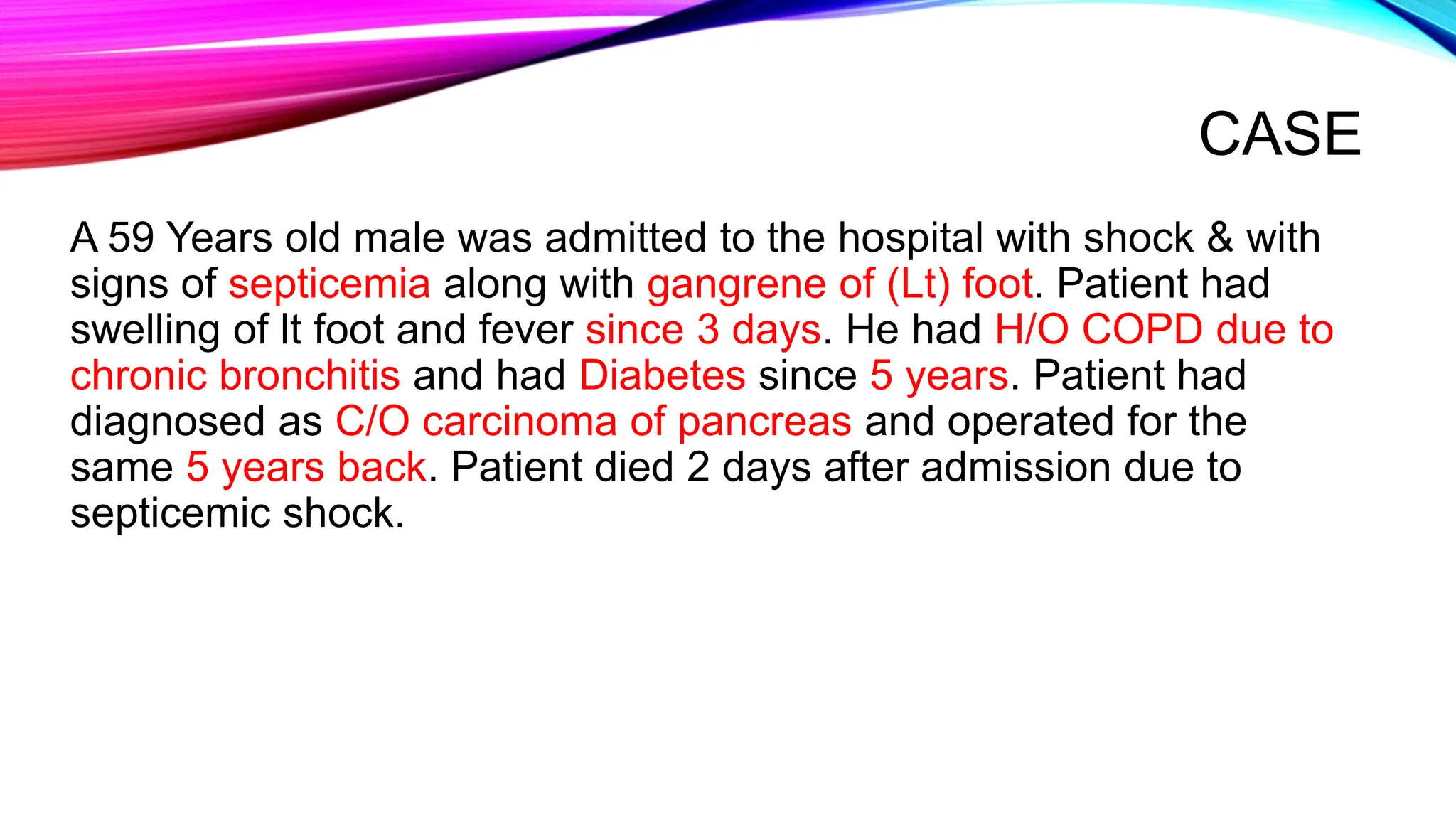
A 59 Years old male was admitted to the hospital with shock & with
signs of septicemia along with gangrene of (Lt) foot. Patient had
swelling of lt foot and fever since 3 days. He had H/O COPD due to
chronic bronchitis and had Diabetes since 5 years. Patient had
diagnosed as C/O carcinoma of pancreas and operated for the
same 5 years back. Patient died 2 days after admission due to
septicemic shock.
CASE
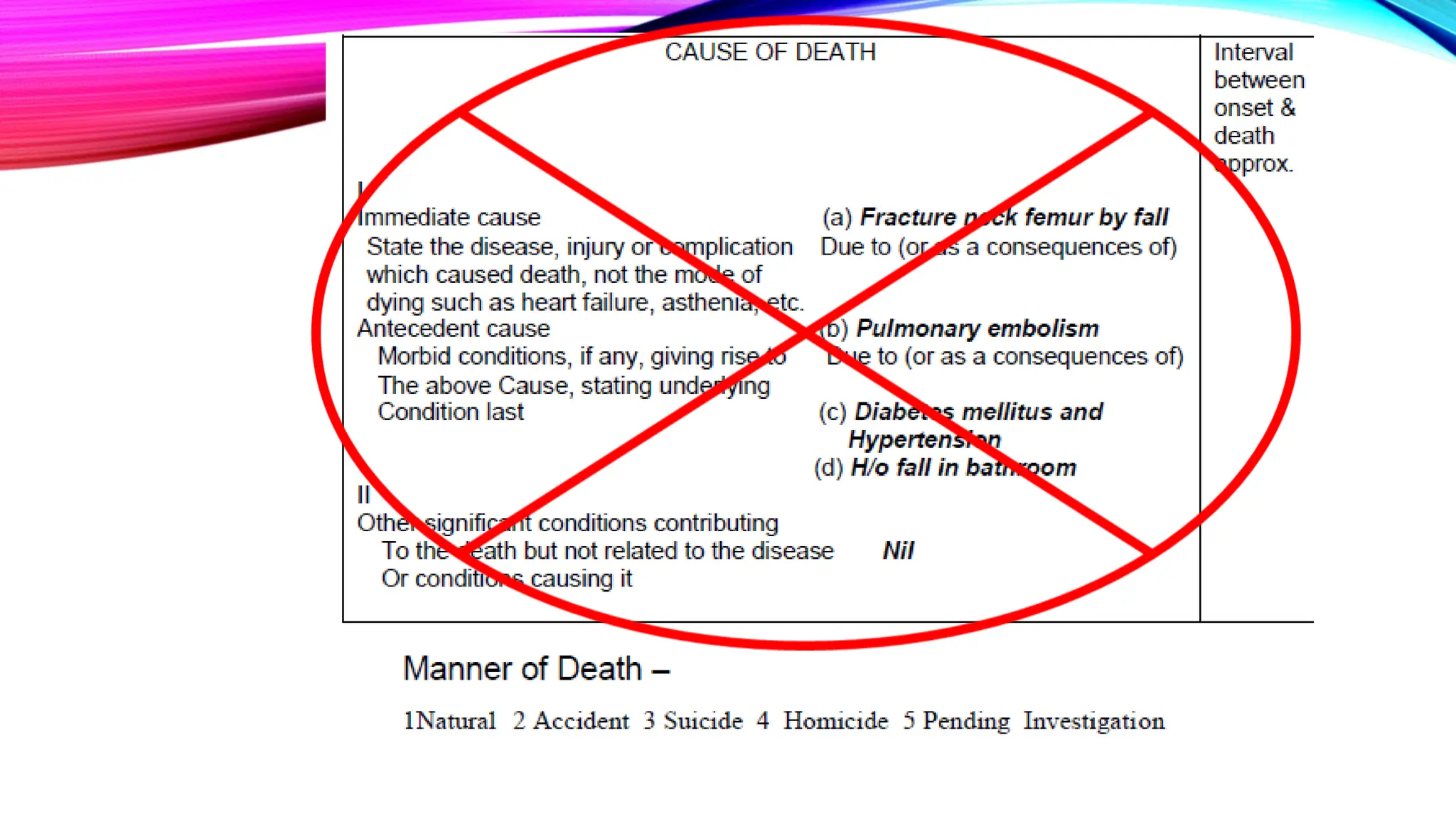
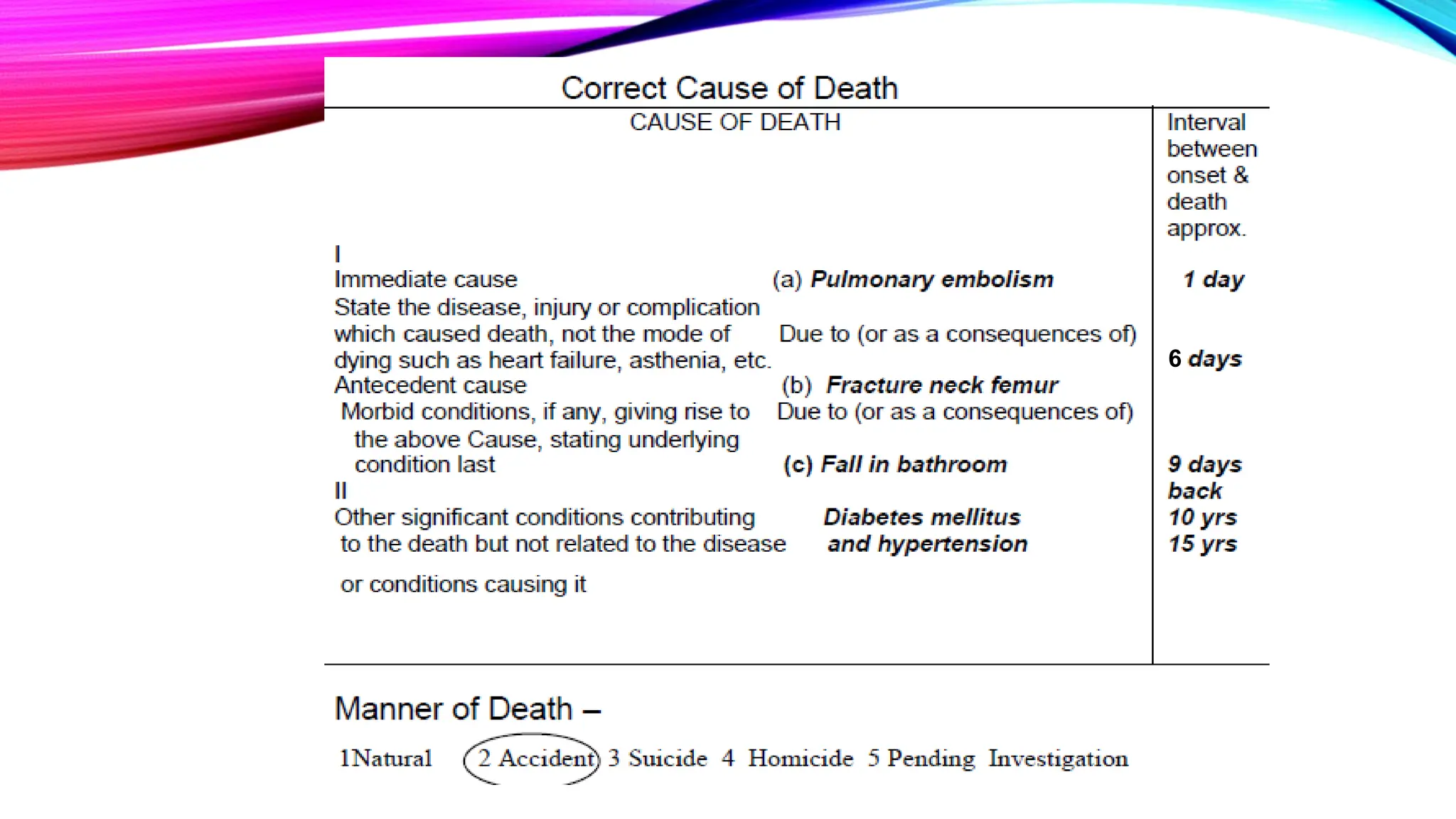
70 years old female was admitted to the hospital for
fracture neck femur 6 hours back due to fall in a
bathroom. She was known diabetic since 10 years and
hypertensive since 15 years. Open reduction of the
fracture was advised but operation was delayed for
fitness, as BSL was not within normal limits. On 6th day,
patient deteriorated becoming severely breathless and
had sudden collapse showing signs of pulmonary
embolism. Patient died after 5 hours
CASE
• 70 years old female was admitted to the hospital for
fracture neck femur 6 days back due to fall in a bathroom
2 days back. She was known diabetic since 10 years and
hypertensive since 15 years. Open reduction of the
fracture was advised but operation was delayed for
fitness, as BSL was not within normal limits. On 6th day
patient deteriorated becoming severe breathless and had
sudden collapse showing signs of pulmonary embolism.
Patient died within hours
6
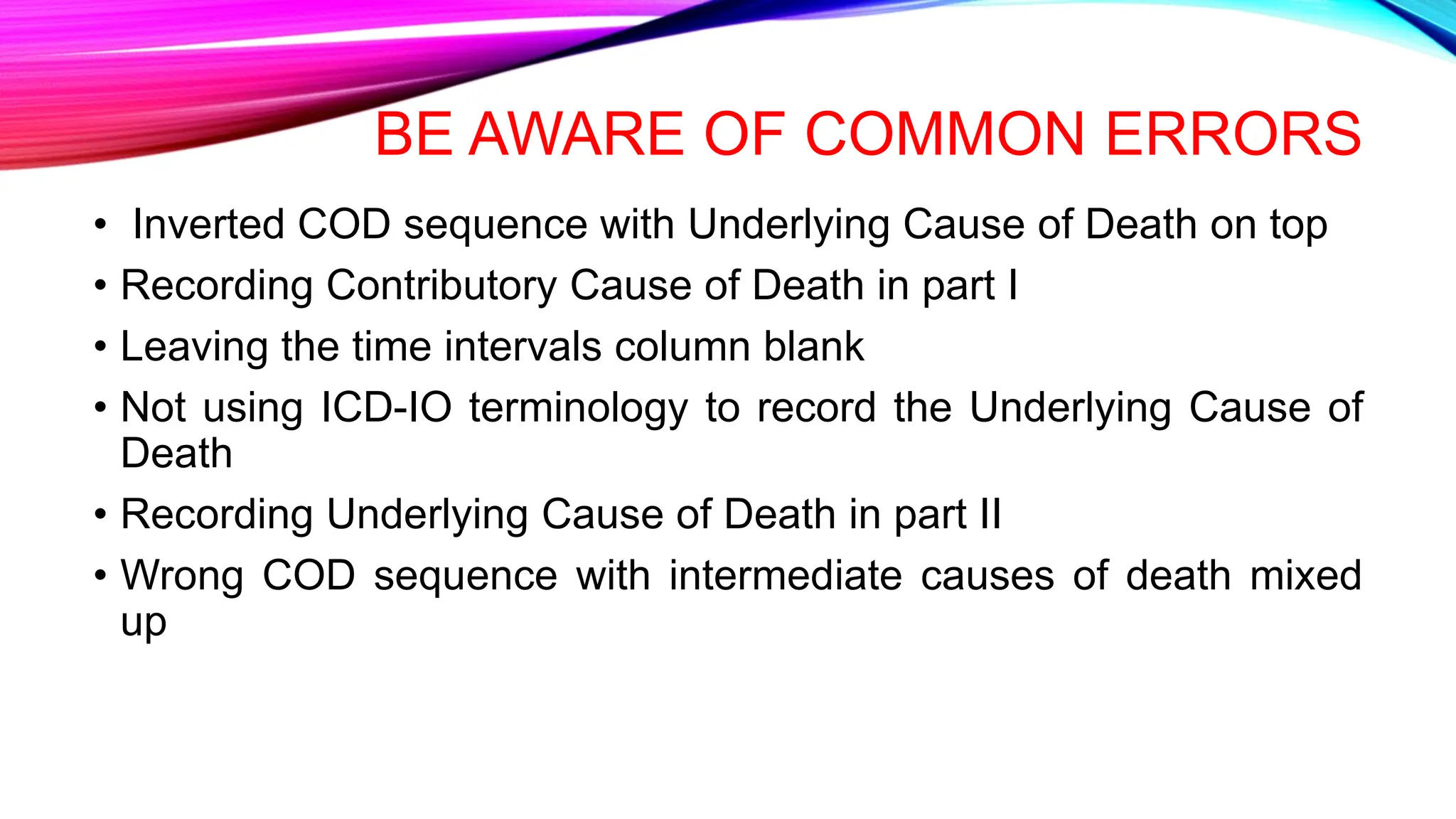
BE AWARE OF COMMON ERRORS
• Inverted COD sequence with Underlying Cause of Death on top
• Recording Contributory Cause of Death in part I
• Leaving the time intervals column blank
• Not using ICD-IO terminology to record the Underlying Cause of
Death
• Recording Underlying Cause of Death in part II
• Wrong COD sequence with intermediate causes of death mixed
up
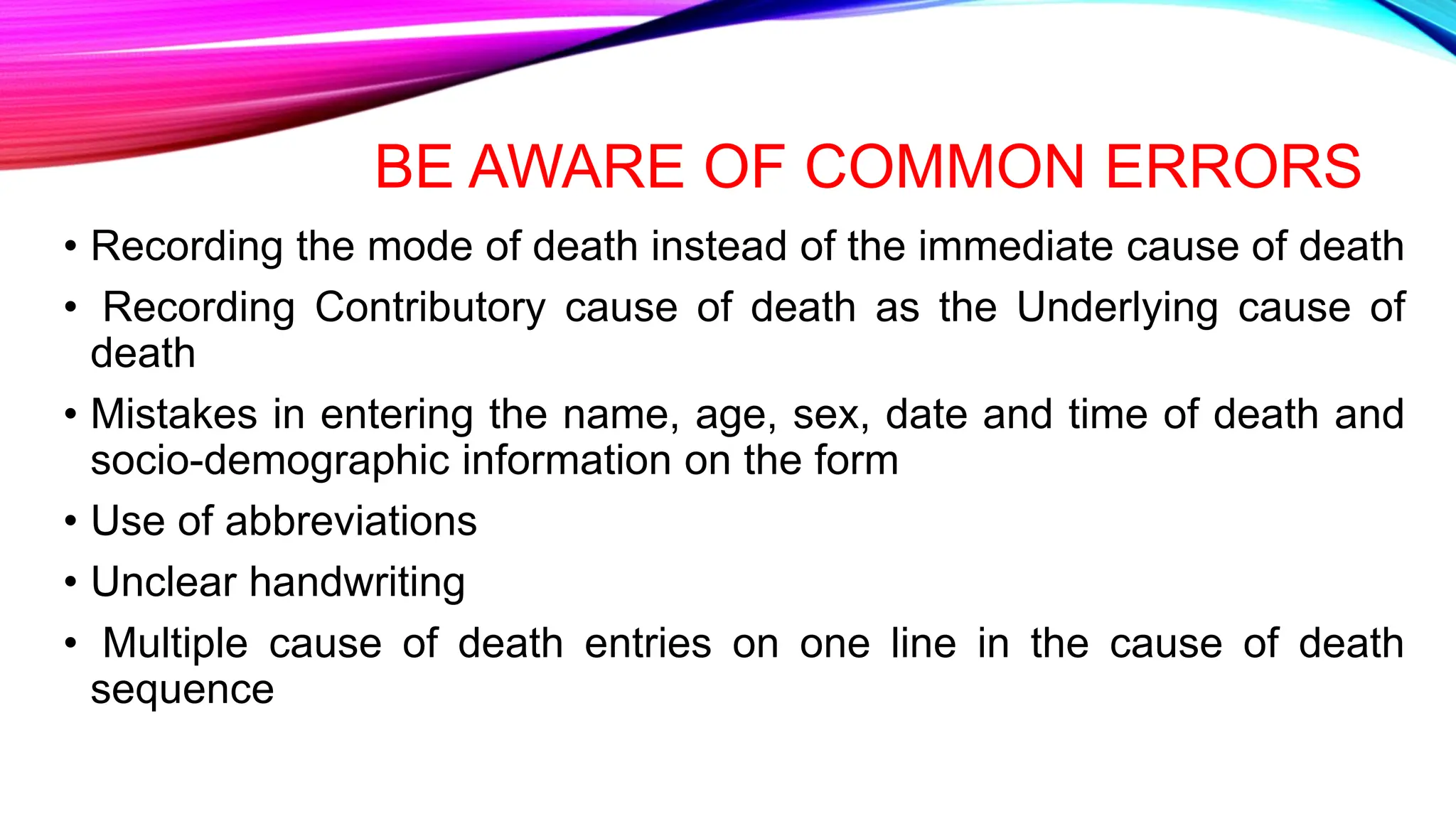
BE AWARE OF COMMON ERRORS
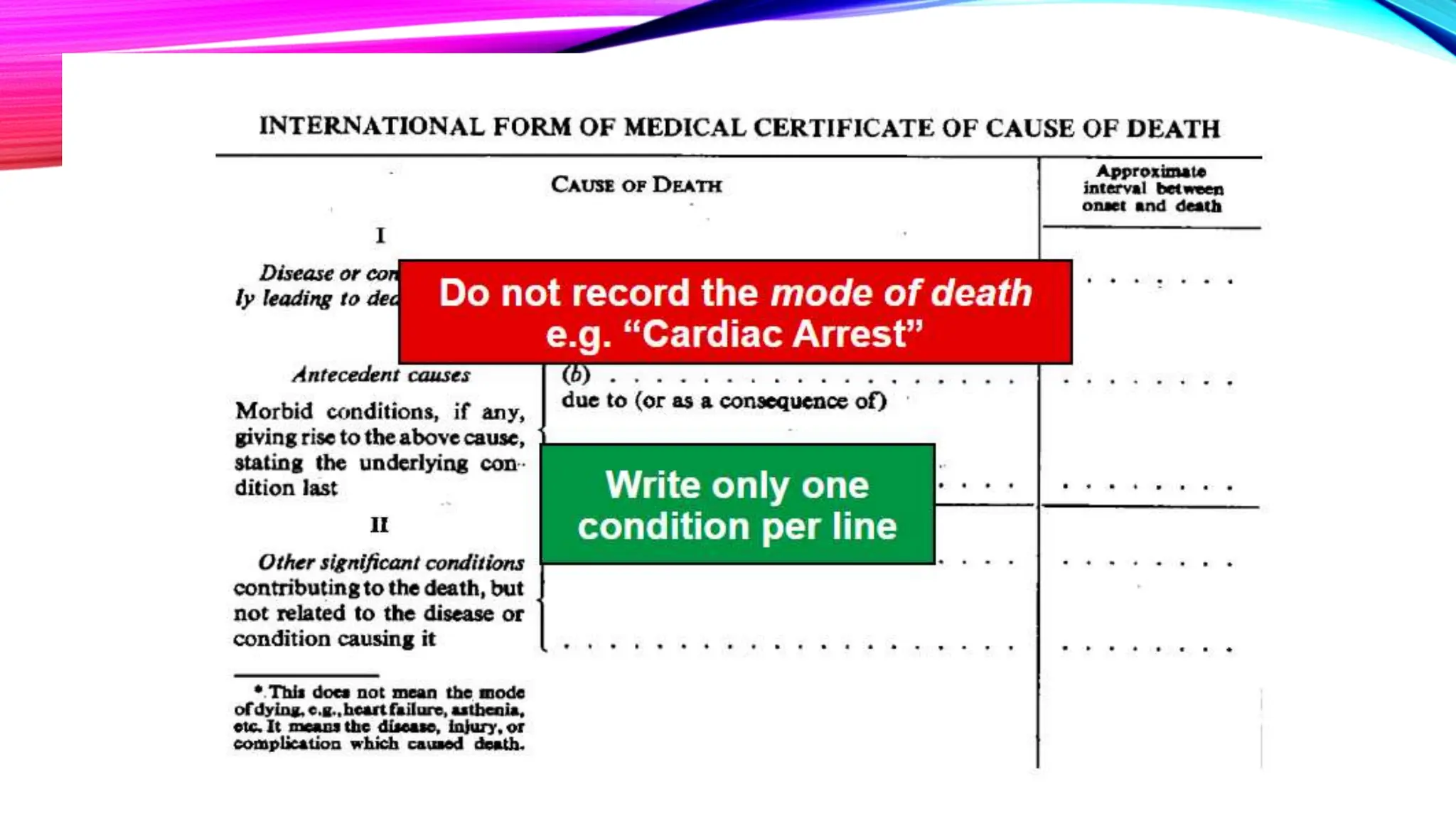
• Recording the mode of death instead of the immediate cause of death
• Recording Contributory cause of death as the Underlying cause of
death
• Mistakes in entering the name, age, sex, date and time of death and
socio-demographic information on the form
• Use of abbreviations
• Unclear handwriting
• Multiple cause of death entries on one line in the cause of death
sequence
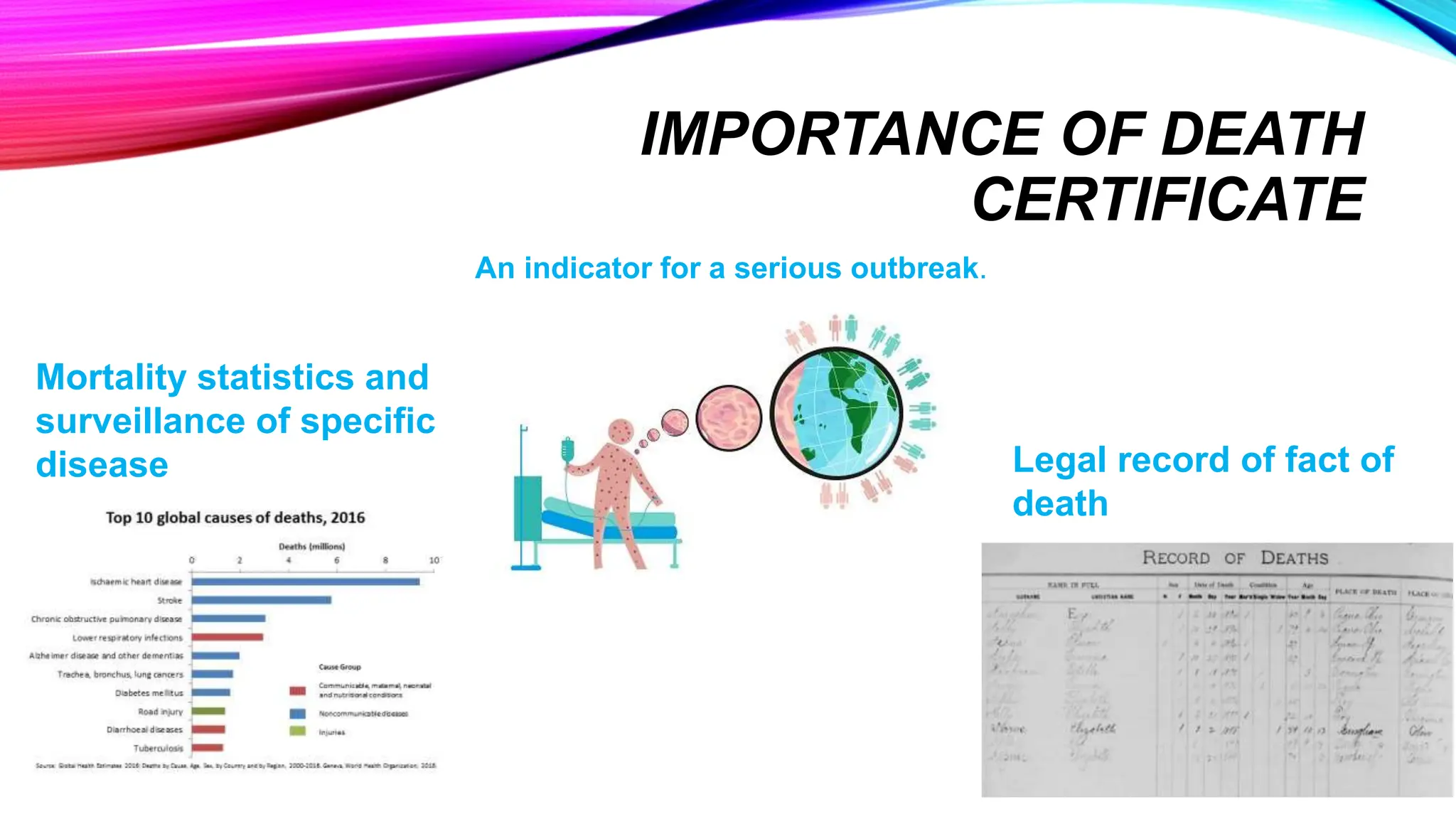
IMPORTANCE OF DEATH
CERTIFICATE
Mortality statistics and
surveillance of specific
disease
An indicator for a serious outbreak.
Legal record of fact of
death
LEGAL AND PROTECTIVE
USES
• For claiming family allowance
• Hospital reimbursement
• Life insurance claims
• Obtaining a probate or succession certificate
• Settling inheritance/property claims
• Releasing provident fund claims
• Deleting the deceased name from the Government and official documents.
• For public safety, accident prevention and eradication programs.
DUTY OF THE DOCTOR
• Who attended the person in last 7 days.
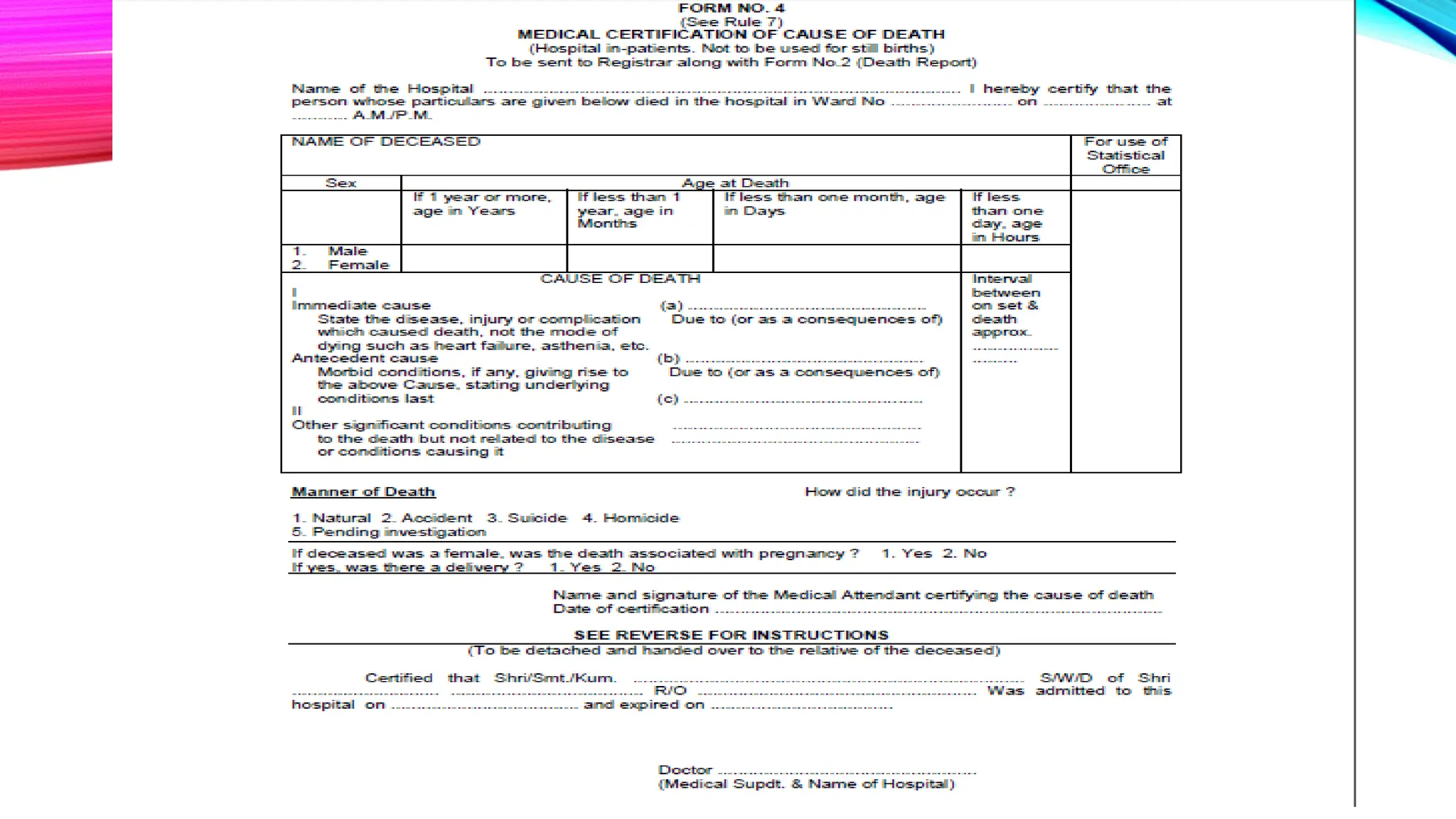
• Fill the prescribed format form 4.
• should not sign medical certificate of cause of death in advance
• No refusal / no delay.
• No fee.
• Forward to the registering authority.
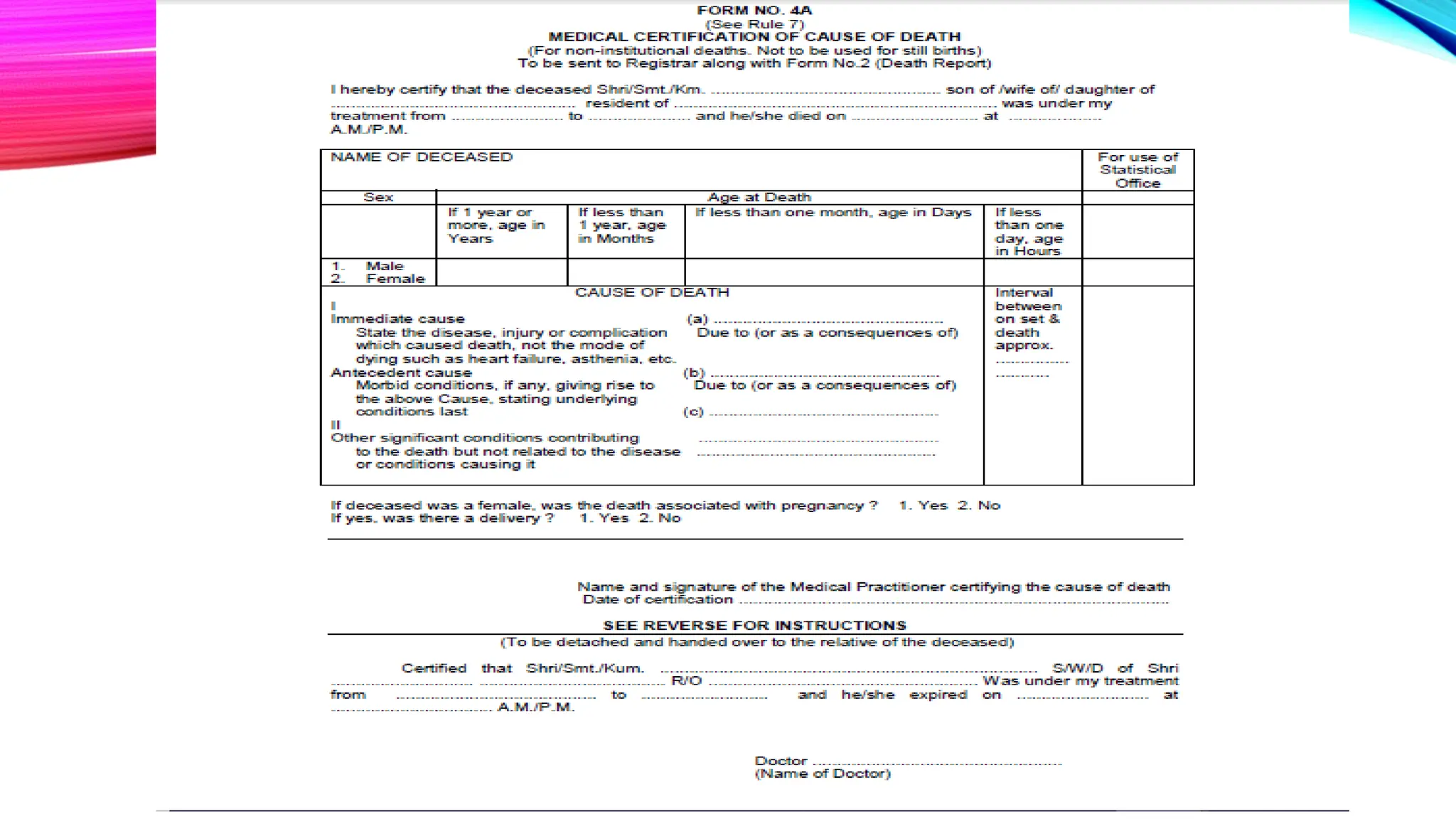
• The death report (Form 2) and MCCD (Form 4/4A) should reach the registrar with in
14 days of occurrence of death.
• Symptomatology or modes of death should not be recorded as cause of death
without mentioning the underlying pathological cause
WHEN NOT TO ISSUE
1. The injured is brought dead
2. A crime has already been registering by the police.
3. The police has already been informed about the case.
4. The cause of death is unknown.
5. When the brought dead is not examined or seen by doctor within
14 days.
Thank you

Death Certification.pptx. MCCD ICD FORMS

  • 1.
    MEDICAL CERTIFICATION OF CAUSE OFDEATH(MCCD) DRVARUNMODGIL,ASST PROF DEPTTOFFORENSICMEDICINE DAYANANDMEDICALCOLLGE
  • 2.
    DEATH… “Complete, permanent andirreversible stoppage of respiration, circulation and brain functions” Legal definition: (under section 46 IPC=s. 2(6) B.N.S 2023) “Permanent disappearance of all Evidence of life at any time after live-birth has taken place” (Section 2(b) of “The registration of births and deaths act, 1969”)
  • 3.
  • 4.
    Brain Death: Beating heart, Breathingby artificial means, absence of encephalic electrical activity. criteria for brain death.. Philadelphia protocol(1969) Minnesota criteria(1971) Harvard Criteria(1968)
  • 5.
    CIRCULATION TESTS •Magnus test •Diaphanoustest •I card's test •Finger nail test •Application of heat •Cutting a small artery •ECG
  • 6.
    RESPIRATION STOPPAGE TEST Apnoeatest Winslow test Stethoscope Mirror test
  • 7.
    BRAIN-STEM DEATH CERTIFICATION Pupillary reflex Oculocephalicreflex Vestibulo ocular reflex(caloric response) Corneal reflex Grimace reflex Gag reflex
  • 9.
    REGISTRATION OF BIRTH& DEATHS ACT (RBD), 1969 Death certification IMP PROVISIONS •Section 10(3) •Section 17(1)
  • 10.
    WHAT IS DEATHCERTIFICATION? •Death is not a moment •Medical Certification of Cause of Death Scheme is an important tool of obtaining authentic and scientific information regarding causes of mortality
  • 11.
    SHOULD KNOW… • Causeof death • Underlying cause of death • Mechanism of death • Manner of death • Mode of death
  • 12.
    CAUSE OF DEATH •The cause of death is a disease, abnormality, injury or poisoning that contributed directly or indirectly to death • Any circumstances of the accident or violence which produced any such injuries which is directly leading cause of Death Chronic Ischemic Heart Disease Acute Myocardial Infarction Pulmonary Embolism CHAIN OF EVENTS
  • 13.
    UNDERLYING CAUSE OFDEATH • The disease or injury that initiated the chain of morbid events leading directly to death. • The circumstances of the accident or violence which produced the fatal injury Pedestrian Hit By Truck Multiple Fracture fat embolism
  • 14.
    MECHANISM OF DEATH •Physiologicalor biochemical derangement produced by the cause of death that results in death •Hemorrhage, Septicemia, And Cardiac Arrhythmia
  • 15.
    MANNER OF DEATH Itis way, fashion or circumstances of death. Natural– when due to disease • Cardiovascular condition e.g. MI • Respiratory condition e.g. Asthma, COPD • Tumor of brain with sudden hemorrhage • Tumor of brain producing pressure • Metabolic disorders e.g. uremia
  • 16.
    Unnatural • Accidental headinjuries e.g. RTA • Homicidal head injuries e.g. stab, lacerated, incised, firearm • Suicidal head injuries e.g. firearm injury • Poisoning e.g. Opium, alcohol
  • 17.
    MODE OF DEATH Itis stoppage or failure of vital system • Coma :- failure of function of brain • Syncope :- failure of function of heart • Asphyxia :- failure of function of respiratory system
  • 21.
    --KEY STEPS-- STEP 1: ALWAYSread the case history and note the key events and conditions. Don’t forget to consider signs and symptoms as well as negative symptoms STEP 2: ALWAYS establish a chronology of conditions which will list out the all disease and events in the order in which they occurred before death
  • 22.
    STEP 3: ALWAYS determinethe underlying cause of death(COD) which is the disease or injury that started the chains of the events the lead to death of the individual Remember to always check which disease, injury or event came first STEP 4: ALWAYS try to use ICD- 10 terminology, which is clear and universally accepted, when recording the underlying COD This also help avoid confusion between similar terms and abbreviations
  • 23.
    A DIABETIC MANWHO HAD BEEN UNDER INSULIN CONTROL FOR MANY YEARS DEVELOPED ISCHEMIC HEART DISEASE AND DIED SUDDENLY FROM A MYOCARDIAL INFARCTION. DEPENDING ON THE PHYSICIAN’S DOCUMENTED MEDICAL DIAGNOSIS, THE FOLLOWING CERTIFICATIONS ARE POSSIBLE AND WOULD BE ACCEPTABLE: : 1. If the physician considered that the heart condition resulted from the long- standing diabetes, the sequence would be: • Part I (a) Myocardial infarction..........................1 hour due to • (b) Chronic ischemic heart disease..........5 years due to • (c) Diabetes mellitus..............................12 years
  • 24.
    2. If thephysician considered that the heart condition developed independently of the diabetes, the certification would be: • Part I (a) Myocardial infarction................................................1 hour due to • (b) Chronic ischemic heart disease..............................5 years • Part II Diabetes mellitus….............................................12 years
  • 25.
    A LADY WASADMITTED WITH 80% SUICIDAL BURNS INJURIES DIED OF SEPTICEMIA AFTER 3 DAYS OF ADMISSION. Part I(a) Septicemic shock ------------------3 days (b) Burn(80% superficial & deep)- 3 days (c) Intentional self harm by fire & flames-3 days back Part II ..............Nil Manner of death 1. Natural 2. Accident 3. Suicide 4. Homicide 5. pending investigation Self Harm By Fire Burns Septicemic Shock
  • 26.
    CASE A 59 Yearsold male was admitted to the hospital with shock & with signs of septicemia along with gangrene of (Lt) foot. Patient had swelling of Lt foot and fever since 3 days. He had H/O COPD due to chronic bronchitis and had Diabetes since 5 years. Patient had diagnosed as C/O carcinoma of pancreas and operated for the same 5 years back. Patient died 2 days after admission due to septicemic shock.
  • 29.
    CASE A 59 Yearsold male was admitted to the hospital with shock & with signs of septicemia along with gangrene of (Lt) foot. Patient had swelling of lt foot and fever since 3 days. He had H/O COPD due to chronic bronchitis and had Diabetes since 5 years. Patient had diagnosed as C/O carcinoma of pancreas and operated for the same 5 years back. Patient died 2 days after admission due to septicemic shock.
  • 31.
    CASE 70 years oldfemale was admitted to the hospital for fracture neck femur 6 hours back due to fall in a bathroom. She was known diabetic since 10 years and hypertensive since 15 years. Open reduction of the fracture was advised but operation was delayed for fitness, as BSL was not within normal limits. On 6th day, patient deteriorated becoming severely breathless and had sudden collapse showing signs of pulmonary embolism. Patient died after 5 hours
  • 33.
    CASE • 70 yearsold female was admitted to the hospital for fracture neck femur 6 days back due to fall in a bathroom 2 days back. She was known diabetic since 10 years and hypertensive since 15 years. Open reduction of the fracture was advised but operation was delayed for fitness, as BSL was not within normal limits. On 6th day patient deteriorated becoming severe breathless and had sudden collapse showing signs of pulmonary embolism. Patient died within hours
  • 34.
  • 35.
    BE AWARE OFCOMMON ERRORS • Inverted COD sequence with Underlying Cause of Death on top • Recording Contributory Cause of Death in part I • Leaving the time intervals column blank • Not using ICD-IO terminology to record the Underlying Cause of Death • Recording Underlying Cause of Death in part II • Wrong COD sequence with intermediate causes of death mixed up
  • 36.
    BE AWARE OFCOMMON ERRORS • Recording the mode of death instead of the immediate cause of death • Recording Contributory cause of death as the Underlying cause of death • Mistakes in entering the name, age, sex, date and time of death and socio-demographic information on the form • Use of abbreviations • Unclear handwriting • Multiple cause of death entries on one line in the cause of death sequence
  • 37.
    IMPORTANCE OF DEATH CERTIFICATE Mortalitystatistics and surveillance of specific disease An indicator for a serious outbreak. Legal record of fact of death
  • 38.
    LEGAL AND PROTECTIVE USES •For claiming family allowance • Hospital reimbursement • Life insurance claims • Obtaining a probate or succession certificate • Settling inheritance/property claims • Releasing provident fund claims • Deleting the deceased name from the Government and official documents. • For public safety, accident prevention and eradication programs.
  • 39.
    DUTY OF THEDOCTOR • Who attended the person in last 7 days. • Fill the prescribed format form 4. • should not sign medical certificate of cause of death in advance • No refusal / no delay. • No fee. • Forward to the registering authority. • The death report (Form 2) and MCCD (Form 4/4A) should reach the registrar with in 14 days of occurrence of death. • Symptomatology or modes of death should not be recorded as cause of death without mentioning the underlying pathological cause
  • 40.
    WHEN NOT TOISSUE 1. The injured is brought dead 2. A crime has already been registering by the police. 3. The police has already been informed about the case. 4. The cause of death is unknown. 5. When the brought dead is not examined or seen by doctor within 14 days.
  • 41.