Addressing
Imbalanced Data Sets
A.NAGAVARTHINI
M.Sc CS II -Year
Understanding Imbalanced Data Sets
Imbalanced data sets occur when the distribution of classes in the
data is not equal. This can be a common problem in many real-world
scenarios, such as fraud detection or medical diagnosis, where the
minority class is of particular interest.
In an imbalanced data set, the model may have a bias towards the
majority class, leading to poor performance on the minority class. It is
important to address this issue to achieve better model performance.
Impact on Model Performance
Biased Model Performance
Imbalanced data sets can lead to biased models that favor the majority
class, resulting in poor performance on the minority class.
Poor Predictive Power
Models trained on imbalanced data sets may have poor predictive power,
as they may not be able to capture the subtle patterns in the minority
class.
Sampling Techniques
Random Under-Sampling (RUS)
This technique randomly removes examples from the majority class to balance the data set.
Random Over-Sampling (ROS)
This technique randomly duplicates examples from the minority class to balance the data
set.
Synthetic Minority Over-Sampling Technique (SMOTE)
This technique creates synthetic examples of the minority class by interpolating between
existing examples.
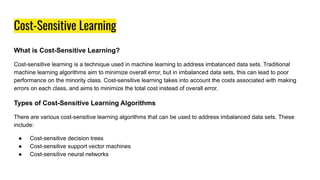
Cost-Sensitive Learning
What is Cost-Sensitive Learning?
Cost-sensitive learning is a technique used in machine learning to address imbalanced data sets. Traditional
machine learning algorithms aim to minimize overall error, but in imbalanced data sets, this can lead to poor
performance on the minority class. Cost-sensitive learning takes into account the costs associated with making
errors on each class, and aims to minimize the total cost instead of overall error.
Types of Cost-Sensitive Learning Algorithms
There are various cost-sensitive learning algorithms that can be used to address imbalanced data sets. These
include:
● Cost-sensitive decision trees
● Cost-sensitive support vector machines
● Cost-sensitive neural networks
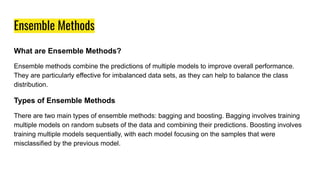
Ensemble Methods
What are Ensemble Methods?
Ensemble methods combine the predictions of multiple models to improve overall performance.
They are particularly effective for imbalanced data sets, as they can help to balance the class
distribution.
Types of Ensemble Methods
There are two main types of ensemble methods: bagging and boosting. Bagging involves training
multiple models on random subsets of the data and combining their predictions. Boosting involves
training multiple models sequentially, with each model focusing on the samples that were
misclassified by the previous model.
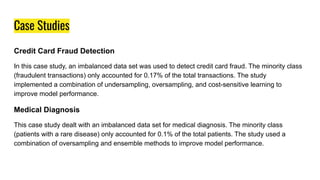
Case Studies
Credit Card Fraud Detection
In this case study, an imbalanced data set was used to detect credit card fraud. The minority class
(fraudulent transactions) only accounted for 0.17% of the total transactions. The study
implemented a combination of undersampling, oversampling, and cost-sensitive learning to
improve model performance.
Medical Diagnosis
This case study dealt with an imbalanced data set for medical diagnosis. The minority class
(patients with a rare disease) only accounted for 0.1% of the total patients. The study used a
combination of oversampling and ensemble methods to improve model performance.

Dealing with imbalanced data sets.pdf

  • 1.
  • 2.
    Understanding Imbalanced DataSets Imbalanced data sets occur when the distribution of classes in the data is not equal. This can be a common problem in many real-world scenarios, such as fraud detection or medical diagnosis, where the minority class is of particular interest. In an imbalanced data set, the model may have a bias towards the majority class, leading to poor performance on the minority class. It is important to address this issue to achieve better model performance.
  • 3.
    Impact on ModelPerformance Biased Model Performance Imbalanced data sets can lead to biased models that favor the majority class, resulting in poor performance on the minority class. Poor Predictive Power Models trained on imbalanced data sets may have poor predictive power, as they may not be able to capture the subtle patterns in the minority class.
  • 4.
    Sampling Techniques Random Under-Sampling(RUS) This technique randomly removes examples from the majority class to balance the data set. Random Over-Sampling (ROS) This technique randomly duplicates examples from the minority class to balance the data set. Synthetic Minority Over-Sampling Technique (SMOTE) This technique creates synthetic examples of the minority class by interpolating between existing examples.
  • 5.
    Cost-Sensitive Learning What isCost-Sensitive Learning? Cost-sensitive learning is a technique used in machine learning to address imbalanced data sets. Traditional machine learning algorithms aim to minimize overall error, but in imbalanced data sets, this can lead to poor performance on the minority class. Cost-sensitive learning takes into account the costs associated with making errors on each class, and aims to minimize the total cost instead of overall error. Types of Cost-Sensitive Learning Algorithms There are various cost-sensitive learning algorithms that can be used to address imbalanced data sets. These include: ● Cost-sensitive decision trees ● Cost-sensitive support vector machines ● Cost-sensitive neural networks
  • 6.
    Ensemble Methods What areEnsemble Methods? Ensemble methods combine the predictions of multiple models to improve overall performance. They are particularly effective for imbalanced data sets, as they can help to balance the class distribution. Types of Ensemble Methods There are two main types of ensemble methods: bagging and boosting. Bagging involves training multiple models on random subsets of the data and combining their predictions. Boosting involves training multiple models sequentially, with each model focusing on the samples that were misclassified by the previous model.
  • 7.
    Case Studies Credit CardFraud Detection In this case study, an imbalanced data set was used to detect credit card fraud. The minority class (fraudulent transactions) only accounted for 0.17% of the total transactions. The study implemented a combination of undersampling, oversampling, and cost-sensitive learning to improve model performance. Medical Diagnosis This case study dealt with an imbalanced data set for medical diagnosis. The minority class (patients with a rare disease) only accounted for 0.1% of the total patients. The study used a combination of oversampling and ensemble methods to improve model performance.