Dealing with 'fit for purpose' obligation 
in International Arbitrations. 
R Venkata raghavan, FCIArb, MRICS 
LLM (UK), B.Eng., C.Eng., FCMA 
Chartered Engineer, Arbitrator and Chartered Surveyor 
NOVEMBER 8, 2014, NEW DELHI
Dealing with 'fit for purpose' obligation in Intl Arbitrations. 
What doest it mean? 
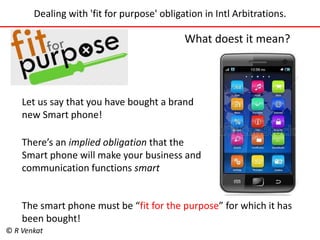
Let us say that you have bought a brand 
new Smart phone! 
There’s an implied obligation that the 
Smart phone will make your business and 
communication functions smart 
The smart phone must be “fit for the purpose” for which it has 
been bought! 
© R Venkat
Dealing with 'fit for purpose' obligation in Intl Arbitrations. 
‘Fit for Purpose’ is a Statutory requirement for Supply of goods in 
most of the jurisdictions. 
Sale of Goods Act 1979 of UK, states that 
"it is an implied term in any sale of goods contract that goods 
sold in the course of business are of reasonable quality and 
reasonably fit for their purpose". 
Other Common law jurisdictions: 
•Sale of Goods Act Cap 393, Singapore 
•Section 16 of Sale of Goods Act 1930, India 
Civil law jurisdictions: 
•Article 1604 of French Civil Code 
•Section 433 of German Civil Code 
© R Venkat
Dealing with 'fit for purpose' obligation in Intl Arbitrations. 
‘Fit for purpose’ in International Sale Contracts 
Governed by an international treaty – the United Nations Convention on 
Contracts for the International Sales of Goods (CISG). 
CISG will apply by default to any international contract for the sale of 
goods where the two parties are from different Contracting States. 
Article 35(2) of CISG states that: 
(2) Except where the parties have agreed otherwise, the goods do not 
conform with the contract unless they: 
(a) Are fit for the purposes for which goods of the same description 
would ordinarily be used. 
See New Zealand case Smallmon v Transport Sales & Anor 
© R Venkat
Dealing with 'fit for purpose' obligation in Intl Arbitrations. 
Know the difference! 
Under Common law, more particularly under English law, 'fit 
for purpose obligation' is treated differently for supply of 
goods and supply of services. 
Supply of services 
Architects 
Doctors 
Lawyers and 
Accountants 
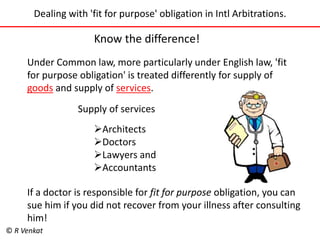
If a doctor is responsible for fit for purpose obligation, you can 
sue him if you did not recover from your illness after consulting 
him! 
© R Venkat
Dealing with 'fit for purpose' obligation in Intl Arbitrations. 
The Service providers like doctors or architects are required to 
exercise 'reasonable skill and care' while undertaking their 
work/design. 
The design must only meet the standard 
expected of a competent professional 
designer. 
This obligation is common for all service providers! 
(Architects, Engineers, Doctors and even lawyers!) 
Supply of Goods and Services Act 1982 of UK. 
Do you remember the famous case of Bolam v Friern Hospital 
Management Committee and is often referred to as the 'Bolam 
principle'. 
© R Venkat
Dealing with 'fit for purpose' obligation in Intl Arbitrations. 
Obligation under Construction Contracts 
In build only (like FIDIC Red book) 
Construction Contracts, the 
Contractor must ensure that the 
goods supplied and installed are 
meeting the 'fit for purpose' 
obligations, since he is responsible 
for the quality of the goods 
supplied. 
© R Venkat
Dealing with 'fit for purpose' obligation in Intl Arbitrations. 
Obligation under Construction Contracts 
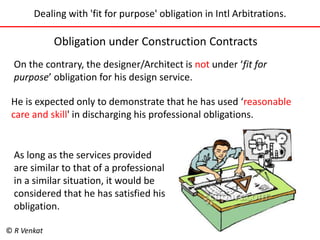
On the contrary, the designer/Architect is not under ‘fit for 
purpose’ obligation for his design service. 
He is expected only to demonstrate that he has used ‘reasonable 
care and skill' in discharging his professional obligations. 
As long as the services provided 
are similar to that of a professional 
in a similar situation, it would be 
considered that he has satisfied his 
obligation. 
© R Venkat
Dealing with 'fit for purpose' obligation in Intl Arbitrations. 
Design & Build Contracts 
If the Contractor undertakes to do both design and build the 
works (like FIDIC Yellow book or Silver book), then he must 
ensure that the works are both designed and executed fulfilling 
the 'fit for purpose' obligations. 
Independent Broadcasting Authority v EMI Electronics Limited [1980] 
© R Venkat
Dealing with 'fit for purpose' obligation in Intl Arbitrations. 
Design & Build Contracts 
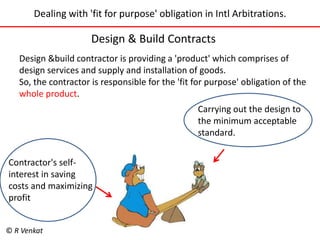
Design &build contractor is providing a 'product' which comprises of 
design services and supply and installation of goods. 
So, the contractor is responsible for the 'fit for purpose' obligation of the 
whole product. 
Contractor's self-interest 
in saving 
costs and maximizing 
profit 
Carrying out the design to 
the minimum acceptable 
standard. 
© R Venkat
Dealing with 'fit for purpose' obligation in Intl Arbitrations. 
Why the 'fit for purpose obligation' is unique? 
Fitness for purpose is a stricter and tougher obligation for the designer 
A reasonable skill and care obligation essentially requires an 
employer to prove that the designer has been negligent. 
In case of 'fit for purpose' obligations, the employer merely needs 
to prove that the completed building does not work as intended; 
there is no need to show that the design has been negligent. 
The professional indemnity insurance cover does not cover fit for 
purpose obligation and it only covers the negligence risk. 
© R Venkat
Dealing with 'fit for purpose' obligation in Intl Arbitrations. 
Is it an implied obligation? 
Yes! 
The Sale of Goods Act 1979 states that when it is obvious that 
the goods supplied are suitable for a particular purpose, then 
there is an implied obligation to comply with this requirement. 
Under English law, the 'fit for purpose' obligation will be implied in 
absence of an express term in a Construction Contract in case of 
Design and Build Contracts. 
Francis Vs. Cockrell, (1870) LR 5 QB 501 
© R Venkat
Dealing with 'fit for purpose' obligation in Intl Arbitrations. 
What Arbitrators must look for 
1. Has the purpose has been clearly defined under the Contract? 
Remember! 
'Fit for purpose' obligation is an implied obligation 
But purpose can't be an implied term in a Contract. 
The purpose for which the product or service is being procured 
must be clearly stated in the Contract. 
This was clarified in a recent English case, Trebor Bassett 
Holdings Ltd & Anor v ADT Fire and security Plc . 
© R Venkat
Dealing with 'fit for purpose' obligation in Intl Arbitrations. 
What Arbitrators must look for 
2. Guidance from Case law from other jurisdictions 
New Zealand case Smallmon v Transport Sales & Anor 
The New Zealand made trucks were not confirming to Australian 
vehicle standards and hence could not be registered. Buyer arguing 
the trucks are not fit for purpose! 
Court held that a seller is not generally responsible for 
compliance with the buyer’s regulatory standards as an implied 
'fit for purpose' requirement 
© R Venkat
Dealing with 'fit for purpose' obligation in Intl Arbitrations. 
What Arbitrators must look for 
2. Guidance from Case law from other jurisdictions (continued) 
Judge Neil LJ concluded that warranty of fit for purpose will not be 
implied as a matter of law against a design profession. 
It can only be implied under the following conditions 
• it must be reasonable and equitable; 
• it must be necessary to give business efficacy to the contract 
• it must be capable of clear expression; 
• it must not contradict any express term of the contract 
BP Refinery (Western Port) Property v Shire of Hastings (1978) 52 ALJR 20 
© R Venkat
Dealing with 'fit for purpose' obligation in Intl Arbitrations. 
What Arbitrators must look for 
3. Guidance from Standard form of Contracts 
Verify how precisely the fit for purpose obligation has been 
defined under the Contract. 
For example, FIDIC Conditions of Contract for EPC/Turnkey 
projects and Design & Build Contracts provide an express 
requirement with respect to 'fit for purpose' obligation. 
Clause 4.1 of FIDIC Silver, Yellow and Gold books states that 
“When completed, the Works shall be fit for the purposes for 
which the Works are intended as defined in the Contract.” 
(emphasis added) 
© R Venkat
Dealing with 'fit for purpose' obligation in Intl Arbitrations. 
What Arbitrators must look for 
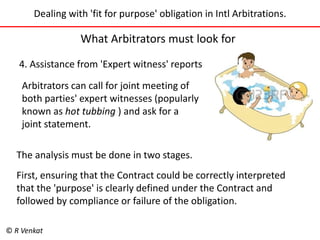
4. Assistance from 'Expert witness' reports 
Arbitrators can call for joint meeting of 
both parties' expert witnesses (popularly 
known as hot tubbing ) and ask for a 
joint statement. 
The analysis must be done in two stages. 
First, ensuring that the Contract could be correctly interpreted 
that the 'purpose' is clearly defined under the Contract and 
followed by compliance or failure of the obligation. 
© R Venkat
Dealing with 'fit for purpose' obligation in Intl Arbitrations. 
Conclusion 
Don’t take 'fit for purpose' obligation lightly. 
Employers always want their architects and EPC contractors to assume 
'fit for purpose' obligation for their services because they need not 
prove any negligence! 
On the other hand, designers/architects always try to avoid to assume 
'fit for purpose' obligation since any risk associated with this 
obligation is not covered by their professional indemnity cover. 
This topic is of greater relevance in EPC/Turnkey contracts and design 
and build contracts. 
© R Venkat
Dealing with 'fit for purpose' obligation in Intl Arbitrations. 
Presentation by 
R Venkata raghavan, FCIArb, MRICS 
LLM (UK), B.Eng., C.Eng., FCMA 
Contact: rmvenkat@gmail.com

Dealing with 'fit for purpose' obligation

  • 1.
    Dealing with 'fitfor purpose' obligation in International Arbitrations. R Venkata raghavan, FCIArb, MRICS LLM (UK), B.Eng., C.Eng., FCMA Chartered Engineer, Arbitrator and Chartered Surveyor NOVEMBER 8, 2014, NEW DELHI
  • 2.
    Dealing with 'fitfor purpose' obligation in Intl Arbitrations. What doest it mean? Let us say that you have bought a brand new Smart phone! There’s an implied obligation that the Smart phone will make your business and communication functions smart The smart phone must be “fit for the purpose” for which it has been bought! © R Venkat
  • 3.
    Dealing with 'fitfor purpose' obligation in Intl Arbitrations. ‘Fit for Purpose’ is a Statutory requirement for Supply of goods in most of the jurisdictions. Sale of Goods Act 1979 of UK, states that "it is an implied term in any sale of goods contract that goods sold in the course of business are of reasonable quality and reasonably fit for their purpose". Other Common law jurisdictions: •Sale of Goods Act Cap 393, Singapore •Section 16 of Sale of Goods Act 1930, India Civil law jurisdictions: •Article 1604 of French Civil Code •Section 433 of German Civil Code © R Venkat
  • 4.
    Dealing with 'fitfor purpose' obligation in Intl Arbitrations. ‘Fit for purpose’ in International Sale Contracts Governed by an international treaty – the United Nations Convention on Contracts for the International Sales of Goods (CISG). CISG will apply by default to any international contract for the sale of goods where the two parties are from different Contracting States. Article 35(2) of CISG states that: (2) Except where the parties have agreed otherwise, the goods do not conform with the contract unless they: (a) Are fit for the purposes for which goods of the same description would ordinarily be used. See New Zealand case Smallmon v Transport Sales & Anor © R Venkat
  • 5.
    Dealing with 'fitfor purpose' obligation in Intl Arbitrations. Know the difference! Under Common law, more particularly under English law, 'fit for purpose obligation' is treated differently for supply of goods and supply of services. Supply of services Architects Doctors Lawyers and Accountants If a doctor is responsible for fit for purpose obligation, you can sue him if you did not recover from your illness after consulting him! © R Venkat
  • 6.
    Dealing with 'fitfor purpose' obligation in Intl Arbitrations. The Service providers like doctors or architects are required to exercise 'reasonable skill and care' while undertaking their work/design. The design must only meet the standard expected of a competent professional designer. This obligation is common for all service providers! (Architects, Engineers, Doctors and even lawyers!) Supply of Goods and Services Act 1982 of UK. Do you remember the famous case of Bolam v Friern Hospital Management Committee and is often referred to as the 'Bolam principle'. © R Venkat
  • 7.
    Dealing with 'fitfor purpose' obligation in Intl Arbitrations. Obligation under Construction Contracts In build only (like FIDIC Red book) Construction Contracts, the Contractor must ensure that the goods supplied and installed are meeting the 'fit for purpose' obligations, since he is responsible for the quality of the goods supplied. © R Venkat
  • 8.
    Dealing with 'fitfor purpose' obligation in Intl Arbitrations. Obligation under Construction Contracts On the contrary, the designer/Architect is not under ‘fit for purpose’ obligation for his design service. He is expected only to demonstrate that he has used ‘reasonable care and skill' in discharging his professional obligations. As long as the services provided are similar to that of a professional in a similar situation, it would be considered that he has satisfied his obligation. © R Venkat
  • 9.
    Dealing with 'fitfor purpose' obligation in Intl Arbitrations. Design & Build Contracts If the Contractor undertakes to do both design and build the works (like FIDIC Yellow book or Silver book), then he must ensure that the works are both designed and executed fulfilling the 'fit for purpose' obligations. Independent Broadcasting Authority v EMI Electronics Limited [1980] © R Venkat
  • 10.
    Dealing with 'fitfor purpose' obligation in Intl Arbitrations. Design & Build Contracts Design &build contractor is providing a 'product' which comprises of design services and supply and installation of goods. So, the contractor is responsible for the 'fit for purpose' obligation of the whole product. Contractor's self-interest in saving costs and maximizing profit Carrying out the design to the minimum acceptable standard. © R Venkat
  • 11.
    Dealing with 'fitfor purpose' obligation in Intl Arbitrations. Why the 'fit for purpose obligation' is unique? Fitness for purpose is a stricter and tougher obligation for the designer A reasonable skill and care obligation essentially requires an employer to prove that the designer has been negligent. In case of 'fit for purpose' obligations, the employer merely needs to prove that the completed building does not work as intended; there is no need to show that the design has been negligent. The professional indemnity insurance cover does not cover fit for purpose obligation and it only covers the negligence risk. © R Venkat
  • 12.
    Dealing with 'fitfor purpose' obligation in Intl Arbitrations. Is it an implied obligation? Yes! The Sale of Goods Act 1979 states that when it is obvious that the goods supplied are suitable for a particular purpose, then there is an implied obligation to comply with this requirement. Under English law, the 'fit for purpose' obligation will be implied in absence of an express term in a Construction Contract in case of Design and Build Contracts. Francis Vs. Cockrell, (1870) LR 5 QB 501 © R Venkat
  • 13.
    Dealing with 'fitfor purpose' obligation in Intl Arbitrations. What Arbitrators must look for 1. Has the purpose has been clearly defined under the Contract? Remember! 'Fit for purpose' obligation is an implied obligation But purpose can't be an implied term in a Contract. The purpose for which the product or service is being procured must be clearly stated in the Contract. This was clarified in a recent English case, Trebor Bassett Holdings Ltd & Anor v ADT Fire and security Plc . © R Venkat
  • 14.
    Dealing with 'fitfor purpose' obligation in Intl Arbitrations. What Arbitrators must look for 2. Guidance from Case law from other jurisdictions New Zealand case Smallmon v Transport Sales & Anor The New Zealand made trucks were not confirming to Australian vehicle standards and hence could not be registered. Buyer arguing the trucks are not fit for purpose! Court held that a seller is not generally responsible for compliance with the buyer’s regulatory standards as an implied 'fit for purpose' requirement © R Venkat
  • 15.
    Dealing with 'fitfor purpose' obligation in Intl Arbitrations. What Arbitrators must look for 2. Guidance from Case law from other jurisdictions (continued) Judge Neil LJ concluded that warranty of fit for purpose will not be implied as a matter of law against a design profession. It can only be implied under the following conditions • it must be reasonable and equitable; • it must be necessary to give business efficacy to the contract • it must be capable of clear expression; • it must not contradict any express term of the contract BP Refinery (Western Port) Property v Shire of Hastings (1978) 52 ALJR 20 © R Venkat
  • 16.
    Dealing with 'fitfor purpose' obligation in Intl Arbitrations. What Arbitrators must look for 3. Guidance from Standard form of Contracts Verify how precisely the fit for purpose obligation has been defined under the Contract. For example, FIDIC Conditions of Contract for EPC/Turnkey projects and Design & Build Contracts provide an express requirement with respect to 'fit for purpose' obligation. Clause 4.1 of FIDIC Silver, Yellow and Gold books states that “When completed, the Works shall be fit for the purposes for which the Works are intended as defined in the Contract.” (emphasis added) © R Venkat
  • 17.
    Dealing with 'fitfor purpose' obligation in Intl Arbitrations. What Arbitrators must look for 4. Assistance from 'Expert witness' reports Arbitrators can call for joint meeting of both parties' expert witnesses (popularly known as hot tubbing ) and ask for a joint statement. The analysis must be done in two stages. First, ensuring that the Contract could be correctly interpreted that the 'purpose' is clearly defined under the Contract and followed by compliance or failure of the obligation. © R Venkat
  • 18.
    Dealing with 'fitfor purpose' obligation in Intl Arbitrations. Conclusion Don’t take 'fit for purpose' obligation lightly. Employers always want their architects and EPC contractors to assume 'fit for purpose' obligation for their services because they need not prove any negligence! On the other hand, designers/architects always try to avoid to assume 'fit for purpose' obligation since any risk associated with this obligation is not covered by their professional indemnity cover. This topic is of greater relevance in EPC/Turnkey contracts and design and build contracts. © R Venkat
  • 19.
    Dealing with 'fitfor purpose' obligation in Intl Arbitrations. Presentation by R Venkata raghavan, FCIArb, MRICS LLM (UK), B.Eng., C.Eng., FCMA Contact: rmvenkat@gmail.com

Editor's Notes

  • #8 For example, if the Contractor has provided an equipment but the supplied equipment failed within a year of operation, then the goods supplied obviously did not meet the 'fit for purpose' obligation.
  • #13 Contract terms may be express (written or oral) or implied.
  • #14 This case was related to a fire which had destroyed the purchaser's confectionary factory and the purchaser's were arguing that the fire suppression system supplied was not 'fit for purpose' under the Sale of Goods Act 1982. However, on scrutinizing the facts, the Court held that the purchaser's did not sufficiently establish the implication of the fitness for purpose obligation on the basis that they had not indicated any particular purpose for which the goods were being acquired.