Life Guide
                                                                      Dealing with Divorce


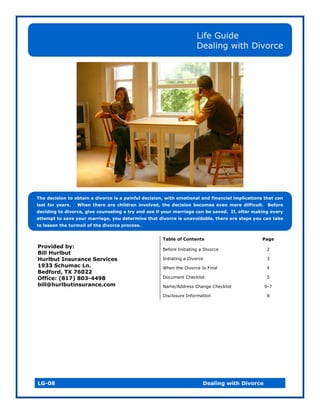
The decision to obtain a divorce is a painful decision, with emotional and financial implications that can
last for years.   When there are children involved, the decision becomes even more difficult. Before
deciding to divorce, give counseling a try and see if your marriage can be saved. If, after making every
attempt to save your marriage, you determine that divorce is unavoidable, there are steps you can take
to lessen the turmoil of the divorce process.


                                                      Table of Contents                          Page
Provided by:                                          Before Initiating a Divorce                  2
Bill Hurlbut
Hurlbut Insurance Services                            Initiating a Divorce                         3
1933 Schumac Ln.                                      When the Divorce Is Final                    4
Bedford, TX 76022
Office: (817) 803-4498                                Document Checklist                           5
bill@hurlbutinsurance.com                             Name/Address Change Checklist               6-7

                                                      Disclosure Information                       8


LG-08                                                                    Dealing with Divorce
Before Initiating a Divorce


Educate yourself on the divorce, child custody and property/debt division laws
    in your state. The Internet is a good source for this information.

Create a current inventory of all financial assets (real estate, investments,
    household goods, vehicles, retirement plans, cash and other liquid assets), whether
    owned jointly or separately. Include all account numbers, as well as names and
    contact information of financial institutions, insurers and financial advisors, on your
    inventory.

Create a list of all current debt, including creditors and amounts. Pay off as many
    bills as possible.

Consider meeting with a financial advisor, such as your accountant or financial
    planner, to discuss the tax and financial implications of a divorce.

Create a file with copies of all relevant documents relating to your situation. A
    document checklist is available on page 5.

Verify the contents of any safety deposit boxes.

Be sure you have access to savings of your own that you can use if you suddenly
    need financial resources to pay household and personal expenses. Do not, however,
    empty bank accounts or hide money.

If you don't have credit in your own name, obtain and begin using your own credit
    card.

Select a qualified, experienced divorce lawyer. In interviewing attorneys, ask
    what the charges are and how they're calculated (a flat hourly rate charged in 15-
    minute increments or some other method). Also determine if an initial retainer is
    required and, if so, how much. You may also want to discuss with the attorney what
    you can do to keep costs to a reasonable amount. For example, you may be able to
    save money by doing some of the routine clerical costs associated with a divorce
    yourself.

While you and your spouse will each still need a divorce lawyer, you may want to
    consider the services of a skilled mediator to work with you and your spouse on
    reaching mutually agreeable solutions to financial and custody issues. The cost of a
    mediator will probably be less than paying the two opposing attorneys to argue through
    each area of disagreement. In addition, mediators encourage cooperation and
    compromise in reaching agreements, as opposed to the adversarial approach employed
    by attorneys. Mediation may leave you and your spouse with less emotional scarring
    and bitterness at the end of the process.

Decide when, where and how you will talk with your spouse about a decision
    to divorce. You and your spouse must then jointly decide when, where and how you
    will talk to your children about your decision to divorce.


Dealing with Divorce                                                                          2
Initiating a Divorce


    The first step in initiating a divorce is to retain a divorce attorney. Since
    divorce, child custody and property/debt division is governed by state law,
    you must rely on your attorney to guide you in matters such as these:

Canceling all joint credit cards.

Protecting your interests in joint accounts, such as joint checking, savings and
    investment accounts.

Revoking any power of attorney documents that name your spouse as your agent.

Who will move out of the marital home and any legal repercussions that might
    result.

Who will have initial custody of any children.

Any interim spousal or child support to be paid.

Any legal repercussions of dating before your divorce is final.

The impact of a divorce on any business interests you own.

How any employee benefits, such as health insurance and retirement plans, or
    military benefits, will be impacted by divorce.

Deciding who will take the dependent tax exemption for any children.

Working with your spouse and his/her attorney (or with a mediator), reaching a final
    agreement on division of assets, custody of children, child support and visitation rights
    for the non-custodial parent.

DO NOT agree to anything, either verbally or in writing, without your attorney's
    okay.

DO NOT agree to or sign a divorce settlement that does not release you from all
    joint financial obligations, such as credit cards, mortgages and auto loans. All joint
    debts should be either paid off or refinanced prior to your signing the final agreement.


    In working with your attorney and his/her staff, make every call/meeting
    count, especially if you're being billed in increments of 15 minutes. Don't
    s e d alt f i s caii g o u i g y u a t r e a ac u s lr h t a
      pn     o o t   me o il n r sn o r to n y s
                               z                                 o n eo …t a c n
    quickly become expensive! Whenever possible, make your own copies of
    documents and take notes of all conversations. Finally, request monthly
    itemized bills from your attorney.


Dealing with Divorce                                                                           3
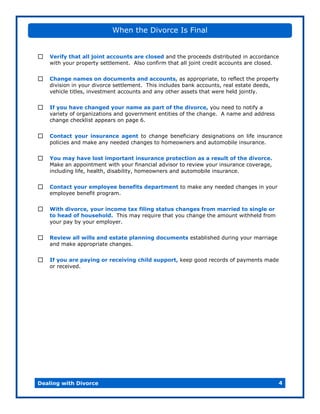
When the Divorce Is Final


 Verify that all joint accounts are closed and the proceeds distributed in accordance
    with your property settlement. Also confirm that all joint credit accounts are closed.


 Change names on documents and accounts, as appropriate, to reflect the property
    division in your divorce settlement. This includes bank accounts, real estate deeds,
    vehicle titles, investment accounts and any other assets that were held jointly.


 If you have changed your name as part of the divorce, you need to notify a
    variety of organizations and government entities of the change. A name and address
    change checklist appears on page 6.


 Contact your insurance agent to change beneficiary designations on life insurance
    policies and make any needed changes to homeowners and automobile insurance.


 You may have lost important insurance protection as a result of the divorce.
    Make an appointment with your financial advisor to review your insurance coverage,
    including life, health, disability, homeowners and automobile insurance.


 Contact your employee benefits department to make any needed changes in your
    employee benefit program.


 With divorce, your income tax filing status changes from married to single or
    to head of household. This may require that you change the amount withheld from
    your pay by your employer.


 Review all wills and estate planning documents established during your marriage
    and make appropriate changes.


 If you are paying or receiving child support, keep good records of payments made
    or received.


Dealing with Divorce                                                                         4
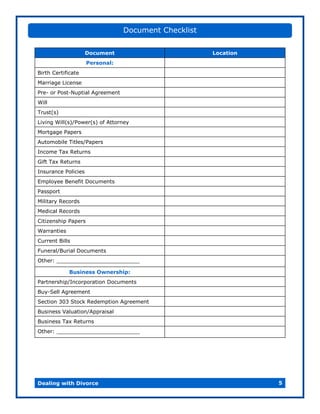
Document Checklist


                     Document                         Location
                     Personal:
Birth Certificate
Marriage License
Pre- or Post-Nuptial Agreement
Will
Trust(s)
Living Will(s)/Power(s) of Attorney
Mortgage Papers
Automobile Titles/Papers
Income Tax Returns
Gift Tax Returns
Insurance Policies
Employee Benefit Documents
Passport
Military Records
Medical Records
Citizenship Papers
Warranties
Current Bills
Funeral/Burial Documents
Other: _________________________

             Business Ownership:
Partnership/Incorporation Documents
Buy-Sell Agreement
Section 303 Stock Redemption Agreement
Business Valuation/Appraisal
Business Tax Returns
Other: _________________________


Dealing with Divorce                                             5
Name/Address Change Checklist

    Government
Social Security Administration (www.ssa.gov)
Post Office (change online at www.usps.com)
Driver's License
Voter Registration
Vehicle Registration
Passport
IRS (use IRS Form 8822)
Department of Veterans Affairs (forms available online at www.va.gov)
Child Support Payments
     Employment
Current Employers
Previous Employers (as needed for future benefits, such as pensions)
Business Associates
     Financial Institutions
Banks (checking/savings accounts, CDs, safety deposit box)
Lenders (auto, mortgage, student loan)
Credit Card Companies
Insurance Companies (life, health, auto, home, disability)
Investment/Brokerage Accounts
     Utilities/Services
Water and Sewer
Electric
Gas
Telephone/Cell Phone
Garbage
Cable or Satellite
Internet


Dealing with Divorce                                                      6
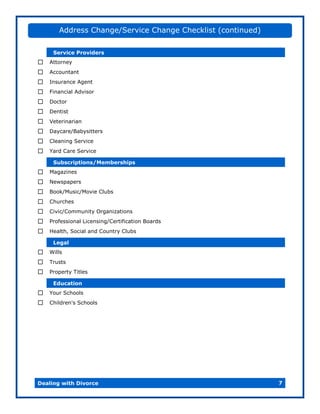
Address Change/Service Change Checklist (continued)

     Service Providers
Attorney
Accountant
Insurance Agent
Financial Advisor
Doctor
Dentist
Veterinarian
Daycare/Babysitters
Cleaning Service
Yard Care Service
     Subscriptions/Memberships
Magazines
Newspapers
Book/Music/Movie Clubs
Churches
Civic/Community Organizations
Professional Licensing/Certification Boards
Health, Social and Country Clubs
     Legal
Wills
Trusts
Property Titles
     Education
Your Schools
Children's Schools


Dealing with Divorce                                         7
Disclosure Information

© VSA, LP   All rights reserved. LG-08 Ed. 01-10


The information, general principles and conclusions presented in this report are subject to
local, state and federal laws and regulations, court cases and any revisions of same. While
every care has been taken in the preparation of this report, neither VSA, L.P. nor The
National Underwriter Company is engaged in providing legal, accounting, financial or other
professional services. This report should not be used as a substitute for the professional
advice of an attorney, accountant, or other qualified professional.


U.S. Treasury Circular 230 may require us to advise you that "any tax information provided
in this document is not intended or written to be used, and cannot be used, by any taxpayer
for the purpose of avoiding penalties that may be imposed on the taxpayer. The tax
information was written to support the promotion or marketing of the transaction(s) or
matter(s) addressed and you should seek advice based on your particular circumstances
from an independent tax advisor."


Dealing with Divorce                                                                      8

Dealing with divorce

  • 1.
    Life Guide Dealing with Divorce The decision to obtain a divorce is a painful decision, with emotional and financial implications that can last for years. When there are children involved, the decision becomes even more difficult. Before deciding to divorce, give counseling a try and see if your marriage can be saved. If, after making every attempt to save your marriage, you determine that divorce is unavoidable, there are steps you can take to lessen the turmoil of the divorce process. Table of Contents Page Provided by: Before Initiating a Divorce 2 Bill Hurlbut Hurlbut Insurance Services Initiating a Divorce 3 1933 Schumac Ln. When the Divorce Is Final 4 Bedford, TX 76022 Office: (817) 803-4498 Document Checklist 5 bill@hurlbutinsurance.com Name/Address Change Checklist 6-7 Disclosure Information 8 LG-08 Dealing with Divorce
  • 2.
    Before Initiating aDivorce Educate yourself on the divorce, child custody and property/debt division laws in your state. The Internet is a good source for this information. Create a current inventory of all financial assets (real estate, investments, household goods, vehicles, retirement plans, cash and other liquid assets), whether owned jointly or separately. Include all account numbers, as well as names and contact information of financial institutions, insurers and financial advisors, on your inventory. Create a list of all current debt, including creditors and amounts. Pay off as many bills as possible. Consider meeting with a financial advisor, such as your accountant or financial planner, to discuss the tax and financial implications of a divorce. Create a file with copies of all relevant documents relating to your situation. A document checklist is available on page 5. Verify the contents of any safety deposit boxes. Be sure you have access to savings of your own that you can use if you suddenly need financial resources to pay household and personal expenses. Do not, however, empty bank accounts or hide money. If you don't have credit in your own name, obtain and begin using your own credit card. Select a qualified, experienced divorce lawyer. In interviewing attorneys, ask what the charges are and how they're calculated (a flat hourly rate charged in 15- minute increments or some other method). Also determine if an initial retainer is required and, if so, how much. You may also want to discuss with the attorney what you can do to keep costs to a reasonable amount. For example, you may be able to save money by doing some of the routine clerical costs associated with a divorce yourself. While you and your spouse will each still need a divorce lawyer, you may want to consider the services of a skilled mediator to work with you and your spouse on reaching mutually agreeable solutions to financial and custody issues. The cost of a mediator will probably be less than paying the two opposing attorneys to argue through each area of disagreement. In addition, mediators encourage cooperation and compromise in reaching agreements, as opposed to the adversarial approach employed by attorneys. Mediation may leave you and your spouse with less emotional scarring and bitterness at the end of the process. Decide when, where and how you will talk with your spouse about a decision to divorce. You and your spouse must then jointly decide when, where and how you will talk to your children about your decision to divorce. Dealing with Divorce 2
  • 3.
    Initiating a Divorce The first step in initiating a divorce is to retain a divorce attorney. Since divorce, child custody and property/debt division is governed by state law, you must rely on your attorney to guide you in matters such as these: Canceling all joint credit cards. Protecting your interests in joint accounts, such as joint checking, savings and investment accounts. Revoking any power of attorney documents that name your spouse as your agent. Who will move out of the marital home and any legal repercussions that might result. Who will have initial custody of any children. Any interim spousal or child support to be paid. Any legal repercussions of dating before your divorce is final. The impact of a divorce on any business interests you own. How any employee benefits, such as health insurance and retirement plans, or military benefits, will be impacted by divorce. Deciding who will take the dependent tax exemption for any children. Working with your spouse and his/her attorney (or with a mediator), reaching a final agreement on division of assets, custody of children, child support and visitation rights for the non-custodial parent. DO NOT agree to anything, either verbally or in writing, without your attorney's okay. DO NOT agree to or sign a divorce settlement that does not release you from all joint financial obligations, such as credit cards, mortgages and auto loans. All joint debts should be either paid off or refinanced prior to your signing the final agreement. In working with your attorney and his/her staff, make every call/meeting count, especially if you're being billed in increments of 15 minutes. Don't s e d alt f i s caii g o u i g y u a t r e a ac u s lr h t a pn o o t me o il n r sn o r to n y s z o n eo …t a c n quickly become expensive! Whenever possible, make your own copies of documents and take notes of all conversations. Finally, request monthly itemized bills from your attorney. Dealing with Divorce 3
  • 4.
    When the DivorceIs Final  Verify that all joint accounts are closed and the proceeds distributed in accordance with your property settlement. Also confirm that all joint credit accounts are closed.  Change names on documents and accounts, as appropriate, to reflect the property division in your divorce settlement. This includes bank accounts, real estate deeds, vehicle titles, investment accounts and any other assets that were held jointly.  If you have changed your name as part of the divorce, you need to notify a variety of organizations and government entities of the change. A name and address change checklist appears on page 6.  Contact your insurance agent to change beneficiary designations on life insurance policies and make any needed changes to homeowners and automobile insurance.  You may have lost important insurance protection as a result of the divorce. Make an appointment with your financial advisor to review your insurance coverage, including life, health, disability, homeowners and automobile insurance.  Contact your employee benefits department to make any needed changes in your employee benefit program.  With divorce, your income tax filing status changes from married to single or to head of household. This may require that you change the amount withheld from your pay by your employer.  Review all wills and estate planning documents established during your marriage and make appropriate changes.  If you are paying or receiving child support, keep good records of payments made or received. Dealing with Divorce 4
  • 5.
    Document Checklist Document Location Personal: Birth Certificate Marriage License Pre- or Post-Nuptial Agreement Will Trust(s) Living Will(s)/Power(s) of Attorney Mortgage Papers Automobile Titles/Papers Income Tax Returns Gift Tax Returns Insurance Policies Employee Benefit Documents Passport Military Records Medical Records Citizenship Papers Warranties Current Bills Funeral/Burial Documents Other: _________________________ Business Ownership: Partnership/Incorporation Documents Buy-Sell Agreement Section 303 Stock Redemption Agreement Business Valuation/Appraisal Business Tax Returns Other: _________________________ Dealing with Divorce 5
  • 6.
    Name/Address Change Checklist Government Social Security Administration (www.ssa.gov) Post Office (change online at www.usps.com) Driver's License Voter Registration Vehicle Registration Passport IRS (use IRS Form 8822) Department of Veterans Affairs (forms available online at www.va.gov) Child Support Payments Employment Current Employers Previous Employers (as needed for future benefits, such as pensions) Business Associates Financial Institutions Banks (checking/savings accounts, CDs, safety deposit box) Lenders (auto, mortgage, student loan) Credit Card Companies Insurance Companies (life, health, auto, home, disability) Investment/Brokerage Accounts Utilities/Services Water and Sewer Electric Gas Telephone/Cell Phone Garbage Cable or Satellite Internet Dealing with Divorce 6
  • 7.
    Address Change/Service ChangeChecklist (continued) Service Providers Attorney Accountant Insurance Agent Financial Advisor Doctor Dentist Veterinarian Daycare/Babysitters Cleaning Service Yard Care Service Subscriptions/Memberships Magazines Newspapers Book/Music/Movie Clubs Churches Civic/Community Organizations Professional Licensing/Certification Boards Health, Social and Country Clubs Legal Wills Trusts Property Titles Education Your Schools Children's Schools Dealing with Divorce 7
  • 8.
    Disclosure Information © VSA,LP All rights reserved. LG-08 Ed. 01-10 The information, general principles and conclusions presented in this report are subject to local, state and federal laws and regulations, court cases and any revisions of same. While every care has been taken in the preparation of this report, neither VSA, L.P. nor The National Underwriter Company is engaged in providing legal, accounting, financial or other professional services. This report should not be used as a substitute for the professional advice of an attorney, accountant, or other qualified professional. U.S. Treasury Circular 230 may require us to advise you that "any tax information provided in this document is not intended or written to be used, and cannot be used, by any taxpayer for the purpose of avoiding penalties that may be imposed on the taxpayer. The tax information was written to support the promotion or marketing of the transaction(s) or matter(s) addressed and you should seek advice based on your particular circumstances from an independent tax advisor." Dealing with Divorce 8