Scott Baroway
Mediation Partners
720-889-2808
Baroway@gmail.com
Parental Responsibilities
DISCLAIMER
2
No legal advice is given in this website. Nothing said in this
website shall in anyway constitutes legal advice. Nothing on this or
associated pages, documents, comments, answers, emails, or other
communications should be taken as legal advice for any individual
case or situation. All information presented is for informative
purposes only and should not be considered legal advice in any
way. Additionally, no attorney-client relationship is established by
viewing any information on this website. If you believe you are
here to get legal advice in any way, you should leave now. THIS
WEBSITE IS FOR GENERAL INFORMATION PURPOSES
ONLY.
No Warranties or Guaranties are made regarding accuracy of the
information provided.
“Legal Custody” –
Abolished in Colorado
Now -Parental Responsibilities
(joint responsibility to be a parent)
3
Parental Responsibilities
C.R.S. 14-10-123
4
Instead of “Custody”, Colorado recognizes “Parental
Responsibilities”
Intended to eliminate the sense of ownership of children by a
parent
Focus parents on their ongoing responsibilities to their children
Separate issues:
Parenting Time
Decision Making Responsibilities
RETURN TO “ALL ABOUT” SERIES SLIDE
Issues To Be Decided
5
Parenting Plan (2 core separate areas)
Parenting Time - Time spent with each parent
Decision Making - authority on various issues
Practical
Details
Flexibility
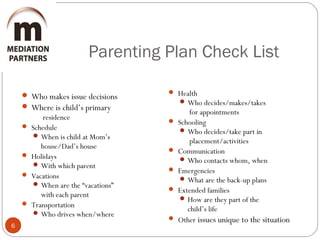
Parenting Plan Check List
6
 Who makes issue decisions
 Where is child’s primary
residence
 Schedule
 When is child at Mom’s
house/Dad’s house
 Holidays
 With which parent
 Vacations
 When are the “vacations”
with each parent
 Transportation
 Who drives when/where
 Health
 Who decides/makes/takes
for appointments
 Schooling
 Who decides/take part in
placement/activities
 Communication
 Who contacts whom, when
 Emergencies
 What are the back-up plans
 Extended families
 How are they part of the
child’s life
 Other issues unique to the situation
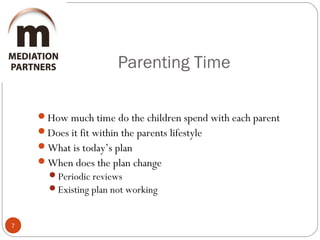
Parenting Time
7
How much time do the children spend with each parent
Does it fit within the parents lifestyle
What is today’s plan
When does the plan change
Periodic reviews
Existing plan not working
Practical Issues
8
Details—why they are important
Avoid future conflicts
Provide consistency and sense of security for children
Provides a schedule for parents and children to organize their
lives around.
Even children need to know their “schedule.”
Flexibility
Children’s needs change over time
Parent’s needs change over time
Ages And Stages:
Different schedule needs
9
Preschoolers
Comfort and consistency
Frequent contact with each parent
School-age children
Schedules and predictability
Independent school, recreational, and social commitments
Teenagers
Support and supervision
Lives become centered on their peers, not the family
Houses And Rules—
Same, Similar Or Different?
10
Rules
Same rules—easiest for the children
Similar rules—can work
Different rules—may cause problems, if parents let it by openly
failing to respect others’ house rules.
Two houses can operate differently but
Try to agree on major rules
Don’t let children manipulate you
Ask other parent only if children report something worrisome
Two houses requires extra courtesies
Parents need to communicate openly and frequently
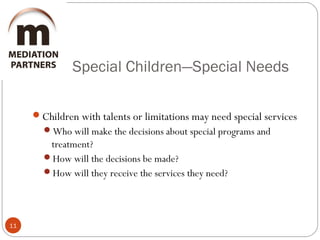
Special Children—Special Needs
11
Children with talents or limitations may need special services
Who will make the decisions about special programs and
treatment?
How will the decisions be made?
How will they receive the services they need?
Parenting Time
Statutory Factors-(page 1)
12
 Desires of Parents
 Desire of Child IF “sufficiently mature to express reasoned and independent
preferences”
 Interactions and interrelationships of the child with his parents, and any other
person who may significantly affect the child’s best interest
 Child’s adjustment to home, school, and community
 Mental and physical health of each
 Disability alone will not be basis to deny or restrict time
 Ability of each to encourage love, affection, and contact with other party
 Past pattern of parties to reflect system of values, time commitment, and mutual
support
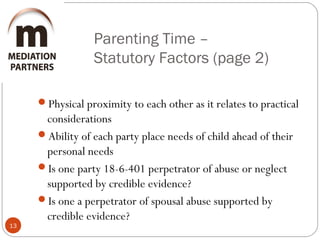
Parenting Time –
Statutory Factors (page 2)
13
Physical proximity to each other as it relates to practical
considerations
Ability of each party place needs of child ahead of their
personal needs
Is one party 18-6-401 perpetrator of abuse or neglect
supported by credible evidence?
Is one a perpetrator of spousal abuse supported by
credible evidence?
Parenting Time
Statutory Excluded Factors
(cannot consider)
14
Cannot Consider a parties conduct that does not affect
parties relationship with child.
No presumption that any person is better able to serve as
parent due to gender.
No prejudice to the fact that a party requested genetic
testing.
If party leaves due to abuse, such absence shall not be a
factor.
Decision Making
15
Second part of Parental Responsibility Plan
NOT SAME AS PARENTING TIME
Decision Making
Statutory Factors – (page 1)
16
Credible evidence of ability of parties to cooperate and make joint
decisions
Past pattern of involvement reflecting ability as mutual decision
makers to provide positive and nourishing relationship with child
Whether allocation of mutual responsibility on one or more issues
will promote frequent contact with both parties and child
One party 18-6-401 perpetrator of abuse or neglect supported by
credible evidence
IF SO – it SHALL NOT be in best interest to have mutual decision making
on any issue over objection of other party
Decision Making
Statutory Factors – (page 2)
17
Perpetrator of spousal abuse
IF SO – it SHALL NOT be in best interest to have mutual
decision making on any issue over objection of other party…
unless (court finding)
Additional Issues
18
Are parents capable and open to hear and understand
children’s wishes
Emergency Medical Treatment
(C.R.S. 14-10-124(6))
19
Decision Making authority rests with BOTH by statute
without it being a violation of an order to the contrary.
PARENTING PLAN
20
Written document provides the default or baseline for all
parties to follow.
Parents may modify by agreement of both parties anytime.
Provides framework to plan life around for both the parents
and the children.
Parenting Plan Contents
21
 Decision Making
 Primary Residence
 Schools
 Religion
 Medical providers
 Regular parenting time
 Holidays
 Vacations
 Transportation
 Terms and conditions for making up
parenting time
 Provisions concerning conflict in
schedule
 Parenting time exchanges
 Extracurricular activities
 Future dispute resolution
 Right of first refusal – if other busy
 Telephone/ correspondence contact
 Emergencies
 Modifications as young kids get older
 Communication about events
 Provision for parenting time of each
child

Parental Responsibilities

  • 1.
  • 2.
    DISCLAIMER 2 No legal adviceis given in this website. Nothing said in this website shall in anyway constitutes legal advice. Nothing on this or associated pages, documents, comments, answers, emails, or other communications should be taken as legal advice for any individual case or situation. All information presented is for informative purposes only and should not be considered legal advice in any way. Additionally, no attorney-client relationship is established by viewing any information on this website. If you believe you are here to get legal advice in any way, you should leave now. THIS WEBSITE IS FOR GENERAL INFORMATION PURPOSES ONLY. No Warranties or Guaranties are made regarding accuracy of the information provided.
  • 3.
    “Legal Custody” – Abolishedin Colorado Now -Parental Responsibilities (joint responsibility to be a parent) 3
  • 4.
    Parental Responsibilities C.R.S. 14-10-123 4 Insteadof “Custody”, Colorado recognizes “Parental Responsibilities” Intended to eliminate the sense of ownership of children by a parent Focus parents on their ongoing responsibilities to their children Separate issues: Parenting Time Decision Making Responsibilities RETURN TO “ALL ABOUT” SERIES SLIDE
  • 5.
    Issues To BeDecided 5 Parenting Plan (2 core separate areas) Parenting Time - Time spent with each parent Decision Making - authority on various issues Practical Details Flexibility
  • 6.
    Parenting Plan CheckList 6  Who makes issue decisions  Where is child’s primary residence  Schedule  When is child at Mom’s house/Dad’s house  Holidays  With which parent  Vacations  When are the “vacations” with each parent  Transportation  Who drives when/where  Health  Who decides/makes/takes for appointments  Schooling  Who decides/take part in placement/activities  Communication  Who contacts whom, when  Emergencies  What are the back-up plans  Extended families  How are they part of the child’s life  Other issues unique to the situation
  • 7.
    Parenting Time 7 How muchtime do the children spend with each parent Does it fit within the parents lifestyle What is today’s plan When does the plan change Periodic reviews Existing plan not working
  • 8.
    Practical Issues 8 Details—why theyare important Avoid future conflicts Provide consistency and sense of security for children Provides a schedule for parents and children to organize their lives around. Even children need to know their “schedule.” Flexibility Children’s needs change over time Parent’s needs change over time
  • 9.
    Ages And Stages: Differentschedule needs 9 Preschoolers Comfort and consistency Frequent contact with each parent School-age children Schedules and predictability Independent school, recreational, and social commitments Teenagers Support and supervision Lives become centered on their peers, not the family
  • 10.
    Houses And Rules— Same,Similar Or Different? 10 Rules Same rules—easiest for the children Similar rules—can work Different rules—may cause problems, if parents let it by openly failing to respect others’ house rules. Two houses can operate differently but Try to agree on major rules Don’t let children manipulate you Ask other parent only if children report something worrisome Two houses requires extra courtesies Parents need to communicate openly and frequently
  • 11.
    Special Children—Special Needs 11 Childrenwith talents or limitations may need special services Who will make the decisions about special programs and treatment? How will the decisions be made? How will they receive the services they need?
  • 12.
    Parenting Time Statutory Factors-(page1) 12  Desires of Parents  Desire of Child IF “sufficiently mature to express reasoned and independent preferences”  Interactions and interrelationships of the child with his parents, and any other person who may significantly affect the child’s best interest  Child’s adjustment to home, school, and community  Mental and physical health of each  Disability alone will not be basis to deny or restrict time  Ability of each to encourage love, affection, and contact with other party  Past pattern of parties to reflect system of values, time commitment, and mutual support
  • 13.
    Parenting Time – StatutoryFactors (page 2) 13 Physical proximity to each other as it relates to practical considerations Ability of each party place needs of child ahead of their personal needs Is one party 18-6-401 perpetrator of abuse or neglect supported by credible evidence? Is one a perpetrator of spousal abuse supported by credible evidence?
  • 14.
    Parenting Time Statutory ExcludedFactors (cannot consider) 14 Cannot Consider a parties conduct that does not affect parties relationship with child. No presumption that any person is better able to serve as parent due to gender. No prejudice to the fact that a party requested genetic testing. If party leaves due to abuse, such absence shall not be a factor.
  • 15.
    Decision Making 15 Second partof Parental Responsibility Plan NOT SAME AS PARENTING TIME
  • 16.
    Decision Making Statutory Factors– (page 1) 16 Credible evidence of ability of parties to cooperate and make joint decisions Past pattern of involvement reflecting ability as mutual decision makers to provide positive and nourishing relationship with child Whether allocation of mutual responsibility on one or more issues will promote frequent contact with both parties and child One party 18-6-401 perpetrator of abuse or neglect supported by credible evidence IF SO – it SHALL NOT be in best interest to have mutual decision making on any issue over objection of other party
  • 17.
    Decision Making Statutory Factors– (page 2) 17 Perpetrator of spousal abuse IF SO – it SHALL NOT be in best interest to have mutual decision making on any issue over objection of other party… unless (court finding)
  • 18.
    Additional Issues 18 Are parentscapable and open to hear and understand children’s wishes
  • 19.
    Emergency Medical Treatment (C.R.S.14-10-124(6)) 19 Decision Making authority rests with BOTH by statute without it being a violation of an order to the contrary.
  • 20.
    PARENTING PLAN 20 Written documentprovides the default or baseline for all parties to follow. Parents may modify by agreement of both parties anytime. Provides framework to plan life around for both the parents and the children.
  • 21.
    Parenting Plan Contents 21 Decision Making  Primary Residence  Schools  Religion  Medical providers  Regular parenting time  Holidays  Vacations  Transportation  Terms and conditions for making up parenting time  Provisions concerning conflict in schedule  Parenting time exchanges  Extracurricular activities  Future dispute resolution  Right of first refusal – if other busy  Telephone/ correspondence contact  Emergencies  Modifications as young kids get older  Communication about events  Provision for parenting time of each child