Division of Property &
Debts
RETURN TO “ALL ABOUT” SERIES SLIDE
Scott Baroway
Mediation Partners
720-889-2808
Baroway@gmail.com
DISCLAIMER
2
No legal advice is given in this website. Nothing said in this
website shall in anyway constitutes legal advice. Nothing on this or
associated pages, documents, comments, answers, emails, or other
communications should be taken as legal advice for any individual
case or situation. All information presented is for informative
purposes only and should not be considered legal advice in any
way. Additionally, no attorney-client relationship is established by
viewing any information on this website. If you believe you are
here to get legal advice in any way, you should leave now. THIS
WEBSITE IS FOR GENERAL INFORMATION PURPOSES
ONLY.
No Warranties or Guaranties are made regarding accuracy of the
information provided.
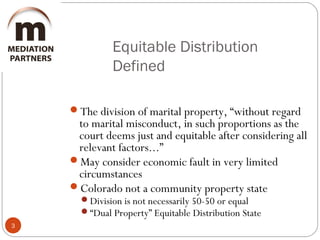
Equitable Distribution
Defined
3
The division of marital property, “without regard
to marital misconduct, in such proportions as the
court deems just and equitable after considering all
relevant factors...”
May consider economic fault in very limited
circumstances
Colorado not a community property state
Division is not necessarily 50-50 or equal
“Dual Property” Equitable Distribution State
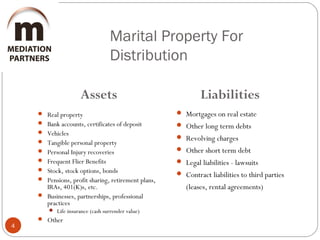
Marital Property For
Distribution
4
 Real property
 Bank accounts, certificates of deposit
 Vehicles
 Tangible personal property
 Personal Injury recoveries
 Frequent Flier Benefits
 Stock, stock options, bonds
 Pensions, profit sharing, retirement plans,
IRAs, 401(K)s, etc.
 Businesses, partnerships, professional
practices
 Life insurance (cash surrender value)
 Other
 Mortgages on real estate
 Other long term debts
 Revolving charges
 Other short term debt
 Legal liabilities - lawsuits
 Contract liabilities to third parties
(leases, rental agreements)
Assets Liabilities
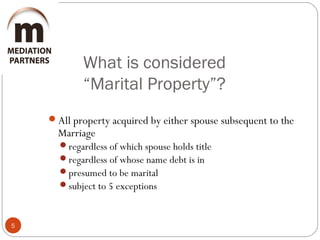
What is considered
“Marital Property”?
5
All property acquired by either spouse subsequent to the
Marriage
regardless of which spouse holds title
regardless of whose name debt is in
presumed to be marital
subject to 5 exceptions
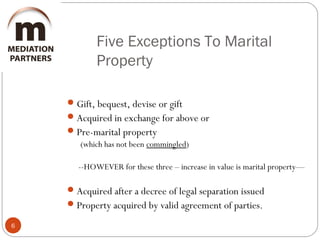
Five Exceptions To Marital
Property
6
Gift, bequest, devise or gift
Acquired in exchange for above or
Pre-marital property
(which has not been commingled)
--HOWEVER for these three – increase in value is marital property—
Acquired after a decree of legal separation issued
Property acquired by valid agreement of parties.
“Commingling”
7
“Separate property” can become marital property if
“commingled”
“Commingled” defined as – Mixing of separate property
with marital property
i.e. - Third party gift to one spouse put into a joint bank
account
Adding spouse’s name to inherited property
Sale of premarital property used to buy marital property
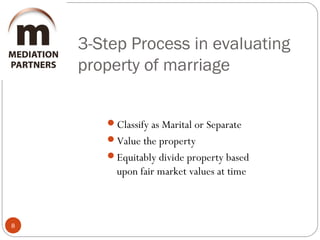
3-Step Process in evaluating
property of marriage
8
Classify as Marital or Separate
Value the property
Equitably divide property based
upon fair market values at time
Equitable Division Factors
9
The Court may consider any or all of the following in determining an
“equitable division” of the property:
Contribution of each spouse to acquisition of property,
INCLUDING contribution as homemaker
Value of property set apart to each spouse
Economic circumstances of each at time of division – includes right
live in home for reasonable period to raise kids
Increase or decrease in value of separate property during marriage
Depletion of the separate property for marital purposes
ANY OTHER FACTOR COURT DEEMS RELEVANT
(other than marital fault or misconduct)
Examples of Other Factors
10
 Duration of Marriage
 Age, physical and emotional health of parties
 Income or property brought to the marriage
 Standard of living established during the marriage
 Any written agreement made by the parties before or during the marriage concerning
an arrangement of property distribution
 Economic circumstances of each party at the time the division of property becomes
effective.
 Income and earning capacity of each party, including educational background,
training, employment skills, work experience, length of absence from the job market,
custodial responsibilities for children, time and expense necessary to acquire sufficient
education or training to enable the party to become self-supporting at a standard of
living reasonable comparable to that enjoyed during the marriage
Other Examples
11
Contribution of each party to the education, training or earning
power of the other
 Tax consequences of the proposed distribution to each party
 Present value of the property
Debts and liabilities of the parties
Need for creation, now or in future, of a trust fund to secure reasonably
foreseeable medical or educational costs for a spouse or children
Extent to which a party deferred achieving their career goals
Any other factor the Court deems relevant.
Valuation Of Marital Property
12
Some assets have stated or easily ascertainable value
Bank accounts, certificates of deposit
IRAs, 401(k)s
Stock (publicly traded), bonds
Some assets may need independent valuation
Vehicles
Real property
Personal property
Defined benefit pension plans
Businesses, partnerships, professional practices
Valuation Methods
13
Publicly available information
Vehicles – NADA Used Car book, Internet sources
Sales of comparable real estate in your neighborhood
Use of neutral experts
Real estate appraisers
Business valuation experts
Pension appraisers
OR MEDIATED AGREEMENT OF THE
PARTIES
Marital Home
14
 Colorado recognizes “desirability of awarding the family home
or right to live therein for a reasonable period of time to the
spouse with whom any children reside the majority of the time.”
 However, may be cost prohibitive
 Spouse not awarded house my be obligated to pay or assist in
paying mortgage and delay equity cash value until future date.
 Spouse in home – forced to reduce standard of living to keep
home
 Options
Sell home
Keep home
Offset against other assets or obligations
Buy-out over time
Deferred sale and deferred distribution of equity
First $250,000 of gain per spouse/former spouse from
sale of primary residence is tax exempt provided home
used as primary residence 2 out of last 5 years
Stock Options Can Be Marital
Property
15
Possible scenarios
Options acquired and vested during marriage
Options acquired but not vested during marriage
Options for past performance
Options for future performance
Options acquired after marriage but granted for performance
during marriage
Social Security Benefits
16
Not marital property subject to distribution
Can be considered as an offset against other marital assets
Protected from most creditors
Exception for payment of child support or alimony
You’re entitled to your own benefits and may be entitled to
benefits as a former spouse if -
Married for at least 10 years and divorced for 2 years
 Both parties at least 62 years old
 Not married when you apply for benefits
 Not receiving Social Security spousal or survival benefits based on someone
else’s employment history
 Need to talk to specialist on this subject as law changes
Pensions Often
Marital Property
17
Retirement benefits earned during marriage
deferred compensation for past employment
Marital property
part earned from employment during the marriage, AND
increased value during marriage
Military pension benefits earned during marriage subject to
special division rules
Pension Plan Valuation
18
Defined contribution plans
value easy to determine
comprised of the spouse’s contributions plus those of the
employer
Defined benefit plans
value more complex to determine
value is defined by the plan and not the employee’s
contributions
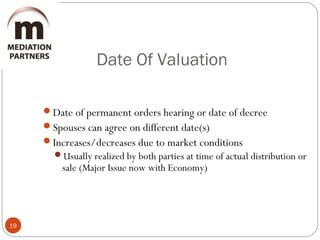
Date Of Valuation
19
Date of permanent orders hearing or date of decree
Spouses can agree on different date(s)
Increases/decreases due to market conditions
Usually realized by both parties at time of actual distribution or
sale (Major Issue now with Economy)
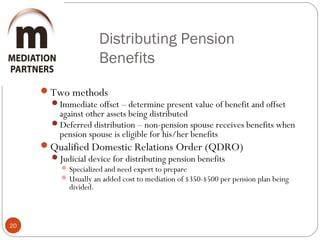
Distributing Pension
Benefits
20
Two methods
Immediate offset – determine present value of benefit and offset
against other assets being distributed
Deferred distribution – non-pension spouse receives benefits when
pension spouse is eligible for his/her benefits
Qualified Domestic Relations Order (QDRO)
Judicial device for distributing pension benefits
Specialized and need expert to prepare
Usually an added cost to mediation of $350-$500 per pension plan being
divided.
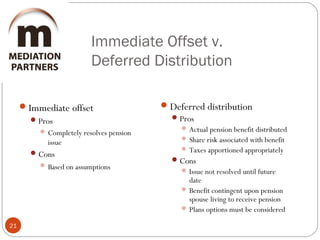
Immediate Offset v.
Deferred Distribution
21
Immediate offset
Pros
 Completely resolves pension
issue
Cons
 Based on assumptions
Deferred distribution
Pros
 Actual pension benefit distributed
 Share risk associated with benefit
 Taxes apportioned appropriately
Cons
 Issue not resolved until future
date
 Benefit contingent upon pension
spouse living to receive pension
 Plans options must be considered
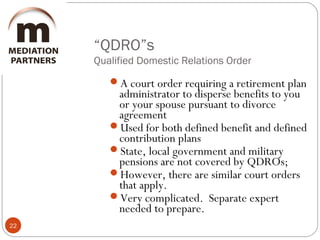
“QDRO”s
Qualified Domestic Relations Order
22
A court order requiring a retirement plan
administrator to disperse benefits to you
or your spouse pursuant to divorce
agreement
Used for both defined benefit and defined
contribution plans
State, local government and military
pensions are not covered by QDROs;
However, there are similar court orders
that apply.
Very complicated. Separate expert
needed to prepare.

Asset & Debt Division in Divorce

  • 1.
    Division of Property& Debts RETURN TO “ALL ABOUT” SERIES SLIDE Scott Baroway Mediation Partners 720-889-2808 Baroway@gmail.com
  • 2.
    DISCLAIMER 2 No legal adviceis given in this website. Nothing said in this website shall in anyway constitutes legal advice. Nothing on this or associated pages, documents, comments, answers, emails, or other communications should be taken as legal advice for any individual case or situation. All information presented is for informative purposes only and should not be considered legal advice in any way. Additionally, no attorney-client relationship is established by viewing any information on this website. If you believe you are here to get legal advice in any way, you should leave now. THIS WEBSITE IS FOR GENERAL INFORMATION PURPOSES ONLY. No Warranties or Guaranties are made regarding accuracy of the information provided.
  • 3.
    Equitable Distribution Defined 3 The divisionof marital property, “without regard to marital misconduct, in such proportions as the court deems just and equitable after considering all relevant factors...” May consider economic fault in very limited circumstances Colorado not a community property state Division is not necessarily 50-50 or equal “Dual Property” Equitable Distribution State
  • 4.
    Marital Property For Distribution 4 Real property  Bank accounts, certificates of deposit  Vehicles  Tangible personal property  Personal Injury recoveries  Frequent Flier Benefits  Stock, stock options, bonds  Pensions, profit sharing, retirement plans, IRAs, 401(K)s, etc.  Businesses, partnerships, professional practices  Life insurance (cash surrender value)  Other  Mortgages on real estate  Other long term debts  Revolving charges  Other short term debt  Legal liabilities - lawsuits  Contract liabilities to third parties (leases, rental agreements) Assets Liabilities
  • 5.
    What is considered “MaritalProperty”? 5 All property acquired by either spouse subsequent to the Marriage regardless of which spouse holds title regardless of whose name debt is in presumed to be marital subject to 5 exceptions
  • 6.
    Five Exceptions ToMarital Property 6 Gift, bequest, devise or gift Acquired in exchange for above or Pre-marital property (which has not been commingled) --HOWEVER for these three – increase in value is marital property— Acquired after a decree of legal separation issued Property acquired by valid agreement of parties.
  • 7.
    “Commingling” 7 “Separate property” canbecome marital property if “commingled” “Commingled” defined as – Mixing of separate property with marital property i.e. - Third party gift to one spouse put into a joint bank account Adding spouse’s name to inherited property Sale of premarital property used to buy marital property
  • 8.
    3-Step Process inevaluating property of marriage 8 Classify as Marital or Separate Value the property Equitably divide property based upon fair market values at time
  • 9.
    Equitable Division Factors 9 TheCourt may consider any or all of the following in determining an “equitable division” of the property: Contribution of each spouse to acquisition of property, INCLUDING contribution as homemaker Value of property set apart to each spouse Economic circumstances of each at time of division – includes right live in home for reasonable period to raise kids Increase or decrease in value of separate property during marriage Depletion of the separate property for marital purposes ANY OTHER FACTOR COURT DEEMS RELEVANT (other than marital fault or misconduct)
  • 10.
    Examples of OtherFactors 10  Duration of Marriage  Age, physical and emotional health of parties  Income or property brought to the marriage  Standard of living established during the marriage  Any written agreement made by the parties before or during the marriage concerning an arrangement of property distribution  Economic circumstances of each party at the time the division of property becomes effective.  Income and earning capacity of each party, including educational background, training, employment skills, work experience, length of absence from the job market, custodial responsibilities for children, time and expense necessary to acquire sufficient education or training to enable the party to become self-supporting at a standard of living reasonable comparable to that enjoyed during the marriage
  • 11.
    Other Examples 11 Contribution ofeach party to the education, training or earning power of the other  Tax consequences of the proposed distribution to each party  Present value of the property Debts and liabilities of the parties Need for creation, now or in future, of a trust fund to secure reasonably foreseeable medical or educational costs for a spouse or children Extent to which a party deferred achieving their career goals Any other factor the Court deems relevant.
  • 12.
    Valuation Of MaritalProperty 12 Some assets have stated or easily ascertainable value Bank accounts, certificates of deposit IRAs, 401(k)s Stock (publicly traded), bonds Some assets may need independent valuation Vehicles Real property Personal property Defined benefit pension plans Businesses, partnerships, professional practices
  • 13.
    Valuation Methods 13 Publicly availableinformation Vehicles – NADA Used Car book, Internet sources Sales of comparable real estate in your neighborhood Use of neutral experts Real estate appraisers Business valuation experts Pension appraisers OR MEDIATED AGREEMENT OF THE PARTIES
  • 14.
    Marital Home 14  Coloradorecognizes “desirability of awarding the family home or right to live therein for a reasonable period of time to the spouse with whom any children reside the majority of the time.”  However, may be cost prohibitive  Spouse not awarded house my be obligated to pay or assist in paying mortgage and delay equity cash value until future date.  Spouse in home – forced to reduce standard of living to keep home  Options Sell home Keep home Offset against other assets or obligations Buy-out over time Deferred sale and deferred distribution of equity First $250,000 of gain per spouse/former spouse from sale of primary residence is tax exempt provided home used as primary residence 2 out of last 5 years
  • 15.
    Stock Options CanBe Marital Property 15 Possible scenarios Options acquired and vested during marriage Options acquired but not vested during marriage Options for past performance Options for future performance Options acquired after marriage but granted for performance during marriage
  • 16.
    Social Security Benefits 16 Notmarital property subject to distribution Can be considered as an offset against other marital assets Protected from most creditors Exception for payment of child support or alimony You’re entitled to your own benefits and may be entitled to benefits as a former spouse if - Married for at least 10 years and divorced for 2 years  Both parties at least 62 years old  Not married when you apply for benefits  Not receiving Social Security spousal or survival benefits based on someone else’s employment history  Need to talk to specialist on this subject as law changes
  • 17.
    Pensions Often Marital Property 17 Retirementbenefits earned during marriage deferred compensation for past employment Marital property part earned from employment during the marriage, AND increased value during marriage Military pension benefits earned during marriage subject to special division rules
  • 18.
    Pension Plan Valuation 18 Definedcontribution plans value easy to determine comprised of the spouse’s contributions plus those of the employer Defined benefit plans value more complex to determine value is defined by the plan and not the employee’s contributions
  • 19.
    Date Of Valuation 19 Dateof permanent orders hearing or date of decree Spouses can agree on different date(s) Increases/decreases due to market conditions Usually realized by both parties at time of actual distribution or sale (Major Issue now with Economy)
  • 20.
    Distributing Pension Benefits 20 Two methods Immediateoffset – determine present value of benefit and offset against other assets being distributed Deferred distribution – non-pension spouse receives benefits when pension spouse is eligible for his/her benefits Qualified Domestic Relations Order (QDRO) Judicial device for distributing pension benefits Specialized and need expert to prepare Usually an added cost to mediation of $350-$500 per pension plan being divided.
  • 21.
    Immediate Offset v. DeferredDistribution 21 Immediate offset Pros  Completely resolves pension issue Cons  Based on assumptions Deferred distribution Pros  Actual pension benefit distributed  Share risk associated with benefit  Taxes apportioned appropriately Cons  Issue not resolved until future date  Benefit contingent upon pension spouse living to receive pension  Plans options must be considered
  • 22.
    “QDRO”s Qualified Domestic RelationsOrder 22 A court order requiring a retirement plan administrator to disperse benefits to you or your spouse pursuant to divorce agreement Used for both defined benefit and defined contribution plans State, local government and military pensions are not covered by QDROs; However, there are similar court orders that apply. Very complicated. Separate expert needed to prepare.