How
 Richard
  Found
 Friends
Richard Schneeman
       @schneems


 I hack rubies for @gowalla
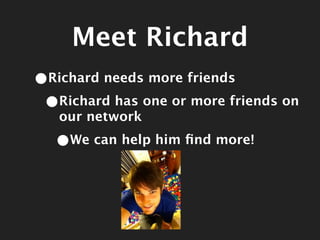
Meet Richard
•Richard needs more friends
 •Richard has one or more friends on
   our network

  •We can help him find more!
def
potential_friend
•Someone who Richard likely
 knows and wants to
 “friend” on a service (e.g.
 Gowalla)
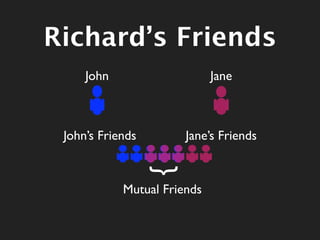
def mutual_friend
•When two users have the same
 friend, it is a mutual friend
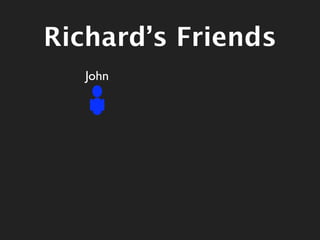
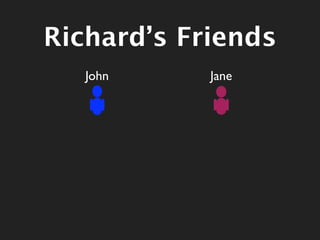
Richard’s Friends
Richard’s Friends
   John
Richard’s Friends
   John     Jane
Richard’s Friends
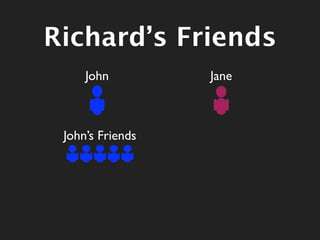
     John         Jane


 John’s Friends
Richard’s Friends
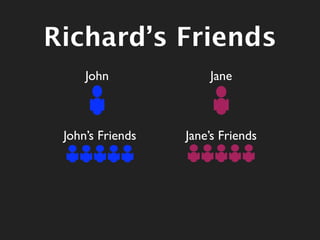
     John             Jane


 John’s Friends   Jane’s Friends
Richard’s Friends
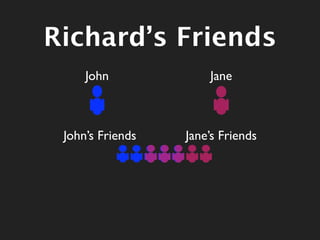
     John             Jane


 John’s Friends   Jane’s Friends
Richard’s Friends
     John                    Jane


 John’s Friends        Jane’s Friends
                  }
            Mutual Friends
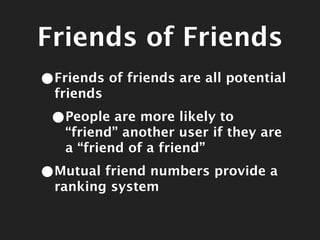
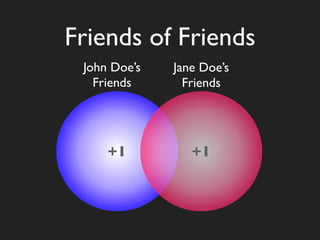
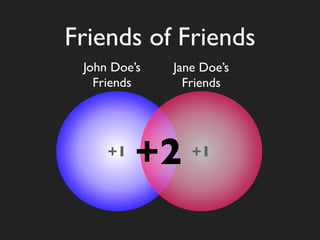
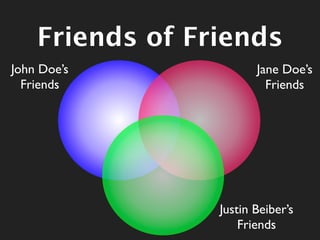
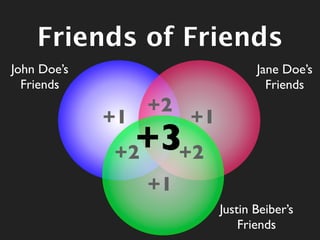
Friends of Friends
•Friends of friends are all potential
  friends

 •People are more likely to
   “friend” another user if they are
   a “friend of a friend”

•Mutual friend numbers provide a
  ranking system
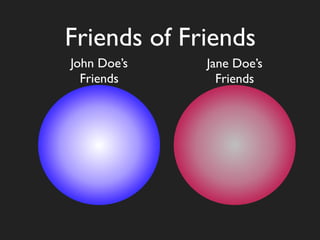
Friends of Friends
John Doe’s   Jane Doe’s
  Friends      Friends
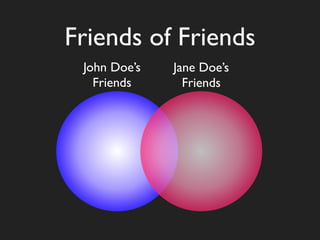
Friends of Friends
 John Doe’s   Jane Doe’s
   Friends      Friends
Friends of Friends
 John Doe’s   Jane Doe’s
   Friends      Friends


     +1          +1
Friends of Friends
 John Doe’s   Jane Doe’s
   Friends      Friends


     +1
          +2     +1
Friends of Friends
John Doe’s              Jane Doe’s
  Friends                 Friends


                 Justin Beiber’s
                     Friends
Friends of Friends
John Doe’s                         Jane Doe’s
  Friends                            Friends
                  +2
             +1        +1
             +2+3+2
                  +1
                            Justin Beiber’s
                                Friends
How do we do that
   in our App?
•Memcache
•Redis
•Street Smarts


                 (Making it rain friendships)
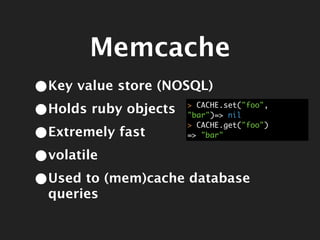
Memcache
•Key value store (NOSQL)
•Holds ruby objects> CACHE.set("foo",
                   "bar")=> nil

•Extremely fast
                   > CACHE.get("foo")
                   => "bar"


•volatile
•Used to (mem)cache database
 queries
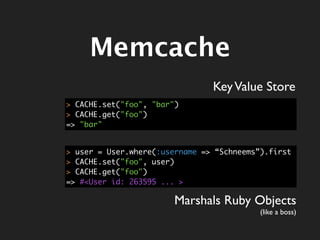
Memcache
                                Key Value Store
> CACHE.set("foo", "bar")
> CACHE.get("foo")
=> "bar"


> user = User.where(:username => “Schneems”).first
> CACHE.set("foo", user)
> CACHE.get("foo")
=> #<User id: 263595 ... >

                        Marshals Ruby Objects
                                           (like a boss)
Memcache

 Is Volitile
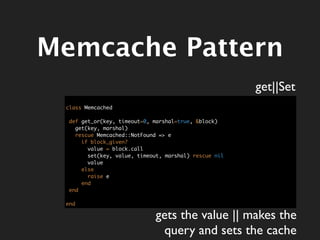
Memcache Pattern
                                                       get||Set
 class Memcached

  def get_or(key, timeout=0, marshal=true, &block)
    get(key, marshal)
    rescue Memcached::NotFound => e
      if block_given?
        value = block.call
        set(key, value, timeout, marshal) rescue nil
        value
      else
        raise e
      end
  end

 end

                              gets the value || makes the
                               query and sets the cache
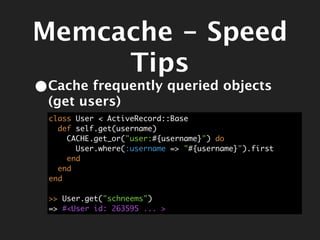
Memcache - Speed
     Tips
•Cache frequently queried objects
 (get users)
  class User < ActiveRecord::Base
    def self.get(username)
      CACHE.get_or("user:#{username}") do
        User.where(:username => "#{username}").first
      end
    end
  end

  >> User.get("schneems")
  => #<User id: 263595 ... >
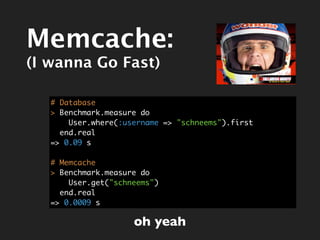
Memcache:
(I wanna Go Fast)

   # Database
   > Benchmark.measure do
       User.where(:username => "schneems").first
     end.real
   => 0.09 s

   # Memcache
   > Benchmark.measure do
       User.get("schneems")
     end.real
   => 0.0009 s

                     oh yeah
Memcache - Speed
     Tips
•Cache expensive queries (Friend
   IDs)
class User < ActiveRecord::Base
  def get_friend_ids
    CACHE.get_or("friend_ids:#{self.id}") do
      friends = Friendships.where(:user_1_id => self.id)
      friends.map {|friend| friend.user_2_id }
    end
  end
end

>> u = User.get("schneems")
>> u.get_friend_ids
=> [1,2,3,...]
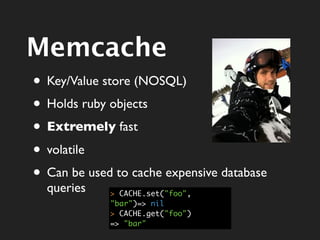
Memcache
• Key/Value store (NOSQL)
• Holds ruby objects
• Extremely fast
• volatile
• Can be used to cache expensive database
  queries    > CACHE.set("foo",
             "bar")=> nil
             > CACHE.get("foo")
             => "bar"
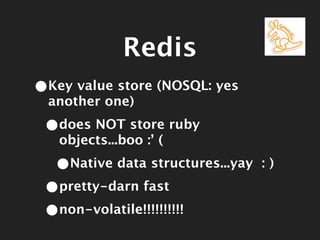
Redis
•Key value store (NOSQL: yes
 another one)

 •does NOT store ruby
   objects...boo :’ (

  •Native data structures...yay   :)

 •pretty-darn fast
 •non-volatile!!!!!!!!!!
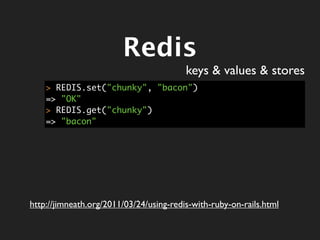
Redis
                                         keys & values & stores
    > REDIS.set("chunky", "bacon")
    => "OK"
    > REDIS.get("chunky")
    => "bacon"


http://jimneath.org/2011/03/24/using-redis-with-ruby-on-rails.html
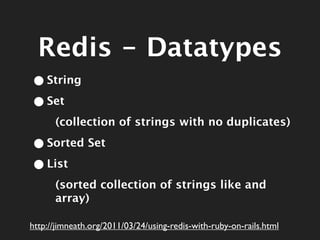
Redis - Datatypes
• String
• Set
      (collection of strings with no duplicates)

• Sorted Set
• List
      (sorted collection of strings like and
      array)

http://jimneath.org/2011/03/24/using-redis-with-ruby-on-rails.html
Redis - Lists
                                        keys & values & stores
> REDIS.lpush("lists:are:like:an:array", 1)
=> 1
> REDIS.lpush("lists:are:like:an:array", 2)
=> 2
> REDIS.lpush("lists:are:like:an:array", 3)
=> 3
> REDIS.lrange("lists:are:like:an:array", 0, -1)
=> ["3", "2", "1"]
> REDIS.lrange("lists:are:like:an:array", 0, -1).map(&:to_i)
=> [3, 2, 1]


http://jimneath.org/2011/03/24/using-redis-with-ruby-on-rails.html
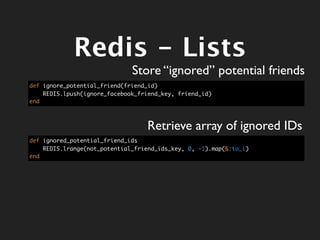
Redis - Lists
                              Store “ignored” potential friends
def ignore_potential_friend(friend_id)
    REDIS.lpush(ignore_facebook_friend_key, friend_id)
end


                                   Retrieve array of ignored IDs
def ignored_potential_friend_ids
    REDIS.lrange(not_potential_friend_ids_key, 0, -1).map(&:to_i)
end
Redis - Recap
•Key value store (yes another one)
 •does NOT store ruby
   objects...boo :’ (

  •Native data structures...yay   :)

 •pretty-darn fast
 •non-volatile!!!!!!!!!!
Redis - Extra
Getting Started
                Credit
    http://jimneath.org/2011/03/24/using-redis-with-ruby-
    on-rails.html

Resque
Background jobs with Redis (and style)
https://github.com/defunkt/resque
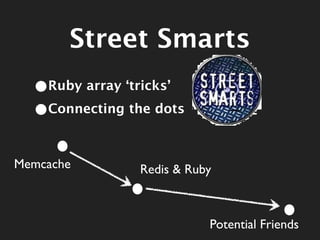
Street Smarts
  •Ruby array ‘tricks’
  •Connecting the dots

Memcache        Redis & Ruby


                           Potential Friends
Street Smarts
            Ruby array Manipulation
Intersection (    &)
 > [1,2,3] & [3,4,5]

 => [3]

 > [1,2,3,4] & [3,4,5]

 => [3,4]

Difference (    -)
 > [1,2,3] - [3,4,5]
 => [1,2,4,5]
 > [1,2,3,4] - [3,4,5]
 => [1,2,5]
Street Smarts
          Ruby array Manipulation
Concatenation (      +)
 > [1,2] + [3,4,5]
 => [1,2,3,4,5]
Street Smarts
            Ruby array Manipulation
inject - turning arrays into other
stuff
  [5,6,7,8,9,10].inject(0)   {|sum, n| sum + n }
  => 45
Street Smarts
            Ruby array Manipulation
inject - turning arrays into other
stuff
  [5,6,7,8,9,10].inject(0)   {|sum, n| sum + n }
  => 45


inject - build hashes from arrays
  > array = [5,6,7,8,9,10]
  > array.inject({}) {|hash, id| hash[id.to_s] = 1; hash }
  => {"6"=>1, "7"=>1, "8"=>1, "9"=>1, "10"=>1, "5"=>1}
inject - build hashes from arrays
       > array.inject({}) {|hash, id|
                            puts "hash: #{hash.inspect}"
                            puts "id: #{id}"
                            hash[id.to_s] = 1;
                            hash }
       hash: {}
       id: 5
       hash: {"5"=>1}
       id: 6
       hash: {"6"=>1, "5"=>1}
       id: 7
       hash: {"6"=>1, "7"=>1, "5"=>1}
       id: 8
       hash: {"6"=>1, "7"=>1, "8"=>1, "5"=>1}
       id: 9
       hash: {"6"=>1, "7"=>1, "8"=>1, "9"=>1, "5"=>1}
       id: 10
       => {"6"=>1, "7"=>1, "8"=>1, "9"=>1, "10"=>1, "5"=>1}
inject - build hashes from arrays
       > array.inject({}) {|hash, id|
                            puts "hash: #{hash.inspect}"
                            puts "id: #{id}"
                            hash[id.to_s] = 1;
                            hash }
       hash: {}
       id: 5
       hash: {"5"=>1}
       id: 6
       hash: {"6"=>1, "5"=>1}
       id: 7
       hash: {"6"=>1, "7"=>1, "5"=>1}
       id: 8
       hash: {"6"=>1, "7"=>1, "8"=>1, "5"=>1}
       id: 9
       hash: {"6"=>1, "7"=>1, "8"=>1, "9"=>1, "5"=>1}
       id: 10
       => {"6"=>1, "7"=>1, "8"=>1, "9"=>1, "10"=>1, "5"=>1}
inject - build hashes from arrays
       > array.inject({}) {|hash, id|
                            puts "hash: #{hash.inspect}"
                            puts "id: #{id}"
                            hash[id.to_s] = 1;
                            hash }
       hash: {}
       id: 5
       hash: {"5"=>1}
       id: 6
       hash: {"6"=>1, "5"=>1}
       id: 7
       hash: {"6"=>1, "7"=>1, "5"=>1}
       id: 8
       hash: {"6"=>1, "7"=>1, "8"=>1, "5"=>1}
       id: 9
       hash: {"6"=>1, "7"=>1, "8"=>1, "9"=>1, "5"=>1}
       id: 10
       => {"6"=>1, "7"=>1, "8"=>1, "9"=>1, "10"=>1, "5"=>1}
inject - build hashes from arrays
       > array.inject({}) {|hash, id|
                            puts "hash: #{hash.inspect}"
                            puts "id: #{id}"
                            hash[id.to_s] = 1;
                            hash }
       hash: {}
       id: 5
       hash: {"5"=>1}
       id: 6
       hash: {"6"=>1, "5"=>1}
       id: 7
       hash: {"6"=>1, "7"=>1, "5"=>1}
       id: 8
       hash: {"6"=>1, "7"=>1, "8"=>1, "5"=>1}
       id: 9
       hash: {"6"=>1, "7"=>1, "8"=>1, "9"=>1, "5"=>1}
       id: 10
       => {"6"=>1, "7"=>1, "8"=>1, "9"=>1, "10"=>1, "5"=>1}
inject - build hashes from arrays
       > array.inject({}) {|hash, id|
                            puts "hash: #{hash.inspect}"
                            puts "id: #{id}"
                            hash[id.to_s] = 1;
                            hash }
       hash: {}
       id: 5
       hash: {"5"=>1}
       id: 6
       hash: {"6"=>1, "5"=>1}
       id: 7
       hash: {"6"=>1, "7"=>1, "5"=>1}
       id: 8
       hash: {"6"=>1, "7"=>1, "8"=>1, "5"=>1}
       id: 9
       hash: {"6"=>1, "7"=>1, "8"=>1, "9"=>1, "5"=>1}
       id: 10
       => {"6"=>1, "7"=>1, "8"=>1, "9"=>1, "10"=>1, "5"=>1}
inject - build hashes from arrays
       > array.inject({}) {|hash, id|
                            puts "hash: #{hash.inspect}"
                            puts "id: #{id}"
                            hash[id.to_s] = 1;
                            hash }
       hash: {}
       id: 5
       hash: {"5"=>1}
       id: 6
       hash: {"6"=>1, "5"=>1}
       id: 7
       hash: {"6"=>1, "7"=>1, "5"=>1}
       id: 8
       hash: {"6"=>1, "7"=>1, "8"=>1, "5"=>1}
       id: 9
       hash: {"6"=>1, "7"=>1, "8"=>1, "9"=>1, "5"=>1}
       id: 10
       => {"6"=>1, "7"=>1, "8"=>1, "9"=>1, "10"=>1, "5"=>1}
inject - build hashes from arrays
       > array.inject({}) {|hash, id|
                            puts "hash: #{hash.inspect}"
                            puts "id: #{id}"
                            hash[id.to_s] = 1;
                            hash }
       hash: {}
       id: 5
       hash: {"5"=>1}
       id: 6
       hash: {"6"=>1, "5"=>1}
       id: 7
       hash: {"6"=>1, "7"=>1, "5"=>1}
       id: 8
       hash: {"6"=>1, "7"=>1, "8"=>1, "5"=>1}
       id: 9
       hash: {"6"=>1, "7"=>1, "8"=>1, "9"=>1, "5"=>1}
       id: 10
       => {"6"=>1, "7"=>1, "8"=>1, "9"=>1, "10"=>1, "5"=>1}
inject - build hashes from arrays
       > array.inject({}) {|hash, id|
                            puts "hash: #{hash.inspect}"
                            puts "id: #{id}"
                            hash[id.to_s] = 1;
                            hash }
       hash: {}
       id: 5
       hash: {"5"=>1}
       id: 6
       hash: {"6"=>1, "5"=>1}
       id: 7
       hash: {"6"=>1, "7"=>1, "5"=>1}
       id: 8
       hash: {"6"=>1, "7"=>1, "8"=>1, "5"=>1}
       id: 9
       hash: {"6"=>1, "7"=>1, "8"=>1, "9"=>1, "5"=>1}
       id: 10
       => {"6"=>1, "7"=>1, "8"=>1, "9"=>1, "10"=>1, "5"=>1}
inject - build hashes from arrays
       > array.inject({}) {|hash, id|
                            puts "hash: #{hash.inspect}"
                            puts "id: #{id}"
                            hash[id.to_s] = 1;
                            hash }
       hash: {}
       id: 5
       hash: {"5"=>1}
       id: 6
       hash: {"6"=>1, "5"=>1}
       id: 7
       hash: {"6"=>1, "7"=>1, "5"=>1}
       id: 8
       hash: {"6"=>1, "7"=>1, "8"=>1, "5"=>1}
       id: 9
       hash: {"6"=>1, "7"=>1, "8"=>1, "9"=>1, "5"=>1}
       id: 10
       => {"6"=>1, "7"=>1, "8"=>1, "9"=>1, "10"=>1, "5"=>1}
            “the best method in
            Ruby...ever”
                                                      - Adam
Street Smarts
  Connect the Dots
Street Smarts
             Connect the Dots
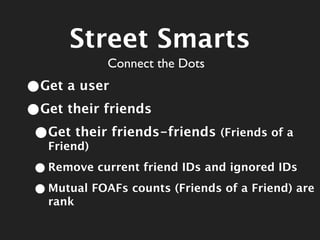
•Get a user
•Get their friends
 •Get their friends-friends (Friends of a
  Friend)

 • Remove current friend IDs and ignored IDs
 • Mutual FOAFs counts (Friends of a Friend) are
   rank
Friend IDs
            Connect the Dots
Get friend’s IDs
 > richard = User.get("Schneems")
 > richard.get_friend_ids
 =>[1, 2] # [john, jane]


Get your friend’s friend IDs
 > friends_of_a_friend_ids = []
 > richard.get_friend_ids do |friend_id|
 > friends_of_a_friend_ids << User.get_someones_friend_ids(friend_id)
 > end.flatten
 =>[3, 4, 5, 6, 7, 3, 4, 5, 8, 9, 10]
   # john and jane’s friend id’s
FOAF IDs
Friend of a Friend Ids
    > friends_of_a_friend_ids = []
    > richard.get_friend_ids do |friend_id|
    > friends_of_a_friend_ids << User.get_someones_friend_ids(friend_id)
    > end.flatten
    =>[3, 4, 5, 6, 7, 3, 4, 5, 8, 9, 10]
      # john and jane’s friend id’s

 What does this give us?

    =>[3,   4, 5,   6, 7,   3, 4, 5,   8, 9, 10]


   (hint, its potential friend IDs)
Remove Bad
                Suggestions
  •Don’t suggest
   •self
     • Pending or accepted friend request
     • Previously ignored potential friends
def not_potential_friend_ids
  @not_potential_friend_ids ||=
    CACHE.get_or("users:not_potential_friends_key:#{self.id}", 24.hours) {
      [self.id] +
      Friendship.where(:user_1_id => self.id).map(&:user_2_id) +
      ignored_potential_friend_ids
    }
end
Put it all Together
Sooooooo... close
 def potential_friend_ids(options = {})
   potential_friend_ids = friends_of_a_friend_ids - not_potential_friend_ids
   potential_ids_with_score = potential_friend_ids.
                              inject({}) {|sorted_id_hash, friend_id|
                                          if sorted_id_hash[friend_id].blank?
                                             sorted_id_hash[friend_id] = 1
                                          else
                                             sorted_id_hash[friend_id] += 1
                                          end
                                          sorted_id_hash }
   sorted_potential_friend_ids = potential_ids_with_score.sort {|x, y|
                                       y.last <=> x.last}.
                                       map(&:first)
   return sorted_potential_friend_ids
 end
Put it all Together
It works!!!!!!
def potential_friends(options = {})
    # TODO add memcached to this call in a production app
    User.where("id in (?)", potential_friend_ids.
         first(options[:limit])).shuffle
end

Boom!!
> User.get(“schneems”).potential_friends(:limit => 2)
> [#<User id: 3 ... >, #<User id: 5 ... >]


                  Goes
                   the
              dynamite
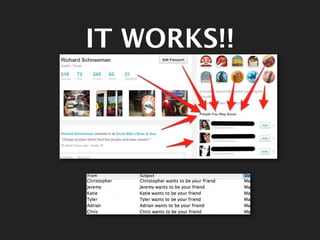
IT WORKS!!
Try It Out
• Sign up on Gowalla
 • http://gowalla.com/join
• Add friends or connect facebook
 • Visit your passport
 • Add and ignore friends to your content
Thats100% Pure
  Crunk Juice
      YEAH!
Questions?


Twitters: @schneems
         github.com/schneems

Potential Friend Finder

  • 1.
    How Richard Found Friends Richard Schneeman @schneems I hack rubies for @gowalla
  • 2.
    Meet Richard •Richard needsmore friends •Richard has one or more friends on our network •We can help him find more!
  • 3.
    def potential_friend •Someone who Richardlikely knows and wants to “friend” on a service (e.g. Gowalla)
  • 4.
    def mutual_friend •When twousers have the same friend, it is a mutual friend
  • 5.
  • 6.
  • 7.
  • 8.
    Richard’s Friends John Jane John’s Friends
  • 9.
    Richard’s Friends John Jane John’s Friends Jane’s Friends
  • 10.
    Richard’s Friends John Jane John’s Friends Jane’s Friends
  • 11.
    Richard’s Friends John Jane John’s Friends Jane’s Friends } Mutual Friends
  • 12.
    Friends of Friends •Friendsof friends are all potential friends •People are more likely to “friend” another user if they are a “friend of a friend” •Mutual friend numbers provide a ranking system
  • 13.
    Friends of Friends JohnDoe’s Jane Doe’s Friends Friends
  • 14.
    Friends of Friends John Doe’s Jane Doe’s Friends Friends
  • 15.
    Friends of Friends John Doe’s Jane Doe’s Friends Friends +1 +1
  • 16.
    Friends of Friends John Doe’s Jane Doe’s Friends Friends +1 +2 +1
  • 17.
    Friends of Friends JohnDoe’s Jane Doe’s Friends Friends Justin Beiber’s Friends
  • 18.
    Friends of Friends JohnDoe’s Jane Doe’s Friends Friends +2 +1 +1 +2+3+2 +1 Justin Beiber’s Friends
  • 19.
    How do wedo that in our App? •Memcache •Redis •Street Smarts (Making it rain friendships)
  • 20.
    Memcache •Key value store(NOSQL) •Holds ruby objects> CACHE.set("foo", "bar")=> nil •Extremely fast > CACHE.get("foo") => "bar" •volatile •Used to (mem)cache database queries
  • 21.
    Memcache Key Value Store > CACHE.set("foo", "bar") > CACHE.get("foo") => "bar" > user = User.where(:username => “Schneems”).first > CACHE.set("foo", user) > CACHE.get("foo") => #<User id: 263595 ... > Marshals Ruby Objects (like a boss)
  • 22.
  • 23.
    Memcache Pattern get||Set class Memcached def get_or(key, timeout=0, marshal=true, &block) get(key, marshal) rescue Memcached::NotFound => e if block_given? value = block.call set(key, value, timeout, marshal) rescue nil value else raise e end end end gets the value || makes the query and sets the cache
  • 24.
    Memcache - Speed Tips •Cache frequently queried objects (get users) class User < ActiveRecord::Base def self.get(username) CACHE.get_or("user:#{username}") do User.where(:username => "#{username}").first end end end >> User.get("schneems") => #<User id: 263595 ... >
  • 25.
    Memcache: (I wanna GoFast) # Database > Benchmark.measure do User.where(:username => "schneems").first end.real => 0.09 s # Memcache > Benchmark.measure do User.get("schneems") end.real => 0.0009 s oh yeah
  • 26.
    Memcache - Speed Tips •Cache expensive queries (Friend IDs) class User < ActiveRecord::Base def get_friend_ids CACHE.get_or("friend_ids:#{self.id}") do friends = Friendships.where(:user_1_id => self.id) friends.map {|friend| friend.user_2_id } end end end >> u = User.get("schneems") >> u.get_friend_ids => [1,2,3,...]
  • 27.
    Memcache • Key/Value store(NOSQL) • Holds ruby objects • Extremely fast • volatile • Can be used to cache expensive database queries > CACHE.set("foo", "bar")=> nil > CACHE.get("foo") => "bar"
  • 28.
    Redis •Key value store(NOSQL: yes another one) •does NOT store ruby objects...boo :’ ( •Native data structures...yay :) •pretty-darn fast •non-volatile!!!!!!!!!!
  • 29.
    Redis keys & values & stores > REDIS.set("chunky", "bacon") => "OK" > REDIS.get("chunky") => "bacon" http://jimneath.org/2011/03/24/using-redis-with-ruby-on-rails.html
  • 30.
    Redis - Datatypes •String • Set (collection of strings with no duplicates) • Sorted Set • List (sorted collection of strings like and array) http://jimneath.org/2011/03/24/using-redis-with-ruby-on-rails.html
  • 31.
    Redis - Lists keys & values & stores > REDIS.lpush("lists:are:like:an:array", 1) => 1 > REDIS.lpush("lists:are:like:an:array", 2) => 2 > REDIS.lpush("lists:are:like:an:array", 3) => 3 > REDIS.lrange("lists:are:like:an:array", 0, -1) => ["3", "2", "1"] > REDIS.lrange("lists:are:like:an:array", 0, -1).map(&:to_i) => [3, 2, 1] http://jimneath.org/2011/03/24/using-redis-with-ruby-on-rails.html
  • 32.
    Redis - Lists Store “ignored” potential friends def ignore_potential_friend(friend_id) REDIS.lpush(ignore_facebook_friend_key, friend_id) end Retrieve array of ignored IDs def ignored_potential_friend_ids REDIS.lrange(not_potential_friend_ids_key, 0, -1).map(&:to_i) end
  • 33.
    Redis - Recap •Keyvalue store (yes another one) •does NOT store ruby objects...boo :’ ( •Native data structures...yay :) •pretty-darn fast •non-volatile!!!!!!!!!!
  • 34.
    Redis - Extra GettingStarted Credit http://jimneath.org/2011/03/24/using-redis-with-ruby- on-rails.html Resque Background jobs with Redis (and style) https://github.com/defunkt/resque
  • 35.
    Street Smarts •Ruby array ‘tricks’ •Connecting the dots Memcache Redis & Ruby Potential Friends
  • 36.
    Street Smarts Ruby array Manipulation Intersection ( &) > [1,2,3] & [3,4,5] => [3] > [1,2,3,4] & [3,4,5] => [3,4] Difference ( -) > [1,2,3] - [3,4,5] => [1,2,4,5] > [1,2,3,4] - [3,4,5] => [1,2,5]
  • 37.
    Street Smarts Ruby array Manipulation Concatenation ( +) > [1,2] + [3,4,5] => [1,2,3,4,5]
  • 38.
    Street Smarts Ruby array Manipulation inject - turning arrays into other stuff [5,6,7,8,9,10].inject(0) {|sum, n| sum + n } => 45
  • 39.
    Street Smarts Ruby array Manipulation inject - turning arrays into other stuff [5,6,7,8,9,10].inject(0) {|sum, n| sum + n } => 45 inject - build hashes from arrays > array = [5,6,7,8,9,10] > array.inject({}) {|hash, id| hash[id.to_s] = 1; hash } => {"6"=>1, "7"=>1, "8"=>1, "9"=>1, "10"=>1, "5"=>1}
  • 40.
    inject - buildhashes from arrays > array.inject({}) {|hash, id| puts "hash: #{hash.inspect}" puts "id: #{id}" hash[id.to_s] = 1; hash } hash: {} id: 5 hash: {"5"=>1} id: 6 hash: {"6"=>1, "5"=>1} id: 7 hash: {"6"=>1, "7"=>1, "5"=>1} id: 8 hash: {"6"=>1, "7"=>1, "8"=>1, "5"=>1} id: 9 hash: {"6"=>1, "7"=>1, "8"=>1, "9"=>1, "5"=>1} id: 10 => {"6"=>1, "7"=>1, "8"=>1, "9"=>1, "10"=>1, "5"=>1}
  • 41.
    inject - buildhashes from arrays > array.inject({}) {|hash, id| puts "hash: #{hash.inspect}" puts "id: #{id}" hash[id.to_s] = 1; hash } hash: {} id: 5 hash: {"5"=>1} id: 6 hash: {"6"=>1, "5"=>1} id: 7 hash: {"6"=>1, "7"=>1, "5"=>1} id: 8 hash: {"6"=>1, "7"=>1, "8"=>1, "5"=>1} id: 9 hash: {"6"=>1, "7"=>1, "8"=>1, "9"=>1, "5"=>1} id: 10 => {"6"=>1, "7"=>1, "8"=>1, "9"=>1, "10"=>1, "5"=>1}
  • 42.
    inject - buildhashes from arrays > array.inject({}) {|hash, id| puts "hash: #{hash.inspect}" puts "id: #{id}" hash[id.to_s] = 1; hash } hash: {} id: 5 hash: {"5"=>1} id: 6 hash: {"6"=>1, "5"=>1} id: 7 hash: {"6"=>1, "7"=>1, "5"=>1} id: 8 hash: {"6"=>1, "7"=>1, "8"=>1, "5"=>1} id: 9 hash: {"6"=>1, "7"=>1, "8"=>1, "9"=>1, "5"=>1} id: 10 => {"6"=>1, "7"=>1, "8"=>1, "9"=>1, "10"=>1, "5"=>1}
  • 43.
    inject - buildhashes from arrays > array.inject({}) {|hash, id| puts "hash: #{hash.inspect}" puts "id: #{id}" hash[id.to_s] = 1; hash } hash: {} id: 5 hash: {"5"=>1} id: 6 hash: {"6"=>1, "5"=>1} id: 7 hash: {"6"=>1, "7"=>1, "5"=>1} id: 8 hash: {"6"=>1, "7"=>1, "8"=>1, "5"=>1} id: 9 hash: {"6"=>1, "7"=>1, "8"=>1, "9"=>1, "5"=>1} id: 10 => {"6"=>1, "7"=>1, "8"=>1, "9"=>1, "10"=>1, "5"=>1}
  • 44.
    inject - buildhashes from arrays > array.inject({}) {|hash, id| puts "hash: #{hash.inspect}" puts "id: #{id}" hash[id.to_s] = 1; hash } hash: {} id: 5 hash: {"5"=>1} id: 6 hash: {"6"=>1, "5"=>1} id: 7 hash: {"6"=>1, "7"=>1, "5"=>1} id: 8 hash: {"6"=>1, "7"=>1, "8"=>1, "5"=>1} id: 9 hash: {"6"=>1, "7"=>1, "8"=>1, "9"=>1, "5"=>1} id: 10 => {"6"=>1, "7"=>1, "8"=>1, "9"=>1, "10"=>1, "5"=>1}
  • 45.
    inject - buildhashes from arrays > array.inject({}) {|hash, id| puts "hash: #{hash.inspect}" puts "id: #{id}" hash[id.to_s] = 1; hash } hash: {} id: 5 hash: {"5"=>1} id: 6 hash: {"6"=>1, "5"=>1} id: 7 hash: {"6"=>1, "7"=>1, "5"=>1} id: 8 hash: {"6"=>1, "7"=>1, "8"=>1, "5"=>1} id: 9 hash: {"6"=>1, "7"=>1, "8"=>1, "9"=>1, "5"=>1} id: 10 => {"6"=>1, "7"=>1, "8"=>1, "9"=>1, "10"=>1, "5"=>1}
  • 46.
    inject - buildhashes from arrays > array.inject({}) {|hash, id| puts "hash: #{hash.inspect}" puts "id: #{id}" hash[id.to_s] = 1; hash } hash: {} id: 5 hash: {"5"=>1} id: 6 hash: {"6"=>1, "5"=>1} id: 7 hash: {"6"=>1, "7"=>1, "5"=>1} id: 8 hash: {"6"=>1, "7"=>1, "8"=>1, "5"=>1} id: 9 hash: {"6"=>1, "7"=>1, "8"=>1, "9"=>1, "5"=>1} id: 10 => {"6"=>1, "7"=>1, "8"=>1, "9"=>1, "10"=>1, "5"=>1}
  • 47.
    inject - buildhashes from arrays > array.inject({}) {|hash, id| puts "hash: #{hash.inspect}" puts "id: #{id}" hash[id.to_s] = 1; hash } hash: {} id: 5 hash: {"5"=>1} id: 6 hash: {"6"=>1, "5"=>1} id: 7 hash: {"6"=>1, "7"=>1, "5"=>1} id: 8 hash: {"6"=>1, "7"=>1, "8"=>1, "5"=>1} id: 9 hash: {"6"=>1, "7"=>1, "8"=>1, "9"=>1, "5"=>1} id: 10 => {"6"=>1, "7"=>1, "8"=>1, "9"=>1, "10"=>1, "5"=>1}
  • 48.
    inject - buildhashes from arrays > array.inject({}) {|hash, id| puts "hash: #{hash.inspect}" puts "id: #{id}" hash[id.to_s] = 1; hash } hash: {} id: 5 hash: {"5"=>1} id: 6 hash: {"6"=>1, "5"=>1} id: 7 hash: {"6"=>1, "7"=>1, "5"=>1} id: 8 hash: {"6"=>1, "7"=>1, "8"=>1, "5"=>1} id: 9 hash: {"6"=>1, "7"=>1, "8"=>1, "9"=>1, "5"=>1} id: 10 => {"6"=>1, "7"=>1, "8"=>1, "9"=>1, "10"=>1, "5"=>1} “the best method in Ruby...ever” - Adam
  • 49.
    Street Smarts Connect the Dots
  • 50.
    Street Smarts Connect the Dots •Get a user •Get their friends •Get their friends-friends (Friends of a Friend) • Remove current friend IDs and ignored IDs • Mutual FOAFs counts (Friends of a Friend) are rank
  • 51.
    Friend IDs Connect the Dots Get friend’s IDs > richard = User.get("Schneems") > richard.get_friend_ids =>[1, 2] # [john, jane] Get your friend’s friend IDs > friends_of_a_friend_ids = [] > richard.get_friend_ids do |friend_id| > friends_of_a_friend_ids << User.get_someones_friend_ids(friend_id) > end.flatten =>[3, 4, 5, 6, 7, 3, 4, 5, 8, 9, 10] # john and jane’s friend id’s
  • 52.
    FOAF IDs Friend ofa Friend Ids > friends_of_a_friend_ids = [] > richard.get_friend_ids do |friend_id| > friends_of_a_friend_ids << User.get_someones_friend_ids(friend_id) > end.flatten =>[3, 4, 5, 6, 7, 3, 4, 5, 8, 9, 10] # john and jane’s friend id’s What does this give us? =>[3, 4, 5, 6, 7, 3, 4, 5, 8, 9, 10] (hint, its potential friend IDs)
  • 53.
    Remove Bad Suggestions •Don’t suggest •self • Pending or accepted friend request • Previously ignored potential friends def not_potential_friend_ids @not_potential_friend_ids ||= CACHE.get_or("users:not_potential_friends_key:#{self.id}", 24.hours) { [self.id] + Friendship.where(:user_1_id => self.id).map(&:user_2_id) + ignored_potential_friend_ids } end
  • 54.
    Put it allTogether Sooooooo... close def potential_friend_ids(options = {}) potential_friend_ids = friends_of_a_friend_ids - not_potential_friend_ids potential_ids_with_score = potential_friend_ids. inject({}) {|sorted_id_hash, friend_id| if sorted_id_hash[friend_id].blank? sorted_id_hash[friend_id] = 1 else sorted_id_hash[friend_id] += 1 end sorted_id_hash } sorted_potential_friend_ids = potential_ids_with_score.sort {|x, y| y.last <=> x.last}. map(&:first) return sorted_potential_friend_ids end
  • 55.
    Put it allTogether It works!!!!!! def potential_friends(options = {}) # TODO add memcached to this call in a production app User.where("id in (?)", potential_friend_ids. first(options[:limit])).shuffle end Boom!! > User.get(“schneems”).potential_friends(:limit => 2) > [#<User id: 3 ... >, #<User id: 5 ... >] Goes the dynamite
  • 56.
  • 57.
    Try It Out •Sign up on Gowalla • http://gowalla.com/join • Add friends or connect facebook • Visit your passport • Add and ignore friends to your content
  • 58.
    Thats100% Pure Crunk Juice YEAH!
  • 59.