Particle Accelerators
Fayoum University
Faculty of Science
Physics Department
Prepared and Presented by
Dr. Mohammed Attia Mahmoud
- PhD from Fayoum University, Egypt and Antwerp university Belgium
- Member in Egyptian network for High Energy Physics
- Researcher in CMS experiment in CERN, Geneva
1. History of accelerators and basic principles;
2. Radio frequency cavities, linacs, SRF accelerators.
3. Magnets, transverse motion, strong focusing, non-linearities
and resonances.
4. Circulating beams, longitudinal dynamics, synchrotron
radiation, beam cooling.
5. Applications of accelerators: HEP/NP, light sources, medical
uses .
Course Outlines
1. To understand how various types of accelerators work and
difference between them.
2. To understand transverse and longitudinal beam dynamics
in accelerators.
3. To have a general understanding of accelerating
structures.
4. To learn about major applications of accelerators
5. To know what are the new accelerator concepts.
Goals
What Accelerators Are Good For
High Energy Physics & Nuclear Physics
Explore the electro-weak bosons Z, W
Find and exploit “new“ and heavy quarks
Find the HIGGS and Physics beyond standard model
Create new states of matter such as quark gluon plasma or colour-glass condensate
In short search for answers of the most fundaments questions
• Chemistry, Biology, Medicine, Material Sciences
 Find the structure of molecules, proteins, cells… with ultimate goal of
 determining structure of a single organic molecule as complex as a protein!
 Determine structure of material and create new once
To answer if people could survive interstellar travel?
 Resolved structural changes in a natural (fsec and asec) time scales
• Civil, Industrial and Military Applications
 Treat cancers, produce isotopes for medical imaging, sterilize products…
 implant ions into the semiconductor chirps…
 Scan containers in ports for undesirable content (n’s?)
 High power free electron lasers as weapons for a ship defence or for producing
 new generation of chips for your computers
This list will never complete .....
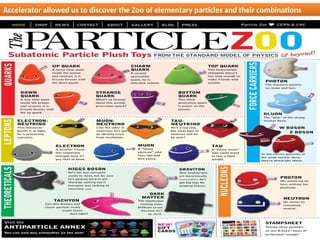
Accelerator allowed us to discover the Zoo of elementary particles and their combinations
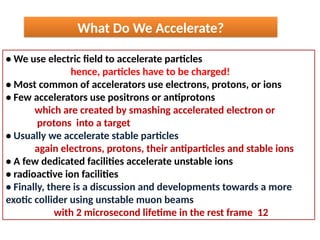
• We use electric field to accelerate particles
hence, particles have to be charged!
• Most common of accelerators use electrons, protons, or ions
• Few accelerators use positrons or antiprotons
which are created by smashing accelerated electron or
protons into a target
• Usually we accelerate stable particles
again electrons, protons, their antiparticles and stable ions
• A few dedicated facilities accelerate unstable ions
• radioactive ion facilities
• Finally, there is a discussion and developments towards a more
exotic collider using unstable muon beams
with 2 microsecond lifetime in the rest frame 12
What Do We Accelerate?
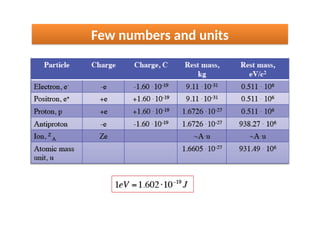
Few numbers and units
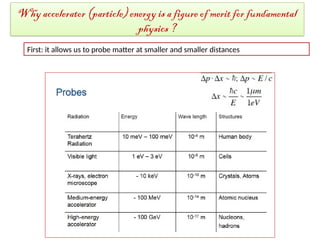
First: it allows us to probe matter at smaller and smaller distances
Why accelerator (particle) energy is a figure of merit for fundamental
physics ?
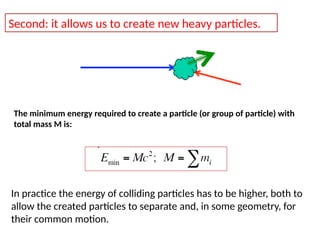
Second: it allows us to create new heavy particles.
The minimum energy required to create a particle (or group of particle) with
total mass M is:
In practice the energy of colliding particles has to be higher, both to
allow the created particles to separate and, in some geometry, for
their common motion.
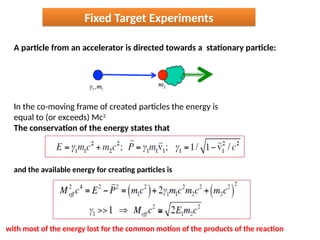
A particle from an accelerator is directed towards a stationary particle:
Fixed Target Experiments
In the co-moving frame of created particles the energy is
equal to (or exceeds) Mc2
The conservation of the energy states that
and the available energy for creating particles is
with most of the energy lost for the common motion of the products of the reaction
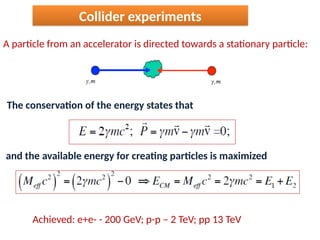
A particle from an accelerator is directed towards a stationary particle:
Collider experiments
The conservation of the energy states that
and the available energy for creating particles is maximized
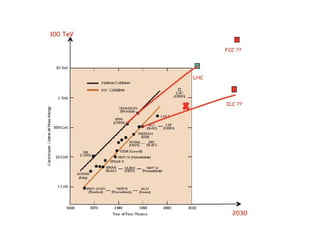
Achieved: e+e- - 200 GeV; p-p – 2 TeV; pp 13 TeV
One of the fastest racetracks on the planet
Several thousand billion protons traveling at 99.9999991% of the
speed of light will travel round the 27km ring over
11000 times a second
Accelerator_Lecturhtfryrwgvtrvrte_1.pptx

Accelerator_Lecturhtfryrwgvtrvrte_1.pptx

  • 1.
    Particle Accelerators Fayoum University Facultyof Science Physics Department Prepared and Presented by Dr. Mohammed Attia Mahmoud - PhD from Fayoum University, Egypt and Antwerp university Belgium - Member in Egyptian network for High Energy Physics - Researcher in CMS experiment in CERN, Geneva
  • 2.
    1. History ofaccelerators and basic principles; 2. Radio frequency cavities, linacs, SRF accelerators. 3. Magnets, transverse motion, strong focusing, non-linearities and resonances. 4. Circulating beams, longitudinal dynamics, synchrotron radiation, beam cooling. 5. Applications of accelerators: HEP/NP, light sources, medical uses . Course Outlines
  • 3.
    1. To understandhow various types of accelerators work and difference between them. 2. To understand transverse and longitudinal beam dynamics in accelerators. 3. To have a general understanding of accelerating structures. 4. To learn about major applications of accelerators 5. To know what are the new accelerator concepts. Goals
  • 4.
    What Accelerators AreGood For High Energy Physics & Nuclear Physics Explore the electro-weak bosons Z, W Find and exploit “new“ and heavy quarks Find the HIGGS and Physics beyond standard model Create new states of matter such as quark gluon plasma or colour-glass condensate In short search for answers of the most fundaments questions • Chemistry, Biology, Medicine, Material Sciences  Find the structure of molecules, proteins, cells… with ultimate goal of  determining structure of a single organic molecule as complex as a protein!  Determine structure of material and create new once To answer if people could survive interstellar travel?  Resolved structural changes in a natural (fsec and asec) time scales • Civil, Industrial and Military Applications  Treat cancers, produce isotopes for medical imaging, sterilize products…  implant ions into the semiconductor chirps…  Scan containers in ports for undesirable content (n’s?)  High power free electron lasers as weapons for a ship defence or for producing  new generation of chips for your computers This list will never complete .....
  • 5.
    Accelerator allowed usto discover the Zoo of elementary particles and their combinations
  • 6.
    • We useelectric field to accelerate particles hence, particles have to be charged! • Most common of accelerators use electrons, protons, or ions • Few accelerators use positrons or antiprotons which are created by smashing accelerated electron or protons into a target • Usually we accelerate stable particles again electrons, protons, their antiparticles and stable ions • A few dedicated facilities accelerate unstable ions • radioactive ion facilities • Finally, there is a discussion and developments towards a more exotic collider using unstable muon beams with 2 microsecond lifetime in the rest frame 12 What Do We Accelerate?
  • 7.
  • 9.
    First: it allowsus to probe matter at smaller and smaller distances Why accelerator (particle) energy is a figure of merit for fundamental physics ?
  • 10.
    Second: it allowsus to create new heavy particles. The minimum energy required to create a particle (or group of particle) with total mass M is: In practice the energy of colliding particles has to be higher, both to allow the created particles to separate and, in some geometry, for their common motion.
  • 11.
    A particle froman accelerator is directed towards a stationary particle: Fixed Target Experiments In the co-moving frame of created particles the energy is equal to (or exceeds) Mc2 The conservation of the energy states that and the available energy for creating particles is with most of the energy lost for the common motion of the products of the reaction
  • 12.
    A particle froman accelerator is directed towards a stationary particle: Collider experiments The conservation of the energy states that and the available energy for creating particles is maximized Achieved: e+e- - 200 GeV; p-p – 2 TeV; pp 13 TeV
  • 13.
    One of thefastest racetracks on the planet Several thousand billion protons traveling at 99.9999991% of the speed of light will travel round the 27km ring over 11000 times a second

Editor's Notes

  • #1 Click to edit Master text styles Second level Third level Fourth level Fifth level