Safe Passage for Children
of Minnesota
2017 Day on the Hill
February 28, 2017
Agenda
1. What is at stake
2. Impact of your visit
3. Where are we today: status of
1. Legislative session
2. Governor’s Task Force recommendations
4. How the process works
5. Making the most of your meeting
2
Legislative priority is prevention
& early intervention
• Fewer victims of child maltreatment
• Most direct impact on racial disparities
• Avoid swamping the system
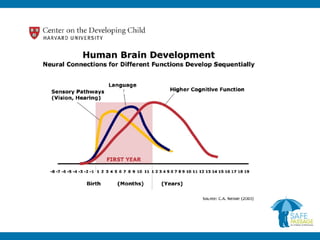
• Help children so they aren’t traumatized
during crucial developmental periods
3
Bills we are part of
1. $27.7 million early childhood education slots
• Children 0-2 with open child protection cases, in
foster care, or homeless
• Working with coalition: MinneMinds, Hennepin
County, People Serving People, Parent Aware
• Bill will be introduced after Day on the Hill
1. Minnesota Targeted Home Visiting Coalition
increase – estimated $38 million year 1,
$52 million year 2
5
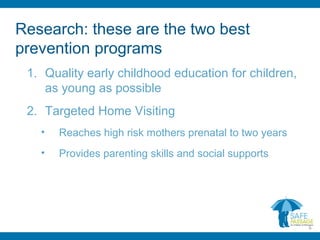
Research: these are the two best
prevention programs
1. Quality early childhood education for children,
as young as possible
2. Targeted Home Visiting
• Reaches high risk mothers prenatal to two years
• Provides parenting skills and social supports
6
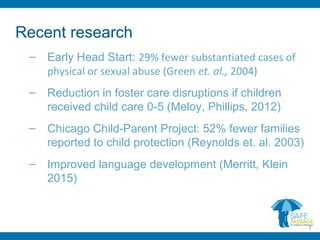
Recent research
– Early Head Start: 29% fewer substantiated cases of
physical or sexual abuse (Green et. al., 2004)
– Reduction in foster care disruptions if children
received child care 0-5 (Meloy, Phillips, 2012)
– Chicago Child-Parent Project: 52% fewer families
reported to child protection (Reynolds et. al. 2003)
– Improved language development (Merritt, Klein
2015)
7
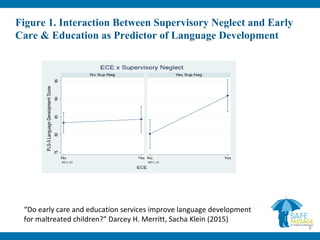
Figure 1. Interaction Between Supervisory Neglect and Early
Care & Education as Predictor of Language Development
8
“Do early care and education services improve language development
for maltreated children?” Darcey H. Merritt, Sacha Klein (2015)
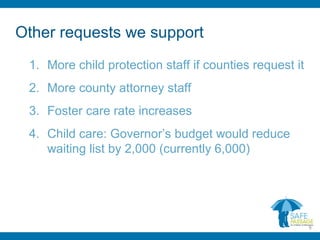
Other requests we support
1. More child protection staff if counties request it
2. More county attorney staff
3. Foster care rate increases
4. Child care: Governor’s budget would reduce
waiting list by 2,000 (currently 6,000)
9
What we aren’t requesting – yet
1. Core practice changes recommended by
Governor’s Child Protection Task Force: not
being implemented
2. Transparency recommendations: not done
3. Will work with state & counties in 2017
4. Option to achieve through legislation in 2018
10
Your visit makes an impact
Minnesota House Speaker Kurt Daudt tells
(Right click then select “Open Hyperlink”)
From speech at Children’s Briefing, Jan.
27, 2017
11
12
1. Percent of reports screened in still half of
national average – nearly 24,000 children
2. 68% still assigned to Family Assessment
3. Caseloads reportedly too high despite new $
13
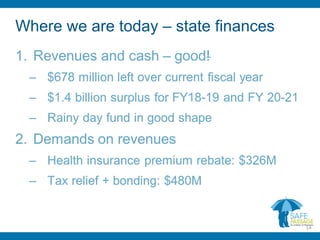
Where we are today – state finances
14
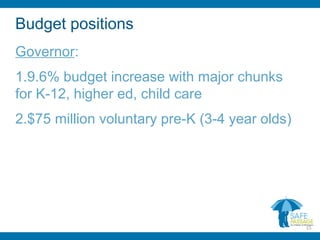
Budget positions
Governor:
1.9.6% budget increase with major chunks
for K-12, higher ed, child care
2.$75 million voluntary pre-K (3-4 year olds)
15
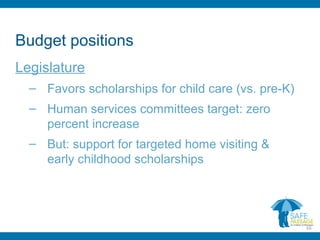
Budget positions
Legislature
– Favors scholarships for child care (vs. pre-K)
– Human services committees target: zero
percent increase
– But: support for targeted home visiting &
early childhood scholarships
16
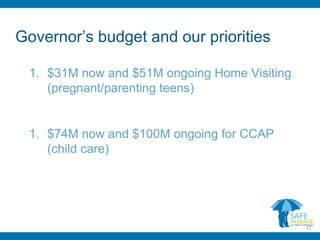
Governor’s budget and our priorities
1. $31M now and $51M ongoing Home Visiting
(pregnant/parenting teens)
1. $74M now and $100M ongoing for CCAP
(child care)
17
Governor’s budget and our priorities
3. $20M now and $49M ongoing for child
protection and foster care:
• Almost all for subsidized adoptions
• Some for state oversight staff and homeless youth
• No foster care rate increases or added child
protection resources
18
Day on the Hill logistics
Meet at State Capitol Room 316 Northeast Hall
•Go to 3rd
floor and ask for directions!
•Morning session 8:00-9:30 a.m.
•Afternoon session noon-1:30 p.m.
Or… Connect outside office of your first meeting 10-
15 minutes early
We will have name tags, handouts, etc.
19
Day on the Hill Hints
• Leave extra time to find rooms & new tunnels
• Link to parking options on website and
emails
• Take time to check out the beautifully
restored state Capitol and new Senate
building!!!
20
If you can’t find us…
Call or text Stephanie or Rich’s cell phone or
send an email or text
– Stephanie: (612) 865-8958
stephanie@safepassagemn.org
– Rich: 651-303-3209 gehrm001@umn.edu
•Sometimes cell phone reception is poor –
keep trying!
21
Meetings with Legislators
• ‘Buddies’ – especially for new volunteers
• Usually 10-15 minutes per legislator
• Cover talking points at a high level
• Leave half of time (or more) to talk about
why your personal reasons for being there
• Sometimes location switched to Capitol if
floor sessions or committees run late
22
Tips for your legislator meetings
• Introduce yourself as:
– A volunteer with Safe Passage for Children
– Any other related role (e.g. teacher, guardian ad litem,
health care professional)
• Describe bullet points on handout
• Point out graphics on reverse side if time
• Refer legislators to Safe Passage for more detail
23
Things to keep in mind:
• Mention if you have talked with others in
their district who share your concerns
• We are partners, not adversaries
• Most legislators don’t know the issues and
will look to you for information
• It’s always helpful to practice your testimony
beforehand
24
Building the Relationship
• Effective relationships with your legislator
are cultivated over time
• Communicate with your legislators
throughout the year
25

Day on the Hill 2017 PowerPoint

  • 1.
    Safe Passage forChildren of Minnesota 2017 Day on the Hill February 28, 2017
  • 2.
    Agenda 1. What isat stake 2. Impact of your visit 3. Where are we today: status of 1. Legislative session 2. Governor’s Task Force recommendations 4. How the process works 5. Making the most of your meeting 2
  • 3.
    Legislative priority isprevention & early intervention • Fewer victims of child maltreatment • Most direct impact on racial disparities • Avoid swamping the system • Help children so they aren’t traumatized during crucial developmental periods 3
  • 5.
    Bills we arepart of 1. $27.7 million early childhood education slots • Children 0-2 with open child protection cases, in foster care, or homeless • Working with coalition: MinneMinds, Hennepin County, People Serving People, Parent Aware • Bill will be introduced after Day on the Hill 1. Minnesota Targeted Home Visiting Coalition increase – estimated $38 million year 1, $52 million year 2 5
  • 6.
    Research: these arethe two best prevention programs 1. Quality early childhood education for children, as young as possible 2. Targeted Home Visiting • Reaches high risk mothers prenatal to two years • Provides parenting skills and social supports 6
  • 7.
    Recent research – EarlyHead Start: 29% fewer substantiated cases of physical or sexual abuse (Green et. al., 2004) – Reduction in foster care disruptions if children received child care 0-5 (Meloy, Phillips, 2012) – Chicago Child-Parent Project: 52% fewer families reported to child protection (Reynolds et. al. 2003) – Improved language development (Merritt, Klein 2015) 7
  • 8.
    Figure 1. InteractionBetween Supervisory Neglect and Early Care & Education as Predictor of Language Development 8 “Do early care and education services improve language development for maltreated children?” Darcey H. Merritt, Sacha Klein (2015)
  • 9.
    Other requests wesupport 1. More child protection staff if counties request it 2. More county attorney staff 3. Foster care rate increases 4. Child care: Governor’s budget would reduce waiting list by 2,000 (currently 6,000) 9
  • 10.
    What we aren’trequesting – yet 1. Core practice changes recommended by Governor’s Child Protection Task Force: not being implemented 2. Transparency recommendations: not done 3. Will work with state & counties in 2017 4. Option to achieve through legislation in 2018 10
  • 11.
    Your visit makesan impact Minnesota House Speaker Kurt Daudt tells (Right click then select “Open Hyperlink”) From speech at Children’s Briefing, Jan. 27, 2017 11
  • 12.
  • 13.
    1. Percent ofreports screened in still half of national average – nearly 24,000 children 2. 68% still assigned to Family Assessment 3. Caseloads reportedly too high despite new $ 13
  • 14.
    Where we aretoday – state finances 14
  • 15.
    Budget positions Governor: 1.9.6% budgetincrease with major chunks for K-12, higher ed, child care 2.$75 million voluntary pre-K (3-4 year olds) 15
  • 16.
    Budget positions Legislature – Favorsscholarships for child care (vs. pre-K) – Human services committees target: zero percent increase – But: support for targeted home visiting & early childhood scholarships 16
  • 17.
    Governor’s budget andour priorities 1. $31M now and $51M ongoing Home Visiting (pregnant/parenting teens) 1. $74M now and $100M ongoing for CCAP (child care) 17
  • 18.
    Governor’s budget andour priorities 3. $20M now and $49M ongoing for child protection and foster care: • Almost all for subsidized adoptions • Some for state oversight staff and homeless youth • No foster care rate increases or added child protection resources 18
  • 19.
    Day on theHill logistics Meet at State Capitol Room 316 Northeast Hall •Go to 3rd floor and ask for directions! •Morning session 8:00-9:30 a.m. •Afternoon session noon-1:30 p.m. Or… Connect outside office of your first meeting 10- 15 minutes early We will have name tags, handouts, etc. 19
  • 20.
    Day on theHill Hints • Leave extra time to find rooms & new tunnels • Link to parking options on website and emails • Take time to check out the beautifully restored state Capitol and new Senate building!!! 20
  • 21.
    If you can’tfind us… Call or text Stephanie or Rich’s cell phone or send an email or text – Stephanie: (612) 865-8958 stephanie@safepassagemn.org – Rich: 651-303-3209 gehrm001@umn.edu •Sometimes cell phone reception is poor – keep trying! 21
  • 22.
    Meetings with Legislators •‘Buddies’ – especially for new volunteers • Usually 10-15 minutes per legislator • Cover talking points at a high level • Leave half of time (or more) to talk about why your personal reasons for being there • Sometimes location switched to Capitol if floor sessions or committees run late 22
  • 23.
    Tips for yourlegislator meetings • Introduce yourself as: – A volunteer with Safe Passage for Children – Any other related role (e.g. teacher, guardian ad litem, health care professional) • Describe bullet points on handout • Point out graphics on reverse side if time • Refer legislators to Safe Passage for more detail 23
  • 24.
    Things to keepin mind: • Mention if you have talked with others in their district who share your concerns • We are partners, not adversaries • Most legislators don’t know the issues and will look to you for information • It’s always helpful to practice your testimony beforehand 24
  • 25.
    Building the Relationship •Effective relationships with your legislator are cultivated over time • Communicate with your legislators throughout the year 25

Editor's Notes

  • #3 Start at 8:30 sharp. Vivian steps in to explain the morning. Practice was 5 minutes.
  • #4 National Child Traumatic Stress network
  • #5 National Child Traumatic Stress network
  • #6 Start at 8:30 sharp. Vivian steps in to explain the morning. Practice was 5 minutes.
  • #7 Start at 8:30 sharp. Vivian steps in to explain the morning. Practice was 5 minutes.
  • #8 Start at 8:30 sharp. Vivian steps in to explain the morning. Practice was 5 minutes.
  • #9 Start at 8:30 sharp. Vivian steps in to explain the morning. Practice was 5 minutes.
  • #10 Start at 8:30 sharp. Vivian steps in to explain the morning. Practice was 5 minutes.
  • #11 Start at 8:30 sharp. Vivian steps in to explain the morning. Practice was 5 minutes.
  • #12 Start at 8:30 sharp. Vivian steps in to explain the morning. Practice was 5 minutes.
  • #13 Start at 8:30 sharp. Vivian steps in to explain the morning. Practice was 5 minutes.
  • #14 Start at 8:30 sharp. Vivian steps in to explain the morning. Practice was 5 minutes.
  • #15 Start at 8:30 sharp. Vivian steps in to explain the morning. Practice was 5 minutes.
  • #16 Start at 8:30 sharp. Vivian steps in to explain the morning. Practice was 5 minutes.
  • #17 Start at 8:30 sharp. Vivian steps in to explain the morning. Practice was 5 minutes.
  • #18 Start at 8:30 sharp. Vivian steps in to explain the morning. Practice was 5 minutes.
  • #19 Start at 8:30 sharp. Vivian steps in to explain the morning. Practice was 5 minutes.
  • #20 National Child Traumatic Stress network
  • #21 National Child Traumatic Stress network
  • #22 National Child Traumatic Stress network
  • #23 National Child Traumatic Stress network
  • #24 National Child Traumatic Stress network
  • #25 National Child Traumatic Stress network
  • #26 National Child Traumatic Stress network