David Moss
Advanced Technologies
Solutions Manager
The Democratisation of Advanced Technologies
@DaveMossTechBod
david.moss@stfc.ac.uk
Agenda
• Introduction to STFC
• Government investment and associated
challenges
• “Democratisation” and reducing complexity
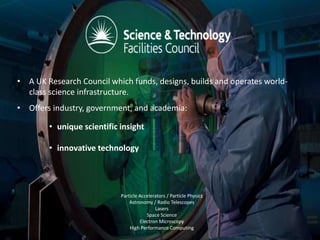
• A UK Research Council which funds, designs, builds and operates world-
class science infrastructure.
• Offers industry, government, and academia:
• unique scientific insight
• innovative technology
Particle Accelerators / Particle Physics
Astronomy / Radio Telescopes
Lasers
Space Science
Electron Microscopy
High Performance Computing
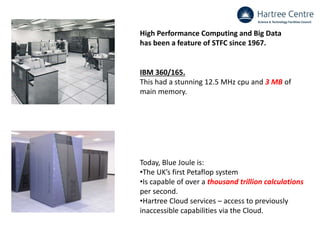
High Performance Computing and Big Data
has been a feature of STFC since 1967.
IBM 360/165.
This had a stunning 12.5 MHz cpu and 3 MB of
main memory.
Today, Blue Joule is:
•The UK’s first Petaflop system
•Is capable of over a thousand trillion calculations
per second.
•Hartree Cloud services – access to previously
inaccessible capabilities via the Cloud.
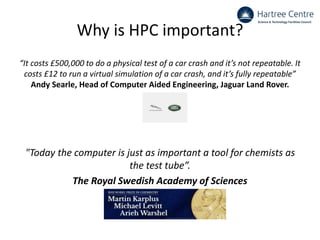
Why is HPC important?
“It costs £500,000 to do a physical test of a car crash and it’s not repeatable. It
costs £12 to run a virtual simulation of a car crash, and it’s fully repeatable”
Andy Searle, Head of Computer Aided Engineering, Jaguar Land Rover.
"Today the computer is just as important a tool for chemists as
the test tube”.
The Royal Swedish Academy of Sciences
Future Challenges
Square Kilometre Array
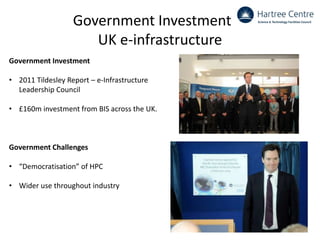
Government Investment in
UK e-infrastructure
Government Investment
• 2011 Tildesley Report – e-Infrastructure
Leadership Council
• £160m investment from BIS across the UK.
Government Challenges
• “Democratisation” of HPC
• Wider use throughout industry
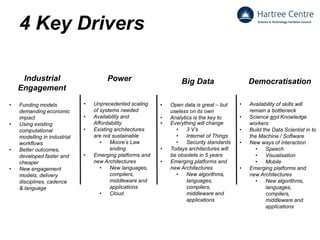
4 Key Drivers
Industrial
Engagement
• Funding models
demanding economic
impact
• Using existing
computational
modelling in industrial
workflows
• Better outcomes,
developed faster and
cheaper
• New engagement
models, delivery
disciplines, cadence
& language
DemocratisationPower
• Unprecedented scaling
of systems needed
• Availability and
Affordability
• Existing architectures
are not sustainable
• Moore’s Law
ending
• Emerging platforms and
new Architectures
• New languages,
compilers,
middleware and
applications
• Cloud
Big Data
• Everything will change
• 3 V’s
• Internet of Things
• Security standards
• Todays architectures will
be obsolete in 5 years
• Emerging platforms and
new Architectures
• New algorithms,
languages,
compilers,
middleware and
applications
• Open data is great – but
useless on its own
• Analytics is the key to
• Availability of skills will
remain a bottleneck
• Science and Knowledge
workers
• Build the Data Scientist in to
the Machine / Software
• New ways of interaction
• Speech
• Visualisation
• Mobile
• Emerging platforms and
new Architectures
• New algorithms,
languages,
compilers,
middleware and
applications
Industrial
Engagement
• Funding models
demanding economic
impact
• Using existing
computational
modelling in industrial
workflows
• Better outcomes,
developed faster and
cheaper
• New engagement
models, delivery
disciplines, cadence
& language
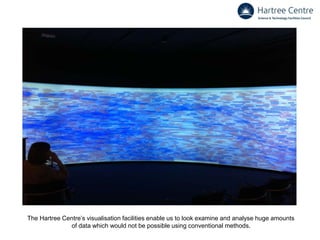
The Hartree Centre’s visualisation facilities enable us to look examine and analyse huge amounts
of data which would not be possible using conventional methods.
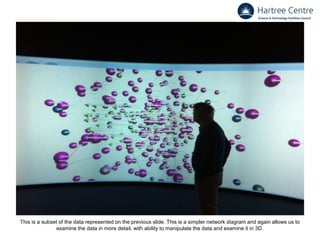
This is a subset of the data represented on the previous slide. This is a simpler network diagram and again allows us to
examine the data in more detail, with ability to manipulate the data and examine it in 3D.
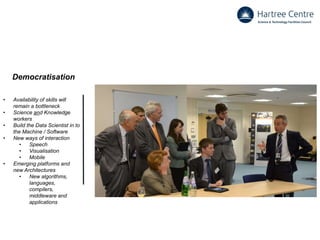
Democratisation
• Availability of skills will
remain a bottleneck
• Science and Knowledge
workers
• Build the Data Scientist in to
the Machine / Software
• New ways of interaction
• Speech
• Visualisation
• Mobile
• Emerging platforms and
new Architectures
• New algorithms,
languages,
compilers,
middleware and
applications
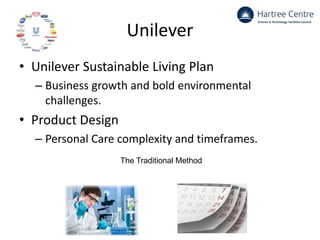
Unilever
• Unilever Sustainable Living Plan
– Business growth and bold environmental
challenges.
• Product Design
– Personal Care complexity and timeframes.
The Traditional Method
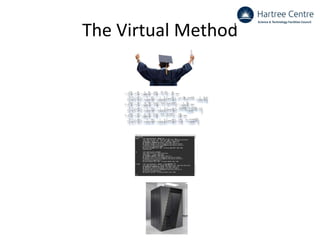
The Virtual Method
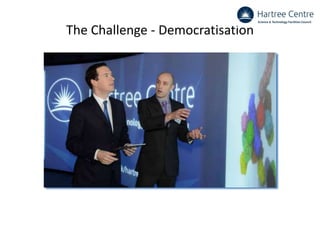
The Challenge - Democratisation
Lessons Learnt
• Democratisation is ALWAYS about the END
USER
• Cultural Change is required
• Get it right and be rewarded for it!
• These technologies are coming your way!
Thank You!
Consumable HPC 4/21/2015
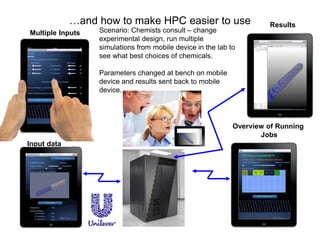
…and how to make HPC easier to use
Scenario: Chemists consult – change
experimental design, run multiple
simulations from mobile device in the lab to
see what best choices of chemicals.
Parameters changed at bench on mobile
device and results sent back to mobile
device.
Multiple Inputs
Results
Overview of Running
Jobs
Input data
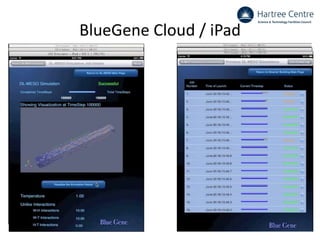
BlueGene Cloud / iPad
David Moss - Hartree Centre

David Moss - Hartree Centre

  • 1.
    David Moss Advanced Technologies SolutionsManager The Democratisation of Advanced Technologies @DaveMossTechBod david.moss@stfc.ac.uk
  • 2.
    Agenda • Introduction toSTFC • Government investment and associated challenges • “Democratisation” and reducing complexity
  • 4.
    • A UKResearch Council which funds, designs, builds and operates world- class science infrastructure. • Offers industry, government, and academia: • unique scientific insight • innovative technology Particle Accelerators / Particle Physics Astronomy / Radio Telescopes Lasers Space Science Electron Microscopy High Performance Computing
  • 5.
    High Performance Computingand Big Data has been a feature of STFC since 1967. IBM 360/165. This had a stunning 12.5 MHz cpu and 3 MB of main memory. Today, Blue Joule is: •The UK’s first Petaflop system •Is capable of over a thousand trillion calculations per second. •Hartree Cloud services – access to previously inaccessible capabilities via the Cloud.
  • 6.
    Why is HPCimportant? “It costs £500,000 to do a physical test of a car crash and it’s not repeatable. It costs £12 to run a virtual simulation of a car crash, and it’s fully repeatable” Andy Searle, Head of Computer Aided Engineering, Jaguar Land Rover. "Today the computer is just as important a tool for chemists as the test tube”. The Royal Swedish Academy of Sciences
  • 7.
  • 8.
    Government Investment in UKe-infrastructure Government Investment • 2011 Tildesley Report – e-Infrastructure Leadership Council • £160m investment from BIS across the UK. Government Challenges • “Democratisation” of HPC • Wider use throughout industry
  • 9.
    4 Key Drivers Industrial Engagement •Funding models demanding economic impact • Using existing computational modelling in industrial workflows • Better outcomes, developed faster and cheaper • New engagement models, delivery disciplines, cadence & language DemocratisationPower • Unprecedented scaling of systems needed • Availability and Affordability • Existing architectures are not sustainable • Moore’s Law ending • Emerging platforms and new Architectures • New languages, compilers, middleware and applications • Cloud Big Data • Everything will change • 3 V’s • Internet of Things • Security standards • Todays architectures will be obsolete in 5 years • Emerging platforms and new Architectures • New algorithms, languages, compilers, middleware and applications • Open data is great – but useless on its own • Analytics is the key to • Availability of skills will remain a bottleneck • Science and Knowledge workers • Build the Data Scientist in to the Machine / Software • New ways of interaction • Speech • Visualisation • Mobile • Emerging platforms and new Architectures • New algorithms, languages, compilers, middleware and applications
  • 10.
    Industrial Engagement • Funding models demandingeconomic impact • Using existing computational modelling in industrial workflows • Better outcomes, developed faster and cheaper • New engagement models, delivery disciplines, cadence & language
  • 12.
    The Hartree Centre’svisualisation facilities enable us to look examine and analyse huge amounts of data which would not be possible using conventional methods.
  • 13.
    This is asubset of the data represented on the previous slide. This is a simpler network diagram and again allows us to examine the data in more detail, with ability to manipulate the data and examine it in 3D.
  • 15.
    Democratisation • Availability ofskills will remain a bottleneck • Science and Knowledge workers • Build the Data Scientist in to the Machine / Software • New ways of interaction • Speech • Visualisation • Mobile • Emerging platforms and new Architectures • New algorithms, languages, compilers, middleware and applications
  • 16.
    Unilever • Unilever SustainableLiving Plan – Business growth and bold environmental challenges. • Product Design – Personal Care complexity and timeframes. The Traditional Method
  • 17.
  • 18.
    The Challenge -Democratisation
  • 19.
    Lessons Learnt • Democratisationis ALWAYS about the END USER • Cultural Change is required • Get it right and be rewarded for it! • These technologies are coming your way!
  • 20.
  • 21.
    Consumable HPC 4/21/2015 …andhow to make HPC easier to use Scenario: Chemists consult – change experimental design, run multiple simulations from mobile device in the lab to see what best choices of chemicals. Parameters changed at bench on mobile device and results sent back to mobile device. Multiple Inputs Results Overview of Running Jobs Input data
  • 22.