I
n today’s competitive marketplace an
organisation faces many challenges. The
need to ensure value for money and deploy
effective working practices has led to the
merger of many of the larger businesses and
companies. In addition, many organisations
now often form a partnership or alliance when
pursuing a business objective.
As a result of these trends, those involved in a
project are seldom located in a single office or
even a single organisation, rather they will be
spread throughout different organisations in
geographically dispersed teams. Under such
circumstances effective communication is
essential, and it becomes necessary to ensure
that the entire team is provided with updated
real-time information, thereby ensuring that
they are aware of the current status of the
project and the progress of their work packages.
Many tools
Organisations typically employ a wide variety of
software-based tools and solutions as an aid to
effective project management. These tools
provide the ability to manage, plan, and
communicate. However, these are often
separate tools, which, if not maintained
correctly, may contain both repetitions
and contradictions in terms of perceived
goals or approaches to a project. In addition,
there is often no single focused source of
information to act as a benchmark or reference
to the current status of the project/organisation.
Clearly, this problem will be further
compounded when a project involves multiple
companies/organisations, each having its
own preferred tools and solutions.
One response to these difficulties has been a
growing demand for assistance in the effective
use of these separate tools, and for processes that
help with management endeavours at both the
project and business level, while ensuring that
the bigger picture is not lost. In a separate but
complementary development, many organ-
isations are now exploring ways to harness new
technologies and, in particular, using theWeb as
a way to bring together their tools and legacy
systems to create a shared data environment.The
aim is to develop a culture where information
does not swamp the individual, but aids
their decision making and reduces risk.
Equally important is the need to ensure
that the right information is obtained
within achievable timescales.
Enterprise solutions
To support a business organisation,
an enterprise software solution is required
which is able to provide the right level of
information to the right levels of
management at the right
time. This will result in
improved communications
and visibility in terms of
highlighting the potential
issues for an organisation, and
identifying who is responsible
for addressing them. It has been
shown time and again that improving
communications within an organisation
ultimately improves the chances of completing
a project to cost, on time and to the
IEE REVIEW SEPTEMBER 2000 45
PROJECT MANAGEMENT
Networking for
project success
Karl Davey describes how the use of Web-based enterprise-wide
project management software is solving the problem of real-time project
management between geographically dispersed teams
required specification.
The enterprise solution should be based
around the current business process, and has to
be balanced with the sensible use of proven
technologies. Such a system must be designed to
ensure that everyone
involved in a project or
business process, i.e.
project managers,
planners, directors,
risk owners,
stakeholders and
customers, has real-
time access to
project/business
information. This
information must be presented in a format that
will aid, and not confuse, the decision-making
process. Seamless integration with a company’s
operations, as well as the capacity to provide a
timely response to evolving risk and changing
business requirements, are thus essential
requirements for any effective enterprise
software tool.
To be of real benefit to an organisation it is
important to ensure that the solution brings
together all the tools and legacy systems
necessary to manage the project or business.
This allows the formation of a central shared
data environment, which contains a consistent
and up-to-date picture of the project or
business.This real-time information is obtained
from effective system integration with existing
management tools, which can include planning,
requirements management, accounting and task
management.The embedded nature of this type
of integration ensures that data entered
into the system is automatically
shared throughout the
components of the
enterprise solution,
cutting down the time
required for data entry
and reducing the
possibility of errors or
contradictions appearing
in the system.
Web technologies
With the rapid realisation that the Internet and
similar technologies are here to stay, and can be
used for an organisation’s mission-critical
services, many application vendors are now
producing Web-based versions of their software
solutions. It has become clear that significant
savings can be made within an organisation by
moving away from client/server software
architectures and adopting Web architectures. A
benefit of Web-based systems is that they do not
require complex client software to be installed
on the user’s computer. A Web-based system
simply uses an Internet browser such as
Netscape or Microsoft’s Internet Explorer
which, almost invariably, is already installed on
the client’s machine. This thin client or
‘thinware’ approach has a number of distinct
benefits to a user:
5 multi-user access (not standalone)
5 robustness and security
5 scalability – from a few local users to many
thousands world-wide
5 a secure true real-time shared data
environment across partner companies
5 reduced installation and configuration costs.
This approach allows authorised users to
share real-time management information, news,
project and programme updates on a world-
wide basis, irrespective of their temporal or
geographical location.
The Web and risk management
Recent high-profile project failures are
attributable to a lack of effective risk
management across organisations. In many
cases, project and business risks were identified,
but too little was done in terms of effective
mitigation. Part of the problem is that risk
management is often seen as a stand-alone or
specialist process, rarely fully integrated into the
management culture, resulting in risk
management software tools being developed as
separated stand alone programs. Clearly, such
problems will be exacerbated by the need to
manage risk across large multi-company or
multi-national projects.
To address the issue of integrating risk as part
of the project management culture across
geographically dispersed project teams Strategic
Thought Ltd developed Active Risk Manager
(ARM), a fully integrated Web-based enterprise
risk management solution designed to track
both business and project risk across an
organisation.ARM has been designed to support
full integration with the leading project
management planning tools – an important
marketing requirement that also helps ensure
that ARM becomes firmly embedded as part of
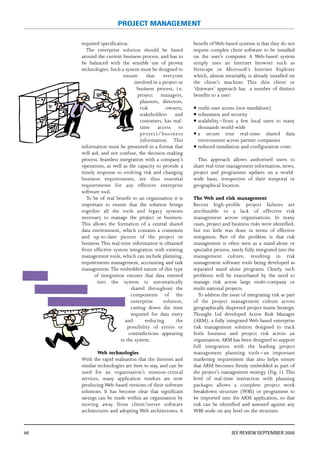
the project’s management strategy (Fig. 1). This
level of real-time interaction with planning
packages allows a complete project work
breakdown structure (WBS) or programme to
be imported into the ARM application, so that
risk can be identified and assessed against any
WBS node on any level on the structure.
46 IEE REVIEW SEPTEMBER 2000
PROJECT MANAGEMENT
PROJECT MANAGEMENT
However, simply analysing risk against a WBS
structure or the project programme will fail to
provide the overall picture, which requires an
assessment of risk against the identified project
requirements or goals that must be met by the
project. In addition, there is often the need to
assess the levels of risk for future projects. In this
case, WBS structures and detailed programmes
may not yet be defined or even developed. The
solution is to assess risk against each of the
requirement or goals that the future project
would set out to meet.
This approach has been adopted by the
Ministry of Defence’s Procurement Agency to
determine future defence procurement prog-
rammes. By analysing the risk relating to future
equipment requirements it is possible to define
the way ahead with many projects. Analysing
risk at this early stage of the project life cycle
ensures an understanding of the levels of
potential cost and schedule risk against each of
the requirements. Requirements managers can
then use this information to scope the require-
ments of their equipment into a specification
which is both realistic and achievable within the
defined schedule and budget constraints.
To achieve this link to the process of
requirements capture, ARM offers integration
with the QSS DOORS requirements
management tool.This allows:
5 requirements to be related to project/business
activities
5 risks to be assessed against the established
requirements breakdown structure (RBS)
5 effective ongoing management of legacy
requirements
5 calculation of total levels of risk against
individual requirements based on the risk
identified against related activities.
ARM recognises the importance of
communication. Once risks are identified this
information must be shared by the project team.
It is important that information is secure and the
technology used is robust. ARM, being an
enterprise-based solution, uses a central Web
server, with local browsers enabling multiple
users to communicate and access the
applications, data, analysis and reporting
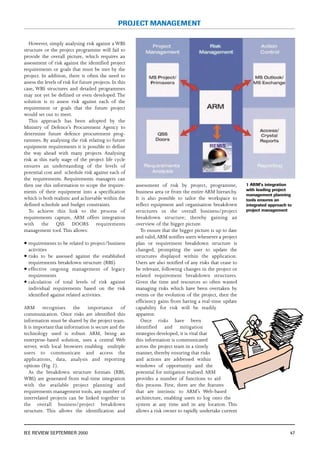
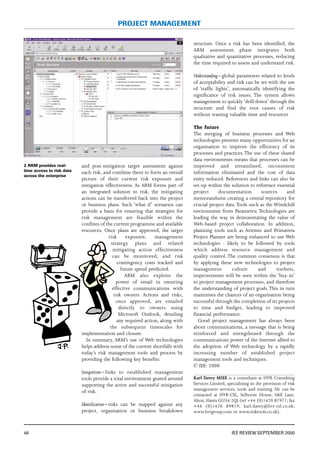
options (Fig. 2).
As the breakdown structure formats (RBS,
WBS) are generated from real-time integration
with the available project planning and
requirements management tools, any number of
interrelated projects can be linked together in
the overall business/project breakdown
structure. This allows the identification and
assessment of risk by project, programme,
business area or from the entire ARM hierarchy.
It is also possible to tailor the workspace to
reflect equipment and organisation breakdown
structures in the overall business/project
breakdown structure; thereby gaining an
overview of the bigger picture.
To ensure that the bigger picture is up to date
and valid,ARM notifies users whenever a project
plan or requirement breakdown structure is
changed, prompting the user to update the
structures displayed within the application.
Users are also notified of any risks that cease to
be relevant, following changes in the project or
related requirement breakdown structures.
Given the time and resources so often wasted
managing risks which have been overtaken by
events or the evolution of the project, then the
efficiency gains from having a real-time update
capability for risk will be readily
apparent.
Once risks have been
identified and mitigation
strategies developed, it is vital that
this information is communicated
across the project team in a timely
manner, thereby ensuring that risks
and actions are addressed within
windows of opportunity and the
potential for mitigation realised. ARM
provides a number of functions to aid
this process. First, there are the features
that are intrinsic to ARM’s Web-based
architecture, enabling users to log onto the
system at any time and in any location. This
allows a risk owner to rapidly undertake current
IEE REVIEW SEPTEMBER 2000 47
1 ARM’s integration
with leading project
management planning
tools ensures an
integrated approach to
project management
and post-mitigation target assessment against
each risk, and combine them to form an overall
picture of their current risk exposure and
mitigation effectiveness. As ARM forms part of
an integrated solution to risk, the mitigating
actions can be transferred back into the project
or business plans. Such ‘what if’ scenarios can
provide a basis for ensuring that strategies for
risk management are feasible within the
confines of the current programme and available
resources. Once plans are approved, the target
risk exposure, management
strategy plans and related
mitigating action effectiveness
can be monitored, and risk
contingency costs tracked and
future spend predicted.
ARM also exploits the
power of email in ensuring
effective communications with
risk owners. Actions and risks,
once approved, are emailed
directly to owners using
Microsoft Outlook, detailing
any required action, along with
the subsequent timescales for
implementation and closure.
In summary, ARM’s use of Web technologies
helps address some of the current shortfalls with
today’s risk management tools and process by
providing the following key benefits:
Integration – links to established management
tools provide a total environment geared around
supporting the active and successful mitigation
of risk.
Identification– risks can be mapped against any
project, organisation or business breakdown
structure. Once a risk has been identified, the
ARM assessment phase integrates both
qualitative and quantitative processes, reducing
the time required to assess and understand risk.
Understanding– global parameters related to levels
of acceptability and risk can be set with the use
of ‘traffic lights’, automatically identifying the
significance of risk issues. The system allows
management to quickly‘drill down’ through the
structure and find the root causes of risk
without wasting valuable time and resources
The future
The merging of business processes and Web
technologies presents many opportunities for an
organisation to improve the efficiency of its
processes and practices. The use of these shared
data environments means that processes can be
improved and streamlined, inconsistent
information eliminated and the cost of data
entry reduced. References and links can also be
set-up within the solution to reference essential
project documentation sources and
memorandums creating a central repository for
crucial project data.Tools such as the Windchill
environment from Parametric Technologies are
leading the way in demonstrating the value of
Web-based project collaboration. In addition,
planning tools such as Artemis and Primavera
Project Planner are being enhanced to use Web
technologies - likely to be followed by tools
which address resource management and
quality control. The common consensus is that
by applying these new technologies to project
management culture and toolsets,
improvements will be seen within the ‘buy-in’
to project management processes, and therefore
the understanding of project goals. This in turn
maximises the chances of an organisation being
successful through the completion of its projects
to time and budget, leading to improved
financial performance.
Good project management has always been
about communications, a message that is being
reinforced and strengthened through the
communications power of the Internet allied to
the adoption of Web technology by a rapidly
increasing number of established project
management tools and techniques.
© IEE: 2000
Karl Davey MIEE is a consultant at HVR Consulting
Services Limited, specialising in the provision of risk
management services, tools and training. He can be
contacted at HVR-CSL, Selborne House, Mill Lane,
Alton, Hants GU34 2QJ (tel +44 (0)1420 87977; fax
+44 (0)1420 89819; karl.davey@hvr-csl.co.uk;
www.hvrgroup.com or www.risktools.co.uk).
48 IEE REVIEW SEPTEMBER 2000
PROJECT MANAGEMENT
2 ARM provides real-
time access to risk data
across the enterprise

The use of risk management systems can asist with ERM implementations

  • 1.
    I n today’s competitivemarketplace an organisation faces many challenges. The need to ensure value for money and deploy effective working practices has led to the merger of many of the larger businesses and companies. In addition, many organisations now often form a partnership or alliance when pursuing a business objective. As a result of these trends, those involved in a project are seldom located in a single office or even a single organisation, rather they will be spread throughout different organisations in geographically dispersed teams. Under such circumstances effective communication is essential, and it becomes necessary to ensure that the entire team is provided with updated real-time information, thereby ensuring that they are aware of the current status of the project and the progress of their work packages. Many tools Organisations typically employ a wide variety of software-based tools and solutions as an aid to effective project management. These tools provide the ability to manage, plan, and communicate. However, these are often separate tools, which, if not maintained correctly, may contain both repetitions and contradictions in terms of perceived goals or approaches to a project. In addition, there is often no single focused source of information to act as a benchmark or reference to the current status of the project/organisation. Clearly, this problem will be further compounded when a project involves multiple companies/organisations, each having its own preferred tools and solutions. One response to these difficulties has been a growing demand for assistance in the effective use of these separate tools, and for processes that help with management endeavours at both the project and business level, while ensuring that the bigger picture is not lost. In a separate but complementary development, many organ- isations are now exploring ways to harness new technologies and, in particular, using theWeb as a way to bring together their tools and legacy systems to create a shared data environment.The aim is to develop a culture where information does not swamp the individual, but aids their decision making and reduces risk. Equally important is the need to ensure that the right information is obtained within achievable timescales. Enterprise solutions To support a business organisation, an enterprise software solution is required which is able to provide the right level of information to the right levels of management at the right time. This will result in improved communications and visibility in terms of highlighting the potential issues for an organisation, and identifying who is responsible for addressing them. It has been shown time and again that improving communications within an organisation ultimately improves the chances of completing a project to cost, on time and to the IEE REVIEW SEPTEMBER 2000 45 PROJECT MANAGEMENT Networking for project success Karl Davey describes how the use of Web-based enterprise-wide project management software is solving the problem of real-time project management between geographically dispersed teams
  • 2.
    required specification. The enterprisesolution should be based around the current business process, and has to be balanced with the sensible use of proven technologies. Such a system must be designed to ensure that everyone involved in a project or business process, i.e. project managers, planners, directors, risk owners, stakeholders and customers, has real- time access to project/business information. This information must be presented in a format that will aid, and not confuse, the decision-making process. Seamless integration with a company’s operations, as well as the capacity to provide a timely response to evolving risk and changing business requirements, are thus essential requirements for any effective enterprise software tool. To be of real benefit to an organisation it is important to ensure that the solution brings together all the tools and legacy systems necessary to manage the project or business. This allows the formation of a central shared data environment, which contains a consistent and up-to-date picture of the project or business.This real-time information is obtained from effective system integration with existing management tools, which can include planning, requirements management, accounting and task management.The embedded nature of this type of integration ensures that data entered into the system is automatically shared throughout the components of the enterprise solution, cutting down the time required for data entry and reducing the possibility of errors or contradictions appearing in the system. Web technologies With the rapid realisation that the Internet and similar technologies are here to stay, and can be used for an organisation’s mission-critical services, many application vendors are now producing Web-based versions of their software solutions. It has become clear that significant savings can be made within an organisation by moving away from client/server software architectures and adopting Web architectures. A benefit of Web-based systems is that they do not require complex client software to be installed on the user’s computer. A Web-based system simply uses an Internet browser such as Netscape or Microsoft’s Internet Explorer which, almost invariably, is already installed on the client’s machine. This thin client or ‘thinware’ approach has a number of distinct benefits to a user: 5 multi-user access (not standalone) 5 robustness and security 5 scalability – from a few local users to many thousands world-wide 5 a secure true real-time shared data environment across partner companies 5 reduced installation and configuration costs. This approach allows authorised users to share real-time management information, news, project and programme updates on a world- wide basis, irrespective of their temporal or geographical location. The Web and risk management Recent high-profile project failures are attributable to a lack of effective risk management across organisations. In many cases, project and business risks were identified, but too little was done in terms of effective mitigation. Part of the problem is that risk management is often seen as a stand-alone or specialist process, rarely fully integrated into the management culture, resulting in risk management software tools being developed as separated stand alone programs. Clearly, such problems will be exacerbated by the need to manage risk across large multi-company or multi-national projects. To address the issue of integrating risk as part of the project management culture across geographically dispersed project teams Strategic Thought Ltd developed Active Risk Manager (ARM), a fully integrated Web-based enterprise risk management solution designed to track both business and project risk across an organisation.ARM has been designed to support full integration with the leading project management planning tools – an important marketing requirement that also helps ensure that ARM becomes firmly embedded as part of the project’s management strategy (Fig. 1). This level of real-time interaction with planning packages allows a complete project work breakdown structure (WBS) or programme to be imported into the ARM application, so that risk can be identified and assessed against any WBS node on any level on the structure. 46 IEE REVIEW SEPTEMBER 2000 PROJECT MANAGEMENT
  • 3.
    PROJECT MANAGEMENT However, simplyanalysing risk against a WBS structure or the project programme will fail to provide the overall picture, which requires an assessment of risk against the identified project requirements or goals that must be met by the project. In addition, there is often the need to assess the levels of risk for future projects. In this case, WBS structures and detailed programmes may not yet be defined or even developed. The solution is to assess risk against each of the requirement or goals that the future project would set out to meet. This approach has been adopted by the Ministry of Defence’s Procurement Agency to determine future defence procurement prog- rammes. By analysing the risk relating to future equipment requirements it is possible to define the way ahead with many projects. Analysing risk at this early stage of the project life cycle ensures an understanding of the levels of potential cost and schedule risk against each of the requirements. Requirements managers can then use this information to scope the require- ments of their equipment into a specification which is both realistic and achievable within the defined schedule and budget constraints. To achieve this link to the process of requirements capture, ARM offers integration with the QSS DOORS requirements management tool.This allows: 5 requirements to be related to project/business activities 5 risks to be assessed against the established requirements breakdown structure (RBS) 5 effective ongoing management of legacy requirements 5 calculation of total levels of risk against individual requirements based on the risk identified against related activities. ARM recognises the importance of communication. Once risks are identified this information must be shared by the project team. It is important that information is secure and the technology used is robust. ARM, being an enterprise-based solution, uses a central Web server, with local browsers enabling multiple users to communicate and access the applications, data, analysis and reporting options (Fig. 2). As the breakdown structure formats (RBS, WBS) are generated from real-time integration with the available project planning and requirements management tools, any number of interrelated projects can be linked together in the overall business/project breakdown structure. This allows the identification and assessment of risk by project, programme, business area or from the entire ARM hierarchy. It is also possible to tailor the workspace to reflect equipment and organisation breakdown structures in the overall business/project breakdown structure; thereby gaining an overview of the bigger picture. To ensure that the bigger picture is up to date and valid,ARM notifies users whenever a project plan or requirement breakdown structure is changed, prompting the user to update the structures displayed within the application. Users are also notified of any risks that cease to be relevant, following changes in the project or related requirement breakdown structures. Given the time and resources so often wasted managing risks which have been overtaken by events or the evolution of the project, then the efficiency gains from having a real-time update capability for risk will be readily apparent. Once risks have been identified and mitigation strategies developed, it is vital that this information is communicated across the project team in a timely manner, thereby ensuring that risks and actions are addressed within windows of opportunity and the potential for mitigation realised. ARM provides a number of functions to aid this process. First, there are the features that are intrinsic to ARM’s Web-based architecture, enabling users to log onto the system at any time and in any location. This allows a risk owner to rapidly undertake current IEE REVIEW SEPTEMBER 2000 47 1 ARM’s integration with leading project management planning tools ensures an integrated approach to project management
  • 4.
    and post-mitigation targetassessment against each risk, and combine them to form an overall picture of their current risk exposure and mitigation effectiveness. As ARM forms part of an integrated solution to risk, the mitigating actions can be transferred back into the project or business plans. Such ‘what if’ scenarios can provide a basis for ensuring that strategies for risk management are feasible within the confines of the current programme and available resources. Once plans are approved, the target risk exposure, management strategy plans and related mitigating action effectiveness can be monitored, and risk contingency costs tracked and future spend predicted. ARM also exploits the power of email in ensuring effective communications with risk owners. Actions and risks, once approved, are emailed directly to owners using Microsoft Outlook, detailing any required action, along with the subsequent timescales for implementation and closure. In summary, ARM’s use of Web technologies helps address some of the current shortfalls with today’s risk management tools and process by providing the following key benefits: Integration – links to established management tools provide a total environment geared around supporting the active and successful mitigation of risk. Identification– risks can be mapped against any project, organisation or business breakdown structure. Once a risk has been identified, the ARM assessment phase integrates both qualitative and quantitative processes, reducing the time required to assess and understand risk. Understanding– global parameters related to levels of acceptability and risk can be set with the use of ‘traffic lights’, automatically identifying the significance of risk issues. The system allows management to quickly‘drill down’ through the structure and find the root causes of risk without wasting valuable time and resources The future The merging of business processes and Web technologies presents many opportunities for an organisation to improve the efficiency of its processes and practices. The use of these shared data environments means that processes can be improved and streamlined, inconsistent information eliminated and the cost of data entry reduced. References and links can also be set-up within the solution to reference essential project documentation sources and memorandums creating a central repository for crucial project data.Tools such as the Windchill environment from Parametric Technologies are leading the way in demonstrating the value of Web-based project collaboration. In addition, planning tools such as Artemis and Primavera Project Planner are being enhanced to use Web technologies - likely to be followed by tools which address resource management and quality control. The common consensus is that by applying these new technologies to project management culture and toolsets, improvements will be seen within the ‘buy-in’ to project management processes, and therefore the understanding of project goals. This in turn maximises the chances of an organisation being successful through the completion of its projects to time and budget, leading to improved financial performance. Good project management has always been about communications, a message that is being reinforced and strengthened through the communications power of the Internet allied to the adoption of Web technology by a rapidly increasing number of established project management tools and techniques. © IEE: 2000 Karl Davey MIEE is a consultant at HVR Consulting Services Limited, specialising in the provision of risk management services, tools and training. He can be contacted at HVR-CSL, Selborne House, Mill Lane, Alton, Hants GU34 2QJ (tel +44 (0)1420 87977; fax +44 (0)1420 89819; karl.davey@hvr-csl.co.uk; www.hvrgroup.com or www.risktools.co.uk). 48 IEE REVIEW SEPTEMBER 2000 PROJECT MANAGEMENT 2 ARM provides real- time access to risk data across the enterprise