FEATURE | SOFTWARE MANAGEMENT 
4 STEPS TO SUCCESSFUL 
SOFTWARE MANAGEMENT 
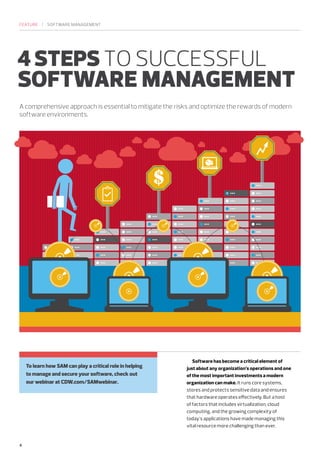
A comprehensive approach is essential to mitigate the risks and optimize the rewards of modern 
software environments. 
Software has become a critical element of 
just about any organization’s operations and one 
of the most important investments a modern 
organization can make. It runs core systems, 
stores and protects sensitive data and ensures 
that hardware operates effectively. But a host 
of factors that includes virtualization, cloud 
computing, and the growing complexity of 
today’s applications have made managing this 
vital resource more challenging than ever. 
4 
To learn how SAM can play a critical role in helping 
to manage and secure your software, check out 
our webinar at CDW.com/SAMwebinar.
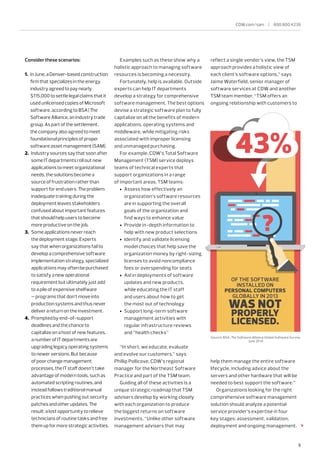
43% 
OF THE SOFTWARE 
INSTALLED ON 
PERSONAL COMPUTERS 
GLOBALLY IN 2013 
WAS NOT 
PROPERLY 
LICENSED. 
Source: BSA, The Software Alliance Global Software Survey, 
5 
Examples such as these show why a 
holistic approach to managing software 
resources is becoming a necessity. 
Fortunately, help is available. Outside 
experts can help IT departments 
develop a strategy for comprehensive 
software management. The best options 
devise a strategic software plan to fully 
capitalize on all the benefits of modern 
applications, operating systems and 
middleware, while mitigating risks 
associated with improper licensing 
and unmanaged purchasing. 
For example, CDW’s Total Software 
Management (TSM) service deploys 
teams of technical experts that 
support organizations in a range 
of important areas. TSM teams: 
• Assess how effectively an 
organization’s software resources 
are in supporting the overall 
goals of the organization and 
find ways to enhance value 
• Provide in-depth information to 
help with new product selections 
• Identify and validate licensing 
model choices that help save the 
organization money by right-sizing 
licenses to avoid noncompliance 
fees or overspending for seats 
• Aid in deployments of software 
updates and new products, 
while educating the IT staff 
and users about how to get 
the most out of technology 
• Support long-term software 
management activities with 
regular infrastructure reviews 
and “health checks” 
“In short, we educate, evaluate 
and evolve our customers,” says 
Phillip Pollicove, CDW’s regional 
manager for the Northeast Software 
Practice and part of the TSM team. 
Guiding all of these activities is a 
unique strategic roadmap that TSM 
advisers develop by working closely 
with each organization to produce 
the biggest returns on software 
investments. “Unlike other software 
management advisers that may 
Consider these scenarios: 
1. In June, a Denver-based construction 
firm that specializes in the energy 
industry agreed to pay nearly 
$115,000 to settle legal claims that it 
used unlicensed copies of Microsoft 
software, according to BSA | The 
Software Alliance, an industry trade 
group. As part of the settlement, 
the company also agreed to meet 
foundational principles of proper 
software asset management (SAM). 
2. Industry sources say that soon after 
some IT departments roll out new 
applications to meet organizational 
needs, the solutions become a 
source of frustration rather than 
support for end users. The problem: 
inadequate training during the 
deployment leaves stakeholders 
confused about important features 
that should help users to become 
more productive on the job. 
3. Some applications never reach 
the deployment stage. Experts 
say that when organizations fail to 
develop a comprehensive software 
implementation strategy, specialized 
applications may often be purchased 
to satisfy a new operational 
requirement but ultimately just add 
to a pile of expensive shelfware 
— programs that don’t move into 
production systems and thus never 
deliver a return on the investment. 
4. Prompted by end-of-support 
deadlines and the chance to 
capitalize on a host of new features, 
a number of IT departments are 
upgrading legacy operating systems 
to newer versions. But because 
of poor change management 
processes, the IT staff doesn’t take 
advantage of modern tools, such as 
automated scripting routines, and 
instead follows traditional manual 
practices when pushing out security 
patches and other updates. The 
result: a lost opportunity to relieve 
technicians of routine tasks and free 
them up for more strategic activities. 
CDW.com/sam | 800.800.4239 
reflect a single vendor’s view, the TSM 
approach provides a holistic view of 
each client’s software options,” says 
Jaime Waterfield, senior manager of 
software services at CDW and another 
TSM team member. “TSM offers an 
ongoing relationship with customers to 
June 2014 
help them manage the entire software 
lifecycle, including advice about the 
servers and other hardware that will be 
needed to best support the software.” 
Organizations looking for the right 
comprehensive software management 
solution should analyze a potential 
service provider’s expertise in four 
key stages: assessment, validation, 
deployment and ongoing management.
FEATURE | SOFTWARE MANAGEMENT 
6 
Assessment tools can help the discovery phase. For 
example, CDW’s SAM solution gathers relevant information 
about applications running on every networked device 
within an organization. “With this data in hand, the customer 
is better informed when speaking with a software vendor,” 
Pollicove explains. “It knows exactly what programs are 
running in production systems and require full compliance 
versus those being used by the development staff, which 
just stands up a program, tests it and then brings it down.” 
Remote auditing capabilities within the SAM solution 
help the TSM team identify necessary updates over time. 
With the complexity of today’s software, it’s not enough 
simply to take a headcount of each program. Organizations 
also need advisers who understand the differences in 
licensing models and other nuances in all major platforms. 
For example, Microsoft offers the True-Up option for 
enterprise-class agreements within organizations. With 
True-Up, IT managers don’t have to cut a purchase order 
every time an additional person starts using software 
covered by the agreement. Instead, at the end of the 
contract year, the organization pays a lump sum for the 
number of seats required to bring it into compliance. 
Vendors such as Adobe, Microsoft, Symantec and VMware 
offer other types of licensing options, such as product suites 
that cost significantly less than if purchased as individual 
components. 
STEP 2 
VALIDATION: A REALITY CHECK FOR ROI 
Validation is essential for narrowing the choices of 
software outlined in the strategic plan and then picking 
the specific solutions that will deliver concrete benefits. 
This key step requires strategy briefings to map out the 
organization’s technology requirements. “The reality is 
that most companies rely on multiple software vendors, 
and sometimes, the best solution consists of applications 
from a mix of different vendors,” Waterfield says. “CDW 
works to keep the customer’s best interest in mind at all 
times by taking a vendor-agnostic approach. Customers 
see the full choice of vendors and learn about the pros and 
cons of those various choices in an unbiased way. We can 
compare features, different pricing models and the hardware 
requirements for each choice, all from a solution perspective.” 
In some cases, a proof of concept is called for to ensure 
that solutions outlined in the strategic software plan 
deliver the expected benefits. This test can also identify 
any incompatibilities or integration problems that may 
arise among legacy software and new implementations. “A 
proof of concept is especially important before a customer 
STEP 1 
ASSESS FOR SUCCESS 
Assessments focus on an organization’s existing software 
environment to determine what programs are already 
running, whether they’re being used effectively and how 
accurately prevailing licensing contracts reflect actual usage. 
“Software audits determine how much of what’s running 
is authorized by the IT department and how much is 
unauthorized so you can enforce policies to get compliance 
under control,” says Rob Enderle, principal analyst at the 
Enderle Group, an independent consulting firm. “Until you do a 
sample inventory, you don’t know how bad the problem is.” 
Hiring an outside consulting firm can help organizations 
avoid common stumbling blocks, he adds. “The challenge is to 
institutionalize the knowledge when you have somebody else 
do the assessment,” Enderle notes. “A best practice when you 
bring in a third party is to have your own team work alongside it.” 
To ensure success, advisers should offer extensive 
experience with major software platforms, such as those from 
Adobe, IBM, Microsoft, Oracle, Red Hat, Symantec and VMware. 
Organizations should then schedule in-depth discussions 
with outside advisers, operations managers and IT stakeholders 
to develop an overarching strategic software plan to determine 
what additional resources are needed to support operational 
goals. This strategic plan will become a guide for helping the 
organization use software to achieve its long-term objectives. 
But first, outside specialists should help an organization 
understand the software it’s already running. The gain is 
full visibility. The TSM team brings together inside account 
representatives along with account managers, licensing 
experts and technical product specialists who make onsite 
visits to customers. “This collaborative approach ensures 
that everyone understands where the customer wants 
to be and how they want to get there,” Pollicove says. 
AIM FOR 
FULL VISIBILITY
7 
departments might be able to free up 
one or two employees who normally 
perform all these manual tasks to do 
more strategic activities,” Sommer says. 
“Implementing automation software can 
be like hiring one or two more people, 
except the software is much cheaper 
than paying salaries year after year.” 
The combined impact of virtualization 
and personnel optimizations can 
reduce the time it takes organizations 
to deliver new services and products, 
which further enhance the ROI of 
software investments. “We encourage 
organizations to put a dollar value on 
what it means to launch a new web app 
in a day versus the competition taking 
30 days to deploy something similar,” 
Sommer says. “Once the organization 
quantifies what that speed means, it 
can roll that into an ROI analysis.” 
Finally, an ROI analysis helps to 
identify the right licensing model for 
a particular application. In addition to 
standard enterprise-class licenses, 
some vendors offer other choices. For 
example, VMware offers its Enterprise 
Purchasing Program (EPP), which lets 
organizations purchase VMware tokens 
that can be redeemed for licenses and 
associated support and subscription 
resources. “If you really like a new virtual 
storage area network that VMware 
just released, you can apply tokens to 
this or any other VMware software 
that’s needed,” Sommer explains. 
STEP 3 
DEPLOYMENT WITHOUT 
DRAMA 
To ensure successful deployments 
of new software and maximize the 
value of the technology, CDW’s TSM 
team can work remotely or onsite with 
organizations. “The most important 
step in the deployment stage is the 
first conversation we have with a 
client after the contract has been 
signed and the organization now 
owns the software,” says Pollicove. 
By having this discussion, the TSM 
team helps organizations get the most 
out of their software investments. For 
example, when an organization buys an 
enterprise-class license from Microsoft, 
it receives a number of ancillary benefits, 
such as discounts for other products. 
Additionally, the contract may offer 
vouchers for free web-based training 
to help end users understand how to 
use new features in the software or 
to offset the costs of sending IT staff 
members for training to learn how to 
maintain servers more effectively. 
“The TSM team makes sure the 
customer understands how to activate 
these benefits and fully realize what 
comes with the agreement, beyond just 
the software itself,” Pollicove explains. 
Then, drawing from the goals outlined 
in the software strategy, the TSM team 
works with customers to create a 
complete implementation plan to quickly 
get the solution running in the existing 
IT environment. The plan considers a 
wide range of factors, including the 
customer’s budget for launching software 
and related hardware and the necessary 
timeline. For example, a new application 
at a retailer may need to be spun up 
before the crush of holiday sales. 
“Software on its own isn’t going 
to help an organization. It must be 
configured correctly to an organization’s 
individual needs and integrated into 
actually purchases a solution. They 
want to be sure the technology is going 
to work as expected in a particular 
operational process,” Waterfield says. 
“We will stand up a test environment 
using the customer’s hardware, or 
sometimes cloud services, so they 
can get that hands-on validation.” 
Also important is a return-on-investment 
(ROI) analysis to validate 
investments and choices about 
licensing models. For example, an 
organization might evaluate whether 
Microsoft Office 365 or Google Apps for 
Business will offer the greatest benefit. 
“Customers may be deciding between 
two vendors or between a cloud and an 
on-premises solution,” Waterfield says. 
“An ROI assessment helps our teams 
demonstrate the impact of each choice.” 
ROI assessments also help to validate 
the impact of important trends, such 
as server virtualization. For example, 
many IT departments manage stable 
or even shrinking budgets, while 
demands for services continue to rise. 
With virtualization, organizations can 
consolidate the workloads of 10 physical 
servers into one unit. “IT managers 
avoid hardware and related costs every 
time they deploy a virtual server,” says 
Tim Sommer, senior systems engineer 
for enterprise accounts at VMware. 
Applications that automate routine 
IT management and maintenance 
tasks offer added ROI benefits. “IT 
CDW.com/sam | 800.800.4239 
WE ENCOURAGE ORGANIZATIONS TO PUT 
A DOLLAR VALUE ON WHAT IT MEANS TO 
LAUNCH A NEW WEB APP IN A DAY VERSUS 
THE COMPETITION TAKING 30 DAYS TO DEPLOY 
SOMETHING SIMILAR. 
— Tim Sommer, 
Senior Systems Engineer for Enterprise Accounts, 
VMware
FEATURE | SOFTWARE MANAGEMENT 
the existing environment,” Waterfield 
says. “The chances are high that we’ve 
already completed hundreds, if not 
thousands, of projects involving the 
particular software that a customer 
wants to deploy. That gives the TSM 
team insights into the likely hurdles that 
may be encountered, as well as the pros 
and cons of the different approaches 
that can help ensure success.” 
By closely linking the validation 
process with deployment activities, an 
organization can mitigate the chances of 
creating any new shelfware that wastes 
money and hampers productivity. 
The plan also outlines how best to 
integrate the new resources into existing 
workflows and the training that will be 
required to help end users quickly become 
productive with new technology. For 
example, if the project is an upgrade 
to the server operating system used 
throughout a data center, TSM technicians 
can help the IT staff become familiar 
with the latest features and utilities. 
“Knowledge transfer is an important 
aspect of the deployment process,” 
says Pollicove. “The last thing an IT 
department needs is for a partner to do 
an installation by itself and then have the 
internal staff step in at the last minute. 
If they are not involved throughout the 
entire deployment in a complete team 
approach, bad things can happen.” 
The TSM staff creates a detailed 
record of each configuration step for 
the customer’s IT staff. “This ensures 
that customers aren’t dependent 
on our help every time they want to 
change something,” Waterfield says. 
STEP 4 
MANAGE FOR 
LONG-TERM VALUE 
Total software management doesn’t 
end once an organization deploys 
new technology. CDW’s TSM staff 
maintains close contact with each 
client to help them meet the terms 
8 
of licensing contracts, reduce the 
burden of compliance responsibilities 
and ensure that the software is 
delivering the expected benefits. 
TSM members also perform regular 
health checks — an important service 
that ensures software solutions run 
optimally long after the initial launch. 
To achieve these results, an 
organization’s IT managers team 
up with the TSM staff for quarterly 
reviews. TSM members also update 
IT managers about any revisions to 
the software they own, track any 
applications that were purchased but 
have yet to be deployed and then show 
anything that’s not in compliance with 
prevailing licensing agreements. 
“The management stage is a continuing 
process designed to help customers get 
the most value out of their software 
agreements,” Pollicove says. 
The TSM staff also routinely schedules 
meetings with clients several months 
before an application is up for renewal. 
“We spend some time letting clients 
know what’s coming in any announced 
software releases that are related to 
what they’re already using or their 
latest goals,” says Waterfield. 
Similarly, the TSM team may discuss 
the differences between software 
versions, such as Microsoft Office 
2013 and Office 365. “Once clients 
completely understand what’s in each 
version, they can more easily decide 
why they may want to purchase a 
newer product,” Pollicove explains. “Or 
maybe they decide to just renew what 
they already have because there’s 
no need to switch versions. The TSM 
team focuses on what’s in the best 
interest of the organization. It’s a full, 
solution-oriented approach as opposed 
to looking at just an individual order.” 
In addition to these discussions, TSM 
experts also encourage annual health 
checks for the organization’s software 
operations. “Once software is in place, 
that doesn’t mean the IT environment 
or organizational requirements stop 
evolving,” says Waterfield. “New 
variables are always being introduced 
that impact the performance of the 
software, which means an organization 
may no longer be running the 
applications in a way that gives them 
the full return on their investment.” 
Health checks make sure that all 
of the software resources are still 
achieving the performance goals 
outlined in the deployment plan. “We 
look at health checks as preventive 
care. We identify any potential risks and 
problems before they become costly 
and unmanageable,” says Waterfield. 
TSM members run script files 
throughout the organization’s IT 
environment to uncover latency issues 
and find system configurations that 
aren’t up to standards. The scripts also 
look for software that may be used 
only infrequently or not at all because 
of changes to the organization. 
The checkups typically occur annually, 
unless an upgrade or new technology 
is slated for implementation and will 
alter the existing environment. “Any 
time something new is being introduced 
into a customer’s operations, we would 
recommend the health check,” says 
Waterfield. “It could mean significant 
problems for an organization if it connects 
a new system to an existing resource 
that’s not working the way it should.” 
A Winning Value Proposition 
Managing today’s quickly evolving 
software environments can be 
challenging and risky even when 
organizations have a formal plan in place. 
But with a comprehensive software 
strategy that formalizes every step from 
assessment to on-going management, 
it becomes far easier to avoid the costly 
consequences of noncompliant and poorly 
utilized programs as they optimize the 
value of their technology investments.

Software Management

  • 1.
    FEATURE | SOFTWAREMANAGEMENT 4 STEPS TO SUCCESSFUL SOFTWARE MANAGEMENT A comprehensive approach is essential to mitigate the risks and optimize the rewards of modern software environments. Software has become a critical element of just about any organization’s operations and one of the most important investments a modern organization can make. It runs core systems, stores and protects sensitive data and ensures that hardware operates effectively. But a host of factors that includes virtualization, cloud computing, and the growing complexity of today’s applications have made managing this vital resource more challenging than ever. 4 To learn how SAM can play a critical role in helping to manage and secure your software, check out our webinar at CDW.com/SAMwebinar.
  • 2.
    43% OF THESOFTWARE INSTALLED ON PERSONAL COMPUTERS GLOBALLY IN 2013 WAS NOT PROPERLY LICENSED. Source: BSA, The Software Alliance Global Software Survey, 5 Examples such as these show why a holistic approach to managing software resources is becoming a necessity. Fortunately, help is available. Outside experts can help IT departments develop a strategy for comprehensive software management. The best options devise a strategic software plan to fully capitalize on all the benefits of modern applications, operating systems and middleware, while mitigating risks associated with improper licensing and unmanaged purchasing. For example, CDW’s Total Software Management (TSM) service deploys teams of technical experts that support organizations in a range of important areas. TSM teams: • Assess how effectively an organization’s software resources are in supporting the overall goals of the organization and find ways to enhance value • Provide in-depth information to help with new product selections • Identify and validate licensing model choices that help save the organization money by right-sizing licenses to avoid noncompliance fees or overspending for seats • Aid in deployments of software updates and new products, while educating the IT staff and users about how to get the most out of technology • Support long-term software management activities with regular infrastructure reviews and “health checks” “In short, we educate, evaluate and evolve our customers,” says Phillip Pollicove, CDW’s regional manager for the Northeast Software Practice and part of the TSM team. Guiding all of these activities is a unique strategic roadmap that TSM advisers develop by working closely with each organization to produce the biggest returns on software investments. “Unlike other software management advisers that may Consider these scenarios: 1. In June, a Denver-based construction firm that specializes in the energy industry agreed to pay nearly $115,000 to settle legal claims that it used unlicensed copies of Microsoft software, according to BSA | The Software Alliance, an industry trade group. As part of the settlement, the company also agreed to meet foundational principles of proper software asset management (SAM). 2. Industry sources say that soon after some IT departments roll out new applications to meet organizational needs, the solutions become a source of frustration rather than support for end users. The problem: inadequate training during the deployment leaves stakeholders confused about important features that should help users to become more productive on the job. 3. Some applications never reach the deployment stage. Experts say that when organizations fail to develop a comprehensive software implementation strategy, specialized applications may often be purchased to satisfy a new operational requirement but ultimately just add to a pile of expensive shelfware — programs that don’t move into production systems and thus never deliver a return on the investment. 4. Prompted by end-of-support deadlines and the chance to capitalize on a host of new features, a number of IT departments are upgrading legacy operating systems to newer versions. But because of poor change management processes, the IT staff doesn’t take advantage of modern tools, such as automated scripting routines, and instead follows traditional manual practices when pushing out security patches and other updates. The result: a lost opportunity to relieve technicians of routine tasks and free them up for more strategic activities. CDW.com/sam | 800.800.4239 reflect a single vendor’s view, the TSM approach provides a holistic view of each client’s software options,” says Jaime Waterfield, senior manager of software services at CDW and another TSM team member. “TSM offers an ongoing relationship with customers to June 2014 help them manage the entire software lifecycle, including advice about the servers and other hardware that will be needed to best support the software.” Organizations looking for the right comprehensive software management solution should analyze a potential service provider’s expertise in four key stages: assessment, validation, deployment and ongoing management.
  • 3.
    FEATURE | SOFTWAREMANAGEMENT 6 Assessment tools can help the discovery phase. For example, CDW’s SAM solution gathers relevant information about applications running on every networked device within an organization. “With this data in hand, the customer is better informed when speaking with a software vendor,” Pollicove explains. “It knows exactly what programs are running in production systems and require full compliance versus those being used by the development staff, which just stands up a program, tests it and then brings it down.” Remote auditing capabilities within the SAM solution help the TSM team identify necessary updates over time. With the complexity of today’s software, it’s not enough simply to take a headcount of each program. Organizations also need advisers who understand the differences in licensing models and other nuances in all major platforms. For example, Microsoft offers the True-Up option for enterprise-class agreements within organizations. With True-Up, IT managers don’t have to cut a purchase order every time an additional person starts using software covered by the agreement. Instead, at the end of the contract year, the organization pays a lump sum for the number of seats required to bring it into compliance. Vendors such as Adobe, Microsoft, Symantec and VMware offer other types of licensing options, such as product suites that cost significantly less than if purchased as individual components. STEP 2 VALIDATION: A REALITY CHECK FOR ROI Validation is essential for narrowing the choices of software outlined in the strategic plan and then picking the specific solutions that will deliver concrete benefits. This key step requires strategy briefings to map out the organization’s technology requirements. “The reality is that most companies rely on multiple software vendors, and sometimes, the best solution consists of applications from a mix of different vendors,” Waterfield says. “CDW works to keep the customer’s best interest in mind at all times by taking a vendor-agnostic approach. Customers see the full choice of vendors and learn about the pros and cons of those various choices in an unbiased way. We can compare features, different pricing models and the hardware requirements for each choice, all from a solution perspective.” In some cases, a proof of concept is called for to ensure that solutions outlined in the strategic software plan deliver the expected benefits. This test can also identify any incompatibilities or integration problems that may arise among legacy software and new implementations. “A proof of concept is especially important before a customer STEP 1 ASSESS FOR SUCCESS Assessments focus on an organization’s existing software environment to determine what programs are already running, whether they’re being used effectively and how accurately prevailing licensing contracts reflect actual usage. “Software audits determine how much of what’s running is authorized by the IT department and how much is unauthorized so you can enforce policies to get compliance under control,” says Rob Enderle, principal analyst at the Enderle Group, an independent consulting firm. “Until you do a sample inventory, you don’t know how bad the problem is.” Hiring an outside consulting firm can help organizations avoid common stumbling blocks, he adds. “The challenge is to institutionalize the knowledge when you have somebody else do the assessment,” Enderle notes. “A best practice when you bring in a third party is to have your own team work alongside it.” To ensure success, advisers should offer extensive experience with major software platforms, such as those from Adobe, IBM, Microsoft, Oracle, Red Hat, Symantec and VMware. Organizations should then schedule in-depth discussions with outside advisers, operations managers and IT stakeholders to develop an overarching strategic software plan to determine what additional resources are needed to support operational goals. This strategic plan will become a guide for helping the organization use software to achieve its long-term objectives. But first, outside specialists should help an organization understand the software it’s already running. The gain is full visibility. The TSM team brings together inside account representatives along with account managers, licensing experts and technical product specialists who make onsite visits to customers. “This collaborative approach ensures that everyone understands where the customer wants to be and how they want to get there,” Pollicove says. AIM FOR FULL VISIBILITY
  • 4.
    7 departments mightbe able to free up one or two employees who normally perform all these manual tasks to do more strategic activities,” Sommer says. “Implementing automation software can be like hiring one or two more people, except the software is much cheaper than paying salaries year after year.” The combined impact of virtualization and personnel optimizations can reduce the time it takes organizations to deliver new services and products, which further enhance the ROI of software investments. “We encourage organizations to put a dollar value on what it means to launch a new web app in a day versus the competition taking 30 days to deploy something similar,” Sommer says. “Once the organization quantifies what that speed means, it can roll that into an ROI analysis.” Finally, an ROI analysis helps to identify the right licensing model for a particular application. In addition to standard enterprise-class licenses, some vendors offer other choices. For example, VMware offers its Enterprise Purchasing Program (EPP), which lets organizations purchase VMware tokens that can be redeemed for licenses and associated support and subscription resources. “If you really like a new virtual storage area network that VMware just released, you can apply tokens to this or any other VMware software that’s needed,” Sommer explains. STEP 3 DEPLOYMENT WITHOUT DRAMA To ensure successful deployments of new software and maximize the value of the technology, CDW’s TSM team can work remotely or onsite with organizations. “The most important step in the deployment stage is the first conversation we have with a client after the contract has been signed and the organization now owns the software,” says Pollicove. By having this discussion, the TSM team helps organizations get the most out of their software investments. For example, when an organization buys an enterprise-class license from Microsoft, it receives a number of ancillary benefits, such as discounts for other products. Additionally, the contract may offer vouchers for free web-based training to help end users understand how to use new features in the software or to offset the costs of sending IT staff members for training to learn how to maintain servers more effectively. “The TSM team makes sure the customer understands how to activate these benefits and fully realize what comes with the agreement, beyond just the software itself,” Pollicove explains. Then, drawing from the goals outlined in the software strategy, the TSM team works with customers to create a complete implementation plan to quickly get the solution running in the existing IT environment. The plan considers a wide range of factors, including the customer’s budget for launching software and related hardware and the necessary timeline. For example, a new application at a retailer may need to be spun up before the crush of holiday sales. “Software on its own isn’t going to help an organization. It must be configured correctly to an organization’s individual needs and integrated into actually purchases a solution. They want to be sure the technology is going to work as expected in a particular operational process,” Waterfield says. “We will stand up a test environment using the customer’s hardware, or sometimes cloud services, so they can get that hands-on validation.” Also important is a return-on-investment (ROI) analysis to validate investments and choices about licensing models. For example, an organization might evaluate whether Microsoft Office 365 or Google Apps for Business will offer the greatest benefit. “Customers may be deciding between two vendors or between a cloud and an on-premises solution,” Waterfield says. “An ROI assessment helps our teams demonstrate the impact of each choice.” ROI assessments also help to validate the impact of important trends, such as server virtualization. For example, many IT departments manage stable or even shrinking budgets, while demands for services continue to rise. With virtualization, organizations can consolidate the workloads of 10 physical servers into one unit. “IT managers avoid hardware and related costs every time they deploy a virtual server,” says Tim Sommer, senior systems engineer for enterprise accounts at VMware. Applications that automate routine IT management and maintenance tasks offer added ROI benefits. “IT CDW.com/sam | 800.800.4239 WE ENCOURAGE ORGANIZATIONS TO PUT A DOLLAR VALUE ON WHAT IT MEANS TO LAUNCH A NEW WEB APP IN A DAY VERSUS THE COMPETITION TAKING 30 DAYS TO DEPLOY SOMETHING SIMILAR. — Tim Sommer, Senior Systems Engineer for Enterprise Accounts, VMware
  • 5.
    FEATURE | SOFTWAREMANAGEMENT the existing environment,” Waterfield says. “The chances are high that we’ve already completed hundreds, if not thousands, of projects involving the particular software that a customer wants to deploy. That gives the TSM team insights into the likely hurdles that may be encountered, as well as the pros and cons of the different approaches that can help ensure success.” By closely linking the validation process with deployment activities, an organization can mitigate the chances of creating any new shelfware that wastes money and hampers productivity. The plan also outlines how best to integrate the new resources into existing workflows and the training that will be required to help end users quickly become productive with new technology. For example, if the project is an upgrade to the server operating system used throughout a data center, TSM technicians can help the IT staff become familiar with the latest features and utilities. “Knowledge transfer is an important aspect of the deployment process,” says Pollicove. “The last thing an IT department needs is for a partner to do an installation by itself and then have the internal staff step in at the last minute. If they are not involved throughout the entire deployment in a complete team approach, bad things can happen.” The TSM staff creates a detailed record of each configuration step for the customer’s IT staff. “This ensures that customers aren’t dependent on our help every time they want to change something,” Waterfield says. STEP 4 MANAGE FOR LONG-TERM VALUE Total software management doesn’t end once an organization deploys new technology. CDW’s TSM staff maintains close contact with each client to help them meet the terms 8 of licensing contracts, reduce the burden of compliance responsibilities and ensure that the software is delivering the expected benefits. TSM members also perform regular health checks — an important service that ensures software solutions run optimally long after the initial launch. To achieve these results, an organization’s IT managers team up with the TSM staff for quarterly reviews. TSM members also update IT managers about any revisions to the software they own, track any applications that were purchased but have yet to be deployed and then show anything that’s not in compliance with prevailing licensing agreements. “The management stage is a continuing process designed to help customers get the most value out of their software agreements,” Pollicove says. The TSM staff also routinely schedules meetings with clients several months before an application is up for renewal. “We spend some time letting clients know what’s coming in any announced software releases that are related to what they’re already using or their latest goals,” says Waterfield. Similarly, the TSM team may discuss the differences between software versions, such as Microsoft Office 2013 and Office 365. “Once clients completely understand what’s in each version, they can more easily decide why they may want to purchase a newer product,” Pollicove explains. “Or maybe they decide to just renew what they already have because there’s no need to switch versions. The TSM team focuses on what’s in the best interest of the organization. It’s a full, solution-oriented approach as opposed to looking at just an individual order.” In addition to these discussions, TSM experts also encourage annual health checks for the organization’s software operations. “Once software is in place, that doesn’t mean the IT environment or organizational requirements stop evolving,” says Waterfield. “New variables are always being introduced that impact the performance of the software, which means an organization may no longer be running the applications in a way that gives them the full return on their investment.” Health checks make sure that all of the software resources are still achieving the performance goals outlined in the deployment plan. “We look at health checks as preventive care. We identify any potential risks and problems before they become costly and unmanageable,” says Waterfield. TSM members run script files throughout the organization’s IT environment to uncover latency issues and find system configurations that aren’t up to standards. The scripts also look for software that may be used only infrequently or not at all because of changes to the organization. The checkups typically occur annually, unless an upgrade or new technology is slated for implementation and will alter the existing environment. “Any time something new is being introduced into a customer’s operations, we would recommend the health check,” says Waterfield. “It could mean significant problems for an organization if it connects a new system to an existing resource that’s not working the way it should.” A Winning Value Proposition Managing today’s quickly evolving software environments can be challenging and risky even when organizations have a formal plan in place. But with a comprehensive software strategy that formalizes every step from assessment to on-going management, it becomes far easier to avoid the costly consequences of noncompliant and poorly utilized programs as they optimize the value of their technology investments.