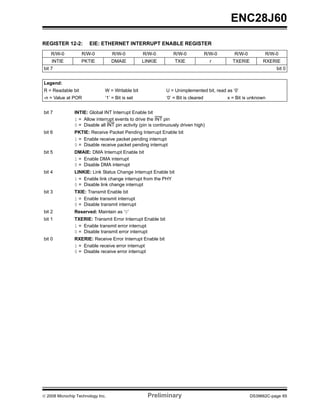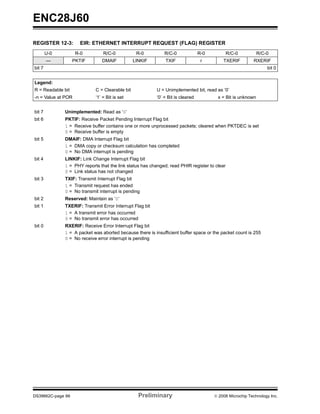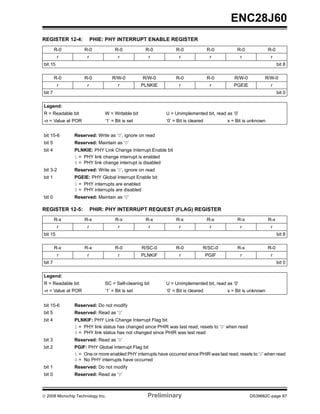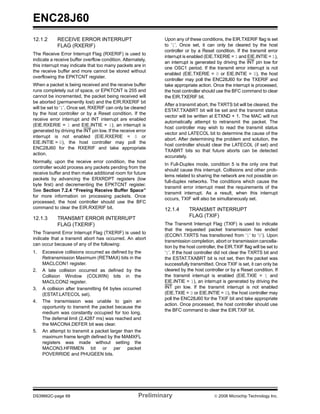




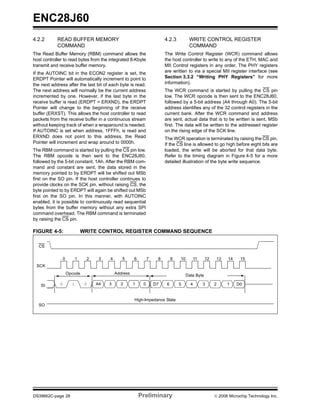
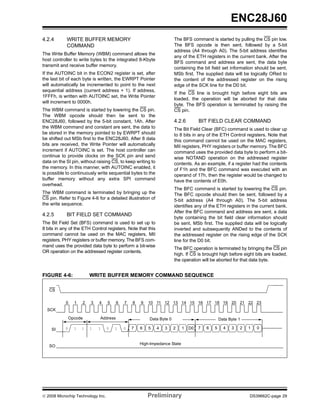
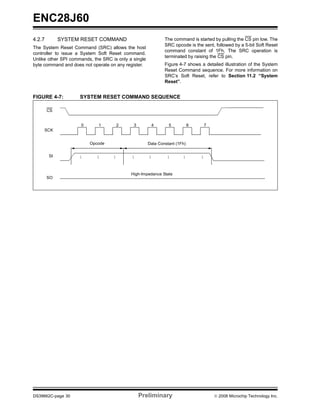
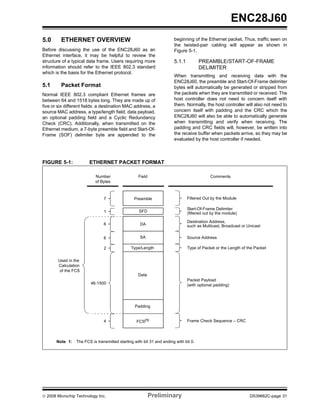


ENC28J60
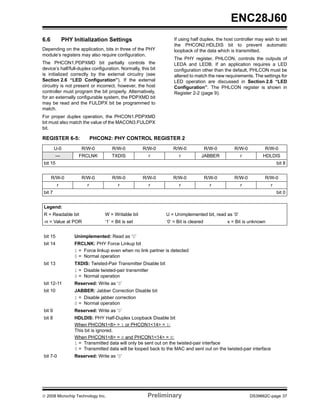
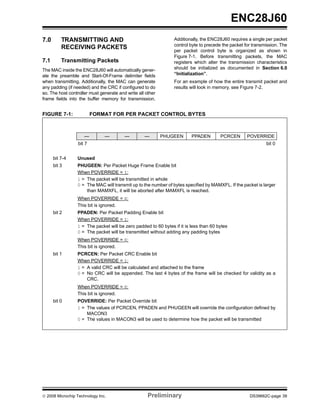
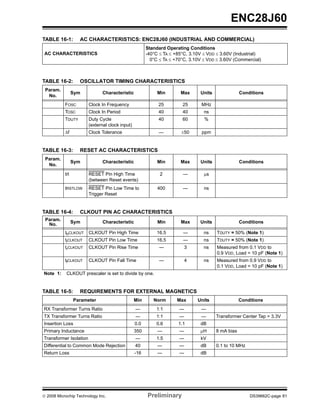
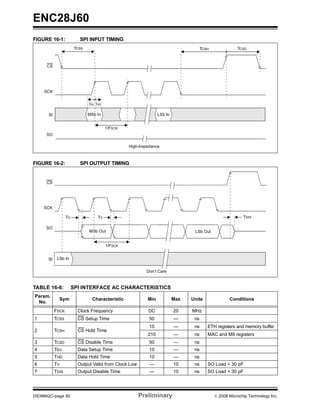
                                                     Data Sheet
                                   Stand-Alone Ethernet Controller
                                                with SPI Interface


© 2008 Microchip Technology Inc.       Preliminary            DS39662C
Note the following details of the code protection feature on Microchip devices:
•    Microchip products meet the specification contained in their particular Microchip Data Sheet.

•    Microchip believes that its family of products is one of the most secure families of its kind on the market today, when used in the
     intended manner and under normal conditions.

•    There are dishonest and possibly illegal methods used to breach the code protection feature. All of these methods, to our
     knowledge, require using the Microchip products in a manner outside the operating specifications contained in Microchip’s Data
     Sheets. Most likely, the person doing so is engaged in theft of intellectual property.

•    Microchip is willing to work with the customer who is concerned about the integrity of their code.

•    Neither Microchip nor any other semiconductor manufacturer can guarantee the security of their code. Code protection does not
     mean that we are guaranteeing the product as “unbreakable.”

Code protection is constantly evolving. We at Microchip are committed to continuously improving the code protection features of our
products. Attempts to break Microchip’s code protection feature may be a violation of the Digital Millennium Copyright Act. If such acts
allow unauthorized access to your software or other copyrighted work, you may have a right to sue for relief under that Act.


Information contained in this publication regarding device               Trademarks
applications and the like is provided only for your convenience          The Microchip name and logo, the Microchip logo, Accuron,
and may be superseded by updates. It is your responsibility to           dsPIC, KEELOQ, KEELOQ logo, MPLAB, PIC, PICmicro,
ensure that your application meets with your specifications.
                                                                         PICSTART, PRO MATE, rfPIC and SmartShunt are registered
MICROCHIP MAKES NO REPRESENTATIONS OR
                                                                         trademarks of Microchip Technology Incorporated in the
WARRANTIES OF ANY KIND WHETHER EXPRESS OR
                                                                         U.S.A. and other countries.
IMPLIED, WRITTEN OR ORAL, STATUTORY OR
OTHERWISE, RELATED TO THE INFORMATION,                                   FilterLab, Linear Active Thermistor, MXDEV, MXLAB,
INCLUDING BUT NOT LIMITED TO ITS CONDITION,                              SEEVAL, SmartSensor and The Embedded Control Solutions
QUALITY, PERFORMANCE, MERCHANTABILITY OR                                 Company are registered trademarks of Microchip Technology
FITNESS FOR PURPOSE. Microchip disclaims all liability                   Incorporated in the U.S.A.
arising from this information and its use. Use of Microchip              Analog-for-the-Digital Age, Application Maestro, CodeGuard,
devices in life support and/or safety applications is entirely at        dsPICDEM, dsPICDEM.net, dsPICworks, dsSPEAK, ECAN,
the buyer’s risk, and the buyer agrees to defend, indemnify and          ECONOMONITOR, FanSense, In-Circuit Serial
hold harmless Microchip from any and all damages, claims,                Programming, ICSP, ICEPIC, Mindi, MiWi, MPASM, MPLAB
suits, or expenses resulting from such use. No licenses are              Certified logo, MPLIB, MPLINK, mTouch, PICkit, PICDEM,
conveyed, implicitly or otherwise, under any Microchip                   PICDEM.net, PICtail, PIC32 logo, PowerCal, PowerInfo,
intellectual property rights.                                            PowerMate, PowerTool, REAL ICE, rfLAB, Select Mode, Total
                                                                         Endurance, UNI/O, WiperLock and ZENA are trademarks of
                                                                         Microchip Technology Incorporated in the U.S.A. and other
                                                                         countries.
                                                                         SQTP is a service mark of Microchip Technology Incorporated
                                                                         in the U.S.A.
                                                                         All other trademarks mentioned herein are property of their
                                                                         respective companies.
                                                                         © 2008, Microchip Technology Incorporated, Printed in the
                                                                         U.S.A., All Rights Reserved.
                                                                              Printed on recycled paper.


                                                                         Microchip received ISO/TS-16949:2002 certification for its worldwide
                                                                         headquarters, design and wafer fabrication facilities in Chandler and
                                                                         Tempe, Arizona; Gresham, Oregon and design centers in California
                                                                         and India. The Company’s quality system processes and procedures
                                                                         are for its PIC® MCUs and dsPIC® DSCs, KEELOQ® code hopping
                                                                         devices, Serial EEPROMs, microperipherals, nonvolatile memory and
                                                                         analog products. In addition, Microchip’s quality system for the design
                                                                         and manufacture of development systems is ISO 9001:2000 certified.


DS39662C-page ii                                            Preliminary                                 © 2008 Microchip Technology Inc.
ENC28J60
          Stand-Alone Ethernet Controller with SPI Interface
Ethernet Controller Features                            Operational
•   IEEE 802.3™ Compatible Ethernet Controller          • Six Interrupt Sources and One Interrupt Output Pin
•   Fully Compatible with 10/100/1000Base-T Networks    • 25 MHz Clock Input Requirement
•   Integrated MAC and 10Base-T PHY                     • Clock Out Pin with Programmable Prescaler
•   Supports One 10Base-T Port with Automatic           • Operating Voltage of 3.1V to 3.6V (3.3V typical)
    Polarity Detection and Correction                   • 5V Tolerant Inputs
•   Supports Full and Half-Duplex modes                 • Temperature Range: -40°C to +85°C Industrial,
•   Programmable Automatic Retransmit on Collision        0°C to +70°C Commercial (SSOP only)
•   Programmable Padding and CRC Generation             • 28-Pin SPDIP, SSOP, SOIC, QFN Packages
•   Programmable Automatic Rejection of Erroneous
    Packets                                             Package Types
•   SPI Interface with Clock Speeds Up to 20 MHz             28-Pin SPDIP, SSOP, SOIC

Buffer                                                               VCAP           1                 28           VDD
                                                                      VSS           2                 27           LEDA
• 8-Kbyte Transmit/Receive Packet Dual Port SRAM                 CLKOUT             3                 26           LEDB
                                                                      INT           4                 25           VDDOSC
• Configurable Transmit/Receive Buffer Size
                                                                                    5                 24           OSC2


                                                                                           ENC28J60
                                                                      NC*
• Hardware Managed Circular Receive FIFO                               SO           6                 23           OSC1
                                                                        SI          7                 22           VSSOSC
• Byte-Wide Random and Sequential Access with
                                                                     SCK            8                 21           VSSPLL
  Auto-Increment                                                       CS           9                 20           VDDPLL
• Internal DMA for Fast Data Movement                             RESET             10                19           VDDRX
• Hardware Assisted Checksum Calculation for                       VSSRX            11                18           VSSTX
                                                                    TPIN-           12                17           TPOUT+
  Various Network Protocols                                                                           16
                                                                   TPIN+            13                             TPOUT-
                                                                   RBIAS            14                15           VDDTX
Medium Access Controller (MAC)
Features
                                                                                  CLKOUT


                                                             28-pin QFN
• Supports Unicast, Multicast and Broadcast
                                                                                  LEDA
                                                                                  LEDB
                                                                                  VCAP
                                                                                  VDD
                                                                                  VSS
                                                                                  INT


  Packets
• Programmable Receive Packet Filtering and Wake-up
  Host on Logical AND or OR of the Following:
  - Unicast destination address                                                   28 27 26 25 24 23 22
  - Multicast address                                         NC*             1                            21            VDDOSC
  - Broadcast address                                          SO             2                            20            OSC2
                                                                SI            3                            19            OSC1
  - Magic Packet™                                                             4     ENC28J60               18            VSSOSC
                                                              SCK
  - Group destination addresses as defined by                  CS             5                            17            VSSPLL
    64-bit Hash Table                                       RESET             6                            16            VDDPLL
                                                             VSSRX            7                            15            VDDRX
  - Programmable Pattern Matching of up to
                                                                                  8 9 10 11 12 13 14
    64 bytes at user-defined offset

Physical Layer (PHY) Features
                                                                                  RBIAS
                                                                                   TPIN-


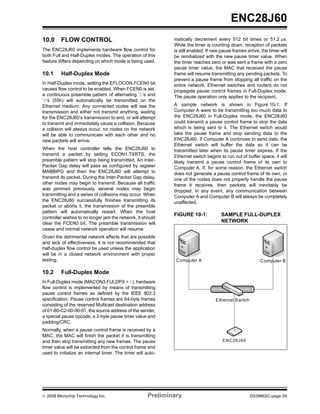
                                                                                                  TPOUT-
                                                                                  TPIN+


                                                                                                 TPOUT+
                                                                                  VDDTX


                                                                                                   VSSTX


• Loopback mode
• Two Programmable LED Outputs for LINK, TX,
  RX, Collision and Full/Half-Duplex Status                 * Reserved pin; always leave disconnected.


© 2008 Microchip Technology Inc.                Preliminary                                                     DS39662C-page 1
ENC28J60
Table of Contents
1.0 Overview ...................................................................................................................................................................................... 3
2.0 External Connections ................................................................................................................................................................... 5
3.0 Memory Organization ................................................................................................................................................................. 11
4.0 Serial Peripheral Interface (SPI)................................................................................................................................................. 25
5.0 Ethernet Overview ...................................................................................................................................................................... 31
6.0 Initialization................................................................................................................................................................................. 33
7.0 Transmitting and Receiving Packets .......................................................................................................................................... 39
8.0 Receive Filters............................................................................................................................................................................ 47
9.0 Duplex Mode Configuration and Negotiation.............................................................................................................................. 53
10.0 Flow Control ............................................................................................................................................................................... 55
11.0 Reset .......................................................................................................................................................................................... 59
12.0 Interrupts .................................................................................................................................................................................... 63
13.0 Direct Memory Access Controller ............................................................................................................................................... 71
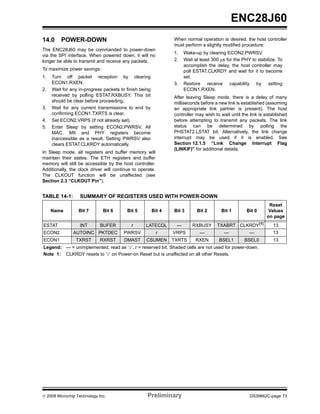
14.0 Power-Down ............................................................................................................................................................................... 73
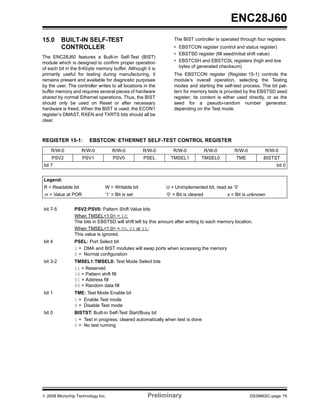
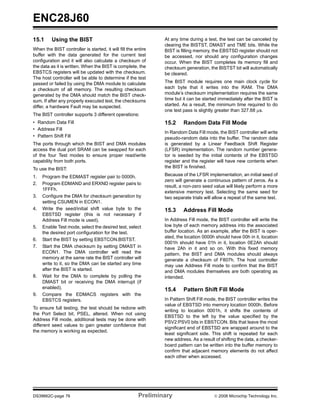
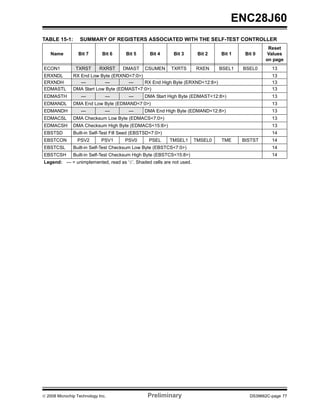
15.0 Built-in Self-Test Controller ........................................................................................................................................................ 75
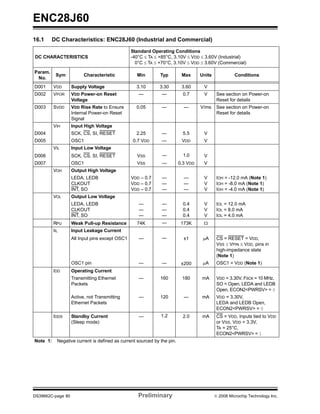
16.0 Electrical Characteristics ............................................................................................................................................................ 79
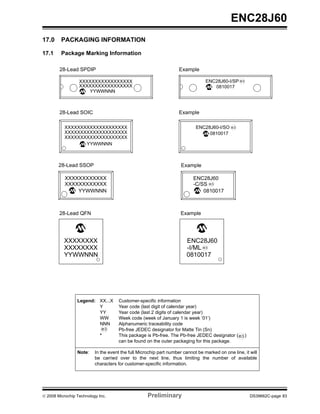
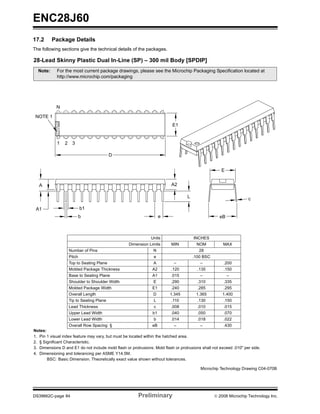
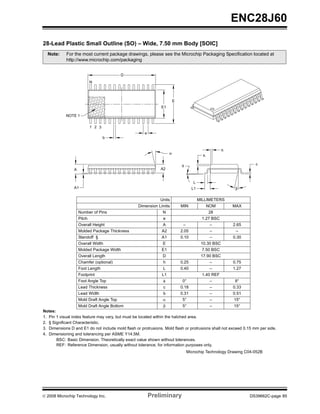
17.0 Packaging Information................................................................................................................................................................ 83
Appendix A: Revision History............................................................................................................................................................... 89
The Microchip Web Site ....................................................................................................................................................................... 91
Customer Change Notification Service ................................................................................................................................................ 91
Customer Support ................................................................................................................................................................................ 91
Reader Response ................................................................................................................................................................................ 92
Index .................................................................................................................................................................................................... 93
Product Identification System............................................................................................................................................................... 95


                                                               TO OUR VALUED CUSTOMERS
  It is our intention to provide our valued customers with the best documentation possible to ensure successful use of your Microchip
  products. To this end, we will continue to improve our publications to better suit your needs. Our publications will be refined and
  enhanced as new volumes and updates are introduced.
  If you have any questions or comments regarding this publication, please contact the Marketing Communications Department via
  E-mail at docerrors@microchip.com or fax the Reader Response Form in the back of this data sheet to (480) 792-4150. We
  welcome your feedback.

  Most Current Data Sheet
  To obtain the most up-to-date version of this data sheet, please register at our Worldwide Web site at:
          http://www.microchip.com
  You can determine the version of a data sheet by examining its literature number found on the bottom outside corner of any page.
  The last character of the literature number is the version number, (e.g., DS30000A is version A of document DS30000).

  Errata
  An errata sheet, describing minor operational differences from the data sheet and recommended workarounds, may exist for current
  devices. As device/documentation issues become known to us, we will publish an errata sheet. The errata will specify the revision
  of silicon and revision of document to which it applies.
  To determine if an errata sheet exists for a particular device, please check with one of the following:
  • Microchip’s Worldwide Web site; http://www.microchip.com
  • Your local Microchip sales office (see last page)
  When contacting a sales office, please specify which device, revision of silicon and data sheet (include literature number) you are
  using.

  Customer Notification System
  Register on our web site at www.microchip.com to receive the most current information on all of our products.


DS39662C-page 2                                                                         Preliminary                                                    © 2008 Microchip Technology Inc.
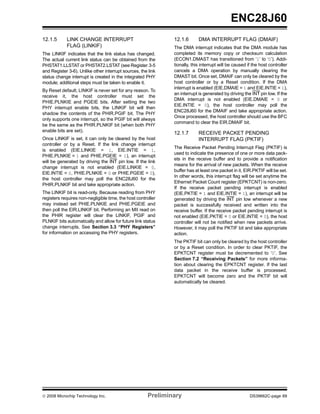
ENC28J60
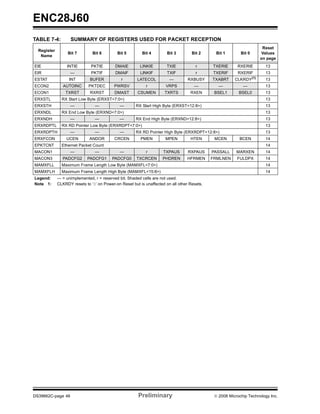
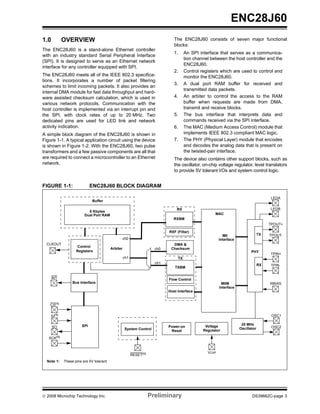
1.0         OVERVIEW                                                            The ENC28J60 consists of seven major functional
                                                                                blocks:
The ENC28J60 is a stand-alone Ethernet controller
                                                                                1.     An SPI interface that serves as a communica-
with an industry standard Serial Peripheral Interface
                                                                                       tion channel between the host controller and the
(SPI). It is designed to serve as an Ethernet network
                                                                                       ENC28J60.
interface for any controller equipped with SPI.
                                                                                2.     Control registers which are used to control and
The ENC28J60 meets all of the IEEE 802.3 specifica-                                    monitor the ENC28J60.
tions. It incorporates a number of packet filtering
                                                                                3.     A dual port RAM buffer for received and
schemes to limit incoming packets. It also provides an
                                                                                       transmitted data packets.
internal DMA module for fast data throughput and hard-
ware assisted checksum calculation, which is used in                            4.     An arbiter to control the access to the RAM
various network protocols. Communication with the                                      buffer when requests are made from DMA,
host controller is implemented via an interrupt pin and                                transmit and receive blocks.
the SPI, with clock rates of up to 20 MHz. Two                                  5.     The bus interface that interprets data and
dedicated pins are used for LED link and network                                       commands received via the SPI interface.
activity indication.                                                            6.     The MAC (Medium Access Control) module that
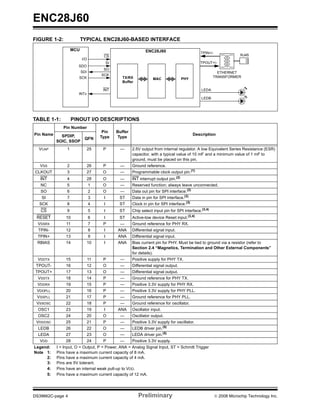
A simple block diagram of the ENC28J60 is shown in                                     implements IEEE 802.3 compliant MAC logic.
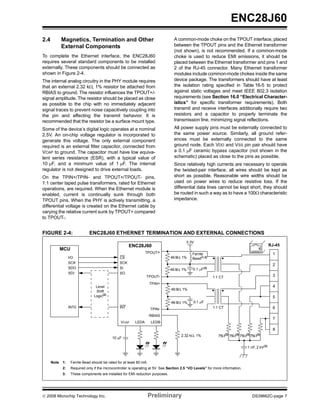
Figure 1-1. A typical application circuit using the device                      7.     The PHY (Physical Layer) module that encodes
is shown in Figure 1-2. With the ENC28J60, two pulse                                   and decodes the analog data that is present on
transformers and a few passive components are all that                                 the twisted-pair interface.
are required to connect a microcontroller to an Ethernet                        The device also contains other support blocks, such as
network.                                                                        the oscillator, on-chip voltage regulator, level translators
                                                                                to provide 5V tolerant I/Os and system control logic.


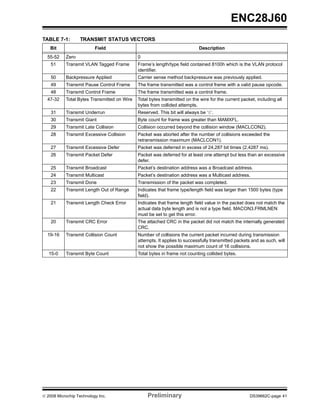
FIGURE 1-1:                  ENC28J60 BLOCK DIAGRAM

                                                                                                                                       LEDA
                             Buffer

                                                                                 RX                                                    LEDB
                          8 Kbytes
                        Dual Port RAM                                                                 MAC
                                                                                RXBM
                                                                                                                                       TPOUT+

                                                                             RXF (Filter)
                                                                                                           MII                    TX   TPOUT-
                                                    ch0                                                  Interface
  CLKOUT                                                                       DMA &
                   Control
                                          Arbiter                      ch0    Checksum
                   Registers                                                                                                PHY
                                                                                                                                       TPIN+
                                                    ch1                           TX
                                                                       ch1
                                                                                                                                  RX   TPIN-
                                                                                TXBM

      INT                                                                    Flow Control
                 Bus Interface                                                                            MIIM                         RBIAS
                                                                                                         Interface
                                                                             Host Interface


    CS(1)


    SI(1)                                                                                                                               OSC1

                       SPI                                                                                            25 MHz
      SO                                                                     Power-on            Voltage                                OSC2
                                                    System Control                                                   Oscillator
                                                                              Reset             Regulator

   SCK(1)


                                                                                                  VCAP
                                                          RESET(1)
  Note 1:   These pins are 5V tolerant.


© 2008 Microchip Technology Inc.                                     Preliminary                                            DS39662C-page 3
ENC28J60
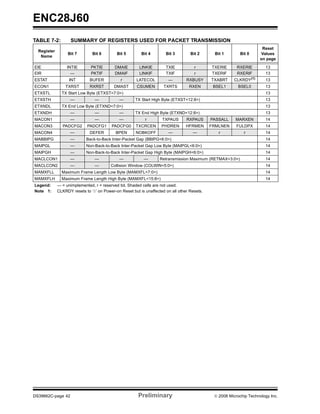
FIGURE 1-2:               TYPICAL ENC28J60-BASED INTERFACE
                    MCU                                         ENC28J60                        TPIN+/-
                                      CS                                                                               RJ45
                          I/O
                                          SI                                                    TPOUT+/-
                       SDO
                                      SO
                          SDI                                                                             ETHERNET
                                     SCK
                       SCK                        TX/RX                                                 TRANSFORMER
                                                                    MAC                PHY
                                                  Buffer

                                      INT                                                        LEDA
                       INTX
                                                                                                 LEDB


TABLE 1-1:           PINOUT I/O DESCRIPTIONS
              Pin Number
                                      Pin      Buffer
Pin Name     SPDIP,                                                                          Description
                           QFN       Type      Type
           SOIC, SSOP
  VCAP          1               25    P         —       2.5V output from internal regulator. A low Equivalent Series Resistance (ESR)
                                                        capacitor, with a typical value of 10 mF and a minimum value of 1 mF to
                                                        ground, must be placed on this pin.
   VSS          2               26    P         —       Ground reference.
CLKOUT          3               27    O         —       Programmable clock output pin.(1)
   INT          4               28    O         —       INT interrupt output pin.(2)
   NC           5               1     O         —       Reserved function; always leave unconnected.
   SO           6               2     O         —       Data out pin for SPI interface.(2)
   SI           7               3     I         ST      Data in pin for SPI interface.(3)
  SCK           8               4     I         ST      Clock in pin for SPI interface.(3)
   CS           9               5     I         ST      Chip select input pin for SPI interface.(3,4)
 RESET          10              6     I         ST      Active-low device Reset input.(3,4)
  VSSRX         11              7     P         —       Ground reference for PHY RX.
  TPIN-         12              8     I        ANA      Differential signal input.
  TPIN+         13              9     I        ANA      Differential signal input.
 RBIAS          14              10    I        ANA      Bias current pin for PHY. Must be tied to ground via a resistor (refer to
                                                        Section 2.4 “Magnetics, Termination and Other External Components”
                                                        for details).
  VDDTX         15              11    P         —       Positive supply for PHY TX.
 TPOUT-         16              12    O         —       Differential signal output.
 TPOUT+         17              13    O         —       Differential signal output.
  VSSTX         18              14    P         —       Ground reference for PHY TX.
 VDDRX          19              15    P         —       Positive 3.3V supply for PHY RX.
 VDDPLL         20              16    P         —       Positive 3.3V supply for PHY PLL.
 VSSPLL         21              17    P         —       Ground reference for PHY PLL.
 VSSOSC         22              18    P         —       Ground reference for oscillator.
  OSC1         23               19    I        ANA      Oscillator input.
  OSC2         24               20    O         —       Oscillator output.
 VDDOSC         25              21    P         —       Positive 3.3V supply for oscillator.
  LEDB          26              22    O         —       LEDB driver pin.(5)
  LEDA          27              23    O         —       LEDA driver pin.(5)
  VDD           28              24    P         —       Positive 3.3V supply.
Legend:    I = Input, O = Output, P = Power, ANA = Analog Signal Input, ST = Schmitt Trigger
Note 1:    Pins have a maximum current capacity of 8 mA.
     2:    Pins have a maximum current capacity of 4 mA.
     3:    Pins are 5V tolerant.
     4:    Pins have an internal weak pull-up to VDD.
     5:    Pins have a maximum current capacity of 12 mA.


DS39662C-page 4                                            Preliminary                                    © 2008 Microchip Technology Inc.
ENC28J60
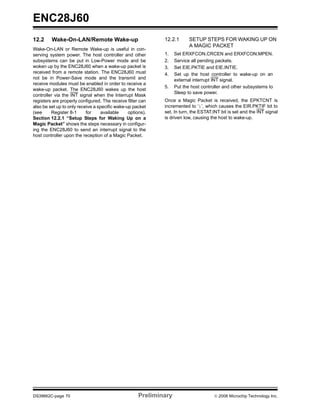
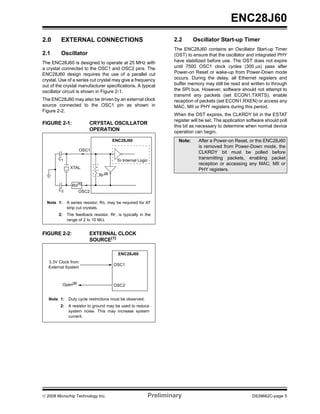
2.0      EXTERNAL CONNECTIONS                                         2.2       Oscillator Start-up Timer
                                                                      The ENC28J60 contains an Oscillator Start-up Timer
2.1      Oscillator                                                   (OST) to ensure that the oscillator and integrated PHY
The ENC28J60 is designed to operate at 25 MHz with                    have stabilized before use. The OST does not expire
a crystal connected to the OSC1 and OSC2 pins. The                    until 7500 OSC1 clock cycles (300 μs) pass after
ENC28J60 design requires the use of a parallel cut                    Power-on Reset or wake-up from Power-Down mode
crystal. Use of a series cut crystal may give a frequency             occurs. During the delay, all Ethernet registers and
out of the crystal manufacturer specifications. A typical             buffer memory may still be read and written to through
oscillator circuit is shown in Figure 2-1.                            the SPI bus. However, software should not attempt to
                                                                      transmit any packets (set ECON1.TXRTS), enable
The ENC28J60 may also be driven by an external clock                  reception of packets (set ECON1.RXEN) or access any
source connected to the OSC1 pin as shown in                          MAC, MII or PHY registers during this period.
Figure 2-2.
                                                                      When the OST expires, the CLKRDY bit in the ESTAT
                                                                      register will be set. The application software should poll
FIGURE 2-1:               CRYSTAL OSCILLATOR
                                                                      this bit as necessary to determine when normal device
                          OPERATION                                   operation can begin.
                                        ENC28J60                        Note:     After a Power-on Reset, or the ENC28J60
                                                                                  is removed from Power-Down mode, the
                    OSC1
                                                                                  CLKRDY bit must be polled before
        C1                                To Internal Logic
                                                                                  transmitting packets, enabling packet
                                                                                  reception or accessing any MAC, MII or
               XTAL                                                               PHY registers.
                                RF(2)

                 RS(1)
        C2          OSC2

  Note 1:     A series resistor, RS, may be required for AT
              strip cut crystals.
        2:    The feedback resistor, RF , is typically in the
              range of 2 to 10 MΩ.


FIGURE 2-2:               EXTERNAL CLOCK
                          SOURCE(1)

                                          ENC28J60
   3.3V Clock from
                                        OSC1
   External System


          Open(2)                       OSC2


   Note 1:    Duty cycle restrictions must be observed.
         2:   A resistor to ground may be used to reduce
              system noise. This may increase system
              current.


© 2008 Microchip Technology Inc.                              Preliminary                                     DS39662C-page 5
ENC28J60
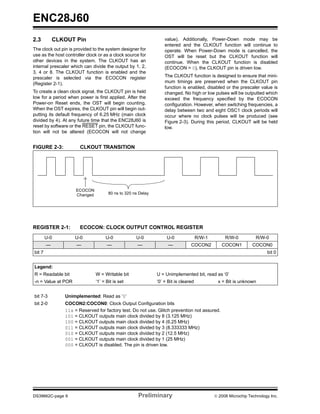
2.3         CLKOUT Pin                                            value). Additionally, Power-Down mode may be
                                                                  entered and the CLKOUT function will continue to
The clock out pin is provided to the system designer for          operate. When Power-Down mode is cancelled, the
use as the host controller clock or as a clock source for         OST will be reset but the CLKOUT function will
other devices in the system. The CLKOUT has an                    continue. When the CLKOUT function is disabled
internal prescaler which can divide the output by 1, 2,           (ECOCON = 0), the CLKOUT pin is driven low.
3, 4 or 8. The CLKOUT function is enabled and the
prescaler is selected via the ECOCON register                     The CLKOUT function is designed to ensure that mini-
(Register 2-1).                                                   mum timings are preserved when the CLKOUT pin
                                                                  function is enabled, disabled or the prescaler value is
To create a clean clock signal, the CLKOUT pin is held            changed. No high or low pulses will be outputted which
low for a period when power is first applied. After the           exceed the frequency specified by the ECOCON
Power-on Reset ends, the OST will begin counting.                 configuration. However, when switching frequencies, a
When the OST expires, the CLKOUT pin will begin out-              delay between two and eight OSC1 clock periods will
putting its default frequency of 6.25 MHz (main clock             occur where no clock pulses will be produced (see
divided by 4). At any future time that the ENC28J60 is            Figure 2-3). During this period, CLKOUT will be held
reset by software or the RESET pin, the CLKOUT func-              low.
tion will not be altered (ECOCON will not change


FIGURE 2-3:            CLKOUT TRANSITION


                     ECOCON
                     Changed          80 ns to 320 ns Delay


REGISTER 2-1:          ECOCON: CLOCK OUTPUT CONTROL REGISTER
        U-0          U-0            U-0             U-0            U-0               R/W-1        R/W-0          R/W-0
        —            —               —               —              —           COCON2          COCON1          COCON0
bit 7                                                                                                                  bit 0


Legend:
R = Readable bit               W = Writable bit               U = Unimplemented bit, read as ‘0’
-n = Value at POR              ‘1’ = Bit is set               ‘0’ = Bit is cleared            x = Bit is unknown


bit 7-3         Unimplemented: Read as ‘0’
bit 2-0         COCON2:COCON0: Clock Output Configuration bits
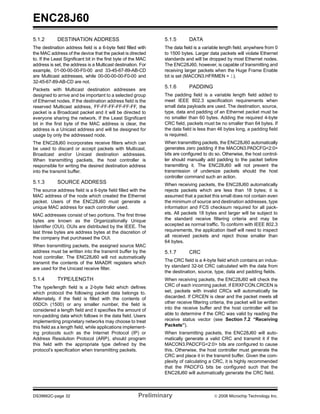
                11x = Reserved for factory test. Do not use. Glitch prevention not assured.
                101 = CLKOUT outputs main clock divided by 8 (3.125 MHz)
                100 = CLKOUT outputs main clock divided by 4 (6.25 MHz)
                011 = CLKOUT outputs main clock divided by 3 (8.333333 MHz)
                010 = CLKOUT outputs main clock divided by 2 (12.5 MHz)
                001 = CLKOUT outputs main clock divided by 1 (25 MHz)
                000 = CLKOUT is disabled. The pin is driven low.


DS39662C-page 6                                      Preliminary                             © 2008 Microchip Technology Inc.
ENC28J60
2.4          Magnetics, Termination and Other                                      A common-mode choke on the TPOUT interface, placed
             External Components                                                   between the TPOUT pins and the Ethernet transformer
                                                                                   (not shown), is not recommended. If a common-mode
To complete the Ethernet interface, the ENC28J60                                   choke is used to reduce EMI emissions, it should be
requires several standard components to be installed                               placed between the Ethernet transformer and pins 1 and
externally. These components should be connected as                                2 of the RJ-45 connector. Many Ethernet transformer
shown in Figure 2-4.                                                               modules include common-mode chokes inside the same
The internal analog circuitry in the PHY module requires                           device package. The transformers should have at least
that an external 2.32 kΩ, 1% resistor be attached from                             the isolation rating specified in Table 16-5 to protect
RBIAS to ground. The resistor influences the TPOUT+/-                              against static voltages and meet IEEE 802.3 isolation
signal amplitude. The resistor should be placed as close                           requirements (see Section 16.0 “Electrical Character-
as possible to the chip with no immediately adjacent                               istics” for specific transformer requirements). Both
signal traces to prevent noise capacitively coupling into                          transmit and receive interfaces additionally require two
the pin and affecting the transmit behavior. It is                                 resistors and a capacitor to properly terminate the
recommended that the resistor be a surface mount type.                             transmission line, minimizing signal reflections.
Some of the device’s digital logic operates at a nominal                           All power supply pins must be externally connected to
2.5V. An on-chip voltage regulator is incorporated to                              the same power source. Similarly, all ground refer-
generate this voltage. The only external component                                 ences must be externally connected to the same
required is an external filter capacitor, connected from                           ground node. Each VDD and VSS pin pair should have
VCAP to ground. The capacitor must have low equiva-                                a 0.1 μF ceramic bypass capacitor (not shown in the
lent series resistance (ESR), with a typical value of                              schematic) placed as close to the pins as possible.
10 μF, and a minimum value of 1 μF. The internal                                   Since relatively high currents are necessary to operate
regulator is not designed to drive external loads.                                 the twisted-pair interface, all wires should be kept as
On the TPIN+/TPIN- and TPOUT+/TPOUT- pins,                                         short as possible. Reasonable wire widths should be
1:1 center taped pulse transformers, rated for Ethernet                            used on power wires to reduce resistive loss. If the
operations, are required. When the Ethernet module is                              differential data lines cannot be kept short, they should
enabled, current is continually sunk through both                                  be routed in such a way as to have a 100Ω characteristic
TPOUT pins. When the PHY is actively transmitting, a                               impedance.
differential voltage is created on the Ethernet cable by
varying the relative current sunk by TPOUT+ compared
to TPOUT-.


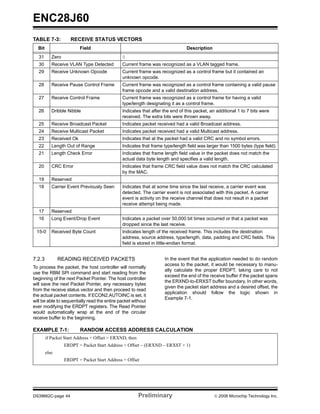
FIGURE 2-4:                   ENC28J60 ETHERNET TERMINATION AND EXTERNAL CONNECTIONS
                                                                                           3.3V
                                                       ENC28J60                                                                                  RJ-45
             MCU                                                                                                                        1
                                                                  TPOUT+                       Ferrite                                            1
                  I/O                            CS                              49.9Ω, 1%     Bead(1,3)
                  SCK                            SCK
                                                                                                                                                  2
                  SDO                            SI                              49.9Ω, 1%     0.1 μF(3)
                  SDI                            SO
                                                                  TPOUT-                                   1:1 CT                                 3
                                                                      TPIN+
                                  Level                                                                                                           4
                                                                                 49.9Ω, 1%
                                  Shift
                                 Logic(2)                                                                                                         5
                                                                                 49.9Ω, 1%     0.1 μF
                  INT0                           INT                                                       1:1 CT                                 6
                                                                      TPIN-
                                                                      RBIAS
                                                                                                                                                  7
                                                  VCAP     LEDA        LEDB

                                                                                                                                                  8
                                                                                        2.32 kΩ, 1%            75Ω(3) 75Ω(3) 75Ω(3) 75Ω(3)
                                             10 μF

                                                                                                                                 1 nF, 2 kV(3)


      Note   1:    Ferrite Bead should be rated for at least 80 mA.
             2:    Required only if the microcontroller is operating at 5V. See Section 2.5 “I/O Levels” for more information.
             3:    These components are installed for EMI reduction purposes.


© 2008 Microchip Technology Inc.                                      Preliminary                                                   DS39662C-page 7
ENC28J60
2.5      I/O Levels                                           2.6       LED Configuration
The ENC28J60 is a 3.3V part; however, it was                  The LEDA and LEDB pins support automatic polarity
designed to be easily integrated into 5V systems. The         detection on Reset. The LEDs can be connected such
SPI CS, SCK and SI inputs, as well as the RESET pin,          that the pin must source current to turn the LED on, or
are all 5V tolerant. On the other hand, if the host           alternately connected such that the pin must sink cur-
controller is operated at 5V, it quite likely will not be     rent to turn the LED on. Upon system Reset, the
within specifications when its SPI and interrupt inputs       ENC28J60 will detect how the LED is connected and
are driven by the 3.3V CMOS outputs on the                    begin driving the LED to the default state configured by
ENC28J60. A unidirectional level translator would be          the PHLCON register. If the LED polarity is changed
necessary.                                                    while the ENC28J60 is operating, the new polarity will
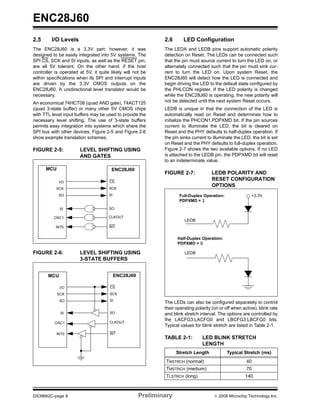
An economical 74HCT08 (quad AND gate), 74ACT125               not be detected until the next system Reset occurs.
(quad 3-state buffer) or many other 5V CMOS chips             LEDB is unique in that the connection of the LED is
with TTL level input buffers may be used to provide the       automatically read on Reset and determines how to
necessary level shifting. The use of 3-state buffers          initialize the PHCON1.PDPXMD bit. If the pin sources
permits easy integration into systems which share the         current to illuminate the LED, the bit is cleared on
SPI bus with other devices. Figure 2-5 and Figure 2-6         Reset and the PHY defaults to half-duplex operation. If
show example translation schemes.                             the pin sinks current to illuminate the LED, the bit is set
                                                              on Reset and the PHY defaults to full-duplex operation.
FIGURE 2-5:            LEVEL SHIFTING USING                   Figure 2-7 shows the two available options. If no LED
                       AND GATES                              is attached to the LEDB pin, the PDPXMD bit will reset
                                                              to an indeterminate value.
      MCU                              ENC28J60
                                                              FIGURE 2-7:             LEDB POLARITY AND
             I/O                      CS
                                                                                      RESET CONFIGURATION
                                                                                      OPTIONS
           SCK                        SCK
            SO                        SI                             Full-Duplex Operation:                 +3.3V
                                                                     PDPXMD = 1
             SI                       SO

          OSC1                        CLKOUT
                                                                        LEDB
           INT0                       INT


                                                                    Half-Duplex Operation:
                                                                    PDPXMD = 0

FIGURE 2-6:            LEVEL SHIFTING USING                             LEDB
                       3-STATE BUFFERS


       MCU                                 ENC28J60

             I/O                      CS
            SCK                       SCK
             SO                       SI
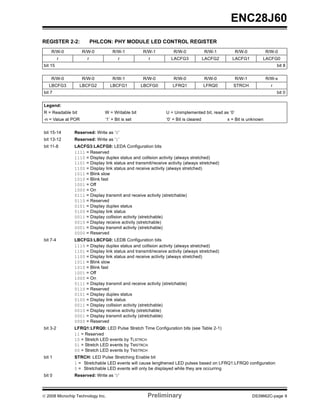
                                                              The LEDs can also be configured separately to control
                                                              their operating polarity (on or off when active), blink rate
             SI                       SO                      and blink stretch interval. The options are controlled by
                                                              the LACFG3:LACFG0 and LBCFG3:LBCFG0 bits.
           OSC1                       CLKOUT
                                                              Typical values for blink stretch are listed in Table 2-1.
           INT0                       INT
                                                              TABLE 2-1:          LED BLINK STRETCH
                                                                                  LENGTH
                                                                    Stretch Length             Typical Stretch (ms)
                                                               TNSTRCH (normal)                          40
                                                               TMSTRCH (medium)                          70
                                                               TLSTRCH (long)                           140


DS39662C-page 8                                       Preliminary                       © 2008 Microchip Technology Inc.
ENC28J60
REGISTER 2-2:             PHLCON: PHY MODULE LED CONTROL REGISTER
    R/W-0           R/W-0          R/W-1           R/W-1           R/W-0              R/W-1         R/W-0           R/W-0
          r           r               r               r           LACFG3              LACFG2     LACFG1         LACFG0
bit 15                                                                                                                    bit 8

    R/W-0           R/W-0          R/W-1           R/W-0           R/W-0              R/W-0         R/W-1           R/W-x
   LBCFG3          LBCFG2          LBCFG1         LBCFG0           LFRQ1              LFRQ0       STRCH               r
bit 7                                                                                                                     bit 0

Legend:
R = Readable bit               W = Writable bit                U = Unimplemented bit, read as ‘0’
-n = Value at POR              ‘1’ = Bit is set                ‘0’ = Bit is cleared            x = Bit is unknown

bit 15-14       Reserved: Write as ‘0’
bit 13-12       Reserved: Write as ‘1’
bit 11-8        LACFG3:LACFG0: LEDA Configuration bits
                1111 = Reserved
                1110 = Display duplex status and collision activity (always stretched)
                1101 = Display link status and transmit/receive activity (always stretched)
                1100 = Display link status and receive activity (always stretched)
                1011 = Blink slow
                1010 = Blink fast
                1001 = Off
                1000 = On
                0111 = Display transmit and receive activity (stretchable)
                0110 = Reserved
                0101 = Display duplex status
                0100 = Display link status
                0011 = Display collision activity (stretchable)
                0010 = Display receive activity (stretchable)
                0001 = Display transmit activity (stretchable)
                0000 = Reserved
bit 7-4         LBCFG3:LBCFG0: LEDB Configuration bits
                1110 = Display duplex status and collision activity (always stretched)
                1101 = Display link status and transmit/receive activity (always stretched)
                1100 = Display link status and receive activity (always stretched)
                1011 = Blink slow
                1010 = Blink fast
                1001 = Off
                1000 = On
                0111 = Display transmit and receive activity (stretchable)
                0110 = Reserved
                0101 = Display duplex status
                0100 = Display link status
                0011 = Display collision activity (stretchable)
                0010 = Display receive activity (stretchable)
                0001 = Display transmit activity (stretchable)
                0000 = Reserved
bit 3-2         LFRQ1:LFRQ0: LED Pulse Stretch Time Configuration bits (see Table 2-1)
                11 = Reserved
                10 = Stretch LED events by TLSTRCH
                01 = Stretch LED events by TMSTRCH
                00 = Stretch LED events by TNSTRCH
bit 1           STRCH: LED Pulse Stretching Enable bit
                1 = Stretchable LED events will cause lengthened LED pulses based on LFRQ1:LFRQ0 configuration
                0 = Stretchable LED events will only be displayed while they are occurring
bit 0           Reserved: Write as ‘0’


© 2008 Microchip Technology Inc.                     Preliminary                                            DS39662C-page 9
ENC28J60
NOTES:


DS39662C-page 10   Preliminary   © 2008 Microchip Technology Inc.
ENC28J60
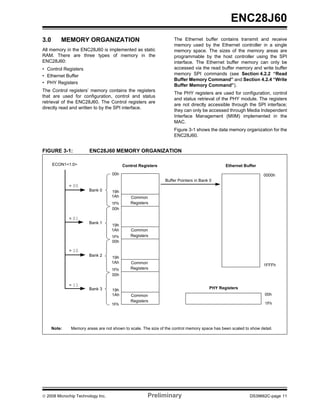
3.0       MEMORY ORGANIZATION                                      The Ethernet buffer contains transmit and receive
                                                                   memory used by the Ethernet controller in a single
All memory in the ENC28J60 is implemented as static                memory space. The sizes of the memory areas are
RAM. There are three types of memory in the                        programmable by the host controller using the SPI
ENC28J60:                                                          interface. The Ethernet buffer memory can only be
• Control Registers                                                accessed via the read buffer memory and write buffer
• Ethernet Buffer                                                  memory SPI commands (see Section 4.2.2 “Read
                                                                   Buffer Memory Command” and Section 4.2.4 “Write
• PHY Registers
                                                                   Buffer Memory Command”).
The Control registers’ memory contains the registers
                                                                   The PHY registers are used for configuration, control
that are used for configuration, control and status
                                                                   and status retrieval of the PHY module. The registers
retrieval of the ENC28J60. The Control registers are
                                                                   are not directly accessible through the SPI interface;
directly read and written to by the SPI interface.
                                                                   they can only be accessed through Media Independent
                                                                   Interface Management (MIIM) implemented in the
                                                                   MAC.
                                                                   Figure 3-1 shows the data memory organization for the
                                                                   ENC28J60.


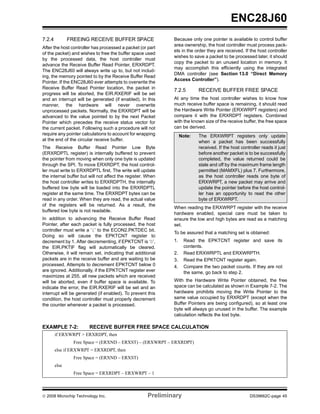
FIGURE 3-1:            ENC28J60 MEMORY ORGANIZATION

      ECON1<1:0>                         Control Registers                                    Ethernet Buffer

                                   00h                                                                            0000h
                                                               Buffer Pointers in Bank 0
              = 00
                       Bank 0      19h
                                   1Ah       Common
                                   1Fh       Registers
                                   00h

              = 01
                       Bank 1
                                   19h
                                   1Ah       Common
                                   1Fh       Registers
                                   00h

              = 10
                       Bank 2
                                   19h
                                   1Ah       Common
                                                                                                                  1FFFh
                                   1Fh       Registers
                                   00h

              = 11
                       Bank 3                                                         PHY Registers
                                   19h
                                   1Ah       Common                                                                00h
                                             Registers
                                   1Fh                                                                             1Fh


      Note:   Memory areas are not shown to scale. The size of the control memory space has been scaled to show detail.


© 2008 Microchip Technology Inc.                     Preliminary                                           DS39662C-page 11
ENC28J60
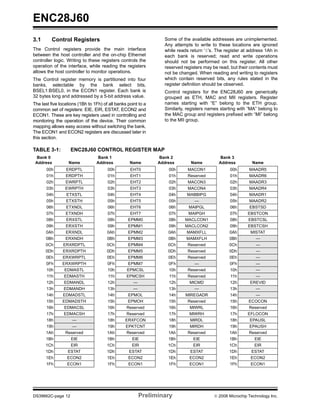
3.1      Control Registers                                       Some of the available addresses are unimplemented.
                                                                 Any attempts to write to these locations are ignored
The Control registers provide the main interface                 while reads return ‘0’s. The register at address 1Ah in
between the host controller and the on-chip Ethernet             each bank is reserved; read and write operations
controller logic. Writing to these registers controls the        should not be performed on this register. All other
operation of the interface, while reading the registers          reserved registers may be read, but their contents must
allows the host controller to monitor operations.                not be changed. When reading and writing to registers
The Control register memory is partitioned into four             which contain reserved bits, any rules stated in the
banks, selectable by the bank select bits,                       register definition should be observed.
BSEL1:BSEL0, in the ECON1 register. Each bank is                 Control registers for the ENC28J60 are generically
32 bytes long and addressed by a 5-bit address value.            grouped as ETH, MAC and MII registers. Register
The last five locations (1Bh to 1Fh) of all banks point to a     names starting with “E” belong to the ETH group.
common set of registers: EIE, EIR, ESTAT, ECON2 and              Similarly, registers names starting with “MA” belong to
ECON1. These are key registers used in controlling and           the MAC group and registers prefixed with “MI” belong
monitoring the operation of the device. Their common             to the MII group.
mapping allows easy access without switching the bank.
The ECON1 and ECON2 registers are discussed later in
this section.

TABLE 3-1:         ENC28J60 CONTROL REGISTER MAP
  Bank 0                          Bank 1                        Bank 2                      Bank 3
 Address          Name           Address           Name        Address       Name          Address          Name
       00h       ERDPTL                00h         EHT0            00h      MACON1               00h      MAADR5
       01h       ERDPTH                01h         EHT1            01h      Reserved             01h      MAADR6
       02h       EWRPTL                02h         EHT2            02h      MACON3               02h      MAADR3
       03h       EWRPTH                03h         EHT3            03h      MACON4               03h      MAADR4
       04h       ETXSTL                04h         EHT4            04h     MABBIPG               04h      MAADR1
       05h       ETXSTH                05h         EHT5            05h         —                 05h      MAADR2
       06h       ETXNDL                06h         EHT6            06h      MAIPGL               06h      EBSTSD
       07h       ETXNDH                07h         EHT7            07h      MAIPGH               07h     EBSTCON
       08h       ERXSTL                08h        EPMM0            08h    MACLCON1               08h      EBSTCSL
       09h       ERXSTH                09h        EPMM1            09h    MACLCON2               09h      EBSTCSH
      0Ah        ERXNDL                0Ah        EPMM2            0Ah     MAMXFLL              0Ah        MISTAT
      0Bh        ERXNDH                0Bh        EPMM3            0Bh     MAMXFLH              0Bh          —
      0Ch       ERXRDPTL               0Ch        EPMM4            0Ch      Reserved            0Ch          —
      0Dh      ERXRDPTH                0Dh        EPMM5            0Dh      Reserved            0Dh          —
      0Eh      ERXWRPTL                0Eh        EPMM6            0Eh      Reserved            0Eh          —
       0Fh     ERXWRPTH                0Fh        EPMM7            0Fh         —                0Fh          —
       10h      EDMASTL                10h       EPMCSL            10h      Reserved             10h         —
       11h      EDMASTH                11h       EPMCSH            11h      Reserved             11h         —
       12h      EDMANDL                12h           —             12h       MICMD               12h       EREVID
       13h      EDMANDH                13h           —             13h         —                 13h         —
       14h     EDMADSTL                14h        EPMOL            14h     MIREGADR              14h         —
       15h     EDMADSTH                15h        EPMOH            15h      Reserved             15h      ECOCON
       16h      EDMACSL                16h       Reserved          16h       MIWRL               16h      Reserved
       17h      EDMACSH                17h       Reserved          17h       MIWRH               17h     EFLOCON
       18h          —                  18h       ERXFCON           18h       MIRDL               18h      EPAUSL
       19h          —                  19h       EPKTCNT           19h       MIRDH               19h      EPAUSH
      1Ah        Reserved              1Ah       Reserved          1Ah      Reserved            1Ah       Reserved
      1Bh           EIE                1Bh          EIE            1Bh        EIE               1Bh          EIE
      1Ch           EIR                1Ch          EIR            1Ch        EIR               1Ch          EIR
      1Dh         ESTAT                1Dh         ESTAT           1Dh       ESTAT              1Dh        ESTAT
      1Eh         ECON2                1Eh        ECON2            1Eh       ECON2              1Eh        ECON2
       1Fh        ECON1                1Fh        ECON1            1Fh       ECON1              1Fh        ECON1


DS39662C-page 12                                         Preliminary                     © 2008 Microchip Technology Inc.
ENC28J60
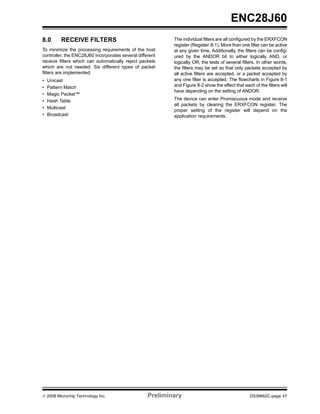
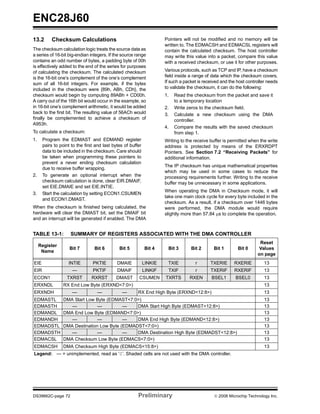
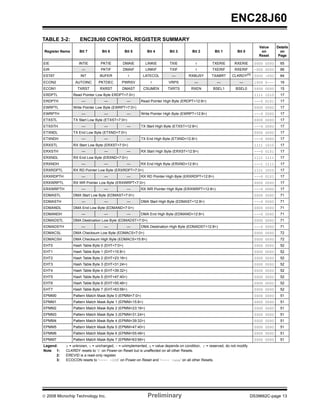
TABLE 3-2:          ENC28J60 CONTROL REGISTER SUMMARY
                                                                                                                            Value     Details
 Register Name      Bit 7        Bit 6          Bit 5       Bit 4        Bit 3        Bit 2        Bit 1       Bit 0         on         on
                                                                                                                            Reset      Page

EIE                 INTIE       PKTIE       DMAIE          LINKIE        TXIE           r        TXERIE      RXERIE       0000 0000     65
EIR                  —          PKTIF       DMAIF          LINKIF        TXIF           r        TXERIF       RXERIF      -000 0000     66
ESTAT                INT       BUFER              r       LATECOL         —         RXBUSY       TXABRT     CLKRDY(1) 0000 -000         64
ECON2             AUTOINC      PKTDEC       PWRSV             r         VRPS           —            —           —         1000 0---     16
ECON1              TXRST       RXRST        DMAST         CSUMEN        TXRTS        RXEN        BSEL1        BSEL0       0000 0000     15
ERDPTL           Read Pointer Low Byte ERDPT<7:0>)                                                                        1111 1010     17
ERDPTH               —            —              —       Read Pointer High Byte (ERDPT<12:8>)                             ---0 0101     17
EWRPTL           Write Pointer Low Byte (EWRPT<7:0>)                                                                      0000 0000     17
EWRPTH               —            —              —       Write Pointer High Byte (EWRPT<12:8>)                            ---0 0000     17
ETXSTL           TX Start Low Byte (ETXST<7:0>)                                                                           0000 0000     17
ETXSTH               —            —              —       TX Start High Byte (ETXST<12:8>)                                 ---0 0000     17
ETXNDL           TX End Low Byte (ETXND<7:0>)                                                                             0000 0000     17
ETXNDH               —            —              —       TX End High Byte (ETXND<12:8>)                                   ---0 0000     17
ERXSTL           RX Start Low Byte (ERXST<7:0>)                                                                           1111 1010     17
ERXSTH               —            —              —       RX Start High Byte (ERXST<12:8>)                                 ---0 0101     17
ERXNDL           RX End Low Byte (ERXND<7:0>)                                                                             1111 1111     17
ERXNDH               —            —              —       RX End High Byte (ERXND<12:8>)                                   ---1 1111     17
ERXRDPTL         RX RD Pointer Low Byte (ERXRDPT<7:0>)                                                                    1111 1010     17
ERXRDPTH             —            —              —       RX RD Pointer High Byte (ERXRDPT<12:8>)                          ---0 0101     17
ERXWRPTL         RX WR Pointer Low Byte (ERXWRPT<7:0>)                                                                    0000 0000     17
ERXWRPTH             —            —              —       RX WR Pointer High Byte (ERXWRPT<12:8>)                          ---0 0000     17
EDMASTL          DMA Start Low Byte (EDMAST<7:0>)                                                                         0000 0000     71
EDMASTH              —            —              —       DMA Start High Byte (EDMAST<12:8>)                               ---0 0000     71
EDMANDL          DMA End Low Byte (EDMAND<7:0>)                                                                           0000 0000     71
EDMANDH              —            —              —       DMA End High Byte (EDMAND<12:8>)                                 ---0 0000     71
EDMADSTL         DMA Destination Low Byte (EDMADST<7:0>)                                                                  0000 0000     71
EDMADSTH             —            —              —       DMA Destination High Byte (EDMADST<12:8>)                        ---0 0000     71
EDMACSL          DMA Checksum Low Byte (EDMACS<7:0>)                                                                      0000 0000     72
EDMACSH          DMA Checksum High Byte (EDMACS<15:8>)                                                                    0000 0000     72
EHT0             Hash Table Byte 0 (EHT<7:0>)                                                                             0000 0000     52
EHT1             Hash Table Byte 1 (EHT<15:8>)                                                                            0000 0000     52
EHT2             Hash Table Byte 2 (EHT<23:16>)                                                                           0000 0000     52
EHT3             Hash Table Byte 3 (EHT<31:24>)                                                                           0000 0000     52
EHT4             Hash Table Byte 4 (EHT<39:32>)                                                                           0000 0000     52
EHT5             Hash Table Byte 5 (EHT<47:40>)                                                                           0000 0000     52
EHT6             Hash Table Byte 6 (EHT<55:48>)                                                                           0000 0000     52
EHT7             Hash Table Byte 7 (EHT<63:56>)                                                                           0000 0000     52
EPMM0            Pattern Match Mask Byte 0 (EPMM<7:0>)                                                                    0000 0000     51
EPMM1            Pattern Match Mask Byte 1 (EPMM<15:8>)                                                                   0000 0000     51
EPMM2            Pattern Match Mask Byte 2 (EPMM<23:16>)                                                                  0000 0000     51
EPMM3            Pattern Match Mask Byte 3 (EPMM<31:24>)                                                                  0000 0000     51
EPMM4            Pattern Match Mask Byte 4 (EPMM<39:32>)                                                                  0000 0000     51
EPMM5            Pattern Match Mask Byte 5 (EPMM<47:40>)                                                                  0000 0000     51
EPMM6            Pattern Match Mask Byte 6 (EPMM<55:48>)                                                                  0000 0000     51
EPMM7            Pattern Match Mask Byte 7 (EPMM<63:56>)                                                                  0000 0000     51
Legend:    x = unknown, u = unchanged, - = unimplemented, q = value depends on condition, r = reserved, do not modify.
Note 1:    CLKRDY resets to ‘0’ on Power-on Reset but is unaffected on all other Resets.
      2:   EREVID is a read-only register.
      3:   ECOCON resets to ‘---- -100’ on Power-on Reset and ‘---- -uuu’ on all other Resets.


© 2008 Microchip Technology Inc.                            Preliminary                                                  DS39662C-page 13
ENC28J60
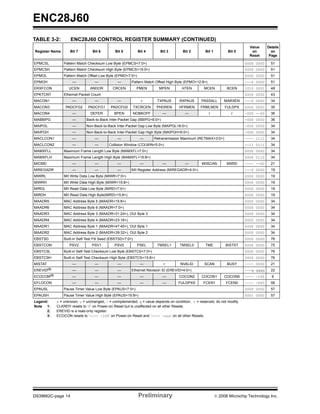
TABLE 3-2:          ENC28J60 CONTROL REGISTER SUMMARY (CONTINUED)
                                                                                                                            Value     Details
Register Name      Bit 7         Bit 6         Bit 5          Bit 4       Bit 3       Bit 2        Bit 1         Bit 0       on         on
                                                                                                                            Reset      Page

EPMCSL          Pattern Match Checksum Low Byte (EPMCS<7:0>)                                                              0000 0000     51
EPMCSH          Pattern Match Checksum High Byte (EPMCS<15:0>)                                                            0000 0000     51
EPMOL           Pattern Match Offset Low Byte (EPMO<7:0>)                                                                 0000 0000     51
EPMOH                —            —             —        Pattern Match Offset High Byte (EPMO<12:8>)                      ---0 0000     51
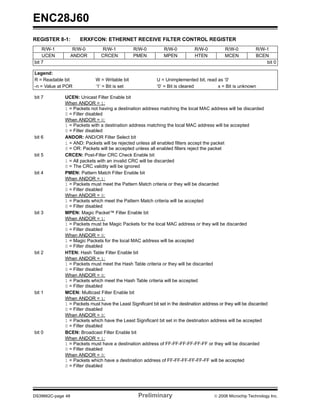
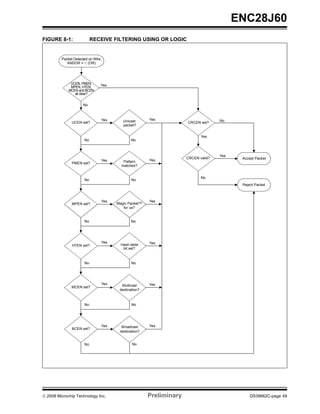
ERXFCON            UCEN        ANDOR         CRCEN            PMEN       MPEN        HTEN         MCEN           BCEN     1010 0001     48
EPKTCNT         Ethernet Packet Count                                                                                     0000 0000     43
MACON1               —            —             —               r       TXPAUS      RXPAUS       PASSALL        MARXEN    ---0 0000     34
MACON3           PADCFG2      PADCFG1       PADCFG0          TXCRCEN    PHDREN     HFRMEN       FRMLNEN         FULDPX    0000 0000     35
MACON4               —          DEFER         BPEN           NOBKOFF       —           —               r           r      -000 --00     36
MABBIPG              —       Back-to-Back Inter-Packet Gap (BBIPG<6:0>)                                                   -000 0000     36
MAIPGL               —       Non-Back-to-Back Inter-Packet Gap Low Byte (MAIPGL<6:0>)                                     -000 0000     34
MAIPGH               —       Non-Back-to-Back Inter-Packet Gap High Byte (MAIPGH<6:0>)                                    -000 0000     34
MACLCON1             —            —             —              —       Retransmission Maximum (RETMAX<3:0>)               ---- 1111     34
MACLCON2             —            —        Collision Window (COLWIN<5:0>)                                                 --11 0111     34
MAMXFLL         Maximum Frame Length Low Byte (MAMXFL<7:0>)                                                               0000 0000     34
MAMXFLH         Maximum Frame Length High Byte (MAMXFL<15:8>)                                                             0000 0110     34
MICMD                —            —             —              —           —           —         MIISCAN         MIIRD    ---- --00     21
MIREGADR             —            —             —        MII Register Address (MIREGADR<4:0>)                             ---0 0000     19
MIWRL           MII Write Data Low Byte (MIWR<7:0>)                                                                       0000 0000     19
MIWRH           MII Write Data High Byte (MIWR<15:8>)                                                                     0000 0000     19
MIRDL           MII Read Data Low Byte (MIRD<7:0>)                                                                        0000 0000     19
MIRDH           MII Read Data High Byte(MIRD<15:8>)                                                                       0000 0000     19
MAADR5          MAC Address Byte 5 (MAADR<15:8>)                                                                          0000 0000     34
MAADR6          MAC Address Byte 6 (MAADR<7:0>)                                                                           0000 0000     34
MAADR3          MAC Address Byte 3 (MAADR<31:24>), OUI Byte 3                                                             0000 0000     34
MAADR4          MAC Address Byte 4 (MAADR<23:16>)                                                                         0000 0000     34
MAADR1          MAC Address Byte 1 (MAADR<47:40>), OUI Byte 1                                                             0000 0000     34
MAADR2          MAC Address Byte 2 (MAADR<39:32>), OUI Byte 2                                                             0000 0000     34
EBSTSD          Built-in Self-Test Fill Seed (EBSTSD<7:0>)                                                                0000 0000     76
EBSTCON            PSV2          PSV1         PSV0            PSEL      TMSEL1      TMSEL0         TME          BISTST    0000 0000     75
EBSTCSL         Built-in Self-Test Checksum Low Byte (EBSTCS<7:0>)                                                        0000 0000     76
EBSTCSH         Built-in Self-Test Checksum High Byte (EBSTCS<15:8>)                                                      0000 0000     76
MISTAT               —            —             —              —            r       NVALID        SCAN           BUSY     ---- 0000     21
EREVID(2)            —            —             —        Ethernet Revision ID (EREVID<4:0>)                               ---q qqqq     22
ECOCON(3)            —            —             —              —           —       COCON2        COCON1         COCON0    ---- -100     6
EFLOCON              —            —             —              —           —       FULDPXS        FCEN1         FCEN0     ---- -000     56
EPAUSL          Pause Timer Value Low Byte (EPAUS<7:0>)                                                                   0000 0000     57
EPAUSH          Pause Timer Value High Byte (EPAUS<15:8>)                                                                 0001 0000     57
Legend:     x = unknown, u = unchanged, - = unimplemented, q = value depends on condition, r = reserved, do not modify.
Note 1:     CLKRDY resets to ‘0’ on Power-on Reset but is unaffected on all other Resets.
      2:    EREVID is a read-only register.
      3:    ECOCON resets to ‘---- -100’ on Power-on Reset and ‘---- -uuu’ on all other Resets.


DS39662C-page 14                                               Preliminary                                 © 2008 Microchip Technology Inc.
ENC28J60
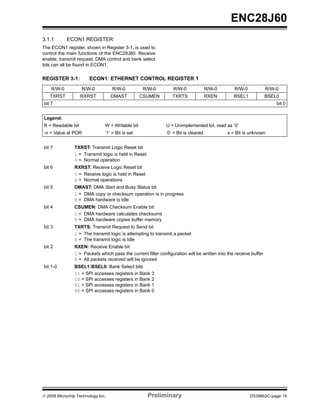
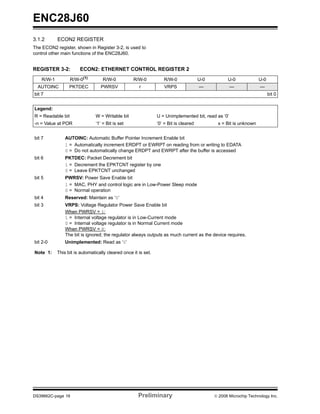
3.1.1       ECON1 REGISTER
The ECON1 register, shown in Register 3-1, is used to
control the main functions of the ENC28J60. Receive
enable, transmit request, DMA control and bank select
bits can all be found in ECON1.

REGISTER 3-1:          ECON1: ETHERNET CONTROL REGISTER 1
    R/W-0          R/W-0           R/W-0           R/W-0         R/W-0               R/W-0      R/W-0             R/W-0
   TXRST           RXRST           DMAST          CSUMEN         TXRTS               RXEN       BSEL1             BSEL0
bit 7                                                                                                                 bit 0


Legend:
R = Readable bit               W = Writable bit               U = Unimplemented bit, read as ‘0’
-n = Value at POR              ‘1’ = Bit is set               ‘0’ = Bit is cleared           x = Bit is unknown


bit 7           TXRST: Transmit Logic Reset bit
                1 = Transmit logic is held in Reset
                0 = Normal operation
bit 6           RXRST: Receive Logic Reset bit
                1 = Receive logic is held in Reset
                0 = Normal operations
bit 5           DMAST: DMA Start and Busy Status bit
                1 = DMA copy or checksum operation is in progress
                0 = DMA hardware is Idle
bit 4           CSUMEN: DMA Checksum Enable bit
                1 = DMA hardware calculates checksums
                0 = DMA hardware copies buffer memory
bit 3           TXRTS: Transmit Request to Send bit
                1 = The transmit logic is attempting to transmit a packet
                0 = The transmit logic is Idle
bit 2           RXEN: Receive Enable bit
                1 = Packets which pass the current filter configuration will be written into the receive buffer
                0 = All packets received will be ignored
bit 1-0         BSEL1:BSEL0: Bank Select bits
                11 = SPI accesses registers in Bank 3
                10 = SPI accesses registers in Bank 2
                01 = SPI accesses registers in Bank 1
                00 = SPI accesses registers in Bank 0


© 2008 Microchip Technology Inc.                      Preliminary                                       DS39662C-page 15
ENC28J60
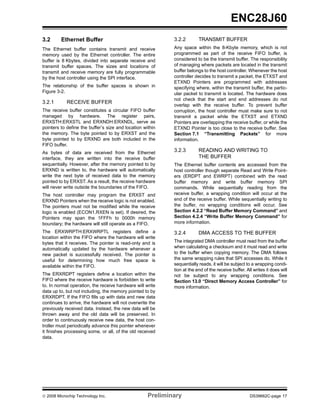
3.1.2       ECON2 REGISTER
The ECON2 register, shown in Register 3-2, is used to
control other main functions of the ENC28J60.


REGISTER 3-2:          ECON2: ETHERNET CONTROL REGISTER 2
    R/W-1          R/W-0(1)         R/W-0          R/W-0           R/W-0               U-0         U-0             U-0
  AUTOINC         PKTDEC          PWRSV               r            VRPS                —             —              —
bit 7                                                                                                                    bit 0


Legend:
R = Readable bit                W = Writable bit                U = Unimplemented bit, read as ‘0’
-n = Value at POR               ‘1’ = Bit is set                ‘0’ = Bit is cleared          x = Bit is unknown


bit 7           AUTOINC: Automatic Buffer Pointer Increment Enable bit
                1 = Automatically increment ERDPT or EWRPT on reading from or writing to EDATA
                0 = Do not automatically change ERDPT and EWRPT after the buffer is accessed
bit 6           PKTDEC: Packet Decrement bit
                1 = Decrement the EPKTCNT register by one
                0 = Leave EPKTCNT unchanged
bit 5           PWRSV: Power Save Enable bit
                1 = MAC, PHY and control logic are in Low-Power Sleep mode
                0 = Normal operation
bit 4           Reserved: Maintain as ‘0’
bit 3           VRPS: Voltage Regulator Power Save Enable bit
                When PWRSV = 1:
                1 = Internal voltage regulator is in Low-Current mode
                0 = Internal voltage regulator is in Normal Current mode
                When PWRSV = 0:
                The bit is ignored; the regulator always outputs as much current as the device requires.
bit 2-0         Unimplemented: Read as ‘0’

Note 1:     This bit is automatically cleared once it is set.


DS39662C-page 16                                      Preliminary                            © 2008 Microchip Technology Inc.
ENC28J60
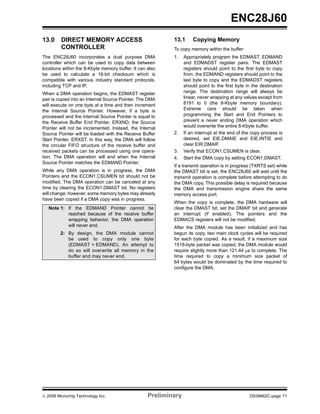
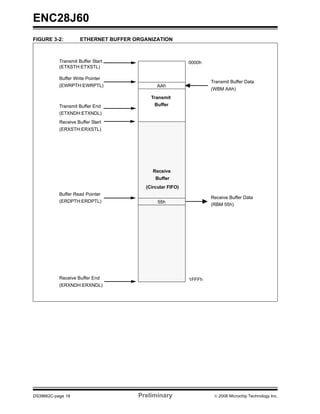
3.2      Ethernet Buffer                                    3.2.2        TRANSMIT BUFFER
The Ethernet buffer contains transmit and receive           Any space within the 8-Kbyte memory, which is not
memory used by the Ethernet controller. The entire          programmed as part of the receive FIFO buffer, is
buffer is 8 Kbytes, divided into separate receive and       considered to be the transmit buffer. The responsibility
transmit buffer spaces. The sizes and locations of          of managing where packets are located in the transmit
transmit and receive memory are fully programmable          buffer belongs to the host controller. Whenever the host
by the host controller using the SPI interface.             controller decides to transmit a packet, the ETXST and
                                                            ETXND Pointers are programmed with addresses
The relationship of the buffer spaces is shown in           specifying where, within the transmit buffer, the partic-
Figure 3-2.                                                 ular packet to transmit is located. The hardware does
                                                            not check that the start and end addresses do not
3.2.1       RECEIVE BUFFER
                                                            overlap with the receive buffer. To prevent buffer
The receive buffer constitutes a circular FIFO buffer       corruption, the host controller must make sure to not
managed by hardware. The register pairs,                    transmit a packet while the ETXST and ETXND
ERXSTH:ERXSTL and ERXNDH:ERXNDL, serve as                   Pointers are overlapping the receive buffer, or while the
pointers to define the buffer’s size and location within    ETXND Pointer is too close to the receive buffer. See
the memory. The byte pointed to by ERXST and the            Section 7.1 “Transmitting Packets” for more
byte pointed to by ERXND are both included in the           information.
FIFO buffer.
As bytes of data are received from the Ethernet             3.2.3        READING AND WRITING TO
interface, they are written into the receive buffer                      THE BUFFER
sequentially. However, after the memory pointed to by       The Ethernet buffer contents are accessed from the
ERXND is written to, the hardware will automatically        host controller though separate Read and Write Point-
write the next byte of received data to the memory          ers (ERDPT and EWRPT) combined with the read
pointed to by ERXST. As a result, the receive hardware      buffer memory and write buffer memory SPI
will never write outside the boundaries of the FIFO.        commands. While sequentially reading from the
The host controller may program the ERXST and               receive buffer, a wrapping condition will occur at the
ERXND Pointers when the receive logic is not enabled.       end of the receive buffer. While sequentially writing to
The pointers must not be modified while the receive         the buffer, no wrapping conditions will occur. See
logic is enabled (ECON1.RXEN is set). If desired, the       Section 4.2.2 “Read Buffer Memory Command” and
Pointers may span the 1FFFh to 0000h memory                 Section 4.2.4 “Write Buffer Memory Command” for
boundary; the hardware will still operate as a FIFO.        more information.

The ERXWRPTH:ERXWRPTL registers define a                    3.2.4        DMA ACCESS TO THE BUFFER
location within the FIFO where the hardware will write
bytes that it receives. The pointer is read-only and is     The integrated DMA controller must read from the buffer
automatically updated by the hardware whenever a            when calculating a checksum and it must read and write
new packet is successfully received. The pointer is         to the buffer when copying memory. The DMA follows
useful for determining how much free space is               the same wrapping rules that SPI accesses do. While it
available within the FIFO.                                  sequentially reads, it will be subject to a wrapping condi-
                                                            tion at the end of the receive buffer. All writes it does will
The ERXRDPT registers define a location within the          not be subject to any wrapping conditions. See
FIFO where the receive hardware is forbidden to write       Section 13.0 “Direct Memory Access Controller” for
to. In normal operation, the receive hardware will write    more information.
data up to, but not including, the memory pointed to by
ERXRDPT. If the FIFO fills up with data and new data
continues to arrive, the hardware will not overwrite the
previously received data. Instead, the new data will be
thrown away and the old data will be preserved. In
order to continuously receive new data, the host con-
troller must periodically advance this pointer whenever
it finishes processing some, or all, of the old received
data.


© 2008 Microchip Technology Inc.                    Preliminary                                      DS39662C-page 17
ENC28J60
FIGURE 3-2:          ETHERNET BUFFER ORGANIZATION


           Transmit Buffer Start                          0000h
           (ETXSTH:ETXSTL)

           Buffer Write Pointer
                                                                  Transmit Buffer Data
           (EWRPTH:EWRPTL)                   AAh
                                                                  (WBM AAh)
                                          Transmit
           Transmit Buffer End             Buffer
           (ETXNDH:ETXNDL)
           Receive Buffer Start
           (ERXSTH:ERXSTL)


                                           Receive
                                            Buffer
                                        (Circular FIFO)
           Buffer Read Pointer
                                                                  Receive Buffer Data
           (ERDPTH:ERDPTL)                   55h
                                                                  (RBM 55h)


           Receive Buffer End                             1FFFh
           (ERXNDH:ERXNDL)


DS39662C-page 18                      Preliminary                  © 2008 Microchip Technology Inc.
ENC28J60
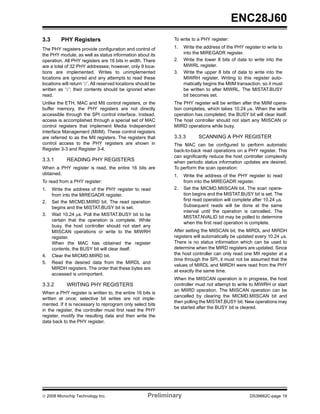
3.3       PHY Registers                                        To write to a PHY register:

The PHY registers provide configuration and control of         1.    Write the address of the PHY register to write to
the PHY module, as well as status information about its              into the MIREGADR register.
operation. All PHY registers are 16 bits in width. There       2.    Write the lower 8 bits of data to write into the
are a total of 32 PHY addresses; however, only 9 loca-               MIWRL register.
tions are implemented. Writes to unimplemented                 3.    Write the upper 8 bits of data to write into the
locations are ignored and any attempts to read these                 MIWRH register. Writing to this register auto-
locations will return ‘0’. All reserved locations should be          matically begins the MIIM transaction, so it must
written as ‘0’; their contents should be ignored when                be written to after MIWRL. The MISTAT.BUSY
read.                                                                bit becomes set.
Unlike the ETH, MAC and MII control registers, or the          The PHY register will be written after the MIIM opera-
buffer memory, the PHY registers are not directly              tion completes, which takes 10.24 μs. When the write
accessible through the SPI control interface. Instead,         operation has completed, the BUSY bit will clear itself.
access is accomplished through a special set of MAC            The host controller should not start any MIISCAN or
control registers that implement Media Independent             MIIRD operations while busy.
Interface Management (MIIM). These control registers
are referred to as the MII registers. The registers that       3.3.3        SCANNING A PHY REGISTER
control access to the PHY registers are shown in               The MAC can be configured to perform automatic
Register 3-3 and Register 3-4.                                 back-to-back read operations on a PHY register. This
                                                               can significantly reduce the host controller complexity
3.3.1        READING PHY REGISTERS                             when periodic status information updates are desired.
When a PHY register is read, the entire 16 bits are            To perform the scan operation:
obtained.                                                      1.    Write the address of the PHY register to read
To read from a PHY register:                                         from into the MIREGADR register.
1.    Write the address of the PHY register to read            2.    Set the MICMD.MIISCAN bit. The scan opera-
      from into the MIREGADR register.                               tion begins and the MISTAT.BUSY bit is set. The
2.    Set the MICMD.MIIRD bit. The read operation                    first read operation will complete after 10.24 μs.
      begins and the MISTAT.BUSY bit is set.                         Subsequent reads will be done at the same
                                                                     interval until the operation is cancelled. The
3.    Wait 10.24 μs. Poll the MISTAT.BUSY bit to be
                                                                     MISTAT.NVALID bit may be polled to determine
      certain that the operation is complete. While
                                                                     when the first read operation is complete.
      busy, the host controller should not start any
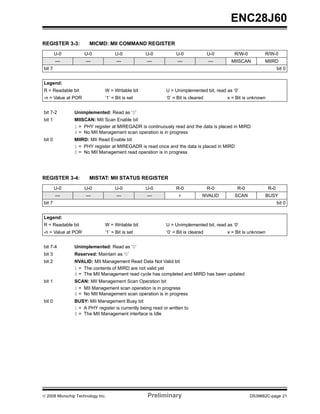
      MIISCAN operations or write to the MIWRH                 After setting the MIISCAN bit, the MIRDL and MIRDH
      register.                                                registers will automatically be updated every 10.24 μs.
      When the MAC has obtained the register                   There is no status information which can be used to
      contents, the BUSY bit will clear itself.                determine when the MIRD registers are updated. Since
4.    Clear the MICMD.MIIRD bit.                               the host controller can only read one MII register at a
                                                               time through the SPI, it must not be assumed that the
5.    Read the desired data from the MIRDL and
                                                               values of MIRDL and MIRDH were read from the PHY
      MIRDH registers. The order that these bytes are
                                                               at exactly the same time.
      accessed is unimportant.
                                                               When the MIISCAN operation is in progress, the host
3.3.2        WRITING PHY REGISTERS                             controller must not attempt to write to MIWRH or start
                                                               an MIIRD operation. The MIISCAN operation can be
When a PHY register is written to, the entire 16 bits is
                                                               cancelled by clearing the MICMD.MIISCAN bit and
written at once; selective bit writes are not imple-
                                                               then polling the MISTAT.BUSY bit. New operations may
mented. If it is necessary to reprogram only select bits
                                                               be started after the BUSY bit is cleared.
in the register, the controller must first read the PHY
register, modify the resulting data and then write the
data back to the PHY register.


© 2008 Microchip Technology Inc.                       Preliminary                                    DS39662C-page 19
TABLE 3-3:            ENC28J60 PHY REGISTER SUMMARY
                                   Addr    Name       Bit 15    Bit 14     Bit 13     Bit 12     Bit 11     Bit 10      Bit 9        Bit 8      Bit 7      Bit 6    Bit 5    Bit 4    Bit 3    Bit 2   Bit 1     Bit 0       Reset Values

                                   00h    PHCON1      PRST PLOOPBK           —          —      PPWRSV         r          —        PDPXMD(1)       r         —        —        —        —        —       —         —      00-- 00-q 0--- ----
                                   01h    PHSTAT1       —         —          —        PFDPX     PHDPX         —          —            —          —          —        —        —        —      LLSTAT JBSTAT       —      ---1 1--- ---- -00-
                                   02h    PHID1                                                                      PHY Identifier (OUI3:OUI18) = 0083h                                                                 0000 0000 1000 0011


DS39662C-page 20
                                   03h    PHID2                  PHY Identifier (OUI19:OUI24) = 000101                               PHY P/N (PPN5:PPN0) = 00h                       PHY Revision (PREV3:PREV0) = 00h 0001 0100 0000 0000
                                   10h    PHCON2        —      FRCLNK      TXDIS         r          r      JABBER         r        HDLDIS         r          r        r        r        r        r       r         r     -000 0000 0000 0000
                                   11h    PHSTAT2       —         —       TXSTAT     RXSTAT COLSTAT         LSTAT    DPXSTAT(1)       —          —          —      PLRITY     —        —        —       —         —      --00 00q- --0- ----
                                                                                                                                                                                                                                               ENC28J60


                                   12h    PHIE           r         r          r          r          r         r           r            r          r          r        r     PLNKIE      r        r     PGEIE       r     0000 0000 0000 0000
                                   13h    PHIR           r         r          r          r          r         r           r            r          r          r        r     PLNKIF      r     PGIF       r         r     xxxx xxxx xx00 00x0
                                   14h    PHLCON         r         r          r          r      LACFG3     LACFG2     LACFG1       LACFG0     LBCFG3 LBCFG2 LBCFG1 LBCFG0 LFRQ1 LFRQ0                  STRCH       r     0011 0100 0010 001x
                                   Legend:       x = unknown, u = unchanged, — = unimplemented, q = value depends on condition, r = reserved, do not modify.
                                   Note 1:       Reset values of the Duplex mode/status bits depend on the connection of the LED to the LEDB pin (see Section 2.6 “LED Configuration” for additional details).


Preliminary
© 2008 Microchip Technology Inc.
ENC28J60

REGISTER 3-3:          MICMD: MII COMMAND REGISTER
        U-0          U-0            U-0           U-0             U-0               U-0      R/W-0         R/W-0
        —            —               —             —               —                —      MIISCAN         MIIRD
bit 7                                                                                                                bit 0


Legend:
R = Readable bit               W = Writable bit              U = Unimplemented bit, read as ‘0’
-n = Value at POR              ‘1’ = Bit is set              ‘0’ = Bit is cleared         x = Bit is unknown


bit 7-2         Unimplemented: Read as ‘0’
bit 1           MIISCAN: MII Scan Enable bit
                1 = PHY register at MIREGADR is continuously read and the data is placed in MIRD
                0 = No MII Management scan operation is in progress
bit 0           MIIRD: MII Read Enable bit
                1 = PHY register at MIREGADR is read once and the data is placed in MIRD
                0 = No MII Management read operation is in progress


REGISTER 3-4:          MISTAT: MII STATUS REGISTER
        U-0          U-0            U-0           U-0             R-0               R-0       R-0              R-0
        —            —               —             —               r            NVALID       SCAN          BUSY
bit 7                                                                                                                bit 0


Legend:
R = Readable bit               W = Writable bit              U = Unimplemented bit, read as ‘0’
-n = Value at POR              ‘1’ = Bit is set              ‘0’ = Bit is cleared         x = Bit is unknown


bit 7-4         Unimplemented: Read as ‘0’
bit 3           Reserved: Maintain as ‘0’
bit 2           NVALID: MII Management Read Data Not Valid bit
                1 = The contents of MIRD are not valid yet
                0 = The MII Management read cycle has completed and MIRD has been updated
bit 1           SCAN: MII Management Scan Operation bit
                1 = MII Management scan operation is in progress
                0 = No MII Management scan operation is in progress
bit 0           BUSY: MII Management Busy bit
                1 = A PHY register is currently being read or written to
                0 = The MII Management interface is Idle


© 2008 Microchip Technology Inc.                   Preliminary                                       DS39662C-page 21
ENC28J60
3.3.4       PHSTAT REGISTERS                                  3.3.5       PHID1 AND PHID2 REGISTERS
The PHSTAT1 and PHSTAT2 registers contain read-               The PHID1 and PHID2 registers are read-only
only bits that show the current status of the PHY             registers. They hold constant data that helps identify
module’s operations, particularly the conditions of the       the Ethernet controller and may be useful for
communications link to the rest of the network.               debugging purposes. This includes:
The PHSTAT1 register (Register 3-5) contains the              • The part number of the PHY module
LLSTAT bit; it clears and latches low if the physical           (PPN5:PPN0)
layer link has gone down since the last read of the           • The revision level of the PHY module
register. Periodic polling by the host controller can be        (PREV3:PREV0); and
used to determine exactly when the link fails. It may be      • The PHY identifier, as part of Microchip’s
particularly useful if the link change interrupt is not         corporate Organizationally Unique Identifier (OUI)
used.                                                           (OUI3:OUI24)
The PHSTAT1 register also contains a jabber status bit.       The PHY part number and revision are part of PHID2.
An Ethernet controller is said to be “jabbering” if it con-   The upper two bytes of the PHY identifier are located in
tinuously transmits data without stopping and allowing        PHID1, with the remainder in PHID2. The exact
other nodes to share the medium. Generally, the jabber        locations within registers are shown in Table 3-3.
condition indicates that the local controller may be
grossly violating the maximum packet size defined by          The 22 bits of the OUI contained in the PHY Identifier
the IEEE specification. This bit latches high to indicate     (OUI3:OUI24, corresponding to PHID1<15:0> and
that a jabber condition has occurred since the last read      PHID2<15:10>) are concatenated with ‘00’ as the first
of the register.                                              two digits (OUI1 and OUI2) to generate the entire OUI.
                                                              For convenience, this 24-bit string is usually interpreted
The PHSTAT2 register (Register 3-6) contains status           in hexadecimal; the resulting OUI for Microchip
bits which report if the PHY module is linked to the          Technology is 0004A3h.
network and whether or not it is transmitting or
receiving.                                                    Revision information is also stored in EREVID. This is
                                                              a read-only control register which contains a 5-bit
                                                              identifier for the specific silicon revision level of the
                                                              device. Details of this register are shown in Table 3-2.


DS39662C-page 22                                      Preliminary                      © 2008 Microchip Technology Inc.
ENC28J60

REGISTER 3-5:          PHSTAT1: PHYSICAL LAYER STATUS REGISTER 1
        U-0          U-0            U-0               R-1       R-1            U-0            U-0           U-0
         —           —               —            PFDPX       PHDPX                —             —           —
bit 15                                                                                                            bit 8


        U-0          U-0            U-0               U-0       U-0           R/LL-0        R/LH-0          U-0
         —           —               —                —          —           LLSTAT        JBSTAT            —
bit 7                                                                                                             bit 0


Legend:                        ‘1’ = Bit is set
R = Read-only bit              ‘0’ = Bit is cleared         U = Unimplemented bit, read as ‘0’
-n = Value at POR              R/L = Read-only latch bit    LL = Bit latches low         LH = Bit latches high


bit 15-13       Unimplemented: Read as ‘0’
bit 12          PFDPX: PHY Full-Duplex Capable bit
                1 = PHY is capable of operating at 10 Mbps in Full-Duplex mode (this bit is always set)
bit 11          PHDPX: PHY Half-Duplex Capable bit
                1 = PHY is capable of operating at 10 Mbps in Half-Duplex mode (this bit is always set)
bit 10-3        Unimplemented: Read as ‘0’
bit 2           LLSTAT: PHY Latching Link Status bit
                1 = Link is up and has been up continously since PHSTAT1 was last read
                0 = Link is down or was down for a period since PHSTAT1 was last read
bit 1           JBSTAT: PHY Latching Jabber Status bit
                1 = PHY has detected a transmission meeting the jabber criteria since PHSTAT1 was last read
                0 = PHY has not detected any jabbering transmissions since PHSTAT1 was last read
bit 0           Unimplemented: Read as ‘0’


© 2008 Microchip Technology Inc.                      Preliminary                                    DS39662C-page 23
ENC28J60
REGISTER 3-6:           PHSTAT2: PHYSICAL LAYER STATUS REGISTER 2
        U-0           U-0           R-0             R-0           R-0                R-0          R-x             U-0
         —            —           TXSTAT          RXSTAT      COLSTAT               LSTAT     DPXSTAT(1)           —
bit 15                                                                                                                  bit 8


        U-0           U-0           R-0             U-0           U-0                U-0          U-0             U-0
         —            —           PLRITY            —              —                 —             —               —
bit 7                                                                                                                   bit 0


Legend:
R = Readable bit               W = Writable bit              U = Unimplemented bit, read as ‘0’
-n = Value at POR              ‘1’ = Bit is set              ‘0’ = Bit is cleared            x = Bit is unknown


bit 15-14        Unimplemented: Read as ‘0’
bit 13           TXSTAT: PHY Transmit Status bit
                 1 = PHY is transmitting data
                 0 = PHY is not transmitting data
bit 12           RXSTAT: PHY Receive Status bit
                 1 = PHY is receiving data
                 0 = PHY is not receiving data
bit 11           COLSTAT: PHY Collision Status bit
                 1 = A collision is occuring
                 0 = A collision is not occuring
bit 10           LSTAT: PHY Link Status bit (non-latching)
                 1 = Link is up
                 0 = Link is down
bit 9            DPXSTAT: PHY Duplex Status bit(1)
                 1 = PHY is configured for full-duplex operation (PHCON1<8> is set)
                 0 = PHY is configured for half-duplex operation (PHCON1<8> is clear)
bit 8-6          Unimplemented: Read as ‘0’
bit 5            PLRITY: Polarity Status bit
                 1 = The polarity of the signal on TPIN+/TPIN- is reversed
                 0 = The polarity of the signal on TPIN+/TPIN- is correct
bit 4-0          Unimplemented: Read as ‘0’

Note 1:       Reset values of the Duplex mode/status bit depends on the connection of the LED to the LEDB pin (see
              Section 2.6 “LED Configuration” for additional details).


DS39662C-page 24                                     Preliminary                            © 2008 Microchip Technology Inc.
ENC28J60
4.0      SERIAL PERIPHERAL                                     Commands and data are sent to the device via the SI
                                                               pin, with data being clocked in on the rising edge of
         INTERFACE (SPI)                                       SCK. Data is driven out by the ENC28J60 on the SO
                                                               line, on the falling edge of SCK. The CS pin must be
4.1      Overview                                              held low while any operation is performed and returned
The ENC28J60 is designed to interface directly with the        high when finished.
Serial Peripheral Interface (SPI) port available on many
microcontrollers. The implementation used on this
device supports SPI mode 0,0 only. In addition, the SPI
port requires that SCK be at Idle in a low state;
selectable clock polarity is not supported.

FIGURE 4-1:            SPI INPUT TIMING

         CS


        SCK


            SI
                        MSb In                                               LSb In


         SO                             High-Impedance State


FIGURE 4-2:            SPI OUTPUT TIMING

      CS


      SCK


      SO              MSb Out                                                               LSb Out


                                                 Don’t Care
       SI


© 2008 Microchip Technology Inc.                    Preliminary                                    DS39662C-page 25
ENC28J60
4.2      SPI Instruction Set                                  followed by a 5-bit argument that specifies either a
                                                              register address or a data constant. Write and bit field
The operation of the ENC28J60 depends entirely on             instructions are also followed by one or more bytes of
commands given by an external host controller over the        data.
SPI interface. These commands take the form of
instructions, of one or more bytes, which are used to         A total of seven instructions are implemented on the
access the control memory and Ethernet buffer spaces.         ENC28J60. Table 4-1 shows the command codes for
At the least, instructions consist of a 3-bit opcode,         all operations.


TABLE 4-1:         SPI INSTRUCTION SET FOR THE ENC28J60
               Instruction                                    Byte 0                     Byte 1 and Following
            Name and Mnemonic                    Opcode           Argument                        Data
Read Control Register                           0    0    0   a   a    a    a    a                 N/A
(RCR)
Read Buffer Memory                              0    0    1   1   1    0    1    0                 N/A
(RBM)
Write Control Register                          0    1    0   a   a    a    a    a   d   d    d   d   d   d   d    d
(WCR)
Write Buffer Memory                             0    1    1   1   1    0    1    0   d   d    d   d   d   d   d    d
(WBM)
Bit Field Set                                   1    0    0   a   a    a    a    a   d   d    d   d   d   d   d    d
(BFS)
Bit Field Clear                                 1    0    1   a   a    a    a    a   d   d    d   d   d   d   d    d
(BFC)
System Reset Command (Soft Reset)               1    1    1   1   1    1    1    1                 N/A
(SRC)
Legend: a = control register address, d = data payload.


DS39662C-page 26                                    Preliminary                       © 2008 Microchip Technology Inc.
ENC28J60
4.2.1        READ CONTROL REGISTER                                                                registers in the current bank. If the 5-bit address is an
             COMMAND                                                                              ETH register, then data in the selected register will
                                                                                                  immediately start shifting out MSb first on the SO pin.
The Read Control Register (RCR) command allows the
                                                                                                  Figure 4-3 shows the read sequence for these
host controller to read any of the ETH, MAC and MII
                                                                                                  registers.
registers in any order. The contents of the PHY regis-
ters are read via a special MII register interface (see                                           If the address specifies one of the MAC or MII registers,
Section 3.3.1 “Reading PHY Registers” for more                                                    a dummy byte will first be shifted out on the SO pin.
information).                                                                                     After the dummy byte, the data will be shifted out MSb
                                                                                                  first on the SO pin. The RCR operation is terminated by
The RCR command is started by pulling the CS pin low.
                                                                                                  raising the CS pin. Figure 4-4 shows the read
The RCR opcode is then sent to the ENC28J60,
                                                                                                  sequence for MAC and MII registers.
followed by a 5-bit register address (A4 through A0).
The 5-bit address identifies any of the 32 control


FIGURE 4-3:                READ CONTROL REGISTER COMMAND SEQUENCE (ETH REGISTERS)

     CS


                 0         1       2        3       4         5           6       7           8        9       10       11       12      13       14      15
    SCK

                      Opcode                            Address

        SI       0         0       0       4        3         2       1       0

                                                                                                                       Data Out
                      High-Impedance State
     SO                                                                                   7        6           5       4         3       2        1       0


FIGURE 4-4:                READ CONTROL REGISTER COMMAND SEQUENCE
                           (MAC AND MII REGISTERS)

     CS

                0      1       2   3   4        5   6     7       8       9   10 11 12 13 14 15 16 17 18 19 20 21 22 23
    SCK

                 Opcode                    Address


        SI      0      0       0   4   3        2   1     0

                                                                              Dummy Byte                                             Data Byte Out
                     High-Impedance State
     SO                                                           7       6   5       4       3    2       1       0   7     6       5   4    3       2   1    0


© 2008 Microchip Technology Inc.                                          Preliminary                                                                     DS39662C-page 27
ENC28J60
4.2.2       READ BUFFER MEMORY                                           4.2.3          WRITE CONTROL REGISTER
            COMMAND                                                                     COMMAND
The Read Buffer Memory (RBM) command allows the                          The Write Control Register (WCR) command allows
host controller to read bytes from the integrated 8-Kbyte                the host controller to write to any of the ETH, MAC and
transmit and receive buffer memory.                                      MII Control registers in any order. The PHY registers
If the AUTOINC bit in the ECON2 register is set, the                     are written to via a special MII register interface (see
ERDPT Pointer will automatically increment to point to                   Section 3.3.2 “Writing PHY Registers” for more
the next address after the last bit of each byte is read.                information).
The next address will normally be the current address                    The WCR command is started by pulling the CS pin
incremented by one. However, if the last byte in the                     low. The WCR opcode is then sent to the ENC28J60,
receive buffer is read (ERDPT = ERXND), the ERDPT                        followed by a 5-bit address (A4 through A0). The 5-bit
Pointer will change to the beginning of the receive                      address identifies any of the 32 control registers in the
buffer (ERXST). This allows the host controller to read                  current bank. After the WCR command and address
packets from the receive buffer in a continuous stream                   are sent, actual data that is to be written is sent, MSb
without keeping track of when a wraparound is needed.                    first. The data will be written to the addressed register
If AUTOINC is set when address, 1FFFh, is read and                       on the rising edge of the SCK line.
ERXND does not point to this address, the Read                           The WCR operation is terminated by raising the CS pin.
Pointer will increment and wrap around to 0000h.                         If the CS line is allowed to go high before eight bits are
The RBM command is started by pulling the CS pin low.                    loaded, the write will be aborted for that data byte.
The RBM opcode is then sent to the ENC28J60,                             Refer to the timing diagram in Figure 4-5 for a more
followed by the 5-bit constant, 1Ah. After the RBM com-                  detailed illustration of the byte write sequence.
mand and constant are sent, the data stored in the
memory pointed to by ERDPT will be shifted out MSb
first on the SO pin. If the host controller continues to
provide clocks on the SCK pin, without raising CS, the
byte pointed to by ERDPT will again be shifted out MSb
first on the SO pin. In this manner, with AUTOINC
enabled, it is possible to continuously read sequential
bytes from the buffer memory without any extra SPI
command overhead. The RBM command is terminated
by raising the CS pin.

FIGURE 4-5:                    WRITE CONTROL REGISTER COMMAND SEQUENCE

  CS


                 0         1    2    3   4      5      6        7    8        9   10         11    12       13   14    15
 SCK
                     Opcode                  Address                                   Data Byte

    SI       0         1        0   A4   3     2       1    0       D7    6       5      4        3     2        1    D0


                                                       High-Impedance State
  SO


DS39662C-page 28                                           Preliminary                                  © 2008 Microchip Technology Inc.
ENC28J60
4.2.4       WRITE BUFFER MEMORY                                      The BFS command is started by pulling the CS pin low.
            COMMAND                                                  The BFS opcode is then sent, followed by a 5-bit
                                                                     address (A4 through A0). The 5-bit address identifies
The Write Buffer Memory (WBM) command allows the
                                                                     any of the ETH registers in the current bank. After the
host controller to write bytes to the integrated 8-Kbyte
                                                                     BFS command and address are sent, the data byte
transmit and receive buffer memory.
                                                                     containing the bit field set information should be sent,
If the AUTOINC bit in the ECON2 register is set, after               MSb first. The supplied data will be logically ORed to
the last bit of each byte is written, the EWRPT Pointer              the content of the addressed register on the rising
will automatically be incremented to point to the next               edge of the SCK line for the D0 bit.
sequential address (current address + 1). If address,
                                                                     If the CS line is brought high before eight bits are
1FFFh, is written with AUTOINC set, the Write Pointer
                                                                     loaded, the operation will be aborted for that data
will increment to 0000h.
                                                                     byte. The BFS operation is terminated by raising the
The WBM command is started by lowering the CS pin.                   CS pin.
The WBM opcode should then be sent to the
ENC28J60, followed by the 5-bit constant, 1Ah. After                 4.2.6         BIT FIELD CLEAR COMMAND
the WBM command and constant are sent, the data to                   The Bit Field Clear (BFC) command is used to clear up
be stored in the memory pointed to by EWRPT should                   to 8 bits in any of the ETH Control registers. Note that
be shifted out MSb first to the ENC28J60. After 8 data               this command cannot be used on the MAC registers,
bits are received, the Write Pointer will automatically              MII registers, PHY registers or buffer memory. The BFC
increment if AUTOINC is set. The host controller can                 command uses the provided data byte to perform a bit-
continue to provide clocks on the SCK pin and send                   wise NOTAND operation on the addressed register
data on the SI pin, without raising CS, to keep writing to           contents. As an example, if a register had the contents
the memory. In this manner, with AUTOINC enabled, it                 of F1h and the BFC command was executed with an
is possible to continuously write sequential bytes to the            operand of 17h, then the register would be changed to
buffer memory without any extra SPI command                          have the contents of E0h.
overhead.
                                                                     The BFC command is started by lowering the CS pin.
The WBM command is terminated by bringing up the                     The BFC opcode should then be sent, followed by a
CS pin. Refer to Figure 4-6 for a detailed illustration of           5-bit address (A4 through A0). The 5-bit address
the write sequence.                                                  identifies any of the ETH registers in the current bank.
                                                                     After the BFC command and address are sent, a data
4.2.5       BIT FIELD SET COMMAND
                                                                     byte containing the bit field clear information should
The Bit Field Set (BFS) command is used to set up to                 be sent, MSb first. The supplied data will be logically
8 bits in any of the ETH Control registers. Note that this           inverted and subsequently ANDed to the contents of
command cannot be used on the MAC registers, MII                     the addressed register on the rising edge of the SCK
registers, PHY registers or buffer memory. The BFS com-              line for the D0 bit.
mand uses the provided data byte to perform a bit-wise
                                                                     The BFC operation is terminated by bringing the CS pin
OR operation on the addressed register contents.
                                                                     high. If CS is brought high before eight bits are loaded,
                                                                     the operation will be aborted for that data byte.


FIGURE 4-6:              WRITE BUFFER MEMORY COMMAND SEQUENCE

   CS


            0    1   2   3   4     5   6   7   8   9   10 11 12 13 14 15 16 17 18 19 20 21 22 23
  SCK

               Opcode        Address                   Data Byte 0                             Data Byte 1

    SI     0     1   1   1   1     0   1   0   7   6   5     4   3   2    1   D0   7   6   5     4   3   2   1   0


                                                   High-Impedance State
   SO


© 2008 Microchip Technology Inc.                       Preliminary                                           DS39662C-page 29
ENC28J60
4.2.7        SYSTEM RESET COMMAND                             The command is started by pulling the CS pin low. The
                                                              SRC opcode is the sent, followed by a 5-bit Soft Reset
The System Reset Command (SRC) allows the host
                                                              command constant of 1Fh. The SRC operation is
controller to issue a System Soft Reset command.
                                                              terminated by raising the CS pin.
Unlike other SPI commands, the SRC is only a single
byte command and does not operate on any register.            Figure 4-7 shows a detailed illustration of the System
                                                              Reset Command sequence. For more information on
                                                              SRC’s Soft Reset, refer to Section 11.2 “System
                                                              Reset”.


FIGURE 4-7:          SYSTEM RESET COMMAND SEQUENCE

        CS


                     0       1          2    3         4        5           6       7
     SCK


                         Opcode                       Data Constant (1Fh)

        SI          1       1       1       1         1        1       1        1


                                            High-Impedance State
        SO


DS39662C-page 30                                 Preliminary                            © 2008 Microchip Technology Inc.
ENC28J60
5.0      ETHERNET OVERVIEW                                             beginning of the Ethernet packet. Thus, traffic seen on
                                                                       the twisted-pair cabling will appear as shown in
Before discussing the use of the ENC28J60 as an                        Figure 5-1.
Ethernet interface, it may be helpful to review the
structure of a typical data frame. Users requiring more                5.1.1          PREAMBLE/START-OF-FRAME
information should refer to the IEEE 802.3 standard                                   DELIMITER
which is the basis for the Ethernet protocol.
                                                                       When transmitting and receiving data with the
                                                                       ENC28J60, the preamble and Start-Of-Frame delimiter
5.1      Packet Format                                                 bytes will automatically be generated or stripped from
Normal IEEE 802.3 compliant Ethernet frames are                        the packets when they are transmitted or received. The
between 64 and 1518 bytes long. They are made up of                    host controller does not need to concern itself with
five or six different fields: a destination MAC address, a             them. Normally, the host controller will also not need to
source MAC address, a type/length field, data payload,                 concern itself with padding and the CRC which the
an optional padding field and a Cyclic Redundancy                      ENC28J60 will also be able to automatically generate
Check (CRC). Additionally, when transmitted on the                     when transmitting and verify when receiving. The
Ethernet medium, a 7-byte preamble field and Start-Of-                 padding and CRC fields will, however, be written into
Frame (SOF) delimiter byte are appended to the                         the receive buffer when packets arrive, so they may be
                                                                       evaluated by the host controller if needed.


FIGURE 5-1:             ETHERNET PACKET FORMAT

                           Number                  Field                                    Comments
                           of Bytes


                                7                Preamble                      Filtered Out by the Module

                                                                               Start-Of-Frame Delimiter
                                1                   SFD                        (filtered out by the module)

                                                                               Destination Address,
                                6                   DA                         such as Multicast, Broadcast or Unicast

                                6                   SA                         Source Address

                                2              Type/Length                     Type of Packet or the Length of the Packet


        Used in the
        Calculation
         of the FCS
                                                   Data
                                                                               Packet Payload
                         46-1500                                               (with optional padding)


                                                 Padding


                                4                 FCS(1)                       Frame Check Sequence – CRC


       Note 1:   The FCS is transmitted starting with bit 31 and ending with bit 0.


© 2008 Microchip Technology Inc.                           Preliminary                                          DS39662C-page 31
ENC28J60
5.1.2        DESTINATION ADDRESS                                5.1.5        DATA
The destination address field is a 6-byte field filled with     The data field is a variable length field, anywhere from 0
the MAC address of the device that the packet is directed       to 1500 bytes. Larger data packets will violate Ethernet
to. If the Least Significant bit in the first byte of the MAC   standards and will be dropped by most Ethernet nodes.
address is set, the address is a Multicast destination. For     The ENC28J60, however, is capable of transmitting and
example, 01-00-00-00-F0-00 and 33-45-67-89-AB-CD                receiving larger packets when the Huge Frame Enable
are Multicast addresses, while 00-00-00-00-F0-00 and            bit is set (MACON3.HFRMEN = 1).
32-45-67-89-AB-CD are not.
                                                                5.1.6        PADDING
Packets with Multicast destination addresses are
designed to arrive and be important to a selected group         The padding field is a variable length field added to
of Ethernet nodes. If the destination address field is the      meet IEEE 802.3 specification requirements when
reserved Multicast address, FF-FF-FF-FF-FF-FF, the              small data payloads are used. The destination, source,
packet is a Broadcast packet and it will be directed to         type, data and padding of an Ethernet packet must be
everyone sharing the network. If the Least Significant          no smaller than 60 bytes. Adding the required 4-byte
bit in the first byte of the MAC address is clear, the          CRC field, packets must be no smaller than 64 bytes. If
address is a Unicast address and will be designed for           the data field is less than 46 bytes long, a padding field
usage by only the addressed node.                               is required.
The ENC28J60 incorporates receive filters which can             When transmitting packets, the ENC28J60 automatically
be used to discard or accept packets with Multicast,            generates zero padding if the MACON3.PADCFG<2:0>
Broadcast and/or Unicast destination addresses.                 bits are configured to do so. Otherwise, the host control-
When transmitting packets, the host controller is               ler should manually add padding to the packet before
responsible for writing the desired destination address         transmitting it. The ENC28J60 will not prevent the
into the transmit buffer.                                       transmission of undersize packets should the host
                                                                controller command such an action.
5.1.3        SOURCE ADDRESS                                     When receiving packets, the ENC28J60 automatically
The source address field is a 6-byte field filled with the      rejects packets which are less than 18 bytes; it is
MAC address of the node which created the Ethernet              assumed that a packet this small does not contain even
packet. Users of the ENC28J60 must generate a                   the minimum of source and destination addresses, type
unique MAC address for each controller used.                    information and FCS checksum required for all pack-
MAC addresses consist of two portions. The first three          ets. All packets 18 bytes and larger will be subject to
bytes are known as the Organizationally Unique                  the standard receive filtering criteria and may be
Identifier (OUI). OUIs are distributed by the IEEE. The         accepted as normal traffic. To conform with IEEE 802.3
last three bytes are address bytes at the discretion of         requirements, the application itself will need to inspect
the company that purchased the OUI.                             all received packets and reject those smaller than
                                                                64 bytes.
When transmitting packets, the assigned source MAC
address must be written into the transmit buffer by the         5.1.7        CRC
host controller. The ENC28J60 will not automatically
                                                                The CRC field is a 4-byte field which contains an indus-
transmit the contents of the MAADR registers which
                                                                try standard 32-bit CRC calculated with the data from
are used for the Unicast receive filter.
                                                                the destination, source, type, data and padding fields.
5.1.4        TYPE/LENGTH                                        When receiving packets, the ENC28J60 will check the
The type/length field is a 2-byte field which defines           CRC of each incoming packet. If ERXFCON.CRCEN is
which protocol the following packet data belongs to.            set, packets with invalid CRCs will automatically be
Alternately, if the field is filled with the contents of        discarded. If CRCEN is clear and the packet meets all
05DCh (1500) or any smaller number, the field is                other receive filtering criteria, the packet will be written
considered a length field and it specifies the amount of        into the receive buffer and the host controller will be
non-padding data which follows in the data field. Users         able to determine if the CRC was valid by reading the
implementing proprietary networks may choose to treat           receive status vector (see Section 7.2 “Receiving
this field as a length field, while applications implement-     Packets”).
ing protocols such as the Internet Protocol (IP) or             When transmitting packets, the ENC28J60 will auto-
Address Resolution Protocol (ARP), should program               matically generate a valid CRC and transmit it if the
this field with the appropriate type defined by the             MACON3.PADCFG<2:0> bits are configured to cause
protocol’s specification when transmitting packets.             this. Otherwise, the host controller must generate the
                                                                CRC and place it in the transmit buffer. Given the com-
                                                                plexity of calculating a CRC, it is highly recommended
                                                                that the PADCFG bits be configured such that the
                                                                ENC28J60 will automatically generate the CRC field.


DS39662C-page 32                                        Preliminary                       © 2008 Microchip Technology Inc.
ENC28J60
6.0       INITIALIZATION                                     6.2      Transmit Buffer
Before the ENC28J60 can be used to transmit and              All memory which is not used by the receive buffer is
receive packets, certain device settings must be initial-    considered the transmission buffer. Data which is to be
ized. Depending on the application, some configuration       transmitted should be written into any unused space.
options may need to be changed. Normally, these tasks        After a packet is transmitted, however, the hardware
may be accomplished once after Reset and do not              will write a seven-byte status vector into memory after
need to be changed thereafter.                               the last byte in the packet. Therefore, the host control-
                                                             ler should leave at least seven bytes between each
6.1       Receive Buffer                                     packet and the beginning of the receive buffer. No
                                                             explicit action is required to initialize the transmission
Before receiving any packets, the receive buffer must        buffer.
be initialized by programming the ERXST and ERXND
Pointers. All memory between and including the               6.3      Receive Filters
ERXST and ERXND addresses will be dedicated to the
receive hardware. It is recommended that the ERXST           The appropriate receive filters should be enabled or
Pointer be programmed with an even address.                  disabled by writing to the ERXFCON register. See
                                                             Section 8.0 “Receive Filters” for information on how
Applications expecting large amounts of data and
                                                             to configure it.
frequent packet delivery may wish to allocate most of
the memory as the receive buffer. Applications that
may need to save older packets or have several               6.4      Waiting For OST
packets ready for transmission should allocate less          If the initialization procedure is being executed immedi-
memory.                                                      ately following a Power-on Reset, the ESTAT.CLKRDY
When programming the ERXST or ERXND Pointer, the             bit should be polled to make certain that enough time
internal hardware copy of the ERXWRPT registers will         has elapsed before proceeding to modify the MAC and
automatically be updated with the value of ERXST. This       PHY registers. For more information on the OST, see
value will be used as the starting location when the         Section 2.2 “Oscillator Start-up Timer”.
receive hardware begins writing received data. The
ERXWRPT registers are updated by the hardware only
when a new packet is successfully received.
  Note:     After writing to ERXST or ERXND, the
            ERXWRPT registers are not updated
            immediately; only the internal hardware
            copy of the ERXWRPT registers is
            updated.     Therefore,      comparing if
            (ERXWRPT = = ERXST) is not practical in
            a firmware initialization routine.
For tracking purposes, the ERXRDPT registers should
additionally be programmed with the same value. To
program ERXRDPT, the host controller must write to
ERXRDPTL first, followed by ERXRDPTH. See
Section 7.2.4 “Freeing Receive Buffer Space” for
more information.


© 2008 Microchip Technology Inc.                     Preliminary                                   DS39662C-page 33
ENC28J60
6.5         MAC Initialization Settings                           4.   Program the MAMXFL registers with the maxi-
                                                                       mum frame length to be permitted to be received
Several of the MAC registers require configuration                     or transmitted. Normal network nodes are
during initialization. This only needs to be done once;                designed to handle packets that are 1518 bytes
the order of programming is unimportant.                               or less.
1.    Set the MARXEN bit in MACON1 to enable the                  5.   Configure the Back-to-Back Inter-Packet Gap
      MAC to receive frames. If using full duplex, most                register, MABBIPG. Most applications will pro-
      applications should also set TXPAUS and                          gram this register with 15h when Full-Duplex
      RXPAUS to allow IEEE defined flow control to                     mode is used and 12h when Half-Duplex mode
      function.                                                        is used.
2.    Configure the PADCFG, TXCRCEN and                           6.   Configure the Non-Back-to-Back Inter-Packet
      FULDPX bits of MACON3. Most applications                         Gap register low byte, MAIPGL. Most applications
      should enable automatic padding to at least                      will program this register with 12h.
      60 bytes and always append a valid CRC. For                 7.   If half duplex is used, the Non-Back-to-Back
      convenience, many applications may wish to set                   Inter-Packet Gap register high byte, MAIPGH,
      the FRMLNEN bit as well to enable frame length                   should be programmed. Most applications will
      status reporting. The FULDPX bit should be set                   program this register to 0Ch.
      if the application will be connected to a
                                                                  8.   If Half-Duplex mode is used, program the
      full-duplex configured remote node; otherwise, it
                                                                       Retransmission and Collision Window registers,
      should be left clear.
                                                                       MACLCON1 and MACLCON2. Most applications
3.    Configure the bits in MACON4. For conform-                       will not need to change the default Reset values.
      ance to the IEEE 802.3 standard, set the                         If the network is spread over exceptionally long
      DEFER bit.                                                       cables, the default value of MACLCON2 may
                                                                       need to be increased.
                                                                  9.   Program the local MAC address into the
                                                                       MAADR1:MAADR6 registers.


REGISTER 6-1:           MACON1: MAC CONTROL REGISTER 1
        U-0            U-0            U-0            R-0          R/W-0              R/W-0        R/W-0           R/W-0
        —               —              —              r         TXPAUS          RXPAUS           PASSALL        MARXEN
bit 7                                                                                                                  bit 0


Legend:
R = Readable bit                 W = Writable bit             U = Unimplemented bit, read as ‘0’
-n = Value at POR                ‘1’ = Bit is set             ‘0’ = Bit is cleared             x = Bit is unknown


bit 7-5           Unimplemented: Read as ‘0’
bit 4             Reserved: Maintain as ‘0’
bit 3             TXPAUS: Pause Control Frame Transmission Enable bit
                  1 = Allow the MAC to transmit pause control frames (needed for flow control in full duplex)
                  0 = Disallow pause frame transmissions
bit 2             RXPAUS: Pause Control Frame Reception Enable bit
                  1 = Inhibit transmissions when pause control frames are received (normal operation)
                  0 = Ignore pause control frames which are received
bit 1             PASSALL: Pass All Received Frames Enable bit
                  1 = Control frames received by the MAC will be written into the receive buffer if not filtered out
                  0 = Control frames will be discarded after being processed by the MAC (normal operation)
bit 0             MARXEN: MAC Receive Enable bit
                  1 = Enable packets to be received by the MAC
                  0 = Disable packet reception


DS39662C-page 34                                     Preliminary                             © 2008 Microchip Technology Inc.
ENC28J60
REGISTER 6-2:          MACON3: MAC CONTROL REGISTER 3
    R/W-0          R/W-0            R/W-0          R/W-0          R/W-0              R/W-0       R/W-0           R/W-0
  PADCFG2        PADCFG1           PADCFG0        TXCRCEN        PHDREN         HFRMEN         FRMLNEN          FULDPX
bit 7                                                                                                                  bit 0


Legend:
R = Readable bit               W = Writable bit               U = Unimplemented bit, read as ‘0’
-n = Value at POR              ‘1’ = Bit is set               ‘0’ = Bit is cleared            x = Bit is unknown


bit 7-5         PADCFG2:PADCFG0: Automatic Pad and CRC Configuration bits
                111 = All short frames will be zero padded to 64 bytes and a valid CRC will then be appended
                110 = No automatic padding of short frames
                101 = MAC will automatically detect VLAN Protocol frames which have a 8100h type field and auto-
                      matically pad to 64 bytes. If the frame is not a VLAN frame, it will be padded to 60 bytes. After
                      padding, a valid CRC will be appended.
                100 = No automatic padding of short frames
                011 = All short frames will be zero padded to 64 bytes and a valid CRC will then be appended
                010 = No automatic padding of short frames
                001 = All short frames will be zero padded to 60 bytes and a valid CRC will then be appended
                000 = No automatic padding of short frames
bit 4           TXCRCEN: Transmit CRC Enable bit
                1 = MAC will append a valid CRC to all frames transmitted regardless of PADCFG bits. TXCRCEN
                    must be set if the PADCFG bits specify that a valid CRC will be appended.
                0 = MAC will not append a CRC. The last 4 bytes will be checked and if it is an invalid CRC, it will be
                    reported in the transmit status vector.
bit 3           PHDREN: Proprietary Header Enable bit
                1 = Frames presented to the MAC contain a 4-byte proprietary header which will not be used when
                    calculating the CRC
                0 = No proprietary header is present. The CRC will cover all data (normal operation).
bit 2           HFRMEN: Huge Frame Enable bit
                1 = Frames of any size will be allowed to be transmitted and received
                0 = Frames bigger than MAMXFL will be aborted when transmitted or received
bit 1           FRMLNEN: Frame Length Checking Enable bit
                1 = The type/length field of transmitted and received frames will be checked. If it represents a length, the
                    frame size will be compared and mismatches will be reported in the transmit/receive status vector.
                0 = Frame lengths will not be compared with the type/length field
bit 0           FULDPX: MAC Full-Duplex Enable bit
                1 = MAC will operate in Full-Duplex mode. PDPXMD bit must also be set.
                0 = MAC will operate in Half-Duplex mode. PDPXMD bit must also be clear.


© 2008 Microchip Technology Inc.                     Preliminary                                         DS39662C-page 35
ENC28J60
REGISTER 6-3:         MACON4: MAC CONTROL REGISTER 4
        U-0         R/W-0       R/W-0           R/W-0         U-0                U-0           R-0            R-0
        —          DEFER        BPEN           NOBKOFF         —                 —              r              r
bit 7                                                                                                               bit 0


Legend:
R = Readable bit            W = Writable bit             U = Unimplemented bit, read as ‘0’
-n = Value at POR           ‘1’ = Bit is set             ‘0’ = Bit is cleared            x = Bit is unknown


bit 7         Unimplemented: Read as ‘0’
bit 6         DEFER: Defer Transmission Enable bit (applies to half duplex only)
              1 = When the medium is occupied, the MAC will wait indefinitely for it to become free when attempting
                  to transmit (use this setting for IEEE 802.3™ compliance)
              0 = When the medium is occupied, the MAC will abort the transmission after the excessive deferral
                  limit is reached
bit 5         BPEN: No Backoff During Backpressure Enable bit (applies to half duplex only)
              1 = After incidentally causing a collision during backpressure, the MAC will immediately begin
                  retransmitting
              0 = After incidentally causing a collision during backpressure, the MAC will delay using the Binary
                  Exponential Backoff algorithm before attempting to retransmit (normal operation)
bit 4         NOBKOFF: No Backoff Enable bit (applies to half duplex only)
              1 = After any collision, the MAC will immediately begin retransmitting
              0 = After any collision, the MAC will delay using the Binary Exponential Backoff algorithm before
                  attempting to retransmit (normal operation)
bit 3-2       Unimplemented: Read as ‘0’
bit 1-0       Reserved: Maintain as ‘0’


REGISTER 6-4:         MABBIPG: MAC BACK-TO-BACK INTER-PACKET GAP REGISTER
        U-0        R/W-0        R/W-0           R/W-0        R/W-0              R/W-0        R/W-0          R/W-0
        —          BBIPG6      BBIPG5          BBIPG4       BBIPG3          BBIPG2          BBIPG1          BBIPG0
bit 7                                                                                                               bit 0


Legend:
R = Readable bit            W = Writable bit             U = Unimplemented bit, read as ‘0’
-n = Value at POR           ‘1’ = Bit is set             ‘0’ = Bit is cleared            x = Bit is unknown


bit 7         Unimplemented: Read as ‘0’
bit 6-0       BBIPG6:BBIPG0: Back-to-Back Inter-Packet Gap Delay Time bits
              When FULDPX (MACON3<0>) = 1:
              Nibble time offset delay between the end of one transmission and the beginning of the next in a
              back-to-back sequence. The register value should be programmed to the desired period in nibble times
              minus 3. The recommended setting is 15h which represents the minimum IEEE specified Inter-Packet
              Gap (IPG) of 9.6 μs.
              When FULDPX (MACON3<0>) = 0:
              Nibble time offset delay between the end of one transmission and the beginning of the next in a
              back-to-back sequence. The register value should be programmed to the desired period in nibble times
              minus 6. The recommended setting is 12h which represents the minimum IEEE specified Inter-Packet
              Gap (IPG) of 9.6 μs.


DS39662C-page 36                                 Preliminary                            © 2008 Microchip Technology Inc.
ENC28J60
6.6          PHY Initialization Settings                            If using half duplex, the host controller may wish to set
                                                                    the PHCON2.HDLDIS bit to prevent automatic
Depending on the application, bits in three of the PHY              loopback of the data which is transmitted.
module’s registers may also require configuration.
                                                                    The PHY register, PHLCON, controls the outputs of
The PHCON1.PDPXMD bit partially controls the                        LEDA and LEDB. If an application requires a LED
device’s half/full-duplex configuration. Normally, this bit         configuration other than the default, PHLCON must be
is initialized correctly by the external circuitry (see             altered to match the new requirements. The settings for
Section 2.6 “LED Configuration”). If the external                   LED operation are discussed in Section 2.6 “LED
circuitry is not present or incorrect, however, the host            Configuration”. The PHLCON register is shown in
controller must program the bit properly. Alternatively,            Register 2-2 (page 9).
for an externally configurable system, the PDPXMD bit
may be read and the FULDPX bit be programmed to
match.
For proper duplex operation, the PHCON1.PDPXMD
bit must also match the value of the MACON3.FULDPX
bit.

REGISTER 6-5:               PHCON2: PHY CONTROL REGISTER 2
        U-0          R/W-0          R/W-0           R/W-0          R/W-0               R/W-0      R/W-0          R/W-0
        —           FRCLNK          TXDIS              r              r            JABBER            r          HDLDIS
bit 15                                                                                                                  bit 8


      R/W-0          R/W-0          R/W-0           R/W-0          R/W-0               R/W-0      R/W-0          R/W-0
         r              r              r               r              r                  r           r              r
bit 7                                                                                                                   bit 0


Legend:
R = Readable bit                W = Writable bit                U = Unimplemented bit, read as ‘0’
-n = Value at POR               ‘1’ = Bit is set                ‘0’ = Bit is cleared           x = Bit is unknown


bit 15            Unimplemented: Read as ‘0’
bit 14            FRCLNK: PHY Force Linkup bit
                  1 = Force linkup even when no link partner is detected
                  0 = Normal operation
bit 13            TXDIS: Twisted-Pair Transmitter Disable bit
                  1 = Disable twisted-pair transmitter
                  0 = Normal operation
bit 12-11         Reserved: Write as ‘0’
bit 10            JABBER: Jabber Correction Disable bit
                  1 = Disable jabber correction
                  0 = Normal operation
bit 9             Reserved: Write as ‘0’
bit 8             HDLDIS: PHY Half-Duplex Loopback Disable bit
                  When PHCON1<8> = 1 or PHCON1<14> = 1:
                  This bit is ignored.
                  When PHCON1<8> = 0 and PHCON1<14> = 0:
                  1 = Transmitted data will only be sent out on the twisted-pair interface
                  0 = Transmitted data will be looped back to the MAC and sent out on the twisted-pair interface
bit 7-0           Reserved: Write as ‘0’


© 2008 Microchip Technology Inc.                      Preliminary                                         DS39662C-page 37
ENC28J60
NOTES:


DS39662C-page 38   Preliminary   © 2008 Microchip Technology Inc.
ENC28J60
7.0       TRANSMITTING AND                                      Additionally, the ENC28J60 requires a single per packet
                                                                control byte to precede the packet for transmission. The
          RECEIVING PACKETS                                     per packet control byte is organized as shown in
                                                                Figure 7-1. Before transmitting packets, the MAC
7.1       Transmitting Packets                                  registers which alter the transmission characteristics
The MAC inside the ENC28J60 will automatically gener-           should be initialized as documented in Section 6.0
ate the preamble and Start-Of-Frame delimiter fields            “Initialization”.
when transmitting. Additionally, the MAC can generate           For an example of how the entire transmit packet and
any padding (if needed) and the CRC if configured to do         results will look in memory, see Figure 7-2.
so. The host controller must generate and write all other
frame fields into the buffer memory for transmission.


FIGURE 7-1:               FORMAT FOR PER PACKET CONTROL BYTES


                     —         —         —         —        PHUGEEN      PPADEN        PCRCEN       POVERRIDE
                  bit 7                                                                                      bit 0


      bit 7-4    Unused
      bit 3      PHUGEEN: Per Packet Huge Frame Enable bit
                 When POVERRIDE = 1:
                 1 = The packet will be transmitted in whole
                 0 = The MAC will transmit up to the number of bytes specified by MAMXFL. If the packet is larger
                     than MAMXFL, it will be aborted after MAMXFL is reached.
                 When POVERRIDE = 0:
                 This bit is ignored.
      bit 2      PPADEN: Per Packet Padding Enable bit
                 When POVERRIDE = 1:
                 1 = The packet will be zero padded to 60 bytes if it is less than 60 bytes
                 0 = The packet will be transmitted without adding any padding bytes
                 When POVERRIDE = 0:
                 This bit is ignored.
      bit 1      PCRCEN: Per Packet CRC Enable bit
                 When POVERRIDE = 1:
                 1 = A valid CRC will be calculated and attached to the frame
                 0 = No CRC will be appended. The last 4 bytes of the frame will be checked for validity as a
                     CRC.
                 When POVERRIDE = 0:
                 This bit is ignored.
      bit 0      POVERRIDE: Per Packet Override bit
                 1 = The values of PCRCEN, PPADEN and PHUGEEN will override the configuration defined by
                     MACON3
                 0 = The values in MACON3 will be used to determine how the packet will be transmitted


© 2008 Microchip Technology Inc.                     Preliminary                                     DS39662C-page 39
ENC28J60
FIGURE 7-2:             SAMPLE TRANSMIT PACKET LAYOUT

              Buffer Pointers   Address         Memory                      Description


                                 0120h            0Eh          Control           PHUGEEN, PPADN,
              ETXST = 0120h
                                                                                 PCRCEN and POVERRIDE
                                 0121h           data[1]
                                 0122h           data[2]

                                                                                 Destination Address,
                                                             Data Packet         Source Address,
                                                                                 Type/Length and Data


              ETXND = 0156h      0156h           data[m]
                                 0157h           tsv[7:0]
                                 0158h          tsv[15:8]
                                 0159h         tsv[23:16]
                                 016Ah                                           Status Vector
                                               tsv[31:24]   Status Vector
                                                                                 Written by the Hardware
                                 016Bh         tsv[39:32]
                                 016Ch         tsv[47:40]
                                 016Dh         tsv[55:48]
                                 016Eh
                                                                                 Start of the Next Packet


To achieve the example layout shown in Figure 7-2 and        DMA and transmission engine share the same memory
to transmit a packet, the host controller should:            access port. Similarly, if the DMAST bit in ECON1 is set
1.   Appropriately program the ETXST Pointer to              after TXRTS is already set, the DMA will wait until the
     point to an unused location in memory. It will          TXRTS bit becomes clear before doing anything. While
     point to the per packet control byte. In the            the transmission is in progress, none of the unshaded
     example, it would be programmed to 0120h. It is         bits (except for the EECON1 register’s bits) in Table 7-2
     recommended that an even address be used for            should be changed. Additionally, none of the bytes to be
     ETXST.                                                  transmitted should be read or written to through the SPI.
                                                             If the host controller wishes to cancel the transmission,
2.   Use the WBM SPI command to write the per
                                                             it can clear the TXRTS bit.
     packet control byte, the destination address, the
     source MAC address, the type/length and the             When the packet is finished transmitting or is aborted
     data payload.                                           due to an error/cancellation, the ECON1.TXRTS bit will
3.   Appropriately program the ETXND Pointer. It             be cleared, a seven-byte transmit status vector will be
     should point to the last byte in the data payload.      written to the location pointed to by ETXND + 1, the
     In the example, it would be programmed to               EIR.TXIF will be set and an interrupt will be generated
     0156h.                                                  (if enabled). The ETXST and ETXND Pointers will not
                                                             be modified. To check if the packet was successfully
4.   Clear EIR.TXIF, set EIE.TXIE and set EIE.INTIE
                                                             transmitted, the ESTAT.TXABRT bit should be read. If
     to enable an interrupt when done (if desired).
                                                             it was set, the host controller may interrogate the
5.   Start the transmission process by setting               ESTAT.LATECOL bit in addition to the various fields in
     ECON1.TXRTS.                                            the transmit status vector to determine the cause. The
If a DMA operation was in progress while the TXRTS bit       transmit status vector is organized as shown in
was set, the ENC28J60 will wait until the DMA opera-         Table 7-1. Multi-byte fields are written in little-endian
tion is complete before attempting to transmit the           format.
packet. This possible delay is required because the


DS39662C-page 40                                     Preliminary                          © 2008 Microchip Technology Inc.
ENC28J60
TABLE 7-1:        TRANSMIT STATUS VECTORS
   Bit                    Field                                             Description
  55-52    Zero                              0
    51     Transmit VLAN Tagged Frame        Frame’s length/type field contained 8100h which is the VLAN protocol
                                             identifier.
    50     Backpressure Applied              Carrier sense method backpressure was previously applied.
    49     Transmit Pause Control Frame      The frame transmitted was a control frame with a valid pause opcode.
    48     Transmit Control Frame            The frame transmitted was a control frame.
  47-32    Total Bytes Transmitted on Wire   Total bytes transmitted on the wire for the current packet, including all
                                             bytes from collided attempts.
    31     Transmit Underrun                 Reserved. This bit will always be ‘0’.
    30     Transmit Giant                    Byte count for frame was greater than MAMXFL.
    29     Transmit Late Collision           Collision occurred beyond the collision window (MACLCON2).
    28     Transmit Excessive Collision      Packet was aborted after the number of collisions exceeded the
                                             retransmission maximum (MACLCON1).
    27     Transmit Excessive Defer          Packet was deferred in excess of 24,287 bit times (2.4287 ms).
    26     Transmit Packet Defer             Packet was deferred for at least one attempt but less than an excessive
                                             defer.
    25     Transmit Broadcast                Packet’s destination address was a Broadcast address.
    24     Transmit Multicast                Packet’s destination address was a Multicast address.
    23     Transmit Done                     Transmission of the packet was completed.
    22     Transmit Length Out of Range      Indicates that frame type/length field was larger than 1500 bytes (type
                                             field).
    21     Transmit Length Check Error       Indicates that frame length field value in the packet does not match the
                                             actual data byte length and is not a type field. MACON3.FRMLNEN
                                             must be set to get this error.
    20     Transmit CRC Error                The attached CRC in the packet did not match the internally generated
                                             CRC.
  19-16    Transmit Collision Count          Number of collisions the current packet incurred during transmission
                                             attempts. It applies to successfully transmitted packets and as such, will
                                             not show the possible maximum count of 16 collisions.
   15-0    Transmit Byte Count               Total bytes in frame not counting collided bytes.


© 2008 Microchip Technology Inc.                  Preliminary                                        DS39662C-page 41
ENC28J60
TABLE 7-2:          SUMMARY OF REGISTERS USED FOR PACKET TRANSMISSION
                                                                                                                      Reset
  Register
                  Bit 7        Bit 6        Bit 5        Bit 4        Bit 3        Bit 2      Bit 1        Bit 0      Values
   Name
                                                                                                                     on page

EIE               INTIE       PKTIE        DMAIE        LINKIE        TXIE           r       TXERIE      RXERIE        13
EIR                 —         PKTIF        DMAIF        LINKIF        TXIF           r       TXERIF      RXERIF        13
ESTAT              INT        BUFER           r        LATECOL         —         RXBUSY      TXABRT     CLKRDY(1)      13
ECON1            TXRST        RXRST        DMAST       CSUMEN        TXRTS        RXEN        BSEL1       BSEL0        13
ETXSTL         TX Start Low Byte (ETXST<7:0>)                                                                          13
ETXSTH             —            —            —        TX Start High Byte (ETXST<12:8>)                                 13
ETXNDL         TX End Low Byte (ETXND<7:0>)                                                                            13
ETXNDH             —            —            —        TX End High Byte (ETXND<12:8>)                                   13
MACON1             —            —            —             r        TXPAUS       RXPAUS      PASSALL    MARXEN         14
MACON3         PADCFG2      PADCFG1      PADCFG0      TXCRCEN       PHDREN       HFRMEN      FRMLNEN     FULDPX        14
MACON4             —          DEFER         BPEN      NOBKOFF          —            —           r            r         14
MABBIPG            —        Back-to-Back Inter-Packet Gap (BBIPG<6:0>)                                                 14
MAIPGL             —        Non-Back-to-Back Inter-Packet Gap Low Byte (MAIPGL<6:0>)                                   14
MAIPGH             —        Non-Back-to-Back Inter-Packet Gap High Byte (MAIPGH<6:0>)                                  14
MACLCON1           —            —            —            —        Retransmission Maximum (RETMAX<3:0>)                14
MACLCON2           —            —        Collision Window (COLWIN<5:0>)                                                14
MAMXFLL        Maximum Frame Length Low Byte (MAMXFL<7:0>)                                                             14
MAMXFLH        Maximum Frame Length High Byte (MAMXFL<15:8>)                                                           14
Legend:      — = unimplemented, r = reserved bit. Shaded cells are not used.
Note 1:      CLKRDY resets to ‘0’ on Power-on Reset but is unaffected on all other Resets.


DS39662C-page 42                                       Preliminary                            © 2008 Microchip Technology Inc.
ENC28J60
7.2       Receiving Packets                                      After reception is enabled, packets which are not
                                                                 filtered out will be written into the circular receive buffer.
7.2.1        ENABLING RECEPTION                                  Any packet which does not meet the necessary filter
                                                                 criteria will be discarded and the host controller will not
Assuming that the receive buffer has been initialized,
                                                                 have any means of identifying that a packet was thrown
the MAC has been properly configured and the receive
                                                                 away. When a packet is accepted and completely
filters have been configured to receive Ethernet
                                                                 written into the buffer, the EPKTCNT register will incre-
packets, the host controller should:
                                                                 ment, the EIR.PKTIF bit will be set, an interrupt will be
1.    If an interrupt is desired whenever a packet is            generated (if enabled) and the Hardware Write Pointer,
      received, set EIE.PKTIE and EIE.INTIE.                     ERXWRPT, will automatically advance.
2.    If an interrupt is desired whenever a packet is
      dropped due to insufficient buffer space, clear            7.2.2        RECEIVE PACKET LAYOUT
      EIR.RXERIF and set both EIE.RXERIE and                     Figure 7-3 shows the layout of a received packet. The
      EIE.INTIE                                                  packets are preceded by a six-byte header which
3.    Enable reception by setting ECON1.RXEN.                    contains a Next Packet Pointer, in addition to a receive
After setting RXEN, the Duplex mode and the Receive              status vector which contains receive statistics, includ-
Buffer Start and End Pointers should not be modified.            ing the packet’s size. This receive status vector is
Additionally, to prevent unexpected packets from arriv-          shown in Table 7-3.
ing, it is recommended that RXEN be cleared before               If the last byte in the packet ends on an odd value
altering the receive filter configuration (ERXFCON) and          address, the hardware will automatically add a padding
MAC address.                                                     byte when advancing the Hardware Write Pointer. As
                                                                 such, all packets will start on an even boundary.


FIGURE 7-3:              SAMPLE RECEIVE PACKET LAYOUT

                            Address      Memory                             Description


          Packet N – 1                                                          End of the Previous Packet
                             101Fh
                             1020h           6Eh           Low Byte
                                                                                Next Packet Pointer
                             1021h           10h           High Byte
                             1022h         rsv[7:0]         status[7:0]
                             1023h        rsv[15:8]        status[15:8]
                                                                                Receive Status Vector
                             1024h       rsv[23:16]       status[23:16]
                             1025h       rsv[30:24]       status[31:24]
                             1026h         data[1]
                             1027h         data[2]
             Packet N

                                                                                Packet Data: Destination Address,
                                                                                Source Address, Type/Length, Data,
                                                                                Padding, CRC
                             1059h       data[m-3]         crc[31:24]
                             106Ah       data[m-2]         crc[23:16]
                             106Bh       data[m-1]          crc[15:8]
                             106Ch        data[m]            crc[7:0]
                             106Dh                                              Byte Skipped to Ensure
                                                                                Even Buffer Address
                             106Eh

          Packet N + 1                                                          Start of the Next Packet


© 2008 Microchip Technology Inc.                      Preliminary                                          DS39662C-page 43
ENC28J60
TABLE 7-3:           RECEIVE STATUS VECTORS
  Bit                    Field                                                Description
   31      Zero                               0
   30      Receive VLAN Type Detected         Current frame was recognized as a VLAN tagged frame.
   29      Receive Unknown Opcode             Current frame was recognized as a control frame but it contained an
                                              unknown opcode.
   28      Receive Pause Control Frame        Current frame was recognized as a control frame containing a valid pause
                                              frame opcode and a valid destination address.
   27      Receive Control Frame              Current frame was recognized as a control frame for having a valid
                                              type/length designating it as a control frame.
   26      Dribble Nibble                     Indicates that after the end of this packet, an additional 1 to 7 bits were
                                              received. The extra bits were thrown away.
   25      Receive Broadcast Packet           Indicates packet received had a valid Broadcast address.
   24      Receive Multicast Packet           Indicates packet received had a valid Multicast address.
   23      Received Ok                        Indicates that at the packet had a valid CRC and no symbol errors.
   22      Length Out of Range                Indicates that frame type/length field was larger than 1500 bytes (type field).
   21      Length Check Error                 Indicates that frame length field value in the packet does not match the
                                              actual data byte length and specifies a valid length.
   20      CRC Error                          Indicates that frame CRC field value does not match the CRC calculated
                                              by the MAC.
   19      Reserved
   18      Carrier Event Previously Seen      Indicates that at some time since the last receive, a carrier event was
                                              detected. The carrier event is not associated with this packet. A carrier
                                              event is activity on the receive channel that does not result in a packet
                                              receive attempt being made.
   17      Reserved
   16      Long Event/Drop Event              Indicates a packet over 50,000 bit times occurred or that a packet was
                                              dropped since the last receive.
 15-0      Received Byte Count                Indicates length of the received frame. This includes the destination
                                              address, source address, type/length, data, padding and CRC fields. This
                                              field is stored in little-endian format.


7.2.3          READING RECEIVED PACKETS                            In the event that the application needed to do random
                                                                   access to the packet, it would be necessary to manu-
To process the packet, the host controller will normally
                                                                   ally calculate the proper ERDPT, taking care to not
use the RBM SPI command and start reading from the
                                                                   exceed the end of the receive buffer if the packet spans
beginning of the next Packet Pointer. The host controller
                                                                   the ERXND-to-ERXST buffer boundary. In other words,
will save the next Packet Pointer, any necessary bytes
                                                                   given the packet start address and a desired offset, the
from the receive status vector and then proceed to read
                                                                   application should follow the logic shown in
the actual packet contents. If ECON2.AUTOINC is set, it
                                                                   Example 7-1.
will be able to sequentially read the entire packet without
ever modifying the ERDPT registers. The Read Pointer
would automatically wrap at the end of the circular
receive buffer to the beginning.

EXAMPLE 7-1:             RANDOM ACCESS ADDRESS CALCULATION
        if Packet Start Address + Offset > ERXND, then
                  ERDPT = Packet Start Address + Offset – (ERXND – ERXST + 1)
        else
                  ERDPT = Packet Start Address + Offset


DS39662C-page 44                                         Preliminary                         © 2008 Microchip Technology Inc.
ENC28J60
7.2.4          FREEING RECEIVE BUFFER SPACE                   Because only one pointer is available to control buffer
                                                              area ownership, the host controller must process pack-
After the host controller has processed a packet (or part
                                                              ets in the order they are received. If the host controller
of the packet) and wishes to free the buffer space used
                                                              wishes to save a packet to be processed later, it should
by the processed data, the host controller must
                                                              copy the packet to an unused location in memory. It
advance the Receive Buffer Read Pointer, ERXRDPT.
                                                              may accomplish this efficiently using the integrated
The ENC28J60 will always write up to, but not includ-
                                                              DMA controller (see Section 13.0 “Direct Memory
ing, the memory pointed to by the Receive Buffer Read
                                                              Access Controller”).
Pointer. If the ENC28J60 ever attempts to overwrite the
Receive Buffer Read Pointer location, the packet in
                                                              7.2.5        RECEIVE BUFFER FREE SPACE
progress will be aborted, the EIR.RXERIF will be set
and an interrupt will be generated (if enabled). In this      At any time the host controller wishes to know how
manner, the hardware will never overwrite                     much receive buffer space is remaining, it should read
unprocessed packets. Normally, the ERXRDPT will be            the Hardware Write Pointer (ERXWRPT registers) and
advanced to the value pointed to by the next Packet           compare it with the ERXRDPT registers. Combined
Pointer which precedes the receive status vector for          with the known size of the receive buffer, the free space
the current packet. Following such a procedure will not       can be derived.
require any pointer calculations to account for wrapping           Note:   The ERXWRPT registers only update
at the end of the circular receive buffer.                                 when a packet has been successfully
The Receive Buffer Read Pointer Low Byte                                   received. If the host controller reads it just
(ERXRDPTL register) is internally buffered to prevent                      before another packet is to be successfully
the pointer from moving when only one byte is updated                      completed, the value returned could be
through the SPI. To move ERXRDPT, the host control-                        stale and off by the maximum frame length
ler must write to ERXRDPTL first. The write will update                    permitted (MAMXFL) plus 7. Furthermore,
the internal buffer but will not affect the register. When                 as the host controller reads one byte of
the host controller writes to ERXRDPTH, the internally                     ERXWRPT, a new packet may arrive and
buffered low byte will be loaded into the ERXRDPTL                         update the pointer before the host control-
register at the same time. The ERXRDPT bytes can be                        ler has an opportunity to read the other
read in any order. When they are read, the actual value                    byte of ERXWRPT.
of the registers will be returned. As a result, the
                                                              When reading the ERXWRPT register with the receive
buffered low byte is not readable.
                                                              hardware enabled, special care must be taken to
In addition to advancing the Receive Buffer Read              ensure the low and high bytes are read as a matching
Pointer, after each packet is fully processed, the host       set.
controller must write a ‘1’ to the ECON2.PKTDEC bit.
                                                              To be assured that a matching set is obtained:
Doing so will cause the EPKTCNT register to
decrement by 1. After decrementing, if EPKTCNT is ‘0’,        1.    Read the EPKTCNT register and save its
the EIR.PKTIF flag will automatically be cleared.                   contents.
Otherwise, it will remain set, indicating that additional     2.    Read ERXWRPTL and ERXWRPTH.
packets are in the receive buffer and are waiting to be       3.    Read the EPKTCNT register again.
processed. Attempts to decrement EPKTCNT below 0              4.    Compare the two packet counts. If they are not
are ignored. Additionally, if the EPKTCNT register ever             the same, go back to step 2.
maximizes at 255, all new packets which are received
will be aborted, even if buffer space is available. To        With the Hardware Write Pointer obtained, the free
indicate the error, the EIR.RXERIF will be set and an         space can be calculated as shown in Example 7-2. The
interrupt will be generated (if enabled). To prevent this     hardware prohibits moving the Write Pointer to the
condition, the host controller must properly decrement        same value occupied by ERXRDPT (except when the
the counter whenever a packet is processed.                   Buffer Pointers are being configured), so at least one
                                                              byte will always go unused in the buffer. The example
                                                              calculation reflects the lost byte.

EXAMPLE 7-2:            RECEIVE BUFFER FREE SPACE CALCULATION
        if ERXWRPT > ERXRDPT, then
                 Free Space = (ERXND – ERXST) – (ERXWRPT – ERXRDPT)
        else if ERXWRPT = ERXRDPT, then
                 Free Space = (ERXND – ERXST)
        else
                 Free Space = ERXRDPT – ERXWRPT – 1


© 2008 Microchip Technology Inc.                      Preliminary                                     DS39662C-page 45
ENC28J60
TABLE 7-4:          SUMMARY OF REGISTERS USED FOR PACKET RECEPTION
                                                                                                                      Reset
  Register
                  Bit 7        Bit 6        Bit 5         Bit 4        Bit 3        Bit 2      Bit 1       Bit 0      Values
   Name
                                                                                                                     on page
EIE               INTIE       PKTIE        DMAIE        LINKIE         TXIE           r      TXERIE      RXERIE        13
EIR                —           PKTIF       DMAIF        LINKIF         TXIF           r      TXERIF      RXERIF        13
ESTAT              INT        BUFER           r        LATECOL          —         RXBUSY     TXABRT     CLKRDY(1)      13
ECON2           AUTOINC      PKTDEC        PWRSV            r         VRPS           —          —           —          13
ECON1            TXRST        RXRST        DMAST       CSUMEN        TXRTS         RXEN       BSEL1       BSEL0        13
ERXSTL         RX Start Low Byte (ERXST<7:0>)                                                                          13
ERXSTH             —             —            —       RX Start High Byte (ERXST<12:8>)                                 13
ERXNDL         RX End Low Byte (ERXND<7:0>)                                                                            13
ERXNDH             —             —            —       RX End High Byte (ERXND<12:8>)                                   13
ERXRDPTL       RX RD Pointer Low Byte (ERXRDPT<7:0>)                                                                   13
ERXRDPTH           —             —            —       RX RD Pointer High Byte (ERXRDPT<12:8>)                          13
ERXFCON          UCEN         ANDOR        CRCEN         PMEN         MPEN         HTEN       MCEN        BCEN         14
EPKTCNT        Ethernet Packet Count                                                                                   14
MACON1             —             —            —             r        TXPAUS       RXPAUS     PASSALL     MARXEN        14
MACON3         PADCFG2       PADCFG1      PADCFG0      TXCRCEN      PHDREN       HFRMEN      FRMLNEN     FULDPX        14
MAMXFLL        Maximum Frame Length Low Byte (MAMXFL<7:0>)                                                             14
MAMXFLH        Maximum Frame Length High Byte (MAMXFL<15:8>)                                                           14
Legend:      — = unimplemented, r = reserved bit. Shaded cells are not used.
Note 1:      CLKRDY resets to ‘0’ on Power-on Reset but is unaffected on all other Resets.


DS39662C-page 46                                       Preliminary                            © 2008 Microchip Technology Inc.
ENC28J60
8.0      RECEIVE FILTERS                                   The individual filters are all configured by the ERXFCON
                                                           register (Register 8-1). More than one filter can be active
To minimize the processing requirements of the host        at any given time. Additionally, the filters can be config-
controller, the ENC28J60 incorporates several different    ured by the ANDOR bit to either logically AND, or
receive filters which can automatically reject packets     logically OR, the tests of several filters. In other words,
which are not needed. Six different types of packet        the filters may be set so that only packets accepted by
filters are implemented:                                   all active filters are accepted, or a packet accepted by
•   Unicast                                                any one filter is accepted. The flowcharts in Figure 8-1
•   Pattern Match                                          and Figure 8-2 show the effect that each of the filters will
                                                           have depending on the setting of ANDOR.
•   Magic Packet™
•   Hash Table                                             The device can enter Promiscuous mode and receive
                                                           all packets by clearing the ERXFCON register. The
•   Multicast
                                                           proper setting of the register will depend on the
•   Broadcast                                              application requirements.


© 2008 Microchip Technology Inc.                   Preliminary                                     DS39662C-page 47
ENC28J60
REGISTER 8-1:         ERXFCON: ETHERNET RECEIVE FILTER CONTROL REGISTER
    R/W-1           R/W-0      R/W-1            R/W-0          R/W-0           R/W-0           R/W-0          R/W-1
    UCEN           ANDOR       CRCEN            PMEN           MPEN            HTEN            MCEN           BCEN
bit 7                                                                                                             bit 0

Legend:
R = Readable bit            W = Writable bit                U = Unimplemented bit, read as ‘0’
-n = Value at POR           ‘1’ = Bit is set                ‘0’ = Bit is cleared        x = Bit is unknown

bit 7        UCEN: Unicast Filter Enable bit
             When ANDOR = 1:
             1 = Packets not having a destination address matching the local MAC address will be discarded
             0 = Filter disabled
             When ANDOR = 0:
             1 = Packets with a destination address matching the local MAC address will be accepted
             0 = Filter disabled
bit 6        ANDOR: AND/OR Filter Select bit
             1 = AND: Packets will be rejected unless all enabled filters accept the packet
             0 = OR: Packets will be accepted unless all enabled filters reject the packet
bit 5        CRCEN: Post-Filter CRC Check Enable bit
             1 = All packets with an invalid CRC will be discarded
             0 = The CRC validity will be ignored
bit 4        PMEN: Pattern Match Filter Enable bit
             When ANDOR = 1:
             1 = Packets must meet the Pattern Match criteria or they will be discarded
             0 = Filter disabled
             When ANDOR = 0:
             1 = Packets which meet the Pattern Match criteria will be accepted
             0 = Filter disabled
bit 3        MPEN: Magic Packet™ Filter Enable bit
             When ANDOR = 1:
             1 = Packets must be Magic Packets for the local MAC address or they will be discarded
             0 = Filter disabled
             When ANDOR = 0:
             1 = Magic Packets for the local MAC address will be accepted
             0 = Filter disabled
bit 2        HTEN: Hash Table Filter Enable bit
             When ANDOR = 1:
             1 = Packets must meet the Hash Table criteria or they will be discarded
             0 = Filter disabled
             When ANDOR = 0:
             1 = Packets which meet the Hash Table criteria will be accepted
             0 = Filter disabled
bit 1        MCEN: Multicast Filter Enable bit
             When ANDOR = 1:
             1 = Packets must have the Least Significant bit set in the destination address or they will be discarded
             0 = Filter disabled
             When ANDOR = 0:
             1 = Packets which have the Least Significant bit set in the destination address will be accepted
             0 = Filter disabled
bit 0        BCEN: Broadcast Filter Enable bit
             When ANDOR = 1:
             1 = Packets must have a destination address of FF-FF-FF-FF-FF-FF or they will be discarded
             0 = Filter disabled
             When ANDOR = 0:
             1 = Packets which have a destination address of FF-FF-FF-FF-FF-FF will be accepted
             0 = Filter disabled


DS39662C-page 48                                  Preliminary                            © 2008 Microchip Technology Inc.
ENC28J60
FIGURE 8-1:                RECEIVE FILTERING USING OR LOGIC


         Packet Detected on Wire,
            ANDOR = 0 (OR)


              UCEN, PMEN,       Yes
              MPEN, HTEN,
             MCEN and BCEN
                all clear?


                     No


                                Yes      Unicast      Yes                          No
               UCEN set?                                            CRCEN set?
                                         packet?


                                                                           Yes
                      No                     No


                                                                                   Yes
                                                                    CRCEN valid?          Accept Packet
                                Yes      Pattern      Yes
               PMEN set?
                                        matches?


                                                                           No
                      No                     No
                                                                                          Reject Packet


                                Yes                   Yes
               MPEN set?              Magic Packet™
                                         for us?


                      No                     No


                                Yes                   Yes
               HTEN set?                Hash table
                                         bit set?


                      No                     No


                                Yes     Multicast     Yes
              MCEN set?
                                       destination?


                      No                      No


                                Yes     Broadcast     Yes
               BCEN set?
                                       destination?


                      No                      No


© 2008 Microchip Technology Inc.                      Preliminary                             DS39662C-page 49
ENC28J60
FIGURE 8-2:        RECEIVE FILTERING USING AND LOGIC


                           Packet Detected on Wire
                            ANDOR = 1 (AND)


                                               Yes          Unicast            No
                               UCEN set?
                                                            packet?


                                 No                               Yes


                                               Yes          Pattern            No
                               PMEN set?                    matches?


                                 No                               Yes


                                               Yes                             No
                               MPEN set?               Magic Packet™
                                                          for us?


                                 No                               Yes


                                               Yes         Hash Table          No
                                HTEN set?
                                                            bit set?


                                 No                               Yes


                                               Yes          Multicast          No
                               MCEN set?
                                                           destination?


                                 No                               Yes


                                               Yes          Broadcast          No
                                BCEN set?
                                                           destination?


                                 No                               Yes


                                      No
                                            CRCEN set?


                                                     Yes


                                                                        No
                                             CRC valid?


                                                     Yes

                                            Accept Packet                    Reject Packet


DS39662C-page 50                              Preliminary                                    © 2008 Microchip Technology Inc.
ENC28J60
8.1        Unicast Filter                                          the filter criteria will immediately not be met, even if the
                                                                   corresponding mask bits are all ‘0’. The Pattern Match
The Unicast receive filter checks the destination                  Checksum registers should be programmed to the
address of all incoming packets. If the destination                checksum which is expected for the selected bytes.
address exactly matches the contents of the MAADR                  The checksum is calculated in the same manner that
registers, the packet will meet the Unicast filter criteria.       the DMA module calculates checksums (see
                                                                   Section 13.2 “Checksum Calculations”). Data bytes
8.2        Pattern Match Filter                                    which have corresponding mask bits programmed to ‘0’
                                                                   are completely removed for purposes of calculating the
The Pattern Match filter selects up to 64 bytes from the
                                                                   checksum, as opposed to treating the data bytes as
incoming packet and calculates an IP checksum of the
                                                                   zero.
bytes. The checksum is then compared to the EPMCS
registers. The packet meets the Pattern Match filter               As an example, if the application wished to filter all
criteria if the calculated checksum matches the EPMCS              packets having a particular source MAC address of
registers. The Pattern Match filter may be useful for              00-04-A3-FF-FF-FF, it could program the Pattern
filtering packets which have expected data inside them.            Match offset to 0000h and then set bits 6 and 7 of
                                                                   EPMM0 and bits 0, 1, 2 and 3 of EPMM1 (assuming all
To use the Pattern Match filter, the host controller must
                                                                   other mask bits are ‘0’). The proper checksum to pro-
program the Pattern Match offset (EPMOH:EPMOL),
                                                                   gram into the EPMCS registers would be 0x5BFC. As
all of the Pattern Match mask bytes (EPMM7:EPMM0)
                                                                   an alternative configuration, it could program the offset
and the Pattern Match Checksum register pair
                                                                   to 0006h and set bits 0, 1, 2, 3, 4 and 5 of EPMM0. The
(EPMCSH:EPMCSL). The Pattern Match offset should
                                                                   checksum would still be 5BFCh. However, the second
be loaded with the offset from the beginning of the des-
                                                                   case would be less desirable as packets less than
tination address field to the 64-byte window which will
                                                                   70 bytes long could never meet the Pattern Match
be used for the checksum computation. Within the
                                                                   criteria, even if they would generate the proper
64-byte window, each individual byte can be selectively
                                                                   checksum given the mask configuration.
included or excluded from the checksum computation
by setting or clearing the respective bit in the Pattern           Another example of a Pattern Matching filter is
Match mask. If a packet is received which would cause              illustrated in Figure 8-3.
the 64-byte window to extend past the end of the CRC,


FIGURE 8-3:              SAMPLE PATTERN MATCH FORMAT

  Input Configuration:
  EMPOH:EPMOL = 0006h
  EPMM7:EPMM0 = 0000000000001F0Ah
  EPMCSH:EPMCSL = 563Fh


      Field                 DA                      SA         Type/Length            Data                        FCS

  Received
  Data              11 22 33 44 55 66 77 88 99 AA BB CC 00 5A                09 0A 0B 0C 0D . . . 40 . . . FE 45 23 01
  Byte #             0 1 2 3 4 5           6 7 8 9 10 11         12 13       14 15 16 17 18 . . . 70 . . .

  Bytes used for
  Checksum Computation


                                                               64-Byte Window Used
                                                                 for Pattern Match


  Values Used for Checksum Computation = {88h, AAh, 09h, 0Ah, 0Bh, 0Ch, 0Dh, 00h}
  (00h padding byte added by hardware)

  Note:       Received data is shown in hexadecimal. Byte numbers are shown in decimal format.


© 2008 Microchip Technology Inc.                         Preliminary                                       DS39662C-page 51
ENC28J60
8.3       Magic Packet™ Filter                                        within it, then the packet will meet the Magic Packet filter
                                                                      criteria. The Magic Packet pattern consists of a sync
The Magic Packet filter checks the destination address                pattern of six 0xFF bytes, followed by 16 repeats of the
and data fields of all incoming packets. If the destination           destination address. See Figure 8-4 for a sample Magic
address matches the MAADR registers and the data                      Packet.
field holds a valid Magic Packet pattern someplace

FIGURE 8-4:              SAMPLE MAGIC PACKET™ FORMAT


                                  Received
                                    Data                           Field                   Comments


                          11 22 33 44 55 66                         DA
                          77 88 99 AA BB CC                         SA
                          00 FE                                 Type/Length
                          09 0A 0B 0C 0D 0E
                          FF FF FF FF FF 00
                          FF FF FF FF FF FF                                             Sync Pattern
                          11 22 33 44 55 66
                          11 22 33 44 55 66
                          11 22 33 44 55 66
                          11 22 33 44 55 66
                          11 22 33 44 55 66
                          11 22 33 44 55 66
                          11 22 33 44 55 66
                                                                   Data
                          11 22 33 44 55 66                                             Sixteen Repeats of
                          11 22 33 44 55 66                                             the Station Address
                          11 22 33 44 55 66
                          11 22 33 44 55 66
                          11 22 33 44 55 66
                          11 22 33 44 55 66
                          11 22 33 44 55 66
                          11 22 33 44 55 66
                          11 22 33 44 55 66
                          19 1A 1B 1C 1D 1E
                          EF 54 32 10                              FCS


8.4       Hash Table Filter                                           8.5       Multicast Filter
The Hash Table receive filter performs a CRC over the                 The Multicast receive filter checks the destination
six destination address bytes in the packet. The CRC is               address of all incoming packets. If the Least Significant
then used as a pointer into the bits of the EHT registers.            bit of the first byte of the destination address is set, the
If the pointer points to a bit which is set, the packet               packet will meet the Multicast filter criteria.
meets the Hash Table filter criteria. For example, if the
CRC is calculated to be 0x5, bit 5 in the Hash Table will             8.6       Broadcast Filter
be checked. If it is set, the Hash Table filter criteria will
be met. If every bit is clear in the Hash Table, the filter           The Broadcast receive filter checks the destination
criteria will never be met. Similarly, if every bit is set in         address of all incoming packets. If the destination
the Hash Table, the filter criteria will always be met.               address is FF-FF-FF-FF-FF-FF, the packet will meet
                                                                      the Broadcast filter criteria.


DS39662C-page 52                                        Preliminary                             © 2008 Microchip Technology Inc.
ENC28J60
9.0       DUPLEX MODE                                         2.    If the collision occurs after the number of bytes
                                                                    specified by the “Collision Window” in
          CONFIGURATION AND
                                                                    MACLCON2 were transmitted, the packet will be
          NEGOTIATION                                               immediately aborted without any retransmission
The ENC28J60 does not support automatic duplex                      attempts. Ordinarily, in IEEE 802.3 compliant
negotiation. If it is connected to an automatic duplex              networks which are properly configured, this late
negotiation enabled network switch or Ethernet control-             collision will not occur. User intervention may be
ler, the ENC28J60 will be detected as a half-duplex                 required to correct the issue. This problem may
device. To communicate in Full-Duplex mode, the                     occur as a result of a full-duplex node attempting
ENC28J60 and the remote node (switch, router or                     to transmit on the half-duplex medium. Alter-
Ethernet controller) must be manually configured for                nately, the ENC28J60 may be attempting to
full-duplex operation.                                              operate in Half-Duplex mode while it may be
                                                                    connected to a full-duplex network. Excessively
                                                                    long cabling and network size may also be a
9.1       Half-Duplex Operation                                     possible cause of late collisions.
The ENC28J60 operates in Half-Duplex mode when                When set in Half-Duplex mode, the Reset default
MACON3.FULDPX = 0 and PHCON1.PDPXMD = 0. If                   configuration will loop transmitted packets back to
only one of these two bits is set, the ENC28J60 will be       itself. Unless the receive filter configuration filters these
in an indeterminate state and not function correctly.         packets out, they will be written into the circular receive
Since switching between Full and Half-Duplex modes            buffer, just as any other network traffic. To stop this
may result in this indeterminate state, the host control-     behavior, the host controller should set the
ler should not transmit any packets (maintain                 PHCON2.HDLDIS bit.
ECON1.TXRTS clear) and packet reception should be
disabled (ECON1.RXEN and ESTAT.RXBUSY should                  9.2       Full-Duplex Operation
be clear) during this period.
In Half-Duplex mode, only one Ethernet controller may         The ENC28J60 operates in Full-Duplex mode when
be transmitting on the physical medium at any time. If        MACON3.FULDPX = 1 and PHCON1.PDPXMD = 1. If
the host controller sets the ECON1.TXRTS bit,                 only one of these two bits is clear, the ENC28J60 will
requesting that a packet be transmitted while another         be in an indeterminate state and not function correctly.
Ethernet controller is already transmitting, the              Since switching between Full and Half-Duplex modes
ENC28J60 will delay, waiting for the remote transmitter       may result in this indeterminate state, the host control-
to stop. After the transmission stops, the ENC28J60           ler should not transmit any packets (maintain
will attempt to transmit its packet. If another Ethernet      ECON1.TXRTS clear) and packet reception should be
controller starts transmitting at approximately the same      disabled (ECON1.RXEN and ESTAT.RXBUSY should
time that the ENC28J60 starts transmitting, the data on       be clear) during this period.
the wire will become corrupt and a collision will occur.      In Full-Duplex mode, packets will be transmitted
The hardware will handle this condition in one of two         simultaneously while packets may be received. Given
ways:                                                         this, it is impossible to cause any collisions when trans-
1.    If the collision occurs before the number of bytes      mitting packets. Several configuration fields, such as
      specified by the “Collision Window” in                  “Retransmission Maximum” (RETMAX) in MACLCON1
      MACLCON2            were      transmitted,     the      and “Collision Window” (COLWIN) in MACLCON2, will
      ECON1.TXRTS bit will remain set, a random               not be used.
      exponential back off delay will elapse as defined       When set in Full-Duplex mode, the Reset default
      by the IEEE 802.3 specification and then a new          configuration will not loop transmitted packets back to
      attempt to transmit the packet from the begin-          itself. If loopback is desired for diagnostic purposes, the
      ning will occur. The host controller will not need      PHCON1.PLOOPBK bit should be set by the host
      to intervene. If the number of retransmission           controller. Enabling loopback in Full-Duplex mode will
      attempts already matches the “Retransmission            disable the twisted-pair output driver and ignore all
      Maximum” (RETMAX) defined in MACLCON1,                  incoming data, thus dropping any link (if established).
      the packet will be aborted and ECON1.TXRTS              All packets received as a result of the loopback config-
      will be cleared. The host controller will then be       uration will be subject to all enabled receive filters, just
      responsible for taking appropriate action. The          as ordinary network traffic would be.
      host controller will be able to determine that the
      packet was aborted instead of being success-
      fully transmitted by reading the ESTAT.TXABRT
      flag. For more information, see Section 7.1
      “Transmitting Packets”. A transmit abort will
      cause the transmit error interrupt.


© 2008 Microchip Technology Inc.                      Preliminary                                     DS39662C-page 53
ENC28J60
NOTES:


DS39662C-page 54   Preliminary   © 2008 Microchip Technology Inc.
ENC28J60
10.0     FLOW CONTROL                                         matically decrement every 512 bit times or 51.2 μs.
                                                              While the timer is counting down, reception of packets
The ENC28J60 implements hardware flow control for             is still enabled. If new pause frames arrive, the timer will
both Full and Half-Duplex modes. The operation of this        be reinitialized with the new pause timer value. When
feature differs depending on which mode is being used.        the timer reaches zero or was sent a frame with a zero
                                                              pause timer value, the MAC that received the pause
10.1     Half-Duplex Mode                                     frame will resume transmitting any pending packets. To
                                                              prevent a pause frame from stopping all traffic on the
In Half-Duplex mode, setting the EFLOCON.FCEN0 bit            entire network, Ethernet switches and routers do not
causes flow control to be enabled. When FCEN0 is set,         propagate pause control frames in Full-Duplex mode.
a continuous preamble pattern of alternating ‘1’s and         The pause operation only applies to the recipient.
‘0’s (55h) will automatically be transmitted on the
Ethernet medium. Any connected nodes will see the             A sample network is shown in Figure 10-1. If
transmission and either not transmit anything, waiting        Computer A were to be transmitting too much data to
for the ENC28J60’s transmission to end, or will attempt       the ENC28J60 in Full-Duplex mode, the ENC28J60
to transmit and immediately cause a collision. Because        could transmit a pause control frame to stop the data
a collision will always occur, no nodes on the network        which is being sent to it. The Ethernet switch would
will be able to communicate with each other and no            take the pause frame and stop sending data to the
new packets will arrive.                                      ENC28J60. If Computer A continues to send data, the
                                                              Ethernet switch will buffer the data so it can be
When the host controller tells the ENC28J60 to                transmitted later when its pause timer expires. If the
transmit a packet by setting ECON1.TXRTS, the                 Ethernet switch begins to run out of buffer space, it will
preamble pattern will stop being transmitted. An Inter-       likely transmit a pause control frame of its own to
Packet Gap delay will pass as configured by register          Computer A. If, for some reason, the Ethernet switch
MABBIPG and then the ENC28J60 will attempt to                 does not generate a pause control frame of its own, or
transmit its packet. During the Inter-Packet Gap delay,       one of the nodes does not properly handle the pause
other nodes may begin to transmit. Because all traffic        frame it receives, then packets will inevitably be
was jammed previously, several nodes may begin                dropped. In any event, any communication between
transmitting and a series of collisions may occur. When       Computer A and Computer B will always be completely
the ENC28J60 successfully finishes transmitting its           unaffected.
packet or aborts it, the transmission of the preamble
pattern will automatically restart. When the host
                                                              FIGURE 10-1:            SAMPLE FULL-DUPLEX
controller wishes to no longer jam the network, it should
clear the FCEN0 bit. The preamble transmission will                                   NETWORK
cease and normal network operation will resume.
Given the detrimental network effects that are possible
and lack of effectiveness, it is not recommended that
half-duplex flow control be used unless the application
will be in a closed network environment with proper
testing.                                                       Computer A                                   Computer B

10.2     Full-Duplex Mode
In Full-Duplex mode (MACON3.FULDPX = 1), hardware
flow control is implemented by means of transmitting
pause control frames as defined by the IEEE 802.3
specification. Pause control frames are 64-byte frames                              Ethernet Switch
consisting of the reserved Multicast destination address
of 01-80-C2-00-00-01, the source address of the sender,
a special pause opcode, a 2-byte pause timer value and
padding/CRC.
Normally, when a pause control frame is received by a
MAC, the MAC will finish the packet it is transmitting
and then stop transmitting any new frames. The pause                                   MCP22S80
                                                                                       E N C 28 J 6 0
timer value will be extracted from the control frame and
used to initialize an internal timer. The timer will auto-


© 2008 Microchip Technology Inc.                      Preliminary                                       DS39662C-page 55
ENC28J60
To enable flow control on the ENC28J60 in Full-Duplex             When RXPAUS is set in the MACON1 register and a
mode, the host controller must set the TXPAUS and                 valid pause frame arrives with a non-zero pause timer
RXPAUS bits in the MACON1 register. Then, at any time             value, the ENC28J60 will automatically inhibit
that the receiver buffer is running out of space, the host        transmissions. If the host controller sets the
controller should turn flow control on by writing the value       ECON1.TXRTS bit to send a packet, the hardware will
02h to the EFLOCON register. The hardware will period-            simply wait until the pause timer expires before
ically transmit pause frames loaded with the pause timer          attempting to send the packet and subsequently clearing
value specified in the EPAUS registers. The host                  the TXRTS bit. Normally, the host controller will never
controller can continue to transmit its own packets               know that a pause frame has been received. However, if
without interfering with the flow control hardware.               it is desirable to the host controller to know when the
When space has been made available for more packets               MAC is paused or not, it should set the PASSALL bit in
in the receive buffer, the host controller should turn flow       MACON1 and then manually interpret the pause control
control off by writing the value 03h to the EFLOCON               frames which may arrive.
register. The hardware will send one last pause frame
loaded with a pause timer value of 0000h. When the
pause frame is received by the remote node, it will
resume normal network operations.


REGISTER 10-1:          EFLOCON: ETHERNET FLOW CONTROL REGISTER
        U-0           U-0            U-0             U-0           U-0               R-0        R/W-0          R/W-0
        —             —               —               —             —           FULDPXS        FCEN1           FCEN0
bit 7                                                                                                                bit 0


Legend:
R = Readable bit                W = Writable bit              U = Unimplemented bit, read as ‘0’
-n = Value at POR               ‘1’ = Bit is set              ‘0’ = Bit is cleared          x = Bit is unknown


bit 7-3         Unimplemented: Read as ‘0’
bit 2           FULDPXS: Read-Only MAC Full-Duplex Shadow bit
                1 = MAC is configured for Full-Duplex mode, FULDPX (MACON3<0>) is set
                0 = MAC is configured for Half-Duplex mode, FULDPX (MACON3<0>) is clear
bit 1-0         FCEN1:FCEN0: Flow Control Enable bits
                When FULDPXS = 1:
                11 = Send one pause frame with a ‘0’ timer value and then turn flow control off
                10 = Send pause frames periodically
                01 = Send one pause frame then turn flow control off
                00 = Flow control off
                When FULDPXS = 0:
                11 = Flow control on
                10 = Flow control off
                01 = Flow control on
                00 = Flow control off


DS39662C-page 56                                      Preliminary                          © 2008 Microchip Technology Inc.
ENC28J60
TABLE 10-1:       SUMMARY OF REGISTERS USED WITH FLOW CONTROL
                                                                                                   Reset
   Name          Bit 7       Bit 6     Bit 5       Bit 4      Bit 3     Bit 2     Bit 1   Bit 0    Values
                                                                                                  on page
ECON1           TXRST       RXRST     DMAST      CSUMEN      TXRTS      RXEN     BSEL1    BSEL0      13
MACON1            —           —          —           r      TXPAUS     RXPAUS    PASSALL MARXEN      14
MABBIPG           —       Back-to-Back Inter-Packet Gap (BBIPG<6:0>)                                 14
EFLOCON           —           —          —          —          —       FULDPXS   FCEN1    FCEN0      14
EPAUSL        Pause Timer Value Low Byte (EPAUS<7:0>)                                                14
EPAUSH        Pause Timer Value High Byte (EPAUS<15:8>)                                              14
Legend: — = unimplemented, read as ‘0’. Shaded cells are not used.


© 2008 Microchip Technology Inc.                  Preliminary                              DS39662C-page 57
ENC28J60
NOTES:


DS39662C-page 58   Preliminary   © 2008 Microchip Technology Inc.
ENC28J60
11.0     RESET
The ENC28J60 differentiates between various kinds of
Reset:
•   Power-on Reset (POR)
•   System Reset
•   Transmit Only Reset
•   Receive Only Reset
•   Miscellaneous MAC and PHY Subsystem Resets
A simplified block diagram of the On-Chip Reset Circuit
is shown in Figure 11-1.


FIGURE 11-1:           ON-CHIP RESET CIRCUIT


            Soft Reset Command

                 Hardware Reset


                                                                 System Reset
                      POR


                                                                 Reset Host Interface


                                                                 Reset Transmit
          Transmit Reset


                                                                 Reset Receive
           Receive Reset


© 2008 Microchip Technology Inc.                   Preliminary               DS39662C-page 59
ENC28J60
11.1     Power-on Reset (POR)                                 After a System Reset, all PHY registers should not be
                                                              read or written to until at least 50 μs have passed since
A Power-on Reset pulse is generated on-chip                   the Reset has ended. All registers will revert to their
whenever VDD rises above a certain threshold. This            Reset default values. The dual port buffer memory will
allows the device to start in the initialized state when      maintain state throughout the System Reset.
VDD is adequate for operation.
The POR circuitry is always enabled. As a result, most        11.3     Transmit Only Reset
applications do not need to attach any external circuitry
to the RESET pin to ensure a proper Reset at power-           The Transmit Only Reset is performed by writing a ‘1’ to
up. The RESET pin’s internal weak pull-up will maintain       the TXRST bit in the ECON1 register using the SPI inter-
a logical high level on the pin during normal device          face. If a packet was being transmitted when the TXRST
operation.                                                    bit was set, the hardware will automatically clear the
                                                              TXRTS bit and abort the transmission. This action resets
To ensure proper POR operation, a minimum rise rate           the transmit logic only. The System Reset automatically
for VDD is specified (parameter D003). The application        performs the Transmit Only Reset. Other register and
circuit must meet this requirement to allow the Oscillator    control blocks, such as buffer management and host
Start-up Timer and CLKOUT functions to reset properly.        interface, are not affected by a Transmit Only Reset
After a Power-on Reset, the contents of the dual port         event. When the host controller wishes to return to
buffer memory will be unknown. However, all registers         normal operation, it should clear the TXRST bit.
will be loaded with their specified Reset values. Certain
portions of the ENC28J60 must not be accessed                 11.4     Receive Only Reset
immediately after a POR. See Section 2.2 “Oscillator
Start-up Timer” for more information.                         The Receive Only Reset is performed by writing a ‘1’ to
                                                              the RXRST bit in the ECON1 register using the SPI
11.2     System Reset                                         interface. If packet reception was enabled (the RXEN
                                                              bit was set) when RXRST was set, the hardware will
The System Reset of ENC28J60 can be accomplished              automatically clear the RXEN bit. If a packet was being
by either the RESET pin, or through the SPI interface.        received, it would be immediately aborted. This action
The RESET pin provides an asynchronous method for             resets receive logic only. The System Reset automati-
triggering an external Reset of the device. A Reset is        cally performs Receive Only Reset. Other register and
generated by holding the RESET pin low. The                   control blocks, such as the buffer management and
ENC28J60 has a noise filter in the RESET path which           host interface blocks, are not affected by a Receive
detects and ignores small pulses of time, tRSTLOW, or         Only Reset event. When the host controller wishes to
less. When the RESET pin is held high, the ENC28J60           return to normal operation, it should clear the RXRST
will operate normally.                                        bit.

The ENC28J60 can also be reset via the SPI using the
System Reset Command. See Section 4.0 “Serial
Peripheral Interface (SPI)”.
The RESET pin will not be driven low by any internal
Resets, including a System Reset command via the
SPI interface.


DS39662C-page 60                                      Preliminary                     © 2008 Microchip Technology Inc.
ENC28J60
11.5         PHY Subsystem Reset                                  Unlike other Resets, the PHY cannot be removed from
                                                                  Reset immediately after setting PRST. The PHY
The PHY module may be reset by writing a ‘1’ to the               requires a delay, after which the hardware automati-
PRST bit in the PHCON1 register (Register 11-1). All              cally clears the PRST bit. After a Reset is issued, the
the PHY register contents will revert to their Reset              host controller should poll PRST and wait for it to
defaults.                                                         become clear before using the PHY.


REGISTER 11-1:          PHCON1: PHY CONTROL REGISTER 1
    R/W-0            R/W-0           U-0            U-0           R/W-0              R/W-0       U-0           R/W-0
    PRST          PLOOPBK             —              —          PPWRSV                 r           —         PDPXMD(1)
bit 15                                                                                                                  bit 8


    R/W-0             U-0            U-0            U-0            U-0                U-0        U-0              U-0
         r            —               —              —              —                 —            —              —
bit 7                                                                                                                   bit 0


Legend:
R = Readable bit                W = Writable bit              U = Unimplemented bit, read as ‘0’
-n = Value at POR               ‘1’ = Bit is set              ‘0’ = Bit is cleared           x = Bit is unknown


bit 15           PRST: PHY Software Reset bit
                 1 = PHY is processing a Software Reset (automatically resets to ‘0’ when done)
                 0 = Normal operation
bit 14           PLOOPBK: PHY Loopback bit
                 1 = All data transmitted will be returned to the MAC. The twisted-pair interface will be disabled.
                 0 = Normal operation
bit 13-12        Unimplemented: Read as ‘0’
bit 11           PPWRSV: PHY Power-Down bit
                 1 = PHY is shut down
                 0 = Normal operation
bit 10           Reserved: Maintain as ‘0’
bit 9            Unimplemented: Read as ‘0’
bit 8            PDPXMD: PHY Duplex Mode bit(1)
                 1 = PHY operates in Full-Duplex mode
                 0 = PHY operates in Half-Duplex mode
bit 7            Reserved: Maintain as ‘0’
bit 6-0          Unimplemented: Read as ‘0’

Note 1:       Reset values of the Duplex mode/status bits depend on the connection of the LED to the LEDB pin (see
              Section 2.6 “LED Configuration” for additional details).


© 2008 Microchip Technology Inc.                     Preliminary                                        DS39662C-page 61
ENC28J60
NOTES:


DS39662C-page 62   Preliminary   © 2008 Microchip Technology Inc.
ENC28J60
12.0      INTERRUPTS                                           When an enabled interrupt occurs, the interrupt pin will
                                                               remain low until all flags which are causing the interrupt
The ENC28J60 has multiple interrupt sources and an             are cleared or masked off (enable bit is cleared) by the
interrupt output pin to signal the occurrence of events        host controller. If more than one interrupt source is
to the host controller. The interrupt pin is designed for      enabled, the host controller must poll each flag in the
use by a host controller that is capable of detecting          EIR register to determine the source(s) of the interrupt.
falling edges.                                                 It is recommended that the Bit Field Clear (BFC) SPI
Interrupts are managed with two registers. The EIE             command be used to reset the flag bits in the EIR reg-
register contains the individual interrupt enable bits for     ister rather than the normal Write Control Register
each interrupt source, while the EIR register contains         (WCR) command. This is necessary to prevent
the corresponding interrupt flag bits. When an interrupt       unintentionally altering a flag that changes during the
occurs, the interrupt flag is set. If the interrupt is         write command. The BFC and WCR commands are
enabled in the EIE register and the INTIE global inter-        discussed in detail in Section 4.0 “Serial Peripheral
rupt enable bit is set, the INT pin will be driven low (see    Interface (SPI)”.
Figure 12-1).                                                  After an interrupt occurs, the host controller should
  Note:     Except for the LINKIF interrupt flag,              clear the global enable bit for the interrupt pin before
            interrupt flag bits are set when an interrupt      servicing the interrupt. Clearing the enable bit will
            condition occurs regardless of the state of        cause the interrupt pin to return to the non-asserted
            its corresponding enable bit or the associ-        state (high). Doing so will prevent the host controller
            ated global enable bit. User software              from missing a falling edge should another interrupt
            should ensure the appropriate interrupt flag       occur while the immediate interrupt is being serviced.
            bits are clear prior to enabling an interrupt.     After the interrupt has been serviced, the global enable
            This feature allows for software polling.          bit may be restored. If an interrupt event occurred while
                                                               the previous interrupt was being processed, the act of
                                                               resetting the global enable bit will cause a new falling
                                                               edge on the interrupt pin to occur.


FIGURE 12-1:            ENC28J60 INTERRUPT LOGIC

                                                      PKTIF
                                                      PKTIE
                                                      DMAIF
           PLNKIF            PGIF                     DMAIE
                                            LINKIF
           PLNKIE
                           PGEIE                                                     INT
                                                      LINKIE
                                                                                                       INT
                                                       TXIF
                                                       TXIE
                                                                          INTIE
                                                     TXERIF
                                                     TXERIE
                                                     RXERIF
                                                     RXERIE


© 2008 Microchip Technology Inc.                       Preliminary                                   DS39662C-page 63
ENC28J60
12.1      INT Interrupt Enable (INTIE)                              When any of the above interrupts are enabled and
                                                                    generated, the virtual bit, INT in the ESTAT register
The INT Interrupt Enable bit (INTIE) is a global enable             (Register 12-1), will be set to ‘1’. If EIE.INTIE is ‘1’, the
bit which allows the following interrupts to drive the INT          INT pin will be driven low.
pin:
•   Receive Error Interrupt (RXERIF)                                12.1.1       INT INTERRUPT REGISTERS
•   Transmit Error Interrupt (TXERIF)                               The registers associated with the INT interrupts are
•   Transmit Interrupt (TXIF)                                       shown in Register 12-2, Register 12-3, Register 12-4
                                                                    and Register 12-5.
•   Link Change Interrupt (LINKIF)
•   DMA Interrupt (DMAIF)
•   Receive Packet Pending Interrupt (PKTIF)


REGISTER 12-1:          ESTAT: ETHERNET STATUS REGISTER
        R-0          R/C-0           R-0            R/C-0            U-0               R-0          R/C-0            R/W-0
        INT         BUFER              r           LATECOL            —           RXBUSY           TXABRT         CLKRDY(1)
bit 7                                                                                                                      bit 0


Legend:
R = Readable bit                C = Clearable bit               U = Unimplemented bit, read as ‘0’
-n = Value at POR               ‘1’ = Bit is set                ‘0’ = Bit is cleared            x = Bit is unknown


bit 7            INT: INT Interrupt Flag bit
                 1 = INT interrupt is pending
                 0 = No INT interrupt is pending
bit 6            BUFER: Ethernet Buffer Error Status bit
                 1 = An Ethernet read or write has generated a buffer error (overrun or underrun)
                 0 = No buffer error has occurred
bit 5            Reserved: Read as ‘0’
bit 4            LATECOL: Late Collision Error bit
                 1 = A collision occurred after 64 bytes had been transmitted
                 0 = No collisions after 64 bytes have occurred
bit 3            Unimplemented: Read as ‘0’
bit 2            RXBUSY: Receive Busy bit
                 1 = Receive logic is receiving a data packet
                 0 = Receive logic is Idle
bit 1            TXABRT: Transmit Abort Error bit
                 1 = The transmit request was aborted
                 0 = No transmit abort error
bit 0            CLKRDY: Clock Ready bit(1)
                 1 = OST has expired; PHY is ready
                 0 = OST is still counting; PHY is not ready

Note 1:       CLKRDY resets to ‘0’ on Power-on Reset but is unaffected on all other Resets.


DS39662C-page 64                                      Preliminary                             © 2008 Microchip Technology Inc.
ENC28J60

REGISTER 12-2:         EIE: ETHERNET INTERRUPT ENABLE REGISTER
    R/W-0          R/W-0           R/W-0          R/W-0           R/W-0              R/W-0      R/W-0         R/W-0
    INTIE          PKTIE           DMAIE          LINKIE          TXIE                 r       TXERIE        RXERIE
bit 7                                                                                                              bit 0


Legend:
R = Readable bit               W = Writable bit               U = Unimplemented bit, read as ‘0’
-n = Value at POR              ‘1’ = Bit is set               ‘0’ = Bit is cleared           x = Bit is unknown


bit 7           INTIE: Global INT Interrupt Enable bit
                1 = Allow interrupt events to drive the INT pin
                0 = Disable all INT pin activity (pin is continuously driven high)
bit 6           PKTIE: Receive Packet Pending Interrupt Enable bit
                1 = Enable receive packet pending interrupt
                0 = Disable receive packet pending interrupt
bit 5           DMAIE: DMA Interrupt Enable bit
                1 = Enable DMA interrupt
                0 = Disable DMA interrupt
bit 4           LINKIE: Link Status Change Interrupt Enable bit
                1 = Enable link change interrupt from the PHY
                0 = Disable link change interrupt
bit 3           TXIE: Transmit Enable bit
                1 = Enable transmit interrupt
                0 = Disable transmit interrupt
bit 2           Reserved: Maintain as ‘0’
bit 1           TXERIE: Transmit Error Interrupt Enable bit
                1 = Enable transmit error interrupt
                0 = Disable transmit error interrupt
bit 0           RXERIE: Receive Error Interrupt Enable bit
                1 = Enable receive error interrupt
                0 = Disable receive error interrupt


© 2008 Microchip Technology Inc.                     Preliminary                                        DS39662C-page 65
ENC28J60

REGISTER 12-3:       EIR: ETHERNET INTERRUPT REQUEST (FLAG) REGISTER
        U-0         R-0         R/C-0            R-0          R/C-0              R-0          R/C-0          R/C-0
        —          PKTIF       DMAIF            LINKIF        TXIF                r        TXERIF         RXERIF
bit 7                                                                                                            bit 0


Legend:
R = Readable bit            C = Clearable bit             U = Unimplemented bit, read as ‘0’
-n = Value at POR           ‘1’ = Bit is set              ‘0’ = Bit is cleared          x = Bit is unknown


bit 7         Unimplemented: Read as ‘0’
bit 6         PKTIF: Receive Packet Pending Interrupt Flag bit
              1 = Receive buffer contains one or more unprocessed packets; cleared when PKTDEC is set
              0 = Receive buffer is empty
bit 5         DMAIF: DMA Interrupt Flag bit
              1 = DMA copy or checksum calculation has completed
              0 = No DMA interrupt is pending
bit 4         LINKIF: Link Change Interrupt Flag bit
              1 = PHY reports that the link status has changed; read PHIR register to clear
              0 = Link status has not changed
bit 3         TXIF: Transmit Interrupt Flag bit
              1 = Transmit request has ended
              0 = No transmit interrupt is pending
bit 2         Reserved: Maintain as ‘0’
bit 1         TXERIF: Transmit Error Interrupt Flag bit
              1 = A transmit error has occurred
              0 = No transmit error has occurred
bit 0         RXERIF: Receive Error Interrupt Flag bit
              1 = A packet was aborted because there is insufficient buffer space or the packet count is 255
              0 = No receive error interrupt is pending


DS39662C-page 66                                  Preliminary                          © 2008 Microchip Technology Inc.
ENC28J60
REGISTER 12-4:            PHIE: PHY INTERRUPT ENABLE REGISTER
        R-0          R-0            R-0            R-0           R-0               R-0        R-0              R-0
         r            r               r             r             r                 r            r              r
bit 15                                                                                                               bit 8

        R-0          R-0           R/W-0          R/W-0          R-0               R-0       R/W-0          R/W-0
         r            r               r           PLNKIE          r                 r        PGEIE              r
bit 7                                                                                                                bit 0

Legend:
R = Readable bit               W = Writable bit             U = Unimplemented bit, read as ‘0’
-n = Value at POR              ‘1’ = Bit is set             ‘0’ = Bit is cleared          x = Bit is unknown


bit 15-6        Reserved: Write as ‘0’, ignore on read
bit 5           Reserved: Maintain as ‘0’
bit 4           PLNKIE: PHY Link Change Interrupt Enable bit
                1 = PHY link change interrupt is enabled
                0 = PHY link change interrupt is disabled
bit 3-2         Reserved: Write as ‘0’, ignore on read
bit 1           PGEIE: PHY Global Interrupt Enable bit
                1 = PHY interrupts are enabled
                0 = PHY interrupts are disabled
bit 0           Reserved: Maintain as ‘0’

REGISTER 12-5:            PHIR: PHY INTERRUPT REQUEST (FLAG) REGISTER
        R-x          R-x            R-x            R-x           R-x               R-x        R-x              R-x
         r            r               r             r             r                 r            r              r
bit 15                                                                                                               bit 8

        R-x          R-x            R-0           R/SC-0         R-0           R/SC-0         R-x              R-0
         r            r               r           PLNKIF          r                PGIF          r              r
bit 7                                                                                                                bit 0

Legend:
R = Readable bit               SC = Self-clearing bit       U = Unimplemented bit, read as ‘0’
-n = Value at POR              ‘1’ = Bit is set             ‘0’ = Bit is cleared          x = Bit is unknown


bit 15-6        Reserved: Do not modify
bit 5           Reserved: Read as ‘0’
bit 4           PLNKIF: PHY Link Change Interrupt Flag bit
                1 = PHY link status has changed since PHIR was last read; resets to ‘0’ when read
                0 = PHY link status has not changed since PHIR was last read
bit 3           Reserved: Read as ‘0’
bit 2           PGIF: PHY Global Interrupt Flag bit
                1 = One or more enabled PHY interrupts have occurred since PHIR was last read; resets to ‘0’ when read
                0 = No PHY interrupts have occurred
bit 1           Reserved: Do not modify
bit 0           Reserved: Read as ‘0’


© 2008 Microchip Technology Inc.                    Preliminary                                      DS39662C-page 67
ENC28J60
12.1.2      RECEIVE ERROR INTERRUPT                           Upon any of these conditions, the EIR.TXERIF flag is set
            FLAG (RXERIF)                                     to ‘1’. Once set, it can only be cleared by the host
                                                              controller or by a Reset condition. If the transmit error
The Receive Error Interrupt Flag (RXERIF) is used to
                                                              interrupt is enabled (EIE.TXERIE = 1 and EIE.INTIE = 1),
indicate a receive buffer overflow condition. Alternately,
                                                              an interrupt is generated by driving the INT pin low for
this interrupt may indicate that too many packets are in
                                                              one OSC1 period. If the transmit error interrupt is not
the receive buffer and more cannot be stored without
                                                              enabled (EIE.TXERIE = 0 or EIE.INTIE = 0), the host
overflowing the EPKTCNT register.
                                                              controller may poll the ENC28J60 for the TXERIF and
When a packet is being received and the receive buffer        take appropriate action. Once the interrupt is processed,
runs completely out of space, or EPKTCNT is 255 and           the host controller should use the BFC command to clear
cannot be incremented, the packet being received will         the EIR.TXERIF bit.
be aborted (permanently lost) and the EIR.RXERIF bit
                                                              After a transmit abort, the TXRTS bit will be cleared, the
will be set to ‘1’. Once set, RXERIF can only be cleared
                                                              ESTAT.TXABRT bit will be set and the transmit status
by the host controller or by a Reset condition. If the
                                                              vector will be written at ETXND + 1. The MAC will not
receive error interrupt and INT interrupt are enabled
                                                              automatically attempt to retransmit the packet. The
(EIE.RXERIE = 1 and EIE.INTIE = 1), an interrupt is
                                                              host controller may wish to read the transmit status
generated by driving the INT pin low. If the receive error
                                                              vector and LATECOL bit to determine the cause of the
interrupt is not enabled (EIE.RXERIE = 0 or
                                                              abort. After determining the problem and solution, the
EIE.INTIE = 0), the host controller may poll the
                                                              host controller should clear the LATECOL (if set) and
ENC28J60 for the RXERIF and take appropriate
                                                              TXABRT bits so that future aborts can be detected
action.
                                                              accurately.
Normally, upon the receive error condition, the host
                                                              In Full-Duplex mode, condition 5 is the only one that
controller would process any packets pending from the
                                                              should cause this interrupt. Collisions and other prob-
receive buffer and then make additional room for future
                                                              lems related to sharing the network are not possible on
packets by advancing the ERXRDPT registers (low
                                                              full-duplex networks. The conditions which cause the
byte first) and decrementing the EPKTCNT register.
                                                              transmit error interrupt meet the requirements of the
See Section 7.2.4 “Freeing Receive Buffer Space”
                                                              transmit interrupt. As a result, when this interrupt
for more information on processing packets. Once
                                                              occurs, TXIF will also be simultaneously set.
processed, the host controller should use the BFC
command to clear the EIR.RXERIF bit.                          12.1.4       TRANSMIT INTERRUPT
                                                                           FLAG (TXIF)
12.1.3      TRANSMIT ERROR INTERRUPT
            FLAG (TXERIF)                                     The Transmit Interrupt Flag (TXIF) is used to indicate
                                                              that the requested packet transmission has ended
The Transmit Error Interrupt Flag (TXERIF) is used to
                                                              (ECON1.TXRTS has transitioned from ‘1’ to ‘0’). Upon
indicate that a transmit abort has occurred. An abort
                                                              transmission completion, abort or transmission cancella-
can occur because of any of the following:
                                                              tion by the host controller, the EIR.TXIF flag will be set to
1.   Excessive collisions occurred as defined by the          ‘1’. If the host controller did not clear the TXRTS bit and
     Retransmission Maximum (RETMAX) bits in the              the ESTAT.TXABRT bit is not set, then the packet was
     MACLCON1 register.                                       successfully transmitted. Once TXIF is set, it can only be
2.   A late collision occurred as defined by the              cleared by the host controller or by a Reset condition. If
     Collision Window (COLWIN) bits in the                    the transmit interrupt is enabled (EIE.TXIE = 1 and
     MACLCON2 register.                                       EIE.INTIE = 1), an interrupt is generated by driving the
3.   A collision after transmitting 64 bytes occurred         INT pin low. If the transmit interrupt is not enabled
     (ESTAT.LATECOL set).                                     (EIE.TXIE = 0 or EIE.INTIE = 0), the host controller may
                                                              poll the ENC28J60 for the TXIF bit and take appropriate
4.   The transmission was unable to gain an
                                                              action. Once processed, the host controller should use
     opportunity to transmit the packet because the
                                                              the BFC command to clear the EIR.TXIF bit.
     medium was constantly occupied for too long.
     The deferral limit (2.4287 ms) was reached and
     the MACON4.DEFER bit was clear.
5.   An attempt to transmit a packet larger than the
     maximum frame length defined by the MAMXFL
     registers was made without setting the
     MACON3.HFRMEN bit or per packet
     POVERRIDE and PHUGEEN bits.


DS39662C-page 68                                      Preliminary                       © 2008 Microchip Technology Inc.
ENC28J60
12.1.5      LINK CHANGE INTERRUPT                             12.1.6       DMA INTERRUPT FLAG (DMAIF)
            FLAG (LINKIF)                                     The DMA interrupt indicates that the DMA module has
The LINKIF indicates that the link status has changed.        completed its memory copy or checksum calculation
The actual current link status can be obtained from the       (ECON1.DMAST has transitioned from ‘1’ to ‘0’). Addi-
PHSTAT1.LLSTAT or PHSTAT2.LSTAT (see Register 3-5             tionally, this interrupt will be caused if the host controller
and Register 3-6). Unlike other interrupt sources, the link   cancels a DMA operation by manually clearing the
status change interrupt is created in the integrated PHY      DMAST bit. Once set, DMAIF can only be cleared by the
module; additional steps must be taken to enable it.          host controller or by a Reset condition. If the DMA
                                                              interrupt is enabled (EIE.DMAIE = 1 and EIE.INTIE = 1),
By Reset default, LINKIF is never set for any reason. To
                                                              an interrupt is generated by driving the INT pin low. If the
receive it, the host controller must set the
                                                              DMA interrupt is not enabled (EIE.DMAIE = 0 or
PHIE.PLNKIE and PGEIE bits. After setting the two
                                                              EIE.INTIE = 0), the host controller may poll the
PHY interrupt enable bits, the LINKIF bit will then
                                                              ENC28J60 for the DMAIF and take appropriate action.
shadow the contents of the PHIR.PGIF bit. The PHY
                                                              Once processed, the host controller should use the BFC
only supports one interrupt, so the PGIF bit will always
                                                              command to clear the EIR.DMAIF bit.
be the same as the PHIR.PLNKIF bit (when both PHY
enable bits are set).
                                                              12.1.7       RECEIVE PACKET PENDING
Once LINKIF is set, it can only be cleared by the host                     INTERRUPT FLAG (PKTIF)
controller or by a Reset. If the link change interrupt
                                                              The Receive Packet Pending Interrupt Flag (PKTIF) is
is enabled (EIE.LINKIE = 1, EIE.INTIE = 1,
                                                              used to indicate the presence of one or more data pack-
PHIE.PLNKIE = 1 and PHIE.PGEIE = 1), an interrupt
                                                              ets in the receive buffer and to provide a notification
will be generated by driving the INT pin low. If the link
                                                              means for the arrival of new packets. When the receive
change interrupt is not enabled (EIE.LINKIE = 0,
                                                              buffer has at least one packet in it, EIR.PKTIF will be set.
EIE.INTIE = 0, PHIE.PLNKIE = 0 or PHIE.PGEIE = 0),
                                                              In other words, this interrupt flag will be set anytime the
the host controller may poll the ENC28J60 for the
                                                              Ethernet Packet Count register (EPKTCNT) is non-zero.
PHIR.PLNKIF bit and take appropriate action.
                                                              If the receive packet pending interrupt is enabled
The LINKIF bit is read-only. Because reading from PHY         (EIE.PKTIE = 1 and EIE.INTIE = 1), an interrupt will be
registers requires non-negligible time, the host controller   generated by driving the INT pin low whenever a new
may instead set PHIE.PLNKIE and PHIE.PGEIE and                packet is successfully received and written into the
then poll the EIR.LINKIF bit. Performing an MII read on       receive buffer. If the receive packet pending interrupt is
the PHIR register will clear the LINKIF, PGIF and             not enabled (EIE.PKTIE = 0 or EIE.INTIE = 0), the host
PLNKIF bits automatically and allow for future link status    controller will not be notified when new packets arrive.
change interrupts. See Section 3.3 “PHY Registers”            However, it may poll the PKTIF bit and take appropriate
for information on accessing the PHY registers.               action.
                                                              The PKTIF bit can only be cleared by the host controller
                                                              or by a Reset condition. In order to clear PKTIF, the
                                                              EPKTCNT register must be decremented to ‘0’. See
                                                              Section 7.2 “Receiving Packets” for more informa-
                                                              tion about clearing the EPKTCNT register. If the last
                                                              data packet in the receive buffer is processed,
                                                              EPKTCNT will become zero and the PKTIF bit will
                                                              automatically be cleared.


© 2008 Microchip Technology Inc.                      Preliminary                                      DS39662C-page 69
ENC28J60
12.2     Wake-On-LAN/Remote Wake-up                          12.2.1       SETUP STEPS FOR WAKING UP ON
                                                                          A MAGIC PACKET
Wake-On-LAN or Remote Wake-up is useful in con-
serving system power. The host controller and other          1.    Set ERXFCON.CRCEN and ERXFCON.MPEN.
subsystems can be put in Low-Power mode and be               2.    Service all pending packets.
woken up by the ENC28J60 when a wake-up packet is            3.    Set EIE.PKTIE and EIE.INTIE.
received from a remote station. The ENC28J60 must            4.    Set up the host controller to wake-up on an
not be in Power-Save mode and the transmit and                     external interrupt INT signal.
receive modules must be enabled in order to receive a
                                                             5.    Put the host controller and other subsystems to
wake-up packet. The ENC28J60 wakes up the host
                                                                   Sleep to save power.
controller via the INT signal when the Interrupt Mask
registers are properly configured. The receive filter can    Once a Magic Packet is received, the EPKTCNT is
also be set up to only receive a specific wake-up packet     incremented to ‘1’, which causes the EIR.PKTIF bit to
(see     Register 8-1      for    available     options).    set. In turn, the ESTAT.INT bit is set and the INT signal
Section 12.2.1 “Setup Steps for Waking Up on a               is driven low, causing the host to wake-up.
Magic Packet” shows the steps necessary in configur-
ing the ENC28J60 to send an interrupt signal to the
host controller upon the reception of a Magic Packet.


DS39662C-page 70                                     Preliminary                      © 2008 Microchip Technology Inc.
ENC28J60
13.0     DIRECT MEMORY ACCESS                              13.1      Copying Memory
         CONTROLLER                                        To copy memory within the buffer:
The ENC28J60 incorporates a dual purpose DMA               1.    Appropriately program the EDMAST, EDMAND
controller which can be used to copy data between                and EDMADST register pairs. The EDMAST
locations within the 8-Kbyte memory buffer. It can also          registers should point to the first byte to copy
be used to calculate a 16-bit checksum which is                  from, the EDMAND registers should point to the
compatible with various industry standard protocols,             last byte to copy and the EDMADST registers
including TCP and IP.                                            should point to the first byte in the destination
When a DMA operation begins, the EDMAST register                 range. The destination range will always be
pair is copied into an Internal Source Pointer. The DMA          linear, never wrapping at any values except from
will execute on one byte at a time and then increment            8191 to 0 (the 8-Kbyte memory boundary).
the Internal Source Pointer. However, if a byte is               Extreme care should be taken when
processed and the Internal Source Pointer is equal to            programming the Start and End Pointers to
the Receive Buffer End Pointer, ERXND, the Source                prevent a never ending DMA operation which
Pointer will not be incremented. Instead, the Internal           would overwrite the entire 8-Kbyte buffer.
Source Pointer will be loaded with the Receive Buffer      2.    If an interrupt at the end of the copy process is
Start Pointer, ERXST. In this way, the DMA will follow           desired, set EIE.DMAIE and EIE.INTIE and
the circular FIFO structure of the receive buffer and            clear EIR.DMAIF.
received packets can be processed using one opera-         3.    Verify that ECON1.CSUMEN is clear.
tion. The DMA operation will end when the Internal         4.    Start the DMA copy by setting ECON1.DMAST.
Source Pointer matches the EDMAND Pointer.
                                                           If a transmit operation is in progress (TXRTS set) while
While any DMA operation is in progress, the DMA            the DMAST bit is set, the ENC28J60 will wait until the
Pointers and the ECON1.CSUMEN bit should not be            transmit operation is complete before attempting to do
modified. The DMA operation can be canceled at any         the DMA copy. This possible delay is required because
time by clearing the ECON1.DMAST bit. No registers         the DMA and transmission engine share the same
will change; however, some memory bytes may already        memory access port.
have been copied if a DMA copy was in progress.
                                                           When the copy is complete, the DMA hardware will
   Note 1: If the EDMAND Pointer cannot be                 clear the DMAST bit, set the DMAIF bit and generate
           reached because of the receive buffer           an interrupt (if enabled). The pointers and the
           wrapping behavior, the DMA operation            EDMACS registers will not be modified.
           will never end.                                 After the DMA module has been initialized and has
         2: By design, the DMA module cannot               begun its copy, two main clock cycles will be required
            be used to copy only one byte                  for each byte copied. As a result, if a maximum size
            (EDMAST = EDMAND). An attempt to               1518-byte packet was copied, the DMA module would
            do so will overwrite all memory in the         require slightly more than 121.44 μs to complete. The
            buffer and may never end.                      time required to copy a minimum size packet of
                                                           64 bytes would be dominated by the time required to
                                                           configure the DMA.


© 2008 Microchip Technology Inc.                   Preliminary                                   DS39662C-page 71
ENC28J60
13.2      Checksum Calculations                                       Pointers will not be modified and no memory will be
                                                                      written to. The EDMACSH and EDMACSL registers will
The checksum calculation logic treats the source data as              contain the calculated checksum. The host controller
a series of 16-bit big-endian integers. If the source range           may write this value into a packet, compare this value
contains an odd number of bytes, a padding byte of 00h                with a received checksum, or use it for other purposes.
is effectively added to the end of the series for purposes
of calculating the checksum. The calculated checksum                  Various protocols, such as TCP and IP, have a checksum
is the 16-bit one’s complement of the one’s complement                field inside a range of data which the checksum covers.
sum of all 16-bit integers. For example, if the bytes                 If such a packet is received and the host controller needs
included in the checksum were {89h, ABh, CDh}, the                    to validate the checksum, it can do the following:
checksum would begin by computing 89ABh + CD00h.                      1.   Read the checksum from the packet and save it
A carry out of the 16th bit would occur in the example, so                 to a temporary location
in 16-bit one’s complement arithmetic, it would be added              2.   Write zeros to the checksum field.
back to the first bit. The resulting value of 56ACh would             3.   Calculate a new checksum using the DMA
finally be complemented to achieve a checksum of                           controller.
A953h.
                                                                      4.   Compare the results with the saved checksum
To calculate a checksum:                                                   from step 1.
1.    Program the EDMAST and EDMAND register                          Writing to the receive buffer is permitted when the write
      pairs to point to the first and last bytes of buffer            address is protected by means of the ERXRDPT
      data to be included in the checksum. Care should                Pointers. See Section 7.2 “Receiving Packets” for
      be taken when programming these pointers to                     additional information.
      prevent a never ending checksum calculation
                                                                      The IP checksum has unique mathematical properties
      due to receive buffer wrapping.
                                                                      which may be used in some cases to reduce the
2.    To generate an optional interrupt when the                      processing requirements further. Writing to the receive
      checksum calculation is done, clear EIR.DMAIF,                  buffer may be unnecessary in some applications.
      set EIE.DMAIE and set EIE.INTIE.
                                                                      When operating the DMA in Checksum mode, it will
3.    Start the calculation by setting ECON1.CSUMEN
                                                                      take one main clock cycle for every byte included in the
      and ECON1.DMAST.
                                                                      checksum. As a result, if a checksum over 1446 bytes
When the checksum is finished being calculated, the                   were performed, the DMA module would require
hardware will clear the DMAST bit, set the DMAIF bit                  slightly more than 57.84 μs to complete the operation.
and an interrupt will be generated if enabled. The DMA


TABLE 13-1:         SUMMARY OF REGISTERS ASSOCIATED WITH THE DMA CONTROLLER
                                                                                                                      Reset
     Register
                    Bit 7        Bit 6        Bit 5          Bit 4     Bit 3       Bit 2       Bit 1       Bit 0      Values
      Name
                                                                                                                     on page
EIE                INTIE        PKTIE        DMAIE           LINKIE    TXIE          r       TXERIE      RXERIE         13
EIR                  —          PKTIF        DMAIF           LINKIF    TXIF          r       TXERIF      RXERIF         13
ECON1             TXRST        RXRST        DMAST       CSUMEN        TXRTS       RXEN        BSEL1       BSEL0         13
ERXNDL          RX End Low Byte (ERXND<7:0>)                                                                            13
ERXNDH               —            —            —        RX End High Byte (ERXND<12:8>)                                  13
EDMASTL         DMA Start Low Byte (EDMAST<7:0>)                                                                        13
EDMASTH            —           —          —    DMA Start High Byte (EDMAST<12:8>)                                       13
EDMANDL         DMA End Low Byte (EDMAND<7:0>)                                                                          13
EDMANDH            —           —          —    DMA End High Byte (EDMAND<12:8>)                                         13
EDMADSTL        DMA Destination Low Byte (EDMADST<7:0>)                                                                 13
EDMADSTH           —           —          —    DMA Destination High Byte (EDMADST<12:8>)                                13
EDMACSL         DMA Checksum Low Byte (EDMACS<7:0>)                                                                     13
EDMACSH         DMA Checksum High Byte (EDMACS<15:8>)                                                                   13
Legend: — = unimplemented, read as ‘0’. Shaded cells are not used with the DMA controller.


DS39662C-page 72                                        Preliminary                            © 2008 Microchip Technology Inc.
ENC28J60
14.0     POWER-DOWN                                             When normal operation is desired, the host controller
                                                                must perform a slightly modified procedure:
The ENC28J60 may be commanded to power-down
                                                                1.   Wake-up by clearing ECON2.PWRSV.
via the SPI interface. When powered down, it will no
longer be able to transmit and receive any packets.             2.   Wait at least 300 μs for the PHY to stabilize. To
                                                                     accomplish the delay, the host controller may
To maximize power savings:                                           poll ESTAT.CLKRDY and wait for it to become
1.   Turn off packet reception by clearing                           set.
     ECON1.RXEN.                                                3.   Restore receive capability by setting
2.   Wait for any in-progress packets to finish being                ECON1.RXEN.
     received by polling ESTAT.RXBUSY. This bit                 After leaving Sleep mode, there is a delay of many
     should be clear before proceeding.                         milliseconds before a new link is established (assuming
3.   Wait for any current transmissions to end by               an appropriate link partner is present). The host
     confirming ECON1.TXRTS is clear.                           controller may wish to wait until the link is established
4.   Set ECON2.VRPS (if not already set).                       before attempting to transmit any packets. The link
5.   Enter Sleep by setting ECON2.PWRSV. All                    status can be determined by polling the
     MAC, MII and PHY registers become                          PHSTAT2.LSTAT bit. Alternatively, the link change
     inaccessible as a result. Setting PWRSV also               interrupt may be used if it is enabled. See
     clears ESTAT.CLKRDY automatically.                         Section 12.1.5 “Link Change Interrupt Flag
                                                                (LINKIF)” for additional details.
In Sleep mode, all registers and buffer memory will
maintain their states. The ETH registers and buffer
memory will still be accessible by the host controller.
Additionally, the clock driver will continue to operate.
The CLKOUT function will be unaffected (see
Section 2.3 “CLKOUT Pin”).


TABLE 14-1:       SUMMARY OF REGISTERS USED WITH POWER-DOWN
                                                                                                               Reset
     Name         Bit 7       Bit 6       Bit 5         Bit 4   Bit 3      Bit 2       Bit 1        Bit 0      Values
                                                                                                              on page
ESTAT             INT        BUFER          r      LATECOL       —       RXBUSY      TXABRT CLKRDY(1)            13
ECON2          AUTOINC PKTDEC           PWRSV              r    VRPS         —           —            —          13
ECON1           TXRST        RXRST      DMAST      CSUMEN       TXRTS     RXEN        BSEL1        BSEL0         13
Legend: — = unimplemented, read as ‘0’, r = reserved bit. Shaded cells are not used for power-down.
Note 1: CLKRDY resets to ‘0’ on Power-on Reset but is unaffected on all other Resets.


© 2008 Microchip Technology Inc.                    Preliminary                                       DS39662C-page 73
ENC28J60
NOTES:


DS39662C-page 74   Preliminary   © 2008 Microchip Technology Inc.
ENC28J60
15.0      BUILT-IN SELF-TEST                                     The BIST controller is operated through four registers:
          CONTROLLER                                             • EBSTCON register (control and status register)
                                                                 • EBSTSD register (fill seed/initial shift value)
The ENC28J60 features a Built-in Self-Test (BIST)
module which is designed to confirm proper operation             • EBSTCSH and EBSTCSL registers (high and low
of each bit in the 8-Kbyte memory buffer. Although it is           bytes of generated checksum)
primarily useful for testing during manufacturing, it            The EBSTCON register (Register 15-1) controls the
remains present and available for diagnostic purposes            module’s overall operation, selecting the Testing
by the user. The controller writes to all locations in the       modes and starting the self-test process. The bit pat-
buffer memory and requires several pieces of hardware            tern for memory tests is provided by the EBSTSD seed
shared by normal Ethernet operations. Thus, the BIST             register; its content is either used directly, or as the
should only be used on Reset or after necessary                  seed for a pseudo-random number generator,
hardware is freed. When the BIST is used, the ECON1              depending on the Test mode.
register’s DMAST, RXEN and TXRTS bits should all be
clear.


REGISTER 15-1:          EBSTCON: ETHERNET SELF-TEST CONTROL REGISTER
    R/W-0           R/W-0           R/W-0          R/W-0        R/W-0               R/W-0      R/W-0          R/W-0
    PSV2            PSV1            PSV0           PSEL        TMSEL1           TMSEL0          TME          BISTST
bit 7                                                                                                              bit 0


Legend:
R = Readable bit                W = Writable bit             U = Unimplemented bit, read as ‘0’
-n = Value at POR               ‘1’ = Bit is set             ‘0’ = Bit is cleared           x = Bit is unknown


bit 7-5         PSV2:PSV0: Pattern Shift Value bits
                When TMSEL<1:0> = 10:
                The bits in EBSTSD will shift left by this amount after writing to each memory location.
                When TMSEL<1:0> = 00, 01 or 11:
                This value is ignored.
bit 4           PSEL: Port Select bit
                1 = DMA and BIST modules will swap ports when accessing the memory
                0 = Normal configuration
bit 3-2         TMSEL1:TMSEL0: Test Mode Select bits
                11 = Reserved
                10 = Pattern shift fill
                01 = Address fill
                00 = Random data fill
bit 1           TME: Test Mode Enable bit
                1 = Enable Test mode
                0 = Disable Test mode
bit 0           BISTST: Built-in Self-Test Start/Busy bit
                1 = Test in progress; cleared automatically when test is done
                0 = No test running


© 2008 Microchip Technology Inc.                      Preliminary                                      DS39662C-page 75
ENC28J60
15.1     Using the BIST                                        At any time during a test, the test can be canceled by
                                                               clearing the BISTST, DMAST and TME bits. While the
When the BIST controller is started, it will fill the entire   BIST is filling memory, the EBSTSD register should not
buffer with the data generated for the current test            be accessed, nor should any configuration changes
configuration and it will also calculate a checksum of         occur. When the BIST completes its memory fill and
the data as it is written. When the BIST is complete, the      checksum generation, the BISTST bit will automatically
EBSTCS registers will be updated with the checksum.            be cleared.
The host controller will be able to determine if the test
passed or failed by using the DMA module to calculate          The BIST module requires one main clock cycle for
a checksum of all memory. The resulting checksum               each byte that it writes into the RAM. The DMA
generated by the DMA should match the BIST check-              module’s checksum implementation requires the same
sum. If after any properly executed test, the checksums        time but it can be started immediately after the BIST is
differ, a hardware Fault may be suspected.                     started. As a result, the minimum time required to do
                                                               one test pass is slightly greater than 327.68 μs.
The BIST controller supports 3 different operations:
• Random Data Fill                                             15.2     Random Data Fill Mode
• Address Fill
                                                               In Random Data Fill mode, the BIST controller will write
• Pattern Shift Fill                                           pseudo-random data into the buffer. The random data
The ports through which the BIST and DMA modules               is generated by a Linear Feedback Shift Register
access the dual port SRAM can be swapped for each              (LFSR) implementation. The random number genera-
of the four Test modes to ensure proper read/write             tor is seeded by the initial contents of the EBSTSD
capability from both ports.                                    register and the register will have new contents when
To use the BIST:                                               the BIST is finished.

1.   Program the EDMAST register pair to 0000h.                Because of the LFSR implementation, an initial seed of
                                                               zero will generate a continuous pattern of zeros. As a
2.   Program EDMAND and ERXND register pairs to
                                                               result, a non-zero seed value will likely perform a more
     1FFFh.
                                                               extensive memory test. Selecting the same seed for
3.   Configure the DMA for checksum generation by              two separate trials will allow a repeat of the same test.
     setting CSUMEN in ECON1.
4.   Write the seed/initial shift value byte to the            15.3     Address Fill Mode
     EBSTSD register (this is not necessary if
     Address Fill mode is used).                               In Address Fill mode, the BIST controller will write the
5.   Enable Test mode, select the desired test, select         low byte of each memory address into the associated
     the desired port configuration for the test.              buffer location. As an example, after the BIST is oper-
                                                               ated, the location 0000h should have 00h in it, location
6.   Start the BIST by setting EBSTCON.BISTST.
                                                               0001h should have 01h in it, location 0E2Ah should
7.   Start the DMA checksum by setting DMAST in                have 2Ah in it and so on. With this fixed memory
     ECON1. The DMA controller will read the                   pattern, the BIST and DMA modules should always
     memory at the same rate the BIST controller will          generate a checksum of F807h. The host controller
     write to it, so the DMA can be started any time           may use Address Fill mode to confirm that the BIST
     after the BIST is started.                                and DMA modules themselves are both operating as
8.   Wait for the DMA to complete by polling the               intended.
     DMAST bit or receiving the DMA interrupt (if
     enabled).                                                 15.4     Pattern Shift Fill Mode
9.   Compare the EDMACS registers with the
     EBSTCS registers.                                         In Pattern Shift Fill mode, the BIST controller writes the
                                                               value of EBSTSD into memory location 0000h. Before
To ensure full testing, the test should be redone with
                                                               writing to location 0001h, it shifts the contents of
the Port Select bit, PSEL, altered. When not using
                                                               EBSTSD to the left by the value specified by the
Address Fill mode, additional tests may be done with
                                                               PSV2:PSV0 bits in EBSTCON. Bits that leave the most
different seed values to gain greater confidence that
                                                               significant end of EBSTSD are wrapped around to the
the memory is working as expected.
                                                               least significant side. This shift is repeated for each
                                                               new address. As a result of shifting the data, a checker-
                                                               board pattern can be written into the buffer memory to
                                                               confirm that adjacent memory elements do not affect
                                                               each other when accessed.


DS39662C-page 76                                       Preliminary                      © 2008 Microchip Technology Inc.
ENC28J60
TABLE 15-1:       SUMMARY OF REGISTERS ASSOCIATED WITH THE SELF-TEST CONTROLLER
                                                                                                 Reset
    Name          Bit 7       Bit 6     Bit 5      Bit 4     Bit 3     Bit 2   Bit 1    Bit 0    Values
                                                                                                on page
ECON1           TXRST       RXRST     DMAST     CSUMEN      TXRTS     RXEN     BSEL1   BSEL0       13
ERXNDL         RX End Low Byte (ERXND<7:0>)                                                        13
ERXNDH            —         —         —     RX End High Byte (ERXND<12:8>)                         13
EDMASTL        DMA Start Low Byte (EDMAST<7:0>)                                                    13
EDMASTH            —           —         —      DMA Start High Byte (EDMAST<12:8>)                 13
EDMANDL        DMA End Low Byte (EDMAND<7:0>)                                                      13
EDMANDH            —           —         —      DMA End High Byte (EDMAND<12:8>)                   13
EDMACSL        DMA Checksum Low Byte (EDMACS<7:0>)                                                 13
EDMACSH        DMA Checksum High Byte (EDMACS<15:8>)                                               13
EBSTSD         Built-in Self-Test Fill Seed (EBSTSD<7:0>)                                          14
EBSTCON          PSV2        PSV1      PSV0       PSEL      TMSEL1    TMSEL0   TME     BISTST      14
EBSTCSL        Built-in Self-Test Checksum Low Byte (EBSTCS<7:0>)                                  14
EBSTCSH        Built-in Self-Test Checksum High Byte (EBSTCS<15:8>)                                14
Legend: — = unimplemented, read as ‘0’. Shaded cells are not used.


© 2008 Microchip Technology Inc.                  Preliminary                             DS39662C-page 77
ENC28J60
NOTES:


DS39662C-page 78   Preliminary   © 2008 Microchip Technology Inc.
ENC28J60
16.0        ELECTRICAL CHARACTERISTICS

Absolute Maximum Ratings
Storage temperature ...............................................................................................................................-65°C to +150°C
Ambient temperature under bias............................................................................................. -40°C to +85°C (Industrial)
                                                                                                                          0°C to +70°C (Commercial)
Voltage on VDD, VDDOSC, VDDPLL, VDDRX and VDDTX, with respect to VSS ................................................. -0.3V to 3.6V
Voltage on RESET, CS, SCK and SI, with respect to VSS ........................................................................... -0.3V to 6.0V
Voltage on CLKOUT, SO, OSC1, OSC2, LEDA and LEDB, with respect to VSS ...............................-0.3V to VDD + 0.3V
Voltage on TPIN+/- and TPOUT+/- with respect to VSS ............................................................................... -0.3V to 5.0V
VCAP with respect to VSS (Note 1) ............................................................................................................. -0.3V to 2.75V
ESD protection on all pins.......................................................................................................................................... 2 kV
Current sourced or sunk by LEDA, LEDB ...............................................................................................................12 mA
Current sourced or sunk by CLKOUT .......................................................................................................................8 mA
Current sourced or sunk by INT and SO...................................................................................................................4 mA


   Note 1: VCAP is not designed to supply an external load. No external voltage should be applied to this pin.

 † Notice: Stresses above those listed under “Maximum Ratings” may cause permanent damage to the device. This
 is a stress rating only and functional operation of the device at those or any other conditions above those indicated in
 the operational listings of this specification is not implied. Exposure to maximum rating conditions for extended periods
 may affect device reliability.


© 2008 Microchip Technology Inc.                                        Preliminary                                                            DS39662C-page 79
ENC28J60
16.1     DC Characteristics: ENC28J60 (Industrial and Commercial)
                                                Standard Operating Conditions
DC CHARACTERISTICS                              -40°C ≤ TA ≤ +85°C, 3.10V ≤ VDD ≤ 3.60V (Industrial)
                                                  0°C ≤ TA ≤ +70°C, 3.10V ≤ VDD ≤ 3.60V (Commercial)
Param.
           Sym           Characteristic           Min         Typ         Max      Units             Conditions
 No.
D001      VDD      Supply Voltage                 3.10       3.30         3.60      V
D002      VPOR     VDD Power-on Reset              —           —           0.7      V       See section on Power-on
                   Voltage                                                                  Reset for details
D003      SVDD     VDD Rise Rate to Ensure        0.05         —           —       V/ms     See section on Power-on
                   Internal Power-on Reset                                                  Reset for details
                   Signal
          VIH      Input High Voltage
D004               SCK, CS, SI, RESET             2.25         —           5.5      V
D005               OSC1                         0.7 VDD        —          VDD       V
          VIL      Input Low Voltage
D006               SCK, CS, SI, RESET             VSS          —           1.0      V
D007               OSC1                           VSS          —         0.3 VDD    V
          VOH      Output High Voltage
                   LEDA, LEDB                   VDD – 0.7      —           —        V       IOH = -12.0 mA (Note 1)
                   CLKOUT                       VDD – 0.7      —           —        V       IOH = -8.0 mA (Note 1)
                   INT, SO                      VDD – 0.7      —           —        V       IOH = -4.0 mA (Note 1)
          VOL      Output Low Voltage
                   LEDA, LEDB                      —           —           0.4      V       IOL = 12.0 mA
                   CLKOUT                          —           —           0.4      V       IOL = 8.0 mA
                   INT, SO                         —           —           0.4      V       IOL = 4.0 mA
          RPU      Weak Pull-up Resistance        74K          —          173K      Ω
          IIL      Input Leakage Current
                   All Input pins except OSC1      —           —           ±1       μA      CS = RESET = VDD,
                                                                                            VSS ≤ VPIN ≤ VDD, pins in
                                                                                            high-impedance state
                                                                                            (Note 1)
                   OSC1 pin                        —           —          ±200      μA      OSC1 = VDD (Note 1)
          IDD      Operating Current
                   Transmitting Ethernet           —          160         180      mA       VDD = 3.30V, FSCK = 10 MHz,
                   Packets                                                                  SO = Open, LEDA and LEDB
                                                                                            Open, ECON2<PWRSV> = 0
                   Active, not Transmitting        —          120          —       mA       VDD = 3.30V,
                   Ethernet Packets                                                         LEDA and LEDB Open,
                                                                                            ECON2<PWRSV> = 0
          IDDS     Standby Current                 —          1.2          2.0     mA       CS = VDD, Inputs tied to VDD
                   (Sleep mode)                                                             or VSS, VDD = 3.3V,
                                                                                            TA = 25°C,
                                                                                            ECON2<PWRSV> = 1
Note 1:     Negative current is defined as current sourced by the pin.


DS39662C-page 80                                   Preliminary                             © 2008 Microchip Technology Inc.
ENC28J60
TABLE 16-1:        AC CHARACTERISTICS: ENC28J60 (INDUSTRIAL AND COMMERCIAL)
                                                       Standard Operating Conditions
 AC CHARACTERISTICS                                    -40°C ≤ TA ≤ +85°C, 3.10V ≤ VDD ≤ 3.60V (Industrial)
                                                         0°C ≤ TA ≤ +70°C, 3.10V ≤ VDD ≤ 3.60V (Commercial)


TABLE 16-2:        OSCILLATOR TIMING CHARACTERISTICS
 Param.
                 Sym           Characteristic               Min       Max      Units               Conditions
  No.
           FOSC         Clock In Frequency                  25         25       MHz
           TOSC         Clock In Period                     40         40        ns
           TDUTY        Duty Cycle                          40         60        %
                        (external clock input)
           Δf           Clock Tolerance                     —          ±50      ppm


TABLE 16-3:        RESET AC CHARACTERISTICS
 Param.
                 Sym           Characteristic               Min       Max      Units               Conditions
  No.

           trl          RESET Pin High Time                  2         —         μs
                        (between Reset events)
           tRSTLOW      RESET Pin Low Time to               400        —         ns
                        Trigger Reset


TABLE 16-4:        CLKOUT PIN AC CHARACTERISTICS
 Param.
  No.            Sym           Characteristic               Min       Max      Units               Conditions

           thCLKOUT     CLKOUT Pin High Time                16.5       —         ns    TDUTY = 50% (Note 1)
           tlCLKOUT     CLKOUT Pin Low Time                 16.5       —         ns    TDUTY = 50% (Note 1)
           trCLKOUT     CLKOUT Pin Rise Time                 —            3      ns    Measured from 0.1 VDD to
                                                                                       0.9 VDD, Load = 10 pF (Note 1)
           tfCLKOUT     CLKOUT Pin Fall Time                 —            4      ns    Measured from 0.9 VDD to
                                                                                       0.1 VDD, Load = 10 pF (Note 1)
Note 1:     CLKOUT prescaler is set to divide by one.


TABLE 16-5:        REQUIREMENTS FOR EXTERNAL MAGNETICS
                 Parameter                       Min      Norm       Max      Units                Conditions
RX Transformer Turns Ratio                       —         1:1        —         —
TX Transformer Turns Ratio                       —         1:1        —         —      Transformer Center Tap = 3.3V
Insertion Loss                                   0.0       0.6       1.1       dB
Primary Inductance                               350        —         —        μH      8 mA bias
Transformer Isolation                            —         1.5        —        kV
Differential to Common Mode Rejection            40         —         —        dB      0.1 to 10 MHz
Return Loss                                      -16        —         —        dB


© 2008 Microchip Technology Inc.                       Preliminary                                     DS39662C-page 81
ENC28J60
FIGURE 16-1:              SPI INPUT TIMING
                        TCSS                                                         TCSH              TCSD


      CS


    SCK


                               TSU THD

      SI                       MSb In                           LSb In


                                         1/FSCK
     SO

                                                  High-Impedance


FIGURE 16-2:              SPI OUTPUT TIMING


     CS


    SCK

                  TV                TV                                                                    TDIS

     SO
                               MSb Out                                          LSb Out


                                         1/FSCK


      SI    LSb In


                                                          Don’t Care


TABLE 16-6:            SPI INTERFACE AC CHARACTERISTICS
Param.
             Sym                 Characteristic           Min            Max   Units               Conditions
 No.
           FSCK          Clock Frequency                  DC             20    MHz
1          TCSS          CS Setup Time                     50            —      ns
                                                           10            —      ns      ETH registers and memory buffer
2          TCSH          CS Hold Time
                                                          210            —      ns      MAC and MII registers
3          TCSD          CS Disable Time                   50            —      ns
4          TSU           Data Setup Time                   10            —      ns
5          THD           Data Hold Time                    10            —      ns
6          TV            Output Valid from Clock Low       —             10     ns      SO Load = 30 pF
7          TDIS          Output Disable Time               —             10     ns      SO Load = 30 pF


DS39662C-page 82                                       Preliminary                          © 2008 Microchip Technology Inc.
ENC28J60
17.0     PACKAGING INFORMATION

17.1     Package Marking Information

        28-Lead SPDIP                                               Example

                  XXXXXXXXXXXXXXXXX                                              ENC28J60-I/SP e3
                  XXXXXXXXXXXXXXXXX                                                 0810017
                     YYWWNNN


        28-Lead SOIC                                                Example

           XXXXXXXXXXXXXXXXXXXX                                             ENC28J60-I/SO e3
           XXXXXXXXXXXXXXXXXXXX                                                  0810017
           XXXXXXXXXXXXXXXXXXXX
                  YYWWNNN


        28-Lead SSOP                                                 Example

           XXXXXXXXXXXX                                                    ENC28J60
           XXXXXXXXXXXX                                                    -C/SS e3
               YYWWNNN                                                         0810017


        28-Lead QFN                                                 Example


          XXXXXXXX                                                     ENC28J60
          XXXXXXXX                                                     -I/ML e3
          YYWWNNN                                                      0810017


                 Legend: XX...X      Customer-specific information
                         Y           Year code (last digit of calendar year)
                         YY          Year code (last 2 digits of calendar year)
                         WW          Week code (week of January 1 is week ‘01’)
                         NNN         Alphanumeric traceability code
                             e3      Pb-free JEDEC designator for Matte Tin (Sn)
                             *       This package is Pb-free. The Pb-free JEDEC designator ( e3 )
                                     can be found on the outer packaging for this package.

                 Note:    In the event the full Microchip part number cannot be marked on one line, it will
                          be carried over to the next line, thus limiting the number of available
                          characters for customer-specific information.


© 2008 Microchip Technology Inc.                    Preliminary                                        DS39662C-page 83
ENC28J60
17.2      Package Details
The following sections give the technical details of the packages.

/HDG 6NLQQ 3ODVWLF 'XDO ,Q/LQH 63
±  PLO %RG 63',3@
  1RWH     )RU WKH PRVW FXUUHQW SDFNDJH GUDZLQJV SOHDVH VHH WKH 0LFURFKLS 3DFNDJLQJ 6SHFLILFDWLRQ ORFDWHG DW
            KWWSZZZPLFURFKLSFRPSDFNDJLQJ


            N
 NOTE 1
                                                                          E1


            1   2 3

                                         D


                                                                                                     E


   A                                                                      A2

                                                                                  L                                c

 A1                       b1
                          b                                          e                              eB


                                                               8QLWV                  ,1+(6
                                                   'LPHQVLRQ /LPLWV       0,1          120            0$;
                  1XPEHU RI 3LQV                                1                        
                  3LWFK                                         H                      %6
                  7RS WR 6HDWLQJ 3ODQH                          $          ±             ±            
                  0ROGHG 3DFNDJH 7KLFNQHVV                     $                             
                  %DVH WR 6HDWLQJ 3ODQH                        $                    ±               ±
                  6KRXOGHU WR 6KRXOGHU :LGWK                    (                             
                  0ROGHG 3DFNDJH :LGWK                         (                             
                  2YHUDOO /HQJWK                                '                          
                  7LS WR 6HDWLQJ 3ODQH                          /                             
                  /HDG 7KLFNQHVV                                F                             
                  8SSHU /HDG :LGWK                              E                            
                  /RZHU /HDG :LGWK                              E                             
                  2YHUDOO 5RZ 6SDFLQJ †                        H%          ±             ±             
1RWHV
 3LQ  YLVXDO LQGH[ IHDWXUH PD YDU EXW PXVW EH ORFDWHG ZLWKLQ WKH KDWFKHG DUHD
 † 6LJQLILFDQW KDUDFWHULVWLF
 'LPHQVLRQV ' DQG ( GR QRW LQFOXGH PROG IODVK RU SURWUXVLRQV 0ROG IODVK RU SURWUXVLRQV VKDOO QRW H[FHHG  SHU VLGH
 'LPHQVLRQLQJ DQG WROHUDQFLQJ SHU $60( 0
       %6 %DVLF 'LPHQVLRQ 7KHRUHWLFDOO H[DFW YDOXH VKRZQ ZLWKRXW WROHUDQFHV

                                                                                         0LFURFKLS 7HFKQRORJ 'UDZLQJ %


DS39662C-page 84                                        Preliminary                              © 2008 Microchip Technology Inc.
ENC28J60

/HDG 3ODVWLF 6PDOO 2XWOLQH 62
± :LGH  PP %RG 62,@
  1RWH     )RU WKH PRVW FXUUHQW SDFNDJH GUDZLQJV SOHDVH VHH WKH 0LFURFKLS 3DFNDJLQJ 6SHFLILFDWLRQ ORFDWHG DW
            KWWSZZZPLFURFKLSFRPSDFNDJLQJ


                                           D
                            N


                                                                        E
                                                               E1

            NOTE 1

                            1 2 3
                                                      e
                                    b


                                                                                                     h
                                                                    α
                                                                                          h

                                                                            φ                                     c
                A                                              A2


                                                                                    L
                A1                                                                 L1                     β

                                                              8QLWV                     0,//,0(7(56
                                                   'LPHQVLRQ /LPLWV         0,1               120        0$;
                    1XPEHU RI 3LQV                              1                             
                    3LWFK                                       H                         %6
                    2YHUDOO +HLJKW                              $            ±                 ±         
                    0ROGHG 3DFNDJH 7KLFNQHVV                   $                          ±          ±
                    6WDQGRII †                                 $                          ±         
                    2YHUDOO :LGWK                               (                         %6
                    0ROGHG 3DFNDJH :LGWK                       (                         %6
                    2YHUDOO /HQJWK                              '                         %6
                    KDPIHU RSWLRQDO
K                          ±         
                    )RRW /HQJWK                                 /                          ±         
                    )RRWSULQW                                  /                          5()
                    )RRW $QJOH 7RS                              I            ƒ                ±          ƒ
                    /HDG 7KLFNQHVV                              F                          ±         
                    /HDG :LGWK                                  E                          ±         
                    0ROG 'UDIW $QJOH 7RS                        D            ƒ                ±         ƒ
                    0ROG 'UDIW $QJOH %RWWRP                     E            ƒ                ±        ƒ
1RWHV
 3LQ  YLVXDO LQGH[ IHDWXUH PD YDU EXW PXVW EH ORFDWHG ZLWKLQ WKH KDWFKHG DUHD
 † 6LJQLILFDQW KDUDFWHULVWLF
 'LPHQVLRQV ' DQG ( GR QRW LQFOXGH PROG IODVK RU SURWUXVLRQV 0ROG IODVK RU SURWUXVLRQV VKDOO QRW H[FHHG  PP SHU VLGH
 'LPHQVLRQLQJ DQG WROHUDQFLQJ SHU $60( 0
       %6 %DVLF 'LPHQVLRQ 7KHRUHWLFDOO H[DFW YDOXH VKRZQ ZLWKRXW WROHUDQFHV
       5() 5HIHUHQFH 'LPHQVLRQ XVXDOO ZLWKRXW WROHUDQFH IRU LQIRUPDWLRQ SXUSRVHV RQO
                                                                                 0LFURFKLS 7HFKQRORJ 'UDZLQJ %


© 2008 Microchip Technology Inc.                          Preliminary                                           DS39662C-page 85
ENC28J60

/HDG 3ODVWLF 6KULQN 6PDOO 2XWOLQH 66
±  PP %RG 6623@
  1RWH       )RU WKH PRVW FXUUHQW SDFNDJH GUDZLQJV SOHDVH VHH WKH 0LFURFKLS 3DFNDJLQJ 6SHFLILFDWLRQ ORFDWHG DW
              KWWSZZZPLFURFKLSFRPSDFNDJLQJ


                                       D
                      N


                                                                    E
                                                             E1


                      1 2
                               b
                NOTE 1
                                                      e


                                                                          c
          A                                                         A2


                                                                                                                 φ
           A1
                                                                                  L1                                 L

                                                              8QLWV               0,//,0(7(56
                                                   'LPHQVLRQ /LPLWV      0,1           120           0$;
                   1XPEHU RI 3LQV                               1                       
                   3LWFK                                        H                     %6
                   2YHUDOO +HLJKW                               $          ±             ±           
                   0ROGHG 3DFNDJH 7KLFNQHVV                    $                            
                   6WDQGRII                                    $                    ±             ±
                   2YHUDOO :LGWK                                (                            
                   0ROGHG 3DFNDJH :LGWK                        (                            
                   2YHUDOO /HQJWK                               '                           
                   )RRW /HQJWK                                  /                            
                   )RRWSULQW                                   /                     5()
                   /HDG 7KLFNQHVV                               F                    ±           
                   )RRW $QJOH                                   I         ƒ            ƒ            ƒ
                   /HDG :LGWK                                   E                    ±           
1RWHV
 3LQ  YLVXDO LQGH[ IHDWXUH PD YDU EXW PXVW EH ORFDWHG ZLWKLQ WKH KDWFKHG DUHD
 'LPHQVLRQV ' DQG ( GR QRW LQFOXGH PROG IODVK RU SURWUXVLRQV 0ROG IODVK RU SURWUXVLRQV VKDOO QRW H[FHHG  PP SHU VLGH
 'LPHQVLRQLQJ DQG WROHUDQFLQJ SHU $60( 0
       %6 %DVLF 'LPHQVLRQ 7KHRUHWLFDOO H[DFW YDOXH VKRZQ ZLWKRXW WROHUDQFHV
       5() 5HIHUHQFH 'LPHQVLRQ XVXDOO ZLWKRXW WROHUDQFH IRU LQIRUPDWLRQ SXUSRVHV RQO

                                                                                         0LFURFKLS 7HFKQRORJ 'UDZLQJ %


DS39662C-page 86                                          Preliminary                           © 2008 Microchip Technology Inc.
ENC28J60

/HDG 3ODVWLF 4XDG )ODW 1R /HDG 3DFNDJH 0/
± [ PP %RG 4)1@
ZLWK  PP RQWDFW /HQJWK
  1RWH      )RU WKH PRVW FXUUHQW SDFNDJH GUDZLQJV SOHDVH VHH WKH 0LFURFKLS 3DFNDJLQJ 6SHFLILFDWLRQ ORFDWHG DW
             KWWSZZZPLFURFKLSFRPSDFNDJLQJ


                                D                                                        D2
                                                         EXPOSED
                                                             PAD


                                                                                                                        e


                                                         E
                                                                                                                b
                                                                  E2

                                                   2                     2
                                                   1                     1                                          K

                                          N                                     N
                                                             NOTE 1                                      L
                             TOP VIEW                                               BOTTOM VIEW


                                                             A


        A3                                          A1

                                                                 8QLWV              0,//,0(7(56
                                                  'LPHQVLRQ /LPLWV           0,1       120         0$;
                  1XPEHU RI 3LQV                                  1                     
                  3LWFK                                           H                   %6
                  2YHUDOO +HLJKW                                  $                         
                  6WDQGRII                                       $                         
                  RQWDFW 7KLFNQHVV                              $                    5()
                  2YHUDOO :LGWK                                   (                   %6
                  ([SRVHG 3DG :LGWK                              (                         
                  2YHUDOO /HQJWK                                  '                   %6
                  ([SRVHG 3DG /HQJWK                             '                         
                  RQWDFW :LGWK                                   E                         
                  RQWDFW /HQJWK                                  /                         
                    RQWDFWWR([SRVHG 3DG                        .                 ±            ±
1RWHV
 3LQ  YLVXDO LQGH[ IHDWXUH PD YDU EXW PXVW EH ORFDWHG ZLWKLQ WKH KDWFKHG DUHD
 3DFNDJH LV VDZ VLQJXODWHG
 'LPHQVLRQLQJ DQG WROHUDQFLQJ SHU $60( 0
       %6 %DVLF 'LPHQVLRQ 7KHRUHWLFDOO H[DFW YDOXH VKRZQ ZLWKRXW WROHUDQFHV
       5() 5HIHUHQFH 'LPHQVLRQ XVXDOO ZLWKRXW WROHUDQFH IRU LQIRUPDWLRQ SXUSRVHV RQO
                                                                                         0LFURFKLS 7HFKQRORJ 'UDZLQJ %


© 2008 Microchip Technology Inc.                         Preliminary                                         DS39662C-page 87
ENC28J60

/HDG 3ODVWLF 4XDG )ODW 1R /HDG 3DFNDJH 0/
± [ PP %RG 4)1@
ZLWK  PP RQWDFW /HQJWK
  1RWH   )RU WKH PRVW FXUUHQW SDFNDJH GUDZLQJV SOHDVH VHH WKH 0LFURFKLS 3DFNDJLQJ 6SHFLILFDWLRQ ORFDWHG DW
          KWWSZZZPLFURFKLSFRPSDFNDJLQJ


DS39662C-page 88                                Preliminary                         © 2008 Microchip Technology Inc.
ENC28J60
APPENDIX A:            REVISION HISTORY

Revision A
Original data sheet for the ENC28J60.

Revision B (July 2006)

Revision C (January 2008)
Added one line to “Ethernet Controller Features” and
added omitted revision history. Minor edits to text
throughout document.


© 2008 Microchip Technology Inc.                Preliminary     DS39662C-page 89
ENC28J60
NOTES:


DS39662C-page 90   Preliminary   © 2008 Microchip Technology Inc.

Datasheet enc28j60

  • 1.
    ENC28J60 Data Sheet Stand-Alone Ethernet Controller with SPI Interface © 2008 Microchip Technology Inc. Preliminary DS39662C
  • 2.
    Note the followingdetails of the code protection feature on Microchip devices: • Microchip products meet the specification contained in their particular Microchip Data Sheet. • Microchip believes that its family of products is one of the most secure families of its kind on the market today, when used in the intended manner and under normal conditions. • There are dishonest and possibly illegal methods used to breach the code protection feature. All of these methods, to our knowledge, require using the Microchip products in a manner outside the operating specifications contained in Microchip’s Data Sheets. Most likely, the person doing so is engaged in theft of intellectual property. • Microchip is willing to work with the customer who is concerned about the integrity of their code. • Neither Microchip nor any other semiconductor manufacturer can guarantee the security of their code. Code protection does not mean that we are guaranteeing the product as “unbreakable.” Code protection is constantly evolving. We at Microchip are committed to continuously improving the code protection features of our products. Attempts to break Microchip’s code protection feature may be a violation of the Digital Millennium Copyright Act. If such acts allow unauthorized access to your software or other copyrighted work, you may have a right to sue for relief under that Act. Information contained in this publication regarding device Trademarks applications and the like is provided only for your convenience The Microchip name and logo, the Microchip logo, Accuron, and may be superseded by updates. It is your responsibility to dsPIC, KEELOQ, KEELOQ logo, MPLAB, PIC, PICmicro, ensure that your application meets with your specifications. PICSTART, PRO MATE, rfPIC and SmartShunt are registered MICROCHIP MAKES NO REPRESENTATIONS OR trademarks of Microchip Technology Incorporated in the WARRANTIES OF ANY KIND WHETHER EXPRESS OR U.S.A. and other countries. IMPLIED, WRITTEN OR ORAL, STATUTORY OR OTHERWISE, RELATED TO THE INFORMATION, FilterLab, Linear Active Thermistor, MXDEV, MXLAB, INCLUDING BUT NOT LIMITED TO ITS CONDITION, SEEVAL, SmartSensor and The Embedded Control Solutions QUALITY, PERFORMANCE, MERCHANTABILITY OR Company are registered trademarks of Microchip Technology FITNESS FOR PURPOSE. Microchip disclaims all liability Incorporated in the U.S.A. arising from this information and its use. Use of Microchip Analog-for-the-Digital Age, Application Maestro, CodeGuard, devices in life support and/or safety applications is entirely at dsPICDEM, dsPICDEM.net, dsPICworks, dsSPEAK, ECAN, the buyer’s risk, and the buyer agrees to defend, indemnify and ECONOMONITOR, FanSense, In-Circuit Serial hold harmless Microchip from any and all damages, claims, Programming, ICSP, ICEPIC, Mindi, MiWi, MPASM, MPLAB suits, or expenses resulting from such use. No licenses are Certified logo, MPLIB, MPLINK, mTouch, PICkit, PICDEM, conveyed, implicitly or otherwise, under any Microchip PICDEM.net, PICtail, PIC32 logo, PowerCal, PowerInfo, intellectual property rights. PowerMate, PowerTool, REAL ICE, rfLAB, Select Mode, Total Endurance, UNI/O, WiperLock and ZENA are trademarks of Microchip Technology Incorporated in the U.S.A. and other countries. SQTP is a service mark of Microchip Technology Incorporated in the U.S.A. All other trademarks mentioned herein are property of their respective companies. © 2008, Microchip Technology Incorporated, Printed in the U.S.A., All Rights Reserved. Printed on recycled paper. Microchip received ISO/TS-16949:2002 certification for its worldwide headquarters, design and wafer fabrication facilities in Chandler and Tempe, Arizona; Gresham, Oregon and design centers in California and India. The Company’s quality system processes and procedures are for its PIC® MCUs and dsPIC® DSCs, KEELOQ® code hopping devices, Serial EEPROMs, microperipherals, nonvolatile memory and analog products. In addition, Microchip’s quality system for the design and manufacture of development systems is ISO 9001:2000 certified. DS39662C-page ii Preliminary © 2008 Microchip Technology Inc.
  • 3.
    ENC28J60 Stand-Alone Ethernet Controller with SPI Interface Ethernet Controller Features Operational • IEEE 802.3™ Compatible Ethernet Controller • Six Interrupt Sources and One Interrupt Output Pin • Fully Compatible with 10/100/1000Base-T Networks • 25 MHz Clock Input Requirement • Integrated MAC and 10Base-T PHY • Clock Out Pin with Programmable Prescaler • Supports One 10Base-T Port with Automatic • Operating Voltage of 3.1V to 3.6V (3.3V typical) Polarity Detection and Correction • 5V Tolerant Inputs • Supports Full and Half-Duplex modes • Temperature Range: -40°C to +85°C Industrial, • Programmable Automatic Retransmit on Collision 0°C to +70°C Commercial (SSOP only) • Programmable Padding and CRC Generation • 28-Pin SPDIP, SSOP, SOIC, QFN Packages • Programmable Automatic Rejection of Erroneous Packets Package Types • SPI Interface with Clock Speeds Up to 20 MHz 28-Pin SPDIP, SSOP, SOIC Buffer VCAP 1 28 VDD VSS 2 27 LEDA • 8-Kbyte Transmit/Receive Packet Dual Port SRAM CLKOUT 3 26 LEDB INT 4 25 VDDOSC • Configurable Transmit/Receive Buffer Size 5 24 OSC2 ENC28J60 NC* • Hardware Managed Circular Receive FIFO SO 6 23 OSC1 SI 7 22 VSSOSC • Byte-Wide Random and Sequential Access with SCK 8 21 VSSPLL Auto-Increment CS 9 20 VDDPLL • Internal DMA for Fast Data Movement RESET 10 19 VDDRX • Hardware Assisted Checksum Calculation for VSSRX 11 18 VSSTX TPIN- 12 17 TPOUT+ Various Network Protocols 16 TPIN+ 13 TPOUT- RBIAS 14 15 VDDTX Medium Access Controller (MAC) Features CLKOUT 28-pin QFN • Supports Unicast, Multicast and Broadcast LEDA LEDB VCAP VDD VSS INT Packets • Programmable Receive Packet Filtering and Wake-up Host on Logical AND or OR of the Following: - Unicast destination address 28 27 26 25 24 23 22 - Multicast address NC* 1 21 VDDOSC - Broadcast address SO 2 20 OSC2 SI 3 19 OSC1 - Magic Packet™ 4 ENC28J60 18 VSSOSC SCK - Group destination addresses as defined by CS 5 17 VSSPLL 64-bit Hash Table RESET 6 16 VDDPLL VSSRX 7 15 VDDRX - Programmable Pattern Matching of up to 8 9 10 11 12 13 14 64 bytes at user-defined offset Physical Layer (PHY) Features RBIAS TPIN- TPOUT- TPIN+ TPOUT+ VDDTX VSSTX • Loopback mode • Two Programmable LED Outputs for LINK, TX, RX, Collision and Full/Half-Duplex Status * Reserved pin; always leave disconnected. © 2008 Microchip Technology Inc. Preliminary DS39662C-page 1
  • 4.
    ENC28J60 Table of Contents 1.0Overview ...................................................................................................................................................................................... 3 2.0 External Connections ................................................................................................................................................................... 5 3.0 Memory Organization ................................................................................................................................................................. 11 4.0 Serial Peripheral Interface (SPI)................................................................................................................................................. 25 5.0 Ethernet Overview ...................................................................................................................................................................... 31 6.0 Initialization................................................................................................................................................................................. 33 7.0 Transmitting and Receiving Packets .......................................................................................................................................... 39 8.0 Receive Filters............................................................................................................................................................................ 47 9.0 Duplex Mode Configuration and Negotiation.............................................................................................................................. 53 10.0 Flow Control ............................................................................................................................................................................... 55 11.0 Reset .......................................................................................................................................................................................... 59 12.0 Interrupts .................................................................................................................................................................................... 63 13.0 Direct Memory Access Controller ............................................................................................................................................... 71 14.0 Power-Down ............................................................................................................................................................................... 73 15.0 Built-in Self-Test Controller ........................................................................................................................................................ 75 16.0 Electrical Characteristics ............................................................................................................................................................ 79 17.0 Packaging Information................................................................................................................................................................ 83 Appendix A: Revision History............................................................................................................................................................... 89 The Microchip Web Site ....................................................................................................................................................................... 91 Customer Change Notification Service ................................................................................................................................................ 91 Customer Support ................................................................................................................................................................................ 91 Reader Response ................................................................................................................................................................................ 92 Index .................................................................................................................................................................................................... 93 Product Identification System............................................................................................................................................................... 95 TO OUR VALUED CUSTOMERS It is our intention to provide our valued customers with the best documentation possible to ensure successful use of your Microchip products. To this end, we will continue to improve our publications to better suit your needs. Our publications will be refined and enhanced as new volumes and updates are introduced. If you have any questions or comments regarding this publication, please contact the Marketing Communications Department via E-mail at docerrors@microchip.com or fax the Reader Response Form in the back of this data sheet to (480) 792-4150. We welcome your feedback. Most Current Data Sheet To obtain the most up-to-date version of this data sheet, please register at our Worldwide Web site at: http://www.microchip.com You can determine the version of a data sheet by examining its literature number found on the bottom outside corner of any page. The last character of the literature number is the version number, (e.g., DS30000A is version A of document DS30000). Errata An errata sheet, describing minor operational differences from the data sheet and recommended workarounds, may exist for current devices. As device/documentation issues become known to us, we will publish an errata sheet. The errata will specify the revision of silicon and revision of document to which it applies. To determine if an errata sheet exists for a particular device, please check with one of the following: • Microchip’s Worldwide Web site; http://www.microchip.com • Your local Microchip sales office (see last page) When contacting a sales office, please specify which device, revision of silicon and data sheet (include literature number) you are using. Customer Notification System Register on our web site at www.microchip.com to receive the most current information on all of our products. DS39662C-page 2 Preliminary © 2008 Microchip Technology Inc.
  • 5.
    ENC28J60 1.0 OVERVIEW The ENC28J60 consists of seven major functional blocks: The ENC28J60 is a stand-alone Ethernet controller 1. An SPI interface that serves as a communica- with an industry standard Serial Peripheral Interface tion channel between the host controller and the (SPI). It is designed to serve as an Ethernet network ENC28J60. interface for any controller equipped with SPI. 2. Control registers which are used to control and The ENC28J60 meets all of the IEEE 802.3 specifica- monitor the ENC28J60. tions. It incorporates a number of packet filtering 3. A dual port RAM buffer for received and schemes to limit incoming packets. It also provides an transmitted data packets. internal DMA module for fast data throughput and hard- ware assisted checksum calculation, which is used in 4. An arbiter to control the access to the RAM various network protocols. Communication with the buffer when requests are made from DMA, host controller is implemented via an interrupt pin and transmit and receive blocks. the SPI, with clock rates of up to 20 MHz. Two 5. The bus interface that interprets data and dedicated pins are used for LED link and network commands received via the SPI interface. activity indication. 6. The MAC (Medium Access Control) module that A simple block diagram of the ENC28J60 is shown in implements IEEE 802.3 compliant MAC logic. Figure 1-1. A typical application circuit using the device 7. The PHY (Physical Layer) module that encodes is shown in Figure 1-2. With the ENC28J60, two pulse and decodes the analog data that is present on transformers and a few passive components are all that the twisted-pair interface. are required to connect a microcontroller to an Ethernet The device also contains other support blocks, such as network. the oscillator, on-chip voltage regulator, level translators to provide 5V tolerant I/Os and system control logic. FIGURE 1-1: ENC28J60 BLOCK DIAGRAM LEDA Buffer RX LEDB 8 Kbytes Dual Port RAM MAC RXBM TPOUT+ RXF (Filter) MII TX TPOUT- ch0 Interface CLKOUT DMA & Control Arbiter ch0 Checksum Registers PHY TPIN+ ch1 TX ch1 RX TPIN- TXBM INT Flow Control Bus Interface MIIM RBIAS Interface Host Interface CS(1) SI(1) OSC1 SPI 25 MHz SO Power-on Voltage OSC2 System Control Oscillator Reset Regulator SCK(1) VCAP RESET(1) Note 1: These pins are 5V tolerant. © 2008 Microchip Technology Inc. Preliminary DS39662C-page 3
  • 6.
    ENC28J60 FIGURE 1-2: TYPICAL ENC28J60-BASED INTERFACE MCU ENC28J60 TPIN+/- CS RJ45 I/O SI TPOUT+/- SDO SO SDI ETHERNET SCK SCK TX/RX TRANSFORMER MAC PHY Buffer INT LEDA INTX LEDB TABLE 1-1: PINOUT I/O DESCRIPTIONS Pin Number Pin Buffer Pin Name SPDIP, Description QFN Type Type SOIC, SSOP VCAP 1 25 P — 2.5V output from internal regulator. A low Equivalent Series Resistance (ESR) capacitor, with a typical value of 10 mF and a minimum value of 1 mF to ground, must be placed on this pin. VSS 2 26 P — Ground reference. CLKOUT 3 27 O — Programmable clock output pin.(1) INT 4 28 O — INT interrupt output pin.(2) NC 5 1 O — Reserved function; always leave unconnected. SO 6 2 O — Data out pin for SPI interface.(2) SI 7 3 I ST Data in pin for SPI interface.(3) SCK 8 4 I ST Clock in pin for SPI interface.(3) CS 9 5 I ST Chip select input pin for SPI interface.(3,4) RESET 10 6 I ST Active-low device Reset input.(3,4) VSSRX 11 7 P — Ground reference for PHY RX. TPIN- 12 8 I ANA Differential signal input. TPIN+ 13 9 I ANA Differential signal input. RBIAS 14 10 I ANA Bias current pin for PHY. Must be tied to ground via a resistor (refer to Section 2.4 “Magnetics, Termination and Other External Components” for details). VDDTX 15 11 P — Positive supply for PHY TX. TPOUT- 16 12 O — Differential signal output. TPOUT+ 17 13 O — Differential signal output. VSSTX 18 14 P — Ground reference for PHY TX. VDDRX 19 15 P — Positive 3.3V supply for PHY RX. VDDPLL 20 16 P — Positive 3.3V supply for PHY PLL. VSSPLL 21 17 P — Ground reference for PHY PLL. VSSOSC 22 18 P — Ground reference for oscillator. OSC1 23 19 I ANA Oscillator input. OSC2 24 20 O — Oscillator output. VDDOSC 25 21 P — Positive 3.3V supply for oscillator. LEDB 26 22 O — LEDB driver pin.(5) LEDA 27 23 O — LEDA driver pin.(5) VDD 28 24 P — Positive 3.3V supply. Legend: I = Input, O = Output, P = Power, ANA = Analog Signal Input, ST = Schmitt Trigger Note 1: Pins have a maximum current capacity of 8 mA. 2: Pins have a maximum current capacity of 4 mA. 3: Pins are 5V tolerant. 4: Pins have an internal weak pull-up to VDD. 5: Pins have a maximum current capacity of 12 mA. DS39662C-page 4 Preliminary © 2008 Microchip Technology Inc.
  • 7.
    ENC28J60 2.0 EXTERNAL CONNECTIONS 2.2 Oscillator Start-up Timer The ENC28J60 contains an Oscillator Start-up Timer 2.1 Oscillator (OST) to ensure that the oscillator and integrated PHY The ENC28J60 is designed to operate at 25 MHz with have stabilized before use. The OST does not expire a crystal connected to the OSC1 and OSC2 pins. The until 7500 OSC1 clock cycles (300 μs) pass after ENC28J60 design requires the use of a parallel cut Power-on Reset or wake-up from Power-Down mode crystal. Use of a series cut crystal may give a frequency occurs. During the delay, all Ethernet registers and out of the crystal manufacturer specifications. A typical buffer memory may still be read and written to through oscillator circuit is shown in Figure 2-1. the SPI bus. However, software should not attempt to transmit any packets (set ECON1.TXRTS), enable The ENC28J60 may also be driven by an external clock reception of packets (set ECON1.RXEN) or access any source connected to the OSC1 pin as shown in MAC, MII or PHY registers during this period. Figure 2-2. When the OST expires, the CLKRDY bit in the ESTAT register will be set. The application software should poll FIGURE 2-1: CRYSTAL OSCILLATOR this bit as necessary to determine when normal device OPERATION operation can begin. ENC28J60 Note: After a Power-on Reset, or the ENC28J60 is removed from Power-Down mode, the OSC1 CLKRDY bit must be polled before C1 To Internal Logic transmitting packets, enabling packet reception or accessing any MAC, MII or XTAL PHY registers. RF(2) RS(1) C2 OSC2 Note 1: A series resistor, RS, may be required for AT strip cut crystals. 2: The feedback resistor, RF , is typically in the range of 2 to 10 MΩ. FIGURE 2-2: EXTERNAL CLOCK SOURCE(1) ENC28J60 3.3V Clock from OSC1 External System Open(2) OSC2 Note 1: Duty cycle restrictions must be observed. 2: A resistor to ground may be used to reduce system noise. This may increase system current. © 2008 Microchip Technology Inc. Preliminary DS39662C-page 5
  • 8.
    ENC28J60 2.3 CLKOUT Pin value). Additionally, Power-Down mode may be entered and the CLKOUT function will continue to The clock out pin is provided to the system designer for operate. When Power-Down mode is cancelled, the use as the host controller clock or as a clock source for OST will be reset but the CLKOUT function will other devices in the system. The CLKOUT has an continue. When the CLKOUT function is disabled internal prescaler which can divide the output by 1, 2, (ECOCON = 0), the CLKOUT pin is driven low. 3, 4 or 8. The CLKOUT function is enabled and the prescaler is selected via the ECOCON register The CLKOUT function is designed to ensure that mini- (Register 2-1). mum timings are preserved when the CLKOUT pin function is enabled, disabled or the prescaler value is To create a clean clock signal, the CLKOUT pin is held changed. No high or low pulses will be outputted which low for a period when power is first applied. After the exceed the frequency specified by the ECOCON Power-on Reset ends, the OST will begin counting. configuration. However, when switching frequencies, a When the OST expires, the CLKOUT pin will begin out- delay between two and eight OSC1 clock periods will putting its default frequency of 6.25 MHz (main clock occur where no clock pulses will be produced (see divided by 4). At any future time that the ENC28J60 is Figure 2-3). During this period, CLKOUT will be held reset by software or the RESET pin, the CLKOUT func- low. tion will not be altered (ECOCON will not change FIGURE 2-3: CLKOUT TRANSITION ECOCON Changed 80 ns to 320 ns Delay REGISTER 2-1: ECOCON: CLOCK OUTPUT CONTROL REGISTER U-0 U-0 U-0 U-0 U-0 R/W-1 R/W-0 R/W-0 — — — — — COCON2 COCON1 COCON0 bit 7 bit 0 Legend: R = Readable bit W = Writable bit U = Unimplemented bit, read as ‘0’ -n = Value at POR ‘1’ = Bit is set ‘0’ = Bit is cleared x = Bit is unknown bit 7-3 Unimplemented: Read as ‘0’ bit 2-0 COCON2:COCON0: Clock Output Configuration bits 11x = Reserved for factory test. Do not use. Glitch prevention not assured. 101 = CLKOUT outputs main clock divided by 8 (3.125 MHz) 100 = CLKOUT outputs main clock divided by 4 (6.25 MHz) 011 = CLKOUT outputs main clock divided by 3 (8.333333 MHz) 010 = CLKOUT outputs main clock divided by 2 (12.5 MHz) 001 = CLKOUT outputs main clock divided by 1 (25 MHz) 000 = CLKOUT is disabled. The pin is driven low. DS39662C-page 6 Preliminary © 2008 Microchip Technology Inc.
  • 9.
    ENC28J60 2.4 Magnetics, Termination and Other A common-mode choke on the TPOUT interface, placed External Components between the TPOUT pins and the Ethernet transformer (not shown), is not recommended. If a common-mode To complete the Ethernet interface, the ENC28J60 choke is used to reduce EMI emissions, it should be requires several standard components to be installed placed between the Ethernet transformer and pins 1 and externally. These components should be connected as 2 of the RJ-45 connector. Many Ethernet transformer shown in Figure 2-4. modules include common-mode chokes inside the same The internal analog circuitry in the PHY module requires device package. The transformers should have at least that an external 2.32 kΩ, 1% resistor be attached from the isolation rating specified in Table 16-5 to protect RBIAS to ground. The resistor influences the TPOUT+/- against static voltages and meet IEEE 802.3 isolation signal amplitude. The resistor should be placed as close requirements (see Section 16.0 “Electrical Character- as possible to the chip with no immediately adjacent istics” for specific transformer requirements). Both signal traces to prevent noise capacitively coupling into transmit and receive interfaces additionally require two the pin and affecting the transmit behavior. It is resistors and a capacitor to properly terminate the recommended that the resistor be a surface mount type. transmission line, minimizing signal reflections. Some of the device’s digital logic operates at a nominal All power supply pins must be externally connected to 2.5V. An on-chip voltage regulator is incorporated to the same power source. Similarly, all ground refer- generate this voltage. The only external component ences must be externally connected to the same required is an external filter capacitor, connected from ground node. Each VDD and VSS pin pair should have VCAP to ground. The capacitor must have low equiva- a 0.1 μF ceramic bypass capacitor (not shown in the lent series resistance (ESR), with a typical value of schematic) placed as close to the pins as possible. 10 μF, and a minimum value of 1 μF. The internal Since relatively high currents are necessary to operate regulator is not designed to drive external loads. the twisted-pair interface, all wires should be kept as On the TPIN+/TPIN- and TPOUT+/TPOUT- pins, short as possible. Reasonable wire widths should be 1:1 center taped pulse transformers, rated for Ethernet used on power wires to reduce resistive loss. If the operations, are required. When the Ethernet module is differential data lines cannot be kept short, they should enabled, current is continually sunk through both be routed in such a way as to have a 100Ω characteristic TPOUT pins. When the PHY is actively transmitting, a impedance. differential voltage is created on the Ethernet cable by varying the relative current sunk by TPOUT+ compared to TPOUT-. FIGURE 2-4: ENC28J60 ETHERNET TERMINATION AND EXTERNAL CONNECTIONS 3.3V ENC28J60 RJ-45 MCU 1 TPOUT+ Ferrite 1 I/O CS 49.9Ω, 1% Bead(1,3) SCK SCK 2 SDO SI 49.9Ω, 1% 0.1 μF(3) SDI SO TPOUT- 1:1 CT 3 TPIN+ Level 4 49.9Ω, 1% Shift Logic(2) 5 49.9Ω, 1% 0.1 μF INT0 INT 1:1 CT 6 TPIN- RBIAS 7 VCAP LEDA LEDB 8 2.32 kΩ, 1% 75Ω(3) 75Ω(3) 75Ω(3) 75Ω(3) 10 μF 1 nF, 2 kV(3) Note 1: Ferrite Bead should be rated for at least 80 mA. 2: Required only if the microcontroller is operating at 5V. See Section 2.5 “I/O Levels” for more information. 3: These components are installed for EMI reduction purposes. © 2008 Microchip Technology Inc. Preliminary DS39662C-page 7
  • 10.
    ENC28J60 2.5 I/O Levels 2.6 LED Configuration The ENC28J60 is a 3.3V part; however, it was The LEDA and LEDB pins support automatic polarity designed to be easily integrated into 5V systems. The detection on Reset. The LEDs can be connected such SPI CS, SCK and SI inputs, as well as the RESET pin, that the pin must source current to turn the LED on, or are all 5V tolerant. On the other hand, if the host alternately connected such that the pin must sink cur- controller is operated at 5V, it quite likely will not be rent to turn the LED on. Upon system Reset, the within specifications when its SPI and interrupt inputs ENC28J60 will detect how the LED is connected and are driven by the 3.3V CMOS outputs on the begin driving the LED to the default state configured by ENC28J60. A unidirectional level translator would be the PHLCON register. If the LED polarity is changed necessary. while the ENC28J60 is operating, the new polarity will An economical 74HCT08 (quad AND gate), 74ACT125 not be detected until the next system Reset occurs. (quad 3-state buffer) or many other 5V CMOS chips LEDB is unique in that the connection of the LED is with TTL level input buffers may be used to provide the automatically read on Reset and determines how to necessary level shifting. The use of 3-state buffers initialize the PHCON1.PDPXMD bit. If the pin sources permits easy integration into systems which share the current to illuminate the LED, the bit is cleared on SPI bus with other devices. Figure 2-5 and Figure 2-6 Reset and the PHY defaults to half-duplex operation. If show example translation schemes. the pin sinks current to illuminate the LED, the bit is set on Reset and the PHY defaults to full-duplex operation. FIGURE 2-5: LEVEL SHIFTING USING Figure 2-7 shows the two available options. If no LED AND GATES is attached to the LEDB pin, the PDPXMD bit will reset to an indeterminate value. MCU ENC28J60 FIGURE 2-7: LEDB POLARITY AND I/O CS RESET CONFIGURATION OPTIONS SCK SCK SO SI Full-Duplex Operation: +3.3V PDPXMD = 1 SI SO OSC1 CLKOUT LEDB INT0 INT Half-Duplex Operation: PDPXMD = 0 FIGURE 2-6: LEVEL SHIFTING USING LEDB 3-STATE BUFFERS MCU ENC28J60 I/O CS SCK SCK SO SI The LEDs can also be configured separately to control their operating polarity (on or off when active), blink rate SI SO and blink stretch interval. The options are controlled by the LACFG3:LACFG0 and LBCFG3:LBCFG0 bits. OSC1 CLKOUT Typical values for blink stretch are listed in Table 2-1. INT0 INT TABLE 2-1: LED BLINK STRETCH LENGTH Stretch Length Typical Stretch (ms) TNSTRCH (normal) 40 TMSTRCH (medium) 70 TLSTRCH (long) 140 DS39662C-page 8 Preliminary © 2008 Microchip Technology Inc.
  • 11.
    ENC28J60 REGISTER 2-2: PHLCON: PHY MODULE LED CONTROL REGISTER R/W-0 R/W-0 R/W-1 R/W-1 R/W-0 R/W-1 R/W-0 R/W-0 r r r r LACFG3 LACFG2 LACFG1 LACFG0 bit 15 bit 8 R/W-0 R/W-0 R/W-1 R/W-0 R/W-0 R/W-0 R/W-1 R/W-x LBCFG3 LBCFG2 LBCFG1 LBCFG0 LFRQ1 LFRQ0 STRCH r bit 7 bit 0 Legend: R = Readable bit W = Writable bit U = Unimplemented bit, read as ‘0’ -n = Value at POR ‘1’ = Bit is set ‘0’ = Bit is cleared x = Bit is unknown bit 15-14 Reserved: Write as ‘0’ bit 13-12 Reserved: Write as ‘1’ bit 11-8 LACFG3:LACFG0: LEDA Configuration bits 1111 = Reserved 1110 = Display duplex status and collision activity (always stretched) 1101 = Display link status and transmit/receive activity (always stretched) 1100 = Display link status and receive activity (always stretched) 1011 = Blink slow 1010 = Blink fast 1001 = Off 1000 = On 0111 = Display transmit and receive activity (stretchable) 0110 = Reserved 0101 = Display duplex status 0100 = Display link status 0011 = Display collision activity (stretchable) 0010 = Display receive activity (stretchable) 0001 = Display transmit activity (stretchable) 0000 = Reserved bit 7-4 LBCFG3:LBCFG0: LEDB Configuration bits 1110 = Display duplex status and collision activity (always stretched) 1101 = Display link status and transmit/receive activity (always stretched) 1100 = Display link status and receive activity (always stretched) 1011 = Blink slow 1010 = Blink fast 1001 = Off 1000 = On 0111 = Display transmit and receive activity (stretchable) 0110 = Reserved 0101 = Display duplex status 0100 = Display link status 0011 = Display collision activity (stretchable) 0010 = Display receive activity (stretchable) 0001 = Display transmit activity (stretchable) 0000 = Reserved bit 3-2 LFRQ1:LFRQ0: LED Pulse Stretch Time Configuration bits (see Table 2-1) 11 = Reserved 10 = Stretch LED events by TLSTRCH 01 = Stretch LED events by TMSTRCH 00 = Stretch LED events by TNSTRCH bit 1 STRCH: LED Pulse Stretching Enable bit 1 = Stretchable LED events will cause lengthened LED pulses based on LFRQ1:LFRQ0 configuration 0 = Stretchable LED events will only be displayed while they are occurring bit 0 Reserved: Write as ‘0’ © 2008 Microchip Technology Inc. Preliminary DS39662C-page 9
  • 12.
    ENC28J60 NOTES: DS39662C-page 10 Preliminary © 2008 Microchip Technology Inc.
  • 13.
    ENC28J60 3.0 MEMORY ORGANIZATION The Ethernet buffer contains transmit and receive memory used by the Ethernet controller in a single All memory in the ENC28J60 is implemented as static memory space. The sizes of the memory areas are RAM. There are three types of memory in the programmable by the host controller using the SPI ENC28J60: interface. The Ethernet buffer memory can only be • Control Registers accessed via the read buffer memory and write buffer • Ethernet Buffer memory SPI commands (see Section 4.2.2 “Read Buffer Memory Command” and Section 4.2.4 “Write • PHY Registers Buffer Memory Command”). The Control registers’ memory contains the registers The PHY registers are used for configuration, control that are used for configuration, control and status and status retrieval of the PHY module. The registers retrieval of the ENC28J60. The Control registers are are not directly accessible through the SPI interface; directly read and written to by the SPI interface. they can only be accessed through Media Independent Interface Management (MIIM) implemented in the MAC. Figure 3-1 shows the data memory organization for the ENC28J60. FIGURE 3-1: ENC28J60 MEMORY ORGANIZATION ECON1<1:0> Control Registers Ethernet Buffer 00h 0000h Buffer Pointers in Bank 0 = 00 Bank 0 19h 1Ah Common 1Fh Registers 00h = 01 Bank 1 19h 1Ah Common 1Fh Registers 00h = 10 Bank 2 19h 1Ah Common 1FFFh 1Fh Registers 00h = 11 Bank 3 PHY Registers 19h 1Ah Common 00h Registers 1Fh 1Fh Note: Memory areas are not shown to scale. The size of the control memory space has been scaled to show detail. © 2008 Microchip Technology Inc. Preliminary DS39662C-page 11
  • 14.
    ENC28J60 3.1 Control Registers Some of the available addresses are unimplemented. Any attempts to write to these locations are ignored The Control registers provide the main interface while reads return ‘0’s. The register at address 1Ah in between the host controller and the on-chip Ethernet each bank is reserved; read and write operations controller logic. Writing to these registers controls the should not be performed on this register. All other operation of the interface, while reading the registers reserved registers may be read, but their contents must allows the host controller to monitor operations. not be changed. When reading and writing to registers The Control register memory is partitioned into four which contain reserved bits, any rules stated in the banks, selectable by the bank select bits, register definition should be observed. BSEL1:BSEL0, in the ECON1 register. Each bank is Control registers for the ENC28J60 are generically 32 bytes long and addressed by a 5-bit address value. grouped as ETH, MAC and MII registers. Register The last five locations (1Bh to 1Fh) of all banks point to a names starting with “E” belong to the ETH group. common set of registers: EIE, EIR, ESTAT, ECON2 and Similarly, registers names starting with “MA” belong to ECON1. These are key registers used in controlling and the MAC group and registers prefixed with “MI” belong monitoring the operation of the device. Their common to the MII group. mapping allows easy access without switching the bank. The ECON1 and ECON2 registers are discussed later in this section. TABLE 3-1: ENC28J60 CONTROL REGISTER MAP Bank 0 Bank 1 Bank 2 Bank 3 Address Name Address Name Address Name Address Name 00h ERDPTL 00h EHT0 00h MACON1 00h MAADR5 01h ERDPTH 01h EHT1 01h Reserved 01h MAADR6 02h EWRPTL 02h EHT2 02h MACON3 02h MAADR3 03h EWRPTH 03h EHT3 03h MACON4 03h MAADR4 04h ETXSTL 04h EHT4 04h MABBIPG 04h MAADR1 05h ETXSTH 05h EHT5 05h — 05h MAADR2 06h ETXNDL 06h EHT6 06h MAIPGL 06h EBSTSD 07h ETXNDH 07h EHT7 07h MAIPGH 07h EBSTCON 08h ERXSTL 08h EPMM0 08h MACLCON1 08h EBSTCSL 09h ERXSTH 09h EPMM1 09h MACLCON2 09h EBSTCSH 0Ah ERXNDL 0Ah EPMM2 0Ah MAMXFLL 0Ah MISTAT 0Bh ERXNDH 0Bh EPMM3 0Bh MAMXFLH 0Bh — 0Ch ERXRDPTL 0Ch EPMM4 0Ch Reserved 0Ch — 0Dh ERXRDPTH 0Dh EPMM5 0Dh Reserved 0Dh — 0Eh ERXWRPTL 0Eh EPMM6 0Eh Reserved 0Eh — 0Fh ERXWRPTH 0Fh EPMM7 0Fh — 0Fh — 10h EDMASTL 10h EPMCSL 10h Reserved 10h — 11h EDMASTH 11h EPMCSH 11h Reserved 11h — 12h EDMANDL 12h — 12h MICMD 12h EREVID 13h EDMANDH 13h — 13h — 13h — 14h EDMADSTL 14h EPMOL 14h MIREGADR 14h — 15h EDMADSTH 15h EPMOH 15h Reserved 15h ECOCON 16h EDMACSL 16h Reserved 16h MIWRL 16h Reserved 17h EDMACSH 17h Reserved 17h MIWRH 17h EFLOCON 18h — 18h ERXFCON 18h MIRDL 18h EPAUSL 19h — 19h EPKTCNT 19h MIRDH 19h EPAUSH 1Ah Reserved 1Ah Reserved 1Ah Reserved 1Ah Reserved 1Bh EIE 1Bh EIE 1Bh EIE 1Bh EIE 1Ch EIR 1Ch EIR 1Ch EIR 1Ch EIR 1Dh ESTAT 1Dh ESTAT 1Dh ESTAT 1Dh ESTAT 1Eh ECON2 1Eh ECON2 1Eh ECON2 1Eh ECON2 1Fh ECON1 1Fh ECON1 1Fh ECON1 1Fh ECON1 DS39662C-page 12 Preliminary © 2008 Microchip Technology Inc.
  • 15.
    ENC28J60 TABLE 3-2: ENC28J60 CONTROL REGISTER SUMMARY Value Details Register Name Bit 7 Bit 6 Bit 5 Bit 4 Bit 3 Bit 2 Bit 1 Bit 0 on on Reset Page EIE INTIE PKTIE DMAIE LINKIE TXIE r TXERIE RXERIE 0000 0000 65 EIR — PKTIF DMAIF LINKIF TXIF r TXERIF RXERIF -000 0000 66 ESTAT INT BUFER r LATECOL — RXBUSY TXABRT CLKRDY(1) 0000 -000 64 ECON2 AUTOINC PKTDEC PWRSV r VRPS — — — 1000 0--- 16 ECON1 TXRST RXRST DMAST CSUMEN TXRTS RXEN BSEL1 BSEL0 0000 0000 15 ERDPTL Read Pointer Low Byte ERDPT<7:0>) 1111 1010 17 ERDPTH — — — Read Pointer High Byte (ERDPT<12:8>) ---0 0101 17 EWRPTL Write Pointer Low Byte (EWRPT<7:0>) 0000 0000 17 EWRPTH — — — Write Pointer High Byte (EWRPT<12:8>) ---0 0000 17 ETXSTL TX Start Low Byte (ETXST<7:0>) 0000 0000 17 ETXSTH — — — TX Start High Byte (ETXST<12:8>) ---0 0000 17 ETXNDL TX End Low Byte (ETXND<7:0>) 0000 0000 17 ETXNDH — — — TX End High Byte (ETXND<12:8>) ---0 0000 17 ERXSTL RX Start Low Byte (ERXST<7:0>) 1111 1010 17 ERXSTH — — — RX Start High Byte (ERXST<12:8>) ---0 0101 17 ERXNDL RX End Low Byte (ERXND<7:0>) 1111 1111 17 ERXNDH — — — RX End High Byte (ERXND<12:8>) ---1 1111 17 ERXRDPTL RX RD Pointer Low Byte (ERXRDPT<7:0>) 1111 1010 17 ERXRDPTH — — — RX RD Pointer High Byte (ERXRDPT<12:8>) ---0 0101 17 ERXWRPTL RX WR Pointer Low Byte (ERXWRPT<7:0>) 0000 0000 17 ERXWRPTH — — — RX WR Pointer High Byte (ERXWRPT<12:8>) ---0 0000 17 EDMASTL DMA Start Low Byte (EDMAST<7:0>) 0000 0000 71 EDMASTH — — — DMA Start High Byte (EDMAST<12:8>) ---0 0000 71 EDMANDL DMA End Low Byte (EDMAND<7:0>) 0000 0000 71 EDMANDH — — — DMA End High Byte (EDMAND<12:8>) ---0 0000 71 EDMADSTL DMA Destination Low Byte (EDMADST<7:0>) 0000 0000 71 EDMADSTH — — — DMA Destination High Byte (EDMADST<12:8>) ---0 0000 71 EDMACSL DMA Checksum Low Byte (EDMACS<7:0>) 0000 0000 72 EDMACSH DMA Checksum High Byte (EDMACS<15:8>) 0000 0000 72 EHT0 Hash Table Byte 0 (EHT<7:0>) 0000 0000 52 EHT1 Hash Table Byte 1 (EHT<15:8>) 0000 0000 52 EHT2 Hash Table Byte 2 (EHT<23:16>) 0000 0000 52 EHT3 Hash Table Byte 3 (EHT<31:24>) 0000 0000 52 EHT4 Hash Table Byte 4 (EHT<39:32>) 0000 0000 52 EHT5 Hash Table Byte 5 (EHT<47:40>) 0000 0000 52 EHT6 Hash Table Byte 6 (EHT<55:48>) 0000 0000 52 EHT7 Hash Table Byte 7 (EHT<63:56>) 0000 0000 52 EPMM0 Pattern Match Mask Byte 0 (EPMM<7:0>) 0000 0000 51 EPMM1 Pattern Match Mask Byte 1 (EPMM<15:8>) 0000 0000 51 EPMM2 Pattern Match Mask Byte 2 (EPMM<23:16>) 0000 0000 51 EPMM3 Pattern Match Mask Byte 3 (EPMM<31:24>) 0000 0000 51 EPMM4 Pattern Match Mask Byte 4 (EPMM<39:32>) 0000 0000 51 EPMM5 Pattern Match Mask Byte 5 (EPMM<47:40>) 0000 0000 51 EPMM6 Pattern Match Mask Byte 6 (EPMM<55:48>) 0000 0000 51 EPMM7 Pattern Match Mask Byte 7 (EPMM<63:56>) 0000 0000 51 Legend: x = unknown, u = unchanged, - = unimplemented, q = value depends on condition, r = reserved, do not modify. Note 1: CLKRDY resets to ‘0’ on Power-on Reset but is unaffected on all other Resets. 2: EREVID is a read-only register. 3: ECOCON resets to ‘---- -100’ on Power-on Reset and ‘---- -uuu’ on all other Resets. © 2008 Microchip Technology Inc. Preliminary DS39662C-page 13
  • 16.
    ENC28J60 TABLE 3-2: ENC28J60 CONTROL REGISTER SUMMARY (CONTINUED) Value Details Register Name Bit 7 Bit 6 Bit 5 Bit 4 Bit 3 Bit 2 Bit 1 Bit 0 on on Reset Page EPMCSL Pattern Match Checksum Low Byte (EPMCS<7:0>) 0000 0000 51 EPMCSH Pattern Match Checksum High Byte (EPMCS<15:0>) 0000 0000 51 EPMOL Pattern Match Offset Low Byte (EPMO<7:0>) 0000 0000 51 EPMOH — — — Pattern Match Offset High Byte (EPMO<12:8>) ---0 0000 51 ERXFCON UCEN ANDOR CRCEN PMEN MPEN HTEN MCEN BCEN 1010 0001 48 EPKTCNT Ethernet Packet Count 0000 0000 43 MACON1 — — — r TXPAUS RXPAUS PASSALL MARXEN ---0 0000 34 MACON3 PADCFG2 PADCFG1 PADCFG0 TXCRCEN PHDREN HFRMEN FRMLNEN FULDPX 0000 0000 35 MACON4 — DEFER BPEN NOBKOFF — — r r -000 --00 36 MABBIPG — Back-to-Back Inter-Packet Gap (BBIPG<6:0>) -000 0000 36 MAIPGL — Non-Back-to-Back Inter-Packet Gap Low Byte (MAIPGL<6:0>) -000 0000 34 MAIPGH — Non-Back-to-Back Inter-Packet Gap High Byte (MAIPGH<6:0>) -000 0000 34 MACLCON1 — — — — Retransmission Maximum (RETMAX<3:0>) ---- 1111 34 MACLCON2 — — Collision Window (COLWIN<5:0>) --11 0111 34 MAMXFLL Maximum Frame Length Low Byte (MAMXFL<7:0>) 0000 0000 34 MAMXFLH Maximum Frame Length High Byte (MAMXFL<15:8>) 0000 0110 34 MICMD — — — — — — MIISCAN MIIRD ---- --00 21 MIREGADR — — — MII Register Address (MIREGADR<4:0>) ---0 0000 19 MIWRL MII Write Data Low Byte (MIWR<7:0>) 0000 0000 19 MIWRH MII Write Data High Byte (MIWR<15:8>) 0000 0000 19 MIRDL MII Read Data Low Byte (MIRD<7:0>) 0000 0000 19 MIRDH MII Read Data High Byte(MIRD<15:8>) 0000 0000 19 MAADR5 MAC Address Byte 5 (MAADR<15:8>) 0000 0000 34 MAADR6 MAC Address Byte 6 (MAADR<7:0>) 0000 0000 34 MAADR3 MAC Address Byte 3 (MAADR<31:24>), OUI Byte 3 0000 0000 34 MAADR4 MAC Address Byte 4 (MAADR<23:16>) 0000 0000 34 MAADR1 MAC Address Byte 1 (MAADR<47:40>), OUI Byte 1 0000 0000 34 MAADR2 MAC Address Byte 2 (MAADR<39:32>), OUI Byte 2 0000 0000 34 EBSTSD Built-in Self-Test Fill Seed (EBSTSD<7:0>) 0000 0000 76 EBSTCON PSV2 PSV1 PSV0 PSEL TMSEL1 TMSEL0 TME BISTST 0000 0000 75 EBSTCSL Built-in Self-Test Checksum Low Byte (EBSTCS<7:0>) 0000 0000 76 EBSTCSH Built-in Self-Test Checksum High Byte (EBSTCS<15:8>) 0000 0000 76 MISTAT — — — — r NVALID SCAN BUSY ---- 0000 21 EREVID(2) — — — Ethernet Revision ID (EREVID<4:0>) ---q qqqq 22 ECOCON(3) — — — — — COCON2 COCON1 COCON0 ---- -100 6 EFLOCON — — — — — FULDPXS FCEN1 FCEN0 ---- -000 56 EPAUSL Pause Timer Value Low Byte (EPAUS<7:0>) 0000 0000 57 EPAUSH Pause Timer Value High Byte (EPAUS<15:8>) 0001 0000 57 Legend: x = unknown, u = unchanged, - = unimplemented, q = value depends on condition, r = reserved, do not modify. Note 1: CLKRDY resets to ‘0’ on Power-on Reset but is unaffected on all other Resets. 2: EREVID is a read-only register. 3: ECOCON resets to ‘---- -100’ on Power-on Reset and ‘---- -uuu’ on all other Resets. DS39662C-page 14 Preliminary © 2008 Microchip Technology Inc.
  • 17.
    ENC28J60 3.1.1 ECON1 REGISTER The ECON1 register, shown in Register 3-1, is used to control the main functions of the ENC28J60. Receive enable, transmit request, DMA control and bank select bits can all be found in ECON1. REGISTER 3-1: ECON1: ETHERNET CONTROL REGISTER 1 R/W-0 R/W-0 R/W-0 R/W-0 R/W-0 R/W-0 R/W-0 R/W-0 TXRST RXRST DMAST CSUMEN TXRTS RXEN BSEL1 BSEL0 bit 7 bit 0 Legend: R = Readable bit W = Writable bit U = Unimplemented bit, read as ‘0’ -n = Value at POR ‘1’ = Bit is set ‘0’ = Bit is cleared x = Bit is unknown bit 7 TXRST: Transmit Logic Reset bit 1 = Transmit logic is held in Reset 0 = Normal operation bit 6 RXRST: Receive Logic Reset bit 1 = Receive logic is held in Reset 0 = Normal operations bit 5 DMAST: DMA Start and Busy Status bit 1 = DMA copy or checksum operation is in progress 0 = DMA hardware is Idle bit 4 CSUMEN: DMA Checksum Enable bit 1 = DMA hardware calculates checksums 0 = DMA hardware copies buffer memory bit 3 TXRTS: Transmit Request to Send bit 1 = The transmit logic is attempting to transmit a packet 0 = The transmit logic is Idle bit 2 RXEN: Receive Enable bit 1 = Packets which pass the current filter configuration will be written into the receive buffer 0 = All packets received will be ignored bit 1-0 BSEL1:BSEL0: Bank Select bits 11 = SPI accesses registers in Bank 3 10 = SPI accesses registers in Bank 2 01 = SPI accesses registers in Bank 1 00 = SPI accesses registers in Bank 0 © 2008 Microchip Technology Inc. Preliminary DS39662C-page 15
  • 18.
    ENC28J60 3.1.2 ECON2 REGISTER The ECON2 register, shown in Register 3-2, is used to control other main functions of the ENC28J60. REGISTER 3-2: ECON2: ETHERNET CONTROL REGISTER 2 R/W-1 R/W-0(1) R/W-0 R/W-0 R/W-0 U-0 U-0 U-0 AUTOINC PKTDEC PWRSV r VRPS — — — bit 7 bit 0 Legend: R = Readable bit W = Writable bit U = Unimplemented bit, read as ‘0’ -n = Value at POR ‘1’ = Bit is set ‘0’ = Bit is cleared x = Bit is unknown bit 7 AUTOINC: Automatic Buffer Pointer Increment Enable bit 1 = Automatically increment ERDPT or EWRPT on reading from or writing to EDATA 0 = Do not automatically change ERDPT and EWRPT after the buffer is accessed bit 6 PKTDEC: Packet Decrement bit 1 = Decrement the EPKTCNT register by one 0 = Leave EPKTCNT unchanged bit 5 PWRSV: Power Save Enable bit 1 = MAC, PHY and control logic are in Low-Power Sleep mode 0 = Normal operation bit 4 Reserved: Maintain as ‘0’ bit 3 VRPS: Voltage Regulator Power Save Enable bit When PWRSV = 1: 1 = Internal voltage regulator is in Low-Current mode 0 = Internal voltage regulator is in Normal Current mode When PWRSV = 0: The bit is ignored; the regulator always outputs as much current as the device requires. bit 2-0 Unimplemented: Read as ‘0’ Note 1: This bit is automatically cleared once it is set. DS39662C-page 16 Preliminary © 2008 Microchip Technology Inc.
  • 19.
    ENC28J60 3.2 Ethernet Buffer 3.2.2 TRANSMIT BUFFER The Ethernet buffer contains transmit and receive Any space within the 8-Kbyte memory, which is not memory used by the Ethernet controller. The entire programmed as part of the receive FIFO buffer, is buffer is 8 Kbytes, divided into separate receive and considered to be the transmit buffer. The responsibility transmit buffer spaces. The sizes and locations of of managing where packets are located in the transmit transmit and receive memory are fully programmable buffer belongs to the host controller. Whenever the host by the host controller using the SPI interface. controller decides to transmit a packet, the ETXST and ETXND Pointers are programmed with addresses The relationship of the buffer spaces is shown in specifying where, within the transmit buffer, the partic- Figure 3-2. ular packet to transmit is located. The hardware does not check that the start and end addresses do not 3.2.1 RECEIVE BUFFER overlap with the receive buffer. To prevent buffer The receive buffer constitutes a circular FIFO buffer corruption, the host controller must make sure to not managed by hardware. The register pairs, transmit a packet while the ETXST and ETXND ERXSTH:ERXSTL and ERXNDH:ERXNDL, serve as Pointers are overlapping the receive buffer, or while the pointers to define the buffer’s size and location within ETXND Pointer is too close to the receive buffer. See the memory. The byte pointed to by ERXST and the Section 7.1 “Transmitting Packets” for more byte pointed to by ERXND are both included in the information. FIFO buffer. As bytes of data are received from the Ethernet 3.2.3 READING AND WRITING TO interface, they are written into the receive buffer THE BUFFER sequentially. However, after the memory pointed to by The Ethernet buffer contents are accessed from the ERXND is written to, the hardware will automatically host controller though separate Read and Write Point- write the next byte of received data to the memory ers (ERDPT and EWRPT) combined with the read pointed to by ERXST. As a result, the receive hardware buffer memory and write buffer memory SPI will never write outside the boundaries of the FIFO. commands. While sequentially reading from the The host controller may program the ERXST and receive buffer, a wrapping condition will occur at the ERXND Pointers when the receive logic is not enabled. end of the receive buffer. While sequentially writing to The pointers must not be modified while the receive the buffer, no wrapping conditions will occur. See logic is enabled (ECON1.RXEN is set). If desired, the Section 4.2.2 “Read Buffer Memory Command” and Pointers may span the 1FFFh to 0000h memory Section 4.2.4 “Write Buffer Memory Command” for boundary; the hardware will still operate as a FIFO. more information. The ERXWRPTH:ERXWRPTL registers define a 3.2.4 DMA ACCESS TO THE BUFFER location within the FIFO where the hardware will write bytes that it receives. The pointer is read-only and is The integrated DMA controller must read from the buffer automatically updated by the hardware whenever a when calculating a checksum and it must read and write new packet is successfully received. The pointer is to the buffer when copying memory. The DMA follows useful for determining how much free space is the same wrapping rules that SPI accesses do. While it available within the FIFO. sequentially reads, it will be subject to a wrapping condi- tion at the end of the receive buffer. All writes it does will The ERXRDPT registers define a location within the not be subject to any wrapping conditions. See FIFO where the receive hardware is forbidden to write Section 13.0 “Direct Memory Access Controller” for to. In normal operation, the receive hardware will write more information. data up to, but not including, the memory pointed to by ERXRDPT. If the FIFO fills up with data and new data continues to arrive, the hardware will not overwrite the previously received data. Instead, the new data will be thrown away and the old data will be preserved. In order to continuously receive new data, the host con- troller must periodically advance this pointer whenever it finishes processing some, or all, of the old received data. © 2008 Microchip Technology Inc. Preliminary DS39662C-page 17
  • 20.
    ENC28J60 FIGURE 3-2: ETHERNET BUFFER ORGANIZATION Transmit Buffer Start 0000h (ETXSTH:ETXSTL) Buffer Write Pointer Transmit Buffer Data (EWRPTH:EWRPTL) AAh (WBM AAh) Transmit Transmit Buffer End Buffer (ETXNDH:ETXNDL) Receive Buffer Start (ERXSTH:ERXSTL) Receive Buffer (Circular FIFO) Buffer Read Pointer Receive Buffer Data (ERDPTH:ERDPTL) 55h (RBM 55h) Receive Buffer End 1FFFh (ERXNDH:ERXNDL) DS39662C-page 18 Preliminary © 2008 Microchip Technology Inc.
  • 21.
    ENC28J60 3.3 PHY Registers To write to a PHY register: The PHY registers provide configuration and control of 1. Write the address of the PHY register to write to the PHY module, as well as status information about its into the MIREGADR register. operation. All PHY registers are 16 bits in width. There 2. Write the lower 8 bits of data to write into the are a total of 32 PHY addresses; however, only 9 loca- MIWRL register. tions are implemented. Writes to unimplemented 3. Write the upper 8 bits of data to write into the locations are ignored and any attempts to read these MIWRH register. Writing to this register auto- locations will return ‘0’. All reserved locations should be matically begins the MIIM transaction, so it must written as ‘0’; their contents should be ignored when be written to after MIWRL. The MISTAT.BUSY read. bit becomes set. Unlike the ETH, MAC and MII control registers, or the The PHY register will be written after the MIIM opera- buffer memory, the PHY registers are not directly tion completes, which takes 10.24 μs. When the write accessible through the SPI control interface. Instead, operation has completed, the BUSY bit will clear itself. access is accomplished through a special set of MAC The host controller should not start any MIISCAN or control registers that implement Media Independent MIIRD operations while busy. Interface Management (MIIM). These control registers are referred to as the MII registers. The registers that 3.3.3 SCANNING A PHY REGISTER control access to the PHY registers are shown in The MAC can be configured to perform automatic Register 3-3 and Register 3-4. back-to-back read operations on a PHY register. This can significantly reduce the host controller complexity 3.3.1 READING PHY REGISTERS when periodic status information updates are desired. When a PHY register is read, the entire 16 bits are To perform the scan operation: obtained. 1. Write the address of the PHY register to read To read from a PHY register: from into the MIREGADR register. 1. Write the address of the PHY register to read 2. Set the MICMD.MIISCAN bit. The scan opera- from into the MIREGADR register. tion begins and the MISTAT.BUSY bit is set. The 2. Set the MICMD.MIIRD bit. The read operation first read operation will complete after 10.24 μs. begins and the MISTAT.BUSY bit is set. Subsequent reads will be done at the same interval until the operation is cancelled. The 3. Wait 10.24 μs. Poll the MISTAT.BUSY bit to be MISTAT.NVALID bit may be polled to determine certain that the operation is complete. While when the first read operation is complete. busy, the host controller should not start any MIISCAN operations or write to the MIWRH After setting the MIISCAN bit, the MIRDL and MIRDH register. registers will automatically be updated every 10.24 μs. When the MAC has obtained the register There is no status information which can be used to contents, the BUSY bit will clear itself. determine when the MIRD registers are updated. Since 4. Clear the MICMD.MIIRD bit. the host controller can only read one MII register at a time through the SPI, it must not be assumed that the 5. Read the desired data from the MIRDL and values of MIRDL and MIRDH were read from the PHY MIRDH registers. The order that these bytes are at exactly the same time. accessed is unimportant. When the MIISCAN operation is in progress, the host 3.3.2 WRITING PHY REGISTERS controller must not attempt to write to MIWRH or start an MIIRD operation. The MIISCAN operation can be When a PHY register is written to, the entire 16 bits is cancelled by clearing the MICMD.MIISCAN bit and written at once; selective bit writes are not imple- then polling the MISTAT.BUSY bit. New operations may mented. If it is necessary to reprogram only select bits be started after the BUSY bit is cleared. in the register, the controller must first read the PHY register, modify the resulting data and then write the data back to the PHY register. © 2008 Microchip Technology Inc. Preliminary DS39662C-page 19
  • 22.
    TABLE 3-3: ENC28J60 PHY REGISTER SUMMARY Addr Name Bit 15 Bit 14 Bit 13 Bit 12 Bit 11 Bit 10 Bit 9 Bit 8 Bit 7 Bit 6 Bit 5 Bit 4 Bit 3 Bit 2 Bit 1 Bit 0 Reset Values 00h PHCON1 PRST PLOOPBK — — PPWRSV r — PDPXMD(1) r — — — — — — — 00-- 00-q 0--- ---- 01h PHSTAT1 — — — PFDPX PHDPX — — — — — — — — LLSTAT JBSTAT — ---1 1--- ---- -00- 02h PHID1 PHY Identifier (OUI3:OUI18) = 0083h 0000 0000 1000 0011 DS39662C-page 20 03h PHID2 PHY Identifier (OUI19:OUI24) = 000101 PHY P/N (PPN5:PPN0) = 00h PHY Revision (PREV3:PREV0) = 00h 0001 0100 0000 0000 10h PHCON2 — FRCLNK TXDIS r r JABBER r HDLDIS r r r r r r r r -000 0000 0000 0000 11h PHSTAT2 — — TXSTAT RXSTAT COLSTAT LSTAT DPXSTAT(1) — — — PLRITY — — — — — --00 00q- --0- ---- ENC28J60 12h PHIE r r r r r r r r r r r PLNKIE r r PGEIE r 0000 0000 0000 0000 13h PHIR r r r r r r r r r r r PLNKIF r PGIF r r xxxx xxxx xx00 00x0 14h PHLCON r r r r LACFG3 LACFG2 LACFG1 LACFG0 LBCFG3 LBCFG2 LBCFG1 LBCFG0 LFRQ1 LFRQ0 STRCH r 0011 0100 0010 001x Legend: x = unknown, u = unchanged, — = unimplemented, q = value depends on condition, r = reserved, do not modify. Note 1: Reset values of the Duplex mode/status bits depend on the connection of the LED to the LEDB pin (see Section 2.6 “LED Configuration” for additional details). Preliminary © 2008 Microchip Technology Inc.
  • 23.
    ENC28J60 REGISTER 3-3: MICMD: MII COMMAND REGISTER U-0 U-0 U-0 U-0 U-0 U-0 R/W-0 R/W-0 — — — — — — MIISCAN MIIRD bit 7 bit 0 Legend: R = Readable bit W = Writable bit U = Unimplemented bit, read as ‘0’ -n = Value at POR ‘1’ = Bit is set ‘0’ = Bit is cleared x = Bit is unknown bit 7-2 Unimplemented: Read as ‘0’ bit 1 MIISCAN: MII Scan Enable bit 1 = PHY register at MIREGADR is continuously read and the data is placed in MIRD 0 = No MII Management scan operation is in progress bit 0 MIIRD: MII Read Enable bit 1 = PHY register at MIREGADR is read once and the data is placed in MIRD 0 = No MII Management read operation is in progress REGISTER 3-4: MISTAT: MII STATUS REGISTER U-0 U-0 U-0 U-0 R-0 R-0 R-0 R-0 — — — — r NVALID SCAN BUSY bit 7 bit 0 Legend: R = Readable bit W = Writable bit U = Unimplemented bit, read as ‘0’ -n = Value at POR ‘1’ = Bit is set ‘0’ = Bit is cleared x = Bit is unknown bit 7-4 Unimplemented: Read as ‘0’ bit 3 Reserved: Maintain as ‘0’ bit 2 NVALID: MII Management Read Data Not Valid bit 1 = The contents of MIRD are not valid yet 0 = The MII Management read cycle has completed and MIRD has been updated bit 1 SCAN: MII Management Scan Operation bit 1 = MII Management scan operation is in progress 0 = No MII Management scan operation is in progress bit 0 BUSY: MII Management Busy bit 1 = A PHY register is currently being read or written to 0 = The MII Management interface is Idle © 2008 Microchip Technology Inc. Preliminary DS39662C-page 21
  • 24.
    ENC28J60 3.3.4 PHSTAT REGISTERS 3.3.5 PHID1 AND PHID2 REGISTERS The PHSTAT1 and PHSTAT2 registers contain read- The PHID1 and PHID2 registers are read-only only bits that show the current status of the PHY registers. They hold constant data that helps identify module’s operations, particularly the conditions of the the Ethernet controller and may be useful for communications link to the rest of the network. debugging purposes. This includes: The PHSTAT1 register (Register 3-5) contains the • The part number of the PHY module LLSTAT bit; it clears and latches low if the physical (PPN5:PPN0) layer link has gone down since the last read of the • The revision level of the PHY module register. Periodic polling by the host controller can be (PREV3:PREV0); and used to determine exactly when the link fails. It may be • The PHY identifier, as part of Microchip’s particularly useful if the link change interrupt is not corporate Organizationally Unique Identifier (OUI) used. (OUI3:OUI24) The PHSTAT1 register also contains a jabber status bit. The PHY part number and revision are part of PHID2. An Ethernet controller is said to be “jabbering” if it con- The upper two bytes of the PHY identifier are located in tinuously transmits data without stopping and allowing PHID1, with the remainder in PHID2. The exact other nodes to share the medium. Generally, the jabber locations within registers are shown in Table 3-3. condition indicates that the local controller may be grossly violating the maximum packet size defined by The 22 bits of the OUI contained in the PHY Identifier the IEEE specification. This bit latches high to indicate (OUI3:OUI24, corresponding to PHID1<15:0> and that a jabber condition has occurred since the last read PHID2<15:10>) are concatenated with ‘00’ as the first of the register. two digits (OUI1 and OUI2) to generate the entire OUI. For convenience, this 24-bit string is usually interpreted The PHSTAT2 register (Register 3-6) contains status in hexadecimal; the resulting OUI for Microchip bits which report if the PHY module is linked to the Technology is 0004A3h. network and whether or not it is transmitting or receiving. Revision information is also stored in EREVID. This is a read-only control register which contains a 5-bit identifier for the specific silicon revision level of the device. Details of this register are shown in Table 3-2. DS39662C-page 22 Preliminary © 2008 Microchip Technology Inc.
  • 25.
    ENC28J60 REGISTER 3-5: PHSTAT1: PHYSICAL LAYER STATUS REGISTER 1 U-0 U-0 U-0 R-1 R-1 U-0 U-0 U-0 — — — PFDPX PHDPX — — — bit 15 bit 8 U-0 U-0 U-0 U-0 U-0 R/LL-0 R/LH-0 U-0 — — — — — LLSTAT JBSTAT — bit 7 bit 0 Legend: ‘1’ = Bit is set R = Read-only bit ‘0’ = Bit is cleared U = Unimplemented bit, read as ‘0’ -n = Value at POR R/L = Read-only latch bit LL = Bit latches low LH = Bit latches high bit 15-13 Unimplemented: Read as ‘0’ bit 12 PFDPX: PHY Full-Duplex Capable bit 1 = PHY is capable of operating at 10 Mbps in Full-Duplex mode (this bit is always set) bit 11 PHDPX: PHY Half-Duplex Capable bit 1 = PHY is capable of operating at 10 Mbps in Half-Duplex mode (this bit is always set) bit 10-3 Unimplemented: Read as ‘0’ bit 2 LLSTAT: PHY Latching Link Status bit 1 = Link is up and has been up continously since PHSTAT1 was last read 0 = Link is down or was down for a period since PHSTAT1 was last read bit 1 JBSTAT: PHY Latching Jabber Status bit 1 = PHY has detected a transmission meeting the jabber criteria since PHSTAT1 was last read 0 = PHY has not detected any jabbering transmissions since PHSTAT1 was last read bit 0 Unimplemented: Read as ‘0’ © 2008 Microchip Technology Inc. Preliminary DS39662C-page 23
  • 26.
    ENC28J60 REGISTER 3-6: PHSTAT2: PHYSICAL LAYER STATUS REGISTER 2 U-0 U-0 R-0 R-0 R-0 R-0 R-x U-0 — — TXSTAT RXSTAT COLSTAT LSTAT DPXSTAT(1) — bit 15 bit 8 U-0 U-0 R-0 U-0 U-0 U-0 U-0 U-0 — — PLRITY — — — — — bit 7 bit 0 Legend: R = Readable bit W = Writable bit U = Unimplemented bit, read as ‘0’ -n = Value at POR ‘1’ = Bit is set ‘0’ = Bit is cleared x = Bit is unknown bit 15-14 Unimplemented: Read as ‘0’ bit 13 TXSTAT: PHY Transmit Status bit 1 = PHY is transmitting data 0 = PHY is not transmitting data bit 12 RXSTAT: PHY Receive Status bit 1 = PHY is receiving data 0 = PHY is not receiving data bit 11 COLSTAT: PHY Collision Status bit 1 = A collision is occuring 0 = A collision is not occuring bit 10 LSTAT: PHY Link Status bit (non-latching) 1 = Link is up 0 = Link is down bit 9 DPXSTAT: PHY Duplex Status bit(1) 1 = PHY is configured for full-duplex operation (PHCON1<8> is set) 0 = PHY is configured for half-duplex operation (PHCON1<8> is clear) bit 8-6 Unimplemented: Read as ‘0’ bit 5 PLRITY: Polarity Status bit 1 = The polarity of the signal on TPIN+/TPIN- is reversed 0 = The polarity of the signal on TPIN+/TPIN- is correct bit 4-0 Unimplemented: Read as ‘0’ Note 1: Reset values of the Duplex mode/status bit depends on the connection of the LED to the LEDB pin (see Section 2.6 “LED Configuration” for additional details). DS39662C-page 24 Preliminary © 2008 Microchip Technology Inc.
  • 27.
    ENC28J60 4.0 SERIAL PERIPHERAL Commands and data are sent to the device via the SI pin, with data being clocked in on the rising edge of INTERFACE (SPI) SCK. Data is driven out by the ENC28J60 on the SO line, on the falling edge of SCK. The CS pin must be 4.1 Overview held low while any operation is performed and returned The ENC28J60 is designed to interface directly with the high when finished. Serial Peripheral Interface (SPI) port available on many microcontrollers. The implementation used on this device supports SPI mode 0,0 only. In addition, the SPI port requires that SCK be at Idle in a low state; selectable clock polarity is not supported. FIGURE 4-1: SPI INPUT TIMING CS SCK SI MSb In LSb In SO High-Impedance State FIGURE 4-2: SPI OUTPUT TIMING CS SCK SO MSb Out LSb Out Don’t Care SI © 2008 Microchip Technology Inc. Preliminary DS39662C-page 25
  • 28.
    ENC28J60 4.2 SPI Instruction Set followed by a 5-bit argument that specifies either a register address or a data constant. Write and bit field The operation of the ENC28J60 depends entirely on instructions are also followed by one or more bytes of commands given by an external host controller over the data. SPI interface. These commands take the form of instructions, of one or more bytes, which are used to A total of seven instructions are implemented on the access the control memory and Ethernet buffer spaces. ENC28J60. Table 4-1 shows the command codes for At the least, instructions consist of a 3-bit opcode, all operations. TABLE 4-1: SPI INSTRUCTION SET FOR THE ENC28J60 Instruction Byte 0 Byte 1 and Following Name and Mnemonic Opcode Argument Data Read Control Register 0 0 0 a a a a a N/A (RCR) Read Buffer Memory 0 0 1 1 1 0 1 0 N/A (RBM) Write Control Register 0 1 0 a a a a a d d d d d d d d (WCR) Write Buffer Memory 0 1 1 1 1 0 1 0 d d d d d d d d (WBM) Bit Field Set 1 0 0 a a a a a d d d d d d d d (BFS) Bit Field Clear 1 0 1 a a a a a d d d d d d d d (BFC) System Reset Command (Soft Reset) 1 1 1 1 1 1 1 1 N/A (SRC) Legend: a = control register address, d = data payload. DS39662C-page 26 Preliminary © 2008 Microchip Technology Inc.
  • 29.
    ENC28J60 4.2.1 READ CONTROL REGISTER registers in the current bank. If the 5-bit address is an COMMAND ETH register, then data in the selected register will immediately start shifting out MSb first on the SO pin. The Read Control Register (RCR) command allows the Figure 4-3 shows the read sequence for these host controller to read any of the ETH, MAC and MII registers. registers in any order. The contents of the PHY regis- ters are read via a special MII register interface (see If the address specifies one of the MAC or MII registers, Section 3.3.1 “Reading PHY Registers” for more a dummy byte will first be shifted out on the SO pin. information). After the dummy byte, the data will be shifted out MSb first on the SO pin. The RCR operation is terminated by The RCR command is started by pulling the CS pin low. raising the CS pin. Figure 4-4 shows the read The RCR opcode is then sent to the ENC28J60, sequence for MAC and MII registers. followed by a 5-bit register address (A4 through A0). The 5-bit address identifies any of the 32 control FIGURE 4-3: READ CONTROL REGISTER COMMAND SEQUENCE (ETH REGISTERS) CS 0 1 2 3 4 5 6 7 8 9 10 11 12 13 14 15 SCK Opcode Address SI 0 0 0 4 3 2 1 0 Data Out High-Impedance State SO 7 6 5 4 3 2 1 0 FIGURE 4-4: READ CONTROL REGISTER COMMAND SEQUENCE (MAC AND MII REGISTERS) CS 0 1 2 3 4 5 6 7 8 9 10 11 12 13 14 15 16 17 18 19 20 21 22 23 SCK Opcode Address SI 0 0 0 4 3 2 1 0 Dummy Byte Data Byte Out High-Impedance State SO 7 6 5 4 3 2 1 0 7 6 5 4 3 2 1 0 © 2008 Microchip Technology Inc. Preliminary DS39662C-page 27
  • 30.
    ENC28J60 4.2.2 READ BUFFER MEMORY 4.2.3 WRITE CONTROL REGISTER COMMAND COMMAND The Read Buffer Memory (RBM) command allows the The Write Control Register (WCR) command allows host controller to read bytes from the integrated 8-Kbyte the host controller to write to any of the ETH, MAC and transmit and receive buffer memory. MII Control registers in any order. The PHY registers If the AUTOINC bit in the ECON2 register is set, the are written to via a special MII register interface (see ERDPT Pointer will automatically increment to point to Section 3.3.2 “Writing PHY Registers” for more the next address after the last bit of each byte is read. information). The next address will normally be the current address The WCR command is started by pulling the CS pin incremented by one. However, if the last byte in the low. The WCR opcode is then sent to the ENC28J60, receive buffer is read (ERDPT = ERXND), the ERDPT followed by a 5-bit address (A4 through A0). The 5-bit Pointer will change to the beginning of the receive address identifies any of the 32 control registers in the buffer (ERXST). This allows the host controller to read current bank. After the WCR command and address packets from the receive buffer in a continuous stream are sent, actual data that is to be written is sent, MSb without keeping track of when a wraparound is needed. first. The data will be written to the addressed register If AUTOINC is set when address, 1FFFh, is read and on the rising edge of the SCK line. ERXND does not point to this address, the Read The WCR operation is terminated by raising the CS pin. Pointer will increment and wrap around to 0000h. If the CS line is allowed to go high before eight bits are The RBM command is started by pulling the CS pin low. loaded, the write will be aborted for that data byte. The RBM opcode is then sent to the ENC28J60, Refer to the timing diagram in Figure 4-5 for a more followed by the 5-bit constant, 1Ah. After the RBM com- detailed illustration of the byte write sequence. mand and constant are sent, the data stored in the memory pointed to by ERDPT will be shifted out MSb first on the SO pin. If the host controller continues to provide clocks on the SCK pin, without raising CS, the byte pointed to by ERDPT will again be shifted out MSb first on the SO pin. In this manner, with AUTOINC enabled, it is possible to continuously read sequential bytes from the buffer memory without any extra SPI command overhead. The RBM command is terminated by raising the CS pin. FIGURE 4-5: WRITE CONTROL REGISTER COMMAND SEQUENCE CS 0 1 2 3 4 5 6 7 8 9 10 11 12 13 14 15 SCK Opcode Address Data Byte SI 0 1 0 A4 3 2 1 0 D7 6 5 4 3 2 1 D0 High-Impedance State SO DS39662C-page 28 Preliminary © 2008 Microchip Technology Inc.
  • 31.
    ENC28J60 4.2.4 WRITE BUFFER MEMORY The BFS command is started by pulling the CS pin low. COMMAND The BFS opcode is then sent, followed by a 5-bit address (A4 through A0). The 5-bit address identifies The Write Buffer Memory (WBM) command allows the any of the ETH registers in the current bank. After the host controller to write bytes to the integrated 8-Kbyte BFS command and address are sent, the data byte transmit and receive buffer memory. containing the bit field set information should be sent, If the AUTOINC bit in the ECON2 register is set, after MSb first. The supplied data will be logically ORed to the last bit of each byte is written, the EWRPT Pointer the content of the addressed register on the rising will automatically be incremented to point to the next edge of the SCK line for the D0 bit. sequential address (current address + 1). If address, If the CS line is brought high before eight bits are 1FFFh, is written with AUTOINC set, the Write Pointer loaded, the operation will be aborted for that data will increment to 0000h. byte. The BFS operation is terminated by raising the The WBM command is started by lowering the CS pin. CS pin. The WBM opcode should then be sent to the ENC28J60, followed by the 5-bit constant, 1Ah. After 4.2.6 BIT FIELD CLEAR COMMAND the WBM command and constant are sent, the data to The Bit Field Clear (BFC) command is used to clear up be stored in the memory pointed to by EWRPT should to 8 bits in any of the ETH Control registers. Note that be shifted out MSb first to the ENC28J60. After 8 data this command cannot be used on the MAC registers, bits are received, the Write Pointer will automatically MII registers, PHY registers or buffer memory. The BFC increment if AUTOINC is set. The host controller can command uses the provided data byte to perform a bit- continue to provide clocks on the SCK pin and send wise NOTAND operation on the addressed register data on the SI pin, without raising CS, to keep writing to contents. As an example, if a register had the contents the memory. In this manner, with AUTOINC enabled, it of F1h and the BFC command was executed with an is possible to continuously write sequential bytes to the operand of 17h, then the register would be changed to buffer memory without any extra SPI command have the contents of E0h. overhead. The BFC command is started by lowering the CS pin. The WBM command is terminated by bringing up the The BFC opcode should then be sent, followed by a CS pin. Refer to Figure 4-6 for a detailed illustration of 5-bit address (A4 through A0). The 5-bit address the write sequence. identifies any of the ETH registers in the current bank. After the BFC command and address are sent, a data 4.2.5 BIT FIELD SET COMMAND byte containing the bit field clear information should The Bit Field Set (BFS) command is used to set up to be sent, MSb first. The supplied data will be logically 8 bits in any of the ETH Control registers. Note that this inverted and subsequently ANDed to the contents of command cannot be used on the MAC registers, MII the addressed register on the rising edge of the SCK registers, PHY registers or buffer memory. The BFS com- line for the D0 bit. mand uses the provided data byte to perform a bit-wise The BFC operation is terminated by bringing the CS pin OR operation on the addressed register contents. high. If CS is brought high before eight bits are loaded, the operation will be aborted for that data byte. FIGURE 4-6: WRITE BUFFER MEMORY COMMAND SEQUENCE CS 0 1 2 3 4 5 6 7 8 9 10 11 12 13 14 15 16 17 18 19 20 21 22 23 SCK Opcode Address Data Byte 0 Data Byte 1 SI 0 1 1 1 1 0 1 0 7 6 5 4 3 2 1 D0 7 6 5 4 3 2 1 0 High-Impedance State SO © 2008 Microchip Technology Inc. Preliminary DS39662C-page 29
  • 32.
    ENC28J60 4.2.7 SYSTEM RESET COMMAND The command is started by pulling the CS pin low. The SRC opcode is the sent, followed by a 5-bit Soft Reset The System Reset Command (SRC) allows the host command constant of 1Fh. The SRC operation is controller to issue a System Soft Reset command. terminated by raising the CS pin. Unlike other SPI commands, the SRC is only a single byte command and does not operate on any register. Figure 4-7 shows a detailed illustration of the System Reset Command sequence. For more information on SRC’s Soft Reset, refer to Section 11.2 “System Reset”. FIGURE 4-7: SYSTEM RESET COMMAND SEQUENCE CS 0 1 2 3 4 5 6 7 SCK Opcode Data Constant (1Fh) SI 1 1 1 1 1 1 1 1 High-Impedance State SO DS39662C-page 30 Preliminary © 2008 Microchip Technology Inc.
  • 33.
    ENC28J60 5.0 ETHERNET OVERVIEW beginning of the Ethernet packet. Thus, traffic seen on the twisted-pair cabling will appear as shown in Before discussing the use of the ENC28J60 as an Figure 5-1. Ethernet interface, it may be helpful to review the structure of a typical data frame. Users requiring more 5.1.1 PREAMBLE/START-OF-FRAME information should refer to the IEEE 802.3 standard DELIMITER which is the basis for the Ethernet protocol. When transmitting and receiving data with the ENC28J60, the preamble and Start-Of-Frame delimiter 5.1 Packet Format bytes will automatically be generated or stripped from Normal IEEE 802.3 compliant Ethernet frames are the packets when they are transmitted or received. The between 64 and 1518 bytes long. They are made up of host controller does not need to concern itself with five or six different fields: a destination MAC address, a them. Normally, the host controller will also not need to source MAC address, a type/length field, data payload, concern itself with padding and the CRC which the an optional padding field and a Cyclic Redundancy ENC28J60 will also be able to automatically generate Check (CRC). Additionally, when transmitted on the when transmitting and verify when receiving. The Ethernet medium, a 7-byte preamble field and Start-Of- padding and CRC fields will, however, be written into Frame (SOF) delimiter byte are appended to the the receive buffer when packets arrive, so they may be evaluated by the host controller if needed. FIGURE 5-1: ETHERNET PACKET FORMAT Number Field Comments of Bytes 7 Preamble Filtered Out by the Module Start-Of-Frame Delimiter 1 SFD (filtered out by the module) Destination Address, 6 DA such as Multicast, Broadcast or Unicast 6 SA Source Address 2 Type/Length Type of Packet or the Length of the Packet Used in the Calculation of the FCS Data Packet Payload 46-1500 (with optional padding) Padding 4 FCS(1) Frame Check Sequence – CRC Note 1: The FCS is transmitted starting with bit 31 and ending with bit 0. © 2008 Microchip Technology Inc. Preliminary DS39662C-page 31
  • 34.
    ENC28J60 5.1.2 DESTINATION ADDRESS 5.1.5 DATA The destination address field is a 6-byte field filled with The data field is a variable length field, anywhere from 0 the MAC address of the device that the packet is directed to 1500 bytes. Larger data packets will violate Ethernet to. If the Least Significant bit in the first byte of the MAC standards and will be dropped by most Ethernet nodes. address is set, the address is a Multicast destination. For The ENC28J60, however, is capable of transmitting and example, 01-00-00-00-F0-00 and 33-45-67-89-AB-CD receiving larger packets when the Huge Frame Enable are Multicast addresses, while 00-00-00-00-F0-00 and bit is set (MACON3.HFRMEN = 1). 32-45-67-89-AB-CD are not. 5.1.6 PADDING Packets with Multicast destination addresses are designed to arrive and be important to a selected group The padding field is a variable length field added to of Ethernet nodes. If the destination address field is the meet IEEE 802.3 specification requirements when reserved Multicast address, FF-FF-FF-FF-FF-FF, the small data payloads are used. The destination, source, packet is a Broadcast packet and it will be directed to type, data and padding of an Ethernet packet must be everyone sharing the network. If the Least Significant no smaller than 60 bytes. Adding the required 4-byte bit in the first byte of the MAC address is clear, the CRC field, packets must be no smaller than 64 bytes. If address is a Unicast address and will be designed for the data field is less than 46 bytes long, a padding field usage by only the addressed node. is required. The ENC28J60 incorporates receive filters which can When transmitting packets, the ENC28J60 automatically be used to discard or accept packets with Multicast, generates zero padding if the MACON3.PADCFG<2:0> Broadcast and/or Unicast destination addresses. bits are configured to do so. Otherwise, the host control- When transmitting packets, the host controller is ler should manually add padding to the packet before responsible for writing the desired destination address transmitting it. The ENC28J60 will not prevent the into the transmit buffer. transmission of undersize packets should the host controller command such an action. 5.1.3 SOURCE ADDRESS When receiving packets, the ENC28J60 automatically The source address field is a 6-byte field filled with the rejects packets which are less than 18 bytes; it is MAC address of the node which created the Ethernet assumed that a packet this small does not contain even packet. Users of the ENC28J60 must generate a the minimum of source and destination addresses, type unique MAC address for each controller used. information and FCS checksum required for all pack- MAC addresses consist of two portions. The first three ets. All packets 18 bytes and larger will be subject to bytes are known as the Organizationally Unique the standard receive filtering criteria and may be Identifier (OUI). OUIs are distributed by the IEEE. The accepted as normal traffic. To conform with IEEE 802.3 last three bytes are address bytes at the discretion of requirements, the application itself will need to inspect the company that purchased the OUI. all received packets and reject those smaller than 64 bytes. When transmitting packets, the assigned source MAC address must be written into the transmit buffer by the 5.1.7 CRC host controller. The ENC28J60 will not automatically The CRC field is a 4-byte field which contains an indus- transmit the contents of the MAADR registers which try standard 32-bit CRC calculated with the data from are used for the Unicast receive filter. the destination, source, type, data and padding fields. 5.1.4 TYPE/LENGTH When receiving packets, the ENC28J60 will check the The type/length field is a 2-byte field which defines CRC of each incoming packet. If ERXFCON.CRCEN is which protocol the following packet data belongs to. set, packets with invalid CRCs will automatically be Alternately, if the field is filled with the contents of discarded. If CRCEN is clear and the packet meets all 05DCh (1500) or any smaller number, the field is other receive filtering criteria, the packet will be written considered a length field and it specifies the amount of into the receive buffer and the host controller will be non-padding data which follows in the data field. Users able to determine if the CRC was valid by reading the implementing proprietary networks may choose to treat receive status vector (see Section 7.2 “Receiving this field as a length field, while applications implement- Packets”). ing protocols such as the Internet Protocol (IP) or When transmitting packets, the ENC28J60 will auto- Address Resolution Protocol (ARP), should program matically generate a valid CRC and transmit it if the this field with the appropriate type defined by the MACON3.PADCFG<2:0> bits are configured to cause protocol’s specification when transmitting packets. this. Otherwise, the host controller must generate the CRC and place it in the transmit buffer. Given the com- plexity of calculating a CRC, it is highly recommended that the PADCFG bits be configured such that the ENC28J60 will automatically generate the CRC field. DS39662C-page 32 Preliminary © 2008 Microchip Technology Inc.
  • 35.
    ENC28J60 6.0 INITIALIZATION 6.2 Transmit Buffer Before the ENC28J60 can be used to transmit and All memory which is not used by the receive buffer is receive packets, certain device settings must be initial- considered the transmission buffer. Data which is to be ized. Depending on the application, some configuration transmitted should be written into any unused space. options may need to be changed. Normally, these tasks After a packet is transmitted, however, the hardware may be accomplished once after Reset and do not will write a seven-byte status vector into memory after need to be changed thereafter. the last byte in the packet. Therefore, the host control- ler should leave at least seven bytes between each 6.1 Receive Buffer packet and the beginning of the receive buffer. No explicit action is required to initialize the transmission Before receiving any packets, the receive buffer must buffer. be initialized by programming the ERXST and ERXND Pointers. All memory between and including the 6.3 Receive Filters ERXST and ERXND addresses will be dedicated to the receive hardware. It is recommended that the ERXST The appropriate receive filters should be enabled or Pointer be programmed with an even address. disabled by writing to the ERXFCON register. See Section 8.0 “Receive Filters” for information on how Applications expecting large amounts of data and to configure it. frequent packet delivery may wish to allocate most of the memory as the receive buffer. Applications that may need to save older packets or have several 6.4 Waiting For OST packets ready for transmission should allocate less If the initialization procedure is being executed immedi- memory. ately following a Power-on Reset, the ESTAT.CLKRDY When programming the ERXST or ERXND Pointer, the bit should be polled to make certain that enough time internal hardware copy of the ERXWRPT registers will has elapsed before proceeding to modify the MAC and automatically be updated with the value of ERXST. This PHY registers. For more information on the OST, see value will be used as the starting location when the Section 2.2 “Oscillator Start-up Timer”. receive hardware begins writing received data. The ERXWRPT registers are updated by the hardware only when a new packet is successfully received. Note: After writing to ERXST or ERXND, the ERXWRPT registers are not updated immediately; only the internal hardware copy of the ERXWRPT registers is updated. Therefore, comparing if (ERXWRPT = = ERXST) is not practical in a firmware initialization routine. For tracking purposes, the ERXRDPT registers should additionally be programmed with the same value. To program ERXRDPT, the host controller must write to ERXRDPTL first, followed by ERXRDPTH. See Section 7.2.4 “Freeing Receive Buffer Space” for more information. © 2008 Microchip Technology Inc. Preliminary DS39662C-page 33
  • 36.
    ENC28J60 6.5 MAC Initialization Settings 4. Program the MAMXFL registers with the maxi- mum frame length to be permitted to be received Several of the MAC registers require configuration or transmitted. Normal network nodes are during initialization. This only needs to be done once; designed to handle packets that are 1518 bytes the order of programming is unimportant. or less. 1. Set the MARXEN bit in MACON1 to enable the 5. Configure the Back-to-Back Inter-Packet Gap MAC to receive frames. If using full duplex, most register, MABBIPG. Most applications will pro- applications should also set TXPAUS and gram this register with 15h when Full-Duplex RXPAUS to allow IEEE defined flow control to mode is used and 12h when Half-Duplex mode function. is used. 2. Configure the PADCFG, TXCRCEN and 6. Configure the Non-Back-to-Back Inter-Packet FULDPX bits of MACON3. Most applications Gap register low byte, MAIPGL. Most applications should enable automatic padding to at least will program this register with 12h. 60 bytes and always append a valid CRC. For 7. If half duplex is used, the Non-Back-to-Back convenience, many applications may wish to set Inter-Packet Gap register high byte, MAIPGH, the FRMLNEN bit as well to enable frame length should be programmed. Most applications will status reporting. The FULDPX bit should be set program this register to 0Ch. if the application will be connected to a 8. If Half-Duplex mode is used, program the full-duplex configured remote node; otherwise, it Retransmission and Collision Window registers, should be left clear. MACLCON1 and MACLCON2. Most applications 3. Configure the bits in MACON4. For conform- will not need to change the default Reset values. ance to the IEEE 802.3 standard, set the If the network is spread over exceptionally long DEFER bit. cables, the default value of MACLCON2 may need to be increased. 9. Program the local MAC address into the MAADR1:MAADR6 registers. REGISTER 6-1: MACON1: MAC CONTROL REGISTER 1 U-0 U-0 U-0 R-0 R/W-0 R/W-0 R/W-0 R/W-0 — — — r TXPAUS RXPAUS PASSALL MARXEN bit 7 bit 0 Legend: R = Readable bit W = Writable bit U = Unimplemented bit, read as ‘0’ -n = Value at POR ‘1’ = Bit is set ‘0’ = Bit is cleared x = Bit is unknown bit 7-5 Unimplemented: Read as ‘0’ bit 4 Reserved: Maintain as ‘0’ bit 3 TXPAUS: Pause Control Frame Transmission Enable bit 1 = Allow the MAC to transmit pause control frames (needed for flow control in full duplex) 0 = Disallow pause frame transmissions bit 2 RXPAUS: Pause Control Frame Reception Enable bit 1 = Inhibit transmissions when pause control frames are received (normal operation) 0 = Ignore pause control frames which are received bit 1 PASSALL: Pass All Received Frames Enable bit 1 = Control frames received by the MAC will be written into the receive buffer if not filtered out 0 = Control frames will be discarded after being processed by the MAC (normal operation) bit 0 MARXEN: MAC Receive Enable bit 1 = Enable packets to be received by the MAC 0 = Disable packet reception DS39662C-page 34 Preliminary © 2008 Microchip Technology Inc.
  • 37.
    ENC28J60 REGISTER 6-2: MACON3: MAC CONTROL REGISTER 3 R/W-0 R/W-0 R/W-0 R/W-0 R/W-0 R/W-0 R/W-0 R/W-0 PADCFG2 PADCFG1 PADCFG0 TXCRCEN PHDREN HFRMEN FRMLNEN FULDPX bit 7 bit 0 Legend: R = Readable bit W = Writable bit U = Unimplemented bit, read as ‘0’ -n = Value at POR ‘1’ = Bit is set ‘0’ = Bit is cleared x = Bit is unknown bit 7-5 PADCFG2:PADCFG0: Automatic Pad and CRC Configuration bits 111 = All short frames will be zero padded to 64 bytes and a valid CRC will then be appended 110 = No automatic padding of short frames 101 = MAC will automatically detect VLAN Protocol frames which have a 8100h type field and auto- matically pad to 64 bytes. If the frame is not a VLAN frame, it will be padded to 60 bytes. After padding, a valid CRC will be appended. 100 = No automatic padding of short frames 011 = All short frames will be zero padded to 64 bytes and a valid CRC will then be appended 010 = No automatic padding of short frames 001 = All short frames will be zero padded to 60 bytes and a valid CRC will then be appended 000 = No automatic padding of short frames bit 4 TXCRCEN: Transmit CRC Enable bit 1 = MAC will append a valid CRC to all frames transmitted regardless of PADCFG bits. TXCRCEN must be set if the PADCFG bits specify that a valid CRC will be appended. 0 = MAC will not append a CRC. The last 4 bytes will be checked and if it is an invalid CRC, it will be reported in the transmit status vector. bit 3 PHDREN: Proprietary Header Enable bit 1 = Frames presented to the MAC contain a 4-byte proprietary header which will not be used when calculating the CRC 0 = No proprietary header is present. The CRC will cover all data (normal operation). bit 2 HFRMEN: Huge Frame Enable bit 1 = Frames of any size will be allowed to be transmitted and received 0 = Frames bigger than MAMXFL will be aborted when transmitted or received bit 1 FRMLNEN: Frame Length Checking Enable bit 1 = The type/length field of transmitted and received frames will be checked. If it represents a length, the frame size will be compared and mismatches will be reported in the transmit/receive status vector. 0 = Frame lengths will not be compared with the type/length field bit 0 FULDPX: MAC Full-Duplex Enable bit 1 = MAC will operate in Full-Duplex mode. PDPXMD bit must also be set. 0 = MAC will operate in Half-Duplex mode. PDPXMD bit must also be clear. © 2008 Microchip Technology Inc. Preliminary DS39662C-page 35
  • 38.
    ENC28J60 REGISTER 6-3: MACON4: MAC CONTROL REGISTER 4 U-0 R/W-0 R/W-0 R/W-0 U-0 U-0 R-0 R-0 — DEFER BPEN NOBKOFF — — r r bit 7 bit 0 Legend: R = Readable bit W = Writable bit U = Unimplemented bit, read as ‘0’ -n = Value at POR ‘1’ = Bit is set ‘0’ = Bit is cleared x = Bit is unknown bit 7 Unimplemented: Read as ‘0’ bit 6 DEFER: Defer Transmission Enable bit (applies to half duplex only) 1 = When the medium is occupied, the MAC will wait indefinitely for it to become free when attempting to transmit (use this setting for IEEE 802.3™ compliance) 0 = When the medium is occupied, the MAC will abort the transmission after the excessive deferral limit is reached bit 5 BPEN: No Backoff During Backpressure Enable bit (applies to half duplex only) 1 = After incidentally causing a collision during backpressure, the MAC will immediately begin retransmitting 0 = After incidentally causing a collision during backpressure, the MAC will delay using the Binary Exponential Backoff algorithm before attempting to retransmit (normal operation) bit 4 NOBKOFF: No Backoff Enable bit (applies to half duplex only) 1 = After any collision, the MAC will immediately begin retransmitting 0 = After any collision, the MAC will delay using the Binary Exponential Backoff algorithm before attempting to retransmit (normal operation) bit 3-2 Unimplemented: Read as ‘0’ bit 1-0 Reserved: Maintain as ‘0’ REGISTER 6-4: MABBIPG: MAC BACK-TO-BACK INTER-PACKET GAP REGISTER U-0 R/W-0 R/W-0 R/W-0 R/W-0 R/W-0 R/W-0 R/W-0 — BBIPG6 BBIPG5 BBIPG4 BBIPG3 BBIPG2 BBIPG1 BBIPG0 bit 7 bit 0 Legend: R = Readable bit W = Writable bit U = Unimplemented bit, read as ‘0’ -n = Value at POR ‘1’ = Bit is set ‘0’ = Bit is cleared x = Bit is unknown bit 7 Unimplemented: Read as ‘0’ bit 6-0 BBIPG6:BBIPG0: Back-to-Back Inter-Packet Gap Delay Time bits When FULDPX (MACON3<0>) = 1: Nibble time offset delay between the end of one transmission and the beginning of the next in a back-to-back sequence. The register value should be programmed to the desired period in nibble times minus 3. The recommended setting is 15h which represents the minimum IEEE specified Inter-Packet Gap (IPG) of 9.6 μs. When FULDPX (MACON3<0>) = 0: Nibble time offset delay between the end of one transmission and the beginning of the next in a back-to-back sequence. The register value should be programmed to the desired period in nibble times minus 6. The recommended setting is 12h which represents the minimum IEEE specified Inter-Packet Gap (IPG) of 9.6 μs. DS39662C-page 36 Preliminary © 2008 Microchip Technology Inc.
  • 39.
    ENC28J60 6.6 PHY Initialization Settings If using half duplex, the host controller may wish to set the PHCON2.HDLDIS bit to prevent automatic Depending on the application, bits in three of the PHY loopback of the data which is transmitted. module’s registers may also require configuration. The PHY register, PHLCON, controls the outputs of The PHCON1.PDPXMD bit partially controls the LEDA and LEDB. If an application requires a LED device’s half/full-duplex configuration. Normally, this bit configuration other than the default, PHLCON must be is initialized correctly by the external circuitry (see altered to match the new requirements. The settings for Section 2.6 “LED Configuration”). If the external LED operation are discussed in Section 2.6 “LED circuitry is not present or incorrect, however, the host Configuration”. The PHLCON register is shown in controller must program the bit properly. Alternatively, Register 2-2 (page 9). for an externally configurable system, the PDPXMD bit may be read and the FULDPX bit be programmed to match. For proper duplex operation, the PHCON1.PDPXMD bit must also match the value of the MACON3.FULDPX bit. REGISTER 6-5: PHCON2: PHY CONTROL REGISTER 2 U-0 R/W-0 R/W-0 R/W-0 R/W-0 R/W-0 R/W-0 R/W-0 — FRCLNK TXDIS r r JABBER r HDLDIS bit 15 bit 8 R/W-0 R/W-0 R/W-0 R/W-0 R/W-0 R/W-0 R/W-0 R/W-0 r r r r r r r r bit 7 bit 0 Legend: R = Readable bit W = Writable bit U = Unimplemented bit, read as ‘0’ -n = Value at POR ‘1’ = Bit is set ‘0’ = Bit is cleared x = Bit is unknown bit 15 Unimplemented: Read as ‘0’ bit 14 FRCLNK: PHY Force Linkup bit 1 = Force linkup even when no link partner is detected 0 = Normal operation bit 13 TXDIS: Twisted-Pair Transmitter Disable bit 1 = Disable twisted-pair transmitter 0 = Normal operation bit 12-11 Reserved: Write as ‘0’ bit 10 JABBER: Jabber Correction Disable bit 1 = Disable jabber correction 0 = Normal operation bit 9 Reserved: Write as ‘0’ bit 8 HDLDIS: PHY Half-Duplex Loopback Disable bit When PHCON1<8> = 1 or PHCON1<14> = 1: This bit is ignored. When PHCON1<8> = 0 and PHCON1<14> = 0: 1 = Transmitted data will only be sent out on the twisted-pair interface 0 = Transmitted data will be looped back to the MAC and sent out on the twisted-pair interface bit 7-0 Reserved: Write as ‘0’ © 2008 Microchip Technology Inc. Preliminary DS39662C-page 37
  • 40.
    ENC28J60 NOTES: DS39662C-page 38 Preliminary © 2008 Microchip Technology Inc.
  • 41.
    ENC28J60 7.0 TRANSMITTING AND Additionally, the ENC28J60 requires a single per packet control byte to precede the packet for transmission. The RECEIVING PACKETS per packet control byte is organized as shown in Figure 7-1. Before transmitting packets, the MAC 7.1 Transmitting Packets registers which alter the transmission characteristics The MAC inside the ENC28J60 will automatically gener- should be initialized as documented in Section 6.0 ate the preamble and Start-Of-Frame delimiter fields “Initialization”. when transmitting. Additionally, the MAC can generate For an example of how the entire transmit packet and any padding (if needed) and the CRC if configured to do results will look in memory, see Figure 7-2. so. The host controller must generate and write all other frame fields into the buffer memory for transmission. FIGURE 7-1: FORMAT FOR PER PACKET CONTROL BYTES — — — — PHUGEEN PPADEN PCRCEN POVERRIDE bit 7 bit 0 bit 7-4 Unused bit 3 PHUGEEN: Per Packet Huge Frame Enable bit When POVERRIDE = 1: 1 = The packet will be transmitted in whole 0 = The MAC will transmit up to the number of bytes specified by MAMXFL. If the packet is larger than MAMXFL, it will be aborted after MAMXFL is reached. When POVERRIDE = 0: This bit is ignored. bit 2 PPADEN: Per Packet Padding Enable bit When POVERRIDE = 1: 1 = The packet will be zero padded to 60 bytes if it is less than 60 bytes 0 = The packet will be transmitted without adding any padding bytes When POVERRIDE = 0: This bit is ignored. bit 1 PCRCEN: Per Packet CRC Enable bit When POVERRIDE = 1: 1 = A valid CRC will be calculated and attached to the frame 0 = No CRC will be appended. The last 4 bytes of the frame will be checked for validity as a CRC. When POVERRIDE = 0: This bit is ignored. bit 0 POVERRIDE: Per Packet Override bit 1 = The values of PCRCEN, PPADEN and PHUGEEN will override the configuration defined by MACON3 0 = The values in MACON3 will be used to determine how the packet will be transmitted © 2008 Microchip Technology Inc. Preliminary DS39662C-page 39
  • 42.
    ENC28J60 FIGURE 7-2: SAMPLE TRANSMIT PACKET LAYOUT Buffer Pointers Address Memory Description 0120h 0Eh Control PHUGEEN, PPADN, ETXST = 0120h PCRCEN and POVERRIDE 0121h data[1] 0122h data[2] Destination Address, Data Packet Source Address, Type/Length and Data ETXND = 0156h 0156h data[m] 0157h tsv[7:0] 0158h tsv[15:8] 0159h tsv[23:16] 016Ah Status Vector tsv[31:24] Status Vector Written by the Hardware 016Bh tsv[39:32] 016Ch tsv[47:40] 016Dh tsv[55:48] 016Eh Start of the Next Packet To achieve the example layout shown in Figure 7-2 and DMA and transmission engine share the same memory to transmit a packet, the host controller should: access port. Similarly, if the DMAST bit in ECON1 is set 1. Appropriately program the ETXST Pointer to after TXRTS is already set, the DMA will wait until the point to an unused location in memory. It will TXRTS bit becomes clear before doing anything. While point to the per packet control byte. In the the transmission is in progress, none of the unshaded example, it would be programmed to 0120h. It is bits (except for the EECON1 register’s bits) in Table 7-2 recommended that an even address be used for should be changed. Additionally, none of the bytes to be ETXST. transmitted should be read or written to through the SPI. If the host controller wishes to cancel the transmission, 2. Use the WBM SPI command to write the per it can clear the TXRTS bit. packet control byte, the destination address, the source MAC address, the type/length and the When the packet is finished transmitting or is aborted data payload. due to an error/cancellation, the ECON1.TXRTS bit will 3. Appropriately program the ETXND Pointer. It be cleared, a seven-byte transmit status vector will be should point to the last byte in the data payload. written to the location pointed to by ETXND + 1, the In the example, it would be programmed to EIR.TXIF will be set and an interrupt will be generated 0156h. (if enabled). The ETXST and ETXND Pointers will not be modified. To check if the packet was successfully 4. Clear EIR.TXIF, set EIE.TXIE and set EIE.INTIE transmitted, the ESTAT.TXABRT bit should be read. If to enable an interrupt when done (if desired). it was set, the host controller may interrogate the 5. Start the transmission process by setting ESTAT.LATECOL bit in addition to the various fields in ECON1.TXRTS. the transmit status vector to determine the cause. The If a DMA operation was in progress while the TXRTS bit transmit status vector is organized as shown in was set, the ENC28J60 will wait until the DMA opera- Table 7-1. Multi-byte fields are written in little-endian tion is complete before attempting to transmit the format. packet. This possible delay is required because the DS39662C-page 40 Preliminary © 2008 Microchip Technology Inc.
  • 43.
    ENC28J60 TABLE 7-1: TRANSMIT STATUS VECTORS Bit Field Description 55-52 Zero 0 51 Transmit VLAN Tagged Frame Frame’s length/type field contained 8100h which is the VLAN protocol identifier. 50 Backpressure Applied Carrier sense method backpressure was previously applied. 49 Transmit Pause Control Frame The frame transmitted was a control frame with a valid pause opcode. 48 Transmit Control Frame The frame transmitted was a control frame. 47-32 Total Bytes Transmitted on Wire Total bytes transmitted on the wire for the current packet, including all bytes from collided attempts. 31 Transmit Underrun Reserved. This bit will always be ‘0’. 30 Transmit Giant Byte count for frame was greater than MAMXFL. 29 Transmit Late Collision Collision occurred beyond the collision window (MACLCON2). 28 Transmit Excessive Collision Packet was aborted after the number of collisions exceeded the retransmission maximum (MACLCON1). 27 Transmit Excessive Defer Packet was deferred in excess of 24,287 bit times (2.4287 ms). 26 Transmit Packet Defer Packet was deferred for at least one attempt but less than an excessive defer. 25 Transmit Broadcast Packet’s destination address was a Broadcast address. 24 Transmit Multicast Packet’s destination address was a Multicast address. 23 Transmit Done Transmission of the packet was completed. 22 Transmit Length Out of Range Indicates that frame type/length field was larger than 1500 bytes (type field). 21 Transmit Length Check Error Indicates that frame length field value in the packet does not match the actual data byte length and is not a type field. MACON3.FRMLNEN must be set to get this error. 20 Transmit CRC Error The attached CRC in the packet did not match the internally generated CRC. 19-16 Transmit Collision Count Number of collisions the current packet incurred during transmission attempts. It applies to successfully transmitted packets and as such, will not show the possible maximum count of 16 collisions. 15-0 Transmit Byte Count Total bytes in frame not counting collided bytes. © 2008 Microchip Technology Inc. Preliminary DS39662C-page 41
  • 44.
    ENC28J60 TABLE 7-2: SUMMARY OF REGISTERS USED FOR PACKET TRANSMISSION Reset Register Bit 7 Bit 6 Bit 5 Bit 4 Bit 3 Bit 2 Bit 1 Bit 0 Values Name on page EIE INTIE PKTIE DMAIE LINKIE TXIE r TXERIE RXERIE 13 EIR — PKTIF DMAIF LINKIF TXIF r TXERIF RXERIF 13 ESTAT INT BUFER r LATECOL — RXBUSY TXABRT CLKRDY(1) 13 ECON1 TXRST RXRST DMAST CSUMEN TXRTS RXEN BSEL1 BSEL0 13 ETXSTL TX Start Low Byte (ETXST<7:0>) 13 ETXSTH — — — TX Start High Byte (ETXST<12:8>) 13 ETXNDL TX End Low Byte (ETXND<7:0>) 13 ETXNDH — — — TX End High Byte (ETXND<12:8>) 13 MACON1 — — — r TXPAUS RXPAUS PASSALL MARXEN 14 MACON3 PADCFG2 PADCFG1 PADCFG0 TXCRCEN PHDREN HFRMEN FRMLNEN FULDPX 14 MACON4 — DEFER BPEN NOBKOFF — — r r 14 MABBIPG — Back-to-Back Inter-Packet Gap (BBIPG<6:0>) 14 MAIPGL — Non-Back-to-Back Inter-Packet Gap Low Byte (MAIPGL<6:0>) 14 MAIPGH — Non-Back-to-Back Inter-Packet Gap High Byte (MAIPGH<6:0>) 14 MACLCON1 — — — — Retransmission Maximum (RETMAX<3:0>) 14 MACLCON2 — — Collision Window (COLWIN<5:0>) 14 MAMXFLL Maximum Frame Length Low Byte (MAMXFL<7:0>) 14 MAMXFLH Maximum Frame Length High Byte (MAMXFL<15:8>) 14 Legend: — = unimplemented, r = reserved bit. Shaded cells are not used. Note 1: CLKRDY resets to ‘0’ on Power-on Reset but is unaffected on all other Resets. DS39662C-page 42 Preliminary © 2008 Microchip Technology Inc.
  • 45.
    ENC28J60 7.2 Receiving Packets After reception is enabled, packets which are not filtered out will be written into the circular receive buffer. 7.2.1 ENABLING RECEPTION Any packet which does not meet the necessary filter criteria will be discarded and the host controller will not Assuming that the receive buffer has been initialized, have any means of identifying that a packet was thrown the MAC has been properly configured and the receive away. When a packet is accepted and completely filters have been configured to receive Ethernet written into the buffer, the EPKTCNT register will incre- packets, the host controller should: ment, the EIR.PKTIF bit will be set, an interrupt will be 1. If an interrupt is desired whenever a packet is generated (if enabled) and the Hardware Write Pointer, received, set EIE.PKTIE and EIE.INTIE. ERXWRPT, will automatically advance. 2. If an interrupt is desired whenever a packet is dropped due to insufficient buffer space, clear 7.2.2 RECEIVE PACKET LAYOUT EIR.RXERIF and set both EIE.RXERIE and Figure 7-3 shows the layout of a received packet. The EIE.INTIE packets are preceded by a six-byte header which 3. Enable reception by setting ECON1.RXEN. contains a Next Packet Pointer, in addition to a receive After setting RXEN, the Duplex mode and the Receive status vector which contains receive statistics, includ- Buffer Start and End Pointers should not be modified. ing the packet’s size. This receive status vector is Additionally, to prevent unexpected packets from arriv- shown in Table 7-3. ing, it is recommended that RXEN be cleared before If the last byte in the packet ends on an odd value altering the receive filter configuration (ERXFCON) and address, the hardware will automatically add a padding MAC address. byte when advancing the Hardware Write Pointer. As such, all packets will start on an even boundary. FIGURE 7-3: SAMPLE RECEIVE PACKET LAYOUT Address Memory Description Packet N – 1 End of the Previous Packet 101Fh 1020h 6Eh Low Byte Next Packet Pointer 1021h 10h High Byte 1022h rsv[7:0] status[7:0] 1023h rsv[15:8] status[15:8] Receive Status Vector 1024h rsv[23:16] status[23:16] 1025h rsv[30:24] status[31:24] 1026h data[1] 1027h data[2] Packet N Packet Data: Destination Address, Source Address, Type/Length, Data, Padding, CRC 1059h data[m-3] crc[31:24] 106Ah data[m-2] crc[23:16] 106Bh data[m-1] crc[15:8] 106Ch data[m] crc[7:0] 106Dh Byte Skipped to Ensure Even Buffer Address 106Eh Packet N + 1 Start of the Next Packet © 2008 Microchip Technology Inc. Preliminary DS39662C-page 43
  • 46.
    ENC28J60 TABLE 7-3: RECEIVE STATUS VECTORS Bit Field Description 31 Zero 0 30 Receive VLAN Type Detected Current frame was recognized as a VLAN tagged frame. 29 Receive Unknown Opcode Current frame was recognized as a control frame but it contained an unknown opcode. 28 Receive Pause Control Frame Current frame was recognized as a control frame containing a valid pause frame opcode and a valid destination address. 27 Receive Control Frame Current frame was recognized as a control frame for having a valid type/length designating it as a control frame. 26 Dribble Nibble Indicates that after the end of this packet, an additional 1 to 7 bits were received. The extra bits were thrown away. 25 Receive Broadcast Packet Indicates packet received had a valid Broadcast address. 24 Receive Multicast Packet Indicates packet received had a valid Multicast address. 23 Received Ok Indicates that at the packet had a valid CRC and no symbol errors. 22 Length Out of Range Indicates that frame type/length field was larger than 1500 bytes (type field). 21 Length Check Error Indicates that frame length field value in the packet does not match the actual data byte length and specifies a valid length. 20 CRC Error Indicates that frame CRC field value does not match the CRC calculated by the MAC. 19 Reserved 18 Carrier Event Previously Seen Indicates that at some time since the last receive, a carrier event was detected. The carrier event is not associated with this packet. A carrier event is activity on the receive channel that does not result in a packet receive attempt being made. 17 Reserved 16 Long Event/Drop Event Indicates a packet over 50,000 bit times occurred or that a packet was dropped since the last receive. 15-0 Received Byte Count Indicates length of the received frame. This includes the destination address, source address, type/length, data, padding and CRC fields. This field is stored in little-endian format. 7.2.3 READING RECEIVED PACKETS In the event that the application needed to do random access to the packet, it would be necessary to manu- To process the packet, the host controller will normally ally calculate the proper ERDPT, taking care to not use the RBM SPI command and start reading from the exceed the end of the receive buffer if the packet spans beginning of the next Packet Pointer. The host controller the ERXND-to-ERXST buffer boundary. In other words, will save the next Packet Pointer, any necessary bytes given the packet start address and a desired offset, the from the receive status vector and then proceed to read application should follow the logic shown in the actual packet contents. If ECON2.AUTOINC is set, it Example 7-1. will be able to sequentially read the entire packet without ever modifying the ERDPT registers. The Read Pointer would automatically wrap at the end of the circular receive buffer to the beginning. EXAMPLE 7-1: RANDOM ACCESS ADDRESS CALCULATION if Packet Start Address + Offset > ERXND, then ERDPT = Packet Start Address + Offset – (ERXND – ERXST + 1) else ERDPT = Packet Start Address + Offset DS39662C-page 44 Preliminary © 2008 Microchip Technology Inc.
  • 47.
    ENC28J60 7.2.4 FREEING RECEIVE BUFFER SPACE Because only one pointer is available to control buffer area ownership, the host controller must process pack- After the host controller has processed a packet (or part ets in the order they are received. If the host controller of the packet) and wishes to free the buffer space used wishes to save a packet to be processed later, it should by the processed data, the host controller must copy the packet to an unused location in memory. It advance the Receive Buffer Read Pointer, ERXRDPT. may accomplish this efficiently using the integrated The ENC28J60 will always write up to, but not includ- DMA controller (see Section 13.0 “Direct Memory ing, the memory pointed to by the Receive Buffer Read Access Controller”). Pointer. If the ENC28J60 ever attempts to overwrite the Receive Buffer Read Pointer location, the packet in 7.2.5 RECEIVE BUFFER FREE SPACE progress will be aborted, the EIR.RXERIF will be set and an interrupt will be generated (if enabled). In this At any time the host controller wishes to know how manner, the hardware will never overwrite much receive buffer space is remaining, it should read unprocessed packets. Normally, the ERXRDPT will be the Hardware Write Pointer (ERXWRPT registers) and advanced to the value pointed to by the next Packet compare it with the ERXRDPT registers. Combined Pointer which precedes the receive status vector for with the known size of the receive buffer, the free space the current packet. Following such a procedure will not can be derived. require any pointer calculations to account for wrapping Note: The ERXWRPT registers only update at the end of the circular receive buffer. when a packet has been successfully The Receive Buffer Read Pointer Low Byte received. If the host controller reads it just (ERXRDPTL register) is internally buffered to prevent before another packet is to be successfully the pointer from moving when only one byte is updated completed, the value returned could be through the SPI. To move ERXRDPT, the host control- stale and off by the maximum frame length ler must write to ERXRDPTL first. The write will update permitted (MAMXFL) plus 7. Furthermore, the internal buffer but will not affect the register. When as the host controller reads one byte of the host controller writes to ERXRDPTH, the internally ERXWRPT, a new packet may arrive and buffered low byte will be loaded into the ERXRDPTL update the pointer before the host control- register at the same time. The ERXRDPT bytes can be ler has an opportunity to read the other read in any order. When they are read, the actual value byte of ERXWRPT. of the registers will be returned. As a result, the When reading the ERXWRPT register with the receive buffered low byte is not readable. hardware enabled, special care must be taken to In addition to advancing the Receive Buffer Read ensure the low and high bytes are read as a matching Pointer, after each packet is fully processed, the host set. controller must write a ‘1’ to the ECON2.PKTDEC bit. To be assured that a matching set is obtained: Doing so will cause the EPKTCNT register to decrement by 1. After decrementing, if EPKTCNT is ‘0’, 1. Read the EPKTCNT register and save its the EIR.PKTIF flag will automatically be cleared. contents. Otherwise, it will remain set, indicating that additional 2. Read ERXWRPTL and ERXWRPTH. packets are in the receive buffer and are waiting to be 3. Read the EPKTCNT register again. processed. Attempts to decrement EPKTCNT below 0 4. Compare the two packet counts. If they are not are ignored. Additionally, if the EPKTCNT register ever the same, go back to step 2. maximizes at 255, all new packets which are received will be aborted, even if buffer space is available. To With the Hardware Write Pointer obtained, the free indicate the error, the EIR.RXERIF will be set and an space can be calculated as shown in Example 7-2. The interrupt will be generated (if enabled). To prevent this hardware prohibits moving the Write Pointer to the condition, the host controller must properly decrement same value occupied by ERXRDPT (except when the the counter whenever a packet is processed. Buffer Pointers are being configured), so at least one byte will always go unused in the buffer. The example calculation reflects the lost byte. EXAMPLE 7-2: RECEIVE BUFFER FREE SPACE CALCULATION if ERXWRPT > ERXRDPT, then Free Space = (ERXND – ERXST) – (ERXWRPT – ERXRDPT) else if ERXWRPT = ERXRDPT, then Free Space = (ERXND – ERXST) else Free Space = ERXRDPT – ERXWRPT – 1 © 2008 Microchip Technology Inc. Preliminary DS39662C-page 45
  • 48.
    ENC28J60 TABLE 7-4: SUMMARY OF REGISTERS USED FOR PACKET RECEPTION Reset Register Bit 7 Bit 6 Bit 5 Bit 4 Bit 3 Bit 2 Bit 1 Bit 0 Values Name on page EIE INTIE PKTIE DMAIE LINKIE TXIE r TXERIE RXERIE 13 EIR — PKTIF DMAIF LINKIF TXIF r TXERIF RXERIF 13 ESTAT INT BUFER r LATECOL — RXBUSY TXABRT CLKRDY(1) 13 ECON2 AUTOINC PKTDEC PWRSV r VRPS — — — 13 ECON1 TXRST RXRST DMAST CSUMEN TXRTS RXEN BSEL1 BSEL0 13 ERXSTL RX Start Low Byte (ERXST<7:0>) 13 ERXSTH — — — RX Start High Byte (ERXST<12:8>) 13 ERXNDL RX End Low Byte (ERXND<7:0>) 13 ERXNDH — — — RX End High Byte (ERXND<12:8>) 13 ERXRDPTL RX RD Pointer Low Byte (ERXRDPT<7:0>) 13 ERXRDPTH — — — RX RD Pointer High Byte (ERXRDPT<12:8>) 13 ERXFCON UCEN ANDOR CRCEN PMEN MPEN HTEN MCEN BCEN 14 EPKTCNT Ethernet Packet Count 14 MACON1 — — — r TXPAUS RXPAUS PASSALL MARXEN 14 MACON3 PADCFG2 PADCFG1 PADCFG0 TXCRCEN PHDREN HFRMEN FRMLNEN FULDPX 14 MAMXFLL Maximum Frame Length Low Byte (MAMXFL<7:0>) 14 MAMXFLH Maximum Frame Length High Byte (MAMXFL<15:8>) 14 Legend: — = unimplemented, r = reserved bit. Shaded cells are not used. Note 1: CLKRDY resets to ‘0’ on Power-on Reset but is unaffected on all other Resets. DS39662C-page 46 Preliminary © 2008 Microchip Technology Inc.
  • 49.
    ENC28J60 8.0 RECEIVE FILTERS The individual filters are all configured by the ERXFCON register (Register 8-1). More than one filter can be active To minimize the processing requirements of the host at any given time. Additionally, the filters can be config- controller, the ENC28J60 incorporates several different ured by the ANDOR bit to either logically AND, or receive filters which can automatically reject packets logically OR, the tests of several filters. In other words, which are not needed. Six different types of packet the filters may be set so that only packets accepted by filters are implemented: all active filters are accepted, or a packet accepted by • Unicast any one filter is accepted. The flowcharts in Figure 8-1 • Pattern Match and Figure 8-2 show the effect that each of the filters will have depending on the setting of ANDOR. • Magic Packet™ • Hash Table The device can enter Promiscuous mode and receive all packets by clearing the ERXFCON register. The • Multicast proper setting of the register will depend on the • Broadcast application requirements. © 2008 Microchip Technology Inc. Preliminary DS39662C-page 47
  • 50.
    ENC28J60 REGISTER 8-1: ERXFCON: ETHERNET RECEIVE FILTER CONTROL REGISTER R/W-1 R/W-0 R/W-1 R/W-0 R/W-0 R/W-0 R/W-0 R/W-1 UCEN ANDOR CRCEN PMEN MPEN HTEN MCEN BCEN bit 7 bit 0 Legend: R = Readable bit W = Writable bit U = Unimplemented bit, read as ‘0’ -n = Value at POR ‘1’ = Bit is set ‘0’ = Bit is cleared x = Bit is unknown bit 7 UCEN: Unicast Filter Enable bit When ANDOR = 1: 1 = Packets not having a destination address matching the local MAC address will be discarded 0 = Filter disabled When ANDOR = 0: 1 = Packets with a destination address matching the local MAC address will be accepted 0 = Filter disabled bit 6 ANDOR: AND/OR Filter Select bit 1 = AND: Packets will be rejected unless all enabled filters accept the packet 0 = OR: Packets will be accepted unless all enabled filters reject the packet bit 5 CRCEN: Post-Filter CRC Check Enable bit 1 = All packets with an invalid CRC will be discarded 0 = The CRC validity will be ignored bit 4 PMEN: Pattern Match Filter Enable bit When ANDOR = 1: 1 = Packets must meet the Pattern Match criteria or they will be discarded 0 = Filter disabled When ANDOR = 0: 1 = Packets which meet the Pattern Match criteria will be accepted 0 = Filter disabled bit 3 MPEN: Magic Packet™ Filter Enable bit When ANDOR = 1: 1 = Packets must be Magic Packets for the local MAC address or they will be discarded 0 = Filter disabled When ANDOR = 0: 1 = Magic Packets for the local MAC address will be accepted 0 = Filter disabled bit 2 HTEN: Hash Table Filter Enable bit When ANDOR = 1: 1 = Packets must meet the Hash Table criteria or they will be discarded 0 = Filter disabled When ANDOR = 0: 1 = Packets which meet the Hash Table criteria will be accepted 0 = Filter disabled bit 1 MCEN: Multicast Filter Enable bit When ANDOR = 1: 1 = Packets must have the Least Significant bit set in the destination address or they will be discarded 0 = Filter disabled When ANDOR = 0: 1 = Packets which have the Least Significant bit set in the destination address will be accepted 0 = Filter disabled bit 0 BCEN: Broadcast Filter Enable bit When ANDOR = 1: 1 = Packets must have a destination address of FF-FF-FF-FF-FF-FF or they will be discarded 0 = Filter disabled When ANDOR = 0: 1 = Packets which have a destination address of FF-FF-FF-FF-FF-FF will be accepted 0 = Filter disabled DS39662C-page 48 Preliminary © 2008 Microchip Technology Inc.
  • 51.
    ENC28J60 FIGURE 8-1: RECEIVE FILTERING USING OR LOGIC Packet Detected on Wire, ANDOR = 0 (OR) UCEN, PMEN, Yes MPEN, HTEN, MCEN and BCEN all clear? No Yes Unicast Yes No UCEN set? CRCEN set? packet? Yes No No Yes CRCEN valid? Accept Packet Yes Pattern Yes PMEN set? matches? No No No Reject Packet Yes Yes MPEN set? Magic Packet™ for us? No No Yes Yes HTEN set? Hash table bit set? No No Yes Multicast Yes MCEN set? destination? No No Yes Broadcast Yes BCEN set? destination? No No © 2008 Microchip Technology Inc. Preliminary DS39662C-page 49
  • 52.
    ENC28J60 FIGURE 8-2: RECEIVE FILTERING USING AND LOGIC Packet Detected on Wire ANDOR = 1 (AND) Yes Unicast No UCEN set? packet? No Yes Yes Pattern No PMEN set? matches? No Yes Yes No MPEN set? Magic Packet™ for us? No Yes Yes Hash Table No HTEN set? bit set? No Yes Yes Multicast No MCEN set? destination? No Yes Yes Broadcast No BCEN set? destination? No Yes No CRCEN set? Yes No CRC valid? Yes Accept Packet Reject Packet DS39662C-page 50 Preliminary © 2008 Microchip Technology Inc.
  • 53.
    ENC28J60 8.1 Unicast Filter the filter criteria will immediately not be met, even if the corresponding mask bits are all ‘0’. The Pattern Match The Unicast receive filter checks the destination Checksum registers should be programmed to the address of all incoming packets. If the destination checksum which is expected for the selected bytes. address exactly matches the contents of the MAADR The checksum is calculated in the same manner that registers, the packet will meet the Unicast filter criteria. the DMA module calculates checksums (see Section 13.2 “Checksum Calculations”). Data bytes 8.2 Pattern Match Filter which have corresponding mask bits programmed to ‘0’ are completely removed for purposes of calculating the The Pattern Match filter selects up to 64 bytes from the checksum, as opposed to treating the data bytes as incoming packet and calculates an IP checksum of the zero. bytes. The checksum is then compared to the EPMCS registers. The packet meets the Pattern Match filter As an example, if the application wished to filter all criteria if the calculated checksum matches the EPMCS packets having a particular source MAC address of registers. The Pattern Match filter may be useful for 00-04-A3-FF-FF-FF, it could program the Pattern filtering packets which have expected data inside them. Match offset to 0000h and then set bits 6 and 7 of EPMM0 and bits 0, 1, 2 and 3 of EPMM1 (assuming all To use the Pattern Match filter, the host controller must other mask bits are ‘0’). The proper checksum to pro- program the Pattern Match offset (EPMOH:EPMOL), gram into the EPMCS registers would be 0x5BFC. As all of the Pattern Match mask bytes (EPMM7:EPMM0) an alternative configuration, it could program the offset and the Pattern Match Checksum register pair to 0006h and set bits 0, 1, 2, 3, 4 and 5 of EPMM0. The (EPMCSH:EPMCSL). The Pattern Match offset should checksum would still be 5BFCh. However, the second be loaded with the offset from the beginning of the des- case would be less desirable as packets less than tination address field to the 64-byte window which will 70 bytes long could never meet the Pattern Match be used for the checksum computation. Within the criteria, even if they would generate the proper 64-byte window, each individual byte can be selectively checksum given the mask configuration. included or excluded from the checksum computation by setting or clearing the respective bit in the Pattern Another example of a Pattern Matching filter is Match mask. If a packet is received which would cause illustrated in Figure 8-3. the 64-byte window to extend past the end of the CRC, FIGURE 8-3: SAMPLE PATTERN MATCH FORMAT Input Configuration: EMPOH:EPMOL = 0006h EPMM7:EPMM0 = 0000000000001F0Ah EPMCSH:EPMCSL = 563Fh Field DA SA Type/Length Data FCS Received Data 11 22 33 44 55 66 77 88 99 AA BB CC 00 5A 09 0A 0B 0C 0D . . . 40 . . . FE 45 23 01 Byte # 0 1 2 3 4 5 6 7 8 9 10 11 12 13 14 15 16 17 18 . . . 70 . . . Bytes used for Checksum Computation 64-Byte Window Used for Pattern Match Values Used for Checksum Computation = {88h, AAh, 09h, 0Ah, 0Bh, 0Ch, 0Dh, 00h} (00h padding byte added by hardware) Note: Received data is shown in hexadecimal. Byte numbers are shown in decimal format. © 2008 Microchip Technology Inc. Preliminary DS39662C-page 51
  • 54.
    ENC28J60 8.3 Magic Packet™ Filter within it, then the packet will meet the Magic Packet filter criteria. The Magic Packet pattern consists of a sync The Magic Packet filter checks the destination address pattern of six 0xFF bytes, followed by 16 repeats of the and data fields of all incoming packets. If the destination destination address. See Figure 8-4 for a sample Magic address matches the MAADR registers and the data Packet. field holds a valid Magic Packet pattern someplace FIGURE 8-4: SAMPLE MAGIC PACKET™ FORMAT Received Data Field Comments 11 22 33 44 55 66 DA 77 88 99 AA BB CC SA 00 FE Type/Length 09 0A 0B 0C 0D 0E FF FF FF FF FF 00 FF FF FF FF FF FF Sync Pattern 11 22 33 44 55 66 11 22 33 44 55 66 11 22 33 44 55 66 11 22 33 44 55 66 11 22 33 44 55 66 11 22 33 44 55 66 11 22 33 44 55 66 Data 11 22 33 44 55 66 Sixteen Repeats of 11 22 33 44 55 66 the Station Address 11 22 33 44 55 66 11 22 33 44 55 66 11 22 33 44 55 66 11 22 33 44 55 66 11 22 33 44 55 66 11 22 33 44 55 66 11 22 33 44 55 66 19 1A 1B 1C 1D 1E EF 54 32 10 FCS 8.4 Hash Table Filter 8.5 Multicast Filter The Hash Table receive filter performs a CRC over the The Multicast receive filter checks the destination six destination address bytes in the packet. The CRC is address of all incoming packets. If the Least Significant then used as a pointer into the bits of the EHT registers. bit of the first byte of the destination address is set, the If the pointer points to a bit which is set, the packet packet will meet the Multicast filter criteria. meets the Hash Table filter criteria. For example, if the CRC is calculated to be 0x5, bit 5 in the Hash Table will 8.6 Broadcast Filter be checked. If it is set, the Hash Table filter criteria will be met. If every bit is clear in the Hash Table, the filter The Broadcast receive filter checks the destination criteria will never be met. Similarly, if every bit is set in address of all incoming packets. If the destination the Hash Table, the filter criteria will always be met. address is FF-FF-FF-FF-FF-FF, the packet will meet the Broadcast filter criteria. DS39662C-page 52 Preliminary © 2008 Microchip Technology Inc.
  • 55.
    ENC28J60 9.0 DUPLEX MODE 2. If the collision occurs after the number of bytes specified by the “Collision Window” in CONFIGURATION AND MACLCON2 were transmitted, the packet will be NEGOTIATION immediately aborted without any retransmission The ENC28J60 does not support automatic duplex attempts. Ordinarily, in IEEE 802.3 compliant negotiation. If it is connected to an automatic duplex networks which are properly configured, this late negotiation enabled network switch or Ethernet control- collision will not occur. User intervention may be ler, the ENC28J60 will be detected as a half-duplex required to correct the issue. This problem may device. To communicate in Full-Duplex mode, the occur as a result of a full-duplex node attempting ENC28J60 and the remote node (switch, router or to transmit on the half-duplex medium. Alter- Ethernet controller) must be manually configured for nately, the ENC28J60 may be attempting to full-duplex operation. operate in Half-Duplex mode while it may be connected to a full-duplex network. Excessively long cabling and network size may also be a 9.1 Half-Duplex Operation possible cause of late collisions. The ENC28J60 operates in Half-Duplex mode when When set in Half-Duplex mode, the Reset default MACON3.FULDPX = 0 and PHCON1.PDPXMD = 0. If configuration will loop transmitted packets back to only one of these two bits is set, the ENC28J60 will be itself. Unless the receive filter configuration filters these in an indeterminate state and not function correctly. packets out, they will be written into the circular receive Since switching between Full and Half-Duplex modes buffer, just as any other network traffic. To stop this may result in this indeterminate state, the host control- behavior, the host controller should set the ler should not transmit any packets (maintain PHCON2.HDLDIS bit. ECON1.TXRTS clear) and packet reception should be disabled (ECON1.RXEN and ESTAT.RXBUSY should 9.2 Full-Duplex Operation be clear) during this period. In Half-Duplex mode, only one Ethernet controller may The ENC28J60 operates in Full-Duplex mode when be transmitting on the physical medium at any time. If MACON3.FULDPX = 1 and PHCON1.PDPXMD = 1. If the host controller sets the ECON1.TXRTS bit, only one of these two bits is clear, the ENC28J60 will requesting that a packet be transmitted while another be in an indeterminate state and not function correctly. Ethernet controller is already transmitting, the Since switching between Full and Half-Duplex modes ENC28J60 will delay, waiting for the remote transmitter may result in this indeterminate state, the host control- to stop. After the transmission stops, the ENC28J60 ler should not transmit any packets (maintain will attempt to transmit its packet. If another Ethernet ECON1.TXRTS clear) and packet reception should be controller starts transmitting at approximately the same disabled (ECON1.RXEN and ESTAT.RXBUSY should time that the ENC28J60 starts transmitting, the data on be clear) during this period. the wire will become corrupt and a collision will occur. In Full-Duplex mode, packets will be transmitted The hardware will handle this condition in one of two simultaneously while packets may be received. Given ways: this, it is impossible to cause any collisions when trans- 1. If the collision occurs before the number of bytes mitting packets. Several configuration fields, such as specified by the “Collision Window” in “Retransmission Maximum” (RETMAX) in MACLCON1 MACLCON2 were transmitted, the and “Collision Window” (COLWIN) in MACLCON2, will ECON1.TXRTS bit will remain set, a random not be used. exponential back off delay will elapse as defined When set in Full-Duplex mode, the Reset default by the IEEE 802.3 specification and then a new configuration will not loop transmitted packets back to attempt to transmit the packet from the begin- itself. If loopback is desired for diagnostic purposes, the ning will occur. The host controller will not need PHCON1.PLOOPBK bit should be set by the host to intervene. If the number of retransmission controller. Enabling loopback in Full-Duplex mode will attempts already matches the “Retransmission disable the twisted-pair output driver and ignore all Maximum” (RETMAX) defined in MACLCON1, incoming data, thus dropping any link (if established). the packet will be aborted and ECON1.TXRTS All packets received as a result of the loopback config- will be cleared. The host controller will then be uration will be subject to all enabled receive filters, just responsible for taking appropriate action. The as ordinary network traffic would be. host controller will be able to determine that the packet was aborted instead of being success- fully transmitted by reading the ESTAT.TXABRT flag. For more information, see Section 7.1 “Transmitting Packets”. A transmit abort will cause the transmit error interrupt. © 2008 Microchip Technology Inc. Preliminary DS39662C-page 53
  • 56.
    ENC28J60 NOTES: DS39662C-page 54 Preliminary © 2008 Microchip Technology Inc.
  • 57.
    ENC28J60 10.0 FLOW CONTROL matically decrement every 512 bit times or 51.2 μs. While the timer is counting down, reception of packets The ENC28J60 implements hardware flow control for is still enabled. If new pause frames arrive, the timer will both Full and Half-Duplex modes. The operation of this be reinitialized with the new pause timer value. When feature differs depending on which mode is being used. the timer reaches zero or was sent a frame with a zero pause timer value, the MAC that received the pause 10.1 Half-Duplex Mode frame will resume transmitting any pending packets. To prevent a pause frame from stopping all traffic on the In Half-Duplex mode, setting the EFLOCON.FCEN0 bit entire network, Ethernet switches and routers do not causes flow control to be enabled. When FCEN0 is set, propagate pause control frames in Full-Duplex mode. a continuous preamble pattern of alternating ‘1’s and The pause operation only applies to the recipient. ‘0’s (55h) will automatically be transmitted on the Ethernet medium. Any connected nodes will see the A sample network is shown in Figure 10-1. If transmission and either not transmit anything, waiting Computer A were to be transmitting too much data to for the ENC28J60’s transmission to end, or will attempt the ENC28J60 in Full-Duplex mode, the ENC28J60 to transmit and immediately cause a collision. Because could transmit a pause control frame to stop the data a collision will always occur, no nodes on the network which is being sent to it. The Ethernet switch would will be able to communicate with each other and no take the pause frame and stop sending data to the new packets will arrive. ENC28J60. If Computer A continues to send data, the Ethernet switch will buffer the data so it can be When the host controller tells the ENC28J60 to transmitted later when its pause timer expires. If the transmit a packet by setting ECON1.TXRTS, the Ethernet switch begins to run out of buffer space, it will preamble pattern will stop being transmitted. An Inter- likely transmit a pause control frame of its own to Packet Gap delay will pass as configured by register Computer A. If, for some reason, the Ethernet switch MABBIPG and then the ENC28J60 will attempt to does not generate a pause control frame of its own, or transmit its packet. During the Inter-Packet Gap delay, one of the nodes does not properly handle the pause other nodes may begin to transmit. Because all traffic frame it receives, then packets will inevitably be was jammed previously, several nodes may begin dropped. In any event, any communication between transmitting and a series of collisions may occur. When Computer A and Computer B will always be completely the ENC28J60 successfully finishes transmitting its unaffected. packet or aborts it, the transmission of the preamble pattern will automatically restart. When the host FIGURE 10-1: SAMPLE FULL-DUPLEX controller wishes to no longer jam the network, it should clear the FCEN0 bit. The preamble transmission will NETWORK cease and normal network operation will resume. Given the detrimental network effects that are possible and lack of effectiveness, it is not recommended that half-duplex flow control be used unless the application will be in a closed network environment with proper testing. Computer A Computer B 10.2 Full-Duplex Mode In Full-Duplex mode (MACON3.FULDPX = 1), hardware flow control is implemented by means of transmitting pause control frames as defined by the IEEE 802.3 specification. Pause control frames are 64-byte frames Ethernet Switch consisting of the reserved Multicast destination address of 01-80-C2-00-00-01, the source address of the sender, a special pause opcode, a 2-byte pause timer value and padding/CRC. Normally, when a pause control frame is received by a MAC, the MAC will finish the packet it is transmitting and then stop transmitting any new frames. The pause MCP22S80 E N C 28 J 6 0 timer value will be extracted from the control frame and used to initialize an internal timer. The timer will auto- © 2008 Microchip Technology Inc. Preliminary DS39662C-page 55
  • 58.
    ENC28J60 To enable flowcontrol on the ENC28J60 in Full-Duplex When RXPAUS is set in the MACON1 register and a mode, the host controller must set the TXPAUS and valid pause frame arrives with a non-zero pause timer RXPAUS bits in the MACON1 register. Then, at any time value, the ENC28J60 will automatically inhibit that the receiver buffer is running out of space, the host transmissions. If the host controller sets the controller should turn flow control on by writing the value ECON1.TXRTS bit to send a packet, the hardware will 02h to the EFLOCON register. The hardware will period- simply wait until the pause timer expires before ically transmit pause frames loaded with the pause timer attempting to send the packet and subsequently clearing value specified in the EPAUS registers. The host the TXRTS bit. Normally, the host controller will never controller can continue to transmit its own packets know that a pause frame has been received. However, if without interfering with the flow control hardware. it is desirable to the host controller to know when the When space has been made available for more packets MAC is paused or not, it should set the PASSALL bit in in the receive buffer, the host controller should turn flow MACON1 and then manually interpret the pause control control off by writing the value 03h to the EFLOCON frames which may arrive. register. The hardware will send one last pause frame loaded with a pause timer value of 0000h. When the pause frame is received by the remote node, it will resume normal network operations. REGISTER 10-1: EFLOCON: ETHERNET FLOW CONTROL REGISTER U-0 U-0 U-0 U-0 U-0 R-0 R/W-0 R/W-0 — — — — — FULDPXS FCEN1 FCEN0 bit 7 bit 0 Legend: R = Readable bit W = Writable bit U = Unimplemented bit, read as ‘0’ -n = Value at POR ‘1’ = Bit is set ‘0’ = Bit is cleared x = Bit is unknown bit 7-3 Unimplemented: Read as ‘0’ bit 2 FULDPXS: Read-Only MAC Full-Duplex Shadow bit 1 = MAC is configured for Full-Duplex mode, FULDPX (MACON3<0>) is set 0 = MAC is configured for Half-Duplex mode, FULDPX (MACON3<0>) is clear bit 1-0 FCEN1:FCEN0: Flow Control Enable bits When FULDPXS = 1: 11 = Send one pause frame with a ‘0’ timer value and then turn flow control off 10 = Send pause frames periodically 01 = Send one pause frame then turn flow control off 00 = Flow control off When FULDPXS = 0: 11 = Flow control on 10 = Flow control off 01 = Flow control on 00 = Flow control off DS39662C-page 56 Preliminary © 2008 Microchip Technology Inc.
  • 59.
    ENC28J60 TABLE 10-1: SUMMARY OF REGISTERS USED WITH FLOW CONTROL Reset Name Bit 7 Bit 6 Bit 5 Bit 4 Bit 3 Bit 2 Bit 1 Bit 0 Values on page ECON1 TXRST RXRST DMAST CSUMEN TXRTS RXEN BSEL1 BSEL0 13 MACON1 — — — r TXPAUS RXPAUS PASSALL MARXEN 14 MABBIPG — Back-to-Back Inter-Packet Gap (BBIPG<6:0>) 14 EFLOCON — — — — — FULDPXS FCEN1 FCEN0 14 EPAUSL Pause Timer Value Low Byte (EPAUS<7:0>) 14 EPAUSH Pause Timer Value High Byte (EPAUS<15:8>) 14 Legend: — = unimplemented, read as ‘0’. Shaded cells are not used. © 2008 Microchip Technology Inc. Preliminary DS39662C-page 57
  • 60.
    ENC28J60 NOTES: DS39662C-page 58 Preliminary © 2008 Microchip Technology Inc.
  • 61.
    ENC28J60 11.0 RESET The ENC28J60 differentiates between various kinds of Reset: • Power-on Reset (POR) • System Reset • Transmit Only Reset • Receive Only Reset • Miscellaneous MAC and PHY Subsystem Resets A simplified block diagram of the On-Chip Reset Circuit is shown in Figure 11-1. FIGURE 11-1: ON-CHIP RESET CIRCUIT Soft Reset Command Hardware Reset System Reset POR Reset Host Interface Reset Transmit Transmit Reset Reset Receive Receive Reset © 2008 Microchip Technology Inc. Preliminary DS39662C-page 59
  • 62.
    ENC28J60 11.1 Power-on Reset (POR) After a System Reset, all PHY registers should not be read or written to until at least 50 μs have passed since A Power-on Reset pulse is generated on-chip the Reset has ended. All registers will revert to their whenever VDD rises above a certain threshold. This Reset default values. The dual port buffer memory will allows the device to start in the initialized state when maintain state throughout the System Reset. VDD is adequate for operation. The POR circuitry is always enabled. As a result, most 11.3 Transmit Only Reset applications do not need to attach any external circuitry to the RESET pin to ensure a proper Reset at power- The Transmit Only Reset is performed by writing a ‘1’ to up. The RESET pin’s internal weak pull-up will maintain the TXRST bit in the ECON1 register using the SPI inter- a logical high level on the pin during normal device face. If a packet was being transmitted when the TXRST operation. bit was set, the hardware will automatically clear the TXRTS bit and abort the transmission. This action resets To ensure proper POR operation, a minimum rise rate the transmit logic only. The System Reset automatically for VDD is specified (parameter D003). The application performs the Transmit Only Reset. Other register and circuit must meet this requirement to allow the Oscillator control blocks, such as buffer management and host Start-up Timer and CLKOUT functions to reset properly. interface, are not affected by a Transmit Only Reset After a Power-on Reset, the contents of the dual port event. When the host controller wishes to return to buffer memory will be unknown. However, all registers normal operation, it should clear the TXRST bit. will be loaded with their specified Reset values. Certain portions of the ENC28J60 must not be accessed 11.4 Receive Only Reset immediately after a POR. See Section 2.2 “Oscillator Start-up Timer” for more information. The Receive Only Reset is performed by writing a ‘1’ to the RXRST bit in the ECON1 register using the SPI 11.2 System Reset interface. If packet reception was enabled (the RXEN bit was set) when RXRST was set, the hardware will The System Reset of ENC28J60 can be accomplished automatically clear the RXEN bit. If a packet was being by either the RESET pin, or through the SPI interface. received, it would be immediately aborted. This action The RESET pin provides an asynchronous method for resets receive logic only. The System Reset automati- triggering an external Reset of the device. A Reset is cally performs Receive Only Reset. Other register and generated by holding the RESET pin low. The control blocks, such as the buffer management and ENC28J60 has a noise filter in the RESET path which host interface blocks, are not affected by a Receive detects and ignores small pulses of time, tRSTLOW, or Only Reset event. When the host controller wishes to less. When the RESET pin is held high, the ENC28J60 return to normal operation, it should clear the RXRST will operate normally. bit. The ENC28J60 can also be reset via the SPI using the System Reset Command. See Section 4.0 “Serial Peripheral Interface (SPI)”. The RESET pin will not be driven low by any internal Resets, including a System Reset command via the SPI interface. DS39662C-page 60 Preliminary © 2008 Microchip Technology Inc.
  • 63.
    ENC28J60 11.5 PHY Subsystem Reset Unlike other Resets, the PHY cannot be removed from Reset immediately after setting PRST. The PHY The PHY module may be reset by writing a ‘1’ to the requires a delay, after which the hardware automati- PRST bit in the PHCON1 register (Register 11-1). All cally clears the PRST bit. After a Reset is issued, the the PHY register contents will revert to their Reset host controller should poll PRST and wait for it to defaults. become clear before using the PHY. REGISTER 11-1: PHCON1: PHY CONTROL REGISTER 1 R/W-0 R/W-0 U-0 U-0 R/W-0 R/W-0 U-0 R/W-0 PRST PLOOPBK — — PPWRSV r — PDPXMD(1) bit 15 bit 8 R/W-0 U-0 U-0 U-0 U-0 U-0 U-0 U-0 r — — — — — — — bit 7 bit 0 Legend: R = Readable bit W = Writable bit U = Unimplemented bit, read as ‘0’ -n = Value at POR ‘1’ = Bit is set ‘0’ = Bit is cleared x = Bit is unknown bit 15 PRST: PHY Software Reset bit 1 = PHY is processing a Software Reset (automatically resets to ‘0’ when done) 0 = Normal operation bit 14 PLOOPBK: PHY Loopback bit 1 = All data transmitted will be returned to the MAC. The twisted-pair interface will be disabled. 0 = Normal operation bit 13-12 Unimplemented: Read as ‘0’ bit 11 PPWRSV: PHY Power-Down bit 1 = PHY is shut down 0 = Normal operation bit 10 Reserved: Maintain as ‘0’ bit 9 Unimplemented: Read as ‘0’ bit 8 PDPXMD: PHY Duplex Mode bit(1) 1 = PHY operates in Full-Duplex mode 0 = PHY operates in Half-Duplex mode bit 7 Reserved: Maintain as ‘0’ bit 6-0 Unimplemented: Read as ‘0’ Note 1: Reset values of the Duplex mode/status bits depend on the connection of the LED to the LEDB pin (see Section 2.6 “LED Configuration” for additional details). © 2008 Microchip Technology Inc. Preliminary DS39662C-page 61
  • 64.
    ENC28J60 NOTES: DS39662C-page 62 Preliminary © 2008 Microchip Technology Inc.
  • 65.
    ENC28J60 12.0 INTERRUPTS When an enabled interrupt occurs, the interrupt pin will remain low until all flags which are causing the interrupt The ENC28J60 has multiple interrupt sources and an are cleared or masked off (enable bit is cleared) by the interrupt output pin to signal the occurrence of events host controller. If more than one interrupt source is to the host controller. The interrupt pin is designed for enabled, the host controller must poll each flag in the use by a host controller that is capable of detecting EIR register to determine the source(s) of the interrupt. falling edges. It is recommended that the Bit Field Clear (BFC) SPI Interrupts are managed with two registers. The EIE command be used to reset the flag bits in the EIR reg- register contains the individual interrupt enable bits for ister rather than the normal Write Control Register each interrupt source, while the EIR register contains (WCR) command. This is necessary to prevent the corresponding interrupt flag bits. When an interrupt unintentionally altering a flag that changes during the occurs, the interrupt flag is set. If the interrupt is write command. The BFC and WCR commands are enabled in the EIE register and the INTIE global inter- discussed in detail in Section 4.0 “Serial Peripheral rupt enable bit is set, the INT pin will be driven low (see Interface (SPI)”. Figure 12-1). After an interrupt occurs, the host controller should Note: Except for the LINKIF interrupt flag, clear the global enable bit for the interrupt pin before interrupt flag bits are set when an interrupt servicing the interrupt. Clearing the enable bit will condition occurs regardless of the state of cause the interrupt pin to return to the non-asserted its corresponding enable bit or the associ- state (high). Doing so will prevent the host controller ated global enable bit. User software from missing a falling edge should another interrupt should ensure the appropriate interrupt flag occur while the immediate interrupt is being serviced. bits are clear prior to enabling an interrupt. After the interrupt has been serviced, the global enable This feature allows for software polling. bit may be restored. If an interrupt event occurred while the previous interrupt was being processed, the act of resetting the global enable bit will cause a new falling edge on the interrupt pin to occur. FIGURE 12-1: ENC28J60 INTERRUPT LOGIC PKTIF PKTIE DMAIF PLNKIF PGIF DMAIE LINKIF PLNKIE PGEIE INT LINKIE INT TXIF TXIE INTIE TXERIF TXERIE RXERIF RXERIE © 2008 Microchip Technology Inc. Preliminary DS39662C-page 63
  • 66.
    ENC28J60 12.1 INT Interrupt Enable (INTIE) When any of the above interrupts are enabled and generated, the virtual bit, INT in the ESTAT register The INT Interrupt Enable bit (INTIE) is a global enable (Register 12-1), will be set to ‘1’. If EIE.INTIE is ‘1’, the bit which allows the following interrupts to drive the INT INT pin will be driven low. pin: • Receive Error Interrupt (RXERIF) 12.1.1 INT INTERRUPT REGISTERS • Transmit Error Interrupt (TXERIF) The registers associated with the INT interrupts are • Transmit Interrupt (TXIF) shown in Register 12-2, Register 12-3, Register 12-4 and Register 12-5. • Link Change Interrupt (LINKIF) • DMA Interrupt (DMAIF) • Receive Packet Pending Interrupt (PKTIF) REGISTER 12-1: ESTAT: ETHERNET STATUS REGISTER R-0 R/C-0 R-0 R/C-0 U-0 R-0 R/C-0 R/W-0 INT BUFER r LATECOL — RXBUSY TXABRT CLKRDY(1) bit 7 bit 0 Legend: R = Readable bit C = Clearable bit U = Unimplemented bit, read as ‘0’ -n = Value at POR ‘1’ = Bit is set ‘0’ = Bit is cleared x = Bit is unknown bit 7 INT: INT Interrupt Flag bit 1 = INT interrupt is pending 0 = No INT interrupt is pending bit 6 BUFER: Ethernet Buffer Error Status bit 1 = An Ethernet read or write has generated a buffer error (overrun or underrun) 0 = No buffer error has occurred bit 5 Reserved: Read as ‘0’ bit 4 LATECOL: Late Collision Error bit 1 = A collision occurred after 64 bytes had been transmitted 0 = No collisions after 64 bytes have occurred bit 3 Unimplemented: Read as ‘0’ bit 2 RXBUSY: Receive Busy bit 1 = Receive logic is receiving a data packet 0 = Receive logic is Idle bit 1 TXABRT: Transmit Abort Error bit 1 = The transmit request was aborted 0 = No transmit abort error bit 0 CLKRDY: Clock Ready bit(1) 1 = OST has expired; PHY is ready 0 = OST is still counting; PHY is not ready Note 1: CLKRDY resets to ‘0’ on Power-on Reset but is unaffected on all other Resets. DS39662C-page 64 Preliminary © 2008 Microchip Technology Inc.
  • 67.
    ENC28J60 REGISTER 12-2: EIE: ETHERNET INTERRUPT ENABLE REGISTER R/W-0 R/W-0 R/W-0 R/W-0 R/W-0 R/W-0 R/W-0 R/W-0 INTIE PKTIE DMAIE LINKIE TXIE r TXERIE RXERIE bit 7 bit 0 Legend: R = Readable bit W = Writable bit U = Unimplemented bit, read as ‘0’ -n = Value at POR ‘1’ = Bit is set ‘0’ = Bit is cleared x = Bit is unknown bit 7 INTIE: Global INT Interrupt Enable bit 1 = Allow interrupt events to drive the INT pin 0 = Disable all INT pin activity (pin is continuously driven high) bit 6 PKTIE: Receive Packet Pending Interrupt Enable bit 1 = Enable receive packet pending interrupt 0 = Disable receive packet pending interrupt bit 5 DMAIE: DMA Interrupt Enable bit 1 = Enable DMA interrupt 0 = Disable DMA interrupt bit 4 LINKIE: Link Status Change Interrupt Enable bit 1 = Enable link change interrupt from the PHY 0 = Disable link change interrupt bit 3 TXIE: Transmit Enable bit 1 = Enable transmit interrupt 0 = Disable transmit interrupt bit 2 Reserved: Maintain as ‘0’ bit 1 TXERIE: Transmit Error Interrupt Enable bit 1 = Enable transmit error interrupt 0 = Disable transmit error interrupt bit 0 RXERIE: Receive Error Interrupt Enable bit 1 = Enable receive error interrupt 0 = Disable receive error interrupt © 2008 Microchip Technology Inc. Preliminary DS39662C-page 65
  • 68.
    ENC28J60 REGISTER 12-3: EIR: ETHERNET INTERRUPT REQUEST (FLAG) REGISTER U-0 R-0 R/C-0 R-0 R/C-0 R-0 R/C-0 R/C-0 — PKTIF DMAIF LINKIF TXIF r TXERIF RXERIF bit 7 bit 0 Legend: R = Readable bit C = Clearable bit U = Unimplemented bit, read as ‘0’ -n = Value at POR ‘1’ = Bit is set ‘0’ = Bit is cleared x = Bit is unknown bit 7 Unimplemented: Read as ‘0’ bit 6 PKTIF: Receive Packet Pending Interrupt Flag bit 1 = Receive buffer contains one or more unprocessed packets; cleared when PKTDEC is set 0 = Receive buffer is empty bit 5 DMAIF: DMA Interrupt Flag bit 1 = DMA copy or checksum calculation has completed 0 = No DMA interrupt is pending bit 4 LINKIF: Link Change Interrupt Flag bit 1 = PHY reports that the link status has changed; read PHIR register to clear 0 = Link status has not changed bit 3 TXIF: Transmit Interrupt Flag bit 1 = Transmit request has ended 0 = No transmit interrupt is pending bit 2 Reserved: Maintain as ‘0’ bit 1 TXERIF: Transmit Error Interrupt Flag bit 1 = A transmit error has occurred 0 = No transmit error has occurred bit 0 RXERIF: Receive Error Interrupt Flag bit 1 = A packet was aborted because there is insufficient buffer space or the packet count is 255 0 = No receive error interrupt is pending DS39662C-page 66 Preliminary © 2008 Microchip Technology Inc.
  • 69.
    ENC28J60 REGISTER 12-4: PHIE: PHY INTERRUPT ENABLE REGISTER R-0 R-0 R-0 R-0 R-0 R-0 R-0 R-0 r r r r r r r r bit 15 bit 8 R-0 R-0 R/W-0 R/W-0 R-0 R-0 R/W-0 R/W-0 r r r PLNKIE r r PGEIE r bit 7 bit 0 Legend: R = Readable bit W = Writable bit U = Unimplemented bit, read as ‘0’ -n = Value at POR ‘1’ = Bit is set ‘0’ = Bit is cleared x = Bit is unknown bit 15-6 Reserved: Write as ‘0’, ignore on read bit 5 Reserved: Maintain as ‘0’ bit 4 PLNKIE: PHY Link Change Interrupt Enable bit 1 = PHY link change interrupt is enabled 0 = PHY link change interrupt is disabled bit 3-2 Reserved: Write as ‘0’, ignore on read bit 1 PGEIE: PHY Global Interrupt Enable bit 1 = PHY interrupts are enabled 0 = PHY interrupts are disabled bit 0 Reserved: Maintain as ‘0’ REGISTER 12-5: PHIR: PHY INTERRUPT REQUEST (FLAG) REGISTER R-x R-x R-x R-x R-x R-x R-x R-x r r r r r r r r bit 15 bit 8 R-x R-x R-0 R/SC-0 R-0 R/SC-0 R-x R-0 r r r PLNKIF r PGIF r r bit 7 bit 0 Legend: R = Readable bit SC = Self-clearing bit U = Unimplemented bit, read as ‘0’ -n = Value at POR ‘1’ = Bit is set ‘0’ = Bit is cleared x = Bit is unknown bit 15-6 Reserved: Do not modify bit 5 Reserved: Read as ‘0’ bit 4 PLNKIF: PHY Link Change Interrupt Flag bit 1 = PHY link status has changed since PHIR was last read; resets to ‘0’ when read 0 = PHY link status has not changed since PHIR was last read bit 3 Reserved: Read as ‘0’ bit 2 PGIF: PHY Global Interrupt Flag bit 1 = One or more enabled PHY interrupts have occurred since PHIR was last read; resets to ‘0’ when read 0 = No PHY interrupts have occurred bit 1 Reserved: Do not modify bit 0 Reserved: Read as ‘0’ © 2008 Microchip Technology Inc. Preliminary DS39662C-page 67
  • 70.
    ENC28J60 12.1.2 RECEIVE ERROR INTERRUPT Upon any of these conditions, the EIR.TXERIF flag is set FLAG (RXERIF) to ‘1’. Once set, it can only be cleared by the host controller or by a Reset condition. If the transmit error The Receive Error Interrupt Flag (RXERIF) is used to interrupt is enabled (EIE.TXERIE = 1 and EIE.INTIE = 1), indicate a receive buffer overflow condition. Alternately, an interrupt is generated by driving the INT pin low for this interrupt may indicate that too many packets are in one OSC1 period. If the transmit error interrupt is not the receive buffer and more cannot be stored without enabled (EIE.TXERIE = 0 or EIE.INTIE = 0), the host overflowing the EPKTCNT register. controller may poll the ENC28J60 for the TXERIF and When a packet is being received and the receive buffer take appropriate action. Once the interrupt is processed, runs completely out of space, or EPKTCNT is 255 and the host controller should use the BFC command to clear cannot be incremented, the packet being received will the EIR.TXERIF bit. be aborted (permanently lost) and the EIR.RXERIF bit After a transmit abort, the TXRTS bit will be cleared, the will be set to ‘1’. Once set, RXERIF can only be cleared ESTAT.TXABRT bit will be set and the transmit status by the host controller or by a Reset condition. If the vector will be written at ETXND + 1. The MAC will not receive error interrupt and INT interrupt are enabled automatically attempt to retransmit the packet. The (EIE.RXERIE = 1 and EIE.INTIE = 1), an interrupt is host controller may wish to read the transmit status generated by driving the INT pin low. If the receive error vector and LATECOL bit to determine the cause of the interrupt is not enabled (EIE.RXERIE = 0 or abort. After determining the problem and solution, the EIE.INTIE = 0), the host controller may poll the host controller should clear the LATECOL (if set) and ENC28J60 for the RXERIF and take appropriate TXABRT bits so that future aborts can be detected action. accurately. Normally, upon the receive error condition, the host In Full-Duplex mode, condition 5 is the only one that controller would process any packets pending from the should cause this interrupt. Collisions and other prob- receive buffer and then make additional room for future lems related to sharing the network are not possible on packets by advancing the ERXRDPT registers (low full-duplex networks. The conditions which cause the byte first) and decrementing the EPKTCNT register. transmit error interrupt meet the requirements of the See Section 7.2.4 “Freeing Receive Buffer Space” transmit interrupt. As a result, when this interrupt for more information on processing packets. Once occurs, TXIF will also be simultaneously set. processed, the host controller should use the BFC command to clear the EIR.RXERIF bit. 12.1.4 TRANSMIT INTERRUPT FLAG (TXIF) 12.1.3 TRANSMIT ERROR INTERRUPT FLAG (TXERIF) The Transmit Interrupt Flag (TXIF) is used to indicate that the requested packet transmission has ended The Transmit Error Interrupt Flag (TXERIF) is used to (ECON1.TXRTS has transitioned from ‘1’ to ‘0’). Upon indicate that a transmit abort has occurred. An abort transmission completion, abort or transmission cancella- can occur because of any of the following: tion by the host controller, the EIR.TXIF flag will be set to 1. Excessive collisions occurred as defined by the ‘1’. If the host controller did not clear the TXRTS bit and Retransmission Maximum (RETMAX) bits in the the ESTAT.TXABRT bit is not set, then the packet was MACLCON1 register. successfully transmitted. Once TXIF is set, it can only be 2. A late collision occurred as defined by the cleared by the host controller or by a Reset condition. If Collision Window (COLWIN) bits in the the transmit interrupt is enabled (EIE.TXIE = 1 and MACLCON2 register. EIE.INTIE = 1), an interrupt is generated by driving the 3. A collision after transmitting 64 bytes occurred INT pin low. If the transmit interrupt is not enabled (ESTAT.LATECOL set). (EIE.TXIE = 0 or EIE.INTIE = 0), the host controller may poll the ENC28J60 for the TXIF bit and take appropriate 4. The transmission was unable to gain an action. Once processed, the host controller should use opportunity to transmit the packet because the the BFC command to clear the EIR.TXIF bit. medium was constantly occupied for too long. The deferral limit (2.4287 ms) was reached and the MACON4.DEFER bit was clear. 5. An attempt to transmit a packet larger than the maximum frame length defined by the MAMXFL registers was made without setting the MACON3.HFRMEN bit or per packet POVERRIDE and PHUGEEN bits. DS39662C-page 68 Preliminary © 2008 Microchip Technology Inc.
  • 71.
    ENC28J60 12.1.5 LINK CHANGE INTERRUPT 12.1.6 DMA INTERRUPT FLAG (DMAIF) FLAG (LINKIF) The DMA interrupt indicates that the DMA module has The LINKIF indicates that the link status has changed. completed its memory copy or checksum calculation The actual current link status can be obtained from the (ECON1.DMAST has transitioned from ‘1’ to ‘0’). Addi- PHSTAT1.LLSTAT or PHSTAT2.LSTAT (see Register 3-5 tionally, this interrupt will be caused if the host controller and Register 3-6). Unlike other interrupt sources, the link cancels a DMA operation by manually clearing the status change interrupt is created in the integrated PHY DMAST bit. Once set, DMAIF can only be cleared by the module; additional steps must be taken to enable it. host controller or by a Reset condition. If the DMA interrupt is enabled (EIE.DMAIE = 1 and EIE.INTIE = 1), By Reset default, LINKIF is never set for any reason. To an interrupt is generated by driving the INT pin low. If the receive it, the host controller must set the DMA interrupt is not enabled (EIE.DMAIE = 0 or PHIE.PLNKIE and PGEIE bits. After setting the two EIE.INTIE = 0), the host controller may poll the PHY interrupt enable bits, the LINKIF bit will then ENC28J60 for the DMAIF and take appropriate action. shadow the contents of the PHIR.PGIF bit. The PHY Once processed, the host controller should use the BFC only supports one interrupt, so the PGIF bit will always command to clear the EIR.DMAIF bit. be the same as the PHIR.PLNKIF bit (when both PHY enable bits are set). 12.1.7 RECEIVE PACKET PENDING Once LINKIF is set, it can only be cleared by the host INTERRUPT FLAG (PKTIF) controller or by a Reset. If the link change interrupt The Receive Packet Pending Interrupt Flag (PKTIF) is is enabled (EIE.LINKIE = 1, EIE.INTIE = 1, used to indicate the presence of one or more data pack- PHIE.PLNKIE = 1 and PHIE.PGEIE = 1), an interrupt ets in the receive buffer and to provide a notification will be generated by driving the INT pin low. If the link means for the arrival of new packets. When the receive change interrupt is not enabled (EIE.LINKIE = 0, buffer has at least one packet in it, EIR.PKTIF will be set. EIE.INTIE = 0, PHIE.PLNKIE = 0 or PHIE.PGEIE = 0), In other words, this interrupt flag will be set anytime the the host controller may poll the ENC28J60 for the Ethernet Packet Count register (EPKTCNT) is non-zero. PHIR.PLNKIF bit and take appropriate action. If the receive packet pending interrupt is enabled The LINKIF bit is read-only. Because reading from PHY (EIE.PKTIE = 1 and EIE.INTIE = 1), an interrupt will be registers requires non-negligible time, the host controller generated by driving the INT pin low whenever a new may instead set PHIE.PLNKIE and PHIE.PGEIE and packet is successfully received and written into the then poll the EIR.LINKIF bit. Performing an MII read on receive buffer. If the receive packet pending interrupt is the PHIR register will clear the LINKIF, PGIF and not enabled (EIE.PKTIE = 0 or EIE.INTIE = 0), the host PLNKIF bits automatically and allow for future link status controller will not be notified when new packets arrive. change interrupts. See Section 3.3 “PHY Registers” However, it may poll the PKTIF bit and take appropriate for information on accessing the PHY registers. action. The PKTIF bit can only be cleared by the host controller or by a Reset condition. In order to clear PKTIF, the EPKTCNT register must be decremented to ‘0’. See Section 7.2 “Receiving Packets” for more informa- tion about clearing the EPKTCNT register. If the last data packet in the receive buffer is processed, EPKTCNT will become zero and the PKTIF bit will automatically be cleared. © 2008 Microchip Technology Inc. Preliminary DS39662C-page 69
  • 72.
    ENC28J60 12.2 Wake-On-LAN/Remote Wake-up 12.2.1 SETUP STEPS FOR WAKING UP ON A MAGIC PACKET Wake-On-LAN or Remote Wake-up is useful in con- serving system power. The host controller and other 1. Set ERXFCON.CRCEN and ERXFCON.MPEN. subsystems can be put in Low-Power mode and be 2. Service all pending packets. woken up by the ENC28J60 when a wake-up packet is 3. Set EIE.PKTIE and EIE.INTIE. received from a remote station. The ENC28J60 must 4. Set up the host controller to wake-up on an not be in Power-Save mode and the transmit and external interrupt INT signal. receive modules must be enabled in order to receive a 5. Put the host controller and other subsystems to wake-up packet. The ENC28J60 wakes up the host Sleep to save power. controller via the INT signal when the Interrupt Mask registers are properly configured. The receive filter can Once a Magic Packet is received, the EPKTCNT is also be set up to only receive a specific wake-up packet incremented to ‘1’, which causes the EIR.PKTIF bit to (see Register 8-1 for available options). set. In turn, the ESTAT.INT bit is set and the INT signal Section 12.2.1 “Setup Steps for Waking Up on a is driven low, causing the host to wake-up. Magic Packet” shows the steps necessary in configur- ing the ENC28J60 to send an interrupt signal to the host controller upon the reception of a Magic Packet. DS39662C-page 70 Preliminary © 2008 Microchip Technology Inc.
  • 73.
    ENC28J60 13.0 DIRECT MEMORY ACCESS 13.1 Copying Memory CONTROLLER To copy memory within the buffer: The ENC28J60 incorporates a dual purpose DMA 1. Appropriately program the EDMAST, EDMAND controller which can be used to copy data between and EDMADST register pairs. The EDMAST locations within the 8-Kbyte memory buffer. It can also registers should point to the first byte to copy be used to calculate a 16-bit checksum which is from, the EDMAND registers should point to the compatible with various industry standard protocols, last byte to copy and the EDMADST registers including TCP and IP. should point to the first byte in the destination When a DMA operation begins, the EDMAST register range. The destination range will always be pair is copied into an Internal Source Pointer. The DMA linear, never wrapping at any values except from will execute on one byte at a time and then increment 8191 to 0 (the 8-Kbyte memory boundary). the Internal Source Pointer. However, if a byte is Extreme care should be taken when processed and the Internal Source Pointer is equal to programming the Start and End Pointers to the Receive Buffer End Pointer, ERXND, the Source prevent a never ending DMA operation which Pointer will not be incremented. Instead, the Internal would overwrite the entire 8-Kbyte buffer. Source Pointer will be loaded with the Receive Buffer 2. If an interrupt at the end of the copy process is Start Pointer, ERXST. In this way, the DMA will follow desired, set EIE.DMAIE and EIE.INTIE and the circular FIFO structure of the receive buffer and clear EIR.DMAIF. received packets can be processed using one opera- 3. Verify that ECON1.CSUMEN is clear. tion. The DMA operation will end when the Internal 4. Start the DMA copy by setting ECON1.DMAST. Source Pointer matches the EDMAND Pointer. If a transmit operation is in progress (TXRTS set) while While any DMA operation is in progress, the DMA the DMAST bit is set, the ENC28J60 will wait until the Pointers and the ECON1.CSUMEN bit should not be transmit operation is complete before attempting to do modified. The DMA operation can be canceled at any the DMA copy. This possible delay is required because time by clearing the ECON1.DMAST bit. No registers the DMA and transmission engine share the same will change; however, some memory bytes may already memory access port. have been copied if a DMA copy was in progress. When the copy is complete, the DMA hardware will Note 1: If the EDMAND Pointer cannot be clear the DMAST bit, set the DMAIF bit and generate reached because of the receive buffer an interrupt (if enabled). The pointers and the wrapping behavior, the DMA operation EDMACS registers will not be modified. will never end. After the DMA module has been initialized and has 2: By design, the DMA module cannot begun its copy, two main clock cycles will be required be used to copy only one byte for each byte copied. As a result, if a maximum size (EDMAST = EDMAND). An attempt to 1518-byte packet was copied, the DMA module would do so will overwrite all memory in the require slightly more than 121.44 μs to complete. The buffer and may never end. time required to copy a minimum size packet of 64 bytes would be dominated by the time required to configure the DMA. © 2008 Microchip Technology Inc. Preliminary DS39662C-page 71
  • 74.
    ENC28J60 13.2 Checksum Calculations Pointers will not be modified and no memory will be written to. The EDMACSH and EDMACSL registers will The checksum calculation logic treats the source data as contain the calculated checksum. The host controller a series of 16-bit big-endian integers. If the source range may write this value into a packet, compare this value contains an odd number of bytes, a padding byte of 00h with a received checksum, or use it for other purposes. is effectively added to the end of the series for purposes of calculating the checksum. The calculated checksum Various protocols, such as TCP and IP, have a checksum is the 16-bit one’s complement of the one’s complement field inside a range of data which the checksum covers. sum of all 16-bit integers. For example, if the bytes If such a packet is received and the host controller needs included in the checksum were {89h, ABh, CDh}, the to validate the checksum, it can do the following: checksum would begin by computing 89ABh + CD00h. 1. Read the checksum from the packet and save it A carry out of the 16th bit would occur in the example, so to a temporary location in 16-bit one’s complement arithmetic, it would be added 2. Write zeros to the checksum field. back to the first bit. The resulting value of 56ACh would 3. Calculate a new checksum using the DMA finally be complemented to achieve a checksum of controller. A953h. 4. Compare the results with the saved checksum To calculate a checksum: from step 1. 1. Program the EDMAST and EDMAND register Writing to the receive buffer is permitted when the write pairs to point to the first and last bytes of buffer address is protected by means of the ERXRDPT data to be included in the checksum. Care should Pointers. See Section 7.2 “Receiving Packets” for be taken when programming these pointers to additional information. prevent a never ending checksum calculation The IP checksum has unique mathematical properties due to receive buffer wrapping. which may be used in some cases to reduce the 2. To generate an optional interrupt when the processing requirements further. Writing to the receive checksum calculation is done, clear EIR.DMAIF, buffer may be unnecessary in some applications. set EIE.DMAIE and set EIE.INTIE. When operating the DMA in Checksum mode, it will 3. Start the calculation by setting ECON1.CSUMEN take one main clock cycle for every byte included in the and ECON1.DMAST. checksum. As a result, if a checksum over 1446 bytes When the checksum is finished being calculated, the were performed, the DMA module would require hardware will clear the DMAST bit, set the DMAIF bit slightly more than 57.84 μs to complete the operation. and an interrupt will be generated if enabled. The DMA TABLE 13-1: SUMMARY OF REGISTERS ASSOCIATED WITH THE DMA CONTROLLER Reset Register Bit 7 Bit 6 Bit 5 Bit 4 Bit 3 Bit 2 Bit 1 Bit 0 Values Name on page EIE INTIE PKTIE DMAIE LINKIE TXIE r TXERIE RXERIE 13 EIR — PKTIF DMAIF LINKIF TXIF r TXERIF RXERIF 13 ECON1 TXRST RXRST DMAST CSUMEN TXRTS RXEN BSEL1 BSEL0 13 ERXNDL RX End Low Byte (ERXND<7:0>) 13 ERXNDH — — — RX End High Byte (ERXND<12:8>) 13 EDMASTL DMA Start Low Byte (EDMAST<7:0>) 13 EDMASTH — — — DMA Start High Byte (EDMAST<12:8>) 13 EDMANDL DMA End Low Byte (EDMAND<7:0>) 13 EDMANDH — — — DMA End High Byte (EDMAND<12:8>) 13 EDMADSTL DMA Destination Low Byte (EDMADST<7:0>) 13 EDMADSTH — — — DMA Destination High Byte (EDMADST<12:8>) 13 EDMACSL DMA Checksum Low Byte (EDMACS<7:0>) 13 EDMACSH DMA Checksum High Byte (EDMACS<15:8>) 13 Legend: — = unimplemented, read as ‘0’. Shaded cells are not used with the DMA controller. DS39662C-page 72 Preliminary © 2008 Microchip Technology Inc.
  • 75.
    ENC28J60 14.0 POWER-DOWN When normal operation is desired, the host controller must perform a slightly modified procedure: The ENC28J60 may be commanded to power-down 1. Wake-up by clearing ECON2.PWRSV. via the SPI interface. When powered down, it will no longer be able to transmit and receive any packets. 2. Wait at least 300 μs for the PHY to stabilize. To accomplish the delay, the host controller may To maximize power savings: poll ESTAT.CLKRDY and wait for it to become 1. Turn off packet reception by clearing set. ECON1.RXEN. 3. Restore receive capability by setting 2. Wait for any in-progress packets to finish being ECON1.RXEN. received by polling ESTAT.RXBUSY. This bit After leaving Sleep mode, there is a delay of many should be clear before proceeding. milliseconds before a new link is established (assuming 3. Wait for any current transmissions to end by an appropriate link partner is present). The host confirming ECON1.TXRTS is clear. controller may wish to wait until the link is established 4. Set ECON2.VRPS (if not already set). before attempting to transmit any packets. The link 5. Enter Sleep by setting ECON2.PWRSV. All status can be determined by polling the MAC, MII and PHY registers become PHSTAT2.LSTAT bit. Alternatively, the link change inaccessible as a result. Setting PWRSV also interrupt may be used if it is enabled. See clears ESTAT.CLKRDY automatically. Section 12.1.5 “Link Change Interrupt Flag (LINKIF)” for additional details. In Sleep mode, all registers and buffer memory will maintain their states. The ETH registers and buffer memory will still be accessible by the host controller. Additionally, the clock driver will continue to operate. The CLKOUT function will be unaffected (see Section 2.3 “CLKOUT Pin”). TABLE 14-1: SUMMARY OF REGISTERS USED WITH POWER-DOWN Reset Name Bit 7 Bit 6 Bit 5 Bit 4 Bit 3 Bit 2 Bit 1 Bit 0 Values on page ESTAT INT BUFER r LATECOL — RXBUSY TXABRT CLKRDY(1) 13 ECON2 AUTOINC PKTDEC PWRSV r VRPS — — — 13 ECON1 TXRST RXRST DMAST CSUMEN TXRTS RXEN BSEL1 BSEL0 13 Legend: — = unimplemented, read as ‘0’, r = reserved bit. Shaded cells are not used for power-down. Note 1: CLKRDY resets to ‘0’ on Power-on Reset but is unaffected on all other Resets. © 2008 Microchip Technology Inc. Preliminary DS39662C-page 73
  • 76.
    ENC28J60 NOTES: DS39662C-page 74 Preliminary © 2008 Microchip Technology Inc.
  • 77.
    ENC28J60 15.0 BUILT-IN SELF-TEST The BIST controller is operated through four registers: CONTROLLER • EBSTCON register (control and status register) • EBSTSD register (fill seed/initial shift value) The ENC28J60 features a Built-in Self-Test (BIST) module which is designed to confirm proper operation • EBSTCSH and EBSTCSL registers (high and low of each bit in the 8-Kbyte memory buffer. Although it is bytes of generated checksum) primarily useful for testing during manufacturing, it The EBSTCON register (Register 15-1) controls the remains present and available for diagnostic purposes module’s overall operation, selecting the Testing by the user. The controller writes to all locations in the modes and starting the self-test process. The bit pat- buffer memory and requires several pieces of hardware tern for memory tests is provided by the EBSTSD seed shared by normal Ethernet operations. Thus, the BIST register; its content is either used directly, or as the should only be used on Reset or after necessary seed for a pseudo-random number generator, hardware is freed. When the BIST is used, the ECON1 depending on the Test mode. register’s DMAST, RXEN and TXRTS bits should all be clear. REGISTER 15-1: EBSTCON: ETHERNET SELF-TEST CONTROL REGISTER R/W-0 R/W-0 R/W-0 R/W-0 R/W-0 R/W-0 R/W-0 R/W-0 PSV2 PSV1 PSV0 PSEL TMSEL1 TMSEL0 TME BISTST bit 7 bit 0 Legend: R = Readable bit W = Writable bit U = Unimplemented bit, read as ‘0’ -n = Value at POR ‘1’ = Bit is set ‘0’ = Bit is cleared x = Bit is unknown bit 7-5 PSV2:PSV0: Pattern Shift Value bits When TMSEL<1:0> = 10: The bits in EBSTSD will shift left by this amount after writing to each memory location. When TMSEL<1:0> = 00, 01 or 11: This value is ignored. bit 4 PSEL: Port Select bit 1 = DMA and BIST modules will swap ports when accessing the memory 0 = Normal configuration bit 3-2 TMSEL1:TMSEL0: Test Mode Select bits 11 = Reserved 10 = Pattern shift fill 01 = Address fill 00 = Random data fill bit 1 TME: Test Mode Enable bit 1 = Enable Test mode 0 = Disable Test mode bit 0 BISTST: Built-in Self-Test Start/Busy bit 1 = Test in progress; cleared automatically when test is done 0 = No test running © 2008 Microchip Technology Inc. Preliminary DS39662C-page 75
  • 78.
    ENC28J60 15.1 Using the BIST At any time during a test, the test can be canceled by clearing the BISTST, DMAST and TME bits. While the When the BIST controller is started, it will fill the entire BIST is filling memory, the EBSTSD register should not buffer with the data generated for the current test be accessed, nor should any configuration changes configuration and it will also calculate a checksum of occur. When the BIST completes its memory fill and the data as it is written. When the BIST is complete, the checksum generation, the BISTST bit will automatically EBSTCS registers will be updated with the checksum. be cleared. The host controller will be able to determine if the test passed or failed by using the DMA module to calculate The BIST module requires one main clock cycle for a checksum of all memory. The resulting checksum each byte that it writes into the RAM. The DMA generated by the DMA should match the BIST check- module’s checksum implementation requires the same sum. If after any properly executed test, the checksums time but it can be started immediately after the BIST is differ, a hardware Fault may be suspected. started. As a result, the minimum time required to do one test pass is slightly greater than 327.68 μs. The BIST controller supports 3 different operations: • Random Data Fill 15.2 Random Data Fill Mode • Address Fill In Random Data Fill mode, the BIST controller will write • Pattern Shift Fill pseudo-random data into the buffer. The random data The ports through which the BIST and DMA modules is generated by a Linear Feedback Shift Register access the dual port SRAM can be swapped for each (LFSR) implementation. The random number genera- of the four Test modes to ensure proper read/write tor is seeded by the initial contents of the EBSTSD capability from both ports. register and the register will have new contents when To use the BIST: the BIST is finished. 1. Program the EDMAST register pair to 0000h. Because of the LFSR implementation, an initial seed of zero will generate a continuous pattern of zeros. As a 2. Program EDMAND and ERXND register pairs to result, a non-zero seed value will likely perform a more 1FFFh. extensive memory test. Selecting the same seed for 3. Configure the DMA for checksum generation by two separate trials will allow a repeat of the same test. setting CSUMEN in ECON1. 4. Write the seed/initial shift value byte to the 15.3 Address Fill Mode EBSTSD register (this is not necessary if Address Fill mode is used). In Address Fill mode, the BIST controller will write the 5. Enable Test mode, select the desired test, select low byte of each memory address into the associated the desired port configuration for the test. buffer location. As an example, after the BIST is oper- ated, the location 0000h should have 00h in it, location 6. Start the BIST by setting EBSTCON.BISTST. 0001h should have 01h in it, location 0E2Ah should 7. Start the DMA checksum by setting DMAST in have 2Ah in it and so on. With this fixed memory ECON1. The DMA controller will read the pattern, the BIST and DMA modules should always memory at the same rate the BIST controller will generate a checksum of F807h. The host controller write to it, so the DMA can be started any time may use Address Fill mode to confirm that the BIST after the BIST is started. and DMA modules themselves are both operating as 8. Wait for the DMA to complete by polling the intended. DMAST bit or receiving the DMA interrupt (if enabled). 15.4 Pattern Shift Fill Mode 9. Compare the EDMACS registers with the EBSTCS registers. In Pattern Shift Fill mode, the BIST controller writes the value of EBSTSD into memory location 0000h. Before To ensure full testing, the test should be redone with writing to location 0001h, it shifts the contents of the Port Select bit, PSEL, altered. When not using EBSTSD to the left by the value specified by the Address Fill mode, additional tests may be done with PSV2:PSV0 bits in EBSTCON. Bits that leave the most different seed values to gain greater confidence that significant end of EBSTSD are wrapped around to the the memory is working as expected. least significant side. This shift is repeated for each new address. As a result of shifting the data, a checker- board pattern can be written into the buffer memory to confirm that adjacent memory elements do not affect each other when accessed. DS39662C-page 76 Preliminary © 2008 Microchip Technology Inc.
  • 79.
    ENC28J60 TABLE 15-1: SUMMARY OF REGISTERS ASSOCIATED WITH THE SELF-TEST CONTROLLER Reset Name Bit 7 Bit 6 Bit 5 Bit 4 Bit 3 Bit 2 Bit 1 Bit 0 Values on page ECON1 TXRST RXRST DMAST CSUMEN TXRTS RXEN BSEL1 BSEL0 13 ERXNDL RX End Low Byte (ERXND<7:0>) 13 ERXNDH — — — RX End High Byte (ERXND<12:8>) 13 EDMASTL DMA Start Low Byte (EDMAST<7:0>) 13 EDMASTH — — — DMA Start High Byte (EDMAST<12:8>) 13 EDMANDL DMA End Low Byte (EDMAND<7:0>) 13 EDMANDH — — — DMA End High Byte (EDMAND<12:8>) 13 EDMACSL DMA Checksum Low Byte (EDMACS<7:0>) 13 EDMACSH DMA Checksum High Byte (EDMACS<15:8>) 13 EBSTSD Built-in Self-Test Fill Seed (EBSTSD<7:0>) 14 EBSTCON PSV2 PSV1 PSV0 PSEL TMSEL1 TMSEL0 TME BISTST 14 EBSTCSL Built-in Self-Test Checksum Low Byte (EBSTCS<7:0>) 14 EBSTCSH Built-in Self-Test Checksum High Byte (EBSTCS<15:8>) 14 Legend: — = unimplemented, read as ‘0’. Shaded cells are not used. © 2008 Microchip Technology Inc. Preliminary DS39662C-page 77
  • 80.
    ENC28J60 NOTES: DS39662C-page 78 Preliminary © 2008 Microchip Technology Inc.
  • 81.
    ENC28J60 16.0 ELECTRICAL CHARACTERISTICS Absolute Maximum Ratings Storage temperature ...............................................................................................................................-65°C to +150°C Ambient temperature under bias............................................................................................. -40°C to +85°C (Industrial) 0°C to +70°C (Commercial) Voltage on VDD, VDDOSC, VDDPLL, VDDRX and VDDTX, with respect to VSS ................................................. -0.3V to 3.6V Voltage on RESET, CS, SCK and SI, with respect to VSS ........................................................................... -0.3V to 6.0V Voltage on CLKOUT, SO, OSC1, OSC2, LEDA and LEDB, with respect to VSS ...............................-0.3V to VDD + 0.3V Voltage on TPIN+/- and TPOUT+/- with respect to VSS ............................................................................... -0.3V to 5.0V VCAP with respect to VSS (Note 1) ............................................................................................................. -0.3V to 2.75V ESD protection on all pins.......................................................................................................................................... 2 kV Current sourced or sunk by LEDA, LEDB ...............................................................................................................12 mA Current sourced or sunk by CLKOUT .......................................................................................................................8 mA Current sourced or sunk by INT and SO...................................................................................................................4 mA Note 1: VCAP is not designed to supply an external load. No external voltage should be applied to this pin. † Notice: Stresses above those listed under “Maximum Ratings” may cause permanent damage to the device. This is a stress rating only and functional operation of the device at those or any other conditions above those indicated in the operational listings of this specification is not implied. Exposure to maximum rating conditions for extended periods may affect device reliability. © 2008 Microchip Technology Inc. Preliminary DS39662C-page 79
  • 82.
    ENC28J60 16.1 DC Characteristics: ENC28J60 (Industrial and Commercial) Standard Operating Conditions DC CHARACTERISTICS -40°C ≤ TA ≤ +85°C, 3.10V ≤ VDD ≤ 3.60V (Industrial) 0°C ≤ TA ≤ +70°C, 3.10V ≤ VDD ≤ 3.60V (Commercial) Param. Sym Characteristic Min Typ Max Units Conditions No. D001 VDD Supply Voltage 3.10 3.30 3.60 V D002 VPOR VDD Power-on Reset — — 0.7 V See section on Power-on Voltage Reset for details D003 SVDD VDD Rise Rate to Ensure 0.05 — — V/ms See section on Power-on Internal Power-on Reset Reset for details Signal VIH Input High Voltage D004 SCK, CS, SI, RESET 2.25 — 5.5 V D005 OSC1 0.7 VDD — VDD V VIL Input Low Voltage D006 SCK, CS, SI, RESET VSS — 1.0 V D007 OSC1 VSS — 0.3 VDD V VOH Output High Voltage LEDA, LEDB VDD – 0.7 — — V IOH = -12.0 mA (Note 1) CLKOUT VDD – 0.7 — — V IOH = -8.0 mA (Note 1) INT, SO VDD – 0.7 — — V IOH = -4.0 mA (Note 1) VOL Output Low Voltage LEDA, LEDB — — 0.4 V IOL = 12.0 mA CLKOUT — — 0.4 V IOL = 8.0 mA INT, SO — — 0.4 V IOL = 4.0 mA RPU Weak Pull-up Resistance 74K — 173K Ω IIL Input Leakage Current All Input pins except OSC1 — — ±1 μA CS = RESET = VDD, VSS ≤ VPIN ≤ VDD, pins in high-impedance state (Note 1) OSC1 pin — — ±200 μA OSC1 = VDD (Note 1) IDD Operating Current Transmitting Ethernet — 160 180 mA VDD = 3.30V, FSCK = 10 MHz, Packets SO = Open, LEDA and LEDB Open, ECON2<PWRSV> = 0 Active, not Transmitting — 120 — mA VDD = 3.30V, Ethernet Packets LEDA and LEDB Open, ECON2<PWRSV> = 0 IDDS Standby Current — 1.2 2.0 mA CS = VDD, Inputs tied to VDD (Sleep mode) or VSS, VDD = 3.3V, TA = 25°C, ECON2<PWRSV> = 1 Note 1: Negative current is defined as current sourced by the pin. DS39662C-page 80 Preliminary © 2008 Microchip Technology Inc.
  • 83.
    ENC28J60 TABLE 16-1: AC CHARACTERISTICS: ENC28J60 (INDUSTRIAL AND COMMERCIAL) Standard Operating Conditions AC CHARACTERISTICS -40°C ≤ TA ≤ +85°C, 3.10V ≤ VDD ≤ 3.60V (Industrial) 0°C ≤ TA ≤ +70°C, 3.10V ≤ VDD ≤ 3.60V (Commercial) TABLE 16-2: OSCILLATOR TIMING CHARACTERISTICS Param. Sym Characteristic Min Max Units Conditions No. FOSC Clock In Frequency 25 25 MHz TOSC Clock In Period 40 40 ns TDUTY Duty Cycle 40 60 % (external clock input) Δf Clock Tolerance — ±50 ppm TABLE 16-3: RESET AC CHARACTERISTICS Param. Sym Characteristic Min Max Units Conditions No. trl RESET Pin High Time 2 — μs (between Reset events) tRSTLOW RESET Pin Low Time to 400 — ns Trigger Reset TABLE 16-4: CLKOUT PIN AC CHARACTERISTICS Param. No. Sym Characteristic Min Max Units Conditions thCLKOUT CLKOUT Pin High Time 16.5 — ns TDUTY = 50% (Note 1) tlCLKOUT CLKOUT Pin Low Time 16.5 — ns TDUTY = 50% (Note 1) trCLKOUT CLKOUT Pin Rise Time — 3 ns Measured from 0.1 VDD to 0.9 VDD, Load = 10 pF (Note 1) tfCLKOUT CLKOUT Pin Fall Time — 4 ns Measured from 0.9 VDD to 0.1 VDD, Load = 10 pF (Note 1) Note 1: CLKOUT prescaler is set to divide by one. TABLE 16-5: REQUIREMENTS FOR EXTERNAL MAGNETICS Parameter Min Norm Max Units Conditions RX Transformer Turns Ratio — 1:1 — — TX Transformer Turns Ratio — 1:1 — — Transformer Center Tap = 3.3V Insertion Loss 0.0 0.6 1.1 dB Primary Inductance 350 — — μH 8 mA bias Transformer Isolation — 1.5 — kV Differential to Common Mode Rejection 40 — — dB 0.1 to 10 MHz Return Loss -16 — — dB © 2008 Microchip Technology Inc. Preliminary DS39662C-page 81
  • 84.
    ENC28J60 FIGURE 16-1: SPI INPUT TIMING TCSS TCSH TCSD CS SCK TSU THD SI MSb In LSb In 1/FSCK SO High-Impedance FIGURE 16-2: SPI OUTPUT TIMING CS SCK TV TV TDIS SO MSb Out LSb Out 1/FSCK SI LSb In Don’t Care TABLE 16-6: SPI INTERFACE AC CHARACTERISTICS Param. Sym Characteristic Min Max Units Conditions No. FSCK Clock Frequency DC 20 MHz 1 TCSS CS Setup Time 50 — ns 10 — ns ETH registers and memory buffer 2 TCSH CS Hold Time 210 — ns MAC and MII registers 3 TCSD CS Disable Time 50 — ns 4 TSU Data Setup Time 10 — ns 5 THD Data Hold Time 10 — ns 6 TV Output Valid from Clock Low — 10 ns SO Load = 30 pF 7 TDIS Output Disable Time — 10 ns SO Load = 30 pF DS39662C-page 82 Preliminary © 2008 Microchip Technology Inc.
  • 85.
    ENC28J60 17.0 PACKAGING INFORMATION 17.1 Package Marking Information 28-Lead SPDIP Example XXXXXXXXXXXXXXXXX ENC28J60-I/SP e3 XXXXXXXXXXXXXXXXX 0810017 YYWWNNN 28-Lead SOIC Example XXXXXXXXXXXXXXXXXXXX ENC28J60-I/SO e3 XXXXXXXXXXXXXXXXXXXX 0810017 XXXXXXXXXXXXXXXXXXXX YYWWNNN 28-Lead SSOP Example XXXXXXXXXXXX ENC28J60 XXXXXXXXXXXX -C/SS e3 YYWWNNN 0810017 28-Lead QFN Example XXXXXXXX ENC28J60 XXXXXXXX -I/ML e3 YYWWNNN 0810017 Legend: XX...X Customer-specific information Y Year code (last digit of calendar year) YY Year code (last 2 digits of calendar year) WW Week code (week of January 1 is week ‘01’) NNN Alphanumeric traceability code e3 Pb-free JEDEC designator for Matte Tin (Sn) * This package is Pb-free. The Pb-free JEDEC designator ( e3 ) can be found on the outer packaging for this package. Note: In the event the full Microchip part number cannot be marked on one line, it will be carried over to the next line, thus limiting the number of available characters for customer-specific information. © 2008 Microchip Technology Inc. Preliminary DS39662C-page 83
  • 86.
    ENC28J60 17.2 Package Details The following sections give the technical details of the packages. /HDG 6NLQQ 3ODVWLF 'XDO ,Q/LQH 63
  • 87.
    ± PLO%RG 63',3@ 1RWH )RU WKH PRVW FXUUHQW SDFNDJH GUDZLQJV SOHDVH VHH WKH 0LFURFKLS 3DFNDJLQJ 6SHFLILFDWLRQ ORFDWHG DW KWWSZZZPLFURFKLSFRPSDFNDJLQJ N NOTE 1 E1 1 2 3 D E A A2 L c A1 b1 b e eB 8QLWV ,1+(6 'LPHQVLRQ /LPLWV 0,1 120 0$; 1XPEHU RI 3LQV 1 3LWFK H %6 7RS WR 6HDWLQJ 3ODQH $ ± ± 0ROGHG 3DFNDJH 7KLFNQHVV $ %DVH WR 6HDWLQJ 3ODQH $ ± ± 6KRXOGHU WR 6KRXOGHU :LGWK ( 0ROGHG 3DFNDJH :LGWK ( 2YHUDOO /HQJWK ' 7LS WR 6HDWLQJ 3ODQH / /HDG 7KLFNQHVV F 8SSHU /HDG :LGWK E /RZHU /HDG :LGWK E 2YHUDOO 5RZ 6SDFLQJ † H% ± ± 1RWHV 3LQ YLVXDO LQGH[ IHDWXUH PD YDU EXW PXVW EH ORFDWHG ZLWKLQ WKH KDWFKHG DUHD † 6LJQLILFDQW KDUDFWHULVWLF 'LPHQVLRQV ' DQG ( GR QRW LQFOXGH PROG IODVK RU SURWUXVLRQV 0ROG IODVK RU SURWUXVLRQV VKDOO QRW H[FHHG SHU VLGH 'LPHQVLRQLQJ DQG WROHUDQFLQJ SHU $60( 0 %6 %DVLF 'LPHQVLRQ 7KHRUHWLFDOO H[DFW YDOXH VKRZQ ZLWKRXW WROHUDQFHV 0LFURFKLS 7HFKQRORJ 'UDZLQJ % DS39662C-page 84 Preliminary © 2008 Microchip Technology Inc.
  • 88.
  • 89.
    ± :LGH PP %RG 62,@ 1RWH )RU WKH PRVW FXUUHQW SDFNDJH GUDZLQJV SOHDVH VHH WKH 0LFURFKLS 3DFNDJLQJ 6SHFLILFDWLRQ ORFDWHG DW KWWSZZZPLFURFKLSFRPSDFNDJLQJ D N E E1 NOTE 1 1 2 3 e b h α h φ c A A2 L A1 L1 β 8QLWV 0,//,0(7(56 'LPHQVLRQ /LPLWV 0,1 120 0$; 1XPEHU RI 3LQV 1 3LWFK H %6 2YHUDOO +HLJKW $ ± ± 0ROGHG 3DFNDJH 7KLFNQHVV $ ± ± 6WDQGRII † $ ± 2YHUDOO :LGWK ( %6 0ROGHG 3DFNDJH :LGWK ( %6 2YHUDOO /HQJWK ' %6 KDPIHU RSWLRQDO
  • 90.
    K ± )RRW /HQJWK / ± )RRWSULQW / 5() )RRW $QJOH 7RS I ƒ ± ƒ /HDG 7KLFNQHVV F ± /HDG :LGWK E ± 0ROG 'UDIW $QJOH 7RS D ƒ ± ƒ 0ROG 'UDIW $QJOH %RWWRP E ƒ ± ƒ 1RWHV 3LQ YLVXDO LQGH[ IHDWXUH PD YDU EXW PXVW EH ORFDWHG ZLWKLQ WKH KDWFKHG DUHD † 6LJQLILFDQW KDUDFWHULVWLF 'LPHQVLRQV ' DQG ( GR QRW LQFOXGH PROG IODVK RU SURWUXVLRQV 0ROG IODVK RU SURWUXVLRQV VKDOO QRW H[FHHG PP SHU VLGH 'LPHQVLRQLQJ DQG WROHUDQFLQJ SHU $60( 0 %6 %DVLF 'LPHQVLRQ 7KHRUHWLFDOO H[DFW YDOXH VKRZQ ZLWKRXW WROHUDQFHV 5() 5HIHUHQFH 'LPHQVLRQ XVXDOO ZLWKRXW WROHUDQFH IRU LQIRUPDWLRQ SXUSRVHV RQO 0LFURFKLS 7HFKQRORJ 'UDZLQJ % © 2008 Microchip Technology Inc. Preliminary DS39662C-page 85
  • 91.
  • 92.
    ± PP%RG 6623@ 1RWH )RU WKH PRVW FXUUHQW SDFNDJH GUDZLQJV SOHDVH VHH WKH 0LFURFKLS 3DFNDJLQJ 6SHFLILFDWLRQ ORFDWHG DW KWWSZZZPLFURFKLSFRPSDFNDJLQJ D N E E1 1 2 b NOTE 1 e c A A2 φ A1 L1 L 8QLWV 0,//,0(7(56 'LPHQVLRQ /LPLWV 0,1 120 0$; 1XPEHU RI 3LQV 1 3LWFK H %6 2YHUDOO +HLJKW $ ± ± 0ROGHG 3DFNDJH 7KLFNQHVV $ 6WDQGRII $ ± ± 2YHUDOO :LGWK ( 0ROGHG 3DFNDJH :LGWK ( 2YHUDOO /HQJWK ' )RRW /HQJWK / )RRWSULQW / 5() /HDG 7KLFNQHVV F ± )RRW $QJOH I ƒ ƒ ƒ /HDG :LGWK E ± 1RWHV 3LQ YLVXDO LQGH[ IHDWXUH PD YDU EXW PXVW EH ORFDWHG ZLWKLQ WKH KDWFKHG DUHD 'LPHQVLRQV ' DQG ( GR QRW LQFOXGH PROG IODVK RU SURWUXVLRQV 0ROG IODVK RU SURWUXVLRQV VKDOO QRW H[FHHG PP SHU VLGH 'LPHQVLRQLQJ DQG WROHUDQFLQJ SHU $60( 0 %6 %DVLF 'LPHQVLRQ 7KHRUHWLFDOO H[DFW YDOXH VKRZQ ZLWKRXW WROHUDQFHV 5() 5HIHUHQFH 'LPHQVLRQ XVXDOO ZLWKRXW WROHUDQFH IRU LQIRUPDWLRQ SXUSRVHV RQO 0LFURFKLS 7HFKQRORJ 'UDZLQJ % DS39662C-page 86 Preliminary © 2008 Microchip Technology Inc.
  • 93.
    ENC28J60 /HDG 3ODVWLF 4XDG)ODW 1R /HDG 3DFNDJH 0/
  • 94.
    ± [ PP%RG 4)1@ ZLWK PP RQWDFW /HQJWK 1RWH )RU WKH PRVW FXUUHQW SDFNDJH GUDZLQJV SOHDVH VHH WKH 0LFURFKLS 3DFNDJLQJ 6SHFLILFDWLRQ ORFDWHG DW KWWSZZZPLFURFKLSFRPSDFNDJLQJ D D2 EXPOSED PAD e E b E2 2 2 1 1 K N N NOTE 1 L TOP VIEW BOTTOM VIEW A A3 A1 8QLWV 0,//,0(7(56 'LPHQVLRQ /LPLWV 0,1 120 0$; 1XPEHU RI 3LQV 1 3LWFK H %6 2YHUDOO +HLJKW $ 6WDQGRII $ RQWDFW 7KLFNQHVV $ 5() 2YHUDOO :LGWK ( %6 ([SRVHG 3DG :LGWK ( 2YHUDOO /HQJWK ' %6 ([SRVHG 3DG /HQJWK ' RQWDFW :LGWK E RQWDFW /HQJWK / RQWDFWWR([SRVHG 3DG . ± ± 1RWHV 3LQ YLVXDO LQGH[ IHDWXUH PD YDU EXW PXVW EH ORFDWHG ZLWKLQ WKH KDWFKHG DUHD 3DFNDJH LV VDZ VLQJXODWHG 'LPHQVLRQLQJ DQG WROHUDQFLQJ SHU $60( 0 %6 %DVLF 'LPHQVLRQ 7KHRUHWLFDOO H[DFW YDOXH VKRZQ ZLWKRXW WROHUDQFHV 5() 5HIHUHQFH 'LPHQVLRQ XVXDOO ZLWKRXW WROHUDQFH IRU LQIRUPDWLRQ SXUSRVHV RQO 0LFURFKLS 7HFKQRORJ 'UDZLQJ % © 2008 Microchip Technology Inc. Preliminary DS39662C-page 87
  • 95.
    ENC28J60 /HDG 3ODVWLF 4XDG)ODW 1R /HDG 3DFNDJH 0/
  • 96.
    ± [ PP%RG 4)1@ ZLWK PP RQWDFW /HQJWK 1RWH )RU WKH PRVW FXUUHQW SDFNDJH GUDZLQJV SOHDVH VHH WKH 0LFURFKLS 3DFNDJLQJ 6SHFLILFDWLRQ ORFDWHG DW KWWSZZZPLFURFKLSFRPSDFNDJLQJ DS39662C-page 88 Preliminary © 2008 Microchip Technology Inc.
  • 97.
    ENC28J60 APPENDIX A: REVISION HISTORY Revision A Original data sheet for the ENC28J60. Revision B (July 2006) Revision C (January 2008) Added one line to “Ethernet Controller Features” and added omitted revision history. Minor edits to text throughout document. © 2008 Microchip Technology Inc. Preliminary DS39662C-page 89
  • 98.
    ENC28J60 NOTES: DS39662C-page 90 Preliminary © 2008 Microchip Technology Inc.