DATA SHEET
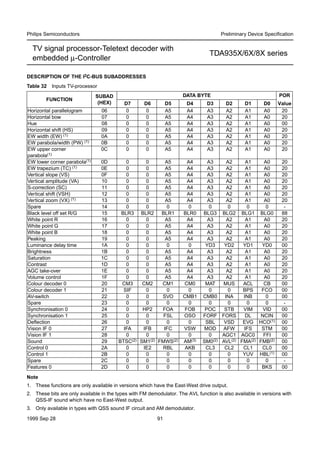
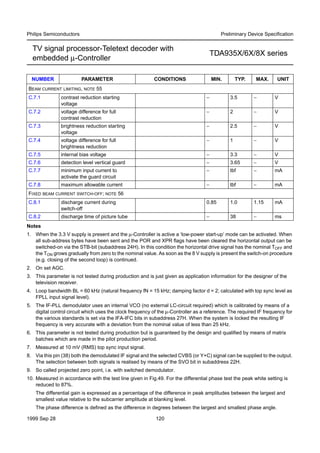
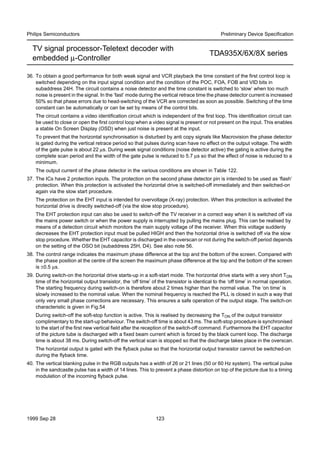
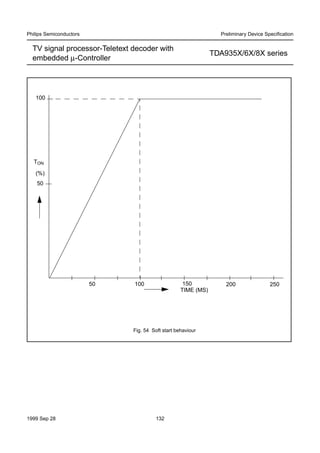
Preliminary Device Specification
File under Integrated Circuits, <Handbook>
1999 Sep 28
INTEGRATED CIRCUITS
TDA935X/6X/8X series
TV signal processor-Teletext
decoder with embedded µ-Controller
DEVICE SPECIFICATION
Previous date: 1999 Aug 26Version: 1.3
D
R
A
F
T
D
R
A
F
T
www.DataSheet4U.com
w
w
w
.datasheet4u.com
1999 Sep 28 2
Philips Semiconductors Preliminary Device Specification
TV signal processor-Teletext decoder
with embedded µ-Controller
TDA935X/6X/8X series
GENERAL DESCRIPTION
The various versions of theTDA935X/6X/8X series
combine the functions of a TV signal processor together
with a µ-Controller and US Closed Caption decoder. Most
versions have a Teletext decoder on board. The Teletext
decoder has an internal RAM memory for 1or 10 page text.
The ICs are intended to be used in economy television
receivers with 90° and 110° picture tubes.
The ICs have supply voltages of 8 V and 3.3 V and they
are mounted in S-DIP envelope with 64 pins.
The features are given in the following feature list. The
differences between the various ICs are given in the table
on page 4.
FEATURES
TV-signal processor
• Multi-standard vision IF circuit with alignment-free PLL
demodulator
• Internal (switchable) time-constant for the IF-AGC circuit
• A choice can be made between versions with mono
intercarrier sound FM demodulator and versions with
QSS IF amplifier.
• The mono intercarrier sound versions have a selective
FM-PLL demodulator which can be switched to the
different FM sound frequencies (4.5/5.5/6.0/6.5 MHz).
The quality of this system is such that the external
band-pass filters can be omitted.
• Source selection between ‘internal’ CVBS and external
CVBS or Y/C signals
• Integrated chrominance trap circuit
• Integrated luminance delay line with adjustable delay
time
• Asymmetrical ‘delay line type’ peaking in the luminance
channel
• Black stretching for non-standard luminance signals
• Integrated chroma band-pass filter with switchable
centre frequency
• Only one reference (12 MHz) crystal required for the
µ-Controller, Teletext- and the colour decoder
• PAL/NTSC or multi-standard colour decoder with
automatic search system
• Internal base-band delay line
• RGB control circuit with ‘Continuous Cathode
Calibration’, white point and black level off set
adjustment so that the colour temperature of the dark
and the light parts of the screen can be chosen
independently.
• Linear RGB or YUV input with fast blanking for external
RGB/YUV sources. The Text/OSD signals are internally
supplied from the µ-Controller/Teletext decoder
• Contrast reduction possibility during mixed-mode of
OSD and Text signals
• Horizontal synchronization with two control loops and
alignment-free horizontal oscillator
• Vertical count-down circuit
• Vertical driver optimized for DC-coupled vertical output
stages
• Horizontal and vertical geometry processing
• Horizontal and vertical zoom function for 16 : 9
applications
• Horizontal parallelogram and bow correction for large
screen picture tubes
• Low-power start-up of the horizontal drive circuit
1999 Sep 28 3
Philips Semiconductors Preliminary Device Specification
TV signal processor-Teletext decoder with
embedded µ-Controller
TDA935X/6X/8X series
µ-Controller
• 80C51 µ-controller core standard instruction set and
timing
• 1 µs machine cycle
• 32 - 128Kx8-bit late programmed ROM
• 3 - 12Kx8-bit Auxiliary RAM (shared with Display and
Acquisition)
• Interrupt controller for individual enable/disable with two
level priority
• Two 16-bit Timer/Counter registers
• WatchDog timer
• Auxiliary RAM page pointer
• 16-bit Data pointer
• IDLE and Power Down (PD) mode
• 14 bits PWM for Voltage Synthesis Tuning
• 8-bit A/D converter
• 4 pins which can be programmed as general I/O pin,
ADC input or PWM (6-bit) output
Data Capture
• Text memory for 1 or 10 pages
• In the 10 page versions inventory of transmitted Teletext
pages stored in the Transmitted Page Table (TPT) and
Subtitle Page Table (SPT)
• Data Capture for US Closed Caption
• Data Capture for 525/625 line WST, VPS (PDC system
A) and Wide Screen Signalling (WSS) bit decoding
• Automatic selection between 525 WST/625 WST
• Automatic selection between 625 WST/VPS on line 16
of VBI
• Real-time capture and decoding for WST Teletext in
Hardware, to enable optimized µ-processor throughput
• Automatic detection of FASTEXT transmission
• Real-time packet 26 engine in Hardware for processing
accented, G2 and G3 characters
• Signal quality detector for video and WST/VPS data
types
• Comprehensive teletext language coverage
• Full Field and Vertical Blanking Interval (VBI) data
capture of WST data
Display
• Teletext and Enhanced OSD modes
• Features of level 1.5 WST and US Close Caption
• Serial and Parallel Display Attributes
• Single/Double/Quadruple Width and Height for
characters
• Scrolling of display region
• Variable flash rate controlled by software
• Enhanced display features including overlining,
underlining and italics
• Soft colours using CLUT with 4096 colour palette
• Globally selectable scan lines per row (9/10/13/16) and
character matrix [12x10, 12x13, 12x16 (VxH)]
• Fringing (Shadow) selectable from N-S-E-W direction
• Fringe colour selectable
• Meshing of defined area
• Contrast reduction of defined area
• Cursor
• Special Graphics Characters with two planes, allowing
four colours per character
• 32 software redefinable On-Screen display characters
• 4 WST Character sets (G0/G2) in single device (e.g.
Latin, Cyrillic, Greek, Arabic)
• G1 Mosaic graphics, Limited G3 Line drawing
characters
• WST Character sets and Closed Caption Character set
in single device
1999Sep284
PhilipsSemiconductorsPreliminaryDeviceSpecification
TVsignalprocessor-Teletextdecoderwith
embeddedµ-Controller
TDA935X/6X/8Xseries
FUNCTIONAL DIFFERENCE BETWEEN THE VARIOUS IC VERSIONS
IC VERSION (TDA) 9350 9351 9352 9353 9360 9361 9362 9363 9364 9365 9366 9367 9380 9381 9382 9383 9384 9385 9386 9387 9388
TV range 90° 90° 90° 110° 90° 90° 110° 110° 110° 110° 90° 90° 90° 90° 90° 110° 110° 110° 110° 90° 110°
Mono intercarrier multi-standard
sound demodulator (4.5 - 6.5 MHz)
with switchable centre frequency
√ √ √ √ √ √ √ √ √ √ √ √ √
Audio switch √ √ √ √ √ √ √ √ √ √ √ √ √
Automatic Volume Levelling √ √ √ √ √ √ √ √ √ √ √ √
Automatic Volume Levelling or
subcarrier output (for comb filter
applications)
√ √ √ √ √ √ √ √ √
QSS sound IF amplifier with
separate input and AGC circuit
√ √ √ √ √ √ √ √
AM sound demodulator without
extra reference circuit
√ √
PAL decoder √ √ √ √ √ √ √ √ √ √ √ √ √ √ √ √ √ √ √
SECAM decoder √ √ √ √ √ √ √ √ √ √ √
NTSC decoder √ √ √ √ √ √ √ √ √ √ √ √ √ √ √ √ √ √ √ √ √
Horizontal geometry (E-W) √ √ √ √ √ √ √ √ √ √
Horizontal and Vertical Zoom √ √ √ √ √ √ √ √ √ √
ROM size 32-
64 k
32-
64 k
32-
64 k
32-
64 k
32-
64 k
32-
64 k
64-
128k
64-
128k
64-
128k
64-
128k
64-
128k
64-
128k
16-
64 k
16-
64 k
16-
64 k
16-
64 k
16-
64 k
16-
64 k
16-
64 k
16-
64 k
16-
64 k
User RAM size 1 k 1 k 1 k 1 k 2 k 2 k 2 k 2 k 2 k 2 k 2 k 2 k 1 k 1 k 1 k 1 k 1 k 1 k 1 k 1 k 1 k
Teletext 1
page
1
page
1
page
1
page
10
page
10
page
10
page
10
page
10
page
10
page
10
page
10
page
Closed captioning √ √ √ √ √ √ √ √ √ √ √ √ √ √ √ √ √ √ √ √ √
1999 Sep 28 5
Philips Semiconductors Preliminary Device Specification
TV signal processor-Teletext decoder with
embedded µ-Controller
TDA935X/6X/8X series
QUICK REFERENCE DATA
SYMBOL PARAMETER MIN. TYP. MAX. UNIT
Supply
VP supply voltages − 8.0/3.3 − V
IP supply current − tbf − mA
Input voltages
ViVIFrms) video IF amplifier sensitivity (RMS value) − 35 − µV
ViSIF(rms) QSS sound IF amplifier sensitivity (RMS value) − 60 − µV
ViAUDIO(rms) external audio input (RMS value) − 500 − mV
ViCVBS(p-p) external CVBS/Y input (peak-to-peak value) − 1.0 − V
ViCHROMA(p-p) external chroma input voltage (burst amplitude)
(peak-to-peak value)
− 0.3 − V
ViRGB(p-p) RGB inputs (peak-to-peak value) − 0.7 − V
ViYIN(p-p) luminance input signal (peak-to-peak value) − 1.4 − V
ViUVIN(p-p) U/V input signal (peak-to-peak value) − 1.33/1.05 − V
Output signals
Vo(IFVO)(p-p) demodulated CVBS output (peak-to-peak value) − 2.5 − V
Vo(QSSO)(rms) sound IF intercarrier output in QSS versions (RMS value) − 100 − mV
Vo(AMOUT)(rms) demodulated AM sound output in QSS versions (RMS
value)
− 500 − mV
Io(AGCOUT) tuner AGC output current range 0 − 5 mA
VoRGB(p-p) RGB output signal amplitudes (peak-to-peak value) − 2.0 − V
IoHOUT horizontal output current 10 − − mA
IoVERT vertical output current (peak-to-peak value) 1 − − mA
IoEWD EW drive output current 1.2 − − mA
1999 Sep 28 6
Philips Semiconductors Preliminary Device Specification
TV signal processor-Teletext decoder with
embedded µ-Controller
TDA935X/6X/8X series
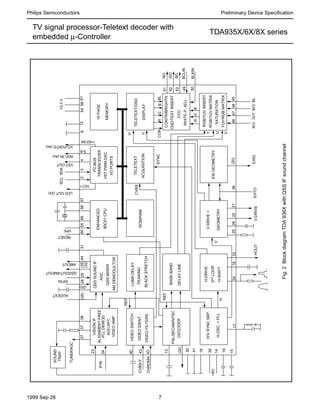
BLOCK DIAGRAM
SOUND
TRAP
TUNERAGC
+8V
HOUTV-DRIVE
RO
GO
B0
BCLIN
BLKIN
CVBS/Y
IFIN
AUDOUT
AUDEXT
Fig.1BlockdiagramTDA935X/6X8Xwithmonointercarriersounddemodulator
CHROMA
SDASCL
VISIONIF
ALIGNMENT-FREE
PLLDEMOD.
AGC/AFC
VIDEOAMP.
VIDEOSWITCH
VIDEOIDENT.
VIDEOFILTERS
PAL/SECAM/NTSC
DECODER
DEEMPHASIS
AUDIOSWITCH
(AVL)
VOLUMECONTROL
BASE-BAND
DELAYLINE
H/VSYNCSEP.
H-OSC.+PLL
H-DRIVE
2ndLOOP
H-SHIFT
V-DRIVE+
CONTR/BRIGHTN
OSD/TEXTINSERT
CCC
WHITE-P.ADJ.
80C51CPU
I2C-BUS
TRANSCEIVER
ROM/RAM
TELETEXT
ACQUISITION
1/10PAGE
MEMORY
TELETEXT/OSD
DISPLAY
RGBBL
Y
U
V
H
V
REF
ENHANCED
VSTPWM-DAC
VSTOUT
I/OPORTS
I/OPORTS(4x)
+3.3V
RESET
LEDOUT(2x)
ADCIN(4x)
VPE
(EWGEOMETRY)
GEOMETRY
EHTOEWDR/VG/YB/UBL
RGB/YUVINSERT
RGB
REF
CVBS
SYNC
H
V
COR
273738
33
(20)2928
34
446055595857
10/11
234
5-8
1+62-64
912545661
51
52
53
49
50
45484746(20)362122262516
35
17
31
15
19
14
39
18
41
(32)
13
43
42
40
24
23
RGB/YUVMATRIX
SATURATION
YUV/RGBMATRIX
30
LUMADELAY
PEAKING
BLACKSTRETCH
AGCCIRCUIT
NARROWBAND
PLL
DEMODULATOR
(32)
(32)
SNDIF
1999 Sep 28 7
Philips Semiconductors Preliminary Device Specification
TV signal processor-Teletext decoder with
embedded µ-Controller
TDA935X/6X/8X seriesSOUND
TRAP
TUNERAGC
+8V
HOUTV-DRIVE
RO
GO
BO
BCLIN
BLKIN
CVBS/Y
IFIN
Fig.2BlockdiagramTDA936XwithQSSIFsoundchannel
CHROMA
SDASCL
VISIONIF
ALIGNMENT-FREE
PLLDEMOD.
AGC/AFC
VIDEOAMP.
VIDEOSWITCH
VIDEOIDENT.
VIDEOFILTERS
PAL/SECAM/NTSC
DECODER
LUMADELAY
PEAKING
BLACKSTRETCH
BASE-BAND
DELAYLINE
H/VSYNCSEP.
H-OSC.+PLL
H-DRIVE
2ndLOOP
H-SHIFT
V-DRIVE+
CONTR/BRIGHTN
OSD/TEXTINSERT
CCC
WHITE-P.ADJ.
80C51CPU
I2C-BUS
TRANSCEIVER
ROM/RAM
TELETEXT
ACQUISITION
10PAGE
MEMORY
TELETEXT/OSD
DISPLAY
RGBBL
Y
U
V
H
V
REF
ENHANCED
VSTPWM-DAC
VSTOUT
I/OPORTS
I/OPORTS(4x)
+3.3V
RESET
LEDOUT(2x)
ADCIN(4x)
VPE
EWGEOMETRY
GEOMETRY
EHTOEWDR/VG/YB/UBL
RGB/YUVINSERT
RGB
REF
CVBS
SYNC
H
V
COR
273738
3334
6055595857
10/11
234
5-8
1+62-64
912545661
51
52
53
49
50
45484746(20)36212226251617
15
19
14
39
18
41
(32)
13
43
42
40
24
23
RGB/YUVMATRIX
SATURATION
YUV/RGBMATRIX
30
QSSSOUNDIF
AGC
QSSMIXER
AMDEMODULTOR
SIFIN
QSSOUT/AMOUT
AMOUT
2829(35)4431
AUDEXT
(35)
(32)
(20)
1999 Sep 28 8
Philips Semiconductors Preliminary Device Specification
TV signal processor-Teletext decoder with
embedded µ-Controller
TDA935X/6X/8X series
PINNING
SYMBOL PIN DESCRIPTION
P1.3/T1 1 port 1.3 or Counter/Timer 1 input
P1.6/SCL 2 port 1.6 or I2C-bus clock line
P1.7/SDA 3 port 1.7 or I2C-bus data line
P2.0/TPWM 4 port 2.0 or Tuning PWM output
P3.0/ADC0 5 port 3.0 or ADC0 input
P3.1/ADC1 6 port 3.1 or ADC1 input
P3.2/ADC2 7 port 3.2 or ADC2 input
P3.3/ADC3 8 port 3.3 or ADC3 input
VSSC/P 9 digital ground for µ-Controller core and periphery
P0.5 10 port 0.5 (8 mA current sinking capability for direct drive of LEDs)
P0.6 11 port 0.6 (8 mA current sinking capability for direct drive of LEDs)
VSSA 12 analog ground of Teletext decoder and digital ground of TV-processor
SECPLL 13 SECAM PLL decoupling
VP2 14 2nd supply voltage TV-processor (+8V)
DECDIG 15 decoupling digital supply of TV-processor
PH2LF 16 phase-2 filter
PH1LF 17 phase-1 filter
GND3 18 ground 3 for TV-processor
DECBG 19 bandgap decoupling
AVL/EWD (1) 20 Automatic Volume Levelling /East-West drive output
VDRB 21 vertical drive B output
VDRA 22 vertical drive A output
IFIN1 23 IF input 1
IFIN2 24 IF input 2
IREF 25 reference current input
VSC 26 vertical sawtooth capacitor
TUNERAGC 27 tuner AGC output
AUDEEM/SIFIN1(1) 28 audio deemphasis or SIF input 1
DECSDEM/SIFIN2(1) 29 decoupling sound demodulator or SIF input 2
GND2 30 ground 2 for TV processor
SNDPLL/SIFAGC(1) 31 narrow band PLL filter /AGC sound IF
AVL/SNDIF/REF0/
AMOUT(1)
32 Automatic Volume Levelling / sound IF input / subcarrier reference output /AM output
(non controlled)
HOUT 33 horizontal output
FBISO 34 flyback input/sandcastle output
AUDEXT/
QSSO/AMOUT(1)
35 external audio input /QSS intercarrier out /AM audio output (non controlled)
EHTO 36 EHT/overvoltage protection input
PLLIF 37 IF-PLL loop filter
IFVO/SVO 38 IF video output / selected CVBS output
VP1 39 main supply voltage TV-processor (+8 V)
CVBSINT 40 internal CVBS input
GND1 41 ground 1 for TV-processor
1999 Sep 28 9
Philips Semiconductors Preliminary Device Specification
TV signal processor-Teletext decoder with
embedded µ-Controller
TDA935X/6X/8X series
Note
1. The function of pin 20, 28, 29, 31, 32, 35 and 44 is dependent on the IC version (mono intercarrier FM demodulator
/ QSS IF amplifier and East-West output or not) and on some software control bits. The valid combinations are given
in table 1.
Table 1 Pin functions for various versions
Note
1. When additional (external) selectivity is required for FM-PLL system pin 32 can be used as sound IF input. This
function is selected by means of SIF bit in subaddress 21H.
CVBS/Y 42 external CVBS/Y input
CHROMA 43 chrominance input (SVHS)
AUDOUT /AMOUT(1) 44 audio output /AM audio output (volume controlled)
INSSW2 45 2nd RGB / YUV insertion input
R2/VIN 46 2nd R input / V (R-Y) input
G2/YIN 47 2nd G input / Y input
B2/UIN 48 2nd B input / U (B-Y) input
BCLIN 49 beam current limiter input/V-guard input
BLKIN 50 black current input
RO 51 Red output
GO 52 Green output
BO 53 Blue output
VDDA 54 analog supply of Teletext decoder and digital supply of TV-processor (3.3 V)
VPE 55 OTP Programming Voltage
VDDC 56 digital supply to core (3.3 V)
OSCGND 57 oscillator ground supply
XTALIN 58 crystal oscillator input
XTALOUT 59 crystal oscillator output
RESET 60 reset
VDDP 61 digital supply to periphery (+3.3 V)
P1.0/INT1 62 port 1.0 or external interrupt 1 input
P1.1/T0 63 port 1.1 or Counter/Timer 0 input
P1.2/INT0 64 port 1.2 or external interrupt 0 input
IC version FM-PLL version QSS version
East-West Y/N N Y N Y
CMB1/CMB0 bits 00 01/10/11 00 01/10/11 00 01/10/11 00 01/10/11
AM bit − − − − − 0 1 − 0 1
Pin 20 AVL EWD AVL EWD
Pin 28 AUDEEM SIFIN1
Pin 29 DECSDEM SIFIN2
Pin 31 SNDPLL SIFAGC
Pin 32 SNDIF(1) REFO AVL/SNDIF(1) REFO AMOUT REFO AMOUT REFO
Pin 35 AUDEXT AUDEXT QSSO AMOUT AUDEXT QSSO AMOUT
Pin 44 AUDOUT controlled AM or audio out
SYMBOL PIN DESCRIPTION
1999 Sep 28 10
Philips Semiconductors Preliminary Device Specification
TV signal processor-Teletext decoder with
embedded µ-Controller
TDA935X/6X/8X series
Fig. 3 Pin configuration (SDIP 64)
handbook, halfpage
XXX
MXXxxx
1
2
3
4
5
6
7
8
9
10
11
12
13
14
15
16
17
18
19
20
21
22
23
24
25
26
27
28
29
30
31
32
64
63
62
61
60
59
58
57
56
55
54
53
52
51
50
49
48
47
46
45
44
43
42
41
40
39
38
37
36
35
34
33
TDA935X/6X/8X
P1.3/T1
P1.6/SCL
P1.7/SDA
P2.0/TPMW
P3.0/ADC0
P3.1/ADC1
P3.2/ADC2
P3.3/ADC3
VSSC/P
P0.5
P0.6
VSSA
SECPLL
VP2
DECDIG
HOUT
FBISO
PH2LF
PH1LF
GND3
AVL/EWD
VDRB
VDRA
IFIN1
IFIN2
EHTO
IREF
VSC
TUNERAGC
AUDEEM/SIFIN1
DECSDEM/SIFIN2
PLLIF
IFVO/SVO
DECBG
CVBSINT
VP1
CHROMA
CVBS/Y
GND1
AUDOUT/AMOUT
AVL/SNDIF/
BLKIN
BO
GO
RO
BCLIN
R2/VIN
B2/UIN
G2/YIN
INSSW2
VDDA
VPE
VDDC
OSCGND
XTALIN
XTALOUT
RESET
VDDP
P1.0/INT1
P1.1/T0
P1.2/INT0
GND2
AMOUT
AUDEXT/QSSO/
SNDPLL/SIFAGC
REFO/AMOUT
Philips Semiconductors Preliminary specification
1999 Sep 28 11
TV signal processor-Teletext decoder with
embedded µ-Controller
TDA 935X/6X/8X series
FUNCTIONAL DESCRIPTION OF THE MICRO-CONTROLLER/TEXT DECODER
Block Diagram
Figure 4 Top level architecture
R
G
B
VDS
V
H
CVBS
CVBS
I2
C, General I/O
Data
Capture
Timing
Display
Timing
Data
Capture Display
Memory
InterfaceDRAM
ROM
Micro
Processor
(80C51)
TV Control
and
Interface
(16K to 128K)
(3K to 12K)
SRAM
256 Bytes
DISP/AUX
Program
Philips Semiconductors Preliminary specification
1999 Sep 28 12
TV signal processor-Teletext decoder with
embedded µ-Controller
TDA 935X/6X/8X series
Microcontroller
The functionality of the microcontroller used on the device is described here with reference to the industry
standard 80C51 microcontroller. A full description of its functionality can be found in the "80C51 Based 8-Bit
Microcontrollers - Philips Semiconductors (ref. IC20)" (Reference [1])
Memory Organisation
The device has the capability of a maximum of 128K PROGRAM ROM and 12K DATA RAM internally.
ROM BANK SWITCHING
Devices with up to 64K Program ROM have a continuous address space. Devices with over 64K Program ROM
use ROM bank switching. The 128K version is arranged in four banks of 32K. One of the 32K banks is common
and is always addressable. The other three banks(Bank0,Bank1,Bank2) can be accessed by selecting the right
bank via the SFR ROMBK bits 1/0.
Figure 5 ROM Bank Switching memory map
ROMBK<2:0> 0 to 32K 32K to 64K
00 Common Bank0
01 Common Bank1
10 Common Bank2
11 Reserved Reserved
Table 2 ROM Bank Selection
7FFFH
0000H
FFFFH
8000H 8000H 8000H
FFFFH FFFFH
Common
32K
Bank0
32K
Bank2
32K
Bank1
32K
Philips Semiconductors Preliminary specification
1999 Sep 28 13
TV signal processor-Teletext decoder with
embedded µ-Controller
TDA 935X/6X/8X series
Security Bits - Program and Verify
TDA935X/6X/8X devices have three sets of security bits, one set for each of the three One Time Programmable
memories, i.e. Program ROM, Character ROM and Packet 26 ROM. The security bits are used to prevent the
ROM from being overwritten once programmed, and also the contents being verified once programmed. The
security bits are one-time programmable and cannot be erased.
The TDA935X/6X/8X memory and security bits are structured as shown in Figure 6. The security bits are set as
shown in Figure 7 for production programmed devices and are set as shown in Figure 8 for production blank
devices.
Figure 6 Memory and security bit structures
Figure 7 Security bits for production devices
handbook, full pagewidth
MBK953
PROGRAM ROM
MEMORY
USER ROM PROGRAMMING
(ENABLE/DISABLE)
VERIFY
(ENABLE/DISABLE)
SECURITY BITS INTERACTION
USER ROM
(128K x 12-BIT)
CHARACTER ROM
USER ROM
(128K x 12-BIT)
PACKET 26 ROM
USER ROM
(128K x 12-BIT)
USER ROM PROGRAMMING
(ENABLE/DISABLE)
VERIFY
(ENABLE/DISABLE)
USER ROM PROGRAMMING
(ENABLE/DISABLE)
VERIFY
(ENABLE/DISABLE)
User Rom
(128K x 8-Bit)
User Rom
(9K x 12-Bit)
User Rom
(4K x 8-Bit)
handbook, full pagewidth
MBK954
PROGRAM ROM
MEMORY
USER ROM PROGRAMMING
(ENABLE/DISABLE)
VERIFY
(ENABLE/DISABLE)
DISABLED ENABLED
DISABLED ENABLED
DISABLED ENABLED
SECURITY BITS SET
CHARACTER ROM
PACKET 26 ROM
Philips Semiconductors Preliminary specification
1999 Sep 28 14
TV signal processor-Teletext decoder with
embedded µ-Controller
TDA 935X/6X/8X series
Figure 8 Security bits for production blank devices
RAM ORGANISATION
The Internal Data RAM is organised into two areas, Data Memory and Special Function Registers (SFR’s) as
shown in Figure 9.
Data Memory
The Data memory is 256 x 8 bits wide (byte) and occupies the address range 00h to 255h when using indirect
addressing and 00h to 127h when using Direct addressing. The SFRs occupy the address range 128 to 255 and
are accessible using Direct addressing only.
Figure 9 Internal Data Memory
The lower 128 Bytes of Data memory are mapped as shown in Figure 10. The lowest 24 bytes are grouped into
4 banks of 8 registers, the next 16 bytes above the register banks form a block of bit addressable memory space.
handbook, full pagewidth
MBK955
PROGRAM ROM
MEMORY
USER ROM PROGRAMMING
(ENABLE/DISABLE)
VERIFY
(ENABLE/DISABLE)
ENABLED ENABLED
ENABLED ENABLED
ENABLED ENABLED
SECURITY BITS SET
CHARACTER ROM
PACKET 26 ROM
Accessible
by Direct
and Indirect
Addressing
Accessible
by Indirect
Addressing
only
Accessible
by Direct
Addressing
00H
7FH
80H
FFH
Lower
128
Upper
128
Data Memory Special Function Registers
only
Philips Semiconductors Preliminary specification
1999 Sep 28 15
TV signal processor-Teletext decoder with
embedded µ-Controller
TDA 935X/6X/8X series
Figure 10 Lower 128 Bytes of Internal RAM
The upper 128 bytes is not allocated for any special area or functions.
SFR Memory
The Special Function Register (SFR) space is used for Port latches, timer, peripheral control, acquisition control,
display control, etc. These register can only be accessed by direct addressing. Sixteen of the addresses in the
SFR space are both byte and bit-addressable. The bit-addressable SFR’s are those whose address ends in 0H
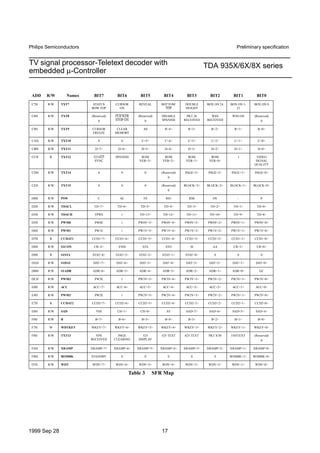
or 8H. A summary of the SFR map in address order is shown in Table 3..
ADD R/W Names BIT7 BIT6 BIT5 BIT4 BIT3 BIT2 BIT1 BIT0
80H R/W P0 - P0<6> P0<5> - - - - -
81H R/W SP SP<7> SP<6> SP<5> SP<4> SP<3> SP<2> SP<1> SP<0>
82H R/W DPL DPL<7> DPL<6> DPL<5> DPL<4> DPL<3> DPL<2> DPL<1> DPL<0>
83H R/W DPH DPH<7> DPH<6> DPH<5> DPH<4> DPH<3> DPH<2> DPH<1> DPH<0>
87H R/W PCON 0 ARD RFI WLE GF1 GF0 PD IDL
88H R/W TCON TF1 TR1 TF0 TR0 IE1 IT1 IE0 IT0
89H R/W TMOD GATE C/T M1 M0 GATE C/T M1 M0
8AH R/W TL0 TL0<7> TL0<6> TL0<5> TL0<4> TL0<3> TL0<2> TL0<1> TL0<0>
8BH R/W TL1 TL1<7> TL1<6> TL1<5> TL1<4> TL1<3> TL1<2> TL1<1> TL1<0>
Table 3 SFR Map
Bank Select
Bits in PSW
00H
08H
10H
18H
20H
07H
0FH
17H
1FH
2FH
11 = BANK3
7FH
10 = BANK2
01 = BANK1
00 = BANK0
Bit Addressable Space
(Bit Addresses 0-7F)
4 Banks of
8 Registers
R0 - R7
Philips Semiconductors Preliminary specification
1999 Sep 28 16
TV signal processor-Teletext decoder with
embedded µ-Controller
TDA 935X/6X/8X series
8CH R/W TH0 TH0<7> TH0<6> TH0<5> TH0<4> TH0<3> TH0<2> TH0<1> TH0<0>
8DH R/W TH1 TH1<7> TH1<6> TH1<5> TH1<4> TH1<3> TH1<2> TH1<1> TH1<0>
90H R/W P1 P1<7> P1<6> - - P1<3> P1<2> P1<1> P1<0>
96H R/W P0CFGA - P0CFGA<6> P0CFGA<5> - - - - -
97H R/W P0CFGB - P0CFGB<6> P0CFGB<5> - - - - -
98H R/W SADB 0 0 0 DC COMP SAD<3> SAD<2> SAD<1> SAD<0>
9EH R/W P1CFGA P1CFGA<7> P1CFGA<6> - - P1CFGA<3> P1CFGA<2> P1CFGA<1> P1CFGA<0>
9FH R/W P1CFGB P1CFGB<7> P1CFGB<6> - - P1CFGB<3> P1CFGB<2> P1CFGB<1> P1CFGB<0>
A0H R/W P2 - - - - - - - P2<0>
A6H R/W P2CFGA - - - - - - - P2CFGA<0>
A7H R/W P2CFGB - - - - - - - P2CFGB<0>
A8H R/W IE EA EBUSY ES2 ECC ET1 EX1 ET0 EX0
B0H R/W P3 - - - - P3<3> P3<2> P3<1> P3<0>
B2H R/W TXT18 NOT<3> NOT<2> NOT<1> NOT<0> 0 0 BS<1> BS<0>
B3H R/W TXT19 TEN TC<2> TC<1> TC<0> 0 0 TS<1> TS<0>
B4H R/W TXT20 DRCS
ENABLE
OSD
PLANES
0 0 OSD LANG
ENABLE
OSD
LAN<2>
OSD
LAN<1>
OSD
LAN<0>
B5H R/W TXT21 DISP
LINE<1>
DISP
LINES<0>
CHAR
SIZE<1>
CHAR
SIZE<0>
0 CC ON I2C PORT0 CC/TXT
B7H R/W CCLIN 0 0 0 CS<4> CS<3> CS<2> CS<1> CS<0>
B8H R/W IP 0 PBUSY PES2 PCC PT1 PX1 PT0 PX0
B9H R/W TXT17 0 FORCE
ACQ<1>
FORCE
ACQ<0>
FORCE
DISP<1>
FORCE
DISP<0>
SCREEN
COL<2>
SCREEN
COL<1>
SCREEN
COL<0>
BAH R WSS1 0 0 0 WSS<3:0>
ERROR
WSS<3> WSS<2> WSS<1> WSS<0>
BBH R WSS2 0 0 0 WSS<7:4>
ERROR
WSS<7> WSS<6> WSS<5> WSS<4>
BCH R WSS3 WSS<13:11>
ERROR
WSS<13> WSS<12> WSS<11> WSS<10:8>
ERROR
WSS<10> WSS<9> WSS<8>
BEH R/W P3CFGA - - - - P3CFGA<3> P3CFGA<2> P3CFGA<1> P3CFGA<0>
BFH R/W P3CFGB - - - - P3CFGB<3> P3CFGB<2> P3CFGB<1> P3CFGB<0>
C0H R/W TXT0 X24 POSN DISPLAY
X24
- DISABLE
HEADER
ROLL
DISPLAY
STATUS
ROW ONLY
- VPS ON INV ON
C1H R/W TXT1 EXT PKT
OFF
8 BIT ACQ OFF X26 OFF FULL
FIELD
- - -
C2H R/W TXT2 (Reserved)
0
REQ<3> REQ<2> REQ<1> REQ<0> SC<2> SC<1> SC<0>
C3H W TXT3 - - - PRD<4> PRD<3> PRD<2> PRD<1> PRD<0>
C4H R/W TXT4 OSD BANK
ENABLE
QUAD
WIDTH
ENABLE
EAST/WEST DISABLE
DOUBLE
HEIGHT
B MESH
ENABLE
C MESH
ENABLE
TRANS
ENABLE
SHADOW
ENABLE
C5H R/W TXT5 BKGND
OUT
BKGND IN CORB OUT CORB IN TEXT OUT TEXT IN PICTURE
ON OUT
PICTURE
ON IN
C6H R/W TXT6 BKGND
OUT
BKGND IN CORB OUT CORB IN TEXT OUT TEXT IN PICTURE
ON OUT
PICTURE
ON IN
ADD R/W Names BIT7 BIT6 BIT5 BIT4 BIT3 BIT2 BIT1 BIT0
Table 3 SFR Map
Philips Semiconductors Preliminary specification
1999 Sep 28 17
TV signal processor-Teletext decoder with
embedded µ-Controller
TDA 935X/6X/8X series
C7H R/W TXT7 STATUS
ROW TOP
CURSOR
ON
REVEAL BOTTOM/
TOP
DOUBLE
HEIGHT
BOX ON 24 BOX ON 1-
23
BOX ON 0
C8H R/W TXT8 (Reserved)
0
FLICKER
STOP ON
(Reserved)
0
DISABLE
SPANISH
PKT 26
RECEIVED
WSS
RECEIVED
WSS ON (Reserved)
0
C9H R/W TXT9 CURSOR
FREEZE
CLEAR
MEMORY
A0 R<4> R<3> R<2> R<1> R<0>
CAH R/W TXT10 0 0 C<5> C<4> C<3> C<2> C<1> C<0>
CBH R/W TXT11 D<7> D<6> D<5> D<4> D<3> D<2> D<1> D<0>
CCH R TXT12 525/625
SYNC
SPANISH ROM
VER<3>
ROM
VER<2>
ROM
VER<1>
ROM
VER<0>
1 VIDEO
SIGNAL
QUALITY
CDH R/W TXT14 0 0 0 (Reserved)
0
PAGE<3> PAGE<2> PAGE<1> PAGE<0>
CEH R/W TXT15 0 0 0 (Reserved)
0
BLOCK<3> BLOCK<2> BLOCK<1> BLOCK<0>
D0H R/W PSW C AC F0 RS1 RS0 OV - P
D2H R/W TDACL TD<7> TD<6> TD<5> TD<4> TD<3> TD<2> TD<1> TD<0>
D3H R/W TDACH TPWE 1 TD<13> TD<12> TD<11> TD<10> TD<9> TD<8>
D5H R/W PWM0 PW0E 1 PW0V<5> PW0V<4> PW0V<3> PW0V<2> PW0V<1> PW0V<0>
D6H R/W PWM1 PW1E 1 PW1V<5> PW1V<4> PW1V<3> PW1V<2> PW1V<1> PW1V<0>
D7H R CCDAT1 CCD1<7> CCD1<6> CCD1<5> CCD1<4> CCD1<3> CCD1<2> CCD1<1> CCD1<0>
D8H R/W S1CON CR<2> ENSI STA STO SI AA CR<1> CR<0>
D9H R S1STA STAT<4> STAT<3> STAT<2> STAT<1> STAT<0> 0 0 0
DAH R/W S1DAT DAT<7> DAT<6> DAT<5> DAT<4> DAT<3> DAT<2> DAT<1> DAT<0>
DBH R/W S1ADR ADR<6> ADR<5> ADR<4> ADR<3> ADR<2> ADR<1> ADR<0> GC
DCH R/W PWM3 PW3E 1 PW3V<5> PW3V<4> PW3V<3> PW3V<2> PW3V<1> PW3V<0>
E0H R/W ACC ACC<7> ACC<6> ACC<5> ACC<4> ACC<3> ACC<2> ACC<1> ACC<0>
E4H R/W PWM2 PW2E 1 PW2V<5> PW2V<4> PW2V<3> PW2V<2> PW2V<1> PW2V<0>
E7H R CCDAT2 CCD2<7> CCD2<6> CCD2<5> CCD2<4> CCD2<3> CCD2<2> CCD2<1> CCD2<0>
E8H R/W SAD VHI CH<1> CH<0> ST SAD<7> SAD<6> SAD<5> SAD<4>
F0H R/W B B<7> B<6> B<5> B<4> B<3> B<2> B<1> B<0>
F7H W WDTKEY WKEY<7> WKEY<6> WKEY<5> WKEY<4> WKEY<3> WKEY<2> WKEY<1> WKEY<0>
F8H R/W TXT13 VPS
RECEIVED
PAGE
CLEARING
525
DISPLAY
525 TEXT 625 TEXT PKT 8/30 FASTEXT (Reserved)
0
FAH R/W XRAMP XRAMP<7> XRAMP<6> XRAMP<5> XRAMP<4> XRAMP<3> XRAMP<2> XRAMP<1> XRAMP<0>
FBH R/W ROMBK STANDBY 0 0 0 0 0 ROMBK<1> ROMBK<0>
FFH R/W WDT WDV<7> WDV<6> WDV<5> WDV<4> WDV<3> WDV<2> WDV<1> WDV<0>
ADD R/W Names BIT7 BIT6 BIT5 BIT4 BIT3 BIT2 BIT1 BIT0
Table 3 SFR Map
Philips Semiconductors Preliminary specification
1999 Sep 28 18
TV signal processor-Teletext decoder with
embedded µ-Controller
TDA 935X/6X/8X series
The description of each of the SFR bits is shown in Table 4, The table has the SFR’s in alphabetical order.
Names BIT7 BIT6 BIT5 BIT4 BIT3 BIT2 BIT1 BIT0 RESET
ACC ACC<7> ACC<6> ACC<5> ACC<4> ACC<3> ACC<2> ACC<1> ACC<0> 00H
ACC<7:0> Accumulator value
B B<7> B<6> B<5> B<4> B<3> B<2> B<1> B<0> 00H
B<7:0> B Register value
CCDAT1 CCD1<7> CCD1<6> CCD1<5> CCD1<4> CCD1<3> CCD1<2> CCD1<1> CCD1<0> 00H
CCD1<7:0> Closed Caption first data byte
CCDAT2 CCD2<7> CCD2<6> CCD2<5> CCD2<4> CCD2<3> CCD2<2> CCD2<1> CCD2<0> 00H
CCD2<7:0> Closed Caption second data byte
CCLIN 0 0 0 CS<4> CS<3> CS<2> CS<1> CS<0> 15H
CS<4:0> Closed caption Slice line using 525 line number.
DPH DPH<7> DPH<6> DPH<5> DPH<4> DPH<3> DPH<2> DPH<1> DPH<0> 00H
DPH<7:0> Data Pointer High byte, used with DPL to address auxiliary memory
DPL DPL<7> DPL<6> DPL<5> DPL<4> DPL<3> DPL<2> DPL<1> DPL<0> 00H
DPL<7:0> Data pointer low byte, used with DPH to address auxiliary memory
IE EA EBUSY ES2 ECC ET1 EX1 ET0 EX0 00H
EA Disable all interrupts (0), or use individual interrupt enable bits (1)
EBUSY Enable BUSY interrupt
ES2 Enable I2C interrupt
ECC Enable Closed Caption interrupt
ET1 Enable Timer 1 interrupt
EX1 Enable external interrupt 1
ET0 Enable Timer 0 interrupt
EX0 Enable External interrupt 0
IP 0 PBUSY PES2 PCC PT1 PX1 PT0 PX0 00H
PBUSY Priority EBUSY interrupt
PES2 Priority ES2 Interrupt
PCC Priority ECC interrupt
PT1 Priority Timer 1 interrupt
PX1 Priority External Interrupt 1
PT0 Priority Timer 0 interrupt
PX0 Priority External Interrupt 0
P0 - P0<6> P0<5> - - - - - FFH
P0<6:5> Port 0 I/O register connected to external pins
P1 P1<7> P1<6> - - P1<3> P1<2> P1<1> P1<0> FFH
P1<7:6,3:0> Port 1 I/O register connected to external pins
P2 - - - - - - - P2<0> FFH
P2<0> Port 2 I/O register connected to external pins
Table 4 SFR Bit description
Philips Semiconductors Preliminary specification
1999 Sep 28 19
TV signal processor-Teletext decoder with
embedded µ-Controller
TDA 935X/6X/8X series
P3 - - - - P3<3> P3<2> P3<1> P3<0> FFH
P3<3:0> Port 3 I/O register connected to external ADC pins. Any combination of ADC input or PWM (P3<3:0>) output available via Software control.
P0CFGA - P0CFGA<6> P0CFGA<5> - - - - - FFH
P0CFGB - P0CFGB<6> P0CFGB<5> - - - - - 00H
P0CFGB<x>/P0CFGA<x> = 00 MODE 0 Open Drain
P0CFGB<x>/P0CFGA<x> = 01 MODE 1 Quasi Bi-Directional
P0CFGB<x>/P0CFGA<x> = 10 MODE2 High Impedance
P0CFGB<x>/P0CFGA<x> = 11 MODE3 Push Pull
P1CFGA P1CFGA<7> P1CFGA<6> - - P1CFGA<3> P1CFGA<2> P1CFGA<1> P1CFGA<0> FFH
P1CFGB P1CFGB<7> P1CFGB<6> - - P1CFGB<3> P1CFGB<2> P1CFGB<1> P1CFGB<0> 00H
P1CFGB<x>/P1CFGA<x> = 00 MODE 0 Open Drain
P1CFGB<x>/P1CFGA<x> = 01 MODE 1 Quasi Bi-Directional
P1CFGB<x>/P1CFGA<x> = 10 MODE2 High Impedance
P1CFGB<x>/P1CFGA<x> = 11 MODE3 Push Pull
P2CFGA - - - - - - - P2CFGA<0> FFH
P2CFGB - - - - - - P2CFGB<0> 00H
P2CFGB<x>/P2CFGA<x> = 00 MODE 0 Open Drain
P2CFGB<x>/P2CFGA<x> = 01 MODE 1 Quasi Bi-Directional
P2CFGB<x>/P2CFGA<x> = 10 MODE2 High Impedance
P2CFGB<x>/P2CFGA<x> = 11 MODE3 Push Pull
P3CFGA - - - - P3CFGA<3> P3CFGA<2> P3CFGA<1> P3CFGA<0> FFH
P3CFGB - - - - P3CFGB<3> P3CFGB<2> P3CFGB<1> P3CFGB<0> 00H
P3CFGB<x>/P3CFGA<x> = 00 MODE 0 Open Drain
P3CFGB<x>/P3CFGA<x> = 01 MODE 1 Quasi Bi-directional
P3CFGB<x>/P3CFGA<x> = 10 MODE2 High Impedance
P3CFGB<x>/P3CFGA<x> = 11 MODE3 Push Pull
PCON - ARD RFI WLE GF1 GF0 PD IDL 00H
ARD Auxiliary RAM Disable, All MOVX instructions access the external data memory
RFI Disable ALE during internal access to reduce Radio Frequency Interference
WLE Watch Dog Timer enable
GF1 General purpose flag
GF0 General purpose flag
PD Power-down activation bit
IDL Idle mode activation bit
PSW C AC F0 RS<1> RS<0> OV - P 00H
C Carry Bit
AC Auxiliary Carry bit
F0 Flag 0, General purpose flag
Names BIT7 BIT6 BIT5 BIT4 BIT3 BIT2 BIT1 BIT0 RESET
Table 4 SFR Bit description
Philips Semiconductors Preliminary specification
1999 Sep 28 20
TV signal processor-Teletext decoder with
embedded µ-Controller
TDA 935X/6X/8X series
RS<1:0> Register Bank selector bits
RS<1:0> = 00, Bank0 (00H - 07H)
RS<1:0> = 01, Bank1 (08H - 0FH)
RS<1:0> = 10, Bank2 (10H - 17H)
RS<1:0> = 11, Bank3 (18H - 1FH)
OV Overflow flag
P Parity bit
PWM0 PW0E 1 PW0V<5> PW0V<4> PW0V<3> PW0V<2> PW0V<1> PW0V<0> 40H
PW0E 0 - Disable Pulse Width Modulator 0
1 - Enable Pulse Width Modulator 0
PW0V<5:0> Pulse Width Modulator high time
PWM1 PW1E 1 PW1V<5> PW1V<4> PW1V<3> PW1V<2> PW1V<1> PW1V<0> 40H
PW1E 0 - Disable Pulse Width Modulator 1
1 - Enable Pulse Width Modulator 1
PW1V<5:0> Pulse Width Modulator high time
PWM2 PW2E 1 PW2V<5> PW2V<4> PW2V<3> PW2V<2> PW2V<1> PW2V<0> 40H
PW2E 0 - Disable Pulse Width Modulator 2
1 - Enable Pulse Width Modulator 2
PW2V<5:0> Pulse Width Modulator high time
PWM3 PW3E 1 PW3V<5> PW3V<4> PW3V<3> PW3V<2> PW3V<1> PW3V<0> 40H
PW3E 0 - Disable Pulse Width Modulator 3
1 - Enable Pulse Width Modulator 3
PW3V<5:0> Pulse Width Modulator high time
PW7V<5:0> Pulse Width Modulator high time
ROMBK STANDBY 0 0 0 0 0 ROMBK<1> ROMBK<0> 00H
STANDBY 0 - Stand-by mode inactive
1 - Stand-by mode active
ROMBK<1:0> ROM Bank selection
ROMBK<1:0>=00, Bank0
ROMBK<1:0>=01, Bank1
ROMBK<1:0>=10, Bank2
ROMBK<1:0>=11, Reserved
S1ADR ADR<6> ADR<5> ADR<4> ADR<3> ADR<2> ADR<1> ADR<0> GC 00H
ADR<6:0> I2C Slave Address
GC 0 - Disable I2C general call address
1 - Enable I2C general call address
S1CON CR<2> ENSI STA STO SI AA CR<1> CR<0> 00H
CR<2:0> Clock rate bits
CR<2:0> = 000, 100KHz bit rate
CR<2:0> = 001, 3.75kHz bit rate
CR<2:0> = 010, 150KHz bit rate
CR<2:0> = 011, 200KHz bit rate
CR<2:0> = 100, 25KHz bit rate
CR<2:0> = 101, 1.875KHz bit rate
CR<2:0> = 110, 37.5KHz bit rate
CR<2:0> = 111, 50KHz bit rate
Names BIT7 BIT6 BIT5 BIT4 BIT3 BIT2 BIT1 BIT0 RESET
Table 4 SFR Bit description
Philips Semiconductors Preliminary specification
1999 Sep 28 21
TV signal processor-Teletext decoder with
embedded µ-Controller
TDA 935X/6X/8X series
ENSI 0 - Disable I2
C interface
1 - Enable I2
C interface
STA START flag. When this bit is set in slave mode, the hardware checks the I2C bus and generates a START condition if the bus is free or after the bus becomes
free. If the device operates in master mode it will generate a repeated START condition.
STO STOP flag. If this bit is set in a master mode a STOP condition is generated. A STOP condition detected on the I2C bus clears this bit. This bit may also be set
in slave mode in order to recover from an error condition. In this case no STOP condition is generated to the I2C bus, but the hardware releases the SDA and
SCL lines and switches to the not selected receiver mode. The STOP flag is cleared by the hardware
SI Serial Interrupt flag. This flag is set and an interrupt request is generated, after any of the following events occur:
-A START condition is generated in master mode.
-The own slave address has been received during AA=1
-The general call address has been received while S1ADR.GC and AA=1
-A data byte has been received or transmitted in master mode (even if arbitration is lost)
-A data byte has been received or transmitted as selected slave
A STOP or START condition is received as selected slave receiver or transmitter
While the SI flag is set, SCL remains LOW and the serial transfer is suspened.SI must be reset by software.
AA Assert Acknowledge flag. When this bit is set, an acknowledge is returned after any one of the following conditions
-Own slave address is received.
-General call address is received(S1ADR.GC=1)
-A data byte is received, while the device is programmed to be a master receiver
-A data byte is received, while the device is selected slave receiver
When the bit is reset, no acknowledge is returned. Consequently, no interrupt is requested when the own address or general call address is received.
S1DAT DAT<7> DAT<6> DAT<5> DAT<4> DAT<3> DAT<2> DAT<1> DAT<0> 00H
DAT<7:0> I2C Data
S1STA STAT<4> STAT<3> STAT<2> STAT<1> STAT<0> 0 0 0 F8H
STAT<4:0> I2C Interface Status
SAD VHI CH<1> CH<0> ST SAD<7> SAD<6> SAD<5> SAD<4> 00H
VHI 0 - Analogue input voltage less than DAC voltage
1 - Analogue input voltage greater then DAC voltage
CH<1:0> ADC Input channel select
CH<1:0> = 00,ADC3
CH<1:0> = 01,ADC0
CH<1:0> = 10,ADC1
CH<1:0> = 11,ADC2
ST Initiate voltage comparison between ADC input Channel and SAD<7:0> value
Note: Set by Software and reset by Hardware
SAD<7:4> Most Significant nibble of DAC input word
SADB 0 0 0 DC COMP SAD<3> SAD<2> SAD<1> SAD<0> 00H
DC COMP 0 - DC Comparator mode disabled
1 - DC Comparator mode enabled
SAD<3:0> Least Significant nibble of 8 bit SAD value
SP SP<7> SP<6> SP<5> SP<4> SP<3> SP<2> SP<1> SP<0> 07H
SP<7> Stack Pointer
TCON TF1 TR1 TF0 TR0 IE1 IT1 IE0 IT0 00H
TF1 Timer 1 overflow Flag. Set by hardware on Timer/Counter overflow.Cleared by hardware when processor vectors to interrupt routine
TR1 Timer 1 Run control bit. Set/Cleared by software to turn Timer/Counter on/off
TF0 Timer 0 overflow Flag. Set by hardware on Timer/Counter overflow.Cleared by hardware when processor vectors to interrupt routine
TR0 Timer 0 Run control bit. Set/Cleared by software to turn Timer/Counter on/off
IE1 Interrupt 1 Edge flag (both edges generate flag). Set by hardware when external interrupt edge detected.Cleared by hardware when interrupt processed.
Names BIT7 BIT6 BIT5 BIT4 BIT3 BIT2 BIT1 BIT0 RESET
Table 4 SFR Bit description
Philips Semiconductors Preliminary specification
1999 Sep 28 22
TV signal processor-Teletext decoder with
embedded µ-Controller
TDA 935X/6X/8X series
IT1 Interrupt 1 Type control bit. Set/Cleared by Software to specify edge/low level triggered external interrupts.
IE0 Interrupt 0 Edge l flag. Set by hardware when external interrupt edge detected.Cleared by hardware when interrupt processed.
IT0 Interrupt 0 Type flag.Set/Cleared by Software to specify falling edge/low level triggered external interrupts
TDACH TPWE 1 TD<13> TD<12> TD<11> TD<10> TD<9> TD<8> 40H
TPWE 0 - Disable Tuning Pulse Width Modulator
1 - Enable Tuning Pulse Width Modulator
TD<13:8> Tuning Pulse Width Modulator High Byte
TDACL TD<7> TD<6> TD<5> TD<4> TD<3> TD<2> TD<1> TD<0> 00H
TD<7:0> Tuning Pulse Width Modulator Low Byte
TH0 TH0<7> TH0<6> TH0<5> TH0<4> TH0<3> TH0<2> TH0<1> TH0<0> 00H
TH0<7:0> Timer 0 high byte
TH1 TH1<7> TH1<6> TH1<5> TH1<4> TH1<3> TH1<2> TH1<1> TH1<0> 00H
TH1<7:0> Timer 1 high byte
TL0 TL0<7> TL0<6> TL0<5> TL0<4> TL0<3> TL0<2> TL0<1> TL0<0> 00H
TL0<7:0> Timer 0 low byte
TL1 TL1<7> TL1<6> TL1<5> TL1<4> TL1<3> TL1<2> TL1<1> TL1<0> 00H
TL1<7:0> Timer 1 low byte
TMOD GATE C/T M1 M0 GATE C/T M1 M0 00H
Timer 1 Timer 0
GATE Gating Control Timer /Counter 1
C/T Counter (1) or Timer (0) selector
M1,M0 Mode control bits
M1,M0 = 00, 8 bit timer or 8 bit counter with divide by 32 prescaler
M1,M0 = 01, 16 bit time interval or event counter
M1,M0 = 10, 8 bit time interval or event counter with automatic reload upon overflow. Reload value stored in TH1
M1,M0 = 11, stopped
GATE Gating control Timer/Counter 0
C/T Counter (1) or Timer (0) selector
M1,M0 Mode Control bits
M1,M0 = 00, 8 bit timer or 8 bit counter with divide by 32 prescaler
M1,M0 = 01, 16 bit time interval or event counter
M1,M0 = 10, 8 bit time interval or event counter with automatic reload upon overflow. Reload value stored in TH0
M1,M0 = 11, one 8bit time interval or event counter and one 8bit time interval counter
TXT0 X24 POSN DISPLAY
X24
- DISABLE
HEADER
ROLL
DISPLAY
STATUS
ROW ONLY
- VPS ON INV ON 00H
X24 POSN 0 - Store X/24 in extension memory
1 - Store X/24 in basic page memory with packets 0 to 23
DISLAY X24 0 - Display row 24 from basic page memory
1 - Display row 24 from appropriate location in extension memory
DISABLE
HEADER ROLL
0 - Write rolling headers and time to current display page
1 - Disable writing of rolling headers and time to into memory
Names BIT7 BIT6 BIT5 BIT4 BIT3 BIT2 BIT1 BIT0 RESET
Table 4 SFR Bit description
Philips Semiconductors Preliminary specification
1999 Sep 28 23
TV signal processor-Teletext decoder with
embedded µ-Controller
TDA 935X/6X/8X series
DISPLAY
STATUS ROW
ONLY
0 - Display normal page rows 0 to 24
1- Display only row 24
VPS ON 0 - VPS acquisition off
1 - VPS acquisition on
INV ON 0 - Inventory page off
1 - Inventory page on
TXT1 EXT PKT
OFF
8 BIT ACQ OFF X26 OFF FULL
FIELD
0 0 0 00H
EXT PKT OFF 0 - Acquire extension packets X/24,X/27,8/30/X
1 - Disable acquisition of extension packets
8 BIT 0 - Error check and/or correct packets 0 to 24
1 - Disable checking of packets 0 to 24 written into memory
ACQ OFF 0 - Write requested data into display memory
1 - Disable writing of data into Display memory
X26 OFF 0 - Enable automatic processing of X/26 data
1 - Disable automatic processing of X/26 data
FULL FIELD 0 - Acquire data only on VBI lines
1 - Acquire data on any TV line
TXT2 (Reserved)
0
REQ<3> REQ<2> REQ<1> REQ<0> SC<2> SC<1> SC<0> 00H
REQ<3:0> Page request
SC<2:0> Start column of page request
TXT3 PRD<4> PRD<3> PRD<2> PRD<1> PRD<0> 00H
PRD<4:0> Page Request data
TXT4 OSD BANK
ENABLE
QUAD
WIDTH
ENABLE
EAST/WEST DISABLE
DBL
HEIGHT
B MESH
ENABLE
C MESH
ENABLE
TRANS
ENABLE
SHADOW
ENABLE
00H
OSD BANK
ENABLE
0 - Only alpha numeric OSD characters available, 32 locations
1 - Alternate OSD location available via graphic attribute, additional 32 location
QUAD WIDTH
ENABLE
0 - Disable display of Quadruple width characters
1 - Enable display of Quadruple width characters
EAST/WEST 0 - Western language selection of character codes A0 to FF
1 - Eastern character selection of character codes A0 to FF
DISABLE
DOUBLE
HEIGHT
0 - Allow normal decoding of double height characters
1 - Disable normal decoding of double height characters
B MESH
ENABLE
0 - Normal display of black background
1 - Enable meshing of black background
C MESH
ENABLE
0 - normal display of coloured background
1 - Enable meshing of coloured background
TRANS
ENABLE
0 - Display black background as normal
1 - Display black background as video
SHADOW
ENABLE
0 - Disable display of shadow/fringing
1 - Display shadow/ fringe (default SE black)
TXT5 BKGND
OUT
BKGND IN COR OUT COR IN TEXT OUT TEXT IN PICTURE
ON OUT
PICTURE
ON IN
03H
BKGND OUT 0 - Background colour not displayed outside teletext boxes
1 - Background colour displayed outside teletext boxes
Names BIT7 BIT6 BIT5 BIT4 BIT3 BIT2 BIT1 BIT0 RESET
Table 4 SFR Bit description
Philips Semiconductors Preliminary specification
1999 Sep 28 24
TV signal processor-Teletext decoder with
embedded µ-Controller
TDA 935X/6X/8X series
BKGND IN 0 - Background colour not displayed inside teletext boxes
1 - Background colour displayed inside teletext boxes
COR OUT 0 - COR not active outside teletext and OSD boxes
1 - COR active outside teletext and OSD boxes
COR IN 0 - COR not active inside teletext and OSD boxes
1 - COR active inside teletext and OSD boxes
TEXT OUT 0 - TEXT not displayed outside teletext boxes
1 - TEXT displayed outside teletext boxes
TEXT IN 0 - TEXT not displayed inside teletext boxes
1 - TEXT displayed inside teletext boxes
PICTURE ON
OUT
0 - VIDEO not displayed outside teletext boxes
1 - VIDEO displayed outside teletext boxes
PICTURE ON IN 0 - VIDEO not displayed inside teletext boxes
1 - VIDEO displayed inside teletext boxes
TXT6 BKGND
OUT
BKGND IN COR OUT COR IN TEXT OUT TEXT IN PICTURE
ON OUT
PICTURE
ON IN
03H
BKGND OUT 0 - Background colour not displayed outside teletext boxes
1 - Background colour displayed outside teletext boxes
BKGND IN 0 - Background colour not displayed inside teletext boxes
1 - Background colour displayed inside teletext boxes
COR OUT 0 - COR not active outside teletext and OSD boxes
1 - COR active outside teletext and OSD boxes
COR IN 0 - COR not active inside teletext and OSD boxes
1 - COR active inside teletext and OSD boxes
TEXT OUT 0 - TEXT not displayed outside teletext boxes
1 - TEXT displayed outside teletext boxes
TEXT IN 0 - TEXT not displayed inside teletext boxes
1 - TEXT displayed inside teletext boxes
PICTURE ON
OUT
0 - VIDEO not displayed outside teletext boxes
1 - VIDEO displayed outside teletext boxes
PICTURE ON IN 0 - VIDEO not displayed inside teletext boxes
1 - VIDEO displayed inside teletext boxes
TXT7 STATUS
ROW TOP
CURSOR
ON
REVEAL BOTTOM/
TOP
DOUBLE
HEIGHT
BOX ON 24 BOX ON 1-
23
BOX ON 0 00H
STATUS ROW
TOP
0 - Display memory row 24 information below teletext page (on display row 24)
1 - Display memory row 24 information above teletext page (on display row 0)
CURSOR ON 0 - Disable display of cursor
1 - Display cursor at position given by TXT9 and TXT10
REVEAL 0 - Display as spaces characters in area with conceal attribute set
1 - Display characters in area with conceal attribute set
BOTTOM/TOP 0 - Display memory rows 0 to 11 when double height bit is set
1 - Display memory rows 12 to 23 when double height bit is set
DOUBLE
HEIGHT
0 - Display each characters with normal height
1 - Display each character as twice normal height.
BOX ON 24 0 - Disable display of teletext boxes in memory row 24
1 - Enable display of teletext boxes in memory row 24
BOX ON 1-23 0 - Disable display of teletext boxes in memory row 1 to 23
1 - Enable display of teletext boxes in memory row 1 to 23
Names BIT7 BIT6 BIT5 BIT4 BIT3 BIT2 BIT1 BIT0 RESET
Table 4 SFR Bit description
Philips Semiconductors Preliminary specification
1999 Sep 28 25
TV signal processor-Teletext decoder with
embedded µ-Controller
TDA 935X/6X/8X series
BOX ON 0 0 - Disable display of teletext boxes in memory row 0
1 - Enable display of teletext boxes in memory row 0
TXT8 (Reserved)
0
FLICKER
STOP ON
(Reserved)
0
DISABLE
SPANISH
PKT 26
RECEIVED
WSS
RECEIVED
WSS ON 0 00H
FLICKER STOP
ON
0 - Enable ‘Flicker Stopper’ circuitry
1 - Disable ‘Flicker Stopper’ circuitry
DISABLE
SPANISH
0 - Enable special treatment of Spanish packet 26 characters
1 - Disable special treatment of Spanish packet 26 characters
PKT 26
RECEIVED
0 - No packet 26 data has been processed
1 - Packet 26 data has been processed.
Note: This flag is set by Hardware and must be reset by Software
WSS RECEIVED 0 - No Wide Screen Signalling data has been processed
1 - Wide Screen signalling data has been processed
Note: This flag is set by Hardware and must be reset by Software.
WSS ON 0 - Disable acquisition of WSS data.
1 - Enable acquisition of WSS data.
TXT9 CURSOR
FREEZE
CLEAR
MEMORY
A0 R<4> R<3> R<2> R<1> R<0> 00H
CURSOR
FREEZE
0 - Use current TXT9 and TXT10 values for cursor position.
1 - Lock cursor at current position
CLEAR
MEMORY
0 - Clear memory block not requested
1 - Clear memory block pointed to by TXT15
Note: This flag is set by Software and reset by Hardware
A0 0 - Access memory block pointed to by TXT15
1 - Access extension packet memory
R<4:0> Current memory ROW value.
Note: Valid range TXT mode 0 to 24.
TXT10 0 0 C<5> C<4> C<3> C<2> C<1> C<0> 00H
C<5:0> Current memory COLUMN value.
Note: Valid range TXT mode 0 to 39.
TXT11 D<7> D<6> D<5> D<4> D<3> D<2> D<1> D<0> 00H
D<7:0> Data value written or read from memory location defined by TXT9, TXT10 and TXT15
TXT12 625/525
SYNC
Spanish ROM
VER<3>
ROM
VER<2>
ROM
VER<1>
ROM
VER<0>
1 VIDEO
SIGNAL
QUALITY
xxxxxx1xB
625/525 SYNC 0 - 625 line CVBS signal is being received
1 - 525 line CVBS signal is being received
Spanish 0 - Spanish character set not present in device
1 - Spanish character set present in device
ROM VER<3:0> Mask programmable identification for character set
VIDEO SIGNAL
QUALITY
0 - Acquisition can not be synchronised to CVBS input
1 - Acquisition can be synchronised to CVBS input
TXT13 VPS
RECEIVED
PAGE
CLEARING
525
DISPLAY
525 TEXT 625 TEXT PKT 8/30 FASTEXT 0 xxxxxxx0B
VPS RECEIVED 0 - VPS data not being received
1 - VPS data being received
PAGE
CLEARING
0 - No page clearing active
1 - Software or Power On page clear in progress
Names BIT7 BIT6 BIT5 BIT4 BIT3 BIT2 BIT1 BIT0 RESET
Table 4 SFR Bit description
Philips Semiconductors Preliminary specification
1999 Sep 28 26
TV signal processor-Teletext decoder with
embedded µ-Controller
TDA 935X/6X/8X series
525 DISPLAY 0 - 625 Line synchronisation for Display
1 - 525 Line synchronisation for Display
525 TEXT 0 - 525 Line WST not being received
1 - 525 line WST being received
625 TEXT 0 - 625 Line WST not being received
1 - 625 line WST being received
PKT 8/30 0 - No Packet 8/30/x(625) or Packet 4/30/x(525) data detected
1 - Packet 8/30/x(625) or Packet 4/30/x(525) data detected
FASTEXT 0 - No Packet x/27 data detected
1 - Packet x/27 data detected
TXT14 0 0 0 (Reserved)
0
PAGE<3> PAGE<2> PAGE<1> PAGE<0> 00H
PAGE<3:0> Current Display page
TXT15 0 0 0 (Reserved)
0
BLOCK<3> BLOCK<2> BLOCK<1> BLOCK<0> 00H
BLOCK<3:0> Current Micro block to be accessed by TXT9, TXT10 and TXT11
TXT17 0 FORCE
ACQ<1>
FORCE
ACQ<0>
FORCE
DISP<1>
FORCE
DISP<0>
SCREEN
COL2
SCREEN
COL1
SCREEN
COL0
00H
FORCE
ACQ<1:0>
00 - Automatic Selection
01 - Force 525 timing, Force 525 Teletext Standard
10 - Force 625 timing, Force 625 Teletext Standard
11 - Force 625 timing, Force 525 Teletext Standard
FORCE
DISP<1:0>
00 - Automatic Selection
01 - Force Display to 525 mode (9 lines per row)
10 - Force Display to 625 mode (10 lines per row)
11 - Not Valid (default to 625)
SCREEN
COL<2:0>
Defines colour to be displayed instead of TV picture and black background. The bits <2:0> are equivalent to the RGB components
000 - Transparent
001 - CLUT entry 9
010 - CLUT entry 10
011- CLUT entry 11
100 - CLUT entry 12
101 - CLUT entry 13
110- CLUT entry 14
111 - CLUT entry 15
TXT18 NOT<3> NOT<2> NOT<1> NOT<0> 0 0 BS<1> BS<0> 00H
NOT<3:0> National Option table selection, maximum of 32 when used with East/West bit
BS<1:0> Basic Character set selection
TXT19 TEN TC<2> TC<1> TC<0> 0 0 TS<1> TS<0> 00H
TEN 0 - Disable Twist function
1- Enable Twist character set
TC<2:0> Language control bits (C12/C13/C14) that has Twisted character set
TS<1:0> Twist Character set selection
TXT20 DRCS
ENABLE
OSD
PLANES
0 0 OSD LANG
ENABLE
OSD
LAN<2>
OSD
LAN<1>
OSD
LAN<0>
00H
DRCS ENABLE 0 - Normal OSD characters used
1 - Re-map column 8 and 9 to DRCS.
OSD PLANES 0 - Character code columns 8 and 9 defined as single plane characters (two colours per character).
1- Character code columns 8 and 9 defined as two plane characters (four colours per character).
Names BIT7 BIT6 BIT5 BIT4 BIT3 BIT2 BIT1 BIT0 RESET
Table 4 SFR Bit description
Philips Semiconductors Preliminary specification
1999 Sep 28 27
TV signal processor-Teletext decoder with
embedded µ-Controller
TDA 935X/6X/8X series
OSD LANG
ENABLE
Enable use of OSD LAN<2:0> to define language option for display, instead of C12/C13/C14
OSD LAN<2:0> Alternative C12/C13/C14 bits for use with OSD menus
TXT21 DISP
LINES<1>
DISP
LINES<0>
CHAR
SIZE<1>
CHAR
SIZE<0>
0 CC ON I2C PORT0 CC/TXT 02H
DISP
LINES<1:0>
The number of display lines per character row.
00 - 10 lines per character (defaults to 9 lines in 525 mode)
01 - 13 lines per character
10 - 16 lines per character
11 - reserved
CHAR
SIZE<1:0>
Character matrix size.
00 - 10 lines per character (matrix 12x10)
01 - 13 lines per character (matrix 12x13)
10 - 16lines per character (matrix 12x16)
11 - reserved
CCON 0 - Closed Caption acquisition off
1 - Closed Caption acquisition on
I2C PORT0 0 - disable I2C PORT0
1 - enable I2C PORT0 selection (P1.7/SDA0, P1.6/SCL0)
CC/TXT 0 - Display configured for TXT mode
1 - Display configured for CC mode
WDT WDV<7> WDV<6> WDV<5> WDV<4> WDV<3> WDV<2> WDV<1> WDV<0> 00H
WDv<7:0> Watch Dog Timer period
WDTKEY WKEY<7> WKEY<6> WKEY<5> WKEY<4> WKEY<3> WKEY<2> WKEY<1> WKEY<0> 00H
WKEY<7:0> Watch Dog Timer Key
Note: Must be set to 55H to disable Watch dog timer when active
WSS1 0 0 0 WSS<3:0>
ERROR
WSS<3> WSS<2> WSS<1> WSS<0> 00H
WSS<3:0>
ERROR
0 - No error in WSS<3:0>
1 - Error in WSS<3:0>
WSS<3:0> Signalling bits to define aspect ratio (group 1)
WSS2 0 0 0 WSS<7:4>
ERROR
WSS<7> WSS<6> WSS<5> WSS<4> 00H
WSS<7:4>
ERROR
0 - No errors in WSS<7:4>
1 - Error in WSS<7:4>
WSS<7:4> Signalling bits to define enhanced services (group 2)
WSS3 WSS<13:11<
ERROR
WSS<13> WSS<12> WSS<11> WSS<10:8>
ERROR
WSS<10> WSS<9> WSS<8> 00H
WSS<13:11>
ERROR
0 - No error in WSS<13:11>
1 - Error in WSS<13:11>
WSS<13:11> Signalling bits to define reserved elements (group 4)
WSS<10:8>
ERROR
0 - No error in WSS<10:8>
1 - Error in WS<10:8>
WSS<10:8> Signalling bits to define subtitles (group 3)
XRAMP XRAMP<7> XRAMP<6> XRAMP<5> XRAMP<4> XRAMP<3> XRAMP<2> XRAMP<1> XRAMP<0> 00H
XRAMP<7:0> Internal RAM access upper byte address
Names BIT7 BIT6 BIT5 BIT4 BIT3 BIT2 BIT1 BIT0 RESET
Table 4 SFR Bit description
Philips Semiconductors Preliminary specification
1999 Sep 28 28
TV signal processor-Teletext decoder with
embedded µ-Controller
TDA 935X/6X/8X series
Character Set Feature Bits
Features available on the TDA935X/6X/8X devices are reflected in a specific area of the character ROM. These
sections of the character ROM are mapped to two Special Function Registers: TXT22 and TXT12. Character
ROM address 09FEH is mapped to SFR TXT22 as shown in Table 5. Character ROM address 09FFH is
mapped to SFR TXT12 as shown in Table 7.
MAPPED ITEMS 11 10 9 8 7 6 5 4 3 2 1 0
Character ROM;
address 09FEH
X X X X X X X U U U U X
Mapped to TXT22 − − − − 7 6 5 4 3 2 1 0
U = Used, X = Reserved
Table 5 Character Rom - TXT22 mapping
BIT FUNCTION
0 Reserved
1 1 = Text Acquisition available
0 = Text Acquisition not available
2 1 = Closed Caption Acquisition available
0 = Closed Caption Acquisition not available
3 1 = PWM0, PWM1, PWM2 and PWM3 not present
0 = PWM0, PWM1, PWM2 and PWM3 output on Port 3.0 to Port 3.3 respectively
4 1 = 10 page available
0 = 6 page available
5 to 11 Reserved
Table 6 Description of Character ROM address 09FEH bits
MAPPED ITEMS 11 10 9 8 7 6 5 4 3 2 1 0
Character ROM;
address 09FFH
X X X X X X X U X X X X
Mapped to TXT2 − − − − − − − 6 5 4 3 2
4 = Used, 5 = Reserved
Table 7 Character Rom - TXT12 mapping
BIT FUNCTION
4 1 = Spanish character set present
0 = no Spanish character set present
0 to 3, 5 to 11 Reserved
Table 8 Description of Character ROM address 0X 09FFH bits
Philips Semiconductors Preliminary specification
1999 Sep 28 29
TV signal processor-Teletext decoder with
embedded µ-Controller
TDA 935X/6X/8X series
External (Auxiliary) Memory
The normal 80C51 external memory area has been mapped internally to the device, this means that the MOVX
instruction accesses memory internal to the device.
Figure 11 Auxiliary RAM allocation
Data RAM(1)
0000H
2000H
7FFFH
8000H
845FH
Display RAM
for
Closed Caption(3)
8700H
871FH
CLUT
87F0H
87FFH
Display Registers
8800H
8BFFH
Dynamically
Redefinable
Characters
Lower 32K bytes Upper 32K bytes
FFFFH
(1) Amount of Data RAM depends on device
(2) Amount of Display RAM depends on the device
(3) Display RAM for Closed Caption and Text is shared
47FFH
Display RAM
for
TEXT PAGES(2)
07FFH
Philips Semiconductors Preliminary specification
1999 Sep 28 30
TV signal processor-Teletext decoder with
embedded µ-Controller
TDA 935X/6X/8X series
Auxiliary RAM Page Selection
The Auxiliary RAM page selector is used to select one of the 256 pages within the auxiliary RAM, not all pages
are allocated, refer to Figure 11 for further detail. A page consists of 256 consecutive bytes.
Figure 12 Indirect addressing of AUX-RAM
(XRAMP)=00H
0000H
00FFH
0100H
01FFH
00H
FFH
00H
FFH
(XRAMP)=01H
(XRAMP)=FEH
FE00H
FEFFH
FF00H
FFFFH
00H
FFH
00H
FFH
(XRAMP)=FFH
MOVX @DPTR,A
MOVX @Ri, A
MOVX A, @Ri
MOVX A,@DPTR
Philips Semiconductors Preliminary specification
1999 Sep 28 31
TV signal processor-Teletext decoder with
embedded µ-Controller
TDA 935X/6X/8X series
Power-on Reset
An automatic reset can be obtained when VDD is applied by connecting the RESET pin to VDDP through a 10uF
capacitor, providing the VDD rise time does not exceed 1ms, and the oscillator start-up time does not exceed
10ms.
To ensure correct initialisation, the RESET pin must be held high long enough for the oscillator to settle following
power-up, usually a few milli-seconds. Once the oscillator is stable, a further 12 clocks are required to generate
the Reset (One machine cycle of the Micro-controller). Once the above reset condition has been detected an
internal reset signal is triggered which remains active for 2048 clock cycles.
Reduced Power modes
There are three power saving modes: Stand-by, Idle and Power Down. In all three modes the 3.3v power
supplies (Vddp, Vddc & Vdda) to the device must be maintained. Power saving is achieved by clock gating on
a section by section basis.
STAND-BY MODE
When Stand-by mode is entered both Acquisition and Display sections are disabled. The following functions
remain active:-
• 80c51 Core
• Memory Interface
• I2C
• Timer/Counters
• WatchDog Timer
• Software A/D
• Pulse Width Modulators
To enter Stand-by mode, the STANDBY control bit in the ROMBANK SFR (Bit-7) must be set. It can be used in
conjunction with either Idle or Power-Down to switch between power saving modes. This mode enables the
80c51 core to decode either IR Remote Commands or receive IIC commands without the need to fully power
the device.
The Stand-by state is maintained upon exit from Idle / Power-Down. No wake-up from Stand-by is necessary
as the 80c51 core remains operational.
Since the output values on RGB and VDS are maintained the teletext/OSD display must be disabled before
entering this mode.
IDLE MODE
During Idle mode, Acquisition, Display and the CPU sections of the device are disabled. The following functions
remain active:-
• Memory Interface
• I2C
• Timer/Counters
Philips Semiconductors Preliminary specification
1999 Sep 28 32
TV signal processor-Teletext decoder with
embedded µ-Controller
TDA 935X/6X/8X series
• WatchDog Timer
• Pulse Width Modulators
To enter Idle mode the IDL bit in the PCON register must be set. The WatchDog timer must be disabled prior to
entering Idle to prevent the device being reset. Once in Idle mode, the XTAL oscillator continues to run, but the
internal clock to the CPU, Acquisition and Display are gated out. However, the clocks to the Memory Interface,
I2C, Timer/Counters, WatchDog Timer and Pulse Width Modulators are maintained. The CPU state is frozen
along with the status of all SFRs, internal RAM contents are maintained, as are the device output pin values.
Since the output values on RGB and VDS are maintained the teletext/OSD display must be disabled before
entering this mode.
There are three methods available to recover from Idle:-
• Assertion of an enabled interrupt will cause the IDL bit to be cleared by hardware, thus terminating Idle
mode. The interrupt is serviced, and following the instruction RETI, the next instruction to be executed will
be the one after the instruction that put the device into Idle mode.
• A second method of exiting Idle is via an Interrupt generated by the SAD DC Compare circuit. When
Painter is configured in this mode, detection of an analogue threshold at the input to the SAD may be
used to trigger wake-up of the device i.e. TV Front Panel Key-press. As above, the interrupt is serviced,
and following the instruction RETI, the next instruction to be executed will be the one following the
instruction that put the device into Idle. For further details of the SAD DC Compare mode refer to the
Software A/D description within the micro-controller section.
• The third method of terminating Idle mode is with an external hardware reset. Since the oscillator is
running, the hardware reset need only be active for one machine cycle (12 clocks at 12MHz) to complete
the reset operation. Reset defines all SFRs and Display memory to a pre-defined state, but maintains all
other RAM values. Code execution commences with the Program Counter set to ’0000’.
POWER DOWN MODE
In Power Down mode the XTAL oscillator is stopped. The contents of all SFR, and RAM is maintained, however
the Auxiliary/Display memory is not maintained. The port pins maintain the values defined by the SFR’s. Since
the output values on RGB and VDS are maintained the teletext/OSD display must be made inoperative before
entering Power Down mode.
The power down mode is activated by setting the PD bit in the PCON register. The WatchDog timer must be
disabled before entering Power down.
There are two methods of exiting power down. Since the clock is stopped, external interrupts needs to be set to
level sensitive, by changing the level of these interrupts the device can be taken out of power down.
The second method of terminating the power down mode is with an external hardware reset. Reset defines all
SFR’s and Display memory, but maintains all other RAM values.
I/O Facility
I/O PORTS
The device has a number of micro-controller port I/O lines, each are individually addressable.
The I2
C-bus ports (P1.6 and P1.7) can only be configured as Open-drain.
Philips Semiconductors Preliminary specification
1999 Sep 28 33
TV signal processor-Teletext decoder with
embedded µ-Controller
TDA 935X/6X/8X series
PORT TYPE
All individual ports bits can be programmed to function in one of four modes, the mode is defined by eight Port
Configuration SFR’s (P0CFGA/P0CFGB, P1CFGA/P1CFGB, P2CFGA/P2CFGB and P3CFGA/P3CFGB). The
modes available are Open Drain, Quasi-bidirectional, High Impedance, Push-Pull.
Open Drain
The Open drain mode can be used for bi-directional operation of a port. It requires an external pull-up resistor,
the pull-up voltage has a maximum value of 5.5V, to allow connection of the device into a 5V environment.
Quasi-bidirectional
The quasi-bidirectional mode is a combination of open drain and push pull. It requires an external pull-up resistor
to VDDp (nominally 3.3V). When a signal transition from 0 to 1 is output from the device, the pad is put into push-
pull mode for one clock cycle (166ns) after which the pad goes into open drain mode. The mode may be used
to speed up the edges of signal transitions. This is the default mode of operation of the pads after reset.
High Impedance
The high impedance mode can be used for Input only operation of the port. When using this configuration the
two output transistors are turned off.
Push-Pull
The push pull mode can be used for output only. In this mode the signal is driven to either 0V or VDDp, which
is nominally 3.3V.
Interrupt System
The device has 7 interrupt sources, each of which can be enabled or disabled. When enabled each interrupt
can be assigned one of two priority levels. There are four interrupts that are common to the 80C51, two of these
are external interrupts (EX0 and EX1) and the other two are timer interrupts (ET0 and ET1). In addition to the
conventional 80c51, two application specific interrupts are incorporated internal to the device which have
following functionality:-
ECC (Closed Caption Data Ready Interrupt) - This interrupt is generated when the device is configured in
Closed Caption Acquisition mode. The interrupt is activated at the end of the currently selected Slice Line as
defined in the CCLIN SFR.
EBUSY (Display Busy Interrupt) - An interrupt is generated when the Display enters either a Horizontal or
Vertical Blanking Period. i.e. Indicates when the micro-controller can update the Display RAM without causing
undesired effects on the screen. This interrupt can be configured in one of two modes using the MMR
Configuration Register (Address 87FF, Bit-3 [TXT/V]):-
• TeXT Display Busy: An interrupt is generated on each active horizontal display line when the Horizontal
Blanking Period is entered.
• Vertical Display Busy: An interrupt is generated on each vertical display field when the Vertical Blanking
Period is entered.
Philips Semiconductors Preliminary specification
1999 Sep 28 34
TV signal processor-Teletext decoder with
embedded µ-Controller
TDA 935X/6X/8X series
Interrupt Enable Structure
Each of the individual interrupt can be enable or disable by setting or clearing the relevant bit in the interrupt
enable SFR called IE. All interrupt sources can also be globally disabled by clearing the EA bit (IE.7)
The interrupt structure is shown in Figure 13.
.
Figure 13 Interrupt Structure
Interrupt Enable Priority
Each interrupt source can be assigned one of two priority levels. The interrupt priority are defined by the interrupt
priority SFR called IP. A low priority interrupt can be interrupted by a high priority interrupt, but not by another
low priority interrupt. A high priority interrupt can not be interrupted by any other interrupt source. If two requests
of different priority level are received simultaneously, the request with the highest priority level is serviced. If
requests of the same priority level are received simultaneously, an internal polling sequence determines which
request is serviced. Thus, within each priority level there is a second priority structure determined by the polling
sequence as defined in Table 9
EX0
ET0
EX1
ET1
ECC
ES2
EBUSY
H1
H2
H3
H4
H5
H6
H7
L1
L2
L3
L4
L5
L6
L7
Interrupt
Source
Source
Enable
Global
Enable
Priority
Control
IE.0:6 IE.7 IP.0:6
Highest Priority Level1
Highest Priority Level0
Lowest Priority Level1
Lowest Priority Level0
Philips Semiconductors Preliminary specification
1999 Sep 28 35
TV signal processor-Teletext decoder with
embedded µ-Controller
TDA 935X/6X/8X series
.
INTERRUPT VECTOR ADDRESS
The processor acknowledges an interrupt request by executing a hardware generated LCALL to the appropriate
servicing routine. The interrupt vector addresses for each source are shown in Table 9.
LEVEL/EDGE INTERRUPT
The external interrupt can be programmed to be either level-activated or transition activated by setting or
clearing the IT0/1 bits in the Timer Control SFR called TCON.
The external interrupt INT1 differs from the standard 80C51 in that it is activated on both edges when in edge
sensitive mode. This is to allow software pulse width measurement for handling remote control inputs.
Timer/Counter
Two 16 bit timers/counters are incorporated Timer0 and Timer1. Both can be configured to operate as either
timers or event counters.
In Timer mode, the register is incremented on every machine cycle. It is therefore counting machine cycles.
Since the machine cycle consists of 12 oscillator periods, the count rate is 1/12 Fosc = 1MHz.
In Counter mode, the register is incremented in response to a negative transition at its corresponding external
pin T0 or T1. Since the pins T0 and T1 are sampled once per machine cycle it takes two machine cycles to
recognise a transition, this gives a maximum count rate of 1/24 Fosc = 0.5MHz.
There are six special function registers used to control the timers/counters. These are:
Source
Priority
within level
Interrupt
Vector
EX0 Highest 0003H
ET0 - 000BH
EX1 - 0013H
ET1 - 001BH
ECC - 0023H
ES2 - 002BH
EBUSY Lowest 0033H
Table 9 Interrupt Priority (within same level)
ITx Level Edge
0 Active low
1 INT0 = Negative Edge
INT1 = Positive and Negative Edge
Table 10 External Interrupt Activation
Philips Semiconductors Preliminary specification
1999 Sep 28 36
TV signal processor-Teletext decoder with
embedded µ-Controller
TDA 935X/6X/8X series
TCON, TMOD, TL0, TH0, TL1 and TH1.
The Timer/Counter function is selected by control bits C/T in the Timer Mode SFR(TMOD). These two Timer/
Counter have four operating modes, which are selected by bit-pairs (M1.M0) in the TMOD. Details of the modes
of operation are given in the "80C51 Based 8-Bit Microcontrollers - Philips Semiconductors (ref. IC20)"
(Reference [1]).
TL0 and TH0 are the actual timer/counter registers for timer 0. TL0 is the low byte and TH0 is the high byte. TL1
and TH1 are the actual timer/counter registers for timer 1. TL1 is the low byte and TH1 is the high byte.
WatchDog Timer
The WatchDog timer is a counter that when it overflows forces the microcontroller in to a reset. The purpose of
the WatchDog timer is to reset the microcontroller if it enters an erroneous processor state (possibly caused by
electrical noise or RFI) within a reasonable period of time. When enabled, the WatchDog circuitry will generate
a system reset if the user program fails to reload the WatchDog timer within a specified length of time known as
the WatchDog interval.
The WatchDog timer consists of an 8-bit counter with an 11 bit prescaler. The prescaler is fed with a signal
whose frequency is 1/12 fosc (1MHz). The 8 bit timer is incremented every ‘t’ seconds where:
t=12x2048x1/fosc=12x2048x1/12x106
= 2.048ms
WATCHDOG TIMER OPERATION
The WatchDog operation is activated when the WLE bit in the Power Control SFR (PCON) is set. The WatchDog
can be disabled by Software by loading the value 55H into the WatchDog Key SFR (WDTKEY). This must be
performed before entering Idle/Power Down mode to prevent exiting the mode prematurely.
Once activated the WatchDog timer SFR (WDT) must be reloaded before the timer overflows. The WLE bit must
be set to enable loading of the WDT SFR, once loaded the WLE bit is reset by hardware, this is to prevent
erroneous Software from loading the WDT SFR.
The value loaded into the WDT defines the WatchDog interval.
WatchDog interval = (256 - WDT) * t = (256 -WDT)*2.048ms
The range of intervals is from WDT = 00H which gives 524ms to WDT = FFH which gives 2.048ms
PORT Alternate Functions
The Ports 1,2 and 3 are shared with alternate functions to enable control of external devices and circuitry. The
alternate functions are enabled by setting the appropriate SFR and also writing a logic ‘1’ to the Port bit that the
function occupies.
If the Pulse Width Modulator outputs (PWM) are required on Ports 3.0 to 3.3, they require an additional bit to be
set in the Character ROM. If this facility is required, it should be requested when ordering the Language Set.
The PWMs may be enabled per pin, thus giving any combination of either PWM output, SFR output or SAD
input.
Philips Semiconductors Preliminary specification
1999 Sep 28 37
TV signal processor-Teletext decoder with
embedded µ-Controller
TDA 935X/6X/8X series
PWM PULSE WIDTH MODULATORS
The device has up to 4 6-bit Pulse Width Modulated (PWM) outputs for analogue control of e.g. volume, balance,
bass, treble, brightness, contrast, hue and saturation. The PWM outputs generate pulse patterns with a
repetition rate of 21.33us, with the high time equal to the PWM SFR value multiplied by 0.33us. The analogue
value is determined by the ratio of the high time to the repetition time, a D.C. voltage proportional to the PWM
setting is obtained by means of an external integration network (low pass filter).
PWM Control
The relevant PWM is enabled by setting the PWM enable bit PWxE in the PWMx Control register. The high time
is defined by the value PWxV<5:0>
TPWM TUNING PULSE WIDTH MODULATOR
The device has a single 14-bit PWM that can be used for Voltage Synthesis Tuning. The method of operation
is similar to the normal PWM except the repetition period is 42.66us.
TPWM Control
Two SFR are used to control the TPWM, they are TDACL and TDACH. The TPWM is enabled by setting the
TPWE bit in the TDACH SFR. The most significant bits TD<13:7> alter the high period between o and 42.33us.
The 7 least significant bits TD<6:0> extend certain pulses by a further 0.33us. e.g. if TD<6:0> = 01H then 1 in
128 periods will be extended by 0.33us, if TD<6:0>=02H the 2 in 128 periods will be extended.
The TPWM will not start to output a new value until writing a value to TDACH. Therefore, if the value is to be
changed TACL should be written before TDACH.
SAD SOFTWARE A/D
Four successive approximation Analogue to Digital Converters can be implemented in software by making use
of the on board 8-bit Digital to Analogue Converter and Analogue Comparator.
SAD Control
The control of the required analogue input is done using the channel select bits CH<1:0> in the SAD SFR, this
selects the required analogue input to be passed to one of the inputs of the comparator. The second comparator
input is generated by the DAC whose value is set by the bits SAD<7:0> in the SAD and SADB SFR’s. A
comparison between the two inputs is made when the start compare bit ST in the SAD SFR is set, this must be
at least one instruction cycle after the SAD<7:0> value has been set. The result of the comparison is given on
VHI one instruction cycle after the setting of ST
Philips Semiconductors Preliminary specification
1999 Sep 28 38
TV signal processor-Teletext decoder with
embedded µ-Controller
TDA 935X/6X/8X series
.
Figure 14 SAD Block Diagram
SAD Input Voltage
The external analogue voltage that is used for comparison with the internally generated DAC voltage do not
have the same voltage range. The DAC has a lower reference level of VSSA and an upper reference level of
VSSA.The resolution of the DAC voltage with a nominal values is 3.3/256 ~ 13mv. The external analogue voltage
has a lower value equivalent to VSSA and an upper value equivalent to VDDP - Vtn, were Vtn is the threshold
voltage for an NMOS transistor. The reason for this is that the input pins for the analogue signals (P3.0 to P3.3)
are 5V tolerant for normal port operations, i.e. when not used as analogue input. To protect the analogue
multiplexer and comparator circuitry from the 5V, a series transistor is used to limit the voltage. This limiting
introduces a voltage drop equivalent to Vtn (~0.6V) on the input voltage. Therefore for an input voltage in the
range VDDP to VDDp-Vtn the SAD returns the same comparison value.
When utilising Port 3.0 to Port 3.3 for SAD operation, the associated PWM outputs must be disabled.
+
-
VHI
MUX
4-1
8bit
DAC
SAD<7:0>
ADC0
ADC1
ADC2
ADC3
CH<1:0>
VDDP
Philips Semiconductors Preliminary specification
1999 Sep 28 39
TV signal processor-Teletext decoder with
embedded µ-Controller
TDA 935X/6X/8X series
SAD DC Comparator mode
The SAD module incorporates a DC Comparator mode which is selected using the ‘DC_COMP’ control bit in
the SADB SFR. This mode enables the microcontroller to detect a threshold crossing at the input to the selected
analog input pin (P3.0/ADC0, P3.1/ADC1, P3.2/ADC2 or P3.3/ADC3) of the software ADC. A level sensitive
interrupt is generated when the analog input voltage level at the pin falls below the analog output level of the
SAD Digital-to-Analog Converter.
This mode is intended to provide the device with a wake-up mechanism from Power-down or Idle mode when
a key-press on the front panel of the TV is detected.
The following software sequence should be used when utilizing this mode for Power-down or Idle mode:
1. Disable INT1 using the IE SFR
2. Set INT1 to level sensitive using the TCON SFR
3. Set the DAC digital input level to the desired threshold level using SAD/SADB SFRs and select the required
input pin (P3.0, P3.1, P3.2 or P3,3) using CH1 and CH0 in the SAD SFR
4. Enter DC Compare mode by setting the ‘DC_COMP’ enable bit in the SADB SFR
5. Enable INT1 using the IE SFR
6. Enter Power-down/Idle mode. Upon wake-up the SAD should be restored to its conventional operating mode
by disabling the ‘DC_COMP’ control bit.
I2C Serial I/O Bus
The I2
C bus consists of a serial data line (SDA on Port P1.7) and a serial clock line (SCL on Port P1.6).
These Ports may be enabled/disabled using TXT21.0 (I2
C Port Enable Bit).
Within the device, two separate hardware modules utilise this Bus: The Micro-controller and the TV Signal
Processor. The Micro-controller I2
C peripheral may operate in four different configurations:
• Master Transmitter
• Master Receiver
• Slave Transmitter
• Slave Receiver
The TV Signal Processor may be addressed in Slave Mode only, either via the 80C51 micro-controller or from
Port P1.6 and Port P1.7 by another master in the system.
I2C-bus control of the TV signal processor
For compatibility and possible re-use of software blocks, the I2
C-bus control for the TV signal processor is
organised as in the stand-alone TV signal processors. The internal communication is independent of the
programming of the Ports P1.6 and P1.7. All details on the control of the TV signal processor are given in the
description of the TV signal processor.
The byte level I2
C serial port on the device is identical in operation/configuration to the I2
C serial port on the
8xC558, with the exception of the clock rate selection bits CR<2:0>. The operation of the I2
C subsystem is
described in detail in the 8xC558 datasheet contained in reference [1].
Philips Semiconductors Preliminary specification
1999 Sep 28 40
TV signal processor-Teletext decoder with
embedded µ-Controller
TDA 935X/6X/8X series
I2C Port Selection
The selection of the SCL0/SDA0 port is done using TXT21.I2C PORT0 bit. When the port is enabled any
information transmitted from the device goes onto the enabled port. Any information transmitted to the device
can only be acted on if the port is enabled.
LED Support
Port pins P0.5 and P0.6 have an 8mA current sinking capability to enable LEDs in series with current limiting
resistors to be driven directly, without the need for additional buffering circuitry.
Memory Interface
The memory interface controls access to the embedded DRAM, refreshing of the DRAM and page clearing. The
DRAM is shared between Data Capture, Display and Microcontroller sections. The Data Capture section uses
the DRAM to store acquired information that has been requested. The Display reads from the DRAM information
and converts it into RGB values. The Microcontroller uses the DRAM as embedded auxiliary RAM and to
generate OSD.
Memory Structure
The memory is partitioned into two distinct areas, the dedicated auxiliary RAM area, and the Display RAM area.
The Display RAM area when not being used for Data Capture or Display can be used as an extension to the
auxiliary RAM area.
AUXILIARY RAM
The auxiliary RAM is not initialised at power up. The contents of the auxiliary RAM are maintained during Idle
mode, but are lost if Power Down mode is entered.
DISPLAY RAM
The Display RAM is initialised on power up to a value 20H. The contents of the Display RAM are maintained
when entering Idle mode. If Idle mode is exited using an Interrupt then the contents are unchanged, if Idle mode
is exited using a RESET then the Display RAM is initialised to 20H.
The size of the DRAM can be any value up to 2K.
Memory Mapping
The dedicated auxiliary RAM area occupies a maximum of 2K, with an address range from 0000H to 07FFH.The
Display RAM occupies a maximum of 10K with an address range from 2000H to 47FFH for TXT mode and
8000H to 86FFH for CC mode (see Figure 15). The two modes although having different address ranges occupy
physical the same DRAM area.
When not utilising the display memory, up to 12K is available for use as dedicated auxiliary RAM.
Philips Semiconductors Preliminary specification
1999 Sep 28 41
TV signal processor-Teletext decoder with
embedded µ-Controller
TDA 935X/6X/8X series
Figure 15 DRAM Memory mapping
Addressing Memory
The memory can be addressed by the Microcontroller in two ways, either directly using a MOVX command, or
via Special Function Registers depending on what address is required.
The dedicated auxiliary RAM, and Display Memory in the range 8000H to 86FFH, can only be accessed using
the MOVX command.The Display memory in the range 2000H to 47FFH can either be directly accessed using
the MOVX, or via the Special Function Registers.
AUXILIARY
0000
7FFF
2000
2800
47FF
Lower 32K Upper 32K
FFFF
845F
CC DISPLAY
8000
TXT BLOCK 9
TXT BLOCK 0
TXT BLOCK 1
TXT BLOCK 2
TXT BLOCK 3
TXT BLOCK 4
TXT BLOCK 5
TXT BLOCK 6
TXT BLOCK 7
TXT BLOCK 8
2400
2C00
3000
3400
3800
3C00
4000
4400
07FF
Philips Semiconductors Preliminary specification
1999 Sep 28 42
TV signal processor-Teletext decoder with
embedded µ-Controller
TDA 935X/6X/8X series
TXT DISPLAY MEMORY SFR ACCESS
The Display memory when in TXT mode is configured as 40 Columns wide by 25 Rows and occupies 1K x 8bits
of memory (see Figure 16). There can be a maximum of 10 display pages. Using TXT15:Block<3:0> and
TXT15:Micro Bank, the required display page can be selected to be written to. The row and column within that
block is selected using TXT9:R<4:0> and TXT10:C<5:0>. The data at the selected position can either be written
or read from by either writing to or reading from TXT11:D<7:0>.
Figure 16 TXT Memory Map
When ever a read or write is performed on TXT11, the row values stored in TXT9 and column value stored in
TXT10 are automatically incremented. For rows 0 to 24 the column value is incremented upto a maximum of
39, at which point it resets to 0 and increments the row counter value. When row 25 column 23 is reached the
values of the row and column are both reset to 0.
Writing values outside of the valid range for TXT9 or TXT10 will cause undetermined operation of the auto-
incrementing function for accesses to TXT11.
C
Row 0
1
2
3
4
5
6
7
8
9
10
11
12
13
14
15
16
17
18
19
20
21
22
23
24
25
0 39
0 9 23
Control Data
None Displayable data
Column
10 20 30
Active Position TXT9:R<4:0>=01h, TXT10:C<5:0>=0Ah, TXT11=43h
Row 25, Col 10 = Reserved.
Philips Semiconductors Preliminary specification
1999 Sep 28 43
TV signal processor-Teletext decoder with
embedded µ-Controller
TDA 935X/6X/8X series
TXT DISPLAY MEMORY MOVX ACCESS
It is important for the generation of OSD displays, that use this mode of access, to understand the mapping of
the MOVX address onto the display row and column value. This mapping of row and column onto address is
shown inTable 11. The values shown are added onto a base address for the required memory block (see Figure
15) to give a 16-bit address-
Page Clearing
Page Clearing is performed on request from either the Data Capture block, or the Microcontroller under the
control of the embedded software.
At power on and reset the whole of the page memory is cleared. TheTXT13.PAGE CLEARING bit will be set
while this takes place.
DATA CAPTURE PAGE CLEAR
When a page header is acquired for the first time after a new page request or a page header is acquired with
the erase (C4) bit set the page memory is ‘cleared’ to spaces before the rest of the page arrives.
When this occurs, the space code (20h) is written into every location of rows 1 to 23 of the basic page memory,
the appropriate packet 27 row of the extension packet memory and the row where teletext packet 24 is written.
This last row is either row 24 of the basic page memory, if the TXT0.X24 POSN bit is set, or the relevant row of
the extension packet memory, if the bit is not set. Page clearing takes place before the end of the TV line in
which the header arrived which initiated the page clear. This means that the 1 field gap between the page
header and the rest of the page which is necessary for many teletext decoders is not required.
SOFTWARE PAGE CLEAR
The software can also initiate a page clear, by setting the TXT9.CLEAR MEMORY bit. When it does so, every
location in the memory block pointed to by TXT15.BLOCK<3:0> is cleared. The CLEAR MEMORY bit is not
latched so the software does not have to reset it after it has been set.
Only one page can be cleared in a TV line, so if the software requests a page clear it will be carried out on the
next TV line on which the Data Capture hardware does not force the page to be cleared. A flag, TXT13.PAGE
CLEARING, is provided to indicate that a software requested page clear is being carried out. The flag is set
when a logic ’1’ is written into the TXT9.CLEAR MEMORY bit and is reset when the page clear has been
completed.
‘Movx’
Addresses
shown in Hex.
Col.
0 .....
Col.
23 .....
Col.
31
Col.
32 .....
Col.
39
Row 0 000 ..... 017 ..... 01F 3F8 ..... 3FF
Row 1 020 ..... 037 ..... 03F 3F0 ..... 3F7
: : : : : : : : :
: : : : : : : : :
: : : : : : : : :
Row 23 2E0 ..... 3F7 ..... 2FF 340 ..... 347
Row 24 300 ..... 317 ..... 31F 338 ..... 33F
Row 25 320 ..... 337
Table 11 Column and Row to ‘Movx’ Address (Lower 10 bits of Address)
Philips Semiconductors Preliminary specification
1999 Sep 28 44
TV signal processor-Teletext decoder with
embedded µ-Controller
TDA 935X/6X/8X series
Data Capture
The Data Capture section takes in the analogue Composite Video and Blanking Signal (CVBS), and from this
extracts the required data, which is then decoded and stored in memory.
The extraction of the data is performed in the digital domain. The first stage is to convert the analogue CVBS
signal into a digital form. This is done using an ADC sampling at 12MHz. The data and clock recovery is then
performed by a Multi-Rate Video Input Processor(MulVIP). From the recovered data and clock the following data
types are extracted WST Teletext(625/525),Closed Caption, VPS, WSS. The extracted data is stored in either
memory (DRAM) via the Memory Interface or in SFR locations.
Data Capture Features
• Video Signal Quality detector
• Data Capture for 625 line WST
• Data Capture for 525 line WST
• Data Capture for US Closed Caption
• Data Capture for VPS data (PDC system A)
• Data Capture for Wide Screen Signalling (WSS) bit decoding
• Automatic selection between 525 WST/625WST
• Automatic selection between 625WST/VPS on line 16 of VBI
• Real-time capture and decoding for WST Teletext in Hardware, to enable optimised microprocessor
throughput
• Up to 10 pages stored On-Chip
• Inventory of transmitted Teletext pages stored in the Transmitted Page Table (TPT) and Subtitle Page
Table (SPT)
• Automatic detection of FASTEXT transmission
• Real-time packet 26 engine in Hardware for processing accented, G2 and G3 characters
• Signal quality detector for WST/VPS data types
• Comprehensive Teletext language coverage
• Full Field and Vertical Blanking Interval (VBI) data capture of WST data
Philips Semiconductors Preliminary specification
1999 Sep 28 45
TV signal processor-Teletext decoder with
embedded µ-Controller
TDA 935X/6X/8X series
Block Diagram for Data Capture
Figure 17 Data Capture Block Diagram
Analogue to Digital Converter
The output of the CVBS switch is passed to a differential to single ended converter (DIVIS), although in this
device it is used as a single value and reference The analogue output of DIVIS is converted into a digital
representation by a full flash ADC with a sampling rate of 12MHz.
Analogue to Digital
Converter
Data<7:0>
TTC TTD
Acquisition
Timing
Output data to
memory interface
Output data to SFR’s
Sync
Separator
Data Slicer
and
Clock Recovery
Acquisition
for
WST/VPS
Acquisition
for
CC/WSS
SYNC_FILTER
CVBS (internal)
Philips Semiconductors Preliminary specification
1999 Sep 28 46
TV signal processor-Teletext decoder with
embedded µ-Controller
TDA 935X/6X/8X series
Multi Rate Video Input Processor
The multi rate video input processor is a Digital Signal Processor designed to extract the data in serial form and
recover the clock from a digitised CVBS signal.
DATA STANDARDS
The data and clock standards that can be recovered are shown in Table 12.
Data Capture Timing
The Data Capture timing section uses the Synchronisation information extracted from the CVBS signal to
generate the required Horizontal and Vertical reference timings.
The timing section automatically recognises and selects the appropriate timings for either 625 (50Hz)
synchronisation or 525 (60Hz) synchronisation. A flag TXT12.Video Signal Quality is set when the timing section
is locked correctly to the incoming CVBS signal. When TXT12.Video Signal Quality is set another flag
TXT12.625/525 SYNC can be used to identify the standard.
Acquisition
The acquisition sections extracts the relevant information from the serial data stream received from the MulVIP
section and writes it in to display memory.
WST ACQUISITION
The device is capable of acquiring level 1.5 625 Line and 525 Line World System Teletext (see Reference [3]
and Reference [4]]).
BROADCAST SERVICE DATA DETECTION
When a packet 8/30 is detected, or a packet 4/30 when the device is receiving a 525 line transmission, the
TXT13. Pkt 8/30 flag is set. The flag can be reset by writing a logic 0 into the SFR bit.
FASTEXT DETECTION
When a packet 27, designation code 0 is detected, whether or not it is acquired, the TXT13. FASTEXT bit is set.
If the device is receiving 525 line teletext, a packet X/0/27/0 is required to set the flag. The flag can be reset by
writing a logic 0 into the SFR bit.
Data Standard Clock Rate
625WST 6.9375 MHz
525WST 5.7272MHz
VPS 5.0MHz
WSS 5.0MHz
Closed Caption 500KHz
Table 12 Data Slicing Standards
Philips Semiconductors Preliminary specification
1999 Sep 28 47
TV signal processor-Teletext decoder with
embedded µ-Controller
TDA 935X/6X/8X series
VPS ACQUISITION
When the TXT0. VPS ON bit is set, any VPS data present on line 16, field 0 of the CVBS signal at the input of
the teletext decoder is error checked and stored. The device automatically detects whether teletext or VPS is
being transmitted on this line and decodes the data appropriately
Figure 18 VPS Data Storage
Each VPS byte in the memory consists of 4 biphase decoded data bits (bits 0-3), a biphase error flag (bit 4) and
three 0s (bits5-7).
The TXT13. VPS Received bit is set by the hardware whenever VPS data is acquired. The flag can be reset by
writing a logic 0 into the SFR bit.
Full details of the VPS system can be found in Reference [5].
WSS ACQUISITION
The Wide Screen Signalling data transmitted on line 23 gives information on the aspect ratio and display
position of the transmitted picture, the position of subtitles and on the camera/film mode. Some additional bits
are reserved for future use. A total of 14 data bits are transmitted.
All of the available data bits transmitted by the Wide Screen Signalling signal are captured and stored in SFR’s
WSS1, WSS2 and WSS3. The bits are stored as groups of related bits and an error flag is provided for each
group to indicate when a transmission error has been detected in one or more of the bits in the group.
Wide screen signalling data is only acquired when the TXT8.WSS ON bit is set.
The TXT8.WSS RECEIVED bit is set by the hardware whenever wide screen signalling data is acquired. The
flag can be reset by writing a logic 0 into the SFR bit.
CLOSED CAPTION ACQUISITION
The US Closed Caption data is transmitted on line 21 (525 line timings) and is used for Captioning information,
Text information and Extended Data Services. Full Details can be found in Reference [6].
Closed Caption data is only acquired when TXT21.CC ON bit is set
Two bytes of data are stored per field in SFR’s, the first bye is stored in CCDAT1 and the second byte is stored
in CCDAT2. The value in the CCDAT registers are reset to 00h at the start of the Closed Caption line defined
by CCLIN.CS<4:0>. At the end of the Closed Caption line an interrupt is generated if IE.ECC is active.
The processing of the Closed Caption data to convert into a displayable format is performed by the embedded
Software.
Teletext page
header data
VPS
byte 11
VPS
byte 12
VPS
byte 13
VPS
byte 14
VPS
byte 15
VPS
byte 4
VPS
byte 5
0 9 10 11 12 13 14 15 16 17 18 19 20 21 22 23
column
row 25
Philips Semiconductors Preliminary specification
1999 Sep 28 48
TV signal processor-Teletext decoder with
embedded µ-Controller
TDA 935X/6X/8X series
MAKING A PAGE REQUEST
A page is requested by writing a series of bytes into the TXT3.PRD<4:0> SFR which corresponds to the
number of the page required. The bytes written into TXT3 are stored in a RAM with an auto-incrementing
address. The start address for the RAM is set using the TXT2.SC<2:0> to define which part of the page
request is being written, and TXT2.REQ<3:0> is used to define which of the 10 page requests is being
modified. If TXT2.REQ<3:0> is greater than 09H, then data being written to TXT3 is ignored. Table 13 shows
the contents of the page request RAM.
Up to 10 pages of teletext can be acquired on the 10 page device, when TXT1.EXT PKT OFF is set to logic 1,
and up to 9 pages can be acquired when this bit is set to logic 0.
If the ‘Do Care’ bit for part of the page number is set logic 0 then that part of the page number is ignored when
the teletext decoder is deciding whether a page being received off air should be stored or not. For example, if
the Do Care bits for the four subcode digits are all set to logic 0 then every subcode version of the page will be
captured. When the HOLD bit is set to a logic 0 the teletext decoder will not recognise any page as having the
correct page number and no pages will be captured. In addition to providing the user requested hold function,
this bit should be used to prevent the inadvertent capture of an unwanted page when a new page request is
being made. For example, if the previous page request was for page 100 and this was being changed to page
234, it would be possible to capture page 200 if this arrived after only the requested magazine number had been
changed.
The E1 and E0 bits control the error checking which should be carried out on packets 1 to 23 when the page
being requested is captured.
For a multi-page device, each packet can only be written into one place in the teletext RAM, so if a page matches
more than one of the page requests the data is written into the area of memory corresponding to the lowest
numbered matching page request.
At power-up each page request defaults to any page, hold on and error check Mode 0.
.
Note: MAG = Magazine PT = Page Tens PU = Page Units HT = Hours Tens HU = Hours Units
MT = Minutes Tens MU = Minutes Units E = Error check mode
Rolling Headers and Time
When a new page has been requested it is conventional for the decoder to turn the header row of the display
green and to display each page header as it arrives until the correct page has been found.
When a page request is changed (i.e. when the TXT3 SFR is written to) a flag (PBLF) is written into bit 5, column
9, row 25 of the corresponding block of the page memory. The state of the flag for each block is updated every
TV line, if it is set for the current display block, the acquisition section writes all valid page headers which arrive
Start
Column
Byte
Identification
PRD<4> PRD<3> PRD<2> PRD<1> PRD<0>
0 Magazine DO CARE HOLD MAG2 MAG1 MAG0
1 Page Tens DO CARE PT3 PT2 PT1 PT0
2 Page Units DO CARE PU3 PU2 PU1 PU0
3 Hours Tens DO CARE x x HT1 HT0
4 Hours Units DO CARE HU3 HU2 HU1 HU0
5 Minutes Tens DO CARE x MT2 MT1 MT0
6 Minutes Units DO CARE MU3 MU2 MU1 MU0
7 Error Mode x x x E1 E0
Table 13 The contents of the Page Request RAM
Philips Semiconductors Preliminary specification
1999 Sep 28 49
TV signal processor-Teletext decoder with
embedded µ-Controller
TDA 935X/6X/8X series
into the display block and automatically writes an alphanumeric green character into column 7 of row 0 of the
display block every TV line.
When a requested page header is acquired for the first time, rows 1 to 23 of the relevant memory block are
cleared to space, i.e. have 20H written into every column, before the rest of the page arrives. Row 24 is also
cleared if the TXT0.X24 POSN bit is set. If the TXT1.EXT PKT OFF bit is set the extension packets
corresponding to the page are also cleared.
The last 8 characters of the page header are used to provide a time display and are always extracted from every
valid page header as it arrives and written into the display block.
The TXT0.DISABLE HEADER ROLL bit prevents any data being written into row 0 of the page memory except
when a page is acquired off air i.e. rolling headers and time are not written into memory. The TXT1.ACQ OFF
bit prevents any data being written into the memory by the teletext acquisition section.
When a parallel magazine mode transmission is being received only headers in the magazine of the page
requested are considered valid for the purposes of rolling headers and time. Only one magazine is used even
if a don’t care magazine is requested. When a serial magazine mode transmission is being received all page
headers are considered to be valid.
ERROR CHECKING
Before teletext packets are written in to the page memory they are error checked. The error checking carried
out depends on the packet number, the byte number, the error check mode bits in the page request data and
the TXT1.8-BIT bit.
If an uncorrectable error occurs in one of the Hamming checked addressing and control bytes in the page
header or in the Hamming checked bytes in packet 8/30, bit 4 of the byte written into the memory is set, to act
as an error flag to the software. If uncorrectable errors are detected in any other Hamming checked data the
byte is not written into the memory.
Philips Semiconductors Preliminary specification
1999 Sep 28 50
TV signal processor-Teletext decoder with
embedded µ-Controller
TDA 935X/6X/8X series
Figure 19 Error Checking
0 1 2 3 4 5 6 7 8 9 101112131415161718192021222324252627282930313233343536373839
0 1 2 3 4 5 6 7 8 9 101112131415161718192021222324252627282930313233343536373839
0 1 2 3 4 5 6 7 8 9 101112131415161718192021222324252627282930313233343536373839
0 1 2 3 4 5 6 7 8 9 101112131415161718192021222324252627282930313233343536373839
Packet X/0
Packet X/27/0
Packet 8/30/0,1
‘8 bit’ bit = 0
‘8 bit’ bit = 1
8 bit odd parity
data checked
8/4 Hamming
checked
0 1 2 3 4 5 6 7 8 9 101112131415161718192021222324252627282930313233343536373839
0 1 2 3 4 5 6 7 8 9 101112131415161718192021222324252627282930313233343536373839
Packet X/1-23
‘8 bit’ bit = 0, error check mode = 0
‘8 bit’ bit = 1
0 1 2 3 4 5 6 7 8 9 101112131415161718192021222324252627282930313233343536373839
0 1 2 3 4 5 6 7 8 9 101112131415161718192021222324252627282930313233343536373839
Packet X/24
‘8 bit’ bit = 0
‘8 bit’ bit = 1
0 1 2 3 4 5 6 7 8 9 101112131415161718192021222324252627282930313233343536373839
‘8 bit’ bit = 0, error check mode = 1
0 1 2 3 4 5 6 7 8 9 101112131415161718192021222324252627282930313233343536373839
‘8 bit’ bit = 0, error check mode = 2
0 1 2 3 4 5 6 7 8 9 101112131415161718192021222324252627282930313233343536373839
‘8 bit’ bit = 0, error check mode = 3
0 1 2 3 4 5 6 7 8 9 101112131415161718192021222324252627282930313233343536373839
Packet 8/30/2,3,4-15
Philips Semiconductors Preliminary specification
1999 Sep 28 51
TV signal processor-Teletext decoder with
embedded µ-Controller
TDA 935X/6X/8X series
Figure 20 Teletext Packet Storage Locations
Packet X/0
Packet X/1
Packet X/2
Packet X/3
Packet X/4
Packet X/5
Packet X/6
Packet X/7
Packet X/8
Packet X/9
Packet X/10
Packet X/11
Packet X/12
Packet X/13
Packet X/14
Packet X/15
Packet X/16
Packet X/17
Packet X/18
Packet X/19
Packet X/20
Packet X/21
Packet X/22
Packet X/23
Packet X/24 1
Row 0
1
2
3
4
5
6
7
8
9
10
11
12
13
14
15
16
17
18
19
20
21
22
23
24
25
0 6 7 8 39
0 9 23
Control Data
OSD only αw/
αg
Basic Page Blocks (0 to 8/9)
1 if ‘X24 Posn’ bit = 1.
2
VPS data block 9, unused in blocks 0 - 8.
VPS Data 2
NOTE:
Philips Semiconductors Preliminary specification
1999 Sep 28 52
TV signal processor-Teletext decoder with
embedded µ-Controller
TDA 935X/6X/8X series
Teletext Memory Organisation
The teletext memory is divided in to 10 blocks. Normally, when the TXT1.EXT PKT OFF bit is logic 0, each of
blocks 0 to 8 contain a teletext page arranged in the same way as the basic page memory of the page device
and block 9 contains extension packets. When the TXT1.EXT PKT OFF bit is logic 1, no extension packets are
captured and block 9 of the memory is used to store another page. The number of the memory block into which
a page is written corresponds to the page request number which resulted in the capture of the page.
Packet 0, the page header, is split into 2 parts when it is written into the text memory. The first 8 bytes of the
header contain control and addressing information. They are Hamming decoded and written into columns 0 to
7 of row 25. Row 25 also contains the magazine number of the acquired page and the PBLF flag but the last 13
bytes are unused and may be used by the software. Row 25, column 10 is reserved and should not be used by
software.
.
Figure 21 Teletext Extension Packet Storage Locations
ROW 25 DATA CONTENTS
The Hamming error flags are set if the on-board 8/4 Hamming checker detects that there has been an
uncorrectable (2 bit) error in the associated byte. It is possible for the page to still be acquired if some of the
page address information contains uncorrectable errors if that part of the page request was a 'don't care'. There
is no error flag for the magazine number as an uncorrectable error in this information prevents the page being
acquired.
The interrupted sequence (C9) bit is automatically dealt with by the acquisition section so that rolling headers
do not contain a discontinuity in the page number sequence.
The magazine serial (C11) bit indicates whether the transmission is a serial or a parallel magazine transmission.
This affects the way the acquisition section operates and is dealt with automatically.
Extension Packet Block (9)
Row 0
1
2
3
4
5
6
7
8
9
10
11
12
13
14
15
16
17
18
19
20
21
22
23
24
25
Packet X/24 for page in block 0 *
Packet X/27/0 for page in block 0
Packet 8/30/0,1
Packet X/24 for page in block 1 *
Packet X/27/0 for page in block 1
Packet 8/30/2,3
Packet X/24 for page in block 2 *
Packet X/27/0 for page in block 2
Packet X/24 for page in block 3 *
Packet X/27/0 for page in block 3
Packet X/24 for page in block 4 *
Packet X/27/0 for page in block 4
Packet X/24 for page in block 5 *
Packet X/27/0 for page in block 5
Packet X/24 for page in block 6 *
Packet X/27/0 for page in block 6
Packet X/24 for page in block 7 *
Packet X/27/0 for page in block 7
Packet X/24 for page in block 8 *
Packet X/27/0 for page in block 8
* if ‘X24 Posn’ bit = 00 9 23
VPS Data
Packet 8/30/4-15
NOTE:
Philips Semiconductors Preliminary specification
1999 Sep 28 53
TV signal processor-Teletext decoder with
embedded µ-Controller
TDA 935X/6X/8X series
The newsflash (C5), subtitle (C6), suppress header (C7), inhibit display (C10) and language control (C12 to 14)
bits are dealt with automatically by the display section, described below.
The update (C8) bit has no effect on the hardware. The remaining 32 bytes of the page header are parity
checked and written into columns 8 to 39 of row 0. Bytes which pass the parity check have the MSB set to logic
0 and are written into the page memory. Bytes with parity errors are not written into the memory.
Mag = Magazine C4 = Erase page C9 = Interrupted Sequence
PT = Page Tens C5 = Newsflash C10 = Inhibit Display
PU = Page Units C6 = Subtitle C11 = Magazine Serial
HT = Hours Tens C7 = Suppress Header C12-14 = Language Selection
HU = Hours Units C8 = Update
MT = Minutes Tens MU = Minutes Units
INVENTORY PAGE
If the TXT0.INV on bit is 1, memory block 8 is used as an inventory page. The inventory page consists of two
tables, - the Transmitted Page Table (TPT) and the subtitle page table (SPT).
In each table, every possible combination of the page tens and units digit, 00 to FFh, is represented by a byte.
Each bit of these bytes corresponds to a magazine number so each page number, from 100 to 8FF, is
represented by a bit in the table. The bit for a particular page in the TPT is set when a page header is received
for that page. The bit in the SPT is set when a page header for the page is received which has the ‘subtitle’ page
header control bit (C6) set.The bit for a particular page in the TPT is set when a page header is received for that
page. The bit in the SPT is set when a page header for the page is received which has the ‘subtitle’ page header
control bit (C6) set.
Col bit 7 bit 6 bit 5 bit 4 bit 3 bit 2 bit 1 bit 0
0 0 0 0 Hamming error PU3 PU2 PU1 PU0
1 0 0 0 Hamming error PT3 PT2 PT1 PT0
2 0 0 0 Hamming error MU3 MU2 MU1 MU0
3 0 0 0 Hamming error C4 MT2 MT1 MT0
4 0 0 0 Hamming error HU3 HU2 HU1 HU0
5 0 0 0 Hamming error C6 C5 HT1 HT0
6 0 0 0 Hamming error C10 C9 C8 C7
7 0 0 0 Hamming error C14 C13 C12 C11
8 0 0 0 FOUND 0 Mag2 Mag1 Mag0
9 0 0 PBLF 0 0 0 0 0
10
:
23
UNUSED
Table 14 The data in row 25 of the basic memory
Philips Semiconductors Preliminary specification
1999 Sep 28 54
TV signal processor-Teletext decoder with
embedded µ-Controller
TDA 935X/6X/8X series
Figure 22 SPT/TPT Organisation
Figure 23 Inventory page Organisation
Bytes in the table
Bits in each byte
x00
x01
x02
x03
x04
x05
x06
x07
x08
x09
x0a
x0b
x0c
x0d
x0e
x0f
x10
x11
x12
x13
x14
x15
x16
x17
x18
x19
x1a
x1b
x1c
x1d
x1e
x1f
x20
x21
x22
x23
x24
x25
x26
x27
x28
x29
x2a
x2b
x2c
x2d
x2e
x2f
x30
x31
x32
x33
x34
x35
x36
x37
x38
x39
x3a
x3b
x3c
x3d
x3e
x3f
0 393216
column
row n
n+1
bit
7
7xx 6xx 5xx 4xx 3xx 2xx 1xx 8xx
248
xf0
xf1
xf2
xf3
xf4
xf5
xf6
xf7
xf8
xf9
xfa
xfb
xfc
xfd
xfe
xff
xc8
xc9
xca
xcb
xcc
xcd
xce
xcf
xd0
xd1
xd2
xd3
xd4
xd5
xd6
xd7
xd8
xd9
xda
xdb
xdc
xdd
xde
xdf
xe8
xe9
xea
xeb
x4c
xed
xee
xef
xe0
xe1
xe2
xe3
xe4
xe5
xe6
xe7
n+6
n+7
xc0
xc1
xc2
xc3
xc4
xc5
xc6
xc7
6 5 4 3 2 1 0
Row 0
1
2
3
4
5
6
7
8
9
10
11
12
13
14
15
16
17
18
19
20
21
22
23
24
25
0 23
Transmitted
Pages
Table
Subtitle
Pages
Table
0 39
Unused
Unused
Unused
Unused
Unused
Unused
Unused
Unused
Unused
Philips Semiconductors Preliminary specification
1999 Sep 28 55
TV signal processor-Teletext decoder with
embedded µ-Controller
TDA 935X/6X/8X series
PACKET 26 PROCESSING
One of the uses of packet 26 is to transmit characters which are not in the basic teletext character set. The family
automatically decodes packet 26 data and, if a character corresponding to that being transmitted is available in
the character set, automatically writes the appropriate character code into the correct location in the teletext
memory. This is not a full implementation of the packet 26 specification allowed for in level 2 teletext, and so is
often referred to as level 1.5.
By convention, the packets 26 for a page are transmitted before the normal packets. To prevent the default
character data over writing the packet 26 data the device incorporates a mechanism which prevents packet 26
data from being overwritten. This mechanism is disabled when the Spanish national option is detected as the
Spanish transmission system sends even parity (i.e. incorrect) characters in the basic page locations
corresponding to the characters sent via packet 26 and these will not over write the packet 26 characters
anyway. The special treatment of Spanish national option is prevented if TXT12. ROM VER R4 is logic 0 or if
the TXT8.DISABLE SPANISH is set.
Packet 26 data is processed regardless of the TXT1. EXT PKT OFF bit, but setting theTXT1.X26 OFF disables
packet 26 processing.
The TXT8. Packet 26 received bit is set by the hardware whenever a character is written into the page memory
by the packet 26 decoding hardware. The flag can be reset by writing a logic 0 into the SFR bit.
525 LINE WORLD SYSTEM TELETEXT
The 525 line format is similar to the 625 line format but the data rate is lower and there are less data bytes per
packet (32 rather than 40). There are still 40 characters per display row so extra packets are sent each of which
contains the last 8 characters for four rows. These packets can be identified by looking at the ‘tabulation bit’ (T),
which replaces one of the magazine bits in 525 line teletext. When an ordinary packet with T = 1 is received, the
decoder puts the data into the four rows starting with that corresponding to the packet number, but with the 2
LSBs set to 0. For example, a packet 9 with T = 1 (packet X/1/9) contains data for rows 8, 9, 10 and 11. The
error checking carried out on data from packets with T = 1 depends on the setting of the TXT1. 8 BIT bit and the
error checking control bits in the page request data and is the same as that applied to the data written into the
same memory location in the 625 line format.
The rolling time display (the last 8 characters in row 0) is taken from any packets X/1/1, 2 or 3 received. In
parallel magazine mode only packets in the correct magazine are used for rolling time. Packet number X/1/0 is
ignored.
The tabulation bit is also used with extension packets. The first 8 data bytes of packet X/1/24 are used to extend
the Fastext prompt row to 40 characters. These characters are written into whichever part of the memory the
packet 24 is being written into (determined by the ‘X24 Posn’ bit).
Packets X/0/27/0 contain 5 Fastext page links and the link control byte and are captured, Hamming checked
and stored by in the same way as are packets X/27/0 in 625 line text. Packets X/1/27/0 are not captured.
Because there are only 2 magazine bits in 525 line text, packets with the magazine bits all set to 0 are referred
to as being in magazine 4. Therefore, the broadcast service data packet is packet 4/30, rather than packet 8/
30. As in 625 line text, the first 20 bytes of packet 4/30 contain encoded data which is decoded in the same way
as that in packet 8/30. The last 12 bytes of the packet contains half of the parity encoded status message.
Packet 4/0/30 contains the first half of the message and packet 4/1/30 contains the second half. The last 4 bytes
of the message are not written into memory. The first 20 bytes of the each version of the packet are the same
so they are stored whenever either version of the packet is acquired.
Philips Semiconductors Preliminary specification
1999 Sep 28 56
TV signal processor-Teletext decoder with
embedded µ-Controller
TDA 935X/6X/8X series
In 525 line text each packet 26 only contains ten 24/18 Hamming encoded data triplets, rather than the 13 found
in 625 line text. The tabulation bit is used as an extra bit (the MSB) of the designation code, allowing 32 packet
26s to be transmitted for each page. The last byte of each packet 26 is ignored.
Figure 24 Teletext Packet Storage for 525WST
Packet X/0/0
Packet X/0/1
Packet X/0/2
Packet X/0/3
Packet X/0/4
Packet X/0/5
Packet X/0/6
Packet X/0/7
Packet X/0/8
Packet X/0/9
Packet X/0/10
Packet X/0/11
Packet X/0/12
Packet X/0/13
Packet X/0/14
Packet X/0/15
Packet X/0/16
Packet X/0/17
Packet X/0/18
Packet X/0/19
Packet X/0/20
Packet X/0/21
Packet X/0/22
Packet X/0/23
Packet X/0/24 †
Row 0
1
2
3
4
5
6
7
8
9
10
11
12
13
14
15
16
17
18
19
20
21
22
23
24
25
0 6 7 8 39
0 9 23
Control Data
OSD only αw/α
g
† if ‘X24 Posn’ bit = 1
Rolling Time
Packet X/1/1
Packet X/1/8
Packet X/1/12
Packet X/1/16
Packet X/1/20
Packet X/1/4
Packet X/1/24 †
Philips Semiconductors Preliminary specification
1999 Sep 28 57
TV signal processor-Teletext decoder with
embedded µ-Controller
TDA 935X/6X/8X series
Display
The display section is based on the requirements for a Level 1.5 WST Teletext and US Closed Caption. There
are some enhancements for use with locally generated On-Screen Displays.
The display section reads the contents of the Display memory and interprets the control/character codes. From
this information and other global settings, the display produces the required RGB signals and Video/Data (Fast
Blanking) signal.
Display Features
• Teletext and Enhanced OSD modes
• Level 1.5 WST features
• US Closed Caption Features
• Serial and Parallel Display Attributes
• Single/Double/Quadruple Width and Height for characters
• Scrolling of display region
• Variable flash rate controlled by software
• Globally selectable scan lines per row 9/10/13/16
• Globally selectable character matrix (HxV) 12x9, 12x10, 12x13, 12x16
• Italics
• Soft Colours using CLUT with 4096 colour palette
• Underline
• Overline
• Fringing (Shadow) selectable from N-S-E-W direction
• Fringe colour selectable
• Meshing of defined area
• Contrast reduction of defined area
• Cursor
• Special Graphics characters with two planes, allowing four colours per character
• 32 Software re-definable On-Screen Display characters
• 4 WST Character sets(G0/G2) in single device (e.g. Latin,Cyrillic,Greek,Arabic)
• G1 Mosaic graphics, Limited G3 Line drawing characters
• WST Character sets and Closed Caption Character set in single device
Philips Semiconductors Preliminary specification
1999 Sep 28 58
TV signal processor-Teletext decoder with
embedded µ-Controller
TDA 935X/6X/8X series
Display Block Diagram
Figure 25 Display Block Diagram
Display Modes
The display section has two distinct modes with different features available in each. The two modes are:
• TXT:- This is the display configured as the WST mode with additional serial and global attributes to
enable the same functionality as the SAA5497 (ETT) device.The display is configured as a
fixed 25 rows with 40 characters per row.
• CC:- This is the display configured as the US Closed Caption mode with the same functionality as
the PC83C771 device. The display is configured as a maximum of 16 rows with a maximum of
48 characters per row.
In both of the above modes the Character matrix, and TV lines per row can be defined. There is an option of 9/
10/13/16 TV lines per display row, and a Character matrix (HxV) of 12x9, 12x10, 12x13, or 12x16. Not all
combinations of TV lines per row and maximum display rows give a sensible OSD display, since there is limited
number of TV scan lines available.
Special Function Register, TXT21 and memory mapped registers are used to control the mode selection.
Throughout this section, the features will be described, and there function in each mode given. If the feature is
different in either mode then this is stated.
Micro Interface
Character Font
Function
Registers
Display Data
Addressing
Character
ROM
Parallel/Serial
Converter
and Fringing
Attribute
Handling
CLUT RAM
D/A D/A D/A
Data
Buffer
Display Timing
Addressing
CLK H V
R G B FB
Address
Data
Address
Address
Address
Data
Data
Data
Data
Attributes
Control
To Memory Interface
From Memory Interface
Data
DRC’s
and
Philips Semiconductors Preliminary specification
1999 Sep 28 59
TV signal processor-Teletext decoder with
embedded µ-Controller
TDA 935X/6X/8X series
Features available in each mode
The following is a list of features available in each mode, and whether it is a serial or parallel attribute, or if it has a global
effect on the display.
Display Feature Descriptions
All display features are now described in detail for both TXT and CC modes.
Feature TXT CC
Flash serial serial
Boxes Txt/OSD (Serial) serial
Horizontal Size x1/x2/x4 (serial) x1/x2 (serial)
Vertical Size x1/x2 (serial)
x4 (global)
x1/x2 (serial)
Italic N/A serial
Foreground colours 8 (serial) 8+8 (parallel)
Background colours 8 (serial) 16 (serial)
Soft Colours (CLUT) 16 from 4096 16 from 4096
Underline N/A serial
Overline N/A serial
Fringe N+S+E+W N+S+E+W
Fringe Colour 16 (Global) 16 (Serial)
Meshing of Background Black or Colour (Global) All (Global)
Fast Blanking Polarity YES YES
Screen Colour 16 (Global) 16 (Global)
DRCS 32 (Global) 32/16 (Global)
Character Matrix (HxV) 12x9/10/13/16 12x9/10/13/16
No. of Rows 25 16
No. of Columns 40 48
No of Characters displayable 1000 544
Cursor YES YES
Special Graphics
(2 planes per character)
16 16
Scroll NO YES
Table 15 Display Features
Philips Semiconductors Preliminary specification
1999 Sep 28 60
TV signal processor-Teletext decoder with
embedded µ-Controller
TDA 935X/6X/8X series
FLASH
Flashing causes the foreground colour pixel to be displayed as the background pixels.The flash frequency is
controlled by software setting and resetting display register REG0: Status (see) at the appropriate interval.
CC:- This attribute is valid from the time set (see Table 21) until the end of the row or until otherwise modified.
TXT:- This attribute is set by the control character ‘flash’ (08h) (see Figure 31) and remains valid until the end
of the row or until reset by the control character ‘steady’ (09h).
BOXES
CC:- This attribute is valid from the time set until end of row or otherwise modified if set with Serial Mode 0. If
set with Serial Mode 1, then it is set from the next character onwards.
In text mode (within CC mode) the background colour is displayed regardless of the setting of the box attribute
bit. Boxes take affect only during mixed mode, where boxes are set in this mode the background colour is
displayed. Character locations where boxes are not set show video/screen colour (depending on the setting in
the display control register. REG0: Display Control) in stead of the background colour.
TXT:- Two types of boxes exist the Teletext box and the OSD box. The Teletext box is activated by the ‘start
box’ control character (0Bh), Two start box characters are required begin a Teletext box, with box starting
between the 2 characters. The box ends at the end of the line or after a ‘end box’ control character.
TXT mode can also use OSD boxes, they are started using size implying OSD control chracters(BCh/BDh/BEh/
BFh). The box starts after the control character (‘set after’) and ends either at the end of the row or at the next
size implying OSD character (‘set at’). To allow OSD boxes to be placed over teletext page the attributes flash,
teletext box, conceal, separate graphics, twist and hold graphics are all reset at the start of an OSD box, as they
are at the start of the row. OSD Boxes are only valid in TV mode which is defined by TXT5=03h and TXT6=03h.
SIZE
The size of the characters can be modified in both the horizontal and vertical directions.
CC:- Two sizes are available in both the horizontal and vertical directions. The sizes available are normal (x1),
double(x2) height/width and any combination of these. The attribute setting is always valid for the whole row.
Mixing of sizes is within a row is not possible.
TXT:- Three horizontal sizes are available normal (x1),double (x2),quadruple (x4). The control characters
‘normal size’ (0Ch/BCh) enables normal size, the ‘double width’ or double size (0Eh/BEh/0Fh/BFh) enables
double width characters. Any two consecutive combination of ‘double width’ or ‘double size’ (0Eh/BEh/0Fh/Bfh)
activates quadruple width characters, provided quadruple width characters are enabled by TXT4.Quad Width
Enable.
Three vertical sizes are available normal(x1),double(x2),quadruple(x4). The control characters ‘normal size’
(0Ch/BCh) enable normal size, the ‘double height’ or ‘double size’ (0Dh/BDh/0Fh/BFh) enable double height
characters. Quadruple height character are achieved by using double height characters and setting the global
attributes TXT7.Double Height(expand) and TXT7.Bottom/Top.
ITALIC
CC:- This attribute is valid from the time set until the end of the row or otherwise modified. The attribute causes
the character foreground pixels to be offset horizontally by 1 pixel per 4 scan lines (interlaced mode). The base
is the bottom left character matrix pixel. The pattern of the character is indented as shown in Figure 26.
Philips Semiconductors Preliminary specification
1999 Sep 28 61
TV signal processor-Teletext decoder with
embedded µ-Controller
TDA 935X/6X/8X series
Figure 26 Italic Characters
TXT:- The Italic attribute is not available.
COLOURS
CLUT (Colour Look Up Table)
A CLUT (Colour Look Up Table) with 16 colour entries is provided. The colours are programmable out of a
palette of 4096 (4 bits per R, G and B). The CLUT is defined by writing data to a RAM that resides in the MOVX
address space of the 80C51
Foreground Colour
CC:- The foreground colour can be chosen from 8 colours on a character by character basis. Two sets of 8 col-
ours are provided. A serial attribute switches between the banks (see Table 21 Serial Mode 1, bit 7). The col-
ours are the CLUT entries 0 to 7 or 8 to 15.
TXT:- The foreground colour is selected via a control character (see Figure 31). The colour control characters
RED3-0
b11. . . b8
GRN3-0
b7. . . b4
BLU3-0
b3. . . b0
Colour entry
0 0 0 0 0 0 0 0 0 0 0 0 0
0 0 0 0 0 0 0 0 1 1 1 1 1
... ... ... ...
1 1 1 1 1 1 1 1 0 0 0 0 14
1 1 1 1 1 1 1 1 1 1 1 1 15
Table 16 CLUT Colour values
0 2 4 6 8 10
Indented by 6/5/3
Indented by 5/4/2
Indented by 4/3/1
Indented by 3/2/0
Indented by 2/1/0
Indented by 1/0/0
Indented by 0/0/0
0 2 4 6 8 10 0 2 4 6 8 10 0 2 4 6 8 10 0 2 4 6 8 10 0 2 4 6 8 10
Indented by 7/6/4
0
1
2
3
4
5
6
7
8
9
10
11
12
13
14
15
Field 1
Field 2
12x16 character matrix 12x13 character matrix 12x10 character matrix
Philips Semiconductors Preliminary specification
1999 Sep 28 62
TV signal processor-Teletext decoder with
embedded µ-Controller
TDA 935X/6X/8X series
takes effect at the start of the next character (’Set After’) and remain valid until the end of the row, or until
modified by a control character. Only 8 foreground colours are available.
The TEXT foreground control characters map to the CLUT entries as shown in Table 17.
Background Colour
CC:- This attribute is valid from the time set until end of row or otherwise modified if set with Serial Mode 0. If
set with Serial Mode 1, then the colour is set from the next character onwards. The background colour can be
chosen from all 16 CLUT entries.
TXT:- The control character ’New background’ (1Dh) is used to change the background colour to the current
foreground colour. The selection is immediate (’Set at’) and remains valid until the end of the row or until
otherwise modified.
The TEXT background control characters map to the CLUT entries as shown in Table 18.
Control Code Defined Colour CLUT Entry
00h Black 0
01h Red 1
02h Green 2
03h Yellow 3
04h Blue 4
05h Magenta 5
06h Cyan 6
07h White 7
Table 17 Foreground CLUT mapping
Control Code Defined Colour CLUT Entry
00h+1Dh Black 8
01h+1Dh Red 9
02h+1Dh Green 10
03h+1Dh Yellow 11
04h+1Dh Blue 12
05h+1Dh Magenta 13
06h+1Dh Cyan 14
07h+1Dh White 15
Table 18 Background CLUT mapping
Philips Semiconductors Preliminary specification
1999 Sep 28 63
TV signal processor-Teletext decoder with
embedded µ-Controller
TDA 935X/6X/8X series
BACKGROUND DURATION
The attribute when set takes effect from the current position until to the end of the text display defined in the
MMR REG4:Text Area End.
CC:- The background duration attribute (see Table 21 Serial Mode 1, bit 8) in combination with the End Of Row
attribute (see Table 21 Serial Mode 1, bit 9) forces the background colour to be display on the row until the end
of the text area is reached
TXT:- This attribute is not available.
UNDERLINE
The underline attribute causes the characters to have the bottom scan line of the character cell forced to fore-
ground colour, including spaces. If background duration is set, then underline is set until the end of the text
area
CC/OSD:- The underline attribute (see Table 21 Serial Mode 0/1, bit 4) is valid from the time set until end of row
or otherwise modified.
TXT:- This attribute is not available, Row length is fixed to 40 characters.
OVERLINE
The overline attribute causes the characters to have the top scan line of the character cell forced to foreground
colour, including spaces. If background duration is set, then overline is set until the end of the text area
CC/OSD:- The overline attribute (see Table 21 Serial Mode 0/1, bit 5) is valid from the time set until end of row
or otherwise modified. Over-lining of Italic characters is not possible
TXT:- This attribute is not available.
END OF ROW
CC/OSD:- The number of characters in a row is flexible and can determined by the end of row attribute (see
Table 21 Serial Mode 1, bit 9).There must exist a space character 20H between the End of Row attribute and
the start of the subsequent display row. The maximum number of characters positioned displayed is deter-
mined by the setting of the MMR REG2:Text Position Horizontal and the MMR REG4:Text Area End.
TXT:- This attribute is not available, Row length is fixed at 40 characters.
FRINGING
A fringe (shadow) can be defined around characters. The fringe direction is individually selectable in any of the
North, South, East and West direction using REG3:Fringing Control. The colour of the fringe can also be defined
as one of the entries in the CLUT, again using REG3:Fringing Control.
CC/OSD:- The fringe attribute (see Table 21 Serial Mode 0, bit 9) is valid from the time set until the end of the
row or otherwise modified.
TXT:- The display of fringing in TXT mode is controlled by the TXT4.SHADOW bit. When set all the
alphanumeric characters being displayed are shadowed, graphics characters are not shadowed.
Philips Semiconductors Preliminary specification
1999 Sep 28 64
TV signal processor-Teletext decoder with
embedded µ-Controller
TDA 935X/6X/8X series
.
Figure 27 South and Southwest Fringing
MESHING
The attribute effects the background colour being displayed. Alternate pixels are displayed as the background
colour or video.The structure is offset by 1 pixel from scan line to scan line, thus achieving a checker board
display of the background colour and video.
TXT:- There are two meshing attributes one that only affects black background colours TXT4.BMESH and a
second that only affects backgrounds other than black TXT4.CMESH. A black background is defined as CLUT
entry 8, a none black background is defined as CLUT entry 9 to 15.
CC:- The setting of the Mesh bit in REG0:Display Control has the effect of meshing any background colour.
Figure 28 Meshing and Meshing/Fringing(South+West)
Note: There is a restriction on the use of fringing (shadowing) when combined with meshing. This applies to both
black and coloured meshing. The limitation is that when meshing is enabled, only the text pixels will be fringed
and video pixels are displayed without fringing.
CURSOR
The cursor operates by reversing the background and foreground colours in the character position pointed to
by the active cursor position. The cursor is enabled using TXT7.CURSOR ON. When active, the row the cursor
appears on is defined by TXT9.R<4:0> and the column is defined by TXT10.C<5:0>. The position of the cursor
can be fixed using TXT9.CURSOR FREEZE
CC:- The valid range for row is 0 to 15. The valid range for column is 0 to 47. The cursor remains rectangular
Philips Semiconductors Preliminary specification
1999 Sep 28 65
TV signal processor-Teletext decoder with
embedded µ-Controller
TDA 935X/6X/8X series
at all times, it’s shape is not affected by the italic attribute, therefore it is not advised to use the cursor with italic
characters.
TXT:- The valid range for row is 0 to 24.The valid range for column is 0 to 39.
Figure 29 Cursor display
SPECIAL GRAPHICS CHARACTERS
CC/TXT:- Several special characters are provided for improved OSD effects. These characters provide a
choice of 4 colours within a character cell. The total number of special graphics characters is limited to 16.
They are stored in the character codes 8Xh and 9Xh of the character table (32 ROM characters), or in the
DRC’s which overlay character codes 8Xh and 9Xh. Each special graphics character uses two consecutive
normal characters.
Fringing, underline and overline is not possible for special graphics characters. Special graphics characters are
activated when TXT21.OSD_PLANES = 1.
Figure 30 Special Character Example
The example in Figure 30 could be done with 8 special characters.
A B C D E F
VOLUME
Background Colour
Foreground Colour 7
Background Colour Serial Attribute
“set at” (Mode 0)
Background Colour
“set after” (Mode 1)
Foreground Colour
Normal Character
Foreground Colour 6
Special Character
Philips Semiconductors Preliminary specification
1999 Sep 28 66
TV signal processor-Teletext decoder with
embedded µ-Controller
TDA 935X/6X/8X series
If the screen colour is transparent (implicit in mixed mode) and inside the object the box attribute is set, then
the object is surrounded by video. If the box attribute is not set the background colour inside the object will also
be displayed as transparent.
Character and Attribute Coding
This section describes the character and attribute coding for each mode.
CC MODE
Character coding is split into character oriented attributes (parallel) and character group coding (serial). The
serial attributes take effect either at the position of the attribute (set at), or at the following location (set after)
and remain effective until either modified by a new serial attribute or until the end of the row. A serial attribute
is represented as a space (the space character itself however is not used for this purpose), the attributes that
are still active, e.g. overline and underline will be visible during the display of the space.
The default setting at the start of a row is:
• 1x size
• flash OFF
• overline OFF
• underline OFF
• italics OFF
• Display mode = superimpose
• fringing OFF
• background colour duration = 0
• end of row = 0
The coding is done in 12 bit words. The codes are stored sequentially in the display memory. A maximum of
768 character positions can be defined for a single display.
Plane
1
Plane
0
Colour Allocation
0 0 Background Colour
0 1 Foreground Colour
1 0 CLUT entry 6
1 1 CLUT entry 7
Table 19 Special character colour allocation
Philips Semiconductors Preliminary specification
1999 Sep 28 67
TV signal processor-Teletext decoder with
embedded µ-Controller
TDA 935X/6X/8X series
Parallel Character Coding
Bits Description
0-7 8 bit character code
8-10 3 bits for 8 foreground colours
11 Mode bit:
0 = Parallel code
Table 20 Parallel Character Coding
Philips Semiconductors Preliminary specification
1999 Sep 28 68
TV signal processor-Teletext decoder with
embedded µ-Controller
TDA 935X/6X/8X series
Serial Character Coding
TXT MODE
Character coding is in a serial format, with only one attributes being changed at any single location. The serial
attributes take effect either at the position of the attribute (Set At), or at the following location (Set After). The
attribute remains effective until either modified by new serial attributes or until the end of the row.
Bits Description
Serial Mode 0
(“set at”)
Serial Mode 1
Char.Pos. 1 (“set at”) Char.Pos. >1 (“set after”)
0-3 4 bits for 16 Back-
ground colours
4 bits for 16 Background col-
ours
4 bits for 16 Background col-
ours
4 0 = Underline OFF
1 = Underline ON
Horizontal Size:
0 = normal
1 = x2
0 = Underline OFF
1 = Underline ON
5 0 = Overline OFF
1 = Overline ON
Vertical Size:
0 = normal
1 = x2
0 = Overline OFF
1 = Overline ON
6 Display mode:
0 = Superimpose
1 = Boxing
Display mode:
0 = Superimpose
1 = Boxing
Display mode:
0 = Superimpose
1 = Boxing
7 0 = Flash OFF
1 = Flash ON
Foreground colour switch
0 = Bank 0 (colours 0-7)
1 = Bank 1 (colours 8-15)
Foreground colour switch
0 = Bank 0 (colours 0-7)
1 = Bank 1 (colours 8-15)
8 0 = Italics OFF
1 = Italics ON
Background colour duration:
0 = stop BGC
1 = set BGC to end of row
Background colour duration
(set at):
0 = stop BGC
1 = set BGC to end of row
9 0 = Fringing OFF
1 = Fringing ON
End of Row
0 = Continue Row
1 = End Row
End of Row (set at):
0 = Continue Row
1 = End Row
10 Switch for Serial cod-
ing mode 0 and 1:
0 = mode 0
Switch for Serial coding
mode 0 and 1:
1 = mode 1
Switch for Serial coding
mode 0 and 1:
1 = mode 1
11 Mode bit:
1 = Serial code
Mode bit:
1 = Serial code
Mode bit:
1 = Serial code
Table 21 Serial Character Coding
Philips Semiconductors Preliminary specification
1999 Sep 28 69
TV signal processor-Teletext decoder with
embedded µ-Controller
TDA 935X/6X/8X series
The default settings at the start of a row is:
• foreground colour white (CLUT Address 7)
• background colour black (CLUT Address 8)
• Horizontal size x1, Vertical size x1 (normal size)
• Alphanumeric ON
• Contiguous Mosaic Graphics
• Release Mosaics
• Flash OFF
• Box OFF
• Conceal OFF
• Twist OFF
The attributes have individual codes which are defined in the basic character table shown in Figure 31.
Figure 31 TXT Basic Character Set
Screen and Global Controls
A number of attributes are available that affect the whole display region, and cannot be applied selectively to
regions of the display.
0
1
2
3
4
5
6
7
8
9
A
B
C
D
E
F
0 1 2 3 4 5 6 7a 8 9 A B C2a 3a 6a 7
0 0 0 0
0 0 0 1
0 0 1 0
0 0 1 1
alpha
black
alpha
red
alpha
green
alpha
yellow
alpha
blue
alpha
magenta
alpha
cyan
alpha
white
graphics
red
graphics
green
graphics
yellow
graphics
blue
graphics
magenta
graphics
cyan
graphics
white
flash
steady
end
box
start
box
normal
height
double
height
double
width
double
size
conceal
display
contiguous
graphics
separated
graphics
black
bkgnd
new
bkgnd
hold
graphics
release
graphics
bkgnd
black
bkgnd
red
bkgnd
green
bkgnd
yellow
bkgnd
blue
bkgnd
magenta
bkgnd
cyan
bkgnd
white
norm sz
OSD
dbl ht
OSD
dbl wd
OSD
dbl sz
OSD
column
row
bits
b7
b6
b5
b4
b3 b2 b1 b0
graphics
black
0 1 0 0
0 1 0 1
0 1 1 0
0 1 1 1
1 0 0 0
1 0 0 1
1 0 1 0
1 0 1 1
1 1 0 0
1 1 0 1
1 1 1 0
1 1 1 1
D E F
0
0
00
1
0
00
0
1
00
1
1
00
0
1
10
1
1
10
0
0
10
1
0
1
0
0
0
01
1
0
01
0
1
01
1
1
01
0
0
1
1
1
0
11
0
1
11
1
1
11
D E F
1
0
11
0
1
11
1
1
11
E/W = 0 E/W = 1
Nat
Opt
Nat
Opt
Nat
Opt
Nat
Opt
Nat
Opt
Nat
Opt
Nat
Opt
Nat
Opt
Nat
Opt
Nat
Opt
Nat
Opt
Nat
Opt
Nat
Opt
O
S
D
O
S
D
O
S
D
O
S
D
O
S
D
O
S
D
O
S
D
O
S
D
O
S
D
O
S
D
O
S
D
O
S
D
O
S
D
O
S
D
O
S
D
O
S
D
O
S
D
O
S
D
O
S
D
O
S
D
O
S
D
O
S
D
O
S
D
O
S
D
O
S
D
O
S
D
O
S
D
O
S
D
O
S
D
O
S
D
O
S
D
O
S
D
Philips Semiconductors Preliminary specification
1999 Sep 28 70
TV signal processor-Teletext decoder with
embedded µ-Controller
TDA 935X/6X/8X series
TV SCAN LINES PER ROW
The number of TV scan lines per field used for each display row can be defined, the value is independent of the
character size being used. The number of lines can be either 10/13/16 per display row. The number of TV scan
lines per row is defined TXT21.DISP_LINES<1:0>.
A value of 9 lines per row can be achieved if the display is forced into 525 line display mode by
TXT17.DISP_FORCE<1:0>, or if the device is in 10 line mode and the automatic detection circuitry within
display finds 525 line display syncs.
CHARACTER MATRIX (HXV)
There are three different character matrices available, these are 12 x 10, 12 x 13 and 12 x 16. The selection is
made using TXT21.CHAR_SIZE<1:0> and is independent of the number of display lines per row.
If the character matrix is less than the number of TV scan lines per row then the matrix is padded with blank
lines. If the character matrix is greater than the number of TV scan lines then the character is truncated.
DISPLAY MODES
CC:- When attributes superimpose or boxing (see Table 21 Serial Mode 0/1, bit 6) are set, the resulting display
depends on the setting of the following screen control mode bits in the MMR REG0:Display Control.
TXT:- The display mode is controlled by the bits in the TXT5 and TXT6. There are 3 control functions - Text on,
Background on and Picture on. Separate sets of bits are used inside and outside Teletext boxes so that different
display modes can be invoked. TXT6 is used if the newsflash (C5) or subtitle (C6) bits in row 25 of the basic
page memory are set otherwise TXT5 is used. This allows the software to set up the type of display required on
newsflash and subtitle pages (e.g. text inside boxes, TV picture outside) this will be invoked without any further
software intervention when such a page is acquired
Display Mode MOD
[1.0]
Description
Video 00 Video mode disables all display activities and sets the RGB
to true black and VDS to video.
Full Text 01 Full Text mode displays screen colour at all locations not
covered by character foreground or background colour. The
box attribute has no effect.
Mixed Screen Colour 10 Mixed Screen mode displays screen colour at all locations
not covered by character foreground, within boxed areas or,
background colour.
Mixed Video 11 Mixed Video mode displays video at all locations not covered
by character foreground, within boxed areas or, background
colour.
Table 22 Display Modes
Philips Semiconductors Preliminary specification
1999 Sep 28 71
TV signal processor-Teletext decoder with
embedded µ-Controller
TDA 935X/6X/8X series
.
When Teletext box control characters are present in the display page memory, the appropriate Box control bit
must be set, TXT7.Boxes On Row 0, TXT7.Boxes On Row 1 - 23 or TXT7.Boxes On Row 24. This allows the
display mode to be different inside the Teletext box compared to outside. These bits are present to allow boxes
in certain areas of the screen to be disabled. So that Teletext boxes can be used for the display of OSD
messages without the danger of subtitles in boxes, which may also be in the display page memory, being
displayed. The use of teletext boxes for OSD messages has been superseded in this device by the OSD box
concept, but these bits remain to allow teletext boxes to be used, if required.
SCREEN COLOUR
CC:- The screen colour is defined by REG0:Display Control and points to a location in the CLUT table. The
screen colour covers the full video width. It is visible when the Full Text or Mixed Screen Colour mode is set and
no foreground or background pixels are being displayed.
TXT:- The register bits TXT17.SCREEN COL<2:0> can be used to define a colour to be displayed in place of
TV picture and the black background colour. If the bits are all set to 0, the screen colour is defined as
‘transparent’ and TV picture and background colour are displayed as normal. Otherwise the bits define CLUT
entries 9 to 15.
Screen colour is displayed from 10.5 ms to 62.5 ms after the active edge of the HSync input and on TV lines 23
to 310 inclusive, for a 625 line display, and lines 17 to 260 inclusive for a 525 line display.
Text Display Controls
TEXT DISPLAY CONFIGURATION (CC MODE)
Two types of areas are possible. The one area is static and the other is dynamic. The dynamic area allows
scrolling of a region to take place. The areas cannot cross each other. Only one scroll region is possible.
Display Map
The display map allows a flexible allocation of data in the memory to individual rows.
Sixteen words are provided in the display memory for this purpose. The lower 10 bits address the first word in
the memory where the row data starts. The most significant bit enables the display when not within the scroll
(dynamic) area.
The display map memory is fixed at the first 16 words in the closed caption display memory.
Picture On Text On Background On Effect
0 0 x Text mode, black screen
0 1 0 Text mode, background always black
0 1 1 Text mode
1 0 x Video mode
1 1 0 Mixed text and TV mode
1 1 1 Text mode, TV picture outside text area
Table 23 TXT Display Control Bits
Philips Semiconductors Preliminary specification
1999 Sep 28 72
TV signal processor-Teletext decoder with
embedded µ-Controller
TDA 935X/6X/8X series
Figure 32 Display Map and Data Pointers
b11 b10 b9 b8 b7 b6 b5 b4 b3 b2 b1 b0
Pointer to Row Data
Reserved, should be set to 0
Text Display Enable, valid outside Soft Scroll Area
0 = Disable
1 = Enable
Table 24 Display map Bit Allocation
Display Memory Text Area
ROW
1
2
3
4
5
6
7
8
9
10
11
12
13
14
15
0
1
2
3
4
5
6
7
8
9
10
11
12
13
14
15
0
DisplayMapEntries
DisplayData
Enablebit=0
Display
possible
Display
possible
Soft Scrolling
display possible
Philips Semiconductors Preliminary specification
1999 Sep 28 73
TV signal processor-Teletext decoder with
embedded µ-Controller
TDA 935X/6X/8X series
SOFT SCROLL ACTION
The dynamic scroll region is defined by the following MMRs: REG5:Scroll Area, REG6:Scroll Range,
REG14:Top Scroll line and the REG8:Status Register. The scroll area is enabled when the SCON bit is set in
MMR REG8: Status.
The position of the soft scroll area window is defined using the Soft Scroll Position (SSP<3:0), and the height of
the window is defined using the Soft Scroll Height (SSH<3:0>), both are in the MMR REG6:Scroll Range. The
rows that are scrolled through the window are defined using the Start Scroll Row (STS<3:0>) and the Stop Scroll
Row (SPS<3:0>), both are in the MMR REG5:Scroll Area.
The soft scrolling function is done by modifying the Scroll Line (SCL<3:0>) in MMR REG14: Top Scroll Line. and
the first scroll row value SCR<3:0> in MMR REG8:Status. If the number of rows allocated to the scroll counter
is larger than the defined visible scroll area, this allows parts of rows at the top and bottom to be displayed during
the scroll function. The registers can be written throughout the field and the values are updated for display with
the next field sync. Care should be taken that the register pairs are written to by the software in the same field.
Only a region that contains only single height rows or only double height rows can be scrolled.
Figure 33 Soft Scroll Area
ROW
1
2
3
4
5
6
7
8
9
10
11
12
13
14
15
0
Soft Scroll Position
Pointer SSP<3:0> e.g. 6
Soft Scroll Height
SSH<3:0> e.g.4
Start Scroll Row
Stop Scroll Row
Usable for OSD Display
Should not be used for
Usable for OSD Display
Soft Scrolling Area
OSD Display
OSD Display
STS<3:0> e.g. 3
SPS<3:0> e.g. 11
Philips Semiconductors Preliminary specification
1999 Sep 28 74
TV signal processor-Teletext decoder with
embedded µ-Controller
TDA 935X/6X/8X series
Figure 34 CC Text Areas
TXT:- The display is organised as a fixed size of 25 rows (0 to 24) of 40 columns (0 to 39), This is the standard
size for TELETEXT transmissions. The Control Data in row 25 is not displayed but is used to configure the
display page correctly.
Figure 35 TXT Text Area
Closed Captioning data row n
Closed Captioning data row n+1
Closed Captioning data row n+2
Closed Captioning data row n+3
Closed Captioning data row n+4
ROW
1
2
3
4
5
6
7
8
9
10
11
12
13
14
15
0
P01 NBC
0-63 lines
Visible area
for scrolling
Scroll Area
Offset
row1
row0
row2
row3
row4
row5
row6
row7
row8
row13
row14
Row 0
1
2
3
4
5
6
7
8
9
10
11
12
13
14
15
16
17
18
19
20
21
22
23
24
25
0 39
0 9 23
Control Data None Displayable data, col 10
is reserved.10
Philips Semiconductors Preliminary specification
1999 Sep 28 75
TV signal processor-Teletext decoder with
embedded µ-Controller
TDA 935X/6X/8X series
Display Positioning
The display consists of the Screen Colour covering the whole screen and the Text Area that is placed within
the visible screen area. The screen colour extends over a large vertical and horizontal range so that no offset is
needed. The text area is offset in both directions relative to the vertical and horizontal sync pulses.
Figure 36 Display Area Positioning
SCREEN COLOUR DISPLAY AREA
This area is covered by the screen colour. The screen colour display area starts with a fixed offset of 8 us from
the leading edge of the horizontal sync pulse in the horizontal direction. A vertical offset is not necessary.
Horizontal start at 8 us after leading edge of H-Sync for 56 us
Vertical line 9, field 1 (321, field 2) to leading edge of vertical
sync (line numbering using 625 Standard)
Table 25 Screen Colour Display Area
Horizontal Sync.
Vertical
Text Area
Screen Colour Area
Text Area Start
56µs
Sync.
0.25 char. offset
Text Area End
Screen Colour Offset = 8µs
Text
Vertical
Offset
6 Lines
Offset
H-Sync delay
Philips Semiconductors Preliminary specification
1999 Sep 28 76
TV signal processor-Teletext decoder with
embedded µ-Controller
TDA 935X/6X/8X series
TEXT DISPLAY AREA
The text area can be defined to start with an offset in both the horizontal and vertical direction.
The horizontal offset is set in the MMR REG2: Text Area Start. The offset is done in full width characters using
TAS<5:0> and quarter characters using HOP<1:0> for fine setting. The values 00h to 08h for TAS<5:0> will
result in a corrupted display.
The width of the text area is defined in the MMR REG4:Text Area End by setting the end character value
TAE<5:0>. This number determines where the background colour of the Text Area will end if set to extend to
the end of the row. It will also terminate the character fetch process thus eliminating the necessity of a row end
attribute. This entails however writing to all positions
The vertical offset is set in the MMR REG1:Text Position Vertical Register. The offset value VOL<5:0> is done
in number of TV scan lines.
Note: The Text Position Vertical register should not be set to 00H as the Display Busy interrupt is not generated
in these circumstances.
Character Set
To facilitate the global nature of the device the character set has the ability to accommodate a large number of
characters, which can be stored in different matrices.
CHARACTER MATRICES
The character matrices that can be accommodated in both display modes are
(H x V x Planes) 12 x 9 x 1, 12 x 10 x 1, 12 x 13 x 1, 12 x 16 x 1. These modes allow two colours character
position.
In CC mode two additional character matrices are available to allow four colours per character
(H x V x Planes) 12 x 13 x 2, 12 x 16 x 2.
The characters are stored physically in ROM in a matrix of size either 12 x 10 or 12 x 16.
CHARACTER SET SELECTION
Four character sets are available in the device. A set can consist of alphanumeric characters as required by the
WST Teletext or FCC Closed Captioning, Customer definable On-Screen Display characters, and Special
Graphic characters.
Horizontal Up to 48 full sized characters per row.
Start position setting from 8 to 64 characters from the leading edge of H-
Sync. Fine adjustment in quarter characters.
Vertical 256 lines (nominal 41- 297).
Start position setting from leading edge of vertical sync, legal values are 4 to
64 lines.
(line numbering using 625 Standard)
Table 26 Text Display Area
Philips Semiconductors Preliminary specification
1999 Sep 28 77
TV signal processor-Teletext decoder with
embedded µ-Controller
TDA 935X/6X/8X series
CC:- Only a single character set can be used for display and this is selected using the Basic Set selection
TXT18.BS<1:0>. When selecting a character set in CC mode the Twist Set selection TXT19.TS<1:0> should be
set to the same value as TXT18.BS<1:0> for correct operation.
TXT:- Two character sets can be displayed at once. These are the basic G0 set or the alternative G0 set (Twist
Set). The basic set is selected using TXT18.BS<1:0>, The alternative/twist character set is defined by
TXT19.TS<1:0>. Since the alternative character set is an option it can be enabled or disabled using
TXT19.TEN, and the language code that is defined for the alternative set is defined by TXT19.TC<2:0>.
The National option table is selected using TXT18.NOT<3:0>, a maximum of 31 National Option tables can be
defined when combined with the E/W control bit located in register TXT4.
An example of the character set selection and definitions is show in Table 27.
An example of the national option reference table is shown in Table 28. Only a certain number of national
options will be relevant for each of the Character Sets.
BS<1:0>/TS<1:0> Character Set Example Language
00 Set 0 Latin
01 Set 1 Greek
10 Set 2 Cyrillic
11 Set 3 Closed Caption
Table 27 Character Set Selection
C12 C13 C14 NOT<3:0>=0000 NOT<3:0>=0001 NOT<3:0>=0010 ... NOT<3:0>=1111
0 0 0 English Polish English ... Polish
0 0 1 German German German ... German
0 1 0 Swedish Swedish Swedish ... Estonian
0 1 1 Italian Italian Italian ... Lettish
1 0 0 French French French ... Russian
1 0 1 Spanish Spanish ... Serb-Croat
1 1 0 Czech Czech Turkish ... Czech
1 1 1 ...
Table 28 National Option Selection
Philips Semiconductors Preliminary specification
1999 Sep 28 78
TV signal processor-Teletext decoder with
embedded µ-Controller
TDA 935X/6X/8X series
CHARACTER SET OPTIONS
A number of pre-defined character sets are available to cover regions throughout the world. These are listed in
Table 29.
The character set option Pan-European is shown Figure 31 on Page 69.
The Closed Caption character table is shown in Table 30 on Page 80.
ROM ADDESSING
Three ROMs are used to generate the correct pixel information. The first contains the National option look-up
table, the second contains the Basic Character look-up table and the third contains the Character Pixel
information.
Although these are individual ROMs, since they do not need to be accessed simultaneously they are all
combined into a single ROM unit.
Name Matrix (HxV)
Pan European 12 x 10
Cyrillic 12 x 10
Greek/Turkish 12 x 10
Arab/English/French 12 x 10
Thai 12 x 10
Arab/Hebrew 12 x 10
Farsi 12 x 10
Closed Caption 13 x 10
Table 29 Character Set Options
Philips Semiconductors Preliminary specification
1999 Sep 28 79
TV signal processor-Teletext decoder with
embedded µ-Controller
TDA 935X/6X/8X series
Figure 37 Character ROM Organisation
CHAR PIXEL
DATA
LOOK-UP
Basic + Nat Opt
0000H
0800H
2400H
2048 location
710 Text
or
71680 x 12 bits
430 Text +176 CC
Look-Up Set 0
Look-Up Set1
Look-Up Set2
Look-Up Set3
0000H
0200H
0400H
0600H
0800H
Philips Semiconductors Preliminary specification
1999 Sep 28 80
TV signal processor-Teletext decoder with
embedded µ-Controller
TDA 935X/6X/8X series
CHARACTER TABLE
CC:- The CC character table is shown in Table 30.
Redefinable Characters
A number of Dynamically Redefinable Characters (DRC) are available. These are mapped onto the normal
character codes, and replace the pre-defined ROM value.
There are 32 DRC’s, the first 16 occupy the character codes 80H to 8FH, the second 16 occupy the locations
90H to 9FH. This allows for 32 DRCs or 16 Special DRCs. The re-mapping of the standard OSD to the DRCs
is activated when the TXT21.DRCS ENABLE bit is set. The selection of Normal or Special OSD symbols is
defined by the TXT21.OSD PLANES.
Character code columns (Bits 4-7)
0 1 2 3 4 5 6 7 8 9 A B C D E F
Charactercoderows(Bits0-3)
0 ® SP 0 @ P ú p
1 ˚ ! 1 A Q a q
2 1/2 " 2 B R b r
3 ¿ # 3 C S c s
4 ™ $ 4 D T d t
5 ¢ % 5 E U e u
6 £ & 6 F V f v
7 ´ 7 G W g w
8 à ( 8 H X h x
9 _ ) 9 I Y i y
A è á : J Z j z
B â + ; K [ k ç
C ê , < L é l
D î - = M ] m Ñ
E ô . > N í n ñ
F û / ? O ó o n
Table 30 Closed Caption Character Table
Special Characters in column 8 & 9.
Additional table locations for normal characters
Table locations for normal characters
Philips Semiconductors Preliminary specification
1999 Sep 28 81
TV signal processor-Teletext decoder with
embedded µ-Controller
TDA 935X/6X/8X series
Each character is stored in a matrix of 12 x 16 x 1 (V x H x planes), this allows for all possible character matrices
to be defined within a single location.
Figure 38 Organisation of DRC RAM
DEFINING CHARACTERS
The DRC RAM is mapped into the 80C51 RAM address space and starts at location 8800H. The character
matrix is 12 bits wide and therefore requires two bytes to be written for each word, the first byte (even
addresses), addresses the lower 8 bits and the lower nibble of the second byte (odd addresses) addresses the
upper 4 bits.
For characters of 9, 10 or 16 lines high the pixel information starts in the first address and continues sequentially
for the required number of address.
Characters of 13 lines high are defined with an initial offset of 1 address, this is to allow for correct generation
of fringing across boundaries of clustered characters (see Figure 39). The characters continue sequentially for
13 lines after which a further line can again be used for generation of correct fringing across boundaries of
clustered characters.
CHAR 1
CHAR 2
CHAR 30
CHAR 31
CHAR 0
A
00
01
02
03
04
05
06
07
08
09
0A
0B
0C
0D
0E
0F
CHAR 0 Address
12 bits
Micro Address
8800
881F
8820
883F
8840
885F
8BFF
8BE0
8BDF
8BC0
Char Code
80h
81h
82h
9Eh
9Fh
Philips Semiconductors Preliminary specification
1999 Sep 28 82
TV signal processor-Teletext decoder with
embedded µ-Controller
TDA 935X/6X/8X series
Figure 39 13 Line High DRC’s Character Format
RGB BRIGHTNESS CONTROL
A brightness control is provided to allows the RGB upper output voltage level to be modified. The nominal value
is 1V into a 150Ω resistor, but can be varied between 0.7V and 1.2V.
The brightness is set in RGB Brightness register.
BRI3-0 RGB Brightness
0 0 0 0 Lowest value
... ...
1 1 1 1 Highest value
Table 31: RGB Brightness
Top Left
Bottom Right
Fringing
Top Line
Hex
003
00C
030
0C0
300
C00
C00
300
C00
030
00C
003
000
440
Line 13 from
character above
Line 1 from
character below
Fringing1A8
000
Pixel
Pixel
Line not used
Line
No.
0
1
2
3
4
5
6
7
8
9
10
11
12
13
14
15
Bottom Line
MSB LSB
Philips Semiconductors Preliminary specification
1999 Sep 28 83
TV signal processor-Teletext decoder with
embedded µ-Controller
TDA 935X/6X/8X series
Memory Mapped Registers
The memory mapped registers are used to control the display. The registers are mapped into the microcontroller
MOVX address space, starting at address 87F0h and extending to 87FF.
MMR ADDRESS SUMMARY
Register No. Memory Address Function
0 87F0 Display Control
1 87F1 Text Position Vertical
2 87F2 Text Area Start
3 87F3 Fringing Control
4 87F4 Text Area End
5 87F5 Scroll Area
6 87F6 Scroll Range
7 87F7 RGB Brightness
8 87F8 Status
9 87F9 Reserved
10 87FA Reserved
11 87FB Reserved
12 87FC Reserved
13 87FD Reserved
14 87FE Top Scroll Line
15 87FF Configuration
Philips Semiconductors Preliminary specification
1999 Sep 28 84
TV signal processor-Teletext decoder with
embedded µ-Controller
TDA 935X/6X/8X series
MMR MAP
MMR BIT DEFINITION
ADD R/W Names BIT7 BIT6 BIT5 BIT4 BIT3 BIT2 BIT1 BIT0
87F0 R/W Display
Control
SRC<3> SRC<2> SRC<1> SRC<0> - MSH MOD<1> MOD<0>
87F1 R/W Text Position
Vertical
VOL<5> VOL<4> VOL<3> VOL<2> VOL<1> VOL<0>
87F2 R/W Text Area Start HOP<1> HOP<0> TAS<5> TAS<4> TAS<3> TAS<2> TAS<1> TAS<0>
87F3 R/W Fringing
Control
FRC<3> FRC<2> FRC<1> FRC<0> FRDN FRDE FRDS FRDW
87F4 R/W Text Area End - - TAE<5> TAE<4> TAE<3> TAE<2> TAE<1> TAE<0>
87F5 R/W Scroll Area SSH<3> SSH<2> SSH<1> SSH<0> SSP<3> SSP<2> SSP<1> SSP<0>
87F6 R/W Scroll Range SPS<3> SPS<2> SPS<1> SPS<0> STS<3> STS<2> STS<1> STS<0>
87F7 R/W RGB Bright.ness - - - BRI<3> BRI<2> BRI<1> BRI<0>
87F8 R Status read BUSY FIELD SCON FLR SCR<3> SCR<2> SCR<1> SCR<0>
87F8 W Status write - - SCON FLR SCR<3> SCR<2> SCR<1> SCR<0>
87FE R/W Top Scroll Line - - - - SCL<3> SCL<2> SCL<1> SCL<0>
87FF R/W Configuration CC VDEL<2> VDEL<1> VDEL<0> TXT/V - - -
Names BIT7 BIT6 BIT5 BIT4 BIT3 BIT2 BIT1 BIT0 RESET
Display Control. SRC<3> SRC<2> SRC<1> SRC<0> - MSH MOD<1> MOD<0> 00H
SRC<3:0> Screen Colour definition
MSH 0 - No meshing of background
1 - Meshing all background colours
MOD<1:0> 00 - Video
01 - Full Text
10 - Mixed Screen Colour
11 - Mixed Video
Text Position
Vertical
VOL<5> VOL<4> VOL<3> VOL<2> VOL<1> VOL<0> 00H
VOL<5:0> Display start Vertical Offset from V-Sync. (lines)
Text Area Start HOP<1> HOP<0> TAS<5> TAS<4> TAS<3> TAS<2> TAS<1> TAS<0> 00H
HOP<1:0> Fine Horizontal Offset in quarter of characters
TAS<5:0> Text area start
Fringing Control. FRC<3> FRC<2> FRC<1> FRC<0> FRDN FRDE FRDS FRDW 00H
FRC<3:0> Fringing colour, value address of CLUT
FRDN 0 - No fringe in North direction
1 - Fringe in North direction
FRDE 0 - No fringe in East direction
1 - Fringe in East direction
FRDS 0 - No fringe in South direction
1 - Fringe in South direction
Philips Semiconductors Preliminary specification
1999 Sep 28 85
TV signal processor-Teletext decoder with
embedded µ-Controller
TDA 935X/6X/8X series
FRDW 0 - No fringe in West direction
1 - Fringe in West direction
Text Area End - - TAE<5> TAE<4> TAE<3> TAE<2> TAE<1> TAE<0> 00H
TAE<5:0> Text Area End, in full characters
Scroll Area SSH<3> SSH<2> SSH<1> SSH<0> SSP<3> SSP<2> SSP<1> SSP<0> 00H
SSH<3:0> Soft Scroll Height
SSP<3:0> Soft Scroll Position
Scroll Range SPS<3> SPS<2> SPS<1> SPS<0> STS<3> STS<2> STS<1> STS<0> 00H
SPS<3:0> Stop Scroll row
STS<3:0> Start Scroll row
RGB Brightness - - - BRI<3> BRI<2> BRI<1> BRI<0> 00H
BRI<3:0> RGB Brightness control
Status read BUSY FIELD SCON FLR SCR<3> SCR<2> SCR<1> SCR<0> 00H
BUSY 0 - Access to display memory will not cause display problems
1 - Access to display memory could cause display problems.
FIELD 0 - Odd Field
1 - Even Field
FLR 0 - Active flash region foreground and background displayed
1 - Active flash region background only displayed
SCR<3:0> First scroll row
Status write - - SCON FLR SCR<3> SCR<2> SCR<1> SCR<0> 00H
SCON 0 - Scroll area disabled
1 - Scroll area enabled
FLR 0 - Active flash region foreground and background colour displayed
1 - Active flash region background colour only displayed
SCR<3:0> First Scroll Row
Top Scroll Line - - - - SCL<3> SCL<2> SCL<1> SCL<0> 00H
SCL<3:0> Top line for scroll.
Configuration CC VDEL<2> VDEL<1> VDEL<0> TXT/V - - - 00H
CC 0 - OSD mode
1 - Closed Caption mode
VDEL<2:0> Pixel delay between VDS and RGB output
000 - VDS switched to video, not active
001 - VDS active one pixel earlier then RGB
010 - VDS synchronous to RGB
100 - VDS active one pixel after RGB
TXT/V BUSY Signal switch
0 - Horizonatal
1 - Vertical
Philips Semiconductors Preliminary specification
1999 Sep 28 86
TV signal processor-Teletext decoder with
embedded µ-Controller
TDA 935X/6X/8X series
References
[1] 80C51 Based 8-Bit Microcontrollers - Philips Semiconductors (ref. IC20)
[2] The I2C bus and how to use it (including specification). Philips Semiconductors
[3] Enhanced Teletext Specification. European Telecommunication Standard ETS 300 706
[4] World System Teletext and Data Broadcasting System. DTI. December 1987 (525 WST only)
[5] Specification of the Domestic Video Programme delivery Control System (PDC) EBU Tech. 3262-E
[6] Recommended Practise for Line 21 data Service EIA-608
1999 Sep 28 87
Philips Semiconductors Preliminary Device Specification
TV signal processor-Teletext decoder with
embedded µ-Controller
TDA935X/6X/8X series
FUNCTIONAL DESCRIPTION OF VIDEO PROCESSOR
Vision IF amplifier
The vision IF amplifier can demodulate signals with
positive and negative modulation. The PLL demodulator is
completely alignment-free.
The VCO of the PLL circuit is internal and the frequency is
fixed to the required value by using the clock frequency of
the µ-Controller/Teletext decoder as a reference. The
setting of the various frequencies (38, 38.9, 45.75 and
58.75 MHz) can be made via the control bits IFA-IFC in
subaddress 27H. Because of the internal VCO the IF
circuit has a high immunity to EMC interferences.
QSS Sound circuit (QSS versions)
The sound IF amplifier is similar to the vision IF amplifier
and has an external AGC decoupling capacitor.
The single reference QSS mixer is realised by a multiplier.
In this multiplier the SIF signal is converted to the
intercarrier frequency by mixing it with the regenerated
picture carrier from the VCO. The mixer output signal is
supplied to the output via a high-pass filter for attenuation
of the residual video signals. With this system a high
performance hi-fi stereo sound processing can be
achieved.
The AM sound demodulator is realised by a multiplier. The
modulated sound IF signal is multiplied in phase with the
limited SIF signal. The demodulator output signal is
supplied to the output via a low-pass filter for attenuation
of the carrier harmonics. The AM signal is supplied to the
output (pin 44) via the volume control.
It is possible to get the AM output signal (not controlled on
amplitude) on the QSS intercarrier output. The selection is
made by means of the AM bit in subaddress 29H.
Another possibility is that pin 35 is transferred to external
audio input pin and pin 32 to (non-controlled) AM output
pin. This can be realised by means of the setting the
control bits CMB0 and CMB1 in subaddress 22H.
FM demodulator and audio amplifier (mono versions)
The FM demodulator is realised as narrow-band PLL with
external loop filter, which provides the necessary
selectivity without using an external band-pass filter. To
obtain a good selectivity a linear phase detector and a
constant input signal amplitude are required. For this
reason the intercarrier signal is internally supplied to the
demodulator via a gain controlled amplifier and AGC
circuit. The nominal frequency of the demodulator is tuned
to the required frequency (4.5/5.5/6.0/6.5 MHz) by means
of a calibration circuit which uses the clock frequency of
the µ-Controller/Teletext decoder as a reference. The
setting to the wanted frequency is realised by means of the
control bits FMA and FMB in control byte 29H.
When required an external sound band-pass filter can be
inserted in front of the narrow-band PLL. In that case pin
32 has to be switched to sound IF input by means of the
bits SIF (subaddress 21H) and CMB0/CMB1 (subaddress
22H). When the sound IF input is selected the subcarrier
output (90° versions) or AVL function (110° versions) are
not available.
From the output status bytes it can be read whether the
PLL frequency is inside or outside the window and whether
the PLL is in lock or not. With this information it is possible
to make an automatic search system for the incoming
sound frequency. This can be realised by means of a
software loop which switches the demodulator to the
various frequencies and then select the frequency on
which a lock condition has been found.
The deemphasis output signal amplitude is independent of
the TV standard and has the same value for a frequency
deviation of ±25 kHz at the 4.5 MHz standard and for a
deviation of ±50 Khz for the other standards.
The audio control circuit contains an audio switch and
volume control. In the mono intercarrier sound versions
the Automatic Volume Levelling (AVL) function can be
activated. The pin to which the external capacitor has to be
connected depends on the IC version. For the 90° types
the capacitor is connected to the EW output pin (pin 20).
For the 110° types a choice must be made between the
AVL function and a sub-carrier output for comb filter
applications. This choice is made via the CBM0 and
CMB1bits (in subaddress 22H). When the AVL is active it
automatically stabilises the audio output signal to a certain
level.
The signal on the deemphasis pin (28) can be supplied to
the SCART connector via a buffer stage. It is also possible
to use this pin as additional audio input. In that case the
internal signal must, of course, be switched off. This can
be realised by means of the sound mute bit (SM in
subaddress 29H). When the IF circuit is switched to
positive modulation the internal signal on the deemphasis
pin is automatically muted.
1999 Sep 28 88
Philips Semiconductors Preliminary Device Specification
TV signal processor-Teletext decoder with
embedded µ-Controller
TDA935X/6X/8X series
TO LUMA/SYNC/DATA SLICING
TO CHROMA
CHROMACVBS/YCVBSINT
VIM
VIDEO IDENT
IDENT
Fig.40 CVBS switch and interfacing of video ident
(+)
IFVO
IFVO/SVO
40 42 43 38
SVO
Video switches
The video switch has one input for an external CVBS or
Y/C signal. The switch configuration is given in Fig.40. The
selected CVBS signal can be supplied to pin 38, the IF
video output. The selection between both signals is
realised by means of the SVO bit in subaddress 22H.
The video ident circuit can be connected to the incoming
‘internal’ video signal or to the selected signal. This ident
circuit is independent of the synchronisation and can be
used to switch the time-constant of the horizontal PLL
depending on the presence of a video signal (via the VID
bit). In this way a very stable OSD can be realised.
Because of the availability of the Y/C input and the
subcarrier output an external comb-filter can be applied. In
that case an external video switch (or comb-filter with
integrated switch) must be used.
The subcarrier output is combined with a 3-level output
switch (0 V, 4 V and 8 V). The output level and the
availability of the subcarrier signal is controlled by the
CMB1 and CMB0 bits. The output can be used to switch
sound traps etc. It is also possible to use this pin for the
connection of the AVL capacitor, external sound IF input or
as AM output. The possibilities are illustrated in table 1.
Synchronisation circuit
The IC contains separator circuits for the horizontal and
vertical sync pulses and a data-slicing circuit which
extracts the digital teletext data from the analog signal.
The horizontal drive signal is obtained from an internal
VCO which is running at a frequency of 25 MHz. This
oscillator is stabilised to this frequency by using a 12 MHz
signal coming from the reference oscillator of the
µ-Controller/Teletext decoder.
The horizontal drive is switched on and off via the soft
start/stop procedure. This function is realised by means of
variation of the TON of the horizontal drive pulses. In
addition the horizontal drive circuit has a ‘low-power
start-up’ function.
The vertical synchronisation is realised by means of a
divider circuit. The vertical ramp generator needs an
external resistor and capacitor. For the vertical drive a
differential output current is available. The outputs must be
DC coupled to the vertical output stage.
In the types which are intended for 90° picture tubes the
following geometry parameters can be adjusted:
• Horizontal shift
• Vertical amplitude
• Vertical slope
• S-correction
• Vertical shift
1999 Sep 28 89
Philips Semiconductors Preliminary Device Specification
TV signal processor-Teletext decoder with
embedded µ-Controller
TDA935X/6X/8X series
The types which are intended to be used in combination
with 110° picture tubes have an East-West control circuit
in stead of the AVL function. The additional controls for
these types are:
• EW width
• EW parabola width
• EW upper and lower corner parabola correction
• EW trapezium correction
• Vertical zoom
and in some versions:
• horizontal parallelogram and bow correction.
Chroma and luminance processing
The chroma band-pass and trap circuits (including the
SECAM cloche filter) are realised by means of gyrators
and are tuned to the right frequency by comparing the
tuning frequency with the reference frequency of the
colour decoder. The luminance delay line and the delay
cells for the peaking circuit are also realised with gyrators.
The circuit contains a black stretcher function which
corrects the black level for incoming signals which have a
difference between the black level and the blanking level.
Colour decoder
The ICs can decode PAL, NTSC and SECAM signals. The
PAL/NTSC decoder does not need external reference
crystals but has an internal clock generator which is
stabilised to the required frequency by using the 12 MHz
clock signal from the reference oscillator of the
µ-Controller/Teletext decoder.
Under bad-signal conditions (e.g. VCR-playback in feature
mode), it may occur that the colour killer is activated
although the colour PLL is still in lock. When this killing
action is not wanted it is possible to overrule the colour
killer by forcing the colour decoder to the required standard
and to activate the FCO-bit (Forced Colour On) in
subaddress 21H.
The Automatic Colour Limiting (ACL) circuit (switchable
via the ACL bit in subaddress 20H) prevents that
oversaturation occurs when signals with a high
chroma-to-burst ratio are received. The ACL circuit is
designed such that it only reduces the chroma signal and
not the burst signal. This has the advantage that the colour
sensitivity is not affected by this function.
The SECAM decoder contains an auto-calibrating PLL
demodulator which has two references, viz: the divided 12
MHz reference frequency (obtained from the µ-Controller)
which is used to tune the PLL to the desired free-running
frequency and the bandgap reference to obtain the correct
absolute value of the output signal. The VCO of the PLL is
calibrated during each vertical blanking period, when the
IC is in search or SECAM mode.
The base-band delay line (TDA 4665 function) is
integrated. This delay line is also active during NTSC to
obtain a good suppression of cross colour effects. The
demodulated colour difference signals are internally
supplied to the delay line.
RGB output circuit and black-current stabilization
In the RGB control circuit the signal is controlled on
contrast, brightness and saturation. The ICs have a linear
input for external RGB signals. It is possible to use this
input for the insertion of YUV signals. Switching between
RGB and YUV can be realised via the YUV-bit in
subaddress 2BH. The signals for OSD and text are
internally supplied to the control circuit. The output signal
has an amplitude of about 2 Volts black-to-white at
nominal input signals and nominal settings of the various
controls.
To obtain an accurate biasing of the picture tube the
‘Continuous Cathode Calibration’ system has been
included in these ICs. A black level off set can be made
with respect to the level which is generated by the black
current stabilization system. In this way different colour
temperatures can be obtained for the bright and the dark
part of the picture.
The black current stabilization system checks the output
level of the 3 channels and indicates whether the black
level of the highest output is in a certain window (WBC-bit)
or below or above this window (HBC-bit). This indication
can be read from the status byte 01 and can be used for
automatic adjustment of the Vg2 voltage during the
production of the TV receiver.
During switch-off of the TV receiver a fixed beam current
is generated by the black current control circuit. This
current ensures that the picture tube capacitance is
discharged. During the switch-off period the vertical
deflection is placed in an overscan position so that the
discharge is not visible on the screen.
1999 Sep 28 90
Philips Semiconductors Preliminary Device Specification
TV signal processor-Teletext decoder with
embedded µ-Controller
TDA935X/6X/8X series
SOFTWARE CONTROL
The CPU communicates with the peripheral functions
using Special function Registers (SFRs) which are
addressed as RAM locations. The registers for the
Teletext decoder appear as normal SFRs in the
µ-Controller memory map and are written to these
functions by using a serial bus. This bus is controlled by
dedicated hardware which uses a simple handshake
system for software synchronisation.
For compatibility reasons and possible re-use of software
blocks, the I2C-bus control for the TV processor is
organised as in the stand-alone TV signal processors. The
TV processor registers cannot be read, so when the
content of these registers is needed in the software, a copy
should be stored in Auxiliary RAM or Non Volatile RAM.
The slave address of the TV signal processor is given in
Fig.41.
Valid subaddresses: 06H to 2DH, subaddress FE and FF
are reserved for test purposes. Auto-increment mode
available for subaddresses.
handbook, halfpage
MLA743
A6 A5 A4 A3 A2 A1 A0
1 0 0 0 1 0 1 1/0
R/W
Fig.41 Slave address (8A).
1999 Sep 28 91
Philips Semiconductors Preliminary Device Specification
TV signal processor-Teletext decoder with
embedded µ-Controller
TDA935X/6X/8X series
DESCRIPTION OF THE I2C-BUS SUBADDRESSES
Table 32 Inputs TV-processor
Note
1. These functions are only available in versions which have the East-West drive output.
2. These bits are only available in the types with FM demodulator. The AVL function is also available in versions with
QSS-IF sound which have no East-West output.
3. Only available in types with QSS sound IF circuit and AM demodulator.
FUNCTION
SUBAD
(HEX)
DATA BYTE POR
D7 D6 D5 D4 D3 D2 D1 D0 Value
Horizontal parallelogram 06 0 0 A5 A4 A3 A2 A1 A0 20
Horizontal bow 07 0 0 A5 A4 A3 A2 A1 A0 20
Hue 08 0 0 A5 A4 A3 A2 A1 A0 00
Horizontal shift (HS) 09 0 0 A5 A4 A3 A2 A1 A0 20
EW width (EW) (1) 0A 0 0 A5 A4 A3 A2 A1 A0 20
EW parabola/width (PW) (1) 0B 0 0 A5 A4 A3 A2 A1 A0 20
EW upper corner
parabola(1)
0C 0 0 A5 A4 A3 A2 A1 A0 20
EW lower corner parabola(1) 0D 0 0 A5 A4 A3 A2 A1 A0 20
EW trapezium (TC) (1) 0E 0 0 A5 A4 A3 A2 A1 A0 20
Vertical slope (VS) 0F 0 0 A5 A4 A3 A2 A1 A0 20
Vertical amplitude (VA) 10 0 0 A5 A4 A3 A2 A1 A0 20
S-correction (SC) 11 0 0 A5 A4 A3 A2 A1 A0 20
Vertical shift (VSH) 12 0 0 A5 A4 A3 A2 A1 A0 20
Vertical zoom (VX) (1) 13 0 0 A5 A4 A3 A2 A1 A0 20
Spare 14 0 0 0 0 0 0 0 0 -
Black level off set R/G 15 BLR3 BLR2 BLR1 BLR0 BLG3 BLG2 BLG1 BLG0 88
White point R 16 0 0 A5 A4 A3 A2 A1 A0 20
White point G 17 0 0 A5 A4 A3 A2 A1 A0 20
White point B 18 0 0 A5 A4 A3 A2 A1 A0 20
Peaking 19 0 0 A5 A4 A3 A2 A1 A0 20
Luminance delay time 1A 0 0 0 0 YD3 YD2 YD1 YD0 00
Brightness 1B 0 0 A5 A4 A3 A2 A1 A0 20
Saturation 1C 0 0 A5 A4 A3 A2 A1 A0 20
Contrast 1D 0 0 A5 A4 A3 A2 A1 A0 20
AGC take-over 1E 0 0 A5 A4 A3 A2 A1 A0 20
Volume control 1F 0 0 A5 A4 A3 A2 A1 A0 20
Colour decoder 0 20 CM3 CM2 CM1 CM0 MAT MUS ACL CB 00
Colour decoder 1 21 SIF 0 0 0 0 0 BPS FCO 00
AV-switch 22 0 0 SVO CMB1 CMB0 INA INB 0 00
Spare 23 0 0 0 0 0 0 0 0 -
Synchronisation 0 24 0 HP2 FOA FOB POC STB VIM VID 00
Synchronisation 1 25 0 0 FSL OSO FORF FORS DL NCIN 00
Deflection 26 0 0 0 0 SBL VSD EVG HCO(1) 00
Vision IF 0 27 IFA IFB IFC VSW MOD AFW IFS STM 00
Vision IF 1 28 0 0 0 0 0 AGC1 AGC0 FFI 00
Sound 29 BTSC(2) SM1(2) FMWS(2) AM(3) SM0(2) AVL(2) FMA(2) FMB(2) 00
Control 0 2A 0 IE2 RBL AKB CL3 CL2 CL1 CL0 00
Control 1 2B 0 0 0 0 0 0 YUV HBL(1) 00
Spare 2C 0 0 0 0 0 0 0 0 -
Features 0 2D 0 0 0 0 0 0 0 BKS 00
1999 Sep 28 92
Philips Semiconductors Preliminary Device Specification
TV signal processor-Teletext decoder with
embedded µ-Controller
TDA935X/6X/8X series
Table 33 Outputs TV-processor
FUNCTION SUBADDRESS
DATA BYTE
D7 D6 D5 D4 D3 D2 D1 D0
Output status bytes 00 POR IFI LOCK SL CD3 CD2 CD1 CD0
01 XPR NDF FSI IVW WBC HBC BCF X
02 SUP X IN2 QSS AFA AFB FMW FML
Explanation input control data TV-processor
Table 34 Horizontal parallelogram
Table 35 Horizontal bow
Table 36 Hue control
Table 37 Horizontal shift
Table 38 EW width
Table 39 EW parabola/width
Table 40 EW upper/lower corner parabola
Table 41 EW trapezium
Table 42 Vertical slope
DAC SETTING CONTROL
0 screen top 0.5 µs delayed and screen
bottom 0.5 µs advanced with respect
to centre
20 no correction
3F screen top 0.5 µs advanced and
screen bottom 0.5 µs delayed with
respect to centre
DAC SETTING CONTROL
0 screen top and bottom 0.5 µs delayed
with respect to centre
20 no correction
3F screen top and bottom 0.5 µs
advanced with respect to centre
DAC SETTING CONTROL
0 −40°
20 0°
3F +40°
DAC SETTING CONTROL
0 −2 µs
20 0
3F +2 µs
DAC SETTING CONTROL
0 output current 700 µA
3F output current 0 µA
DAC SETTING CONTROL
0 output current 0 µA
3F output current 440 µA at top and
bottom of screen
DAC SETTING CONTROL
0 output current 0 µA
3F output current −190 µA
DAC SETTING CONTROL
0 output current at top of screen 100 µA
lower that at bottom
20 no correction
3F output current at top of screen 100 µA
higher than at bottom
DAC SETTING CONTROL
0 correction −20%
20 no correction
3F correction +20%
1999 Sep 28 93
Philips Semiconductors Preliminary Device Specification
TV signal processor-Teletext decoder with
embedded µ-Controller
TDA935X/6X/8X series
Table 43 Vertical amplitude
Table 44 S-correction
Table 45 Vertical shift
Table 46 Vertical zoom
Table 47 Black level off set R/B
Table 48 White point R/G/B
Table 49 Peaking control (overshoot in direction ‘black’)
Table 50 Y-delay adjustment; note 1
Note
1. For an equal delay of the luminance and chrominance
signal the delay must be set at a value of 160 ns. This
is only valid for a CVBS signal without group
delay distortions.
Table 51 Brightness control
Table 52 Saturation control
Table 53 Contrast control
Table 54 AGC take-over
Table 55 Volume control
DAC SETTING CONTROL
0 amplitude 80%
20 amplitude 100%
3F amplitude 120%
DAC SETTING CONTROL
0 no correction
3F correction 30%
DAC SETTING CONTROL
0 shift −5%
20 no correction
3F shift +5%
DAC SETTING CONTROL
0 amplitude 75%
20 amplitude 100%
3F amplitude 138%
DAC SETTING CONTROL
0 off set of −40 mV
08 no off set
0F off set of +40 mV
DAC SETTING CONTROL
0 gain −3 dB
20 no correction
3F gain +3 dB
DAC SETTING CONTROL
0 no peaking
20 overshoot 40%
3F overshoot 80%
YD0 to YD3 Y-DELAY
YD3 YD3 × 160 ns +
YD2 YD2 × 80 ns +
YD1 YD1 × 40 ns +
YD0 YD0 × 40 ns
DAC SETTING CONTROL
0 correction −0.7 V
20 no correction
3F correction +0.7 V
DAC SETTING CONTROL
0 colour off (−52 dB)
17 saturation nominal
3F saturation +300%
DAC SETTING CONTROL
0 RGB amplitude −14 dB
20 RGB amplitude nominal
3F RGB amplitude +6 dB
DAC SETTING CONTROL
0 tuner take-over at IF input signal of
0.4 mV
3F tuner take-over at IF input signal of 80
mV
DAC SETTING CONTROL
0 attenuation 80 dB
3F no attenuation
1999 Sep 28 94
Philips Semiconductors Preliminary Device Specification
TV signal processor-Teletext decoder with
embedded µ-Controller
TDA935X/6X/8X series
Table 56 Colour decoder mode, note 1
Note
1. The decoder frequencies for the various standards are
obtained from an internal clock generator which is
synchronised by a 12 MHz reference signal which is
obtained from the µ-Controller clock generator.
These frequencies are:
a) A: 4.433619 MHz
b) B: 3.582056 MHz (PAL-N)
c) C: 3.575611 MHz (PAL-M)
d) D: 3.579545 MHz (NTSC-M)
Table 57 PAL-SECAM/NTSC matrix
Table 58 NTSC matrix
Table 59 Automatic colour limiting
Table 60 Chroma bandpass centre frequency
Table 61 Selection external input for sound IF circuit
Table 62 Bypass of chroma base-band delay line
Table 63 Forced Colour-On
Table 64 Selected video out (pin 38)
Table 65 Condition AVL/SNDIF/REFO (pin 32)
Note
1. The result of this setting depends on the version
(FM-PLL or QSS type). The various possibilities are
given in table 1.
CM3 CM2 CM1 CM0 DECODER MODE FREQ
0 0 0 0 PAL/NTSC/SECAM A
0 0 0 1 PAL/SECAM A
0 0 1 0 PAL A
0 0 1 1 NTSC A
0 1 0 0 SECAM
0 1 0 1 PAL/NTSC B
0 1 1 0 PAL B
0 1 1 1 NTSC B
1 0 0 0 PAL/NTSC/SECAM ABCD
1 0 0 1 PAL/NTSC C
1 0 1 0 PAL C
1 0 1 1 NTSC C
1 1 0 0 PAL/NTSC
(Tri-Norma)
BCD
1 1 0 1 PAL/NTSC D
1 1 1 0 PAL D
1 1 1 1 NTSC D
MAT MATRIX POSITION
0 adapted to standard
1 PAL matrix
MUS MATRIX POSITION
0 Japanese matrix
1 USA matrix
ACL COLOUR LIMITING
0 not active
1 active
CB CENTRE FREQUENCY
0 FSC
1 1.1 × FSC
SIF MODE
0 IF input not selected
1 IF input selected (see also table 1)
BPS DELAY LINE MODE
0 active
1 bypassed
FCO CONDITION
0 off
1 on
SVO CONDITION
0 IF video available at output
1 selected CVBS available at output
CMB1 CMB0 CONDITION
0 0 AVL/SNDIF active; note 1
0 1 output voltage 4 V + subcarrier
1 0 output voltage 0 V
1 1 output voltage 8 V
1999 Sep 28 95
Philips Semiconductors Preliminary Device Specification
TV signal processor-Teletext decoder with
embedded µ-Controller
TDA935X/6X/8X series
Table 66 Source select
Table 67 Synchronization of OSD/TEXT display
Table 68 Phase 1 (ϕ1) time constant
Table 69 Synchronization mode
Table 70 Stand-by
Table 71 Video ident mode
Table 72 Video ident mode
Table 73 Forced slicing level for vertical sync
Table 74 Switch-off in vertical overscan
Table 75 Forced field frequency
Table 76 Interlace
Table 77 Vertical divider mode
Table 78 Service blanking
Table 79 Vertical scan disable
Table 80 Enable vertical guard (RGB blanking)
INA INB SELECTED SIGNALS
0 0 Internal CVBS+ audio
0 1 External CVBS+ audio
1 0 Y/C + ext. audio
HP2 µ-CONTROLLER COUPLED TO
0 ϕ1 loop
1 ϕ2 loop
FOA FOB MODE
0 0 normal
0 1 slow
1 0 slow/fast
1 1 fast
POC MODE
0 active
1 not active
STB MODE
0 stand-by
1 normal
VIM MODE
0 ident coupled to internal CVBS (pin 38)
1 ident coupled to selected CVBS
VID VIDEO IDENT MODE
0 ϕ1 loop switched on and off
1 not active
FSL SLICING LEVEL
0 slicing level dependent on noise detector
1 fixed slicing level of 70%
OSO MODE
0 Switch-off undefined
1 Switch-off in vertical overscan
FORF FORS FIELD FREQUENCY
0 0 auto (60 Hz when line not in sync)
0 1 60 Hz
1 0 keep last detected field frequency
1 1 auto (50 Hz when line not in sync)
DL STATUS
0 interlace
1 de-interlace
NCIN VERTICAL DIVIDER MODE
0 normal operation
1 switched to search window
SBL SERVICE BLANKING MODE
0 off
1 on
VSD MODE
0 Vertical scan active
1 Vertical scan disabled
EVG VERTICAL GUARD MODE
0 not active
1 active
1999 Sep 28 96
Philips Semiconductors Preliminary Device Specification
TV signal processor-Teletext decoder with
embedded µ-Controller
TDA935X/6X/8X series
Table 81 EHT tracking mode
Table 82 PLL demodulator frequency adjust
Table 83 Video mute
Table 84 Modulation standard
Table 85 AFC window
Table 86 IF sensitivity
Table 87 Search tuning mode
Table 88 IF AGC speed
Table 89 Fast filter IF-PLL
Table 90 Gain FM demodulator
Table 91 Sound mute
Note
1. The mute is activated when the FM-PLL is out-of-lock
or when the digital acquisition help is out-of-window.
2. The mute is activated when the digital acquisition help
is out-of-window.
Table 92 Window selection of Narrow-band sound PLL
Table 93 Selection QSS out or AM out
HCO TRACKING MODE
0 EHT tracking only on vertical
1 EHT tracking on vertical and EW
IFA IFB IFC IF FREQUENCY
0 0 0 58.75 MHz
0 0 1 45.75 MHz
0 1 0 38.90 MHz
0 1 1 38.00 MHz
1 0 0 33.40 MHz
1 1 0 33.90 MHz
VSW STATE
0 normal operation
1 IF-video signal switched off
MOD MODULATION
0 negative
1 positive
AFW AFC WINDOW
0 normal
1 enlarged
IFS IF SENSITIVITY
0 normal
1 reduced
STM MODE
0 normal operation
1 reduced sensitivity of video indent circuit
AGC1 AGC0 AGC SPEED
0 0 0.7 × norm
0 1 norm
1 0 2 × norm
1 1 4 × norm
FFI CONDITION
0 normal time constant
1 increased time constant
BTSC MODE
0 normal operation
1 reduced gain so that BTSC stereo signal
remains undistorted
SM1 SM0 CONDITION
0 0 see note 1
0 1 see note 2
1 0 mute on
1 1 mute off
FMWS FUNCTION
0 small window
1 large window
AM MODE
0 QSS output selected
1 AM output selected
1999 Sep 28 97
Philips Semiconductors Preliminary Device Specification
TV signal processor-Teletext decoder with
embedded µ-Controller
TDA935X/6X/8X series
Table 94 Auto Volume Levelling
Table 95 Nominal frequency FM demodulator
Table 96 Enable fast blanking ext.RGB/YUV
Table 97 RGB blanking
Table 98 Black current stabilization
AVL MODE
0 not active
1 active
FMA FMB FREQUENCY
0 0 5.5 MHz
0 1 4.5 MHz
1 0 6.0 MHz
1 1 6.5 MHz
IE2 FAST BLANKING
0 not active
1 active
RBL RGB BLANKING
0 not active
1 active
AKB MODE
0 active
1 not active
Table 99 Cathode drive level (15 steps; 3.5 V/step)
Note
1. The given values are valid for the following conditions:
a) - Nominal CVBS input signal
b) - Nominal settings for contrast, WPA and peaking
c) - Black- and blue-stretch switched-off
d) - Gain of output stage such that no clipping occurs
e) - Beam current limiting not active
f) The tolerance on these values is about ± 3 V.
Table 100 RGB / YUV switch
Table 101 RGB blanking mode (110° types)
Table 102 Black stretch
CL3 CL2 CL1 CL0
SETTING CATHODE
DRIVE AMPLITUDE; NOTE
1
0 0 0 0 50 VBL-WH
0 1 1 1 75 VBL-WH
1 1 1 1 95 VBL-WH
YUV STATUS
0 RGB input activated
1 YUV input activated
HBL MODE
0 normal blanking (horizontal flyback)
1 wide blanking
BKS BLACK STRETCH MODE
0 off
1 on
1999 Sep 28 98
Philips Semiconductors Preliminary Device Specification
TV signal processor-Teletext decoder with
embedded µ-Controller
TDA935X/6X/8X series
Explanation output control data TV-processor
Table 103 Power-on-reset
Table 104 Output video identification
Table 105 IF-PLL lock indication
Table 106 Phase 1 (ϕ1) lock indication
Table 107 Colour decoder mode, note 1
Note
1. The values for the various frequencies can be found in
the note of table 56.
Table 108 X-ray protection
Table 109 Output vertical guard
Table 110 Field frequency indication
Table 111 Condition vertical divider
Table 112 Indication output black level in/out window
Table 113 Indication output black level
Table 114 Condition black current loop
Table 115 Supply voltage indication
Table 116 Indication RGB input condition
POR MODE
0 normal
1 power-down
IFI VIDEO SIGNAL
0 no video signal identified
1 video signal identified
LOCK INDICATION
0 not locked
1 locked
SL INDICATION
0 not locked
1 locked
CD3 CD2 CD1 CD0 STANDARD
0 0 0 0 no colour standard identified
0 0 0 1 NTSC with freq. A
0 0 1 0 PAL with freq. A
0 0 1 1 NTSC with freq. B
0 1 0 0 PAL with freq. B
0 1 0 1 NTSC with freq. C
0 1 1 0 PAL with freq. C
0 1 1 1 NTSC with freq. D
1 0 0 0 PAL with freq. D
1 0 1 0 SECAM
XPR OVERVOLTAGE
0 no overvoltage detected
1 overvoltage detected
NDF VERTICAL OUTPUT STAGE
0 OK
1 failure
FSI FREQUENCY
0 50 Hz
1 60 Hz
IVW STANDARD VIDEO SIGNAL
0 no standard video signal
1 standard video signal (525 or 625 lines)
WBC CONDITION
0 black current stabilisation outside window
1 black current stabilisation inside window
HBC CONDITION
0 black current stabilisation below window
1 black current stabilisation above window
BCF CONDITION
0 black current loop is stabilised
1 black current loop is not stabilised
SUP CONDITION
0 supply voltage (8 Volt) not present
1 supply voltage (8 Volt) present
IN2 RGB INSERTION
0 no
1 yes
1999 Sep 28 99
Philips Semiconductors Preliminary Device Specification
TV signal processor-Teletext decoder with
embedded µ-Controller
TDA935X/6X/8X series
Table 117 Version indication
Table 118 AFC output
QSS IC VERSION
0 version with intercarrier mono sound circuit
1 version with QSS-IF circuit
AFA AFB CONDITION
0 0 outside window; RF too low
0 1 outside window; RF too high
1 0 in window; below reference
1 1 in window; above reference
Table 119 Indication FM-PLL in/out window
Table 120 Indication FM-PLL in/out lock
FMW CONDITION
0 FM-PLL in window
1 FM-PLL out of window
FML CONDITION
0 FM-PLL out of lock
1 FM-PLL locked
1999 Sep 28 100
Philips Semiconductors Preliminary Device Specification
TV signal processor-Teletext decoder with
embedded µ-Controller
TDA935X/6X/8X series
1999 Sep 28 101
Philips Semiconductors Preliminary Device Specification
TV signal processor-Teletext decoder with
embedded µ-Controller
TDA935X/6X/8X series
LIMITING VALUES
In accordance with the Absolute Maximum Rating System (IEC 134).
Notes
1. This maximum value has an absolute maximum of 5.5 V independent of VDD.
2. All pins are protected against ESD by means of internal clamping diodes.
3. Human Body Model (HBM): R = 1.5 kΩ; C = 100 pF.
4. Machine Model (MM): R = 0 Ω; C = 200 pF.
THERMAL CHARACTERISTICS
QUALITY SPECIFICATION
In accordance with “SNW-FQ-611E”.
Latch-up
At an ambient temperature of 70 °C all pins meet the following specification:
• Itrigger ≥ 100 mA or ≥1.5VDD(max)
• Itrigger ≤ −100 mA or ≤−0.5VDD(max).
SYMBOL PARAMETER CONDITIONS MIN. MAX. UNIT
VP supply voltage − 9.0 V
VDD supply voltage (all digital
supplies)
−0.5 5.0 V
VI digital inputs note 1 −0.5 VDD+ 0.5 V
VO digital outputs note 1 −0.5 VDD+ 0.5 V
IO output current (each output) − ±10 mA
IIOK DC input or output diode current − ±20 mA
Tstg storage temperature −25 +150 °C
Tamb operating ambient temperature 0 70 °C
Tsol soldering temperature for 5 s − 260 °C
Tj operating junction temperature − 150 °C
Ves electrostatic handling HBM; all pins; notes 2 and 3 −2000 +2000 V
MM; all pins; notes 2 and 4 −300 +300 V
SYMBOL PARAMETER VALUE UNIT
Rth j-a thermal resistance from junction to ambient in free air 40 K/W
1999 Sep 28 102
Philips Semiconductors Preliminary Device Specification
TV signal processor-Teletext decoder with
embedded µ-Controller
TDA935X/6X/8X series
CHARACTERISTICS OF MICRO-COMPUTER AND TEXT DECODER
VDD = 3.3 V ± 10%; VSS = 0 V; Tamb = −20 to +70 °C; unless otherwise specified
NUMBER PARAMETER CONDITIONS MIN. TYP. MAX. UNIT
Supplies
VM.1.1 supply voltage (VDDA/P/C) 3.0 3.3 3.6 V
VM.1.2 periphery supply current (IDDP) note 1 1 − − mA
VM.1.3 core supply current (IDDC) − 15 tbf mA
VM.1.4 analog supply current (IDDA) − 45 tbf mA
Digital inputs
RESET
I.1.1 low level input voltage − − 0.8 V
I.1.2 high level input voltage 2.0 − 5.5 V
I.1.3 hysteresis of Schmitt Trigger
input
0.4 − 0.7 V
I.1.4 input leakage current VI = 0 − − 1 µA
I.1.5 equivalent pull down resistance V = VDD − 33 − kΩ
I.1.6 capacitance of input pin − − 10 pF
Digital input/outputs
P1.0 TO P1.3, P2.0 AND P3.0 TO P3.3
IO.1.1 low level input voltage − − 0.8 V
IO.1.2 high level input voltage 2.0 − 5.5 V
IO.1.3 hysteresis of Schmitt Trigger
input
0.4 − 0.7 V
IO.1.4 low level output voltage IOL = 4 mA − − 0.4 V
IO.1.5 high level output voltage open drain − − 5.5 V
IO.1.6 high level output voltage IOH = 4 mA 2.4 − − V
IO.1.7 output rise time (push-pull only)
10% to 90%
load 100 pF − 16 − ns
IO.1.8 output fall time 10% to 90% load 100pF − 14 − ns
IO.1.9 load capacitance − − 100 pF
IO.1.10 capacitance of input pin − − 10 pF
1999 Sep 28 103
Philips Semiconductors Preliminary Device Specification
TV signal processor-Teletext decoder with
embedded µ-Controller
TDA935X/6X/8X series
Note
1. Peripheral current is dependent on external components and voltage levels on I/Os
2. The simplified circuit diagram of the oscillator is given in Fig.42.
A suitable crystal for this oscillator is the Saronix type 9922 520 00169. The nominal tuning of the crystal is important
to obtain a symmetrical catching range for the PLL in the colour decoder. This tuning can be adapted by means of
the values of the capacitors Cx1 and Cx2 in Fig.42. Good results were obtained with capacitor values of 39 pF,
however, for a new application the optimum value should be determined by checking the symmetry of the catching
range of the colour decoder.
P0.5 AND P0.6
IO.2.1 low level input voltage − − 0.8 V
IO.2.2 high level input voltage 2.0 − 5.5 V
IO.2.3 hysteresis of Schmitt Trigger
input
0.4 − 0.7 V
IO.2.4 low level output voltage IOL = 8mA − − 0.4 V
IO.2.5 high level output voltage open drain − − 5.5 V
IO.2.6 high level output voltage IOH = 8mA 2.4 − − V
IO.2.7 output rise time (push-pull only)
10% to 90%
load 100 pF − 16 − ns
IO.2.8 output fall time 10% to 90% load 100pF − 14 − ns
IO.2.9 load capacitance − − 100 pF
IO.2.10 capacitance of input pin − − 10 pF
P1.6 AND P1.7
IO.3.1 low level input voltage (VIL) − − 1.5 V
IO.3.2 high level input voltage (VIH) 3.0 − 5.5 V
IO.3.3 hysteresis of Schmitt-trigger
input
0.2 − − V
IO.3.4 low level output voltage sink current 8mA 0 − 0.4 V
IO.3.5 high level output voltage open drain − − 5.5 V
IO.3.6 output fall time (VIH to VIL for CL) 20+0.1×
CL
− 250 ns
IO.3.7 bus load capacitance 10 − 400 pF
IO.3.8 capacitance of IO pin − − 10 pF
Crystal oscillator
OSCIN; NOTE 2
X.1.1 resonator frequency − 12 − MHz
X.1.2 input capacitance (Ci) − 4.1 − pF
X.1.3 output capacitance (Co) − 2.9 − pF
X.1.4 Cx1 = Cx2 12 − 56 pF
X.1.5 Ri (crystal) − − 100 Ω
NUMBER PARAMETER CONDITIONS MIN. TYP. MAX. UNIT
1999 Sep 28 104
Philips Semiconductors Preliminary Device Specification
TV signal processor-Teletext decoder with
embedded µ-Controller
TDA935X/6X/8X series
CHARACTERISTICS OF TV-PROCESSORS
VP = 8 V; Tamb = 25 °C; unless otherwise specified.
NUMBER PARAMETER CONDITIONS MIN. TYP. MAX. UNIT
Supplies
MAIN SUPPLY; NOTE 1
V.1.1 supply voltage 7.2 8.0 8.8 V
V.1.2 supply current main supply − tbf − mA
V.1.3 supply current 2nd supply − tbf − mA
V.1.4 total power dissipation − tbf − mW
IF circuit
VISION IF AMPLIFIER INPUTS
input sensitivity (RMS value) note 2
M.1.1 fi = 38.90 MHz − 35 100 µV
M.1.2 fi = 45.75 MHz − 35 100 µV
M.1.3 fi = 58.75 MHz − 35 100 µV
M.1.4 input resistance (differential) note 3 − 2 − kΩ
M.1.5 input capacitance (differential) note 3 − 3 − pF
M.1.6 gain control range 64 − − dB
M.1.7 maximum input signal
(RMS value)
150 − − mV
PLL DEMODULATOR; NOTES 4 AND 5
M.2.1 Free-running frequency of VCO PLL not locked, deviation
from nominal setting
−500 − +500 kHz
M.2.2 Catching range PLL without SAW filter − ±1 − MHz
M.2.3 delay time of identification via LOCK bit − − 20 ms
VIDEO AMPLIFIER OUTPUT (PIN 38); NOTES 7 AND 8
M.3.1 zero signal output level negative modulation; note 9 − 4.7 − V
M.3.2 positive modulation; note 9 − 2.0 − V
M.3.3 top sync level negative modulation 1.9 2.0 2.1 V
M.3.4 white level positive modulation − 4.5 − V
M.3.5 difference in amplitude between
negative and positive
modulation
− 0 15 %
M.3.6 video output impedance − 50 − Ω
M.3.7 internal bias current of NPN
emitter follower output transistor
1.0 − − mA
M.3.8 maximum source current − − 5 mA
M.3.9 bandwidth of demodulated
output signal
at −3 dB 6 9 − MHz
M.3.10 differential gain note 10 − 2 5 %
M.3.11 differential phase notes 10 and 6 − − 5 deg
1999 Sep 28 105
Philips Semiconductors Preliminary Device Specification
TV signal processor-Teletext decoder with
embedded µ-Controller
TDA935X/6X/8X series
VIDEO AMPLIFIER (CONTINUED)
M.3.12 video non-linearity note 11 − − 5 %
M.3.13 white spot clamp level − 5.3 − V
M.3.14 noise inverter clamping level note 12 − 1.7 − V
M.3.15 noise inverter insertion level
(identical to black level)
note 12 − 2.8 − V
intermodulation notes 6
M.3.16 blue Vo = 0.92 or 1.1 MHz 60 66 − dB
M.3.17 Vo = 2.66 or 3.3 MHz 60 66 − dB
M.3.18 yellow Vo = 0.92 or 1.1 MHz 56 62 − dB
M.3.19 Vo = 2.66 or 3.3 MHz 60 66 − dB
signal-to-noise ratio notes 6 and 13
M.3.20 weighted 56 60 − dB
M.3.21 unweighted 49 53 − dB
M.3.22 residual carrier signal note 6 − 5.5 − mV
M.3.23 residual 2nd harmonic of carrier
signal
note 6 − 2.5 − mV
IF AND TUNER AGC; NOTE 14
Timing of IF-AGC
M.4.1 modulated video interference 30% AM for 1 mV to 100 mV;
0 to 200 Hz (system B/G)
− − 10 %
M.4.2 response time to IF input signal
amplitude increase of 52 dB
positive and negative
modulation
− 2 − ms
M.4.3 response to an IF input signal
amplitude decrease of 52 dB
negative modulation − 50 − ms
M.4.4 positive modulation − 100 − ms
Tuner take-over adjustment (via I2C-bus)
M.5.1 minimum starting level for tuner
take-over (RMS value)
− 0.4 0.8 mV
M.5.2 maximum starting level for tuner
take-over (RMS value)
75 150 − mV
Tuner control output
M.6.1 maximum tuner AGC output
voltage
maximum tuner gain; note 3 − − 9 V
M.6.2 output saturation voltage minimum tuner gain;
IO = 2 mA
− − 300 mV
M.6.3 maximum tuner AGC output
swing
5 − − mA
M.6.4 leakage current RF AGC − − 1 µA
M.6.5 input signal variation for
complete tuner control
0.5 2 4 dB
NUMBER PARAMETER CONDITIONS MIN. TYP. MAX. UNIT
1999 Sep 28 106
Philips Semiconductors Preliminary Device Specification
TV signal processor-Teletext decoder with
embedded µ-Controller
TDA935X/6X/8X series
AFC OUTPUT (VIA I2C-BUS); NOTE 15
M.7.1 AFC resolution − 2 − bits
M.7.2 window sensitivity − 125 − kHz
M.7.3 window sensitivity in large
window mode
− 275 − kHz
VIDEO IDENTIFICATION OUTPUT (VIA IFI BIT IN OUTPUT BYTE 00)
M.8.1 delay time of identification after
the AGC has stabilized on a new
transmitter
− − 10 ms
QSS Sound IF circuit (in versions with QSS demodulation)
SOUND IF AMPLIFIER
input sensitivity (RMS value)
Q.1.1 FM mode (−3 dB) − 30 70 µV
Q.1.2 AM mode (−3 dB) − 60 100 µV
maximum input signal
(RMS value)Q.1.3 FM mode 50 70 − mV
Q.1.4 AM mode 80 140 − mV
Q.1.5 input resistance (differential) note 3 − 2 − kΩ
Q.1.6 input capacitance (differential) note 3 − 3 − pF
Q.1.7 gain control range 64 − − dB
Q.1.8 crosstalk attenuation between
SIF and VIF input
50 − − dB
SOUND IF INTERCARRIER OUTPUT; PIN 32 WITH AM = 0
Q.2.1 output signal amplitude (RMS
value)
SC-1; sound carrier 2 off 75 100 125 mV
Q.2.2 bandwidth (-3 dB) 7.5 9 − MHz
Q.2.3 residual IF sound carrier (RMS
value)
− 2 − mV
Q.2.4 output resistance − tbf − Ω
Q.2.5 DC output voltage − tbf − V
Q.2.6 internal bias current of emitter
follower
− tbf − mA
Q.2.7 maximum AC and DC sink
current
− tbf − mA
Q.2.8 maximum AC and DC source
current
− tbf − mA
NUMBER PARAMETER CONDITIONS MIN. TYP. MAX. UNIT
1999 Sep 28 107
Philips Semiconductors Preliminary Device Specification
TV signal processor-Teletext decoder with
embedded µ-Controller
TDA935X/6X/8X series
SOUND INTERCARRIER OUTPUT (CONTINUED)
Q.2.9 weighted S/N ratio (SC1/SC2).
Ratio of PC/SC1 at vision IF
input of 40 dB or higher, note 16
black picture 53/48 58/55 − dB
Q.2.10 white picture 52/47 55/53 − dB
Q.2.11 6 kHz sinewave
(black-to-white modulation)
44/42 48/46 − dB
Q.2.12 250 kHz sine wave
(black-to-white modulation)
44/25 48/30 − dB
Q.2.13 sound carrier subharmonics
(f=2.75 MHz ± 3 kHz)
45/44 51/50 − dB
Q.2.14 sound carrier subharmonics
(f=2.87 MHz ± 3 kHz)
46/45 52/51 − dB
AM SOUND OUTPUT; PIN 32 OR 35 DEPENDING ON SETTING OF CMB0/CMB1 AND AM BITS (SEE TABLE 1)
Q.3.1 AF output signal amplitude
(RMS value)
54% modulation 400 500 600 mV
Q.3.2 total harmonic distortion 54% modulation − 0.5 1.0 %
Q.3.21 total harmonic distortion 80% modulation − tbf 5.0 %
Q.3.3 AF bandwidth −3 dB 100 125 − kHz
Q.3.4 weighted signal-to-noise ratio 47 53 − dB
Q.3.5 DC output voltage − tbf − V
Q.3.6 power supply ripple rejection − tbf − dB
NUMBER PARAMETER CONDITIONS MIN. TYP. MAX. UNIT
1999 Sep 28 108
Philips Semiconductors Preliminary Device Specification
TV signal processor-Teletext decoder with
embedded µ-Controller
TDA935X/6X/8X series
FM demodulator and audio amplifier (in versions with mono intercarrier sound channel)
FM-PLL DEMODULATOR; NOTE 17
G.1.1 IF intercarrier level at IF video
output (RMS value) for lock-in of
PLL
− − tbf mV
G.1.2 gain control range AGC
amplifier
26 30 − dB
G.1.3 catching range PLL note 18 − ±225 − kHz
G.1.4 maximum phase detector output
current
− ±100 − µA
G.1.5 VCO steepness ∆fFM/∆VC (K0) − 3.3 − MHz/V
G.1.6 phase detector steepness
∆IC/∆ϕVFM (KD)
− 9 − µA/rad
G.1.7 AM rejection note 19 40 46 − dB
EXTERNAL SOUND IF INPUT (PIN 32, WHEN SELECTED; SEE ALSO TABLE 1)
G.1.8 input limiting for lock-in of PLL
(RMS value)
− 1 2 mV
G.1.9 input resistance note 3 − 8.5 − kΩ
G.1.10 input capacitance note 3 − − 5 pF
DE-EMPHASIS OUTPUT (PIN 28); NOTE 21
G.2.1 output signal amplitude (RMS
value)
note 18 − 500 − mV
G.2.2 output resistance − 15 − kΩ
G.2.3 DC output voltage − 3 − V
AUDIO INPUT VIA PIN 28; NOTE 21
G.2.4 input signal amplitude (RMS
value)
− 500 − mV
G.2.5 input resistance − 15 − kΩ
G.2.6 voltage gain between input and
output
maximum volume − 9 − dB
NUMBER PARAMETER CONDITIONS MIN. TYP. MAX. UNIT
1999 Sep 28 109
Philips Semiconductors Preliminary Device Specification
TV signal processor-Teletext decoder with
embedded µ-Controller
TDA935X/6X/8X series
Audio Amplifier
AUDIO OUTPUT (FM VERSIONS) OR VOLUME CONTROLLED AM-OUT (QSS VERSIONS)
A.1.1 controlled output signal
amplitude (RMS value)
−6 dB; note 18 500 700 900 mV
A.1.2 output resistance − 500 − Ω
A.1.3 DC output voltage − 3.0 − V
A.1.4 total harmonic distortion note 22 − − 0.5 %
A.1.5 total harmonic distortion note 23 − − tbf %
A.1.6 power supply rejection note 6 − tbf − dB
A.1.7 internal signal-to-noise ratio note 6 + 24 − 60 − dB
A.1.8 external signal-to-noise ratio note 6 + 24 − 80 − dB
A.1.9 output level variation with
temperature
note 6 + 25 − − tbf dB
A.1.10 control range see also Fig.43 − 80 − dB
A.1.11 suppression of output signal
when mute is active
− 80 − dB
A.1.12 DC shift of the output when
mute is active
− 10 50 mV
EXTERNAL AUDIO INPUT
A.2.1 input signal amplitude (RMS
value)
− 500 2000 mV
A.2.2 input resistance − 25 − kΩ
A.2.3 voltage gain between input and
output
maximum volume − 9 − dB
A.2.4 crosstalk between internal and
external audio signals
60 − − dB
AUTOMATIC VOLUME LEVELLING; NOTE 26
A.3.1 gain at maximum boost − 6 − dB
A.3.2 gain at minimum boost − -14 − dB
A.3.3 charge (attack) current − 1 − mA
A.3.4 discharge (decay) current − 200 − nA
A.3.5 control voltage at maximum
boost
− 1 − V
A.3.6 control voltage at minimum
boost
− 5 − V
NUMBER PARAMETER CONDITIONS MIN. TYP. MAX. UNIT
1999 Sep 28 110
Philips Semiconductors Preliminary Device Specification
TV signal processor-Teletext decoder with
embedded µ-Controller
TDA935X/6X/8X series
CVBS, Y/C, RGB, CD AND LUMINANCE OUT- AND INPUTS
CVBS-Y/C SWITCH
S.1.1 CVBS or Y input voltage
(peak-to-peak value)
note 27 − 1.0 1.4 V
S.1.2 CVBS or Y input current − 4 − µA
S.1.3 suppression of non-selected
CVBS input signal
notes 6 and 28 50 − − dB
S.1.4 chrominance input voltage
(burst amplitude)
note 3 and 29 − 0.3 1.0 V
S.1.5 chrominance input impedance − 50 − kΩ
CVBS OUTPUT ON PIN 38 (WHEN ACTIVATED, NOTE 8)
S.1.9 output signal amplitude
(peak-to-peak value)
− 2.0 − V
S.1.10 top sync level − 1.8 − V
S.1.11 output impedance − − 50 Ω
EXTERNAL RGB / YUV INPUT
S.2.1 RGB input signal amplitude for
an output signal of 2 V
(black-to-white) (peak-to-peak
value)
note 30 − 0.7 0.8 V
S.2.2 RGB input signal amplitude
before clipping occurs
(peak-to-peak value)
note 6 1.0 − − V
S.2.3 Y input signal amplitude
(peak-to-peak value)
input signal amplitude for an
output signal of 2 V
(black-to-white); YUV bit
active; note 31
− 1.4 2.0 V
S.2.4 U input signal amplitude
(peak-to-peak value)
− 1.33 2.0 V
S.2.5 V input signal amplitude
(peak-to-peak value)
− 1.05 1.5 V
S.2.6 difference between black level of
internal and external signals at
the outputs
− − 20 mV
S.2.7 input currents no clamping; note 3 − 0.1 1 µA
S.2.8 delay difference for the three
channels
note 6 − 0 20 ns
NUMBER PARAMETER CONDITIONS MIN. TYP. MAX. UNIT
1999 Sep 28 111
Philips Semiconductors Preliminary Device Specification
TV signal processor-Teletext decoder with
embedded µ-Controller
TDA935X/6X/8X series
FAST BLANKING
S.3.1 input voltage no data insertion − − 0.4 V
S.3.2 data insertion 0.9 − − V
S.3.3 maximum input pulse insertion − − 3.0 V
S.3.4 delay time from RGB in to
RGB out
data insertion; note 6 − − tbf ns
S.3.5 delay difference between
insertion to RGB out and
RGB in to RGB out
data insertion; note 6 − − tbf ns
S.3.6 input current − − 0.2 mA
S.3.7 suppression of internal RGB
signals
notes 6 and 28; insertion;
fi = 0 to 5 MHz
− 55 − dB
S.3.8 suppression of external RGB
signals
notes 6 and 28; no insertion;
fi = 0 to 5 MHz
− 55 − dB
Chrominance filters
CHROMINANCE TRAP CIRCUIT; NOTE 32
F.1.1 trap frequency − fosc − MHz
F.1.2 Bandwidth at fSC = 3.58 MHz −3 dB − 2.8 − MHz
F.1.3 Bandwidth at fSC = 4.43 MHz −3 dB − 3.4 − MHz
F.1.4 colour subcarrier rejection 24 26 − dB
F.1.5 trap frequency during SECAM
reception
− 4.3 − MHz
CHROMINANCE BANDPASS CIRCUIT
F.2.1 centre frequency (CB = 0) − fosc − MHz
F.2.2 centre frequency (CB = 1) − 1.1×fosc − MHz
F.2.3 bandpass quality factor − 3 −
CLOCHE FILTER
F.3.1 centre frequency 4.26 4.29 4.31 MHz
F.3.2 Bandwidth 241 268 295 kHz
NUMBER PARAMETER CONDITIONS MIN. TYP. MAX. UNIT
1999 Sep 28 112
Philips Semiconductors Preliminary Device Specification
TV signal processor-Teletext decoder with
embedded µ-Controller
TDA935X/6X/8X series
Luminance Processing
Y DELAY LINE
F.4.1 delay time note 6 − 480 − ns
F.4.2 tuning range delay time 8 steps −160 − +160 ns
F.4.3 bandwidth of internal delay line note 6 8 − − MHz
PEAKING CONTROL; NOTE 33
F.5.1 width of preshoot or overshoot note 3 − 160 − ns
F.5.2 peaking signal compression
threshold
− 50 − IRE
F.5.3 overshoot at maximum peaking positive − 45 − %
F.5.4 negative − 80 − %
F.5.5 Ratio negative/positive
overshoot
− 1.8 −
F.5.6 peaking control curve 63 steps see Fig.44
BLACK LEVEL STRETCHER; NOTE 34
F.7.1 Maximum black level shift 15 21 27 IRE
F.7.2 level shift at 100% peak white −1 0 1 IRE
F.7.3 level shift at 50% peak white −1 − 3 IRE
F.7.4 level shift at 15% peak white 6 8 10 IRE
NUMBER PARAMETER CONDITIONS MIN. TYP. MAX. UNIT
1999 Sep 28 113
Philips Semiconductors Preliminary Device Specification
TV signal processor-Teletext decoder with
embedded µ-Controller
TDA935X/6X/8X series
Horizontal and vertical synchronization and drive circuits
SYNC VIDEO INPUT
H.1.1 sync pulse amplitude note 3 50 300 350 mV
H.1.2 slicing level for horizontal sync note 35 − 50 − %
H.1.3 slicing level for vertical sync note 35 − 30 − %
HORIZONTAL OSCILLATOR
H.2.1 free running frequency − 15625 − Hz
H.2.2 spread on free running
frequency
− − ±2 %
H.2.3 frequency variation with respect
to the supply voltage
VP = 8.0 V ±10%; note 6 − 0.2 0.5 %
H.2.4 frequency variation with
temperature
Tamb = 0 to 70 °C; note 6 − − 80 Hz
FIRST CONTROL LOOP; NOTE 36
H.3.1 holding range PLL − ±0.9 ±1.2 kHz
H.3.2 catching range PLL note 6 ±0.6 ±0.9 − kHz
H.3.3 signal-to-noise ratio of the video
input signal at which the time
constant is switched
− 20 − dB
H.3.4 hysteresis at the switching point − 3 − dB
SECOND CONTROL LOOP
H.4.1 control sensitivity − 150 − µs/µs
H.4.2 control range from start of
horizontal output to flyback at
nominal shift position
− 19 − µs
H.4.3 horizontal shift range 63 steps ±2 − − µs
H.4.4 control sensitivity for dynamic
compensation
− 7.6 − µs/V
H.4.5 Voltage to switch-on the ‘flash’
protection
note 37 6 − − V
H.4.6 Input current during protection − − 1 mA
H.4.7 control range of the
parallelogram correction
note 38 − ±0.5 − µs
H.4.8 control range of the bow
correction
note 38 − ±0.5 − µs
NUMBER PARAMETER CONDITIONS MIN. TYP. MAX. UNIT
1999 Sep 28 114
Philips Semiconductors Preliminary Device Specification
TV signal processor-Teletext decoder with
embedded µ-Controller
TDA935X/6X/8X series
HORIZONTAL OUTPUT; NOTE 39
H.5.1 LOW level output voltage IO = 10 mA − − 0.3 V
H.5.2 maximum allowed output
current
10 − − mA
H.5.3 maximum allowed output
voltage
− − VP V
H.5.4 duty factor VOUT = LOW (TON) − 55 − %
H.5.5 switch-on time of horizontal
drive pulse
− 100 − ms
H.5.6 switch-off time of horizontal
drive pulse
− 43 − ms
FLYBACK PULSE INPUT AND SANDCASTLE OUTPUT
H.6.1 required input current during
flyback pulse
note 3 100 − 300 µA
H.6.2 output voltage during burst key 4.8 5.3 5.8 V
during blanking 1.8 2.0 2.2 V
H.6.3 clamped input voltage during
flyback
2.6 3.0 3.4 V
H.6.4 pulse width burst key pulse 3.3 3.5 3.7 µs
H.6.5 vertical blanking, note 40 − 14 − lines
H.6.6 delay of start of burst key to
start of sync
4.6 4.8 5.0 µs
VERTICAL OSCILLATOR; NOTE 41
H.7.1 free running frequency − 50/60 − Hz
H.7.2 locking range 45 − 64.5/72 Hz
H.7.3 divider value not locked − 625/525 − lines
H.7.4 locking range 434/488 − 722 lines/
frame
VERTICAL RAMP GENERATOR
H.8.1 sawtooth amplitude
(peak-to-peak value)
VS = 1FH;
C = 100 nF; R = 39 kΩ
− 3.0 − V
H.8.2 discharge current − 1 − mA
H.8.3 charge current set by external
resistor
note 42 − 16 − µA
H.8.4 vertical slope control range (63 steps) −20 − +20 %
H.8.5 charge current increase f = 60 Hz − 19 − %
H.8.6 LOW level of ramp − 2.3 − V
VERTICAL DRIVE OUTPUTS
H.9.1 differential output current
(peak-to-peak value)
VA = 1FH − 0.95 − mA
H.9.2 common mode current − 400 − µA
H.9.3 output voltage range 0 − 4.0 V
NUMBER PARAMETER CONDITIONS MIN. TYP. MAX. UNIT
1999 Sep 28 115
Philips Semiconductors Preliminary Device Specification
TV signal processor-Teletext decoder with
embedded µ-Controller
TDA935X/6X/8X series
EHT TRACKING/OVERVOLTAGE PROTECTION
H.10.1 input voltage 1.2 − 2.8 V
H.10.2 scan modulation range −5 − +5 %
H.10.3 vertical sensitivity − 6.3 − %/V
H.10.4 EW sensitivity when switched-on − −6.3 − %/V
H.10.5 EW equivalent output current +100 − −100 µA
H.10.6 overvoltage detection level note 37 − 3.9 − V
DE-INTERLACE
H.11.1 first field delay − 0.5H −
EW WIDTH; NOTE 43
H.12.1 control range 63 steps 100 − 65 %
H.12.2 equivalent output current 0 − 700 µA
H.12.3 EW output voltage range 1.0 − 5.0 V
H.12.4 EW output current range 0 − 1200 µA
EW PARABOLA/WIDTH
H.13.1 control range 63 steps 0 − 22 %
H.13.2 equivalent output current EW = 3FH 0 − 440 µA
EW UPPER/LOWER CORNER/PARABOLA
H.14.1 control range 63 steps −43 − 0 %
H.14.2 equivalent output current PW = 3FH; EW = 3FH −190 − 0 µA
EW TRAPEZIUM
H.15.1 control range 63 steps −5 − +5 %
H.15.2 equivalent output current −100 − +100 µA
VERTICAL AMPLITUDE
H.16.1 control range 63 steps; SC = 00H 80 − 120 %
H.16.2 equivalent differential vertical
drive output current
(peak-to-peak value)
SC = 00H 760 − 1140 µA
VERTICAL SHIFT
H.17.1 control range 63 steps −5 − +5 %
H.17.2 equivalent differential vertical
drive output current
(peak-to-peak value)
−50 − +50 µA
S-CORRECTION
H.18.1 control range 63 steps 0 − 30 %
VERTICAL ZOOM MODE (OUTPUT CURRENT VARIATION WITH RESPECT TO NOMINAL SCAN); NOTE 44
H.19.1 vertical expand factor 0.75 − 1.38
H.19.2 output current limiting and RGB
blanking
− 1.05 −
NUMBER PARAMETER CONDITIONS MIN. TYP. MAX. UNIT
1999 Sep 28 116
Philips Semiconductors Preliminary Device Specification
TV signal processor-Teletext decoder with
embedded µ-Controller
TDA935X/6X/8X series
Colour demodulation part
CHROMINANCE AMPLIFIER
D.1.1 ACC control range note 45 26 − − dB
D.1.2 change in amplitude of the
output signals over the ACC
range
− − 2 dB
D.1.3 threshold colour killer ON −30 − − dB
D.1.4 hysteresis colour killer OFF strong signal conditions;
S/N ≥ 40 dB; note 6
− +3 − dB
D.1.5 noisy input signals; note 6 − +1 − dB
ACL CIRCUIT; NOTE 46
D.2.1 chrominance burst ratio at which
the ACL starts to operate
− 3.0 −
REFERENCE PART
Phase-locked loop
D.3.1 catching range ±500 tbf − Hz
D.3.2 phase shift for a ±400 Hz
deviation of the oscillator
frequency
note 6 − − 2 deg
HUE CONTROL
D.5.1 hue control range 63 steps; see Fig.45 ±35 ±40 − deg
D.5.2 hue variation for ±10% VP note 6 − 0 − deg
D.5.3 hue variation with temperature Tamb = 0 to 70 °C; note 6 − 0 − deg
DEMODULATORS
General
D.6.3 spread of signal amplitude ratio
between standards
note 6 −1 − +1 dB
D.6.5 bandwidth of demodulators −3 dB; note 47 − 650 − kHz
PAL/NTSC demodulator
D.6.6 gain between both
demodulators G(B−Y) and
G(R−Y)
1.60 1.78 1.96
D.6.12 change of output signal
amplitude with temperature
note 6 − 0.1 − %/K
D.6.13 change of output signal
amplitude with supply voltage
note 6 − − ±0.1 dB
D.6.14 phase error in the demodulated
signals
note 6 − − ±5 deg
NUMBER PARAMETER CONDITIONS MIN. TYP. MAX. UNIT
1999 Sep 28 117
Philips Semiconductors Preliminary Device Specification
TV signal processor-Teletext decoder with
embedded µ-Controller
TDA935X/6X/8X series
SECAM demodulator
D.7.1 black level off set − − 7 kHz
D.7.2 pole frequency of deemphasis 77 85 93 kHz
D.7.3 ratio pole and zero frequency − 3 −
D.7.4 non linearity − − 3 %
D.7.5 calibration voltage 1.7 2.3 2.7 V
Base-band delay line
D.8.1 variation of output signal for
adjacent time samples at
constant input signals
−0.1 − 0.1 dB
D.8.2 residual clock signal
(peak-to-peak value)
− − 5 mV
D.8.3 delay of delayed signal 63.94 64.0 64.06 µs
D.8.4 delay of non-delayed signal 40 60 80 ns
D.8.5 difference in output amplitude
with delay on or off
− − 5 %
COLOUR DIFFERENCE MATRICES (IN CONTROL CIRCUIT)
PAL/SECAM mode; (R−Y) and (B−Y) not affected
D.9.1 ratio of demodulated signals
(G−Y)/(R−Y)
− −0.51
±10%
−
D.9.2 ratio of demodulated signals
(G−Y)/(B−Y)
− −0.19
±25%
−
NTSC mode; the matrix results in the following signals (nominal hue setting)
MUS-bit = 0
D.9.6 (B−Y) signal: 2.03/0° 2.03UR
D.9.7 (R−Y) signal: 1.59/95° −0.14UR + 1.58VR
D.9.8 (G−Y) signal: 0.61/240° −0.31UR − 0.53VR
MUS-bit = 1
D.9.9 (B−Y) signal: 2.20/−1° 2.20UR − 0.04VR
D.9.10 (R−Y) signal: 1.53/99° −0.24UR + 1.51VR
D.9.11 (G−Y) signal: 0.70/223° −0.51UR − 0.48VR
REFERENCE SIGNAL OUTPUT/SWITCH OUTPUT, PIN 32; NOTE 48
D.10.1 reference frequency CMB1/CMB0 = 01 3.58/4.43 MHz
D.10.2 output signal amplitude
(peak-to-peak value)
CMB1/CMB0 = 01 0.2 0.25 0.3 V
D.10.3 output level (mid position) CMB1/CMB0 = 01 tbf 4.0 tbf V
D.10.4 output level LOW CMB1/CMB0 = 10 − − 0.8 V
D.10.5 output level HIGH CMB1/CMB0 = 11 7.5 − − V
NUMBER PARAMETER CONDITIONS MIN. TYP. MAX. UNIT
1999 Sep 28 118
Philips Semiconductors Preliminary Device Specification
TV signal processor-Teletext decoder with
embedded µ-Controller
TDA935X/6X/8X series
Control part
SATURATION CONTROL; NOTE 30
C.1.1 saturation control range 63 steps; see Fig.46 52 − − dB
CONTRAST CONTROL; NOTE 30
C.2.1 contrast control range 63 steps; see Fig.47 − 20 − dB
C.2.2 tracking between the three
channels over a control range of
10 dB
− − 0.5 dB
C.2.6 contrast reduction − 6 − dB
BRIGHTNESS CONTROL
C.3.1 brightness control range 63 steps; see Fig.48 − ±0.7 − V
RGB AMPLIFIERS
C.4.1 output signal amplitude
(peak-to-peak value)
at nominal luminance input
signal, nominal contrast and
white-point adjustment;
tbf 2.0 tbf V
C.4.2 maximum signal amplitude
(black-to-white)
note 49 − tbf − V
C.4.3 input signal amplitude
(CVBS/Y-input, pins 38 or 41) at
which the soft clipping is
activated
note 49 − tbf − V
C.4.4 output signal amplitude for the
‘red’ channel (peak-to-peak
value)
at nominal settings for
contrast and saturation
control and no luminance
signal to the input (R−Y, PAL)
tbf 2.1 tbf V
C.4.5 nominal black level voltage − 2.5 − V
C.4.6 black level voltage when black level stabilisation
is switched-off (via AKB bit)
− 2.5 − V
C.4.61 black level voltage control range VSD bit active; note 50 1.8 2.5 3.2 V
C.4.7 width of video blanking with HBL
bit active
note 51 15.3 15.6 15.9 µs
C.4.8 control range of the
black-current stabilisation
− ±1 − V
C.4.9 blanking level difference with black level,
note 49
− −0.5 − V
C.4.10 level during leakage
measurement
− −0.1 − V
C.4.11 level during ‘low’ measuring
pulse
− 0.25 − V
C.4.12 level during ‘high’ measuring
pulse
− 0.38 − V
C.4.13 adjustment range of the ratio
between the amplitudes of the
RGB drive voltage and the
measuring pulses
note 49 − ±3 − dB
NUMBER PARAMETER CONDITIONS MIN. TYP. MAX. UNIT
1999 Sep 28 119
Philips Semiconductors Preliminary Device Specification
TV signal processor-Teletext decoder with
embedded µ-Controller
TDA935X/6X/8X series
RGB AMPLIFIERS (CONTINUED)
C.4.14 variation of black level with
temperature
note 6 − 1.0 − mV/K
C.4.141 black level off set adjustment on
the Red and Blue channel
15 steps tbf ±40 tbf mV
C.4.15 relative variation in black level
between the three channels
during variations of
note 6
C.4.16 supply voltage (±10%) nominal controls − − tbf mV
C.4.17 saturation (50 dB) nominal contrast − − tbf mV
C.4.18 contrast (20 dB) nominal saturation − − tbf mV
C.4.19 brightness (±0.5 V) nominal controls − − tbf mV
C.4.20 temperature (range 40 °C) − − tbf mV
C.4.21 signal-to-noise ratio of the
output signals
RGB input; note 52 60 − − dB
C.4.22 CVBS input; note 52 50 − − dB
C.4.23 residual voltage at the RGB
outputs (peak-to-peak value)
at fosc − − 15 mV
C.4.24 at 2fosc plus higher
harmonics
− − 15 mV
C.4.25 bandwidth of output signals RGB input; at −3 dB tbf 15 − MHz
C.4.26 CVBS input; at −3 dB;
fosc = 3.58 MHz
− 2.8 − MHz
C.4.27 CVBS input; at −3 dB;
fosc = 4.43 MHz
− 3.4 − MHz
C.4.28 S-VHS input; at −3 dB 5 − − MHz
WHITE-POINT ADJUSTMENT
C.5.1 I2C-bus setting for nominal gain HEX code − 20H −
C.5.2 adjustment range of RGB drive
levels
note 53 − ±3 − dB
C.5.3 gain control range to
compensate spreads in picture
tube characteristics
− ±6 − dB
2-POINT BLACK-CURRENT STABILIZATION, NOTE 54
C.6.1 amplitude of ‘low’ reference
current
− 8 − µA
C.6.2 amplitude of ‘high’ reference
current
− 20 − µA
C.6.3 acceptable leakage current − ±100 − µA
C.6.4 maximum current during scan − tbf − mA
C.6.5 input impedance − tbf − Ω
NUMBER PARAMETER CONDITIONS MIN. TYP. MAX. UNIT
1999 Sep 28 120
Philips Semiconductors Preliminary Device Specification
TV signal processor-Teletext decoder with
embedded µ-Controller
TDA935X/6X/8X series
Notes
1. When the 3.3 V supply is present and the µ-Controller is active a ‘low-power start-up’ mode can be activated. When
all sub-address bytes have been sent and the POR and XPR flags have been cleared the horizontal output can be
switched-on via the STB-bit (subaddress 24H). In this condition the horizontal drive signal has the nominal TOFF and
the TON grows gradually from zero to the nominal value. As soon as the 8 V supply is present the switch-on procedure
(e.g. closing of the second loop) is continued.
2. On set AGC.
3. This parameter is not tested during production and is just given as application information for the designer of the
television receiver.
4. Loop bandwidth BL = 60 kHz (natural frequency fN = 15 kHz; damping factor d = 2; calculated with top sync level as
FPLL input signal level).
5. The IF-PLL demodulator uses an internal VCO (no external LC-circuit required) which is calibrated by means of a
digital control circuit which uses the clock frequency of the µ-Controller as a reference. The required IF frequency for
the various standards is set via the IFA-IFC bits in subaddress 27H. When the system is locked the resulting IF
frequency is very accurate with a deviation from the nominal value of less than 25 kHz.
6. This parameter is not tested during production but is guaranteed by the design and qualified by means of matrix
batches which are made in the pilot production period.
7. Measured at 10 mV (RMS) top sync input signal.
8. Via this pin (38) both the demodulated IF signal and the selected CVBS (or Y+C) signal can be supplied to the output.
The selection between both signals is realised by means of the SVO bit in subaddress 22H.
9. So called projected zero point, i.e. with switched demodulator.
10. Measured in accordance with the test line given in Fig.49. For the differential phase test the peak white setting is
reduced to 87%.
The differential gain is expressed as a percentage of the difference in peak amplitudes between the largest and
smallest value relative to the subcarrier amplitude at blanking level.
The phase difference is defined as the difference in degrees between the largest and smallest phase angle.
BEAM CURRENT LIMITING, NOTE 55
C.7.1 contrast reduction starting
voltage
− 3.5 − V
C.7.2 voltage difference for full
contrast reduction
− 2 − V
C.7.3 brightness reduction starting
voltage
− 2.5 − V
C.7.4 voltage difference for full
brightness reduction
− 1 − V
C.7.5 internal bias voltage − 3.3 − V
C.7.6 detection level vertical guard − 3.65 − V
C.7.7 minimum input current to
activate the guard circuit
− tbf − mA
C.7.8 maximum allowable current − tbf − mA
FIXED BEAM CURRENT SWITCH-OFF; NOTE 56
C.8.1 discharge current during
switch-off
0.85 1.0 1.15 mA
C.8.2 discharge time of picture tube − 38 − ms
NUMBER PARAMETER CONDITIONS MIN. TYP. MAX. UNIT
1999 Sep 28 121
Philips Semiconductors Preliminary Device Specification
TV signal processor-Teletext decoder with
embedded µ-Controller
TDA935X/6X/8X series
11. This figure is valid for the complete video signal amplitude (peak white-to-black), see Fig.50.
12. The noise inverter is only active in the ‘strong signal mode’ (no noise detected in the incoming signal)
13. Measured at an input signal of 10 mVRMS. The S/N is the ratio of black-to-white amplitude to the black level noise
voltage (RMS value). B = 5 MHz. Weighted in accordance with CCIR 567.
14. The time-constant of the IF-AGC is internal and the speed of the AGC can be set via the bits AGC1 and AGC0 in
subaddress 28H. The AGC response time is also dependent on the acquisition time of the PLL demodulator. The
values given are valid for the ‘norm’ setting (AGC1-AGC0 = 0-1) and when the PLL is in lock.
15. The AFC control voltage is generated by the digital tuning system of the PLL demodulator. This system uses the
clock frequency of the µ-Controller/Teletext decoder as a reference and is therefore very accurate. For this reason
no maximum and minimum values are given for the window sensitivity figures (parameters M.7.2 and M.7.3). The
tuning information is supplied to the tuning system via the AFA and AFB bits in output byte 02H. The AFC value is
valid only when the LOCK-bit is 1.
16. The weighted S/N ratio is measured under the following conditions:
a) The vision IF modulator must meet the following specifications:
Incidental phase modulation for black-to-white jumps less than 0.5 degrees.
QSS AF performance, measured with the television-demodulator AMF2 (audio output, weighted S/N ratio) better
than 60 dB (deviation 27 kHz) for 6 kHz sine wave black-to-white modulation.
Picture-to-sound carrier ratio: PC/SC1 = 13 dB (transmitter).
b) The measurements must be carried out with the Siemens SAW filters G3962 for vision IF and G9350 for sound
IF. Input level for sound IF 10 mVRMS with 27 kHz deviation.
c) The PC/SC ratio at the vision IF input is calculated as the addition of the TV transmitter ratio and the SAW filter
PC/SC ratio. This PC/SC ratio is necessary to achieve the S/N(W) values as indicated.
17. Calculation of the FM-PLL filter can be done approximately by use of the following equations:
BL−3dB = f0(1.55 − υ2)
These equations are only valid under the conditions that υ ≤ 1 and CS >5CP.
Definitions:
K0 = VCO steepness in rad/V
KD = phase detector steepness µA/rad
R = loop filter resistor
CS = series capacitor
CP = parallel capacitor
f0 = natural frequency of PLL
BL−3dB = loop bandwidth for −3dB
υ = damping factor
Some examples for these values are given in table 121
18. Modulation frequency: 1 kHz, ∆f = ± 50 kHz.
19. f = 4.5/5.5 MHz; FM: 70 Hz, ± 50 kHz deviation; AM: 1.0 kHz, 30% modulation.
fo
1
2π
-------
K0KD
CP
--------------=
υ
1
2R K0KDCP
-----------------------------------=
1999 Sep 28 122
Philips Semiconductors Preliminary Device Specification
TV signal processor-Teletext decoder with
embedded µ-Controller
TDA935X/6X/8X series
20. This figure is independent of the TV standard and valid for a frequency deviation of ±25 kHz at a carrier frequency
of 4.5 MHz or a deviation of ±50 kHz at a carrier frequency of 5.5/6.0/6.5 MHz.
21. The deemphasis pin can also be used as additional audio input. In that case the internal (demodulated FM signal)
must be switched off. This can be realised by means of the SM (sound mute) bit. When the vision IF amplifier is
switched to positive modulation the signal from the FM demodulator is automatically switched off. The external signal
on pin 28 must be switched off when the internal signal is selected.
22. f = 5.5 MHz; FM: 1 kHz, ± 17.5 kHz deviation. Measured with a bandwidth of 15 kHz and the audio attenuator at −6
dB.
23. f = 4.5 MHz, FM: 1 kHz, ± 100 kHz deviation and the volume control setting such that no clipping occurs in the audio
output.
24. Unweighted RMS value, Vi = 100 mVRMS, FM: 1 kHz, ± 50 kHz deviation, audio attenuator at −6 dB.
25. Audio attenuator at −20 dB; temperature range 10 to 50 °C.
26. In various versions the Automatic Volume Levelling (AVL) function can be activated. The pin to which the external
capacitor has to be connected depends on the IC version. For the 90° types the capacitor is connected to the EW
output pin (pin 20). For the 110° types a choice can be made between the AVL function and a sub-carrier output /
general purpose switch output. The selection must be made by means of the CMB0 and CMB1 bit in subaddress
22H (see also table G-1 on page G-9). More details about the sub-carrier output are given in the parameters D.10.
The Automatic Volume Levelling (AVL) circuit stabilises automatically the audio output signal to a certain level which
can be set by means of the volume control. This AVL function prevents big audio output fluctuations due to variation
of the modulation depth of the transmitter. The AVL can be switched on and off via the AVL bit in subaddress 29H.
The AVL is active over an input voltage range (measured at the deemphasis output) of 150 to 1500 mVRMS. The AVL
control curve is given in Fig.51. The control range of +6 dB to −14 dB is valid for input signals with 50% of the
maximum frequency deviation.
27. Signal with negative-going sync. Amplitude includes sync pulse amplitude.
28. This parameter is measured at nominal settings of the various controls.
29. Indicated is a signal for a colour bar with 75% saturation (chroma : burst ratio = 2.2 : 1).
30. The contrast and saturation control is active on the internal signal (YUV) and on the external RGB/YUV input. The
Text/OSD input can be controlled on brightness only. Nominal contrast is specified with the DAC in position 20 HEX.
Nominal saturation as maximum −10 dB.
31. The YUV input signal amplitudes are based on a colour bar signal with 75% saturation.
32. When the decoder is forced to a fixed subcarrier frequency (via the CM-bits) the chroma trap is always switched-on,
also when no colour signal is identified. In the automatic mode the chroma trap is switched-off when no colour signal
is identified.
33. Valid for a signal amplitude on the Y-input of 0.7 V black-to-white (100 IRE) with a rise time (10% to 90%) of 70 ns
and the video switch in the Y/C mode. During production the peaking function is not tested by measuring the
overshoots but by measuring the frequency response of the Y output.
34. For video signals with a black level which deviates from the back-porch blanking level the signal is “stretched” to the
blanking level. The amount of correction depends on the IRE value of the signal (see Fig.52). The black level is
detected by means of an internal capacitor. The black level stretcher can be switched on and off via the BKS bit in
subaddress 2DH. The values given in the specification are valid only when the luminance input signal has an
amplitude of 1 Vp-p.
35. The slicing level is independent of sync pulse amplitude. The given percentage is the distance between the slicing
level and the black level (back porch). When the amplitude of the sync pulse exceeds the value of 350 mV the sync
separator will slice the sync pulse at a level of 175 mV above top sync. The maximum sync pulse amplitude is 4 Vp-p.
1999 Sep 28 123
Philips Semiconductors Preliminary Device Specification
TV signal processor-Teletext decoder with
embedded µ-Controller
TDA935X/6X/8X series
36. To obtain a good performance for both weak signal and VCR playback the time constant of the first control loop is
switched depending on the input signal condition and the condition of the POC, FOA, FOB and VID bits in
subaddress 24H. The circuit contains a noise detector and the time constant is switched to ‘slow’ when too much
noise is present in the signal. In the ‘fast’ mode during the vertical retrace time the phase detector current is increased
50% so that phase errors due to head-switching of the VCR are corrected as soon as possible. Switching of the time
constant can be automatically or can be set by means of the control bits.
The circuit contains a video identification circuit which is independent of the first loop. This identification circuit can
be used to close or open the first control loop when a video signal is present or not present on the input. This enables
a stable On Screen Display (OSD) when just noise is present at the input.
To prevent that the horizontal synchronisation is disturbed by anti copy signals like Macrovision the phase detector
is gated during the vertical retrace period so that pulses during scan have no effect on the output voltage. The width
of the gate pulse is about 22 µs. During weak signal conditions (noise detector active) the gating is active during the
complete scan period and the width of the gate pulse is reduced to 5.7 µs so that the effect of noise is reduced to a
minimum.
The output current of the phase detector in the various conditions are shown in Table 122.
37. The ICs have 2 protection inputs. The protection on the second phase detector pin is intended to be used as ‘flash’
protection. When this protection is activated the horizontal drive is switched-off immediately and then switched-on
again via the slow start procedure.
The protection on the EHT input is intended for overvoltage (X-ray) protection. When this protection is activated the
horizontal drive is directly switched-off (via the slow stop procedure).
The EHT protection input can also be used to switch-off the TV receiver in a correct way when it is switched off via
the mains power switch or when the power supply is interrupted by pulling the mains plug. This can be realised by
means of a detection circuit which monitors the main supply voltage of the receiver. When this voltage suddenly
decreases the EHT protection input must be pulled HIGH and then the horizontal drive is switched off via the slow
stop procedure. Whether the EHT capacitor is discharged in the overscan or not during the switch-off period depends
on the setting of the OSO bit (subaddress 25H, D4). See also note 56.
38. The control range indicates the maximum phase difference at the top and the bottom of the screen. Compared with
the phase position at the centre of the screen the maximum phase difference at the top and the bottom of the screen
is ±0.5 µs.
39. During switch-on the horizontal drive starts-up in a soft-start mode. The horizontal drive starts with a very short TON
time of the horizontal output transistor, the ‘off time’ of the transistor is identical to the ‘off time’ in normal operation.
The starting frequency during switch-on is therefore about 2 times higher than the normal value. The ‘on time’ is
slowly increased to the nominal value. When the nominal frequency is reached the PLL is closed in such a way that
only very small phase corrections are necessary. This ensures a safe operation of the output stage. The switch-on
characteristic is given in Fig.54
During switch-off the soft-stop function is active. This is realised by decreasing the TON of the output transistor
complimentary to the start-up behaviour. The switch-off time is about 43 ms. The soft-stop procedure is synchronised
to the start of the first new vertical field after the reception of the switch-off command. Furthermore the EHT capacitor
of the picture tube is discharged with a fixed beam current which is forced by the black current loop. The discharge
time is about 38 ms. During switch-off the vertical scan is stopped so that the discharge takes place in the overscan.
The horizontal output is gated with the flyback pulse so that the horizontal output transistor cannot be switched-on
during the flyback time.
40. The vertical blanking pulse in the RGB outputs has a width of 26 or 21 lines (50 or 60 Hz system). The vertical pulse
in the sandcastle pulse has a width of 14 lines. This to prevent a phase distortion on top of the picture due to a timing
modulation of the incoming flyback pulse.
1999 Sep 28 124
Philips Semiconductors Preliminary Device Specification
TV signal processor-Teletext decoder with
embedded µ-Controller
TDA935X/6X/8X series
41. The timing pulses for the vertical ramp generator are obtained from the horizontal oscillator via a divider circuit.
During TV reception this divider circuit has 3 modes of operation:
a) Search mode ‘large window’.
This mode is switched on when the circuit is not synchronized or when a non-standard signal (number of lines
per frame outside the range between 311 and 314(50 Hz mode) or between 261 and 264 (60 Hz mode) is
received). In the search mode the divider can be triggered between line 244 and line 361 (approximately
45 to 64.5 Hz).
b) Standard mode ‘narrow window’.
This mode is switched on when more than 15 succeeding vertical sync pulses are detected in the narrow window.
When the circuit is in the standard mode and a vertical sync pulse is missing the retrace of the vertical ramp
generator is started at the end of the window. Consequently, the disturbance of the picture is very small. The
circuit will switch back to the search window when, for 6 successive vertical periods, no sync pulses are found
within the window.
c) Standard TV-norm (divider ratio 525 (60 Hz) or 625 (50 Hz).
When the system is switched to the narrow window it is checked whether the incoming vertical sync pulses are
in accordance with the TV-norm. When 15 standard TV-norm pulses are counted the divider system is switched
to the standard divider ratio mode. In this mode the divider is always reset at the standard value even if the vertical
sync pulse is missing.
When 3 vertical sync pulses are missed the system switches back to the narrow window and when also in this
window no sync pulses are found (condition 3 missing pulses) the system switches over to the search window.
The vertical divider needs some waiting time during channel-switching of the tuner. When a fast reaction of the
divider is required during channel-switching the system can be forced to the search window by means of the NCIN bit
in subaddress 25H.
When RGB signals are inserted the maximum vertical frequency is increased to 72 Hz. This has the consequence
that the circuit can also be synchronised by signals with a higher vertical frequency like VGA.
42. Conditions: frequency is 50 Hz; normal mode; VS = 1F.
43. The output range percentages mentioned for E-W control parameters are based on the assumption that 400 µA
variation in E-W output current is equivalent to 20% variation in picture width.
44. The ICs have a zoom adjustment possibility for the horizontal and vertical deflection. For this reason an extra DAC
has been added in the vertical amplitude control which controls the vertical scan amplitude between 0.75 and 1.38
of the nominal scan. At an amplitude of 1.06 of the nominal scan the output current is limited and the blanking of the
RGB outputs is activated. This is illustrated in Fig.53.
The nominal scan height must be adjusted at a position of 19 HEX of the vertical ‘zoom’ DAC.
45. At a chrominance input voltage of 660 mV (p-p) (colour bar with 75% saturation i.e. burst signal amplitude
300 mV (p-p)) the dynamic range of the ACC is +6 and −20 dB.
46. The ACL function can be activated by via the ACL bit in the subaddress 20H. The ACL circuit reduces the gain of the
chroma amplifier for input signals with a chroma-to-burst ratio which exceeds a value of 3.0.
47. This parameter indicates the bandwidth of the complete chrominance circuit including the chrominance bandpass
filter. The bandwidth of the low-pass filter of the demodulator is approximately 1 MHz.
48. The subcarrier output is combined with a 3-level switch output which can be used to switch external circuits like
sound traps etc. This output is controlled by the CMB1 and CMB0 bits in control byte 22H. The subcarrier signal is
available when CMB1/0 are set to 0/1. When CMB1/0 are set to 00 in versions for 90° picture tubes (no EW output)
this pin is switched to external sound IF input.
49. Because of the 2-point black current stabilization circuit both the black level and the amplitude of the RGB output
signals depend on the drive characteristic of the picture tube. The system checks whether the returning measuring
currents meet the requirement and adapts the output level and gain of the circuit when necessary. Therefore the
typical value of the black level and amplitude at the output are just given as an indication for the design of the RGB
output stage.
1999 Sep 28 125
Philips Semiconductors Preliminary Device Specification
TV signal processor-Teletext decoder with
embedded µ-Controller
TDA935X/6X/8X series
The 2-point black level system adapts the drive voltage for each cathode in such a way that the 2 measuring currents
have the right value. This has the consequence that a change in the gain of the output stage will be compensated
by a gain change of the RGB control circuit. Because different picture tubes may require different drive voltage
amplitudes the ratio between the output signal amplitude and the inserted measuring pulses can be adapted via the
I2C-bus. This is indicated in the parameter Adjustment range of the ratio between the amplitudes of the RGB drive
voltage and the measuring pulses’.
Because of the dependence of the output signal amplitude on the application the soft clipping limiting has been
related to the input signal amplitude.
50. For the alignment of the picture tube the vertical scan can be stopped by means of the VSD bit. In that condition a
certain black level is inserted at the RGB outputs. The value of this level can be adjusted by means of the brightness
control DAC. An automatic adjustment of the Vg2 of the picture tube can be realised by using the WBC and HBC bits
in output byte 01. For a black level feedback current between 2 and 5 µA the WBC = 1, for a higher or lower current
WBC = 0. Whether the current is too high or too low can be found from the HBC bit.
51. When the reproduction of 4 : 3 pictures on a 16 : 9 picture tube is realised by means of a reduction of the horizontal
scan amplitude the edges of the picture may slightly be disturbed. This effect can be prevented by adding an
additional blanking to the RGB signals. The blanking pulse is derived form the horizontal oscillator and is directly
related to the incoming video signal (independent of the flyback pulse). The additional blanking overlaps the normal
blanking signal with about 1 µs on both sides. This blanking is activated with the HBL bit.
52. Signal-to-noise ratio (S/N) is specified as peak-to-peak signal with respect to RMS noise (bandwidth 5 MHz).
53. When the black-current stabilization loop is switched off (AKB = 1) the WPA control range is reduced to ±1 dB.
54. This is a current input. The start-up procedure is as follows.
When the TV receiver is switched-on the RGB outputs are blanked and the black-current loop will try to adjust the
picture tube to the right bias levels. The RGB drive signals are switched-on as soon as the black current loop is
stabilised. This results in the shortest switch-on time.
When this switch-on system results in a visible disturbance of the picture it is possible to add a further switch-on delay
via a software routine. In that case the RGB outputs must be blanked by means of the RBL bit. As soon as the black
current loop is stabilised the BCF-bit is set to 0 (output byte 01). This information can then be used to switch-on the
RGB outputs with some additional delay.
55. The beam current limiting and the vertical guard function have been combined on this pin. The beam current limiting
function is active during the vertical scan period.
56. During switch-off the magnitude of the discharge current of the picture tube is controlled by the black current loop.
Dependent on the setting of the OSO bit the vertical scan can be stopped in an overscan position during that time so
that the discharge is not visible on the screen. The switch-off procedure is as follows:
a) The vertical scan and retrace are completed
b) The soft-stop procedure is started with a reduction of the TON of the output stage from nominal to zero
c) The fixed beam current is forced via the black current loop
d) If OSO = 1 the vertical deflection stays in the overscan position
e) If OSO = 0 the vertical deflection will keep running during the switch-off time
Table 121 Some examples for the FM-PLL filter
BL−3dB (kHz) CS (nF) CP (pF) R (kΩ) ν
100 4.7 820 2.7 0.5
160 4.7 330 3.9 0.5
1999 Sep 28 126
Philips Semiconductors Preliminary Device Specification
TV signal processor-Teletext decoder with
embedded µ-Controller
TDA935X/6X/8X series
Table 122 Output current of the phase detector in the various conditions
Note
1. Only during vertical retrace, width 22 µs. In the other conditions the width is 5.7 µs and the gating is continuous.
I2C-BUS COMMANDS IC CONDITIONS ϕ-1 CURRENT/MODE
VID POC FOA FOB IFI SL NOISE SCAN V-RETR GATING MODE
− 0 0 0 yes yes no 180 270 yes (1) auto
− 0 0 0 yes yes yes 30 30 yes auto
− 0 0 0 yes no − 180 270 no auto
− 0 0 1 yes yes − 30 30 yes slow
− 0 0 1 yes no − 180 270 no slow
− 0 1 0 yes yes no 180 270 yes fast
− 0 1 0 yes yes yes 30 30 yes slow
− − 1 1 − − − 180 270 no fast
0 0 − − no − − 6 6 no OSD
− 1 − − − − − − − − off
Fig.42 Simplified diagram crystal oscillator.
fosc
1
Li
Ci Ctot×
Ci Ctot+
----------------------×2π
-----------------------------------------=
Ctot Cp
Ca Cb×
Ca Cb+
--------------------+=
Ca = Ci + Cx1
Cb = Co + Cx2
handbook, halfpage
MGR447
100 kΩ
XTALI XTALO
crystal
or
ceramic
resonator
Ri
Li CiCi
gm
Cp
Ca Cb
276
pin 58 pin 59
Cx2Cx1
CoCi
1999 Sep 28 127
Philips Semiconductors Preliminary Device Specification
TV signal processor-Teletext decoder with
embedded µ-Controller
TDA935X/6X/8X series
Fig. 43 Volume control curve
0
-20
-40
-60
-80
0 10 20 30 40
DAC (HEX)
dB
Fig. 44 Peaking control curve.
Overshoot in direction ‘black’.
0 10 20 30 40
DAC (HEX)
20
40
60
80
%
Fig.45 Hue control curve.
+50
+30
+10
−10
−30
−50
(deg)
0 10 20 30 40
DAC(HEX)
Fig. 46 Saturation control curve.
MLA740 - 1
250
25
0
(%)
0 10 20 30 40
DAC (HEX)
50
75
100
125
150
175
200
225
300
250
200
150
100
50
0
%
1999 Sep 28 128
Philips Semiconductors Preliminary Device Specification
TV signal processor-Teletext decoder with
embedded µ-Controller
TDA935X/6X/8X series
Fig. 47 Contrast control curve.
MLA741 - 1
90
50
10
(%)
0 10 20 30 40
DAC (HEX)
20
30
40
60
70
80
100
MLA742 - 1
0.7
0.35
0
0.35
0.7
0
(V)
0 10 20 30 40
DAC (HEX)
Fig. 48 Brightness control curve.
MBC212
100%
92%
30%
16 %
for negative modulation
100% = 10% rest carrier
Fig. 49 Video output signal.
MBC211
100%
86%
72%
58%
44%
30%
646056524844403632221210 26 µs
Fig. 50 Test signal waveform.
1999 Sep 28 129
Philips Semiconductors Preliminary Device Specification
TV signal processor-Teletext decoder with
embedded µ-Controller
TDA935X/6X/8X series
CHARACTERISTIC POINTS AVL A B C D UNIT
Deemphasis voltage 150 300 500 1500 mVRMS
FM swing 15 30 50 150 kHz
10.0m
100.0m
1.0
2.0
100.0m
1.0
1.8
DEEMP
AVL is ON
AVL is OFF
Fig. 51 AVL characteristic
A B C D
1999 Sep 28 130
Philips Semiconductors Preliminary Device Specification
TV signal processor-Teletext decoder with
embedded µ-Controller
TDA935X/6X/8X series
Fig. 52 I/O relation of the black level stretch circuit
OUTPUT (IRE)
100
80
60
40
20
0
-20
A
A
B
B
20 40 60 80 100
INPUT (IRE)
A-A: MAXIMUM BLACK LEVEL SHIFT
B-B: LEVEL SHIFT AT 15% OF PEAK WHITE
1999 Sep 28 131
Philips Semiconductors Preliminary Device Specification
TV signal processor-Teletext decoder with
embedded µ-Controller
TDA935X/6X/8X series
TOP
PICTURE
BOTTOM
PICTURE
138%
100%
75%
T/2 T
60
50
40
30
20
10
0
-10
-20
-30
-40
-50
-60
VERTICALPOSITION
TIME
BLANKING FOR EXPANSION OF 138%
Fig. 53 Sawtooth waveform and blanking pulse for 110° types
%
1999 Sep 28 132
Philips Semiconductors Preliminary Device Specification
TV signal processor-Teletext decoder with
embedded µ-Controller
TDA935X/6X/8X series
TIME (MS)
50 250
TON
(%)
50
100
100 150 200
Fig. 54 Soft start behaviour
1999 Sep 28 133
Philips Semiconductors Preliminary Device Specification
TV signal processor-Teletext decoder with
embedded µ-Controller
TDA935X/6X/8X series
TEST AND APPLICATION INFORMATION
East-West output stage
In order to obtain correct tracking of the vertical and
horizontal EHT-correction, the EW output stage should be
dimensioned as illustrated in Fig.55.
Resistor REW determines the gain of the EW output stage.
Resistor Rc determines the reference current for both the
vertical sawtooth generator and the geometry processor.
The preferred value of Rc is 39 kΩ which results in a
reference current of 100 µA (Vref = 3.9 V).
The value of REW must be:
Example: With Vref = 3.9 V; Rc = 39 kΩ and Vscan = 120 V
then REW = 68 kΩ.
REW Rc
Vscan
18 Vref×
-----------------------×=
handbook, full pagewidth
MLA744 - 1
TDA8366
HORIZONTAL
DEFLECTION
STAGE
DIODE
MODULATOR
VDD
Vscan
VEW
Rew
EW output
stage
EWD
Csaw
100 nF
(5%)
Vref
Rc
39 kΩ
(2%)
Iref
43
4950
Fig. 55 East-West output stage.
TDA 935X
21
28 27
TDA 935X/6X/8X
20
25 26
1999 Sep 28 134
Philips Semiconductors Preliminary Device Specification
TV signal processor-Teletext decoder with
embedded µ-Controller
TDA935X/6X/8X series
Fig. 56 Control range of vertical amplitude.
VA = 0, 31H and 63H; VSH = 31H; SC = 0.
Fig. 57 Control range of vertical slope.
VS = 0, 31H and 63H; VA = 31H; VHS = 31H; SC = 0.
700
500
300
100
-100
-300
-500
-700
IVERT
(µA)
TIME0 T/2 T
Fig. 58 Control range of vertical shift.
VSH = 0, 31H and 63H; VA = 31H; SC = 0.
Fig. 59 Control range of S-correction.
SC = 0, 31H and 63H; VA = 31H; VHS = 31H.
1999 Sep 28 135
Philips Semiconductors Preliminary Device Specification
TV signal processor-Teletext decoder with
embedded µ-Controller
TDA935X/6X/8X series
Fig. 60 Control range of EW width.
EW = 0, 31H and 63H; PW = 31H; CP = 31H.
1200
1000
800
600
400
200
0
0 T/2 TTIME
IEW
(µA)
Fig. 61 Control range of EW parabola/width ratio.
PW = 0, 31H and 63H; EW = 31H; CP = 31H.
0 T/2 TTIME
IEW
(µA)
900
800
700
600
500
400
300
Fig. 62 Control range of EW corner/parabola ratio.
CP = 0, 31H and 63H; EW = 31H; PW = 63H.
0 T/2 TTIME
900
800
700
600
500
400
300
IEW
(µA)
Fig. 63 Control range of EW trapezium correction.
TC = 0, 31H and 63H; EW = 31H; PW = 31H.
0 T/2 TTIME
900
800
700
600
500
400
300
IEW
(µA)
1999 Sep 28 136
Philips Semiconductors Preliminary Device Specification
TV signal processor-Teletext decoder with
embedded µ-Controller
TDA935X/6X/8X series
Adjustment of geometry control parameters
The deflection processor offers 5 control parameters for
picture alignment, viz:
• S-correction
• vertical amplitude
• vertical slope
• vertical shift
• horizontal shift.
The 110° types offer in addition:
• EW width
• EW parabola width
• EW upper/lower corner parabola
• EW trapezium correction.
• Vertical zoom
• Horizontal parallelogram and bow correction for some
versions in the range
It is important to notice that the ICs are designed for use
with a DC-coupled vertical deflection stage. This is the
reason why a vertical linearity alignment is not necessary
(and therefore not available).
For a particular combination of picture tube type, vertical
output stage and EW output stage it is determined which
are the required values for the settings of S-correction, EW
parabola/width ratio and EW corner/parabola ratio. These
parameters can be preset via the I2C-bus, and do not need
any additional adjustment. The rest of the parameters are
preset with the mid-value of their control range (i.e. 1FH),
or with the values obtained by previous TV-set
adjustments.
The vertical shift control is meant for compensation of
off sets in the external vertical output stage or in the picture
tube. It can be shown that without compensation these
off sets will result in a certain linearity error, especially with
picture tubes that need large S-correction. The total
linearity error is in first order approximation proportional to
the value of the off set, and to the square of the
S-correction needed. The necessity to use the vertical shift
alignment depends on the expected off sets in vertical
output stage and picture tube, on the required value of the
S-correction, and on the demands upon vertical linearity.
For adjustment of the vertical shift and vertical slope
independent of each other, a special service blanking
mode can be entered by setting the SBL bit HIGH. In this
mode the RGB-outputs are blanked during the second half
of the picture. There are 2 different methods for alignment
of the picture in vertical direction. Both methods make use
of the service blanking mode.
The first method is recommended for picture tubes that
have a marking for the middle of the screen. With the
vertical shift control the last line of the visible picture is
positioned exactly in the middle of the screen. After this
adjustment the vertical shift should not be changed. The
top of the picture is placed by adjustment of the vertical
amplitude, and the bottom by adjustment of the vertical
slope.
The second method is recommended for picture tubes that
have no marking for the middle of the screen. For this
method a video signal is required in which the middle of the
picture is indicated (e.g. the white line in the circle test
pattern). With the vertical slope control the beginning of the
blanking is positioned exactly on the middle of the picture.
Then the top and bottom of the picture are placed
symmetrical with respect to the middle of the screen by
adjustment of the vertical amplitude and vertical shift.
After this adjustment the vertical shift has the right setting
and should not be changed.
If the vertical shift alignment is not required VSH should be
set to its mid-value (i.e. VSH = 1F). Then the top of the
picture is placed by adjustment of the vertical amplitude
and the bottom by adjustment of the vertical slope. After
the vertical picture alignment the picture is positioned in
the horizontal direction by adjustment of the EW width and
the horizontal shift. Finally (if necessary) the left- and
right-hand sides of the picture are aligned in parallel by
adjusting the EW trapezium control.
To obtain the full range of the vertical zoom function the
adjustment of the vertical geometry should be carried out
at a nominal setting of the zoom DAC at position 19 HEX.
1999 Sep 28 137
Philips Semiconductors Preliminary Device Specification
TV signal processor-Teletext decoder with
embedded µ-Controller
TDA935X/6X/8X series
PACKAGE OUTLINE
UNIT b1 c E e MHL
REFERENCESOUTLINE
VERSION
EUROPEAN
PROJECTION
ISSUE DATE
IEC JEDEC EIAJ
mm
DIMENSIONS (mm are the original dimensions)
SOT274-1
92-10-13
95-02-04
b max.
wMEe1
1.3
0.8
0.53
0.40
0.32
0.23
58.67
57.70
17.2
16.9
3.2
2.8
0.181.778 19.05
19.61
19.05
20.96
19.71
1.735.84 0.51 4.57
MH
c
(e )1
ME
A
L
seatingplane
A1
w M
b1
e
D
A 2
Z
0 5 10 mm
scale
Note
1. Plastic or metal protrusions of 0.25 mm maximum per side are not included.
(1) (1)
D
(1)
Z
64
1
33
32
b
E
pin 1 index
A
max.
1 2A
min.
A
max.
SDIP64: plastic shrink dual in-line package; 64 leads (750 mil) SOT274-1
UNIT b1 c E e MHL
REFERENCESOUTLINE
VERSION
EUROPEAN
PROJECTION
ISSUE DATE
IEC JEDEC EIAJ
mm
DIMENSIONS (mm are the original dimensions)
SOT274-1
92-10-13
95-02-04
b max.
wMEe1
1.3
0.8
0.53
0.40
0.32
0.23
58.67
57.70
17.2
16.9
3.2
2.8
0.181.778 19.05
19.61
19.05
20.96
19.71
1.735.84 0.51 4.57
MH
c
(e )1
ME
A
L
seatingplane
A1
w M
b1
e
D
A 2
Z
0 5 10 mm
scale
Note
1. Plastic or metal protrusions of 0.25 mm maximum per side are not included.
(1) (1)
D
(1)
Z
64
1
33
32
b
E
pin 1 index
A
max.
1 2A
min.
A
max.
SDIP64: plastic shrink dual in-line package; 64 leads (750 mil) SOT274-1
1999 Sep 28 138
Philips Semiconductors Preliminary Device Specification
TV signal processor-Teletext decoder with
embedded µ-Controller
TDA935X/6X/8X series
SOLDERING
Introduction
There is no soldering method that is ideal for all IC
packages. Wave soldering is often preferred when
through-hole and surface mounted components are mixed
on one printed-circuit board. However, wave soldering is
not always suitable for surface mounted ICs, or for
printed-circuits with high population densities. In these
situations reflow soldering is often used.
This text gives a very brief insight to a complex technology.
A more in-depth account of soldering ICs can be found in
our “IC package Databook” (order code 9398 652 90011).
SDIP
SOLDERING BY DIPPING OR BY WAVE
The maximum permissible temperature of the solder is
260 °C; solder at this temperature must not be in contact
with the joint for more than 5 seconds. The total contact
time of successive solder waves must not exceed
5 seconds.
The device may be mounted up to the seating plane, but
the temperature of the plastic body must not exceed the
specified maximum storage temperature (Tstg max). If the
printed-circuit board has been pre-heated, forced cooling
may be necessary immediately after soldering to keep the
temperature within the permissible limit.
REPAIRING SOLDERED JOINTS
Apply a low voltage soldering iron (less than 24 V) to the
lead(s) of the package, below the seating plane or not
more than 2 mm above it. If the temperature of the
soldering iron bit is less than 300 °C it may remain in
contact for up to 10 seconds. If the bit temperature is
between 300 and 400 °C, contact may be up to 5 seconds.
QFP
REFLOW SOLDERING
Reflow soldering techniques are suitable for all QFP
packages.
The choice of heating method may be influenced by larger
plastic QFP packages (44 leads, or more). If infrared or
vapour phase heating is used and the large packages are
not absolutely dry (less than 0.1% moisture content by
weight), vaporization of the small amount of moisture in
them can cause cracking of the plastic body. For details,
refer to the Drypack information in our “Quality Reference
Handbook” (order code 9397 750 00192).
Reflow soldering requires solder paste (a suspension of
fine solder particles, flux and binding agent) to be applied
to the printed-circuit board by screen printing, stencilling or
pressure-syringe dispensing before package placement.
Several methods exist for reflowing; for example,
infrared/convection heating in a conveyor type oven.
Throughput times (preheating, soldering and cooling) vary
between 50 and 300 seconds depending on heating
method. Typical reflow peak temperatures range from
215 to 250 °C.
WAVE SOLDERING
Wave soldering is not recommended for QFP packages.
This is because of the likelihood of solder bridging due to
closely-spaced leads and the possibility of incomplete
solder penetration in multi-lead devices.
If wave soldering cannot be avoided, for QFP
packages with a pitch (e) larger than 0.5 mm, the
following conditions must be observed:
• A double-wave (a turbulent wave with high upward
pressure followed by a smooth laminar wave)
soldering technique should be used.
• The footprint must be at an angle of 45° to the board
direction and must incorporate solder thieves
downstream and at the side corners.
During placement and before soldering, the package must
be fixed with a droplet of adhesive. The adhesive can be
applied by screen printing, pin transfer or syringe
dispensing. The package can be soldered after the
adhesive is cured.
Maximum permissible solder temperature is 260 °C, and
maximum duration of package immersion in solder is
10 seconds, if cooled to less than 150 °C within
6 seconds. Typical dwell time is 4 seconds at 250 °C.
A mildly-activated flux will eliminate the need for removal
of corrosive residues in most applications.
REPAIRING SOLDERED JOINTS
Fix the component by first soldering two diagonally-
opposite end leads. Use only a low voltage soldering iron
(less than 24 V) applied to the flat part of the lead. Contact
time must be limited to 10 seconds at up to 300 °C. When
using a dedicated tool, all other leads can be soldered in
one operation within 2 to 5 seconds between
270 and 320 °C.
1999 Sep 28 139
Philips Semiconductors Preliminary Device Specification
TV signal processor-Teletext decoder with
embedded µ-Controller
TDA935X/6X/8X series
DEFINITIONS
LIFE SUPPORT APPLICATIONS
These products are not designed for use in life support appliances, devices, or systems where malfunction of these
products can reasonably be expected to result in personal injury. Philips customers using or selling these products for
use in such applications do so at their own risk and agree to fully indemnify Philips for any damages resulting from such
improper use or sale.
PURCHASE OF PHILIPS I2C COMPONENTS
Data sheet status
Objective specification This data sheet contains target or goal specifications for product development.
Preliminary specification This data sheet contains preliminary data; supplementary data may be published later.
Product specification This data sheet contains final product specifications.
Limiting values
Limiting values given are in accordance with the Absolute Maximum Rating System (IEC 134). Stress above one or
more of the limiting values may cause permanent damage to the device. These are stress ratings only and operation
of the device at these or at any other conditions above those given in the Characteristics sections of the specification
is not implied. Exposure to limiting values for extended periods may affect device reliability.
Application information
Where application information is given, it is advisory and does not form part of the specification.
Purchase of Philips I2C components conveys a license under the Philips’ I2C patent to use the
components in the I2C system provided the system conforms to the I2C specification defined by
Philips. This specification can be ordered using the code 9398 393 40011.
1999 Sep 28 140
Philips Semiconductors Preliminary Device Specification
TV signal processor-Teletext decoder with
embedded µ-Controller
TDA935X/6X/8X series

Datasheet

  • 1.
    DATA SHEET Preliminary DeviceSpecification File under Integrated Circuits, <Handbook> 1999 Sep 28 INTEGRATED CIRCUITS TDA935X/6X/8X series TV signal processor-Teletext decoder with embedded µ-Controller DEVICE SPECIFICATION Previous date: 1999 Aug 26Version: 1.3 D R A F T D R A F T www.DataSheet4U.com w w w .datasheet4u.com
  • 2.
    1999 Sep 282 Philips Semiconductors Preliminary Device Specification TV signal processor-Teletext decoder with embedded µ-Controller TDA935X/6X/8X series GENERAL DESCRIPTION The various versions of theTDA935X/6X/8X series combine the functions of a TV signal processor together with a µ-Controller and US Closed Caption decoder. Most versions have a Teletext decoder on board. The Teletext decoder has an internal RAM memory for 1or 10 page text. The ICs are intended to be used in economy television receivers with 90° and 110° picture tubes. The ICs have supply voltages of 8 V and 3.3 V and they are mounted in S-DIP envelope with 64 pins. The features are given in the following feature list. The differences between the various ICs are given in the table on page 4. FEATURES TV-signal processor • Multi-standard vision IF circuit with alignment-free PLL demodulator • Internal (switchable) time-constant for the IF-AGC circuit • A choice can be made between versions with mono intercarrier sound FM demodulator and versions with QSS IF amplifier. • The mono intercarrier sound versions have a selective FM-PLL demodulator which can be switched to the different FM sound frequencies (4.5/5.5/6.0/6.5 MHz). The quality of this system is such that the external band-pass filters can be omitted. • Source selection between ‘internal’ CVBS and external CVBS or Y/C signals • Integrated chrominance trap circuit • Integrated luminance delay line with adjustable delay time • Asymmetrical ‘delay line type’ peaking in the luminance channel • Black stretching for non-standard luminance signals • Integrated chroma band-pass filter with switchable centre frequency • Only one reference (12 MHz) crystal required for the µ-Controller, Teletext- and the colour decoder • PAL/NTSC or multi-standard colour decoder with automatic search system • Internal base-band delay line • RGB control circuit with ‘Continuous Cathode Calibration’, white point and black level off set adjustment so that the colour temperature of the dark and the light parts of the screen can be chosen independently. • Linear RGB or YUV input with fast blanking for external RGB/YUV sources. The Text/OSD signals are internally supplied from the µ-Controller/Teletext decoder • Contrast reduction possibility during mixed-mode of OSD and Text signals • Horizontal synchronization with two control loops and alignment-free horizontal oscillator • Vertical count-down circuit • Vertical driver optimized for DC-coupled vertical output stages • Horizontal and vertical geometry processing • Horizontal and vertical zoom function for 16 : 9 applications • Horizontal parallelogram and bow correction for large screen picture tubes • Low-power start-up of the horizontal drive circuit
  • 3.
    1999 Sep 283 Philips Semiconductors Preliminary Device Specification TV signal processor-Teletext decoder with embedded µ-Controller TDA935X/6X/8X series µ-Controller • 80C51 µ-controller core standard instruction set and timing • 1 µs machine cycle • 32 - 128Kx8-bit late programmed ROM • 3 - 12Kx8-bit Auxiliary RAM (shared with Display and Acquisition) • Interrupt controller for individual enable/disable with two level priority • Two 16-bit Timer/Counter registers • WatchDog timer • Auxiliary RAM page pointer • 16-bit Data pointer • IDLE and Power Down (PD) mode • 14 bits PWM for Voltage Synthesis Tuning • 8-bit A/D converter • 4 pins which can be programmed as general I/O pin, ADC input or PWM (6-bit) output Data Capture • Text memory for 1 or 10 pages • In the 10 page versions inventory of transmitted Teletext pages stored in the Transmitted Page Table (TPT) and Subtitle Page Table (SPT) • Data Capture for US Closed Caption • Data Capture for 525/625 line WST, VPS (PDC system A) and Wide Screen Signalling (WSS) bit decoding • Automatic selection between 525 WST/625 WST • Automatic selection between 625 WST/VPS on line 16 of VBI • Real-time capture and decoding for WST Teletext in Hardware, to enable optimized µ-processor throughput • Automatic detection of FASTEXT transmission • Real-time packet 26 engine in Hardware for processing accented, G2 and G3 characters • Signal quality detector for video and WST/VPS data types • Comprehensive teletext language coverage • Full Field and Vertical Blanking Interval (VBI) data capture of WST data Display • Teletext and Enhanced OSD modes • Features of level 1.5 WST and US Close Caption • Serial and Parallel Display Attributes • Single/Double/Quadruple Width and Height for characters • Scrolling of display region • Variable flash rate controlled by software • Enhanced display features including overlining, underlining and italics • Soft colours using CLUT with 4096 colour palette • Globally selectable scan lines per row (9/10/13/16) and character matrix [12x10, 12x13, 12x16 (VxH)] • Fringing (Shadow) selectable from N-S-E-W direction • Fringe colour selectable • Meshing of defined area • Contrast reduction of defined area • Cursor • Special Graphics Characters with two planes, allowing four colours per character • 32 software redefinable On-Screen display characters • 4 WST Character sets (G0/G2) in single device (e.g. Latin, Cyrillic, Greek, Arabic) • G1 Mosaic graphics, Limited G3 Line drawing characters • WST Character sets and Closed Caption Character set in single device
  • 4.
    1999Sep284 PhilipsSemiconductorsPreliminaryDeviceSpecification TVsignalprocessor-Teletextdecoderwith embeddedµ-Controller TDA935X/6X/8Xseries FUNCTIONAL DIFFERENCE BETWEENTHE VARIOUS IC VERSIONS IC VERSION (TDA) 9350 9351 9352 9353 9360 9361 9362 9363 9364 9365 9366 9367 9380 9381 9382 9383 9384 9385 9386 9387 9388 TV range 90° 90° 90° 110° 90° 90° 110° 110° 110° 110° 90° 90° 90° 90° 90° 110° 110° 110° 110° 90° 110° Mono intercarrier multi-standard sound demodulator (4.5 - 6.5 MHz) with switchable centre frequency √ √ √ √ √ √ √ √ √ √ √ √ √ Audio switch √ √ √ √ √ √ √ √ √ √ √ √ √ Automatic Volume Levelling √ √ √ √ √ √ √ √ √ √ √ √ Automatic Volume Levelling or subcarrier output (for comb filter applications) √ √ √ √ √ √ √ √ √ QSS sound IF amplifier with separate input and AGC circuit √ √ √ √ √ √ √ √ AM sound demodulator without extra reference circuit √ √ PAL decoder √ √ √ √ √ √ √ √ √ √ √ √ √ √ √ √ √ √ √ SECAM decoder √ √ √ √ √ √ √ √ √ √ √ NTSC decoder √ √ √ √ √ √ √ √ √ √ √ √ √ √ √ √ √ √ √ √ √ Horizontal geometry (E-W) √ √ √ √ √ √ √ √ √ √ Horizontal and Vertical Zoom √ √ √ √ √ √ √ √ √ √ ROM size 32- 64 k 32- 64 k 32- 64 k 32- 64 k 32- 64 k 32- 64 k 64- 128k 64- 128k 64- 128k 64- 128k 64- 128k 64- 128k 16- 64 k 16- 64 k 16- 64 k 16- 64 k 16- 64 k 16- 64 k 16- 64 k 16- 64 k 16- 64 k User RAM size 1 k 1 k 1 k 1 k 2 k 2 k 2 k 2 k 2 k 2 k 2 k 2 k 1 k 1 k 1 k 1 k 1 k 1 k 1 k 1 k 1 k Teletext 1 page 1 page 1 page 1 page 10 page 10 page 10 page 10 page 10 page 10 page 10 page 10 page Closed captioning √ √ √ √ √ √ √ √ √ √ √ √ √ √ √ √ √ √ √ √ √
  • 5.
    1999 Sep 285 Philips Semiconductors Preliminary Device Specification TV signal processor-Teletext decoder with embedded µ-Controller TDA935X/6X/8X series QUICK REFERENCE DATA SYMBOL PARAMETER MIN. TYP. MAX. UNIT Supply VP supply voltages − 8.0/3.3 − V IP supply current − tbf − mA Input voltages ViVIFrms) video IF amplifier sensitivity (RMS value) − 35 − µV ViSIF(rms) QSS sound IF amplifier sensitivity (RMS value) − 60 − µV ViAUDIO(rms) external audio input (RMS value) − 500 − mV ViCVBS(p-p) external CVBS/Y input (peak-to-peak value) − 1.0 − V ViCHROMA(p-p) external chroma input voltage (burst amplitude) (peak-to-peak value) − 0.3 − V ViRGB(p-p) RGB inputs (peak-to-peak value) − 0.7 − V ViYIN(p-p) luminance input signal (peak-to-peak value) − 1.4 − V ViUVIN(p-p) U/V input signal (peak-to-peak value) − 1.33/1.05 − V Output signals Vo(IFVO)(p-p) demodulated CVBS output (peak-to-peak value) − 2.5 − V Vo(QSSO)(rms) sound IF intercarrier output in QSS versions (RMS value) − 100 − mV Vo(AMOUT)(rms) demodulated AM sound output in QSS versions (RMS value) − 500 − mV Io(AGCOUT) tuner AGC output current range 0 − 5 mA VoRGB(p-p) RGB output signal amplitudes (peak-to-peak value) − 2.0 − V IoHOUT horizontal output current 10 − − mA IoVERT vertical output current (peak-to-peak value) 1 − − mA IoEWD EW drive output current 1.2 − − mA
  • 6.
    1999 Sep 286 Philips Semiconductors Preliminary Device Specification TV signal processor-Teletext decoder with embedded µ-Controller TDA935X/6X/8X series BLOCK DIAGRAM SOUND TRAP TUNERAGC +8V HOUTV-DRIVE RO GO B0 BCLIN BLKIN CVBS/Y IFIN AUDOUT AUDEXT Fig.1BlockdiagramTDA935X/6X8Xwithmonointercarriersounddemodulator CHROMA SDASCL VISIONIF ALIGNMENT-FREE PLLDEMOD. AGC/AFC VIDEOAMP. VIDEOSWITCH VIDEOIDENT. VIDEOFILTERS PAL/SECAM/NTSC DECODER DEEMPHASIS AUDIOSWITCH (AVL) VOLUMECONTROL BASE-BAND DELAYLINE H/VSYNCSEP. H-OSC.+PLL H-DRIVE 2ndLOOP H-SHIFT V-DRIVE+ CONTR/BRIGHTN OSD/TEXTINSERT CCC WHITE-P.ADJ. 80C51CPU I2C-BUS TRANSCEIVER ROM/RAM TELETEXT ACQUISITION 1/10PAGE MEMORY TELETEXT/OSD DISPLAY RGBBL Y U V H V REF ENHANCED VSTPWM-DAC VSTOUT I/OPORTS I/OPORTS(4x) +3.3V RESET LEDOUT(2x) ADCIN(4x) VPE (EWGEOMETRY) GEOMETRY EHTOEWDR/VG/YB/UBL RGB/YUVINSERT RGB REF CVBS SYNC H V COR 273738 33 (20)2928 34 446055595857 10/11 234 5-8 1+62-64 912545661 51 52 53 49 50 45484746(20)362122262516 35 17 31 15 19 14 39 18 41 (32) 13 43 42 40 24 23 RGB/YUVMATRIX SATURATION YUV/RGBMATRIX 30 LUMADELAY PEAKING BLACKSTRETCH AGCCIRCUIT NARROWBAND PLL DEMODULATOR (32) (32) SNDIF
  • 7.
    1999 Sep 287 Philips Semiconductors Preliminary Device Specification TV signal processor-Teletext decoder with embedded µ-Controller TDA935X/6X/8X seriesSOUND TRAP TUNERAGC +8V HOUTV-DRIVE RO GO BO BCLIN BLKIN CVBS/Y IFIN Fig.2BlockdiagramTDA936XwithQSSIFsoundchannel CHROMA SDASCL VISIONIF ALIGNMENT-FREE PLLDEMOD. AGC/AFC VIDEOAMP. VIDEOSWITCH VIDEOIDENT. VIDEOFILTERS PAL/SECAM/NTSC DECODER LUMADELAY PEAKING BLACKSTRETCH BASE-BAND DELAYLINE H/VSYNCSEP. H-OSC.+PLL H-DRIVE 2ndLOOP H-SHIFT V-DRIVE+ CONTR/BRIGHTN OSD/TEXTINSERT CCC WHITE-P.ADJ. 80C51CPU I2C-BUS TRANSCEIVER ROM/RAM TELETEXT ACQUISITION 10PAGE MEMORY TELETEXT/OSD DISPLAY RGBBL Y U V H V REF ENHANCED VSTPWM-DAC VSTOUT I/OPORTS I/OPORTS(4x) +3.3V RESET LEDOUT(2x) ADCIN(4x) VPE EWGEOMETRY GEOMETRY EHTOEWDR/VG/YB/UBL RGB/YUVINSERT RGB REF CVBS SYNC H V COR 273738 3334 6055595857 10/11 234 5-8 1+62-64 912545661 51 52 53 49 50 45484746(20)36212226251617 15 19 14 39 18 41 (32) 13 43 42 40 24 23 RGB/YUVMATRIX SATURATION YUV/RGBMATRIX 30 QSSSOUNDIF AGC QSSMIXER AMDEMODULTOR SIFIN QSSOUT/AMOUT AMOUT 2829(35)4431 AUDEXT (35) (32) (20)
  • 8.
    1999 Sep 288 Philips Semiconductors Preliminary Device Specification TV signal processor-Teletext decoder with embedded µ-Controller TDA935X/6X/8X series PINNING SYMBOL PIN DESCRIPTION P1.3/T1 1 port 1.3 or Counter/Timer 1 input P1.6/SCL 2 port 1.6 or I2C-bus clock line P1.7/SDA 3 port 1.7 or I2C-bus data line P2.0/TPWM 4 port 2.0 or Tuning PWM output P3.0/ADC0 5 port 3.0 or ADC0 input P3.1/ADC1 6 port 3.1 or ADC1 input P3.2/ADC2 7 port 3.2 or ADC2 input P3.3/ADC3 8 port 3.3 or ADC3 input VSSC/P 9 digital ground for µ-Controller core and periphery P0.5 10 port 0.5 (8 mA current sinking capability for direct drive of LEDs) P0.6 11 port 0.6 (8 mA current sinking capability for direct drive of LEDs) VSSA 12 analog ground of Teletext decoder and digital ground of TV-processor SECPLL 13 SECAM PLL decoupling VP2 14 2nd supply voltage TV-processor (+8V) DECDIG 15 decoupling digital supply of TV-processor PH2LF 16 phase-2 filter PH1LF 17 phase-1 filter GND3 18 ground 3 for TV-processor DECBG 19 bandgap decoupling AVL/EWD (1) 20 Automatic Volume Levelling /East-West drive output VDRB 21 vertical drive B output VDRA 22 vertical drive A output IFIN1 23 IF input 1 IFIN2 24 IF input 2 IREF 25 reference current input VSC 26 vertical sawtooth capacitor TUNERAGC 27 tuner AGC output AUDEEM/SIFIN1(1) 28 audio deemphasis or SIF input 1 DECSDEM/SIFIN2(1) 29 decoupling sound demodulator or SIF input 2 GND2 30 ground 2 for TV processor SNDPLL/SIFAGC(1) 31 narrow band PLL filter /AGC sound IF AVL/SNDIF/REF0/ AMOUT(1) 32 Automatic Volume Levelling / sound IF input / subcarrier reference output /AM output (non controlled) HOUT 33 horizontal output FBISO 34 flyback input/sandcastle output AUDEXT/ QSSO/AMOUT(1) 35 external audio input /QSS intercarrier out /AM audio output (non controlled) EHTO 36 EHT/overvoltage protection input PLLIF 37 IF-PLL loop filter IFVO/SVO 38 IF video output / selected CVBS output VP1 39 main supply voltage TV-processor (+8 V) CVBSINT 40 internal CVBS input GND1 41 ground 1 for TV-processor
  • 9.
    1999 Sep 289 Philips Semiconductors Preliminary Device Specification TV signal processor-Teletext decoder with embedded µ-Controller TDA935X/6X/8X series Note 1. The function of pin 20, 28, 29, 31, 32, 35 and 44 is dependent on the IC version (mono intercarrier FM demodulator / QSS IF amplifier and East-West output or not) and on some software control bits. The valid combinations are given in table 1. Table 1 Pin functions for various versions Note 1. When additional (external) selectivity is required for FM-PLL system pin 32 can be used as sound IF input. This function is selected by means of SIF bit in subaddress 21H. CVBS/Y 42 external CVBS/Y input CHROMA 43 chrominance input (SVHS) AUDOUT /AMOUT(1) 44 audio output /AM audio output (volume controlled) INSSW2 45 2nd RGB / YUV insertion input R2/VIN 46 2nd R input / V (R-Y) input G2/YIN 47 2nd G input / Y input B2/UIN 48 2nd B input / U (B-Y) input BCLIN 49 beam current limiter input/V-guard input BLKIN 50 black current input RO 51 Red output GO 52 Green output BO 53 Blue output VDDA 54 analog supply of Teletext decoder and digital supply of TV-processor (3.3 V) VPE 55 OTP Programming Voltage VDDC 56 digital supply to core (3.3 V) OSCGND 57 oscillator ground supply XTALIN 58 crystal oscillator input XTALOUT 59 crystal oscillator output RESET 60 reset VDDP 61 digital supply to periphery (+3.3 V) P1.0/INT1 62 port 1.0 or external interrupt 1 input P1.1/T0 63 port 1.1 or Counter/Timer 0 input P1.2/INT0 64 port 1.2 or external interrupt 0 input IC version FM-PLL version QSS version East-West Y/N N Y N Y CMB1/CMB0 bits 00 01/10/11 00 01/10/11 00 01/10/11 00 01/10/11 AM bit − − − − − 0 1 − 0 1 Pin 20 AVL EWD AVL EWD Pin 28 AUDEEM SIFIN1 Pin 29 DECSDEM SIFIN2 Pin 31 SNDPLL SIFAGC Pin 32 SNDIF(1) REFO AVL/SNDIF(1) REFO AMOUT REFO AMOUT REFO Pin 35 AUDEXT AUDEXT QSSO AMOUT AUDEXT QSSO AMOUT Pin 44 AUDOUT controlled AM or audio out SYMBOL PIN DESCRIPTION
  • 10.
    1999 Sep 2810 Philips Semiconductors Preliminary Device Specification TV signal processor-Teletext decoder with embedded µ-Controller TDA935X/6X/8X series Fig. 3 Pin configuration (SDIP 64) handbook, halfpage XXX MXXxxx 1 2 3 4 5 6 7 8 9 10 11 12 13 14 15 16 17 18 19 20 21 22 23 24 25 26 27 28 29 30 31 32 64 63 62 61 60 59 58 57 56 55 54 53 52 51 50 49 48 47 46 45 44 43 42 41 40 39 38 37 36 35 34 33 TDA935X/6X/8X P1.3/T1 P1.6/SCL P1.7/SDA P2.0/TPMW P3.0/ADC0 P3.1/ADC1 P3.2/ADC2 P3.3/ADC3 VSSC/P P0.5 P0.6 VSSA SECPLL VP2 DECDIG HOUT FBISO PH2LF PH1LF GND3 AVL/EWD VDRB VDRA IFIN1 IFIN2 EHTO IREF VSC TUNERAGC AUDEEM/SIFIN1 DECSDEM/SIFIN2 PLLIF IFVO/SVO DECBG CVBSINT VP1 CHROMA CVBS/Y GND1 AUDOUT/AMOUT AVL/SNDIF/ BLKIN BO GO RO BCLIN R2/VIN B2/UIN G2/YIN INSSW2 VDDA VPE VDDC OSCGND XTALIN XTALOUT RESET VDDP P1.0/INT1 P1.1/T0 P1.2/INT0 GND2 AMOUT AUDEXT/QSSO/ SNDPLL/SIFAGC REFO/AMOUT
  • 11.
    Philips Semiconductors Preliminaryspecification 1999 Sep 28 11 TV signal processor-Teletext decoder with embedded µ-Controller TDA 935X/6X/8X series FUNCTIONAL DESCRIPTION OF THE MICRO-CONTROLLER/TEXT DECODER Block Diagram Figure 4 Top level architecture R G B VDS V H CVBS CVBS I2 C, General I/O Data Capture Timing Display Timing Data Capture Display Memory InterfaceDRAM ROM Micro Processor (80C51) TV Control and Interface (16K to 128K) (3K to 12K) SRAM 256 Bytes DISP/AUX Program
  • 12.
    Philips Semiconductors Preliminaryspecification 1999 Sep 28 12 TV signal processor-Teletext decoder with embedded µ-Controller TDA 935X/6X/8X series Microcontroller The functionality of the microcontroller used on the device is described here with reference to the industry standard 80C51 microcontroller. A full description of its functionality can be found in the "80C51 Based 8-Bit Microcontrollers - Philips Semiconductors (ref. IC20)" (Reference [1]) Memory Organisation The device has the capability of a maximum of 128K PROGRAM ROM and 12K DATA RAM internally. ROM BANK SWITCHING Devices with up to 64K Program ROM have a continuous address space. Devices with over 64K Program ROM use ROM bank switching. The 128K version is arranged in four banks of 32K. One of the 32K banks is common and is always addressable. The other three banks(Bank0,Bank1,Bank2) can be accessed by selecting the right bank via the SFR ROMBK bits 1/0. Figure 5 ROM Bank Switching memory map ROMBK<2:0> 0 to 32K 32K to 64K 00 Common Bank0 01 Common Bank1 10 Common Bank2 11 Reserved Reserved Table 2 ROM Bank Selection 7FFFH 0000H FFFFH 8000H 8000H 8000H FFFFH FFFFH Common 32K Bank0 32K Bank2 32K Bank1 32K
  • 13.
    Philips Semiconductors Preliminaryspecification 1999 Sep 28 13 TV signal processor-Teletext decoder with embedded µ-Controller TDA 935X/6X/8X series Security Bits - Program and Verify TDA935X/6X/8X devices have three sets of security bits, one set for each of the three One Time Programmable memories, i.e. Program ROM, Character ROM and Packet 26 ROM. The security bits are used to prevent the ROM from being overwritten once programmed, and also the contents being verified once programmed. The security bits are one-time programmable and cannot be erased. The TDA935X/6X/8X memory and security bits are structured as shown in Figure 6. The security bits are set as shown in Figure 7 for production programmed devices and are set as shown in Figure 8 for production blank devices. Figure 6 Memory and security bit structures Figure 7 Security bits for production devices handbook, full pagewidth MBK953 PROGRAM ROM MEMORY USER ROM PROGRAMMING (ENABLE/DISABLE) VERIFY (ENABLE/DISABLE) SECURITY BITS INTERACTION USER ROM (128K x 12-BIT) CHARACTER ROM USER ROM (128K x 12-BIT) PACKET 26 ROM USER ROM (128K x 12-BIT) USER ROM PROGRAMMING (ENABLE/DISABLE) VERIFY (ENABLE/DISABLE) USER ROM PROGRAMMING (ENABLE/DISABLE) VERIFY (ENABLE/DISABLE) User Rom (128K x 8-Bit) User Rom (9K x 12-Bit) User Rom (4K x 8-Bit) handbook, full pagewidth MBK954 PROGRAM ROM MEMORY USER ROM PROGRAMMING (ENABLE/DISABLE) VERIFY (ENABLE/DISABLE) DISABLED ENABLED DISABLED ENABLED DISABLED ENABLED SECURITY BITS SET CHARACTER ROM PACKET 26 ROM
  • 14.
    Philips Semiconductors Preliminaryspecification 1999 Sep 28 14 TV signal processor-Teletext decoder with embedded µ-Controller TDA 935X/6X/8X series Figure 8 Security bits for production blank devices RAM ORGANISATION The Internal Data RAM is organised into two areas, Data Memory and Special Function Registers (SFR’s) as shown in Figure 9. Data Memory The Data memory is 256 x 8 bits wide (byte) and occupies the address range 00h to 255h when using indirect addressing and 00h to 127h when using Direct addressing. The SFRs occupy the address range 128 to 255 and are accessible using Direct addressing only. Figure 9 Internal Data Memory The lower 128 Bytes of Data memory are mapped as shown in Figure 10. The lowest 24 bytes are grouped into 4 banks of 8 registers, the next 16 bytes above the register banks form a block of bit addressable memory space. handbook, full pagewidth MBK955 PROGRAM ROM MEMORY USER ROM PROGRAMMING (ENABLE/DISABLE) VERIFY (ENABLE/DISABLE) ENABLED ENABLED ENABLED ENABLED ENABLED ENABLED SECURITY BITS SET CHARACTER ROM PACKET 26 ROM Accessible by Direct and Indirect Addressing Accessible by Indirect Addressing only Accessible by Direct Addressing 00H 7FH 80H FFH Lower 128 Upper 128 Data Memory Special Function Registers only
  • 15.
    Philips Semiconductors Preliminaryspecification 1999 Sep 28 15 TV signal processor-Teletext decoder with embedded µ-Controller TDA 935X/6X/8X series Figure 10 Lower 128 Bytes of Internal RAM The upper 128 bytes is not allocated for any special area or functions. SFR Memory The Special Function Register (SFR) space is used for Port latches, timer, peripheral control, acquisition control, display control, etc. These register can only be accessed by direct addressing. Sixteen of the addresses in the SFR space are both byte and bit-addressable. The bit-addressable SFR’s are those whose address ends in 0H or 8H. A summary of the SFR map in address order is shown in Table 3.. ADD R/W Names BIT7 BIT6 BIT5 BIT4 BIT3 BIT2 BIT1 BIT0 80H R/W P0 - P0<6> P0<5> - - - - - 81H R/W SP SP<7> SP<6> SP<5> SP<4> SP<3> SP<2> SP<1> SP<0> 82H R/W DPL DPL<7> DPL<6> DPL<5> DPL<4> DPL<3> DPL<2> DPL<1> DPL<0> 83H R/W DPH DPH<7> DPH<6> DPH<5> DPH<4> DPH<3> DPH<2> DPH<1> DPH<0> 87H R/W PCON 0 ARD RFI WLE GF1 GF0 PD IDL 88H R/W TCON TF1 TR1 TF0 TR0 IE1 IT1 IE0 IT0 89H R/W TMOD GATE C/T M1 M0 GATE C/T M1 M0 8AH R/W TL0 TL0<7> TL0<6> TL0<5> TL0<4> TL0<3> TL0<2> TL0<1> TL0<0> 8BH R/W TL1 TL1<7> TL1<6> TL1<5> TL1<4> TL1<3> TL1<2> TL1<1> TL1<0> Table 3 SFR Map Bank Select Bits in PSW 00H 08H 10H 18H 20H 07H 0FH 17H 1FH 2FH 11 = BANK3 7FH 10 = BANK2 01 = BANK1 00 = BANK0 Bit Addressable Space (Bit Addresses 0-7F) 4 Banks of 8 Registers R0 - R7
  • 16.
    Philips Semiconductors Preliminaryspecification 1999 Sep 28 16 TV signal processor-Teletext decoder with embedded µ-Controller TDA 935X/6X/8X series 8CH R/W TH0 TH0<7> TH0<6> TH0<5> TH0<4> TH0<3> TH0<2> TH0<1> TH0<0> 8DH R/W TH1 TH1<7> TH1<6> TH1<5> TH1<4> TH1<3> TH1<2> TH1<1> TH1<0> 90H R/W P1 P1<7> P1<6> - - P1<3> P1<2> P1<1> P1<0> 96H R/W P0CFGA - P0CFGA<6> P0CFGA<5> - - - - - 97H R/W P0CFGB - P0CFGB<6> P0CFGB<5> - - - - - 98H R/W SADB 0 0 0 DC COMP SAD<3> SAD<2> SAD<1> SAD<0> 9EH R/W P1CFGA P1CFGA<7> P1CFGA<6> - - P1CFGA<3> P1CFGA<2> P1CFGA<1> P1CFGA<0> 9FH R/W P1CFGB P1CFGB<7> P1CFGB<6> - - P1CFGB<3> P1CFGB<2> P1CFGB<1> P1CFGB<0> A0H R/W P2 - - - - - - - P2<0> A6H R/W P2CFGA - - - - - - - P2CFGA<0> A7H R/W P2CFGB - - - - - - - P2CFGB<0> A8H R/W IE EA EBUSY ES2 ECC ET1 EX1 ET0 EX0 B0H R/W P3 - - - - P3<3> P3<2> P3<1> P3<0> B2H R/W TXT18 NOT<3> NOT<2> NOT<1> NOT<0> 0 0 BS<1> BS<0> B3H R/W TXT19 TEN TC<2> TC<1> TC<0> 0 0 TS<1> TS<0> B4H R/W TXT20 DRCS ENABLE OSD PLANES 0 0 OSD LANG ENABLE OSD LAN<2> OSD LAN<1> OSD LAN<0> B5H R/W TXT21 DISP LINE<1> DISP LINES<0> CHAR SIZE<1> CHAR SIZE<0> 0 CC ON I2C PORT0 CC/TXT B7H R/W CCLIN 0 0 0 CS<4> CS<3> CS<2> CS<1> CS<0> B8H R/W IP 0 PBUSY PES2 PCC PT1 PX1 PT0 PX0 B9H R/W TXT17 0 FORCE ACQ<1> FORCE ACQ<0> FORCE DISP<1> FORCE DISP<0> SCREEN COL<2> SCREEN COL<1> SCREEN COL<0> BAH R WSS1 0 0 0 WSS<3:0> ERROR WSS<3> WSS<2> WSS<1> WSS<0> BBH R WSS2 0 0 0 WSS<7:4> ERROR WSS<7> WSS<6> WSS<5> WSS<4> BCH R WSS3 WSS<13:11> ERROR WSS<13> WSS<12> WSS<11> WSS<10:8> ERROR WSS<10> WSS<9> WSS<8> BEH R/W P3CFGA - - - - P3CFGA<3> P3CFGA<2> P3CFGA<1> P3CFGA<0> BFH R/W P3CFGB - - - - P3CFGB<3> P3CFGB<2> P3CFGB<1> P3CFGB<0> C0H R/W TXT0 X24 POSN DISPLAY X24 - DISABLE HEADER ROLL DISPLAY STATUS ROW ONLY - VPS ON INV ON C1H R/W TXT1 EXT PKT OFF 8 BIT ACQ OFF X26 OFF FULL FIELD - - - C2H R/W TXT2 (Reserved) 0 REQ<3> REQ<2> REQ<1> REQ<0> SC<2> SC<1> SC<0> C3H W TXT3 - - - PRD<4> PRD<3> PRD<2> PRD<1> PRD<0> C4H R/W TXT4 OSD BANK ENABLE QUAD WIDTH ENABLE EAST/WEST DISABLE DOUBLE HEIGHT B MESH ENABLE C MESH ENABLE TRANS ENABLE SHADOW ENABLE C5H R/W TXT5 BKGND OUT BKGND IN CORB OUT CORB IN TEXT OUT TEXT IN PICTURE ON OUT PICTURE ON IN C6H R/W TXT6 BKGND OUT BKGND IN CORB OUT CORB IN TEXT OUT TEXT IN PICTURE ON OUT PICTURE ON IN ADD R/W Names BIT7 BIT6 BIT5 BIT4 BIT3 BIT2 BIT1 BIT0 Table 3 SFR Map
  • 17.
    Philips Semiconductors Preliminaryspecification 1999 Sep 28 17 TV signal processor-Teletext decoder with embedded µ-Controller TDA 935X/6X/8X series C7H R/W TXT7 STATUS ROW TOP CURSOR ON REVEAL BOTTOM/ TOP DOUBLE HEIGHT BOX ON 24 BOX ON 1- 23 BOX ON 0 C8H R/W TXT8 (Reserved) 0 FLICKER STOP ON (Reserved) 0 DISABLE SPANISH PKT 26 RECEIVED WSS RECEIVED WSS ON (Reserved) 0 C9H R/W TXT9 CURSOR FREEZE CLEAR MEMORY A0 R<4> R<3> R<2> R<1> R<0> CAH R/W TXT10 0 0 C<5> C<4> C<3> C<2> C<1> C<0> CBH R/W TXT11 D<7> D<6> D<5> D<4> D<3> D<2> D<1> D<0> CCH R TXT12 525/625 SYNC SPANISH ROM VER<3> ROM VER<2> ROM VER<1> ROM VER<0> 1 VIDEO SIGNAL QUALITY CDH R/W TXT14 0 0 0 (Reserved) 0 PAGE<3> PAGE<2> PAGE<1> PAGE<0> CEH R/W TXT15 0 0 0 (Reserved) 0 BLOCK<3> BLOCK<2> BLOCK<1> BLOCK<0> D0H R/W PSW C AC F0 RS1 RS0 OV - P D2H R/W TDACL TD<7> TD<6> TD<5> TD<4> TD<3> TD<2> TD<1> TD<0> D3H R/W TDACH TPWE 1 TD<13> TD<12> TD<11> TD<10> TD<9> TD<8> D5H R/W PWM0 PW0E 1 PW0V<5> PW0V<4> PW0V<3> PW0V<2> PW0V<1> PW0V<0> D6H R/W PWM1 PW1E 1 PW1V<5> PW1V<4> PW1V<3> PW1V<2> PW1V<1> PW1V<0> D7H R CCDAT1 CCD1<7> CCD1<6> CCD1<5> CCD1<4> CCD1<3> CCD1<2> CCD1<1> CCD1<0> D8H R/W S1CON CR<2> ENSI STA STO SI AA CR<1> CR<0> D9H R S1STA STAT<4> STAT<3> STAT<2> STAT<1> STAT<0> 0 0 0 DAH R/W S1DAT DAT<7> DAT<6> DAT<5> DAT<4> DAT<3> DAT<2> DAT<1> DAT<0> DBH R/W S1ADR ADR<6> ADR<5> ADR<4> ADR<3> ADR<2> ADR<1> ADR<0> GC DCH R/W PWM3 PW3E 1 PW3V<5> PW3V<4> PW3V<3> PW3V<2> PW3V<1> PW3V<0> E0H R/W ACC ACC<7> ACC<6> ACC<5> ACC<4> ACC<3> ACC<2> ACC<1> ACC<0> E4H R/W PWM2 PW2E 1 PW2V<5> PW2V<4> PW2V<3> PW2V<2> PW2V<1> PW2V<0> E7H R CCDAT2 CCD2<7> CCD2<6> CCD2<5> CCD2<4> CCD2<3> CCD2<2> CCD2<1> CCD2<0> E8H R/W SAD VHI CH<1> CH<0> ST SAD<7> SAD<6> SAD<5> SAD<4> F0H R/W B B<7> B<6> B<5> B<4> B<3> B<2> B<1> B<0> F7H W WDTKEY WKEY<7> WKEY<6> WKEY<5> WKEY<4> WKEY<3> WKEY<2> WKEY<1> WKEY<0> F8H R/W TXT13 VPS RECEIVED PAGE CLEARING 525 DISPLAY 525 TEXT 625 TEXT PKT 8/30 FASTEXT (Reserved) 0 FAH R/W XRAMP XRAMP<7> XRAMP<6> XRAMP<5> XRAMP<4> XRAMP<3> XRAMP<2> XRAMP<1> XRAMP<0> FBH R/W ROMBK STANDBY 0 0 0 0 0 ROMBK<1> ROMBK<0> FFH R/W WDT WDV<7> WDV<6> WDV<5> WDV<4> WDV<3> WDV<2> WDV<1> WDV<0> ADD R/W Names BIT7 BIT6 BIT5 BIT4 BIT3 BIT2 BIT1 BIT0 Table 3 SFR Map
  • 18.
    Philips Semiconductors Preliminaryspecification 1999 Sep 28 18 TV signal processor-Teletext decoder with embedded µ-Controller TDA 935X/6X/8X series The description of each of the SFR bits is shown in Table 4, The table has the SFR’s in alphabetical order. Names BIT7 BIT6 BIT5 BIT4 BIT3 BIT2 BIT1 BIT0 RESET ACC ACC<7> ACC<6> ACC<5> ACC<4> ACC<3> ACC<2> ACC<1> ACC<0> 00H ACC<7:0> Accumulator value B B<7> B<6> B<5> B<4> B<3> B<2> B<1> B<0> 00H B<7:0> B Register value CCDAT1 CCD1<7> CCD1<6> CCD1<5> CCD1<4> CCD1<3> CCD1<2> CCD1<1> CCD1<0> 00H CCD1<7:0> Closed Caption first data byte CCDAT2 CCD2<7> CCD2<6> CCD2<5> CCD2<4> CCD2<3> CCD2<2> CCD2<1> CCD2<0> 00H CCD2<7:0> Closed Caption second data byte CCLIN 0 0 0 CS<4> CS<3> CS<2> CS<1> CS<0> 15H CS<4:0> Closed caption Slice line using 525 line number. DPH DPH<7> DPH<6> DPH<5> DPH<4> DPH<3> DPH<2> DPH<1> DPH<0> 00H DPH<7:0> Data Pointer High byte, used with DPL to address auxiliary memory DPL DPL<7> DPL<6> DPL<5> DPL<4> DPL<3> DPL<2> DPL<1> DPL<0> 00H DPL<7:0> Data pointer low byte, used with DPH to address auxiliary memory IE EA EBUSY ES2 ECC ET1 EX1 ET0 EX0 00H EA Disable all interrupts (0), or use individual interrupt enable bits (1) EBUSY Enable BUSY interrupt ES2 Enable I2C interrupt ECC Enable Closed Caption interrupt ET1 Enable Timer 1 interrupt EX1 Enable external interrupt 1 ET0 Enable Timer 0 interrupt EX0 Enable External interrupt 0 IP 0 PBUSY PES2 PCC PT1 PX1 PT0 PX0 00H PBUSY Priority EBUSY interrupt PES2 Priority ES2 Interrupt PCC Priority ECC interrupt PT1 Priority Timer 1 interrupt PX1 Priority External Interrupt 1 PT0 Priority Timer 0 interrupt PX0 Priority External Interrupt 0 P0 - P0<6> P0<5> - - - - - FFH P0<6:5> Port 0 I/O register connected to external pins P1 P1<7> P1<6> - - P1<3> P1<2> P1<1> P1<0> FFH P1<7:6,3:0> Port 1 I/O register connected to external pins P2 - - - - - - - P2<0> FFH P2<0> Port 2 I/O register connected to external pins Table 4 SFR Bit description
  • 19.
    Philips Semiconductors Preliminaryspecification 1999 Sep 28 19 TV signal processor-Teletext decoder with embedded µ-Controller TDA 935X/6X/8X series P3 - - - - P3<3> P3<2> P3<1> P3<0> FFH P3<3:0> Port 3 I/O register connected to external ADC pins. Any combination of ADC input or PWM (P3<3:0>) output available via Software control. P0CFGA - P0CFGA<6> P0CFGA<5> - - - - - FFH P0CFGB - P0CFGB<6> P0CFGB<5> - - - - - 00H P0CFGB<x>/P0CFGA<x> = 00 MODE 0 Open Drain P0CFGB<x>/P0CFGA<x> = 01 MODE 1 Quasi Bi-Directional P0CFGB<x>/P0CFGA<x> = 10 MODE2 High Impedance P0CFGB<x>/P0CFGA<x> = 11 MODE3 Push Pull P1CFGA P1CFGA<7> P1CFGA<6> - - P1CFGA<3> P1CFGA<2> P1CFGA<1> P1CFGA<0> FFH P1CFGB P1CFGB<7> P1CFGB<6> - - P1CFGB<3> P1CFGB<2> P1CFGB<1> P1CFGB<0> 00H P1CFGB<x>/P1CFGA<x> = 00 MODE 0 Open Drain P1CFGB<x>/P1CFGA<x> = 01 MODE 1 Quasi Bi-Directional P1CFGB<x>/P1CFGA<x> = 10 MODE2 High Impedance P1CFGB<x>/P1CFGA<x> = 11 MODE3 Push Pull P2CFGA - - - - - - - P2CFGA<0> FFH P2CFGB - - - - - - P2CFGB<0> 00H P2CFGB<x>/P2CFGA<x> = 00 MODE 0 Open Drain P2CFGB<x>/P2CFGA<x> = 01 MODE 1 Quasi Bi-Directional P2CFGB<x>/P2CFGA<x> = 10 MODE2 High Impedance P2CFGB<x>/P2CFGA<x> = 11 MODE3 Push Pull P3CFGA - - - - P3CFGA<3> P3CFGA<2> P3CFGA<1> P3CFGA<0> FFH P3CFGB - - - - P3CFGB<3> P3CFGB<2> P3CFGB<1> P3CFGB<0> 00H P3CFGB<x>/P3CFGA<x> = 00 MODE 0 Open Drain P3CFGB<x>/P3CFGA<x> = 01 MODE 1 Quasi Bi-directional P3CFGB<x>/P3CFGA<x> = 10 MODE2 High Impedance P3CFGB<x>/P3CFGA<x> = 11 MODE3 Push Pull PCON - ARD RFI WLE GF1 GF0 PD IDL 00H ARD Auxiliary RAM Disable, All MOVX instructions access the external data memory RFI Disable ALE during internal access to reduce Radio Frequency Interference WLE Watch Dog Timer enable GF1 General purpose flag GF0 General purpose flag PD Power-down activation bit IDL Idle mode activation bit PSW C AC F0 RS<1> RS<0> OV - P 00H C Carry Bit AC Auxiliary Carry bit F0 Flag 0, General purpose flag Names BIT7 BIT6 BIT5 BIT4 BIT3 BIT2 BIT1 BIT0 RESET Table 4 SFR Bit description
  • 20.
    Philips Semiconductors Preliminaryspecification 1999 Sep 28 20 TV signal processor-Teletext decoder with embedded µ-Controller TDA 935X/6X/8X series RS<1:0> Register Bank selector bits RS<1:0> = 00, Bank0 (00H - 07H) RS<1:0> = 01, Bank1 (08H - 0FH) RS<1:0> = 10, Bank2 (10H - 17H) RS<1:0> = 11, Bank3 (18H - 1FH) OV Overflow flag P Parity bit PWM0 PW0E 1 PW0V<5> PW0V<4> PW0V<3> PW0V<2> PW0V<1> PW0V<0> 40H PW0E 0 - Disable Pulse Width Modulator 0 1 - Enable Pulse Width Modulator 0 PW0V<5:0> Pulse Width Modulator high time PWM1 PW1E 1 PW1V<5> PW1V<4> PW1V<3> PW1V<2> PW1V<1> PW1V<0> 40H PW1E 0 - Disable Pulse Width Modulator 1 1 - Enable Pulse Width Modulator 1 PW1V<5:0> Pulse Width Modulator high time PWM2 PW2E 1 PW2V<5> PW2V<4> PW2V<3> PW2V<2> PW2V<1> PW2V<0> 40H PW2E 0 - Disable Pulse Width Modulator 2 1 - Enable Pulse Width Modulator 2 PW2V<5:0> Pulse Width Modulator high time PWM3 PW3E 1 PW3V<5> PW3V<4> PW3V<3> PW3V<2> PW3V<1> PW3V<0> 40H PW3E 0 - Disable Pulse Width Modulator 3 1 - Enable Pulse Width Modulator 3 PW3V<5:0> Pulse Width Modulator high time PW7V<5:0> Pulse Width Modulator high time ROMBK STANDBY 0 0 0 0 0 ROMBK<1> ROMBK<0> 00H STANDBY 0 - Stand-by mode inactive 1 - Stand-by mode active ROMBK<1:0> ROM Bank selection ROMBK<1:0>=00, Bank0 ROMBK<1:0>=01, Bank1 ROMBK<1:0>=10, Bank2 ROMBK<1:0>=11, Reserved S1ADR ADR<6> ADR<5> ADR<4> ADR<3> ADR<2> ADR<1> ADR<0> GC 00H ADR<6:0> I2C Slave Address GC 0 - Disable I2C general call address 1 - Enable I2C general call address S1CON CR<2> ENSI STA STO SI AA CR<1> CR<0> 00H CR<2:0> Clock rate bits CR<2:0> = 000, 100KHz bit rate CR<2:0> = 001, 3.75kHz bit rate CR<2:0> = 010, 150KHz bit rate CR<2:0> = 011, 200KHz bit rate CR<2:0> = 100, 25KHz bit rate CR<2:0> = 101, 1.875KHz bit rate CR<2:0> = 110, 37.5KHz bit rate CR<2:0> = 111, 50KHz bit rate Names BIT7 BIT6 BIT5 BIT4 BIT3 BIT2 BIT1 BIT0 RESET Table 4 SFR Bit description
  • 21.
    Philips Semiconductors Preliminaryspecification 1999 Sep 28 21 TV signal processor-Teletext decoder with embedded µ-Controller TDA 935X/6X/8X series ENSI 0 - Disable I2 C interface 1 - Enable I2 C interface STA START flag. When this bit is set in slave mode, the hardware checks the I2C bus and generates a START condition if the bus is free or after the bus becomes free. If the device operates in master mode it will generate a repeated START condition. STO STOP flag. If this bit is set in a master mode a STOP condition is generated. A STOP condition detected on the I2C bus clears this bit. This bit may also be set in slave mode in order to recover from an error condition. In this case no STOP condition is generated to the I2C bus, but the hardware releases the SDA and SCL lines and switches to the not selected receiver mode. The STOP flag is cleared by the hardware SI Serial Interrupt flag. This flag is set and an interrupt request is generated, after any of the following events occur: -A START condition is generated in master mode. -The own slave address has been received during AA=1 -The general call address has been received while S1ADR.GC and AA=1 -A data byte has been received or transmitted in master mode (even if arbitration is lost) -A data byte has been received or transmitted as selected slave A STOP or START condition is received as selected slave receiver or transmitter While the SI flag is set, SCL remains LOW and the serial transfer is suspened.SI must be reset by software. AA Assert Acknowledge flag. When this bit is set, an acknowledge is returned after any one of the following conditions -Own slave address is received. -General call address is received(S1ADR.GC=1) -A data byte is received, while the device is programmed to be a master receiver -A data byte is received, while the device is selected slave receiver When the bit is reset, no acknowledge is returned. Consequently, no interrupt is requested when the own address or general call address is received. S1DAT DAT<7> DAT<6> DAT<5> DAT<4> DAT<3> DAT<2> DAT<1> DAT<0> 00H DAT<7:0> I2C Data S1STA STAT<4> STAT<3> STAT<2> STAT<1> STAT<0> 0 0 0 F8H STAT<4:0> I2C Interface Status SAD VHI CH<1> CH<0> ST SAD<7> SAD<6> SAD<5> SAD<4> 00H VHI 0 - Analogue input voltage less than DAC voltage 1 - Analogue input voltage greater then DAC voltage CH<1:0> ADC Input channel select CH<1:0> = 00,ADC3 CH<1:0> = 01,ADC0 CH<1:0> = 10,ADC1 CH<1:0> = 11,ADC2 ST Initiate voltage comparison between ADC input Channel and SAD<7:0> value Note: Set by Software and reset by Hardware SAD<7:4> Most Significant nibble of DAC input word SADB 0 0 0 DC COMP SAD<3> SAD<2> SAD<1> SAD<0> 00H DC COMP 0 - DC Comparator mode disabled 1 - DC Comparator mode enabled SAD<3:0> Least Significant nibble of 8 bit SAD value SP SP<7> SP<6> SP<5> SP<4> SP<3> SP<2> SP<1> SP<0> 07H SP<7> Stack Pointer TCON TF1 TR1 TF0 TR0 IE1 IT1 IE0 IT0 00H TF1 Timer 1 overflow Flag. Set by hardware on Timer/Counter overflow.Cleared by hardware when processor vectors to interrupt routine TR1 Timer 1 Run control bit. Set/Cleared by software to turn Timer/Counter on/off TF0 Timer 0 overflow Flag. Set by hardware on Timer/Counter overflow.Cleared by hardware when processor vectors to interrupt routine TR0 Timer 0 Run control bit. Set/Cleared by software to turn Timer/Counter on/off IE1 Interrupt 1 Edge flag (both edges generate flag). Set by hardware when external interrupt edge detected.Cleared by hardware when interrupt processed. Names BIT7 BIT6 BIT5 BIT4 BIT3 BIT2 BIT1 BIT0 RESET Table 4 SFR Bit description
  • 22.
    Philips Semiconductors Preliminaryspecification 1999 Sep 28 22 TV signal processor-Teletext decoder with embedded µ-Controller TDA 935X/6X/8X series IT1 Interrupt 1 Type control bit. Set/Cleared by Software to specify edge/low level triggered external interrupts. IE0 Interrupt 0 Edge l flag. Set by hardware when external interrupt edge detected.Cleared by hardware when interrupt processed. IT0 Interrupt 0 Type flag.Set/Cleared by Software to specify falling edge/low level triggered external interrupts TDACH TPWE 1 TD<13> TD<12> TD<11> TD<10> TD<9> TD<8> 40H TPWE 0 - Disable Tuning Pulse Width Modulator 1 - Enable Tuning Pulse Width Modulator TD<13:8> Tuning Pulse Width Modulator High Byte TDACL TD<7> TD<6> TD<5> TD<4> TD<3> TD<2> TD<1> TD<0> 00H TD<7:0> Tuning Pulse Width Modulator Low Byte TH0 TH0<7> TH0<6> TH0<5> TH0<4> TH0<3> TH0<2> TH0<1> TH0<0> 00H TH0<7:0> Timer 0 high byte TH1 TH1<7> TH1<6> TH1<5> TH1<4> TH1<3> TH1<2> TH1<1> TH1<0> 00H TH1<7:0> Timer 1 high byte TL0 TL0<7> TL0<6> TL0<5> TL0<4> TL0<3> TL0<2> TL0<1> TL0<0> 00H TL0<7:0> Timer 0 low byte TL1 TL1<7> TL1<6> TL1<5> TL1<4> TL1<3> TL1<2> TL1<1> TL1<0> 00H TL1<7:0> Timer 1 low byte TMOD GATE C/T M1 M0 GATE C/T M1 M0 00H Timer 1 Timer 0 GATE Gating Control Timer /Counter 1 C/T Counter (1) or Timer (0) selector M1,M0 Mode control bits M1,M0 = 00, 8 bit timer or 8 bit counter with divide by 32 prescaler M1,M0 = 01, 16 bit time interval or event counter M1,M0 = 10, 8 bit time interval or event counter with automatic reload upon overflow. Reload value stored in TH1 M1,M0 = 11, stopped GATE Gating control Timer/Counter 0 C/T Counter (1) or Timer (0) selector M1,M0 Mode Control bits M1,M0 = 00, 8 bit timer or 8 bit counter with divide by 32 prescaler M1,M0 = 01, 16 bit time interval or event counter M1,M0 = 10, 8 bit time interval or event counter with automatic reload upon overflow. Reload value stored in TH0 M1,M0 = 11, one 8bit time interval or event counter and one 8bit time interval counter TXT0 X24 POSN DISPLAY X24 - DISABLE HEADER ROLL DISPLAY STATUS ROW ONLY - VPS ON INV ON 00H X24 POSN 0 - Store X/24 in extension memory 1 - Store X/24 in basic page memory with packets 0 to 23 DISLAY X24 0 - Display row 24 from basic page memory 1 - Display row 24 from appropriate location in extension memory DISABLE HEADER ROLL 0 - Write rolling headers and time to current display page 1 - Disable writing of rolling headers and time to into memory Names BIT7 BIT6 BIT5 BIT4 BIT3 BIT2 BIT1 BIT0 RESET Table 4 SFR Bit description
  • 23.
    Philips Semiconductors Preliminaryspecification 1999 Sep 28 23 TV signal processor-Teletext decoder with embedded µ-Controller TDA 935X/6X/8X series DISPLAY STATUS ROW ONLY 0 - Display normal page rows 0 to 24 1- Display only row 24 VPS ON 0 - VPS acquisition off 1 - VPS acquisition on INV ON 0 - Inventory page off 1 - Inventory page on TXT1 EXT PKT OFF 8 BIT ACQ OFF X26 OFF FULL FIELD 0 0 0 00H EXT PKT OFF 0 - Acquire extension packets X/24,X/27,8/30/X 1 - Disable acquisition of extension packets 8 BIT 0 - Error check and/or correct packets 0 to 24 1 - Disable checking of packets 0 to 24 written into memory ACQ OFF 0 - Write requested data into display memory 1 - Disable writing of data into Display memory X26 OFF 0 - Enable automatic processing of X/26 data 1 - Disable automatic processing of X/26 data FULL FIELD 0 - Acquire data only on VBI lines 1 - Acquire data on any TV line TXT2 (Reserved) 0 REQ<3> REQ<2> REQ<1> REQ<0> SC<2> SC<1> SC<0> 00H REQ<3:0> Page request SC<2:0> Start column of page request TXT3 PRD<4> PRD<3> PRD<2> PRD<1> PRD<0> 00H PRD<4:0> Page Request data TXT4 OSD BANK ENABLE QUAD WIDTH ENABLE EAST/WEST DISABLE DBL HEIGHT B MESH ENABLE C MESH ENABLE TRANS ENABLE SHADOW ENABLE 00H OSD BANK ENABLE 0 - Only alpha numeric OSD characters available, 32 locations 1 - Alternate OSD location available via graphic attribute, additional 32 location QUAD WIDTH ENABLE 0 - Disable display of Quadruple width characters 1 - Enable display of Quadruple width characters EAST/WEST 0 - Western language selection of character codes A0 to FF 1 - Eastern character selection of character codes A0 to FF DISABLE DOUBLE HEIGHT 0 - Allow normal decoding of double height characters 1 - Disable normal decoding of double height characters B MESH ENABLE 0 - Normal display of black background 1 - Enable meshing of black background C MESH ENABLE 0 - normal display of coloured background 1 - Enable meshing of coloured background TRANS ENABLE 0 - Display black background as normal 1 - Display black background as video SHADOW ENABLE 0 - Disable display of shadow/fringing 1 - Display shadow/ fringe (default SE black) TXT5 BKGND OUT BKGND IN COR OUT COR IN TEXT OUT TEXT IN PICTURE ON OUT PICTURE ON IN 03H BKGND OUT 0 - Background colour not displayed outside teletext boxes 1 - Background colour displayed outside teletext boxes Names BIT7 BIT6 BIT5 BIT4 BIT3 BIT2 BIT1 BIT0 RESET Table 4 SFR Bit description
  • 24.
    Philips Semiconductors Preliminaryspecification 1999 Sep 28 24 TV signal processor-Teletext decoder with embedded µ-Controller TDA 935X/6X/8X series BKGND IN 0 - Background colour not displayed inside teletext boxes 1 - Background colour displayed inside teletext boxes COR OUT 0 - COR not active outside teletext and OSD boxes 1 - COR active outside teletext and OSD boxes COR IN 0 - COR not active inside teletext and OSD boxes 1 - COR active inside teletext and OSD boxes TEXT OUT 0 - TEXT not displayed outside teletext boxes 1 - TEXT displayed outside teletext boxes TEXT IN 0 - TEXT not displayed inside teletext boxes 1 - TEXT displayed inside teletext boxes PICTURE ON OUT 0 - VIDEO not displayed outside teletext boxes 1 - VIDEO displayed outside teletext boxes PICTURE ON IN 0 - VIDEO not displayed inside teletext boxes 1 - VIDEO displayed inside teletext boxes TXT6 BKGND OUT BKGND IN COR OUT COR IN TEXT OUT TEXT IN PICTURE ON OUT PICTURE ON IN 03H BKGND OUT 0 - Background colour not displayed outside teletext boxes 1 - Background colour displayed outside teletext boxes BKGND IN 0 - Background colour not displayed inside teletext boxes 1 - Background colour displayed inside teletext boxes COR OUT 0 - COR not active outside teletext and OSD boxes 1 - COR active outside teletext and OSD boxes COR IN 0 - COR not active inside teletext and OSD boxes 1 - COR active inside teletext and OSD boxes TEXT OUT 0 - TEXT not displayed outside teletext boxes 1 - TEXT displayed outside teletext boxes TEXT IN 0 - TEXT not displayed inside teletext boxes 1 - TEXT displayed inside teletext boxes PICTURE ON OUT 0 - VIDEO not displayed outside teletext boxes 1 - VIDEO displayed outside teletext boxes PICTURE ON IN 0 - VIDEO not displayed inside teletext boxes 1 - VIDEO displayed inside teletext boxes TXT7 STATUS ROW TOP CURSOR ON REVEAL BOTTOM/ TOP DOUBLE HEIGHT BOX ON 24 BOX ON 1- 23 BOX ON 0 00H STATUS ROW TOP 0 - Display memory row 24 information below teletext page (on display row 24) 1 - Display memory row 24 information above teletext page (on display row 0) CURSOR ON 0 - Disable display of cursor 1 - Display cursor at position given by TXT9 and TXT10 REVEAL 0 - Display as spaces characters in area with conceal attribute set 1 - Display characters in area with conceal attribute set BOTTOM/TOP 0 - Display memory rows 0 to 11 when double height bit is set 1 - Display memory rows 12 to 23 when double height bit is set DOUBLE HEIGHT 0 - Display each characters with normal height 1 - Display each character as twice normal height. BOX ON 24 0 - Disable display of teletext boxes in memory row 24 1 - Enable display of teletext boxes in memory row 24 BOX ON 1-23 0 - Disable display of teletext boxes in memory row 1 to 23 1 - Enable display of teletext boxes in memory row 1 to 23 Names BIT7 BIT6 BIT5 BIT4 BIT3 BIT2 BIT1 BIT0 RESET Table 4 SFR Bit description
  • 25.
    Philips Semiconductors Preliminaryspecification 1999 Sep 28 25 TV signal processor-Teletext decoder with embedded µ-Controller TDA 935X/6X/8X series BOX ON 0 0 - Disable display of teletext boxes in memory row 0 1 - Enable display of teletext boxes in memory row 0 TXT8 (Reserved) 0 FLICKER STOP ON (Reserved) 0 DISABLE SPANISH PKT 26 RECEIVED WSS RECEIVED WSS ON 0 00H FLICKER STOP ON 0 - Enable ‘Flicker Stopper’ circuitry 1 - Disable ‘Flicker Stopper’ circuitry DISABLE SPANISH 0 - Enable special treatment of Spanish packet 26 characters 1 - Disable special treatment of Spanish packet 26 characters PKT 26 RECEIVED 0 - No packet 26 data has been processed 1 - Packet 26 data has been processed. Note: This flag is set by Hardware and must be reset by Software WSS RECEIVED 0 - No Wide Screen Signalling data has been processed 1 - Wide Screen signalling data has been processed Note: This flag is set by Hardware and must be reset by Software. WSS ON 0 - Disable acquisition of WSS data. 1 - Enable acquisition of WSS data. TXT9 CURSOR FREEZE CLEAR MEMORY A0 R<4> R<3> R<2> R<1> R<0> 00H CURSOR FREEZE 0 - Use current TXT9 and TXT10 values for cursor position. 1 - Lock cursor at current position CLEAR MEMORY 0 - Clear memory block not requested 1 - Clear memory block pointed to by TXT15 Note: This flag is set by Software and reset by Hardware A0 0 - Access memory block pointed to by TXT15 1 - Access extension packet memory R<4:0> Current memory ROW value. Note: Valid range TXT mode 0 to 24. TXT10 0 0 C<5> C<4> C<3> C<2> C<1> C<0> 00H C<5:0> Current memory COLUMN value. Note: Valid range TXT mode 0 to 39. TXT11 D<7> D<6> D<5> D<4> D<3> D<2> D<1> D<0> 00H D<7:0> Data value written or read from memory location defined by TXT9, TXT10 and TXT15 TXT12 625/525 SYNC Spanish ROM VER<3> ROM VER<2> ROM VER<1> ROM VER<0> 1 VIDEO SIGNAL QUALITY xxxxxx1xB 625/525 SYNC 0 - 625 line CVBS signal is being received 1 - 525 line CVBS signal is being received Spanish 0 - Spanish character set not present in device 1 - Spanish character set present in device ROM VER<3:0> Mask programmable identification for character set VIDEO SIGNAL QUALITY 0 - Acquisition can not be synchronised to CVBS input 1 - Acquisition can be synchronised to CVBS input TXT13 VPS RECEIVED PAGE CLEARING 525 DISPLAY 525 TEXT 625 TEXT PKT 8/30 FASTEXT 0 xxxxxxx0B VPS RECEIVED 0 - VPS data not being received 1 - VPS data being received PAGE CLEARING 0 - No page clearing active 1 - Software or Power On page clear in progress Names BIT7 BIT6 BIT5 BIT4 BIT3 BIT2 BIT1 BIT0 RESET Table 4 SFR Bit description
  • 26.
    Philips Semiconductors Preliminaryspecification 1999 Sep 28 26 TV signal processor-Teletext decoder with embedded µ-Controller TDA 935X/6X/8X series 525 DISPLAY 0 - 625 Line synchronisation for Display 1 - 525 Line synchronisation for Display 525 TEXT 0 - 525 Line WST not being received 1 - 525 line WST being received 625 TEXT 0 - 625 Line WST not being received 1 - 625 line WST being received PKT 8/30 0 - No Packet 8/30/x(625) or Packet 4/30/x(525) data detected 1 - Packet 8/30/x(625) or Packet 4/30/x(525) data detected FASTEXT 0 - No Packet x/27 data detected 1 - Packet x/27 data detected TXT14 0 0 0 (Reserved) 0 PAGE<3> PAGE<2> PAGE<1> PAGE<0> 00H PAGE<3:0> Current Display page TXT15 0 0 0 (Reserved) 0 BLOCK<3> BLOCK<2> BLOCK<1> BLOCK<0> 00H BLOCK<3:0> Current Micro block to be accessed by TXT9, TXT10 and TXT11 TXT17 0 FORCE ACQ<1> FORCE ACQ<0> FORCE DISP<1> FORCE DISP<0> SCREEN COL2 SCREEN COL1 SCREEN COL0 00H FORCE ACQ<1:0> 00 - Automatic Selection 01 - Force 525 timing, Force 525 Teletext Standard 10 - Force 625 timing, Force 625 Teletext Standard 11 - Force 625 timing, Force 525 Teletext Standard FORCE DISP<1:0> 00 - Automatic Selection 01 - Force Display to 525 mode (9 lines per row) 10 - Force Display to 625 mode (10 lines per row) 11 - Not Valid (default to 625) SCREEN COL<2:0> Defines colour to be displayed instead of TV picture and black background. The bits <2:0> are equivalent to the RGB components 000 - Transparent 001 - CLUT entry 9 010 - CLUT entry 10 011- CLUT entry 11 100 - CLUT entry 12 101 - CLUT entry 13 110- CLUT entry 14 111 - CLUT entry 15 TXT18 NOT<3> NOT<2> NOT<1> NOT<0> 0 0 BS<1> BS<0> 00H NOT<3:0> National Option table selection, maximum of 32 when used with East/West bit BS<1:0> Basic Character set selection TXT19 TEN TC<2> TC<1> TC<0> 0 0 TS<1> TS<0> 00H TEN 0 - Disable Twist function 1- Enable Twist character set TC<2:0> Language control bits (C12/C13/C14) that has Twisted character set TS<1:0> Twist Character set selection TXT20 DRCS ENABLE OSD PLANES 0 0 OSD LANG ENABLE OSD LAN<2> OSD LAN<1> OSD LAN<0> 00H DRCS ENABLE 0 - Normal OSD characters used 1 - Re-map column 8 and 9 to DRCS. OSD PLANES 0 - Character code columns 8 and 9 defined as single plane characters (two colours per character). 1- Character code columns 8 and 9 defined as two plane characters (four colours per character). Names BIT7 BIT6 BIT5 BIT4 BIT3 BIT2 BIT1 BIT0 RESET Table 4 SFR Bit description
  • 27.
    Philips Semiconductors Preliminaryspecification 1999 Sep 28 27 TV signal processor-Teletext decoder with embedded µ-Controller TDA 935X/6X/8X series OSD LANG ENABLE Enable use of OSD LAN<2:0> to define language option for display, instead of C12/C13/C14 OSD LAN<2:0> Alternative C12/C13/C14 bits for use with OSD menus TXT21 DISP LINES<1> DISP LINES<0> CHAR SIZE<1> CHAR SIZE<0> 0 CC ON I2C PORT0 CC/TXT 02H DISP LINES<1:0> The number of display lines per character row. 00 - 10 lines per character (defaults to 9 lines in 525 mode) 01 - 13 lines per character 10 - 16 lines per character 11 - reserved CHAR SIZE<1:0> Character matrix size. 00 - 10 lines per character (matrix 12x10) 01 - 13 lines per character (matrix 12x13) 10 - 16lines per character (matrix 12x16) 11 - reserved CCON 0 - Closed Caption acquisition off 1 - Closed Caption acquisition on I2C PORT0 0 - disable I2C PORT0 1 - enable I2C PORT0 selection (P1.7/SDA0, P1.6/SCL0) CC/TXT 0 - Display configured for TXT mode 1 - Display configured for CC mode WDT WDV<7> WDV<6> WDV<5> WDV<4> WDV<3> WDV<2> WDV<1> WDV<0> 00H WDv<7:0> Watch Dog Timer period WDTKEY WKEY<7> WKEY<6> WKEY<5> WKEY<4> WKEY<3> WKEY<2> WKEY<1> WKEY<0> 00H WKEY<7:0> Watch Dog Timer Key Note: Must be set to 55H to disable Watch dog timer when active WSS1 0 0 0 WSS<3:0> ERROR WSS<3> WSS<2> WSS<1> WSS<0> 00H WSS<3:0> ERROR 0 - No error in WSS<3:0> 1 - Error in WSS<3:0> WSS<3:0> Signalling bits to define aspect ratio (group 1) WSS2 0 0 0 WSS<7:4> ERROR WSS<7> WSS<6> WSS<5> WSS<4> 00H WSS<7:4> ERROR 0 - No errors in WSS<7:4> 1 - Error in WSS<7:4> WSS<7:4> Signalling bits to define enhanced services (group 2) WSS3 WSS<13:11< ERROR WSS<13> WSS<12> WSS<11> WSS<10:8> ERROR WSS<10> WSS<9> WSS<8> 00H WSS<13:11> ERROR 0 - No error in WSS<13:11> 1 - Error in WSS<13:11> WSS<13:11> Signalling bits to define reserved elements (group 4) WSS<10:8> ERROR 0 - No error in WSS<10:8> 1 - Error in WS<10:8> WSS<10:8> Signalling bits to define subtitles (group 3) XRAMP XRAMP<7> XRAMP<6> XRAMP<5> XRAMP<4> XRAMP<3> XRAMP<2> XRAMP<1> XRAMP<0> 00H XRAMP<7:0> Internal RAM access upper byte address Names BIT7 BIT6 BIT5 BIT4 BIT3 BIT2 BIT1 BIT0 RESET Table 4 SFR Bit description
  • 28.
    Philips Semiconductors Preliminaryspecification 1999 Sep 28 28 TV signal processor-Teletext decoder with embedded µ-Controller TDA 935X/6X/8X series Character Set Feature Bits Features available on the TDA935X/6X/8X devices are reflected in a specific area of the character ROM. These sections of the character ROM are mapped to two Special Function Registers: TXT22 and TXT12. Character ROM address 09FEH is mapped to SFR TXT22 as shown in Table 5. Character ROM address 09FFH is mapped to SFR TXT12 as shown in Table 7. MAPPED ITEMS 11 10 9 8 7 6 5 4 3 2 1 0 Character ROM; address 09FEH X X X X X X X U U U U X Mapped to TXT22 − − − − 7 6 5 4 3 2 1 0 U = Used, X = Reserved Table 5 Character Rom - TXT22 mapping BIT FUNCTION 0 Reserved 1 1 = Text Acquisition available 0 = Text Acquisition not available 2 1 = Closed Caption Acquisition available 0 = Closed Caption Acquisition not available 3 1 = PWM0, PWM1, PWM2 and PWM3 not present 0 = PWM0, PWM1, PWM2 and PWM3 output on Port 3.0 to Port 3.3 respectively 4 1 = 10 page available 0 = 6 page available 5 to 11 Reserved Table 6 Description of Character ROM address 09FEH bits MAPPED ITEMS 11 10 9 8 7 6 5 4 3 2 1 0 Character ROM; address 09FFH X X X X X X X U X X X X Mapped to TXT2 − − − − − − − 6 5 4 3 2 4 = Used, 5 = Reserved Table 7 Character Rom - TXT12 mapping BIT FUNCTION 4 1 = Spanish character set present 0 = no Spanish character set present 0 to 3, 5 to 11 Reserved Table 8 Description of Character ROM address 0X 09FFH bits
  • 29.
    Philips Semiconductors Preliminaryspecification 1999 Sep 28 29 TV signal processor-Teletext decoder with embedded µ-Controller TDA 935X/6X/8X series External (Auxiliary) Memory The normal 80C51 external memory area has been mapped internally to the device, this means that the MOVX instruction accesses memory internal to the device. Figure 11 Auxiliary RAM allocation Data RAM(1) 0000H 2000H 7FFFH 8000H 845FH Display RAM for Closed Caption(3) 8700H 871FH CLUT 87F0H 87FFH Display Registers 8800H 8BFFH Dynamically Redefinable Characters Lower 32K bytes Upper 32K bytes FFFFH (1) Amount of Data RAM depends on device (2) Amount of Display RAM depends on the device (3) Display RAM for Closed Caption and Text is shared 47FFH Display RAM for TEXT PAGES(2) 07FFH
  • 30.
    Philips Semiconductors Preliminaryspecification 1999 Sep 28 30 TV signal processor-Teletext decoder with embedded µ-Controller TDA 935X/6X/8X series Auxiliary RAM Page Selection The Auxiliary RAM page selector is used to select one of the 256 pages within the auxiliary RAM, not all pages are allocated, refer to Figure 11 for further detail. A page consists of 256 consecutive bytes. Figure 12 Indirect addressing of AUX-RAM (XRAMP)=00H 0000H 00FFH 0100H 01FFH 00H FFH 00H FFH (XRAMP)=01H (XRAMP)=FEH FE00H FEFFH FF00H FFFFH 00H FFH 00H FFH (XRAMP)=FFH MOVX @DPTR,A MOVX @Ri, A MOVX A, @Ri MOVX A,@DPTR
  • 31.
    Philips Semiconductors Preliminaryspecification 1999 Sep 28 31 TV signal processor-Teletext decoder with embedded µ-Controller TDA 935X/6X/8X series Power-on Reset An automatic reset can be obtained when VDD is applied by connecting the RESET pin to VDDP through a 10uF capacitor, providing the VDD rise time does not exceed 1ms, and the oscillator start-up time does not exceed 10ms. To ensure correct initialisation, the RESET pin must be held high long enough for the oscillator to settle following power-up, usually a few milli-seconds. Once the oscillator is stable, a further 12 clocks are required to generate the Reset (One machine cycle of the Micro-controller). Once the above reset condition has been detected an internal reset signal is triggered which remains active for 2048 clock cycles. Reduced Power modes There are three power saving modes: Stand-by, Idle and Power Down. In all three modes the 3.3v power supplies (Vddp, Vddc & Vdda) to the device must be maintained. Power saving is achieved by clock gating on a section by section basis. STAND-BY MODE When Stand-by mode is entered both Acquisition and Display sections are disabled. The following functions remain active:- • 80c51 Core • Memory Interface • I2C • Timer/Counters • WatchDog Timer • Software A/D • Pulse Width Modulators To enter Stand-by mode, the STANDBY control bit in the ROMBANK SFR (Bit-7) must be set. It can be used in conjunction with either Idle or Power-Down to switch between power saving modes. This mode enables the 80c51 core to decode either IR Remote Commands or receive IIC commands without the need to fully power the device. The Stand-by state is maintained upon exit from Idle / Power-Down. No wake-up from Stand-by is necessary as the 80c51 core remains operational. Since the output values on RGB and VDS are maintained the teletext/OSD display must be disabled before entering this mode. IDLE MODE During Idle mode, Acquisition, Display and the CPU sections of the device are disabled. The following functions remain active:- • Memory Interface • I2C • Timer/Counters
  • 32.
    Philips Semiconductors Preliminaryspecification 1999 Sep 28 32 TV signal processor-Teletext decoder with embedded µ-Controller TDA 935X/6X/8X series • WatchDog Timer • Pulse Width Modulators To enter Idle mode the IDL bit in the PCON register must be set. The WatchDog timer must be disabled prior to entering Idle to prevent the device being reset. Once in Idle mode, the XTAL oscillator continues to run, but the internal clock to the CPU, Acquisition and Display are gated out. However, the clocks to the Memory Interface, I2C, Timer/Counters, WatchDog Timer and Pulse Width Modulators are maintained. The CPU state is frozen along with the status of all SFRs, internal RAM contents are maintained, as are the device output pin values. Since the output values on RGB and VDS are maintained the teletext/OSD display must be disabled before entering this mode. There are three methods available to recover from Idle:- • Assertion of an enabled interrupt will cause the IDL bit to be cleared by hardware, thus terminating Idle mode. The interrupt is serviced, and following the instruction RETI, the next instruction to be executed will be the one after the instruction that put the device into Idle mode. • A second method of exiting Idle is via an Interrupt generated by the SAD DC Compare circuit. When Painter is configured in this mode, detection of an analogue threshold at the input to the SAD may be used to trigger wake-up of the device i.e. TV Front Panel Key-press. As above, the interrupt is serviced, and following the instruction RETI, the next instruction to be executed will be the one following the instruction that put the device into Idle. For further details of the SAD DC Compare mode refer to the Software A/D description within the micro-controller section. • The third method of terminating Idle mode is with an external hardware reset. Since the oscillator is running, the hardware reset need only be active for one machine cycle (12 clocks at 12MHz) to complete the reset operation. Reset defines all SFRs and Display memory to a pre-defined state, but maintains all other RAM values. Code execution commences with the Program Counter set to ’0000’. POWER DOWN MODE In Power Down mode the XTAL oscillator is stopped. The contents of all SFR, and RAM is maintained, however the Auxiliary/Display memory is not maintained. The port pins maintain the values defined by the SFR’s. Since the output values on RGB and VDS are maintained the teletext/OSD display must be made inoperative before entering Power Down mode. The power down mode is activated by setting the PD bit in the PCON register. The WatchDog timer must be disabled before entering Power down. There are two methods of exiting power down. Since the clock is stopped, external interrupts needs to be set to level sensitive, by changing the level of these interrupts the device can be taken out of power down. The second method of terminating the power down mode is with an external hardware reset. Reset defines all SFR’s and Display memory, but maintains all other RAM values. I/O Facility I/O PORTS The device has a number of micro-controller port I/O lines, each are individually addressable. The I2 C-bus ports (P1.6 and P1.7) can only be configured as Open-drain.
  • 33.
    Philips Semiconductors Preliminaryspecification 1999 Sep 28 33 TV signal processor-Teletext decoder with embedded µ-Controller TDA 935X/6X/8X series PORT TYPE All individual ports bits can be programmed to function in one of four modes, the mode is defined by eight Port Configuration SFR’s (P0CFGA/P0CFGB, P1CFGA/P1CFGB, P2CFGA/P2CFGB and P3CFGA/P3CFGB). The modes available are Open Drain, Quasi-bidirectional, High Impedance, Push-Pull. Open Drain The Open drain mode can be used for bi-directional operation of a port. It requires an external pull-up resistor, the pull-up voltage has a maximum value of 5.5V, to allow connection of the device into a 5V environment. Quasi-bidirectional The quasi-bidirectional mode is a combination of open drain and push pull. It requires an external pull-up resistor to VDDp (nominally 3.3V). When a signal transition from 0 to 1 is output from the device, the pad is put into push- pull mode for one clock cycle (166ns) after which the pad goes into open drain mode. The mode may be used to speed up the edges of signal transitions. This is the default mode of operation of the pads after reset. High Impedance The high impedance mode can be used for Input only operation of the port. When using this configuration the two output transistors are turned off. Push-Pull The push pull mode can be used for output only. In this mode the signal is driven to either 0V or VDDp, which is nominally 3.3V. Interrupt System The device has 7 interrupt sources, each of which can be enabled or disabled. When enabled each interrupt can be assigned one of two priority levels. There are four interrupts that are common to the 80C51, two of these are external interrupts (EX0 and EX1) and the other two are timer interrupts (ET0 and ET1). In addition to the conventional 80c51, two application specific interrupts are incorporated internal to the device which have following functionality:- ECC (Closed Caption Data Ready Interrupt) - This interrupt is generated when the device is configured in Closed Caption Acquisition mode. The interrupt is activated at the end of the currently selected Slice Line as defined in the CCLIN SFR. EBUSY (Display Busy Interrupt) - An interrupt is generated when the Display enters either a Horizontal or Vertical Blanking Period. i.e. Indicates when the micro-controller can update the Display RAM without causing undesired effects on the screen. This interrupt can be configured in one of two modes using the MMR Configuration Register (Address 87FF, Bit-3 [TXT/V]):- • TeXT Display Busy: An interrupt is generated on each active horizontal display line when the Horizontal Blanking Period is entered. • Vertical Display Busy: An interrupt is generated on each vertical display field when the Vertical Blanking Period is entered.
  • 34.
    Philips Semiconductors Preliminaryspecification 1999 Sep 28 34 TV signal processor-Teletext decoder with embedded µ-Controller TDA 935X/6X/8X series Interrupt Enable Structure Each of the individual interrupt can be enable or disable by setting or clearing the relevant bit in the interrupt enable SFR called IE. All interrupt sources can also be globally disabled by clearing the EA bit (IE.7) The interrupt structure is shown in Figure 13. . Figure 13 Interrupt Structure Interrupt Enable Priority Each interrupt source can be assigned one of two priority levels. The interrupt priority are defined by the interrupt priority SFR called IP. A low priority interrupt can be interrupted by a high priority interrupt, but not by another low priority interrupt. A high priority interrupt can not be interrupted by any other interrupt source. If two requests of different priority level are received simultaneously, the request with the highest priority level is serviced. If requests of the same priority level are received simultaneously, an internal polling sequence determines which request is serviced. Thus, within each priority level there is a second priority structure determined by the polling sequence as defined in Table 9 EX0 ET0 EX1 ET1 ECC ES2 EBUSY H1 H2 H3 H4 H5 H6 H7 L1 L2 L3 L4 L5 L6 L7 Interrupt Source Source Enable Global Enable Priority Control IE.0:6 IE.7 IP.0:6 Highest Priority Level1 Highest Priority Level0 Lowest Priority Level1 Lowest Priority Level0
  • 35.
    Philips Semiconductors Preliminaryspecification 1999 Sep 28 35 TV signal processor-Teletext decoder with embedded µ-Controller TDA 935X/6X/8X series . INTERRUPT VECTOR ADDRESS The processor acknowledges an interrupt request by executing a hardware generated LCALL to the appropriate servicing routine. The interrupt vector addresses for each source are shown in Table 9. LEVEL/EDGE INTERRUPT The external interrupt can be programmed to be either level-activated or transition activated by setting or clearing the IT0/1 bits in the Timer Control SFR called TCON. The external interrupt INT1 differs from the standard 80C51 in that it is activated on both edges when in edge sensitive mode. This is to allow software pulse width measurement for handling remote control inputs. Timer/Counter Two 16 bit timers/counters are incorporated Timer0 and Timer1. Both can be configured to operate as either timers or event counters. In Timer mode, the register is incremented on every machine cycle. It is therefore counting machine cycles. Since the machine cycle consists of 12 oscillator periods, the count rate is 1/12 Fosc = 1MHz. In Counter mode, the register is incremented in response to a negative transition at its corresponding external pin T0 or T1. Since the pins T0 and T1 are sampled once per machine cycle it takes two machine cycles to recognise a transition, this gives a maximum count rate of 1/24 Fosc = 0.5MHz. There are six special function registers used to control the timers/counters. These are: Source Priority within level Interrupt Vector EX0 Highest 0003H ET0 - 000BH EX1 - 0013H ET1 - 001BH ECC - 0023H ES2 - 002BH EBUSY Lowest 0033H Table 9 Interrupt Priority (within same level) ITx Level Edge 0 Active low 1 INT0 = Negative Edge INT1 = Positive and Negative Edge Table 10 External Interrupt Activation
  • 36.
    Philips Semiconductors Preliminaryspecification 1999 Sep 28 36 TV signal processor-Teletext decoder with embedded µ-Controller TDA 935X/6X/8X series TCON, TMOD, TL0, TH0, TL1 and TH1. The Timer/Counter function is selected by control bits C/T in the Timer Mode SFR(TMOD). These two Timer/ Counter have four operating modes, which are selected by bit-pairs (M1.M0) in the TMOD. Details of the modes of operation are given in the "80C51 Based 8-Bit Microcontrollers - Philips Semiconductors (ref. IC20)" (Reference [1]). TL0 and TH0 are the actual timer/counter registers for timer 0. TL0 is the low byte and TH0 is the high byte. TL1 and TH1 are the actual timer/counter registers for timer 1. TL1 is the low byte and TH1 is the high byte. WatchDog Timer The WatchDog timer is a counter that when it overflows forces the microcontroller in to a reset. The purpose of the WatchDog timer is to reset the microcontroller if it enters an erroneous processor state (possibly caused by electrical noise or RFI) within a reasonable period of time. When enabled, the WatchDog circuitry will generate a system reset if the user program fails to reload the WatchDog timer within a specified length of time known as the WatchDog interval. The WatchDog timer consists of an 8-bit counter with an 11 bit prescaler. The prescaler is fed with a signal whose frequency is 1/12 fosc (1MHz). The 8 bit timer is incremented every ‘t’ seconds where: t=12x2048x1/fosc=12x2048x1/12x106 = 2.048ms WATCHDOG TIMER OPERATION The WatchDog operation is activated when the WLE bit in the Power Control SFR (PCON) is set. The WatchDog can be disabled by Software by loading the value 55H into the WatchDog Key SFR (WDTKEY). This must be performed before entering Idle/Power Down mode to prevent exiting the mode prematurely. Once activated the WatchDog timer SFR (WDT) must be reloaded before the timer overflows. The WLE bit must be set to enable loading of the WDT SFR, once loaded the WLE bit is reset by hardware, this is to prevent erroneous Software from loading the WDT SFR. The value loaded into the WDT defines the WatchDog interval. WatchDog interval = (256 - WDT) * t = (256 -WDT)*2.048ms The range of intervals is from WDT = 00H which gives 524ms to WDT = FFH which gives 2.048ms PORT Alternate Functions The Ports 1,2 and 3 are shared with alternate functions to enable control of external devices and circuitry. The alternate functions are enabled by setting the appropriate SFR and also writing a logic ‘1’ to the Port bit that the function occupies. If the Pulse Width Modulator outputs (PWM) are required on Ports 3.0 to 3.3, they require an additional bit to be set in the Character ROM. If this facility is required, it should be requested when ordering the Language Set. The PWMs may be enabled per pin, thus giving any combination of either PWM output, SFR output or SAD input.
  • 37.
    Philips Semiconductors Preliminaryspecification 1999 Sep 28 37 TV signal processor-Teletext decoder with embedded µ-Controller TDA 935X/6X/8X series PWM PULSE WIDTH MODULATORS The device has up to 4 6-bit Pulse Width Modulated (PWM) outputs for analogue control of e.g. volume, balance, bass, treble, brightness, contrast, hue and saturation. The PWM outputs generate pulse patterns with a repetition rate of 21.33us, with the high time equal to the PWM SFR value multiplied by 0.33us. The analogue value is determined by the ratio of the high time to the repetition time, a D.C. voltage proportional to the PWM setting is obtained by means of an external integration network (low pass filter). PWM Control The relevant PWM is enabled by setting the PWM enable bit PWxE in the PWMx Control register. The high time is defined by the value PWxV<5:0> TPWM TUNING PULSE WIDTH MODULATOR The device has a single 14-bit PWM that can be used for Voltage Synthesis Tuning. The method of operation is similar to the normal PWM except the repetition period is 42.66us. TPWM Control Two SFR are used to control the TPWM, they are TDACL and TDACH. The TPWM is enabled by setting the TPWE bit in the TDACH SFR. The most significant bits TD<13:7> alter the high period between o and 42.33us. The 7 least significant bits TD<6:0> extend certain pulses by a further 0.33us. e.g. if TD<6:0> = 01H then 1 in 128 periods will be extended by 0.33us, if TD<6:0>=02H the 2 in 128 periods will be extended. The TPWM will not start to output a new value until writing a value to TDACH. Therefore, if the value is to be changed TACL should be written before TDACH. SAD SOFTWARE A/D Four successive approximation Analogue to Digital Converters can be implemented in software by making use of the on board 8-bit Digital to Analogue Converter and Analogue Comparator. SAD Control The control of the required analogue input is done using the channel select bits CH<1:0> in the SAD SFR, this selects the required analogue input to be passed to one of the inputs of the comparator. The second comparator input is generated by the DAC whose value is set by the bits SAD<7:0> in the SAD and SADB SFR’s. A comparison between the two inputs is made when the start compare bit ST in the SAD SFR is set, this must be at least one instruction cycle after the SAD<7:0> value has been set. The result of the comparison is given on VHI one instruction cycle after the setting of ST
  • 38.
    Philips Semiconductors Preliminaryspecification 1999 Sep 28 38 TV signal processor-Teletext decoder with embedded µ-Controller TDA 935X/6X/8X series . Figure 14 SAD Block Diagram SAD Input Voltage The external analogue voltage that is used for comparison with the internally generated DAC voltage do not have the same voltage range. The DAC has a lower reference level of VSSA and an upper reference level of VSSA.The resolution of the DAC voltage with a nominal values is 3.3/256 ~ 13mv. The external analogue voltage has a lower value equivalent to VSSA and an upper value equivalent to VDDP - Vtn, were Vtn is the threshold voltage for an NMOS transistor. The reason for this is that the input pins for the analogue signals (P3.0 to P3.3) are 5V tolerant for normal port operations, i.e. when not used as analogue input. To protect the analogue multiplexer and comparator circuitry from the 5V, a series transistor is used to limit the voltage. This limiting introduces a voltage drop equivalent to Vtn (~0.6V) on the input voltage. Therefore for an input voltage in the range VDDP to VDDp-Vtn the SAD returns the same comparison value. When utilising Port 3.0 to Port 3.3 for SAD operation, the associated PWM outputs must be disabled. + - VHI MUX 4-1 8bit DAC SAD<7:0> ADC0 ADC1 ADC2 ADC3 CH<1:0> VDDP
  • 39.
    Philips Semiconductors Preliminaryspecification 1999 Sep 28 39 TV signal processor-Teletext decoder with embedded µ-Controller TDA 935X/6X/8X series SAD DC Comparator mode The SAD module incorporates a DC Comparator mode which is selected using the ‘DC_COMP’ control bit in the SADB SFR. This mode enables the microcontroller to detect a threshold crossing at the input to the selected analog input pin (P3.0/ADC0, P3.1/ADC1, P3.2/ADC2 or P3.3/ADC3) of the software ADC. A level sensitive interrupt is generated when the analog input voltage level at the pin falls below the analog output level of the SAD Digital-to-Analog Converter. This mode is intended to provide the device with a wake-up mechanism from Power-down or Idle mode when a key-press on the front panel of the TV is detected. The following software sequence should be used when utilizing this mode for Power-down or Idle mode: 1. Disable INT1 using the IE SFR 2. Set INT1 to level sensitive using the TCON SFR 3. Set the DAC digital input level to the desired threshold level using SAD/SADB SFRs and select the required input pin (P3.0, P3.1, P3.2 or P3,3) using CH1 and CH0 in the SAD SFR 4. Enter DC Compare mode by setting the ‘DC_COMP’ enable bit in the SADB SFR 5. Enable INT1 using the IE SFR 6. Enter Power-down/Idle mode. Upon wake-up the SAD should be restored to its conventional operating mode by disabling the ‘DC_COMP’ control bit. I2C Serial I/O Bus The I2 C bus consists of a serial data line (SDA on Port P1.7) and a serial clock line (SCL on Port P1.6). These Ports may be enabled/disabled using TXT21.0 (I2 C Port Enable Bit). Within the device, two separate hardware modules utilise this Bus: The Micro-controller and the TV Signal Processor. The Micro-controller I2 C peripheral may operate in four different configurations: • Master Transmitter • Master Receiver • Slave Transmitter • Slave Receiver The TV Signal Processor may be addressed in Slave Mode only, either via the 80C51 micro-controller or from Port P1.6 and Port P1.7 by another master in the system. I2C-bus control of the TV signal processor For compatibility and possible re-use of software blocks, the I2 C-bus control for the TV signal processor is organised as in the stand-alone TV signal processors. The internal communication is independent of the programming of the Ports P1.6 and P1.7. All details on the control of the TV signal processor are given in the description of the TV signal processor. The byte level I2 C serial port on the device is identical in operation/configuration to the I2 C serial port on the 8xC558, with the exception of the clock rate selection bits CR<2:0>. The operation of the I2 C subsystem is described in detail in the 8xC558 datasheet contained in reference [1].
  • 40.
    Philips Semiconductors Preliminaryspecification 1999 Sep 28 40 TV signal processor-Teletext decoder with embedded µ-Controller TDA 935X/6X/8X series I2C Port Selection The selection of the SCL0/SDA0 port is done using TXT21.I2C PORT0 bit. When the port is enabled any information transmitted from the device goes onto the enabled port. Any information transmitted to the device can only be acted on if the port is enabled. LED Support Port pins P0.5 and P0.6 have an 8mA current sinking capability to enable LEDs in series with current limiting resistors to be driven directly, without the need for additional buffering circuitry. Memory Interface The memory interface controls access to the embedded DRAM, refreshing of the DRAM and page clearing. The DRAM is shared between Data Capture, Display and Microcontroller sections. The Data Capture section uses the DRAM to store acquired information that has been requested. The Display reads from the DRAM information and converts it into RGB values. The Microcontroller uses the DRAM as embedded auxiliary RAM and to generate OSD. Memory Structure The memory is partitioned into two distinct areas, the dedicated auxiliary RAM area, and the Display RAM area. The Display RAM area when not being used for Data Capture or Display can be used as an extension to the auxiliary RAM area. AUXILIARY RAM The auxiliary RAM is not initialised at power up. The contents of the auxiliary RAM are maintained during Idle mode, but are lost if Power Down mode is entered. DISPLAY RAM The Display RAM is initialised on power up to a value 20H. The contents of the Display RAM are maintained when entering Idle mode. If Idle mode is exited using an Interrupt then the contents are unchanged, if Idle mode is exited using a RESET then the Display RAM is initialised to 20H. The size of the DRAM can be any value up to 2K. Memory Mapping The dedicated auxiliary RAM area occupies a maximum of 2K, with an address range from 0000H to 07FFH.The Display RAM occupies a maximum of 10K with an address range from 2000H to 47FFH for TXT mode and 8000H to 86FFH for CC mode (see Figure 15). The two modes although having different address ranges occupy physical the same DRAM area. When not utilising the display memory, up to 12K is available for use as dedicated auxiliary RAM.
  • 41.
    Philips Semiconductors Preliminaryspecification 1999 Sep 28 41 TV signal processor-Teletext decoder with embedded µ-Controller TDA 935X/6X/8X series Figure 15 DRAM Memory mapping Addressing Memory The memory can be addressed by the Microcontroller in two ways, either directly using a MOVX command, or via Special Function Registers depending on what address is required. The dedicated auxiliary RAM, and Display Memory in the range 8000H to 86FFH, can only be accessed using the MOVX command.The Display memory in the range 2000H to 47FFH can either be directly accessed using the MOVX, or via the Special Function Registers. AUXILIARY 0000 7FFF 2000 2800 47FF Lower 32K Upper 32K FFFF 845F CC DISPLAY 8000 TXT BLOCK 9 TXT BLOCK 0 TXT BLOCK 1 TXT BLOCK 2 TXT BLOCK 3 TXT BLOCK 4 TXT BLOCK 5 TXT BLOCK 6 TXT BLOCK 7 TXT BLOCK 8 2400 2C00 3000 3400 3800 3C00 4000 4400 07FF
  • 42.
    Philips Semiconductors Preliminaryspecification 1999 Sep 28 42 TV signal processor-Teletext decoder with embedded µ-Controller TDA 935X/6X/8X series TXT DISPLAY MEMORY SFR ACCESS The Display memory when in TXT mode is configured as 40 Columns wide by 25 Rows and occupies 1K x 8bits of memory (see Figure 16). There can be a maximum of 10 display pages. Using TXT15:Block<3:0> and TXT15:Micro Bank, the required display page can be selected to be written to. The row and column within that block is selected using TXT9:R<4:0> and TXT10:C<5:0>. The data at the selected position can either be written or read from by either writing to or reading from TXT11:D<7:0>. Figure 16 TXT Memory Map When ever a read or write is performed on TXT11, the row values stored in TXT9 and column value stored in TXT10 are automatically incremented. For rows 0 to 24 the column value is incremented upto a maximum of 39, at which point it resets to 0 and increments the row counter value. When row 25 column 23 is reached the values of the row and column are both reset to 0. Writing values outside of the valid range for TXT9 or TXT10 will cause undetermined operation of the auto- incrementing function for accesses to TXT11. C Row 0 1 2 3 4 5 6 7 8 9 10 11 12 13 14 15 16 17 18 19 20 21 22 23 24 25 0 39 0 9 23 Control Data None Displayable data Column 10 20 30 Active Position TXT9:R<4:0>=01h, TXT10:C<5:0>=0Ah, TXT11=43h Row 25, Col 10 = Reserved.
  • 43.
    Philips Semiconductors Preliminaryspecification 1999 Sep 28 43 TV signal processor-Teletext decoder with embedded µ-Controller TDA 935X/6X/8X series TXT DISPLAY MEMORY MOVX ACCESS It is important for the generation of OSD displays, that use this mode of access, to understand the mapping of the MOVX address onto the display row and column value. This mapping of row and column onto address is shown inTable 11. The values shown are added onto a base address for the required memory block (see Figure 15) to give a 16-bit address- Page Clearing Page Clearing is performed on request from either the Data Capture block, or the Microcontroller under the control of the embedded software. At power on and reset the whole of the page memory is cleared. TheTXT13.PAGE CLEARING bit will be set while this takes place. DATA CAPTURE PAGE CLEAR When a page header is acquired for the first time after a new page request or a page header is acquired with the erase (C4) bit set the page memory is ‘cleared’ to spaces before the rest of the page arrives. When this occurs, the space code (20h) is written into every location of rows 1 to 23 of the basic page memory, the appropriate packet 27 row of the extension packet memory and the row where teletext packet 24 is written. This last row is either row 24 of the basic page memory, if the TXT0.X24 POSN bit is set, or the relevant row of the extension packet memory, if the bit is not set. Page clearing takes place before the end of the TV line in which the header arrived which initiated the page clear. This means that the 1 field gap between the page header and the rest of the page which is necessary for many teletext decoders is not required. SOFTWARE PAGE CLEAR The software can also initiate a page clear, by setting the TXT9.CLEAR MEMORY bit. When it does so, every location in the memory block pointed to by TXT15.BLOCK<3:0> is cleared. The CLEAR MEMORY bit is not latched so the software does not have to reset it after it has been set. Only one page can be cleared in a TV line, so if the software requests a page clear it will be carried out on the next TV line on which the Data Capture hardware does not force the page to be cleared. A flag, TXT13.PAGE CLEARING, is provided to indicate that a software requested page clear is being carried out. The flag is set when a logic ’1’ is written into the TXT9.CLEAR MEMORY bit and is reset when the page clear has been completed. ‘Movx’ Addresses shown in Hex. Col. 0 ..... Col. 23 ..... Col. 31 Col. 32 ..... Col. 39 Row 0 000 ..... 017 ..... 01F 3F8 ..... 3FF Row 1 020 ..... 037 ..... 03F 3F0 ..... 3F7 : : : : : : : : : : : : : : : : : : : : : : : : : : : Row 23 2E0 ..... 3F7 ..... 2FF 340 ..... 347 Row 24 300 ..... 317 ..... 31F 338 ..... 33F Row 25 320 ..... 337 Table 11 Column and Row to ‘Movx’ Address (Lower 10 bits of Address)
  • 44.
    Philips Semiconductors Preliminaryspecification 1999 Sep 28 44 TV signal processor-Teletext decoder with embedded µ-Controller TDA 935X/6X/8X series Data Capture The Data Capture section takes in the analogue Composite Video and Blanking Signal (CVBS), and from this extracts the required data, which is then decoded and stored in memory. The extraction of the data is performed in the digital domain. The first stage is to convert the analogue CVBS signal into a digital form. This is done using an ADC sampling at 12MHz. The data and clock recovery is then performed by a Multi-Rate Video Input Processor(MulVIP). From the recovered data and clock the following data types are extracted WST Teletext(625/525),Closed Caption, VPS, WSS. The extracted data is stored in either memory (DRAM) via the Memory Interface or in SFR locations. Data Capture Features • Video Signal Quality detector • Data Capture for 625 line WST • Data Capture for 525 line WST • Data Capture for US Closed Caption • Data Capture for VPS data (PDC system A) • Data Capture for Wide Screen Signalling (WSS) bit decoding • Automatic selection between 525 WST/625WST • Automatic selection between 625WST/VPS on line 16 of VBI • Real-time capture and decoding for WST Teletext in Hardware, to enable optimised microprocessor throughput • Up to 10 pages stored On-Chip • Inventory of transmitted Teletext pages stored in the Transmitted Page Table (TPT) and Subtitle Page Table (SPT) • Automatic detection of FASTEXT transmission • Real-time packet 26 engine in Hardware for processing accented, G2 and G3 characters • Signal quality detector for WST/VPS data types • Comprehensive Teletext language coverage • Full Field and Vertical Blanking Interval (VBI) data capture of WST data
  • 45.
    Philips Semiconductors Preliminaryspecification 1999 Sep 28 45 TV signal processor-Teletext decoder with embedded µ-Controller TDA 935X/6X/8X series Block Diagram for Data Capture Figure 17 Data Capture Block Diagram Analogue to Digital Converter The output of the CVBS switch is passed to a differential to single ended converter (DIVIS), although in this device it is used as a single value and reference The analogue output of DIVIS is converted into a digital representation by a full flash ADC with a sampling rate of 12MHz. Analogue to Digital Converter Data<7:0> TTC TTD Acquisition Timing Output data to memory interface Output data to SFR’s Sync Separator Data Slicer and Clock Recovery Acquisition for WST/VPS Acquisition for CC/WSS SYNC_FILTER CVBS (internal)
  • 46.
    Philips Semiconductors Preliminaryspecification 1999 Sep 28 46 TV signal processor-Teletext decoder with embedded µ-Controller TDA 935X/6X/8X series Multi Rate Video Input Processor The multi rate video input processor is a Digital Signal Processor designed to extract the data in serial form and recover the clock from a digitised CVBS signal. DATA STANDARDS The data and clock standards that can be recovered are shown in Table 12. Data Capture Timing The Data Capture timing section uses the Synchronisation information extracted from the CVBS signal to generate the required Horizontal and Vertical reference timings. The timing section automatically recognises and selects the appropriate timings for either 625 (50Hz) synchronisation or 525 (60Hz) synchronisation. A flag TXT12.Video Signal Quality is set when the timing section is locked correctly to the incoming CVBS signal. When TXT12.Video Signal Quality is set another flag TXT12.625/525 SYNC can be used to identify the standard. Acquisition The acquisition sections extracts the relevant information from the serial data stream received from the MulVIP section and writes it in to display memory. WST ACQUISITION The device is capable of acquiring level 1.5 625 Line and 525 Line World System Teletext (see Reference [3] and Reference [4]]). BROADCAST SERVICE DATA DETECTION When a packet 8/30 is detected, or a packet 4/30 when the device is receiving a 525 line transmission, the TXT13. Pkt 8/30 flag is set. The flag can be reset by writing a logic 0 into the SFR bit. FASTEXT DETECTION When a packet 27, designation code 0 is detected, whether or not it is acquired, the TXT13. FASTEXT bit is set. If the device is receiving 525 line teletext, a packet X/0/27/0 is required to set the flag. The flag can be reset by writing a logic 0 into the SFR bit. Data Standard Clock Rate 625WST 6.9375 MHz 525WST 5.7272MHz VPS 5.0MHz WSS 5.0MHz Closed Caption 500KHz Table 12 Data Slicing Standards
  • 47.
    Philips Semiconductors Preliminaryspecification 1999 Sep 28 47 TV signal processor-Teletext decoder with embedded µ-Controller TDA 935X/6X/8X series VPS ACQUISITION When the TXT0. VPS ON bit is set, any VPS data present on line 16, field 0 of the CVBS signal at the input of the teletext decoder is error checked and stored. The device automatically detects whether teletext or VPS is being transmitted on this line and decodes the data appropriately Figure 18 VPS Data Storage Each VPS byte in the memory consists of 4 biphase decoded data bits (bits 0-3), a biphase error flag (bit 4) and three 0s (bits5-7). The TXT13. VPS Received bit is set by the hardware whenever VPS data is acquired. The flag can be reset by writing a logic 0 into the SFR bit. Full details of the VPS system can be found in Reference [5]. WSS ACQUISITION The Wide Screen Signalling data transmitted on line 23 gives information on the aspect ratio and display position of the transmitted picture, the position of subtitles and on the camera/film mode. Some additional bits are reserved for future use. A total of 14 data bits are transmitted. All of the available data bits transmitted by the Wide Screen Signalling signal are captured and stored in SFR’s WSS1, WSS2 and WSS3. The bits are stored as groups of related bits and an error flag is provided for each group to indicate when a transmission error has been detected in one or more of the bits in the group. Wide screen signalling data is only acquired when the TXT8.WSS ON bit is set. The TXT8.WSS RECEIVED bit is set by the hardware whenever wide screen signalling data is acquired. The flag can be reset by writing a logic 0 into the SFR bit. CLOSED CAPTION ACQUISITION The US Closed Caption data is transmitted on line 21 (525 line timings) and is used for Captioning information, Text information and Extended Data Services. Full Details can be found in Reference [6]. Closed Caption data is only acquired when TXT21.CC ON bit is set Two bytes of data are stored per field in SFR’s, the first bye is stored in CCDAT1 and the second byte is stored in CCDAT2. The value in the CCDAT registers are reset to 00h at the start of the Closed Caption line defined by CCLIN.CS<4:0>. At the end of the Closed Caption line an interrupt is generated if IE.ECC is active. The processing of the Closed Caption data to convert into a displayable format is performed by the embedded Software. Teletext page header data VPS byte 11 VPS byte 12 VPS byte 13 VPS byte 14 VPS byte 15 VPS byte 4 VPS byte 5 0 9 10 11 12 13 14 15 16 17 18 19 20 21 22 23 column row 25
  • 48.
    Philips Semiconductors Preliminaryspecification 1999 Sep 28 48 TV signal processor-Teletext decoder with embedded µ-Controller TDA 935X/6X/8X series MAKING A PAGE REQUEST A page is requested by writing a series of bytes into the TXT3.PRD<4:0> SFR which corresponds to the number of the page required. The bytes written into TXT3 are stored in a RAM with an auto-incrementing address. The start address for the RAM is set using the TXT2.SC<2:0> to define which part of the page request is being written, and TXT2.REQ<3:0> is used to define which of the 10 page requests is being modified. If TXT2.REQ<3:0> is greater than 09H, then data being written to TXT3 is ignored. Table 13 shows the contents of the page request RAM. Up to 10 pages of teletext can be acquired on the 10 page device, when TXT1.EXT PKT OFF is set to logic 1, and up to 9 pages can be acquired when this bit is set to logic 0. If the ‘Do Care’ bit for part of the page number is set logic 0 then that part of the page number is ignored when the teletext decoder is deciding whether a page being received off air should be stored or not. For example, if the Do Care bits for the four subcode digits are all set to logic 0 then every subcode version of the page will be captured. When the HOLD bit is set to a logic 0 the teletext decoder will not recognise any page as having the correct page number and no pages will be captured. In addition to providing the user requested hold function, this bit should be used to prevent the inadvertent capture of an unwanted page when a new page request is being made. For example, if the previous page request was for page 100 and this was being changed to page 234, it would be possible to capture page 200 if this arrived after only the requested magazine number had been changed. The E1 and E0 bits control the error checking which should be carried out on packets 1 to 23 when the page being requested is captured. For a multi-page device, each packet can only be written into one place in the teletext RAM, so if a page matches more than one of the page requests the data is written into the area of memory corresponding to the lowest numbered matching page request. At power-up each page request defaults to any page, hold on and error check Mode 0. . Note: MAG = Magazine PT = Page Tens PU = Page Units HT = Hours Tens HU = Hours Units MT = Minutes Tens MU = Minutes Units E = Error check mode Rolling Headers and Time When a new page has been requested it is conventional for the decoder to turn the header row of the display green and to display each page header as it arrives until the correct page has been found. When a page request is changed (i.e. when the TXT3 SFR is written to) a flag (PBLF) is written into bit 5, column 9, row 25 of the corresponding block of the page memory. The state of the flag for each block is updated every TV line, if it is set for the current display block, the acquisition section writes all valid page headers which arrive Start Column Byte Identification PRD<4> PRD<3> PRD<2> PRD<1> PRD<0> 0 Magazine DO CARE HOLD MAG2 MAG1 MAG0 1 Page Tens DO CARE PT3 PT2 PT1 PT0 2 Page Units DO CARE PU3 PU2 PU1 PU0 3 Hours Tens DO CARE x x HT1 HT0 4 Hours Units DO CARE HU3 HU2 HU1 HU0 5 Minutes Tens DO CARE x MT2 MT1 MT0 6 Minutes Units DO CARE MU3 MU2 MU1 MU0 7 Error Mode x x x E1 E0 Table 13 The contents of the Page Request RAM
  • 49.
    Philips Semiconductors Preliminaryspecification 1999 Sep 28 49 TV signal processor-Teletext decoder with embedded µ-Controller TDA 935X/6X/8X series into the display block and automatically writes an alphanumeric green character into column 7 of row 0 of the display block every TV line. When a requested page header is acquired for the first time, rows 1 to 23 of the relevant memory block are cleared to space, i.e. have 20H written into every column, before the rest of the page arrives. Row 24 is also cleared if the TXT0.X24 POSN bit is set. If the TXT1.EXT PKT OFF bit is set the extension packets corresponding to the page are also cleared. The last 8 characters of the page header are used to provide a time display and are always extracted from every valid page header as it arrives and written into the display block. The TXT0.DISABLE HEADER ROLL bit prevents any data being written into row 0 of the page memory except when a page is acquired off air i.e. rolling headers and time are not written into memory. The TXT1.ACQ OFF bit prevents any data being written into the memory by the teletext acquisition section. When a parallel magazine mode transmission is being received only headers in the magazine of the page requested are considered valid for the purposes of rolling headers and time. Only one magazine is used even if a don’t care magazine is requested. When a serial magazine mode transmission is being received all page headers are considered to be valid. ERROR CHECKING Before teletext packets are written in to the page memory they are error checked. The error checking carried out depends on the packet number, the byte number, the error check mode bits in the page request data and the TXT1.8-BIT bit. If an uncorrectable error occurs in one of the Hamming checked addressing and control bytes in the page header or in the Hamming checked bytes in packet 8/30, bit 4 of the byte written into the memory is set, to act as an error flag to the software. If uncorrectable errors are detected in any other Hamming checked data the byte is not written into the memory.
  • 50.
    Philips Semiconductors Preliminaryspecification 1999 Sep 28 50 TV signal processor-Teletext decoder with embedded µ-Controller TDA 935X/6X/8X series Figure 19 Error Checking 0 1 2 3 4 5 6 7 8 9 101112131415161718192021222324252627282930313233343536373839 0 1 2 3 4 5 6 7 8 9 101112131415161718192021222324252627282930313233343536373839 0 1 2 3 4 5 6 7 8 9 101112131415161718192021222324252627282930313233343536373839 0 1 2 3 4 5 6 7 8 9 101112131415161718192021222324252627282930313233343536373839 Packet X/0 Packet X/27/0 Packet 8/30/0,1 ‘8 bit’ bit = 0 ‘8 bit’ bit = 1 8 bit odd parity data checked 8/4 Hamming checked 0 1 2 3 4 5 6 7 8 9 101112131415161718192021222324252627282930313233343536373839 0 1 2 3 4 5 6 7 8 9 101112131415161718192021222324252627282930313233343536373839 Packet X/1-23 ‘8 bit’ bit = 0, error check mode = 0 ‘8 bit’ bit = 1 0 1 2 3 4 5 6 7 8 9 101112131415161718192021222324252627282930313233343536373839 0 1 2 3 4 5 6 7 8 9 101112131415161718192021222324252627282930313233343536373839 Packet X/24 ‘8 bit’ bit = 0 ‘8 bit’ bit = 1 0 1 2 3 4 5 6 7 8 9 101112131415161718192021222324252627282930313233343536373839 ‘8 bit’ bit = 0, error check mode = 1 0 1 2 3 4 5 6 7 8 9 101112131415161718192021222324252627282930313233343536373839 ‘8 bit’ bit = 0, error check mode = 2 0 1 2 3 4 5 6 7 8 9 101112131415161718192021222324252627282930313233343536373839 ‘8 bit’ bit = 0, error check mode = 3 0 1 2 3 4 5 6 7 8 9 101112131415161718192021222324252627282930313233343536373839 Packet 8/30/2,3,4-15
  • 51.
    Philips Semiconductors Preliminaryspecification 1999 Sep 28 51 TV signal processor-Teletext decoder with embedded µ-Controller TDA 935X/6X/8X series Figure 20 Teletext Packet Storage Locations Packet X/0 Packet X/1 Packet X/2 Packet X/3 Packet X/4 Packet X/5 Packet X/6 Packet X/7 Packet X/8 Packet X/9 Packet X/10 Packet X/11 Packet X/12 Packet X/13 Packet X/14 Packet X/15 Packet X/16 Packet X/17 Packet X/18 Packet X/19 Packet X/20 Packet X/21 Packet X/22 Packet X/23 Packet X/24 1 Row 0 1 2 3 4 5 6 7 8 9 10 11 12 13 14 15 16 17 18 19 20 21 22 23 24 25 0 6 7 8 39 0 9 23 Control Data OSD only αw/ αg Basic Page Blocks (0 to 8/9) 1 if ‘X24 Posn’ bit = 1. 2 VPS data block 9, unused in blocks 0 - 8. VPS Data 2 NOTE:
  • 52.
    Philips Semiconductors Preliminaryspecification 1999 Sep 28 52 TV signal processor-Teletext decoder with embedded µ-Controller TDA 935X/6X/8X series Teletext Memory Organisation The teletext memory is divided in to 10 blocks. Normally, when the TXT1.EXT PKT OFF bit is logic 0, each of blocks 0 to 8 contain a teletext page arranged in the same way as the basic page memory of the page device and block 9 contains extension packets. When the TXT1.EXT PKT OFF bit is logic 1, no extension packets are captured and block 9 of the memory is used to store another page. The number of the memory block into which a page is written corresponds to the page request number which resulted in the capture of the page. Packet 0, the page header, is split into 2 parts when it is written into the text memory. The first 8 bytes of the header contain control and addressing information. They are Hamming decoded and written into columns 0 to 7 of row 25. Row 25 also contains the magazine number of the acquired page and the PBLF flag but the last 13 bytes are unused and may be used by the software. Row 25, column 10 is reserved and should not be used by software. . Figure 21 Teletext Extension Packet Storage Locations ROW 25 DATA CONTENTS The Hamming error flags are set if the on-board 8/4 Hamming checker detects that there has been an uncorrectable (2 bit) error in the associated byte. It is possible for the page to still be acquired if some of the page address information contains uncorrectable errors if that part of the page request was a 'don't care'. There is no error flag for the magazine number as an uncorrectable error in this information prevents the page being acquired. The interrupted sequence (C9) bit is automatically dealt with by the acquisition section so that rolling headers do not contain a discontinuity in the page number sequence. The magazine serial (C11) bit indicates whether the transmission is a serial or a parallel magazine transmission. This affects the way the acquisition section operates and is dealt with automatically. Extension Packet Block (9) Row 0 1 2 3 4 5 6 7 8 9 10 11 12 13 14 15 16 17 18 19 20 21 22 23 24 25 Packet X/24 for page in block 0 * Packet X/27/0 for page in block 0 Packet 8/30/0,1 Packet X/24 for page in block 1 * Packet X/27/0 for page in block 1 Packet 8/30/2,3 Packet X/24 for page in block 2 * Packet X/27/0 for page in block 2 Packet X/24 for page in block 3 * Packet X/27/0 for page in block 3 Packet X/24 for page in block 4 * Packet X/27/0 for page in block 4 Packet X/24 for page in block 5 * Packet X/27/0 for page in block 5 Packet X/24 for page in block 6 * Packet X/27/0 for page in block 6 Packet X/24 for page in block 7 * Packet X/27/0 for page in block 7 Packet X/24 for page in block 8 * Packet X/27/0 for page in block 8 * if ‘X24 Posn’ bit = 00 9 23 VPS Data Packet 8/30/4-15 NOTE:
  • 53.
    Philips Semiconductors Preliminaryspecification 1999 Sep 28 53 TV signal processor-Teletext decoder with embedded µ-Controller TDA 935X/6X/8X series The newsflash (C5), subtitle (C6), suppress header (C7), inhibit display (C10) and language control (C12 to 14) bits are dealt with automatically by the display section, described below. The update (C8) bit has no effect on the hardware. The remaining 32 bytes of the page header are parity checked and written into columns 8 to 39 of row 0. Bytes which pass the parity check have the MSB set to logic 0 and are written into the page memory. Bytes with parity errors are not written into the memory. Mag = Magazine C4 = Erase page C9 = Interrupted Sequence PT = Page Tens C5 = Newsflash C10 = Inhibit Display PU = Page Units C6 = Subtitle C11 = Magazine Serial HT = Hours Tens C7 = Suppress Header C12-14 = Language Selection HU = Hours Units C8 = Update MT = Minutes Tens MU = Minutes Units INVENTORY PAGE If the TXT0.INV on bit is 1, memory block 8 is used as an inventory page. The inventory page consists of two tables, - the Transmitted Page Table (TPT) and the subtitle page table (SPT). In each table, every possible combination of the page tens and units digit, 00 to FFh, is represented by a byte. Each bit of these bytes corresponds to a magazine number so each page number, from 100 to 8FF, is represented by a bit in the table. The bit for a particular page in the TPT is set when a page header is received for that page. The bit in the SPT is set when a page header for the page is received which has the ‘subtitle’ page header control bit (C6) set.The bit for a particular page in the TPT is set when a page header is received for that page. The bit in the SPT is set when a page header for the page is received which has the ‘subtitle’ page header control bit (C6) set. Col bit 7 bit 6 bit 5 bit 4 bit 3 bit 2 bit 1 bit 0 0 0 0 0 Hamming error PU3 PU2 PU1 PU0 1 0 0 0 Hamming error PT3 PT2 PT1 PT0 2 0 0 0 Hamming error MU3 MU2 MU1 MU0 3 0 0 0 Hamming error C4 MT2 MT1 MT0 4 0 0 0 Hamming error HU3 HU2 HU1 HU0 5 0 0 0 Hamming error C6 C5 HT1 HT0 6 0 0 0 Hamming error C10 C9 C8 C7 7 0 0 0 Hamming error C14 C13 C12 C11 8 0 0 0 FOUND 0 Mag2 Mag1 Mag0 9 0 0 PBLF 0 0 0 0 0 10 : 23 UNUSED Table 14 The data in row 25 of the basic memory
  • 54.
    Philips Semiconductors Preliminaryspecification 1999 Sep 28 54 TV signal processor-Teletext decoder with embedded µ-Controller TDA 935X/6X/8X series Figure 22 SPT/TPT Organisation Figure 23 Inventory page Organisation Bytes in the table Bits in each byte x00 x01 x02 x03 x04 x05 x06 x07 x08 x09 x0a x0b x0c x0d x0e x0f x10 x11 x12 x13 x14 x15 x16 x17 x18 x19 x1a x1b x1c x1d x1e x1f x20 x21 x22 x23 x24 x25 x26 x27 x28 x29 x2a x2b x2c x2d x2e x2f x30 x31 x32 x33 x34 x35 x36 x37 x38 x39 x3a x3b x3c x3d x3e x3f 0 393216 column row n n+1 bit 7 7xx 6xx 5xx 4xx 3xx 2xx 1xx 8xx 248 xf0 xf1 xf2 xf3 xf4 xf5 xf6 xf7 xf8 xf9 xfa xfb xfc xfd xfe xff xc8 xc9 xca xcb xcc xcd xce xcf xd0 xd1 xd2 xd3 xd4 xd5 xd6 xd7 xd8 xd9 xda xdb xdc xdd xde xdf xe8 xe9 xea xeb x4c xed xee xef xe0 xe1 xe2 xe3 xe4 xe5 xe6 xe7 n+6 n+7 xc0 xc1 xc2 xc3 xc4 xc5 xc6 xc7 6 5 4 3 2 1 0 Row 0 1 2 3 4 5 6 7 8 9 10 11 12 13 14 15 16 17 18 19 20 21 22 23 24 25 0 23 Transmitted Pages Table Subtitle Pages Table 0 39 Unused Unused Unused Unused Unused Unused Unused Unused Unused
  • 55.
    Philips Semiconductors Preliminaryspecification 1999 Sep 28 55 TV signal processor-Teletext decoder with embedded µ-Controller TDA 935X/6X/8X series PACKET 26 PROCESSING One of the uses of packet 26 is to transmit characters which are not in the basic teletext character set. The family automatically decodes packet 26 data and, if a character corresponding to that being transmitted is available in the character set, automatically writes the appropriate character code into the correct location in the teletext memory. This is not a full implementation of the packet 26 specification allowed for in level 2 teletext, and so is often referred to as level 1.5. By convention, the packets 26 for a page are transmitted before the normal packets. To prevent the default character data over writing the packet 26 data the device incorporates a mechanism which prevents packet 26 data from being overwritten. This mechanism is disabled when the Spanish national option is detected as the Spanish transmission system sends even parity (i.e. incorrect) characters in the basic page locations corresponding to the characters sent via packet 26 and these will not over write the packet 26 characters anyway. The special treatment of Spanish national option is prevented if TXT12. ROM VER R4 is logic 0 or if the TXT8.DISABLE SPANISH is set. Packet 26 data is processed regardless of the TXT1. EXT PKT OFF bit, but setting theTXT1.X26 OFF disables packet 26 processing. The TXT8. Packet 26 received bit is set by the hardware whenever a character is written into the page memory by the packet 26 decoding hardware. The flag can be reset by writing a logic 0 into the SFR bit. 525 LINE WORLD SYSTEM TELETEXT The 525 line format is similar to the 625 line format but the data rate is lower and there are less data bytes per packet (32 rather than 40). There are still 40 characters per display row so extra packets are sent each of which contains the last 8 characters for four rows. These packets can be identified by looking at the ‘tabulation bit’ (T), which replaces one of the magazine bits in 525 line teletext. When an ordinary packet with T = 1 is received, the decoder puts the data into the four rows starting with that corresponding to the packet number, but with the 2 LSBs set to 0. For example, a packet 9 with T = 1 (packet X/1/9) contains data for rows 8, 9, 10 and 11. The error checking carried out on data from packets with T = 1 depends on the setting of the TXT1. 8 BIT bit and the error checking control bits in the page request data and is the same as that applied to the data written into the same memory location in the 625 line format. The rolling time display (the last 8 characters in row 0) is taken from any packets X/1/1, 2 or 3 received. In parallel magazine mode only packets in the correct magazine are used for rolling time. Packet number X/1/0 is ignored. The tabulation bit is also used with extension packets. The first 8 data bytes of packet X/1/24 are used to extend the Fastext prompt row to 40 characters. These characters are written into whichever part of the memory the packet 24 is being written into (determined by the ‘X24 Posn’ bit). Packets X/0/27/0 contain 5 Fastext page links and the link control byte and are captured, Hamming checked and stored by in the same way as are packets X/27/0 in 625 line text. Packets X/1/27/0 are not captured. Because there are only 2 magazine bits in 525 line text, packets with the magazine bits all set to 0 are referred to as being in magazine 4. Therefore, the broadcast service data packet is packet 4/30, rather than packet 8/ 30. As in 625 line text, the first 20 bytes of packet 4/30 contain encoded data which is decoded in the same way as that in packet 8/30. The last 12 bytes of the packet contains half of the parity encoded status message. Packet 4/0/30 contains the first half of the message and packet 4/1/30 contains the second half. The last 4 bytes of the message are not written into memory. The first 20 bytes of the each version of the packet are the same so they are stored whenever either version of the packet is acquired.
  • 56.
    Philips Semiconductors Preliminaryspecification 1999 Sep 28 56 TV signal processor-Teletext decoder with embedded µ-Controller TDA 935X/6X/8X series In 525 line text each packet 26 only contains ten 24/18 Hamming encoded data triplets, rather than the 13 found in 625 line text. The tabulation bit is used as an extra bit (the MSB) of the designation code, allowing 32 packet 26s to be transmitted for each page. The last byte of each packet 26 is ignored. Figure 24 Teletext Packet Storage for 525WST Packet X/0/0 Packet X/0/1 Packet X/0/2 Packet X/0/3 Packet X/0/4 Packet X/0/5 Packet X/0/6 Packet X/0/7 Packet X/0/8 Packet X/0/9 Packet X/0/10 Packet X/0/11 Packet X/0/12 Packet X/0/13 Packet X/0/14 Packet X/0/15 Packet X/0/16 Packet X/0/17 Packet X/0/18 Packet X/0/19 Packet X/0/20 Packet X/0/21 Packet X/0/22 Packet X/0/23 Packet X/0/24 † Row 0 1 2 3 4 5 6 7 8 9 10 11 12 13 14 15 16 17 18 19 20 21 22 23 24 25 0 6 7 8 39 0 9 23 Control Data OSD only αw/α g † if ‘X24 Posn’ bit = 1 Rolling Time Packet X/1/1 Packet X/1/8 Packet X/1/12 Packet X/1/16 Packet X/1/20 Packet X/1/4 Packet X/1/24 †
  • 57.
    Philips Semiconductors Preliminaryspecification 1999 Sep 28 57 TV signal processor-Teletext decoder with embedded µ-Controller TDA 935X/6X/8X series Display The display section is based on the requirements for a Level 1.5 WST Teletext and US Closed Caption. There are some enhancements for use with locally generated On-Screen Displays. The display section reads the contents of the Display memory and interprets the control/character codes. From this information and other global settings, the display produces the required RGB signals and Video/Data (Fast Blanking) signal. Display Features • Teletext and Enhanced OSD modes • Level 1.5 WST features • US Closed Caption Features • Serial and Parallel Display Attributes • Single/Double/Quadruple Width and Height for characters • Scrolling of display region • Variable flash rate controlled by software • Globally selectable scan lines per row 9/10/13/16 • Globally selectable character matrix (HxV) 12x9, 12x10, 12x13, 12x16 • Italics • Soft Colours using CLUT with 4096 colour palette • Underline • Overline • Fringing (Shadow) selectable from N-S-E-W direction • Fringe colour selectable • Meshing of defined area • Contrast reduction of defined area • Cursor • Special Graphics characters with two planes, allowing four colours per character • 32 Software re-definable On-Screen Display characters • 4 WST Character sets(G0/G2) in single device (e.g. Latin,Cyrillic,Greek,Arabic) • G1 Mosaic graphics, Limited G3 Line drawing characters • WST Character sets and Closed Caption Character set in single device
  • 58.
    Philips Semiconductors Preliminaryspecification 1999 Sep 28 58 TV signal processor-Teletext decoder with embedded µ-Controller TDA 935X/6X/8X series Display Block Diagram Figure 25 Display Block Diagram Display Modes The display section has two distinct modes with different features available in each. The two modes are: • TXT:- This is the display configured as the WST mode with additional serial and global attributes to enable the same functionality as the SAA5497 (ETT) device.The display is configured as a fixed 25 rows with 40 characters per row. • CC:- This is the display configured as the US Closed Caption mode with the same functionality as the PC83C771 device. The display is configured as a maximum of 16 rows with a maximum of 48 characters per row. In both of the above modes the Character matrix, and TV lines per row can be defined. There is an option of 9/ 10/13/16 TV lines per display row, and a Character matrix (HxV) of 12x9, 12x10, 12x13, or 12x16. Not all combinations of TV lines per row and maximum display rows give a sensible OSD display, since there is limited number of TV scan lines available. Special Function Register, TXT21 and memory mapped registers are used to control the mode selection. Throughout this section, the features will be described, and there function in each mode given. If the feature is different in either mode then this is stated. Micro Interface Character Font Function Registers Display Data Addressing Character ROM Parallel/Serial Converter and Fringing Attribute Handling CLUT RAM D/A D/A D/A Data Buffer Display Timing Addressing CLK H V R G B FB Address Data Address Address Address Data Data Data Data Attributes Control To Memory Interface From Memory Interface Data DRC’s and
  • 59.
    Philips Semiconductors Preliminaryspecification 1999 Sep 28 59 TV signal processor-Teletext decoder with embedded µ-Controller TDA 935X/6X/8X series Features available in each mode The following is a list of features available in each mode, and whether it is a serial or parallel attribute, or if it has a global effect on the display. Display Feature Descriptions All display features are now described in detail for both TXT and CC modes. Feature TXT CC Flash serial serial Boxes Txt/OSD (Serial) serial Horizontal Size x1/x2/x4 (serial) x1/x2 (serial) Vertical Size x1/x2 (serial) x4 (global) x1/x2 (serial) Italic N/A serial Foreground colours 8 (serial) 8+8 (parallel) Background colours 8 (serial) 16 (serial) Soft Colours (CLUT) 16 from 4096 16 from 4096 Underline N/A serial Overline N/A serial Fringe N+S+E+W N+S+E+W Fringe Colour 16 (Global) 16 (Serial) Meshing of Background Black or Colour (Global) All (Global) Fast Blanking Polarity YES YES Screen Colour 16 (Global) 16 (Global) DRCS 32 (Global) 32/16 (Global) Character Matrix (HxV) 12x9/10/13/16 12x9/10/13/16 No. of Rows 25 16 No. of Columns 40 48 No of Characters displayable 1000 544 Cursor YES YES Special Graphics (2 planes per character) 16 16 Scroll NO YES Table 15 Display Features
  • 60.
    Philips Semiconductors Preliminaryspecification 1999 Sep 28 60 TV signal processor-Teletext decoder with embedded µ-Controller TDA 935X/6X/8X series FLASH Flashing causes the foreground colour pixel to be displayed as the background pixels.The flash frequency is controlled by software setting and resetting display register REG0: Status (see) at the appropriate interval. CC:- This attribute is valid from the time set (see Table 21) until the end of the row or until otherwise modified. TXT:- This attribute is set by the control character ‘flash’ (08h) (see Figure 31) and remains valid until the end of the row or until reset by the control character ‘steady’ (09h). BOXES CC:- This attribute is valid from the time set until end of row or otherwise modified if set with Serial Mode 0. If set with Serial Mode 1, then it is set from the next character onwards. In text mode (within CC mode) the background colour is displayed regardless of the setting of the box attribute bit. Boxes take affect only during mixed mode, where boxes are set in this mode the background colour is displayed. Character locations where boxes are not set show video/screen colour (depending on the setting in the display control register. REG0: Display Control) in stead of the background colour. TXT:- Two types of boxes exist the Teletext box and the OSD box. The Teletext box is activated by the ‘start box’ control character (0Bh), Two start box characters are required begin a Teletext box, with box starting between the 2 characters. The box ends at the end of the line or after a ‘end box’ control character. TXT mode can also use OSD boxes, they are started using size implying OSD control chracters(BCh/BDh/BEh/ BFh). The box starts after the control character (‘set after’) and ends either at the end of the row or at the next size implying OSD character (‘set at’). To allow OSD boxes to be placed over teletext page the attributes flash, teletext box, conceal, separate graphics, twist and hold graphics are all reset at the start of an OSD box, as they are at the start of the row. OSD Boxes are only valid in TV mode which is defined by TXT5=03h and TXT6=03h. SIZE The size of the characters can be modified in both the horizontal and vertical directions. CC:- Two sizes are available in both the horizontal and vertical directions. The sizes available are normal (x1), double(x2) height/width and any combination of these. The attribute setting is always valid for the whole row. Mixing of sizes is within a row is not possible. TXT:- Three horizontal sizes are available normal (x1),double (x2),quadruple (x4). The control characters ‘normal size’ (0Ch/BCh) enables normal size, the ‘double width’ or double size (0Eh/BEh/0Fh/BFh) enables double width characters. Any two consecutive combination of ‘double width’ or ‘double size’ (0Eh/BEh/0Fh/Bfh) activates quadruple width characters, provided quadruple width characters are enabled by TXT4.Quad Width Enable. Three vertical sizes are available normal(x1),double(x2),quadruple(x4). The control characters ‘normal size’ (0Ch/BCh) enable normal size, the ‘double height’ or ‘double size’ (0Dh/BDh/0Fh/BFh) enable double height characters. Quadruple height character are achieved by using double height characters and setting the global attributes TXT7.Double Height(expand) and TXT7.Bottom/Top. ITALIC CC:- This attribute is valid from the time set until the end of the row or otherwise modified. The attribute causes the character foreground pixels to be offset horizontally by 1 pixel per 4 scan lines (interlaced mode). The base is the bottom left character matrix pixel. The pattern of the character is indented as shown in Figure 26.
  • 61.
    Philips Semiconductors Preliminaryspecification 1999 Sep 28 61 TV signal processor-Teletext decoder with embedded µ-Controller TDA 935X/6X/8X series Figure 26 Italic Characters TXT:- The Italic attribute is not available. COLOURS CLUT (Colour Look Up Table) A CLUT (Colour Look Up Table) with 16 colour entries is provided. The colours are programmable out of a palette of 4096 (4 bits per R, G and B). The CLUT is defined by writing data to a RAM that resides in the MOVX address space of the 80C51 Foreground Colour CC:- The foreground colour can be chosen from 8 colours on a character by character basis. Two sets of 8 col- ours are provided. A serial attribute switches between the banks (see Table 21 Serial Mode 1, bit 7). The col- ours are the CLUT entries 0 to 7 or 8 to 15. TXT:- The foreground colour is selected via a control character (see Figure 31). The colour control characters RED3-0 b11. . . b8 GRN3-0 b7. . . b4 BLU3-0 b3. . . b0 Colour entry 0 0 0 0 0 0 0 0 0 0 0 0 0 0 0 0 0 0 0 0 0 1 1 1 1 1 ... ... ... ... 1 1 1 1 1 1 1 1 0 0 0 0 14 1 1 1 1 1 1 1 1 1 1 1 1 15 Table 16 CLUT Colour values 0 2 4 6 8 10 Indented by 6/5/3 Indented by 5/4/2 Indented by 4/3/1 Indented by 3/2/0 Indented by 2/1/0 Indented by 1/0/0 Indented by 0/0/0 0 2 4 6 8 10 0 2 4 6 8 10 0 2 4 6 8 10 0 2 4 6 8 10 0 2 4 6 8 10 Indented by 7/6/4 0 1 2 3 4 5 6 7 8 9 10 11 12 13 14 15 Field 1 Field 2 12x16 character matrix 12x13 character matrix 12x10 character matrix
  • 62.
    Philips Semiconductors Preliminaryspecification 1999 Sep 28 62 TV signal processor-Teletext decoder with embedded µ-Controller TDA 935X/6X/8X series takes effect at the start of the next character (’Set After’) and remain valid until the end of the row, or until modified by a control character. Only 8 foreground colours are available. The TEXT foreground control characters map to the CLUT entries as shown in Table 17. Background Colour CC:- This attribute is valid from the time set until end of row or otherwise modified if set with Serial Mode 0. If set with Serial Mode 1, then the colour is set from the next character onwards. The background colour can be chosen from all 16 CLUT entries. TXT:- The control character ’New background’ (1Dh) is used to change the background colour to the current foreground colour. The selection is immediate (’Set at’) and remains valid until the end of the row or until otherwise modified. The TEXT background control characters map to the CLUT entries as shown in Table 18. Control Code Defined Colour CLUT Entry 00h Black 0 01h Red 1 02h Green 2 03h Yellow 3 04h Blue 4 05h Magenta 5 06h Cyan 6 07h White 7 Table 17 Foreground CLUT mapping Control Code Defined Colour CLUT Entry 00h+1Dh Black 8 01h+1Dh Red 9 02h+1Dh Green 10 03h+1Dh Yellow 11 04h+1Dh Blue 12 05h+1Dh Magenta 13 06h+1Dh Cyan 14 07h+1Dh White 15 Table 18 Background CLUT mapping
  • 63.
    Philips Semiconductors Preliminaryspecification 1999 Sep 28 63 TV signal processor-Teletext decoder with embedded µ-Controller TDA 935X/6X/8X series BACKGROUND DURATION The attribute when set takes effect from the current position until to the end of the text display defined in the MMR REG4:Text Area End. CC:- The background duration attribute (see Table 21 Serial Mode 1, bit 8) in combination with the End Of Row attribute (see Table 21 Serial Mode 1, bit 9) forces the background colour to be display on the row until the end of the text area is reached TXT:- This attribute is not available. UNDERLINE The underline attribute causes the characters to have the bottom scan line of the character cell forced to fore- ground colour, including spaces. If background duration is set, then underline is set until the end of the text area CC/OSD:- The underline attribute (see Table 21 Serial Mode 0/1, bit 4) is valid from the time set until end of row or otherwise modified. TXT:- This attribute is not available, Row length is fixed to 40 characters. OVERLINE The overline attribute causes the characters to have the top scan line of the character cell forced to foreground colour, including spaces. If background duration is set, then overline is set until the end of the text area CC/OSD:- The overline attribute (see Table 21 Serial Mode 0/1, bit 5) is valid from the time set until end of row or otherwise modified. Over-lining of Italic characters is not possible TXT:- This attribute is not available. END OF ROW CC/OSD:- The number of characters in a row is flexible and can determined by the end of row attribute (see Table 21 Serial Mode 1, bit 9).There must exist a space character 20H between the End of Row attribute and the start of the subsequent display row. The maximum number of characters positioned displayed is deter- mined by the setting of the MMR REG2:Text Position Horizontal and the MMR REG4:Text Area End. TXT:- This attribute is not available, Row length is fixed at 40 characters. FRINGING A fringe (shadow) can be defined around characters. The fringe direction is individually selectable in any of the North, South, East and West direction using REG3:Fringing Control. The colour of the fringe can also be defined as one of the entries in the CLUT, again using REG3:Fringing Control. CC/OSD:- The fringe attribute (see Table 21 Serial Mode 0, bit 9) is valid from the time set until the end of the row or otherwise modified. TXT:- The display of fringing in TXT mode is controlled by the TXT4.SHADOW bit. When set all the alphanumeric characters being displayed are shadowed, graphics characters are not shadowed.
  • 64.
    Philips Semiconductors Preliminaryspecification 1999 Sep 28 64 TV signal processor-Teletext decoder with embedded µ-Controller TDA 935X/6X/8X series . Figure 27 South and Southwest Fringing MESHING The attribute effects the background colour being displayed. Alternate pixels are displayed as the background colour or video.The structure is offset by 1 pixel from scan line to scan line, thus achieving a checker board display of the background colour and video. TXT:- There are two meshing attributes one that only affects black background colours TXT4.BMESH and a second that only affects backgrounds other than black TXT4.CMESH. A black background is defined as CLUT entry 8, a none black background is defined as CLUT entry 9 to 15. CC:- The setting of the Mesh bit in REG0:Display Control has the effect of meshing any background colour. Figure 28 Meshing and Meshing/Fringing(South+West) Note: There is a restriction on the use of fringing (shadowing) when combined with meshing. This applies to both black and coloured meshing. The limitation is that when meshing is enabled, only the text pixels will be fringed and video pixels are displayed without fringing. CURSOR The cursor operates by reversing the background and foreground colours in the character position pointed to by the active cursor position. The cursor is enabled using TXT7.CURSOR ON. When active, the row the cursor appears on is defined by TXT9.R<4:0> and the column is defined by TXT10.C<5:0>. The position of the cursor can be fixed using TXT9.CURSOR FREEZE CC:- The valid range for row is 0 to 15. The valid range for column is 0 to 47. The cursor remains rectangular
  • 65.
    Philips Semiconductors Preliminaryspecification 1999 Sep 28 65 TV signal processor-Teletext decoder with embedded µ-Controller TDA 935X/6X/8X series at all times, it’s shape is not affected by the italic attribute, therefore it is not advised to use the cursor with italic characters. TXT:- The valid range for row is 0 to 24.The valid range for column is 0 to 39. Figure 29 Cursor display SPECIAL GRAPHICS CHARACTERS CC/TXT:- Several special characters are provided for improved OSD effects. These characters provide a choice of 4 colours within a character cell. The total number of special graphics characters is limited to 16. They are stored in the character codes 8Xh and 9Xh of the character table (32 ROM characters), or in the DRC’s which overlay character codes 8Xh and 9Xh. Each special graphics character uses two consecutive normal characters. Fringing, underline and overline is not possible for special graphics characters. Special graphics characters are activated when TXT21.OSD_PLANES = 1. Figure 30 Special Character Example The example in Figure 30 could be done with 8 special characters. A B C D E F VOLUME Background Colour Foreground Colour 7 Background Colour Serial Attribute “set at” (Mode 0) Background Colour “set after” (Mode 1) Foreground Colour Normal Character Foreground Colour 6 Special Character
  • 66.
    Philips Semiconductors Preliminaryspecification 1999 Sep 28 66 TV signal processor-Teletext decoder with embedded µ-Controller TDA 935X/6X/8X series If the screen colour is transparent (implicit in mixed mode) and inside the object the box attribute is set, then the object is surrounded by video. If the box attribute is not set the background colour inside the object will also be displayed as transparent. Character and Attribute Coding This section describes the character and attribute coding for each mode. CC MODE Character coding is split into character oriented attributes (parallel) and character group coding (serial). The serial attributes take effect either at the position of the attribute (set at), or at the following location (set after) and remain effective until either modified by a new serial attribute or until the end of the row. A serial attribute is represented as a space (the space character itself however is not used for this purpose), the attributes that are still active, e.g. overline and underline will be visible during the display of the space. The default setting at the start of a row is: • 1x size • flash OFF • overline OFF • underline OFF • italics OFF • Display mode = superimpose • fringing OFF • background colour duration = 0 • end of row = 0 The coding is done in 12 bit words. The codes are stored sequentially in the display memory. A maximum of 768 character positions can be defined for a single display. Plane 1 Plane 0 Colour Allocation 0 0 Background Colour 0 1 Foreground Colour 1 0 CLUT entry 6 1 1 CLUT entry 7 Table 19 Special character colour allocation
  • 67.
    Philips Semiconductors Preliminaryspecification 1999 Sep 28 67 TV signal processor-Teletext decoder with embedded µ-Controller TDA 935X/6X/8X series Parallel Character Coding Bits Description 0-7 8 bit character code 8-10 3 bits for 8 foreground colours 11 Mode bit: 0 = Parallel code Table 20 Parallel Character Coding
  • 68.
    Philips Semiconductors Preliminaryspecification 1999 Sep 28 68 TV signal processor-Teletext decoder with embedded µ-Controller TDA 935X/6X/8X series Serial Character Coding TXT MODE Character coding is in a serial format, with only one attributes being changed at any single location. The serial attributes take effect either at the position of the attribute (Set At), or at the following location (Set After). The attribute remains effective until either modified by new serial attributes or until the end of the row. Bits Description Serial Mode 0 (“set at”) Serial Mode 1 Char.Pos. 1 (“set at”) Char.Pos. >1 (“set after”) 0-3 4 bits for 16 Back- ground colours 4 bits for 16 Background col- ours 4 bits for 16 Background col- ours 4 0 = Underline OFF 1 = Underline ON Horizontal Size: 0 = normal 1 = x2 0 = Underline OFF 1 = Underline ON 5 0 = Overline OFF 1 = Overline ON Vertical Size: 0 = normal 1 = x2 0 = Overline OFF 1 = Overline ON 6 Display mode: 0 = Superimpose 1 = Boxing Display mode: 0 = Superimpose 1 = Boxing Display mode: 0 = Superimpose 1 = Boxing 7 0 = Flash OFF 1 = Flash ON Foreground colour switch 0 = Bank 0 (colours 0-7) 1 = Bank 1 (colours 8-15) Foreground colour switch 0 = Bank 0 (colours 0-7) 1 = Bank 1 (colours 8-15) 8 0 = Italics OFF 1 = Italics ON Background colour duration: 0 = stop BGC 1 = set BGC to end of row Background colour duration (set at): 0 = stop BGC 1 = set BGC to end of row 9 0 = Fringing OFF 1 = Fringing ON End of Row 0 = Continue Row 1 = End Row End of Row (set at): 0 = Continue Row 1 = End Row 10 Switch for Serial cod- ing mode 0 and 1: 0 = mode 0 Switch for Serial coding mode 0 and 1: 1 = mode 1 Switch for Serial coding mode 0 and 1: 1 = mode 1 11 Mode bit: 1 = Serial code Mode bit: 1 = Serial code Mode bit: 1 = Serial code Table 21 Serial Character Coding
  • 69.
    Philips Semiconductors Preliminaryspecification 1999 Sep 28 69 TV signal processor-Teletext decoder with embedded µ-Controller TDA 935X/6X/8X series The default settings at the start of a row is: • foreground colour white (CLUT Address 7) • background colour black (CLUT Address 8) • Horizontal size x1, Vertical size x1 (normal size) • Alphanumeric ON • Contiguous Mosaic Graphics • Release Mosaics • Flash OFF • Box OFF • Conceal OFF • Twist OFF The attributes have individual codes which are defined in the basic character table shown in Figure 31. Figure 31 TXT Basic Character Set Screen and Global Controls A number of attributes are available that affect the whole display region, and cannot be applied selectively to regions of the display. 0 1 2 3 4 5 6 7 8 9 A B C D E F 0 1 2 3 4 5 6 7a 8 9 A B C2a 3a 6a 7 0 0 0 0 0 0 0 1 0 0 1 0 0 0 1 1 alpha black alpha red alpha green alpha yellow alpha blue alpha magenta alpha cyan alpha white graphics red graphics green graphics yellow graphics blue graphics magenta graphics cyan graphics white flash steady end box start box normal height double height double width double size conceal display contiguous graphics separated graphics black bkgnd new bkgnd hold graphics release graphics bkgnd black bkgnd red bkgnd green bkgnd yellow bkgnd blue bkgnd magenta bkgnd cyan bkgnd white norm sz OSD dbl ht OSD dbl wd OSD dbl sz OSD column row bits b7 b6 b5 b4 b3 b2 b1 b0 graphics black 0 1 0 0 0 1 0 1 0 1 1 0 0 1 1 1 1 0 0 0 1 0 0 1 1 0 1 0 1 0 1 1 1 1 0 0 1 1 0 1 1 1 1 0 1 1 1 1 D E F 0 0 00 1 0 00 0 1 00 1 1 00 0 1 10 1 1 10 0 0 10 1 0 1 0 0 0 01 1 0 01 0 1 01 1 1 01 0 0 1 1 1 0 11 0 1 11 1 1 11 D E F 1 0 11 0 1 11 1 1 11 E/W = 0 E/W = 1 Nat Opt Nat Opt Nat Opt Nat Opt Nat Opt Nat Opt Nat Opt Nat Opt Nat Opt Nat Opt Nat Opt Nat Opt Nat Opt O S D O S D O S D O S D O S D O S D O S D O S D O S D O S D O S D O S D O S D O S D O S D O S D O S D O S D O S D O S D O S D O S D O S D O S D O S D O S D O S D O S D O S D O S D O S D O S D
  • 70.
    Philips Semiconductors Preliminaryspecification 1999 Sep 28 70 TV signal processor-Teletext decoder with embedded µ-Controller TDA 935X/6X/8X series TV SCAN LINES PER ROW The number of TV scan lines per field used for each display row can be defined, the value is independent of the character size being used. The number of lines can be either 10/13/16 per display row. The number of TV scan lines per row is defined TXT21.DISP_LINES<1:0>. A value of 9 lines per row can be achieved if the display is forced into 525 line display mode by TXT17.DISP_FORCE<1:0>, or if the device is in 10 line mode and the automatic detection circuitry within display finds 525 line display syncs. CHARACTER MATRIX (HXV) There are three different character matrices available, these are 12 x 10, 12 x 13 and 12 x 16. The selection is made using TXT21.CHAR_SIZE<1:0> and is independent of the number of display lines per row. If the character matrix is less than the number of TV scan lines per row then the matrix is padded with blank lines. If the character matrix is greater than the number of TV scan lines then the character is truncated. DISPLAY MODES CC:- When attributes superimpose or boxing (see Table 21 Serial Mode 0/1, bit 6) are set, the resulting display depends on the setting of the following screen control mode bits in the MMR REG0:Display Control. TXT:- The display mode is controlled by the bits in the TXT5 and TXT6. There are 3 control functions - Text on, Background on and Picture on. Separate sets of bits are used inside and outside Teletext boxes so that different display modes can be invoked. TXT6 is used if the newsflash (C5) or subtitle (C6) bits in row 25 of the basic page memory are set otherwise TXT5 is used. This allows the software to set up the type of display required on newsflash and subtitle pages (e.g. text inside boxes, TV picture outside) this will be invoked without any further software intervention when such a page is acquired Display Mode MOD [1.0] Description Video 00 Video mode disables all display activities and sets the RGB to true black and VDS to video. Full Text 01 Full Text mode displays screen colour at all locations not covered by character foreground or background colour. The box attribute has no effect. Mixed Screen Colour 10 Mixed Screen mode displays screen colour at all locations not covered by character foreground, within boxed areas or, background colour. Mixed Video 11 Mixed Video mode displays video at all locations not covered by character foreground, within boxed areas or, background colour. Table 22 Display Modes
  • 71.
    Philips Semiconductors Preliminaryspecification 1999 Sep 28 71 TV signal processor-Teletext decoder with embedded µ-Controller TDA 935X/6X/8X series . When Teletext box control characters are present in the display page memory, the appropriate Box control bit must be set, TXT7.Boxes On Row 0, TXT7.Boxes On Row 1 - 23 or TXT7.Boxes On Row 24. This allows the display mode to be different inside the Teletext box compared to outside. These bits are present to allow boxes in certain areas of the screen to be disabled. So that Teletext boxes can be used for the display of OSD messages without the danger of subtitles in boxes, which may also be in the display page memory, being displayed. The use of teletext boxes for OSD messages has been superseded in this device by the OSD box concept, but these bits remain to allow teletext boxes to be used, if required. SCREEN COLOUR CC:- The screen colour is defined by REG0:Display Control and points to a location in the CLUT table. The screen colour covers the full video width. It is visible when the Full Text or Mixed Screen Colour mode is set and no foreground or background pixels are being displayed. TXT:- The register bits TXT17.SCREEN COL<2:0> can be used to define a colour to be displayed in place of TV picture and the black background colour. If the bits are all set to 0, the screen colour is defined as ‘transparent’ and TV picture and background colour are displayed as normal. Otherwise the bits define CLUT entries 9 to 15. Screen colour is displayed from 10.5 ms to 62.5 ms after the active edge of the HSync input and on TV lines 23 to 310 inclusive, for a 625 line display, and lines 17 to 260 inclusive for a 525 line display. Text Display Controls TEXT DISPLAY CONFIGURATION (CC MODE) Two types of areas are possible. The one area is static and the other is dynamic. The dynamic area allows scrolling of a region to take place. The areas cannot cross each other. Only one scroll region is possible. Display Map The display map allows a flexible allocation of data in the memory to individual rows. Sixteen words are provided in the display memory for this purpose. The lower 10 bits address the first word in the memory where the row data starts. The most significant bit enables the display when not within the scroll (dynamic) area. The display map memory is fixed at the first 16 words in the closed caption display memory. Picture On Text On Background On Effect 0 0 x Text mode, black screen 0 1 0 Text mode, background always black 0 1 1 Text mode 1 0 x Video mode 1 1 0 Mixed text and TV mode 1 1 1 Text mode, TV picture outside text area Table 23 TXT Display Control Bits
  • 72.
    Philips Semiconductors Preliminaryspecification 1999 Sep 28 72 TV signal processor-Teletext decoder with embedded µ-Controller TDA 935X/6X/8X series Figure 32 Display Map and Data Pointers b11 b10 b9 b8 b7 b6 b5 b4 b3 b2 b1 b0 Pointer to Row Data Reserved, should be set to 0 Text Display Enable, valid outside Soft Scroll Area 0 = Disable 1 = Enable Table 24 Display map Bit Allocation Display Memory Text Area ROW 1 2 3 4 5 6 7 8 9 10 11 12 13 14 15 0 1 2 3 4 5 6 7 8 9 10 11 12 13 14 15 0 DisplayMapEntries DisplayData Enablebit=0 Display possible Display possible Soft Scrolling display possible
  • 73.
    Philips Semiconductors Preliminaryspecification 1999 Sep 28 73 TV signal processor-Teletext decoder with embedded µ-Controller TDA 935X/6X/8X series SOFT SCROLL ACTION The dynamic scroll region is defined by the following MMRs: REG5:Scroll Area, REG6:Scroll Range, REG14:Top Scroll line and the REG8:Status Register. The scroll area is enabled when the SCON bit is set in MMR REG8: Status. The position of the soft scroll area window is defined using the Soft Scroll Position (SSP<3:0), and the height of the window is defined using the Soft Scroll Height (SSH<3:0>), both are in the MMR REG6:Scroll Range. The rows that are scrolled through the window are defined using the Start Scroll Row (STS<3:0>) and the Stop Scroll Row (SPS<3:0>), both are in the MMR REG5:Scroll Area. The soft scrolling function is done by modifying the Scroll Line (SCL<3:0>) in MMR REG14: Top Scroll Line. and the first scroll row value SCR<3:0> in MMR REG8:Status. If the number of rows allocated to the scroll counter is larger than the defined visible scroll area, this allows parts of rows at the top and bottom to be displayed during the scroll function. The registers can be written throughout the field and the values are updated for display with the next field sync. Care should be taken that the register pairs are written to by the software in the same field. Only a region that contains only single height rows or only double height rows can be scrolled. Figure 33 Soft Scroll Area ROW 1 2 3 4 5 6 7 8 9 10 11 12 13 14 15 0 Soft Scroll Position Pointer SSP<3:0> e.g. 6 Soft Scroll Height SSH<3:0> e.g.4 Start Scroll Row Stop Scroll Row Usable for OSD Display Should not be used for Should not be used for Usable for OSD Display Soft Scrolling Area OSD Display OSD Display STS<3:0> e.g. 3 SPS<3:0> e.g. 11
  • 74.
    Philips Semiconductors Preliminaryspecification 1999 Sep 28 74 TV signal processor-Teletext decoder with embedded µ-Controller TDA 935X/6X/8X series Figure 34 CC Text Areas TXT:- The display is organised as a fixed size of 25 rows (0 to 24) of 40 columns (0 to 39), This is the standard size for TELETEXT transmissions. The Control Data in row 25 is not displayed but is used to configure the display page correctly. Figure 35 TXT Text Area Closed Captioning data row n Closed Captioning data row n+1 Closed Captioning data row n+2 Closed Captioning data row n+3 Closed Captioning data row n+4 ROW 1 2 3 4 5 6 7 8 9 10 11 12 13 14 15 0 P01 NBC 0-63 lines Visible area for scrolling Scroll Area Offset row1 row0 row2 row3 row4 row5 row6 row7 row8 row13 row14 Row 0 1 2 3 4 5 6 7 8 9 10 11 12 13 14 15 16 17 18 19 20 21 22 23 24 25 0 39 0 9 23 Control Data None Displayable data, col 10 is reserved.10
  • 75.
    Philips Semiconductors Preliminaryspecification 1999 Sep 28 75 TV signal processor-Teletext decoder with embedded µ-Controller TDA 935X/6X/8X series Display Positioning The display consists of the Screen Colour covering the whole screen and the Text Area that is placed within the visible screen area. The screen colour extends over a large vertical and horizontal range so that no offset is needed. The text area is offset in both directions relative to the vertical and horizontal sync pulses. Figure 36 Display Area Positioning SCREEN COLOUR DISPLAY AREA This area is covered by the screen colour. The screen colour display area starts with a fixed offset of 8 us from the leading edge of the horizontal sync pulse in the horizontal direction. A vertical offset is not necessary. Horizontal start at 8 us after leading edge of H-Sync for 56 us Vertical line 9, field 1 (321, field 2) to leading edge of vertical sync (line numbering using 625 Standard) Table 25 Screen Colour Display Area Horizontal Sync. Vertical Text Area Screen Colour Area Text Area Start 56µs Sync. 0.25 char. offset Text Area End Screen Colour Offset = 8µs Text Vertical Offset 6 Lines Offset H-Sync delay
  • 76.
    Philips Semiconductors Preliminaryspecification 1999 Sep 28 76 TV signal processor-Teletext decoder with embedded µ-Controller TDA 935X/6X/8X series TEXT DISPLAY AREA The text area can be defined to start with an offset in both the horizontal and vertical direction. The horizontal offset is set in the MMR REG2: Text Area Start. The offset is done in full width characters using TAS<5:0> and quarter characters using HOP<1:0> for fine setting. The values 00h to 08h for TAS<5:0> will result in a corrupted display. The width of the text area is defined in the MMR REG4:Text Area End by setting the end character value TAE<5:0>. This number determines where the background colour of the Text Area will end if set to extend to the end of the row. It will also terminate the character fetch process thus eliminating the necessity of a row end attribute. This entails however writing to all positions The vertical offset is set in the MMR REG1:Text Position Vertical Register. The offset value VOL<5:0> is done in number of TV scan lines. Note: The Text Position Vertical register should not be set to 00H as the Display Busy interrupt is not generated in these circumstances. Character Set To facilitate the global nature of the device the character set has the ability to accommodate a large number of characters, which can be stored in different matrices. CHARACTER MATRICES The character matrices that can be accommodated in both display modes are (H x V x Planes) 12 x 9 x 1, 12 x 10 x 1, 12 x 13 x 1, 12 x 16 x 1. These modes allow two colours character position. In CC mode two additional character matrices are available to allow four colours per character (H x V x Planes) 12 x 13 x 2, 12 x 16 x 2. The characters are stored physically in ROM in a matrix of size either 12 x 10 or 12 x 16. CHARACTER SET SELECTION Four character sets are available in the device. A set can consist of alphanumeric characters as required by the WST Teletext or FCC Closed Captioning, Customer definable On-Screen Display characters, and Special Graphic characters. Horizontal Up to 48 full sized characters per row. Start position setting from 8 to 64 characters from the leading edge of H- Sync. Fine adjustment in quarter characters. Vertical 256 lines (nominal 41- 297). Start position setting from leading edge of vertical sync, legal values are 4 to 64 lines. (line numbering using 625 Standard) Table 26 Text Display Area
  • 77.
    Philips Semiconductors Preliminaryspecification 1999 Sep 28 77 TV signal processor-Teletext decoder with embedded µ-Controller TDA 935X/6X/8X series CC:- Only a single character set can be used for display and this is selected using the Basic Set selection TXT18.BS<1:0>. When selecting a character set in CC mode the Twist Set selection TXT19.TS<1:0> should be set to the same value as TXT18.BS<1:0> for correct operation. TXT:- Two character sets can be displayed at once. These are the basic G0 set or the alternative G0 set (Twist Set). The basic set is selected using TXT18.BS<1:0>, The alternative/twist character set is defined by TXT19.TS<1:0>. Since the alternative character set is an option it can be enabled or disabled using TXT19.TEN, and the language code that is defined for the alternative set is defined by TXT19.TC<2:0>. The National option table is selected using TXT18.NOT<3:0>, a maximum of 31 National Option tables can be defined when combined with the E/W control bit located in register TXT4. An example of the character set selection and definitions is show in Table 27. An example of the national option reference table is shown in Table 28. Only a certain number of national options will be relevant for each of the Character Sets. BS<1:0>/TS<1:0> Character Set Example Language 00 Set 0 Latin 01 Set 1 Greek 10 Set 2 Cyrillic 11 Set 3 Closed Caption Table 27 Character Set Selection C12 C13 C14 NOT<3:0>=0000 NOT<3:0>=0001 NOT<3:0>=0010 ... NOT<3:0>=1111 0 0 0 English Polish English ... Polish 0 0 1 German German German ... German 0 1 0 Swedish Swedish Swedish ... Estonian 0 1 1 Italian Italian Italian ... Lettish 1 0 0 French French French ... Russian 1 0 1 Spanish Spanish ... Serb-Croat 1 1 0 Czech Czech Turkish ... Czech 1 1 1 ... Table 28 National Option Selection
  • 78.
    Philips Semiconductors Preliminaryspecification 1999 Sep 28 78 TV signal processor-Teletext decoder with embedded µ-Controller TDA 935X/6X/8X series CHARACTER SET OPTIONS A number of pre-defined character sets are available to cover regions throughout the world. These are listed in Table 29. The character set option Pan-European is shown Figure 31 on Page 69. The Closed Caption character table is shown in Table 30 on Page 80. ROM ADDESSING Three ROMs are used to generate the correct pixel information. The first contains the National option look-up table, the second contains the Basic Character look-up table and the third contains the Character Pixel information. Although these are individual ROMs, since they do not need to be accessed simultaneously they are all combined into a single ROM unit. Name Matrix (HxV) Pan European 12 x 10 Cyrillic 12 x 10 Greek/Turkish 12 x 10 Arab/English/French 12 x 10 Thai 12 x 10 Arab/Hebrew 12 x 10 Farsi 12 x 10 Closed Caption 13 x 10 Table 29 Character Set Options
  • 79.
    Philips Semiconductors Preliminaryspecification 1999 Sep 28 79 TV signal processor-Teletext decoder with embedded µ-Controller TDA 935X/6X/8X series Figure 37 Character ROM Organisation CHAR PIXEL DATA LOOK-UP Basic + Nat Opt 0000H 0800H 2400H 2048 location 710 Text or 71680 x 12 bits 430 Text +176 CC Look-Up Set 0 Look-Up Set1 Look-Up Set2 Look-Up Set3 0000H 0200H 0400H 0600H 0800H
  • 80.
    Philips Semiconductors Preliminaryspecification 1999 Sep 28 80 TV signal processor-Teletext decoder with embedded µ-Controller TDA 935X/6X/8X series CHARACTER TABLE CC:- The CC character table is shown in Table 30. Redefinable Characters A number of Dynamically Redefinable Characters (DRC) are available. These are mapped onto the normal character codes, and replace the pre-defined ROM value. There are 32 DRC’s, the first 16 occupy the character codes 80H to 8FH, the second 16 occupy the locations 90H to 9FH. This allows for 32 DRCs or 16 Special DRCs. The re-mapping of the standard OSD to the DRCs is activated when the TXT21.DRCS ENABLE bit is set. The selection of Normal or Special OSD symbols is defined by the TXT21.OSD PLANES. Character code columns (Bits 4-7) 0 1 2 3 4 5 6 7 8 9 A B C D E F Charactercoderows(Bits0-3) 0 ® SP 0 @ P ú p 1 ˚ ! 1 A Q a q 2 1/2 " 2 B R b r 3 ¿ # 3 C S c s 4 ™ $ 4 D T d t 5 ¢ % 5 E U e u 6 £ & 6 F V f v 7 ´ 7 G W g w 8 à ( 8 H X h x 9 _ ) 9 I Y i y A è á : J Z j z B â + ; K [ k ç C ê , < L é l D î - = M ] m Ñ E ô . > N í n ñ F û / ? O ó o n Table 30 Closed Caption Character Table Special Characters in column 8 & 9. Additional table locations for normal characters Table locations for normal characters
  • 81.
    Philips Semiconductors Preliminaryspecification 1999 Sep 28 81 TV signal processor-Teletext decoder with embedded µ-Controller TDA 935X/6X/8X series Each character is stored in a matrix of 12 x 16 x 1 (V x H x planes), this allows for all possible character matrices to be defined within a single location. Figure 38 Organisation of DRC RAM DEFINING CHARACTERS The DRC RAM is mapped into the 80C51 RAM address space and starts at location 8800H. The character matrix is 12 bits wide and therefore requires two bytes to be written for each word, the first byte (even addresses), addresses the lower 8 bits and the lower nibble of the second byte (odd addresses) addresses the upper 4 bits. For characters of 9, 10 or 16 lines high the pixel information starts in the first address and continues sequentially for the required number of address. Characters of 13 lines high are defined with an initial offset of 1 address, this is to allow for correct generation of fringing across boundaries of clustered characters (see Figure 39). The characters continue sequentially for 13 lines after which a further line can again be used for generation of correct fringing across boundaries of clustered characters. CHAR 1 CHAR 2 CHAR 30 CHAR 31 CHAR 0 A 00 01 02 03 04 05 06 07 08 09 0A 0B 0C 0D 0E 0F CHAR 0 Address 12 bits Micro Address 8800 881F 8820 883F 8840 885F 8BFF 8BE0 8BDF 8BC0 Char Code 80h 81h 82h 9Eh 9Fh
  • 82.
    Philips Semiconductors Preliminaryspecification 1999 Sep 28 82 TV signal processor-Teletext decoder with embedded µ-Controller TDA 935X/6X/8X series Figure 39 13 Line High DRC’s Character Format RGB BRIGHTNESS CONTROL A brightness control is provided to allows the RGB upper output voltage level to be modified. The nominal value is 1V into a 150Ω resistor, but can be varied between 0.7V and 1.2V. The brightness is set in RGB Brightness register. BRI3-0 RGB Brightness 0 0 0 0 Lowest value ... ... 1 1 1 1 Highest value Table 31: RGB Brightness Top Left Bottom Right Fringing Top Line Hex 003 00C 030 0C0 300 C00 C00 300 C00 030 00C 003 000 440 Line 13 from character above Line 1 from character below Fringing1A8 000 Pixel Pixel Line not used Line No. 0 1 2 3 4 5 6 7 8 9 10 11 12 13 14 15 Bottom Line MSB LSB
  • 83.
    Philips Semiconductors Preliminaryspecification 1999 Sep 28 83 TV signal processor-Teletext decoder with embedded µ-Controller TDA 935X/6X/8X series Memory Mapped Registers The memory mapped registers are used to control the display. The registers are mapped into the microcontroller MOVX address space, starting at address 87F0h and extending to 87FF. MMR ADDRESS SUMMARY Register No. Memory Address Function 0 87F0 Display Control 1 87F1 Text Position Vertical 2 87F2 Text Area Start 3 87F3 Fringing Control 4 87F4 Text Area End 5 87F5 Scroll Area 6 87F6 Scroll Range 7 87F7 RGB Brightness 8 87F8 Status 9 87F9 Reserved 10 87FA Reserved 11 87FB Reserved 12 87FC Reserved 13 87FD Reserved 14 87FE Top Scroll Line 15 87FF Configuration
  • 84.
    Philips Semiconductors Preliminaryspecification 1999 Sep 28 84 TV signal processor-Teletext decoder with embedded µ-Controller TDA 935X/6X/8X series MMR MAP MMR BIT DEFINITION ADD R/W Names BIT7 BIT6 BIT5 BIT4 BIT3 BIT2 BIT1 BIT0 87F0 R/W Display Control SRC<3> SRC<2> SRC<1> SRC<0> - MSH MOD<1> MOD<0> 87F1 R/W Text Position Vertical VOL<5> VOL<4> VOL<3> VOL<2> VOL<1> VOL<0> 87F2 R/W Text Area Start HOP<1> HOP<0> TAS<5> TAS<4> TAS<3> TAS<2> TAS<1> TAS<0> 87F3 R/W Fringing Control FRC<3> FRC<2> FRC<1> FRC<0> FRDN FRDE FRDS FRDW 87F4 R/W Text Area End - - TAE<5> TAE<4> TAE<3> TAE<2> TAE<1> TAE<0> 87F5 R/W Scroll Area SSH<3> SSH<2> SSH<1> SSH<0> SSP<3> SSP<2> SSP<1> SSP<0> 87F6 R/W Scroll Range SPS<3> SPS<2> SPS<1> SPS<0> STS<3> STS<2> STS<1> STS<0> 87F7 R/W RGB Bright.ness - - - BRI<3> BRI<2> BRI<1> BRI<0> 87F8 R Status read BUSY FIELD SCON FLR SCR<3> SCR<2> SCR<1> SCR<0> 87F8 W Status write - - SCON FLR SCR<3> SCR<2> SCR<1> SCR<0> 87FE R/W Top Scroll Line - - - - SCL<3> SCL<2> SCL<1> SCL<0> 87FF R/W Configuration CC VDEL<2> VDEL<1> VDEL<0> TXT/V - - - Names BIT7 BIT6 BIT5 BIT4 BIT3 BIT2 BIT1 BIT0 RESET Display Control. SRC<3> SRC<2> SRC<1> SRC<0> - MSH MOD<1> MOD<0> 00H SRC<3:0> Screen Colour definition MSH 0 - No meshing of background 1 - Meshing all background colours MOD<1:0> 00 - Video 01 - Full Text 10 - Mixed Screen Colour 11 - Mixed Video Text Position Vertical VOL<5> VOL<4> VOL<3> VOL<2> VOL<1> VOL<0> 00H VOL<5:0> Display start Vertical Offset from V-Sync. (lines) Text Area Start HOP<1> HOP<0> TAS<5> TAS<4> TAS<3> TAS<2> TAS<1> TAS<0> 00H HOP<1:0> Fine Horizontal Offset in quarter of characters TAS<5:0> Text area start Fringing Control. FRC<3> FRC<2> FRC<1> FRC<0> FRDN FRDE FRDS FRDW 00H FRC<3:0> Fringing colour, value address of CLUT FRDN 0 - No fringe in North direction 1 - Fringe in North direction FRDE 0 - No fringe in East direction 1 - Fringe in East direction FRDS 0 - No fringe in South direction 1 - Fringe in South direction
  • 85.
    Philips Semiconductors Preliminaryspecification 1999 Sep 28 85 TV signal processor-Teletext decoder with embedded µ-Controller TDA 935X/6X/8X series FRDW 0 - No fringe in West direction 1 - Fringe in West direction Text Area End - - TAE<5> TAE<4> TAE<3> TAE<2> TAE<1> TAE<0> 00H TAE<5:0> Text Area End, in full characters Scroll Area SSH<3> SSH<2> SSH<1> SSH<0> SSP<3> SSP<2> SSP<1> SSP<0> 00H SSH<3:0> Soft Scroll Height SSP<3:0> Soft Scroll Position Scroll Range SPS<3> SPS<2> SPS<1> SPS<0> STS<3> STS<2> STS<1> STS<0> 00H SPS<3:0> Stop Scroll row STS<3:0> Start Scroll row RGB Brightness - - - BRI<3> BRI<2> BRI<1> BRI<0> 00H BRI<3:0> RGB Brightness control Status read BUSY FIELD SCON FLR SCR<3> SCR<2> SCR<1> SCR<0> 00H BUSY 0 - Access to display memory will not cause display problems 1 - Access to display memory could cause display problems. FIELD 0 - Odd Field 1 - Even Field FLR 0 - Active flash region foreground and background displayed 1 - Active flash region background only displayed SCR<3:0> First scroll row Status write - - SCON FLR SCR<3> SCR<2> SCR<1> SCR<0> 00H SCON 0 - Scroll area disabled 1 - Scroll area enabled FLR 0 - Active flash region foreground and background colour displayed 1 - Active flash region background colour only displayed SCR<3:0> First Scroll Row Top Scroll Line - - - - SCL<3> SCL<2> SCL<1> SCL<0> 00H SCL<3:0> Top line for scroll. Configuration CC VDEL<2> VDEL<1> VDEL<0> TXT/V - - - 00H CC 0 - OSD mode 1 - Closed Caption mode VDEL<2:0> Pixel delay between VDS and RGB output 000 - VDS switched to video, not active 001 - VDS active one pixel earlier then RGB 010 - VDS synchronous to RGB 100 - VDS active one pixel after RGB TXT/V BUSY Signal switch 0 - Horizonatal 1 - Vertical
  • 86.
    Philips Semiconductors Preliminaryspecification 1999 Sep 28 86 TV signal processor-Teletext decoder with embedded µ-Controller TDA 935X/6X/8X series References [1] 80C51 Based 8-Bit Microcontrollers - Philips Semiconductors (ref. IC20) [2] The I2C bus and how to use it (including specification). Philips Semiconductors [3] Enhanced Teletext Specification. European Telecommunication Standard ETS 300 706 [4] World System Teletext and Data Broadcasting System. DTI. December 1987 (525 WST only) [5] Specification of the Domestic Video Programme delivery Control System (PDC) EBU Tech. 3262-E [6] Recommended Practise for Line 21 data Service EIA-608
  • 87.
    1999 Sep 2887 Philips Semiconductors Preliminary Device Specification TV signal processor-Teletext decoder with embedded µ-Controller TDA935X/6X/8X series FUNCTIONAL DESCRIPTION OF VIDEO PROCESSOR Vision IF amplifier The vision IF amplifier can demodulate signals with positive and negative modulation. The PLL demodulator is completely alignment-free. The VCO of the PLL circuit is internal and the frequency is fixed to the required value by using the clock frequency of the µ-Controller/Teletext decoder as a reference. The setting of the various frequencies (38, 38.9, 45.75 and 58.75 MHz) can be made via the control bits IFA-IFC in subaddress 27H. Because of the internal VCO the IF circuit has a high immunity to EMC interferences. QSS Sound circuit (QSS versions) The sound IF amplifier is similar to the vision IF amplifier and has an external AGC decoupling capacitor. The single reference QSS mixer is realised by a multiplier. In this multiplier the SIF signal is converted to the intercarrier frequency by mixing it with the regenerated picture carrier from the VCO. The mixer output signal is supplied to the output via a high-pass filter for attenuation of the residual video signals. With this system a high performance hi-fi stereo sound processing can be achieved. The AM sound demodulator is realised by a multiplier. The modulated sound IF signal is multiplied in phase with the limited SIF signal. The demodulator output signal is supplied to the output via a low-pass filter for attenuation of the carrier harmonics. The AM signal is supplied to the output (pin 44) via the volume control. It is possible to get the AM output signal (not controlled on amplitude) on the QSS intercarrier output. The selection is made by means of the AM bit in subaddress 29H. Another possibility is that pin 35 is transferred to external audio input pin and pin 32 to (non-controlled) AM output pin. This can be realised by means of the setting the control bits CMB0 and CMB1 in subaddress 22H. FM demodulator and audio amplifier (mono versions) The FM demodulator is realised as narrow-band PLL with external loop filter, which provides the necessary selectivity without using an external band-pass filter. To obtain a good selectivity a linear phase detector and a constant input signal amplitude are required. For this reason the intercarrier signal is internally supplied to the demodulator via a gain controlled amplifier and AGC circuit. The nominal frequency of the demodulator is tuned to the required frequency (4.5/5.5/6.0/6.5 MHz) by means of a calibration circuit which uses the clock frequency of the µ-Controller/Teletext decoder as a reference. The setting to the wanted frequency is realised by means of the control bits FMA and FMB in control byte 29H. When required an external sound band-pass filter can be inserted in front of the narrow-band PLL. In that case pin 32 has to be switched to sound IF input by means of the bits SIF (subaddress 21H) and CMB0/CMB1 (subaddress 22H). When the sound IF input is selected the subcarrier output (90° versions) or AVL function (110° versions) are not available. From the output status bytes it can be read whether the PLL frequency is inside or outside the window and whether the PLL is in lock or not. With this information it is possible to make an automatic search system for the incoming sound frequency. This can be realised by means of a software loop which switches the demodulator to the various frequencies and then select the frequency on which a lock condition has been found. The deemphasis output signal amplitude is independent of the TV standard and has the same value for a frequency deviation of ±25 kHz at the 4.5 MHz standard and for a deviation of ±50 Khz for the other standards. The audio control circuit contains an audio switch and volume control. In the mono intercarrier sound versions the Automatic Volume Levelling (AVL) function can be activated. The pin to which the external capacitor has to be connected depends on the IC version. For the 90° types the capacitor is connected to the EW output pin (pin 20). For the 110° types a choice must be made between the AVL function and a sub-carrier output for comb filter applications. This choice is made via the CBM0 and CMB1bits (in subaddress 22H). When the AVL is active it automatically stabilises the audio output signal to a certain level. The signal on the deemphasis pin (28) can be supplied to the SCART connector via a buffer stage. It is also possible to use this pin as additional audio input. In that case the internal signal must, of course, be switched off. This can be realised by means of the sound mute bit (SM in subaddress 29H). When the IF circuit is switched to positive modulation the internal signal on the deemphasis pin is automatically muted.
  • 88.
    1999 Sep 2888 Philips Semiconductors Preliminary Device Specification TV signal processor-Teletext decoder with embedded µ-Controller TDA935X/6X/8X series TO LUMA/SYNC/DATA SLICING TO CHROMA CHROMACVBS/YCVBSINT VIM VIDEO IDENT IDENT Fig.40 CVBS switch and interfacing of video ident (+) IFVO IFVO/SVO 40 42 43 38 SVO Video switches The video switch has one input for an external CVBS or Y/C signal. The switch configuration is given in Fig.40. The selected CVBS signal can be supplied to pin 38, the IF video output. The selection between both signals is realised by means of the SVO bit in subaddress 22H. The video ident circuit can be connected to the incoming ‘internal’ video signal or to the selected signal. This ident circuit is independent of the synchronisation and can be used to switch the time-constant of the horizontal PLL depending on the presence of a video signal (via the VID bit). In this way a very stable OSD can be realised. Because of the availability of the Y/C input and the subcarrier output an external comb-filter can be applied. In that case an external video switch (or comb-filter with integrated switch) must be used. The subcarrier output is combined with a 3-level output switch (0 V, 4 V and 8 V). The output level and the availability of the subcarrier signal is controlled by the CMB1 and CMB0 bits. The output can be used to switch sound traps etc. It is also possible to use this pin for the connection of the AVL capacitor, external sound IF input or as AM output. The possibilities are illustrated in table 1. Synchronisation circuit The IC contains separator circuits for the horizontal and vertical sync pulses and a data-slicing circuit which extracts the digital teletext data from the analog signal. The horizontal drive signal is obtained from an internal VCO which is running at a frequency of 25 MHz. This oscillator is stabilised to this frequency by using a 12 MHz signal coming from the reference oscillator of the µ-Controller/Teletext decoder. The horizontal drive is switched on and off via the soft start/stop procedure. This function is realised by means of variation of the TON of the horizontal drive pulses. In addition the horizontal drive circuit has a ‘low-power start-up’ function. The vertical synchronisation is realised by means of a divider circuit. The vertical ramp generator needs an external resistor and capacitor. For the vertical drive a differential output current is available. The outputs must be DC coupled to the vertical output stage. In the types which are intended for 90° picture tubes the following geometry parameters can be adjusted: • Horizontal shift • Vertical amplitude • Vertical slope • S-correction • Vertical shift
  • 89.
    1999 Sep 2889 Philips Semiconductors Preliminary Device Specification TV signal processor-Teletext decoder with embedded µ-Controller TDA935X/6X/8X series The types which are intended to be used in combination with 110° picture tubes have an East-West control circuit in stead of the AVL function. The additional controls for these types are: • EW width • EW parabola width • EW upper and lower corner parabola correction • EW trapezium correction • Vertical zoom and in some versions: • horizontal parallelogram and bow correction. Chroma and luminance processing The chroma band-pass and trap circuits (including the SECAM cloche filter) are realised by means of gyrators and are tuned to the right frequency by comparing the tuning frequency with the reference frequency of the colour decoder. The luminance delay line and the delay cells for the peaking circuit are also realised with gyrators. The circuit contains a black stretcher function which corrects the black level for incoming signals which have a difference between the black level and the blanking level. Colour decoder The ICs can decode PAL, NTSC and SECAM signals. The PAL/NTSC decoder does not need external reference crystals but has an internal clock generator which is stabilised to the required frequency by using the 12 MHz clock signal from the reference oscillator of the µ-Controller/Teletext decoder. Under bad-signal conditions (e.g. VCR-playback in feature mode), it may occur that the colour killer is activated although the colour PLL is still in lock. When this killing action is not wanted it is possible to overrule the colour killer by forcing the colour decoder to the required standard and to activate the FCO-bit (Forced Colour On) in subaddress 21H. The Automatic Colour Limiting (ACL) circuit (switchable via the ACL bit in subaddress 20H) prevents that oversaturation occurs when signals with a high chroma-to-burst ratio are received. The ACL circuit is designed such that it only reduces the chroma signal and not the burst signal. This has the advantage that the colour sensitivity is not affected by this function. The SECAM decoder contains an auto-calibrating PLL demodulator which has two references, viz: the divided 12 MHz reference frequency (obtained from the µ-Controller) which is used to tune the PLL to the desired free-running frequency and the bandgap reference to obtain the correct absolute value of the output signal. The VCO of the PLL is calibrated during each vertical blanking period, when the IC is in search or SECAM mode. The base-band delay line (TDA 4665 function) is integrated. This delay line is also active during NTSC to obtain a good suppression of cross colour effects. The demodulated colour difference signals are internally supplied to the delay line. RGB output circuit and black-current stabilization In the RGB control circuit the signal is controlled on contrast, brightness and saturation. The ICs have a linear input for external RGB signals. It is possible to use this input for the insertion of YUV signals. Switching between RGB and YUV can be realised via the YUV-bit in subaddress 2BH. The signals for OSD and text are internally supplied to the control circuit. The output signal has an amplitude of about 2 Volts black-to-white at nominal input signals and nominal settings of the various controls. To obtain an accurate biasing of the picture tube the ‘Continuous Cathode Calibration’ system has been included in these ICs. A black level off set can be made with respect to the level which is generated by the black current stabilization system. In this way different colour temperatures can be obtained for the bright and the dark part of the picture. The black current stabilization system checks the output level of the 3 channels and indicates whether the black level of the highest output is in a certain window (WBC-bit) or below or above this window (HBC-bit). This indication can be read from the status byte 01 and can be used for automatic adjustment of the Vg2 voltage during the production of the TV receiver. During switch-off of the TV receiver a fixed beam current is generated by the black current control circuit. This current ensures that the picture tube capacitance is discharged. During the switch-off period the vertical deflection is placed in an overscan position so that the discharge is not visible on the screen.
  • 90.
    1999 Sep 2890 Philips Semiconductors Preliminary Device Specification TV signal processor-Teletext decoder with embedded µ-Controller TDA935X/6X/8X series SOFTWARE CONTROL The CPU communicates with the peripheral functions using Special function Registers (SFRs) which are addressed as RAM locations. The registers for the Teletext decoder appear as normal SFRs in the µ-Controller memory map and are written to these functions by using a serial bus. This bus is controlled by dedicated hardware which uses a simple handshake system for software synchronisation. For compatibility reasons and possible re-use of software blocks, the I2C-bus control for the TV processor is organised as in the stand-alone TV signal processors. The TV processor registers cannot be read, so when the content of these registers is needed in the software, a copy should be stored in Auxiliary RAM or Non Volatile RAM. The slave address of the TV signal processor is given in Fig.41. Valid subaddresses: 06H to 2DH, subaddress FE and FF are reserved for test purposes. Auto-increment mode available for subaddresses. handbook, halfpage MLA743 A6 A5 A4 A3 A2 A1 A0 1 0 0 0 1 0 1 1/0 R/W Fig.41 Slave address (8A).
  • 91.
    1999 Sep 2891 Philips Semiconductors Preliminary Device Specification TV signal processor-Teletext decoder with embedded µ-Controller TDA935X/6X/8X series DESCRIPTION OF THE I2C-BUS SUBADDRESSES Table 32 Inputs TV-processor Note 1. These functions are only available in versions which have the East-West drive output. 2. These bits are only available in the types with FM demodulator. The AVL function is also available in versions with QSS-IF sound which have no East-West output. 3. Only available in types with QSS sound IF circuit and AM demodulator. FUNCTION SUBAD (HEX) DATA BYTE POR D7 D6 D5 D4 D3 D2 D1 D0 Value Horizontal parallelogram 06 0 0 A5 A4 A3 A2 A1 A0 20 Horizontal bow 07 0 0 A5 A4 A3 A2 A1 A0 20 Hue 08 0 0 A5 A4 A3 A2 A1 A0 00 Horizontal shift (HS) 09 0 0 A5 A4 A3 A2 A1 A0 20 EW width (EW) (1) 0A 0 0 A5 A4 A3 A2 A1 A0 20 EW parabola/width (PW) (1) 0B 0 0 A5 A4 A3 A2 A1 A0 20 EW upper corner parabola(1) 0C 0 0 A5 A4 A3 A2 A1 A0 20 EW lower corner parabola(1) 0D 0 0 A5 A4 A3 A2 A1 A0 20 EW trapezium (TC) (1) 0E 0 0 A5 A4 A3 A2 A1 A0 20 Vertical slope (VS) 0F 0 0 A5 A4 A3 A2 A1 A0 20 Vertical amplitude (VA) 10 0 0 A5 A4 A3 A2 A1 A0 20 S-correction (SC) 11 0 0 A5 A4 A3 A2 A1 A0 20 Vertical shift (VSH) 12 0 0 A5 A4 A3 A2 A1 A0 20 Vertical zoom (VX) (1) 13 0 0 A5 A4 A3 A2 A1 A0 20 Spare 14 0 0 0 0 0 0 0 0 - Black level off set R/G 15 BLR3 BLR2 BLR1 BLR0 BLG3 BLG2 BLG1 BLG0 88 White point R 16 0 0 A5 A4 A3 A2 A1 A0 20 White point G 17 0 0 A5 A4 A3 A2 A1 A0 20 White point B 18 0 0 A5 A4 A3 A2 A1 A0 20 Peaking 19 0 0 A5 A4 A3 A2 A1 A0 20 Luminance delay time 1A 0 0 0 0 YD3 YD2 YD1 YD0 00 Brightness 1B 0 0 A5 A4 A3 A2 A1 A0 20 Saturation 1C 0 0 A5 A4 A3 A2 A1 A0 20 Contrast 1D 0 0 A5 A4 A3 A2 A1 A0 20 AGC take-over 1E 0 0 A5 A4 A3 A2 A1 A0 20 Volume control 1F 0 0 A5 A4 A3 A2 A1 A0 20 Colour decoder 0 20 CM3 CM2 CM1 CM0 MAT MUS ACL CB 00 Colour decoder 1 21 SIF 0 0 0 0 0 BPS FCO 00 AV-switch 22 0 0 SVO CMB1 CMB0 INA INB 0 00 Spare 23 0 0 0 0 0 0 0 0 - Synchronisation 0 24 0 HP2 FOA FOB POC STB VIM VID 00 Synchronisation 1 25 0 0 FSL OSO FORF FORS DL NCIN 00 Deflection 26 0 0 0 0 SBL VSD EVG HCO(1) 00 Vision IF 0 27 IFA IFB IFC VSW MOD AFW IFS STM 00 Vision IF 1 28 0 0 0 0 0 AGC1 AGC0 FFI 00 Sound 29 BTSC(2) SM1(2) FMWS(2) AM(3) SM0(2) AVL(2) FMA(2) FMB(2) 00 Control 0 2A 0 IE2 RBL AKB CL3 CL2 CL1 CL0 00 Control 1 2B 0 0 0 0 0 0 YUV HBL(1) 00 Spare 2C 0 0 0 0 0 0 0 0 - Features 0 2D 0 0 0 0 0 0 0 BKS 00
  • 92.
    1999 Sep 2892 Philips Semiconductors Preliminary Device Specification TV signal processor-Teletext decoder with embedded µ-Controller TDA935X/6X/8X series Table 33 Outputs TV-processor FUNCTION SUBADDRESS DATA BYTE D7 D6 D5 D4 D3 D2 D1 D0 Output status bytes 00 POR IFI LOCK SL CD3 CD2 CD1 CD0 01 XPR NDF FSI IVW WBC HBC BCF X 02 SUP X IN2 QSS AFA AFB FMW FML Explanation input control data TV-processor Table 34 Horizontal parallelogram Table 35 Horizontal bow Table 36 Hue control Table 37 Horizontal shift Table 38 EW width Table 39 EW parabola/width Table 40 EW upper/lower corner parabola Table 41 EW trapezium Table 42 Vertical slope DAC SETTING CONTROL 0 screen top 0.5 µs delayed and screen bottom 0.5 µs advanced with respect to centre 20 no correction 3F screen top 0.5 µs advanced and screen bottom 0.5 µs delayed with respect to centre DAC SETTING CONTROL 0 screen top and bottom 0.5 µs delayed with respect to centre 20 no correction 3F screen top and bottom 0.5 µs advanced with respect to centre DAC SETTING CONTROL 0 −40° 20 0° 3F +40° DAC SETTING CONTROL 0 −2 µs 20 0 3F +2 µs DAC SETTING CONTROL 0 output current 700 µA 3F output current 0 µA DAC SETTING CONTROL 0 output current 0 µA 3F output current 440 µA at top and bottom of screen DAC SETTING CONTROL 0 output current 0 µA 3F output current −190 µA DAC SETTING CONTROL 0 output current at top of screen 100 µA lower that at bottom 20 no correction 3F output current at top of screen 100 µA higher than at bottom DAC SETTING CONTROL 0 correction −20% 20 no correction 3F correction +20%
  • 93.
    1999 Sep 2893 Philips Semiconductors Preliminary Device Specification TV signal processor-Teletext decoder with embedded µ-Controller TDA935X/6X/8X series Table 43 Vertical amplitude Table 44 S-correction Table 45 Vertical shift Table 46 Vertical zoom Table 47 Black level off set R/B Table 48 White point R/G/B Table 49 Peaking control (overshoot in direction ‘black’) Table 50 Y-delay adjustment; note 1 Note 1. For an equal delay of the luminance and chrominance signal the delay must be set at a value of 160 ns. This is only valid for a CVBS signal without group delay distortions. Table 51 Brightness control Table 52 Saturation control Table 53 Contrast control Table 54 AGC take-over Table 55 Volume control DAC SETTING CONTROL 0 amplitude 80% 20 amplitude 100% 3F amplitude 120% DAC SETTING CONTROL 0 no correction 3F correction 30% DAC SETTING CONTROL 0 shift −5% 20 no correction 3F shift +5% DAC SETTING CONTROL 0 amplitude 75% 20 amplitude 100% 3F amplitude 138% DAC SETTING CONTROL 0 off set of −40 mV 08 no off set 0F off set of +40 mV DAC SETTING CONTROL 0 gain −3 dB 20 no correction 3F gain +3 dB DAC SETTING CONTROL 0 no peaking 20 overshoot 40% 3F overshoot 80% YD0 to YD3 Y-DELAY YD3 YD3 × 160 ns + YD2 YD2 × 80 ns + YD1 YD1 × 40 ns + YD0 YD0 × 40 ns DAC SETTING CONTROL 0 correction −0.7 V 20 no correction 3F correction +0.7 V DAC SETTING CONTROL 0 colour off (−52 dB) 17 saturation nominal 3F saturation +300% DAC SETTING CONTROL 0 RGB amplitude −14 dB 20 RGB amplitude nominal 3F RGB amplitude +6 dB DAC SETTING CONTROL 0 tuner take-over at IF input signal of 0.4 mV 3F tuner take-over at IF input signal of 80 mV DAC SETTING CONTROL 0 attenuation 80 dB 3F no attenuation
  • 94.
    1999 Sep 2894 Philips Semiconductors Preliminary Device Specification TV signal processor-Teletext decoder with embedded µ-Controller TDA935X/6X/8X series Table 56 Colour decoder mode, note 1 Note 1. The decoder frequencies for the various standards are obtained from an internal clock generator which is synchronised by a 12 MHz reference signal which is obtained from the µ-Controller clock generator. These frequencies are: a) A: 4.433619 MHz b) B: 3.582056 MHz (PAL-N) c) C: 3.575611 MHz (PAL-M) d) D: 3.579545 MHz (NTSC-M) Table 57 PAL-SECAM/NTSC matrix Table 58 NTSC matrix Table 59 Automatic colour limiting Table 60 Chroma bandpass centre frequency Table 61 Selection external input for sound IF circuit Table 62 Bypass of chroma base-band delay line Table 63 Forced Colour-On Table 64 Selected video out (pin 38) Table 65 Condition AVL/SNDIF/REFO (pin 32) Note 1. The result of this setting depends on the version (FM-PLL or QSS type). The various possibilities are given in table 1. CM3 CM2 CM1 CM0 DECODER MODE FREQ 0 0 0 0 PAL/NTSC/SECAM A 0 0 0 1 PAL/SECAM A 0 0 1 0 PAL A 0 0 1 1 NTSC A 0 1 0 0 SECAM 0 1 0 1 PAL/NTSC B 0 1 1 0 PAL B 0 1 1 1 NTSC B 1 0 0 0 PAL/NTSC/SECAM ABCD 1 0 0 1 PAL/NTSC C 1 0 1 0 PAL C 1 0 1 1 NTSC C 1 1 0 0 PAL/NTSC (Tri-Norma) BCD 1 1 0 1 PAL/NTSC D 1 1 1 0 PAL D 1 1 1 1 NTSC D MAT MATRIX POSITION 0 adapted to standard 1 PAL matrix MUS MATRIX POSITION 0 Japanese matrix 1 USA matrix ACL COLOUR LIMITING 0 not active 1 active CB CENTRE FREQUENCY 0 FSC 1 1.1 × FSC SIF MODE 0 IF input not selected 1 IF input selected (see also table 1) BPS DELAY LINE MODE 0 active 1 bypassed FCO CONDITION 0 off 1 on SVO CONDITION 0 IF video available at output 1 selected CVBS available at output CMB1 CMB0 CONDITION 0 0 AVL/SNDIF active; note 1 0 1 output voltage 4 V + subcarrier 1 0 output voltage 0 V 1 1 output voltage 8 V
  • 95.
    1999 Sep 2895 Philips Semiconductors Preliminary Device Specification TV signal processor-Teletext decoder with embedded µ-Controller TDA935X/6X/8X series Table 66 Source select Table 67 Synchronization of OSD/TEXT display Table 68 Phase 1 (ϕ1) time constant Table 69 Synchronization mode Table 70 Stand-by Table 71 Video ident mode Table 72 Video ident mode Table 73 Forced slicing level for vertical sync Table 74 Switch-off in vertical overscan Table 75 Forced field frequency Table 76 Interlace Table 77 Vertical divider mode Table 78 Service blanking Table 79 Vertical scan disable Table 80 Enable vertical guard (RGB blanking) INA INB SELECTED SIGNALS 0 0 Internal CVBS+ audio 0 1 External CVBS+ audio 1 0 Y/C + ext. audio HP2 µ-CONTROLLER COUPLED TO 0 ϕ1 loop 1 ϕ2 loop FOA FOB MODE 0 0 normal 0 1 slow 1 0 slow/fast 1 1 fast POC MODE 0 active 1 not active STB MODE 0 stand-by 1 normal VIM MODE 0 ident coupled to internal CVBS (pin 38) 1 ident coupled to selected CVBS VID VIDEO IDENT MODE 0 ϕ1 loop switched on and off 1 not active FSL SLICING LEVEL 0 slicing level dependent on noise detector 1 fixed slicing level of 70% OSO MODE 0 Switch-off undefined 1 Switch-off in vertical overscan FORF FORS FIELD FREQUENCY 0 0 auto (60 Hz when line not in sync) 0 1 60 Hz 1 0 keep last detected field frequency 1 1 auto (50 Hz when line not in sync) DL STATUS 0 interlace 1 de-interlace NCIN VERTICAL DIVIDER MODE 0 normal operation 1 switched to search window SBL SERVICE BLANKING MODE 0 off 1 on VSD MODE 0 Vertical scan active 1 Vertical scan disabled EVG VERTICAL GUARD MODE 0 not active 1 active
  • 96.
    1999 Sep 2896 Philips Semiconductors Preliminary Device Specification TV signal processor-Teletext decoder with embedded µ-Controller TDA935X/6X/8X series Table 81 EHT tracking mode Table 82 PLL demodulator frequency adjust Table 83 Video mute Table 84 Modulation standard Table 85 AFC window Table 86 IF sensitivity Table 87 Search tuning mode Table 88 IF AGC speed Table 89 Fast filter IF-PLL Table 90 Gain FM demodulator Table 91 Sound mute Note 1. The mute is activated when the FM-PLL is out-of-lock or when the digital acquisition help is out-of-window. 2. The mute is activated when the digital acquisition help is out-of-window. Table 92 Window selection of Narrow-band sound PLL Table 93 Selection QSS out or AM out HCO TRACKING MODE 0 EHT tracking only on vertical 1 EHT tracking on vertical and EW IFA IFB IFC IF FREQUENCY 0 0 0 58.75 MHz 0 0 1 45.75 MHz 0 1 0 38.90 MHz 0 1 1 38.00 MHz 1 0 0 33.40 MHz 1 1 0 33.90 MHz VSW STATE 0 normal operation 1 IF-video signal switched off MOD MODULATION 0 negative 1 positive AFW AFC WINDOW 0 normal 1 enlarged IFS IF SENSITIVITY 0 normal 1 reduced STM MODE 0 normal operation 1 reduced sensitivity of video indent circuit AGC1 AGC0 AGC SPEED 0 0 0.7 × norm 0 1 norm 1 0 2 × norm 1 1 4 × norm FFI CONDITION 0 normal time constant 1 increased time constant BTSC MODE 0 normal operation 1 reduced gain so that BTSC stereo signal remains undistorted SM1 SM0 CONDITION 0 0 see note 1 0 1 see note 2 1 0 mute on 1 1 mute off FMWS FUNCTION 0 small window 1 large window AM MODE 0 QSS output selected 1 AM output selected
  • 97.
    1999 Sep 2897 Philips Semiconductors Preliminary Device Specification TV signal processor-Teletext decoder with embedded µ-Controller TDA935X/6X/8X series Table 94 Auto Volume Levelling Table 95 Nominal frequency FM demodulator Table 96 Enable fast blanking ext.RGB/YUV Table 97 RGB blanking Table 98 Black current stabilization AVL MODE 0 not active 1 active FMA FMB FREQUENCY 0 0 5.5 MHz 0 1 4.5 MHz 1 0 6.0 MHz 1 1 6.5 MHz IE2 FAST BLANKING 0 not active 1 active RBL RGB BLANKING 0 not active 1 active AKB MODE 0 active 1 not active Table 99 Cathode drive level (15 steps; 3.5 V/step) Note 1. The given values are valid for the following conditions: a) - Nominal CVBS input signal b) - Nominal settings for contrast, WPA and peaking c) - Black- and blue-stretch switched-off d) - Gain of output stage such that no clipping occurs e) - Beam current limiting not active f) The tolerance on these values is about ± 3 V. Table 100 RGB / YUV switch Table 101 RGB blanking mode (110° types) Table 102 Black stretch CL3 CL2 CL1 CL0 SETTING CATHODE DRIVE AMPLITUDE; NOTE 1 0 0 0 0 50 VBL-WH 0 1 1 1 75 VBL-WH 1 1 1 1 95 VBL-WH YUV STATUS 0 RGB input activated 1 YUV input activated HBL MODE 0 normal blanking (horizontal flyback) 1 wide blanking BKS BLACK STRETCH MODE 0 off 1 on
  • 98.
    1999 Sep 2898 Philips Semiconductors Preliminary Device Specification TV signal processor-Teletext decoder with embedded µ-Controller TDA935X/6X/8X series Explanation output control data TV-processor Table 103 Power-on-reset Table 104 Output video identification Table 105 IF-PLL lock indication Table 106 Phase 1 (ϕ1) lock indication Table 107 Colour decoder mode, note 1 Note 1. The values for the various frequencies can be found in the note of table 56. Table 108 X-ray protection Table 109 Output vertical guard Table 110 Field frequency indication Table 111 Condition vertical divider Table 112 Indication output black level in/out window Table 113 Indication output black level Table 114 Condition black current loop Table 115 Supply voltage indication Table 116 Indication RGB input condition POR MODE 0 normal 1 power-down IFI VIDEO SIGNAL 0 no video signal identified 1 video signal identified LOCK INDICATION 0 not locked 1 locked SL INDICATION 0 not locked 1 locked CD3 CD2 CD1 CD0 STANDARD 0 0 0 0 no colour standard identified 0 0 0 1 NTSC with freq. A 0 0 1 0 PAL with freq. A 0 0 1 1 NTSC with freq. B 0 1 0 0 PAL with freq. B 0 1 0 1 NTSC with freq. C 0 1 1 0 PAL with freq. C 0 1 1 1 NTSC with freq. D 1 0 0 0 PAL with freq. D 1 0 1 0 SECAM XPR OVERVOLTAGE 0 no overvoltage detected 1 overvoltage detected NDF VERTICAL OUTPUT STAGE 0 OK 1 failure FSI FREQUENCY 0 50 Hz 1 60 Hz IVW STANDARD VIDEO SIGNAL 0 no standard video signal 1 standard video signal (525 or 625 lines) WBC CONDITION 0 black current stabilisation outside window 1 black current stabilisation inside window HBC CONDITION 0 black current stabilisation below window 1 black current stabilisation above window BCF CONDITION 0 black current loop is stabilised 1 black current loop is not stabilised SUP CONDITION 0 supply voltage (8 Volt) not present 1 supply voltage (8 Volt) present IN2 RGB INSERTION 0 no 1 yes
  • 99.
    1999 Sep 2899 Philips Semiconductors Preliminary Device Specification TV signal processor-Teletext decoder with embedded µ-Controller TDA935X/6X/8X series Table 117 Version indication Table 118 AFC output QSS IC VERSION 0 version with intercarrier mono sound circuit 1 version with QSS-IF circuit AFA AFB CONDITION 0 0 outside window; RF too low 0 1 outside window; RF too high 1 0 in window; below reference 1 1 in window; above reference Table 119 Indication FM-PLL in/out window Table 120 Indication FM-PLL in/out lock FMW CONDITION 0 FM-PLL in window 1 FM-PLL out of window FML CONDITION 0 FM-PLL out of lock 1 FM-PLL locked
  • 100.
    1999 Sep 28100 Philips Semiconductors Preliminary Device Specification TV signal processor-Teletext decoder with embedded µ-Controller TDA935X/6X/8X series
  • 101.
    1999 Sep 28101 Philips Semiconductors Preliminary Device Specification TV signal processor-Teletext decoder with embedded µ-Controller TDA935X/6X/8X series LIMITING VALUES In accordance with the Absolute Maximum Rating System (IEC 134). Notes 1. This maximum value has an absolute maximum of 5.5 V independent of VDD. 2. All pins are protected against ESD by means of internal clamping diodes. 3. Human Body Model (HBM): R = 1.5 kΩ; C = 100 pF. 4. Machine Model (MM): R = 0 Ω; C = 200 pF. THERMAL CHARACTERISTICS QUALITY SPECIFICATION In accordance with “SNW-FQ-611E”. Latch-up At an ambient temperature of 70 °C all pins meet the following specification: • Itrigger ≥ 100 mA or ≥1.5VDD(max) • Itrigger ≤ −100 mA or ≤−0.5VDD(max). SYMBOL PARAMETER CONDITIONS MIN. MAX. UNIT VP supply voltage − 9.0 V VDD supply voltage (all digital supplies) −0.5 5.0 V VI digital inputs note 1 −0.5 VDD+ 0.5 V VO digital outputs note 1 −0.5 VDD+ 0.5 V IO output current (each output) − ±10 mA IIOK DC input or output diode current − ±20 mA Tstg storage temperature −25 +150 °C Tamb operating ambient temperature 0 70 °C Tsol soldering temperature for 5 s − 260 °C Tj operating junction temperature − 150 °C Ves electrostatic handling HBM; all pins; notes 2 and 3 −2000 +2000 V MM; all pins; notes 2 and 4 −300 +300 V SYMBOL PARAMETER VALUE UNIT Rth j-a thermal resistance from junction to ambient in free air 40 K/W
  • 102.
    1999 Sep 28102 Philips Semiconductors Preliminary Device Specification TV signal processor-Teletext decoder with embedded µ-Controller TDA935X/6X/8X series CHARACTERISTICS OF MICRO-COMPUTER AND TEXT DECODER VDD = 3.3 V ± 10%; VSS = 0 V; Tamb = −20 to +70 °C; unless otherwise specified NUMBER PARAMETER CONDITIONS MIN. TYP. MAX. UNIT Supplies VM.1.1 supply voltage (VDDA/P/C) 3.0 3.3 3.6 V VM.1.2 periphery supply current (IDDP) note 1 1 − − mA VM.1.3 core supply current (IDDC) − 15 tbf mA VM.1.4 analog supply current (IDDA) − 45 tbf mA Digital inputs RESET I.1.1 low level input voltage − − 0.8 V I.1.2 high level input voltage 2.0 − 5.5 V I.1.3 hysteresis of Schmitt Trigger input 0.4 − 0.7 V I.1.4 input leakage current VI = 0 − − 1 µA I.1.5 equivalent pull down resistance V = VDD − 33 − kΩ I.1.6 capacitance of input pin − − 10 pF Digital input/outputs P1.0 TO P1.3, P2.0 AND P3.0 TO P3.3 IO.1.1 low level input voltage − − 0.8 V IO.1.2 high level input voltage 2.0 − 5.5 V IO.1.3 hysteresis of Schmitt Trigger input 0.4 − 0.7 V IO.1.4 low level output voltage IOL = 4 mA − − 0.4 V IO.1.5 high level output voltage open drain − − 5.5 V IO.1.6 high level output voltage IOH = 4 mA 2.4 − − V IO.1.7 output rise time (push-pull only) 10% to 90% load 100 pF − 16 − ns IO.1.8 output fall time 10% to 90% load 100pF − 14 − ns IO.1.9 load capacitance − − 100 pF IO.1.10 capacitance of input pin − − 10 pF
  • 103.
    1999 Sep 28103 Philips Semiconductors Preliminary Device Specification TV signal processor-Teletext decoder with embedded µ-Controller TDA935X/6X/8X series Note 1. Peripheral current is dependent on external components and voltage levels on I/Os 2. The simplified circuit diagram of the oscillator is given in Fig.42. A suitable crystal for this oscillator is the Saronix type 9922 520 00169. The nominal tuning of the crystal is important to obtain a symmetrical catching range for the PLL in the colour decoder. This tuning can be adapted by means of the values of the capacitors Cx1 and Cx2 in Fig.42. Good results were obtained with capacitor values of 39 pF, however, for a new application the optimum value should be determined by checking the symmetry of the catching range of the colour decoder. P0.5 AND P0.6 IO.2.1 low level input voltage − − 0.8 V IO.2.2 high level input voltage 2.0 − 5.5 V IO.2.3 hysteresis of Schmitt Trigger input 0.4 − 0.7 V IO.2.4 low level output voltage IOL = 8mA − − 0.4 V IO.2.5 high level output voltage open drain − − 5.5 V IO.2.6 high level output voltage IOH = 8mA 2.4 − − V IO.2.7 output rise time (push-pull only) 10% to 90% load 100 pF − 16 − ns IO.2.8 output fall time 10% to 90% load 100pF − 14 − ns IO.2.9 load capacitance − − 100 pF IO.2.10 capacitance of input pin − − 10 pF P1.6 AND P1.7 IO.3.1 low level input voltage (VIL) − − 1.5 V IO.3.2 high level input voltage (VIH) 3.0 − 5.5 V IO.3.3 hysteresis of Schmitt-trigger input 0.2 − − V IO.3.4 low level output voltage sink current 8mA 0 − 0.4 V IO.3.5 high level output voltage open drain − − 5.5 V IO.3.6 output fall time (VIH to VIL for CL) 20+0.1× CL − 250 ns IO.3.7 bus load capacitance 10 − 400 pF IO.3.8 capacitance of IO pin − − 10 pF Crystal oscillator OSCIN; NOTE 2 X.1.1 resonator frequency − 12 − MHz X.1.2 input capacitance (Ci) − 4.1 − pF X.1.3 output capacitance (Co) − 2.9 − pF X.1.4 Cx1 = Cx2 12 − 56 pF X.1.5 Ri (crystal) − − 100 Ω NUMBER PARAMETER CONDITIONS MIN. TYP. MAX. UNIT
  • 104.
    1999 Sep 28104 Philips Semiconductors Preliminary Device Specification TV signal processor-Teletext decoder with embedded µ-Controller TDA935X/6X/8X series CHARACTERISTICS OF TV-PROCESSORS VP = 8 V; Tamb = 25 °C; unless otherwise specified. NUMBER PARAMETER CONDITIONS MIN. TYP. MAX. UNIT Supplies MAIN SUPPLY; NOTE 1 V.1.1 supply voltage 7.2 8.0 8.8 V V.1.2 supply current main supply − tbf − mA V.1.3 supply current 2nd supply − tbf − mA V.1.4 total power dissipation − tbf − mW IF circuit VISION IF AMPLIFIER INPUTS input sensitivity (RMS value) note 2 M.1.1 fi = 38.90 MHz − 35 100 µV M.1.2 fi = 45.75 MHz − 35 100 µV M.1.3 fi = 58.75 MHz − 35 100 µV M.1.4 input resistance (differential) note 3 − 2 − kΩ M.1.5 input capacitance (differential) note 3 − 3 − pF M.1.6 gain control range 64 − − dB M.1.7 maximum input signal (RMS value) 150 − − mV PLL DEMODULATOR; NOTES 4 AND 5 M.2.1 Free-running frequency of VCO PLL not locked, deviation from nominal setting −500 − +500 kHz M.2.2 Catching range PLL without SAW filter − ±1 − MHz M.2.3 delay time of identification via LOCK bit − − 20 ms VIDEO AMPLIFIER OUTPUT (PIN 38); NOTES 7 AND 8 M.3.1 zero signal output level negative modulation; note 9 − 4.7 − V M.3.2 positive modulation; note 9 − 2.0 − V M.3.3 top sync level negative modulation 1.9 2.0 2.1 V M.3.4 white level positive modulation − 4.5 − V M.3.5 difference in amplitude between negative and positive modulation − 0 15 % M.3.6 video output impedance − 50 − Ω M.3.7 internal bias current of NPN emitter follower output transistor 1.0 − − mA M.3.8 maximum source current − − 5 mA M.3.9 bandwidth of demodulated output signal at −3 dB 6 9 − MHz M.3.10 differential gain note 10 − 2 5 % M.3.11 differential phase notes 10 and 6 − − 5 deg
  • 105.
    1999 Sep 28105 Philips Semiconductors Preliminary Device Specification TV signal processor-Teletext decoder with embedded µ-Controller TDA935X/6X/8X series VIDEO AMPLIFIER (CONTINUED) M.3.12 video non-linearity note 11 − − 5 % M.3.13 white spot clamp level − 5.3 − V M.3.14 noise inverter clamping level note 12 − 1.7 − V M.3.15 noise inverter insertion level (identical to black level) note 12 − 2.8 − V intermodulation notes 6 M.3.16 blue Vo = 0.92 or 1.1 MHz 60 66 − dB M.3.17 Vo = 2.66 or 3.3 MHz 60 66 − dB M.3.18 yellow Vo = 0.92 or 1.1 MHz 56 62 − dB M.3.19 Vo = 2.66 or 3.3 MHz 60 66 − dB signal-to-noise ratio notes 6 and 13 M.3.20 weighted 56 60 − dB M.3.21 unweighted 49 53 − dB M.3.22 residual carrier signal note 6 − 5.5 − mV M.3.23 residual 2nd harmonic of carrier signal note 6 − 2.5 − mV IF AND TUNER AGC; NOTE 14 Timing of IF-AGC M.4.1 modulated video interference 30% AM for 1 mV to 100 mV; 0 to 200 Hz (system B/G) − − 10 % M.4.2 response time to IF input signal amplitude increase of 52 dB positive and negative modulation − 2 − ms M.4.3 response to an IF input signal amplitude decrease of 52 dB negative modulation − 50 − ms M.4.4 positive modulation − 100 − ms Tuner take-over adjustment (via I2C-bus) M.5.1 minimum starting level for tuner take-over (RMS value) − 0.4 0.8 mV M.5.2 maximum starting level for tuner take-over (RMS value) 75 150 − mV Tuner control output M.6.1 maximum tuner AGC output voltage maximum tuner gain; note 3 − − 9 V M.6.2 output saturation voltage minimum tuner gain; IO = 2 mA − − 300 mV M.6.3 maximum tuner AGC output swing 5 − − mA M.6.4 leakage current RF AGC − − 1 µA M.6.5 input signal variation for complete tuner control 0.5 2 4 dB NUMBER PARAMETER CONDITIONS MIN. TYP. MAX. UNIT
  • 106.
    1999 Sep 28106 Philips Semiconductors Preliminary Device Specification TV signal processor-Teletext decoder with embedded µ-Controller TDA935X/6X/8X series AFC OUTPUT (VIA I2C-BUS); NOTE 15 M.7.1 AFC resolution − 2 − bits M.7.2 window sensitivity − 125 − kHz M.7.3 window sensitivity in large window mode − 275 − kHz VIDEO IDENTIFICATION OUTPUT (VIA IFI BIT IN OUTPUT BYTE 00) M.8.1 delay time of identification after the AGC has stabilized on a new transmitter − − 10 ms QSS Sound IF circuit (in versions with QSS demodulation) SOUND IF AMPLIFIER input sensitivity (RMS value) Q.1.1 FM mode (−3 dB) − 30 70 µV Q.1.2 AM mode (−3 dB) − 60 100 µV maximum input signal (RMS value)Q.1.3 FM mode 50 70 − mV Q.1.4 AM mode 80 140 − mV Q.1.5 input resistance (differential) note 3 − 2 − kΩ Q.1.6 input capacitance (differential) note 3 − 3 − pF Q.1.7 gain control range 64 − − dB Q.1.8 crosstalk attenuation between SIF and VIF input 50 − − dB SOUND IF INTERCARRIER OUTPUT; PIN 32 WITH AM = 0 Q.2.1 output signal amplitude (RMS value) SC-1; sound carrier 2 off 75 100 125 mV Q.2.2 bandwidth (-3 dB) 7.5 9 − MHz Q.2.3 residual IF sound carrier (RMS value) − 2 − mV Q.2.4 output resistance − tbf − Ω Q.2.5 DC output voltage − tbf − V Q.2.6 internal bias current of emitter follower − tbf − mA Q.2.7 maximum AC and DC sink current − tbf − mA Q.2.8 maximum AC and DC source current − tbf − mA NUMBER PARAMETER CONDITIONS MIN. TYP. MAX. UNIT
  • 107.
    1999 Sep 28107 Philips Semiconductors Preliminary Device Specification TV signal processor-Teletext decoder with embedded µ-Controller TDA935X/6X/8X series SOUND INTERCARRIER OUTPUT (CONTINUED) Q.2.9 weighted S/N ratio (SC1/SC2). Ratio of PC/SC1 at vision IF input of 40 dB or higher, note 16 black picture 53/48 58/55 − dB Q.2.10 white picture 52/47 55/53 − dB Q.2.11 6 kHz sinewave (black-to-white modulation) 44/42 48/46 − dB Q.2.12 250 kHz sine wave (black-to-white modulation) 44/25 48/30 − dB Q.2.13 sound carrier subharmonics (f=2.75 MHz ± 3 kHz) 45/44 51/50 − dB Q.2.14 sound carrier subharmonics (f=2.87 MHz ± 3 kHz) 46/45 52/51 − dB AM SOUND OUTPUT; PIN 32 OR 35 DEPENDING ON SETTING OF CMB0/CMB1 AND AM BITS (SEE TABLE 1) Q.3.1 AF output signal amplitude (RMS value) 54% modulation 400 500 600 mV Q.3.2 total harmonic distortion 54% modulation − 0.5 1.0 % Q.3.21 total harmonic distortion 80% modulation − tbf 5.0 % Q.3.3 AF bandwidth −3 dB 100 125 − kHz Q.3.4 weighted signal-to-noise ratio 47 53 − dB Q.3.5 DC output voltage − tbf − V Q.3.6 power supply ripple rejection − tbf − dB NUMBER PARAMETER CONDITIONS MIN. TYP. MAX. UNIT
  • 108.
    1999 Sep 28108 Philips Semiconductors Preliminary Device Specification TV signal processor-Teletext decoder with embedded µ-Controller TDA935X/6X/8X series FM demodulator and audio amplifier (in versions with mono intercarrier sound channel) FM-PLL DEMODULATOR; NOTE 17 G.1.1 IF intercarrier level at IF video output (RMS value) for lock-in of PLL − − tbf mV G.1.2 gain control range AGC amplifier 26 30 − dB G.1.3 catching range PLL note 18 − ±225 − kHz G.1.4 maximum phase detector output current − ±100 − µA G.1.5 VCO steepness ∆fFM/∆VC (K0) − 3.3 − MHz/V G.1.6 phase detector steepness ∆IC/∆ϕVFM (KD) − 9 − µA/rad G.1.7 AM rejection note 19 40 46 − dB EXTERNAL SOUND IF INPUT (PIN 32, WHEN SELECTED; SEE ALSO TABLE 1) G.1.8 input limiting for lock-in of PLL (RMS value) − 1 2 mV G.1.9 input resistance note 3 − 8.5 − kΩ G.1.10 input capacitance note 3 − − 5 pF DE-EMPHASIS OUTPUT (PIN 28); NOTE 21 G.2.1 output signal amplitude (RMS value) note 18 − 500 − mV G.2.2 output resistance − 15 − kΩ G.2.3 DC output voltage − 3 − V AUDIO INPUT VIA PIN 28; NOTE 21 G.2.4 input signal amplitude (RMS value) − 500 − mV G.2.5 input resistance − 15 − kΩ G.2.6 voltage gain between input and output maximum volume − 9 − dB NUMBER PARAMETER CONDITIONS MIN. TYP. MAX. UNIT
  • 109.
    1999 Sep 28109 Philips Semiconductors Preliminary Device Specification TV signal processor-Teletext decoder with embedded µ-Controller TDA935X/6X/8X series Audio Amplifier AUDIO OUTPUT (FM VERSIONS) OR VOLUME CONTROLLED AM-OUT (QSS VERSIONS) A.1.1 controlled output signal amplitude (RMS value) −6 dB; note 18 500 700 900 mV A.1.2 output resistance − 500 − Ω A.1.3 DC output voltage − 3.0 − V A.1.4 total harmonic distortion note 22 − − 0.5 % A.1.5 total harmonic distortion note 23 − − tbf % A.1.6 power supply rejection note 6 − tbf − dB A.1.7 internal signal-to-noise ratio note 6 + 24 − 60 − dB A.1.8 external signal-to-noise ratio note 6 + 24 − 80 − dB A.1.9 output level variation with temperature note 6 + 25 − − tbf dB A.1.10 control range see also Fig.43 − 80 − dB A.1.11 suppression of output signal when mute is active − 80 − dB A.1.12 DC shift of the output when mute is active − 10 50 mV EXTERNAL AUDIO INPUT A.2.1 input signal amplitude (RMS value) − 500 2000 mV A.2.2 input resistance − 25 − kΩ A.2.3 voltage gain between input and output maximum volume − 9 − dB A.2.4 crosstalk between internal and external audio signals 60 − − dB AUTOMATIC VOLUME LEVELLING; NOTE 26 A.3.1 gain at maximum boost − 6 − dB A.3.2 gain at minimum boost − -14 − dB A.3.3 charge (attack) current − 1 − mA A.3.4 discharge (decay) current − 200 − nA A.3.5 control voltage at maximum boost − 1 − V A.3.6 control voltage at minimum boost − 5 − V NUMBER PARAMETER CONDITIONS MIN. TYP. MAX. UNIT
  • 110.
    1999 Sep 28110 Philips Semiconductors Preliminary Device Specification TV signal processor-Teletext decoder with embedded µ-Controller TDA935X/6X/8X series CVBS, Y/C, RGB, CD AND LUMINANCE OUT- AND INPUTS CVBS-Y/C SWITCH S.1.1 CVBS or Y input voltage (peak-to-peak value) note 27 − 1.0 1.4 V S.1.2 CVBS or Y input current − 4 − µA S.1.3 suppression of non-selected CVBS input signal notes 6 and 28 50 − − dB S.1.4 chrominance input voltage (burst amplitude) note 3 and 29 − 0.3 1.0 V S.1.5 chrominance input impedance − 50 − kΩ CVBS OUTPUT ON PIN 38 (WHEN ACTIVATED, NOTE 8) S.1.9 output signal amplitude (peak-to-peak value) − 2.0 − V S.1.10 top sync level − 1.8 − V S.1.11 output impedance − − 50 Ω EXTERNAL RGB / YUV INPUT S.2.1 RGB input signal amplitude for an output signal of 2 V (black-to-white) (peak-to-peak value) note 30 − 0.7 0.8 V S.2.2 RGB input signal amplitude before clipping occurs (peak-to-peak value) note 6 1.0 − − V S.2.3 Y input signal amplitude (peak-to-peak value) input signal amplitude for an output signal of 2 V (black-to-white); YUV bit active; note 31 − 1.4 2.0 V S.2.4 U input signal amplitude (peak-to-peak value) − 1.33 2.0 V S.2.5 V input signal amplitude (peak-to-peak value) − 1.05 1.5 V S.2.6 difference between black level of internal and external signals at the outputs − − 20 mV S.2.7 input currents no clamping; note 3 − 0.1 1 µA S.2.8 delay difference for the three channels note 6 − 0 20 ns NUMBER PARAMETER CONDITIONS MIN. TYP. MAX. UNIT
  • 111.
    1999 Sep 28111 Philips Semiconductors Preliminary Device Specification TV signal processor-Teletext decoder with embedded µ-Controller TDA935X/6X/8X series FAST BLANKING S.3.1 input voltage no data insertion − − 0.4 V S.3.2 data insertion 0.9 − − V S.3.3 maximum input pulse insertion − − 3.0 V S.3.4 delay time from RGB in to RGB out data insertion; note 6 − − tbf ns S.3.5 delay difference between insertion to RGB out and RGB in to RGB out data insertion; note 6 − − tbf ns S.3.6 input current − − 0.2 mA S.3.7 suppression of internal RGB signals notes 6 and 28; insertion; fi = 0 to 5 MHz − 55 − dB S.3.8 suppression of external RGB signals notes 6 and 28; no insertion; fi = 0 to 5 MHz − 55 − dB Chrominance filters CHROMINANCE TRAP CIRCUIT; NOTE 32 F.1.1 trap frequency − fosc − MHz F.1.2 Bandwidth at fSC = 3.58 MHz −3 dB − 2.8 − MHz F.1.3 Bandwidth at fSC = 4.43 MHz −3 dB − 3.4 − MHz F.1.4 colour subcarrier rejection 24 26 − dB F.1.5 trap frequency during SECAM reception − 4.3 − MHz CHROMINANCE BANDPASS CIRCUIT F.2.1 centre frequency (CB = 0) − fosc − MHz F.2.2 centre frequency (CB = 1) − 1.1×fosc − MHz F.2.3 bandpass quality factor − 3 − CLOCHE FILTER F.3.1 centre frequency 4.26 4.29 4.31 MHz F.3.2 Bandwidth 241 268 295 kHz NUMBER PARAMETER CONDITIONS MIN. TYP. MAX. UNIT
  • 112.
    1999 Sep 28112 Philips Semiconductors Preliminary Device Specification TV signal processor-Teletext decoder with embedded µ-Controller TDA935X/6X/8X series Luminance Processing Y DELAY LINE F.4.1 delay time note 6 − 480 − ns F.4.2 tuning range delay time 8 steps −160 − +160 ns F.4.3 bandwidth of internal delay line note 6 8 − − MHz PEAKING CONTROL; NOTE 33 F.5.1 width of preshoot or overshoot note 3 − 160 − ns F.5.2 peaking signal compression threshold − 50 − IRE F.5.3 overshoot at maximum peaking positive − 45 − % F.5.4 negative − 80 − % F.5.5 Ratio negative/positive overshoot − 1.8 − F.5.6 peaking control curve 63 steps see Fig.44 BLACK LEVEL STRETCHER; NOTE 34 F.7.1 Maximum black level shift 15 21 27 IRE F.7.2 level shift at 100% peak white −1 0 1 IRE F.7.3 level shift at 50% peak white −1 − 3 IRE F.7.4 level shift at 15% peak white 6 8 10 IRE NUMBER PARAMETER CONDITIONS MIN. TYP. MAX. UNIT
  • 113.
    1999 Sep 28113 Philips Semiconductors Preliminary Device Specification TV signal processor-Teletext decoder with embedded µ-Controller TDA935X/6X/8X series Horizontal and vertical synchronization and drive circuits SYNC VIDEO INPUT H.1.1 sync pulse amplitude note 3 50 300 350 mV H.1.2 slicing level for horizontal sync note 35 − 50 − % H.1.3 slicing level for vertical sync note 35 − 30 − % HORIZONTAL OSCILLATOR H.2.1 free running frequency − 15625 − Hz H.2.2 spread on free running frequency − − ±2 % H.2.3 frequency variation with respect to the supply voltage VP = 8.0 V ±10%; note 6 − 0.2 0.5 % H.2.4 frequency variation with temperature Tamb = 0 to 70 °C; note 6 − − 80 Hz FIRST CONTROL LOOP; NOTE 36 H.3.1 holding range PLL − ±0.9 ±1.2 kHz H.3.2 catching range PLL note 6 ±0.6 ±0.9 − kHz H.3.3 signal-to-noise ratio of the video input signal at which the time constant is switched − 20 − dB H.3.4 hysteresis at the switching point − 3 − dB SECOND CONTROL LOOP H.4.1 control sensitivity − 150 − µs/µs H.4.2 control range from start of horizontal output to flyback at nominal shift position − 19 − µs H.4.3 horizontal shift range 63 steps ±2 − − µs H.4.4 control sensitivity for dynamic compensation − 7.6 − µs/V H.4.5 Voltage to switch-on the ‘flash’ protection note 37 6 − − V H.4.6 Input current during protection − − 1 mA H.4.7 control range of the parallelogram correction note 38 − ±0.5 − µs H.4.8 control range of the bow correction note 38 − ±0.5 − µs NUMBER PARAMETER CONDITIONS MIN. TYP. MAX. UNIT
  • 114.
    1999 Sep 28114 Philips Semiconductors Preliminary Device Specification TV signal processor-Teletext decoder with embedded µ-Controller TDA935X/6X/8X series HORIZONTAL OUTPUT; NOTE 39 H.5.1 LOW level output voltage IO = 10 mA − − 0.3 V H.5.2 maximum allowed output current 10 − − mA H.5.3 maximum allowed output voltage − − VP V H.5.4 duty factor VOUT = LOW (TON) − 55 − % H.5.5 switch-on time of horizontal drive pulse − 100 − ms H.5.6 switch-off time of horizontal drive pulse − 43 − ms FLYBACK PULSE INPUT AND SANDCASTLE OUTPUT H.6.1 required input current during flyback pulse note 3 100 − 300 µA H.6.2 output voltage during burst key 4.8 5.3 5.8 V during blanking 1.8 2.0 2.2 V H.6.3 clamped input voltage during flyback 2.6 3.0 3.4 V H.6.4 pulse width burst key pulse 3.3 3.5 3.7 µs H.6.5 vertical blanking, note 40 − 14 − lines H.6.6 delay of start of burst key to start of sync 4.6 4.8 5.0 µs VERTICAL OSCILLATOR; NOTE 41 H.7.1 free running frequency − 50/60 − Hz H.7.2 locking range 45 − 64.5/72 Hz H.7.3 divider value not locked − 625/525 − lines H.7.4 locking range 434/488 − 722 lines/ frame VERTICAL RAMP GENERATOR H.8.1 sawtooth amplitude (peak-to-peak value) VS = 1FH; C = 100 nF; R = 39 kΩ − 3.0 − V H.8.2 discharge current − 1 − mA H.8.3 charge current set by external resistor note 42 − 16 − µA H.8.4 vertical slope control range (63 steps) −20 − +20 % H.8.5 charge current increase f = 60 Hz − 19 − % H.8.6 LOW level of ramp − 2.3 − V VERTICAL DRIVE OUTPUTS H.9.1 differential output current (peak-to-peak value) VA = 1FH − 0.95 − mA H.9.2 common mode current − 400 − µA H.9.3 output voltage range 0 − 4.0 V NUMBER PARAMETER CONDITIONS MIN. TYP. MAX. UNIT
  • 115.
    1999 Sep 28115 Philips Semiconductors Preliminary Device Specification TV signal processor-Teletext decoder with embedded µ-Controller TDA935X/6X/8X series EHT TRACKING/OVERVOLTAGE PROTECTION H.10.1 input voltage 1.2 − 2.8 V H.10.2 scan modulation range −5 − +5 % H.10.3 vertical sensitivity − 6.3 − %/V H.10.4 EW sensitivity when switched-on − −6.3 − %/V H.10.5 EW equivalent output current +100 − −100 µA H.10.6 overvoltage detection level note 37 − 3.9 − V DE-INTERLACE H.11.1 first field delay − 0.5H − EW WIDTH; NOTE 43 H.12.1 control range 63 steps 100 − 65 % H.12.2 equivalent output current 0 − 700 µA H.12.3 EW output voltage range 1.0 − 5.0 V H.12.4 EW output current range 0 − 1200 µA EW PARABOLA/WIDTH H.13.1 control range 63 steps 0 − 22 % H.13.2 equivalent output current EW = 3FH 0 − 440 µA EW UPPER/LOWER CORNER/PARABOLA H.14.1 control range 63 steps −43 − 0 % H.14.2 equivalent output current PW = 3FH; EW = 3FH −190 − 0 µA EW TRAPEZIUM H.15.1 control range 63 steps −5 − +5 % H.15.2 equivalent output current −100 − +100 µA VERTICAL AMPLITUDE H.16.1 control range 63 steps; SC = 00H 80 − 120 % H.16.2 equivalent differential vertical drive output current (peak-to-peak value) SC = 00H 760 − 1140 µA VERTICAL SHIFT H.17.1 control range 63 steps −5 − +5 % H.17.2 equivalent differential vertical drive output current (peak-to-peak value) −50 − +50 µA S-CORRECTION H.18.1 control range 63 steps 0 − 30 % VERTICAL ZOOM MODE (OUTPUT CURRENT VARIATION WITH RESPECT TO NOMINAL SCAN); NOTE 44 H.19.1 vertical expand factor 0.75 − 1.38 H.19.2 output current limiting and RGB blanking − 1.05 − NUMBER PARAMETER CONDITIONS MIN. TYP. MAX. UNIT
  • 116.
    1999 Sep 28116 Philips Semiconductors Preliminary Device Specification TV signal processor-Teletext decoder with embedded µ-Controller TDA935X/6X/8X series Colour demodulation part CHROMINANCE AMPLIFIER D.1.1 ACC control range note 45 26 − − dB D.1.2 change in amplitude of the output signals over the ACC range − − 2 dB D.1.3 threshold colour killer ON −30 − − dB D.1.4 hysteresis colour killer OFF strong signal conditions; S/N ≥ 40 dB; note 6 − +3 − dB D.1.5 noisy input signals; note 6 − +1 − dB ACL CIRCUIT; NOTE 46 D.2.1 chrominance burst ratio at which the ACL starts to operate − 3.0 − REFERENCE PART Phase-locked loop D.3.1 catching range ±500 tbf − Hz D.3.2 phase shift for a ±400 Hz deviation of the oscillator frequency note 6 − − 2 deg HUE CONTROL D.5.1 hue control range 63 steps; see Fig.45 ±35 ±40 − deg D.5.2 hue variation for ±10% VP note 6 − 0 − deg D.5.3 hue variation with temperature Tamb = 0 to 70 °C; note 6 − 0 − deg DEMODULATORS General D.6.3 spread of signal amplitude ratio between standards note 6 −1 − +1 dB D.6.5 bandwidth of demodulators −3 dB; note 47 − 650 − kHz PAL/NTSC demodulator D.6.6 gain between both demodulators G(B−Y) and G(R−Y) 1.60 1.78 1.96 D.6.12 change of output signal amplitude with temperature note 6 − 0.1 − %/K D.6.13 change of output signal amplitude with supply voltage note 6 − − ±0.1 dB D.6.14 phase error in the demodulated signals note 6 − − ±5 deg NUMBER PARAMETER CONDITIONS MIN. TYP. MAX. UNIT
  • 117.
    1999 Sep 28117 Philips Semiconductors Preliminary Device Specification TV signal processor-Teletext decoder with embedded µ-Controller TDA935X/6X/8X series SECAM demodulator D.7.1 black level off set − − 7 kHz D.7.2 pole frequency of deemphasis 77 85 93 kHz D.7.3 ratio pole and zero frequency − 3 − D.7.4 non linearity − − 3 % D.7.5 calibration voltage 1.7 2.3 2.7 V Base-band delay line D.8.1 variation of output signal for adjacent time samples at constant input signals −0.1 − 0.1 dB D.8.2 residual clock signal (peak-to-peak value) − − 5 mV D.8.3 delay of delayed signal 63.94 64.0 64.06 µs D.8.4 delay of non-delayed signal 40 60 80 ns D.8.5 difference in output amplitude with delay on or off − − 5 % COLOUR DIFFERENCE MATRICES (IN CONTROL CIRCUIT) PAL/SECAM mode; (R−Y) and (B−Y) not affected D.9.1 ratio of demodulated signals (G−Y)/(R−Y) − −0.51 ±10% − D.9.2 ratio of demodulated signals (G−Y)/(B−Y) − −0.19 ±25% − NTSC mode; the matrix results in the following signals (nominal hue setting) MUS-bit = 0 D.9.6 (B−Y) signal: 2.03/0° 2.03UR D.9.7 (R−Y) signal: 1.59/95° −0.14UR + 1.58VR D.9.8 (G−Y) signal: 0.61/240° −0.31UR − 0.53VR MUS-bit = 1 D.9.9 (B−Y) signal: 2.20/−1° 2.20UR − 0.04VR D.9.10 (R−Y) signal: 1.53/99° −0.24UR + 1.51VR D.9.11 (G−Y) signal: 0.70/223° −0.51UR − 0.48VR REFERENCE SIGNAL OUTPUT/SWITCH OUTPUT, PIN 32; NOTE 48 D.10.1 reference frequency CMB1/CMB0 = 01 3.58/4.43 MHz D.10.2 output signal amplitude (peak-to-peak value) CMB1/CMB0 = 01 0.2 0.25 0.3 V D.10.3 output level (mid position) CMB1/CMB0 = 01 tbf 4.0 tbf V D.10.4 output level LOW CMB1/CMB0 = 10 − − 0.8 V D.10.5 output level HIGH CMB1/CMB0 = 11 7.5 − − V NUMBER PARAMETER CONDITIONS MIN. TYP. MAX. UNIT
  • 118.
    1999 Sep 28118 Philips Semiconductors Preliminary Device Specification TV signal processor-Teletext decoder with embedded µ-Controller TDA935X/6X/8X series Control part SATURATION CONTROL; NOTE 30 C.1.1 saturation control range 63 steps; see Fig.46 52 − − dB CONTRAST CONTROL; NOTE 30 C.2.1 contrast control range 63 steps; see Fig.47 − 20 − dB C.2.2 tracking between the three channels over a control range of 10 dB − − 0.5 dB C.2.6 contrast reduction − 6 − dB BRIGHTNESS CONTROL C.3.1 brightness control range 63 steps; see Fig.48 − ±0.7 − V RGB AMPLIFIERS C.4.1 output signal amplitude (peak-to-peak value) at nominal luminance input signal, nominal contrast and white-point adjustment; tbf 2.0 tbf V C.4.2 maximum signal amplitude (black-to-white) note 49 − tbf − V C.4.3 input signal amplitude (CVBS/Y-input, pins 38 or 41) at which the soft clipping is activated note 49 − tbf − V C.4.4 output signal amplitude for the ‘red’ channel (peak-to-peak value) at nominal settings for contrast and saturation control and no luminance signal to the input (R−Y, PAL) tbf 2.1 tbf V C.4.5 nominal black level voltage − 2.5 − V C.4.6 black level voltage when black level stabilisation is switched-off (via AKB bit) − 2.5 − V C.4.61 black level voltage control range VSD bit active; note 50 1.8 2.5 3.2 V C.4.7 width of video blanking with HBL bit active note 51 15.3 15.6 15.9 µs C.4.8 control range of the black-current stabilisation − ±1 − V C.4.9 blanking level difference with black level, note 49 − −0.5 − V C.4.10 level during leakage measurement − −0.1 − V C.4.11 level during ‘low’ measuring pulse − 0.25 − V C.4.12 level during ‘high’ measuring pulse − 0.38 − V C.4.13 adjustment range of the ratio between the amplitudes of the RGB drive voltage and the measuring pulses note 49 − ±3 − dB NUMBER PARAMETER CONDITIONS MIN. TYP. MAX. UNIT
  • 119.
    1999 Sep 28119 Philips Semiconductors Preliminary Device Specification TV signal processor-Teletext decoder with embedded µ-Controller TDA935X/6X/8X series RGB AMPLIFIERS (CONTINUED) C.4.14 variation of black level with temperature note 6 − 1.0 − mV/K C.4.141 black level off set adjustment on the Red and Blue channel 15 steps tbf ±40 tbf mV C.4.15 relative variation in black level between the three channels during variations of note 6 C.4.16 supply voltage (±10%) nominal controls − − tbf mV C.4.17 saturation (50 dB) nominal contrast − − tbf mV C.4.18 contrast (20 dB) nominal saturation − − tbf mV C.4.19 brightness (±0.5 V) nominal controls − − tbf mV C.4.20 temperature (range 40 °C) − − tbf mV C.4.21 signal-to-noise ratio of the output signals RGB input; note 52 60 − − dB C.4.22 CVBS input; note 52 50 − − dB C.4.23 residual voltage at the RGB outputs (peak-to-peak value) at fosc − − 15 mV C.4.24 at 2fosc plus higher harmonics − − 15 mV C.4.25 bandwidth of output signals RGB input; at −3 dB tbf 15 − MHz C.4.26 CVBS input; at −3 dB; fosc = 3.58 MHz − 2.8 − MHz C.4.27 CVBS input; at −3 dB; fosc = 4.43 MHz − 3.4 − MHz C.4.28 S-VHS input; at −3 dB 5 − − MHz WHITE-POINT ADJUSTMENT C.5.1 I2C-bus setting for nominal gain HEX code − 20H − C.5.2 adjustment range of RGB drive levels note 53 − ±3 − dB C.5.3 gain control range to compensate spreads in picture tube characteristics − ±6 − dB 2-POINT BLACK-CURRENT STABILIZATION, NOTE 54 C.6.1 amplitude of ‘low’ reference current − 8 − µA C.6.2 amplitude of ‘high’ reference current − 20 − µA C.6.3 acceptable leakage current − ±100 − µA C.6.4 maximum current during scan − tbf − mA C.6.5 input impedance − tbf − Ω NUMBER PARAMETER CONDITIONS MIN. TYP. MAX. UNIT
  • 120.
    1999 Sep 28120 Philips Semiconductors Preliminary Device Specification TV signal processor-Teletext decoder with embedded µ-Controller TDA935X/6X/8X series Notes 1. When the 3.3 V supply is present and the µ-Controller is active a ‘low-power start-up’ mode can be activated. When all sub-address bytes have been sent and the POR and XPR flags have been cleared the horizontal output can be switched-on via the STB-bit (subaddress 24H). In this condition the horizontal drive signal has the nominal TOFF and the TON grows gradually from zero to the nominal value. As soon as the 8 V supply is present the switch-on procedure (e.g. closing of the second loop) is continued. 2. On set AGC. 3. This parameter is not tested during production and is just given as application information for the designer of the television receiver. 4. Loop bandwidth BL = 60 kHz (natural frequency fN = 15 kHz; damping factor d = 2; calculated with top sync level as FPLL input signal level). 5. The IF-PLL demodulator uses an internal VCO (no external LC-circuit required) which is calibrated by means of a digital control circuit which uses the clock frequency of the µ-Controller as a reference. The required IF frequency for the various standards is set via the IFA-IFC bits in subaddress 27H. When the system is locked the resulting IF frequency is very accurate with a deviation from the nominal value of less than 25 kHz. 6. This parameter is not tested during production but is guaranteed by the design and qualified by means of matrix batches which are made in the pilot production period. 7. Measured at 10 mV (RMS) top sync input signal. 8. Via this pin (38) both the demodulated IF signal and the selected CVBS (or Y+C) signal can be supplied to the output. The selection between both signals is realised by means of the SVO bit in subaddress 22H. 9. So called projected zero point, i.e. with switched demodulator. 10. Measured in accordance with the test line given in Fig.49. For the differential phase test the peak white setting is reduced to 87%. The differential gain is expressed as a percentage of the difference in peak amplitudes between the largest and smallest value relative to the subcarrier amplitude at blanking level. The phase difference is defined as the difference in degrees between the largest and smallest phase angle. BEAM CURRENT LIMITING, NOTE 55 C.7.1 contrast reduction starting voltage − 3.5 − V C.7.2 voltage difference for full contrast reduction − 2 − V C.7.3 brightness reduction starting voltage − 2.5 − V C.7.4 voltage difference for full brightness reduction − 1 − V C.7.5 internal bias voltage − 3.3 − V C.7.6 detection level vertical guard − 3.65 − V C.7.7 minimum input current to activate the guard circuit − tbf − mA C.7.8 maximum allowable current − tbf − mA FIXED BEAM CURRENT SWITCH-OFF; NOTE 56 C.8.1 discharge current during switch-off 0.85 1.0 1.15 mA C.8.2 discharge time of picture tube − 38 − ms NUMBER PARAMETER CONDITIONS MIN. TYP. MAX. UNIT
  • 121.
    1999 Sep 28121 Philips Semiconductors Preliminary Device Specification TV signal processor-Teletext decoder with embedded µ-Controller TDA935X/6X/8X series 11. This figure is valid for the complete video signal amplitude (peak white-to-black), see Fig.50. 12. The noise inverter is only active in the ‘strong signal mode’ (no noise detected in the incoming signal) 13. Measured at an input signal of 10 mVRMS. The S/N is the ratio of black-to-white amplitude to the black level noise voltage (RMS value). B = 5 MHz. Weighted in accordance with CCIR 567. 14. The time-constant of the IF-AGC is internal and the speed of the AGC can be set via the bits AGC1 and AGC0 in subaddress 28H. The AGC response time is also dependent on the acquisition time of the PLL demodulator. The values given are valid for the ‘norm’ setting (AGC1-AGC0 = 0-1) and when the PLL is in lock. 15. The AFC control voltage is generated by the digital tuning system of the PLL demodulator. This system uses the clock frequency of the µ-Controller/Teletext decoder as a reference and is therefore very accurate. For this reason no maximum and minimum values are given for the window sensitivity figures (parameters M.7.2 and M.7.3). The tuning information is supplied to the tuning system via the AFA and AFB bits in output byte 02H. The AFC value is valid only when the LOCK-bit is 1. 16. The weighted S/N ratio is measured under the following conditions: a) The vision IF modulator must meet the following specifications: Incidental phase modulation for black-to-white jumps less than 0.5 degrees. QSS AF performance, measured with the television-demodulator AMF2 (audio output, weighted S/N ratio) better than 60 dB (deviation 27 kHz) for 6 kHz sine wave black-to-white modulation. Picture-to-sound carrier ratio: PC/SC1 = 13 dB (transmitter). b) The measurements must be carried out with the Siemens SAW filters G3962 for vision IF and G9350 for sound IF. Input level for sound IF 10 mVRMS with 27 kHz deviation. c) The PC/SC ratio at the vision IF input is calculated as the addition of the TV transmitter ratio and the SAW filter PC/SC ratio. This PC/SC ratio is necessary to achieve the S/N(W) values as indicated. 17. Calculation of the FM-PLL filter can be done approximately by use of the following equations: BL−3dB = f0(1.55 − υ2) These equations are only valid under the conditions that υ ≤ 1 and CS >5CP. Definitions: K0 = VCO steepness in rad/V KD = phase detector steepness µA/rad R = loop filter resistor CS = series capacitor CP = parallel capacitor f0 = natural frequency of PLL BL−3dB = loop bandwidth for −3dB υ = damping factor Some examples for these values are given in table 121 18. Modulation frequency: 1 kHz, ∆f = ± 50 kHz. 19. f = 4.5/5.5 MHz; FM: 70 Hz, ± 50 kHz deviation; AM: 1.0 kHz, 30% modulation. fo 1 2π ------- K0KD CP --------------= υ 1 2R K0KDCP -----------------------------------=
  • 122.
    1999 Sep 28122 Philips Semiconductors Preliminary Device Specification TV signal processor-Teletext decoder with embedded µ-Controller TDA935X/6X/8X series 20. This figure is independent of the TV standard and valid for a frequency deviation of ±25 kHz at a carrier frequency of 4.5 MHz or a deviation of ±50 kHz at a carrier frequency of 5.5/6.0/6.5 MHz. 21. The deemphasis pin can also be used as additional audio input. In that case the internal (demodulated FM signal) must be switched off. This can be realised by means of the SM (sound mute) bit. When the vision IF amplifier is switched to positive modulation the signal from the FM demodulator is automatically switched off. The external signal on pin 28 must be switched off when the internal signal is selected. 22. f = 5.5 MHz; FM: 1 kHz, ± 17.5 kHz deviation. Measured with a bandwidth of 15 kHz and the audio attenuator at −6 dB. 23. f = 4.5 MHz, FM: 1 kHz, ± 100 kHz deviation and the volume control setting such that no clipping occurs in the audio output. 24. Unweighted RMS value, Vi = 100 mVRMS, FM: 1 kHz, ± 50 kHz deviation, audio attenuator at −6 dB. 25. Audio attenuator at −20 dB; temperature range 10 to 50 °C. 26. In various versions the Automatic Volume Levelling (AVL) function can be activated. The pin to which the external capacitor has to be connected depends on the IC version. For the 90° types the capacitor is connected to the EW output pin (pin 20). For the 110° types a choice can be made between the AVL function and a sub-carrier output / general purpose switch output. The selection must be made by means of the CMB0 and CMB1 bit in subaddress 22H (see also table G-1 on page G-9). More details about the sub-carrier output are given in the parameters D.10. The Automatic Volume Levelling (AVL) circuit stabilises automatically the audio output signal to a certain level which can be set by means of the volume control. This AVL function prevents big audio output fluctuations due to variation of the modulation depth of the transmitter. The AVL can be switched on and off via the AVL bit in subaddress 29H. The AVL is active over an input voltage range (measured at the deemphasis output) of 150 to 1500 mVRMS. The AVL control curve is given in Fig.51. The control range of +6 dB to −14 dB is valid for input signals with 50% of the maximum frequency deviation. 27. Signal with negative-going sync. Amplitude includes sync pulse amplitude. 28. This parameter is measured at nominal settings of the various controls. 29. Indicated is a signal for a colour bar with 75% saturation (chroma : burst ratio = 2.2 : 1). 30. The contrast and saturation control is active on the internal signal (YUV) and on the external RGB/YUV input. The Text/OSD input can be controlled on brightness only. Nominal contrast is specified with the DAC in position 20 HEX. Nominal saturation as maximum −10 dB. 31. The YUV input signal amplitudes are based on a colour bar signal with 75% saturation. 32. When the decoder is forced to a fixed subcarrier frequency (via the CM-bits) the chroma trap is always switched-on, also when no colour signal is identified. In the automatic mode the chroma trap is switched-off when no colour signal is identified. 33. Valid for a signal amplitude on the Y-input of 0.7 V black-to-white (100 IRE) with a rise time (10% to 90%) of 70 ns and the video switch in the Y/C mode. During production the peaking function is not tested by measuring the overshoots but by measuring the frequency response of the Y output. 34. For video signals with a black level which deviates from the back-porch blanking level the signal is “stretched” to the blanking level. The amount of correction depends on the IRE value of the signal (see Fig.52). The black level is detected by means of an internal capacitor. The black level stretcher can be switched on and off via the BKS bit in subaddress 2DH. The values given in the specification are valid only when the luminance input signal has an amplitude of 1 Vp-p. 35. The slicing level is independent of sync pulse amplitude. The given percentage is the distance between the slicing level and the black level (back porch). When the amplitude of the sync pulse exceeds the value of 350 mV the sync separator will slice the sync pulse at a level of 175 mV above top sync. The maximum sync pulse amplitude is 4 Vp-p.
  • 123.
    1999 Sep 28123 Philips Semiconductors Preliminary Device Specification TV signal processor-Teletext decoder with embedded µ-Controller TDA935X/6X/8X series 36. To obtain a good performance for both weak signal and VCR playback the time constant of the first control loop is switched depending on the input signal condition and the condition of the POC, FOA, FOB and VID bits in subaddress 24H. The circuit contains a noise detector and the time constant is switched to ‘slow’ when too much noise is present in the signal. In the ‘fast’ mode during the vertical retrace time the phase detector current is increased 50% so that phase errors due to head-switching of the VCR are corrected as soon as possible. Switching of the time constant can be automatically or can be set by means of the control bits. The circuit contains a video identification circuit which is independent of the first loop. This identification circuit can be used to close or open the first control loop when a video signal is present or not present on the input. This enables a stable On Screen Display (OSD) when just noise is present at the input. To prevent that the horizontal synchronisation is disturbed by anti copy signals like Macrovision the phase detector is gated during the vertical retrace period so that pulses during scan have no effect on the output voltage. The width of the gate pulse is about 22 µs. During weak signal conditions (noise detector active) the gating is active during the complete scan period and the width of the gate pulse is reduced to 5.7 µs so that the effect of noise is reduced to a minimum. The output current of the phase detector in the various conditions are shown in Table 122. 37. The ICs have 2 protection inputs. The protection on the second phase detector pin is intended to be used as ‘flash’ protection. When this protection is activated the horizontal drive is switched-off immediately and then switched-on again via the slow start procedure. The protection on the EHT input is intended for overvoltage (X-ray) protection. When this protection is activated the horizontal drive is directly switched-off (via the slow stop procedure). The EHT protection input can also be used to switch-off the TV receiver in a correct way when it is switched off via the mains power switch or when the power supply is interrupted by pulling the mains plug. This can be realised by means of a detection circuit which monitors the main supply voltage of the receiver. When this voltage suddenly decreases the EHT protection input must be pulled HIGH and then the horizontal drive is switched off via the slow stop procedure. Whether the EHT capacitor is discharged in the overscan or not during the switch-off period depends on the setting of the OSO bit (subaddress 25H, D4). See also note 56. 38. The control range indicates the maximum phase difference at the top and the bottom of the screen. Compared with the phase position at the centre of the screen the maximum phase difference at the top and the bottom of the screen is ±0.5 µs. 39. During switch-on the horizontal drive starts-up in a soft-start mode. The horizontal drive starts with a very short TON time of the horizontal output transistor, the ‘off time’ of the transistor is identical to the ‘off time’ in normal operation. The starting frequency during switch-on is therefore about 2 times higher than the normal value. The ‘on time’ is slowly increased to the nominal value. When the nominal frequency is reached the PLL is closed in such a way that only very small phase corrections are necessary. This ensures a safe operation of the output stage. The switch-on characteristic is given in Fig.54 During switch-off the soft-stop function is active. This is realised by decreasing the TON of the output transistor complimentary to the start-up behaviour. The switch-off time is about 43 ms. The soft-stop procedure is synchronised to the start of the first new vertical field after the reception of the switch-off command. Furthermore the EHT capacitor of the picture tube is discharged with a fixed beam current which is forced by the black current loop. The discharge time is about 38 ms. During switch-off the vertical scan is stopped so that the discharge takes place in the overscan. The horizontal output is gated with the flyback pulse so that the horizontal output transistor cannot be switched-on during the flyback time. 40. The vertical blanking pulse in the RGB outputs has a width of 26 or 21 lines (50 or 60 Hz system). The vertical pulse in the sandcastle pulse has a width of 14 lines. This to prevent a phase distortion on top of the picture due to a timing modulation of the incoming flyback pulse.
  • 124.
    1999 Sep 28124 Philips Semiconductors Preliminary Device Specification TV signal processor-Teletext decoder with embedded µ-Controller TDA935X/6X/8X series 41. The timing pulses for the vertical ramp generator are obtained from the horizontal oscillator via a divider circuit. During TV reception this divider circuit has 3 modes of operation: a) Search mode ‘large window’. This mode is switched on when the circuit is not synchronized or when a non-standard signal (number of lines per frame outside the range between 311 and 314(50 Hz mode) or between 261 and 264 (60 Hz mode) is received). In the search mode the divider can be triggered between line 244 and line 361 (approximately 45 to 64.5 Hz). b) Standard mode ‘narrow window’. This mode is switched on when more than 15 succeeding vertical sync pulses are detected in the narrow window. When the circuit is in the standard mode and a vertical sync pulse is missing the retrace of the vertical ramp generator is started at the end of the window. Consequently, the disturbance of the picture is very small. The circuit will switch back to the search window when, for 6 successive vertical periods, no sync pulses are found within the window. c) Standard TV-norm (divider ratio 525 (60 Hz) or 625 (50 Hz). When the system is switched to the narrow window it is checked whether the incoming vertical sync pulses are in accordance with the TV-norm. When 15 standard TV-norm pulses are counted the divider system is switched to the standard divider ratio mode. In this mode the divider is always reset at the standard value even if the vertical sync pulse is missing. When 3 vertical sync pulses are missed the system switches back to the narrow window and when also in this window no sync pulses are found (condition 3 missing pulses) the system switches over to the search window. The vertical divider needs some waiting time during channel-switching of the tuner. When a fast reaction of the divider is required during channel-switching the system can be forced to the search window by means of the NCIN bit in subaddress 25H. When RGB signals are inserted the maximum vertical frequency is increased to 72 Hz. This has the consequence that the circuit can also be synchronised by signals with a higher vertical frequency like VGA. 42. Conditions: frequency is 50 Hz; normal mode; VS = 1F. 43. The output range percentages mentioned for E-W control parameters are based on the assumption that 400 µA variation in E-W output current is equivalent to 20% variation in picture width. 44. The ICs have a zoom adjustment possibility for the horizontal and vertical deflection. For this reason an extra DAC has been added in the vertical amplitude control which controls the vertical scan amplitude between 0.75 and 1.38 of the nominal scan. At an amplitude of 1.06 of the nominal scan the output current is limited and the blanking of the RGB outputs is activated. This is illustrated in Fig.53. The nominal scan height must be adjusted at a position of 19 HEX of the vertical ‘zoom’ DAC. 45. At a chrominance input voltage of 660 mV (p-p) (colour bar with 75% saturation i.e. burst signal amplitude 300 mV (p-p)) the dynamic range of the ACC is +6 and −20 dB. 46. The ACL function can be activated by via the ACL bit in the subaddress 20H. The ACL circuit reduces the gain of the chroma amplifier for input signals with a chroma-to-burst ratio which exceeds a value of 3.0. 47. This parameter indicates the bandwidth of the complete chrominance circuit including the chrominance bandpass filter. The bandwidth of the low-pass filter of the demodulator is approximately 1 MHz. 48. The subcarrier output is combined with a 3-level switch output which can be used to switch external circuits like sound traps etc. This output is controlled by the CMB1 and CMB0 bits in control byte 22H. The subcarrier signal is available when CMB1/0 are set to 0/1. When CMB1/0 are set to 00 in versions for 90° picture tubes (no EW output) this pin is switched to external sound IF input. 49. Because of the 2-point black current stabilization circuit both the black level and the amplitude of the RGB output signals depend on the drive characteristic of the picture tube. The system checks whether the returning measuring currents meet the requirement and adapts the output level and gain of the circuit when necessary. Therefore the typical value of the black level and amplitude at the output are just given as an indication for the design of the RGB output stage.
  • 125.
    1999 Sep 28125 Philips Semiconductors Preliminary Device Specification TV signal processor-Teletext decoder with embedded µ-Controller TDA935X/6X/8X series The 2-point black level system adapts the drive voltage for each cathode in such a way that the 2 measuring currents have the right value. This has the consequence that a change in the gain of the output stage will be compensated by a gain change of the RGB control circuit. Because different picture tubes may require different drive voltage amplitudes the ratio between the output signal amplitude and the inserted measuring pulses can be adapted via the I2C-bus. This is indicated in the parameter Adjustment range of the ratio between the amplitudes of the RGB drive voltage and the measuring pulses’. Because of the dependence of the output signal amplitude on the application the soft clipping limiting has been related to the input signal amplitude. 50. For the alignment of the picture tube the vertical scan can be stopped by means of the VSD bit. In that condition a certain black level is inserted at the RGB outputs. The value of this level can be adjusted by means of the brightness control DAC. An automatic adjustment of the Vg2 of the picture tube can be realised by using the WBC and HBC bits in output byte 01. For a black level feedback current between 2 and 5 µA the WBC = 1, for a higher or lower current WBC = 0. Whether the current is too high or too low can be found from the HBC bit. 51. When the reproduction of 4 : 3 pictures on a 16 : 9 picture tube is realised by means of a reduction of the horizontal scan amplitude the edges of the picture may slightly be disturbed. This effect can be prevented by adding an additional blanking to the RGB signals. The blanking pulse is derived form the horizontal oscillator and is directly related to the incoming video signal (independent of the flyback pulse). The additional blanking overlaps the normal blanking signal with about 1 µs on both sides. This blanking is activated with the HBL bit. 52. Signal-to-noise ratio (S/N) is specified as peak-to-peak signal with respect to RMS noise (bandwidth 5 MHz). 53. When the black-current stabilization loop is switched off (AKB = 1) the WPA control range is reduced to ±1 dB. 54. This is a current input. The start-up procedure is as follows. When the TV receiver is switched-on the RGB outputs are blanked and the black-current loop will try to adjust the picture tube to the right bias levels. The RGB drive signals are switched-on as soon as the black current loop is stabilised. This results in the shortest switch-on time. When this switch-on system results in a visible disturbance of the picture it is possible to add a further switch-on delay via a software routine. In that case the RGB outputs must be blanked by means of the RBL bit. As soon as the black current loop is stabilised the BCF-bit is set to 0 (output byte 01). This information can then be used to switch-on the RGB outputs with some additional delay. 55. The beam current limiting and the vertical guard function have been combined on this pin. The beam current limiting function is active during the vertical scan period. 56. During switch-off the magnitude of the discharge current of the picture tube is controlled by the black current loop. Dependent on the setting of the OSO bit the vertical scan can be stopped in an overscan position during that time so that the discharge is not visible on the screen. The switch-off procedure is as follows: a) The vertical scan and retrace are completed b) The soft-stop procedure is started with a reduction of the TON of the output stage from nominal to zero c) The fixed beam current is forced via the black current loop d) If OSO = 1 the vertical deflection stays in the overscan position e) If OSO = 0 the vertical deflection will keep running during the switch-off time Table 121 Some examples for the FM-PLL filter BL−3dB (kHz) CS (nF) CP (pF) R (kΩ) ν 100 4.7 820 2.7 0.5 160 4.7 330 3.9 0.5
  • 126.
    1999 Sep 28126 Philips Semiconductors Preliminary Device Specification TV signal processor-Teletext decoder with embedded µ-Controller TDA935X/6X/8X series Table 122 Output current of the phase detector in the various conditions Note 1. Only during vertical retrace, width 22 µs. In the other conditions the width is 5.7 µs and the gating is continuous. I2C-BUS COMMANDS IC CONDITIONS ϕ-1 CURRENT/MODE VID POC FOA FOB IFI SL NOISE SCAN V-RETR GATING MODE − 0 0 0 yes yes no 180 270 yes (1) auto − 0 0 0 yes yes yes 30 30 yes auto − 0 0 0 yes no − 180 270 no auto − 0 0 1 yes yes − 30 30 yes slow − 0 0 1 yes no − 180 270 no slow − 0 1 0 yes yes no 180 270 yes fast − 0 1 0 yes yes yes 30 30 yes slow − − 1 1 − − − 180 270 no fast 0 0 − − no − − 6 6 no OSD − 1 − − − − − − − − off Fig.42 Simplified diagram crystal oscillator. fosc 1 Li Ci Ctot× Ci Ctot+ ----------------------×2π -----------------------------------------= Ctot Cp Ca Cb× Ca Cb+ --------------------+= Ca = Ci + Cx1 Cb = Co + Cx2 handbook, halfpage MGR447 100 kΩ XTALI XTALO crystal or ceramic resonator Ri Li CiCi gm Cp Ca Cb 276 pin 58 pin 59 Cx2Cx1 CoCi
  • 127.
    1999 Sep 28127 Philips Semiconductors Preliminary Device Specification TV signal processor-Teletext decoder with embedded µ-Controller TDA935X/6X/8X series Fig. 43 Volume control curve 0 -20 -40 -60 -80 0 10 20 30 40 DAC (HEX) dB Fig. 44 Peaking control curve. Overshoot in direction ‘black’. 0 10 20 30 40 DAC (HEX) 20 40 60 80 % Fig.45 Hue control curve. +50 +30 +10 −10 −30 −50 (deg) 0 10 20 30 40 DAC(HEX) Fig. 46 Saturation control curve. MLA740 - 1 250 25 0 (%) 0 10 20 30 40 DAC (HEX) 50 75 100 125 150 175 200 225 300 250 200 150 100 50 0 %
  • 128.
    1999 Sep 28128 Philips Semiconductors Preliminary Device Specification TV signal processor-Teletext decoder with embedded µ-Controller TDA935X/6X/8X series Fig. 47 Contrast control curve. MLA741 - 1 90 50 10 (%) 0 10 20 30 40 DAC (HEX) 20 30 40 60 70 80 100 MLA742 - 1 0.7 0.35 0 0.35 0.7 0 (V) 0 10 20 30 40 DAC (HEX) Fig. 48 Brightness control curve. MBC212 100% 92% 30% 16 % for negative modulation 100% = 10% rest carrier Fig. 49 Video output signal. MBC211 100% 86% 72% 58% 44% 30% 646056524844403632221210 26 µs Fig. 50 Test signal waveform.
  • 129.
    1999 Sep 28129 Philips Semiconductors Preliminary Device Specification TV signal processor-Teletext decoder with embedded µ-Controller TDA935X/6X/8X series CHARACTERISTIC POINTS AVL A B C D UNIT Deemphasis voltage 150 300 500 1500 mVRMS FM swing 15 30 50 150 kHz 10.0m 100.0m 1.0 2.0 100.0m 1.0 1.8 DEEMP AVL is ON AVL is OFF Fig. 51 AVL characteristic A B C D
  • 130.
    1999 Sep 28130 Philips Semiconductors Preliminary Device Specification TV signal processor-Teletext decoder with embedded µ-Controller TDA935X/6X/8X series Fig. 52 I/O relation of the black level stretch circuit OUTPUT (IRE) 100 80 60 40 20 0 -20 A A B B 20 40 60 80 100 INPUT (IRE) A-A: MAXIMUM BLACK LEVEL SHIFT B-B: LEVEL SHIFT AT 15% OF PEAK WHITE
  • 131.
    1999 Sep 28131 Philips Semiconductors Preliminary Device Specification TV signal processor-Teletext decoder with embedded µ-Controller TDA935X/6X/8X series TOP PICTURE BOTTOM PICTURE 138% 100% 75% T/2 T 60 50 40 30 20 10 0 -10 -20 -30 -40 -50 -60 VERTICALPOSITION TIME BLANKING FOR EXPANSION OF 138% Fig. 53 Sawtooth waveform and blanking pulse for 110° types %
  • 132.
    1999 Sep 28132 Philips Semiconductors Preliminary Device Specification TV signal processor-Teletext decoder with embedded µ-Controller TDA935X/6X/8X series TIME (MS) 50 250 TON (%) 50 100 100 150 200 Fig. 54 Soft start behaviour
  • 133.
    1999 Sep 28133 Philips Semiconductors Preliminary Device Specification TV signal processor-Teletext decoder with embedded µ-Controller TDA935X/6X/8X series TEST AND APPLICATION INFORMATION East-West output stage In order to obtain correct tracking of the vertical and horizontal EHT-correction, the EW output stage should be dimensioned as illustrated in Fig.55. Resistor REW determines the gain of the EW output stage. Resistor Rc determines the reference current for both the vertical sawtooth generator and the geometry processor. The preferred value of Rc is 39 kΩ which results in a reference current of 100 µA (Vref = 3.9 V). The value of REW must be: Example: With Vref = 3.9 V; Rc = 39 kΩ and Vscan = 120 V then REW = 68 kΩ. REW Rc Vscan 18 Vref× -----------------------×= handbook, full pagewidth MLA744 - 1 TDA8366 HORIZONTAL DEFLECTION STAGE DIODE MODULATOR VDD Vscan VEW Rew EW output stage EWD Csaw 100 nF (5%) Vref Rc 39 kΩ (2%) Iref 43 4950 Fig. 55 East-West output stage. TDA 935X 21 28 27 TDA 935X/6X/8X 20 25 26
  • 134.
    1999 Sep 28134 Philips Semiconductors Preliminary Device Specification TV signal processor-Teletext decoder with embedded µ-Controller TDA935X/6X/8X series Fig. 56 Control range of vertical amplitude. VA = 0, 31H and 63H; VSH = 31H; SC = 0. Fig. 57 Control range of vertical slope. VS = 0, 31H and 63H; VA = 31H; VHS = 31H; SC = 0. 700 500 300 100 -100 -300 -500 -700 IVERT (µA) TIME0 T/2 T Fig. 58 Control range of vertical shift. VSH = 0, 31H and 63H; VA = 31H; SC = 0. Fig. 59 Control range of S-correction. SC = 0, 31H and 63H; VA = 31H; VHS = 31H.
  • 135.
    1999 Sep 28135 Philips Semiconductors Preliminary Device Specification TV signal processor-Teletext decoder with embedded µ-Controller TDA935X/6X/8X series Fig. 60 Control range of EW width. EW = 0, 31H and 63H; PW = 31H; CP = 31H. 1200 1000 800 600 400 200 0 0 T/2 TTIME IEW (µA) Fig. 61 Control range of EW parabola/width ratio. PW = 0, 31H and 63H; EW = 31H; CP = 31H. 0 T/2 TTIME IEW (µA) 900 800 700 600 500 400 300 Fig. 62 Control range of EW corner/parabola ratio. CP = 0, 31H and 63H; EW = 31H; PW = 63H. 0 T/2 TTIME 900 800 700 600 500 400 300 IEW (µA) Fig. 63 Control range of EW trapezium correction. TC = 0, 31H and 63H; EW = 31H; PW = 31H. 0 T/2 TTIME 900 800 700 600 500 400 300 IEW (µA)
  • 136.
    1999 Sep 28136 Philips Semiconductors Preliminary Device Specification TV signal processor-Teletext decoder with embedded µ-Controller TDA935X/6X/8X series Adjustment of geometry control parameters The deflection processor offers 5 control parameters for picture alignment, viz: • S-correction • vertical amplitude • vertical slope • vertical shift • horizontal shift. The 110° types offer in addition: • EW width • EW parabola width • EW upper/lower corner parabola • EW trapezium correction. • Vertical zoom • Horizontal parallelogram and bow correction for some versions in the range It is important to notice that the ICs are designed for use with a DC-coupled vertical deflection stage. This is the reason why a vertical linearity alignment is not necessary (and therefore not available). For a particular combination of picture tube type, vertical output stage and EW output stage it is determined which are the required values for the settings of S-correction, EW parabola/width ratio and EW corner/parabola ratio. These parameters can be preset via the I2C-bus, and do not need any additional adjustment. The rest of the parameters are preset with the mid-value of their control range (i.e. 1FH), or with the values obtained by previous TV-set adjustments. The vertical shift control is meant for compensation of off sets in the external vertical output stage or in the picture tube. It can be shown that without compensation these off sets will result in a certain linearity error, especially with picture tubes that need large S-correction. The total linearity error is in first order approximation proportional to the value of the off set, and to the square of the S-correction needed. The necessity to use the vertical shift alignment depends on the expected off sets in vertical output stage and picture tube, on the required value of the S-correction, and on the demands upon vertical linearity. For adjustment of the vertical shift and vertical slope independent of each other, a special service blanking mode can be entered by setting the SBL bit HIGH. In this mode the RGB-outputs are blanked during the second half of the picture. There are 2 different methods for alignment of the picture in vertical direction. Both methods make use of the service blanking mode. The first method is recommended for picture tubes that have a marking for the middle of the screen. With the vertical shift control the last line of the visible picture is positioned exactly in the middle of the screen. After this adjustment the vertical shift should not be changed. The top of the picture is placed by adjustment of the vertical amplitude, and the bottom by adjustment of the vertical slope. The second method is recommended for picture tubes that have no marking for the middle of the screen. For this method a video signal is required in which the middle of the picture is indicated (e.g. the white line in the circle test pattern). With the vertical slope control the beginning of the blanking is positioned exactly on the middle of the picture. Then the top and bottom of the picture are placed symmetrical with respect to the middle of the screen by adjustment of the vertical amplitude and vertical shift. After this adjustment the vertical shift has the right setting and should not be changed. If the vertical shift alignment is not required VSH should be set to its mid-value (i.e. VSH = 1F). Then the top of the picture is placed by adjustment of the vertical amplitude and the bottom by adjustment of the vertical slope. After the vertical picture alignment the picture is positioned in the horizontal direction by adjustment of the EW width and the horizontal shift. Finally (if necessary) the left- and right-hand sides of the picture are aligned in parallel by adjusting the EW trapezium control. To obtain the full range of the vertical zoom function the adjustment of the vertical geometry should be carried out at a nominal setting of the zoom DAC at position 19 HEX.
  • 137.
    1999 Sep 28137 Philips Semiconductors Preliminary Device Specification TV signal processor-Teletext decoder with embedded µ-Controller TDA935X/6X/8X series PACKAGE OUTLINE UNIT b1 c E e MHL REFERENCESOUTLINE VERSION EUROPEAN PROJECTION ISSUE DATE IEC JEDEC EIAJ mm DIMENSIONS (mm are the original dimensions) SOT274-1 92-10-13 95-02-04 b max. wMEe1 1.3 0.8 0.53 0.40 0.32 0.23 58.67 57.70 17.2 16.9 3.2 2.8 0.181.778 19.05 19.61 19.05 20.96 19.71 1.735.84 0.51 4.57 MH c (e )1 ME A L seatingplane A1 w M b1 e D A 2 Z 0 5 10 mm scale Note 1. Plastic or metal protrusions of 0.25 mm maximum per side are not included. (1) (1) D (1) Z 64 1 33 32 b E pin 1 index A max. 1 2A min. A max. SDIP64: plastic shrink dual in-line package; 64 leads (750 mil) SOT274-1 UNIT b1 c E e MHL REFERENCESOUTLINE VERSION EUROPEAN PROJECTION ISSUE DATE IEC JEDEC EIAJ mm DIMENSIONS (mm are the original dimensions) SOT274-1 92-10-13 95-02-04 b max. wMEe1 1.3 0.8 0.53 0.40 0.32 0.23 58.67 57.70 17.2 16.9 3.2 2.8 0.181.778 19.05 19.61 19.05 20.96 19.71 1.735.84 0.51 4.57 MH c (e )1 ME A L seatingplane A1 w M b1 e D A 2 Z 0 5 10 mm scale Note 1. Plastic or metal protrusions of 0.25 mm maximum per side are not included. (1) (1) D (1) Z 64 1 33 32 b E pin 1 index A max. 1 2A min. A max. SDIP64: plastic shrink dual in-line package; 64 leads (750 mil) SOT274-1
  • 138.
    1999 Sep 28138 Philips Semiconductors Preliminary Device Specification TV signal processor-Teletext decoder with embedded µ-Controller TDA935X/6X/8X series SOLDERING Introduction There is no soldering method that is ideal for all IC packages. Wave soldering is often preferred when through-hole and surface mounted components are mixed on one printed-circuit board. However, wave soldering is not always suitable for surface mounted ICs, or for printed-circuits with high population densities. In these situations reflow soldering is often used. This text gives a very brief insight to a complex technology. A more in-depth account of soldering ICs can be found in our “IC package Databook” (order code 9398 652 90011). SDIP SOLDERING BY DIPPING OR BY WAVE The maximum permissible temperature of the solder is 260 °C; solder at this temperature must not be in contact with the joint for more than 5 seconds. The total contact time of successive solder waves must not exceed 5 seconds. The device may be mounted up to the seating plane, but the temperature of the plastic body must not exceed the specified maximum storage temperature (Tstg max). If the printed-circuit board has been pre-heated, forced cooling may be necessary immediately after soldering to keep the temperature within the permissible limit. REPAIRING SOLDERED JOINTS Apply a low voltage soldering iron (less than 24 V) to the lead(s) of the package, below the seating plane or not more than 2 mm above it. If the temperature of the soldering iron bit is less than 300 °C it may remain in contact for up to 10 seconds. If the bit temperature is between 300 and 400 °C, contact may be up to 5 seconds. QFP REFLOW SOLDERING Reflow soldering techniques are suitable for all QFP packages. The choice of heating method may be influenced by larger plastic QFP packages (44 leads, or more). If infrared or vapour phase heating is used and the large packages are not absolutely dry (less than 0.1% moisture content by weight), vaporization of the small amount of moisture in them can cause cracking of the plastic body. For details, refer to the Drypack information in our “Quality Reference Handbook” (order code 9397 750 00192). Reflow soldering requires solder paste (a suspension of fine solder particles, flux and binding agent) to be applied to the printed-circuit board by screen printing, stencilling or pressure-syringe dispensing before package placement. Several methods exist for reflowing; for example, infrared/convection heating in a conveyor type oven. Throughput times (preheating, soldering and cooling) vary between 50 and 300 seconds depending on heating method. Typical reflow peak temperatures range from 215 to 250 °C. WAVE SOLDERING Wave soldering is not recommended for QFP packages. This is because of the likelihood of solder bridging due to closely-spaced leads and the possibility of incomplete solder penetration in multi-lead devices. If wave soldering cannot be avoided, for QFP packages with a pitch (e) larger than 0.5 mm, the following conditions must be observed: • A double-wave (a turbulent wave with high upward pressure followed by a smooth laminar wave) soldering technique should be used. • The footprint must be at an angle of 45° to the board direction and must incorporate solder thieves downstream and at the side corners. During placement and before soldering, the package must be fixed with a droplet of adhesive. The adhesive can be applied by screen printing, pin transfer or syringe dispensing. The package can be soldered after the adhesive is cured. Maximum permissible solder temperature is 260 °C, and maximum duration of package immersion in solder is 10 seconds, if cooled to less than 150 °C within 6 seconds. Typical dwell time is 4 seconds at 250 °C. A mildly-activated flux will eliminate the need for removal of corrosive residues in most applications. REPAIRING SOLDERED JOINTS Fix the component by first soldering two diagonally- opposite end leads. Use only a low voltage soldering iron (less than 24 V) applied to the flat part of the lead. Contact time must be limited to 10 seconds at up to 300 °C. When using a dedicated tool, all other leads can be soldered in one operation within 2 to 5 seconds between 270 and 320 °C.
  • 139.
    1999 Sep 28139 Philips Semiconductors Preliminary Device Specification TV signal processor-Teletext decoder with embedded µ-Controller TDA935X/6X/8X series DEFINITIONS LIFE SUPPORT APPLICATIONS These products are not designed for use in life support appliances, devices, or systems where malfunction of these products can reasonably be expected to result in personal injury. Philips customers using or selling these products for use in such applications do so at their own risk and agree to fully indemnify Philips for any damages resulting from such improper use or sale. PURCHASE OF PHILIPS I2C COMPONENTS Data sheet status Objective specification This data sheet contains target or goal specifications for product development. Preliminary specification This data sheet contains preliminary data; supplementary data may be published later. Product specification This data sheet contains final product specifications. Limiting values Limiting values given are in accordance with the Absolute Maximum Rating System (IEC 134). Stress above one or more of the limiting values may cause permanent damage to the device. These are stress ratings only and operation of the device at these or at any other conditions above those given in the Characteristics sections of the specification is not implied. Exposure to limiting values for extended periods may affect device reliability. Application information Where application information is given, it is advisory and does not form part of the specification. Purchase of Philips I2C components conveys a license under the Philips’ I2C patent to use the components in the I2C system provided the system conforms to the I2C specification defined by Philips. This specification can be ordered using the code 9398 393 40011.
  • 140.
    1999 Sep 28140 Philips Semiconductors Preliminary Device Specification TV signal processor-Teletext decoder with embedded µ-Controller TDA935X/6X/8X series