DATABASE
MODEL
 Nirjala Subedi
 Samikshya Bhandhari
 Rukshan karki
DATABASE MODEL
A set of rules and standards that define how the database
organize data is called database model.
It also defines how users views the organization of data.
2
The collection of the structured information or data store
electronically in a computer system is known as database.
3
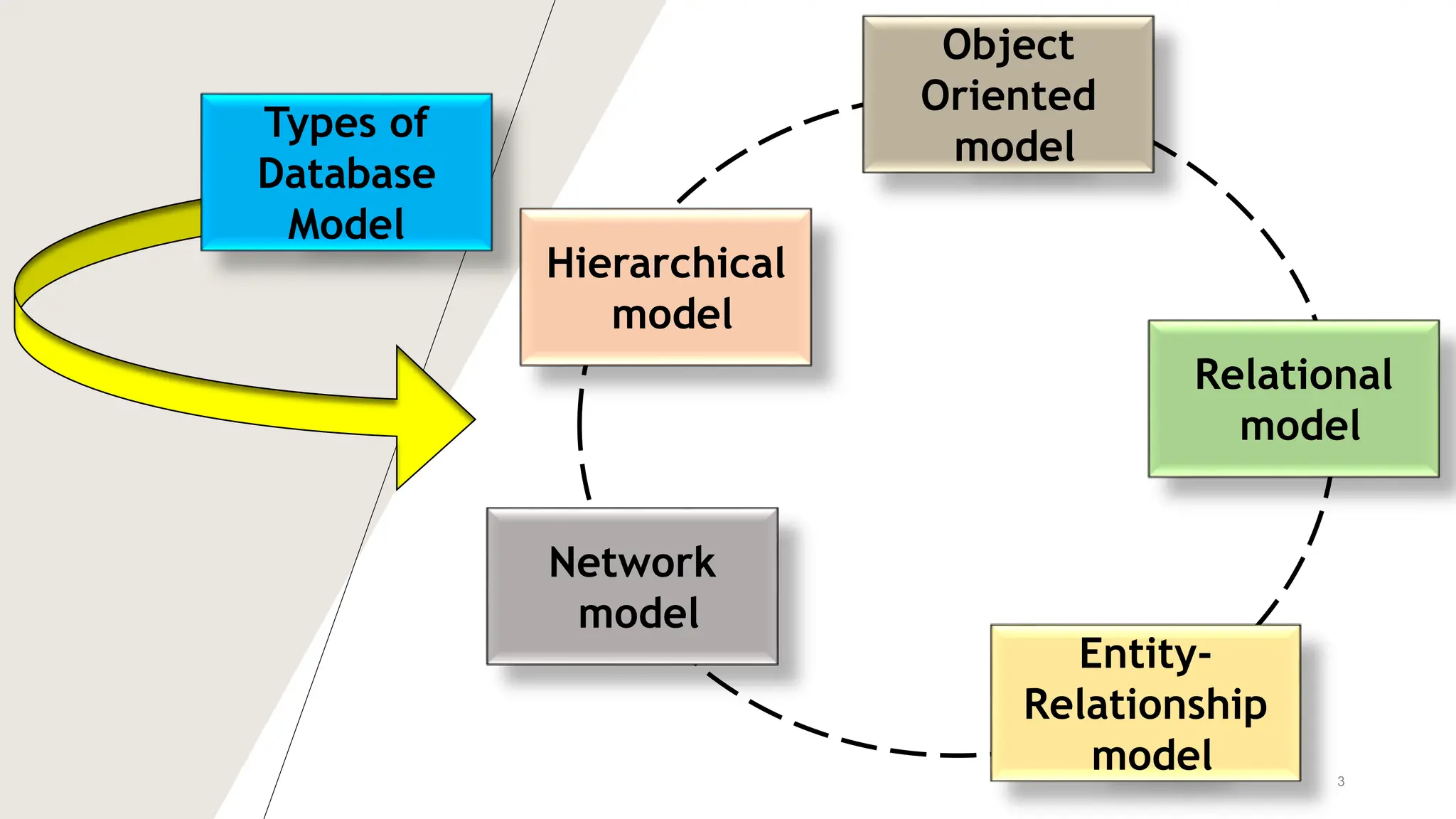
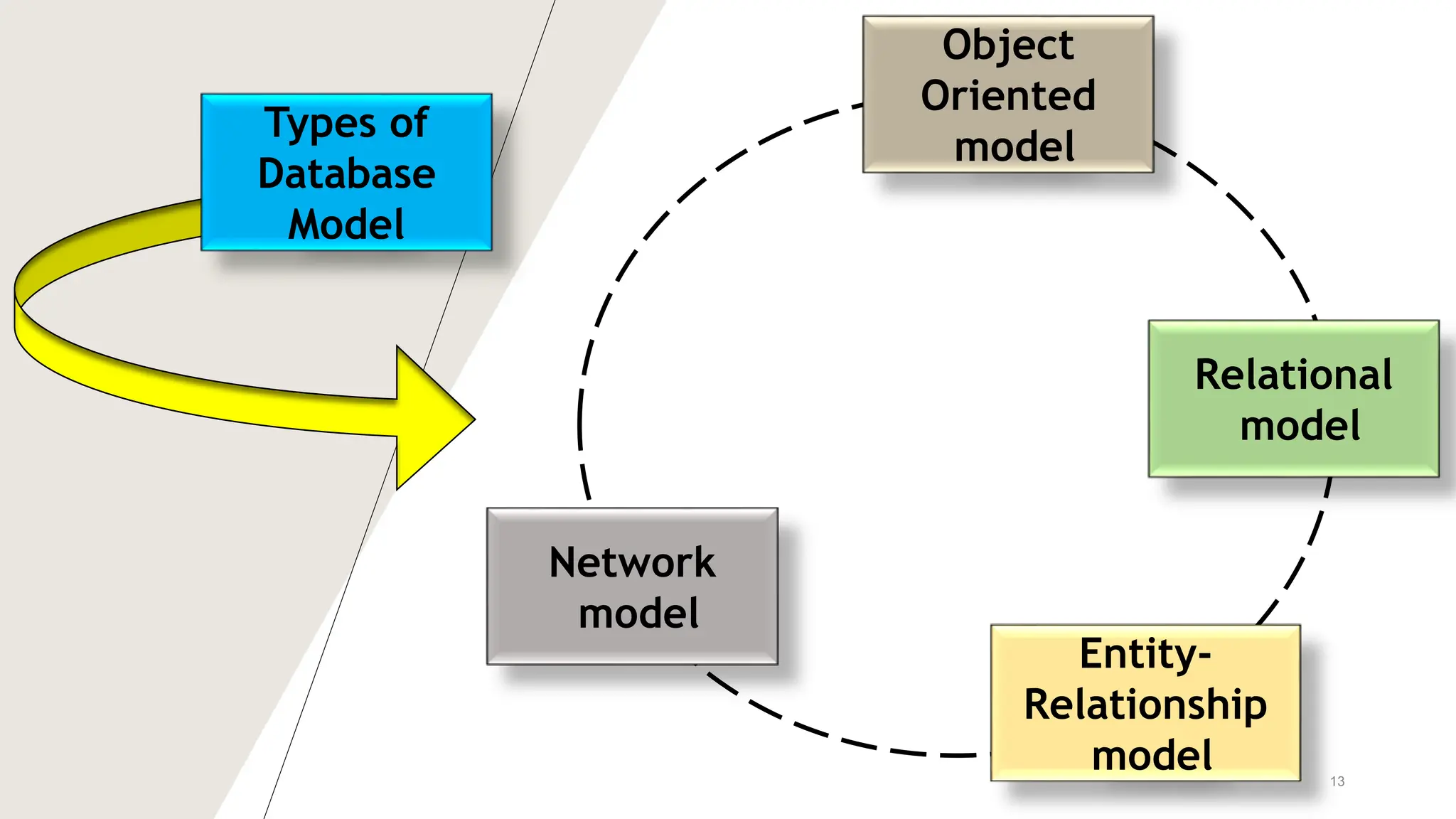
Object
Oriented
model
Hierarchical
model
Network
model
Entity-
Relationship
model
Relational
model
Types of
Database
Model
4
Object
Oriented
model
Types of
Database
Model
OBJECT ORIENTED MODEL
An object-oriented Database is a type of database management
system that is designed to store and manage complex data
structure and relationships. It is based on the principles of object-
oriented programming where the data is organized into objects
and defined characteristics and behaviours.
5
6
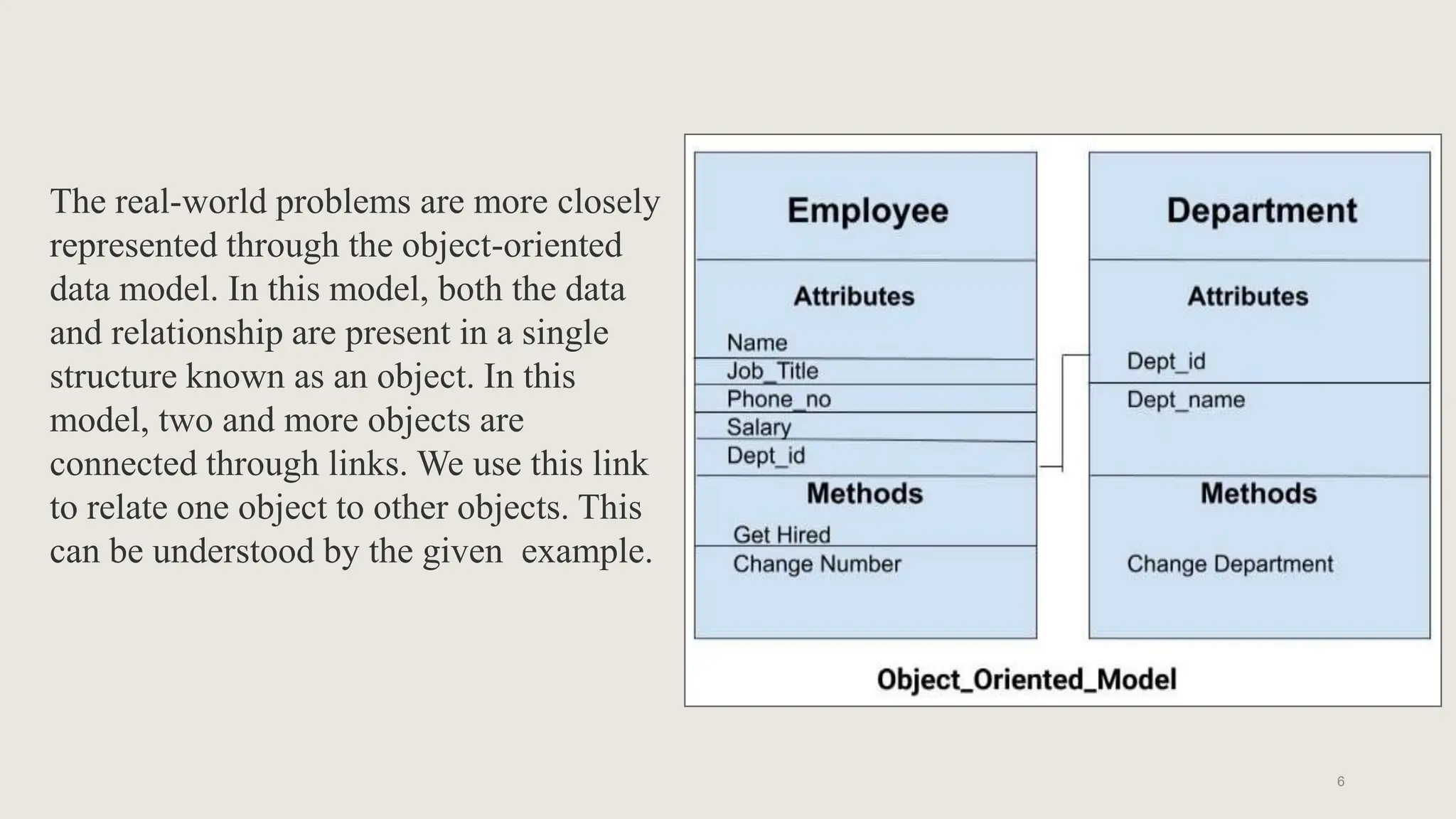
The real-world problems are more closely
represented through the object-oriented
data model. In this model, both the data
and relationship are present in a single
structure known as an object. In this
model, two and more objects are
connected through links. We use this link
to relate one object to other objects. This
can be understood by the given example.
7
Object
Oriented
model
Entity-
Relationship
model
Types of
Database
Model
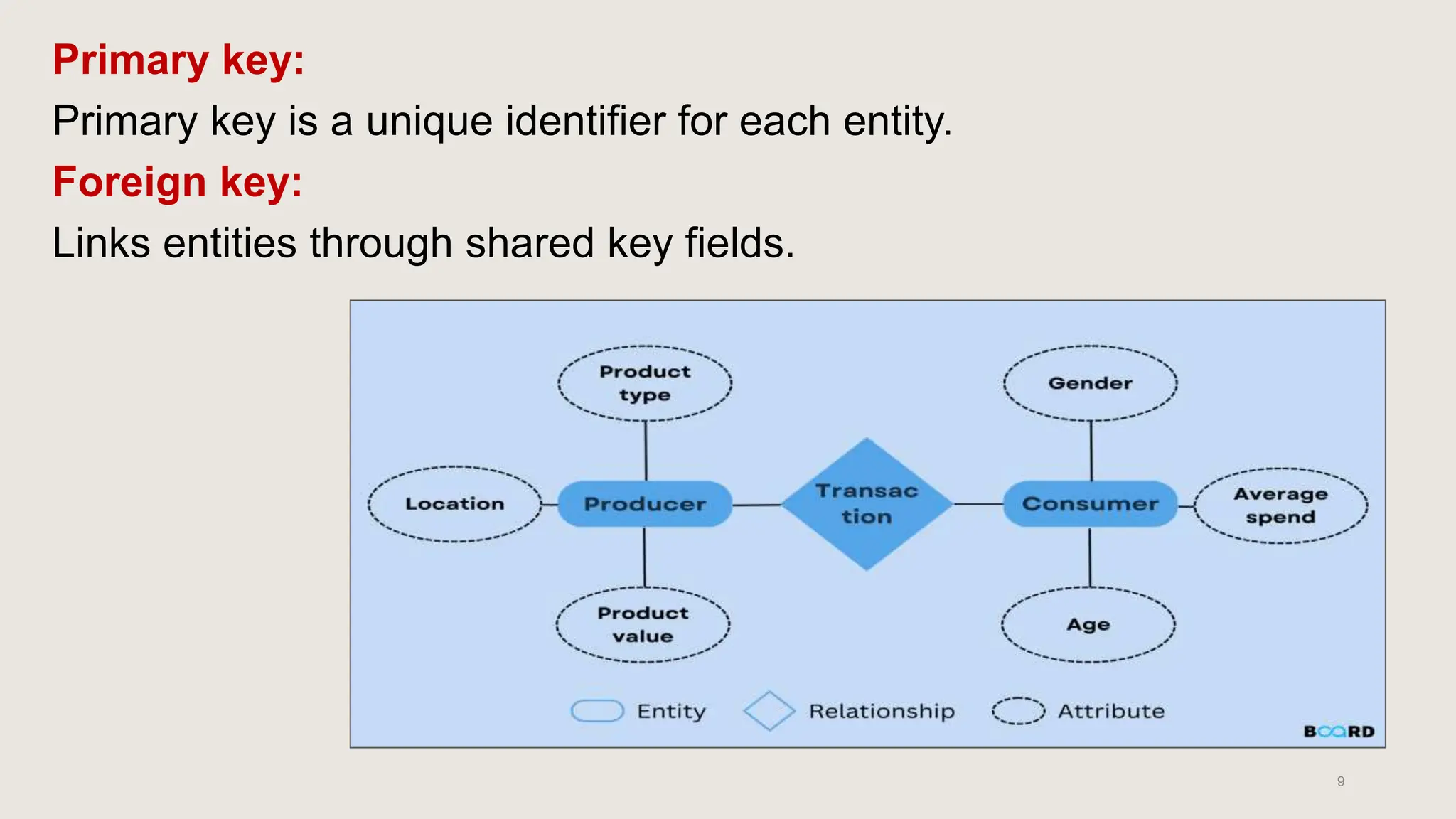
ENTITY-RELATION MODEL
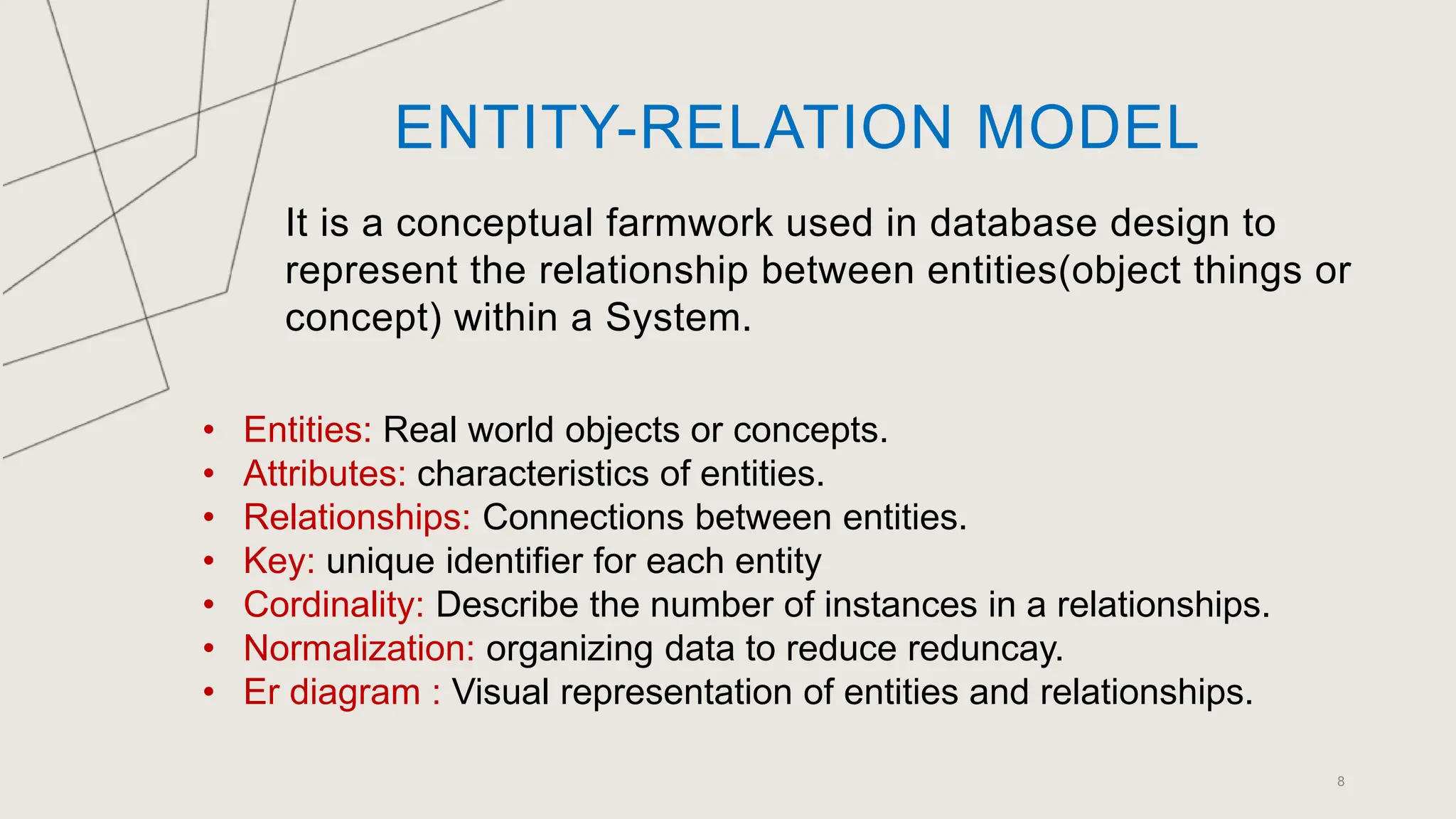
It is a conceptual farmwork used in database design to
represent the relationship between entities(object things or
concept) within a System.
8
• Entities: Real world objects or concepts.
• Attributes: characteristics of entities.
• Relationships: Connections between entities.
• Key: unique identifier for each entity
• Cordinality: Describe the number of instances in a relationships.
• Normalization: organizing data to reduce reduncay.
• Er diagram : Visual representation of entities and relationships.
9
Primary key:
Primary key is a unique identifier for each entity.
Foreign key:
Links entities through shared key fields.
10
Object
Oriented
model
Entity-
Relationship
model
Relational
model
Types of
Database
Model
RATIONAL MODEL
Rational Model database management system concept that
organize data into table each with rows and columns.
11
• flexibility: Adatable for various types of data and application.
• Tables: Represent entities each specific attributes.
• Data integrity: Ensures consistency & accuracy through
constraints.
• Normalization: Aims to eliminate redundancy and enhance data
integrity.
12
Primary key:
• Primary key is a unique identifier for a
record in a database table.
• It must have a unique value for each record
and cannot have null value.
Foreign key:
• It is a column or a set of columns in a
database table that refers to the privacy
key of another table.
• Foreign key helps maintain relationship
between tables in a relational database
ensuring consistency dpreventing orhanced
records.
13
Object
Oriented
model
Network
model
Entity-
Relationship
model
Relational
model
Types of
Database
Model
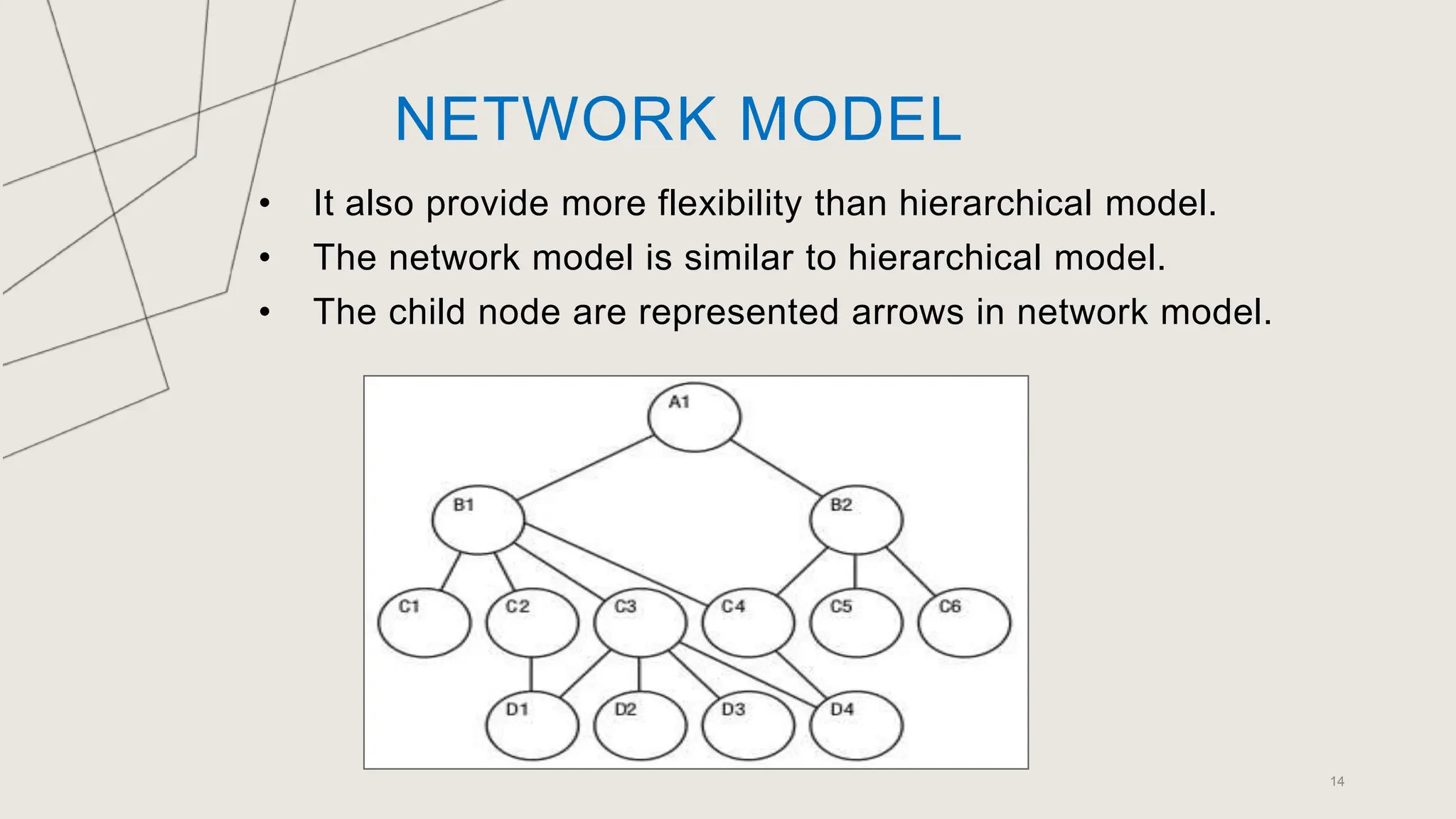
NETWORK MODEL
• It also provide more flexibility than hierarchical model.
• The network model is similar to hierarchical model.
• The child node are represented arrows in network model.
14
15
16
Object
Oriented
model
Hierarchical
model
Network
model
Entity-
Relationship
model
Relational
model
Types of
Database
Model
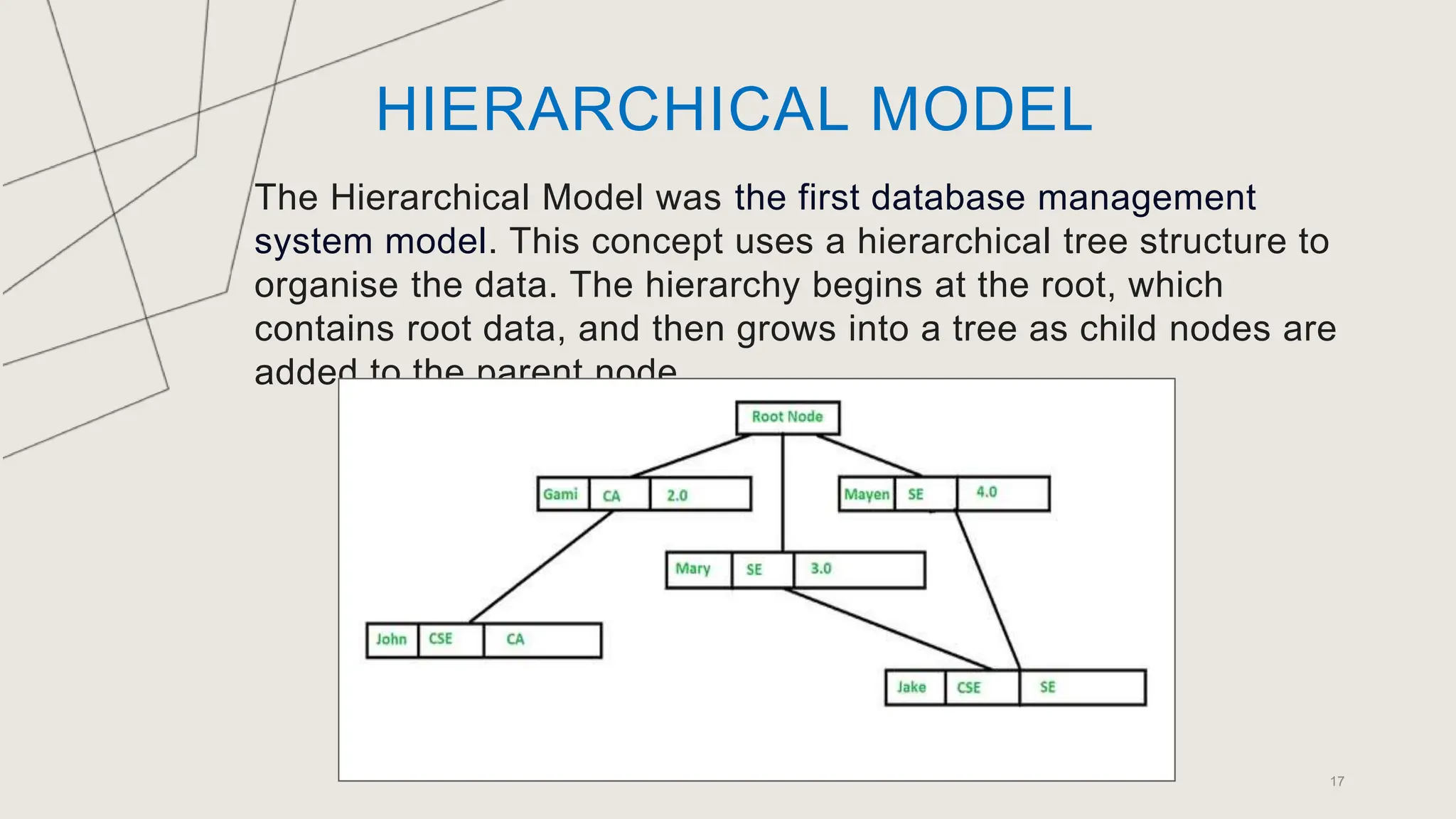
HIERARCHICAL MODEL
The Hierarchical Model was the first database management
system model. This concept uses a hierarchical tree structure to
organise the data. The hierarchy begins at the root, which
contains root data, and then grows into a tree as child nodes are
added to the parent node.
17
18
THANK
YOU
Database Model 19

database-model group presentation.pptx