Database System Data Hardware Software Users Operational Data Why Database? Data Independence An architecture for a database system Distributed Databases
Similar to Database System Data Hardware Software Users Operational Data Why Database? Data Independence An architecture for a database system Distributed Databases
Database System Data Hardware Software Users Operational Data Why Database? Data Independence An architecture for a database system Distributed Databases
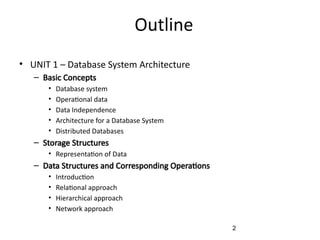
Outline
2
• UNIT 1– Database System Architecture
– Basic Concepts
• Database system
• Operational data
• Data Independence
• Architecture for a Database System
• Distributed Databases
– Storage Structures
• Representation of Data
– Data Structures and Corresponding Operations
• Introduction
• Relational approach
• Hierarchical approach
• Network approach
3.
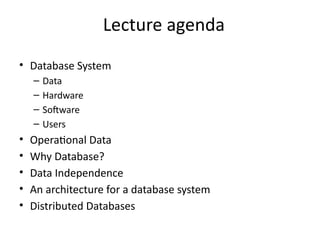
Lecture agenda
• DatabaseSystem
– Data
– Hardware
– Software
– Users
• Operational Data
• Why Database?
• Data Independence
• An architecture for a database system
• Distributed Databases
4.
Expected Outcome
• Fromthis Session, The student will know
about
• Database meaning and its architecture
• How is represent data in database
• What are the different approaches in the
Database
5.
Database System
• Acomputerized record keeping system.
• Purpose: To store information and allow users to retrieve and update the
information on demand.
• Database - Definition:
1. A Database is a collection of data, typically describing the activities of
one or more organizations.
2. A Database is a collection of persistent or stored operational data used
by the application systems of some particular enterprise.
• Example – University Database might contain information about
– Students
– Faculty
– Courses
– Classrooms
6.
Database System
Variety ofoperations that can be performed on
a database is:
• Adding new files to the database
• Inserting data into the existing files
• Retrieving data from existing files
• Deleting data from existing files
• Changing data in existing files
• Removing existing files from the database
7.
Database System
• DBMS– Definition
A database Management System, or DBMS, is a software
designed to assist in maintaining and utilizing large collections of
data.
• Goal of DBMS
To provide a way to store and retrieve database information in a
– convenient and
– Efficient manner
• Necessary for the decision-making processes involved in the
management of an organization.
Database System
• Functionsof DBMS:
– Defining structure for data storage
– Providing mechanisms for manipulation of data
– Ensure safety of data (system crashes, unauthorized access,
misused, …)
– Concurrent control in multi-user environment
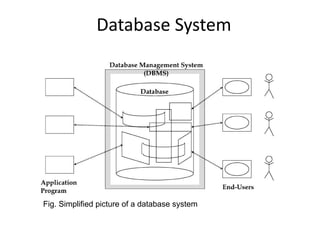
• Four major components of a database system:
– Data
– Hardware
– Software
– Users
10.
Database System
• Data– A collection of raw facts and figures is
called as data.
• The word raw means that the facts have not yet
been processed to get their exact meaning.
• Example – Students admission form
• The form consists of raw facts about the
students.
• These raw facts are student’s name, father name,
address etc.
11.
Database System
• Datais collected from different sources for
different purposes.
• Data may consist of
– Numbers
– Characters
– Symbols
– pictures etc.
12.
Database System
• Adatabase, which is a repository of data is both
– Integrated &
– Shared
• Integrated database
– Unification of several distinct data files without redundancies.
– Example: Employee database contains both employee and enrollment record
• EMPLOYEE records
– Contains the fields
» Name
» Address
» Department
» Salary etc.,
• ENROLLMENT records
– Represents the enrollment of employees in training course
– Makes the course administration easier without redundancies
13.
Database System
• Shareddatabase
– Individual pieces of data in the database may be shared among
several different users.
– Only if the database is integrated the data in it can be shared.
– Example: Employee record is shared by users in the personnel
department and education department.
• Concurrent sharing
– Ability for several users to access the same piece of data at the
same time in a database.
• Multiuser system
– A database system that supports concurrent sharing is referred to
as multiuser system.
14.
Database System
Hardware
• Adatabase system consists of secondary
storage volumes – magnetic disks, drums, etc.,
• Database resides on it with associated I/O
devices, device controllers, IO channels etc.,
• The hardware – processors and main memory
are used to support the execution of database
system software.
15.
Database System
Software
• Softwareis instructions that can be stored and run by
hardware.
• DBMS is a software which resides between physical
database and the user of the system.
• All requests from users for access to the database is
handled by the DBMS.
• DBMS shields users from the hardware-level details.
• Operations supported by the DBMS are:
– Create, Insert, Update, Delete, Select, Alter, Drop etc.,
16.
Database System
Users
• 3broad classes of users:
– Application programmer
– End-user
– Database administrator(DBA)
• Application programmer
– Responsible for writing application programs to use the database.
– Application programs performs operations on the data such as
» Creating new information
» Retrieving information
» Deleting and modifying existing information
– Application programs may be
» Conventional batch application or
» On-line programs
17.
Database System
• End-user
–Access the database interactively from the terminal
– End user may use
• query language or
• Interfaces provided by the applications
– User may perform functions such as
• Retrieval
• Creation
• Deletion
• Modification
– Retrieval is the most common function of the end user
18.
Database System
Database Administrator(DBA)
• A DBA is responsible for the
– performance, integrity and security of a database.
– planning and development of the database
– troubleshooting any issues on behalf of the users.
• A DBA makes sure that databases have the following qualities:
– data remains consistent across the database
– data is clearly defined
– users access data concurrently, in a form that suits their needs
– there is provision for data security and recovery control
• DBA roles vary depending on the type of database, the processes they
administer and the capabilities of DBMS in use.
19.
Database System
Database Administrator(DBA)
• A DBA is responsible for the
– performance, integrity and security of a database.
– planning and development of the database
– troubleshooting any issues on behalf of the users.
• A DBA makes sure that databases have the following qualities:
– data remains consistent across the database
– data is clearly defined
– users access data concurrently, in a form that suits their needs
– there is provision for data security and recovery control
• DBA roles vary depending on the type of database, the processes they
administer and the capabilities of DBMS in use.
20.
Multiple Choice Questions
1)__________isthe collection of raw facts
A)Data b)information c)program
2)Who is responsible for writing programs to
database?
a)End user b)Application Programmer c)DBA
3) Individual pieces of data in the database may be
shared among several different users____________
a)Concurrent Users b)Shared Database c)Multiuser
system
21.
Contd…
4)_______is the mostcommon end function of the end user
• A)Retrivel b)insertion c)Sorting
5)__________ vary depending on the type of database, the
processes they administer and the capabilities of DBMS in
use.
A)DBA b)DML c)DDL
Anwers
1)A 2)b 3)b 4)a 5) a
Points to Ponder
•A database system consists of secondary storage volumes –
magnetic disks, drums, etc
• Application programs performs operations on the data such as
Creating new information, Retrieving information, Deleting
and modifying existing information
• DBA roles vary depending on the type of database, the
processes they administer and the capabilities of DBMS in
use.
• All requests from users for access to the database is handled
by the DBMS.
24.
Summary of theClass and Next
Lecture
• A database system consists of secondary storage volumes –
magnetic disks, drums, etc
• Application programs performs operations on the data such as
Creating new information, Retrieving information, Deleting
and modifying existing information
• DBA roles vary depending on the type of database, the
processes they administer and the capabilities of DBMS in
use.
• All requests from users for access to the database is handled
by the DBMS.
• The Next section is Operational Data