Fundamental of Database System
Chapter One:
Introduction to Database System
PreparedBy:-Mr.AbdurehmanM.(MSC.)
Gmail:-abdure288@gmail.com
Mettu University
Mr. Abdurehman M. , MeU 1
Contents of the Chapter
Mr. Abdurehman M. MeU 2
❖ Introduction of Database system
❖ Data management approaches
❖ DBMS and Components of DBMS
❖ Database development life cycles
❖ Users of the database system (DBA,
DBD & user )
❖ The ANSI-SPARC Architecture
❖ Database Languages (DDL, DML,DCL)
Terminologies of Database
System
Mr. Abdurehman M. MeU 3
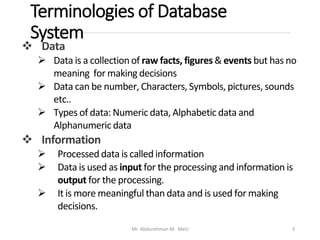
❖ Data
➢ Data is a collection of raw facts, figures& events but has no
meaning for making decisions
➢ Data can be number, Characters, Symbols, pictures, sounds
etc..
➢ Types of data: Numeric data, Alphabetic data and
Alphanumeric data
❖ Information
➢ Processed data is called information
➢ Data is used as input for the processing and information is
output for the processing.
➢ It is more meaningful than data and is used for making
decisions.
Terminologies of Database System..
Mr. Abdurehman M. MeU 4
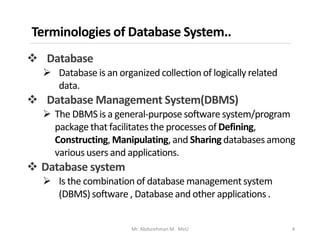
❖ Database
➢ Database is an organized collection of logically related
data.
❖ Database Management System(DBMS)
➢ The DBMS is a general-purpose software system/program
package that facilitates the processes of Defining,
Constructing, Manipulating, and Sharing databases among
various users and applications.
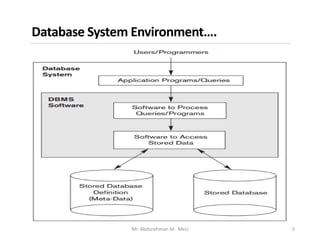
❖ Database system
➢ Is the combination of database management system
(DBMS) software , Database and other applications .
Database System Environment….
Mr. Abdurehman M. MeU 5
Data management
approaches
Mr. Abdurehman M. MeU 6
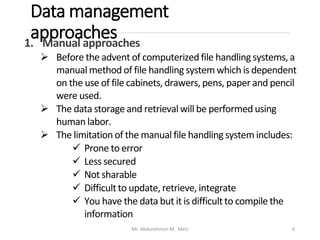
1. Manual approaches
➢ Before the advent of computerized file handling systems, a
manual method of file handling system which is dependent
on the use of file cabinets, drawers, pens, paper and pencil
were used.
➢ The data storage and retrieval will be performed using
human labor.
➢ The limitation of the manual file handling system includes:
✓ Prone to error
✓ Less secured
✓ Not sharable
✓ Difficultto update, retrieve, integrate
✓ You have the data but it is difficultto compile the
information
Data management
approaches…
Mr. Abdurehman M. MeU 7
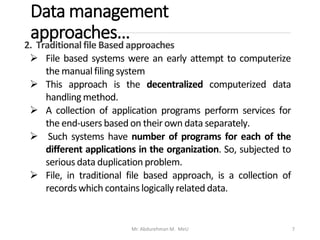
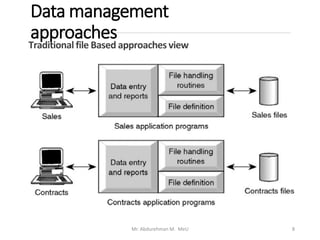
2. Traditional file Based approaches
➢ File based systems were an early attempt to computerize
the manual filing system
➢ This approach is the decentralized computerized data
handling method.
➢ A collection of application programs perform services for
the end-users based on their own data separately.
➢ Such systems have number of programs for each of the
different applications in the organization. So, subjected to
serious data duplication problem.
➢ File, in traditional file based approach, is a collection of
records which containslogically related data.
Data management
approaches
Mr. Abdurehman M. MeU 8
Traditional file Based approaches view
Limitation of File Based Approach
Mr. Abdurehman M. MeU 9
➢ Redundancy or duplication of data
➢ Data inconsistency
➢ Difficult data Isolation
➢ Integrity Problems
➢ Security Problems/No authorized and
authentication facilities
➢ Data dependency on the application or file
➢ Limited data sharing
➢ Lengthy development and maintenance time
➢ Incompatible file formats between different
applications and programs.
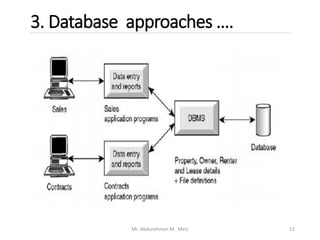
3. Database approaches
Mr. Abdurehman M. MeU 10
➢ To become more effective computerized record keeping
system, a new approach was required by the name
database approach.
➢ This approach is the centralized computerized data
handling method.
➢ Database is a collection of logically related data where
these logically related data comprises entities, attributes,
relationships, and constraints or business rules of an
organization's information
➢ In addition to containing data required by an organization,
database also contains a description of the data which
called as “Metadata” or “Data Dictionary” or “Systems
Catalogue” or “Data about Data” or
3. Database approaches ….
Mr. Abdurehman M. MeU 11
➢ The purpose of database is to:-
▪ Store information and
▪ To allow users to retrieve and update that information
on demand.
➢ Each database application will perform the combination of:
▪ Creating database
▪ Reading
▪ Updating and Deleting data.
➢ Unlike the traditional file based approach in database
approach there is program data independence.
➢ Database is designed once and used simultaneously by
many users.
3. Database approaches ….
Mr. Abdurehman M. MeU 12
Benefit of Database
approach
Mr. Abdurehman M. MeU 13
➢ Data can be shared: two or more users can access and
use same data instead of storing data in redundant
manner for each user.
➢ Improved accessibility of data: by using structured
query languages, the users can easily access data
without programming experience.
➢ Redundancy can be reduced: isolated data is integrated
in database to decrease the redundant data stored at
different applications.
➢ Inconsistency can be avoided: controlled data
redundancy will avoid inconsistency of the data in the
database to some extent.
Benefit of Database
approach…
Mr. Abdurehman M. MeU 14
➢ Integrity can be maintained: data at different applications
will be integrated together with additional constraints to
facilitate shared data resource.
➢ Security measures can be enforced: the shared data can
be secured by having different levels of clearance and
other data security mechanisms.
➢ Centralized information control: it can be controlled and
managed at the central level
❖ Some common application area of Database system
➢ University , Bank
➢ Airline , Human resources
➢ Library , Sales
➢ Credit and transaction
Limitations and risk of Database Approach
Mr. Abdurehman M. MeU 15
➢ Introduction of new professional and
specialized personnel.
➢ Complexity in designing and managing data
➢ High cost to be incurred to develop and maintain
the system
➢ Complex backup and recovery services from the
users perspective
➢ Reduced performance due to centralization and
data independence
➢ High impact on the system when failure occurs
to the central system.
DBMS and Components
Mr. Abdurehman M. MeU 16
DBMS is a general-purpose software system that
facilitates the processes of
➢ Defining database :-involves specifying the structures, data types
and constraints of the data to be stored in the data-base.
➢ The database definition or descriptive information is also stored
by the DBMS in the form of a database catalog or dictionary; it is
called meta-data.
➢ Constructing the database is the process of storing the data on
some storage medium that is controlled by the DBMS.
➢ Manipulating a database includes functions such as retrieving
and updating specific data from database and generating reports
from the data.
➢ Sharing a database allows multiple users and programs to access
the database simultaneously
A Various Common of DBMS
Mr. Abdurehman M. MeU 17
❖ Server DBMS
❖Oracle
❖ SQL Server
❖DB2
❖MySQL, Firebird, PostgreSQL (Significant
open source DBMSs)
❖ Desktop DBMS
➢ Microsoft Access
➢ FoxPro, Paradox, Approach, FileMaker Pro
Database development life
cycles
Mr. Abdurehman M. MeU 18
As it is one component in most information system
development tasks, there are several steps in designing a
database system.
1. Planning: that is identifying information gap in an
organization and propose a database solution to solve
the problem.
2. Analysis: that concentrates more on fact finding about
the problem or the opportunity. Feasibility analysis,
requirement determination and structuring, and
selection of best design method are also performed at
this phase.
Database development life
cycles…
Mr. Abdurehman M. MeU 19
3. Design: in database designing more emphasis is given
to this phase. The phase is further divided into three sub-
phases.
A. Conceptual Design: concise description of the data,
data type, relationship between data and constraints
on the data. There is no implementation or physical
detail consideration. Used to elicit and structure all
information requirements
B. Logical Design: a higher level conceptual abstraction
with selected specific data model to implement the
data structure. It is particular DBMS independent and
with no other physical considerations.
Database development life
cycles…
Mr. Abdurehman M. MeU 20
C. Physical Design: physical implementation of the lower
level design of the database with respect to internal
storage and file structure of the database for the selected
DBMS.
• To develop all technology and organizational
specification.
4. Implementation: the testing and deployment of the
designed database for use.
5. Operation and Support: administering and maintaining
the operation of the database system and providing
support to users.
Users of the database system
Mr. Abdurehman M. MeU 21
Users of data bases system may be divided into:
➢ Those who actually use and control the content (called
“Actors on the Scene”) and
➢ Those who enable the database to be developed and
the DBMS software to be designed and implemented
(called “Workers Behind the Scene”).
1) Database administrators: responsible for authorizing
access to the database, for co-ordinating and
monitoring its use, acquiring software, and hardware
resources, controlling its use and monitoring efficiency
of operations
Users of the database system…
Mr. Abdurehman M. MeU 22
2) Database Designers: responsible to define the
content, the structure, the constraints, and functions
or transactions against the database. They must
communicate with the end-users and understand
their needs.
3. Application developer: are software programmers
that designs and implements the application
programs to be used as an interface for the database
system and for manipulating the data in the
database.
Users of the database system…
Mr. Abdurehman M. MeU 23
4) End-users: they use the data for , reports and some of them actually
update the database content
▪ Casual : access database occasionally when needed
▪ Naïve or Parametric: they make up a large section of the end-user
population. They use previously well-defined functions in the form
of “canned transactions” against the database. Examples are bank-
tellers or reservation clerks who do this activity for an entire shift of
operations.
▪ Sophisticated : these include business analysts, scientists,
engineers, others thoroughly familiar with the system capabilities.
Many use tools in the form of software packages that work closely
with the stored database.
▪Stand-alone : mostly maintain personal databases using ready-to-
use packaged applications.An example is a tax program user that
creates his or her own internal database.
The ANSI-SPARC Architecture
Mr. Abdurehman M. MeU 24
❖The major purpose of a database system is to provide
users with an abstract view of the system which some
time referred as architecture of the system
❖The main purpose is:
▪ To hide the complicity from the database users (
how to design and store) and
▪ To enable data independence among
development phases
❖There are three schema/levels of abstraction of the
database architecture:
➢ External/View level
➢ Logical or Conceptual level
➢ Physical/ internal level
The ANSI-SPARC Architecture of DB
Mr. Abdurehman M. MeU 25
❖External Level: Users' view of the database. Describes
that part of database that is relevant to a particular
user. Different users have their own customized view
of the database independent of other users.
❖Conceptual Level: Community view of the database.
Describes what data is stored in database and
relationships among the data.
❖Internal Level: Physical representation of the
database on the computer. Describes how the data is
stored in the database.
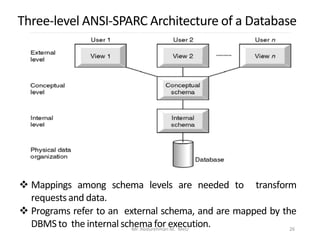
Three-level ANSI-SPARC Architecture of a Database
Mr. Abdurehman M. MeU 26
❖ Mappings among schema levels are needed to transform
requestsand data.
❖ Programs refer to an external schema, and are mapped by the
DBMS to the internal schema for execution.
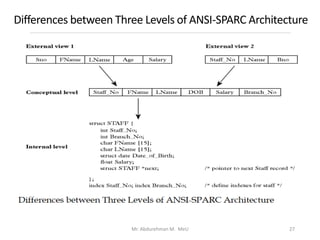
Differences between Three Levels of ANSI-SPARC Architecture
Mr. Abdurehman M. MeU 27
Database Languages (DDL,
DML,DCL)
Mr. Abdurehman M. MeU 28
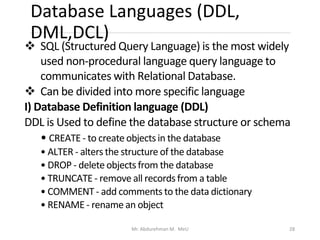
❖ SQL (Structured Query Language) is the most widely
used non-procedural language query language to
communicates with Relational Database.
❖ Can be divided into more specific language
I) Database Definition language (DDL)
DDL is Used to define the database structure or schema
• CREATE - to create objects in the database
• ALTER - alters the structure of the database
• DROP - delete objects from the database
• TRUNCATE - remove all records from a table
• COMMENT - add comments to the data dictionary
• RENAME - rename an object
Database Languages (DDL, DML,DCL)
Mr. Abdurehman M. MeU 29
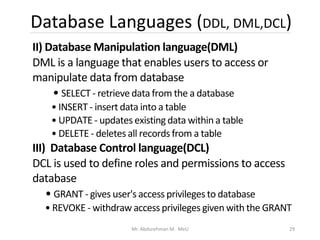
II) Database Manipulation language(DML)
DML is a language that enables users to access or
manipulate data from database
• SELECT - retrieve data from the a database
• INSERT - insert data into a table
• UPDATE - updates existing data within a table
• DELETE - deletes all records from a table
III) Database Control language(DCL)
DCL is used to define roles and permissions to access
database
• GRANT - gives user's access privileges to database
• REVOKE - withdraw access privileges given with the GRANT
Review Questions
Mr. Abdurehman M. MeU 30
❖ Differences between data, database, information and metadata
❖ What are the disadvantagesof file processing?
❖ What is the database approach?
❖ What are the advantagesof the database approach?
❖ What are the costs and risks of the database approach?
❖ What are the componentsof the database environment?
❖ What are the database development life cycle?
❖ What are the users (actors and workers) and their roles in DB?
❖ What are The three-level Architecture of database)
❖ What are the databaseLanguages?
Mr. Abdurehman M. MeU 31

Chapter 01 Fundamental of Database Management System (DBMS)

  • 1.
    Fundamental of DatabaseSystem Chapter One: Introduction to Database System PreparedBy:-Mr.AbdurehmanM.(MSC.) Gmail:-abdure288@gmail.com Mettu University Mr. Abdurehman M. , MeU 1
  • 2.
    Contents of theChapter Mr. Abdurehman M. MeU 2 ❖ Introduction of Database system ❖ Data management approaches ❖ DBMS and Components of DBMS ❖ Database development life cycles ❖ Users of the database system (DBA, DBD & user ) ❖ The ANSI-SPARC Architecture ❖ Database Languages (DDL, DML,DCL)
  • 3.
    Terminologies of Database System Mr.Abdurehman M. MeU 3 ❖ Data ➢ Data is a collection of raw facts, figures& events but has no meaning for making decisions ➢ Data can be number, Characters, Symbols, pictures, sounds etc.. ➢ Types of data: Numeric data, Alphabetic data and Alphanumeric data ❖ Information ➢ Processed data is called information ➢ Data is used as input for the processing and information is output for the processing. ➢ It is more meaningful than data and is used for making decisions.
  • 4.
    Terminologies of DatabaseSystem.. Mr. Abdurehman M. MeU 4 ❖ Database ➢ Database is an organized collection of logically related data. ❖ Database Management System(DBMS) ➢ The DBMS is a general-purpose software system/program package that facilitates the processes of Defining, Constructing, Manipulating, and Sharing databases among various users and applications. ❖ Database system ➢ Is the combination of database management system (DBMS) software , Database and other applications .
  • 5.
  • 6.
    Data management approaches Mr. AbdurehmanM. MeU 6 1. Manual approaches ➢ Before the advent of computerized file handling systems, a manual method of file handling system which is dependent on the use of file cabinets, drawers, pens, paper and pencil were used. ➢ The data storage and retrieval will be performed using human labor. ➢ The limitation of the manual file handling system includes: ✓ Prone to error ✓ Less secured ✓ Not sharable ✓ Difficultto update, retrieve, integrate ✓ You have the data but it is difficultto compile the information
  • 7.
    Data management approaches… Mr. AbdurehmanM. MeU 7 2. Traditional file Based approaches ➢ File based systems were an early attempt to computerize the manual filing system ➢ This approach is the decentralized computerized data handling method. ➢ A collection of application programs perform services for the end-users based on their own data separately. ➢ Such systems have number of programs for each of the different applications in the organization. So, subjected to serious data duplication problem. ➢ File, in traditional file based approach, is a collection of records which containslogically related data.
  • 8.
    Data management approaches Mr. AbdurehmanM. MeU 8 Traditional file Based approaches view
  • 9.
    Limitation of FileBased Approach Mr. Abdurehman M. MeU 9 ➢ Redundancy or duplication of data ➢ Data inconsistency ➢ Difficult data Isolation ➢ Integrity Problems ➢ Security Problems/No authorized and authentication facilities ➢ Data dependency on the application or file ➢ Limited data sharing ➢ Lengthy development and maintenance time ➢ Incompatible file formats between different applications and programs.
  • 10.
    3. Database approaches Mr.Abdurehman M. MeU 10 ➢ To become more effective computerized record keeping system, a new approach was required by the name database approach. ➢ This approach is the centralized computerized data handling method. ➢ Database is a collection of logically related data where these logically related data comprises entities, attributes, relationships, and constraints or business rules of an organization's information ➢ In addition to containing data required by an organization, database also contains a description of the data which called as “Metadata” or “Data Dictionary” or “Systems Catalogue” or “Data about Data” or
  • 11.
    3. Database approaches…. Mr. Abdurehman M. MeU 11 ➢ The purpose of database is to:- ▪ Store information and ▪ To allow users to retrieve and update that information on demand. ➢ Each database application will perform the combination of: ▪ Creating database ▪ Reading ▪ Updating and Deleting data. ➢ Unlike the traditional file based approach in database approach there is program data independence. ➢ Database is designed once and used simultaneously by many users.
  • 12.
    3. Database approaches…. Mr. Abdurehman M. MeU 12
  • 13.
    Benefit of Database approach Mr.Abdurehman M. MeU 13 ➢ Data can be shared: two or more users can access and use same data instead of storing data in redundant manner for each user. ➢ Improved accessibility of data: by using structured query languages, the users can easily access data without programming experience. ➢ Redundancy can be reduced: isolated data is integrated in database to decrease the redundant data stored at different applications. ➢ Inconsistency can be avoided: controlled data redundancy will avoid inconsistency of the data in the database to some extent.
  • 14.
    Benefit of Database approach… Mr.Abdurehman M. MeU 14 ➢ Integrity can be maintained: data at different applications will be integrated together with additional constraints to facilitate shared data resource. ➢ Security measures can be enforced: the shared data can be secured by having different levels of clearance and other data security mechanisms. ➢ Centralized information control: it can be controlled and managed at the central level ❖ Some common application area of Database system ➢ University , Bank ➢ Airline , Human resources ➢ Library , Sales ➢ Credit and transaction
  • 15.
    Limitations and riskof Database Approach Mr. Abdurehman M. MeU 15 ➢ Introduction of new professional and specialized personnel. ➢ Complexity in designing and managing data ➢ High cost to be incurred to develop and maintain the system ➢ Complex backup and recovery services from the users perspective ➢ Reduced performance due to centralization and data independence ➢ High impact on the system when failure occurs to the central system.
  • 16.
    DBMS and Components Mr.Abdurehman M. MeU 16 DBMS is a general-purpose software system that facilitates the processes of ➢ Defining database :-involves specifying the structures, data types and constraints of the data to be stored in the data-base. ➢ The database definition or descriptive information is also stored by the DBMS in the form of a database catalog or dictionary; it is called meta-data. ➢ Constructing the database is the process of storing the data on some storage medium that is controlled by the DBMS. ➢ Manipulating a database includes functions such as retrieving and updating specific data from database and generating reports from the data. ➢ Sharing a database allows multiple users and programs to access the database simultaneously
  • 17.
    A Various Commonof DBMS Mr. Abdurehman M. MeU 17 ❖ Server DBMS ❖Oracle ❖ SQL Server ❖DB2 ❖MySQL, Firebird, PostgreSQL (Significant open source DBMSs) ❖ Desktop DBMS ➢ Microsoft Access ➢ FoxPro, Paradox, Approach, FileMaker Pro
  • 18.
    Database development life cycles Mr.Abdurehman M. MeU 18 As it is one component in most information system development tasks, there are several steps in designing a database system. 1. Planning: that is identifying information gap in an organization and propose a database solution to solve the problem. 2. Analysis: that concentrates more on fact finding about the problem or the opportunity. Feasibility analysis, requirement determination and structuring, and selection of best design method are also performed at this phase.
  • 19.
    Database development life cycles… Mr.Abdurehman M. MeU 19 3. Design: in database designing more emphasis is given to this phase. The phase is further divided into three sub- phases. A. Conceptual Design: concise description of the data, data type, relationship between data and constraints on the data. There is no implementation or physical detail consideration. Used to elicit and structure all information requirements B. Logical Design: a higher level conceptual abstraction with selected specific data model to implement the data structure. It is particular DBMS independent and with no other physical considerations.
  • 20.
    Database development life cycles… Mr.Abdurehman M. MeU 20 C. Physical Design: physical implementation of the lower level design of the database with respect to internal storage and file structure of the database for the selected DBMS. • To develop all technology and organizational specification. 4. Implementation: the testing and deployment of the designed database for use. 5. Operation and Support: administering and maintaining the operation of the database system and providing support to users.
  • 21.
    Users of thedatabase system Mr. Abdurehman M. MeU 21 Users of data bases system may be divided into: ➢ Those who actually use and control the content (called “Actors on the Scene”) and ➢ Those who enable the database to be developed and the DBMS software to be designed and implemented (called “Workers Behind the Scene”). 1) Database administrators: responsible for authorizing access to the database, for co-ordinating and monitoring its use, acquiring software, and hardware resources, controlling its use and monitoring efficiency of operations
  • 22.
    Users of thedatabase system… Mr. Abdurehman M. MeU 22 2) Database Designers: responsible to define the content, the structure, the constraints, and functions or transactions against the database. They must communicate with the end-users and understand their needs. 3. Application developer: are software programmers that designs and implements the application programs to be used as an interface for the database system and for manipulating the data in the database.
  • 23.
    Users of thedatabase system… Mr. Abdurehman M. MeU 23 4) End-users: they use the data for , reports and some of them actually update the database content ▪ Casual : access database occasionally when needed ▪ Naïve or Parametric: they make up a large section of the end-user population. They use previously well-defined functions in the form of “canned transactions” against the database. Examples are bank- tellers or reservation clerks who do this activity for an entire shift of operations. ▪ Sophisticated : these include business analysts, scientists, engineers, others thoroughly familiar with the system capabilities. Many use tools in the form of software packages that work closely with the stored database. ▪Stand-alone : mostly maintain personal databases using ready-to- use packaged applications.An example is a tax program user that creates his or her own internal database.
  • 24.
    The ANSI-SPARC Architecture Mr.Abdurehman M. MeU 24 ❖The major purpose of a database system is to provide users with an abstract view of the system which some time referred as architecture of the system ❖The main purpose is: ▪ To hide the complicity from the database users ( how to design and store) and ▪ To enable data independence among development phases ❖There are three schema/levels of abstraction of the database architecture: ➢ External/View level ➢ Logical or Conceptual level ➢ Physical/ internal level
  • 25.
    The ANSI-SPARC Architectureof DB Mr. Abdurehman M. MeU 25 ❖External Level: Users' view of the database. Describes that part of database that is relevant to a particular user. Different users have their own customized view of the database independent of other users. ❖Conceptual Level: Community view of the database. Describes what data is stored in database and relationships among the data. ❖Internal Level: Physical representation of the database on the computer. Describes how the data is stored in the database.
  • 26.
    Three-level ANSI-SPARC Architectureof a Database Mr. Abdurehman M. MeU 26 ❖ Mappings among schema levels are needed to transform requestsand data. ❖ Programs refer to an external schema, and are mapped by the DBMS to the internal schema for execution.
  • 27.
    Differences between ThreeLevels of ANSI-SPARC Architecture Mr. Abdurehman M. MeU 27
  • 28.
    Database Languages (DDL, DML,DCL) Mr.Abdurehman M. MeU 28 ❖ SQL (Structured Query Language) is the most widely used non-procedural language query language to communicates with Relational Database. ❖ Can be divided into more specific language I) Database Definition language (DDL) DDL is Used to define the database structure or schema • CREATE - to create objects in the database • ALTER - alters the structure of the database • DROP - delete objects from the database • TRUNCATE - remove all records from a table • COMMENT - add comments to the data dictionary • RENAME - rename an object
  • 29.
    Database Languages (DDL,DML,DCL) Mr. Abdurehman M. MeU 29 II) Database Manipulation language(DML) DML is a language that enables users to access or manipulate data from database • SELECT - retrieve data from the a database • INSERT - insert data into a table • UPDATE - updates existing data within a table • DELETE - deletes all records from a table III) Database Control language(DCL) DCL is used to define roles and permissions to access database • GRANT - gives user's access privileges to database • REVOKE - withdraw access privileges given with the GRANT
  • 30.
    Review Questions Mr. AbdurehmanM. MeU 30 ❖ Differences between data, database, information and metadata ❖ What are the disadvantagesof file processing? ❖ What is the database approach? ❖ What are the advantagesof the database approach? ❖ What are the costs and risks of the database approach? ❖ What are the componentsof the database environment? ❖ What are the database development life cycle? ❖ What are the users (actors and workers) and their roles in DB? ❖ What are The three-level Architecture of database) ❖ What are the databaseLanguages?
  • 31.