DATABASE
APPLICATIONS
IN RESEARCH &
INDUSTRY
PRESENTED BY:
DR. AMAN BHARDWAJ
P.G. DEPARTMENT OF RAS SHASHTRA AND BHAISHJYA KALPANA
[M.M.M. GOVERNMENT AYURVEDA COLLEGE, UDAIPUR]
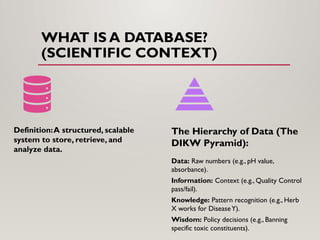
WHAT IS A DATABASE?
(SCIENTIFIC CONTEXT)
Definition:A structured, scalable
system to store, retrieve, and
analyze data.
The Hierarchy of Data (The
DIKW Pyramid):
Data: Raw numbers (e.g., pH value,
absorbance).
Information: Context (e.g., Quality Control
pass/fail).
Knowledge: Pattern recognition (e.g., Herb
X works for DiseaseY).
Wisdom: Policy decisions (e.g., Banning
specific toxic constituents).
WHY DATABASES MATTERTODAY
• The Problem:
• Explosion of "Big Data" in Pharma (Genomics, Clinical, Supply Chain).
• Manual handling is impossible;Traditional Knowledge (TK) is currently
fragmented.
• The Solution:
• Structured Repositories: Digitizing ancient texts (Samhitas).
• Analytical Engines: Mining connections between Dravya (substance)
and Guna (property).
“In the 21st century, the bottleneck of discovery isn't the lack of
resources, but the inability to organize them.”
DATABASE APPLICATIONS IN
RESEARCH
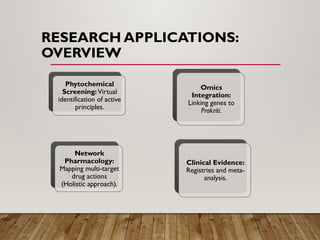
RESEARCH APPLICATIONS:
OVERVIEW
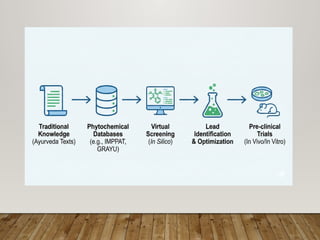
Phytochemical
Screening:Virtual
identification of active
principles.
Network
Pharmacology:
Mapping multi-target
drug actions
(Holistic approach).
Omics
Integration:
Linking genes to
Prakriti.
Clinical Evidence:
Registries and meta-
analysis.
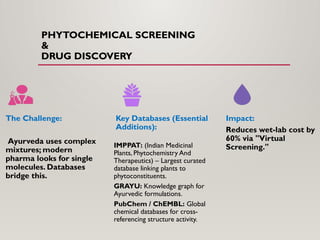
PHYTOCHEMICAL SCREENING
&
DRUG DISCOVERY
The Challenge:
Ayurveda uses complex
mixtures; modern
pharma looks for single
molecules. Databases
bridge this.
Key Databases (Essential
Additions):
IMPPAT: (Indian Medicinal
Plants, Phytochemistry And
Therapeutics) – Largest curated
database linking plants to
phytoconstituents.
GRAYU: Knowledge graph for
Ayurvedic formulations.
PubChem / ChEMBL: Global
chemical databases for cross-
referencing structure activity.
Impact:
Reduces wet-lab cost by
60% via "Virtual
Screening."
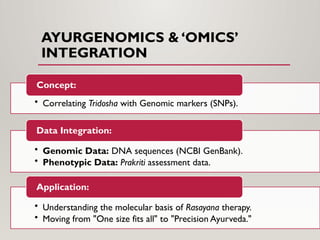
AYURGENOMICS & ‘OMICS’
INTEGRATION
• Correlating Tridosha with Genomic markers (SNPs).
Concept:
• Genomic Data: DNA sequences (NCBI GenBank).
• Phenotypic Data: Prakriti assessment data.
Data Integration:
• Understanding the molecular basis of Rasayana therapy.
• Moving from "One size fits all" to "Precision Ayurveda."
Application:
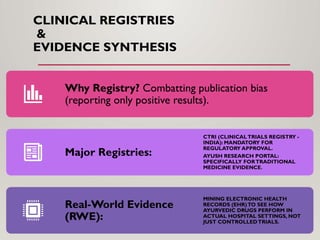
CLINICAL REGISTRIES
&
EVIDENCE SYNTHESIS
Why Registry? Combatting publication bias
(reporting only positive results).
Major Registries:
CTRI (CLINICALTRIALS REGISTRY -
INDIA): MANDATORY FOR
REGULATORY APPROVAL.
AYUSH RESEARCH PORTAL:
SPECIFICALLY FORTRADITIONAL
MEDICINE EVIDENCE.
Real-World Evidence
(RWE):
MINING ELECTRONIC HEALTH
RECORDS (EHR)TO SEE HOW
AYURVEDIC DRUGS PERFORM IN
ACTUAL HOSPITAL SETTINGS, NOT
JUST CONTROLLEDTRIALS.
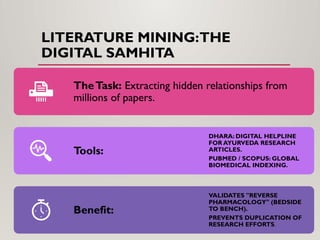
LITERATURE MINING:THE
DIGITAL SAMHITA
TheTask: Extracting hidden relationships from
millions of papers.
Tools:
DHARA: DIGITAL HELPLINE
FOR AYURVEDA RESEARCH
ARTICLES.
PUBMED / SCOPUS: GLOBAL
BIOMEDICAL INDEXING.
Benefit:
VALIDATES "REVERSE
PHARMACOLOGY" (BEDSIDE
TO BENCH).
PREVENTS DUPLICATION OF
RESEARCH EFFORTS.
DATABASE APPLICATIONS
IN INDUSTRY
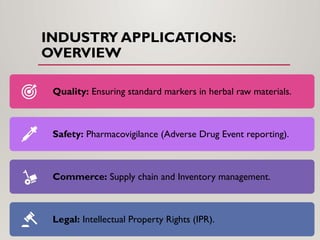
INDUSTRY APPLICATIONS:
OVERVIEW
Quality: Ensuring standard markers in herbal raw materials.
Safety: Pharmacovigilance (Adverse Drug Event reporting).
Commerce: Supply chain and Inventory management.
Legal: Intellectual Property Rights (IPR).
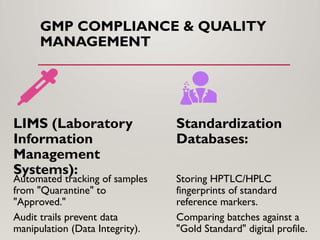
GMP COMPLIANCE & QUALITY
MANAGEMENT
LIMS (Laboratory
Information
Management
Systems):
Automated tracking of samples
from "Quarantine" to
"Approved."
Audit trails prevent data
manipulation (Data Integrity).
Standardization
Databases:
Storing HPTLC/HPLC
fingerprints of standard
reference markers.
Comparing batches against a
"Gold Standard" digital profile.
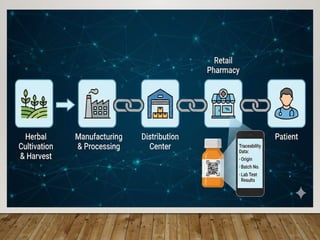
SUPPLY CHAIN & BLOCKCHAIN
TRACEABILITY
The Issue: TheTech Solution:
Blockchain Database: An
immutable ledger.
Traceability: Scanning a QR
code to see the farm location,
harvest date, and lab test results
of the specific batch.
Adulteration and
substitution in raw
herbs.
IP PROTECTION:THE CRITICAL
SHIELD
TheThreat: Biopiracy
(Patenting existing
traditional knowledge).
The Defense:TKDL
(Traditional Knowledge
Digital Library):
A unique database by CSIR & AYUSH.
Translates Sanskrit texts into 5
international languages.
Impact:
Has successfully overturned 200+
wrong patent claims globally.
DATABASES FOR DECISION-
MAKING & POLICY
CLINICAL DECISION SUPPORT
SYSTEMS (CDSS)
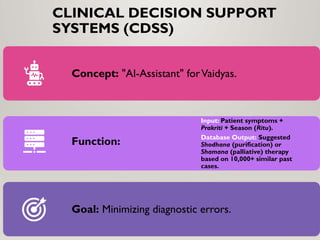
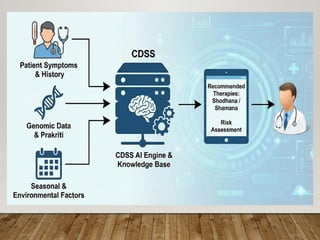
Concept: "AI-Assistant" forVaidyas.
Function:
Input: Patient symptoms +
Prakriti + Season (Ritu).
Database Output: Suggested
Shodhana (purification) or
Shamana (palliative) therapy
based on 10,000+ similar past
cases.
Goal: Minimizing diagnostic errors.
PUBLIC HEALTH & POLICY: GLOBAL
RECOGNITION
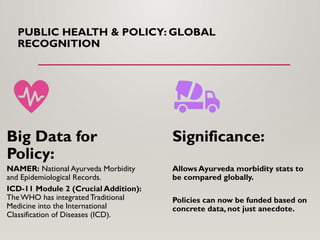
Big Data for
Policy:
NAMER: National Ayurveda Morbidity
and Epidemiological Records.
ICD-11 Module 2 (Crucial Addition):
The WHO has integratedTraditional
Medicine into the International
Classification of Diseases (ICD).
Significance:
Allows Ayurveda morbidity stats to
be compared globally.
Policies can now be funded based on
concrete data, not just anecdote.
FUTURE DIRECTIONS &
EMERGINGTECHNOLOGIES
AI &
PREDICTIVE
TOXICOLOGY
(IN SILICO)
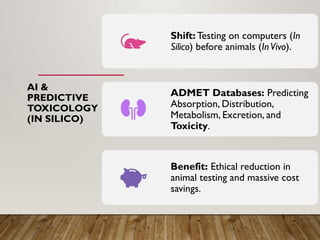
Shift: Testing on computers (In
Silico) before animals (InVivo).
ADMET Databases: Predicting
Absorption, Distribution,
Metabolism, Excretion, and
Toxicity.
Benefit: Ethical reduction in
animal testing and massive cost
savings.
FEDERATED
LEARNING
(COLLABORATIVE
INTELLIGENCE)
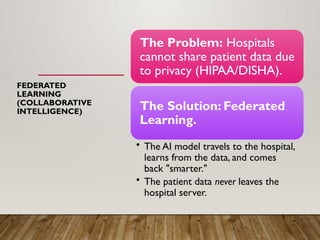
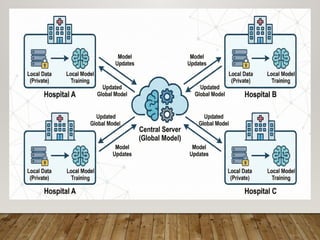
The Problem: Hospitals
cannot share patient data due
to privacy (HIPAA/DISHA).
The Solution: Federated
Learning.
• The AI model travels to the hospital,
learns from the data, and comes
back "smarter."
• The patient data never leaves the
hospital server.
CONCLUSION
Databases are the "Nervous System"
of modern pharmaceutical science.
THANK
YOU

Database Applications in Research and Industry: Decision-Making, Policy Development & Emerging Technologies.pptx

  • 1.
    DATABASE APPLICATIONS IN RESEARCH & INDUSTRY PRESENTEDBY: DR. AMAN BHARDWAJ P.G. DEPARTMENT OF RAS SHASHTRA AND BHAISHJYA KALPANA [M.M.M. GOVERNMENT AYURVEDA COLLEGE, UDAIPUR]
  • 2.
    WHAT IS ADATABASE? (SCIENTIFIC CONTEXT) Definition:A structured, scalable system to store, retrieve, and analyze data. The Hierarchy of Data (The DIKW Pyramid): Data: Raw numbers (e.g., pH value, absorbance). Information: Context (e.g., Quality Control pass/fail). Knowledge: Pattern recognition (e.g., Herb X works for DiseaseY). Wisdom: Policy decisions (e.g., Banning specific toxic constituents).
  • 3.
    WHY DATABASES MATTERTODAY •The Problem: • Explosion of "Big Data" in Pharma (Genomics, Clinical, Supply Chain). • Manual handling is impossible;Traditional Knowledge (TK) is currently fragmented. • The Solution: • Structured Repositories: Digitizing ancient texts (Samhitas). • Analytical Engines: Mining connections between Dravya (substance) and Guna (property). “In the 21st century, the bottleneck of discovery isn't the lack of resources, but the inability to organize them.”
  • 4.
  • 5.
    RESEARCH APPLICATIONS: OVERVIEW Phytochemical Screening:Virtual identification ofactive principles. Network Pharmacology: Mapping multi-target drug actions (Holistic approach). Omics Integration: Linking genes to Prakriti. Clinical Evidence: Registries and meta- analysis.
  • 6.
    PHYTOCHEMICAL SCREENING & DRUG DISCOVERY TheChallenge: Ayurveda uses complex mixtures; modern pharma looks for single molecules. Databases bridge this. Key Databases (Essential Additions): IMPPAT: (Indian Medicinal Plants, Phytochemistry And Therapeutics) – Largest curated database linking plants to phytoconstituents. GRAYU: Knowledge graph for Ayurvedic formulations. PubChem / ChEMBL: Global chemical databases for cross- referencing structure activity. Impact: Reduces wet-lab cost by 60% via "Virtual Screening."
  • 8.
    AYURGENOMICS & ‘OMICS’ INTEGRATION •Correlating Tridosha with Genomic markers (SNPs). Concept: • Genomic Data: DNA sequences (NCBI GenBank). • Phenotypic Data: Prakriti assessment data. Data Integration: • Understanding the molecular basis of Rasayana therapy. • Moving from "One size fits all" to "Precision Ayurveda." Application:
  • 9.
    CLINICAL REGISTRIES & EVIDENCE SYNTHESIS WhyRegistry? Combatting publication bias (reporting only positive results). Major Registries: CTRI (CLINICALTRIALS REGISTRY - INDIA): MANDATORY FOR REGULATORY APPROVAL. AYUSH RESEARCH PORTAL: SPECIFICALLY FORTRADITIONAL MEDICINE EVIDENCE. Real-World Evidence (RWE): MINING ELECTRONIC HEALTH RECORDS (EHR)TO SEE HOW AYURVEDIC DRUGS PERFORM IN ACTUAL HOSPITAL SETTINGS, NOT JUST CONTROLLEDTRIALS.
  • 10.
    LITERATURE MINING:THE DIGITAL SAMHITA TheTask:Extracting hidden relationships from millions of papers. Tools: DHARA: DIGITAL HELPLINE FOR AYURVEDA RESEARCH ARTICLES. PUBMED / SCOPUS: GLOBAL BIOMEDICAL INDEXING. Benefit: VALIDATES "REVERSE PHARMACOLOGY" (BEDSIDE TO BENCH). PREVENTS DUPLICATION OF RESEARCH EFFORTS.
  • 11.
  • 12.
    INDUSTRY APPLICATIONS: OVERVIEW Quality: Ensuringstandard markers in herbal raw materials. Safety: Pharmacovigilance (Adverse Drug Event reporting). Commerce: Supply chain and Inventory management. Legal: Intellectual Property Rights (IPR).
  • 13.
    GMP COMPLIANCE &QUALITY MANAGEMENT LIMS (Laboratory Information Management Systems): Automated tracking of samples from "Quarantine" to "Approved." Audit trails prevent data manipulation (Data Integrity). Standardization Databases: Storing HPTLC/HPLC fingerprints of standard reference markers. Comparing batches against a "Gold Standard" digital profile.
  • 14.
    SUPPLY CHAIN &BLOCKCHAIN TRACEABILITY The Issue: TheTech Solution: Blockchain Database: An immutable ledger. Traceability: Scanning a QR code to see the farm location, harvest date, and lab test results of the specific batch. Adulteration and substitution in raw herbs.
  • 16.
    IP PROTECTION:THE CRITICAL SHIELD TheThreat:Biopiracy (Patenting existing traditional knowledge). The Defense:TKDL (Traditional Knowledge Digital Library): A unique database by CSIR & AYUSH. Translates Sanskrit texts into 5 international languages. Impact: Has successfully overturned 200+ wrong patent claims globally.
  • 17.
  • 18.
    CLINICAL DECISION SUPPORT SYSTEMS(CDSS) Concept: "AI-Assistant" forVaidyas. Function: Input: Patient symptoms + Prakriti + Season (Ritu). Database Output: Suggested Shodhana (purification) or Shamana (palliative) therapy based on 10,000+ similar past cases. Goal: Minimizing diagnostic errors.
  • 20.
    PUBLIC HEALTH &POLICY: GLOBAL RECOGNITION Big Data for Policy: NAMER: National Ayurveda Morbidity and Epidemiological Records. ICD-11 Module 2 (Crucial Addition): The WHO has integratedTraditional Medicine into the International Classification of Diseases (ICD). Significance: Allows Ayurveda morbidity stats to be compared globally. Policies can now be funded based on concrete data, not just anecdote.
  • 21.
  • 22.
    AI & PREDICTIVE TOXICOLOGY (IN SILICO) Shift:Testing on computers (In Silico) before animals (InVivo). ADMET Databases: Predicting Absorption, Distribution, Metabolism, Excretion, and Toxicity. Benefit: Ethical reduction in animal testing and massive cost savings.
  • 23.
    FEDERATED LEARNING (COLLABORATIVE INTELLIGENCE) The Problem: Hospitals cannotshare patient data due to privacy (HIPAA/DISHA). The Solution: Federated Learning. • The AI model travels to the hospital, learns from the data, and comes back "smarter." • The patient data never leaves the hospital server.
  • 25.
    CONCLUSION Databases are the"Nervous System" of modern pharmaceutical science.
  • 26.