● Java Identifiers
●Java Data Types
● Java Reserved words
● TypeCasting in primitive types
List of Concepts Involved:
3.
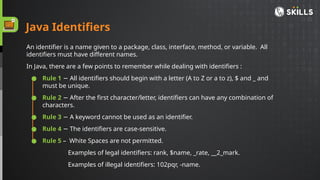
An identifier isa name given to a package, class, interface, method, or variable. All
identifiers must have different names.
In Java, there are a few points to remember while dealing with identifiers :
● Rule 1 All identifiers should begin with a letter (A to Z or a to z), $ and _ and
−
must be unique.
● Rule 2 After the first character/letter, identifiers can have any combination of
−
characters.
● Rule 3 A keyword cannot be used as an identifier.
−
● Rule 4 The identifiers are case-sensitive.
−
● Rule 5 – White Spaces are not permitted.
Examples of legal identifiers: rank, $name, _rate, __2_mark.
Examples of illegal identifiers: 102pqr, -name.
Java Identifiers
4.
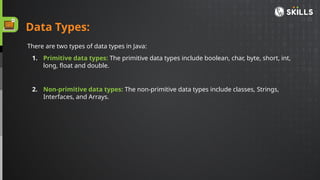
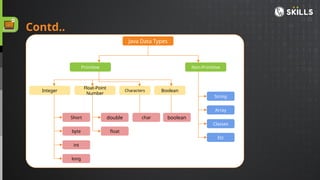
There are twotypes of data types in Java:
1. Primitive data types: The primitive data types include boolean, char, byte, short, int,
long, float and double.
2. Non-primitive data types: The non-primitive data types include classes, Strings,
Interfaces, and Arrays.
Data Types:
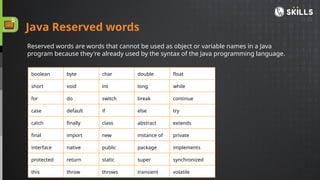
Reserved words arewords that cannot be used as object or variable names in a Java
program because they're already used by the syntax of the Java programming language.
Java Reserved words
boolean byte char double float
short void int long while
for do switch break continue
case default if else try
catch finally class abstract extends
final import new instance of private
interface native public package implements
protected return static super synchronized
this throw throws transient volatile
7.
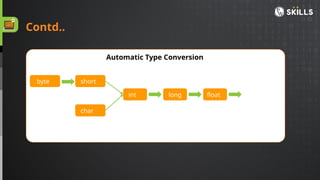
● Changing avalue from one data type to another data type is called as data type
conversion.
● Assigning a value of one type of a variable of another type is known as type casting.
Types of type Casting:
1. Implicit Type Casting
2. Explicit Type Casting
TypeCasting in primitive types