Data Structures -
Introduction
S.Deepa
Assistant professor
Department of computer technology – pg
Kongu engineering college, erode
What is Data Structure?
 Data structure is a representation of the logical relationship
existing between individual elements of data.
 Data Structure is a way of organizing all data items that considers
not only the elements stored but also their relationship to each other.
STORAGE AND FILE STRUCTURES
 The representation of particular data structure in the main memory of a
computer is called as storage structure.
 The storage structure representation in auxiliary memory is called as
file structure.
DATA STRUCTURES STUDY
 Data structure study covers the following points
 Amount of memory require to store.
 Amount of time require to process.
 Representation of data in memory.
 Operations performed on that data.
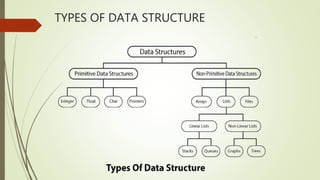
TYPES OF DATA STRUCTURE
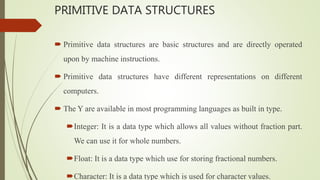
PRIMITIVE DATA STRUCTURES
 Primitive data structures are basic structures and are directly operated
upon by machine instructions.
 Primitive data structures have different representations on different
computers.
 The Y are available in most programming languages as built in type.
Integer: It is a data type which allows all values without fraction part.
We can use it for whole numbers.
Float: It is a data type which use for storing fractional numbers.
Character: It is a data type which is used for character values.
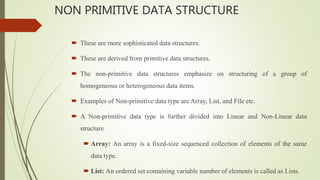
NON PRIMITIVE DATA STRUCTURE
 These are more sophisticated data structures.
 These are derived from primitive data structures.
 The non-primitive data structures emphasize on structuring of a group of
homogeneous or heterogeneous data items.
 Examples of Non-primitive data type are Array, List, and File etc.
 A Non-primitive data type is further divided into Linear and Non-Linear data
structure
 Array: An array is a fixed-size sequenced collection of elements of the same
data type.
 List: An ordered set containing variable number of elements is called as Lists.
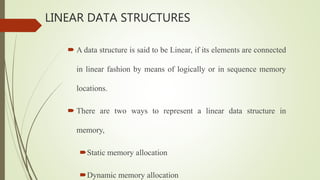
LINEAR DATA STRUCTURES
 A data structure is said to be Linear, if its elements are connected
in linear fashion by means of logically or in sequence memory
locations.
 There are two ways to represent a linear data structure in
memory,
Static memory allocation
Dynamic memory allocation
STACK
 Examples of Linear Data Structure are Stack and Queue.
 Stack: Stack is a data structure in which insertion and deletion operations are
performed at one end only.
 The insertion operation is referred to as ‘PUSH’ and deletion operation is referred to as
‘POP’ operation.
 Stack is also called as Last in First out (LIFO) data structure.
QUEUE
 Queue: The data structure which permits the insertion at one end and Deletion at another
end, known as Queue.
 End at which deletion is occurs is known as FRONT end and another end at which insertion
occurs is known as REAR end.
 Queue is also called as First in First out (FIFO) data structure.
NONLINEAR DATA STRUCTURES
 Nonlinear data structures are those data structure in which data items are not
arranged in a sequence.
 Examples of Non-linear Data Structure are Tree and Graph.
 Tree: A tree can be defined as finite set of data items (nodes) in which data items
are arranged in branches and sub branches according to requirement.
 Trees represent the hierarchical relationship between various elements.
 Tree consist of nodes connected by edge, the node represented by circle and
edge lives connecting to circle.
GRAPH
 Graph is a collection of nodes (Information) and connecting edges (Logical relation) between
nodes.
 A tree can be viewed as restricted graph.
 Graphs have many types:
 Un-directed Graph
 Directed Graph
 Mixed Graph
 Multi Graph
 Simple Graph
 Null Graph
 Weighted Graph
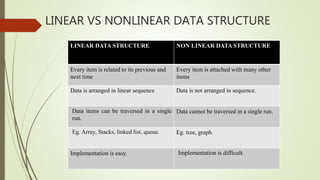
LINEAR VS NONLINEAR DATA STRUCTURE

LINEAR DATA STRUCTURE NON LINEAR DATA STRUCTURE
Every item is related to its previous and
next time
Every item is attached with many other
items
Data is arranged in linear sequence Data is not arranged in sequence.
Data items can be traversed in a single
run.
Data cannot be traversed in a single run.
Eg. Array, Stacks, linked list, queue. Eg. tree, graph.
Implementation is easy. Implementation is difficult.
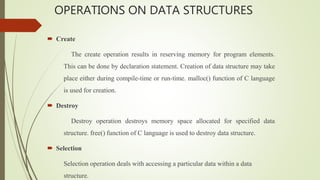
OPERATIONS ON DATA STRUCTURES
 Create
The create operation results in reserving memory for program elements.
This can be done by declaration statement. Creation of data structure may take
place either during compile-time or run-time. malloc() function of C language
is used for creation.
 Destroy
Destroy operation destroys memory space allocated for specified data
structure. free() function of C language is used to destroy data structure.
 Selection
Selection operation deals with accessing a particular data within a data
structure.
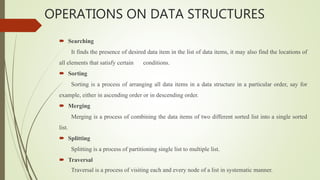
OPERATIONS ON DATA STRUCTURES
 Searching
It finds the presence of desired data item in the list of data items, it may also find the locations of
all elements that satisfy certain conditions.
 Sorting
Sorting is a process of arranging all data items in a data structure in a particular order, say for
example, either in ascending order or in descending order.
 Merging
Merging is a process of combining the data items of two different sorted list into a single sorted
list.
 Splitting
Splitting is a process of partitioning single list to multiple list.
 Traversal
Traversal is a process of visiting each and every node of a list in systematic manner.
ALGORITHM EFFICIENCY
 Some algorithms are more efficient than others. We would prefer to
choose an efficient algorithm, so it would be nice to have metrics for
comparing algorithm efficiency.
 The complexity of an algorithm is a function describing the
efficiency of the algorithm in terms of the amount of data the
algorithm must process.
 Usually there are natural units for the domain and range of this
function. There are two main complexity measures of the efficiency
of an algorithm.
TIME COMPLEXITY
 Time complexity is a function describing the amount of time an
algorithm takes in terms of the amount of input to algorithm.
 "Time" can mean the number of memory accesses performed, the
number of comparisons between integers, the number of times
some inner loop is executed, or some other natural unit related to
the amount of real time the algorithm will take.
SPACE COMPLEXITY
Space complexity is a function describing the amount of memory
(space) an algorithm takes in terms of the amount of input to the
algorithm.
We can use bytes, but it's easier to use, say, number of integers used,
number of fixed-sized structures, etc. In the end, the function we
come up with will be independent of the actual number of bytes
needed to represent the unit.
WORST CASE ANALYSIS
 In the worst case analysis, we calculate the upper bound on the running
time of an algorithm.
 We must know the case that causes the maximum number of operations
to be executed.
 For Linear Search, the worst case happens when the element to be
searched is not present in the array.
 When x is not present, the search () function compares it with all the
elements of array [] one by one.
 Therefore, the worst case time complexity of linear search would be.
AVERAGE CASE ANALYSIS
 In average case analysis, we take all possible inputs and calculate
computing time for all of the inputs.
 Sum all the calculated values and divide the sum by total number
of inputs.
 We must know (or predict) distribution of cases.
 For the linear search problem, let us assume that all cases are
uniformly distributed. So we sum all the cases and divide the sum
by (n+1).
BEST CASE ANALYSIS
 In the best case analysis, we calculate lower bound on running time of an
algorithm.
 We must know the case that causes minimum number of operations to be
executed.
 In the linear search problem, the best case occurs when x is present at the
first location.
 The number of operations in worst case is constant (not dependent on n).
 So time complexity in the best case would be.

Data structures - Introduction

  • 1.
    Data Structures - Introduction S.Deepa Assistantprofessor Department of computer technology – pg Kongu engineering college, erode
  • 2.
    What is DataStructure?  Data structure is a representation of the logical relationship existing between individual elements of data.  Data Structure is a way of organizing all data items that considers not only the elements stored but also their relationship to each other.
  • 3.
    STORAGE AND FILESTRUCTURES  The representation of particular data structure in the main memory of a computer is called as storage structure.  The storage structure representation in auxiliary memory is called as file structure.
  • 4.
    DATA STRUCTURES STUDY Data structure study covers the following points  Amount of memory require to store.  Amount of time require to process.  Representation of data in memory.  Operations performed on that data.
  • 5.
    TYPES OF DATASTRUCTURE
  • 6.
    PRIMITIVE DATA STRUCTURES Primitive data structures are basic structures and are directly operated upon by machine instructions.  Primitive data structures have different representations on different computers.  The Y are available in most programming languages as built in type. Integer: It is a data type which allows all values without fraction part. We can use it for whole numbers. Float: It is a data type which use for storing fractional numbers. Character: It is a data type which is used for character values.
  • 7.
    NON PRIMITIVE DATASTRUCTURE  These are more sophisticated data structures.  These are derived from primitive data structures.  The non-primitive data structures emphasize on structuring of a group of homogeneous or heterogeneous data items.  Examples of Non-primitive data type are Array, List, and File etc.  A Non-primitive data type is further divided into Linear and Non-Linear data structure  Array: An array is a fixed-size sequenced collection of elements of the same data type.  List: An ordered set containing variable number of elements is called as Lists.
  • 8.
    LINEAR DATA STRUCTURES A data structure is said to be Linear, if its elements are connected in linear fashion by means of logically or in sequence memory locations.  There are two ways to represent a linear data structure in memory, Static memory allocation Dynamic memory allocation
  • 9.
    STACK  Examples ofLinear Data Structure are Stack and Queue.  Stack: Stack is a data structure in which insertion and deletion operations are performed at one end only.  The insertion operation is referred to as ‘PUSH’ and deletion operation is referred to as ‘POP’ operation.  Stack is also called as Last in First out (LIFO) data structure.
  • 10.
    QUEUE  Queue: Thedata structure which permits the insertion at one end and Deletion at another end, known as Queue.  End at which deletion is occurs is known as FRONT end and another end at which insertion occurs is known as REAR end.  Queue is also called as First in First out (FIFO) data structure.
  • 11.
    NONLINEAR DATA STRUCTURES Nonlinear data structures are those data structure in which data items are not arranged in a sequence.  Examples of Non-linear Data Structure are Tree and Graph.  Tree: A tree can be defined as finite set of data items (nodes) in which data items are arranged in branches and sub branches according to requirement.  Trees represent the hierarchical relationship between various elements.  Tree consist of nodes connected by edge, the node represented by circle and edge lives connecting to circle.
  • 12.
    GRAPH  Graph isa collection of nodes (Information) and connecting edges (Logical relation) between nodes.  A tree can be viewed as restricted graph.  Graphs have many types:  Un-directed Graph  Directed Graph  Mixed Graph  Multi Graph  Simple Graph  Null Graph  Weighted Graph
  • 13.
    LINEAR VS NONLINEARDATA STRUCTURE  LINEAR DATA STRUCTURE NON LINEAR DATA STRUCTURE Every item is related to its previous and next time Every item is attached with many other items Data is arranged in linear sequence Data is not arranged in sequence. Data items can be traversed in a single run. Data cannot be traversed in a single run. Eg. Array, Stacks, linked list, queue. Eg. tree, graph. Implementation is easy. Implementation is difficult.
  • 14.
    OPERATIONS ON DATASTRUCTURES  Create The create operation results in reserving memory for program elements. This can be done by declaration statement. Creation of data structure may take place either during compile-time or run-time. malloc() function of C language is used for creation.  Destroy Destroy operation destroys memory space allocated for specified data structure. free() function of C language is used to destroy data structure.  Selection Selection operation deals with accessing a particular data within a data structure.
  • 15.
    OPERATIONS ON DATASTRUCTURES  Searching It finds the presence of desired data item in the list of data items, it may also find the locations of all elements that satisfy certain conditions.  Sorting Sorting is a process of arranging all data items in a data structure in a particular order, say for example, either in ascending order or in descending order.  Merging Merging is a process of combining the data items of two different sorted list into a single sorted list.  Splitting Splitting is a process of partitioning single list to multiple list.  Traversal Traversal is a process of visiting each and every node of a list in systematic manner.
  • 16.
    ALGORITHM EFFICIENCY  Somealgorithms are more efficient than others. We would prefer to choose an efficient algorithm, so it would be nice to have metrics for comparing algorithm efficiency.  The complexity of an algorithm is a function describing the efficiency of the algorithm in terms of the amount of data the algorithm must process.  Usually there are natural units for the domain and range of this function. There are two main complexity measures of the efficiency of an algorithm.
  • 17.
    TIME COMPLEXITY  Timecomplexity is a function describing the amount of time an algorithm takes in terms of the amount of input to algorithm.  "Time" can mean the number of memory accesses performed, the number of comparisons between integers, the number of times some inner loop is executed, or some other natural unit related to the amount of real time the algorithm will take.
  • 18.
    SPACE COMPLEXITY Space complexityis a function describing the amount of memory (space) an algorithm takes in terms of the amount of input to the algorithm. We can use bytes, but it's easier to use, say, number of integers used, number of fixed-sized structures, etc. In the end, the function we come up with will be independent of the actual number of bytes needed to represent the unit.
  • 19.
    WORST CASE ANALYSIS In the worst case analysis, we calculate the upper bound on the running time of an algorithm.  We must know the case that causes the maximum number of operations to be executed.  For Linear Search, the worst case happens when the element to be searched is not present in the array.  When x is not present, the search () function compares it with all the elements of array [] one by one.  Therefore, the worst case time complexity of linear search would be.
  • 20.
    AVERAGE CASE ANALYSIS In average case analysis, we take all possible inputs and calculate computing time for all of the inputs.  Sum all the calculated values and divide the sum by total number of inputs.  We must know (or predict) distribution of cases.  For the linear search problem, let us assume that all cases are uniformly distributed. So we sum all the cases and divide the sum by (n+1).
  • 21.
    BEST CASE ANALYSIS In the best case analysis, we calculate lower bound on running time of an algorithm.  We must know the case that causes minimum number of operations to be executed.  In the linear search problem, the best case occurs when x is present at the first location.  The number of operations in worst case is constant (not dependent on n).  So time complexity in the best case would be.