Data Security In Hybrid Cloud Computing
What is cloud
It is a type of Network-based computing where different services --
such as servers, storage and applications -- are delivered to an
organization's computers and devices through the network by
sharing computing resources.
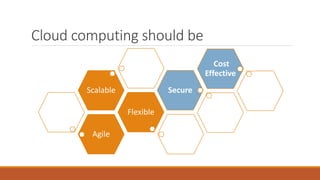
Cloud computing should be
Agile
Flexible
Scalable Secure
Cost
Effective
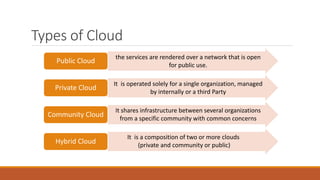
Types of Cloud
Public Cloud
Private Cloud
Community Cloud
Hybrid Cloud
the services are rendered over a network that is open
for public use.
It is operated solely for a single organization, managed
by internally or a third Party
It shares infrastructure between several organizations
from a specific community with common concerns
It is a composition of two or more clouds
(private and community or public)
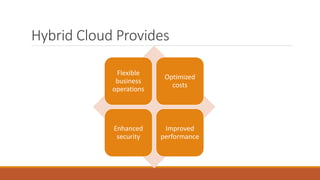
Hybrid Cloud Provides
Flexible
business
operations
Optimized
costs
Enhanced
security
Improved
performance
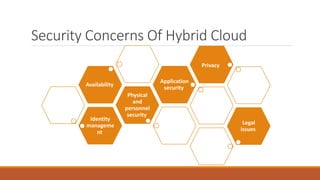
Security Concerns Of Hybrid Cloud
Identity
manageme
nt
Physical
and
personnel
security
Availability
Application
security
Privacy
Legal
issues
Identity management
Every enterprise will have its own identity management
system to control access to information and computing
resources. Cloud providers either integrate the
customer’s identity management system into their own
infrastructure, using federation or SSO technology, or
provide an identity management solution of their own.
Physical and personnel security
Providers ensure that physical machines are adequately
secure and that access to these machines as well as all
relevant customer data is not only restricted but that
access is documented.
Availability
Cloud providers assure customers that they will have
regular and predictable access to their data and
applications.
Application security
Cloud providers ensure that applications available as a
service via the cloud are secure by implementing testing
and acceptance procedures for outsourced or packaged
application code. It also requires application
security measures be in place in the production
environment.
Privacy
providers ensure that all critical data (credit card
numbers) are masked or encrypted (even better) and that
only authorized users have access to data in its entirety.
Moreover, digital identities and credentials must be
protected as should any data that the provider collects or
produces about customer activity in the hybrid cloud.
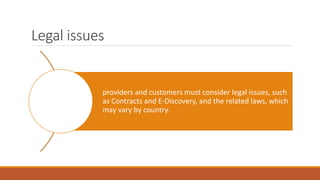
Legal issues
providers and customers must consider legal issues, such
as Contracts and E-Discovery, and the related laws, which
may vary by country.
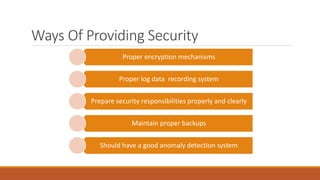
Ways Of Providing Security
Proper encryption mechanisms
Proper log data recording system
Prepare security responsibilities properly and clearly
Maintain proper backups
Should have a good anomaly detection system
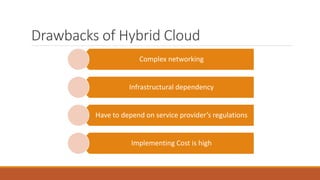
Drawbacks of Hybrid Cloud
Complex networking
Infrastructural dependency
Have to depend on service provider’s regulations
Implementing Cost is high
Thank you!

Data security in Hybrid Cloud Computing

  • 1.
    Data Security InHybrid Cloud Computing
  • 2.
    What is cloud Itis a type of Network-based computing where different services -- such as servers, storage and applications -- are delivered to an organization's computers and devices through the network by sharing computing resources.
  • 3.
    Cloud computing shouldbe Agile Flexible Scalable Secure Cost Effective
  • 4.
    Types of Cloud PublicCloud Private Cloud Community Cloud Hybrid Cloud the services are rendered over a network that is open for public use. It is operated solely for a single organization, managed by internally or a third Party It shares infrastructure between several organizations from a specific community with common concerns It is a composition of two or more clouds (private and community or public)
  • 5.
  • 6.
    Security Concerns OfHybrid Cloud Identity manageme nt Physical and personnel security Availability Application security Privacy Legal issues
  • 7.
    Identity management Every enterprisewill have its own identity management system to control access to information and computing resources. Cloud providers either integrate the customer’s identity management system into their own infrastructure, using federation or SSO technology, or provide an identity management solution of their own.
  • 8.
    Physical and personnelsecurity Providers ensure that physical machines are adequately secure and that access to these machines as well as all relevant customer data is not only restricted but that access is documented.
  • 9.
    Availability Cloud providers assurecustomers that they will have regular and predictable access to their data and applications.
  • 10.
    Application security Cloud providersensure that applications available as a service via the cloud are secure by implementing testing and acceptance procedures for outsourced or packaged application code. It also requires application security measures be in place in the production environment.
  • 11.
    Privacy providers ensure thatall critical data (credit card numbers) are masked or encrypted (even better) and that only authorized users have access to data in its entirety. Moreover, digital identities and credentials must be protected as should any data that the provider collects or produces about customer activity in the hybrid cloud.
  • 12.
    Legal issues providers andcustomers must consider legal issues, such as Contracts and E-Discovery, and the related laws, which may vary by country.
  • 13.
    Ways Of ProvidingSecurity Proper encryption mechanisms Proper log data recording system Prepare security responsibilities properly and clearly Maintain proper backups Should have a good anomaly detection system
  • 14.
    Drawbacks of HybridCloud Complex networking Infrastructural dependency Have to depend on service provider’s regulations Implementing Cost is high
  • 15.