Data Science: Unlocking
Insights from Data
Transforming raw information into powerful knowledge that drives decision-
making and innovation across every industry
What is Data Science?
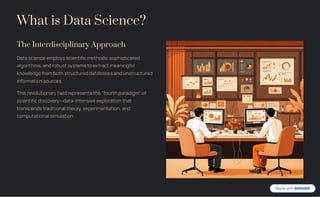
The Interdisciplinary Approach
Data science employs scientific methods, sophisticated
algorithms, and robust systems to extract meaningful
knowledge from both structured databases and unstructured
information sources.
This revolutionary field represents the "fourth paradigm" of
scientific discovery4data-intensive exploration that
transcends traditional theory, experimentation, and
computational simulation.
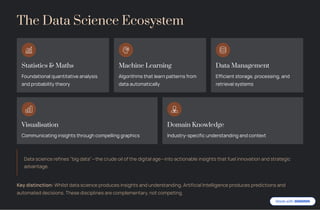
The Data Science Ecosystem
Statistics & Maths
Foundational quantitative analysis
and probability theory
Machine Learning
Algorithms that learn patterns from
data automatically
Data Management
Efficient storage, processing, and
retrieval systems
Visualisation
Communicating insights through compelling graphics
Domain Knowledge
Industry-specific understanding and context
Data science refines "big data"4the crude oil of the digital age4into actionable insights that fuel innovation and strategic
advantage.
Key distinction: Whilst data science produces insights and understanding, Artificial Intelligence produces predictions and
automated decisions. These disciplines are complementary, not competing.
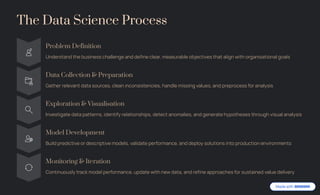
The Data Science Process
Problem Definition
Understand the business challenge and define clear, measurable objectives that align with organisational goals
Data Collection & Preparation
Gather relevant data sources, clean inconsistencies, handle missing values, and preprocess for analysis
Exploration & Visualisation
Investigate data patterns, identify relationships, detect anomalies, and generate hypotheses through visual analysis
Model Development
Build predictive or descriptive models, validate performance, and deploy solutions into production environments
Monitoring & Iteration
Continuously track model performance, update with new data, and refine approaches for sustained value delivery
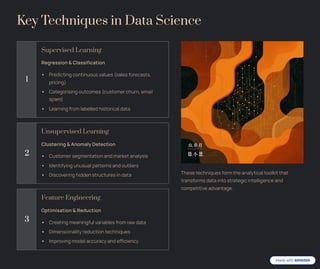
Key Techniques in Data Science
1
Supervised Learning
Regression & Classification
Predicting continuous values (sales forecasts,
pricing)
Categorising outcomes (customer churn, email
spam)
Learning from labelled historical data
2
Unsupervised Learning
Clustering & Anomaly Detection
Customer segmentation and market analysis
Identifying unusual patterns and outliers
Discovering hidden structures in data
3
Feature Engineering
Optimisation & Reduction
Creating meaningful variables from raw data
Dimensionality reduction techniques
Improving model accuracy and efficiency
These techniques form the analytical toolkit that
transforms data into strategic intelligence and
competitive advantage.
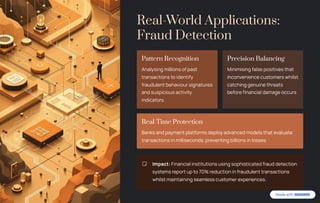
Real-World Applications:
Fraud Detection
Pattern Recognition
Analysing millions of past
transactions to identify
fraudulent behaviour signatures
and suspicious activity
indicators
Precision Balancing
Minimising false positives that
inconvenience customers whilst
catching genuine threats
before financial damage occurs
Real-Time Protection
Banks and payment platforms deploy advanced models that evaluate
transactions in milliseconds, preventing billions in losses
Impact: Financial institutions using sophisticated fraud detection
systems report up to 70% reduction in fraudulent transactions
whilst maintaining seamless customer experiences.
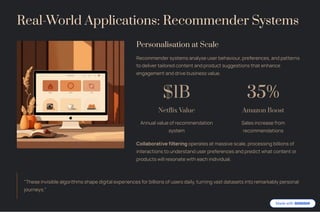
Real-World Applications: Recommender Systems
Personalisation at Scale
Recommender systems analyse user behaviour, preferences, and patterns
to deliver tailored content and product suggestions that enhance
engagement and drive business value.
$1B
Netflix Value
Annual value of recommendation
system
35%
Amazon Boost
Sales increase from
recommendations
Collaborative filtering operates at massive scale, processing billions of
interactions to understand user preferences and predict what content or
products will resonate with each individual.
"These invisible algorithms shape digital experiences for billions of users daily, turning vast datasets into remarkably personal
journeys."
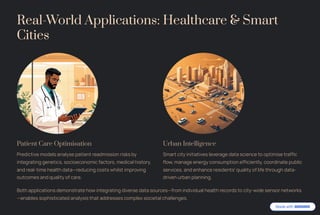
Real-World Applications: Healthcare & Smart
Cities
Patient Care Optimisation
Predictive models analyse patient readmission risks by
integrating genetics, socioeconomic factors, medical history,
and real-time health data4reducing costs whilst improving
outcomes and quality of care.
Urban Intelligence
Smart city initiatives leverage data science to optimise traffic
flow, manage energy consumption efficiently, coordinate public
services, and enhance residents' quality of life through data-
driven urban planning.
Both applications demonstrate how integrating diverse data sources4from individual health records to city-wide sensor networks
4enables sophisticated analysis that addresses complex societal challenges.
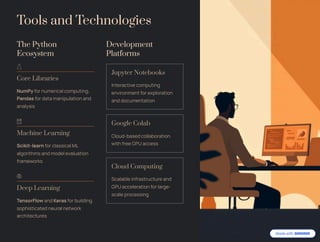
Tools and Technologies
The Python
Ecosystem
Core Libraries
NumPy for numerical computing,
Pandas for data manipulation and
analysis
Machine Learning
Scikit-learn for classical ML
algorithms and model evaluation
frameworks
Deep Learning
TensorFlow and Keras for building
sophisticated neural network
architectures
Development
Platforms
Jupyter Notebooks
Interactive computing
environment for exploration
and documentation
Google Colab
Cloud-based collaboration
with free GPU access
Cloud Computing
Scalable infrastructure and
GPU acceleration for large-
scale processing
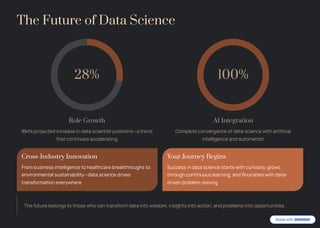
The Future of Data Science
28%
Role Growth
IBM's projected increase in data scientist positions4a trend
that continues accelerating
100%
AI Integration
Complete convergence of data science with artificial
intelligence and automation
Cross-Industry Innovation
From business intelligence to healthcare breakthroughs to
environmental sustainability4data science drives
transformation everywhere
Your Journey Begins
Success in data science starts with curiosity, grows
through continuous learning, and flourishes with data-
driven problem-solving
The future belongs to those who can transform data into wisdom, insights into action, and problems into opportunities.

Decoding Data: Turning Numbers into Actionable Insights

  • 1.
    Data Science: Unlocking Insightsfrom Data Transforming raw information into powerful knowledge that drives decision- making and innovation across every industry
  • 2.
    What is DataScience? The Interdisciplinary Approach Data science employs scientific methods, sophisticated algorithms, and robust systems to extract meaningful knowledge from both structured databases and unstructured information sources. This revolutionary field represents the "fourth paradigm" of scientific discovery4data-intensive exploration that transcends traditional theory, experimentation, and computational simulation.
  • 3.
    The Data ScienceEcosystem Statistics & Maths Foundational quantitative analysis and probability theory Machine Learning Algorithms that learn patterns from data automatically Data Management Efficient storage, processing, and retrieval systems Visualisation Communicating insights through compelling graphics Domain Knowledge Industry-specific understanding and context Data science refines "big data"4the crude oil of the digital age4into actionable insights that fuel innovation and strategic advantage. Key distinction: Whilst data science produces insights and understanding, Artificial Intelligence produces predictions and automated decisions. These disciplines are complementary, not competing.
  • 4.
    The Data ScienceProcess Problem Definition Understand the business challenge and define clear, measurable objectives that align with organisational goals Data Collection & Preparation Gather relevant data sources, clean inconsistencies, handle missing values, and preprocess for analysis Exploration & Visualisation Investigate data patterns, identify relationships, detect anomalies, and generate hypotheses through visual analysis Model Development Build predictive or descriptive models, validate performance, and deploy solutions into production environments Monitoring & Iteration Continuously track model performance, update with new data, and refine approaches for sustained value delivery
  • 5.
    Key Techniques inData Science 1 Supervised Learning Regression & Classification Predicting continuous values (sales forecasts, pricing) Categorising outcomes (customer churn, email spam) Learning from labelled historical data 2 Unsupervised Learning Clustering & Anomaly Detection Customer segmentation and market analysis Identifying unusual patterns and outliers Discovering hidden structures in data 3 Feature Engineering Optimisation & Reduction Creating meaningful variables from raw data Dimensionality reduction techniques Improving model accuracy and efficiency These techniques form the analytical toolkit that transforms data into strategic intelligence and competitive advantage.
  • 6.
    Real-World Applications: Fraud Detection PatternRecognition Analysing millions of past transactions to identify fraudulent behaviour signatures and suspicious activity indicators Precision Balancing Minimising false positives that inconvenience customers whilst catching genuine threats before financial damage occurs Real-Time Protection Banks and payment platforms deploy advanced models that evaluate transactions in milliseconds, preventing billions in losses Impact: Financial institutions using sophisticated fraud detection systems report up to 70% reduction in fraudulent transactions whilst maintaining seamless customer experiences.
  • 7.
    Real-World Applications: RecommenderSystems Personalisation at Scale Recommender systems analyse user behaviour, preferences, and patterns to deliver tailored content and product suggestions that enhance engagement and drive business value. $1B Netflix Value Annual value of recommendation system 35% Amazon Boost Sales increase from recommendations Collaborative filtering operates at massive scale, processing billions of interactions to understand user preferences and predict what content or products will resonate with each individual. "These invisible algorithms shape digital experiences for billions of users daily, turning vast datasets into remarkably personal journeys."
  • 8.
    Real-World Applications: Healthcare& Smart Cities Patient Care Optimisation Predictive models analyse patient readmission risks by integrating genetics, socioeconomic factors, medical history, and real-time health data4reducing costs whilst improving outcomes and quality of care. Urban Intelligence Smart city initiatives leverage data science to optimise traffic flow, manage energy consumption efficiently, coordinate public services, and enhance residents' quality of life through data- driven urban planning. Both applications demonstrate how integrating diverse data sources4from individual health records to city-wide sensor networks 4enables sophisticated analysis that addresses complex societal challenges.
  • 9.
    Tools and Technologies ThePython Ecosystem Core Libraries NumPy for numerical computing, Pandas for data manipulation and analysis Machine Learning Scikit-learn for classical ML algorithms and model evaluation frameworks Deep Learning TensorFlow and Keras for building sophisticated neural network architectures Development Platforms Jupyter Notebooks Interactive computing environment for exploration and documentation Google Colab Cloud-based collaboration with free GPU access Cloud Computing Scalable infrastructure and GPU acceleration for large- scale processing
  • 10.
    The Future ofData Science 28% Role Growth IBM's projected increase in data scientist positions4a trend that continues accelerating 100% AI Integration Complete convergence of data science with artificial intelligence and automation Cross-Industry Innovation From business intelligence to healthcare breakthroughs to environmental sustainability4data science drives transformation everywhere Your Journey Begins Success in data science starts with curiosity, grows through continuous learning, and flourishes with data- driven problem-solving The future belongs to those who can transform data into wisdom, insights into action, and problems into opportunities.