(Unit II- Privacy)
III Sem B. Tech. Computer Sc. & Engg(CBCS)
Department of Computer Science & Engineering
Priyadarshini Bhagwati College of Engineering, Nagpur
K. N. Hande
8/6/2024 1
• Measures and practices aimed at safeguarding an individual's
• Technological solutions, policies, and legal frameworks.
• Important in today's digital age as individuals are s more
1. Data Minimization
2. Data Encryption
3. Access Control
4. Privacy policies
5. Privacy by Design
6. User control
7. Compliance with regulations
• Individual's right to control their and to be
free from intrusion or surveillance by others
• Protects an individual's and
• Closely tied to other fundamental rights, such as
, and .
1) - Right to control, right to know
2)
3) - Right to communicate freely, protect the confidentiality
of their communications
4)
5)
7) - right to be free from surveillance by the
government, businesses, or other individuals without a valid reason
1) - Tracking stolen vehicles,
identifying vehicles involved in crimes, and monitoring traffic
2) - Allow websites to , provide targeted
advertising, and
3) - , used for mapping terrain, monitoring
wildlife, inspecting infrastructure, and delivering goods.
4) - Track , uses
algorithms to analyze user behavior and preferences
5) - Use GPS technology to the
user's location, a user's location data can reveal sensitive
information about their and s
6) - Surveillance program used by the National Security
Agency (NSA) to capture and store phone conversations, emails, and
other electronic communications.
7) - Surveillance program used by the NSA to
from major tech companies, including Google,
Facebook, and Apple
8) - surveillance device
• In the digital age, personal information is collected, processed, and
stored on a vast scale
• Consequences, such as identity theft, fraud, discrimination, and
infringement of basic human rights
• Laws establish rules for the collection, storage, use, and sharing of
personal information, and provide individuals with rights to access,
correct, and delete their data.
• Highly important data, includes information such as
, and other financial details
• Planning and Budgeting
• Creditworthiness - and
• Investment Decisions - Risk tolerance, investment goals, and financial
situation
• Tax Planning
• Fraud Prevention
• Regulate the of consumer credit
information by credit reporting agencies (CRAs) in the United States.
1) Disclosure and Consent
2) Accuracy and Dispute Resolution
3) Adverse Action Notice
4) Limitations on Access
5) Identity Theft Prevention
Key provisions of the RFPA:
1) Notice and Consent
2) Exceptions to Consent Requirement
3) Notification of Access
4) Penalties for Violations
, governs the collection, use, and disclosure of consumers'
personal financial information by financial institutions
• The law consists of three main parts
1) Financial Privacy Rule
2) Safeguards Rule
3) Pretexting provisions
, was designed to help consumers protect their credit
information and prevent identity theft.
1) Free credit reports
2) Identity theft protections
3) Dispute resolution
4) Truncation of credit and debit card numbers
• Any information related to an individual's health or medical
condition.
• Health information is and transmitted
electronically
• Improve the of patient care
by flagging potential drug interactions
• Raises concerns about the and of patient
information.
, Protect individuals' health information and give them the
right to control the and of their medical records
• HIPAA has two main components: and
• Privacy Rule - Sets for the protection of
individuals' health information
1) Access their medical records and request corrections to any
inaccurate information
2) Control the use and disclosure of their health information
3) Receive notice of how their health information is being used and
shared
• Protecting children's personal data is of utmost importance in today's
digital age
• Obtaining parental consent
• Limiting data collection
• Ensuring data security
• Educating children
• Providing transparency
• The purpose of FERPA is to protect the privacy of student
education records, while also ensuring that parents and eligible
students have the right to access and review those records.
• Right to access
• Right to request amendments
• Consent for disclosure
• Annual notification
• Directory information
• Penalties for non-compliance
• Protect the privacy of children under the age of 13 who use the internet
• Definition of personal information
• Parental consent
• Notice to parents
• Right to opt-out
• Penalties for non-compliance
1)
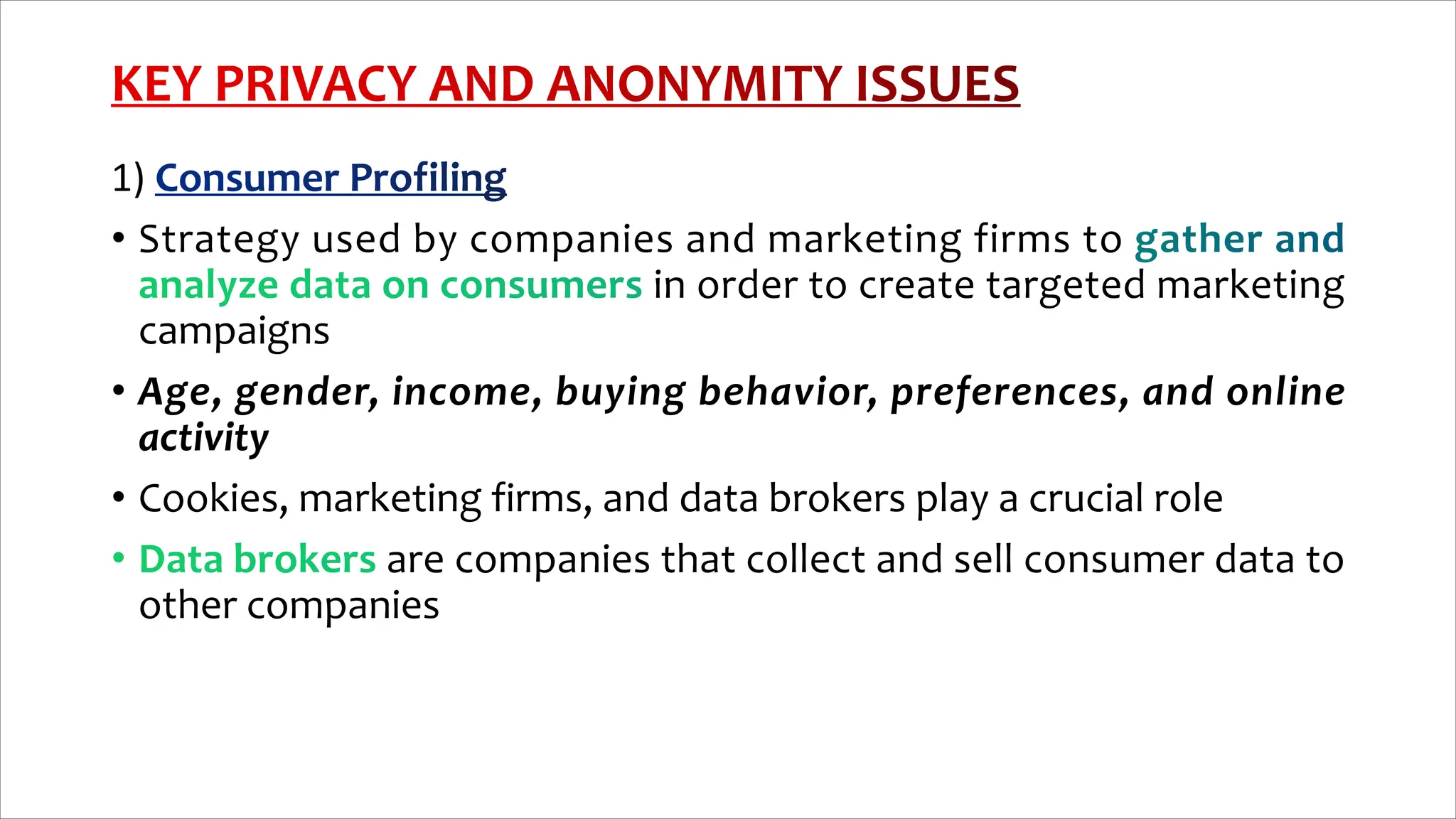
• Strategy used by companies and marketing firms to
in order to create targeted marketing
campaigns
• Age, gender, income, buying behavior, preferences, and online
activity
• Cookies, marketing firms, and data brokers play a crucial role
are companies that collect and sell consumer data to
other companies
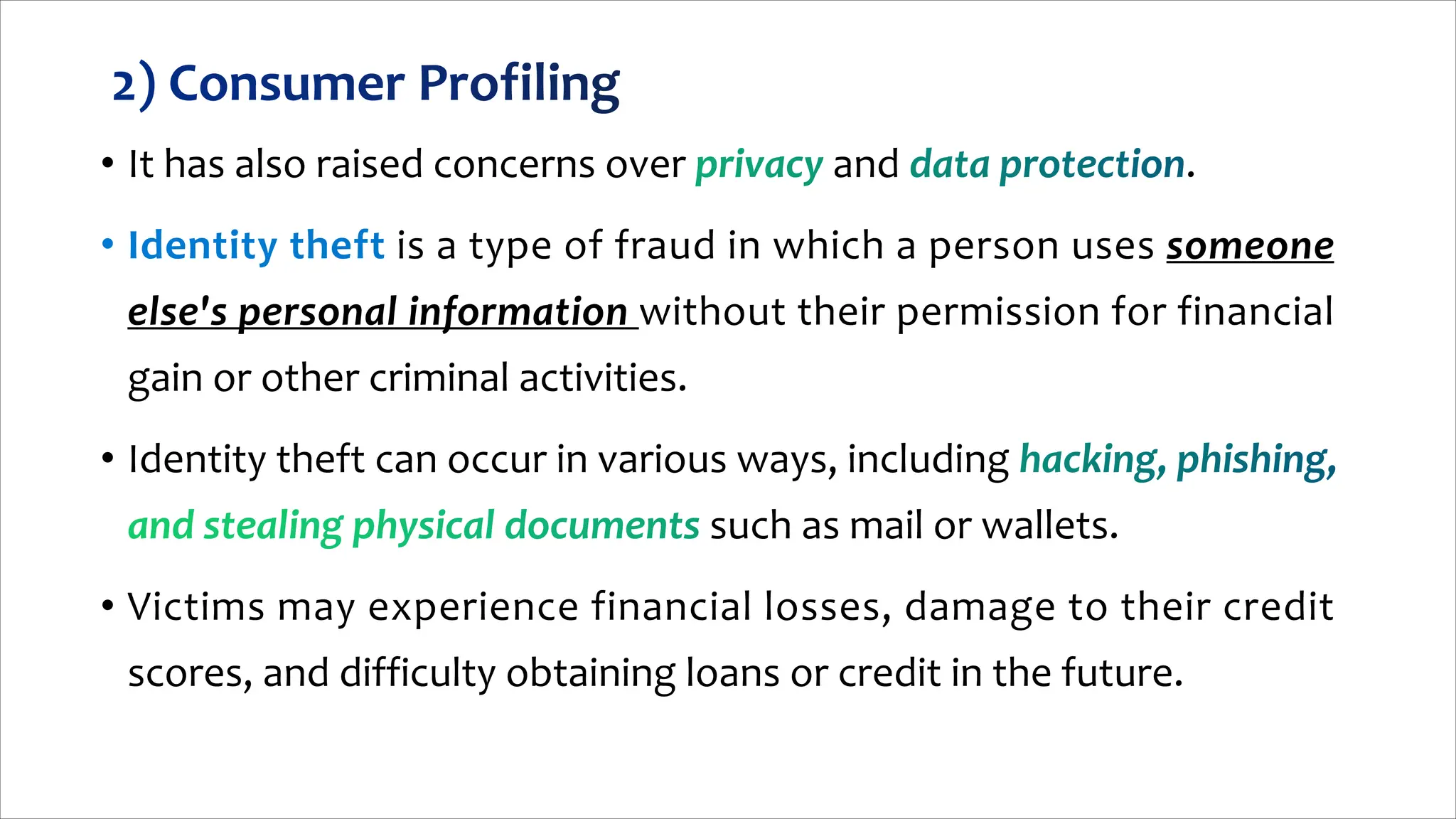
• It has also raised concerns over and .
is a type of fraud in which a person uses someone
else's personal information without their permission for financial
gain or other criminal activities.
• Identity theft can occur in various ways, including
such as mail or wallets.
• Victims may experience financial losses, damage to their credit
scores, and difficulty obtaining loans or credit in the future.
• Electronic Discovery ( ) refers to the process of
identifying, collecting, processing, reviewing, and producing
for use in legal proceedings.
• Includes information like emails, documents, spreadsheets,
databases, social media posts, and audio or video files.
• E-Discovery involves several stages, including
• The collection stage involves the identification, acquisition, and
extraction of ESI from various sources, such as computers, servers,
mobile devices, cloud storage, and social media accounts.
• The stage involves , and
• During the review stage, legal teams review and analyze the processed ESI
to and assess its potential impact on the case
• Finally, during the production stage, relevant ESI is produced in a
that is acceptable to the court and opposing parties.
• E-Discovery software is a critical tool for managing large volumes of ESI
during the discovery process
, also known as technology-assisted review (TAR), is an
advanced machine learning technology used during the E-Discovery process
to expedite the review and analysis of large volumes of ESI
• The algorithm uses a variety of techniques, such as
to identify patterns in the training set and
apply those patterns to the remaining documents.
• Benefits of predictive coding are reduced time and cost associated with
manual review, reduced risk of human error and bias, improved accuracy
and consistency of review
• Practice of employee activities and
behaviors while they are at work
• There are various types of workplace monitoring, such as
, and
• Cyberloafing is the practice of employees using the internet for
personal activities during work hours
• BYOD policies allow employees to use their personal devices, such
as smartphones and laptops, for work purposes
• Fitness trackers are wearable devices that track physical activity,
sleep patterns, and other health metrics
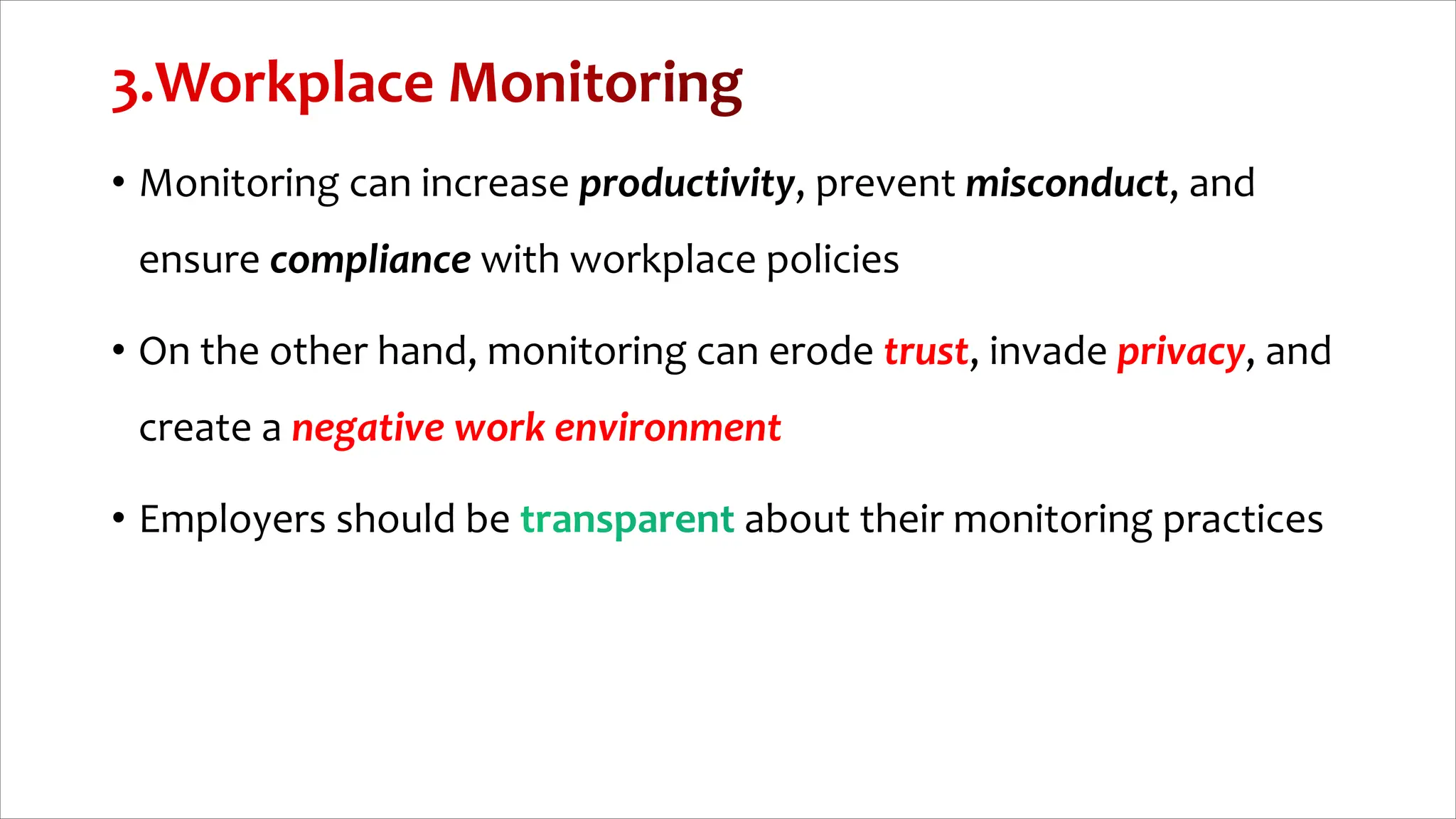
• Monitoring can increase productivity, prevent misconduct, and
ensure compliance with workplace policies
• On the other hand, monitoring can erode trust, invade privacy, and
create a negative work environment
• Employers should be about their monitoring practices

Ethics in Information Technology - Privacy

  • 1.
    (Unit II- Privacy) IIISem B. Tech. Computer Sc. & Engg(CBCS) Department of Computer Science & Engineering Priyadarshini Bhagwati College of Engineering, Nagpur K. N. Hande 8/6/2024 1
  • 2.
    • Measures andpractices aimed at safeguarding an individual's • Technological solutions, policies, and legal frameworks. • Important in today's digital age as individuals are s more
  • 3.
    1. Data Minimization 2.Data Encryption 3. Access Control 4. Privacy policies 5. Privacy by Design 6. User control 7. Compliance with regulations
  • 4.
    • Individual's rightto control their and to be free from intrusion or surveillance by others • Protects an individual's and • Closely tied to other fundamental rights, such as , and .
  • 5.
    1) - Rightto control, right to know 2) 3) - Right to communicate freely, protect the confidentiality of their communications 4) 5) 7) - right to be free from surveillance by the government, businesses, or other individuals without a valid reason
  • 6.
    1) - Trackingstolen vehicles, identifying vehicles involved in crimes, and monitoring traffic 2) - Allow websites to , provide targeted advertising, and 3) - , used for mapping terrain, monitoring wildlife, inspecting infrastructure, and delivering goods. 4) - Track , uses algorithms to analyze user behavior and preferences
  • 7.
    5) - UseGPS technology to the user's location, a user's location data can reveal sensitive information about their and s 6) - Surveillance program used by the National Security Agency (NSA) to capture and store phone conversations, emails, and other electronic communications. 7) - Surveillance program used by the NSA to from major tech companies, including Google, Facebook, and Apple 8) - surveillance device
  • 8.
    • In thedigital age, personal information is collected, processed, and stored on a vast scale • Consequences, such as identity theft, fraud, discrimination, and infringement of basic human rights • Laws establish rules for the collection, storage, use, and sharing of personal information, and provide individuals with rights to access, correct, and delete their data.
  • 9.
    • Highly importantdata, includes information such as , and other financial details • Planning and Budgeting • Creditworthiness - and • Investment Decisions - Risk tolerance, investment goals, and financial situation • Tax Planning • Fraud Prevention
  • 10.
    • Regulate theof consumer credit information by credit reporting agencies (CRAs) in the United States. 1) Disclosure and Consent 2) Accuracy and Dispute Resolution 3) Adverse Action Notice 4) Limitations on Access 5) Identity Theft Prevention
  • 11.
    Key provisions ofthe RFPA: 1) Notice and Consent 2) Exceptions to Consent Requirement 3) Notification of Access 4) Penalties for Violations
  • 12.
    , governs thecollection, use, and disclosure of consumers' personal financial information by financial institutions • The law consists of three main parts 1) Financial Privacy Rule 2) Safeguards Rule 3) Pretexting provisions
  • 13.
    , was designedto help consumers protect their credit information and prevent identity theft. 1) Free credit reports 2) Identity theft protections 3) Dispute resolution 4) Truncation of credit and debit card numbers
  • 14.
    • Any informationrelated to an individual's health or medical condition. • Health information is and transmitted electronically • Improve the of patient care by flagging potential drug interactions • Raises concerns about the and of patient information.
  • 15.
    , Protect individuals'health information and give them the right to control the and of their medical records • HIPAA has two main components: and • Privacy Rule - Sets for the protection of individuals' health information 1) Access their medical records and request corrections to any inaccurate information 2) Control the use and disclosure of their health information 3) Receive notice of how their health information is being used and shared
  • 16.
    • Protecting children'spersonal data is of utmost importance in today's digital age • Obtaining parental consent • Limiting data collection • Ensuring data security • Educating children • Providing transparency
  • 17.
    • The purposeof FERPA is to protect the privacy of student education records, while also ensuring that parents and eligible students have the right to access and review those records. • Right to access • Right to request amendments • Consent for disclosure • Annual notification • Directory information • Penalties for non-compliance
  • 18.
    • Protect theprivacy of children under the age of 13 who use the internet • Definition of personal information • Parental consent • Notice to parents • Right to opt-out • Penalties for non-compliance
  • 19.
    1) • Strategy usedby companies and marketing firms to in order to create targeted marketing campaigns • Age, gender, income, buying behavior, preferences, and online activity • Cookies, marketing firms, and data brokers play a crucial role are companies that collect and sell consumer data to other companies
  • 20.
    • It hasalso raised concerns over and . is a type of fraud in which a person uses someone else's personal information without their permission for financial gain or other criminal activities. • Identity theft can occur in various ways, including such as mail or wallets. • Victims may experience financial losses, damage to their credit scores, and difficulty obtaining loans or credit in the future.
  • 21.
    • Electronic Discovery( ) refers to the process of identifying, collecting, processing, reviewing, and producing for use in legal proceedings. • Includes information like emails, documents, spreadsheets, databases, social media posts, and audio or video files. • E-Discovery involves several stages, including • The collection stage involves the identification, acquisition, and extraction of ESI from various sources, such as computers, servers, mobile devices, cloud storage, and social media accounts.
  • 22.
    • The stageinvolves , and • During the review stage, legal teams review and analyze the processed ESI to and assess its potential impact on the case • Finally, during the production stage, relevant ESI is produced in a that is acceptable to the court and opposing parties. • E-Discovery software is a critical tool for managing large volumes of ESI during the discovery process
  • 23.
    , also knownas technology-assisted review (TAR), is an advanced machine learning technology used during the E-Discovery process to expedite the review and analysis of large volumes of ESI • The algorithm uses a variety of techniques, such as to identify patterns in the training set and apply those patterns to the remaining documents. • Benefits of predictive coding are reduced time and cost associated with manual review, reduced risk of human error and bias, improved accuracy and consistency of review
  • 24.
    • Practice ofemployee activities and behaviors while they are at work • There are various types of workplace monitoring, such as , and • Cyberloafing is the practice of employees using the internet for personal activities during work hours • BYOD policies allow employees to use their personal devices, such as smartphones and laptops, for work purposes • Fitness trackers are wearable devices that track physical activity, sleep patterns, and other health metrics
  • 25.
    • Monitoring canincrease productivity, prevent misconduct, and ensure compliance with workplace policies • On the other hand, monitoring can erode trust, invade privacy, and create a negative work environment • Employers should be about their monitoring practices