Data poison detection schemes
for distributed Machine
Learning
CONTENTS
• Abstract
• Introduction
• Existing system
• Proposed system
• Advantages
• Disadvantages
• Block diagram
• System requirements
• Conclusion
• References
ABSTRACT
• Distributed machine learning (DML) can realize massive dataset training when no single node can work out
the accurate results within an acceptable time. However, this will inevitably expose more potential targets to
attackers compared with the non-distributed environment. In this paper, we classify DML into basic-DML and
semi-DML. In basic-DML, the center server dispatches learning tasks to distributed machines and aggregates
their learning results. While in semi-DML, the center server further devotes resources into dataset learning in
addition to its duty in basic-DML.
• We firstly put forward a novel data poison detection scheme for basic-DML, which utilizes a cross-learning
mechanism to find out the poisoned data. We prove that the proposed cross-learning mechanism would
generate training loops, based on which a mathematical model is established to find the optimal number of
training loops. Then, for semi-DML, we present an improved data poison detection scheme to provide better
learning protection with the aid of the central resource.
INTRODUCTION
•In a typical DML system, a central server has a tremendous amount of data at its disposal. It divides the
dataset into different parts and disseminates them to distributed workers who perform the training tasks and
return their results to the center . Finally, the center integrates these results and outputs the eventual
model.Unfortunately, with the number of distributed workers increasing, it is hard to guarantee the security of
each worker. This lack of security will increase the danger that attackers poison the dataset and manipulate the
training result. Poisoning attack [11]–[13] is a typical way to tamper the training data in machine learning.
Especially in scenarios that newly generated datasets should be periodically sent to the distributed workers for
updating the decision model, the attacker will have more chances to poison the datasets, leading to a more
severe threat in DML.
•However, these schemes are designed for specific DML algorithm and cannot be used in general DML
situations. Since the adversarial attack can mislead various machine learning algorithms, a widely applicable
DML protection mechanism is urgent to be studied.
CONT..
• On the contrary, in the semi-DML scenario, the center has some spare resources in the computing server for
sub-datasets learning. Consequently, it will keep some sub-datasets and learn from them by itself. That is to
say, in the semi-DML, the center will learn from some sub-datasets as well as integrate the results from
both of the center and distributed workers.
EXISTING SYSTEM
•Many detailed internal mechanisms and principles are still left unknown in the field of machine learning ,
therefore the differences between the learned models cannot be quantified by a specific value. However, an
efficient machine learning algorithm should have a good characteristic of convergence. This means if several
models are learned from a dataset with the same learning algorithm, the learned models should not have
significant differences. The empirical threshold or manually set threshold is used to solve similar problems .
Inspired by this, in this paper we use a threshold of parameters to find out the poisoned dataset in the basic-
DML scenario.
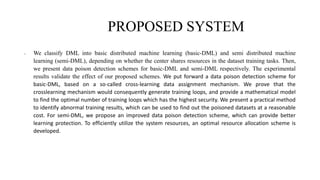
PROPOSED SYSTEM
• We classify DML into basic distributed machine learning (basic-DML) and semi distributed machine
learning (semi-DML), depending on whether the center shares resources in the dataset training tasks. Then,
we present data poison detection schemes for basic-DML and semi-DML respectively. The experimental
results validate the effect of our proposed schemes. We put forward a data poison detection scheme for
basic-DML, based on a so-called cross-learning data assignment mechanism. We prove that the
crosslearning mechanism would consequently generate training loops, and provide a mathematical model
to find the optimal number of training loops which has the highest security. We present a practical method
to identify abnormal training results, which can be used to find out the poisoned datasets at a reasonable
cost. For semi-DML, we propose an improved data poison detection scheme, which can provide better
learning protection. To efficiently utilize the system resources, an optimal resource allocation scheme is
developed.
ADVANTAGES
• High performance and accuracy
• Less time consumption
• Classification is easy.
• A threshold of parameters, a cross-learning mechanism, and a detection method of abnormal training results.
DISADVANTAGES
• Low accuracy
• An attacker may have different levels of knowledge of the targeted system,
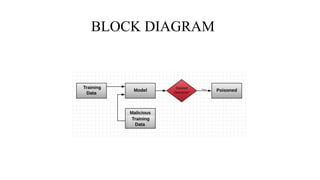
BLOCK DIAGRAM
SYSTEM REQUIREMENTS
Hardware:-
• OS – Windows 7,8 or 10 (32 or 64 bit)
• RAM – 4GB
Software:-
• Python IDLE
• Anaconda
• Jupyter notebook
CONCLUSION
• Firstly, we intend to validate the proposed mathematical model by comparing the model results with the
simulation results. The model results are got from our proposed mathematical model, which is concerned .
The comparison between the model results and the simulation results . We can see that the results of the
mathematical model match the simulation results well, which indicates the proposed mathematical model can
accurately obtain the PFT in the proposed scheme. Furthermore, both of the results clearly show that the
optimal number of training loops is the maximum of k, which is 10 in the simulation. Nevertheless, the
proposed data poison detection scheme can increase the classification accuracy in the basic-DML scenario
with data poisoning. When half of the workers are compromised, the proposed scheme can keep the
classification accuracy near to 84%, which is 20% higher than the case without the proposed scheme.
REFERENCES
• M. Abadi, P. Barham, J. Chen, Z. Chen, A. Davis, J. Dean, M. Devin, S. Ghemawat, G. Irving, M. Isard, and
M. Kudlur, ‘‘Tensorflow: A system for large-scale machine learning,’’ in Proc. 12th USENIX Symp. Operating
Syst. Design Implement. (OSDI), vol. 16, 2016, pp. 265–283.
• T. Chen, M. Li, Y. Li, M. Lin, N. Wang, M. Wang, T. Xiao, B. Xu, C. Zhang, and Z. Zhang, ‘‘Mxnet: A
flexible and efficient machine learning library for heterogeneous distributed systems,’’ Dec. 2015,
arXiv:1512.01274. [Online]. Available: https://arxiv.org/abs/1512.01274
• L. Zhou, S. Pan, J. Wang, and A. V. Vasilakos, ‘‘Machine learning on big data: Opportunities and challenges,’’
Neurocomputing, vol. 237, pp. 350–361, May 2017.
• S. Yu, M. Liu, W. Dou, X. Liu, and S. Zhou, ‘‘Networking for big data: A survey,’’ IEEE Commun. Surveys
Tuts., vol. 19, no. 1, pp. 531–549, 1st Quart., 2016.
• M. Li, D. G. Andersen, J. W. Park, A. J. Smola, A. Ahmed, V. Josifovski, J. Long, E. J. Shekita, and B.-Y. Su,
‘‘Scaling distributed machine learning with the parameter server,’’ in Proc. 11th USENIX Symp. Operating
Syst. Design Implement. (OSDI), vol. 14, 2014, pp. 583–598.
THANK YOU

Data poison detection schemes for distributed Machine Learning.pptx

  • 1.
    Data poison detectionschemes for distributed Machine Learning
  • 2.
    CONTENTS • Abstract • Introduction •Existing system • Proposed system • Advantages • Disadvantages • Block diagram • System requirements • Conclusion • References
  • 3.
    ABSTRACT • Distributed machinelearning (DML) can realize massive dataset training when no single node can work out the accurate results within an acceptable time. However, this will inevitably expose more potential targets to attackers compared with the non-distributed environment. In this paper, we classify DML into basic-DML and semi-DML. In basic-DML, the center server dispatches learning tasks to distributed machines and aggregates their learning results. While in semi-DML, the center server further devotes resources into dataset learning in addition to its duty in basic-DML. • We firstly put forward a novel data poison detection scheme for basic-DML, which utilizes a cross-learning mechanism to find out the poisoned data. We prove that the proposed cross-learning mechanism would generate training loops, based on which a mathematical model is established to find the optimal number of training loops. Then, for semi-DML, we present an improved data poison detection scheme to provide better learning protection with the aid of the central resource.
  • 4.
    INTRODUCTION •In a typicalDML system, a central server has a tremendous amount of data at its disposal. It divides the dataset into different parts and disseminates them to distributed workers who perform the training tasks and return their results to the center . Finally, the center integrates these results and outputs the eventual model.Unfortunately, with the number of distributed workers increasing, it is hard to guarantee the security of each worker. This lack of security will increase the danger that attackers poison the dataset and manipulate the training result. Poisoning attack [11]–[13] is a typical way to tamper the training data in machine learning. Especially in scenarios that newly generated datasets should be periodically sent to the distributed workers for updating the decision model, the attacker will have more chances to poison the datasets, leading to a more severe threat in DML. •However, these schemes are designed for specific DML algorithm and cannot be used in general DML situations. Since the adversarial attack can mislead various machine learning algorithms, a widely applicable DML protection mechanism is urgent to be studied.
  • 5.
    CONT.. • On thecontrary, in the semi-DML scenario, the center has some spare resources in the computing server for sub-datasets learning. Consequently, it will keep some sub-datasets and learn from them by itself. That is to say, in the semi-DML, the center will learn from some sub-datasets as well as integrate the results from both of the center and distributed workers.
  • 6.
    EXISTING SYSTEM •Many detailedinternal mechanisms and principles are still left unknown in the field of machine learning , therefore the differences between the learned models cannot be quantified by a specific value. However, an efficient machine learning algorithm should have a good characteristic of convergence. This means if several models are learned from a dataset with the same learning algorithm, the learned models should not have significant differences. The empirical threshold or manually set threshold is used to solve similar problems . Inspired by this, in this paper we use a threshold of parameters to find out the poisoned dataset in the basic- DML scenario.
  • 7.
    PROPOSED SYSTEM • Weclassify DML into basic distributed machine learning (basic-DML) and semi distributed machine learning (semi-DML), depending on whether the center shares resources in the dataset training tasks. Then, we present data poison detection schemes for basic-DML and semi-DML respectively. The experimental results validate the effect of our proposed schemes. We put forward a data poison detection scheme for basic-DML, based on a so-called cross-learning data assignment mechanism. We prove that the crosslearning mechanism would consequently generate training loops, and provide a mathematical model to find the optimal number of training loops which has the highest security. We present a practical method to identify abnormal training results, which can be used to find out the poisoned datasets at a reasonable cost. For semi-DML, we propose an improved data poison detection scheme, which can provide better learning protection. To efficiently utilize the system resources, an optimal resource allocation scheme is developed.
  • 8.
    ADVANTAGES • High performanceand accuracy • Less time consumption • Classification is easy. • A threshold of parameters, a cross-learning mechanism, and a detection method of abnormal training results.
  • 9.
    DISADVANTAGES • Low accuracy •An attacker may have different levels of knowledge of the targeted system,
  • 10.
  • 11.
    SYSTEM REQUIREMENTS Hardware:- • OS– Windows 7,8 or 10 (32 or 64 bit) • RAM – 4GB Software:- • Python IDLE • Anaconda • Jupyter notebook
  • 12.
    CONCLUSION • Firstly, weintend to validate the proposed mathematical model by comparing the model results with the simulation results. The model results are got from our proposed mathematical model, which is concerned . The comparison between the model results and the simulation results . We can see that the results of the mathematical model match the simulation results well, which indicates the proposed mathematical model can accurately obtain the PFT in the proposed scheme. Furthermore, both of the results clearly show that the optimal number of training loops is the maximum of k, which is 10 in the simulation. Nevertheless, the proposed data poison detection scheme can increase the classification accuracy in the basic-DML scenario with data poisoning. When half of the workers are compromised, the proposed scheme can keep the classification accuracy near to 84%, which is 20% higher than the case without the proposed scheme.
  • 13.
    REFERENCES • M. Abadi,P. Barham, J. Chen, Z. Chen, A. Davis, J. Dean, M. Devin, S. Ghemawat, G. Irving, M. Isard, and M. Kudlur, ‘‘Tensorflow: A system for large-scale machine learning,’’ in Proc. 12th USENIX Symp. Operating Syst. Design Implement. (OSDI), vol. 16, 2016, pp. 265–283. • T. Chen, M. Li, Y. Li, M. Lin, N. Wang, M. Wang, T. Xiao, B. Xu, C. Zhang, and Z. Zhang, ‘‘Mxnet: A flexible and efficient machine learning library for heterogeneous distributed systems,’’ Dec. 2015, arXiv:1512.01274. [Online]. Available: https://arxiv.org/abs/1512.01274 • L. Zhou, S. Pan, J. Wang, and A. V. Vasilakos, ‘‘Machine learning on big data: Opportunities and challenges,’’ Neurocomputing, vol. 237, pp. 350–361, May 2017. • S. Yu, M. Liu, W. Dou, X. Liu, and S. Zhou, ‘‘Networking for big data: A survey,’’ IEEE Commun. Surveys Tuts., vol. 19, no. 1, pp. 531–549, 1st Quart., 2016. • M. Li, D. G. Andersen, J. W. Park, A. J. Smola, A. Ahmed, V. Josifovski, J. Long, E. J. Shekita, and B.-Y. Su, ‘‘Scaling distributed machine learning with the parameter server,’’ in Proc. 11th USENIX Symp. Operating Syst. Design Implement. (OSDI), vol. 14, 2014, pp. 583–598.
  • 14.