1
Temporal Causal Models for Massive Time-series Data
Mining: Climate Change Attribution and other Applications
Yan Liu
Computer Science Department
Viterbi School of Engineering
University of Southern California
2011 Japan-America Frontiers of Engineering Symposium June 6-8, 2011
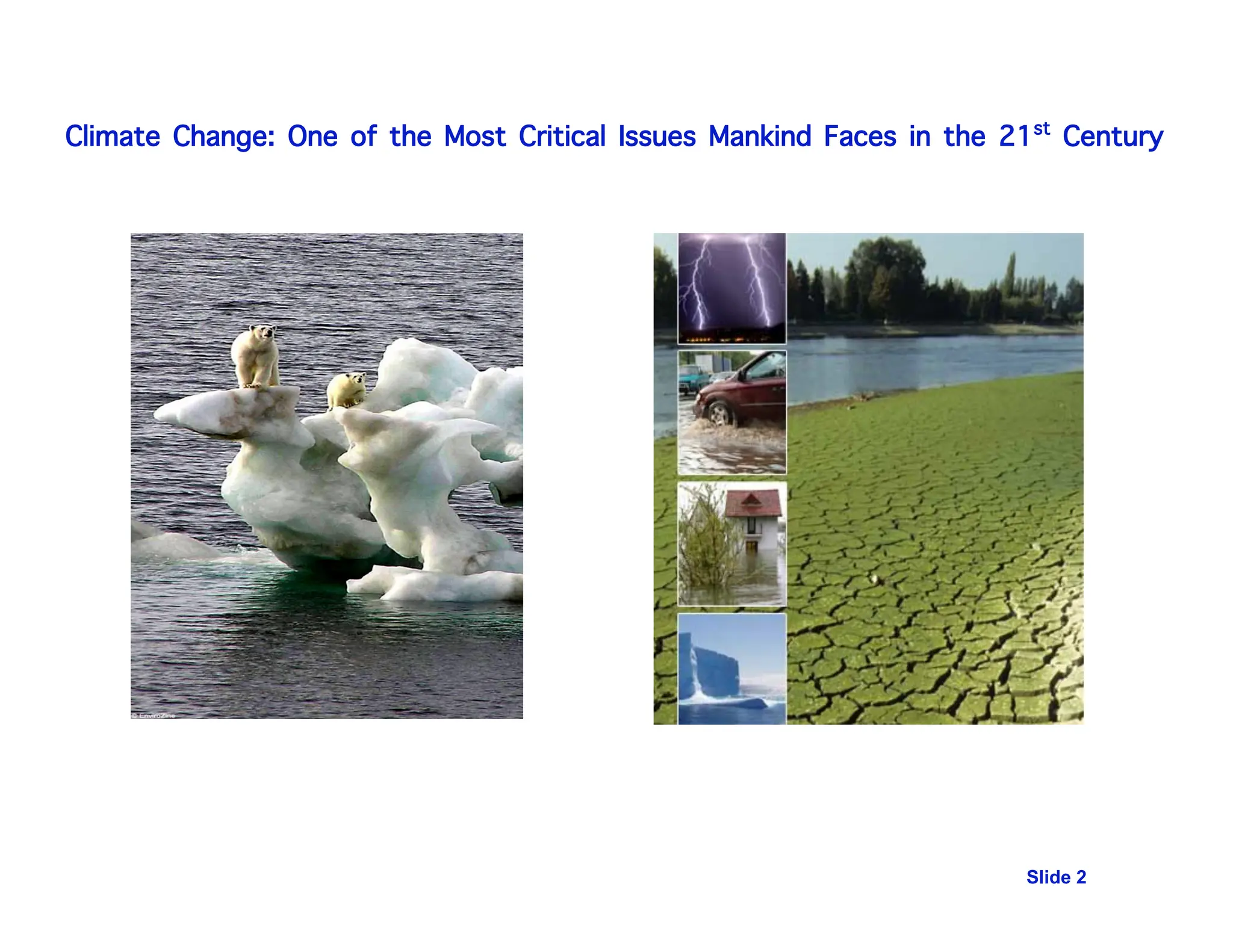
Climate Change: One of the Most Critical Issues Mankind Faces in the 21st Century
Slide 2
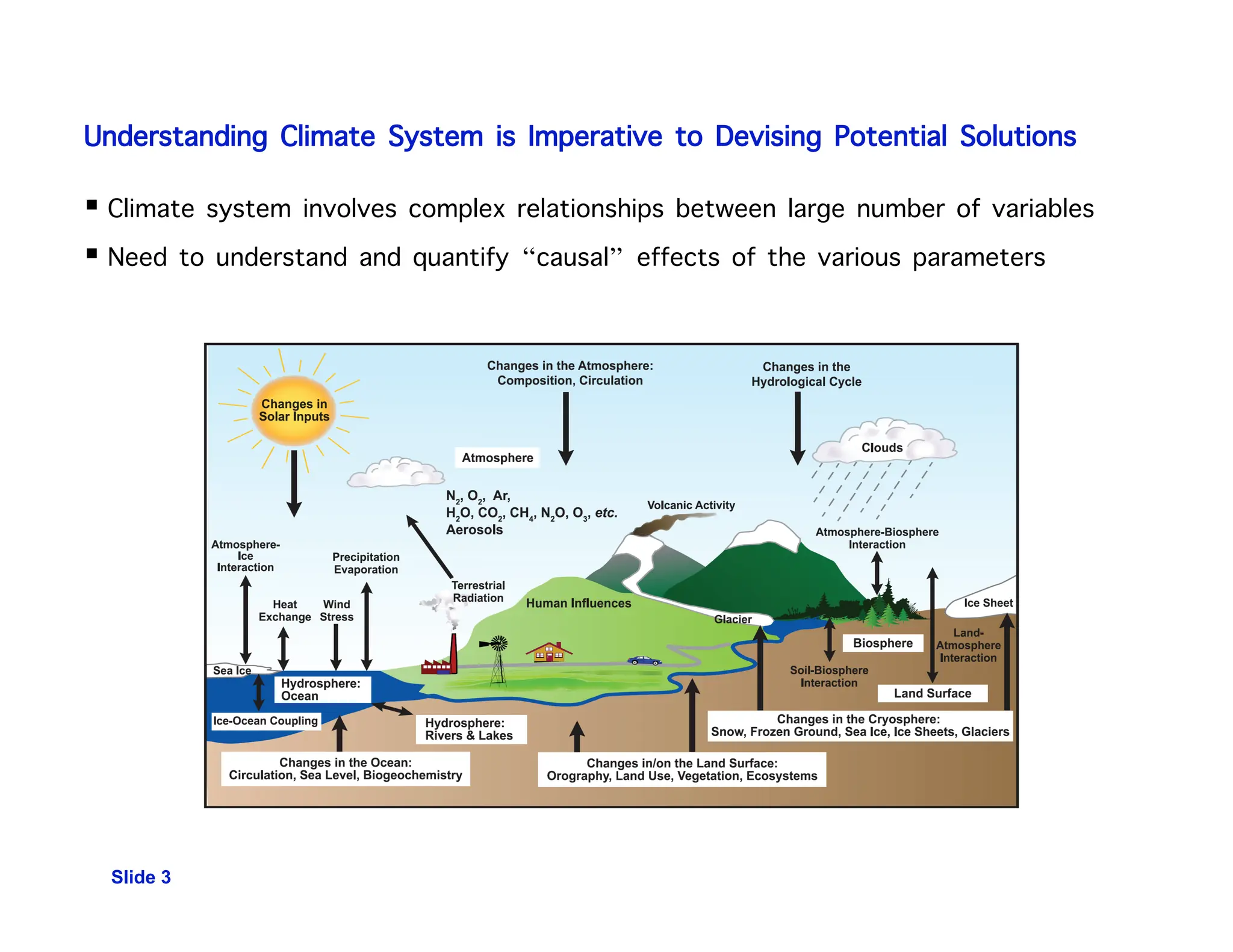
Understanding Climate System is Imperative to Devising Potential Solutions
 Climate system involves complex relationships between large number of variables
 Need to understand and quantify “causal” effects of the various parameters
Slide 3
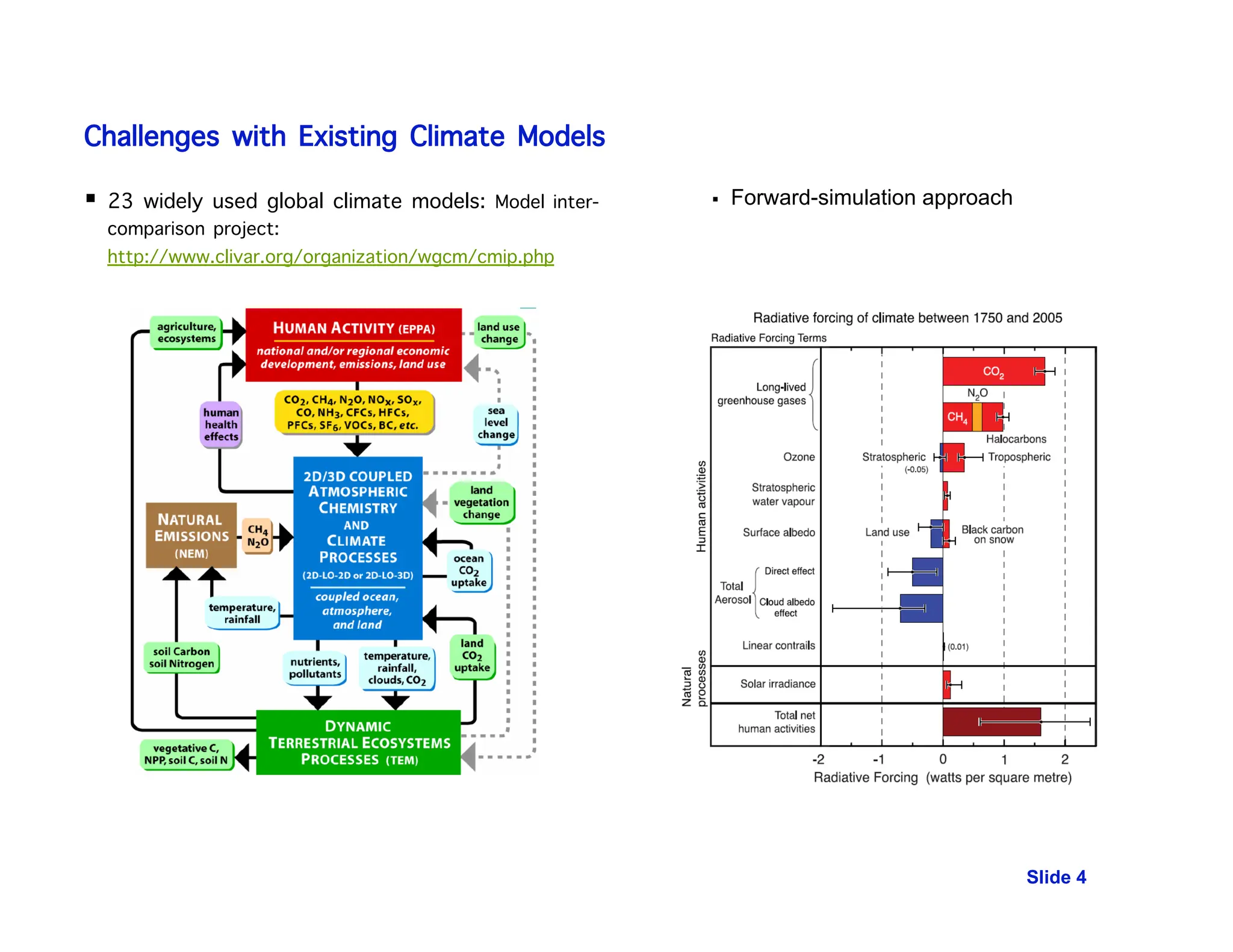
Challenges with Existing Climate Models
 23 widely used global climate models: Model inter-
comparison project:
http://www.clivar.org/organization/wgcm/cmip.php
Slide 4
 Forward-simulation approach
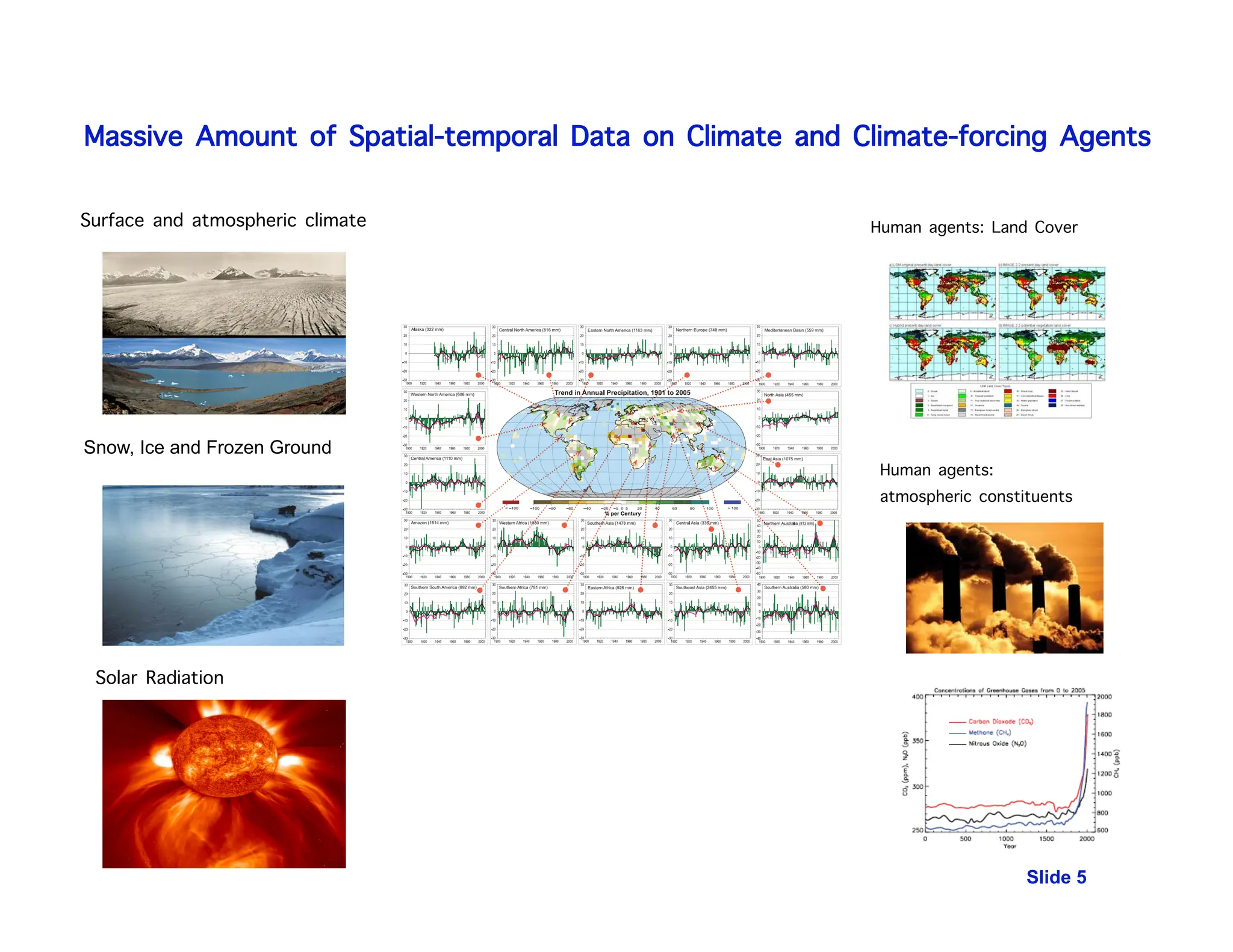
Massive Amount of Spatial-temporal Data on Climate and Climate-forcing Agents
Slide 5
Human agents:
atmospheric constituents
Surface and atmospheric climate
Snow, Ice and Frozen Ground
Human agents: Land Cover
Solar Radiation
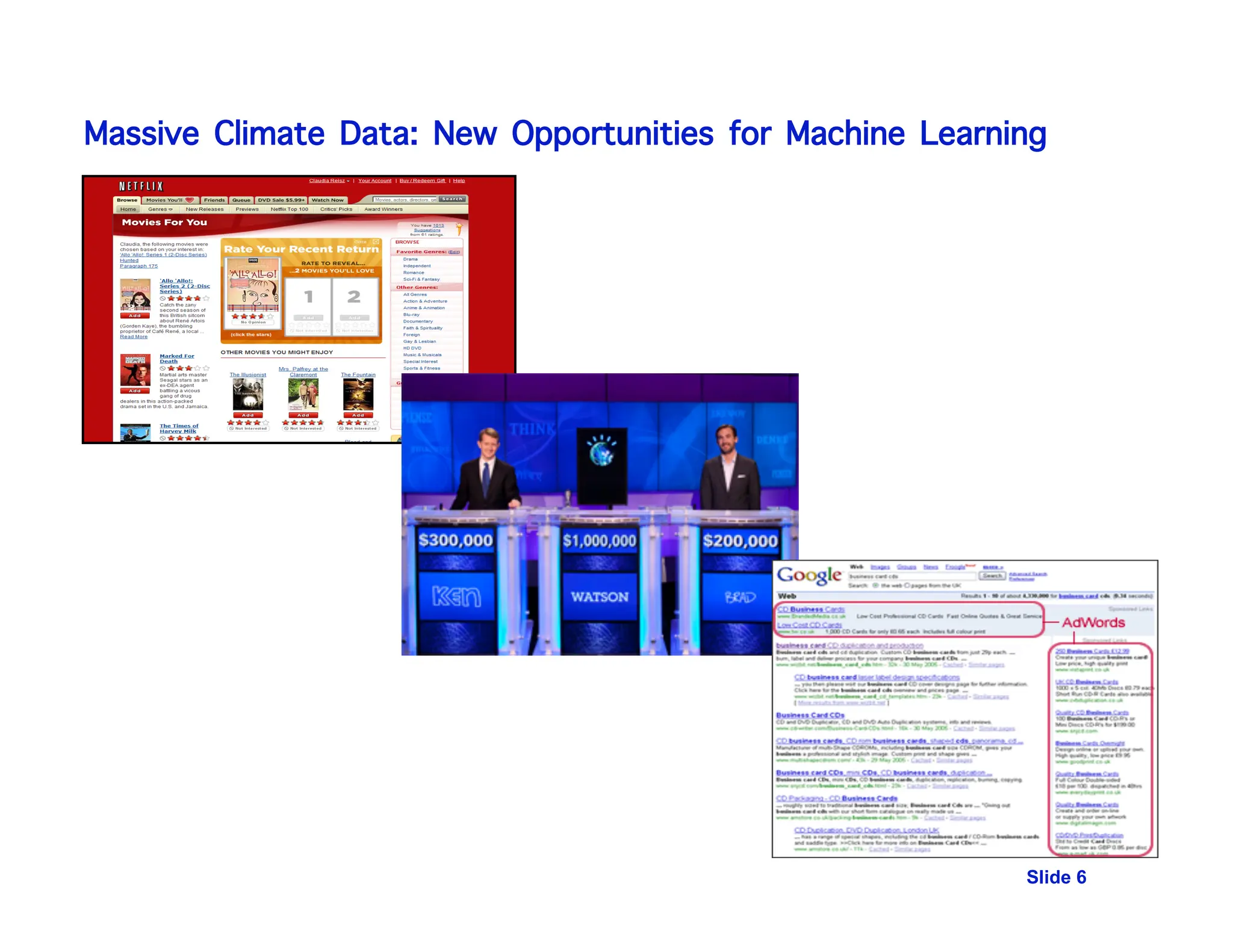
Massive Climate Data: New Opportunities for Machine Learning
Slide 6
Slide 7
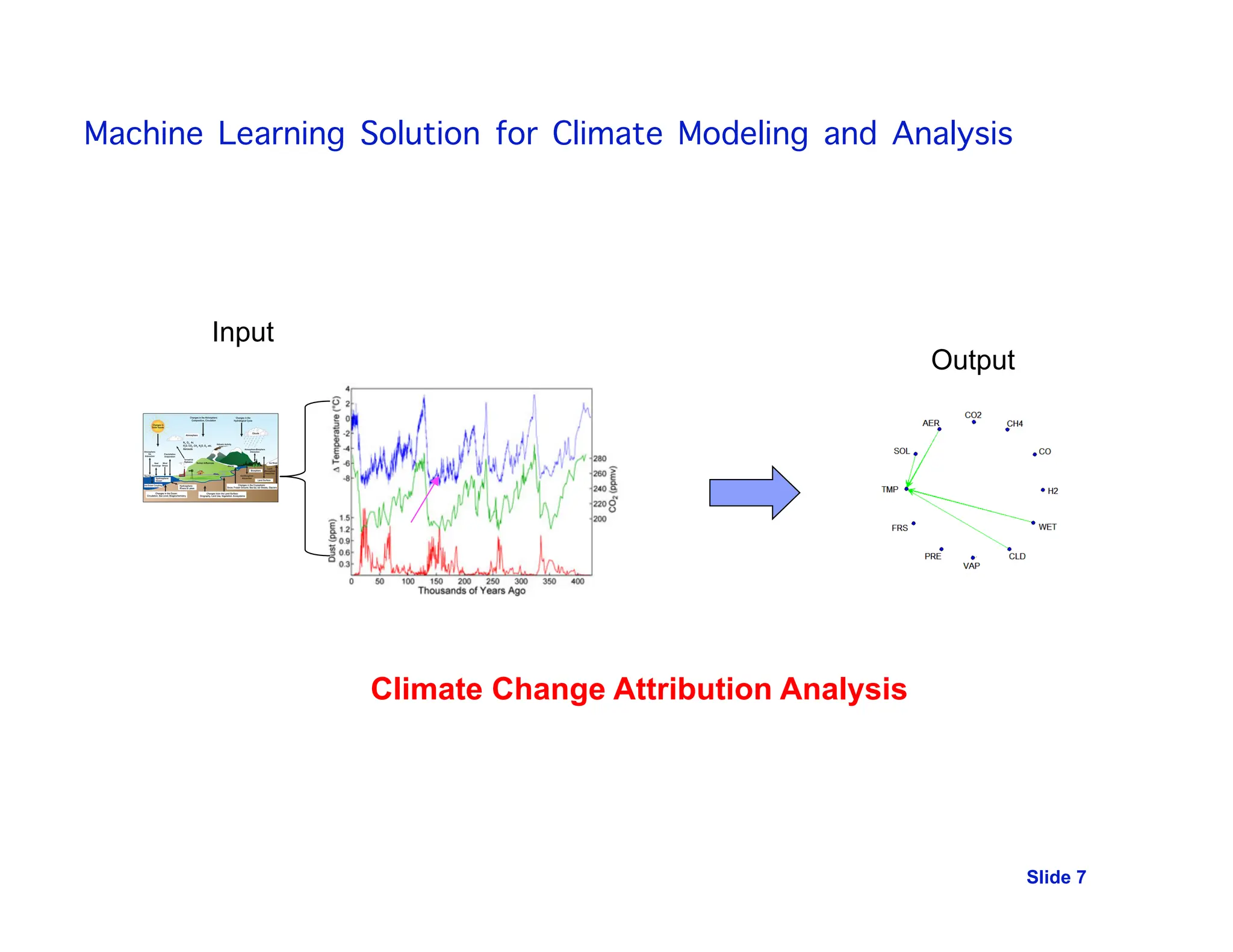
Machine Learning Solution for Climate Modeling and Analysis
Climate Change Attribution Analysis
Input
Output
Roadmap
 Introduction of Granger Graphical Models
 Examples of Granger Graphical Models
 Granger Graphical Models for Climate Change Attribution
 Experiment Results on Biology Applications
Slide 8
Roadmap
 Introduction of Granger Graphical Models
 Examples of Granger Graphical Models
 Granger Graphical Models for Climate Change Attribution
 Experiment Results on Biology Applications
Slide 9
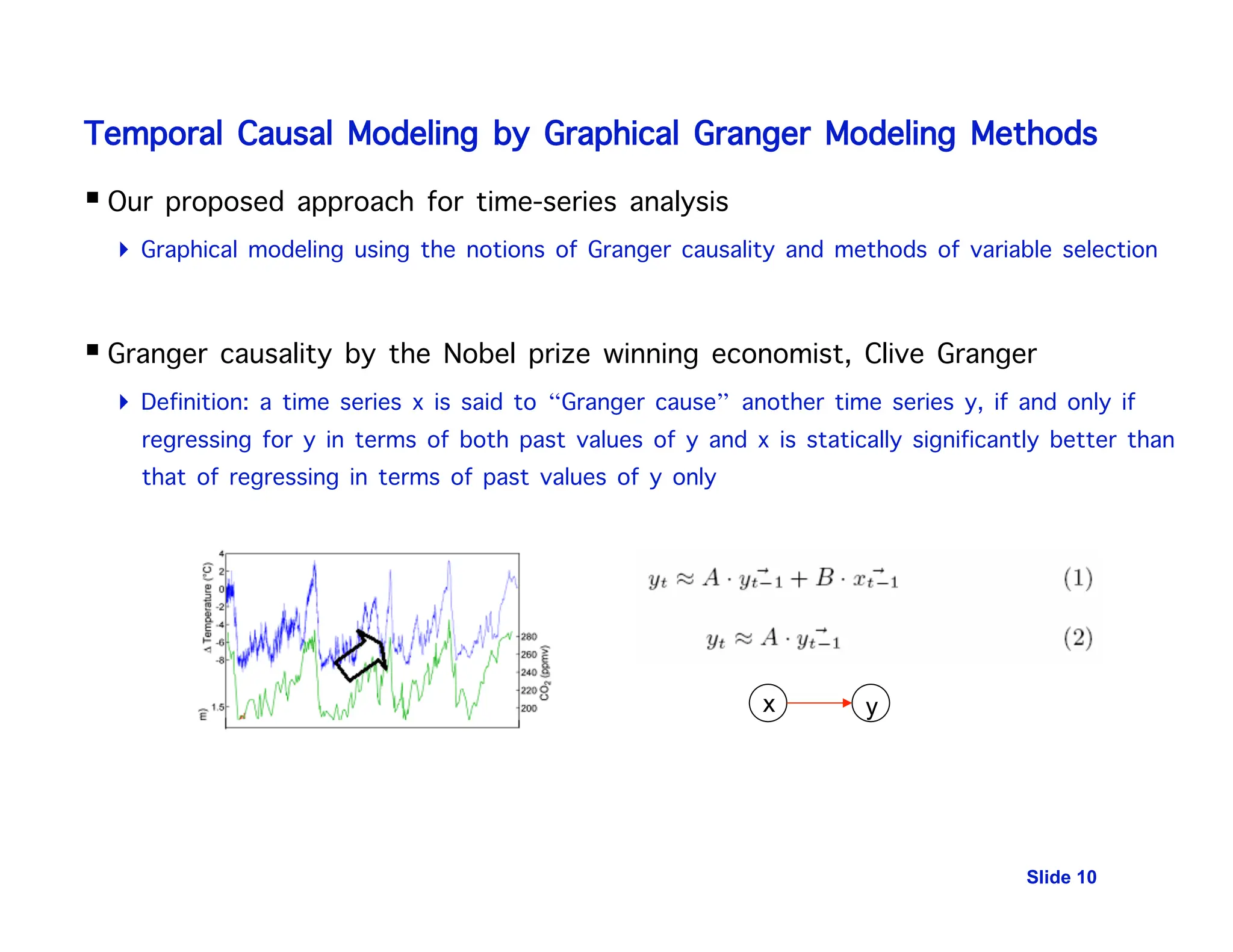
Temporal Causal Modeling by Graphical Granger Modeling Methods
Slide 10
 Our proposed approach for time-series analysis
 Graphical modeling using the notions of Granger causality and methods of variable selection
 Granger causality by the Nobel prize winning economist, Clive Granger
 Definition: a time series x is said to “Granger cause” another time series y, if and only if
regressing for y in terms of both past values of y and x is statically significantly better than
that of regressing in terms of past values of y only
x y
Graph Structure Learning
 Graph Structure learning [Heckerman, 1995] has been an active research area
for decades
 Recent progress on L1-penalized regression method for graph structure learning
 LASSO regression for neighborhood selection [Meinshausen and Bühlmann, Ann. Stat. 06]
Consider the p-dimensional multivariate normal distributed random variable:$ $
The neighborhood selection can be solved efficiently with the LASSO
 Block sub-gradient algorithm for finding precision matrix [Banerjee, JMLR 08]
 Efficient fixed-point equations based on a sub-gradient algorithm [Friedman et al.,
Biostatistics 08]
Slide 11
Generic Temporal Causal Modeling Method [KDD 2007 joint work with Arnold, Abe]
Slide 12
An example of REG can be Lasso [Tibshirani, 1996] Granger Causality
Neighborhood
selection
Structure learning is possible even when the number of variables is
significantly larger than that of the samples
Temporal Causal Modeling for Time-series Data Analysis
 Natural grouping of variables
 Group Lasso and group boosting [KDD 2009; ISMB 2009, with Lozano, Abe and Rosset]
 Non-stationary
 Dynamic linear system [KDD 2009, with Kalagnanam and Johnsen]
 Non-linear time-series
 Non-parametric approach [AAAI 2010, with Chen, Liu and Carbonell]
 Spatial time-series
 Spatio-temporal regression via group elastic net [KDD 2009, with Lozano et al.]
 Relational time-series
 Hidden Markov random field [Snowbird, ICML 2010, with Niculescu-Mizi, Lozano and Lu]
 Extreme event modeling
 Spatial-temporal extreme value models [KDD 2009, with Lozano et al; NIPS 2011 in
preparation]
Slide 13
Roadmap
 Introduction of Granger Graphical Models
 Examples of Granger Graphical Models
 Granger Graphical Models for Climate Change Attribution
 Experiment Results on Biology Applications
Slide 14
Slide 15
Example 1: Relational Multivariate Time-Series Data [ICML 2010, Liu et al]
 Input: multivariate time-series X(1), …, X(M) and relational graph GM
 Goal: learn a reasonable temporal causal graph for each location/species ..
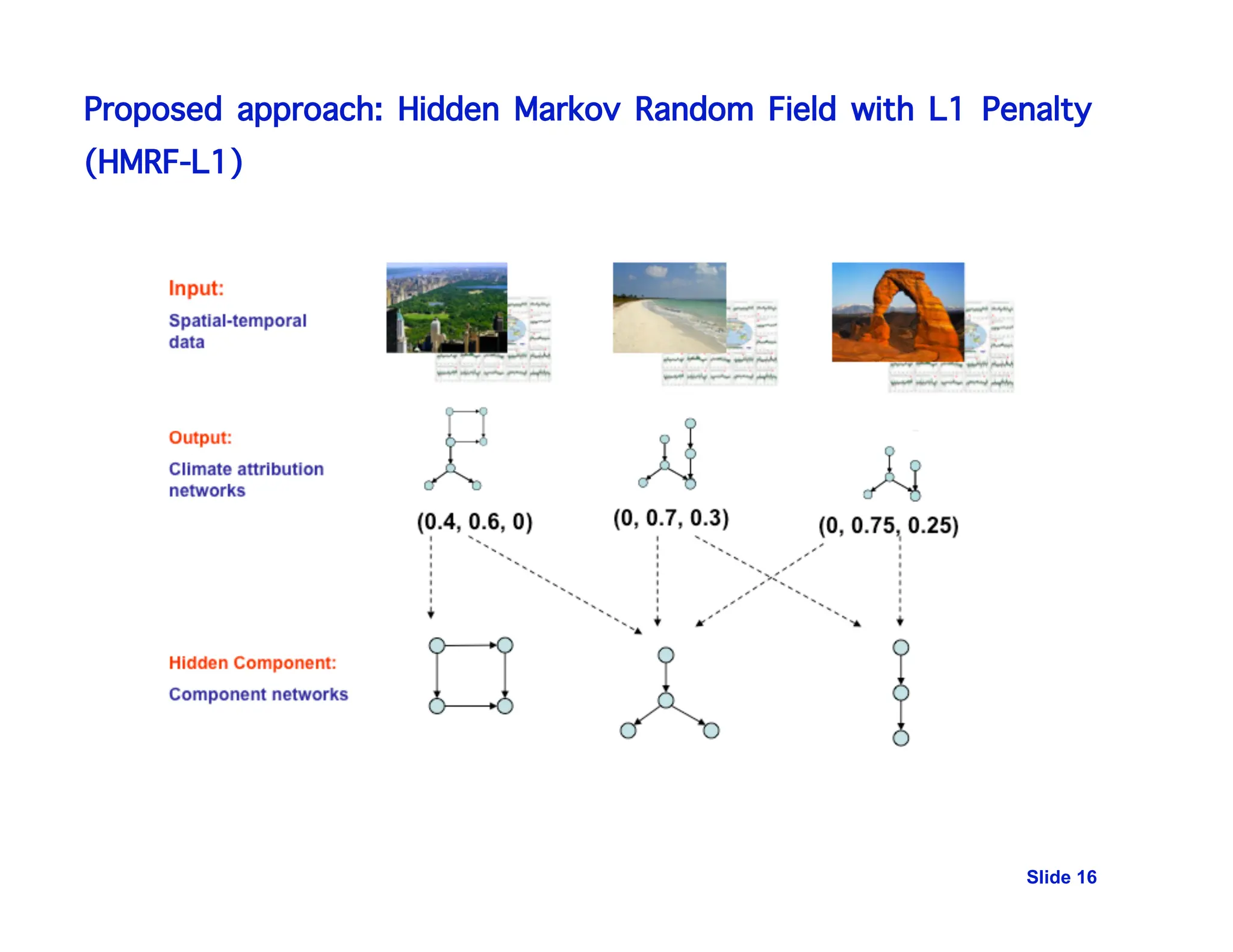
Proposed approach: Hidden Markov Random Field with L1 Penalty
(HMRF-L1)
Slide 16
Proposed approach: Hidden Markov Random Field with L1 –Penalty
(HMRF-L1)
Slide 17
 Define a hidden Markov Random Field on relational graph GM
 Assign a hidden state s(i) to each time-series X(i)
 Time-series that share the same state will share component networks
 Use EM to jointly infer the hidden state assignments and the causal
structure associated with each state
Slide 18
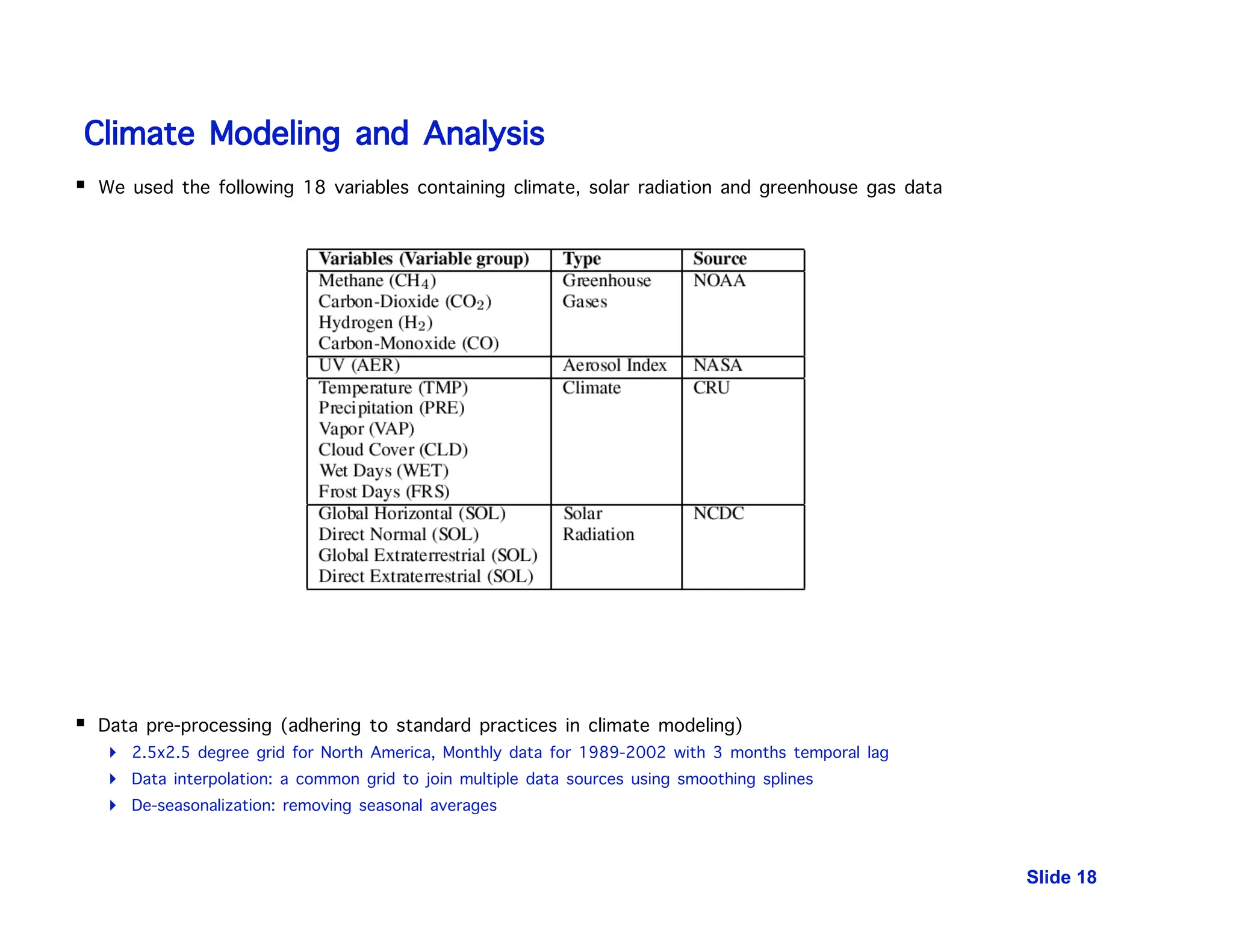
Climate Modeling and Analysis
 We used the following 18 variables containing climate, solar radiation and greenhouse gas data
 Data pre-processing (adhering to standard practices in climate modeling)
 2.5x2.5 degree grid for North America, Monthly data for 1989-2002 with 3 months temporal lag
 Data interpolation: a common grid to join multiple data sources using smoothing splines
 De-seasonalization: removing seasonal averages
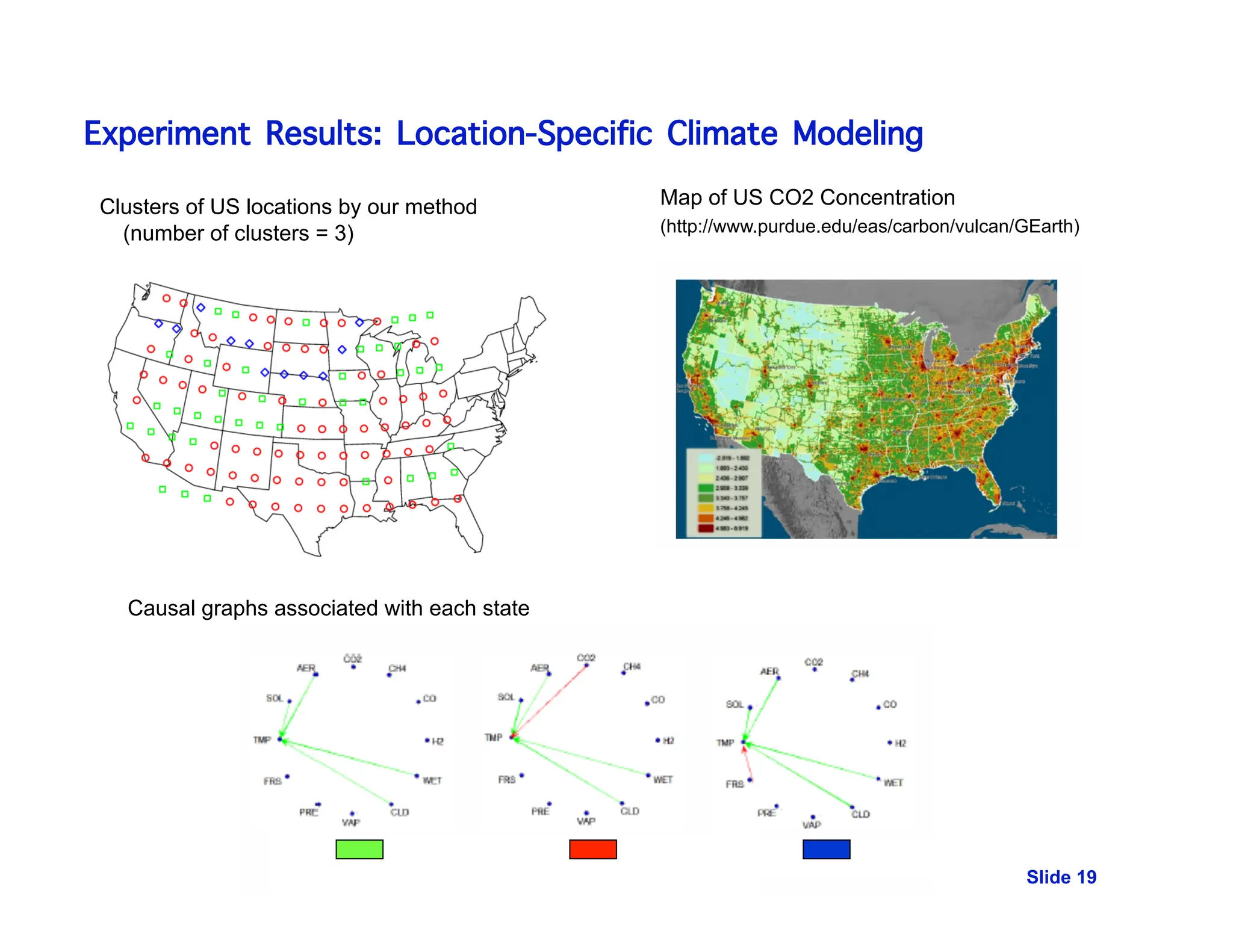
Experiment Results: Location-Specific Climate Modeling
Slide 19
Clusters of US locations by our method
(number of clusters = 3)
Causal graphs associated with each state
Map of US CO2 Concentration
(http://www.purdue.edu/eas/carbon/vulcan/GEarth)
Slide 20
Example 2: Extreme Event Modeling
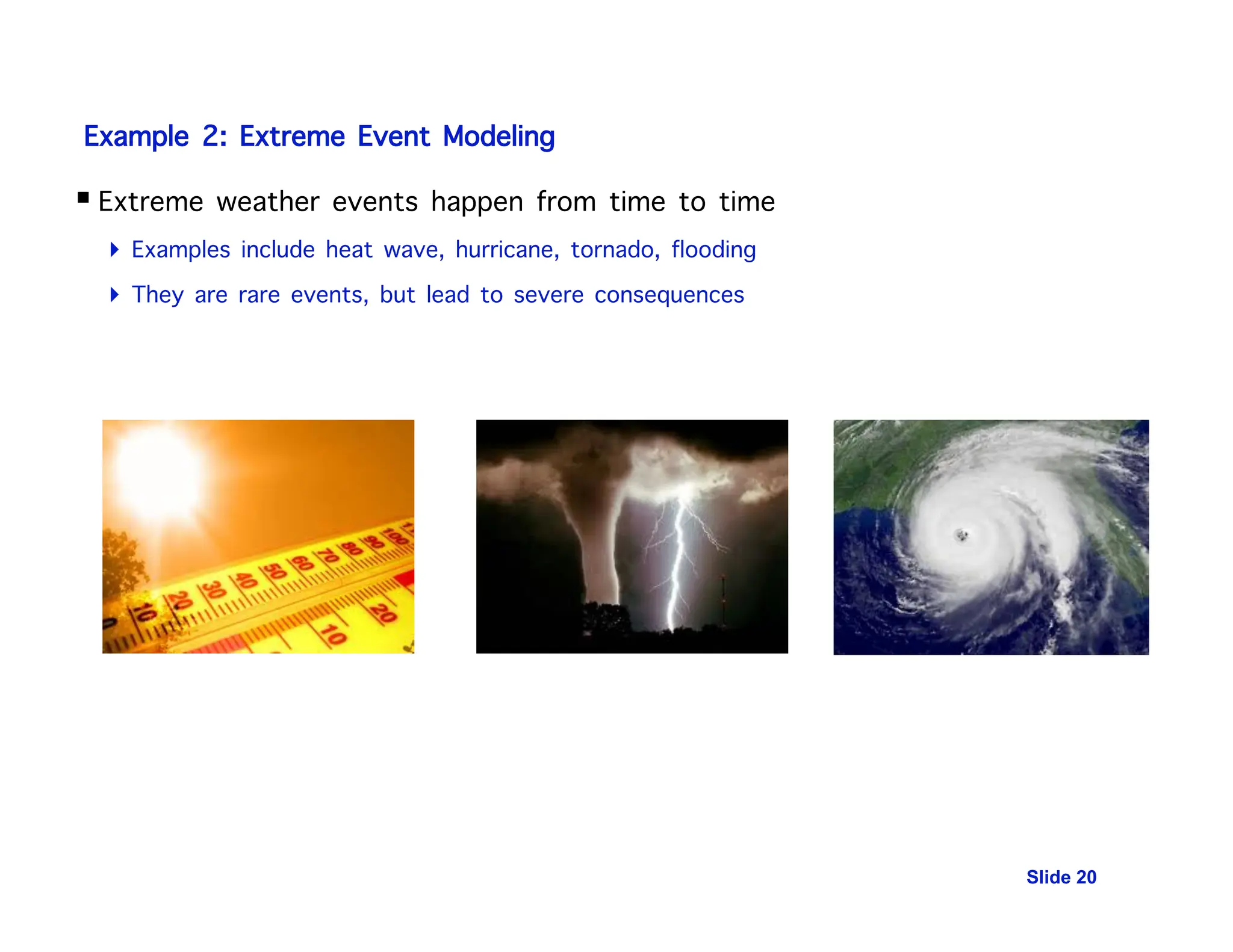
 Extreme weather events happen from time to time
 Examples include heat wave, hurricane, tornado, flooding
 They are rare events, but lead to severe consequences
Slide 21
Example 2: Extreme Event Modeling
 Key questions to be answered:
 Will the extreme weather happen more intensively?
 Will the extreme weather happen more frequently?
 Our approach: hierarchical Bayesian spatio-temporal dynamic model via extreme
value distribution
 Quantify the stochastic behavior of a process at unusually large or small levels
 A point process incorporating spatio-temporal dependence structures
Slide 22
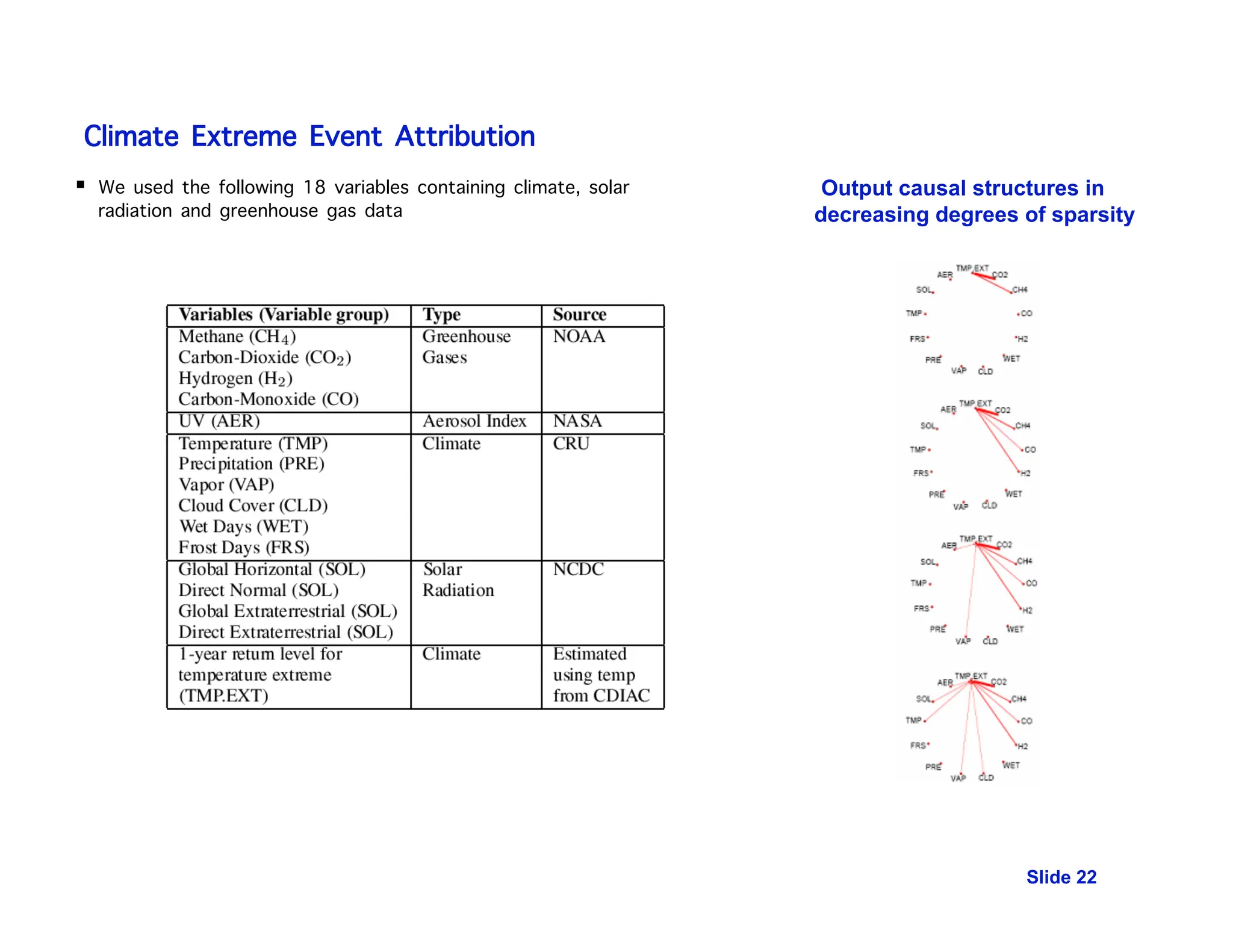
Climate Extreme Event Attribution
 We used the following 18 variables containing climate, solar
radiation and greenhouse gas data
Output causal structures in
decreasing degrees of sparsity
Roadmap
 Introduction of Granger Graphical Models
 Examples of Granger Graphical Models
 Granger Graphical Models for Climate Change Attribution
 Experiment Results on Biology Applications
Slide 23
Gene Regulatory Network Discovery [ISMB 2010]
Slide 24
Causal graphs discovered by our method
Evaluation against BioGRID
BioGRID
Recent Literature
Precision Recall F1
Our method 0.50 0.72 0.59
Sambo et al. (2008) 0.36 0.44 0.40
 Gene expression regulatory networks for the human cancer cell HeLa S3 [Whitfield
et al., 2002]
 Existing methods in the literature are unable to
 Accommodate lags greater than one
 Handle causality tests involving a large number of genes simultaneously
 Our method addresses both limitations, achieved higher accuracy, and was able
to uncovered previously uncaptured relationships
 CCNA2 to PCNA verified in [Liu, et al 2007]
 CCNE1 to ETF1 verified in [Merdzhanova, et al 2007]
 CCNE1 to CDC6 verified in [Furstenthal, et al 2001]
Granger Graphical Models for Time-series Analysis
 A general framework to reveal important dependency information about time-
series data
 Extensions to application data with different properties
 Applications: computational biology, climate science, production management
 Data properties: non-stationary, non-paranormal, relational data, spatial data, natural grouping
 On-going work
 Scalable models to massive data: online algorithms, parallel algorithms
 Anomaly detection and prediction: scalable and interpretable solutions
 Hidden variables: automatically identifying the existence of hidden variables
 Other applications: social-media analysis
Slide 25
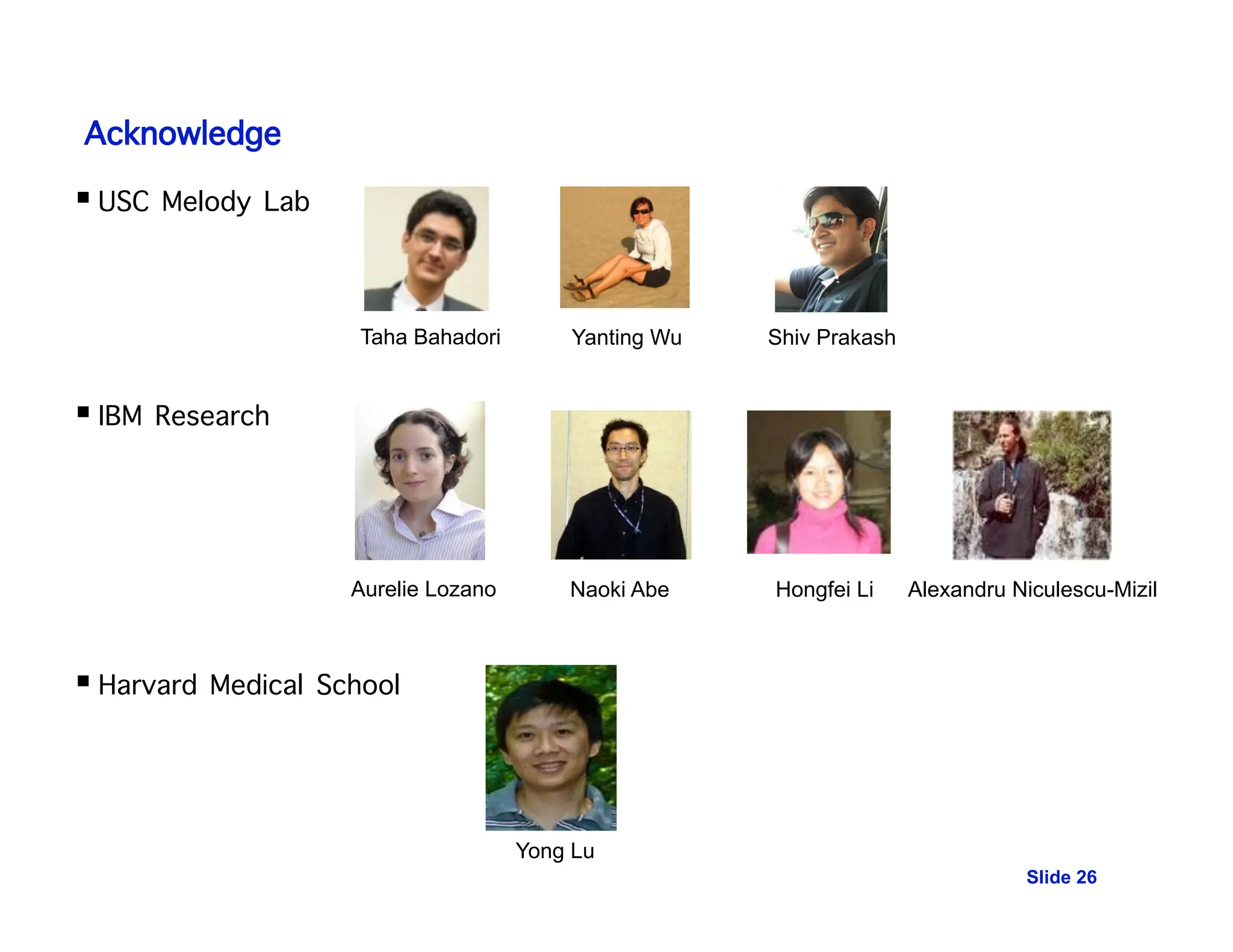
Acknowledge
 USC Melody Lab
 IBM Research
 Harvard Medical School
Slide 26
Taha Bahadori Yanting Wu Shiv Prakash
Aurelie Lozano Naoki Abe Hongfei Li Alexandru Niculescu-Mizil
Yong Lu

Data Mgmt-Liu.pdf

  • 1.
    1 Temporal Causal Modelsfor Massive Time-series Data Mining: Climate Change Attribution and other Applications Yan Liu Computer Science Department Viterbi School of Engineering University of Southern California 2011 Japan-America Frontiers of Engineering Symposium June 6-8, 2011
  • 2.
    Climate Change: Oneof the Most Critical Issues Mankind Faces in the 21st Century Slide 2
  • 3.
    Understanding Climate Systemis Imperative to Devising Potential Solutions  Climate system involves complex relationships between large number of variables  Need to understand and quantify “causal” effects of the various parameters Slide 3
  • 4.
    Challenges with ExistingClimate Models  23 widely used global climate models: Model inter- comparison project: http://www.clivar.org/organization/wgcm/cmip.php Slide 4  Forward-simulation approach
  • 5.
    Massive Amount ofSpatial-temporal Data on Climate and Climate-forcing Agents Slide 5 Human agents: atmospheric constituents Surface and atmospheric climate Snow, Ice and Frozen Ground Human agents: Land Cover Solar Radiation
  • 6.
    Massive Climate Data:New Opportunities for Machine Learning Slide 6
  • 7.
    Slide 7 Machine LearningSolution for Climate Modeling and Analysis Climate Change Attribution Analysis Input Output
  • 8.
    Roadmap  Introduction ofGranger Graphical Models  Examples of Granger Graphical Models  Granger Graphical Models for Climate Change Attribution  Experiment Results on Biology Applications Slide 8
  • 9.
    Roadmap  Introduction ofGranger Graphical Models  Examples of Granger Graphical Models  Granger Graphical Models for Climate Change Attribution  Experiment Results on Biology Applications Slide 9
  • 10.
    Temporal Causal Modelingby Graphical Granger Modeling Methods Slide 10  Our proposed approach for time-series analysis  Graphical modeling using the notions of Granger causality and methods of variable selection  Granger causality by the Nobel prize winning economist, Clive Granger  Definition: a time series x is said to “Granger cause” another time series y, if and only if regressing for y in terms of both past values of y and x is statically significantly better than that of regressing in terms of past values of y only x y
  • 11.
    Graph Structure Learning Graph Structure learning [Heckerman, 1995] has been an active research area for decades  Recent progress on L1-penalized regression method for graph structure learning  LASSO regression for neighborhood selection [Meinshausen and Bühlmann, Ann. Stat. 06] Consider the p-dimensional multivariate normal distributed random variable:$ $ The neighborhood selection can be solved efficiently with the LASSO  Block sub-gradient algorithm for finding precision matrix [Banerjee, JMLR 08]  Efficient fixed-point equations based on a sub-gradient algorithm [Friedman et al., Biostatistics 08] Slide 11
  • 12.
    Generic Temporal CausalModeling Method [KDD 2007 joint work with Arnold, Abe] Slide 12 An example of REG can be Lasso [Tibshirani, 1996] Granger Causality Neighborhood selection Structure learning is possible even when the number of variables is significantly larger than that of the samples
  • 13.
    Temporal Causal Modelingfor Time-series Data Analysis  Natural grouping of variables  Group Lasso and group boosting [KDD 2009; ISMB 2009, with Lozano, Abe and Rosset]  Non-stationary  Dynamic linear system [KDD 2009, with Kalagnanam and Johnsen]  Non-linear time-series  Non-parametric approach [AAAI 2010, with Chen, Liu and Carbonell]  Spatial time-series  Spatio-temporal regression via group elastic net [KDD 2009, with Lozano et al.]  Relational time-series  Hidden Markov random field [Snowbird, ICML 2010, with Niculescu-Mizi, Lozano and Lu]  Extreme event modeling  Spatial-temporal extreme value models [KDD 2009, with Lozano et al; NIPS 2011 in preparation] Slide 13
  • 14.
    Roadmap  Introduction ofGranger Graphical Models  Examples of Granger Graphical Models  Granger Graphical Models for Climate Change Attribution  Experiment Results on Biology Applications Slide 14
  • 15.
    Slide 15 Example 1:Relational Multivariate Time-Series Data [ICML 2010, Liu et al]  Input: multivariate time-series X(1), …, X(M) and relational graph GM  Goal: learn a reasonable temporal causal graph for each location/species ..
  • 16.
    Proposed approach: HiddenMarkov Random Field with L1 Penalty (HMRF-L1) Slide 16
  • 17.
    Proposed approach: HiddenMarkov Random Field with L1 –Penalty (HMRF-L1) Slide 17  Define a hidden Markov Random Field on relational graph GM  Assign a hidden state s(i) to each time-series X(i)  Time-series that share the same state will share component networks  Use EM to jointly infer the hidden state assignments and the causal structure associated with each state
  • 18.
    Slide 18 Climate Modelingand Analysis  We used the following 18 variables containing climate, solar radiation and greenhouse gas data  Data pre-processing (adhering to standard practices in climate modeling)  2.5x2.5 degree grid for North America, Monthly data for 1989-2002 with 3 months temporal lag  Data interpolation: a common grid to join multiple data sources using smoothing splines  De-seasonalization: removing seasonal averages
  • 19.
    Experiment Results: Location-SpecificClimate Modeling Slide 19 Clusters of US locations by our method (number of clusters = 3) Causal graphs associated with each state Map of US CO2 Concentration (http://www.purdue.edu/eas/carbon/vulcan/GEarth)
  • 20.
    Slide 20 Example 2:Extreme Event Modeling  Extreme weather events happen from time to time  Examples include heat wave, hurricane, tornado, flooding  They are rare events, but lead to severe consequences
  • 21.
    Slide 21 Example 2:Extreme Event Modeling  Key questions to be answered:  Will the extreme weather happen more intensively?  Will the extreme weather happen more frequently?  Our approach: hierarchical Bayesian spatio-temporal dynamic model via extreme value distribution  Quantify the stochastic behavior of a process at unusually large or small levels  A point process incorporating spatio-temporal dependence structures
  • 22.
    Slide 22 Climate ExtremeEvent Attribution  We used the following 18 variables containing climate, solar radiation and greenhouse gas data Output causal structures in decreasing degrees of sparsity
  • 23.
    Roadmap  Introduction ofGranger Graphical Models  Examples of Granger Graphical Models  Granger Graphical Models for Climate Change Attribution  Experiment Results on Biology Applications Slide 23
  • 24.
    Gene Regulatory NetworkDiscovery [ISMB 2010] Slide 24 Causal graphs discovered by our method Evaluation against BioGRID BioGRID Recent Literature Precision Recall F1 Our method 0.50 0.72 0.59 Sambo et al. (2008) 0.36 0.44 0.40  Gene expression regulatory networks for the human cancer cell HeLa S3 [Whitfield et al., 2002]  Existing methods in the literature are unable to  Accommodate lags greater than one  Handle causality tests involving a large number of genes simultaneously  Our method addresses both limitations, achieved higher accuracy, and was able to uncovered previously uncaptured relationships  CCNA2 to PCNA verified in [Liu, et al 2007]  CCNE1 to ETF1 verified in [Merdzhanova, et al 2007]  CCNE1 to CDC6 verified in [Furstenthal, et al 2001]
  • 25.
    Granger Graphical Modelsfor Time-series Analysis  A general framework to reveal important dependency information about time- series data  Extensions to application data with different properties  Applications: computational biology, climate science, production management  Data properties: non-stationary, non-paranormal, relational data, spatial data, natural grouping  On-going work  Scalable models to massive data: online algorithms, parallel algorithms  Anomaly detection and prediction: scalable and interpretable solutions  Hidden variables: automatically identifying the existence of hidden variables  Other applications: social-media analysis Slide 25
  • 26.
    Acknowledge  USC MelodyLab  IBM Research  Harvard Medical School Slide 26 Taha Bahadori Yanting Wu Shiv Prakash Aurelie Lozano Naoki Abe Hongfei Li Alexandru Niculescu-Mizil Yong Lu