Information management and
Using data to measure performance improvement
Dr. Badawy M. Abdelaziz
Egyptian board in family medicine
MRCGP
HC QM diploma
Hospital management diploma
CPHQ
‫السعوديـة‬ ‫العربيـة‬ ‫المملكـة‬
‫الصحة‬ ‫وزارة‬
‫الوسطى‬ ‫بالمنطقة‬ ‫األول‬ ‫الصحي‬ ‫التجمع‬
‫المجتمع‬ ‫صحة‬ ‫في‬ ‫للتميز‬ ‫التنفيذية‬ ‫اإلدارة‬
‫المرضى‬ ‫سالمة‬ ‫و‬ ‫الجودة‬ ‫إدارة‬
Information Management
Data: un-interpreted observations of facts.
Information: data transformed through:
• analysis and interpretation into a form
• useful for decision making.
Goal: →to support the decision making to improve:
• Patient outcomes
• Safety
• Documentation
• Performance
‫البيانات‬ ‫و‬ ‫المعلومات‬ ‫بين‬ ‫الفرق‬
•
‫البيانات‬ ‫تعرف‬
(
Data
)
‫مجدية‬ ‫غير‬ ‫وهي‬ ‫منظمة‬ ‫غير‬ ‫عشوائية‬ ‫أولية‬ ‫حقائق‬ ‫أنها‬ ‫على‬
‫البيانات‬ ‫تحويل‬ ‫خالل‬ ‫من‬ ‫وذلك‬ ،‫معالجتها‬ ‫يستلزم‬ ‫فإنه‬ ‫قيمة‬ ‫ذات‬ ‫ولجعلها‬ ،‫للبشر‬
‫إلى‬
‫المعلومات‬ ‫عرف‬ُ‫ت‬ ‫بينما‬ ،‫معلومات‬
(
Information
)
‫ومعالجة‬ ‫منظمة‬ ‫بيانات‬ ‫أنها‬ ‫على‬
‫القرار‬ ‫صنع‬ ‫في‬ ‫تساعد‬ ‫و‬ ‫للبشر‬ ‫مجدية‬ ‫لتكون‬ ‫معين‬ ‫سياق‬ ‫في‬ ‫وتقدم‬
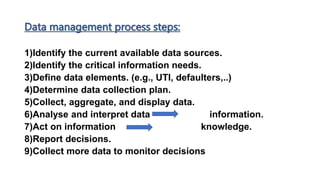
Data management process steps:
1)Identify the current available data sources.
2)Identify the critical information needs.
3)Define data elements. (e.g., UTI, defaulters,..)
4)Determine data collection plan.
5)Collect, aggregate, and display data.
6)Analyse and interpret data information.
7)Act on information knowledge.
8)Report decisions.
9)Collect more data to monitor decisions
‫المعلومات‬ ‫إدارة‬ ‫خطوات‬
:
•
1
)
‫حاليا‬ ‫المتاحة‬ ‫البيانات‬ ‫مصادر‬ ‫تحديد‬
.
•
2
)
‫الهامة‬ ‫المعلومات‬ ‫احتياجات‬ ‫تحديد‬
.
•
3
)
‫البيانات‬ ‫عناصر‬ ‫تحديد‬
( .
، ‫المثال‬ ‫سبيل‬ ‫على‬
UTI
،
، ‫المتخلفون‬
)..
•
4
)
‫البيانات‬ ‫جمع‬ ‫خطة‬ ‫تحديد‬
.
•
5
)
‫البيانات‬ ‫وعرض‬ ‫وتجميع‬ ‫حصر‬
.
•
6
)
‫البيانات‬ ‫وتفسير‬ ‫تحليل‬
.
‫معلومات‬
•
7
)
‫المعلومات‬ ‫على‬ ‫العمل‬
.
‫معرفة‬
•
8
)
‫تقرير‬
/
‫القرارات‬ ‫صنع‬
.
•
9
)
‫القرارات‬ ‫لمراقبة‬ ‫البيانات‬ ‫من‬ ‫المزيد‬ ‫جمع‬
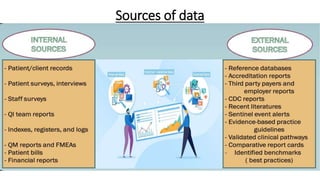
Sources of data
DATA FOR
PERFORMANCE MEASUREMENT
Why Does an Organization Need to Measure Performance?
• A reliable process to determine if an organization’s current system is working well.
• A demand for transparency and increasing scrutiny of an organization’s business practices.
• Distinguish what appears to be happening from what is really happening
• Establish a baseline; i.e., measure before improvements are made
• Make priorities for improvement
• Make decisions based on solid evidence
• Demonstrate that changes lead to improvements
• Allow performance comparisons across sites
• Monitor process changes to ensure improvements are sustained over time
There are additional motives for a health care organization to measure
its performance:
• Government-accrediting organizations and funding sources rely on
performance measurement to prove resources are used effectively and
efficiently
• Clinicians use performance measurement to quantify the effectiveness of
evidence-based care provided by their care delivery systems
• Organizational leaders use performance measurement to monitor and
improve management, clinical care, and support services
Performance Evaluation
• To provide context for evaluating
baseline data, an organization
may choose to compare and
benchmark its data against other
health care organizations.
• BENCHMARKING is a
process that compares
organizational performance with
health care industry best
practices, which may include data
from local, regional, or national
sources.
• Benchmarking brings objectivity
to the analysis of performance
and identifies the strengths and
weaknesses of a health care
organization.
• If an organization is satisfied with its current level of performance, then it
may:
• Acknowledge and celebrate its success!
• Put a system in place to monitor performance periodically. The measure was selected because it is
important to the organization; check performance periodically to ensure that the underlying
systems involved in performance continue to function satisfactorily.
• Consider another performance measure.
• If an organization’s performance is less than desired, then it may establish an
aim for improvement.
MANAGING DATA FOR PERFORMANCE IMPROVEMENT
Managing Data for Performance Improvement consists of four primary steps :
• Collecting data
• Tracking data
• Analysing and interpreting data
• Acting on data
Step 1: Collecting Data
• Data collection plan should be in place prior to actually collecting the data, or to develop the plan
while the baseline is calculated.
• A well-documented data collection plan standardizes the various processes required to collect and
measure data.
• An effective data collection plan includes the following details for each measure:
• Name of the measure
• Data source
• Denominator and numerator.
• Collection method
• Frequency of data collection
• Standardized time to collect data and time for reporting as applicable e.g., calculating
Breast Cancer Screening measure on the second Monday of each month is appropriate if the
Breast Cancer Screening QI Team reviews performance data on the second Thursday of each
month
• Identify staff responsible for collection and other aspects of the measurement process to
create a detailed record
• Required Data Elements for the Breast Cancer Screening Example:
• Name: Breast Cancer Screening
• Description: Percentage of women 40 to 69 years of age who had a mammogram
• Denominator: All women patients aged 42 to 69 years of age during the measurement year or year prior to
the measurement year
• Numerator: Women in the denominator who received one or more mammograms during the measurement
year or the year prior to the measurement year
• Data Source: registers of the screening clinic
• Reference: http://www.qu alityforum.org/ MeasureDetail s.aspx?actid=0 &SubmissionI d=392#k=brea
st+Cancer+scr eening
Types of Performance Measures
• Process measure quantifies a health care service provided to patient. It
quantifies a specific system; e.g., to get a test done or a service performed.
• Outcome measure quantifies a patient’s health status resulting from health
care. In the clinical area, it often measures a patient outcome so it can be
compared to a care standard, such as, a patient’s test value. E.g. controlled
diabetics,
• Balancing measure ensures that changes to improve one part of the system are
not causing new problems in other parts of the system. It examines another part of
the system to ensure that improvements in one area have no unexpected
consequences in another.
• Structure of care measure quantifies a feature of a health care organization
(or clinician) relevant to its capacity to provide health care.
How to Choose Performance Measures
• Consider the following in selecting performance measures:
• Measure what is important based on the evaluation of an organization’s community, population, and
priorities as determined in Step 1
• Measure what is required to meet funding or contractual expectations
• Include staff in the measure selection process since staff will be involved in the actual
implementation of measurement and improvement activities. Buy-in from staff significantly
facilitates these steps.
• Use existing measures, if possible. Clinical performance measures are derived from evidence-
based clinical guidelines
• If an organization creates its own measure, consider the characteristics of
good performance measures:
• Consider using several measures of different types as described above. For example, diabetes
care may best be evaluated by including:
• o Frequency of evidence-based testing (process measure)
• o Patient blood glucose control (outcome measure)
• o Patient satisfaction as diabetes care delivery evolves (balancing measure)
• o Trained staff in diabetes care (structural measure)
Usability: The relative ease with which the indicator can be understood or the tool
can be used
Step 2: Tracking Data
• Calculate Each Measure Over Time
When the performance is calculated, a QI team then decides how often to monitor it. As a general
rule, a QI team that is actively making changes to systems of care monitors performance frequently.
The following guidelines are suggestions that a team may use for determining performance
measurement frequency:
• Frequency Team’s Position in the Process
• Monthly Actively changing the underlying systems
• Quarterly After aim or goal is achieved
• Annually (or periodically) After aim or goal is achieved and performance is stable
Monitor Performance Over Time
• A critical part of QI is to measure when changes occur.
• For an organization actively engaged in improvement work, this is often monthly.
• As performance is measured over time, a trend develops.
• Trended data shows opportunities for improvement.
• It is important to use the same methodology to collect and calculate the data each time.
• Changes that improve the underlying critical pathway often reflect improved performance
on the measure.
• An organization may choose to continue its improvement efforts as it moves toward its target
or goal for the performance measure.
• All changes do not result in improvement and reflection on other change opportunities may
be required to get improvement back on track.
• Continue to test changes and make improvements until aims have been achieved.
Data displays
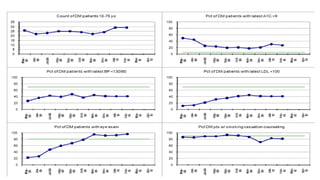
• Data displays are effective tools for sharing Progress with the Practice Team .
• Data that is displayed graphically provides a quick view of the team’s progress—from
baseline to aim.
• The commonly-used data display techniques:
• Run Charts
• Run charts show trends in data over time, are easy to interpret, and provide a picture
of how a process is performing
• Control Charts
• Similar to run charts, control charts show data over time; however, they provide limits
on which observed variation can be detected as either random or expected.
• Dashboard
• provide several performance indicators at a glance, and are more commonly used as
organizations increase their number of measures.
• Dashboards are created to display various aspects of one quality improvement project
or used to convey performance across the organization,
Step 3: Analysing and Interpreting Data
• Analysing data: is the reviewing the current performance and
comparing it to the baseline, the previous month’s performance,
and its aim or goal. This analysis gives a general sense of progress
toward the aim, if it is reachable, and if performance is improving. it
is used to define a performance plan.
• Interpreting data: is the process of assigning meaning or
determining the significance, implications, and conclusions of data
collected; it is used to evaluate and improve activities, identify gaps,
and plan for improvement.
• The interpretation process provides knowledge of the changes
applied to the systems, special events with a potential impact, and
lessons learned from the prior month’s work that forms the next
steps.
• Example : A Women’s Health Center’s Use of a Run Chart to Analyse Improvement
• The QI team from a women’s health center is working to improve the rate of Pap smears for its patient
population.
• The team’s aim statement is: Over the next 12 months, we will redesign the care systems of the women’s health
center to ensure that 90 percent of women aged 21 to 64 years have been screened for cervical cancer with at least one
Pap test within the past three years.
• The QI team reviewed the run chart.
• The performance improved from a baseline of 62 percent to 79 percent over the last eight months.
• The team was glad to see improvement but realized it had a way to go to meet its aim of 90 percent in just four
months.
• It interpreted this information by concluding that the rate of improvement was unlikely to achieve its aim by the
end of the project period.
Part 5: Acting on the Data
When Progress is Insufficient:
• Ensure Data Systems Are Reliable
• .A current, updated registry, timely data entry, and compliance with the data collection methodology avoid a less-
than-expected performance
• Re-evaluate Potential Causes of Underlying System Problems (fish-bone)
• Re-evaluate Changes Made for Improvement
• A common cause of a change failing to result in improvement is because the change was implemented
inconsistently or unexpectedly discontinued. There are a number of reasons this occurs--communication issues,
insufficient training, or resistance to change are the typical challenges that may contribute to a unsuccessful
change.
• Increase Number of Changes per Week
• When a team has insufficient resources or time, it may implement only one change every week or two, which
slows the rate of performance improvement. A recommendation for this scenario is to include other staff
members to assist with incremental tasks, such as testing the changes, so the QI team can work on multiple
factors simultaneously to improve systems.
• Remove Barriers
• Women who do not have access to mammography, or transportation issues that prevent patients to get routine
HbA1c tests, are examples of barriers. One solution is to partner with other agencies, such as the Cancer Control
Program, to schedule the mobile mammography van once a month, or seek funding to offer HbA1c tests on site
When Progress is Sufficient
• Celebrate the improvement.
• Continue on the Same Path
• Work on a Different Part of the System
• Test Changes in More Situations
When changes result in performance improvement as planned, a team may consider testing
the changes further to ensure they will work under all conditions. The ultimate goal is to
embed the new and improved process until it is consistently performed each time.
• Spread the Improvement
When the team achieves success in its QI project for a population of focus (POF), the work
should be spread to other providers, care teams, or sites within the organization.
data for measurement.pptx

data for measurement.pptx

  • 1.
    Information management and Usingdata to measure performance improvement Dr. Badawy M. Abdelaziz Egyptian board in family medicine MRCGP HC QM diploma Hospital management diploma CPHQ ‫السعوديـة‬ ‫العربيـة‬ ‫المملكـة‬ ‫الصحة‬ ‫وزارة‬ ‫الوسطى‬ ‫بالمنطقة‬ ‫األول‬ ‫الصحي‬ ‫التجمع‬ ‫المجتمع‬ ‫صحة‬ ‫في‬ ‫للتميز‬ ‫التنفيذية‬ ‫اإلدارة‬ ‫المرضى‬ ‫سالمة‬ ‫و‬ ‫الجودة‬ ‫إدارة‬
  • 2.
    Information Management Data: un-interpretedobservations of facts. Information: data transformed through: • analysis and interpretation into a form • useful for decision making. Goal: →to support the decision making to improve: • Patient outcomes • Safety • Documentation • Performance
  • 3.
    ‫البيانات‬ ‫و‬ ‫المعلومات‬‫بين‬ ‫الفرق‬ • ‫البيانات‬ ‫تعرف‬ ( Data ) ‫مجدية‬ ‫غير‬ ‫وهي‬ ‫منظمة‬ ‫غير‬ ‫عشوائية‬ ‫أولية‬ ‫حقائق‬ ‫أنها‬ ‫على‬ ‫البيانات‬ ‫تحويل‬ ‫خالل‬ ‫من‬ ‫وذلك‬ ،‫معالجتها‬ ‫يستلزم‬ ‫فإنه‬ ‫قيمة‬ ‫ذات‬ ‫ولجعلها‬ ،‫للبشر‬ ‫إلى‬ ‫المعلومات‬ ‫عرف‬ُ‫ت‬ ‫بينما‬ ،‫معلومات‬ ( Information ) ‫ومعالجة‬ ‫منظمة‬ ‫بيانات‬ ‫أنها‬ ‫على‬ ‫القرار‬ ‫صنع‬ ‫في‬ ‫تساعد‬ ‫و‬ ‫للبشر‬ ‫مجدية‬ ‫لتكون‬ ‫معين‬ ‫سياق‬ ‫في‬ ‫وتقدم‬
  • 7.
    Data management processsteps: 1)Identify the current available data sources. 2)Identify the critical information needs. 3)Define data elements. (e.g., UTI, defaulters,..) 4)Determine data collection plan. 5)Collect, aggregate, and display data. 6)Analyse and interpret data information. 7)Act on information knowledge. 8)Report decisions. 9)Collect more data to monitor decisions
  • 8.
    ‫المعلومات‬ ‫إدارة‬ ‫خطوات‬ : • 1 ) ‫حاليا‬‫المتاحة‬ ‫البيانات‬ ‫مصادر‬ ‫تحديد‬ . • 2 ) ‫الهامة‬ ‫المعلومات‬ ‫احتياجات‬ ‫تحديد‬ . • 3 ) ‫البيانات‬ ‫عناصر‬ ‫تحديد‬ ( . ، ‫المثال‬ ‫سبيل‬ ‫على‬ UTI ، ، ‫المتخلفون‬ ).. • 4 ) ‫البيانات‬ ‫جمع‬ ‫خطة‬ ‫تحديد‬ . • 5 ) ‫البيانات‬ ‫وعرض‬ ‫وتجميع‬ ‫حصر‬ . • 6 ) ‫البيانات‬ ‫وتفسير‬ ‫تحليل‬ . ‫معلومات‬ • 7 ) ‫المعلومات‬ ‫على‬ ‫العمل‬ . ‫معرفة‬ • 8 ) ‫تقرير‬ / ‫القرارات‬ ‫صنع‬ . • 9 ) ‫القرارات‬ ‫لمراقبة‬ ‫البيانات‬ ‫من‬ ‫المزيد‬ ‫جمع‬
  • 9.
  • 20.
  • 21.
    Why Does anOrganization Need to Measure Performance? • A reliable process to determine if an organization’s current system is working well. • A demand for transparency and increasing scrutiny of an organization’s business practices. • Distinguish what appears to be happening from what is really happening • Establish a baseline; i.e., measure before improvements are made • Make priorities for improvement • Make decisions based on solid evidence • Demonstrate that changes lead to improvements • Allow performance comparisons across sites • Monitor process changes to ensure improvements are sustained over time
  • 22.
    There are additionalmotives for a health care organization to measure its performance: • Government-accrediting organizations and funding sources rely on performance measurement to prove resources are used effectively and efficiently • Clinicians use performance measurement to quantify the effectiveness of evidence-based care provided by their care delivery systems • Organizational leaders use performance measurement to monitor and improve management, clinical care, and support services
  • 23.
    Performance Evaluation • Toprovide context for evaluating baseline data, an organization may choose to compare and benchmark its data against other health care organizations. • BENCHMARKING is a process that compares organizational performance with health care industry best practices, which may include data from local, regional, or national sources. • Benchmarking brings objectivity to the analysis of performance and identifies the strengths and weaknesses of a health care organization.
  • 24.
    • If anorganization is satisfied with its current level of performance, then it may: • Acknowledge and celebrate its success! • Put a system in place to monitor performance periodically. The measure was selected because it is important to the organization; check performance periodically to ensure that the underlying systems involved in performance continue to function satisfactorily. • Consider another performance measure. • If an organization’s performance is less than desired, then it may establish an aim for improvement.
  • 25.
    MANAGING DATA FORPERFORMANCE IMPROVEMENT Managing Data for Performance Improvement consists of four primary steps : • Collecting data • Tracking data • Analysing and interpreting data • Acting on data
  • 26.
    Step 1: CollectingData • Data collection plan should be in place prior to actually collecting the data, or to develop the plan while the baseline is calculated. • A well-documented data collection plan standardizes the various processes required to collect and measure data. • An effective data collection plan includes the following details for each measure: • Name of the measure • Data source • Denominator and numerator. • Collection method • Frequency of data collection • Standardized time to collect data and time for reporting as applicable e.g., calculating Breast Cancer Screening measure on the second Monday of each month is appropriate if the Breast Cancer Screening QI Team reviews performance data on the second Thursday of each month • Identify staff responsible for collection and other aspects of the measurement process to create a detailed record
  • 27.
    • Required DataElements for the Breast Cancer Screening Example: • Name: Breast Cancer Screening • Description: Percentage of women 40 to 69 years of age who had a mammogram • Denominator: All women patients aged 42 to 69 years of age during the measurement year or year prior to the measurement year • Numerator: Women in the denominator who received one or more mammograms during the measurement year or the year prior to the measurement year • Data Source: registers of the screening clinic • Reference: http://www.qu alityforum.org/ MeasureDetail s.aspx?actid=0 &SubmissionI d=392#k=brea st+Cancer+scr eening
  • 28.
    Types of PerformanceMeasures • Process measure quantifies a health care service provided to patient. It quantifies a specific system; e.g., to get a test done or a service performed. • Outcome measure quantifies a patient’s health status resulting from health care. In the clinical area, it often measures a patient outcome so it can be compared to a care standard, such as, a patient’s test value. E.g. controlled diabetics, • Balancing measure ensures that changes to improve one part of the system are not causing new problems in other parts of the system. It examines another part of the system to ensure that improvements in one area have no unexpected consequences in another. • Structure of care measure quantifies a feature of a health care organization (or clinician) relevant to its capacity to provide health care.
  • 29.
    How to ChoosePerformance Measures • Consider the following in selecting performance measures: • Measure what is important based on the evaluation of an organization’s community, population, and priorities as determined in Step 1 • Measure what is required to meet funding or contractual expectations • Include staff in the measure selection process since staff will be involved in the actual implementation of measurement and improvement activities. Buy-in from staff significantly facilitates these steps. • Use existing measures, if possible. Clinical performance measures are derived from evidence- based clinical guidelines
  • 30.
    • If anorganization creates its own measure, consider the characteristics of good performance measures: • Consider using several measures of different types as described above. For example, diabetes care may best be evaluated by including: • o Frequency of evidence-based testing (process measure) • o Patient blood glucose control (outcome measure) • o Patient satisfaction as diabetes care delivery evolves (balancing measure) • o Trained staff in diabetes care (structural measure)
  • 31.
    Usability: The relativeease with which the indicator can be understood or the tool can be used
  • 32.
    Step 2: TrackingData • Calculate Each Measure Over Time When the performance is calculated, a QI team then decides how often to monitor it. As a general rule, a QI team that is actively making changes to systems of care monitors performance frequently. The following guidelines are suggestions that a team may use for determining performance measurement frequency: • Frequency Team’s Position in the Process • Monthly Actively changing the underlying systems • Quarterly After aim or goal is achieved • Annually (or periodically) After aim or goal is achieved and performance is stable
  • 33.
    Monitor Performance OverTime • A critical part of QI is to measure when changes occur. • For an organization actively engaged in improvement work, this is often monthly. • As performance is measured over time, a trend develops. • Trended data shows opportunities for improvement. • It is important to use the same methodology to collect and calculate the data each time. • Changes that improve the underlying critical pathway often reflect improved performance on the measure. • An organization may choose to continue its improvement efforts as it moves toward its target or goal for the performance measure. • All changes do not result in improvement and reflection on other change opportunities may be required to get improvement back on track. • Continue to test changes and make improvements until aims have been achieved.
  • 34.
    Data displays • Datadisplays are effective tools for sharing Progress with the Practice Team . • Data that is displayed graphically provides a quick view of the team’s progress—from baseline to aim. • The commonly-used data display techniques: • Run Charts • Run charts show trends in data over time, are easy to interpret, and provide a picture of how a process is performing • Control Charts • Similar to run charts, control charts show data over time; however, they provide limits on which observed variation can be detected as either random or expected. • Dashboard • provide several performance indicators at a glance, and are more commonly used as organizations increase their number of measures. • Dashboards are created to display various aspects of one quality improvement project or used to convey performance across the organization,
  • 37.
    Step 3: Analysingand Interpreting Data • Analysing data: is the reviewing the current performance and comparing it to the baseline, the previous month’s performance, and its aim or goal. This analysis gives a general sense of progress toward the aim, if it is reachable, and if performance is improving. it is used to define a performance plan. • Interpreting data: is the process of assigning meaning or determining the significance, implications, and conclusions of data collected; it is used to evaluate and improve activities, identify gaps, and plan for improvement. • The interpretation process provides knowledge of the changes applied to the systems, special events with a potential impact, and lessons learned from the prior month’s work that forms the next steps.
  • 38.
    • Example :A Women’s Health Center’s Use of a Run Chart to Analyse Improvement • The QI team from a women’s health center is working to improve the rate of Pap smears for its patient population. • The team’s aim statement is: Over the next 12 months, we will redesign the care systems of the women’s health center to ensure that 90 percent of women aged 21 to 64 years have been screened for cervical cancer with at least one Pap test within the past three years. • The QI team reviewed the run chart. • The performance improved from a baseline of 62 percent to 79 percent over the last eight months. • The team was glad to see improvement but realized it had a way to go to meet its aim of 90 percent in just four months. • It interpreted this information by concluding that the rate of improvement was unlikely to achieve its aim by the end of the project period.
  • 39.
    Part 5: Actingon the Data When Progress is Insufficient: • Ensure Data Systems Are Reliable • .A current, updated registry, timely data entry, and compliance with the data collection methodology avoid a less- than-expected performance • Re-evaluate Potential Causes of Underlying System Problems (fish-bone) • Re-evaluate Changes Made for Improvement • A common cause of a change failing to result in improvement is because the change was implemented inconsistently or unexpectedly discontinued. There are a number of reasons this occurs--communication issues, insufficient training, or resistance to change are the typical challenges that may contribute to a unsuccessful change. • Increase Number of Changes per Week • When a team has insufficient resources or time, it may implement only one change every week or two, which slows the rate of performance improvement. A recommendation for this scenario is to include other staff members to assist with incremental tasks, such as testing the changes, so the QI team can work on multiple factors simultaneously to improve systems. • Remove Barriers • Women who do not have access to mammography, or transportation issues that prevent patients to get routine HbA1c tests, are examples of barriers. One solution is to partner with other agencies, such as the Cancer Control Program, to schedule the mobile mammography van once a month, or seek funding to offer HbA1c tests on site
  • 40.
    When Progress isSufficient • Celebrate the improvement. • Continue on the Same Path • Work on a Different Part of the System • Test Changes in More Situations When changes result in performance improvement as planned, a team may consider testing the changes further to ensure they will work under all conditions. The ultimate goal is to embed the new and improved process until it is consistently performed each time. • Spread the Improvement When the team achieves success in its QI project for a population of focus (POF), the work should be spread to other providers, care teams, or sites within the organization.