DEBRA ASKANASE
STEVEN BACKMAN
MARC BAIZMAN
introducing
DATA DRIVEN
TECH LEADERSHIP
1
Some rights reserved: This work is licensed by Debra Askanase, Steven Backman, Marc Baizman under
the Creative Commons Attribution-NonCommercial-ShareAlike 3.0 Unported License. To view a copy of
this license, visit http://creativecommons.org/licenses/by-nc-sa/3.0/ or send a letter to Creative
Commons, 444 Castro Street, Suite 900, Mountain View, California, 94041, USA.
TODAY’S AGENDA
• Introductions: Who’s in the room
• Data-driven leadership and business goals
• Facebook Insights: informing decisions
• Getting what you need from Google Analytics
• Smart data segmentation
• Wrap-up/Q&A
• Handout
What you need to make great decisions!
2
WHO’S IN THE ROOM?
3
…AND WHO ARE WE?
4
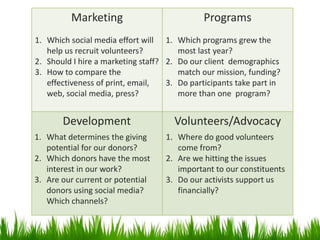
Sample Questions to Consider
5
Marketing
Development
Programs
Volunteers/Advocacy
1. Which social media effort will
help us recruit volunteers?
2. Should I hire a marketing staff?
3. How to compare the
effectiveness of print, email,
web, social media, press?
1. Which programs grew the
most last year?
2. Do our client demographics
match our mission, funding?
3. Do participants take part in
more than one program?
1. What determines the giving
potential for our donors?
2. Which donors have the most
interest in our work?
3. Are our current or potential
donors using social media?
Which channels?
1. Where do good volunteers
come from?
2. Are we hitting the issues
important to our constituents
3. Do our activists support us
financially?
6
FACEBOOK
INSIGHTS
GOOGLE
ANALYTICS
SMART
SEGMENTATION
WHERE TO GET THE DATA
7
FACEBOOK INSIGHTS
8
SAMPLE SOCIAL MEDIA QUESTIONS
1. How many people care about us
(and how deeply)?
2. What do they care about the most
(and how deeply)?
3. What are we doing that reaches the most
people?
4. What do we know about who cares about
us?
Programming, advocacy and fundraising implications
9
10
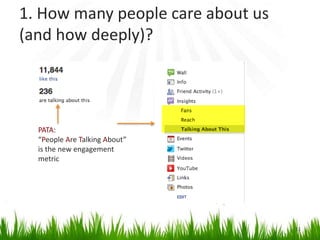
1. How many people care about us
(and how deeply)?
PATA:
“People Are Talking About”
is the new engagement
metric
11
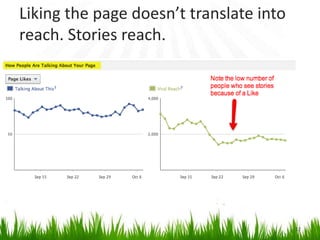
Liking the page doesn’t translate into
reach. Stories reach.
12
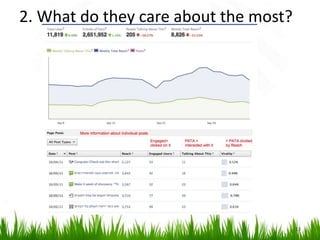
2. What do they care about the most?
13
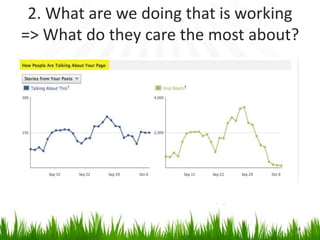
2. What are we doing that is working
=> What do they care the most about?
14
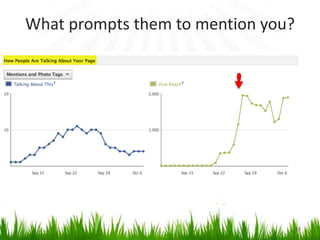
What prompts them to mention you?
15
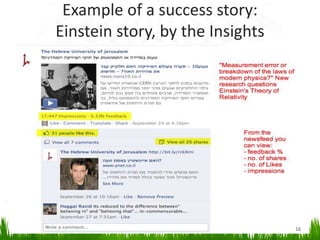
Example of a success story:
Einstein story, by the Insights
16
Drilling down into post engagement
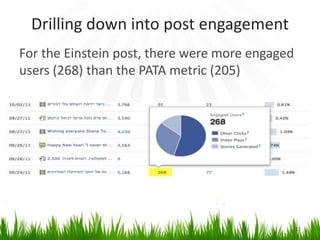
For the Einstein post, there were more engaged
users (268) than the PATA metric (205)
17
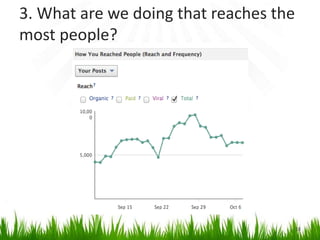
3. What are we doing that reaches the
most people?
18
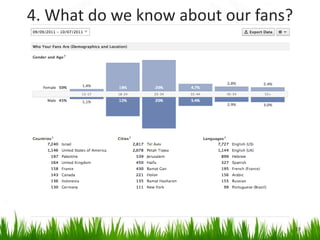
4. What do we know about our fans?
19
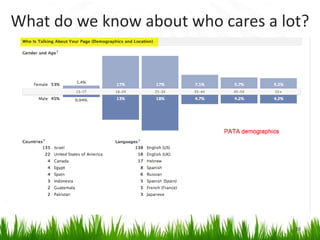
What do we know about who cares a lot?
20
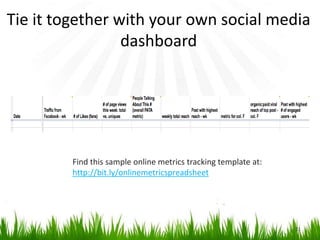
Tie it together with your own social media
dashboard
Find this sample online metrics tracking template at:
http://bit.ly/onlinemetricspreadsheet
21
WEB ANALYTICS
22
Definition:
Web analytics is the assessment of a variety of data,
including web traffic, web-based transactions,
web server performance, usability studies, and
related sources to help create a generalized
understanding of the visitor experience on-line.
Eric Petersen, “Web Analytics Demystified”
http://webanalyticsdemystified.com
23
“Knowledge without action is
meaningless” Goethe
24
Need to determine YOUR
“Key Performance Indicators”
25
Google Analytics is Free
BUT
Your Staff’s Time Isn’t!
Invest in Training
OR
Get Someone to Help!
26
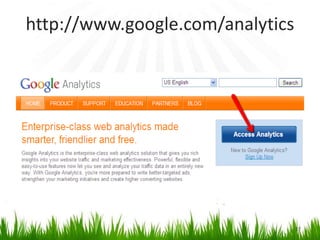
http://www.google.com/analytics
27
SAMPLE NONPROFIT QUESTIONS
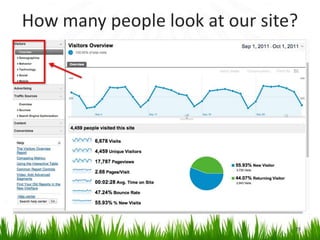
1. How many people look at our site?
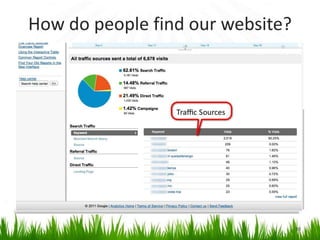
2. How do people find our website?
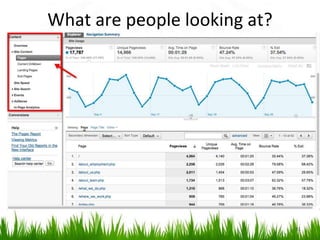
3. What are people looking at?
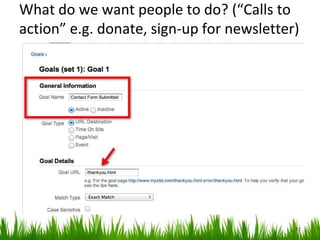
4. What do we want people to do?
(“Calls to action” e.g. donate, sign-up
for newsletter)
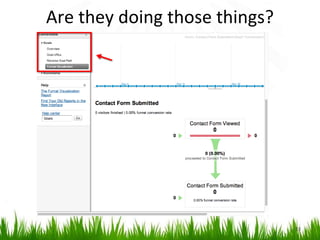
5. Are they actually doing those things?
28
How many people look at our site?
29
How do people find our website?
30
What are people looking at?
31
What do we want people to do? (“Calls to
action” e.g. donate, sign-up for newsletter)
32
Are they doing those things?
33
THIS IS JUST THE BEGINNING!
• Geography/Language Targeting
• AdWords/Google Grants ($10K/month)
www.google.com/nonprofits
• Real-time statistics
• Benchmarking
…and so much more!
34
SMART SEGMENTATION
35
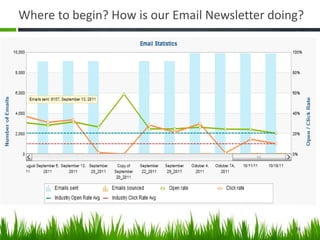
Where to begin? How is our Email Newsletter doing?
36
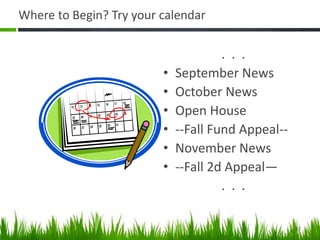
Where to Begin? Try your calendar
. . .
• September News
• October News
• Open House
• --Fall Fund Appeal--
• November News
• --Fall 2d Appeal—
. . .
37
Segmentation and Nonprofit Communications
“Segmentation is the process of defining the
largest potential market in a way that is most
useful to an organization. Market segmentation
is done by dividing the whole into definable
parts to identify, name, and describe these
pieces in a way that makes sense for an
organization.” --Shelli Bischoff
http://www.austincc.edu/npo/library/documents/Nonprofit%20Marketing%20with%20a%20Purpose.pdf
38
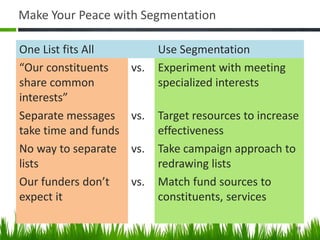
Make Your Peace with Segmentation
One List fits All Use Segmentation
“Our constituents
share common
interests”
vs. Experiment with meeting
specialized interests
Separate messages
take time and funds
vs. Target resources to increase
effectiveness
No way to separate
lists
vs. Take campaign approach to
redrawing lists
Our funders don’t
expect it
vs. Match fund sources to
constituents, services
39
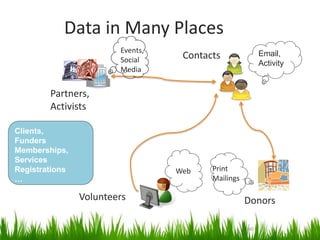
Data in Many Places
40
Donors
Print
Mailings
Email,
Activity
Volunteers
Web
Clients,
Funders
Memberships,
Services
Registrations
…
Partners,
Activists
Contacts
Events,
Social
Media
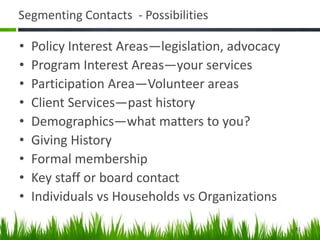
Segmenting Contacts - Possibilities
• Policy Interest Areas—legislation, advocacy
• Program Interest Areas—your services
• Participation Area—Volunteer areas
• Client Services—past history
• Demographics—what matters to you?
• Giving History
• Formal membership
• Key staff or board contact
• Individuals vs Households vs Organizations
41
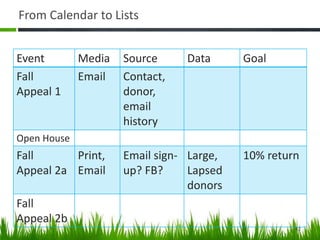
From Calendar to Lists
Event Media Source Data Goal
Fall
Appeal 1
Email Contact,
donor,
email
history
Open House
Fall
Appeal 2a
Print,
Email
Email sign-
up? FB?
Large,
Lapsed
donors
10% return
Fall
Appeal 2b
42
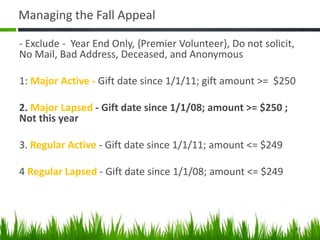
Managing the Fall Appeal
- Exclude - Year End Only, {Premier Volunteer}, Do not solicit,
No Mail, Bad Address, Deceased, and Anonymous
1: Major Active - Gift date since 1/1/11; gift amount >= $250
2. Major Lapsed - Gift date since 1/1/08; amount >= $250 ;
Not this year
3. Regular Active - Gift date since 1/1/11; amount <= $249
4 Regular Lapsed - Gift date since 1/1/08; amount <= $249
43
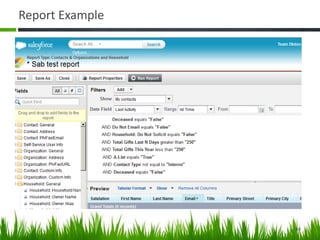
Report Example
44
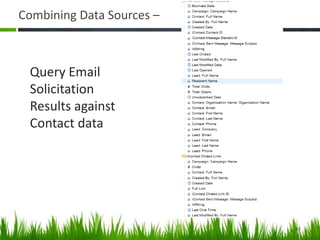
Combining Data Sources –
45
Query Email
Solicitation
Results against
Contact data
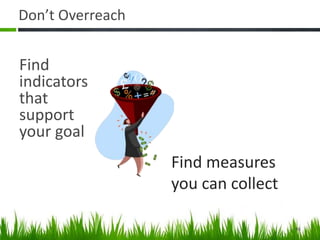
Don’t Overreach
Find
indicators
that
support
your goal
Find measures
you can collect
46
FACEBOOK
INSIGHTS
GOOGLE
ANALYTICS
SMART
SEGMENTATION
RESOURCES FOR YOU
47
Wrapping Up: Where to Start
• Know what you want to know before digging into
the data
• Learn from experience...Be confident everyone is
learning
• Plan to have integrated tools
• Demystify “data” for your organization
• FREE is not FREE - invest in training or get help!!!!
48
Facebook Insights Resources
• Customizable online metrics tracking spreadsheet for you to use and
share: http://bit.ly/onlinemetricspreadsheet
• (New) Facebook page insights, explained:
ads.ak.facebook.com/ads/creative/insights/page-insights-guide.pdf
• Applying social metrics framework to the new Facebook Insights, from
Beth Kanter: http://www.bethkanter.org/best-metrics/
• How to use the new Facebook insights (video tutorial), from John Haydon:
http://www.johnhaydon.com/2011/10/how-use-facebook-insights-video-
tutorial/
• Using Facebook to Meet Your Mission, Idealware report:
http://idealware.org/facebook_survey
• Consistently updated list of nonprofit marketing bloggers and influencers:
http://campaigns.traackr.com/campaigns/view/3518
49
50
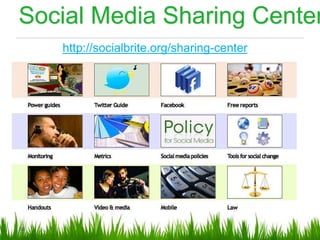
Social Media Sharing Center
http://socialbrite.org/sharing-center
Web Analytics Resources
• Brian Clifton, “Advanced Web Metrics with Google Analytics”
• Eric Petersen, “Web Analytics Demystified”
• Jim Sterne, “Web Metrics”
• Analysis Exchange (pairs web analytics peeps and NPOs for FREE):
http://www.webanalyticsdemystified.com/ae/ae-business.asp
• Frogloop Blog Post:
http://www.frogloop.com/care2blog/2008/10/13/using-google-analytics-
to-track-a-nonprofit-website-part-1.html
• Google Analytics Help:
http://www.google.com/support/analyticshelp
• Google Analytics Getting Started:
http://www.google.com/analytics/discover_analytics.html
• Google Analytics Blog: http://analytics.blogspot.com
• LunaMetrics:
http://www.lunametrics.com/google-analytics-training/
• eMetrics Marketing: http://www.emetrics.org
51
Data Segmentation Resources
• Geoff Lancaster, “Customers and marketing,”
http://bit.ly/9f8FRq
• Ian Bruce, “Segmentation and targeting “ http://bit.ly/apETsV
• Idealware, Consumers Guide to Low Cost Donor Management
Systems, http://bit.ly/ljzdKC
• Constant Contact, Email Marketing resources,
http://bit.ly/8YiiTs
• Convio, Moves Management, http://slidesha.re/pdgmfn
• Shelli Bishoff, Nonprofit Marketing With a Purpose
http://bit.ly/nfKuCD
52
Thank You!!
Debra Askanase, Digital Engagement Strategist
http://communityorganizer20.com
debra@communityorganizer20.com
(617) 682-2977
Marc Baizman, My Computer Guy
http://mcgtraining.com
marc@mcgtraining.com
(617) 329-1868
Steve Backman, Database Designs
http://www.dbdes.com
steve@dbdes.com
(617) 423-6355
53

Introducing Data Driven Tech Leadership: Social media, Google Analytics, and Data Segmentation

  • 1.
    DEBRA ASKANASE STEVEN BACKMAN MARCBAIZMAN introducing DATA DRIVEN TECH LEADERSHIP 1 Some rights reserved: This work is licensed by Debra Askanase, Steven Backman, Marc Baizman under the Creative Commons Attribution-NonCommercial-ShareAlike 3.0 Unported License. To view a copy of this license, visit http://creativecommons.org/licenses/by-nc-sa/3.0/ or send a letter to Creative Commons, 444 Castro Street, Suite 900, Mountain View, California, 94041, USA.
  • 2.
    TODAY’S AGENDA • Introductions:Who’s in the room • Data-driven leadership and business goals • Facebook Insights: informing decisions • Getting what you need from Google Analytics • Smart data segmentation • Wrap-up/Q&A • Handout What you need to make great decisions! 2
  • 3.
  • 4.
  • 5.
  • 6.
    Marketing Development Programs Volunteers/Advocacy 1. Which socialmedia effort will help us recruit volunteers? 2. Should I hire a marketing staff? 3. How to compare the effectiveness of print, email, web, social media, press? 1. Which programs grew the most last year? 2. Do our client demographics match our mission, funding? 3. Do participants take part in more than one program? 1. What determines the giving potential for our donors? 2. Which donors have the most interest in our work? 3. Are our current or potential donors using social media? Which channels? 1. Where do good volunteers come from? 2. Are we hitting the issues important to our constituents 3. Do our activists support us financially? 6
  • 7.
  • 8.
  • 9.
    SAMPLE SOCIAL MEDIAQUESTIONS 1. How many people care about us (and how deeply)? 2. What do they care about the most (and how deeply)? 3. What are we doing that reaches the most people? 4. What do we know about who cares about us? Programming, advocacy and fundraising implications 9
  • 10.
  • 11.
    1. How manypeople care about us (and how deeply)? PATA: “People Are Talking About” is the new engagement metric 11
  • 12.
    Liking the pagedoesn’t translate into reach. Stories reach. 12
  • 13.
    2. What dothey care about the most? 13
  • 14.
    2. What arewe doing that is working => What do they care the most about? 14
  • 15.
    What prompts themto mention you? 15
  • 16.
    Example of asuccess story: Einstein story, by the Insights 16
  • 17.
    Drilling down intopost engagement For the Einstein post, there were more engaged users (268) than the PATA metric (205) 17
  • 18.
    3. What arewe doing that reaches the most people? 18
  • 19.
    4. What dowe know about our fans? 19
  • 20.
    What do weknow about who cares a lot? 20
  • 21.
    Tie it togetherwith your own social media dashboard Find this sample online metrics tracking template at: http://bit.ly/onlinemetricspreadsheet 21
  • 22.
  • 23.
    Definition: Web analytics isthe assessment of a variety of data, including web traffic, web-based transactions, web server performance, usability studies, and related sources to help create a generalized understanding of the visitor experience on-line. Eric Petersen, “Web Analytics Demystified” http://webanalyticsdemystified.com 23
  • 24.
    “Knowledge without actionis meaningless” Goethe 24
  • 25.
    Need to determineYOUR “Key Performance Indicators” 25
  • 26.
    Google Analytics isFree BUT Your Staff’s Time Isn’t! Invest in Training OR Get Someone to Help! 26
  • 27.
  • 28.
    SAMPLE NONPROFIT QUESTIONS 1.How many people look at our site? 2. How do people find our website? 3. What are people looking at? 4. What do we want people to do? (“Calls to action” e.g. donate, sign-up for newsletter) 5. Are they actually doing those things? 28
  • 29.
    How many peoplelook at our site? 29
  • 30.
    How do peoplefind our website? 30
  • 31.
    What are peoplelooking at? 31
  • 32.
    What do wewant people to do? (“Calls to action” e.g. donate, sign-up for newsletter) 32
  • 33.
    Are they doingthose things? 33
  • 34.
    THIS IS JUSTTHE BEGINNING! • Geography/Language Targeting • AdWords/Google Grants ($10K/month) www.google.com/nonprofits • Real-time statistics • Benchmarking …and so much more! 34
  • 35.
  • 36.
    Where to begin?How is our Email Newsletter doing? 36
  • 37.
    Where to Begin?Try your calendar . . . • September News • October News • Open House • --Fall Fund Appeal-- • November News • --Fall 2d Appeal— . . . 37
  • 38.
    Segmentation and NonprofitCommunications “Segmentation is the process of defining the largest potential market in a way that is most useful to an organization. Market segmentation is done by dividing the whole into definable parts to identify, name, and describe these pieces in a way that makes sense for an organization.” --Shelli Bischoff http://www.austincc.edu/npo/library/documents/Nonprofit%20Marketing%20with%20a%20Purpose.pdf 38
  • 39.
    Make Your Peacewith Segmentation One List fits All Use Segmentation “Our constituents share common interests” vs. Experiment with meeting specialized interests Separate messages take time and funds vs. Target resources to increase effectiveness No way to separate lists vs. Take campaign approach to redrawing lists Our funders don’t expect it vs. Match fund sources to constituents, services 39
  • 40.
    Data in ManyPlaces 40 Donors Print Mailings Email, Activity Volunteers Web Clients, Funders Memberships, Services Registrations … Partners, Activists Contacts Events, Social Media
  • 41.
    Segmenting Contacts -Possibilities • Policy Interest Areas—legislation, advocacy • Program Interest Areas—your services • Participation Area—Volunteer areas • Client Services—past history • Demographics—what matters to you? • Giving History • Formal membership • Key staff or board contact • Individuals vs Households vs Organizations 41
  • 42.
    From Calendar toLists Event Media Source Data Goal Fall Appeal 1 Email Contact, donor, email history Open House Fall Appeal 2a Print, Email Email sign- up? FB? Large, Lapsed donors 10% return Fall Appeal 2b 42
  • 43.
    Managing the FallAppeal - Exclude - Year End Only, {Premier Volunteer}, Do not solicit, No Mail, Bad Address, Deceased, and Anonymous 1: Major Active - Gift date since 1/1/11; gift amount >= $250 2. Major Lapsed - Gift date since 1/1/08; amount >= $250 ; Not this year 3. Regular Active - Gift date since 1/1/11; amount <= $249 4 Regular Lapsed - Gift date since 1/1/08; amount <= $249 43
  • 44.
  • 45.
    Combining Data Sources– 45 Query Email Solicitation Results against Contact data
  • 46.
  • 47.
  • 48.
    Wrapping Up: Whereto Start • Know what you want to know before digging into the data • Learn from experience...Be confident everyone is learning • Plan to have integrated tools • Demystify “data” for your organization • FREE is not FREE - invest in training or get help!!!! 48
  • 49.
    Facebook Insights Resources •Customizable online metrics tracking spreadsheet for you to use and share: http://bit.ly/onlinemetricspreadsheet • (New) Facebook page insights, explained: ads.ak.facebook.com/ads/creative/insights/page-insights-guide.pdf • Applying social metrics framework to the new Facebook Insights, from Beth Kanter: http://www.bethkanter.org/best-metrics/ • How to use the new Facebook insights (video tutorial), from John Haydon: http://www.johnhaydon.com/2011/10/how-use-facebook-insights-video- tutorial/ • Using Facebook to Meet Your Mission, Idealware report: http://idealware.org/facebook_survey • Consistently updated list of nonprofit marketing bloggers and influencers: http://campaigns.traackr.com/campaigns/view/3518 49
  • 50.
    50 Social Media SharingCenter http://socialbrite.org/sharing-center
  • 51.
    Web Analytics Resources •Brian Clifton, “Advanced Web Metrics with Google Analytics” • Eric Petersen, “Web Analytics Demystified” • Jim Sterne, “Web Metrics” • Analysis Exchange (pairs web analytics peeps and NPOs for FREE): http://www.webanalyticsdemystified.com/ae/ae-business.asp • Frogloop Blog Post: http://www.frogloop.com/care2blog/2008/10/13/using-google-analytics- to-track-a-nonprofit-website-part-1.html • Google Analytics Help: http://www.google.com/support/analyticshelp • Google Analytics Getting Started: http://www.google.com/analytics/discover_analytics.html • Google Analytics Blog: http://analytics.blogspot.com • LunaMetrics: http://www.lunametrics.com/google-analytics-training/ • eMetrics Marketing: http://www.emetrics.org 51
  • 52.
    Data Segmentation Resources •Geoff Lancaster, “Customers and marketing,” http://bit.ly/9f8FRq • Ian Bruce, “Segmentation and targeting “ http://bit.ly/apETsV • Idealware, Consumers Guide to Low Cost Donor Management Systems, http://bit.ly/ljzdKC • Constant Contact, Email Marketing resources, http://bit.ly/8YiiTs • Convio, Moves Management, http://slidesha.re/pdgmfn • Shelli Bishoff, Nonprofit Marketing With a Purpose http://bit.ly/nfKuCD 52
  • 53.
    Thank You!! Debra Askanase,Digital Engagement Strategist http://communityorganizer20.com debra@communityorganizer20.com (617) 682-2977 Marc Baizman, My Computer Guy http://mcgtraining.com marc@mcgtraining.com (617) 329-1868 Steve Backman, Database Designs http://www.dbdes.com steve@dbdes.com (617) 423-6355 53

Editor's Notes

  • #2 This presentation demonstrates the new capabilities of PowerPoint and it is best viewed in Slide Show. These slides are designed to give you great ideas for the presentations you’ll create in PowerPoint 2011! For more sample templates, click the File menu, and then click New From Template. Under Templates, click Presentations.
  • #4 Roles: Leadership Development Marketing/Comms Tech Are you in charge of doing any of this (looking at numbers)?
  • #6 Sample questions?
  • #7 What are the leadership decisions you need to make in these 4 areas? We’re setting up to answer these in our sections of the preso.
  • #10 Programming, advocacy and fundraising implications
  • #18 Columns L to R: Total Reach, Engaged users, Talking about this, Virality
  • #24 Yes, it’s long and sucky. But it eoncompasses everything!
  • #25 Purpose of web analytics is to help you make decisions about your org: what to change, what to add, what to remove, etc.
  • #26 KPIs reduce all the mounds of data to a few simple, crucial points of data that are important to you, your org, your board, etc. The are often ratios,
  • #27 Training providers: FREE: Google Analytics Help, LunaMetrics
  • #49 In today’s world, data is not something else.