Visit https://testbankdeal.com to download the full version and
explore more testbank or solutions manual
Data Communications and Computer Networks A
Business Users Approach 8th Edition White
Solutions Manual
_____ Click the link below to download _____
https://testbankdeal.com/product/data-communications-and-
computer-networks-a-business-users-approach-8th-edition-
white-solutions-manual/
Explore and download more testbank or solutions manual at testbankdeal.com
Here are some recommended products that we believe you will be
interested in. You can click the link to download.
Data Communications and Computer Networks A Business Users
Approach 8th Edition White Test Bank
https://testbankdeal.com/product/data-communications-and-computer-
networks-a-business-users-approach-8th-edition-white-test-bank/
Data Communications and Computer Networks A Business Users
Approach 7th Edition White Test Bank
https://testbankdeal.com/product/data-communications-and-computer-
networks-a-business-users-approach-7th-edition-white-test-bank/
Data And Computer Communications 10th Edition Stallings
Solutions Manual
https://testbankdeal.com/product/data-and-computer-
communications-10th-edition-stallings-solutions-manual/
Traditions and Encounters A Global Perspective on the Past
6th Edition Bentley Test Bank
https://testbankdeal.com/product/traditions-and-encounters-a-global-
perspective-on-the-past-6th-edition-bentley-test-bank/
Evolve Resources for Goulds Pathophysiology for the Health
Professions 6th Edition Hubert Test Bank
https://testbankdeal.com/product/evolve-resources-for-goulds-
pathophysiology-for-the-health-professions-6th-edition-hubert-test-
bank/
Marketing Management 4th Edition Winer Test Bank
https://testbankdeal.com/product/marketing-management-4th-edition-
winer-test-bank/
Essentials of Geology 13th Edition Lutgens Test Bank
https://testbankdeal.com/product/essentials-of-geology-13th-edition-
lutgens-test-bank/
Human Anatomy and Physiology 10th Edition Marieb Test Bank
https://testbankdeal.com/product/human-anatomy-and-physiology-10th-
edition-marieb-test-bank/
Marketing Management 3rd Edition Marshall Test Bank
https://testbankdeal.com/product/marketing-management-3rd-edition-
marshall-test-bank/
Business Research Methods 9th Edition Zikmund Solutions
Manual
https://testbankdeal.com/product/business-research-methods-9th-
edition-zikmund-solutions-manual/
Local Area Networks – The Basics
Learning Objectives
After reading this chapter you should be able to:
• State the definition of a local area network.
• List the primary function, activities, and application areas of a local area network.
• Cite the advantages and disadvantages of local area networks.
• Identify the physical and logical local area networks.
• Specify the different medium access control techniques.
• Recognize the different IEEE 802 frame formats.
• Describe the common wired local area network systems.
Chapter Outline
1. Introduction
2. Primary Function of Local Area Networks
3. Advantages and Disadvantages of Local Area Networks
4. The First Local Area Network – The Bus/Tree
5. A More Modern LAN
a. Contention-based protocols
6. Switches
a. Isolating traffic patterns and providing multiple access
b. Full-duplex switches
c. Virtual LANs
d. Link aggregation
e. Spanning tree algorithm
f. Quality of service
7. Wired Ethernet
8. Wired Ethernet Frame Format
Chapter 7
9. LANs In Action: A Small Office Solution
10. Summary
Lecture Notes
Introduction
A local area network (LAN) is a communication network that interconnects a variety of data
communicating devices within a small geographic area and broadcasts data at high data transfer
rates with very low error rates. Since the local area network first appeared in the 1970s, its use
has become widespread in commercial and academic environments. It would be very difficult to
imagine a collection of personal computers within a computing environment that does not
employ some form of local area network. This chapter begins by discussing the basic layouts or
topologies of the most commonly found local area networks, followed by the medium access
control protocols that allow a workstation to transmit data on the network. We will then examine
most of the common Ethernet products.
Functions of a Local Area Network
The majority of users expect a local area network to perform the following functions and provide
the following applications: file serving, database and application serving, print serving,
electronic mail, remote links, video transfers, process control and monitoring, and distributed
processing.
Advantages and Disadvantages of Local Area Networks
Local area networks have several advantages, including hardware and software sharing,
workstation survival during network failure, component and system evolution, heterogeneous
mix of hardware and software, and access to other LANs, WANs, and mainframe computers.
Disadvantages include complexity, maintenance costs, and the network is only as strong as the
weakest link.
The First Local Area Network – The Bus/Tree
The bus local area network was the first physical design when LANs became commercially
available in the late 1970s, and it essentially consists of a single cable, or bus, to which all
devices attach. Since then the bus has diminished significantly to the point of near extinction. It
is interesting to note that cable television signals are still delivered by a network bus. Thus,
understanding the bus/tee network is still important.
A More Modern LAN
The most popular configuration for a local area network is the star-wired bus. This form of LAN
should not be confused with an older technology called the star topology. Today’s modern star-
wired bus network acts like a bus but looks like a star. The logical design of operates as a bus
where one workstation can transmit to all other workstations. The physical design, however,
more resembles a star, with the hub or switch acting as the central point.
Contention-based Protocols
A medium access control protocol is part of the software that allows a workstation to place data
onto a local area network. Depending on the network’s topology, several types of protocols may
be applicable. The bottom line with all medium access control protocols is this: Since a local
area network is a broadcast network, it is imperative that only one workstation at a time be
allowed to transmit its data onto the network. In the case of a broadband local area network,
which can support multiple channels at the same time, it is imperative that only one workstation
at a time be allowed to transmit its data onto a channel on the network. There remains only one
basic category of medium access control protocol for local area networks: contention-based.
Switches
A switch is a combination of a hub and a bridge and can interconnect multiple workstations like
a hub but can also filter out frames providing a segmentation of the network. Switches can
provide a significant decrease in interconnection traffic and increase the throughput of the
interconnected networks while requiring no additional cabling or rearranging of the network
devices. Modern switches can provide full-duplex connections, virtual LANs, aggregated links,
support spanning tree algorithms, and provide quality of service levels.
Wired Ethernet
The various versions of wired Ethernet include the older 10 Mbps systems, 100 Mbps, Gigabit,
and 10 Gbps.
Wired Ethernet Frame Format
The IEEE 802 set of standards has split the data link layer into two sublayers: the medium access
control sublayer and the logical link control sublayer. The medium access control (MAC)
sublayer works more closely with the physical layer and contains a header, computer (physical)
addresses, error detection codes, and control information. The logical link control (LLC)
sublayer is primarily responsible for logical addressing and providing error control and flow
control information.
LANs In Action: A Small Office Solution
The first In Action example examines how a small business decides to incorporate a LAN into
their business solution. The business included 35 - 40 workstations with word processing,
spreadsheets, and database applications. In order to add internal e-mail, a central database
system, and print sharing, the company will consider the addition of a local area network.
Quick Quiz
1. What are the major functions of a LAN?
File and print serving, access to other LANs, WANs and mainframes, distributed processing, and
process control.
2. What are the various medium access control techniques?
Contention-based. Round robin systems have essentially disappeared.
3. What is the difference between a hub, a switch, and a router?
Hub broadcasts any input onto all outgoing lines; switch replaces a hub and provides filtering;
router interconnects a LAN with a WAN.
4. What are the basic functions of a network server?
Holds network operating system as well as application programs and data set; may also function
as a hub, switch, bridge or router.
Discussion Topics
1. Couldn’t IEEE have made a single frame format for all the forms of local area networks?
2. Are LANs a stable technology or are they changing just as quickly as other forms of
communication technologies?
3. Is Ethernet that good that it’s the predominant form of LAN? Will everything eventually be
Ethernet / CSMA/CD?
4. Will hubs be obsolete someday?
5. What are the advantages of creating virtual LANs?
Teaching Tips
1. Be sure to emphasize the difference between logical view and physical view. For example, a
star-wired bus logically acts like a bus but physically looks like a star. A star-wire ring logically
acts like a ring but physically looks like a star. A bus logically and physically is a bus.
2. The frame is the name of the package at the data link layer. It is the frame that is placed onto
the medium of the physical layer. The IEEE 802 frame formats describe the layout of the frame
and what the data looks like as it moves over a LAN. The frame addresses are the ones used to
address a NIC in a machine. This is not the address that is used to send a packet over the Internet
(that is the IP address).
3. Discuss the non-determinism of the CSMA/CD LAN and how collisions in hub-based LANs
create this characteristic. Discuss how switches and no collisions have changed things.
4. What kind of mix does your school or company have of hubs, routers, and switches? Use this
information as an example in class.
5. Take your students to one or more locations on campus and show them an actual, working hub
/ switch / router.
6. Make sure you emphasize how a switch filters out unnecessary packets.
Solutions to Review Questions
1. What is the definition of a local area network?
A communication network that interconnects a variety of data communicating devices within a
small geographic area and broadcasts data at high data transfer rates with very low error rates.
2. List the primary activities and application areas of a local area network.
File serving, print serving, connection to other networks and mainframes.
3. List the advantages and disadvantages of local area networks.
Adv: Share files and devices, intercommunication.
Disadv: Maintenance, complexity, costs.
4. What are the basic layouts of local area networks? List two advantages that each layout
has over the others.
Bus: Uses low noise coaxial cable, inexpensive taps.
Star-wired bus: Simple to interconnect, easy to add components, most popular.
Star-wired ring: Simple to interconnect and easy to add components (but no more so than star-
wired bus).
5. What is meant by a passive device?
A signal that enters is neither amplified nor regenerated. The signal is simply passed on.
6. What is meant by a bidirectional signal?
A signal that propagates in either direction on a medium.
7. What are the primary differences between baseband technology and broadband
technology?
Baseband is a signal digital signal while broadband is analog and may carry many signals.
8. What purpose does a hub serve?
The hub is a collection point for workstations.
9. What is the difference between a physical design and a logical design?
Physical is the wiring and components, logical is how the software passes the data.
10. What is a medium access control protocol?
The software that allows a workstation to insert its data onto the LAN.
11. What are the basic operating principles behind CSMA/CD?
CSMA/CD: Listen to medium, if no one transmitting, transmit. Continue to listen for collisions.
If someone is transmitting, wait.
12. What is meant by a “nondeterministic” protocol?
You cannot determine precisely when a workstation will get a chance to transmit (because of
potential collisions).
13. What does the term 100BaseT stand for?
One hundred mega-bits per second transmission over baseband (digital) signals, using twisted
pair wiring.
14. What is the difference between Fast Ethernet and regular Ethernet?
Fast Ethernet transmits at 100 Mbps while regular Ethernet transmits at 10 Mbps.
15. What are the latest 10-Gbps Ethernet standards?
10GBase-fiber, 10GBase-T, 10GBase-CS
16. What is the primary advantage of power over Ethernet? The primary disadvantage?
Primary advantage is not having to run a separate power line to power device; primary
disadvantage is making sure the switch has enough power to run PoE devices.
17. How does a transparent switch work?
Observes traffic on a LAN and creates a set of forwarding tables; filters traffic
18. What is the purpose of a virtual LAN?
To create a logical subgroup of multiple workstations and servers.
19. How does a switch encapsulate a message for transmission?
It really doesn’t encapsulate anything. Switch looks at NIC/MAC addresses and forwards
accordingly.
20. When referring to a hub or a switch, what is a port?
The port is the connection that is used to connect a workstation or another hub or switch to this
hub or switch.
21. What are the basic functions of a switch?
A switch examines a packet’s destination address and routes the packet to the appropriate
workstation.
22. How does a switch differ from a hub?
Switch examines addresses, hub does not. A switch has multiple ports and takes the place of a
hub.
23. What is cut-through architecture?
The device is passing the data packet on before it has even finished entering the device.
24. How is a full-duplex switch different from a switch?
Full duplex switch has one set of lines for receiving and one set of lines for transmitting, thus it
can do both operations at the same time.
25. What is meant by link aggregation?
The process of combining two or more links into one logical fat link.
Suggested Solutions to Exercises
1. What properties set a local area network apart from other forms of networks?
Small geographic distances using broadband transmissions.
2. Describe an example of a broadband bus system.
Cable modems, video surveillance systems, cable television.
3. Is a hub a passive device? Explain.
Not completely. A hub does regenerate a digital signal. And there may be some simple network
management functions performed in a hub.
4. Which of the Ethernet standards (10 Mbps, 100 Mbps, 1000 Mbps, 10 Gbps) allow for
twisted pair media? What are the corresponding IEEE standard names?
Currently all but 10 Gbps Ethernet can run over twisted pair.
5. If a network were described as 1000BaseT, list everything you know about that network.
CSMA/CD LAN, 1000 Mbps transmission, baseband or digital signaling, twisted pair wiring.
6. In the IEEE 802.3 frame forma, what is the PAD field used for? What is the minimum
packet size?
PAD field makes sure the frame is not mis-interpreted as a runt. Minimum packet size is 64
bytes.
7. Suppose workstation A wants to send the message HELLO to workstation B. Both
workstations are on an IEEE 802.3 local area network. Workstation A has the binary
address “1" and workstation B has the binary address “10." Show the resulting MAC
sublayer frame (in binary) that is transmitted. Don’t calculate a CRC; just make one up.
HEADER 10 1 5(data length) HELLO PAD(33 bytes) CHECKSUM
8. What is the difference between the physical representation of a star-wired ring LAN and
the logical representation?
A star-wired ring LAN physically looks like a star but acts logically like a ring. A star-wired bus
physically looks like a star but acts logically like a bus.
9. How is a hub similar to a switch? How are they different?
Not too much similar. They both physically connect into the network the same. Both forward
frames. But a switch looks at the MAC address and either forwards or drops the frame.
10. Are hubs and switches interchangeable? Explain.
Yes. But results can be quite different.
11. a. The local area network shown in Figure 7-21 has two hubs (X and Y) interconnecting
the workstations and servers. What workstations and servers will receive a copy of a
packet if the following workstations/servers transmit a message:
• Workstation 1 sends a message to workstation 3:
• Workstation 2 sends a message to Server 1:
• Server 1 sends a message to workstation 3:
All devices will receive all messages.
b. Replace hub Y with a switch. Now what workstations and servers will receive a copy of a
packet if the following workstations/servers transmit a message:
• Workstation 1 sends a message to workstation 3:
• Workstation 2 sends a message to Server 1:
• Server 1 sends a message to workstation 3:
Workstations 1, 2 and 3.
Workstations 1, 2 and the server.
Only workstation 3.
12. A transparent switch is inserted between two local area networks ABC and XYZ.
Network ABC has workstations 1, 2 and 3, and network XYZ has workstations 4, 5, and 6.
Show the contents of the two forwarding tables in the switch as the following packets are
transmitted. Both forwarding tables start off empty.
• Workstation 2 sends a packet to workstation 3.
• Workstation 2 sends a packet to workstation 5.
• Workstation 1 sends a packet to workstation 2.
• Workstation 2 sends a packet to workstation 3.
• Workstation 2 sends a packet to workstation 6.
• Workstation 6 sends a packet to workstation 3.
• Workstation 5 sends a packet to workstation 4.
• Workstation 2 sends a packet to workstation 1.
• Workstation 1 sends a packet to workstation 3.
• Workstation 1 sends a packet to workstation 5.
• Workstation 5 sends a packet to workstation 4.
• Workstation 4 sends a packet to workstation 5.
At the end:
Routing table on ABC’s port: 1, 2
Routing table on XYZ’s port: 4,5,6
13. Give an example of a situation in which a virtual LAN might be a useful tool in a
business environment. What about in an educational environment?
If you want a certain group of users to work together on a project, you might want to place them
on a virtual LAN. Likewise for school.
14. What does it mean when a switch or device is cut-through? What is the main
disadvantage of a cut-through switch? Is there a way to solve this disadvantage of a cut-
through switch without losing the advantages?
Cut-through means the beginning of the data packet is leaving the switch before the end of the
packet has entered the switch. Disadvantage is errors are propagated. Not if you want to keep it
truly cut-through.
15. Give a common business example that mimics the differences between a shared network
segment and a dedicated network segment.
Wide range of possible answers here.
16. Your company’s switch between its two networks has just died. You have a router
lying on your desk that is not currently being used. Will the router work in place of the
broken bridge? Explain.
No. Routers operate on IP addresses, while switches operate on NIC addresses.
17. A CSMA/CD network is connected to the Internet via a router. A user on the
CSMA/CD network sends an e-mail to a user on the Internet. Show how the e-mail
message is encapsulated as it leaves the CSMA/CD network, enters the router, and then
leaves the router.
Leaving the LAN:
Data
App + Data
TCP + App + Data
IP + TCP + App + Data
MAC + IP + TCP + App + Data + MAC
Entering router:
MAC + IP + TCP + App + Data + MAC
IP + TCP + App + Data
Leaving router
IP + TCP + App + Data
WAN + IP + TCP + App + Data + WAN
18. Given the following network (Figure 7-22), show how the Spanning Tree Protocol will
eliminate the cyclic path.
The protocol will probably “remove” the bottom link on the far-right switch and the bottom link
on the switch immediately to the left of the far-right switch.
Thinking Outside the Box
1. You can interconnect all cash registers into one or two centrally located switches or hubs. Cat
5e/6 twisted pair should be sufficient. If hubs/switches can’t be centrally located and cable
distance exceeds 100 meters, be careful. Might need better medium. Can also connect using
multiplexing solution from earlier chapter.
Problems 2-6: Many possible solutions here.
Another Random Scribd Document
with Unrelated Content
By 1492 the block for this had apparently been damaged and is
replaced by a larger cut (56 mm. in height), representing a king and
two councillors, apparently taken from some other book. The 1493
illustrator was clearly puzzled by this, and for lack of anything better
repeated a cut of Moses and Miriam from Exodus. Clearly he had not
in this case the 1490 edition before him. But neither am I at all sure
that he had that of 1492. While he copies six of the new pictures in
Genesis he omits six others; in Exodus, Numbers, and Deuteronomy
he agrees with the 1490 edition against that of 1492; in Judges,
Ruth, and Kings, with 1492 as against 1490; in Genesis, Leviticus,
and Joshua, partly with one, partly with the other. In two other
cases he steers a middle course. The 1490 artist had illustrated far
too realistically both the temptation of Joseph and the sin which
called forth the zeal of Phineas. In the 1492 edition these subjects
are very wisely omitted. In that of 1493 they appear, but in a
modified form. My own theory to account for these discrepancies is
that between 1490 and 1492—presumably in 1491—Giunta
published yet another issue of the Bible, adding a few illustrations,
but not so many as in 1492, and substituting two new cuts of the
subjects unpleasantly illustrated in 1490, which he subsequently
thought well to pass over altogether. Such an intermediate edition
would supply a model which would explain all the early illustrations
in the edition of 1493, and would also allow a more reasonable time
to 'Anima Mia' to get them made, and his book printed, than the
nine months which separate the editions of July 1492, and April
1493. 'Anima Mia,' however, was by no means wholly a plagiarist, as
is proved by the fact that while in his first volume the 236
illustrations stand midways numerically between the 215 and the
252 of the two Giunta editions of 1490 and 1492; for his second
volume he provided no fewer than 208 against the 176 and 187 of
his predecessors, the new cuts being fairly evenly distributed
through the different books, while their artistic merit is of average
quality.
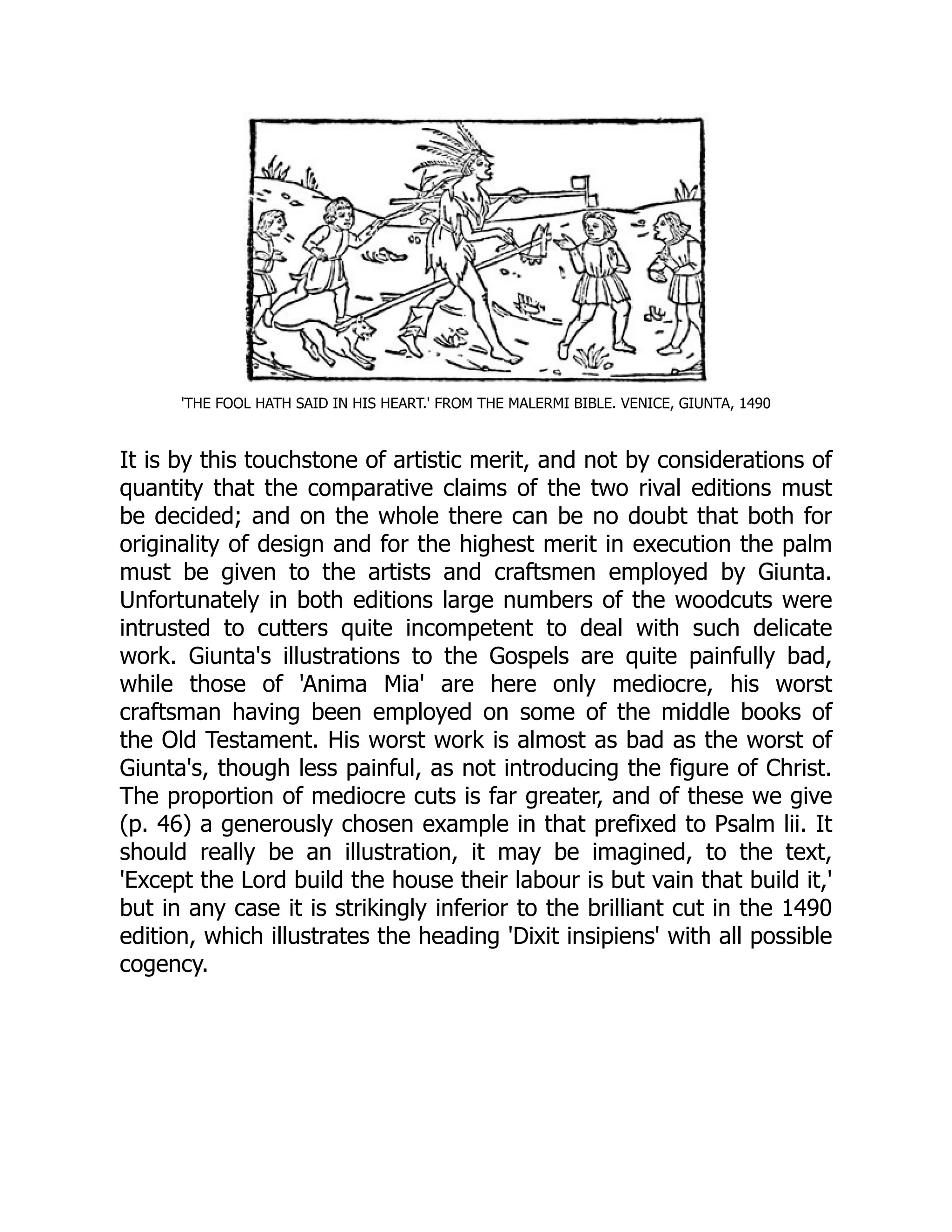
'THE FOOL HATH SAID IN HIS HEART.' FROM THE MALERMI BIBLE. VENICE, GIUNTA, 1490
It is by this touchstone of artistic merit, and not by considerations of
quantity that the comparative claims of the two rival editions must
be decided; and on the whole there can be no doubt that both for
originality of design and for the highest merit in execution the palm
must be given to the artists and craftsmen employed by Giunta.
Unfortunately in both editions large numbers of the woodcuts were
intrusted to cutters quite incompetent to deal with such delicate
work. Giunta's illustrations to the Gospels are quite painfully bad,
while those of 'Anima Mia' are here only mediocre, his worst
craftsman having been employed on some of the middle books of
the Old Testament. His worst work is almost as bad as the worst of
Giunta's, though less painful, as not introducing the figure of Christ.
The proportion of mediocre cuts is far greater, and of these we give
(p. 46) a generously chosen example in that prefixed to Psalm lii. It
should really be an illustration, it may be imagined, to the text,
'Except the Lord build the house their labour is but vain that build it,'
but in any case it is strikingly inferior to the brilliant cut in the 1490
edition, which illustrates the heading 'Dixit insipiens' with all possible
cogency.
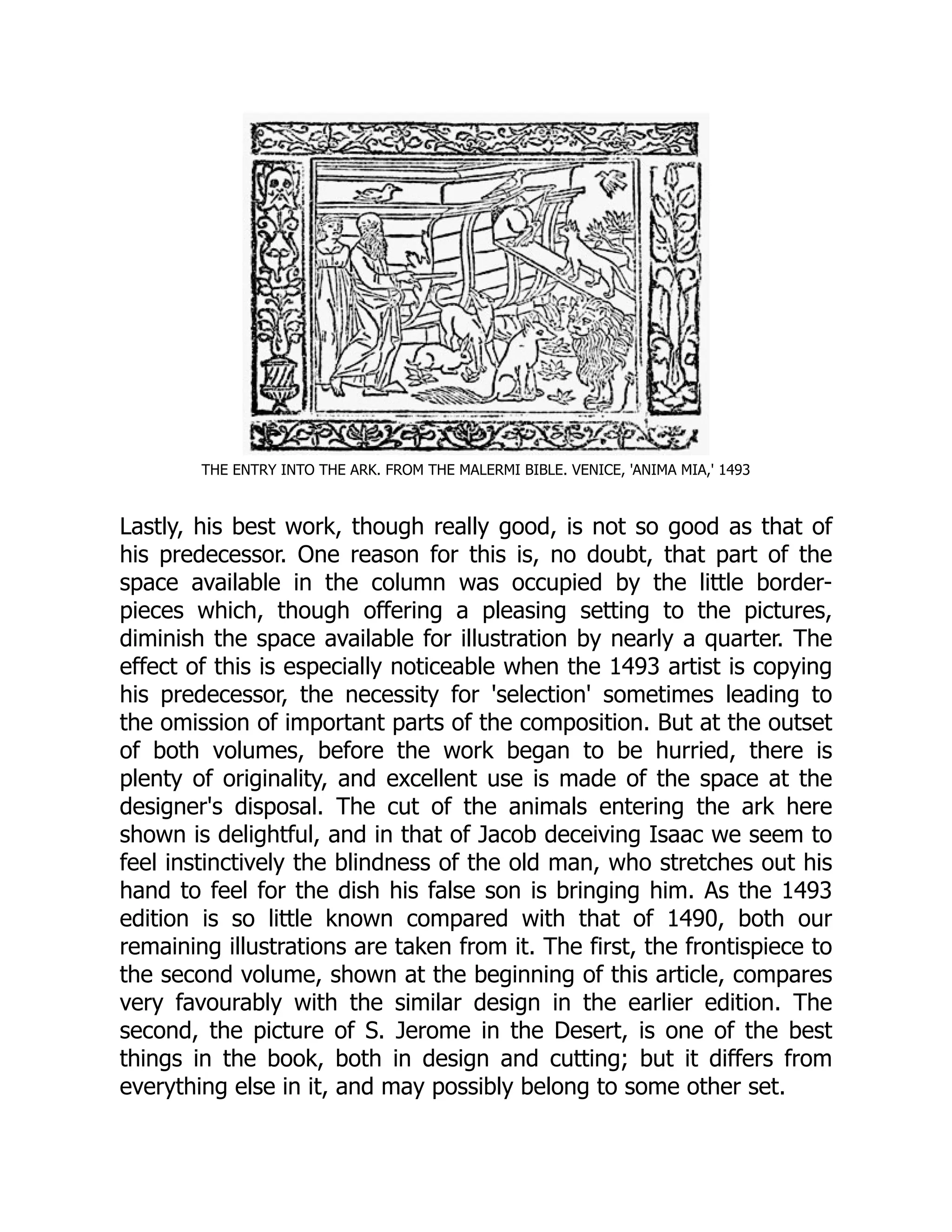
THE ENTRY INTO THE ARK. FROM THE MALERMI BIBLE. VENICE, 'ANIMA MIA,' 1493
Lastly, his best work, though really good, is not so good as that of
his predecessor. One reason for this is, no doubt, that part of the
space available in the column was occupied by the little border-
pieces which, though offering a pleasing setting to the pictures,
diminish the space available for illustration by nearly a quarter. The
effect of this is especially noticeable when the 1493 artist is copying
his predecessor, the necessity for 'selection' sometimes leading to
the omission of important parts of the composition. But at the outset
of both volumes, before the work began to be hurried, there is
plenty of originality, and excellent use is made of the space at the
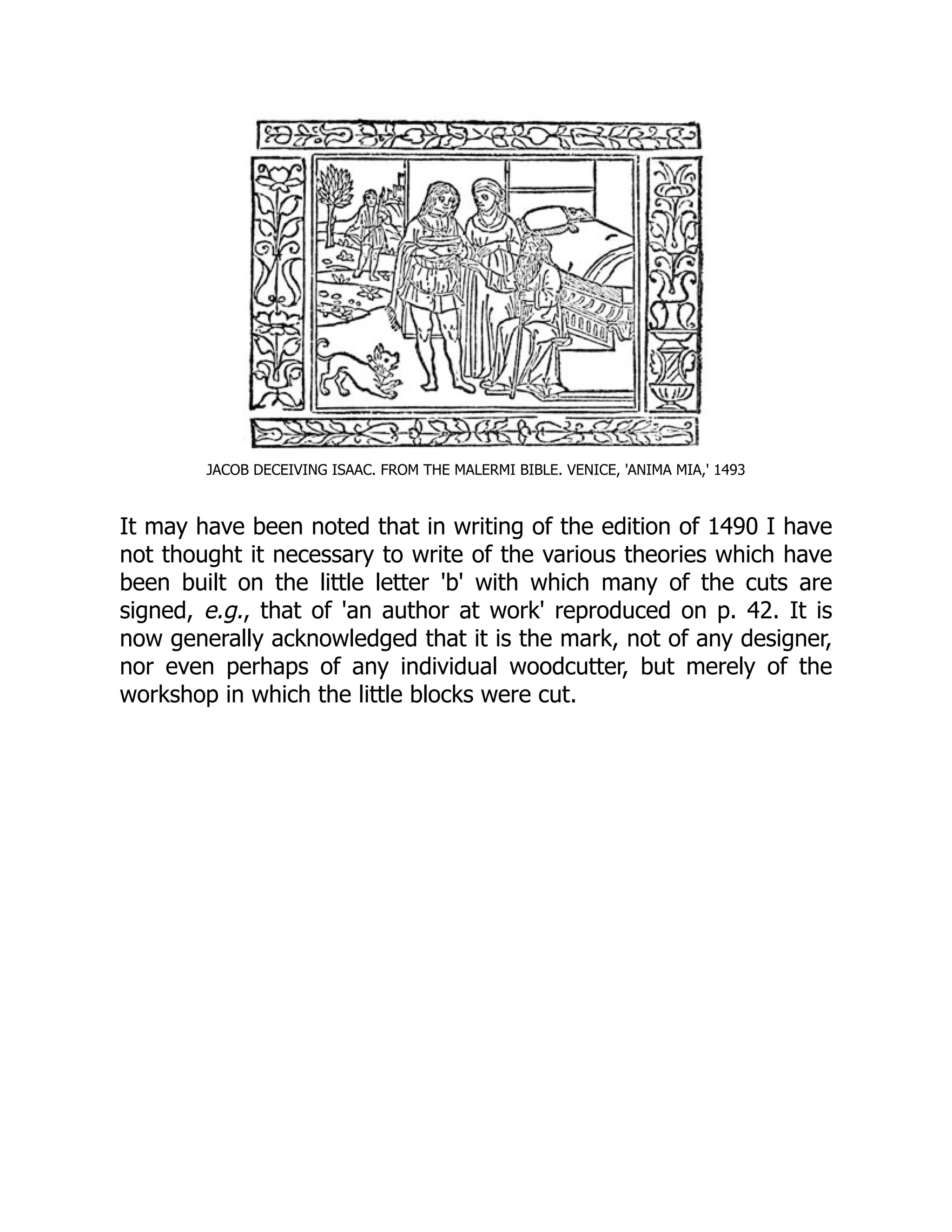
designer's disposal. The cut of the animals entering the ark here
shown is delightful, and in that of Jacob deceiving Isaac we seem to
feel instinctively the blindness of the old man, who stretches out his
hand to feel for the dish his false son is bringing him. As the 1493
edition is so little known compared with that of 1490, both our
remaining illustrations are taken from it. The first, the frontispiece to
the second volume, shown at the beginning of this article, compares
very favourably with the similar design in the earlier edition. The
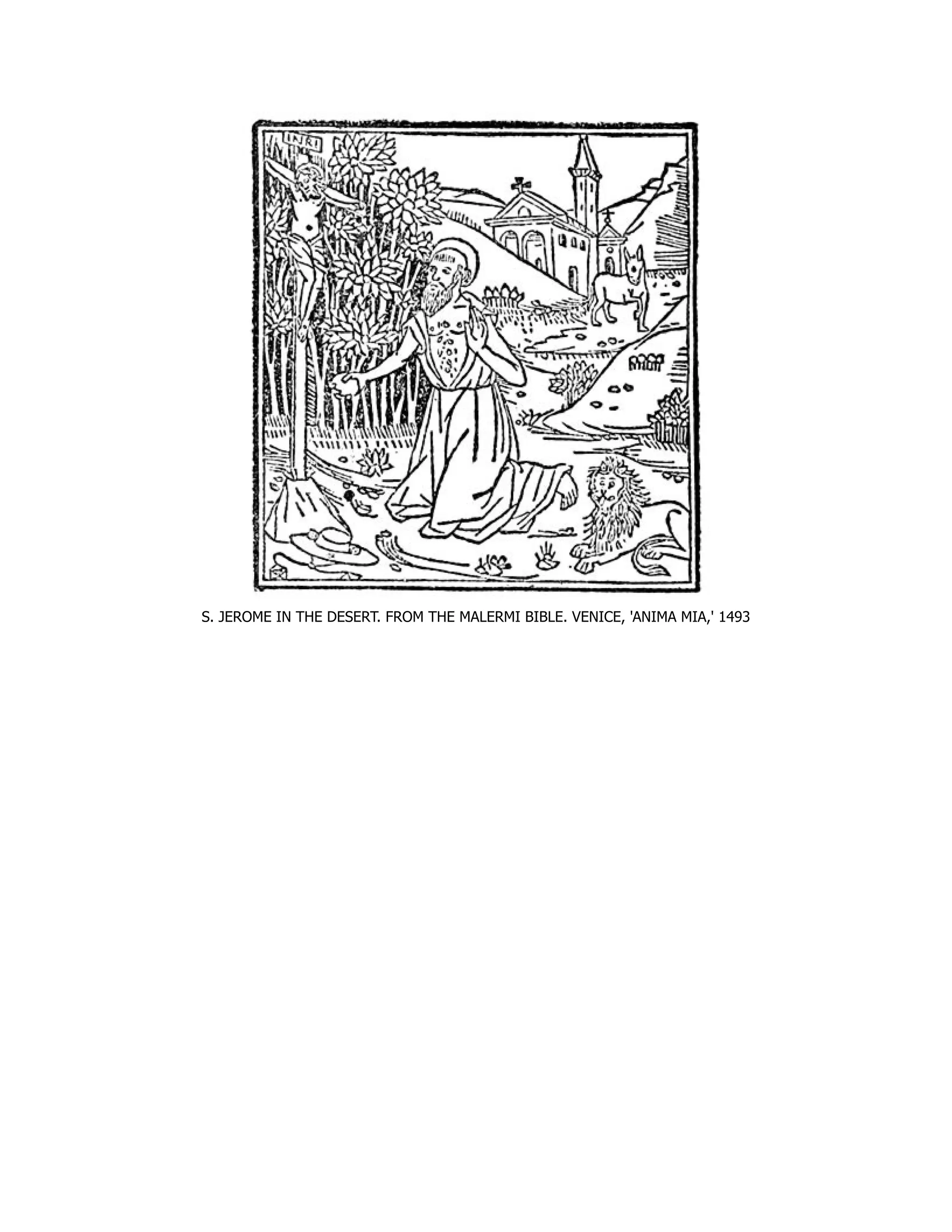
second, the picture of S. Jerome in the Desert, is one of the best
things in the book, both in design and cutting; but it differs from
everything else in it, and may possibly belong to some other set.
JACOB DECEIVING ISAAC. FROM THE MALERMI BIBLE. VENICE, 'ANIMA MIA,' 1493
It may have been noted that in writing of the edition of 1490 I have
not thought it necessary to write of the various theories which have
been built on the little letter 'b' with which many of the cuts are
signed, e.g., that of 'an author at work' reproduced on p. 42. It is
now generally acknowledged that it is the mark, not of any designer,
nor even perhaps of any individual woodcutter, but merely of the
workshop in which the little blocks were cut.
S. JEROME IN THE DESERT. FROM THE MALERMI BIBLE. VENICE, 'ANIMA MIA,' 1493
S
A BOOK OF HOURS[3]
OME years ago a copy of an edition of the 'Hours of the Blessed
Virgin,' according to the use of Sarum, came into my possession,
and I have since been surprised to learn that it is probably unique.
On the fly-leaf of the little volume is the note: 'This Book I picked up
on a Stall at Venice, in 1741, and had it bound there. It was
probably printed in England (as there are some few English
directions in it) some time before Henry viii.' The second half of this
note has been crossed through, and the more correct information
substituted: 'rather at Paris for the use of English booksellers, about
the year 1500.' A later note shows that the original purchaser was
Mr. Joseph Smith, for many years British Consul at Venice, most of
whose many bargains in early printed books passed into the library
of George iii., and thence to the British Museum. Of this little 'Book
of Hours' many of the pages are stained with damp, so that it
probably belonged to the consignment of his purchases which was
wrecked on its way home. Perhaps for this reason, perhaps because
the most esteemed Horae are on vellum and this is on paper and
moreover lacks its first leaf, perhaps because the good king did not
care to collect works of prae-Reformation devotion, this particular
purchase of the energetic consul never found a royal owner. It
possesses, however, not a little interest of its own, and if my readers
will consent to turn over its pages with me, they will disclose to us a
great deal of information as to the compilation and printing of these
books of devotion in the fifteenth century, and their supply for the
use of devout persons in England.
It is rather surprising that Consul Smith was deceived, even for a
moment, as to the foreign origin of his purchase. The illustrations, as
to which we shall have a great deal to say later on, are unmistakably
French, and appear in many French 'Books of Hours,' both of earlier
and later date. The type also is of a character very common in
French books, and never found out of France. These points,
however, require just a smattering of knowledge about early printing
for their appreciation, while only a little common sense is needed in
the present case to determine the origin of the book. The general
printing is excellent, but the mistakes made in the half-dozen
directions in English could have been made by no Englishman. Thus
the words into the chirche appear as in thothe chir che; hous is
misprinted bous; begynne as hegynne; and the like. Moreover, we
note that the printer possessed no letter k in his fount, but was
obliged to represent it by a combination of l and the old sign for
and:
The book, therefore, was printed neither in England, Germany, nor
the Low Countries, but in a country where the letter k forms no part
of the alphabet, and a good guess might easily have suggested
France as its most likely place of imprint.
A clause in one of the Acts passed by the Parliament of 1483, while
Richard iii. was still anxious to pose as a constitutional monarch,
expressly provided for the free importation of books printed abroad,
and for the exemption of foreign printers and booksellers settling in
England from the restrictions usually imposed upon alien traders.
The clause was no doubt prompted by a genuine desire to promote
education and learning, but it is probable that a little protection of a
young industry might have quickened its development without
imposing too serious a tax upon reading. Lettou and Machlinia were
already at work in London when the Act was passed, and Theodoric
Rood at Oxford, but no other printers were attracted from abroad for
several years, while the influx of foreign books made home
competition so hazardous that after Rood disappears Oxford was for
many years without a printer, and at Cambridge no press was set up
till 1521. Not only were almost all classical books imported, but
English works were printed in English by several Dutch firms, the
much greater similarity of the two languages in those days rendering
the task easier than it would be at present. English books were also
printed occasionally in France, for Antoine Vérard among others, not
always, however, very intelligently, as indeed the misprints at which
we have just been looking would lead us to expect.
In addition to the works of poetry and romance, which are now the
best known among the productions of his press, William Caxton
issued also many books of devotion. In the show-case devoted to his
publications in the King's Library at the British Museum, among other
unique books are shown the Latin Psalter, printed by him between
1480 and 1483, and a volume containing the 'Fifteen Oes,' and other
prayers, 'emprented bi the commaundementes of the most hye and
vertuous pryncesse our liege ladi Elizabeth by the grace of God
Quene of Englonde,' and of Margaret Tudor, the king's mother.
THE TREE OF JESSE. FROM PIGOUCHET'S 'HORAE'
Caxton also printed at least four editions of the Horae, fragments of
which survive at the Museum and at Oxford, though no copy even
approaching completeness is now known to exist. As a rule,
however, English liturgical works were printed abroad, for the most
part in France (at Paris or Rouen), but also at Venice, at Antwerp, at
Basel, and elsewhere. Thus of the Sarum Breviary there are at the
Museum six early Paris editions, and one from Antwerp, but no
London edition before 1541. The solitary editions of the Sarum
Gradual and Antiphonal are both from Paris, while of the thirty
editions of the Sarum Missal, five and twenty were printed abroad
and only five at home. It need not, therefore, surprise us to find that
of thirty-nine Sarum Horae in the Museum library, while two were
printed at Antwerp, and two at Rouen, the Paris presses produced
twenty-seven, those of London only eight, and these with some help
from France.
It is time now to turn to the contents of our book. These are as
follows:—
i. A Kalendar.
ii. Passages from the Gospels on the Birth, Ascension, and Death of Christ,
viz., S. John i. 1-14; S. Luke i. 20-38; S. Matt. ii. 1-12; S. Mark xvi. 14-
20; S. John xviii. 1-42.
iii. Prayers: On the Trinity: 'Whan thou goest first out of thy hous'; 'Whan thou
entrest into the chirch'; 'Whan thou beginnest to praye.'
iv. The Hours of the Blessed Virgin—'Horae intemeratae beatae Mariae Virginis
secundum usum Sarum.'
v. The Hours of the Compassion of the Blessed Virgin.
vi. The Seven Penitential Psalms.
vii. The Litany of the Saints.
viii. The Vigils of the Dead.
ix. Seven Psalms on the Lord's Passion.
x. Prayers: Before the Image of the Body of Christ; To the Blessed Mary and
to S. John the Evangelist.
There is thus, as in all editions, a great deal in the volume besides
the Horae, from which the book takes its name. But of the hundred
and sixty pages to which (in addition to the twelve leaves of
Kalendar) the volume extends, upwards of sixty are occupied by the
Hours, which are thus much the most important item in the
contents. The antiquity of these Hours was very great, for they are
mentioned as an office as early as the sixth century. They fell,
however, into disuse, but were revived, and probably rearranged, by
Peter Damian just ten years before our battle of Hastings. Forty
years later, in 1096, at the Council of Claremont, the saying of them,
in addition to the canonical hours, was made compulsory upon all
the clergy, and this compulsion continued until 1568, when Pope
Pius v., in issuing his revision of the Breviary, released the clergy
from the obligation to say this office, at the same time that he
forbade the use of the vernacular translations of it, which for at least
two centuries had been permitted to the laity. In England, as we all
know, these vernacular versions were called Primers, and their
rendering of the Psalms and Prayers of which the Hours were made
up, and of the additional matter which was joined with them, has
formed the basis of our present English Prayer Book.
Thee God we preise: Thee Lord we knowleche:
Thee endless Fader everi erthe worschipeth:
To Thee alle angels, to Thee hevenes and alle manere powers:
To thee cherubim and seraphim crieth with vois withouten cessinge:
Holy, Holy, Holy, Lord God of Ostis:
Hevenes and erthe ben ful of mageste of thi glorie:
Thee the glorious compainie of apostles:
Thee the preisable noumbre of prophetes:
Thee preiseth the white ost of martires.
So began the English version of the Te Deum in a Primer written at
the end of the fourteenth century (British Museum, Add. MS. 27,
592),[4] and if the beauty of some of these lines has caused us to
give them a preference over other versions a little closer to our own,
they serve none the less well to show whence it was that our Prayer
Book obtained its magnificent rhythms. But who would know more
of our old English Primers must be referred to the third volume of
the late Mr. Maskell's 'Monumenta Ritualia Ecclesiae Anglicanae'
(Clarendon Press, 1882). Here we are concerned with Horae, and
that in their bibliographical and pictorial, rather than their liturgical
aspect.
Each of the Hours, we are told, had its mystical reference to some
event in the Lives of the Blessed Virgin and our Lord, and these
references are explained in some of the Primers in some rude
verses, which, with correction of some obvious misprints, and
modernising the spelling, I proceed to quote:—
Ad Laudes:
How Mary, the mother and virgin,
Visited Elizabeth, wife of Zachary,
Which said, 'Blessed be thou cousin,
And blessed be the fruit of thy body.'
Ad Primam:
How Jesu Christ right poorly born was,
In an old crib laid all in poverty,
At Bethleem, by an ox and an ass,
Where Mary blessed His nativity.
Ad Tertiam:
How an Angel appeared in the morn,
Singing, 'Gloria in Excelsis Deo';
Saying, 'The very Son of God is born,
Ye Shepherds of Bethleem, ye may go.'
Ad Sextam:
How three kings of strange nations,
Of Christ's birth having intelligence,
Unto Bethleem brought their oblations,
Of gold, of myrrh, and frankincense.
Ad Nonam:
Simeon, at Christ's circumcision,
These words unto the Jews did tell,
'My eyen beholdeth your redemption,
The light and glory of Israel.'
Ad Vesperas:
How Mary and Joseph with Jesus were fain
Into Egypt, for succour, to flee,
Whan the Innocents for His sake were slain,
By commission of Herod's cruelty.
Ad Completorium:
How Mary assumpted was above the skies,
By her Son as sovereign lady,
Received there among the hierarchies,
And crowned her the queen of glory.
I have quoted these verses in full, rude though they are, because
they form the keynote to the scheme of illustrations of all Horae and
Primers. The Hours were intended as devotional comments on the
subjects of these verses, and in the fourteenth and fifteenth
centuries it was thus the most natural thing in the world that each
Hour should be accompanied by an illumination, or, failing that, a
woodcut, to illustrate its special theme. Accustomed as we nowadays
are to gain our information exclusively by reading letterpress, it is
only by a visit to our nurseries that we can recall to ourselves how
deeply the need of pictures was felt in the ages before the printing
press made the art of reading a common acquirement. Of this need
the Miracle Plays, with all their rudeness, all their unconscious
profanity, were at once the living witness and the living fulfilment. In
the great cycles, such as those of York, Wakefield, and Chester,
which have come down to us, the history of the world in its sacred
aspects is unrolled from the creation of the angels to the day of
judgment; and the presentment of these plays probably brought the
Bible stories nearer to the people than could have been possible in
any other way. Certainly these plays left a deep mark upon current
ideas of art, and helped to render impossible any attempt at
antiquarian correctness. In the scene of the Adoration of the
Shepherds in some of the finest books of Hours (P. Pigouchet: Paris,
1498, 1502, etc.), underneath the figures of the shepherds and their
wives (by whom they are mostly represented as being accompanied)
are written the names Gobin le gai, le beau Roger, Aloris, Alison,
Mahault, Ysambre, by which they were known in the French plays on
the Nativity, and the shepherds are French Shepherds of the
fifteenth century. But however great their anachronisms, the
tableaux in the Miracle Plays and the pictures in books of devotion
were found abundantly helpful, and for more than a century and a
half, first in manuscript and afterwards in print, the Horae or
Primers, the prayer-books of the laity, hold the first place among
illuminated books.
FROM A SARUM HORAE. PARIS: P. PIGOUCHET FOR S. VOSTRE, 1502
A few years ago Mr. Quaritch possessed a charming 'Book of Hours,'
which at one time belonged to Elizabeth Poyntz, a relative of the
Thomas Poyntz at whose book we were looking a little while back.
To this manuscript Mr. Quaritch in his catalogue assigned the date
'about 1360,' which, if correct, gives it considerable antiquity among
illuminated Horae. The end of the fourteenth century is the date at
which these first become at all common, and it was during the
fifteenth century that they obtained their greatest popularity, and
that the greatest artists were employed in their production.
Numerous and very beautiful examples of the manuscripts produced
during this period form part of the permanent exhibition in the
Grenville Library at the British Museum, and I hope that many of my
readers will go to look at them there. All fine examples of
manuscript Horae possess (i.) beautiful initial letters, (ii.) borders
surrounding every page, formed of leaves, flowers, birds,
grotesques, and the like, (iii.) a number of beautiful miniatures,
filling the whole or the greater part of a page, and representing the
scenes from the life of Christ and His Mother mentioned in the lines
quoted above, with additional illustrations from the Passion, and
from the lives of the saints. Beyond saying this, it is impossible to
give any general description of these manuscript Hours, each one of
which possesses its own delightful individuality. Two or three special
examples, however, may be mentioned to show the estimation in
which they were held and the care which was spent on their
decoration. Thus the late Mr. Charles Elton possessed a charming
little 'Book of Hours' which once belonged to Queen Jeanne ii. of
Naples (1370-1435). It measures only 2 5/8 × 1 7/8 inches, and
contains one hundred and sixty leaves and twenty miniatures, nine
of which occupy the whole of their page. The initial letters
throughout are in gold and colours, and the borders are of the ivy-
leaf pattern, the scrolls often terminating in grotesques. Mr.
Quaritch, again, when this paper was written, had for disposal (for
the sum of one thousand pounds) a Horae of slightly later date, a
wedding present from the Regent, John, Duke of Bedford, to Lord
Talbot on his second marriage in 1424, when he allied himself to
Margaret Beauchamp, daughter of Richard, Earl of Warwick. The first
leaf contains a miniature showing Talbot and his wife at prayer under
the protection of their patron saints, and many other miniatures are
scattered through the rest of the volume. In 1429 Talbot was
captured at the battle of Patay and remained a prisoner in France till
1433. During this time he made many entries in the blank leaves of
his Hours. Here is a snatch from one in verse:
Saynt George the gode knyght
Over your Fomen geve you myght,
And holy Saynt Katheryne
To youre begynnyng send gode fyne,
Saynt Christofre botefull (helpful) on see and lond,
Joyfully make you see Engelond.
Twenty years after his release from imprisonment, Talbot was slain
(July 20, 1453), fighting against a Breton force at Chatillon. It is
possible that he may have carried his Hours on his person, for it was
in the cottage of a Breton peasant that it was discovered a few years
ago, and it seems likely that a Breton soldier may have found it on
the battle-field, and transmitted it to his descendants as an
heirloom. As an example of another kind of interest, we may
instance a Horae at the Bodleian, on four of whose leaves are drawn
most delicate and beautiful representations of religious processions.
The best of these has been reproduced in the Proceedings of the
Palæographical Society, and it is impossible to overrate the charm of
the drawing.
In 1473 Nicholas Jenson printed a Horae at Venice; three years later,
Matthias Moravus followed his example at Naples, and the earliest of
Caxton's four editions was probably printed not much later than
1478. But these were all ordinary books, with no special beauty
about them except what they might receive from the 'rubrisher,' or
illuminator, after the printer had done his work. It was not till 1487,
just a third of a century after the issue from the press of the first
printed document bearing a date, that any serious attempt was
made to supplant the manuscript Horae by printed editions. The first
essay was made by Anthoine Vérard, of Paris, and is said—I have
never seen a copy of it—to have been a poor production, 'without
frontispieces' (whatever that may mean), or borders to the text. The
success, however, with which it met was apparently sufficient to
encourage Vérard to renew his attempt, and in 1488 or thereabouts
he issued his 'Grandes Heures,' a fine quarto, with fourteen large
engravings, and borders in four compartments to every page. In
1489, he reprinted the book in much cheaper form, using most of
the large engravings which now occupied a whole page apiece, and
devising for the borders smaller figures, in which scenes from the life
of the Blessed Virgin and our Lord were set forth with their Old
Testament types. Meanwhile other publishers had not been idle, for,
in 1488, Jean du Pré, or Johannes de Prato, as he called himself on
his Latin title-pages, issued the first of the few Horae which
proceeded from his press; and in 1491 Philippe Pigouchet printed his
first known edition, and not long afterwards entered into relations
with Simon Vostre, an enterprising bookseller, which resulted in the
publication of at least a score of editions, all extraordinarily rare,
during the next twenty years. Towards the end of this century, and
in the early part of the next, other Paris firms of printers and
publishers joined in the trade. Of these, Thielman Kerver, Gilles and
Germain Hardouyn, Guillaume Eustace, Francois Regnault, and
Geoffroy Tory were the most important, but Horae are extant
bearing the imprint of more than thirty other firms besides these.
The demand must have been very great, for Paris supplied not only
the rest of France—and in the British Museum there are examples of
Horae for the use of no fewer than thirty different French dioceses—
but also England. Hence there was abundance of work for all, and
the different publishers copied each other's editions with a freedom
which is not a little embarrassing to the humble bibliographer.
The subjects of the fourteen full-page illustrations in the little 'Horae
secundum usum Sarum,' which we have taken as our text, are as
follows:-
i. The Betrayal of Christ (repeated after xiv.).
ii. The root of Jesse, from whose slumbering body a tree is springing, its
branches being the Jewish kings, and the Virgin and Holy Child its
summit (see page 54).
iii. The Holy Trinity adored by the Saints in heaven and by the Pope and
Emperor and their followers upon earth.
iv. The Annunciation.
v. The Visitation.
vi. The Crucifixion.
vii. The Adoration by the Shepherds.
viii. The Annunciation to the Shepherds.
ix. The Adoration by the Magi.
x. The Presentation in the Temple.
xi. The Flight into Egypt.
xii. The Death of the Virgin.
xiii. S. John before the Latin Gate.
xiv. Dives and Lazarus.
These, with the exception of the last, which is not quite so common,
occur in most Horae. Other illustrations, which are frequently found,
especially in earlier editions, represent scenes from the life of David
in connection with the Penitential Psalms, his gazing at Bathsheba,
the consummation of his plan for the murder of Uriah, and his
punishment. His victory over Goliath is also occasionally represented.
We also find in several early editions 'Les Trois Vifs' placed over
against 'Les Trois Morts,' three gay knights on one page and three
grinning skeletons on another, and in Tory's 'Heures à l'usage de
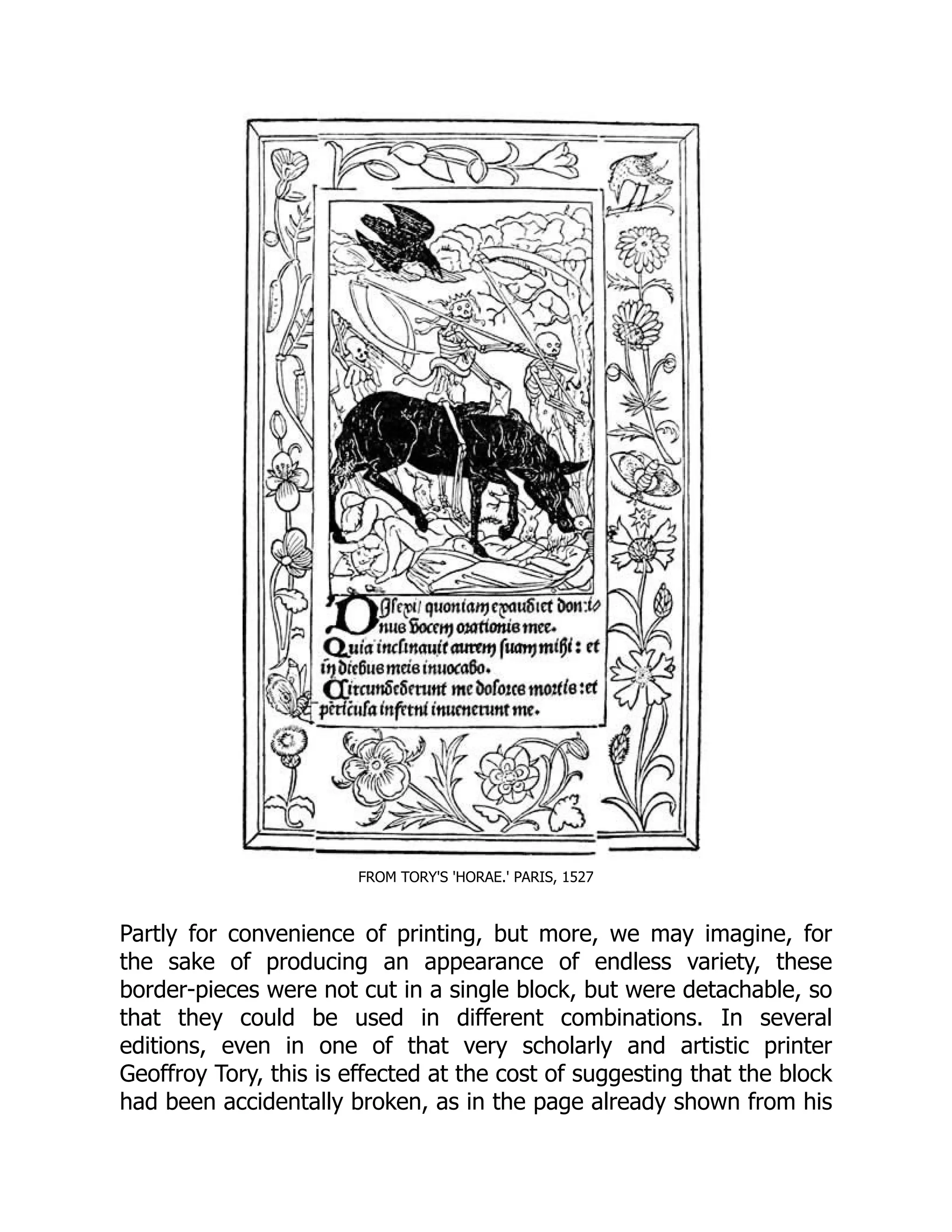
Paris' of 1527 we have a striking picture of Death, on his black
horse, riding over the corpses of his victims to deliver yet another
summons. The Calendar, again, is usually prefaced by a figure of a
man, with all the organs of his body exposed, and lines drawn from
them to the celestial bodies, which, in the popular beliefs, were
supposed to influence their health and sickness. Of all these
illustrations five or six different varieties are found; but from 1495 to
the end of the century, the set of designs which was used for our
little Sarum Horae was by far the most popular, and influenced the
editions of all the leading publishers.
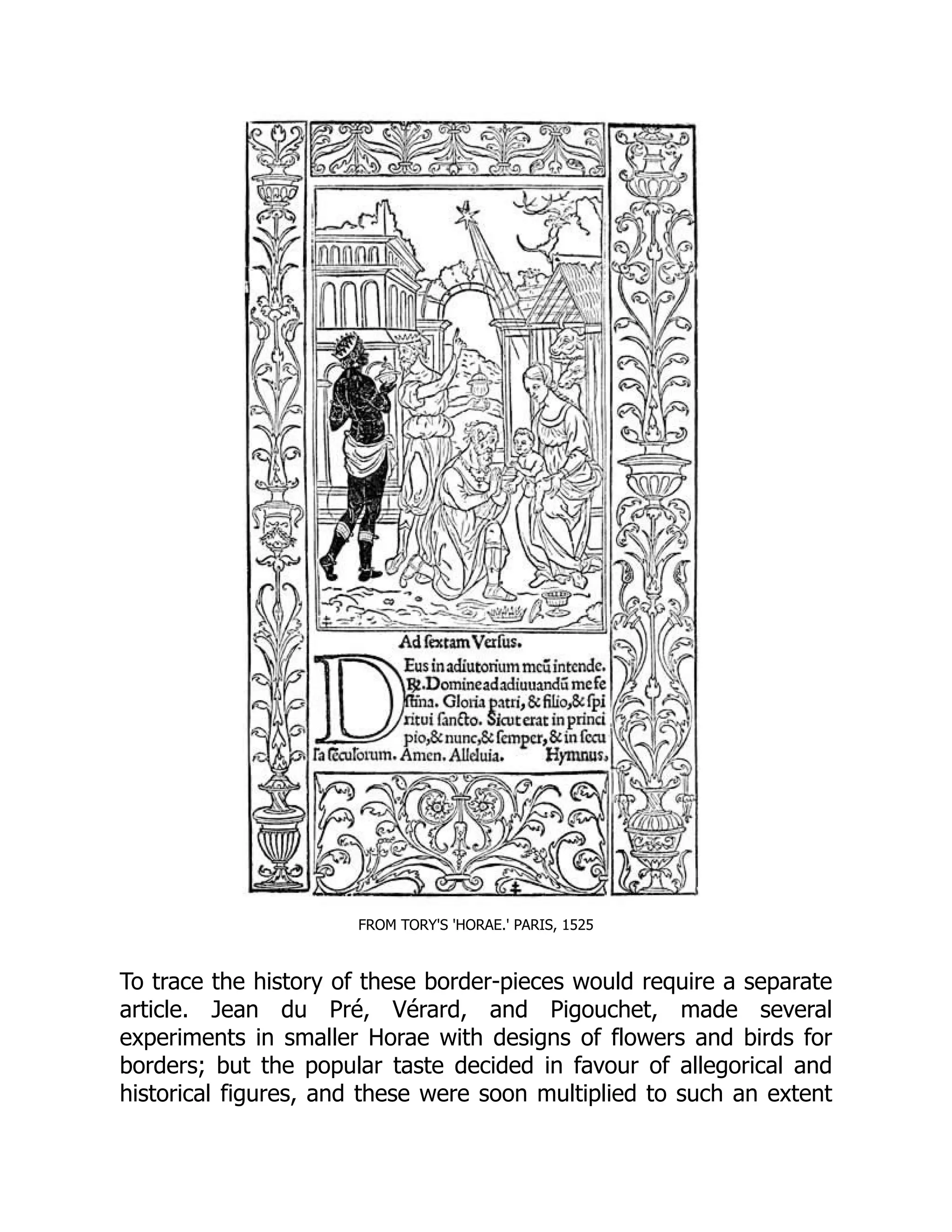
FROM TORY'S 'HORAE.' PARIS, 1525
To trace the history of these border-pieces would require a separate
article. Jean du Pré, Vérard, and Pigouchet, made several
experiments in smaller Horae with designs of flowers and birds for
borders; but the popular taste decided in favour of allegorical and
historical figures, and these were soon multiplied to such an extent
that their original order and significance were lost sight of. In the
editions published by Jean du Pré in 1488, and by Vérard in 1489,
several pages are occupied with an explanation of the small figures
in the border. Jesse and Balaam are shown as types of the Nativity
of the Blessed Virgin, the betrothal of Isaac and Rebecca as a type
of her Espousal, Eve tempted by the Serpent shows the Fall to which
the Annunciation preluded the remedy, the Burning Bush and
Aaron's rod foreshadowed the Nativity. Here all is clear, but as the
demand for variety increased, there were added, in addition to the
'Dance of Death,' figures of the Saints, Prophets, Angels, and
Virtues, representations of the Sibyls, emblems of the Fifteen Signs
of Coming Judgment, and scenes from the life of the Blessed Virgin
and our Lord, and from the Old Testament.
FROM TORY'S 'HORAE.' PARIS, 1527
Partly for convenience of printing, but more, we may imagine, for
the sake of producing an appearance of endless variety, these
border-pieces were not cut in a single block, but were detachable, so
that they could be used in different combinations. In several
editions, even in one of that very scholarly and artistic printer
Geoffroy Tory, this is effected at the cost of suggesting that the block
had been accidentally broken, as in the page already shown from his
edition of 1527, where at the foot the pieces do not even fit
together. The more general plan, however, was that exemplified in
Tory's edition of 1525, where it is carried out with unusual precision,
the borders being built up by the repetition of exactly sixteen blocks
of each size, fitting respectively into the inner and outer margin and
the head and foot of the page. In earlier editions the border-pieces
are more numerous and not so mathematically apportioned, the
reason being that while Tory's are purely decorative, and their
number therefore fixed at will, in the earlier editions the cuts are
pictorial, and their number decided by the exigencies of the subjects.
Thus in Pigouchet's Paris 'Hours' of 1491 there are in all 147 border-
pieces, of which 78 are outer side-pieces, 15 inner side-pieces, 16
cornices, 8 head-pieces, and 30 foot-pieces. The numbers illustrate
the greater importance of the outer side-pieces and foot-pieces,
which have a depth or breadth of twenty-one millimetres against the
nine of the inner side-piece and head-piece. The subjects illustrated
in them are the Creation, the Gospel history from the birth of the
Blessed Virgin to the Last Judgment, and special sets of the Nativity
and Passion with Old Testament types. All these were extensively
imitated by other publishers, and the same honour was paid to the
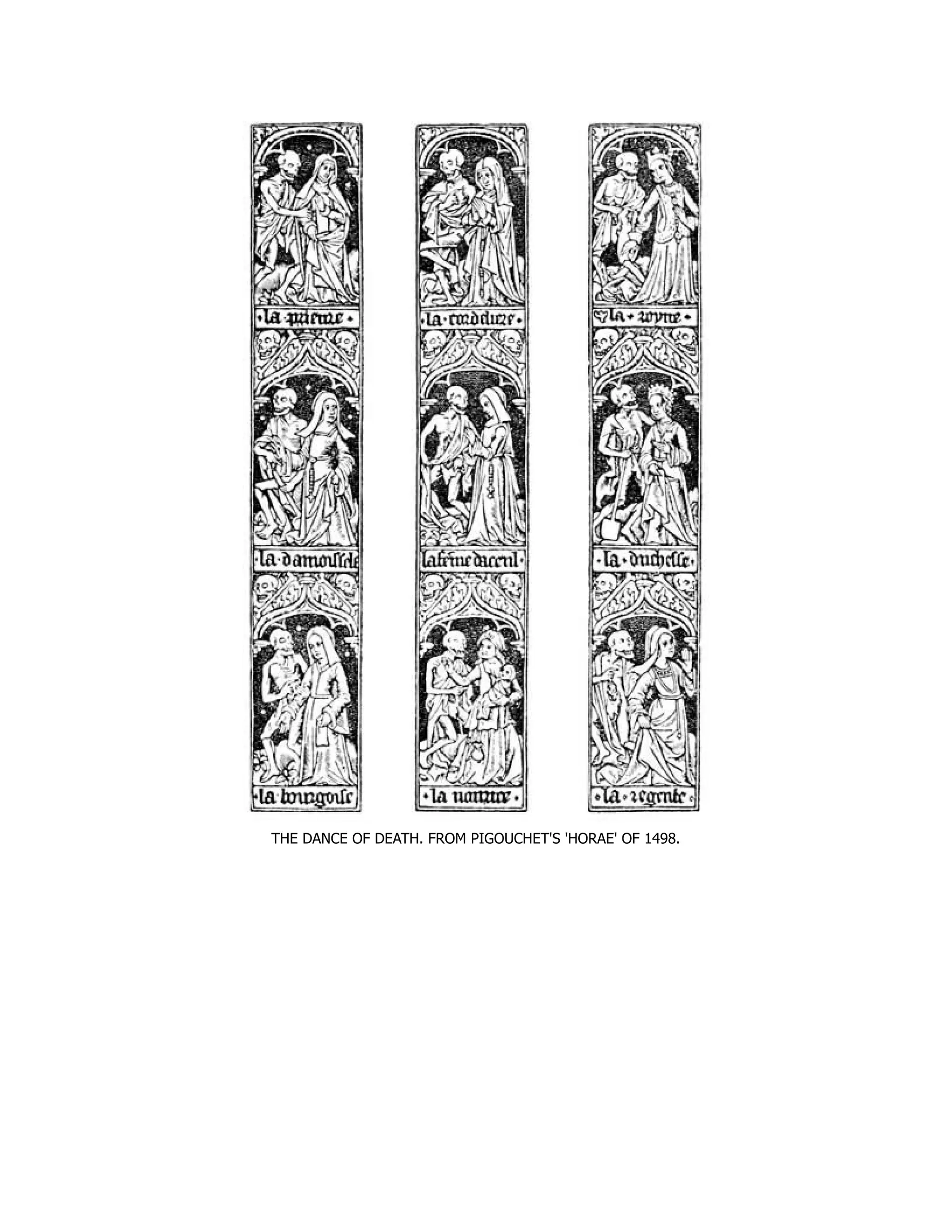
famous set of the Dance of Death, which Pigouchet began to
introduce early in 1496, and gradually increased in successive
editions till in that of 8th August 1497 we find the full number of ten
triple blocks of male victims and twelve of women. A similar
succession may be traced in the gradual changes in the full-page
cuts, so that we can often tell within two or three months the time
at which an undated edition was sent to press. In my own little book
there are no large border-pieces, only ledges round the text, but
from its containing the picture of the stem of Jesse (shown as one of
our illustrations) and the Church Militant and Triumphant, it must be
assigned to the year 1498 or a little later.
THE DANCE OF DEATH. FROM PIGOUCHET'S 'HORAE' OF 1498.
Welcome to our website – the ideal destination for book lovers and
knowledge seekers. With a mission to inspire endlessly, we offer a
vast collection of books, ranging from classic literary works to
specialized publications, self-development books, and children's
literature. Each book is a new journey of discovery, expanding
knowledge and enriching the soul of the reade
Our website is not just a platform for buying books, but a bridge
connecting readers to the timeless values of culture and wisdom. With
an elegant, user-friendly interface and an intelligent search system,
we are committed to providing a quick and convenient shopping
experience. Additionally, our special promotions and home delivery
services ensure that you save time and fully enjoy the joy of reading.
Let us accompany you on the journey of exploring knowledge and
personal growth!
testbankdeal.com

Data Communications and Computer Networks A Business Users Approach 8th Edition White Solutions Manual


  • 1.
    Visit https://testbankdeal.com todownload the full version and explore more testbank or solutions manual Data Communications and Computer Networks A Business Users Approach 8th Edition White Solutions Manual _____ Click the link below to download _____ https://testbankdeal.com/product/data-communications-and- computer-networks-a-business-users-approach-8th-edition- white-solutions-manual/ Explore and download more testbank or solutions manual at testbankdeal.com

  • 2.
    Here are somerecommended products that we believe you will be interested in. You can click the link to download. Data Communications and Computer Networks A Business Users Approach 8th Edition White Test Bank https://testbankdeal.com/product/data-communications-and-computer- networks-a-business-users-approach-8th-edition-white-test-bank/ Data Communications and Computer Networks A Business Users Approach 7th Edition White Test Bank https://testbankdeal.com/product/data-communications-and-computer- networks-a-business-users-approach-7th-edition-white-test-bank/ Data And Computer Communications 10th Edition Stallings Solutions Manual https://testbankdeal.com/product/data-and-computer- communications-10th-edition-stallings-solutions-manual/ Traditions and Encounters A Global Perspective on the Past 6th Edition Bentley Test Bank https://testbankdeal.com/product/traditions-and-encounters-a-global- perspective-on-the-past-6th-edition-bentley-test-bank/
  • 3.
    Evolve Resources forGoulds Pathophysiology for the Health Professions 6th Edition Hubert Test Bank https://testbankdeal.com/product/evolve-resources-for-goulds- pathophysiology-for-the-health-professions-6th-edition-hubert-test- bank/ Marketing Management 4th Edition Winer Test Bank https://testbankdeal.com/product/marketing-management-4th-edition- winer-test-bank/ Essentials of Geology 13th Edition Lutgens Test Bank https://testbankdeal.com/product/essentials-of-geology-13th-edition- lutgens-test-bank/ Human Anatomy and Physiology 10th Edition Marieb Test Bank https://testbankdeal.com/product/human-anatomy-and-physiology-10th- edition-marieb-test-bank/ Marketing Management 3rd Edition Marshall Test Bank https://testbankdeal.com/product/marketing-management-3rd-edition- marshall-test-bank/
  • 4.
    Business Research Methods9th Edition Zikmund Solutions Manual https://testbankdeal.com/product/business-research-methods-9th- edition-zikmund-solutions-manual/
  • 5.
    Local Area Networks– The Basics Learning Objectives After reading this chapter you should be able to: • State the definition of a local area network. • List the primary function, activities, and application areas of a local area network. • Cite the advantages and disadvantages of local area networks. • Identify the physical and logical local area networks. • Specify the different medium access control techniques. • Recognize the different IEEE 802 frame formats. • Describe the common wired local area network systems. Chapter Outline 1. Introduction 2. Primary Function of Local Area Networks 3. Advantages and Disadvantages of Local Area Networks 4. The First Local Area Network – The Bus/Tree 5. A More Modern LAN a. Contention-based protocols 6. Switches a. Isolating traffic patterns and providing multiple access b. Full-duplex switches c. Virtual LANs d. Link aggregation e. Spanning tree algorithm f. Quality of service 7. Wired Ethernet 8. Wired Ethernet Frame Format Chapter 7
  • 6.
    9. LANs InAction: A Small Office Solution 10. Summary Lecture Notes Introduction A local area network (LAN) is a communication network that interconnects a variety of data communicating devices within a small geographic area and broadcasts data at high data transfer rates with very low error rates. Since the local area network first appeared in the 1970s, its use has become widespread in commercial and academic environments. It would be very difficult to imagine a collection of personal computers within a computing environment that does not employ some form of local area network. This chapter begins by discussing the basic layouts or topologies of the most commonly found local area networks, followed by the medium access control protocols that allow a workstation to transmit data on the network. We will then examine most of the common Ethernet products. Functions of a Local Area Network The majority of users expect a local area network to perform the following functions and provide the following applications: file serving, database and application serving, print serving, electronic mail, remote links, video transfers, process control and monitoring, and distributed processing. Advantages and Disadvantages of Local Area Networks Local area networks have several advantages, including hardware and software sharing, workstation survival during network failure, component and system evolution, heterogeneous mix of hardware and software, and access to other LANs, WANs, and mainframe computers. Disadvantages include complexity, maintenance costs, and the network is only as strong as the weakest link. The First Local Area Network – The Bus/Tree The bus local area network was the first physical design when LANs became commercially available in the late 1970s, and it essentially consists of a single cable, or bus, to which all devices attach. Since then the bus has diminished significantly to the point of near extinction. It
  • 7.
    is interesting tonote that cable television signals are still delivered by a network bus. Thus, understanding the bus/tee network is still important. A More Modern LAN The most popular configuration for a local area network is the star-wired bus. This form of LAN should not be confused with an older technology called the star topology. Today’s modern star- wired bus network acts like a bus but looks like a star. The logical design of operates as a bus where one workstation can transmit to all other workstations. The physical design, however, more resembles a star, with the hub or switch acting as the central point. Contention-based Protocols A medium access control protocol is part of the software that allows a workstation to place data onto a local area network. Depending on the network’s topology, several types of protocols may be applicable. The bottom line with all medium access control protocols is this: Since a local area network is a broadcast network, it is imperative that only one workstation at a time be allowed to transmit its data onto the network. In the case of a broadband local area network, which can support multiple channels at the same time, it is imperative that only one workstation at a time be allowed to transmit its data onto a channel on the network. There remains only one basic category of medium access control protocol for local area networks: contention-based. Switches A switch is a combination of a hub and a bridge and can interconnect multiple workstations like a hub but can also filter out frames providing a segmentation of the network. Switches can provide a significant decrease in interconnection traffic and increase the throughput of the interconnected networks while requiring no additional cabling or rearranging of the network devices. Modern switches can provide full-duplex connections, virtual LANs, aggregated links, support spanning tree algorithms, and provide quality of service levels. Wired Ethernet The various versions of wired Ethernet include the older 10 Mbps systems, 100 Mbps, Gigabit, and 10 Gbps. Wired Ethernet Frame Format The IEEE 802 set of standards has split the data link layer into two sublayers: the medium access control sublayer and the logical link control sublayer. The medium access control (MAC) sublayer works more closely with the physical layer and contains a header, computer (physical) addresses, error detection codes, and control information. The logical link control (LLC) sublayer is primarily responsible for logical addressing and providing error control and flow control information.
  • 8.
    LANs In Action:A Small Office Solution The first In Action example examines how a small business decides to incorporate a LAN into their business solution. The business included 35 - 40 workstations with word processing, spreadsheets, and database applications. In order to add internal e-mail, a central database system, and print sharing, the company will consider the addition of a local area network. Quick Quiz 1. What are the major functions of a LAN? File and print serving, access to other LANs, WANs and mainframes, distributed processing, and process control. 2. What are the various medium access control techniques? Contention-based. Round robin systems have essentially disappeared. 3. What is the difference between a hub, a switch, and a router? Hub broadcasts any input onto all outgoing lines; switch replaces a hub and provides filtering; router interconnects a LAN with a WAN. 4. What are the basic functions of a network server? Holds network operating system as well as application programs and data set; may also function as a hub, switch, bridge or router. Discussion Topics 1. Couldn’t IEEE have made a single frame format for all the forms of local area networks? 2. Are LANs a stable technology or are they changing just as quickly as other forms of communication technologies? 3. Is Ethernet that good that it’s the predominant form of LAN? Will everything eventually be Ethernet / CSMA/CD? 4. Will hubs be obsolete someday? 5. What are the advantages of creating virtual LANs?
  • 9.
    Teaching Tips 1. Besure to emphasize the difference between logical view and physical view. For example, a star-wired bus logically acts like a bus but physically looks like a star. A star-wire ring logically acts like a ring but physically looks like a star. A bus logically and physically is a bus. 2. The frame is the name of the package at the data link layer. It is the frame that is placed onto the medium of the physical layer. The IEEE 802 frame formats describe the layout of the frame and what the data looks like as it moves over a LAN. The frame addresses are the ones used to address a NIC in a machine. This is not the address that is used to send a packet over the Internet (that is the IP address). 3. Discuss the non-determinism of the CSMA/CD LAN and how collisions in hub-based LANs create this characteristic. Discuss how switches and no collisions have changed things. 4. What kind of mix does your school or company have of hubs, routers, and switches? Use this information as an example in class. 5. Take your students to one or more locations on campus and show them an actual, working hub / switch / router. 6. Make sure you emphasize how a switch filters out unnecessary packets. Solutions to Review Questions 1. What is the definition of a local area network? A communication network that interconnects a variety of data communicating devices within a small geographic area and broadcasts data at high data transfer rates with very low error rates. 2. List the primary activities and application areas of a local area network. File serving, print serving, connection to other networks and mainframes. 3. List the advantages and disadvantages of local area networks. Adv: Share files and devices, intercommunication. Disadv: Maintenance, complexity, costs. 4. What are the basic layouts of local area networks? List two advantages that each layout has over the others. Bus: Uses low noise coaxial cable, inexpensive taps. Star-wired bus: Simple to interconnect, easy to add components, most popular.
  • 10.
    Star-wired ring: Simpleto interconnect and easy to add components (but no more so than star- wired bus). 5. What is meant by a passive device? A signal that enters is neither amplified nor regenerated. The signal is simply passed on. 6. What is meant by a bidirectional signal? A signal that propagates in either direction on a medium. 7. What are the primary differences between baseband technology and broadband technology? Baseband is a signal digital signal while broadband is analog and may carry many signals. 8. What purpose does a hub serve? The hub is a collection point for workstations. 9. What is the difference between a physical design and a logical design? Physical is the wiring and components, logical is how the software passes the data. 10. What is a medium access control protocol? The software that allows a workstation to insert its data onto the LAN. 11. What are the basic operating principles behind CSMA/CD? CSMA/CD: Listen to medium, if no one transmitting, transmit. Continue to listen for collisions. If someone is transmitting, wait. 12. What is meant by a “nondeterministic” protocol? You cannot determine precisely when a workstation will get a chance to transmit (because of potential collisions). 13. What does the term 100BaseT stand for? One hundred mega-bits per second transmission over baseband (digital) signals, using twisted pair wiring. 14. What is the difference between Fast Ethernet and regular Ethernet? Fast Ethernet transmits at 100 Mbps while regular Ethernet transmits at 10 Mbps.
  • 11.
    15. What arethe latest 10-Gbps Ethernet standards? 10GBase-fiber, 10GBase-T, 10GBase-CS 16. What is the primary advantage of power over Ethernet? The primary disadvantage? Primary advantage is not having to run a separate power line to power device; primary disadvantage is making sure the switch has enough power to run PoE devices. 17. How does a transparent switch work? Observes traffic on a LAN and creates a set of forwarding tables; filters traffic 18. What is the purpose of a virtual LAN? To create a logical subgroup of multiple workstations and servers. 19. How does a switch encapsulate a message for transmission? It really doesn’t encapsulate anything. Switch looks at NIC/MAC addresses and forwards accordingly. 20. When referring to a hub or a switch, what is a port? The port is the connection that is used to connect a workstation or another hub or switch to this hub or switch. 21. What are the basic functions of a switch? A switch examines a packet’s destination address and routes the packet to the appropriate workstation. 22. How does a switch differ from a hub? Switch examines addresses, hub does not. A switch has multiple ports and takes the place of a hub. 23. What is cut-through architecture? The device is passing the data packet on before it has even finished entering the device. 24. How is a full-duplex switch different from a switch? Full duplex switch has one set of lines for receiving and one set of lines for transmitting, thus it can do both operations at the same time.
  • 12.
    25. What ismeant by link aggregation? The process of combining two or more links into one logical fat link. Suggested Solutions to Exercises 1. What properties set a local area network apart from other forms of networks? Small geographic distances using broadband transmissions. 2. Describe an example of a broadband bus system. Cable modems, video surveillance systems, cable television. 3. Is a hub a passive device? Explain. Not completely. A hub does regenerate a digital signal. And there may be some simple network management functions performed in a hub. 4. Which of the Ethernet standards (10 Mbps, 100 Mbps, 1000 Mbps, 10 Gbps) allow for twisted pair media? What are the corresponding IEEE standard names? Currently all but 10 Gbps Ethernet can run over twisted pair. 5. If a network were described as 1000BaseT, list everything you know about that network. CSMA/CD LAN, 1000 Mbps transmission, baseband or digital signaling, twisted pair wiring. 6. In the IEEE 802.3 frame forma, what is the PAD field used for? What is the minimum packet size? PAD field makes sure the frame is not mis-interpreted as a runt. Minimum packet size is 64 bytes. 7. Suppose workstation A wants to send the message HELLO to workstation B. Both workstations are on an IEEE 802.3 local area network. Workstation A has the binary address “1" and workstation B has the binary address “10." Show the resulting MAC sublayer frame (in binary) that is transmitted. Don’t calculate a CRC; just make one up. HEADER 10 1 5(data length) HELLO PAD(33 bytes) CHECKSUM 8. What is the difference between the physical representation of a star-wired ring LAN and the logical representation?
  • 13.
    A star-wired ringLAN physically looks like a star but acts logically like a ring. A star-wired bus physically looks like a star but acts logically like a bus. 9. How is a hub similar to a switch? How are they different? Not too much similar. They both physically connect into the network the same. Both forward frames. But a switch looks at the MAC address and either forwards or drops the frame. 10. Are hubs and switches interchangeable? Explain. Yes. But results can be quite different. 11. a. The local area network shown in Figure 7-21 has two hubs (X and Y) interconnecting the workstations and servers. What workstations and servers will receive a copy of a packet if the following workstations/servers transmit a message: • Workstation 1 sends a message to workstation 3: • Workstation 2 sends a message to Server 1: • Server 1 sends a message to workstation 3: All devices will receive all messages. b. Replace hub Y with a switch. Now what workstations and servers will receive a copy of a packet if the following workstations/servers transmit a message: • Workstation 1 sends a message to workstation 3: • Workstation 2 sends a message to Server 1: • Server 1 sends a message to workstation 3: Workstations 1, 2 and 3. Workstations 1, 2 and the server. Only workstation 3. 12. A transparent switch is inserted between two local area networks ABC and XYZ. Network ABC has workstations 1, 2 and 3, and network XYZ has workstations 4, 5, and 6. Show the contents of the two forwarding tables in the switch as the following packets are transmitted. Both forwarding tables start off empty. • Workstation 2 sends a packet to workstation 3. • Workstation 2 sends a packet to workstation 5. • Workstation 1 sends a packet to workstation 2. • Workstation 2 sends a packet to workstation 3. • Workstation 2 sends a packet to workstation 6. • Workstation 6 sends a packet to workstation 3.
  • 14.
    • Workstation 5sends a packet to workstation 4. • Workstation 2 sends a packet to workstation 1. • Workstation 1 sends a packet to workstation 3. • Workstation 1 sends a packet to workstation 5. • Workstation 5 sends a packet to workstation 4. • Workstation 4 sends a packet to workstation 5. At the end: Routing table on ABC’s port: 1, 2 Routing table on XYZ’s port: 4,5,6 13. Give an example of a situation in which a virtual LAN might be a useful tool in a business environment. What about in an educational environment? If you want a certain group of users to work together on a project, you might want to place them on a virtual LAN. Likewise for school. 14. What does it mean when a switch or device is cut-through? What is the main disadvantage of a cut-through switch? Is there a way to solve this disadvantage of a cut- through switch without losing the advantages? Cut-through means the beginning of the data packet is leaving the switch before the end of the packet has entered the switch. Disadvantage is errors are propagated. Not if you want to keep it truly cut-through. 15. Give a common business example that mimics the differences between a shared network segment and a dedicated network segment. Wide range of possible answers here. 16. Your company’s switch between its two networks has just died. You have a router lying on your desk that is not currently being used. Will the router work in place of the broken bridge? Explain. No. Routers operate on IP addresses, while switches operate on NIC addresses. 17. A CSMA/CD network is connected to the Internet via a router. A user on the CSMA/CD network sends an e-mail to a user on the Internet. Show how the e-mail message is encapsulated as it leaves the CSMA/CD network, enters the router, and then leaves the router. Leaving the LAN: Data App + Data TCP + App + Data IP + TCP + App + Data MAC + IP + TCP + App + Data + MAC
  • 15.
    Entering router: MAC +IP + TCP + App + Data + MAC IP + TCP + App + Data Leaving router IP + TCP + App + Data WAN + IP + TCP + App + Data + WAN 18. Given the following network (Figure 7-22), show how the Spanning Tree Protocol will eliminate the cyclic path. The protocol will probably “remove” the bottom link on the far-right switch and the bottom link on the switch immediately to the left of the far-right switch. Thinking Outside the Box 1. You can interconnect all cash registers into one or two centrally located switches or hubs. Cat 5e/6 twisted pair should be sufficient. If hubs/switches can’t be centrally located and cable distance exceeds 100 meters, be careful. Might need better medium. Can also connect using multiplexing solution from earlier chapter. Problems 2-6: Many possible solutions here.
  • 16.
    Another Random ScribdDocument with Unrelated Content
  • 17.
    By 1492 theblock for this had apparently been damaged and is replaced by a larger cut (56 mm. in height), representing a king and two councillors, apparently taken from some other book. The 1493 illustrator was clearly puzzled by this, and for lack of anything better repeated a cut of Moses and Miriam from Exodus. Clearly he had not in this case the 1490 edition before him. But neither am I at all sure that he had that of 1492. While he copies six of the new pictures in Genesis he omits six others; in Exodus, Numbers, and Deuteronomy he agrees with the 1490 edition against that of 1492; in Judges, Ruth, and Kings, with 1492 as against 1490; in Genesis, Leviticus, and Joshua, partly with one, partly with the other. In two other cases he steers a middle course. The 1490 artist had illustrated far too realistically both the temptation of Joseph and the sin which called forth the zeal of Phineas. In the 1492 edition these subjects are very wisely omitted. In that of 1493 they appear, but in a modified form. My own theory to account for these discrepancies is that between 1490 and 1492—presumably in 1491—Giunta published yet another issue of the Bible, adding a few illustrations, but not so many as in 1492, and substituting two new cuts of the subjects unpleasantly illustrated in 1490, which he subsequently thought well to pass over altogether. Such an intermediate edition would supply a model which would explain all the early illustrations in the edition of 1493, and would also allow a more reasonable time to 'Anima Mia' to get them made, and his book printed, than the nine months which separate the editions of July 1492, and April 1493. 'Anima Mia,' however, was by no means wholly a plagiarist, as is proved by the fact that while in his first volume the 236 illustrations stand midways numerically between the 215 and the 252 of the two Giunta editions of 1490 and 1492; for his second volume he provided no fewer than 208 against the 176 and 187 of his predecessors, the new cuts being fairly evenly distributed through the different books, while their artistic merit is of average quality.
  • 18.
    'THE FOOL HATHSAID IN HIS HEART.' FROM THE MALERMI BIBLE. VENICE, GIUNTA, 1490 It is by this touchstone of artistic merit, and not by considerations of quantity that the comparative claims of the two rival editions must be decided; and on the whole there can be no doubt that both for originality of design and for the highest merit in execution the palm must be given to the artists and craftsmen employed by Giunta. Unfortunately in both editions large numbers of the woodcuts were intrusted to cutters quite incompetent to deal with such delicate work. Giunta's illustrations to the Gospels are quite painfully bad, while those of 'Anima Mia' are here only mediocre, his worst craftsman having been employed on some of the middle books of the Old Testament. His worst work is almost as bad as the worst of Giunta's, though less painful, as not introducing the figure of Christ. The proportion of mediocre cuts is far greater, and of these we give (p. 46) a generously chosen example in that prefixed to Psalm lii. It should really be an illustration, it may be imagined, to the text, 'Except the Lord build the house their labour is but vain that build it,' but in any case it is strikingly inferior to the brilliant cut in the 1490 edition, which illustrates the heading 'Dixit insipiens' with all possible cogency.
  • 19.
    THE ENTRY INTOTHE ARK. FROM THE MALERMI BIBLE. VENICE, 'ANIMA MIA,' 1493 Lastly, his best work, though really good, is not so good as that of his predecessor. One reason for this is, no doubt, that part of the space available in the column was occupied by the little border- pieces which, though offering a pleasing setting to the pictures, diminish the space available for illustration by nearly a quarter. The effect of this is especially noticeable when the 1493 artist is copying his predecessor, the necessity for 'selection' sometimes leading to the omission of important parts of the composition. But at the outset of both volumes, before the work began to be hurried, there is plenty of originality, and excellent use is made of the space at the designer's disposal. The cut of the animals entering the ark here shown is delightful, and in that of Jacob deceiving Isaac we seem to feel instinctively the blindness of the old man, who stretches out his hand to feel for the dish his false son is bringing him. As the 1493 edition is so little known compared with that of 1490, both our remaining illustrations are taken from it. The first, the frontispiece to the second volume, shown at the beginning of this article, compares very favourably with the similar design in the earlier edition. The second, the picture of S. Jerome in the Desert, is one of the best things in the book, both in design and cutting; but it differs from everything else in it, and may possibly belong to some other set.
  • 20.
    JACOB DECEIVING ISAAC.FROM THE MALERMI BIBLE. VENICE, 'ANIMA MIA,' 1493 It may have been noted that in writing of the edition of 1490 I have not thought it necessary to write of the various theories which have been built on the little letter 'b' with which many of the cuts are signed, e.g., that of 'an author at work' reproduced on p. 42. It is now generally acknowledged that it is the mark, not of any designer, nor even perhaps of any individual woodcutter, but merely of the workshop in which the little blocks were cut.
  • 21.
    S. JEROME INTHE DESERT. FROM THE MALERMI BIBLE. VENICE, 'ANIMA MIA,' 1493
  • 22.
    S A BOOK OFHOURS[3] OME years ago a copy of an edition of the 'Hours of the Blessed Virgin,' according to the use of Sarum, came into my possession, and I have since been surprised to learn that it is probably unique. On the fly-leaf of the little volume is the note: 'This Book I picked up on a Stall at Venice, in 1741, and had it bound there. It was probably printed in England (as there are some few English directions in it) some time before Henry viii.' The second half of this note has been crossed through, and the more correct information substituted: 'rather at Paris for the use of English booksellers, about the year 1500.' A later note shows that the original purchaser was Mr. Joseph Smith, for many years British Consul at Venice, most of whose many bargains in early printed books passed into the library of George iii., and thence to the British Museum. Of this little 'Book of Hours' many of the pages are stained with damp, so that it probably belonged to the consignment of his purchases which was wrecked on its way home. Perhaps for this reason, perhaps because the most esteemed Horae are on vellum and this is on paper and moreover lacks its first leaf, perhaps because the good king did not care to collect works of prae-Reformation devotion, this particular purchase of the energetic consul never found a royal owner. It possesses, however, not a little interest of its own, and if my readers will consent to turn over its pages with me, they will disclose to us a great deal of information as to the compilation and printing of these
  • 23.
    books of devotionin the fifteenth century, and their supply for the use of devout persons in England. It is rather surprising that Consul Smith was deceived, even for a moment, as to the foreign origin of his purchase. The illustrations, as to which we shall have a great deal to say later on, are unmistakably French, and appear in many French 'Books of Hours,' both of earlier and later date. The type also is of a character very common in French books, and never found out of France. These points, however, require just a smattering of knowledge about early printing for their appreciation, while only a little common sense is needed in the present case to determine the origin of the book. The general printing is excellent, but the mistakes made in the half-dozen directions in English could have been made by no Englishman. Thus the words into the chirche appear as in thothe chir che; hous is misprinted bous; begynne as hegynne; and the like. Moreover, we note that the printer possessed no letter k in his fount, but was obliged to represent it by a combination of l and the old sign for and: The book, therefore, was printed neither in England, Germany, nor the Low Countries, but in a country where the letter k forms no part of the alphabet, and a good guess might easily have suggested France as its most likely place of imprint. A clause in one of the Acts passed by the Parliament of 1483, while Richard iii. was still anxious to pose as a constitutional monarch, expressly provided for the free importation of books printed abroad, and for the exemption of foreign printers and booksellers settling in England from the restrictions usually imposed upon alien traders. The clause was no doubt prompted by a genuine desire to promote education and learning, but it is probable that a little protection of a young industry might have quickened its development without imposing too serious a tax upon reading. Lettou and Machlinia were already at work in London when the Act was passed, and Theodoric Rood at Oxford, but no other printers were attracted from abroad for
  • 24.
    several years, whilethe influx of foreign books made home competition so hazardous that after Rood disappears Oxford was for many years without a printer, and at Cambridge no press was set up till 1521. Not only were almost all classical books imported, but English works were printed in English by several Dutch firms, the much greater similarity of the two languages in those days rendering the task easier than it would be at present. English books were also printed occasionally in France, for Antoine Vérard among others, not always, however, very intelligently, as indeed the misprints at which we have just been looking would lead us to expect. In addition to the works of poetry and romance, which are now the best known among the productions of his press, William Caxton issued also many books of devotion. In the show-case devoted to his publications in the King's Library at the British Museum, among other unique books are shown the Latin Psalter, printed by him between 1480 and 1483, and a volume containing the 'Fifteen Oes,' and other prayers, 'emprented bi the commaundementes of the most hye and vertuous pryncesse our liege ladi Elizabeth by the grace of God Quene of Englonde,' and of Margaret Tudor, the king's mother.
  • 25.
    THE TREE OFJESSE. FROM PIGOUCHET'S 'HORAE' Caxton also printed at least four editions of the Horae, fragments of which survive at the Museum and at Oxford, though no copy even approaching completeness is now known to exist. As a rule, however, English liturgical works were printed abroad, for the most part in France (at Paris or Rouen), but also at Venice, at Antwerp, at Basel, and elsewhere. Thus of the Sarum Breviary there are at the Museum six early Paris editions, and one from Antwerp, but no London edition before 1541. The solitary editions of the Sarum
  • 26.
    Gradual and Antiphonalare both from Paris, while of the thirty editions of the Sarum Missal, five and twenty were printed abroad and only five at home. It need not, therefore, surprise us to find that of thirty-nine Sarum Horae in the Museum library, while two were printed at Antwerp, and two at Rouen, the Paris presses produced twenty-seven, those of London only eight, and these with some help from France. It is time now to turn to the contents of our book. These are as follows:— i. A Kalendar. ii. Passages from the Gospels on the Birth, Ascension, and Death of Christ, viz., S. John i. 1-14; S. Luke i. 20-38; S. Matt. ii. 1-12; S. Mark xvi. 14- 20; S. John xviii. 1-42. iii. Prayers: On the Trinity: 'Whan thou goest first out of thy hous'; 'Whan thou entrest into the chirch'; 'Whan thou beginnest to praye.' iv. The Hours of the Blessed Virgin—'Horae intemeratae beatae Mariae Virginis secundum usum Sarum.' v. The Hours of the Compassion of the Blessed Virgin. vi. The Seven Penitential Psalms. vii. The Litany of the Saints. viii. The Vigils of the Dead. ix. Seven Psalms on the Lord's Passion. x. Prayers: Before the Image of the Body of Christ; To the Blessed Mary and to S. John the Evangelist. There is thus, as in all editions, a great deal in the volume besides the Horae, from which the book takes its name. But of the hundred and sixty pages to which (in addition to the twelve leaves of Kalendar) the volume extends, upwards of sixty are occupied by the Hours, which are thus much the most important item in the contents. The antiquity of these Hours was very great, for they are mentioned as an office as early as the sixth century. They fell, however, into disuse, but were revived, and probably rearranged, by Peter Damian just ten years before our battle of Hastings. Forty years later, in 1096, at the Council of Claremont, the saying of them,
  • 27.
    in addition tothe canonical hours, was made compulsory upon all the clergy, and this compulsion continued until 1568, when Pope Pius v., in issuing his revision of the Breviary, released the clergy from the obligation to say this office, at the same time that he forbade the use of the vernacular translations of it, which for at least two centuries had been permitted to the laity. In England, as we all know, these vernacular versions were called Primers, and their rendering of the Psalms and Prayers of which the Hours were made up, and of the additional matter which was joined with them, has formed the basis of our present English Prayer Book. Thee God we preise: Thee Lord we knowleche: Thee endless Fader everi erthe worschipeth: To Thee alle angels, to Thee hevenes and alle manere powers: To thee cherubim and seraphim crieth with vois withouten cessinge: Holy, Holy, Holy, Lord God of Ostis: Hevenes and erthe ben ful of mageste of thi glorie: Thee the glorious compainie of apostles: Thee the preisable noumbre of prophetes: Thee preiseth the white ost of martires. So began the English version of the Te Deum in a Primer written at the end of the fourteenth century (British Museum, Add. MS. 27, 592),[4] and if the beauty of some of these lines has caused us to give them a preference over other versions a little closer to our own, they serve none the less well to show whence it was that our Prayer Book obtained its magnificent rhythms. But who would know more of our old English Primers must be referred to the third volume of the late Mr. Maskell's 'Monumenta Ritualia Ecclesiae Anglicanae' (Clarendon Press, 1882). Here we are concerned with Horae, and that in their bibliographical and pictorial, rather than their liturgical aspect. Each of the Hours, we are told, had its mystical reference to some event in the Lives of the Blessed Virgin and our Lord, and these references are explained in some of the Primers in some rude verses, which, with correction of some obvious misprints, and modernising the spelling, I proceed to quote:—
  • 28.
    Ad Laudes: How Mary,the mother and virgin, Visited Elizabeth, wife of Zachary, Which said, 'Blessed be thou cousin, And blessed be the fruit of thy body.' Ad Primam: How Jesu Christ right poorly born was, In an old crib laid all in poverty, At Bethleem, by an ox and an ass, Where Mary blessed His nativity. Ad Tertiam: How an Angel appeared in the morn, Singing, 'Gloria in Excelsis Deo'; Saying, 'The very Son of God is born, Ye Shepherds of Bethleem, ye may go.' Ad Sextam: How three kings of strange nations, Of Christ's birth having intelligence, Unto Bethleem brought their oblations, Of gold, of myrrh, and frankincense. Ad Nonam: Simeon, at Christ's circumcision, These words unto the Jews did tell, 'My eyen beholdeth your redemption, The light and glory of Israel.' Ad Vesperas: How Mary and Joseph with Jesus were fain Into Egypt, for succour, to flee, Whan the Innocents for His sake were slain, By commission of Herod's cruelty. Ad Completorium: How Mary assumpted was above the skies, By her Son as sovereign lady, Received there among the hierarchies, And crowned her the queen of glory.
  • 29.
    I have quotedthese verses in full, rude though they are, because they form the keynote to the scheme of illustrations of all Horae and Primers. The Hours were intended as devotional comments on the subjects of these verses, and in the fourteenth and fifteenth centuries it was thus the most natural thing in the world that each Hour should be accompanied by an illumination, or, failing that, a woodcut, to illustrate its special theme. Accustomed as we nowadays are to gain our information exclusively by reading letterpress, it is only by a visit to our nurseries that we can recall to ourselves how deeply the need of pictures was felt in the ages before the printing press made the art of reading a common acquirement. Of this need the Miracle Plays, with all their rudeness, all their unconscious profanity, were at once the living witness and the living fulfilment. In the great cycles, such as those of York, Wakefield, and Chester, which have come down to us, the history of the world in its sacred aspects is unrolled from the creation of the angels to the day of judgment; and the presentment of these plays probably brought the Bible stories nearer to the people than could have been possible in any other way. Certainly these plays left a deep mark upon current ideas of art, and helped to render impossible any attempt at antiquarian correctness. In the scene of the Adoration of the Shepherds in some of the finest books of Hours (P. Pigouchet: Paris, 1498, 1502, etc.), underneath the figures of the shepherds and their wives (by whom they are mostly represented as being accompanied) are written the names Gobin le gai, le beau Roger, Aloris, Alison, Mahault, Ysambre, by which they were known in the French plays on the Nativity, and the shepherds are French Shepherds of the fifteenth century. But however great their anachronisms, the tableaux in the Miracle Plays and the pictures in books of devotion were found abundantly helpful, and for more than a century and a half, first in manuscript and afterwards in print, the Horae or Primers, the prayer-books of the laity, hold the first place among illuminated books.
  • 30.
    FROM A SARUMHORAE. PARIS: P. PIGOUCHET FOR S. VOSTRE, 1502 A few years ago Mr. Quaritch possessed a charming 'Book of Hours,' which at one time belonged to Elizabeth Poyntz, a relative of the Thomas Poyntz at whose book we were looking a little while back. To this manuscript Mr. Quaritch in his catalogue assigned the date 'about 1360,' which, if correct, gives it considerable antiquity among illuminated Horae. The end of the fourteenth century is the date at which these first become at all common, and it was during the fifteenth century that they obtained their greatest popularity, and that the greatest artists were employed in their production. Numerous and very beautiful examples of the manuscripts produced
  • 31.
    during this periodform part of the permanent exhibition in the Grenville Library at the British Museum, and I hope that many of my readers will go to look at them there. All fine examples of manuscript Horae possess (i.) beautiful initial letters, (ii.) borders surrounding every page, formed of leaves, flowers, birds, grotesques, and the like, (iii.) a number of beautiful miniatures, filling the whole or the greater part of a page, and representing the scenes from the life of Christ and His Mother mentioned in the lines quoted above, with additional illustrations from the Passion, and from the lives of the saints. Beyond saying this, it is impossible to give any general description of these manuscript Hours, each one of which possesses its own delightful individuality. Two or three special examples, however, may be mentioned to show the estimation in which they were held and the care which was spent on their decoration. Thus the late Mr. Charles Elton possessed a charming little 'Book of Hours' which once belonged to Queen Jeanne ii. of Naples (1370-1435). It measures only 2 5/8 × 1 7/8 inches, and contains one hundred and sixty leaves and twenty miniatures, nine of which occupy the whole of their page. The initial letters throughout are in gold and colours, and the borders are of the ivy- leaf pattern, the scrolls often terminating in grotesques. Mr. Quaritch, again, when this paper was written, had for disposal (for the sum of one thousand pounds) a Horae of slightly later date, a wedding present from the Regent, John, Duke of Bedford, to Lord Talbot on his second marriage in 1424, when he allied himself to Margaret Beauchamp, daughter of Richard, Earl of Warwick. The first leaf contains a miniature showing Talbot and his wife at prayer under the protection of their patron saints, and many other miniatures are scattered through the rest of the volume. In 1429 Talbot was captured at the battle of Patay and remained a prisoner in France till 1433. During this time he made many entries in the blank leaves of his Hours. Here is a snatch from one in verse: Saynt George the gode knyght Over your Fomen geve you myght, And holy Saynt Katheryne
  • 32.
    To youre begynnyngsend gode fyne, Saynt Christofre botefull (helpful) on see and lond, Joyfully make you see Engelond. Twenty years after his release from imprisonment, Talbot was slain (July 20, 1453), fighting against a Breton force at Chatillon. It is possible that he may have carried his Hours on his person, for it was in the cottage of a Breton peasant that it was discovered a few years ago, and it seems likely that a Breton soldier may have found it on the battle-field, and transmitted it to his descendants as an heirloom. As an example of another kind of interest, we may instance a Horae at the Bodleian, on four of whose leaves are drawn most delicate and beautiful representations of religious processions. The best of these has been reproduced in the Proceedings of the Palæographical Society, and it is impossible to overrate the charm of the drawing. In 1473 Nicholas Jenson printed a Horae at Venice; three years later, Matthias Moravus followed his example at Naples, and the earliest of Caxton's four editions was probably printed not much later than 1478. But these were all ordinary books, with no special beauty about them except what they might receive from the 'rubrisher,' or illuminator, after the printer had done his work. It was not till 1487, just a third of a century after the issue from the press of the first printed document bearing a date, that any serious attempt was made to supplant the manuscript Horae by printed editions. The first essay was made by Anthoine Vérard, of Paris, and is said—I have never seen a copy of it—to have been a poor production, 'without frontispieces' (whatever that may mean), or borders to the text. The success, however, with which it met was apparently sufficient to encourage Vérard to renew his attempt, and in 1488 or thereabouts he issued his 'Grandes Heures,' a fine quarto, with fourteen large engravings, and borders in four compartments to every page. In 1489, he reprinted the book in much cheaper form, using most of the large engravings which now occupied a whole page apiece, and devising for the borders smaller figures, in which scenes from the life of the Blessed Virgin and our Lord were set forth with their Old
  • 33.
    Testament types. Meanwhileother publishers had not been idle, for, in 1488, Jean du Pré, or Johannes de Prato, as he called himself on his Latin title-pages, issued the first of the few Horae which proceeded from his press; and in 1491 Philippe Pigouchet printed his first known edition, and not long afterwards entered into relations with Simon Vostre, an enterprising bookseller, which resulted in the publication of at least a score of editions, all extraordinarily rare, during the next twenty years. Towards the end of this century, and in the early part of the next, other Paris firms of printers and publishers joined in the trade. Of these, Thielman Kerver, Gilles and Germain Hardouyn, Guillaume Eustace, Francois Regnault, and Geoffroy Tory were the most important, but Horae are extant bearing the imprint of more than thirty other firms besides these. The demand must have been very great, for Paris supplied not only the rest of France—and in the British Museum there are examples of Horae for the use of no fewer than thirty different French dioceses— but also England. Hence there was abundance of work for all, and the different publishers copied each other's editions with a freedom which is not a little embarrassing to the humble bibliographer. The subjects of the fourteen full-page illustrations in the little 'Horae secundum usum Sarum,' which we have taken as our text, are as follows:- i. The Betrayal of Christ (repeated after xiv.). ii. The root of Jesse, from whose slumbering body a tree is springing, its branches being the Jewish kings, and the Virgin and Holy Child its summit (see page 54). iii. The Holy Trinity adored by the Saints in heaven and by the Pope and Emperor and their followers upon earth. iv. The Annunciation. v. The Visitation. vi. The Crucifixion. vii. The Adoration by the Shepherds. viii. The Annunciation to the Shepherds. ix. The Adoration by the Magi. x. The Presentation in the Temple.
  • 34.
    xi. The Flightinto Egypt. xii. The Death of the Virgin. xiii. S. John before the Latin Gate. xiv. Dives and Lazarus. These, with the exception of the last, which is not quite so common, occur in most Horae. Other illustrations, which are frequently found, especially in earlier editions, represent scenes from the life of David in connection with the Penitential Psalms, his gazing at Bathsheba, the consummation of his plan for the murder of Uriah, and his punishment. His victory over Goliath is also occasionally represented. We also find in several early editions 'Les Trois Vifs' placed over against 'Les Trois Morts,' three gay knights on one page and three grinning skeletons on another, and in Tory's 'Heures à l'usage de Paris' of 1527 we have a striking picture of Death, on his black horse, riding over the corpses of his victims to deliver yet another summons. The Calendar, again, is usually prefaced by a figure of a man, with all the organs of his body exposed, and lines drawn from them to the celestial bodies, which, in the popular beliefs, were supposed to influence their health and sickness. Of all these illustrations five or six different varieties are found; but from 1495 to the end of the century, the set of designs which was used for our little Sarum Horae was by far the most popular, and influenced the editions of all the leading publishers.
  • 35.
    FROM TORY'S 'HORAE.'PARIS, 1525 To trace the history of these border-pieces would require a separate article. Jean du Pré, Vérard, and Pigouchet, made several experiments in smaller Horae with designs of flowers and birds for borders; but the popular taste decided in favour of allegorical and historical figures, and these were soon multiplied to such an extent
  • 36.
    that their originalorder and significance were lost sight of. In the editions published by Jean du Pré in 1488, and by Vérard in 1489, several pages are occupied with an explanation of the small figures in the border. Jesse and Balaam are shown as types of the Nativity of the Blessed Virgin, the betrothal of Isaac and Rebecca as a type of her Espousal, Eve tempted by the Serpent shows the Fall to which the Annunciation preluded the remedy, the Burning Bush and Aaron's rod foreshadowed the Nativity. Here all is clear, but as the demand for variety increased, there were added, in addition to the 'Dance of Death,' figures of the Saints, Prophets, Angels, and Virtues, representations of the Sibyls, emblems of the Fifteen Signs of Coming Judgment, and scenes from the life of the Blessed Virgin and our Lord, and from the Old Testament.
  • 37.
    FROM TORY'S 'HORAE.'PARIS, 1527 Partly for convenience of printing, but more, we may imagine, for the sake of producing an appearance of endless variety, these border-pieces were not cut in a single block, but were detachable, so that they could be used in different combinations. In several editions, even in one of that very scholarly and artistic printer Geoffroy Tory, this is effected at the cost of suggesting that the block had been accidentally broken, as in the page already shown from his
  • 38.
    edition of 1527,where at the foot the pieces do not even fit together. The more general plan, however, was that exemplified in Tory's edition of 1525, where it is carried out with unusual precision, the borders being built up by the repetition of exactly sixteen blocks of each size, fitting respectively into the inner and outer margin and the head and foot of the page. In earlier editions the border-pieces are more numerous and not so mathematically apportioned, the reason being that while Tory's are purely decorative, and their number therefore fixed at will, in the earlier editions the cuts are pictorial, and their number decided by the exigencies of the subjects. Thus in Pigouchet's Paris 'Hours' of 1491 there are in all 147 border- pieces, of which 78 are outer side-pieces, 15 inner side-pieces, 16 cornices, 8 head-pieces, and 30 foot-pieces. The numbers illustrate the greater importance of the outer side-pieces and foot-pieces, which have a depth or breadth of twenty-one millimetres against the nine of the inner side-piece and head-piece. The subjects illustrated in them are the Creation, the Gospel history from the birth of the Blessed Virgin to the Last Judgment, and special sets of the Nativity and Passion with Old Testament types. All these were extensively imitated by other publishers, and the same honour was paid to the famous set of the Dance of Death, which Pigouchet began to introduce early in 1496, and gradually increased in successive editions till in that of 8th August 1497 we find the full number of ten triple blocks of male victims and twelve of women. A similar succession may be traced in the gradual changes in the full-page cuts, so that we can often tell within two or three months the time at which an undated edition was sent to press. In my own little book there are no large border-pieces, only ledges round the text, but from its containing the picture of the stem of Jesse (shown as one of our illustrations) and the Church Militant and Triumphant, it must be assigned to the year 1498 or a little later.
  • 39.
    THE DANCE OFDEATH. FROM PIGOUCHET'S 'HORAE' OF 1498.
  • 40.
    Welcome to ourwebsite – the ideal destination for book lovers and knowledge seekers. With a mission to inspire endlessly, we offer a vast collection of books, ranging from classic literary works to specialized publications, self-development books, and children's literature. Each book is a new journey of discovery, expanding knowledge and enriching the soul of the reade Our website is not just a platform for buying books, but a bridge connecting readers to the timeless values of culture and wisdom. With an elegant, user-friendly interface and an intelligent search system, we are committed to providing a quick and convenient shopping experience. Additionally, our special promotions and home delivery services ensure that you save time and fully enjoy the joy of reading. Let us accompany you on the journey of exploring knowledge and personal growth! testbankdeal.com