Database Systems
Introduction Database Management Systems
1
Lecture 1
Today’s agenda
• Database introduction and definition
• DBMS functionalities
• Characteristics of database approach
2
Database Management Systems
Database definition
• A shared collection of logically related data,
designed to meet the information needs of
multiple users in an organization.
• The term database is often erroneously referred
to as a synonym for a “database management
system (DBMS)”.
3
Database Management Systems
Basic Definitions
• Database: A collection of related data.
• Data: Known facts that can be recorded and have
an implicit meaning.
• Mini-world: Some part of the real world about
which data is stored in a database. For example,
student grades and transcripts at a university.
• Database Management System (DBMS): A
software package/ system to facilitate the
creation and maintenance of a computerized
database.
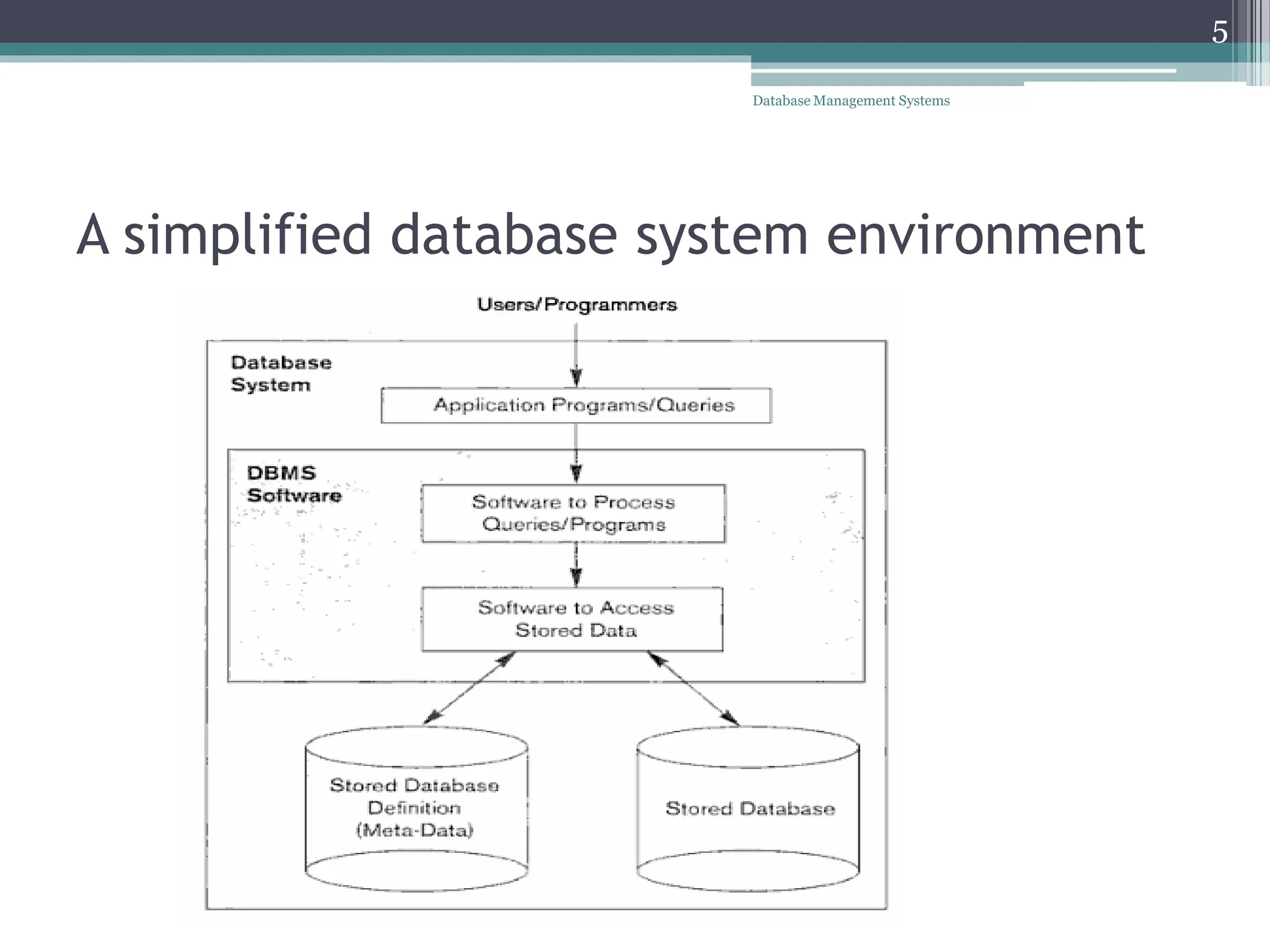
• Database System: The DBMS software
together with the data itself. Sometimes, the
applications are also included.
4
Database Management Systems
A simplified database system environment
5
Database Management Systems
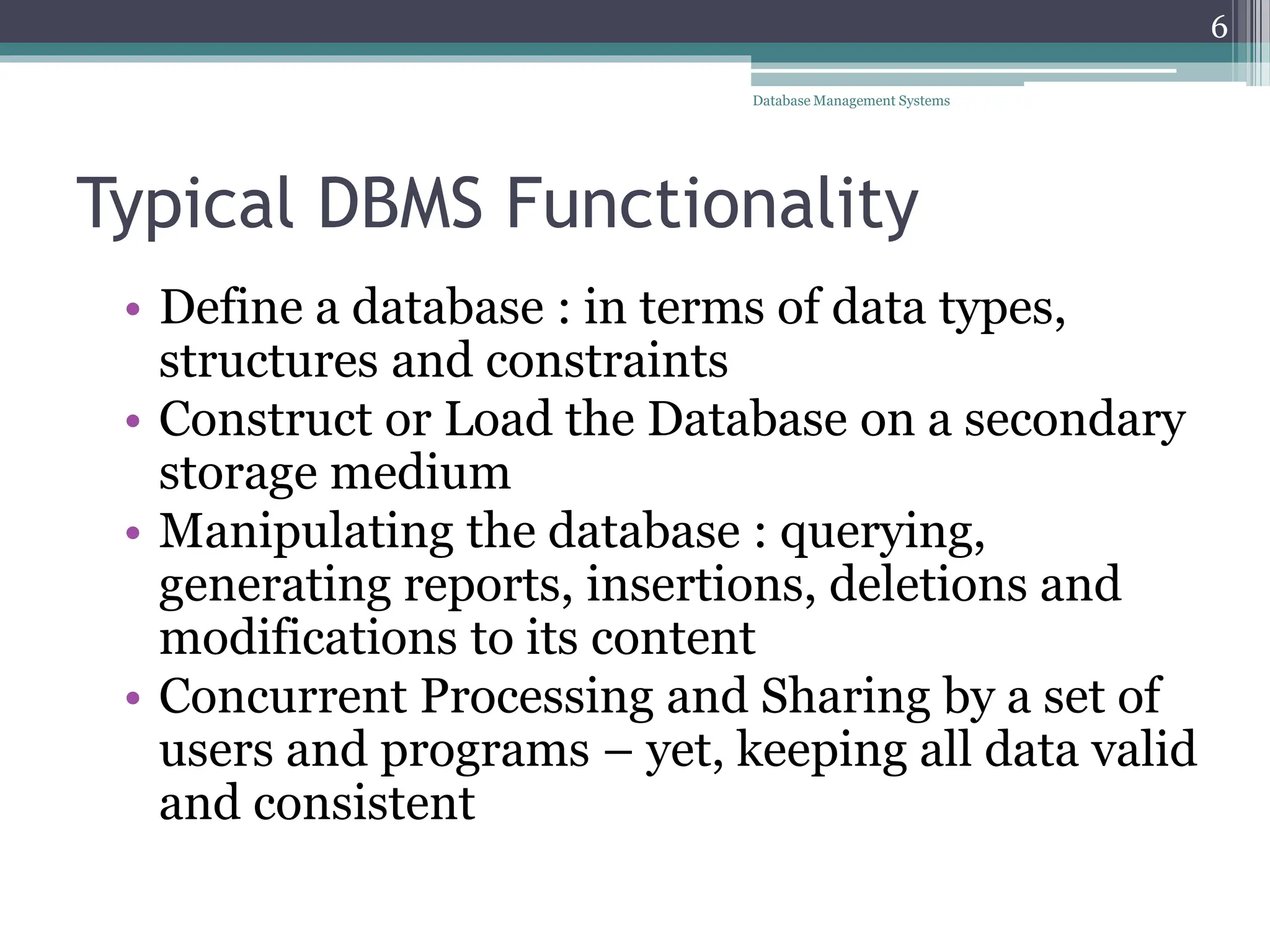
Typical DBMS Functionality
• Define a database : in terms of data types,
structures and constraints
• Construct or Load the Database on a secondary
storage medium
• Manipulating the database : querying,
generating reports, insertions, deletions and
modifications to its content
• Concurrent Processing and Sharing by a set of
users and programs – yet, keeping all data valid
and consistent
6
Database Management Systems
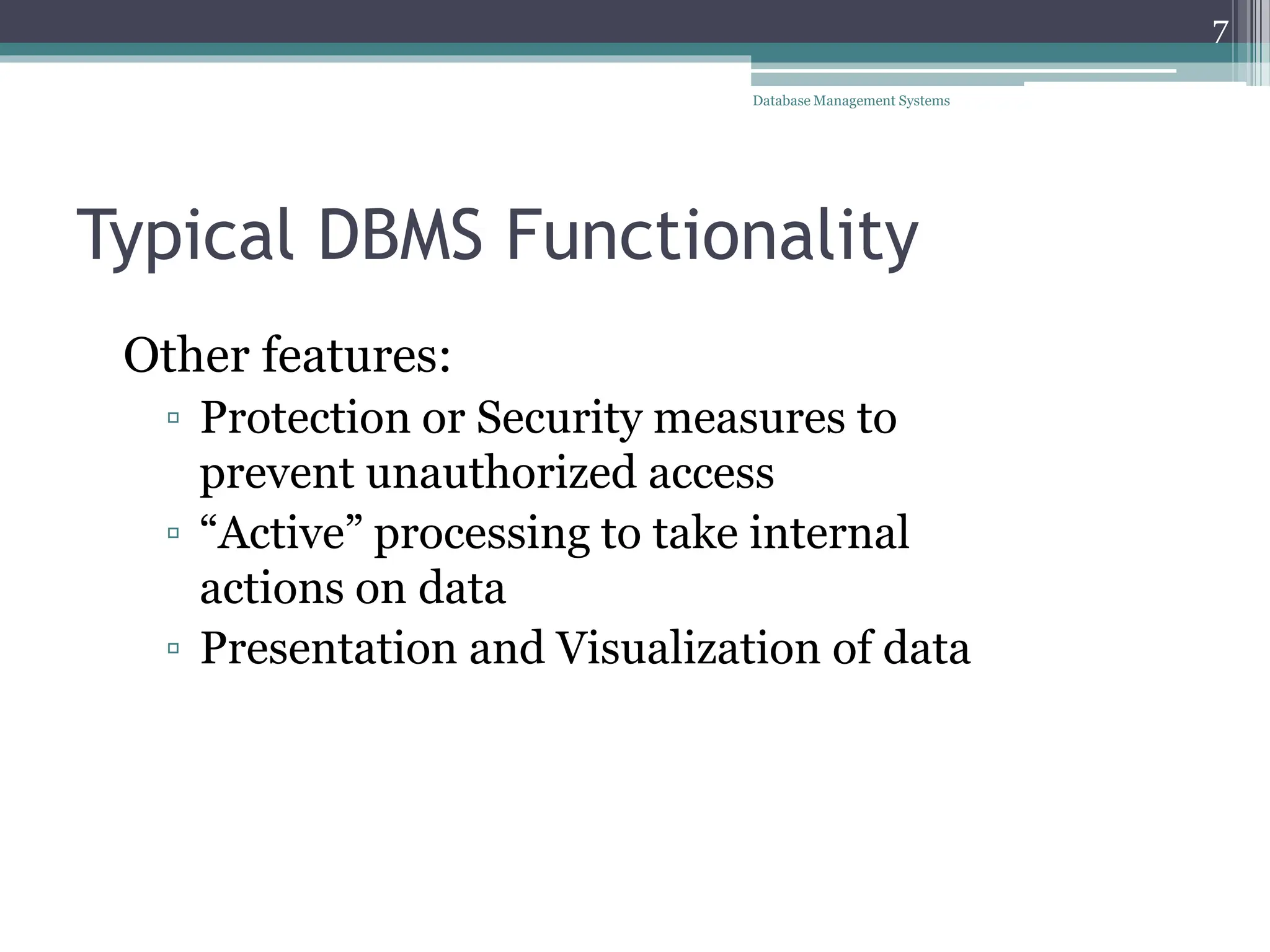
Typical DBMS Functionality
Other features:
▫ Protection or Security measures to
prevent unauthorized access
▫ “Active” processing to take internal
actions on data
▫ Presentation and Visualization of data
7
Database Management Systems
Example of a Database
(with a Conceptual Data Model)
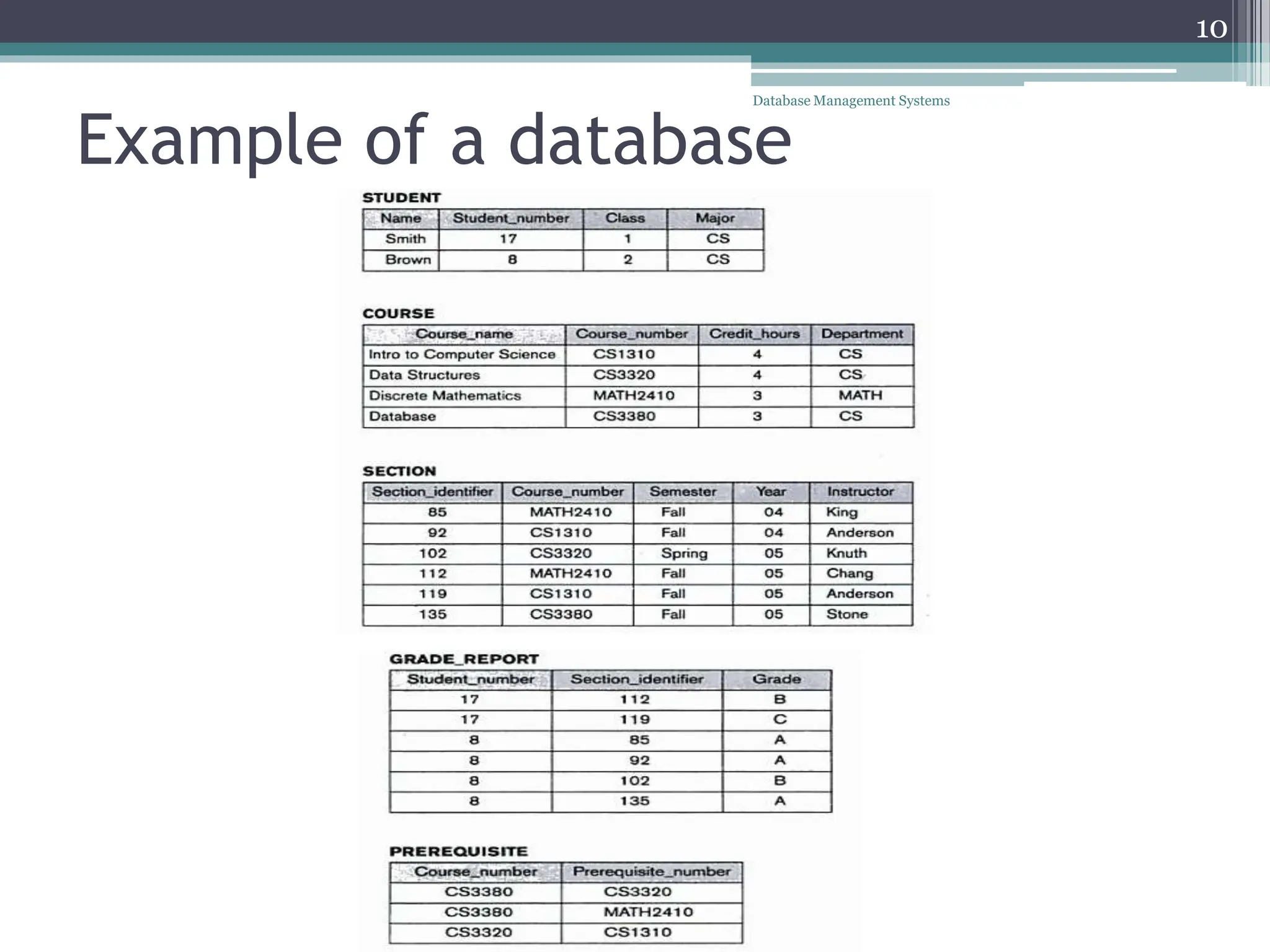
• Mini-world for the example: Part of a
UNIVERSITY environment.
• Some mini-world entities:
▫ STUDENTs
▫ COURSEs
▫ SECTIONs (of COURSEs)
▫ (academic) DEPARTMENTs
▫ INSTRUCTORs
Note: The above could be expressed in the
ENTITY-RELATIONSHIP data model.
8
Database Management Systems
Example of a Database
(with a Conceptual Data Model)
• Some mini-world relationships:
▫ SECTIONs are of specific COURSEs
▫ STUDENTs take SECTIONs
▫ COURSEs have prerequisite COURSEs
▫ INSTRUCTORs teach SECTIONs
▫ COURSEs are offered by DEPARTMENTs
▫ STUDENTs major in DEPARTMENTs
Note: The above could be expressed in the
ENTITY-RELATIONSHIP data model.
9
Database Management Systems
Example of a database
10
Database Management Systems
Main Characteristics of the Database
Approach
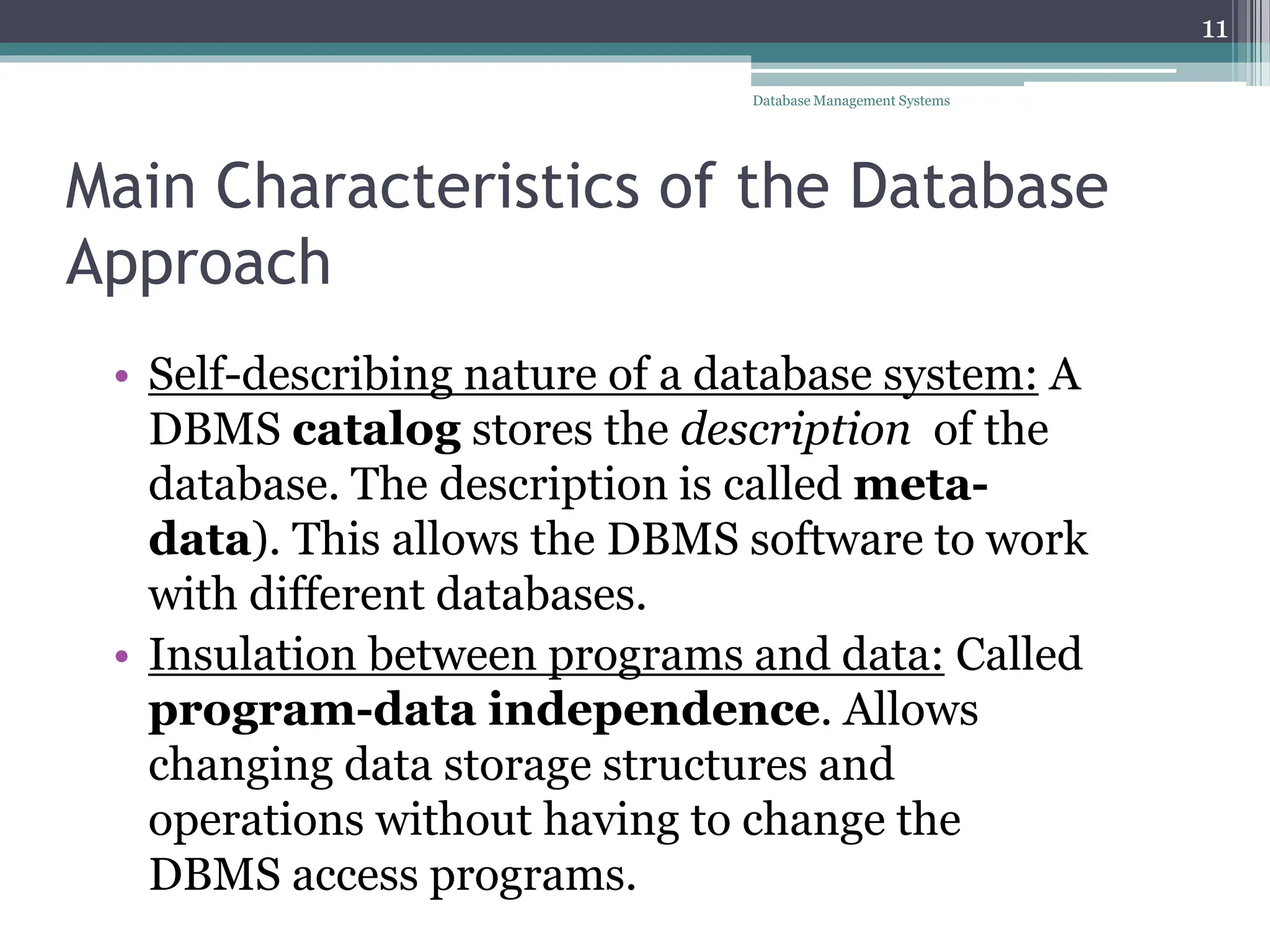
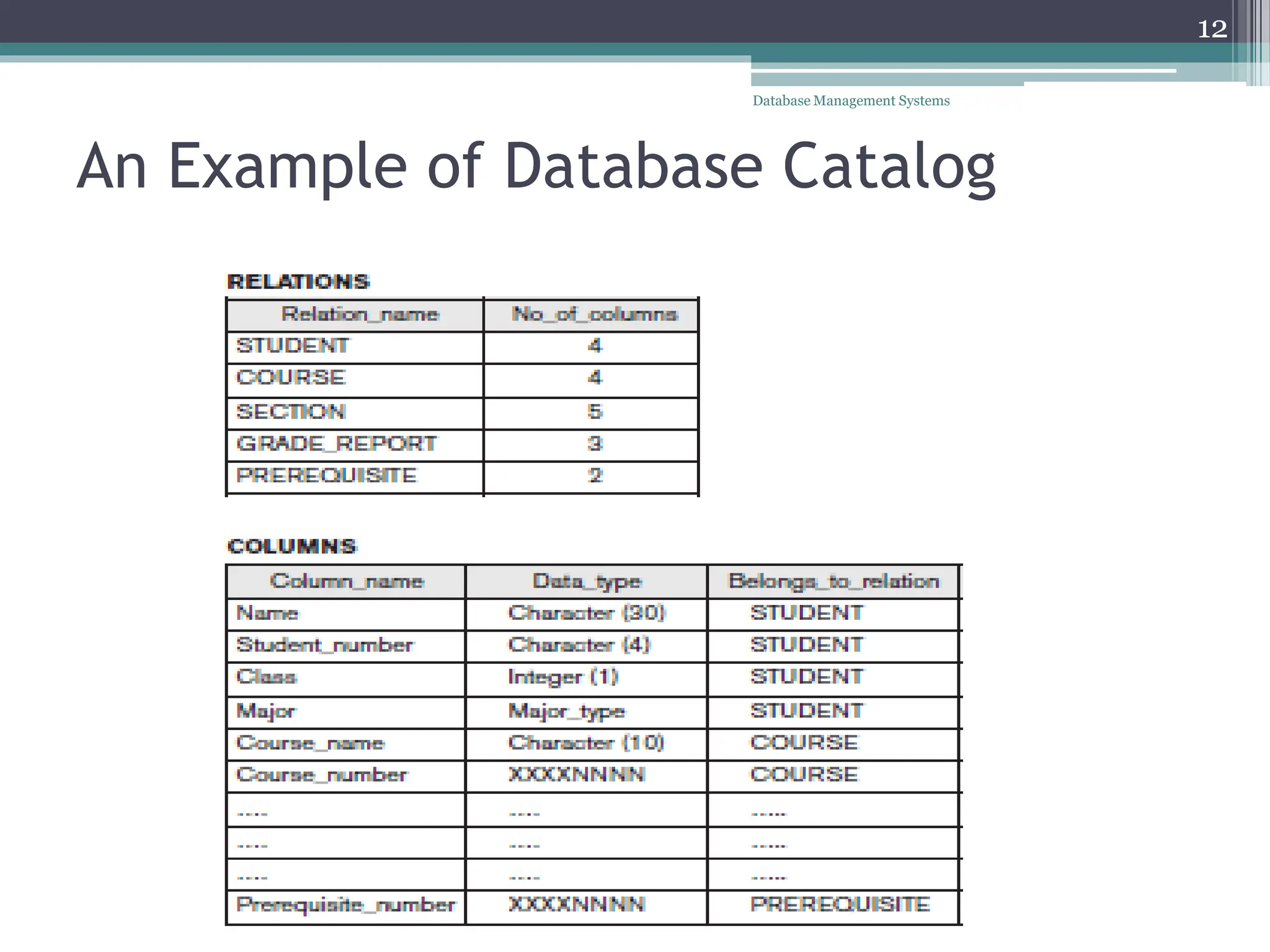
• Self-describing nature of a database system: A
DBMS catalog stores the description of the
database. The description is called meta-
data). This allows the DBMS software to work
with different databases.
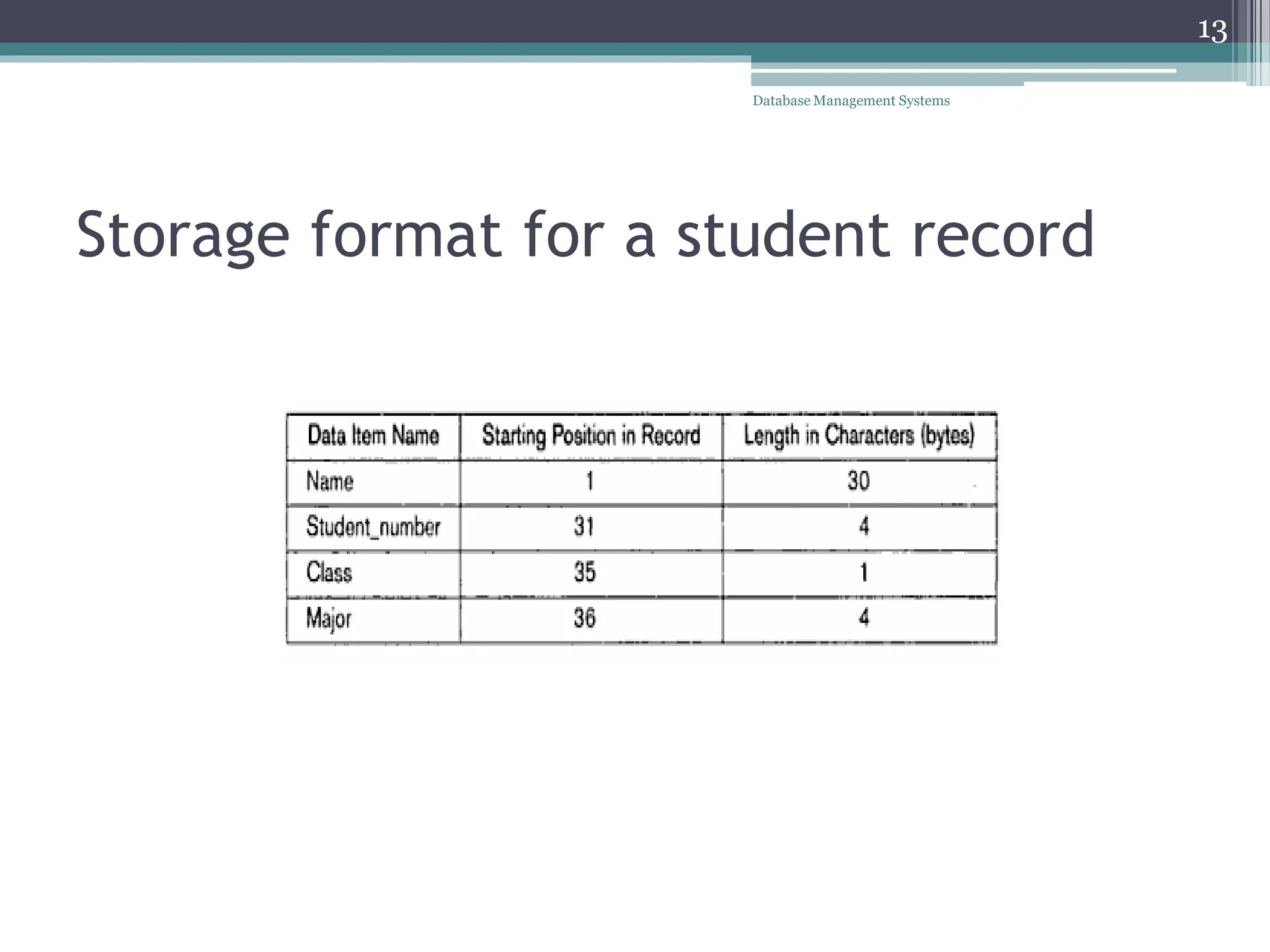
• Insulation between programs and data: Called
program-data independence. Allows
changing data storage structures and
operations without having to change the
DBMS access programs.
11
Database Management Systems
12
Database Management Systems
An Example of Database Catalog
Storage format for a student record
13
Database Management Systems
Main Characteristics of the Database
Approach
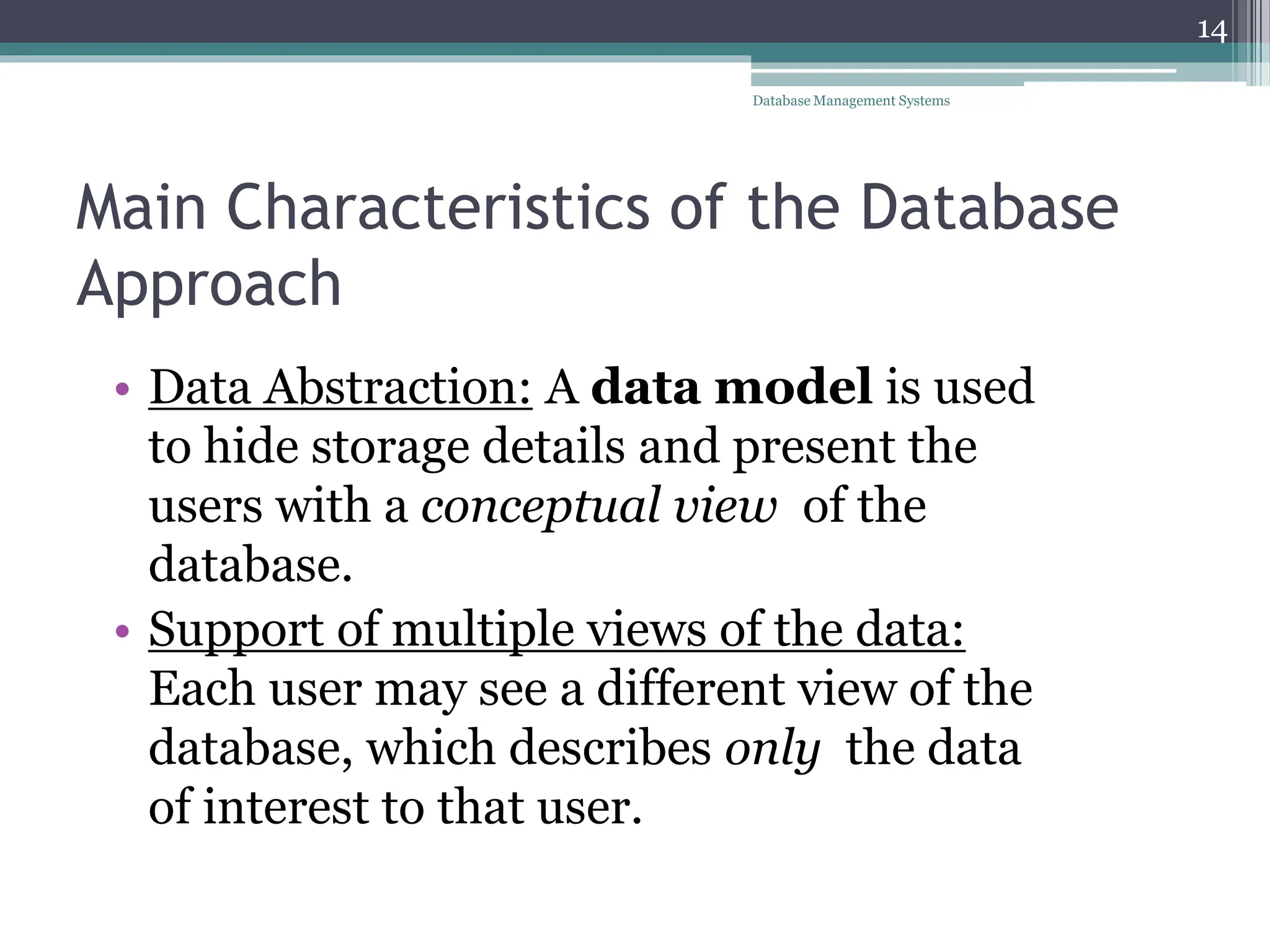
• Data Abstraction: A data model is used
to hide storage details and present the
users with a conceptual view of the
database.
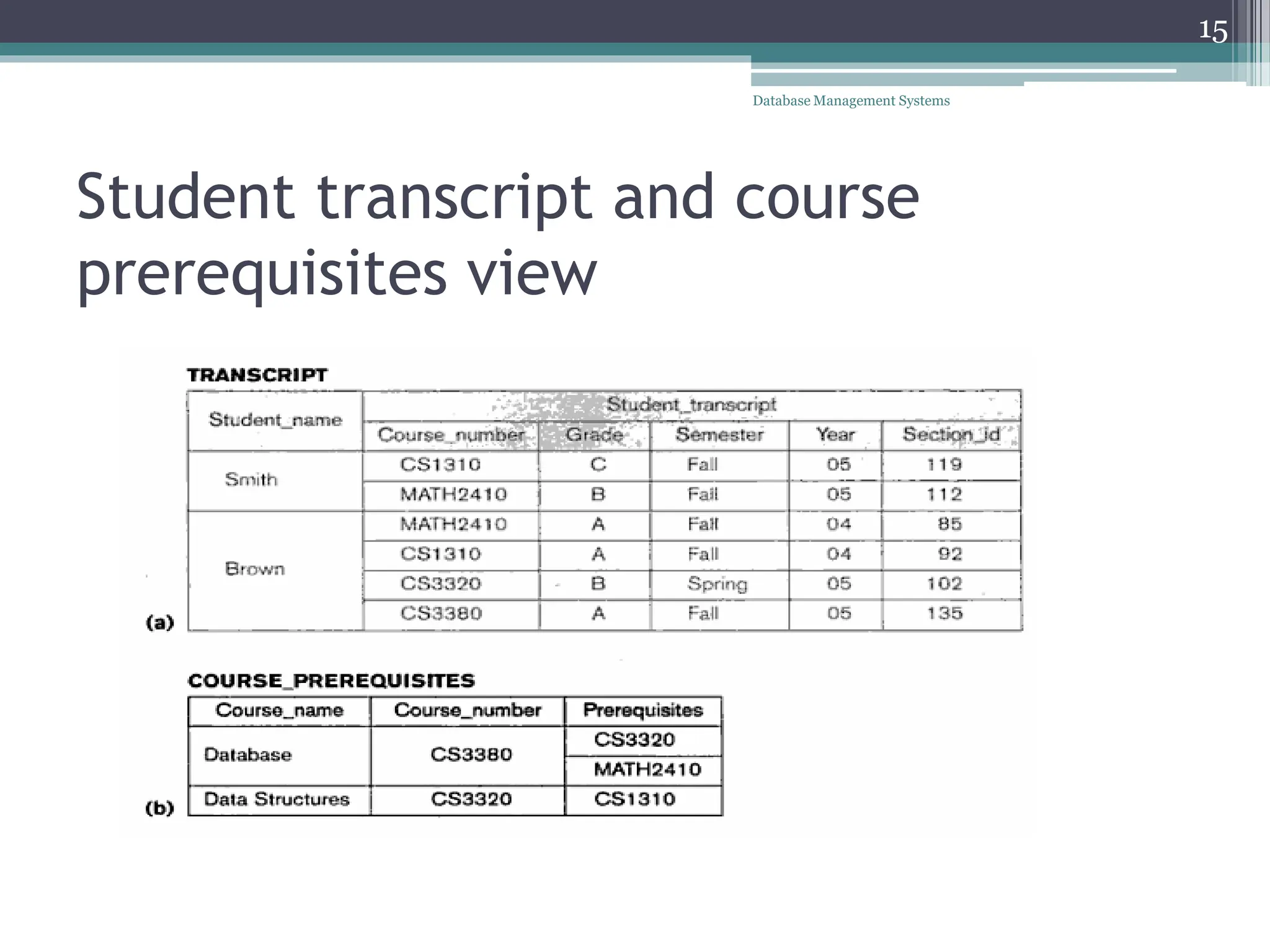
• Support of multiple views of the data:
Each user may see a different view of the
database, which describes only the data
of interest to that user.
14
Database Management Systems
Student transcript and course
prerequisites view
15
Database Management Systems
Main Characteristics of the Database
Approach
• Sharing of data and multiuser transaction
processing : allowing a set of concurrent users
to retrieve and to update the database.
Concurrency control within the DBMS
guarantees that each transaction is
correctly executed or completely aborted.
OLTP (Online Transaction Processing) is a
major part of database applications.
16
Database Management Systems
Summary
• Introduction
• Basic definitions
▫ Database
▫ Data
▫ Mini world
▫ DBMS
▫ Database systems
• An example database
• Functionalities of database systems
• Characteristics of database systems
Database Management Systems
17

Data base chapter 1 | the complete note of database

  • 1.
    Database Systems Introduction DatabaseManagement Systems 1 Lecture 1
  • 2.
    Today’s agenda • Databaseintroduction and definition • DBMS functionalities • Characteristics of database approach 2 Database Management Systems
  • 3.
    Database definition • Ashared collection of logically related data, designed to meet the information needs of multiple users in an organization. • The term database is often erroneously referred to as a synonym for a “database management system (DBMS)”. 3 Database Management Systems
  • 4.
    Basic Definitions • Database:A collection of related data. • Data: Known facts that can be recorded and have an implicit meaning. • Mini-world: Some part of the real world about which data is stored in a database. For example, student grades and transcripts at a university. • Database Management System (DBMS): A software package/ system to facilitate the creation and maintenance of a computerized database. • Database System: The DBMS software together with the data itself. Sometimes, the applications are also included. 4 Database Management Systems
  • 5.
    A simplified databasesystem environment 5 Database Management Systems
  • 6.
    Typical DBMS Functionality •Define a database : in terms of data types, structures and constraints • Construct or Load the Database on a secondary storage medium • Manipulating the database : querying, generating reports, insertions, deletions and modifications to its content • Concurrent Processing and Sharing by a set of users and programs – yet, keeping all data valid and consistent 6 Database Management Systems
  • 7.
    Typical DBMS Functionality Otherfeatures: ▫ Protection or Security measures to prevent unauthorized access ▫ “Active” processing to take internal actions on data ▫ Presentation and Visualization of data 7 Database Management Systems
  • 8.
    Example of aDatabase (with a Conceptual Data Model) • Mini-world for the example: Part of a UNIVERSITY environment. • Some mini-world entities: ▫ STUDENTs ▫ COURSEs ▫ SECTIONs (of COURSEs) ▫ (academic) DEPARTMENTs ▫ INSTRUCTORs Note: The above could be expressed in the ENTITY-RELATIONSHIP data model. 8 Database Management Systems
  • 9.
    Example of aDatabase (with a Conceptual Data Model) • Some mini-world relationships: ▫ SECTIONs are of specific COURSEs ▫ STUDENTs take SECTIONs ▫ COURSEs have prerequisite COURSEs ▫ INSTRUCTORs teach SECTIONs ▫ COURSEs are offered by DEPARTMENTs ▫ STUDENTs major in DEPARTMENTs Note: The above could be expressed in the ENTITY-RELATIONSHIP data model. 9 Database Management Systems
  • 10.
    Example of adatabase 10 Database Management Systems
  • 11.
    Main Characteristics ofthe Database Approach • Self-describing nature of a database system: A DBMS catalog stores the description of the database. The description is called meta- data). This allows the DBMS software to work with different databases. • Insulation between programs and data: Called program-data independence. Allows changing data storage structures and operations without having to change the DBMS access programs. 11 Database Management Systems
  • 12.
    12 Database Management Systems AnExample of Database Catalog
  • 13.
    Storage format fora student record 13 Database Management Systems
  • 14.
    Main Characteristics ofthe Database Approach • Data Abstraction: A data model is used to hide storage details and present the users with a conceptual view of the database. • Support of multiple views of the data: Each user may see a different view of the database, which describes only the data of interest to that user. 14 Database Management Systems
  • 15.
    Student transcript andcourse prerequisites view 15 Database Management Systems
  • 16.
    Main Characteristics ofthe Database Approach • Sharing of data and multiuser transaction processing : allowing a set of concurrent users to retrieve and to update the database. Concurrency control within the DBMS guarantees that each transaction is correctly executed or completely aborted. OLTP (Online Transaction Processing) is a major part of database applications. 16 Database Management Systems
  • 17.
    Summary • Introduction • Basicdefinitions ▫ Database ▫ Data ▫ Mini world ▫ DBMS ▫ Database systems • An example database • Functionalities of database systems • Characteristics of database systems Database Management Systems 17