WRA 420 Class — 04.02.07 ON DATA ANALYSIS  FOR THE  DYSLEXIA USABILITY PROJECT
Terminology •  DATA —> verifiable and replicable facts collected in a research study; the “evidence” that everyone shares - integrity of data set is important - ethics of protecting rights and privacy of participants is important •  QUALITATIVE RESEARCH —> based primarily on observations, interviews, descriptions, and non-quantitative forms of data (e.g., words, pictures)
Terminology •  DATA is a plural word! (though often treated as collective singular noun) … — > “The data collected in this study SHOW that …” — > “Our collected data IS stored in the usability lab.”  •  DATUM is, strictly speaking, the singular form — but it is seldom used
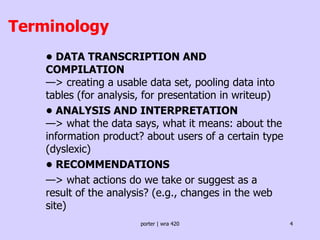
Terminology •  DATA TRANSCRIPTION AND COMPILATION  —> creating a usable data set, pooling data into tables (for analysis, for presentation in writeup) •  ANALYSIS AND INTERPRETATION  —> what the data says, what it means: about the information product? about users of a certain type (dyslexic) •  RECOMMENDATIONS — > what actions do we take or suggest as a result of the analysis? (e.g., changes in the web site)
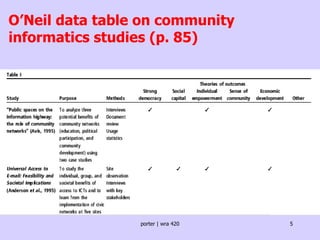
O’Neil data table on community informatics studies (p. 85)
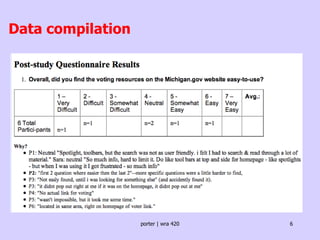
Data compilation
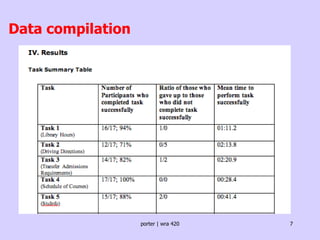
Data compilation
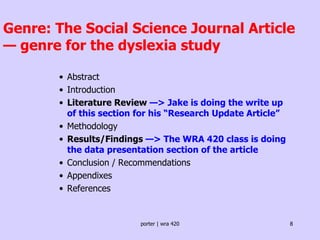
Genre: The Social Science Journal Article — genre for the dyslexia study Abstract Introduction Literature Review  —> Jake is doing the write up of this section for his “Research Update Article”  Methodology Results/Findings  —> The WRA 420 class is doing the data presentation section of the article Conclusion / Recommendations Appendixes References
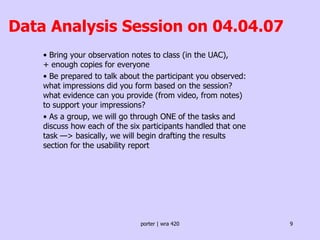
Data Analysis Session on 04.04.07 •  Bring your observation notes to class (in the UAC),  + enough copies for everyone •  Be prepared to talk about the participant you observed: what impressions did you form based on the session? what evidence can you provide (from video, from notes) to support your impressions?  •  As a group, we will go through ONE of the tasks and discuss how each of the six participants handled that one task —> basically, we will begin drafting the results section for the usability report
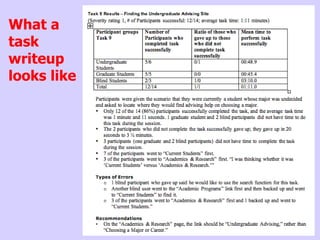
What a task writeup looks like

Data Analysis Presentation

  • 1.
    WRA 420 Class— 04.02.07 ON DATA ANALYSIS FOR THE DYSLEXIA USABILITY PROJECT
  • 2.
    Terminology • DATA —> verifiable and replicable facts collected in a research study; the “evidence” that everyone shares - integrity of data set is important - ethics of protecting rights and privacy of participants is important • QUALITATIVE RESEARCH —> based primarily on observations, interviews, descriptions, and non-quantitative forms of data (e.g., words, pictures)
  • 3.
    Terminology • DATA is a plural word! (though often treated as collective singular noun) … — > “The data collected in this study SHOW that …” — > “Our collected data IS stored in the usability lab.” • DATUM is, strictly speaking, the singular form — but it is seldom used
  • 4.
    Terminology • DATA TRANSCRIPTION AND COMPILATION —> creating a usable data set, pooling data into tables (for analysis, for presentation in writeup) • ANALYSIS AND INTERPRETATION —> what the data says, what it means: about the information product? about users of a certain type (dyslexic) • RECOMMENDATIONS — > what actions do we take or suggest as a result of the analysis? (e.g., changes in the web site)
  • 5.
    O’Neil data tableon community informatics studies (p. 85)
  • 6.
  • 7.
  • 8.
    Genre: The SocialScience Journal Article — genre for the dyslexia study Abstract Introduction Literature Review —> Jake is doing the write up of this section for his “Research Update Article” Methodology Results/Findings —> The WRA 420 class is doing the data presentation section of the article Conclusion / Recommendations Appendixes References
  • 9.
    Data Analysis Sessionon 04.04.07 • Bring your observation notes to class (in the UAC), + enough copies for everyone • Be prepared to talk about the participant you observed: what impressions did you form based on the session? what evidence can you provide (from video, from notes) to support your impressions? • As a group, we will go through ONE of the tasks and discuss how each of the six participants handled that one task —> basically, we will begin drafting the results section for the usability report
  • 10.
    What a taskwriteup looks like