Chapter 2 Hazards - Biological, Chemical, Physical
Objective Awareness of: Biological hazards Chemical hazards Physical hazards Characteristics of certain microorganisms
Hazard A biological, chemical or physical agent that is reasonably likely to cause illness or injury in the absence of its control
Hazards In HACCP, “hazards” refer to conditions or contaminants in foods that can cause illness or injury. It does not refer to undesirable conditions or contaminants such as: Insects Hair Filth Spoilage Economic fraud and Violations of regulatory food standards not directly related to safety
Hazards Biological Chemical Physical
Biological Hazards Microorganisms Yeast Mold Bacteria Viruses Protozoa Parasitic worms
Microorganisms Microorganisms can be beneficial, even essential Some microorganisms can be pathogenic. It is this class that concerns food processors and public health officials
What do microorganisms (other than viruses) need? Food Water Proper temperature Air, no air, minimal air
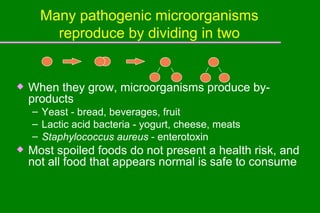
Many pathogenic microorganisms reproduce by dividing in two When they grow, microorganisms produce by-products Yeast - bread, beverages, fruit Lactic acid bacteria - yogurt, cheese, meats Staphylococcus aureus  - enterotoxin Most spoiled foods do not present a health risk, and not all food that appears normal is safe to consume
Spoilage or Decomposition Food spoilage or decomposition that can result in a food safety problem should be prevented or controlled by a HACCP program
Microbiological hazards include harmful: Bacteria Viruses, and Protozoa
Bacterial Hazards Food infection and food intoxication Sporeforming and nonsporeforming bacteria
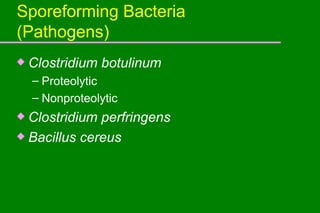
Sporeforming Bacteria (Pathogens) Clostridium botulinum Proteolytic Nonproteolytic Clostridium perfringens Bacillus cereus
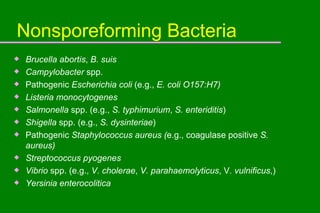
Nonsporeforming Bacteria Brucella abortis ,  B. suis Campylobacter  spp. Pathogenic  Escherichia coli  (e.g.,  E. coli O157:H7) Listeria monocytogenes Salmonella  spp. (e.g.,  S. typhimurium ,  S. enteriditis ) Shigella  spp. (e.g.,  S. dysinteriae ) Pathogenic  Staphylococcus aureus ( e.g., coagulase positive  S. aureus) Streptococcus pyogenes Vibrio  spp. (e.g.,  V. cholerae ,  V. parahaemolyticus , V . vulnificus ,) Yersinia enterocolitica
Hazards from Viruses in Foods What are viruses? Where do they come from? How do they reproduce? How can they be controlled? What are some examples? (Table A)
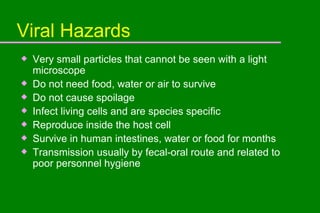
Viral Hazards Very small particles that cannot be seen with a light microscope Do not need food, water or air to survive Do not cause spoilage Infect living cells and are species specific Reproduce inside the host cell Survive in human intestines, water or food for months Transmission usually by fecal-oral route and related to poor personnel hygiene
Parasites in Foods Parasites are organisms that need a host to survive Thousands of kinds exist worldwide, but only about 100 types are known to infect people through food contamination Two types of concern from food or water: Parasitic worms [e.g., roundworms (nematodes), tapeworms (cestodes), flukes (trematodes)] Protozoa Role of fecal material in transmission of parasites
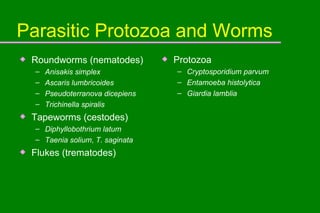
Parasitic Protozoa and Worms Roundworms (nematodes) Anisakis simplex Ascaris lumbricoides  Pseudoterranova dicepiens Trichinella spiralis   Tapeworms (cestodes) Diphyllobothrium latum Taenia solium ,  T. saginata Flukes (trematodes) Protozoa Cryptosporidium parvum Entamoeba histolytica  Giardia lamblia
Chemical Hazards Naturally Occurring Intentionally added Unintentionally added
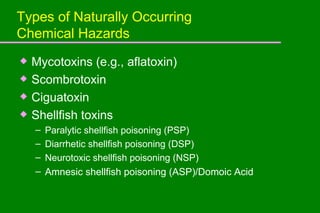
Types of Naturally Occurring  Chemical Hazards Mycotoxins (e.g., aflatoxin) Scombrotoxin Ciguatoxin Shellfish toxins Paralytic shellfish poisoning (PSP) Diarrhetic shellfish poisoning (DSP) Neurotoxic shellfish poisoning (NSP) Amnesic shellfish poisoning (ASP)/Domoic Acid
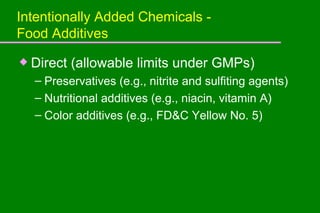
Intentionally Added Chemicals -  Food Additives Direct (allowable limits under GMPs) Preservatives (e.g., nitrite and sulfiting agents) Nutritional additives (e.g., niacin, vitamin A) Color additives (e.g., FD&C Yellow No. 5)
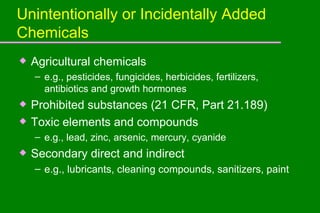
Unintentionally or Incidentally Added Chemicals Agricultural chemicals  e.g., pesticides, fungicides, herbicides, fertilizers, antibiotics and growth hormones Prohibited substances (21 CFR, Part 21.189) Toxic elements and compounds  e.g., lead, zinc, arsenic, mercury, cyanide Secondary direct and indirect e.g., lubricants, cleaning compounds, sanitizers, paint
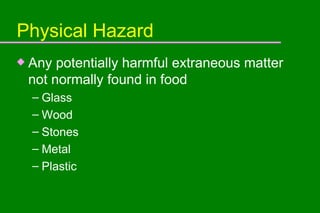
Physical Hazard Any potentially harmful extraneous matter not normally found in food Glass Wood Stones Metal Plastic
 

dasd

  • 1.
    Chapter 2 Hazards- Biological, Chemical, Physical
  • 2.
    Objective Awareness of:Biological hazards Chemical hazards Physical hazards Characteristics of certain microorganisms
  • 3.
    Hazard A biological,chemical or physical agent that is reasonably likely to cause illness or injury in the absence of its control
  • 4.
    Hazards In HACCP,“hazards” refer to conditions or contaminants in foods that can cause illness or injury. It does not refer to undesirable conditions or contaminants such as: Insects Hair Filth Spoilage Economic fraud and Violations of regulatory food standards not directly related to safety
  • 5.
  • 6.
    Biological Hazards MicroorganismsYeast Mold Bacteria Viruses Protozoa Parasitic worms
  • 7.
    Microorganisms Microorganisms canbe beneficial, even essential Some microorganisms can be pathogenic. It is this class that concerns food processors and public health officials
  • 8.
    What do microorganisms(other than viruses) need? Food Water Proper temperature Air, no air, minimal air
  • 9.
    Many pathogenic microorganismsreproduce by dividing in two When they grow, microorganisms produce by-products Yeast - bread, beverages, fruit Lactic acid bacteria - yogurt, cheese, meats Staphylococcus aureus - enterotoxin Most spoiled foods do not present a health risk, and not all food that appears normal is safe to consume
  • 10.
    Spoilage or DecompositionFood spoilage or decomposition that can result in a food safety problem should be prevented or controlled by a HACCP program
  • 11.
    Microbiological hazards includeharmful: Bacteria Viruses, and Protozoa
  • 12.
    Bacterial Hazards Foodinfection and food intoxication Sporeforming and nonsporeforming bacteria
  • 13.
    Sporeforming Bacteria (Pathogens)Clostridium botulinum Proteolytic Nonproteolytic Clostridium perfringens Bacillus cereus
  • 14.
    Nonsporeforming Bacteria Brucellaabortis , B. suis Campylobacter spp. Pathogenic Escherichia coli (e.g., E. coli O157:H7) Listeria monocytogenes Salmonella spp. (e.g., S. typhimurium , S. enteriditis ) Shigella spp. (e.g., S. dysinteriae ) Pathogenic Staphylococcus aureus ( e.g., coagulase positive S. aureus) Streptococcus pyogenes Vibrio spp. (e.g., V. cholerae , V. parahaemolyticus , V . vulnificus ,) Yersinia enterocolitica
  • 15.
    Hazards from Virusesin Foods What are viruses? Where do they come from? How do they reproduce? How can they be controlled? What are some examples? (Table A)
  • 16.
    Viral Hazards Verysmall particles that cannot be seen with a light microscope Do not need food, water or air to survive Do not cause spoilage Infect living cells and are species specific Reproduce inside the host cell Survive in human intestines, water or food for months Transmission usually by fecal-oral route and related to poor personnel hygiene
  • 17.
    Parasites in FoodsParasites are organisms that need a host to survive Thousands of kinds exist worldwide, but only about 100 types are known to infect people through food contamination Two types of concern from food or water: Parasitic worms [e.g., roundworms (nematodes), tapeworms (cestodes), flukes (trematodes)] Protozoa Role of fecal material in transmission of parasites
  • 18.
    Parasitic Protozoa andWorms Roundworms (nematodes) Anisakis simplex Ascaris lumbricoides Pseudoterranova dicepiens Trichinella spiralis Tapeworms (cestodes) Diphyllobothrium latum Taenia solium , T. saginata Flukes (trematodes) Protozoa Cryptosporidium parvum Entamoeba histolytica Giardia lamblia
  • 19.
    Chemical Hazards NaturallyOccurring Intentionally added Unintentionally added
  • 20.
    Types of NaturallyOccurring Chemical Hazards Mycotoxins (e.g., aflatoxin) Scombrotoxin Ciguatoxin Shellfish toxins Paralytic shellfish poisoning (PSP) Diarrhetic shellfish poisoning (DSP) Neurotoxic shellfish poisoning (NSP) Amnesic shellfish poisoning (ASP)/Domoic Acid
  • 21.
    Intentionally Added Chemicals- Food Additives Direct (allowable limits under GMPs) Preservatives (e.g., nitrite and sulfiting agents) Nutritional additives (e.g., niacin, vitamin A) Color additives (e.g., FD&C Yellow No. 5)
  • 22.
    Unintentionally or IncidentallyAdded Chemicals Agricultural chemicals e.g., pesticides, fungicides, herbicides, fertilizers, antibiotics and growth hormones Prohibited substances (21 CFR, Part 21.189) Toxic elements and compounds e.g., lead, zinc, arsenic, mercury, cyanide Secondary direct and indirect e.g., lubricants, cleaning compounds, sanitizers, paint
  • 23.
    Physical Hazard Anypotentially harmful extraneous matter not normally found in food Glass Wood Stones Metal Plastic
  • 24.