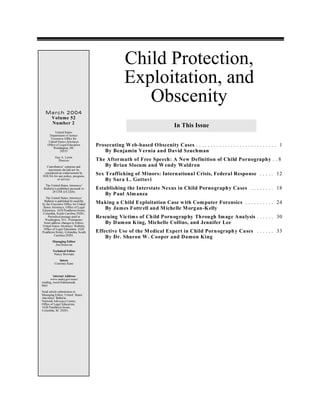
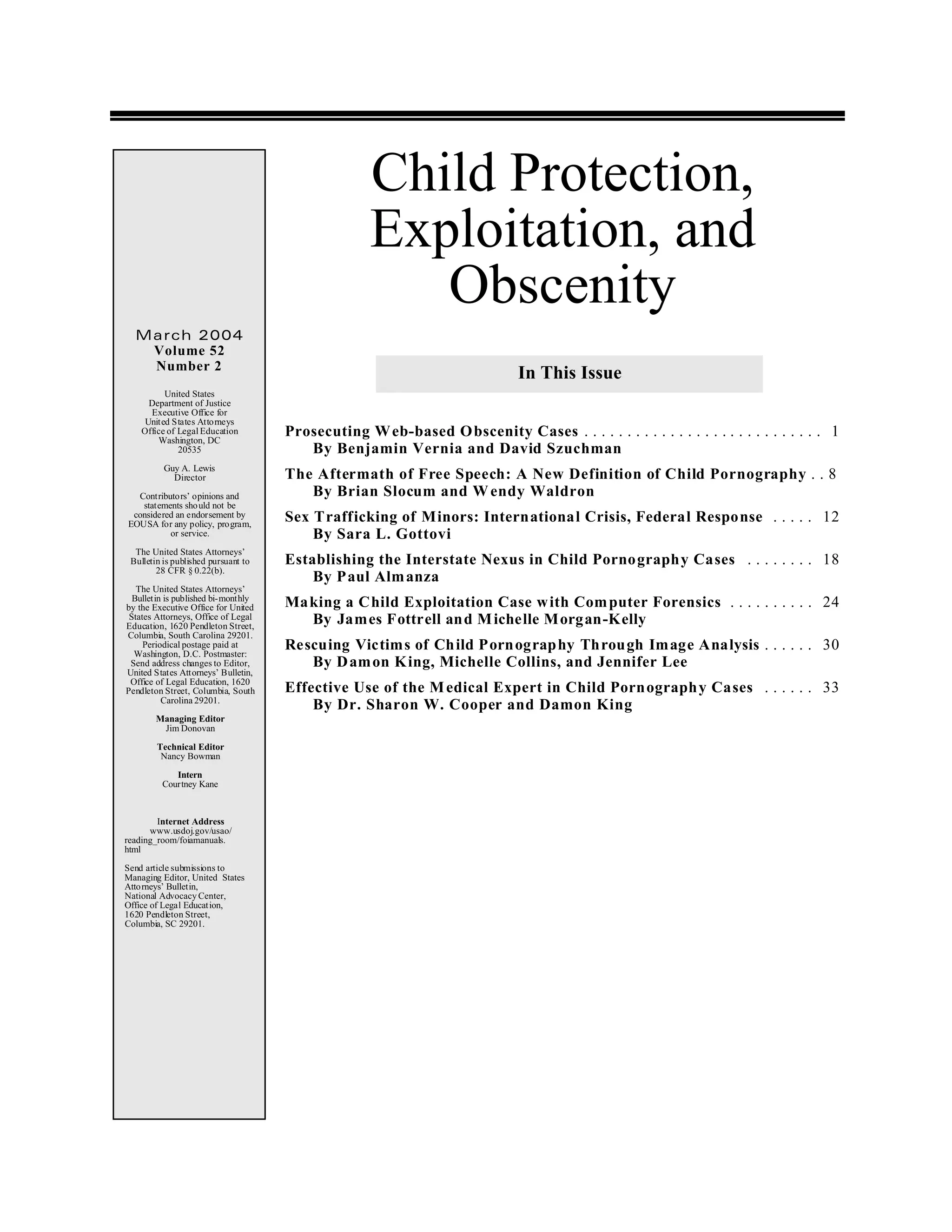
Child Protection,
                                                   Exploitation, and
                                                      Obscenity
  March 2004
   Volume 52
   Number 2
                                                                             In This Issue
          United States
      Department of Justice
      Executive Office for
     United States Attorneys
    Office of Legal Education
        Washington, DC
                                     Prosecuting W eb-based O bscenity Cases . . . . . . . . . . . . . . . . . . . . . . . . . . . . 1
              20535                     By Benjamin Vernia and David Szuchman
          Guy A. Lewis
            Director                 The Aftermath of Free Speech: A New Definition of Child Pornography . . 8
  Contributors’ opinions and            By Brian Slocum and W endy Waldron
   statements should not be
 considered an endorsement by
EOUSA for any policy, program,
                                     Sex Trafficking of Minors: International Crisis, Federal Response . . . . . 12
          or service.                    By Sara L. Gottovi
  The United States Attorneys’
 Bulletin is published pursuant to   Establishing the Interstate Nexus in Child Porno graphy Cases . . . . . . . . 18
        28 CFR § 0.22(b).
                                         By Paul Alm anza
   The United States Attorneys’
  Bulletin is published bi-monthly
by the Executive Office for United   Ma king a Child Exploitation Case w ith Com puter Forensics . . . . . . . . . . 24
 States Attorneys, Office of Legal      By James Fottrell and M ichelle M organ-Kelly
Education, 1620 Pendleton Street,
Columbia, South Carolina 29201.
     Periodical postage paid at
  Washington, D.C. Postmaster:
                                     Rescuing Victims of Ch ild Porn ograp hy Throu gh Im age Analysis . . . . . . 30
 Send address changes to Editor,        By D am on K ing, Michelle Collins, and Jennifer Lee
United States Attorneys’ Bulletin,
 Office of Legal Education, 1620
Pendleton Street, Columbia, South    Effective Use of the M edical Expert in Child Porn ograph y Cases . . . . . . 33
          Carolina 29201.
                                         By Dr. Sharon W. Cooper and Damon King
        Managing Editor
         Jim Donovan
        Technical Editor
         Nancy Bowman

            Intern
         Courtney Kane


        Internet Address
      www.usdoj.gov/usao/
reading_room/foiamanuals.
html
Send article submissions to
Managing Editor, United States
Atto rneys’ Bulletin,
National Advocacy Center,
Office of Legal Educat ion,
1620 Pendleton Street,
Columbia, SC 29201.
Prosecuting Web-based Obscenity
Cases
Benjamin Vernia                                                       Internet is used to commit the offense.
Trial Attorney                                                        Additionally, existing obscenity laws, once
Child Exploitation and Obscenity Section                              developed to address brick-and-mortar retailers,
Criminal Division                                                     apply equally well to retailers in cyberspace. The
                                                                      recen t addition of new legal tools by Congress to
                                                                      specifically target Internet-based offenders
David Szuchman                                                        complement those existing laws nicely.
Trial Attorney
Child Exploitation and Obscenity Section                              II. Overview of the bu siness
Criminal Division                                                          Pornographic Web sites can be classified
                                                                      generally by their content and manner of
I. Introduction                                                       conducting business. In terms of content, Web
     The pornography industry has capitalized on                      sites may offer explicit heterosexual or
the growth and popularity of the Internet, and                        homosexual conduct, or may specialize in a fetish
particularly the World W ide Web, as have few                         which appeals to a small segment of the
other businesses. Although estimates of the                           population. These include "scat" (depicting the
volume of Internet pornography are often                              use of feces or urine in sexual con duct), bestiality,
unreliable, a study from one reputable source                         sadomasochism, necrophilia, and real or simulated
estimates that "adult" online pornography                             rape. Alth ough child pornography, as that term is
generates approximately $1 billion per year in                        defin ed in 18 U.S .C. C hapter 110, is subject to
reven ues, an amount which is expected to grow to                     obscenity laws as well, this article addresses on ly
between $5 and $7 billion by 2007. Y OUTH ,                           "adult" pornographic W eb sites. There is,
P ORNOGRAPHY , AND THE INTERNET , 72 Computer                         how ever, much overlap in the prosecution of child
Science and Telecommunications Board, National                        and adult pornograph y cases.
Research C ouncil (Thornbugh and Lin, eds.                                 Fetish-cen tered Web sites are often small
2002). One of the factors contributing to the                         enterprises, run by one or two individuals (the
explosion of pornography on the Internet is the                       "webm asters"). Typically, the webm asters of these
relative anonymity that the Internet affords to                       sites deal in third or fourth-hand pirated copies of
producers and consumers alike. Equally appealing                      material originally collected for their personal use.
to distributors is the ease and low cost of mass                      Alth ough some non-fetish W eb sites, particularly
distribution afforded by the Internet.                                online video catalog sites, are also "mom-and-
     Opposing these forces are concerned parents,                     pop" operations, they are m ore often part of a
with little or no computer savvy, who lack the                        larger enterprise that includes production
tools to supervise their children's use of the                        operations and parallel retail distribution of their
Internet and exposure to pornography and                              products. These latter organizations are more
obscenity. Often, these same parents are unwilling                    likely to share the features of a legitimate
recipients of "porn spam" themselves. Indeed,                         business, such as operation from a location
offensive m aterial that was once largely                             separate from the webmaster's residence, and the
unavailable to average citizens and children is                       use of a corporate bank account.
now largely unavoidable. Finding obscene                                    Web sites also differ widely in the m anner in
material on the Internet is as easy as a click of the                 which they conduct business. A Web site may be
mouse, and even persons seeking to avoid the                          little more than an online catalog, providing users
material find themselves confronted w ith it. It is                   with a convenient mechanism for ordering
this situation that h as led to the Attorney G eneral's               magazines or videos which the retailer then mails
call for obscenity enforcement. The Internet's                        or ships to the customer. Conversely, a W eb site
porous borders call for federal prosecution.                          may offer only online content, pictures, videos, or
    While the Internet poses m any ch allenges to                     "chat," and charge by the item or through a
obscenity prosecutions, the challenges faced by                       subscription fee. Some Web sites offer only
prosecutors in this area are not very different from                  advertising space to other pornographic W eb sites.
the challenges faced in other areas where the                         Organized as a ranking service of the "best" or


M A R C H 2004                         U N IT E D S T AT E S A T TO R N E YS '   B UL LET IN                               1
most frequently visited Web sites, they perm it                    it illegal to use a misleading domain name to
advertisers to display sexually explicit "banner                   deceive a minor into viewing m aterial that is
ads" that occupy a small portion of the web page.                  harmful. (The Child Obscenity and Exploitation
                                                                   Section (CEOS ) has issued guidance for
     Marketin g and sales practices of pornograph ic               Un ited States A ttorneys' Offices describing this
Web sites also differ widely. Many magazines and                   law and its application, which is available on
video producers have established Web sites as an                   US AB ook).
adjunct to, and sales vehicle for, their hard copy
products. Other Web sites attract business through                      Forfeiture for obscenity cases is covered
the use of "spam" (unsolicited bulk e-mail), or                    under 18 U .S.C . § 1467. Criminal forfeiture is
they may trick cu stomers, including children, into                authorized under this section, but civil forfeiture is
visiting their sites through the use of common                     not. The following is subject to forfeiture under
misspellings of otherw ise inn ocuous dom ain                      § 1467: (1) any obscene material produced,
nam es. Frequ ently, W eb sites place terms likely to              transported, mailed, shipped, or received; (2) any
be entered into search engines (such as                            real or personal prop erty constituting or traceable
Google.com) in "metatags," codes stored in the                     to gross profits or other proceeds; and (3) any real
web page but invisible to the user. These terms                    or personal property that facilitates the offense.
cause the search engines, which periodically index                 Facilitating property is subject to forfeiture if the
Web sites, to falsely identify the pornographic                    court, in its discretion, determines the property
Web site as one responsive to the user's innocuous                 should be forfeited, taking into consideration the
search request.                                                    nature, scope, and proportionality of the use of the
                                                                   property in the offense. Id.
III. Laws app licable to W eb sites
                                                                        It is critical to consider using seizure warrants
     Most of the provisions of 18 U.S.C. Chapter                   and orders to seize bank accounts and funds
71, created in response to the brick-and-mortar                    associated with the illegal enterprise. As in any
obscenity trade, are fully applicable to web-based                 "white collar" investigation, money that is
obscenity cases. Those laws include 18 U.S.C.                      potentially forfeitable should be seized at the time
§§ 1461 (mailing obscene matter), 1462                             of indictment or arrest to avoid potential disposal
(importation or transportation of obscene m atters),               of proceeds of the crime by the target of the
1465 (transportation of obscene matters for sale or                investigation. In addition, if p roperty was used to
distribution), and 1466 (engaging in the business                  facilitate the crime, it should be seized for
of selling or transferring obscene m atter).                       forfeiture pending conviction so that the target
    Numerous prosecutions have been brought                        does not dispose of it. Furthermore, plea
against persons distributing obscenity through                     agreements should address forfeiture where
computers. In United States v. Thomas, 74 F.3d                     possible, including forfeiture of the domain name
701 (6th Cir. 1996), a case involving a                            itself and related ownership interests in and
commercial computer "bulletin board," the Sixth                    related to the Web site, as well as forfeiture of any
Circuit specifically rejected the defendants'                      and all property and equipment used to facilitate
arguments that 18 U.S .C. § 1465 did not apply to                  the offenses.
intangible objects such as compu ter image files,                  IV. Investigating web-based cases
and that C ongress had not intended to regulate
computer transmissions. Subsequent to this                         A. T argets
decision, Congress amended 18 U.S.C. §§ 1462                           Obscene W eb sites are referred for
and 1465 specifically to prohibit the use of an                    prosecution from a variety of sources. These
"interactive computer service" to distribute                       include, among others, citizen complaints
obscenity.                                                         registered with private groups such as
     Congress' frustration with Web sites with                     ObscenityCrimes.org and the National Center for
nam es calculated to m islead Internet users to                    Missing and Exploited Children, or those sent
pornographic Web sites (such as whitehouse.com)                    directly to U.S. Attorneys' Offices. Leads are also
led to the passage of 18 U.S.C. § 2252B in the                     developed by law enforcement and the Criminal
PR OT EC T A ct. This provision, enacted on A pril                 Division's Child Exploitation and Ob scenity
30, 2003, creates two related crimes for the                       Section, and particularly its High Tech
misleading use of a domain name (a W eb site's                     Investigative U nit.
"address" that a user enters into a Web browser).                      It is crucial, early in the investigation, for a
The first criminalizes the knowing use of a                        law enforcement agent to visit the W eb site in
misleading domain name to deceive any person                       question and preserve its publicly-accessible
into viewing obscene material. The second makes                    content using a tool such as Teleport Pro or

2                                     U N IT E D S T AT E S A T TO R N E YS ' B UL LET IN                    M A R C H 2004
Adobe Acrobat. Both programs can create a copy                       those typically availab le at homes and small
of the Web site's Hypertext Markup Language                          businesses.
(HTML) and graphic files, in essence duplicating                          As with W eb sites, ISPs provide Internet
the W eb site on a law enforcement computer's file                   connectivity in many different ways. The two
system. This work should be performed on an                          primary Web site "hosting" models are server
undercover computer with proper backstopping                         leasing and collocation. In server leasing, the ISP
(including the use of an untraceable Internet                        owns the server (a computer with specialized
Protocol, or IP address), and should be carefully                    software for receiving and transmitting web
documented.                                                          pages) and leases it, or a portion of the space
     Identifying the webmaster is the first, and                     available on it, to the webmaster operating the
often , insurmountable h urdle. The Web site's                       Web site. The webmaster typically never even
public registration information is the first source                  sees the server but administers the site from a
to check, because it is free and does not risk                       remote location by logging into the machine over
notifying the webmaster of law enforcement                           the Internet with a password supplied by the ISP.
interest. Typically, a W eb site acquires a domain                   A collocated server is also remotely administered,
name or address, such as "usdoj.gov," through                        but the machine is usually provided by the
private companies, known as registrars, which                        webmaster to the ISP which places the server in
have been delegated the authority to register                        its facility and connects it to power and
unique names for a fee. The information provided                     communication lines.
by the webmaster to the registrar can be retrieved                        Although many ISPs provide web hosting
using an Internet "whois" query available on a                       services to W eb sites regardless of subject m atter,
variety of Web sites, including hexillion.com and                    others specialize in hosting pornography. By
samspade.org.                                                        visiting the ISP's own W eb site, an investigator
     Many pornographic webmasters provide                            may develop a sense for whether the ISP is a
genuine information to the domain name                               large, diverse company, or a specialist. Large
registrars. More devious webmasters, how ever,                       firms are likely to have significant experience in,
can easily provide false information, because the                    and stand ard proced ures for, respon ding to
only verification most registrars undertake is of                    subpoenas and search warrants, and their size and
the credit card used to pay for the service. The                     diversity makes it unlikely that they would inform
practice of providing false or fictitious registration               the webmaster if they are contacted by law
information is likely to increase in frequency as                    enforcement. "Adult" hosting companies, on the
more webmasters are prosecuted for obscenity. If                     other hand, should be approached with suspicion,
the registrar's information on the webmaster is                      and it should be assumed that even informal
false or fictitious, additional investigation may be                 inquiries, as well as compulsory process, will
necessary to make an identification. Despite a                       result in the subject's becoming aware of the
bogus registration, a webmaster may be located by                    investigation.
tracing the webmaster's payment method,                                  Title 18 U.S.C. § 2703(f) provides a means by
typically a check, credit card, or wire transfer, to                 which ISPs can be instructed to preserve the
either the registrar or the Internet service provider                contents of web servers for a period of ninety
(ISP) for the hosting services. Conversely, an                       days, pending the issuance of a search warrant. As
identification may result from tracing the                           with other contacts, however, care should be taken
webmaster's method of receiving payment for                          in determining whether the ISP receiving this
goods or services. For example, checks or credit                     request is likely to notify the subject of the
card accounts used to buy videotapes, DV Ds, or                      investigation.
subscription access to a Web site, can be
examined for information leading to the recipient                         The information provided in these steps is
of the funds.                                                        also significant in determining the appropriate
                                                                     venue for prosecuting the webmaster and for
     When the agent performs the "whois" query to                    opposing a possible motion to transfer. (Venue
identify the webmaster, he or she should also                        issues are discussed in more detail below.) The
perform a "traceroute" query (using the publicly-                    location of the webmaster and the Web site's
available resources provided above) to identify the                  server are two important venues to be considered.
owner of the Web site's IP address. Most                             Identifying the physical location of the server,
pornographic Web sites are operated using the                        however, may require contacting the ISP. Many
facilities of an ISP and are housed at an ISP, in                    ISPs operate server facilities in several cities or
order to obtain communication speeds faster than                     states, and the traceroute information will identify
                                                                     the company, but not the location, where the

M A R C H 2004                        U N IT E D S T AT E S A T TO R N E YS '   B UL LET IN                                3
server is operating. Notably, Web sites selling                         Despite the challenges of searching the Web
obscene materials are frequently located in foreign                site's servers, they are potentially quite useful in
countries. If both the Web site and the webmaster                  investigating and prosecuting online obscenity.
are overseas, the case is unlikely to merit further                First, the server is likely to provide additional
investigation.                                                     evidence of both the content alleged to be obscene
                                                                   and the webm aster's use of the Internet to
B. Evidence gathering                                              distribute it. In addition, File Transfer Protocol
     With the Web site's content captured, and the                 (FTP) logs maintained by the web server can
registration and ISP of the Web site identified,                   provide useful information regarding the
investigators can proceed to place undercover                      webmaster's remote administration of the Web
purchases through the Web site and preserve the                    site, and the webmaster's transmission of
evidence. A software program su ch as Camtasia                     obscenity between the business location and the
can preserve the ordering process so that a ju ry                  server. However, the evidentiary opportunities
can view the images seen by the agent as they                      presented by the web server and the other
listen to the agent's description of the ordering                  computers cannot be exploited without obtaining
process.                                                           the assistance of computer forensic technicians
                                                                   familiar with duplicating and investigating Web
    The undercover purchases can then be used to                   sites.
gain insight into the subject's banking practices
and finances. Can celled checks or money orders                         Prosecutions will often require the
will provide the subject's bank and account                        governm ent to obtain search w arrants in
number, and undercover cred it card statements                     jurisdictions other than w here the prosecution is
can provide sim ilar information on the ultim ate                  venued. In these instances, the question will arise
recipient of the funds. Grand jury subpoenas                       as to which community standard the reviewing
directed at the subject's financial institutions will              magistrate should apply in evaluating probable
provide access to the subject's account records.                   cause. The magistrate may inquire whether he or
                                                                   she should apply the community standards of the
    The full range of investigative techniques                     jurisdiction where the business is located and
employed in other criminal cases is also useful in                 where the search warrant will be executed or of
Web site obscenity investigations. These include                   the community where the case will be prosecuted.
mail covers, surveillance of businesses and
residences, and interviews of witnesses such as                         This issue was addressed in United States v.
former employees. Althou gh W eb site cases begin                  Levinson, 991 F.2d 508 (9th Cir. 1993). The
in cyberspace, they mu st, in the end, result in real-             district court held that the commu nity standards of
world investigations of individuals and the                        the district in w hich the alleged obscene materials
businesses they operate.                                           are located, which in this case was Los Angeles,
                                                                   generally govern a probable cause determination.
C. Searches                                                        However, where the government expresses an
     The final investigative step typically                        intent to prosecute in a different jurisdiction, the
employed in a Web site obscenity case is to search                 community standard s of that district should
the business, residence, and computers of the                      control. Because the governm ent intended to
webmasters. As in any case, the investigative                      prosecute in Las Vegas, the district court found
agent prepares an affidavit describing the                         that probable cause did not exist because the
investigation to date and the locations to be                      governm ent had not proven the community
searched. When either a computer server, or                        standard s of that district. The N inth Circuit
personal computers at the enterprise's physical                    reversed, holding that the district court could have
location (used for bookkeeping, e-mail, and                        applied the community standards of Los Angeles
remotely managing the Web site) are searched, the                  because the government could have prosecuted
affidavit should describe the nature of the search                 the case there. See also Multi-media Distributing
and assert that pre-publication materials, if any are              Co. v. United States, 836 F. Supp 606 (N.D. Ind.
found, will be protected under the Privacy                         1993) (district court where alleged obscene
Protection Act, 42 U.S.C. § 2000aa. This Act                       materials were located could make probable cause
forbids a government officer or employee, in                       determination based on that commun ity's
connection with the investigation of a criminal                    standards).
offense, from searching for or seizing any work                    V. Grand jury practice
product or documentary m aterials reasonably
believed to be intended for dissemination to the                        Most W eb site indictments are presented
public, a newspaper, book, broadcast, or other                     using a single agent who describes the results of
form of public communication.                                      the investigation. Although the grand jury may

4                                     U N IT E D S T AT E S A T TO R N E YS ' B UL LET IN                  M A R C H 2004
issue a valid ind ictment based solely on an agent's                California, where the defendants formed the
description of the material alleged to be obscene,                  conspiracy and performed the overt acts in
see, e.g., U nited States v. M anarite, 448 F.2d 583                furtherance of that conspiracy, instead of the
(2d Cir. 1971), the grand jury must be provided                     Northern D istrict of Iow a wh ere the materials
the opportunity to view the material if it wishes                   were distributed. The Eighth Circuit stated that the
and to do so in its entirety to meet the test for                   same principles of venue under 18 U.S.C. § 3237
obscenity in Miller v. California, 413 U.S. 15                      apply to a charge of conspiracy, and "it is w ell
(197 3).                                                            settled that the offense of conspiracy may be tried
                                                                    not only in the district where the agreement was
     By presenting at least a portion of the                        made, but also in the district where an overt act
material, the prosecuting attorney will have the                    was committed." Id. at 1041-42.
opportunity to observe the grand jurors' reactions,
and thereby gain some insight into the community                         Defendants may also file motions to dismiss
standard s that the petit jury will likely employ in                the indictment, arguing that the government
evaluating the material. In practice, booklets of                   allegedly manufactured jurisdiction or venue. The
photographs or short clips of videos may be                         defense will argue that the government lured the
prep ared which can be shown to the grand jury in                   defendant into a pro-government district and that
the context of the agent's description of the                       the defendant was merely an operator of a Web
purchases. In cases in which the Web site content                   site located in a distant jurisdiction. The
itself is alleged to be obscene, the captured                       government can counter that the defendant created
version of the Web site can be provided on a                        the interstate nexus by sending the material in
computer to demonstrate the contents to the grand                   interstate comm erce, or used a facility of interstate
jury.                                                               commerce or interactive computer service for the
                                                                    purpose of distribution, and thus accepted the
VI. Pretrial motions                                                possibility of prosecution in the district to which
     When defendants are charged in the                             the material was sent. Several analogous cases
jurisdiction to which materials were sent or                        support the view that in Web site cases, the
downloaded, they may file motions to change                         government may charge a defendant in the district
venue to where they reside or where their business                  from which the materials originated or where the
is located. These arguments have been tried and                     materials were received. See, e.g., United States v.
rejected in several cases. In United States v.                      Bagnell, 679 F.2d 826 (11th Cir. 1982) (interstate
Espinoza, 641 F.2d 153 (4th C ir. 1981), a case                     shipment of obscenity); Reed E nterprises v. Clark,
involving the shipment of child pornography                         278 F. Su pp. 372 (D.D.C. 1967) (mailing of
under 18 U .S.C . § 1465, the Fourth Circuit                        obscenity); see also United States v. Thomas, 74
rejected the defendant's claim that he had a                        F.3d 701 (6th C ir. 1996) (Internet bulletin board
constitutional right to be tried in the jurisdiction                with restricted mem bership).
of his residence. Similarly, in United States v.                    VII. Trial issues
Slepicoff, 524 F.2d 1244 (5th Cir. 1975), in a
prosecution for mailing obscene materials under                     A. C om munity standards and the internet
18 U.S.C. § 1461, it was held that the multivenue                        Many of the prosecutions for violations of
provisions contained in 18 U.S.C. § 3237 allow                      obscenity statutes will involve crimes committed
for enforcement in selected districts. In view of                   via the Internet. Wh ile the Miller test established a
the contemporary community standards                                three-part test for obscenity which incorporates
requirement of the Miller test, the Slepicoff court                 "the average person applying contemporary adult
found that it was logical to try a defendant in a                   community standards," this test was devised
jurisdiction to which obscene materials had been                    before the advent of the Internet. Miller v.
mailed. Id. Furthermore, a defendant's choice to                    California, 413 U.S. 15, 24 (1973). Therefore, the
do business throughout the nation limited his right                 question as to what the community standard is on
to be tried in the locality where he lives and bases                the Internet has not yet been answered. Is the
his operations. Id.                                                 standard that of the community in the jurisdiction
    The principles of broad venue under 18                          where the case is brough t? Shou ld the com munity
U.S.C . § 3237 have even been held to apply in                      standard be that of the district where the material
obscenity conspiracy prosecutions. United States                    is produced, distributed , or sold? Or should there
v. Cohen, 583 F.2d 1030 (8th Cir. 1978). In the                     be a national community standard because the
Cohen decision, the Eighth Circuit rejected the                     Internet is available in each and every jurisdiction
defendants' claims that the governm ent sh ould                     in the country?
have been required to introduce evidence of the
community standards of the Central District of

M A R C H 2004                       U N IT E D S T AT E S A T TO R N E YS '   B UL LET IN                               5
Although the Supreme Court has yet to weigh                   at 590-91 (Breyer, J., concurring) (stating that
in on the forum shopping issue in the context of                   legislative history of Child Online Protection Act
Internet obscenity, its recent analysis regarding                  made clear that Congress intended a national
the constitutionality of applying local community                  standard). This point has not been lost on at least
standards to material distributed on the Internet                  one lower court considering the overbreadth of
suggests at least some agreement with the notion                   other Internet-related statutes. See Nitke v.
that the commu nity standards of the district of                   Ash croft, 253 F. Supp. 2d 587, 603-05 (S.D.N.Y.
receipt should be applied. In Ashcroft v. American                 2003) (in discussing appropriate comm unity
Civil Liberties Union, 535 U.S. 564 (2002), a                      standard for Internet, court distinguished Hamling
plurality held that the Child Online Protection                    and Sable, stating that "because the Internet
Act's (COPA 's) reliance on community standards                    content providers cannot con trol the geograph ic
to determine what was "harmful to minors" over                     distribution of their materials, Internet obscenity
the Internet did not, by itself, render COPA                       statutes restrict protected speech"). Id. at 604.
unconstitutionally overbroad. The plurality stated:                     This emerging view that distributors on the
    If a publisher chooses to send its material into               Internet are helpless to control the vast extent of
    a particular commun ity, this C ourt's                         distribution could precipitate an unfavorable
    jurisprud ence teaches that it is the pub lisher's             judicial attitude toward the government's selection
    responsibility to abide by that com mun ity's                  of venue in ju dicially conservative districts. W hile
    standards. The publisher's burden does not                     a national community standard has not yet been
    change simp ly because it decid es to distribute               created, it appears from the opinions discussed
    its material to every community in the Nation.                 above that it is at least being considered by some
                                                                   members of the judiciary. Following this type of
Id. at 583. In reaching this conclusion, the                       reasoning, a lower court could try to impose a
plurality relied on Ham ling v. United States, 418                 national standard, which could greatly impact any
U.S. 87 (1974), in which the Court upheld the                      obscenity prosecution. For example, that national
application of varying community standard s to                     standard could be that of a restrictive commu nity,
obscenity in an obscenity mail distribution case,                  a permissive community, or something in
and Sable Communications v. FCC, 492 U.S. 115                      between. This concern will be mitigated where the
(1989), in which it held that the application of                   distributor exercises increased control over
local community standards to "dial-a-porn"                         distribution, such as by m ailing into a district. In
telephon e com munications was constitutional.                     any event, the appropriate community standard is
Ash croft, 535 U.S. at 580-81. Ash croft's language                an issue that requires thought and preparation in
also im plies that the Court would view venue in                   advance of trial.
any district a necessary consequence of choosing
to distribute obscenity over a far-reaching medium                 B. Scienter
like the Internet.                                                      When prosecuting obscenity cases, many
     All of this is not to suggest that the broad                  defendants will claim lack of knowledge that the
distribution aspect of the Internet has not caused                 material they were distributing was obscene.
apprehension am ong some courts, with regard to                    However, a defendant does not need to know that
both venue and the appropriate comm unity                          the m aterial is obscene to sustain a guilty verdict.
standards to be applied. Recent rumblings in the                   For example, under 18 U.S.C. § 1461, the
Supreme Court and elsewhere suggest that the                       knowledge requirement has been deemed satisfied
breadth of the Internet's reach is elevating                       if the defendant "knew the character and nature of
concerns about broad venue and the concomitant                     the materials," so that the government does not
applicability of varying comm unity standards.                     have to prove that the defendant knew that the
Despite the plurality's holding in Ash croft, the                  materials were legally obscene. Ham ling v.
concurring opinions suggest that Hamling and                       United States, 418 U.S. 87, 123 (1974 ). Rather,
Sable might not be applicable to the Internet                      proving scienter only requires a showing of
because it is a broader medium with necessarily                    "general kn owledge that the m aterial is sexually
unlimited distribution, unlike the mail or the                     oriented." United States v. Linestsky, 533 F.2d
telephone. Id. at 587 (O'Connor, J. concurring)                    192, 204 (5th Cir. 1976). One court has held that
("adoption of a national standard is necessary in                  books, magazines, and other films seized from the
my view for any reasonable regulation of Internet                  defend ant can be used to prove the defendant's
obscenity"); Id. at 594-97 (Kennedy, J.                            knowledge of the nature of the films that are the
concurring, joined b y Souter and Ginsburg, JJ.)                   subject of the prosecution. Un ited States v. Hurt,
(recognizing the burden on Internet speech based                   795 F.2d 765 (9th C ir. 1986).
on the varying national community standard s); Id.


6                                     U N IT E D S T AT E S A T TO R N E YS ' B UL LET IN                   M A R C H 2004
In addition, in a prosecution for conspiracy to                Therefore, USSG §2G3.1 (Mailing or
violate 18 U.S .C. § § 1461 and 1462, it was held                   Transporting Obscene Matter) is utilized for
that scienter was established where, among other                    violations of this statute.
things, the record contained evidence that the                           Based on USSG § 3D1 .1(a), Procedure for
defendants attempted to conceal their personal                      Determining Offense Level on M ultiple Counts,
involvement in the scheme by evasive tactics,                       when a defendant has been convicted of more than
including the use of fictitious corporate names,                    one count, the court shall group the counts
changes of address filed by persons using aliases,                  resulting in conviction into distinct Groups of
and the use of various locations as mail drops for                  Closely Related Counts by applying the rules
return mail consisting of orders and payments                       specified in USSG § 3D1.2. Based on USSG
from cu stomers. United States v. Cohen, 583 F.2d                   § 3D1 .2(a), offenses are grouped when coun ts
1030 (8th C ir. 1978). In another conspiracy case,                  involve the same victim and the same act or
the court held that know ledge that materials were                  transaction. In addition, USSG § 3D1.2(b)
sexually explicit was the only scienter                             provides that offenses are grouped when coun ts
requirement under 18 U.S.C. § 1462, and                             involve the same victim and two or more acts or
therefore, the defendants could be convicted of                     transactions connected by a common criminal
conspiring to violate the statute even if they did                  objective or constituting part of a common plan or
not know that the videos in question would be                       scheme. Fin ally, although not sp ecifically
distributed to a comm unity in which they would                     enumerated, USSG § 3D 1.2(d) also provides for
be deemed obscene. United States v. Investment                      the possibility of grouping. Therefore, based on
Enterprises, Inc., 10 F .3d 263 (5th Cir. 1994).                    the foregoing sections, it is likely that these
VIII. Sentencing                                                    offenses will group based on the fact that the same
                                                                    victim, i.e., society, is harmed by commission of
     Offenses committed under 18 U.S.C. §§ 1461,                    these offenses which are based on a common
1462, and 1 465 fall under the purview of                           scheme or plan. The offenses are of the same type,
United States Sentencing Guideline (USSG)                           and therefore, all counts likely will group
§ 2G 3.1, M ailing or Transporting O bscene Matter.                 together, forming one group. Pursuant to USSG §
The base offense level is 10 for this violation and                 3D1.4, there would be no increase in the offense
includes enhancements based on the content of the                   level.
material (sadistic and m asochistic conduct),
whether or not a computer was involved in the                       IX. Conclusion
commission of the crime, and whether the                                Although web-based obscenity prosecutions
distribution was for pecuniary gain. If the                         present unique challenges, they are a vital
distribution was for pecun iary gain, then the loss                 compon ent of an overall federal strategy to
table located in USSG § 2B 1.1 is utilized,                         address an increasingly degradative pornography
corresponding to the retail value of the material.                  industry. In addition, effective enforcement of
The enhancement increases the offense level b y a                   obscenity law on the Internet is critical to
minimum of 5, and may increase it more, based                       reclaiming this important medium as an arena
on the total loss value.                                            which, while permitting the expression of First
     There will also be cases where the general                     Am endment-protected sp eech, is reasonably safe
conspiracy statute is charged pursuant to 18                        for children and adults to explore.˜
U.S.C. § 371, most often in the context of a                        ABOUT THE AUTHORS
conspiracy to use the mails for the mailing of
obscene matters and to use an interactive                           ‘Benjamin V ernia is a Trial Attorney in the
computer service for the purpose of the sale and                    Child Exploitation and Ob scenity Section. P rior to
distribution of obscene matters, in violation of 18                 joining C EO S in 2002, he w as a Trial Attorney in
U.S.C. §§ 1461 and 14 65. This crime carries a                      the Fraud Section of the Civil Division for eight
maximum sentence of five years and no specific                      years.
guideline covers this offense. Therefore,
prosecutors are directed to USSG § 2X1.1,                           ‘David Szuchman joined the Child Exploitation
Attempt, Solicitation, or Conspiracy Not Covered                    & Obscenity Section as a Trial Attorney in 2002.
by a Specific Offense Guideline. This section                       Mr. Szuchm an was previously employed as a
states that the base level to be used is the base                   Legislative Attorney for the N ew York City
offense level from the guideline for the                            Council and also served for four years as an
substantive offense, plus any adjustments from                      Assistant District Attorney for the Manhattan
such guideline for any intended offense conduct                     District Attorney's Office in New York. a
that can be established with reasonable certainty.


M A R C H 2004                       U N IT E D S T AT E S A T TO R N E YS '   B UL LET IN                             7
The Aftermath of Free Speech: A New
Definition for Child Pornography
Brian Slocum                                                     provision that covers highly-realistic computer-
Trial Attorney                                                   generated images, it is difficult to meet the burden
Child Exploitation and Obscenity Section                         of proof when images are of real, but unidentified,
Criminal Division                                                children. This problem has the potential to grow
                                                                 increasingly worse as trials devolve into confusing
                                                                 battles between experts arguing over the method
Wendy Waldron                                                    of generating im ages that look like, and prob ably
Trial Attorney                                                   are, real children. Even in cases involving
Child Exploitation and Obscenity Section                         identified victims of ch ild pornography, it is very
Criminal Division                                                difficult for prosecutors to arrange for one of the
                                                                 few law enforcement witnesses who have met the
I. Introduction                                                  child to be available for any given child
     In 2002, a U nited States Supreme Court                     pornography trial.
decision struck a serious blow to federal child                  II. The need for a "Free Speech fix"
pornography prosecutions. In Ashcroft v. Free
Speech Coalition, 535 U.S. 234 (2002), the                           Congress sought to remedy these concerns
Supreme Court found two of the four then-                        with the enactment of the Prosecutorial Remedies
existing definitions of child pornography to be                  and Other Tools to end the Exploitation of
unconstitutional. The first of these was 18 U.S.C.               Children T oday A ct of 2003 (P RO TECT Act),
§ 2256(8 )(B), which defined "child pornography"                 Pub. L. No. 108-066, 117 Stat. 650, on April 30,
to include visual depictions that "appear[] to be"               2003. The PRO TEC T Act greatly enhances
of minors engaging in sexually explicit conduct.                 federal child pornography law by, among other
This definition, often referred to as the "virtual               things, replacing with a new provision the prior
child pornography" definition, included com puter-               definition of "child pornography" in 18 U.S.C.
generated images or images of adults who                         § 2256(8)(B) that was struck by the Free Speech
appeared to be minors. The C ourt foun d this                    court. Title V, Subsection A of the PROTEC T Act
provision to be unconstitutionally overbroad. In                 directly responded to the Free Speech decision by
                                                                 creating a new provision in § 2256(8)(B) that
particular, the Court concluded that the definition
                                                                 defines child pornography to include computer-
extended beyond the traditional reach of obscenity
as described in Miller v. California, 413 U.S. 15                based depictions that are indistinguishable from
(1973), that the Court's decision in New Y ork v.                those involving real children. The PROTECT Act
Ferber, 458 U.S. 747 (1982) could not be                         also expands the affirmative defense applicable to
extended to support a complete ban on virtual                    cases brou ght under § 2256(8)(B) in respon se to
child pornograph y, and that the government's                    the Supreme Court's criticism of the prior law.
argum ents in favor of the prohibition were                           The PROTEC T Act child pornography
insufficient under the First Amendment. Ashcroft,                provisions more narrowly focus federal child
at 246-52, 256. The aftermath of this portion of                 pornography law on the government's core
the Court's decision is the focus of this article.               interest: preserving its ability to enforce laws
    By invalidating these important features of the              proscribing child pornography produced using
Child Pornography Prevention Act of 1996,                        real children. To further this interest, the
codified at 18 U.S.C. §§ 225 1-22 60 , the Court's               PR OT EC T A ct makes fundam ental changes with
decision left the government in an unsatisfactory                respect to the "virtual" child pornography ban in
position that warranted a prompt legislative                     § 2256(8)(B), and the corresponding affirmative
response. As a result of the Free Speech decision,               defense in 18 U.S.C. § 2252A(c). Thus, the
defendants frequ ently contend that there is                     PR OT EC T A ct includes in the definition of child
"reasonable dou bt" as to whether charged images,                pornography images that, to an ordinary observer,
particularly digital images on a com puter, w ere                could pass for the real thing. At the same time, the
produced with an actual child, or as a result of                 PROTE CT Act provision gives a defendant the
some other process. Occasionally, there are                      ability to escape conviction under the child
experts who are willing to testify to the same                   pornography statutes if he can establish that the
effect on the defend ants' behalf. Withou t a                    image was not produced using a real child.


8                                   U N IT E D S T AT E S A T TO R N E YS ' B UL LET IN                  M A R C H 2004
The changes brought about by the PROTECT                        image[s]," and "computer-generated image[s]."
Act are inten ded to add ress the Sup reme Court's                   This limitation implicitly acknowledges the power
concerns that legitimate expression might                            of computer imaging technology both to alter
improperly fall within the scope of the child                        actual child pornography and to generate
pornography laws. T he provision is therefore                        simulated child pornography. Because the use of
narrowly tailored in four ways to advance the                        computers and digital technology to traffic images
government's compelling interest, without casting                    of child pornography implicates the core of the
a broad net over protected speech. First, the                        government's practical concern about
proscription of virtual images is limited to digital,                enforceability, "drawings, cartoons, sculptures, or
computer or computer-generated images. Second,                       paintings," which cannot pass for the real thing,
the images must genuinely look like they depict                      are specifically excluded from the scope of
real children. Third, the sexual content must be                     § 2256(8 )(B).
particularly explicit. Fourth, the defendant can                          Along w ith narrow ing the definition of child
escape conviction through an affirmative defense                     pornography, the PROTEC T Act limits the scope
by establishing that the images were produced                        of sexual conduct depicted that is actionable for
without the use of a real child. As set forth in                     virtual child pornography under § 2256(8)(B ).
more detail below, the new provision provides an                     (Note that this new definition does not affect
important response to the Sup reme Court's                           prosecutions u nder either § 2256 (8)(A) or (C)).
concerns in Ashcroft v. Free Speech Coalition.                       Thus, a new provision, § 2256(2)(B), contains a
III. The details of the new child pornography                        defin ition of sexually ex plicit cond uct sp ecific to
provisions                                                           § 2256(8 )(B):
    The centerpiece of the PROTECT Act's                                    (B) For purposes of subsection 8(B) of this
response to the Free Speech decision was to                                 section, 'sexually explicit conduct' means–
amend § 22 56(8)(B) to read as follows:                                     (i) graphic sexual intercourse, including
    such visual depiction is a digital image,                               genital-genital, oral-genital, anal-genital, or
    computer image, or computer-generated                                   oral-anal, whether between persons of the
    image that is, or is indistinguishable from,                            same or opposite sex, or lascivious simulated
    that of a minor engaging in sexually                                    sexual intercou rse, where the genitals, breast,
    explicit conduct;                                                       or pubic area of any person is exhibited;
18 U .S.C. § 2256(8 )(B) (2003 ).                                           (ii) graphic or lascivious simulated;
Among other changes, the new definition                                            (I) bestiality;
substitutes the phrase "indistinguishable from []                                  (II) masturbation; or
that" of a minor for the "appears to be" phrase
struck down by the Court in Free Speech. A new                                     (III) sadistic or masochistic abuse; or
provision, § 2256(11), explains the meaning of                              (iii) graphic or simulated lascivious exhibition
"indistinguishable" as follows:                                             of the genitals or pubic area of any person;
     the term "indistinguishable," used with respect                 18 U .S.C. § 2256(2 )(B) (2003 ).
     to a depiction, m eans virtually
     indistinguishable, in that the depiction is such                This provision, in turn, relies upon a new
     that an ordinary person viewing the depiction                   definition in 18 U.S.C. § 22 56(10), which defines
     would conclude that the depiction is of an                      "graphic":
     actual minor engaged in sexually ex plicit                             'graphic', when used w ith respect to a
     conduct. This definition does not apply to                             depiction of sexually explicit conduct, means
     drawings, cartoons, sculptures or paintings                            that a viewer can observe any part of the
     depicting minors or adults.                                            genital area of any depicted person or animal
18 U .S.C. § 2256(1 1) (2003).                                              during any part of the time that the sexually
                                                                            explicit conduct is being depicted[.]
The definition thus clarifies that only the most
convincing depictions of ch ild pornography,                             Notably, the new provision requires a
which are indistinguishable from those depicting                     simu lated image to be lascivious to constitute
real children, are proscribed.                                       child pornography under § 2256(8)(B). Thus,
                                                                     child porn ography that sim ulates sexually ex plicit
    Further narrowing the scope of the virtual                       conduct (as opposed to depicting actual sexually
child pornography definition, § 2256(8)(B) is now                    explicit conduct) must be lascivious, as well as
explicitly limited to "digital image[s]," "computer                  meet the other requirement of the definition. The

M A R C H 2004                        U N IT E D S T AT E S A T TO R N E YS '   B UL LET IN                                    9
combined effect of these changes is to narrow the                  challenge. Prudence dictates that, until the
definition of sexually explicit conduct in cases                   challenges are finally resolved by the Supreme
involving virtual child pornography under                          Court, prosecutors should carefully evaluate and
§ 2256(8)(B). In such cases, sexually exp licit                    scrutinize their use of the new provisions, and
conduct must be graph ic or, if simulated, also                    include "safe harbor" or back-up charges in their
lascivious.                                                        indictm ents to the extent such charges are
                                                                   available.
     The PROTEC T Act also significantly amends
the affirmative defen se in 18 U.S.C. § 2252A(c).                      Several aspects of the images should be
Previously, the affirmative defense was available                  considered before a charging decision is made.
in cases involving transportation, distribution,                   The images should be of good quality, ap pear to
receipt, and reproduction of child pornography if                  show real children , and depict sexually ex plicit
the defendant could prove that the alleged child                   conduct, if possible. In addition, given the
pornograph y was prod uced using an actual adult,                  Supreme Court's emphasis on the potential literary
and was not pandered in such a manner as to                        and artistic merit of materials exploring teenage
convey the impression that it was child                            sexuality, images of prepubescent children shou ld
pornography. In Free Speech, the Court criticized                  be given preference over those of older children.
the affirmative defense on the grounds that it                          In all cases, prosecutors and law enforcement
incompletely protected defendants' First                           should continue their efforts to identify children
Am endment rights. Specifically, the Court                         depicted in the images. The identification of
observed that the affirmative defense was not                      known victims is essential in determining which
available to a defendant who could prove that real                 victims of child pornography have not yet been
children were not involved in the production of                    identified and protected from further harm.
the images, but who had pandered the material as                   Prosecutions under § 2256(8)(B) will also be in a
child pornography. 535 U.S. at 256. The Court                      stronger position against any constitutional
was also concerned that the defense did not extend                 challenge if some of the charged images depict
to possession offen ses. Id.                                       known victims. In cases brought under the old
     The new affirmative defense eliminates both                   child pornography statutes, the identification of
of the problems identified by the Court. First, the                known victims is useful even if it is not feasible to
affirmative defense now includes possession                        introduce evidence regarding the child's identity at
offenses. Second, while prior law only granted an                  trial. The identification of known victims can
affirmative defense for productions involving                      often lead to plea agreements or to stipulations
youthful-looking adults, and only allowed the                      that charged images depict actual minors engaged
defense if the defendant did not pander the                        in sexu ally explicit conduct.
material as child pornography, a defendant can                          Prosecutors considering charging under the
now prevail simply by showing that no children                     pre-existing child pornography provisions, rather
were used in the production of the materials. In                   than the new § 2256(8)(B), should keep in mind
other words, a defendant can now prevail by                        that the identification of known victims is by no
establishing that the images do not depict actual                  means the only way to meet the governm ent's
children. The defendant must, however, provide                     burden of proving that charged images depict real
notice to the govern ment of an intention to assert                children engaging in sexually ex plicit cond uct.
the affirmative defense no later than ten days                     Indeed, there is support for the position that
before trial.                                                      simply entering the images into evidence can meet
IV. Application of the new provisions and                          the government's burden.
alternative charges                                                     The three circuits that have addressed the
     Since the enactment of the PRO TE CT Act,                     issue in light of the Free Speech decision have
prosecutors have several options to consider in                    concluded that the jury can make its decision by
child pornography cases. The Department of                         simply viewing the images themselves. See
Justice (Department) expects that the "virtual                     United States v. Kimler, 335 F.3d 1132, 1142
porn" provision of the PROTEC T Act will face                      (10th Cir. 2003) (holding that juries are capable of
constitutional challenges. Because it is possible                  distinguishing between "real and virtual images"
that those challenges will ultimately be heard by                  and that neither expert testimony nor evidence of
the Supreme Cou rt, Assistant United States                        victim identity is required by the Free Speech
Attorneys (AUSA s) considering charges under the                   decision); United States v. Deaton, 328 F.3d 454,
new child pornography definition in § 2256(8)(B)                   455 (8th Cir. 2003) (per curiam) (holding that
should be m indful that their cases are just as likely             images alone were sufficient to prove that
as any other to serve as the vehicle for a                         production of charged images involved u se of a

10                                    U N IT E D S T AT E S A T TO R N E YS ' B UL LET IN                  M A R C H 2004
real minor); Un ited States v. Hall, 312 F.3d 1250,                       Finally, care should be taken to develop a
1260 (11th Cir. 2002) (holding that desp ite                         strong record when accepting pleas to ch ild
unconstitutional jury instruction, examination of                    pornography charges. First, to the extent the
charged images showed that no reasonable jury                        record supports it and the defendant agrees, the
could have found that images depicted virtual                        plea colloquy should unequivocally reflect that the
children as opposed to actual children).                             defendant is pleading to child pornography
Prosecutors in child pornography cases may also                      involving real minors. If the government has
want to support their proof that images depict real                  evidence suggesting that one or more of the
children by presen ting the testimony of a                           charged images depicts an identified minor, the
physician that characteristics such as the                           fact that such evidence exists should be part of the
proportions, body fat distribution, and skin tone of                 colloquy.
the children depicted are consistent with those of                   V. Conclusion
real children. See United States v. Bender, 290
F.3d 1279 (11th Cir. 2002).                                               The situation before the enactment of the
                                                                     PROTE CT Act was unacceptable, as many
      In cases that proceed under the new 18 U.S.C.                  meritorious cases involving child pornography
§ 2256(8)(B), charging some images under one of                      were not being brought, or were creating an
the obscenity provisions, 18 U .S.C . §§ 1460-70, is                 unnecessarily heavy drain on law enforcement and
also an effective way to ensure that convictions                     prosecutorial resources. T he Su preme Court's
will stand in the event that § 2256(8)(B) is struck                  decision in Free Speech made enforcement of the
dow n as u nconstitutional. The new obscenity                        child pornography laws substantially more
statute enacted as part of the PROT EC T A ct,                       difficult and threatened to reinvigorate this
§ 1466A , is one of the possible backup charges.                     pern icious traffic and harm more children . While
This statute is directed to the obscene visual                       the D epartment was disapp ointed with the Court's
represen tation of the sexual abuse of children. See                 decision, any legislation must necessarily respect
18 U.S.C. § 1466A (2003). When p ossession, as                       it and endeavor, in good faith, to resolve the
opp osed to receipt or distribution, of the im ages is               constitutional deficiencies in the prior law that
all that can be shown, the new § 1466A(b) is the                     were identified by the Court. The Department
only available federal obscenity provision because                   believes that the PROT EC T A ct has succeeded in
it is the only one that includes possession within                   doing so.˜
its prohibitions. When receipt or distribution can
be shown, however, obscenity provisions other                        ABOUT THE AUTHORS
than § 1466A can be used. In addition, while
§ 1466A(a)(1) is likely to be a safe charge,                         ‘Brian Slocum is a Trial Attorney in the Child
§ 1466A (a)(2) should be used with caution as a                      Exploitation and Obscenity Section (CEOS). Prior
backup charge due to the likelihood that it will be                  to joining CEOS in 20 02, Mr. Slocum was hired
challenged.                                                          through the Honors Program as an attorney in the
                                                                     Civil Division in 2000.
                                                                     ‘Wendy W aldron joined the Child Exploitation
                                                                     and Obscenity Section throu gh the Honors
                                                                     Program as a Trial Attorney in 2001. Ms. Waldron
                                                                     spent six months on detail in the United States
                                                                     Attorney's Office for the District of Columbia,
                                                                     specializing in child sexual and physical abuse
                                                                     cases.a


M A R C H 2004                        U N IT E D S T AT E S A T TO R N E YS '   B UL LET IN                            11
Sex Trafficking of Minors:
International Crisis, Federal Response
Sara L. Gottovi                                                        The human trafficking business is a lucrative
Trial Attorney                                                    one, generating approximately $7-10 billion
Child Exploitation Obscenity Section                              annually for traffickers. Id. at 9. Trafficking is a
Criminal Division                                                 particularly alluring crime because many nations
                                                                  punish trafficking victims more harshly than the
     For most A mericans, the word "slavery"                      traffickers, thus allowing a high level of income to
invokes thoughts of shameful practices abolished                  be gen erated with a low level of risk. Kara C. R yf,
long ago. Unfortunately, however, modern day                      Note, The First Modern Anti-Slavery Law: The
slavery not only exists, but is a thriving industry               Trafficking Victims Protection Act of 2000, 34
in countries throughout the world. U.S.                           C ASE W. R ES . J. INT 'L L. 45, 48 (2002). Because
Department of State, Trafficking in Persons                       "there is less overhead cost than in the drug and
Report, 2003, available at                                        arms smuggling industries, and humans are a
http://www.state.gov/g/tip/rls/tiprpt/2003                        reusable commodity that can be sold and
[hereinafter TIP Report]. The business of human                   resold. . . . large and well-established organized
trafficking is a problem of global proportions,                   crime rings" including the Russian Mafia, have
with potentially devastating consequences not                     become involved in the market of human
only for the individu al victims, but for entire                  trafficking. Id. at 50.
nations as well. Id. at 10-11. This article examines                   Although United States citizens are not
the United States' approach to the crime of human                 immune from the crime of trafficking, residents of
trafficking, with a focus on sex trafficking of                   nations plagued by poverty, war, or other political
children .                                                        unrest, are particularly vulnerable. Th ese
I. Introduction                                                   conditions fuel the residents' desire to migrate. Tal
                                                                  Reviv, Interna tional Trafficking in Persons: A
     Although there is no worldwide consensus on                  Focus on Women and Children—The Current
the appropriate definition for "trafficking in                    Situation and the Recent International Legal
persons," Francis T. Miko & G race Park,                          Response, 9 C ARDOZO W OMEN 'S L.J. 659, 661
Trafficking in Women and Children: The U.S. and                   (2003). In some cases, victims are sold by their
International Respon se, at 2 (Updated July 10,                   families. Kara C. R yf, Note, supra at 49. In
200 3), at                                                        others, tantalizing promises of lucrative
http://ww w.usembassy.it/pdf/other/RL305 45.pdf,                  employm ent or marriage into an afflu ent family
United States legislation defines "severe forms of                may be used to lure victims. TIP R eport, supra, at
trafficking in persons" as:                                       7. It is also a com mon scenario for traffickers to
     sex trafficking in which a commercial sex act                use threats, force, violen ce, or even kidnapping, to
     is induced by force, fraud, or coercion , or in              procure victims. Id. at 6-7.
     which the person induced to perform such an                       International traffickers generally transport
     act has not attained 18 years of age; or                     victims to foreign and unfamiliar countries to
     the recruitment, harboring, transportation,                  increase their vulnerability and susceptibility to
     provision, or obtaining of a person for labor                manipulation. Id. at 6. A fter reaching their
     or services, through the use of force, fraud or              intended destination, traffickers may strip the
     coercion for the purpose of subjection to                    victim of all identification and other documents
     involuntary servitude, peonage, debt bondage,                needed for travel. Id. Traffickers may also charge
     or slavery.                                                  grossly inflated fees for their "immigration
                                                                  services," which can result in a lifetime of debt
TIP R eport, supra at 12.                                         bondage. Miko supra, at 4.
     Using that definition, the United States                         Victims of trafficking are then used to provide
Departm ent of State estimates that approximately                 cheap labor for a variety of industries. Some of
800,000-900,000 people are trafficked annually.                   the most common sites of "employment" include,
Id. at 7. App roximately 18,000-20,000 of those                   but are not limited to: houses of prostitution or
victims are trafficked into the United States. Id.                other forms of sexual exploitation, farms,
                                                                  residences (victims forced into domestic


12                                   U N IT E D S T AT E S A T TO R N E YS ' B UL LET IN                  M A R C H 2004
servitude), sweatshops, the military (victims                       prostitution as a way to support themselves
utilized as ch ild soldiers or in other military                    financially or to get the things they want or need.
positions), and the streets (victims forced to beg                  Id. at 3.
or steal). TIP Report, supra, at 9, 26, 38, 45, 59,                      Oth er young people are recruited into
97. In the Un ited States, ap proximately one-half                  prostitution through forced abduction, pressure
of all trafficking victim s are forced into                         from parents, or through deceptive agreements
prostitution and the sex industry. Miko, supra, at                  between parents and traffickers. M iko, supra, at 7.
7.                                                                  On ce these ch ildren become involved in
     All genders, races, and ages are subject to                    prostitution, they are often forced to travel far
human trafficking. The majority of trafficking                      from their homes and, as a result, are isolated
victims, however, are women "under the age of                       from their friends an d family. Id. Few children in
25, many in [their] mid to late teens." Id. at 4                    this situation are able to develop new relationships
(noting that "[t]he fear of infection with HIV and                  with peers or adults other than the person who is
AID S am ong customers has driven traffickers to                    victimizing them. Id. The lifestyle of such
recruit younger women and girls, some as young                      children revolves around violence, forced drug
as seven, erroneously perceived by customers to                     use, and constant threats. Id.
be too young to have been infected."). Id.                               Am ong children and teens living on the streets
Internationally, the majority of trafficking victims                in the United States, involvement in commercial
are believed to come from South an d Southeast                      sex activity is a problem of epidemic proportions.
Asia, while the former Soviet Union "may be the                     Ap proximately 55 % of street girls engage in
largest new source of trafficking for prostitution                  formal prostitution. Estes Report at 7. O f the girls
and the sex industry." Id. at 2. After being                        engaged in formal prostitution, about 75% worked
trafficked, "most of the victims are sent to Asia,                  for a pimp. Id. Pimp-controlled commercial sexual
the M iddle East, Western Europe, and N orth                        exploitation of children is linked to escort and
Am erica. They usually end up in large cities,                      massage services, private dancing, drinking and
vacation and tourist areas, or near military bases,                 photographic clubs, major sporting and
where demand is highest." Id. Victims who come                      recreational events, major cultural events,
to the United States "most often end up in the                      conventions, and tourist destinations. Id. About
larger cities of N ew York, Florida, North                          one-fifth of these ch ildren become entangled in
Carolina, California, and Hawaii . . . [although]                   nationally organized crime networks and are
the problem is also migrating to smaller cities and                 trafficked nationally. Id. at 8. They are transported
suburbs." Id. at 7.                                                 around the United States by a variety of means,
    In addition to addressing the influx of                         including cars, buses, vans, trucks or planes, Id.,
international victims of sex trafficking, the                       and are often provided coun terfeit identification to
United States has its own homegrown problem of                      use in the event of arrest. Id. The average age at
interstate sex trafficking of minors. Although                      which girls first becom e victim s of prostitution is
comprehensive research to document the number                       twelve to fourteen. Id. at 92. It is not only the girls
of children engaged in prostitution in the                          on the streets that are affected; for boys and
United States is lacking, it is estimated that about                transgender youth, the average age of entry into
293,000 American youth are currently at risk of                     prostitution is eleven to thirteen. Id.
becoming victims of commercial sexual                               II. Recent U.S initiatives to curb sex trafficking
exploitation. Richard J. Estes & Neil Alan                          of m inors
Weiner, Comm ercial Sexual Exploitation of
Children in the U.S, Canada and Mexico,                                 The Un ited States has declared its firm
U NIVERSITY OF P EN NS YL VA NIA , E XECUTIVE                       commitment to combat the scourge of trafficking
S UMMARY at 11-12 (2001) (available at                              in persons and to protect the "victims w ho fall
http://caster.ssw.upenn.edu/~restes/CSEC.htm)                       prey to traffickers." T IP Report, supra, at 169.
[hereinafter Estes Report]; see also Mia                            Numerous policy directives and statutory
Spangenberg, Prostituted Youth in New York City:                    enactments, both international and domestic in
An O verview (available at                                          scope, have resulted from this comm itment to
http://www.ecpatusa.org/child_prosti_us.asp). The                   eradicate human trafficking. Miko & P ark, supra
majority of American victims of commercial                          at 8-19. These initiatives are designed to target
sexual exploitation tend to be runaway or thrown                    various aspects of the trafficking epidemic and
away youth who live on the streets. Estes Report,                   rely on a cooperative approach by, among others,
at 11-12. These ch ildren come from homes where                     the Departments of Justice, Labor, State,
they have been abused, or from families that have                   Homeland Security, and the Federal Bureau of
abandoned them, and often become involved in                        Investigation. Id. at 8-10.

M A R C H 2004                       U N IT E D S T AT E S A T TO R N E YS '   B UL LET IN                              13
"The U.S. government-wide anti-trafficking                   mandated in the TVPA, for international victims
strategy is one of (1) prevention, (2) protection                 of trafficking in the United States who cooperate
and support for victims, and (3) prosecution of                   with law enforcement officials. In addition to
traffickers." Id. at 8. Numerous initiatives have                 providing the non-immigrant "T" visa for those
emerged from this strategy. A W orkers'                           individuals recently victimized by traffickers, the
Exploitation T ask Force w as created to investigate              Attorney G eneral made clear that individu als in
and prosecute human trafficking and exploitation                  "T" status would have an opportunity to seek
cases. Id. at 9. Internationally, "[t]he Department               permanent residency after three years in "T"
of State funded the creation of a database on U.S.                status, and that their spouses and children living in
and international legislation on trafficking." Id.                the United States could apply for non-immigrant
An Interagency Council on Women w as created to                   visa status.
increase awareness of the problem and to develop                       In early 2003, the FBI announced O peration
strategies for solutions. The United States urged                 Innocence Lost, a nationwide initiative focusing
other countries to take strong action to address the              on child victims of interstate sex trafficking in the
problem of human trafficking, including passage                   United States. The FBI initiative first identified
of necessary legislation and cooperation with non-                several urban areas that are known to be hubs for
governm ental organizations (NGO s) dedicated to                  interstate sex trafficking of minors. Federal and
eradicating trafficking. Id.                                      state prosecutors and investigators, along with
     As a result of this initiative, the U.S. Congress            FBI special agents from these geographic areas,
passed the Victims of Trafficking and Violence                    have been targeted for special training at the
Protection Act in 2000. Pub. L. 106-386, 114 Stat.                National Center for Missing and Exploited
1466 (Oct. 28, 2002) [hereinafter TVPA]. Among                    Children on issues related to identifying,
its key provisions, the TVPA directs the                          investigating, and prosecuting cases involving
Department of State to submit an annual report                    child victims of prostitution. S tarting in 2004, this
identifying coun tries that do and do not com ply                 training program will be expanded to include
with minimum standards for the elimination of                     individu als from areas not initially targeted in
trafficking. The report must also provide, on a                   Operation Innocence Lost. In addition, as part of
country-by-country basis, a description of the                    Operation Innocence Lost, the FBI has committed
nature and extent of severe form s of trafficking in              additional investigative resources to work cases of
persons in each country, and an assessment of the                 child prostitution in the targeted field offices.
efforts by governments to combat trafficking. See                 Overall, Operation Innocence Lost is committed
22 U .S.C. § 2151n (f). Another important aspect of               to a task force approach, joining local, state, and
the T VP A w as the authorization to grant up to                  federal resources to solve these horrific crimes
5,000 non-immigrant visas per year to victims of                  against children.
severe forms of trafficking who are in the                        III. Federal statutory tools for prosecutors
United States, who have been in the United States                 com bating sex trafficking of m inors
for at least three years, who agree to assist in a
trafficking investigation and/or prosecution, and                     The federal prosecutor's tool kit in cases of
who wou ld face a significant possibility of                      sex trafficking of minors con tains four primary
retribution or other harm if they were removed                    statutes: 18 U.S.C. § 1591 and 18 U.S.C. §§ 2421-
from the Un ited States. See 8 U.S.C. §§ 1101,                    2423. Most are familiar only with 18 U.S.C.
1184; 22 U.S.C. § 7105. The TVPA also amended                     §§ 2421–2423, which have their origins in the
the federal criminal sex trafficking provisions,                  Mann Act of 1910. Prosecutors are less familiar
discussed in detail below in Section III, to                      with 18 U.S.C. § 1591, which was amended by
enhance prosecutors' abilities to bring sex                       the TV PA in 2000, and on ly since that time has
traffickers to justice. See 18 U .S.C. § 1591.                    become a truly effective tool to address cases of
                                                                  child sex trafficking.
     The strong anti-traffickin g initiative begun in
the last adm inistration has carried through w ith                   Title 18, United States Code, Section 1591, as
equal force to the current administration. Miko,                  amended in 2000 by the TVPA, provides:
supra, at 10. In March 2001, the Department of                          (a) W hoever knowingly –
Justice (D epartment) annou nced that the effort to
combat trafficking would be a top priority for the                          (1) in or affecting interstate commerce,
administration and that U.S. law enforcement                            recruits, entices, harbors, transports, provides,
agencies would coop erate closely to upgrade their                      or obtains by any means a person; or
efforts to combat trafficking. Id. at 9. On January                         (2) benefits financially or by receiving
24, 2002, the Attorney General announced the                            anything of value, from participation in a
implementation of the special "T" visa program,

14                                   U N IT E D S T AT E S A T TO R N E YS ' B UL LET IN                    M A R C H 2004
venture which has engaged in an act described                   given or received. 18 U .S.C. § 1591(c)(1).
    in violation of paragraph (1), knowing that                     "Coercion" is defined as:
    force, fraud or coercion . . . will be used to                  1) actual threats of harm ;
    cause the person to engage in a commercial
    sex act, or that the person has not attained the                2) any scheme intended to cause the victim to
    age of 18 years and will be caused to engage                    believe harm would result; or
    in a commercial sex act, shall be punished as                   3) threats of legal repercussions against the
    provided in subsection (b).                                     victim.
    (b) The punishment for an offense under                         18 U.S.C. § 1591(c)(2). Statutory penalties for
    subsection (a) is –                                             violating § 1591 are quite severe. In instances
        (1) if the offense was effected by force,                   where no force, fraud, or coercion is used , and in
    fraud or coercion or if the person transported                  which the victim is between fourteen and eighteen
    had not attained the age of 14 years at the                     years of age, the statutory maxim um penalty is
    time of such offense, by fine under this title or               forty years imprisonment. If the victim has not
    imprisonment for any term or years or for life,                 attained the age of fourteen, or in instances when
    or both; or                                                     force, fraud, or coercion can be proved, the
                                                                    statutory maximum penalty is any term of years or
        (2) if the offense was not so effected, and                 life imprisonment. It is important to note that 18
    the person transported had attained the age of                  U.S.C. § 1591 includes an attempt provision.
    14 years but had not attained the age of 18
    years at the time of such offense, by a fine                        A prosecutor with a case of international or
    und er this title or imprisonment for not more                  interstate sex trafficking of minors may also
    than 40 years, or both.                                         charge violations of 18 U.S.C. §§ 2421-2423.
                                                                    Each of the statutes requires that the government
     In summ ary, the statute makes it illegal to                   show actual travel in interstate commerce, or a
recruit, entice, obtain, provide, m ove, or harbor a                specific use of the channels of interstate
person, or to benefit from such activities, knowing                 com merce for illegal sexual activity.
that the person will be caused to engage in
commercial sex acts where the person is under                            Although these statutes have been refined
eighteen or where force, fraud, or coercion exists.                 over the years, they have their origins in the 1910
As written, this statute can be applied to both the                 Mann Act. In this case, age has some advantages
pimp, who recruits or provides the minor, and to                    as there is extensive case law interpreting the
the customer who obtains the m inor for sex. This                   Mann Act and working out any Constitutional
statute does not require that either the defendant                  kinks. See, for example, Hoke v. United States,
or the victim actually travel. The federal                          227 U .S. 308 (1913) (holding Mann Act
jurisdictional hook in the statute uses the language                constitutional under com merce power); Camin etti
"in or affecting interstate commerce." T his                        v. United States, 242 U.S. 470 (1917) (holding
provision makes the jurisdictional reach of this                    that Congress' authority under the Commerce
statute broader than the older Mann Act derived                     Clause to keep the channels of interstate
statutes described below, which require actual                      commerce free from imm oral or injurious uses is
travel. Although there is no case law interpreting                  unq uestioned).
the appropriate reach of the jurisdictional hook in                     Passage of the PROTEC T Act has made
the specific context of 18 U.S.C. § 1591,                           significant changes designed to enhance the
analogous provisions are included in 18 U.S.C.                      effectiveness of 18 U.S.C. §§ 2422 and 2423.
§ 922(g) (criminalizing, inter alia, possession of a                Title 18, Section 2421 of the United States Code
firearm "in or affecting interstate commerce"); 18                  provides:
U.S.C. § 84 4(i) (criminalizing use of fire or
explosives to damage or destroy any building,                                   Whoever knowingly transports any
vehicle or other property used in, or affecting,                           individual in interstate or foreign commerce,
interstate or foreign commerce); and 18 U.S.C.                             or in any Territory or Possession of the
§ 1951(a) (The Hobb s Act) (crim inalizing acts                            United States, with the intent that such
which "in any way or degree obstruct[], delay[] or                         individual engage in prostitution, or in any
affect[] commerce…"). These statutes have a                                sexual activity for which any person can be
significant volume of case law interpreting the                            charged with a criminal offense, or attempts to
jurisdictional language.                                                   do so, shall be fined under this title or
                                                                           imprisoned not more than 10 years, or both.
    The statute defines "Commercial Sex Act" as
any sexual act for which something of value is


M A R C H 2004                       U N IT E D S T AT E S A T TO R N E YS '   B UL LET IN                              15
The statute really needs no summ ary or                                 knowingly transports an individual who has
explanation, b ut there are two important points to                     not attained the age of 18 years in interstate or
make about 18 U .S.C . § 2421: (1) it applies to                        foreign commerce, or in any commonwealth,
transportation of any individual; and (2) of the                        territory or possession of the United States,
three statutes (18 U.S.C. §§ 2421, 2422 and                             with the intent that the individu al engage in
242 3), it has the lowest potential statutory                           prostitution, or in any sexual activity for
maximum sentence. These two points lead to the                          which any person can be charged with a
natural conclusion that, in instances when minors                       criminal offense, shall be fined under this title
are being trafficked for sex, the prosecutor should                     and imprisoned not less than 5 years and not
look first to one of the other applicable statutes                      more than 30 years.
with sentencing structures that reflect the                                  (b) Travel w ith intent to engage in illicit
involvement of underage victims.                                        sexual cond uct. – A person who travels in
    Title 18, Section 2422 of the United States                         interstate commerce or travels into the
Code applies to defendants who coerce or entice                         United States, or a United States citizen or
either adults or minors to engage in illegal sexual                     alien admitted for permanent residence in the
activity:                                                               United States who travels in foreign
                                                                        commerce, for the purpose of engaging in any
          (a) Whoever knowingly persuades,                              illicit sexual conduct with another person
     induces, entices or coerces any individu al to                     shall be fined under this title or imprisoned
     travel in interstate or foreign commerce, or in                    not more than 30 years, or both.
     any Territory or Possession of the
     Un ited States, to engage in prostitution or in                        (c) Engaging in illicit sexual conduct in
     any sexual activity for which any person can                       foreign places. – Any United States citizen or
     be charged with a criminal offense, or                             alien admitted for permanent residence who
     attempts to do so, shall be fined under this                       travels in foreign commerce, an d engages in
     title or imprisoned not more than 20 years, or                     any illicit sexual conduct with another person
     both,                                                              shall be fined under this title or imprisoned
                                                                        not more than 30 years, or both.
          (b) Whoever, using the mail or any
     facility or means of interstate or foreign                              (d) Ancillary offenses. – Whoever, for the
     commerce or within the special maritime and                        purpose of commercial advantage or private
     territorial jurisdiction of the United States                      financial gain, arranges, induces, procures, or
     knowingly persuades, induces, entices, or                          facilitates the travel of a person knowing that
     coerces any individual who has not attained                        such a person is traveling in interstate
     the age of 18 years, to engage in prostitution                     commerce or foreign commerce for the
     or any sexual activity for which any person                        purpose of engaging in illicit sexual conduct
     can be charged with a criminal offense, or                         shall be fined under this title, imprisoned not
     attempts to do so, shall be fined under this                       more than 30 years, or both.
     title and imprisoned not less than 5 years and                          (e) Attempt and Conspiracy. – Whoever
     not more than 30 years.                                            attempts or consp ires to violate subsection (a),
The PR OTECT Act raised the maximum sentence                            (b), (c), or (d) shall be punishable in that same
under section 2422(a), and both established a                           manner as a completed violation of that
mandatory minimum sentence and raised the                               subsection.
maximum sentence under section 2422 (b).                                     (f) Definition. – As used in this section
Notably, in United States v. Bailey, 228 F.3d 637                       the term "illicit sexual conduct" mean s (1) a
(6th Cir. 2000), the court held that a conviction                       sexual act (as defined in section 2246) with a
under 18 U .S.C . § 2422(b) requ ired a finding only                    person under 18 years of age that would be in
of intent to persuade or attempt to persuade, and                       violation of chapter 109A if the sexual act
not of intent to perform a sexual act following                         occurred in the special maritime and territorial
persuasion.                                                             jurisdiction of the United States; or (2) any
    Congress extensively amended 18 U.S.C.                              commercial sex act (as defined in section
§ 2423, the statute addressing interstate or                            1591) with a person under 18 years of age.
international transportation of minors for illegal                           (g) Defense. – In a prosecution based on
sexual activity, in the PRO TE CT Act. The newly                        illicit sexual conduct as defined in subsection
revised statute provides:                                               (f)(2), it is a defense which the defendant
         (a) Transportation with intent to engage in                    must establish by a preponderance of the
     criminal sexual activity. – A person who                           evidence, that the defendant reasonably

16                                   U N IT E D S T AT E S A T TO R N E YS ' B UL LET IN                     M A R C H 2004
believed that the person with whom the                          was convicted of transporting a minor for
    defendant engaged in the commercial sex act                     prostitution, transporting an adult for prostitution,
    had attained the age of 18 years.                               sex trafficking of children, money laundering, and
                                                                    interstate travel in aid of racketeering. Williams,
18 U .S.C. § 2423.                                                  a Chicago resident, operated a prostitution
     The PROTEC T Act amendments enhance the                        business in which he transported women,
statute in several w ays:                                           including minors, across state lines for the
                                                                    purposes of prostitution or other illegal sexual
(1) in the area of sex tourism, a new provision                     activity. During 2001, Williams transported a
2423(c) makes it sufficient to show that a                          sixteen-year-old juvenile and an adult prostitute
United States citizen or lawful permanent resident                  by automobile from Ch icago to Portage, Indiana,
traveled abroad and engaged in any illicit sexual                   Houston, Texas, Phoenix, Arizona, and Las
conduct with a min or, regardless of what his                       Vegas, Nevada. In those cities, the defendant
intentions may have been when he left the                           supervised the prostitution activities of the adult
Un ited States;                                                     and minor female, and he collected and kept all of
(2) the addition of 2423(d) specifically reaches                    their earnings. The defendant had no source of
any person who knowingly "arranges, induces,                        income other than from the illegal prostitution
procures, or facilitates the travel" of an individual               activity. For approximately the last ten years, the
they know is traveling for the purpose of engaging                  defendant filed only one federal individual income
in illicit sexual conduct, wh en they engage in                     tax return with total reported earnings of less than
facilitating the travel for the purpose of                          $500. W illiams has prior felony convictions for
commercial advantage or private financial gain                      attempted robbery and narcotics trafficking. The
(i.e., sex tour operators);                                         case was investigated by IRS Criminal
                                                                    Investigation Unit and the Las Vegas
(3) new provision 2423(e) punishes an attempt or                    Metropolitan Police Department. This case
conspiracy to violate any of the provisions in                      represen ts the first jury trial on an 18 U .S.C. §
2423;                                                               1591 charge since the statute was amended by the
(4) the definitions contained in 2423(f) broaden                    TVPA in 2000.
the prohibited conduct under the statute to include                      Although the United States Attorney's Office
commercial sex acts (as defined in 18 U.S.C.                        in the District of Nevada ultimately achieved a
§ 1591(c)(1)) with persons under 18; and                            successfu l result, this case was not without a
(5) for defendants charged under the sex tourism                    challenge that often occurs in interstate sex
provision, 2423(c), an affirmative defense was                      trafficking cases. Both the adult and juvenile, who
added for defendant who "reasonably believed"                       had been transported by Williams, disappeared
that person who had engaged in the commercial                       and were not available to testify at trial.
sex act was eighteen. The defendant bears the                       Originally, a criminal complaint was filed in the
burden of proving the affirmative defense by a                      Fall of 2002, but it had to be dismissed because
preponderance of the evidence.                                      the w itnesses vanished. The adult prostitute
                                                                    Williams had transported to Nevada was later
    The PROTEC T Act also changed the                               arrested on new charges in Las Vegas. At that
sentencing scheme for 18 U.S.C. § 2423. For 18                      time, the prosecutors were able to make out a new
U.S.C. § 2423(a)(traveling for criminal sex act),                   criminal complaint against Williams based upon
the m axim um sentence was upgraded to thirty                       his money laundering activity. After filing the
years imprisonment. Formerly, the equivalent                        complaint, they compelled a deposition of the
provision had a maximum sentence of fifteen                         adult prostitute as a material witness under F ED .
years. A mandatory minimum sentence of five                         R. C RIM . P. 15 . Although the prosecutors w ere
years was also enacted. In the revision to section                  never able to locate the adult witness for further
2423(b), the maximum sentence was also                              testimony after the deposition, they were able to
upgraded from fifteen to thirty years                               use the deposition testimony at pretrial
imprisonment.                                                       proceedings and at trial. Contents of the
IV. United States v. Quinton Williams, CR-S-03-                     deposition were corroborated by police reports
0046-KJD-RJJ (D. Nev. 2003)                                         from all of the cities to which the defendant and
                                                                    witness had traveled.
    Recently, AUSAs Howard J. Zlotnick and
Justin J. Roberts successfully prosecuted a case of                     In addition, the prosecutors presented the
interstate sex trafficking under 18 U.S.C. § 1591,                  juvenile witness to the grand jury at the earliest
and other violations, in the District of Nevada.                    possible opportunity after locating her. This
Following a three-day jury trial, Quinton Williams                  proved to be a very important and smart strategy

M A R C H 2004                       U N IT E D S T AT E S A T TO R N E YS '   B UL LET IN                               17
because the juvenile witness became less                         V. Conclusion
cooperative, ultimately disappeared, and was not                      The heinous crime of interstate and
available as a trial witness. The gran d jury                    international trafficking of children for sex in the
testimony was admitted at trial and it corroborated              United States is on the rise. Th ousan ds of minors
information about the defendant's dates and                      are exploited within our own borders for
locations of travel contained in the adult witness'              prostitution and other illicit sexual activities and,
deposition. Further, since the juvenile witness was              by all reports, the numbers are increasing. Recent
not available to testify, certain hearsay statements             amendm ents to several federal statutes
she made to her mother, implicating the                          significantly enhance prosecutors' abilities to seek
defendant, w ere admitted at trial.                              justice for children. W hether those children are
    Quinton Williams was sentenced to 125                        from the United States or abroad, it is beyond
months in prison, the high-end of the sentencing                 question that they are the most vulnerable victims
guid eline range. W illiams has filed an appeal,                 of the business of illegal sex.˜
which is currently pending in the United States                  ABOUT THE AUTHOR
Court of Ap peals for the Ninth Circuit.
                                                                 ‘Sara L. Gottovi joined CEO S as a Trial
                                                                 Attorney in 2002. Prior to joining the Justice
                                                                 Department, Ms. Gottovi was in private practice
                                                                 for three years at Covington & Burling. She has
                                                                 previously published United States v. Lopez:
                                                                 Theoretical Bang and Practical Whimper? An
                                                                 Illustrative Analysis Based o n Lower Court
                                                                 Treatment of the Child Support Recovery Act, 38
                                                                 W M .& M ARY L. R EV . 677 (1997). a


Establishing the Interstate Nexus in
Child Pornography Cases
Paul Almanza                                                     produced using materials that had traveled in
Trial Attorney                                                   interstate commerce (e.g., 18 U.S.C.
Child Exploitation and Obscenity Section                         § 2252(a)(4)(b)); or (3) the child pornography had
Criminal Division                                                traveled in interstate commerce (e.g., 18 U.S.C.
                                                                 § 2252A (a)(2)(b)). U nfortun ately, some courts are
I. Introduction                                                  unwilling to rely on the second element to
                                                                 establish an interstate nexus.
     Establishing a federal jurisdictional nexus in
                                                                     Indeed, in two recent cases in which the
child pornography cases is critical to success, yet
                                                                 interstate nexus was based solely on the fact that
can easily be taken for granted until the eleventh
                                                                 the child pornography was produced using
hou r. Because federal jurisdiction in the child
                                                                 materials that had traveled in interstate commerce,
pornography statutes rests on the Commerce
                                                                 two circuit courts of appeal reversed child
Clause, the statutes, including 18 U.S.C. §§ 2251,
                                                                 pornography convictions, concluding that the
2252, and 2252A, contain jurisdictional elem ents
                                                                 prosecution failed to prove a sufficient nexus to
that the prosecution m ust prove in order to ob tain
                                                                 interstate commerce to confer federal jurisdiction
a conviction . These elements generally are that:
                                                                 under the Commerce Clause. This article first
(1) the defendant knew or had reason to know that
                                                                 outlines Supreme Court jurisprudence concerning
the child porn ography wou ld be transported in
                                                                 the nexus to interstate com merce that prosecutors
interstate or foreign commerce (e.g., 18 U.S.C.
§ 2251(a)); (2) the child pornography was                        must establish in child pornography cases under
                                                                 18 U.S.C. §§ 2251, 2252, and 2252A . It then

18                                  U N IT E D S T AT E S A T TO R N E YS ' B UL LET IN                   M A R C H 2004
explores the analysis underlying the recent                         materials that had traveled in interstate commerce.
adverse circuit court decisions in order to fully                   Typically, prosecutors rely on this jurisdictional
explain the nature of the problem prosecutors may                   element w hen they cannot prove the child
face, while pointing out that the majority of                       pornograph y, itself, traveled in interstate
circuits to consider the issue have found in the                    commerce, but can prove the m aterials used to
government's favor. Finally, this article outlines                  produce the child pornography did. Commerce
ways that prosecutors can meet their burden of                      Clause jurisdiction in such cases depends on the
establishing a sufficient nexus to interstate                       third Lopez category, governing activities that
commerce.                                                           have a substantial effect on interstate commerce.
                                                                    In United States v. Morrison, 529 U.S. 598
      The current controversy surrounding the                       (200 0), the Supreme C ourt established a four part
interstate nexus for child pornography produced                     test used to determine wh ether an activity
using materials that traveled in interstate                         "substantially affects" interstate commerce: (a)
com merce can be sum marized as follows. In                         whether the statute regulates commerce or
essence, the fact that child pornography was                        economic activity; (b) whether the statute contains
produced using materials that traveled in interstate                a jurisdictional element that limits its application;
commerce is a statutory element of the offense.                     (c) whether the statute or its legislative history
Two circuit courts have held that even when the                     contains congressional findings that the activity
government proves that statutory element, it must                   affects interstate comm erce; and (d) whether there
still establish through competent proof that, under                 is an attenuated link between the activity and a
the facts of the particular case, Congress did not                  substantial effect on interstate commerce. Id. at
exceed its authority under the Comm erce Clause.                    610-12. Against this backdrop, several courts have
This means that, in addition to the statutory                       considered whether child pornography that was
element, the government must prove that the                         produced using materials that traveled in interstate
offense conduct impacted interstate commerce,                       commerce, but that remained intrastate itself,
i.e., a nexus to interstate comm erce. U sing this                  creates a sufficient interstate nexus for federal
analysis, the Ninth and Sixth Circuits held that                    jurisdiction. While a majority of courts have
while the government proved the statutory                           found this nexus sufficient, two circuits have not.
element, the offense conduct did not have a
sufficient nexus to interstate commerce. In similar                 III. Though taking a m inority view , the Ninth
circumstances, however, other courts have found                     and Sixth Circuits have found a lack of
that a sufficient nexus was proven. The latter                      sufficient nexus to interstate commerce where
courts base their conclusions on the fact that                      materials used to produce child pornography
Congress determined (in the legislative history of                  traveled in interstate commerce.
the statutes) that the purely intrastate possession                      In two rather troubling opinion s, the Ninth
of child pornography affects interstate commerce.                   and Sixth Circuit Courts of Appeal have reversed
II. Supreme Court jurisprudence requires a                          convictions on the grounds that the prosecution
sufficient impact on interstate com merce to                        failed to prove a sufficient nexus between the
confer federal jurisdiction under the                               defendant's actions and interstate commerce. In
Com merce Clause.                                                   neither case did the courts find the statutes
                                                                    unconstitutional on their face. Rather, in both
     In United States v. Lopez, 514 U.S. 549                        cases, the courts found the statute unconstitutional
(1995), the United States Supreme Court held that                   as applied to the facts before them.
the C ommerce Clause allow s Congress to
regulate: (a) "the channels of interstate                               In United States v. McCoy, 323 F.3d 1114
commerce," (b ) "the instrumentalities of interstate                (9th Cir. 2003), the Ninth Circuit reversed a
commerce, or persons or things in interstate                        conviction for the possession of child
commerce," and (c) "those activities having a                       pornography in violation of 18 U.S.C.
substantial relation to interstate commerce, i.e.,                  § 2252(a)(4)(B ). The court held that intrastate
those activities that substantially affect interstate               possession of child pornography cannot be
commerce." Id. at 558-59. In cases involving child                  prohibited if the images themselves have not
pornograph y that actually traveled in interstate                   traveled in interstate commerce, or if there was no
commerce, prosecutors generally have little                         other econ omic connection to interstate
difficulty in establishing a nexus to interstate                    commerce. Id. at 1131-33. McCoy involved a
commerce.                                                           conditional guilty plea to one count of possession
                                                                    of child pornography in the Southern District of
    Prosecutors may have to work harder to                          California. Id. at 1115-16. Defendant's husband
establish this nexus, however, in cases involving                   had taken one photograph of her and her ten year
child pornography that was produced using

M A R C H 2004                       U N IT E D S T AT E S A T TO R N E YS '   B UL LET IN                            19
old daughter, partially unclothed, with their                           The court concluded that, under the facts
genitals exposed . Id. The photograph was taken in                 before it, there was no "substantial connection
defendant's home in San D iego, and was                            between ... [appellant's] conduct and any interstate
discovered and reported to police by the photo                     commercial activity.... The kind of demonstrable
developers, also in San Diego, to whom defendant                   and substantial relationship required between
had taken the film for developing. Id. Defendant's                 intrastate activity and interstate comm erce is
husband w as charged with four counts of                           utterly lacking here." Id. at 1132 (emphasis in
production of child pornography, but was                           original). The Ninth Circuit noted that it expressed
acquitted of all counts after a jury trial. Id. As part            no opinion as to whether the statute applies "to
of the plea, the parties stipulated that the cam era               wholly intrastate possession [of child
and film used to take the photograph were                          pornograph y] of a comm ercial or econ omic
manufactured outside California. Id. at 1116.                      character." Id.
These were the only facts that conferred                               In United States v. Corp, 236 F.3d 325 (6th
jurisdiction, as there was no evidence that the                    Cir. 2001), the Sixth Circuit reversed a conviction
photograph itself was transported in interstate                    for possession of child pornography produced
commerce, or that the defend ant intended to sell                  using materials that had traveled in interstate
or otherwise distribute the photograph in interstate               commerce in violation of 18 U.S.C.
commerce. Id.                                                      § 2252(a)(4)(B) because, as applied to the facts of
    Defendant argued on appeal that 18 U.S.C.                      the case, the statute exceeded Congress' power
§ 2252(a)(4)(B ) is unconstitutional in that it                    under the Commerce Clause. The Sixth Circuit
perm its a con viction for possession of child                     found that there was an insufficient nexus
pornography if the materials used to make the                      betw een Corp's intrastate possession of child
child pornography traveled in interstate or foreign                pornography and interstate commerce. Id. at 325-
commerce. Id. After a lengthy discussion of the                    26.
Supreme C ourt's Comm erce Clause jurisprudence,                       Corp involved a conditional guilty plea to one
focusing on Lopez and Morrison, the N inth                         count of possession of child pornography in the
Circuit agreed with the defendant, finding the                     Western D istrict of Michigan. Id. at 326-27.
statute unconstitutional as applied to those "whose                Defendant had taken sexual photograph s of a
noncommercial, noneconom ic possession of a                        seventeen-year-old girl, months away from her
prohibited photograph is entirely intrastate in                    eighteenth birthday. There was no indication that
nature." Id. at 1131, 1133.                                        he distributed these pictures or that he intended to
    In its analysis, the Ninth Circuit considered                  do so, nor was there any sign that the pictures had
several recent cases interpreting whether what it                  traveled in interstate commerce. Id. at 326.
called the "jurisdictional hook" of 18 U.S.C.                      Federal jurisdiction was thus predicated on the
§ 2252(a)(4)(B ) (materials used to produce child                  fact that the photographic paper used to produce
pornography traveled in interstate commerce)                       the ph otographs was made in G erman y. Id.
passes m uster in light of Lopez and Morrison. Id.                      The Sixth Circuit did not find § 2252(a)(4)(B)
at 1124-26. The N inth Circuit noted that given                    unconstitutional on its face, although it noted that
today's realities, the jurisdictional element w ill                it had "serious questions" about whether the
apply to virtually all cases because the materials                 statute passed constitutional muster. Id. at 332.
used to produce child pornography will almost                      Rather, the court foun d that, as ap plied to
always be produced outside of the state in which a                 defendant, whose activity "was not of a type
defendant is prosecuted. Id. at 1124. The Ninth                    demonstrated substantially to be connected or
Circuit declined to follow cases that found the                    related to interstate comm erce," (emphasis in
statute constitutional, such as United States v.                   original), the statute exceeded Congress' power
Angle, 234 F.3d 326 (7th C ir. 2000), cert. denied,                und er the Comm erce Clause. Id. The court then
533 U.S. 932 (2001), appeal after remand, 315                      listed several factors it believed relevant to a
F.3d 810 (7th Cir. 2003); United States v.                         determination as to whether a defendant's activity
Kallestad, 236 F.3d 225 (5th Cir. 2000); and                       has a sub stantial effect on interstate commerce:
Un ited States v. Rodia, 194 F.3d 465 (3d C ir.
199 9), cert. denied, 529 U.S. 1131 (2002).                              Was the activity ... related to explicit and
Instead, it followed the Sixth Circuit in                                graphic pictures of children engaged in
United States v. Corp, 236 F.3d 325 (6th C ir.                           sexual activity, particularly children about
200 1) (see infra), in finding the statute                               fourteen years of age or under, for
unconstitutional as applied. Id. at 1119-26, 1131-                       commercial or exploitive purp oses? W ere
33.                                                                      there multiple children so pictured? W ere
                                                                         the children otherwise sexually abused?

20                                    U N IT E D S T AT E S A T TO R N E YS ' B UL LET IN                    M A R C H 2004
Was there a record that defendant                               "commercial" child pornography). Taken together,
    repeatedly engaged in such conduct or                           these opinions from seven circuits indicate that
    other sexually ab usive conduct with                            courts are reluctant to follow McCoy and Corp in
    children? Did defendant move from place                         finding this jurisdictional basis unconstitutional.
    to place, or state to state, and repeatedly                          Kallestad, Rodia, Angle, Holston, and Adams
    engage in production of such pictures of                        adopt the view that federal jurisd iction is
    children?                                                       permissible und er the Commerce Clause because
Id. at 333.                                                         there is a nexus between the intrastate possession
                                                                    of child pornography and interstate commerce.
     The factors set forth in Corp are somewhat                     See Kallestad, 236 F.3d at 230 ("Congress could
disjointed. Certain of them wou ld confer an                        rationally determine that banning purely local
independent jurisdictional basis, such as asking if                 possession [of child pornography] was a necessary
the defendant moved from state to state and                         adjunct to its effort to ban interstate traffic");
repeatedly engaged in production of child                           Rodia, 194 F.3d at 479 ("C ongress rationally
pornography. In such a case, there likely would be                  could have believed that child pornography that
jurisdiction based on interstate travel. Other                      did not itself travel in interstate commerce has a
factors are not particularly germane to a child                     substantial effect in interstate commerce, an d is
pornography possession case, such as asking                         thus a valid subject of regulation under the
whether the children depicted in child                              Comm erce C lause"); Angle, 234 F.3d at 338
pornography were otherwise sexually abused.                         ("there is a nexus, via a market theory, between
Whether the children w ere or were not otherwise                    interstate commerce and the intrastate possession
sexu ally abused does not impact the defend ant's                   of child pornography"); Holston, 343 F.3d at 90
conduct in possessing the child pornography. The                    (Congress has the power to "prohibit local
factors enumerated by the court read more like                      production that feeds the national market and
prosecution guidelines than jurisdictional                          stimulates demand, as this production
elements. It is likely that the court was troubled by               substantially affects interstate comm erce"). While
the exercise of prosecutorial discretion under the                  these cases discuss the jurisdictional element in
facts of this case. Neverth eless, in the Sixth                     the relevant statutes, they do not ascribe much
Circuit, prosecutors must now consider these                        importance to it in their Commerce Clause
factors when evaluating a case where jurisdiction                   analysis.
will be based on the out-of-state origin of the
materials used to produce the child pornography.                        Robinson and Bausch, on the other hand,
                                                                    appear to conclude that proof of the statutory
IV. The majority of circuits have found a                           element (i.e., that the image was produced using
sufficient nexus to interstate commerce in cases                    material that traveled in interstate commerce)
where the materials used to prod uce child                          necessarily establishes a sufficient nexus.
pornography traveled in interstate commerce.                        Accordingly, in the First and Eighth C ircuits,
     In addition to the Third, Fifth, an d Seventh                  prosecutors should have little difficulty
Circuit cases cited above, upholding federal                        establishing a nexus to interstate commerce
jurisdiction in cases where the materials used to                   becau se they only need show that the bare
produce the child pornography had traveled in                       requ irements of the statutory element are met.
interstate commerce (Rodia, Kallestad, and Angle,                   Note that Robinson, Bausch, and Rodia predate
respectively), the First and Eighth Circuits have                   the Supreme Court's opinion in Morrison.
upheld federal jurisdiction relying, in large part,                 However, Morrison does not compel a different
on the mere proof of the statutory element.                         result than that reached by those courts because
United States v. Robinson, 137 F.3d 652 (1st Cir.                   other post-Morrison courts have upheld the
199 8); United States v. Bausch, 140 F.3d 739                       constitutionality of the statute. Specifically, the
(8th Cir. 199 8). Additionally, in two recent cases,                Eighth Circuit followed Bausch in United States v.
the Second and the Ninth Circuits have upheld                       Hampton, 260 F.3d 832 (8th C ir. 2001), cert.
prosecutions in which federal jurisdiction was                      denied, 535 U.S. 1058 (2002) and in United States
based on the out-of-state origin of the materials                   v. Hoggard, 254 F.3d 744 (8th Cir. 2001), while
used to produce the child pornography at issue.                     the Third C ircuit reaffirmed the vitality of Rodia
United States v. Holston, 343 F.3d 83 (2d Cir.                      in Un ited States v. Galo, 239 F.3d 572 (3d C ir.
200 3) (upholding 18 U.S.C. §2251(a));                              2001) and Do e v. Chamb erlin, 299 F.3d 192 (3d
United States v. Adams, 343 F.3d 1024 (9th Cir.                     Cir. 20 02).
2003) (upholding 18 U.S.C. § 2252(a)(4)(B) and
distinguishing McCoy because the defendant in
Adams, unlike the defendant in McCoy, possessed

M A R C H 2004                       U N IT E D S T AT E S A T TO R N E YS '   B UL LET IN                           21
V. Prosecutors can prove a nexu s to interstate                   images defendant received and possessed had
   com merce in a variety of w ays.                               traveled in interstate commerce. Id. at 240. In
                                                                  affirming the government's use of circumstantial
A. The image traveled in interstate comm erce.                    evidence to show that the images at issue were
     The cleanest way for a prosecutor to establish               obtained from the Internet (such as the fact that
the interstate commerce nexus in a child                          one image retrieved from defendant's computer
pornography case is to show that the image at                     had a Web site address and language describing
issue actually traveled in interstate commerce. If                the child porn ography availab le at that site
the im age in photograph or video form physically                 embedded on it), the Fifth Circuit emphasized that
was transported across state lines, or if the image               "the Government must make a specific connection
in digital form crossed state lines via the Internet,             between the images introduced at trial and the
prosecutors should have no problem establishing a                 Internet to prove the requisite jurisdictional
nexus to interstate commerce.                                     nexus." Id at 242. Although the court affirmed
                                                                  most of defendant's convictions, it reversed his
    The physical transportation of an image was                   conviction for distribution in violation of § 2252A
discussed in United States v. Tampico, 297 F.3d                   on the grounds that the government presented no
396 (5th C ir. 2002). Tam pico involved a violation               evidence that he actually distributed the images he
of 18 U.S.C. § 2252A(a)(2), in that the defendant                 produced to anyone, or that he actually
distributed child pornography to his next door                    transported these images in interstate commerce.
neighbor in Texas. The child pornography had                      Id. at 243.
traveled in interstate commerce because Tampico
had brou ght it from C alifornia wh en he moved to                     Similarly, in United States v. Ellyson, 326
Texas. Id. at 398. The Fifth Circuit upheld                       F.3d 522 (4th Cir. 2002), a case involving
Tampico's conviction because the interstate                       possession of child pornography in violation of 18
commerce nexus was established by the child                       U.S.C. § 22 52A(a)(5)(B), a number of the images
pornograph y having m oved in interstate                          contained Internet addresses of European child
commerce before Tampico distributed it to his                     pornography Web sites or logos of particular Web
next door neighbor. Id. at 400.                                   sites. Id. at 533. The court followed Runyan in
                                                                  concluding that this kind of evidence, when
      Another case involving physical                             verified and explained by an experienced agent,
transportation of an image is United States v.                    "is sufficient evidence, albeit circumstantial, to
Schaffner, 258 F.3d 675 (7th C ir. 2001), cert.                   establish an interstate nexus...." Id.
denied, 534 U.S. 1148 (2002), a case involving a
violation of 18 U.S.C. § 2251(a). Schaffner took a                     Of course, images that actually travel across
sexually explicit picture of a fifteen-year-old girl              state lines via the Internet confer federal
in M innesota and then took the picture to                        jurisdiction. In United States v. Kimler, 335 F.3d
Wisconsin, where authorities discovered it. Id. at                1132 (10th Cir. 2003), a case involving various
677. The Seventh Circuit found that the                           violations of 18 U.S.C. § 2252, defendant
movement of the photograph across state lines                     received and transmitted child pornography "over
impacted interstate commerce and implicated                       the Internet across state lines via telephone wires."
Congress' "concern that this evil not be spread or                Id. at 113 9. The Circuit found there was m ore
encouraged through the use of the channels of                     than sufficient evidence to sup port the interstate
interstate commerce." Id. at 683. Moreover, the                   commerce elemen t of the statute. Id. at 1140.
court reasoned that "Congress could have                          B. The defendant intended that the image
determined that the most effective way of curbing                 travel in interstate commerce, or knew or had
. . . [child pornography's] spread was to sanction                reason to know that the image would so travel.
the producer whenever his product crossed a state
line and had the opportunity to fuel the demand                        Prosecutors can also establish the requisite
for such material in another locale." Id.                         nexus to interstate commerce by showing that the
                                                                  defendant intended that the image travel in
    When the basis for jurisdiction is that the                   interstate comm erce or that he knew or should
image traveled in interstate commerce,                            have known that it w ould. W hen a defend ant's
prosecutors should take care to show that each                    knowled ge or intent is at issue, prosecutors should
charged image, in fact, traveled in interstate                    be attuned to using circumstantial evidence or
commerce. In United States v. Runyan, 290 F.3d                    statements by the defendant to show the fact
223 (5th C ir. 2002), cert. denied, 537 U.S. 888                  finder what was in the defendant's mind.
(2002), an Internet case involving violations of 18
U.S.C. §§ 2251 and 2252A, jurisdiction on the                         Circumstantial evidence of intent was
§ 2252A count was predicated on the fact that the                 sufficient in United States v. Buculei, 262 F.3d


22                                   U N IT E D S T AT E S A T TO R N E YS ' B UL LET IN                  M A R C H 2004
322 (4th C ir. 2001), cert. denied, 535 U.S. 963                     pub licized cases of McCoy and Corp , is still alive
(2002), a case involving a violation of 18 U.S.C.                    and well.
§ 2251(a). Federal jurisdiction was premised on                           The out-of-state origin of computer disks can
the defendant's intent to produce child                              be sufficient to confer Commerce Clause
pornography in Maryland and to transport that                        jurisdiction. In United States v. Guagliardo, 278
child pornography to New Y ork, his state of                         F.3d 868 (9th C ir. 2002), cert. denied, 537 U.S.
residence. Id. at 330 (the evidence of intent                        1004 (2002), a case involving possession of child
appears to have been purely circumstan tial).                        pornography in violation of 18 U.S.C.
Alth ough defendant was unsuccessfu l in actu ally                   § 2252A(a)(5)(B), the Ninth Circuit upheld a
producing child pornography because he had not                       conviction where jurisdiction was premised on the
fully rew oun d the videotape he used to record his                  defendant having cop ied child porn ography onto
sexual activity with the minor in Maryland, the                      computer disks that had been made overseas. Id.
Fourth Circuit affirmed his conviction because he                    at 870-71. Interestingly, this case was not cited by
induced the minor to engage in sexually ex plicit                    the Ninth Circuit panel in McCoy, perhaps
conduct for the purpose of making a visual                           because the Guagliardo panel did not engage in
depiction of that conduct. Id. at 328. In response                   Com merce Clause analysis.
to defendant's claim that the statute could not be
constitution ally applied to him, the court                               Similarly, the foreign origin of a computer
explained that Congress "rationally determined                       hard drive can establish the necessary nexus to
that eliminating such pernicious activity [the                       interstate commerce. In United States v. Anderson,
intent to transport child porn ography in interstate                 280 F.3d 1121 (7th Cir. 2002), cert. denied, 537
commerce] will reduce the enormous interstate                        U.S. 1176 (2003), a case involving possession of
market in child pornography." Id. at 330. The                        child porn ography on defendant’s hard drive in
court thus affirmed, finding the application of the                  violation of 18 U.S.C. §2252A (a)(5)(B),
statute to defendant within Congress' Commerce                       jurisdiction was predicated on the hard drive
Clause authority. Id.                                                having been made overseas. Id. at 1123. The
                                                                     Seventh Circuit, citing Angle for the proposition
     The defend ant's statements were sufficient to                  that images are "produced" for purposes of the
prove his inten t that the images travel in interstate               statute when computer equipment is used to copy
commerce in Runyan, a case involving violations                      or download them, found that the government had
of 18 U.S.C. §§ 2251 and 2252A . Federal                             established the jurisdictional element by
jurisdiction on the Section 2251 violation was                       introducing evidence that the hard drive that
prem ised on defendant's statements to the victim                    "produced" the images had previously traveled in
that he would use the Internet to solicit people to                  interstate com merce. Id. at 1125. Similar
buy the sexually explicit pictures he took of her,                   argumen ts could be made in regard to cameras,
and that he planned to sell those pictures to people                 video equipment, photographic paper, or video
in another country. Runyan, 290 F.3d at 238-39.                      tape.
The Fifth Circuit rejected defendant's argument
that planning to sell images over the Internet was                   VI. Conclusion
not sufficient to establish a nexus to interstate                        Alth ough the Ninth and Sixth Circuits in
commerce, finding that "transmission of                              McCoy and Corp , respectively, have called into
photograph s by means of the Internet is                             question whether Congress has the authority under
tantamount to moving photograph s across state                       the C ommerce Clause to prohibit intrastate
lines and thus constitutes transportation in                         activities with respect to child pornography, the
interstate commerce." Id. at 239 (quoting                            majority of the Circuits have found that Congress
Un ited States v. Carro ll, 105 F.3d 740, 742 (1st                   can do so. Prosecutors should be aware, McCoy
Cir. 19 97) (internal marks omitted).                                and Corp notw ithstan ding, that they can still
C. The materials used to produce the image                           establish a sufficient nexus to interstate commerce
traveled in interstate commerce.                                     in most cases, even where the child pornography
                                                                     images themselves did not cross state lines.˜
     Despite the cases cited above in section III,
there is authority for the proposition that
Commerce Clause jurisdiction attaches when the
materials used to produce the child pornography
at issue travel in interstate commerce. Prosecutors
should be aware that this jurisdictional element,
while called into question by the highly-


M A R C H 2004                        U N IT E D S T AT E S A T TO R N E YS '   B UL LET IN                             23
ABOUT THE AUTHOR
‘Paul A lman za is a Trial Attorney in the Child
Exploitation and Obscenity Section (CEOS). Prior
to joining CEOS in 20 02, Mr. Almanza practiced
white collar criminal defense with McKenna Long
& Aldridge and served on active duty in the U.S.
Army JAG Corps. a


Making a Child Exploitation Case with
Computer Forensics
James Fottrell                                                   the deviant activity of child exploitation offenders
Manager, High Tech Investigative Unit                            tends to start small and increase significantly and
Child Exploitation and Obscenity Section                         compulsively. Prosecutors and investigators must
Criminal Division                                                begin with an appreciation of the fact that no true
                                                                 pedophile will be satisfied with just one image of
                                                                 child porn ography. Thus, pedophiles may begin
Michelle Morgan-Kelly                                            by "merely" viewing child pornography on free
Trial Attorney                                                   Web sites without downloading any images. They
Child Exploitation and Obscenity Section                         may then graduate to paying for Web site
Criminal Division                                                subscriptions, downloading images, joining
                                                                 newsgroups dedicated to pedophilia, trading files
I. Introduction                                                  through e-mail, peer-to-peer networks or Internet
     A target's computer has been seized after he e-             relay chat, and even trolling for minor victims in
mailed an image of child pornography to an                       chat room s, eventually engaging in private e-mail
undercover agent. However, the computer                          conversations intended to lure victims into sexual
forensic examiner is inexperienced, with little                  encounters. At the most extreme end of the
knowledge of the child exploitation statutes and                 spectrum , they will photograph or videotape their
the type of evidence needed to support every                     victims, or even use W eb cams for "live feeds," to
element of each crime. If the AU SA is new to                    memorialize and post on the Internet their sexual
Internet child exploitation crimes or computer                   abuse of the children they victimize. O ffenders
forensics, supervising a complete evaluation of a                tend to maintain their collections in a w ell-
computer hard drive may seem like a daunting                     organized manner, perhaps by the victims' names,
task. Yet there may be substantial evidence,                     ages, or physical characteristics. Seasoned
within the target's computer, of crimes far in                   collectors often seek "new" images (those not
excess of the single distribution count already on               previously available on the Internet) and
the table. Approaching the evaluation of computer                "extrem e" images (includ ing, for example, very
evidence methodically and with common sense                      young children, torture, and bondage).
will ensure that all critical evidence is obtained               Understanding these behavioral characteristics at
and the best possible case is mounted against the                the outset can significantly assist a computer
target.                                                          forensic investigation.

    Before understanding how the target uses his                 II. Initial examination of the computer
computer, it is a must to consider how the target                     As a precursor to any child exploitation
thinks. Individuals who trade child pornography                  computer forensic investigation, the accuracy of
generally have several common characteristics.                   the computer's Bios date and time stamp must be
Viewing child pornography is most often                          verified. Through this memory chip, the computer
symptomatic of the ultimate desire to molest                     automatically tracks and stores date and time
children. Photographs serve to validate these                    information, and any evidence that is obtained
intentions, and sharing photographs and stories                  from the computer will be based on the accuracy
with others enhances this validation. Therefore,                 of the Bios date and time stamp as compared with

24                                  U N IT E D S T AT E S A T TO R N E YS ' B UL LET IN                  M A R C H 2004
the actual time. This memory chip operates on a                      child porn ography, but also produced child
battery and, therefore, does not lose information                    pornograph y. For this reason, it is critical to
when the computer's power is off. It is important                    examine the images on the target's computer in
to assess the accuracy of the date and time stamp                    conjunction with photographs taken at his home
and preserve this information as soon as the                         or other location from which the seizure occurred,
computer is seized because the battery will lose its                 whenever possible. Items in the background of an
power after a period of time.                                        image, such as an unusual bedspread or a unique
                                                                     poster, have been traced to targets and have
     The forensic examiner's first step should be to                 brought about the rescue of victimized children on
find the actionable child pornography on the                         numerous occasions. The powerful potential of
target's computer. Thus, he should search the                        such details should never be overlooked.
entire hard drive for .jpg (image) files, .mpg or
.avi (video) files, and compressed archives, such                         Perhaps the most common mistake among
as zip files, to identify any child pornography.                     inexperienced agents and prosecutors is to assume
Obtaining the directory structure or path names,                     that once the child pornography is located and
for each of these files will indicate where the file                 possession has been established, the computer
was obtained and provide additional support for                      forensic ex amination is over. Nothing, however,
the case. Accordingly, the AUSA should ask the                       could be furth er from the truth. Locating child
examiner to identify where these images or videos                    pornography on the target's computer is only the
are located on the computer. In addition, some                       first step in building a strong child exploitation
images or videos may be part of a known series,                      case. A thorough examination of every potential
which also will be helpful for the case. The                         channel of Internet communication available to
exam iner should flag these.                                         the target is essential in determining where, when,
                                                                     and for how long the target has been possessing,
     In searching for child pornography, the                         receiving, distributing, or even prod ucing, child
examiner should also check external storage                          pornography.
media, such as floppy disks, C Ds, DV Ds, and zip
disks, if seized in conjunction with the com puter,                  III. Tracking the sou rce of the child
as well as Web cams and digital cameras.                             pornography
Offenders often save images on these types of                            The first step in tracing the source of the
storage media that they can relocate or hide and                     target's child pornography collection is
delete the images from their hard drives, in the                     determining the target's mode of Internet
hopes that their unlawful activities will go                         connectivity. Is it:
undetected by other family members who might
use the computer. The volume of images present                       •     broadband, e.g., DSL or cable?
on the computer and related storage media may                        •     dial-up via modem?
provide an indication of the target's preferences
regarding children, as well as the length of time                    •     dedicated access (such as at a university)?
that he has been involved in collecting child                        •     or is it through one of the new, cutting-edge
pornography. It should be noted, however, that                             wireless networks?
broad band connections such as Digital Subscriber
Line (DSL) or cab le modem allow traders to                          The type of connectivity can be determined by
increase their collections quickly despite having                    examining the hard drive configuration files,
collected for a relatively short period of time.                     which can be analyzed in conjunction with a
                                                                     picture taken at the scen e of the search that depicts
     In addition, though unpleasant, it is critical for              wires from the computer con nected to a jack in
prosecutors to view the images retrieved from the                    the wall. Connectivity must be established as part
computer and storage media. New investigators,                       of the proof that the defendant distributed one
in particular, may not have a clear understanding                    image of child pornography to the undercover
of what constitutes "child pornography" under the                    agent, and is critical to proving any other Internet-
statutory definition . The investigator may fail to                  related illegal conduct, including establishing an
bring to the AU SA's attention images that meet                      interstate nexus.
the definition, including images that reflect the
lascivious exhibition of the genitals (as opposed to                     On ce it has been established how the target is
more graphic sexual conduct) or that appear to be                    connected to the Internet, it is necessary to
older minors. Nevertheless, such images may very                     determine how he is communicating with like-
well constitute child pornography. Moreover, the                     minded individuals. In addition to explaining the
images may reveal essential clues that the target                    potential source of the target's collection of child
has not only possessed, received, or distributed                     pornography, his methods of computer


M A R C H 2004                        U N IT E D S T AT E S A T TO R N E YS '   B UL LET IN                                25
communication will demonstrate his knowledge,                    children, may initially rely exclusively on the
criminal intent, and pattern of behavior over a                  World Wide Web for child pornography. The
period of time. He m ay be accessing Web sites,                  examiner's first task is to determine which
obtaining images throu gh e-mail, participating in               browser the target is using, e.g., Internet Explorer,
newsgroups, sharing files through Internet relay                 Netscape Navigator, Mozilla, or others. The
chat (IRC) or peer-to-peer networks, or using                    examiner should seek evidence of the target's Web
instant messaging. All of these possible channels                use, which may lie in a variety of areas on the
of access should be explored.                                    computer. For example, the browser may contain
                                                                 "favorites," or Web sites that the user has
     In each investigation it is best to begin with              specifically saved as preferred sites. Selecting
the technology that spawned the investigation.                   child porn Web sites as "favorites" suggests
Thus, because the hypothetical case began with an                knowledge, intent, and a pattern of behavior by
undercover e-mail exchange, begin by analyzing                   the target, an d is therefore helpful evidence. All
the target's e-mail use. As a general matter, the                "favorites" should be examined even if they
target m ay be communicating via e-mail with                     appear innocuous, as users can easily change the
individuals whom he already knows or whom he                     names of the favorites from the Web site's actual
met in Internet chat rooms ded icated to                         uniform resource locator (URL) to a name that
pedophilia, or perhaps even with children. His e-                will not raise an y suspicion.
mail use may include not only written
communication, but the exchange of images                             An other potentially fruitful area for an alysis is
containing child pornography. The forensic                       recently-visited sites, or cache files located in the
examiner should first determine what type of e-                  temporary Internet files folder. These are
mail program is installed. E-mail applications can               physically stored on the hard drive and show the
be either client-based or Web-based. Client-side e-              .html pages and associated graphics with recently-
mail programs, such as Outlook, O utlook Express,                accessed W eb pages. The exam iner should also
Netscape Communicator, and Eudora, store the                     explore the history, or ind ex.d at, file. This file
user's e-mails on the user's computer. Thus, if the              shows the date, time, and location of every step of
target uses client-based e-mail, the examiner                    the target's W eb-browsing activity. In addition to
should thoroughly check the "sent," "inbox,"                     showing downloads of images by the user, it will
"deleted," and "trash" folders. All of these may                 also reflect any search terms that the user entered
contain evidence of child exploitation crimes,                   when visiting various search engines, such as
including images, written communications, stories                Google or Y ahoo! (e.g., "preteen sex" or "lolita").
(either real or fantasy-driven) about child                      The history may also show registration or
molestation, and even registration or confirmation               confirmation screens for Web site subscription
e-mails for W eb site sub scriptions or mail orders              activity. W hile the history does inclu de redirects
of child pornography. The "sent" folder should be                (URLs arrived at by virtue of unwanted pop-up
examined to locate and verify the particular e-mail              ads), they are clearly identifiable, precluding an
message that the undercover agent received,                      argument by a defendant that his access to such a
which would clearly document criminal                            site was an "accident." The history also includes
distribution. Another good source of information                 typed U RLs, i.e., UR Ls that the target actually
may be the user's address book, which w ill                      typed, precluding the defendant's argument that he
identify persons with whom he is corresponding.                  was redirected to these sites.
If the target is instead using W eb-based e-mail,                     The history may also include cookies, which
such as Yahoo!, Hotmail, or America Online,                      are files used by Web sites to uniquely identify
there will be no program on the hard drive                       each visitor and consist of text files that the user's
containing content. In such cases, the examiner                  computer automatically stores about the Web sites
must instead conduct a generic W eb analysis,                    visited. Thu s, cookies generally reflect the user's
described in more detail below. This will consist                preferences or interests. They m ay indicate that a
primarily of a search for hypertext markup                       target is subscribing to a certain site, or may
language (.html) pages in unallocated space,                     reflect access to Web-based communities that
which will show fragments of e-mail messages                     distribute child pornography, through the presence
sent or received on the target's computer.                       of URLs associated with groups such as Yahoo!
    The next step is to analyze the target's Web                 Groups and M icrosoft Communities. Cookies,
use. Nearly everyone explores the Internet using a               however, have some characteristics that diminish
Web browser, and some individuals utilize the                    their evidentiary value, including the fact that:
Internet to view and obtain child pornography.                   •     they can be disabled;
Indeed, offenders who are relatively new to
computers, or new to their deviant interests in

26                                  U N IT E D S T AT E S A T TO R N E YS ' B UL LET IN                    M A R C H 2004
•   a user can receive redirected cookies, e.g.,                      Nevertheless, newsgrou ps m ay contain
    from pop-up ads in which the user is not                          convincing evidence of the distribution of child
    interested; and                                                   pornograph y where targets post images to
                                                                      newsgroups. Like e-mail, "sent items" may reflect
•   most child pornography Web sites do not                           images posted by the target, which will match up
    create cookies.                                                   with the same postings received by the
     Newsgroups are another popular method for                        newsgroups server, creating clear evidence of
accessing child pornography. Newsgroups consist                       distribution via newsgroups.
of a protocol that facilitates the distribution of text                    A more sophisticated means of
and images relating to a specific topic of interest,                  communication is IRC, or "Internet relay chat."
such as cooking, hockey, and even child                               IRCs are real-time chat rooms organized by
pornograph y. Newsgroups are similar to e-mail,                       specific subject matter. IRC channels or chat
except that the messages are sent to a specific                       rooms exist that are utilized by offenders for the
topic, rather than to a specific person. To                           specific purpose of advertising and trading child
determine if a target is using newsgroups, the                        pornograph y. These individ uals typically create
forensic examiner should look for programs that                       "rules" associated with the use of their files, for
facilitate newsgroups access, such as Outlook,                        example, requiring the upload of one file in
Outlook Express, or Netscape Communicator, or                         exchange for the download of two files. To
commercial programs such as Forte's Agent. The                        determine whether the target is using IRC, the
examiner should also determine from which                             exam iner should look for an IRC client software
newsgroups' server the target's computer was                          program from a third-party provider, such as
configured to access newsgroups. Newsgroups                           MIRC , because Microsoft and Netscape do not
access is usually bundled as a service through the                    sell these programs. IRC programs are coupled
user's Internet service provider (ISP), but many                      with FTP file-servers, which allow for the
ISPs filter or lim it access to sexual newsgroups. In                 simultaneous transfer of files. For example, MIRC
such circumstances, there may be configuration                        is usually coupled with FTP file server directories
settings to reflect that the user is accessing a                      such as Panzer and Sphere, which rely on
commercial newsgroups provider, such as                               configuration files associated with MIRC to
EZN ews, which offers unlimited or unfiltered                         function properly. The FTP file server directory
new sgrou ps access for a fee. If su ch activity is                   will contain all of the child pornography images
identified, the case agent can verify commercial                      that the target has sent or received via IRC. The
newsgroups access by employing legal process,                         file server directory will also contain
for example, by checking credit card statements                       configu ration files and settings for those visitors
and recent billing activity, to determine the                         who have conn ected to the target's file server,
target's length of service.                                           which can often result in spin-off investigations of
     The target's configuration file will show if he                  other individuals.
subscribes to any of the roughly 30,000 existing                           Offenders may also obtain child pornography
newsgroup s. The target's newsgroup s software                        through peer-to-peer file sharing, or "P2P." P2P
will be configured to download and store images                       software allows individ ual computers to
in a particular directory. The exam iner shou ld                      communicate with one another directly in real-
confirm that this configuration matches the                           time in order to share files without the use of a
directory from which child pornography was                            central server. The presence of P2P software such
recovered. If it does, this provides additional                       as KaZaA, Morpheus, Limewire, Winmx,
evidence to support receipt of child pornography                      Blubster, and KaZaA Lite may indicate the
through newsgroups. If not, it suggests that the                      target's use of P2P file sharing. The examiner
target is getting his child pornography from                          should analyze the target's "shared folder," which
another source. Finally, the newsgroups                               may contain files received by the target and/or
application may contain log records showing dates                     files placed there by the target for distribution.
and times when files were received. Most                              P2P investigations, however, can be challenging.
newsgroups software automatically schedules                           Because P2P file sharing occurs in real-time with
receipt of newsgroups commun ications on                              no central server, there are no log records to
specific dates at specific times, e.g., 3:00 a.m.                     indicate previous activity. It is also difficult to
every Saturd ay, and downloads all m essages in                       show a target's knowledge simply based on the
subscribed newsgroups. Prosecutors should be                          presence of child pornography in his shared folder
cautioned that such a configuration can negatively                    because last modified and last accessed dates may
impact the ability to prove knowing possession or                     be altered by virus scanning and indexing
receipt because it occurs automatically.                              software, such as Microsoft Fast-Find.

M A R C H 2004                         U N IT E D S T AT E S A T TO R N E YS '   B UL LET IN                            27
Accordingly, P2P investigations are best done in                      activities may take a variety of forms, for which
real-time by an undercover agent. Nevertheless, if                    the examiner should be on the lookout. O ffenders
the target's computer contains evidence of P2P                        may change the names of files or favorites from
use, the presence of child pornography in the                         nam es clearly connotin g child pornography to
shared folder should be buttressed with evidence                      benign names. They may store images in zip files
from the Windows media player reflecting that the                     (compressed files on the hard drive), which are
files received have been viewed by the target. It is                  less readily accessed. Offend ers may also delete
also helpful if the examining agent can identify                      Internet cache files or delete images (though as
the presence of the same files from the shared                        discussed above, an examination of unallocated
folder elsew here in the com puter.                                   space may disclose such activity). Another
                                                                      increasingly popular covert tactic is to utilize
     An other possible means of com munication is                     remote storage, i.e., to upload images to Yahoo!
instant messaging (IM ), which consists of real-                      groups and store them there, permitting constant
time communication with a specific person.                            access without local presence of the im ages.
Targets m ay use IM to send file attachments
containing child pornography or to comm unicate                           Perhaps the most blatant method of covering
with potential child victims. Evidence of instant                     one's tracks is to utilize Evidence Eliminator
messaging will be reflected in the presence of a                      software. The presence of this tool is detectable
software application such as AOL instant                              on a target's computer, as log records in the
messenger, Y ahoo! Pager, Microsoft Messenger,                        Windows directory will indicate when the
or ICQ. Some IM software maintain logs of                             software was installed. In addition, while the
comm unications while others do not, unless                           software may successfully remove client-side
requested by the user.                                                records, records may still exist on the server side.
                                                                      The software also may not be as thorough as
     If all else fails, a tool of last resort is to search            offenders would like in every instance. For
for images in unallocated space. Unallocated                          example, if Evidence Eliminator erased the sent e-
space reflects portions of the hard drive that have                   mail from the Internet history and temporary
been deleted, but not yet overwritten. This is the                    Internet files, it still would not delete .html pages
last resort because the files and file fragments in                   in unallocated space, and the server would likely
unallocated space have been deleted by the user,                      have a record of the e-mail as well. Moreover,
making it difficult to document the dates and                         even if a communication is deleted, the presence
times when the files ex isted and what the file                       of Evidence Eliminator software provides at least
names were. Where a case relies solely on images                      circum stantial evidence of illegal activity.
in unallocated space, defend ants can more easily
argue that they did not wan t the images and just                     V. Thorough computer forensics seal a
deleted them (though if there are hundreds of                         defendant's fate
images in unallocated sp ace, that would tend to                           The mu ltiple aspects of a thorough computer
refute such an argument). W hile im ages in                           forensic examination may seem intimidating at
unallocated space may correlate to images on                          first, but it is important to consider the rewards
other storage media, it is often difficu lt to                        that m ay be reaped from a good forensic
ascertain how images got into unallocated space,                      investigation. One child exploitation case from
which also diminishes their evidentiary value.                        several years ago provides a good example. The
     As a final step in any thorough computer                         case began as a possession case in which the
forensic examination, it is alw ays pru dent to                       forensic agent identified fifty images of child
restore the hard drive, and view the computer as                      pornography on the defendant's hard drive and
the target would have viewed it. This step often                      copied them to a CD-Rom for the case agent and
further illuminates the specific interests of the                     attorney to review, without documenting the
target. By seeing how the target arranged his                         directory structure. The defendant was indicted
desktop and icons, and even what type of screen                       for possession but, one month before trial, the
savers and wallpaper he used, the examining agent                     prosecutor sought fu rther forensic assistance in
may obtain additional helpful clues to build the                      order to understand the significance of the date
case against the target.                                              and tim e stamp s associated with certain im ages. In
                                                                      particular, the prosecutor needed to explain when
IV. P articularly deviou s defendants                                 the defendant possessed the child pornography
    Com puters are rapidly becoming the premiere                      and why there was a series of images dated
forum for trafficking in child pornography, and                       sequentially over a short period of time. The
therefore, collectors are becom ing increasingly                      prosecutor's inquiry prompted further forensic
computer savvy. Efforts to disguise illegal                           investigation of the target's computer.


28                                       U N IT E D S T AT E S A T TO R N E YS ' B UL LET IN                  M A R C H 2004
The directory structure proved quite                                  The constant education of law enforcement
significant because it showed that the defendant                     regarding emerging technologies is also essential.
had been using a Panzer file server con nected to                    Individuals who trade child pornography on the
IRC to distribute hundreds of images of child                        Internet quickly embrace new technologies, the
pornography over a six-month period. Log records                     manufacturers of which increasingly tout their
associated with the Panzer file server not only                      ability to provide users with heightened
showed the dates and times when the files were                       anonymity and quicker access to larger quantities
sent and received, supporting distribution and                       of information. As offenders look ahead to new
receipt counts, but also identified a dozen other                    technological developments, law enforcement
people with whom the defendant had been trading                      must keep pace with them in order to prevail. ˜
for an extended period of time. In addition, the                     ABOU T THE AU THOR S:
recent directory of the Windows media player
showed that images from the Panzer file server                       ‘James Fottrell is the Manager of the High Tech
had been viewed, indicating defendant's knowing                      Investigative Unit of the Child Exploitation and
possession. The Panzer file server was also                          Obscenity Section (CEOS). Prior to joining CEOS
configured by the defendant to receive files in the                  in 2002, Mr. Fottrell served for twelve years as a
"downloads" directory, and the defendant had                         computer consultant for the United States
organized the files and placed them in other                         Customs Service, focusing on child exploitation
directories. M oreover, restoring the defend ant's                   cases. Mr. Fottrell lectures frequently on computer
hard drive revealed wallpaper consisting of an                       forensic investigations.
actionable child pornography image. This image
had been saved w ith an innocuous filename in                        ‘ Michelle M organ-Kelly has been a Trial
bitmap format rather than as a .jpg or .mpg file,                    Attorney in the CE OS since 2002. Previously, Ms.
and therefore, would never have been revealed                        Morgan-Kelly spent four years as an intellectual
without restoring the machine. All of the above                      property litigator at Skadden, Arps, Slate,
evidence resulted in a sup erced ing indictm ent,                    Meagher & Flom LLP. M s. Morgan-Kelly has
which included multiple distribution and receipt                     published law review and journal articles
counts associated with much higher sentences                         regarding international parental kidnaping and
than m ere possession. Un ited States v. Cundiff,                    various aspects of patent litigation.a
EV 99-029-C R-01 (S.D. Ind. Aug. 16, 2000).
VI. Looking beyon d the target's compu ter
     As the above discussion indicates, finding
child pornography images on a target's computer
is only half of the battle. There are other critical
aspects to b uilding a strong com puter-based child
exploitation case, all of which must be facilitated
by early and frequent communication between the
case agent, forensic examiner, and prosecutor. In
addition, as important as the evidence on the
computer itself is, the evidence possessed by ISPs
is equ ally so. Because ISP s may only retain their
records for a limited period of time, it is crucial to
complete the forensic analysis as quickly as
possible so that all relevant evidence in the
possession of ISPs, as well as other third parties,
can be readily obtained.


M A R C H 2004                        U N IT E D S T AT E S A T TO R N E YS '   B UL LET IN                           29
Rescuing Victims of Child
Pornography Through Image Analysis
Damon King                                                            [T]h e NCV IP is primarily intended to help
Trial Attorney                                                        law enforcement identify and stop current
Child Exploitation and Obscenity Section                              instances of child abuse associated with the
Criminal Division                                                     production of child pornography. T he NCV IP
                                                                      will help stop current child abuse by allowing
                                                                      law enforcement, upon discovering an image
Michelle Collins                                                      of child pornography, quickly to determine
Program Manager                                                       whether that image is new or dated. If the
Child Exploitation and Obscenity Section                              image is new, law enforcement can then take
Criminal Division                                                     steps to identify the victim and the producer
                                                                      with the goal of preventing continued abuse of
Jennifer Lee                                                          the victim. . . . NC VIP will be instrumental in
Staff Analyst                                                         focusing law enforcement's efforts on current
National Center for Missing and Exploited                             abuse and ensuring that our focus is not
Children                                                              simp ly limited to the trafficking of child
                                                                      pornographic images, but extends to the
I. Introduction                                                       investigation and prosecution of the
                                                                      und erlying abuse.
     Nearly every prosecutor who has worked on a                Statement of Assistant Attorney General Michael
child pornography case is haunted by the images                 Chertoff , United States Government Accounting
they have viewed. There is, of course, a sense of               Office, File Sharing Program s: Peer-to-Peer
relief in knowing that a child, in a given image,               Networks Provide R eady Access to Child
has been identified and rescued from the horrific               Pornography, Report 03-351, Appendix III
abuse he or she has suffered. However, oftentimes               (200 3).
the child depicted is totally unkn own, and could
be anyone, anywhere in the w orld. Until very                        Victim identification requires painstaking
recently, there was insufficient focus placed on                Image Analysis. Image Analysis is an
accomplishing the critical task of identifying                  investigative technique whereby an investigator
victims of child pornography. "For far too long,                looks at the child pornography images at issue and
law enforcement's focus has been on the image                   attempts to use the information contained in the
itself–with little consideration for the serious                images to gather intelligence about the victim, the
abuse depicted in the images," wrote Assistant                  perpetrator, and the location where the
Attorney General Michael Chertoff, head of the                  victimization occurred. Successfully capturing
Department of Justice's Criminal Division, in a                 and synthesizing all of the information that can be
February 3, 2003 letter to the General Accounting               gleaned from each child pornography image, and
Office. See also Max Taylor, Child Pornography                  combining that data with all other information
and the Internet: Challenges and Gaps, Panel                    known from the investigation, is the key
presentation to the 2nd World Congress Against                  component of Image Analysis. Although the
the Comm ercial Sexual Exploitation of Children                 ultimate goal of Image Analysis is to identify and
(Yokohama, December 2001) ("There needs to be                   locate the child depicted, the first goal is to
a greater focus on the identification of child                  narrow the pool of potential victims and
victims, rather than trading n etworks.").                      perp etrators to a sufficiently discrete geographic
                                                                area so that a single law enforcement office or
     Prompted in large part by a growing                        task force is able to take ownership of the
consensus among federal law enforcement and                     investigation. This requires developing sufficient
prosecutors of the importance of identifying the                information from the images to establish that the
victims depicted in child pornography, the crucial              victim and/or perpetrator is within the jurisdiction
National Child Victim Identification Program                    of a specific law enforcement office or task force,
(NCV IP) has emerged. As Assistant Attorney                     and garnering enough information to enable local
General Chertoff aptly explained:                               law enforcement to locate the victim or
                                                                perpetrator.


30                                 U N IT E D S T AT E S A T TO R N E YS ' B UL LET IN                   M A R C H 2004
II. Every child porn ograp hy image is a crim e                     was quickly identified as the acronym for
scene                                                               "Georgia Public T elevision."
      Each image of child pornography displays                           The CVIP analysts contacted the European
some information about the victim, the                              organization C OP INE (Combating Paedop hile
perpetrator, and the location in which the crime                    Networks in Europe) to request additional images
occurred, making every child pornography image                      that might assist in the Image Analysis. The
a crime scene. Often, a significant amount of                       COPINE staff provided approximately 940
information can be gleaned merely from a close                      additional photos of this child. Further analysis of
examination of images. This examination will                        the images revealed the following distinguishing
entail attempting to determine the ages of the                      details:
child and perpetrator, as well as any identifying                   •     The child had a broken left wrist during a
physical characteristics concerning each.                                 previou s summer;
However, unless specific information is seen in a
broader context, this information alone will be of                  •     An older model, red Toyota Supra GT with no
little value. Items seen in the background, such as                       license plates was in the background;
unique clothing worn by the victim or perpetrator                   •     Photos were taken in front of a white house
and other distinguishing indicia, may identify a                          with burgundy shutters;
discrete geographic location and ultimately make
the noteworthy physical characteristics of the                      •     Shell casings from Remington amm unition
victim or perpetrator useful. The more images that                        were on the floor in some images;
are available for ex amination, the more likely it is               •     Tw o additional children were featured in
that the critical mass of detail needed for                               some images. On e child wore a necklace with
successful identification will be reached.                                an unusual name spelled with beads; and
    The following two examples demonstrate how                      •     Many photographs were taken indoors, so that
the application of the principles of Image A nalysis                      plaques and family photos were visible in the
can help iden tify child victims and their abusers.                       background.
In both of these cases, the National Center for
Missing and Exploited Children's (NCMEC)                                 The CVIP generated a detailed report and
Child Victim Identification Project (CVIP) and                      forwarded it to the Internet Crimes A gainst
law enforcement officials used the Image A nalysis                  Children (ICAC) task force of the Georgia Bureau
technique to successfully locate the unidentified                   of Investigation (G BI) to seek their assistance in
child victims in the pornographic images.                           identifying these children. Upon receiving the
                                                                    CV IP report and images, the GBI created a task
A. Som ewhere in Am erica                                           force to locate the children and identify the
    During the first week of November 2002,                         producer of the photographs. Ultimately, law
Interpol contacted the CVIP to share information                    enforcement w as able to identify a person seen in
regarding a series of photographs that were being                   a framed photograph in the background of an
widely distributed on the Internet. Although                        image. Although the person in the framed
Interpol was un aware of any sexually graphic                       photograph turned out to be an innocent third
images of this child, it was highly concerned                       party who w as not the producer of the photos, this
about the child because her photos were being                       person was able to quickly lead law enforcement
traded in child pornography newsgroups. In                          to the three children and perpetrator.
addition, photos of this child were discovered on                        Investigators arrested the perpetrator and
multiple computers belonging to child                               charged him with fifty-nine counts of sexual
pornographers in Europe. Interpol notified the                      exploitation of a minor after they found dozens of
CVIP because various items in the background                        sexually explicit pictures of children in his home.
indicated that the photos originated in the                         The coordination and cooperation between
United States.                                                      various law enforcement agencies including the
     Interpol provided forty non-pornographic                       GBI, Bibb County District Attorney's Office, Bibb
images of the child to the CV IP. The CVIP team                     County Sheriff's Office, Macon P olice
scrutinized each im age and noticed that the child                  Department, Twiggs County Sheriff's Office, and
was holding a school yearbook. By magnifying                        the Houston Cou nty Sheriff's Office, were
the text on the book, NC MEC analysts were able                     instrumental in the success of the investigation.
to identify the high school and its location. In
another im age, a television program captured in
the background contained the logo "GPTV" which


M A R C H 2004                       U N IT E D S T AT E S A T TO R N E YS '   B UL LET IN                              31
B. A lifesaving t-shirt                                            with a variety of inexpensive media player
                                                                   software packages, such as RealOne Player.
    On June 21, 2003 , an unknown subject
dropped off a disposable camera at a drugstore in                       In some cases, however, there is more to a
Prunedale, California. The photo developer                         particular image than meets the eye. For example,
contacted the Mon terey County Sheriff's Office                    a digital image that is created by a digital cam era
upon discovering that the majority of the pictures                 will oftentim es be in Exchangeable Image File
featured a prepubescen t girl being sexually                       (Exif) format. Basically, Exif format is the same
assaulted.                                                         as a JPEG file format. Exif inserts some
                                                                   image/digicam information data and thumbnail
     The Sh eriff's Office reviewed the store's                    image data to JPEG format in conformity to JPEG
security video, set up surveillance at the store, and              specifications. Thus, although a seized image may
lifted fin gerprints from the film. In an effort to                have a filename with a .jpg extension, there may
promptly rescue the child from the abusive                         be Exif data (sometimes referred to collectively as
situation, a cropped image of the child's t-shirt                  an "Exif header") contained within the image.
was aired on a local news netw ork. A fter this                    Because m ost editing and viewing software
effort failed to generate any significant leads                    simply skips past the Exif header and ignores it, a
within Monterey County, the Sheriff's Office                       casual viewer normally will not even be aware of
contacted NCM EC's CVIP for assistance.                            its presence. An investigator employing the
     The CVIP obtained the cropped image of the                    specialized software to view the Exif data
child's t-shirt from the Sheriff's Office for further              contained in an im age, in which the Exif data is
analysis. The t-shirt featured the text "Pep &                     intact, can obtain a wealth of information,
Cheer" and a logo of a megaphone w ith the word                    including the date and time that the image was
"Skyhawks" emblazoned across it. The CV IP ran                     created, the make and model of the digital camera,
various queries on the Internet and identified a                   and perhaps even the camera's serial number.
local elementary school in Clovis, California that                 IV. Conclusion
had a cheerleading squad whose mascot was the
skyhawk. The elementary school also had the                            Image Analysis is a powerful investigative
same blue and green school colors as the victim's                  tool that can be used to locate and rescue the
t-shirt.                                                           unidentified children depicted in porn ographic
                                                                   images. Law enforcement agents and prosecutors
     On July 2, 2003, the CVIP contacted the                       should consider employing this technique in every
Clovis Police Department and provided the Image                    child porn ography case in which seized child
An alysis report and cropped photo of the t-shirt.                 pornography contains images of unidentified
Detective John Weaver immediately visited the                      children.˜
elementary school and learned that the t-shirt
worn by the child victim had been issued to                        ABOUT THE AUTHORS
approximately sixty girls the prior summer during
a cheerleading camp. Clovis police coordinated                     ‘Damon King is a Trial Attorney in the Child
with the Monterey County Sheriff's Office, and                     Exploitation and Obscenity Section. Mr. King
through their joint effort the cropped image of the                joined the Section in 2001 after serving for seven
t-shirt was featured the following day on the six                  years as a prosecutor in the U.S. Army JAG
o'clock new s, airing over a multi-county                          Corps. For six of those years, he was a Special
geographic area.                                                   Assistant United States A ttorney in the Eastern
                                                                   District of Virginia.
    The adult offender surrendered to the Fresno
Police Department the next day, confessed to                       ‘Michelle Collins is the Program Manager for
abusing the victim, and disclosed the identity of                  the Exploited Child Unit at the National Center
the eight-year old victim.                                         for Missing and Exploited Children, where she
                                                                   has been employed for over five years. Ms.
III. Im age Analysis to ols                                        Collins oversees the Child Victim Identification
    Because most child pornography is now                          Project.
discovered in digital format, a basic set of digital
imaging tools is needed in order to successfully                   ‘Jennifer Lee has been a Staff Analyst with the
apply the Image Analysis technique in most cases.                  Child Victim Identification Project at NCME C for
Digital "still" images in formats such as JPEG can                 the past two years. a
be examined using inexpensive digital imaging
software such as Paint Shop Pro. Video, for
example, .mpg and .avi files, can be examined


32                                    U N IT E D S T AT E S A T TO R N E YS ' B UL LET IN                 M A R C H 2004
Effective Use of the Medical Expert in
Child Pornography Cases
Dr. Sharon W. Cooper                                                depicted, to aid the ju ry in making its
Forensic and Developmental Pediatrician                             determination. The decision to implement one
Associate Professor of Pediatrics                                   strategy over the other will turn on the particular
University of North Carolina                                        facts of the case. A s the F ifth Circuit explained in
                                                                    Un ited States v. Katz, 178 F.3d 368 (5th C ir.
                                                                    199 9):
Damon King
Trial Attorney                                                            The threshold question–whether the age of a
Child Exploitation and Obscenity Section                                  model in a child pornography prosecution can
Criminal Division                                                         be determined by a lay jury without the
                                                                          assistance of expert testimony–must be
I. Introduction                                                           determined on a case by case basis. As the
                                                                          governm ent correctly points out, it is
     Wh ile not always required, a forensic medical                       sometimes possible for the fact finder to
expert can provide essential assistance in the                            decide the issue of age in a child pornography
investigation and prosecution of child sexual                             case without hearing any expert testimony.
exploitation cases. In particular, forensic medical                       However, in other cases, the parties have been
experts are helpful in proving that (1) the person                        allowed to present conflicting expert
depicted in an image is a minor, not an adult, and                        testimony. In yet other cases, one party
(2) the person depicted is a "real" minor, as                             presents expert testimony, while the other
opposed to a "virtual" minor.                                             does not. A case by case analysis will
                                                                          encoun ter som e images in which the m odels
II. Deciding whether to use an expert to                                  are prepubescent children wh o are so
establish a child's age                                                   obviously less than 18 years old that expert
     Wh ere both the identity of the child depicted                       testimony is not necessary or helpful to the
in a suspected child pornography image and the                            fact finder. On the other hand, some cases will
approximate date of the image's creation are                              be based on images of models of sufficient
known, establishing that the image depicts a                              maturity that there is no need for ex pert
person under the age of eighteen years should , in                        testimony. However, in this case, in which the
most cases, be relatively straightforward. Notable                        governm ent m ust prove that a m odel, who is
exceptions to this rule include cases of child sex                        post-puberty but appears quite young, is less
tourism in which the perpetrator produces images                          than eighteen years old, expert testimony may
of sexually explicit conduct involving one or more                        well be necessary to assist the trier of fact to
child prostitutes in a foreign country. Although                          understand the evidence or to determine a fact
law enforcement officials have been increasingly                          in issue.
successfu l at iden tifying the children depicted in                Id. at 373 (internal citations omitted).
such cases, often, the child himself does not know
how old he is and official documentation                                 "There is no requirement that expert
establishing the child's date of birth is either                    testimony be presented in child pornography cases
unobtainable or nonexistent.                                        to establish the age of the children in the
                                                                    pictures." United States v. Nelson, 38 Fed. Appx.
     How ever, if a prosecutor is unable to establish               386, 392 (9th Cir. 2002); accord Un ited States v.
that a particular image depicts a child whose                       Ga llo, 1988 WL 46293 (4th Cir., May 12, 1988)
identity and age are known, the prosecutor has                      (unpublished). In cases involving images of
two options. Under the first option, the prosecutor                 clearly prepubescent children, there may be no
can proceed without an expert on the basis that the                 need to present expert testimony as to whether the
trier of fact can examine the image and determine,                  image depicts a person under the age of eighteen.
without expert testimony, whether the individual                    United States v. Fox, 248 F.3d 394, 409 (5th C ir.
is under the age of eighteen. Secondly, the                         2001) (no abuse of discretion in admitting
prosecutor can em ploy an expert, such as a                         photographs without testimony as to subjects' ages
pediatrician, to analyze the image and give an                      where even defendant conceded that "[s]ome of
expert opinion as to the age of the person                          the photos appear to be prepubescent children


M A R C H 2004                       U N IT E D S T AT E S A T TO R N E YS '   B UL LET IN                               33
who are. . . obviously less than 18"), vacated on                E VID . 701 in 2000 to exclude testimony "based on
other grounds, 535 U .S. 1014 (2002). Even in                    scientific, technical, or other specialized
instances where the images are of children who                   know ledge w ithin the scope of Rule 702 ."
are not clearly prepubescent, the images can                     Comp are Un ited States v. Hall, 312 F.3d 1250,
sometimes be introduced without expert opinion                   1260 (11th C ir. 2002) (Innocen t Images Task
evidence, if bolstered by other evidence.                        Force detective testified that based on his training
United States v. Hilton, 167 F.3d 61, 75 (1st C ir.              and experience, images depicted minors);
1999) ("W ithout limiting a priori the type of                   Un ited States v. Davis, 41 Fed. Appx . 566 (3d C ir.
evidence that would be admissible on this                        2002) (testimony from two postal inspectors who
question in a given case, the following proof                    had training and experience in child pornography
could be offered to establish the apparent age of                investigations was properly admitted under
the person shown: the physical characteristics of                version of R ule 701 in effect at time of trial); and
the person; expert testimony as to the physical                  United States v. Stanley, 896 F.2d 450, 451-52
development of the depicted person; how the disk,                (10th Cir. 1990) (no abuse of discretion in
file, or video was labeled or marked by the creator              admitting, over defense objection, lay opinion
or the distributor of the image, or the defendant                testimony by postal inspector as to age of children
himself. . . and the manner in which the image                   depicted); with Nelson, 38 Fed. Appx. at 392 (trial
was described, displayed, or advertised. While                   court abused its discretion by admitting lay
this list is hardly exhaustive, it gives a flavor of             opinion testimony by probation officer and law
the ways in which a depicted person's apparent                   enforcement witnesses as to age of children
age m ight be objectively proven."); United States               depicted because testimony was not "helpful."
v. O'Malley, 854 F.2d 1085 (8th Cir. 1988)                       Given the fact that the images were available for
(sufficient evidence existed to support district                 the jury to review, however, error was harm less
court's factual determination that images depicted               since any reasonable juror who reviewed pictures
persons und er the age of eighteen where                         would have determined that some of individu als
defendant had described one photograph as a                      depicted were under eighteen years old).
twelve-year-old girl engaging in oral sex with "her                   Federal courts have long admitted testimony
mother's boyfriend" and photographs depicted                     by medical professionals, in the form of expert
young females, one of whom wore braces, and the                  opinion, as to the approximate age range of
other appeared "dim inutive in all her bodily                    children depicted in digital computer images,
proportions"). Id. at 1086, 1088 n.3.                            videotap es, and photograph s. See, e.g.,
     A trial court may preclude the introduction of              United States v. Rayl, 270 F.3d 709, 714 (8th C ir.
certain photographs which otherwise could have                   2001) (experienced pediatrician opined that many
been introduced, had the government presented                    of children depicted in digital pictures attached to
expert testimony to assist the trier of fact in                  incoming and outgoing e-mails were under age of
determining age. For example, in United States v.                eighteen); United States v. Long, 1997 WL
Riccardi, 258 F. Su pp. 2d 1212 (D . Kan. 2003),                 130079 (6th Cir., Mar. 19, 1997) (pediatrician and
rather than simply admitting all six computer                    forensic psychiatrist who had been a medical
images that the government moved to introduce,                   doctor for eighteen years opined that some of
the trial court "carefully analyzed each computer                individuals depicted on two videotap es were
file to determine w hether a lay jury could                      under eighteen); United States v. Broyles, 37 F.3d
determine the age of the models without the                      1314, 1317-18 (8th Cir. 1994) (pediatric
assistance of an expert. In the end, the court found             endocrinologist opined that one girl and one boy
that only two of the six computer files contained                depicted in charged videotape were "definitely
images of models who were so obviously less than                 under age eighteen, with an estimated age for the
18 years old that expert testimony was not                       girl of from nine to fourteen years and of the boy,
necessary to assist the fact finder." Id. at 1219.               who was clearly in a pre-pubertal state, from eight
Thus, in cases in which the age of the person                    to nine years."); United States v. Snow, 1990 WL
depicted may be difficult to discern, the prudent                171572 (6th Cir., Nov. 7, 1990) (unpublished)
course is to offer opinion testimony regarding the               (forensic pathologist examined two seized
child's age.                                                     publications containing nude photographs and
                                                                 provided medical opinion that all of the m odels in
     If a prosecutor intends to offer opinion                    one publication were under eighteen, but was
testimony as to the age of children depicted, it is              unable to state opinion as to whether models in
important to employ a qualified witness. Eliciting               second publication w ere under eighteen).
lay opinion testimony as to the age of children
depicted in a ch arged image should be done with                    Prosecutors should be especially wary,
caution, especially with the amendment of F ED R.                however, of defense attempts to present expert

34                                  U N IT E D S T AT E S A T TO R N E YS ' B UL LET IN                  M A R C H 2004
witness testimony from persons who lack                            •     Hirsuitism or degree of hair distribution over
sufficient qualifications to give an opinion as to                       the body, especially to include facial hair and
the age of persons depicted in images. For                               axillary hair;
example, in United States v. Anderton, 136 F.3d                    •     Fat distribution;
747, 750 (11th Cir. 1998), the government
presented expert testimony from a medical doctor                   •     Extremity length proportion with respect to
with expertise in adolescent growth and                                  torso;
development. The doctor testified that, in her                     •     Dentition; and
opinion, the children depicted in the charged
videotape were between the ages of eleven and                      •     Dysmorphia or the appearance of the face and
fifteen and a half. The defense presented                                bod y, which m ight be consistent with specific
testimony from a clinical psychologist and sex                           developmental syndromes, which may be
therapist that, in his opinion, the ages of the                          associated with an abnormal stature or
individuals depicted in the "videotape could not                         maturation processes.
be determined because the pornography industry                     On e com pon ent of the m edical expert's analysis is
is 'notorious for picking youn g looking people.'"                 "Tanner staging," which is a helpful tool used by
On cross examination by the government, the                        medical experts in forming the basis of their
defense expert admitted that he possessed no                       opinion as to the age of a child depicted in an
medical training or experience evaluating                          image.
adolescent growth and development. Without
commenting directly on the defense expert's lack                        Tanner staging was developed four decades
of qualifications, the Eleventh Circuit affirmed the               ago by Dr. James Tanner, who completed research
conviction of the defendant, stating that "[t]he                   in the United Kingdom that established the
jury was free to evaluate both experts' testimony                  sequence of pubertal changes seen in children. Dr.
and conclude that the government's expert was                      Tanner established the original definitions of the
more reliable and credible." Id. at 750 (internal                  stages of sexual maturation by reviewing
citations omitted). A lthough the governm ent's                    numerous pictures of the breasts and genitals of
cross-exam ination was obviously effective in                      boys and girls in the U.K. as they began to enter
discrediting the defense's "expert" in Anderton by                 pub erty. These stages, now familiar to health care
demonstrating his lack of qualifications to testify                providers as the "Tanner stages," had correlating
as to the age of the children depicted, in such                    ages noted by the original researchers, which
situations, it would also be appropriate to move                   varied between boys and girls. Tanner used the
the court for a pretrial hearing to consider whether               letter 'B' to refer to breast development, 'PH' for
the proposed expert's testimony meets the                          pubic hair distribution, and 'G' for genital or
standard for admissibility set forth by the                        gonad (testes) development. The designations "1-
Supreme Court in Daubert v. Merrell Dow                            5" denoted increasing maturation signs, such as
Pharm aceuticals, Inc., 509 U.S. 579 (1993), and                   the pubic hair changing from fine soft hair to a
its progeny.                                                       more dense curling hair of a greater distribution.
                                                                   See J.M. Tanner, G ROWTH AT A DOLESCENCE
III. Determining age through Tanner staging                        (Lippincott 2d ed., 1969) and J.M. Tanner,
    The an alysis of computer media, photographs,                  Sequence, Tempo, and Individual Variation in
videos, or other published depictions of child                     Grow th and Development of Boys and Girls Aged
pornograph y by a forensic medical expert to                       Twelve to Sixteen, A DOLESCENT B EHAVIOR AND
determine age involves several factors. All aspects                S OCIETY: A B OOK OF R EADINGS (Rolf Eduard,
of ph ysical maturation are con sidered in order to                Helmut Mu uss & Harriet Porton eds., 1998).
determine if the image of the person depicted is                        It is important to recognize that Tanner
consistent with a child who is less than eighteen                  staging is only one of many tools that a medical
years of age. Factors deemed important include,                    expert can use to arrive at a clinical opinion as to
but are not limited to:                                            the age of a child. In 1998, an inartfully drafted
•   Body habitus and musculature;                                  letter was submitted by Dr. Tanner and Dr. Arlan
                                                                   L. Rosenbloom to the editor of the journal,
•   Height and weight proportion;                                  P EDIATRICS , wh ich generated som e controversy.
•   Signs of sexual maturation (breast                             Drs. Tanner and Rosenbloom were apparently
    development, axillary hair, pubic hair                         concerned about the possibility of Tanner staging
    distribution, pigmentation of scrotal sac,                     being used as the sole basis for an expert witness'
    elongation of the penis, etc.);                                opinion as to the age of a child, but the text of the
                                                                   letter was read by some as stating that Tanner


M A R C H 2004                      U N IT E D S T AT E S A T TO R N E YS '   B UL LET IN                              35
staging should not be used at all by medical                            sufficient ability to visualize the Tanner Scale
professionals who testify as expert witnesses. As                       criteria to permit the expert to express a
explained later in letters subsequently submitted                       reliable opinion whether the models were less
by medical professionals, and in a clarifying letter                    than 18 years old and prelim inarily
submitted by Dr. Rosenbloom himself, the                                determined that the videotape an d the expert
purpose of the original letter submitted by Drs.                        witness testimony were admissible. A second
Tanner and Rosenbloom was simply to point out                           hearing was conducted on December 1-4,
that T anner staging, while scientifically reliab le                    1997, imm ediately prior to the scheduled trial,
and of valu e in forming an expert opinion as to                        to resolve all remaining evidentiary issues.
the age of a child, is only one tool out of many                        The district court reaffirmed that the
that a medical professional should employ when                          videotape and government's expert testimony
making a clinical judgment as to the age of a                           were ad missible.
child. See A.L. Rosenbloom and J.M. Tanner,                       Id. at 370. However, with respect to five color
Misuse of Tanner Puberty Stages to Estimate                       digital images (the "GIF" images) which were on
Chronological Age, 102(6) P EDIATRICS 1494                        a computer disk delivered to the defendant in the
(1998); Timothy J. Kutz, Andrew Sirotnak,                         same controlled delivery as the charged videotape,
Angelo P. Giardino, A.L. Rosenb loom, Tanner                      the district court ruled that those images were
Staging and Pornography,104(4) P EDIATRICS 995                    inadmissible because the government had
(1999); and James F. McLaughlin and A.L.                          provided "only poor quality black and white
Rosenbloom, Misuse of Tanner Scale, (Dec. 16,                     versions of these images to the defense during
1998) (unpublished letters, on file at                            discovery." Id. As a discovery sanction, the trial
www.ci.keene.nh.us/police/tanner%20scale.htm).                    court permitted only the use of the black and
The controversy generated by the original letter                  white images, and then ruled that the black and
submitted by Drs. Rosenbloom and Tanner is                        white images w ere inadmissible und er F ED . R.
excellently summarized and analyzed in                            E VID . 403 because "they lacked sufficient clarity
United States v. Pollard, 128 F. Supp. 2d 1104                    to determine the models ages under the Tanner
(E.D. Tenn. 2001), which fully describes the                      Scale and therefore their probative value was
proper employment of the medical expert, the                      outweighed by their prejudicial effect," and
usefulness of Tanner staging, and why testimony                   because the uncertainty concerning the ethnicity
from a qualified expert, in part based on the                     of the model in one photograph and problems
expert's consideration of Tanner staging, is                      with visibility attributed to the angles of some of
properly admissible under the criteria set forth by               the photos further reduced the probity of the
the Supreme Court in Da ubert and its progeny.                    exhibits. Id. at 371. After an interlocutory appeal
     While experts can utilize Tanner staging and                 by the government, the Fifth Circuit affirmed the
other method s to help establish the age of a child               exclusion of the color photographs and the
depicted in an image, it is important to note that                subsequent exclusion of the black and white
there may be pitfalls in this process. Poor image                 copies, finding that the trial court had not abused
quality and other factors can limit the ability of an             its discretion in excluding them under F ED . R.
expert to render a sufficiently reliable opinion as               E VID . 403. (Interestingly, this case involved the
to the age of a child depicted. F or example, in                  same expert whose testimony was later found
Un ited States v. Katz, 178 F.3d 368 (5th C ir.                   admissible in Pollard.).
1999), after conducting a Daubert hearing, the                    IV. Avoiding Katz problems
trial court found a medical expert's opinion
admissible as to some images, but not others.                          One way to avoid discovery problems, like
With regard to a set of images of children on a                   those in Katz, is to make the child pornography
charged videotape that the defendant received                     evidence available for the defense to inspect in a
from a un dercover agent in a controlled delivery,                controlled environment, such as the secure law
the court stated:                                                 enforcement facility where the actual case
                                                                  evidence is maintained, instead of providing
     After hearing testimony, the parties stipulated              copies of child pornography to the defense. At
     and the district court found that the Tanner                 least two circu its and one district court have held
     Scale has been subject to peer review and                    that the government is not required to provide
     publication, that it is a scientifically valid               copies of child pornography to the defense
     methodology for determining the age of                       becau se it is contraband. See United States v.
     individu als, and that the Government's expert,              Horn, 187 F.3d 781 (8th Cir. 1999); United States
     Dr. W oodling, was qualified to perform                      v. Kimbrough, 69 F.3d 723 (5th Cir. 1995);
     Tanner Scale analysis. . . . At the close of the             United States v. Husband, 246 F. Supp. 2d 467
     hearing, the district court concluded there was

36                                   U N IT E D S T AT E S A T TO R N E YS ' B UL LET IN                   M A R C H 2004
(E.D. Va. 2003). In the event, however, that a trial                 from various ethnic groups with the Tanner
court orders the government to provide copies of                     stages. Indeed, in November 2002 , the medical
the child pornography to the defense over the                        journal P EDIATRICS published the results of a
governm ent's objection, the governm ent sh ould                     study that correlated ages with the Tanner stages
ensure that the court enters a protective order                      of maturation amongst a U.S. sample of 4,263
concerning the handling and preservation of the                      non-Hispanic white, black, and Mexican-
material. The government must also ensure that                       American girls and boys aged eight to nineteen.
the materials provided to the defense are exact                      (See Tables 1 and 2). Shum ei S. Su n, et al.,
duplicates of what the governm ent intends to                        National Estimates of the Timing of Sexual
introduce at trial.                                                  Maturation and Racial Differences Among U.S.
                                                                     Children, 110(5) P EDIATRICS 911-919 (2002).
     Given that the original Tanner studies were                     This study, coupled with demographic studies
limited to Caucasians, an additional basis for                       conducted in other countries that correlated the
excluding one of the images in Katz was the                          ages of children from varying ethnic groups with
uncertainty of the ethnicity of the model in the                     the Tanner stages (see Table 3), should allow a
photo, prompting the district court to note "that                    clinician w ho has experience with the ethnic
the scientific method ology of the Tanner Scale                      group depicted to render a reliable opinion as to
was not sufficiently verified on non-Caucasian                       the age of a child in an image.
individuals." Katz at 371. This basis for exclusion
is likely no longer valid due to subsequent studies
pub lished after Katz, correlating ages of children

[Table 1]
     PU BIC HA IR             NO N-H ISPA NIC                      NO N-H ISPA NIC            MEXICAN-
                              WHITE                                BLACK                      AMERICAN
     PH2                      10.57 (10.29-10.85)                  9.43 (9.05-9.74)           10.39 (-)
     PH3                      11.80 (11.54-12.07)                  10.57 (10.30-10.83)        11.70 (11.14-12.27)
     PH4                      13.00 (12.71-13.30)                  11.90 (11.38-12.42)        13.19 (12.88-13.52)
     PH5                      16.33 (15.86-16.88)                  14.70 (14.32-15.11)        16.30 (15.90-16.76)
     BREAST
     DEVELOPMENT
     B2                       10.38   (10.11-10.65)                9.48 (9.14-9.76)           9.80 (0-11.78)
     B3                       11.75   (11.49-12.02)                10.79 (10.50-11.08)        11.43 (8.64-14.50)
     B4                       13.29   (12.97-13.61)                12.24 (11.87-12.61)        13.07 (12.79-13.36)
     B5                       15.47   (15.04-15.94)                13.92 (13.57-14.29)        14.70 (14.37-15.04)
Table 1. Media n A ges at Entry into Each Maturity Stage and Fiducial L imits in Y ears for Pubic
Ha ir and Breast D evelopm ent in Girls by Race. Shumei S. Su n, et al., National Estimates of the
Tim ing of Sexual Maturation and Racial Differences Am ong U .S. Children, 110(5) P EDIATRICS 911-
919 (2002).


M A R C H 2004                        U N IT E D S T AT E S A T TO R N E YS '   B UL LET IN                              37
[Table 2]
     PU BIC HA IR               NO N-H ISPA NIC                    NO N-H ISPA NIC                    MEXICAN-
                                WHITE                              BLACK                              AMERICAN
     PH2                        11.98 (11.69-12.29)                11.16 (10.89-11.43)                12.30 (12.06-12.56)
     PH3                        12.65 (12.37-12.95)                12.51 (12.26-12.77)                13.06 (12.79-13.36)
     PH4                        13.56 (13.27-13.86)                13.73 (13.49-13.99)                14.08 (13.83-14.32)
     PH5                        15.67 (15.30-16.05)                15.32 (14.99-15.67)                15.75 (15.46-16.03)

     GE NIT AL IA
     DEVELOPMENT
     G2                         10.03   (9.61-10.40)               9.20 (8.62-9.64)                   10.29   (9.94-10.60)
     G3                         12.32   (12.00-12.67)              11.78 (11.50-12.08)                12.53   (12.29-12.79)
     G4                         13.52   (13.22-13.83)              13.40 (13.15-13.66)                13.77   (13.51-14.03)
     G5                         16.01   (15.57-16.50)              15.00 (14.70-15.32)                15.76   (15.39-16.14)
Table 2. Media n A ges at Entry into Each Maturity Stage and Fiducial L imits in Y ears for Pubic
Ha ir and G enitalia Developm ent in Boys by Race. Shumei S. Su n, et al., National Estimates of the
Tim ing of Sexual Maturation and Racial Differences Am ong U .S. Children, 110(5) P EDIATRICS 911-
919 (2002).


[Table 3]
     STUDY                                 FEMALES                                            MALES
                                           B2-B5 /PH2-PH5                                     G2-G5 /PH2-PH5
     Roy (France) 1972                     11.4-14.0 /11.3-13.2(PH4)                          12.2-14.3(G4) /12.4-14.3(PH4)
     Tarranger (Sweden) 1976               11.4-15.6 /11.5-15.2                               12.2-15.1 /12.5-15.5
     Largo & Prader                        10.9-14.0 /10.4-14.0                               11.2-14.7 /12.2-14.9
     (Switzerland) 1983
     Villarreal (Mexico) 1989              10.9-15.1 /11.2-15.5                               12.2-16.3 /12.8-16.1
     Roede (Netherlands) 1990              10.5-14.2 /10.8-14.0                               11.3-15.3 /11.7-14.9
     Ag arw al, A garwal,                  10.9-14.8 / NA                                     11.9-15.9 /NA
     Upadhyay, Mittal, Prakash,
     Rai (India) 1992
     Dober & Kiralyfalvi                   10.0-16.4 /10.1-15.5                               11.9-14.4 /11.8-14.6
     (Hungary) 1993
     Willers, Engleha rdt & Pelz           10.8-15.7 /11.1-14.6                               10.8-15.9 /11.4-15.6
     (Germany) 1995/1996
     Roche, Wellens, Attie &               11.2-12.4 (B4) /11.0-13.1                          11.2-14.3 /11.2-14.3
     Siervogel (USA) 1995
     Wacharasindhu, Pri-Ngam               10.4-13.6 (B4) /11.9-13.5                          11.3-13.2 /12.2-13.9
     & Kongchonrak (Thailand)
     2002
Tab le 3: Sexual maturation studies with median ages for fem ales and males from various countries.


     It is also critically important to note in regard               Black boys is 13.73 years and 13.40 years,
to these studies (especially the recent Shumei                       respectively. Such dem ographic information may
study) that all stages below B5, PH5, and G5 are                     make it easier for a medical expert to op ine as to
consistent with children well below the age of 18                    whether an im age is consistent with that of a child
years of almost all nationalities. For example, as                   less than full adult maturation (i.e., 18 years of
shown in Tables 1 and 2 above, recent data from                      age un der federal law).
the United States illustrates that the median ages                      In sum, it is important to re-emphasize that
consistent with PH 4 and G 4 in non-Hisp anic
                                                                     Tanner staging is merely one of the various tools

38                                      U N IT E D S T AT E S A T TO R N E YS ' B UL LET IN                          M A R C H 2004
that a medical expert will utilize in forming an                    Circuit held that the government was not required
opinion as to the age of a child depicted, and that                 to present expert testimony from a photography
the reliability of the expert's testimony should be                 expert to negate speculation by the defense that
based on other groun ds as well. As the court                       the charged images may have been "doctored" or
stated in Pollard:                                                  prepared from composites. The court also noted
                                                                    that during the direct examination of the
    It is manifest from Dr. Woodling's testimony                    pediatrician, the following exchange took place,
    that he did utilize the Tanner scale in helping                 which would also help negate such speculation:
    to formulate his expert opinion, but that was
    only one of a number of factors he took into                          Q[:] A nd w hy do you conclude that, Doctor?
    account when reaching his expert opinion. Dr.                         People can doctor photographs. People can
    Wood ling testified that he had treated                               alter photographs. Why do you conclude that
    thousands of young girls and young women,                             these are not altered photographs or perhaps
    he is a qualified forensic examining physician,                       composites of adult genitalia, let's say, with
    and he has worked and written extensively in                          children's torsos and arms and legs and heads?
    the area of sexual abuse of children. The                             A[:] Well, I think that that kind of
    United States Supreme Court ruled in Daubert                          conglomeration of parts, body parts, would be
    that in order for expert testimony to be                              very bizarre appearing, because of the
    admissible at trial, it must be both relevant                         differences in size, texture. The gestalt would
    and reliable. The "reliability" of the proposed                       be wrong; in other words, the total picture
    expert testimony was addressed by the                                 would not be of a normal human being, m ost
    Supreme Court by requiring that the expert be                         likely.
    properly qualified and possess valid scientific
    and/or technical knowledge. It is the opinion                   Id. at 1019; see also United States v. Bender, 290
    of the undersigned that the qualifications and                  F.3d 127 9, 1282 (11th C ir. 2002) (pediatrician
    the reliability of Dr. Wood ling's testimony has                testified that "photographs appeared to portray
    been properly established, and his testimony                    real children"); Un ited States v. Vig, 167 F.3d
    is properly reliable to be introd uced into                     443, 449-50 (8th Cir. 1999) (jury could infer from
    evidence pursuant to Rule 702, Federal Rules                    images and pediatrician's testimony that children
    of Evidence.                                                    depicted were real). Nolan therefore suggests that
                                                                    pediatricians, if called to testify about the ages of
Pollard at 1123-24.                                                 children depicted, can help the government rebut
V. Proving that a child depicted is real                            unsubstantiated claims of computer-generated or
                                                                    composite images.
     The Supreme Court's decision in Ashcroft v.
Free Speech Coalition, 535 U.S. 234 (2002),                         VI. Conclusion
made clear that the government must prove                               In appropriate cases, the forensic medical
beyond a reasonable doubt that the image depicts                    expert can greatly enhance the investigation and
a "real" child. There had been much discussion                      prosecution of child pornography cases. The
regarding the methods by which the government                       expert's knowledge of childhood growth and
can meet this burden, particularly given the                        development can significantly augment the skill of
prospect that defendants could allege that an                       those who analyze images to determine if they are
image might be of a "virtual" child, created out of                 consistent with children younger than a certain
whole cloth by digital imaging software and                         age. Furthermore, the forensic medical
indistinguishable from a real child, despite the fact               practitioner can provide important expert witness
that no such image has ever been seen to date. The                  assistance w ith regard to whether real children are
method s that prosecutors can use to prove that a                   depicted in the images at issue in child
child is real are discu ssed in a separate article in               pornography prosecutions. ˜
this issue. In conjunction with these methods,
testimony from a pediatrician may be helpfu l.                      ABOUT THE AUTHORS
    Testimony from a medical expert can be                          ‘Dr. Sharon W . Cooper is a Forensic and
potentially helpful in establishing that the images                 Develop mental Pediatrician and an A ssociate
in question are of real children by eliminating                     Professor of Pediatrics at the University of North
defense-posited hypotheticals, such as the                          Carolina's School of Medicine in Chapel Hill,
proposition that the images at issue might be                       North Carolina. Sh e has testified as an expert
composite images prepared w ith adult                               witness in more than 150 cases in federal, state,
pornography. For example, in United States v.
Nolan, 818 F.2d 1015 (1st Cir. 1987), the First


M A R C H 2004                       U N IT E D S T AT E S A T TO R N E YS '   B UL LET IN                             39
and military courts, in m atters involving child
physical abuse, sexual abuse, and exploitation.
‘Damon King is a Trial Attorney in the Child
Exploitation and Obscenity Section. Mr. King
joined the Section in 2001 after serving for seven
years as a prosecutor in the U.S. Army JAG
Corps. For six of those years, he was a Special
Assistant United States A ttorney in the Eastern
District of Virginia.a


40                                  U N IT E D S T AT E S A T TO R N E YS ' B UL LET IN   M A R C H 2004
Request for Subscription Update
    In an effort to provide the UNITED STATES ATTORNEYS' BULLETIN to all who wish to receive it,
we are requesting that you e-mail Nancy Bowman (nancy.bowman@usdoj.gov) with the following
information: Name, title, complete address, telephone number, number of copies desired, and e-mail
address. If there is more than one person in your office receiving the BULLETIN , we ask that you
have one receiving contact and make distribution within your organization. If you do not have access
to e-mail, please call 803-576-7659. Your cooperation is appreciated.

Child Porn Prosecution Darren-Chaker

  • 1.
    Child Protection, Exploitation, and Obscenity March 2004 Volume 52 Number 2 In This Issue United States Department of Justice Executive Office for United States Attorneys Office of Legal Education Washington, DC Prosecuting W eb-based O bscenity Cases . . . . . . . . . . . . . . . . . . . . . . . . . . . . 1 20535 By Benjamin Vernia and David Szuchman Guy A. Lewis Director The Aftermath of Free Speech: A New Definition of Child Pornography . . 8 Contributors’ opinions and By Brian Slocum and W endy Waldron statements should not be considered an endorsement by EOUSA for any policy, program, Sex Trafficking of Minors: International Crisis, Federal Response . . . . . 12 or service. By Sara L. Gottovi The United States Attorneys’ Bulletin is published pursuant to Establishing the Interstate Nexus in Child Porno graphy Cases . . . . . . . . 18 28 CFR § 0.22(b). By Paul Alm anza The United States Attorneys’ Bulletin is published bi-monthly by the Executive Office for United Ma king a Child Exploitation Case w ith Com puter Forensics . . . . . . . . . . 24 States Attorneys, Office of Legal By James Fottrell and M ichelle M organ-Kelly Education, 1620 Pendleton Street, Columbia, South Carolina 29201. Periodical postage paid at Washington, D.C. Postmaster: Rescuing Victims of Ch ild Porn ograp hy Throu gh Im age Analysis . . . . . . 30 Send address changes to Editor, By D am on K ing, Michelle Collins, and Jennifer Lee United States Attorneys’ Bulletin, Office of Legal Education, 1620 Pendleton Street, Columbia, South Effective Use of the M edical Expert in Child Porn ograph y Cases . . . . . . 33 Carolina 29201. By Dr. Sharon W. Cooper and Damon King Managing Editor Jim Donovan Technical Editor Nancy Bowman Intern Courtney Kane Internet Address www.usdoj.gov/usao/ reading_room/foiamanuals. html Send article submissions to Managing Editor, United States Atto rneys’ Bulletin, National Advocacy Center, Office of Legal Educat ion, 1620 Pendleton Street, Columbia, SC 29201.
  • 2.
    Prosecuting Web-based Obscenity Cases BenjaminVernia Internet is used to commit the offense. Trial Attorney Additionally, existing obscenity laws, once Child Exploitation and Obscenity Section developed to address brick-and-mortar retailers, Criminal Division apply equally well to retailers in cyberspace. The recen t addition of new legal tools by Congress to specifically target Internet-based offenders David Szuchman complement those existing laws nicely. Trial Attorney Child Exploitation and Obscenity Section II. Overview of the bu siness Criminal Division Pornographic Web sites can be classified generally by their content and manner of I. Introduction conducting business. In terms of content, Web The pornography industry has capitalized on sites may offer explicit heterosexual or the growth and popularity of the Internet, and homosexual conduct, or may specialize in a fetish particularly the World W ide Web, as have few which appeals to a small segment of the other businesses. Although estimates of the population. These include "scat" (depicting the volume of Internet pornography are often use of feces or urine in sexual con duct), bestiality, unreliable, a study from one reputable source sadomasochism, necrophilia, and real or simulated estimates that "adult" online pornography rape. Alth ough child pornography, as that term is generates approximately $1 billion per year in defin ed in 18 U.S .C. C hapter 110, is subject to reven ues, an amount which is expected to grow to obscenity laws as well, this article addresses on ly between $5 and $7 billion by 2007. Y OUTH , "adult" pornographic W eb sites. There is, P ORNOGRAPHY , AND THE INTERNET , 72 Computer how ever, much overlap in the prosecution of child Science and Telecommunications Board, National and adult pornograph y cases. Research C ouncil (Thornbugh and Lin, eds. Fetish-cen tered Web sites are often small 2002). One of the factors contributing to the enterprises, run by one or two individuals (the explosion of pornography on the Internet is the "webm asters"). Typically, the webm asters of these relative anonymity that the Internet affords to sites deal in third or fourth-hand pirated copies of producers and consumers alike. Equally appealing material originally collected for their personal use. to distributors is the ease and low cost of mass Alth ough some non-fetish W eb sites, particularly distribution afforded by the Internet. online video catalog sites, are also "mom-and- Opposing these forces are concerned parents, pop" operations, they are m ore often part of a with little or no computer savvy, who lack the larger enterprise that includes production tools to supervise their children's use of the operations and parallel retail distribution of their Internet and exposure to pornography and products. These latter organizations are more obscenity. Often, these same parents are unwilling likely to share the features of a legitimate recipients of "porn spam" themselves. Indeed, business, such as operation from a location offensive m aterial that was once largely separate from the webmaster's residence, and the unavailable to average citizens and children is use of a corporate bank account. now largely unavoidable. Finding obscene Web sites also differ widely in the m anner in material on the Internet is as easy as a click of the which they conduct business. A Web site may be mouse, and even persons seeking to avoid the little more than an online catalog, providing users material find themselves confronted w ith it. It is with a convenient mechanism for ordering this situation that h as led to the Attorney G eneral's magazines or videos which the retailer then mails call for obscenity enforcement. The Internet's or ships to the customer. Conversely, a W eb site porous borders call for federal prosecution. may offer only online content, pictures, videos, or While the Internet poses m any ch allenges to "chat," and charge by the item or through a obscenity prosecutions, the challenges faced by subscription fee. Some Web sites offer only prosecutors in this area are not very different from advertising space to other pornographic W eb sites. the challenges faced in other areas where the Organized as a ranking service of the "best" or M A R C H 2004 U N IT E D S T AT E S A T TO R N E YS ' B UL LET IN 1
  • 3.
    most frequently visitedWeb sites, they perm it it illegal to use a misleading domain name to advertisers to display sexually explicit "banner deceive a minor into viewing m aterial that is ads" that occupy a small portion of the web page. harmful. (The Child Obscenity and Exploitation Section (CEOS ) has issued guidance for Marketin g and sales practices of pornograph ic Un ited States A ttorneys' Offices describing this Web sites also differ widely. Many magazines and law and its application, which is available on video producers have established Web sites as an US AB ook). adjunct to, and sales vehicle for, their hard copy products. Other Web sites attract business through Forfeiture for obscenity cases is covered the use of "spam" (unsolicited bulk e-mail), or under 18 U .S.C . § 1467. Criminal forfeiture is they may trick cu stomers, including children, into authorized under this section, but civil forfeiture is visiting their sites through the use of common not. The following is subject to forfeiture under misspellings of otherw ise inn ocuous dom ain § 1467: (1) any obscene material produced, nam es. Frequ ently, W eb sites place terms likely to transported, mailed, shipped, or received; (2) any be entered into search engines (such as real or personal prop erty constituting or traceable Google.com) in "metatags," codes stored in the to gross profits or other proceeds; and (3) any real web page but invisible to the user. These terms or personal property that facilitates the offense. cause the search engines, which periodically index Facilitating property is subject to forfeiture if the Web sites, to falsely identify the pornographic court, in its discretion, determines the property Web site as one responsive to the user's innocuous should be forfeited, taking into consideration the search request. nature, scope, and proportionality of the use of the property in the offense. Id. III. Laws app licable to W eb sites It is critical to consider using seizure warrants Most of the provisions of 18 U.S.C. Chapter and orders to seize bank accounts and funds 71, created in response to the brick-and-mortar associated with the illegal enterprise. As in any obscenity trade, are fully applicable to web-based "white collar" investigation, money that is obscenity cases. Those laws include 18 U.S.C. potentially forfeitable should be seized at the time §§ 1461 (mailing obscene matter), 1462 of indictment or arrest to avoid potential disposal (importation or transportation of obscene m atters), of proceeds of the crime by the target of the 1465 (transportation of obscene matters for sale or investigation. In addition, if p roperty was used to distribution), and 1466 (engaging in the business facilitate the crime, it should be seized for of selling or transferring obscene m atter). forfeiture pending conviction so that the target Numerous prosecutions have been brought does not dispose of it. Furthermore, plea against persons distributing obscenity through agreements should address forfeiture where computers. In United States v. Thomas, 74 F.3d possible, including forfeiture of the domain name 701 (6th Cir. 1996), a case involving a itself and related ownership interests in and commercial computer "bulletin board," the Sixth related to the Web site, as well as forfeiture of any Circuit specifically rejected the defendants' and all property and equipment used to facilitate arguments that 18 U.S .C. § 1465 did not apply to the offenses. intangible objects such as compu ter image files, IV. Investigating web-based cases and that C ongress had not intended to regulate computer transmissions. Subsequent to this A. T argets decision, Congress amended 18 U.S.C. §§ 1462 Obscene W eb sites are referred for and 1465 specifically to prohibit the use of an prosecution from a variety of sources. These "interactive computer service" to distribute include, among others, citizen complaints obscenity. registered with private groups such as Congress' frustration with Web sites with ObscenityCrimes.org and the National Center for nam es calculated to m islead Internet users to Missing and Exploited Children, or those sent pornographic Web sites (such as whitehouse.com) directly to U.S. Attorneys' Offices. Leads are also led to the passage of 18 U.S.C. § 2252B in the developed by law enforcement and the Criminal PR OT EC T A ct. This provision, enacted on A pril Division's Child Exploitation and Ob scenity 30, 2003, creates two related crimes for the Section, and particularly its High Tech misleading use of a domain name (a W eb site's Investigative U nit. "address" that a user enters into a Web browser). It is crucial, early in the investigation, for a The first criminalizes the knowing use of a law enforcement agent to visit the W eb site in misleading domain name to deceive any person question and preserve its publicly-accessible into viewing obscene material. The second makes content using a tool such as Teleport Pro or 2 U N IT E D S T AT E S A T TO R N E YS ' B UL LET IN M A R C H 2004
  • 4.
    Adobe Acrobat. Bothprograms can create a copy those typically availab le at homes and small of the Web site's Hypertext Markup Language businesses. (HTML) and graphic files, in essence duplicating As with W eb sites, ISPs provide Internet the W eb site on a law enforcement computer's file connectivity in many different ways. The two system. This work should be performed on an primary Web site "hosting" models are server undercover computer with proper backstopping leasing and collocation. In server leasing, the ISP (including the use of an untraceable Internet owns the server (a computer with specialized Protocol, or IP address), and should be carefully software for receiving and transmitting web documented. pages) and leases it, or a portion of the space Identifying the webmaster is the first, and available on it, to the webmaster operating the often , insurmountable h urdle. The Web site's Web site. The webmaster typically never even public registration information is the first source sees the server but administers the site from a to check, because it is free and does not risk remote location by logging into the machine over notifying the webmaster of law enforcement the Internet with a password supplied by the ISP. interest. Typically, a W eb site acquires a domain A collocated server is also remotely administered, name or address, such as "usdoj.gov," through but the machine is usually provided by the private companies, known as registrars, which webmaster to the ISP which places the server in have been delegated the authority to register its facility and connects it to power and unique names for a fee. The information provided communication lines. by the webmaster to the registrar can be retrieved Although many ISPs provide web hosting using an Internet "whois" query available on a services to W eb sites regardless of subject m atter, variety of Web sites, including hexillion.com and others specialize in hosting pornography. By samspade.org. visiting the ISP's own W eb site, an investigator Many pornographic webmasters provide may develop a sense for whether the ISP is a genuine information to the domain name large, diverse company, or a specialist. Large registrars. More devious webmasters, how ever, firms are likely to have significant experience in, can easily provide false information, because the and stand ard proced ures for, respon ding to only verification most registrars undertake is of subpoenas and search warrants, and their size and the credit card used to pay for the service. The diversity makes it unlikely that they would inform practice of providing false or fictitious registration the webmaster if they are contacted by law information is likely to increase in frequency as enforcement. "Adult" hosting companies, on the more webmasters are prosecuted for obscenity. If other hand, should be approached with suspicion, the registrar's information on the webmaster is and it should be assumed that even informal false or fictitious, additional investigation may be inquiries, as well as compulsory process, will necessary to make an identification. Despite a result in the subject's becoming aware of the bogus registration, a webmaster may be located by investigation. tracing the webmaster's payment method, Title 18 U.S.C. § 2703(f) provides a means by typically a check, credit card, or wire transfer, to which ISPs can be instructed to preserve the either the registrar or the Internet service provider contents of web servers for a period of ninety (ISP) for the hosting services. Conversely, an days, pending the issuance of a search warrant. As identification may result from tracing the with other contacts, however, care should be taken webmaster's method of receiving payment for in determining whether the ISP receiving this goods or services. For example, checks or credit request is likely to notify the subject of the card accounts used to buy videotapes, DV Ds, or investigation. subscription access to a Web site, can be examined for information leading to the recipient The information provided in these steps is of the funds. also significant in determining the appropriate venue for prosecuting the webmaster and for When the agent performs the "whois" query to opposing a possible motion to transfer. (Venue identify the webmaster, he or she should also issues are discussed in more detail below.) The perform a "traceroute" query (using the publicly- location of the webmaster and the Web site's available resources provided above) to identify the server are two important venues to be considered. owner of the Web site's IP address. Most Identifying the physical location of the server, pornographic Web sites are operated using the however, may require contacting the ISP. Many facilities of an ISP and are housed at an ISP, in ISPs operate server facilities in several cities or order to obtain communication speeds faster than states, and the traceroute information will identify the company, but not the location, where the M A R C H 2004 U N IT E D S T AT E S A T TO R N E YS ' B UL LET IN 3
  • 5.
    server is operating.Notably, Web sites selling Despite the challenges of searching the Web obscene materials are frequently located in foreign site's servers, they are potentially quite useful in countries. If both the Web site and the webmaster investigating and prosecuting online obscenity. are overseas, the case is unlikely to merit further First, the server is likely to provide additional investigation. evidence of both the content alleged to be obscene and the webm aster's use of the Internet to B. Evidence gathering distribute it. In addition, File Transfer Protocol With the Web site's content captured, and the (FTP) logs maintained by the web server can registration and ISP of the Web site identified, provide useful information regarding the investigators can proceed to place undercover webmaster's remote administration of the Web purchases through the Web site and preserve the site, and the webmaster's transmission of evidence. A software program su ch as Camtasia obscenity between the business location and the can preserve the ordering process so that a ju ry server. However, the evidentiary opportunities can view the images seen by the agent as they presented by the web server and the other listen to the agent's description of the ordering computers cannot be exploited without obtaining process. the assistance of computer forensic technicians familiar with duplicating and investigating Web The undercover purchases can then be used to sites. gain insight into the subject's banking practices and finances. Can celled checks or money orders Prosecutions will often require the will provide the subject's bank and account governm ent to obtain search w arrants in number, and undercover cred it card statements jurisdictions other than w here the prosecution is can provide sim ilar information on the ultim ate venued. In these instances, the question will arise recipient of the funds. Grand jury subpoenas as to which community standard the reviewing directed at the subject's financial institutions will magistrate should apply in evaluating probable provide access to the subject's account records. cause. The magistrate may inquire whether he or she should apply the community standards of the The full range of investigative techniques jurisdiction where the business is located and employed in other criminal cases is also useful in where the search warrant will be executed or of Web site obscenity investigations. These include the community where the case will be prosecuted. mail covers, surveillance of businesses and residences, and interviews of witnesses such as This issue was addressed in United States v. former employees. Althou gh W eb site cases begin Levinson, 991 F.2d 508 (9th Cir. 1993). The in cyberspace, they mu st, in the end, result in real- district court held that the commu nity standards of world investigations of individuals and the the district in w hich the alleged obscene materials businesses they operate. are located, which in this case was Los Angeles, generally govern a probable cause determination. C. Searches However, where the government expresses an The final investigative step typically intent to prosecute in a different jurisdiction, the employed in a Web site obscenity case is to search community standard s of that district should the business, residence, and computers of the control. Because the governm ent intended to webmasters. As in any case, the investigative prosecute in Las Vegas, the district court found agent prepares an affidavit describing the that probable cause did not exist because the investigation to date and the locations to be governm ent had not proven the community searched. When either a computer server, or standard s of that district. The N inth Circuit personal computers at the enterprise's physical reversed, holding that the district court could have location (used for bookkeeping, e-mail, and applied the community standards of Los Angeles remotely managing the Web site) are searched, the because the government could have prosecuted affidavit should describe the nature of the search the case there. See also Multi-media Distributing and assert that pre-publication materials, if any are Co. v. United States, 836 F. Supp 606 (N.D. Ind. found, will be protected under the Privacy 1993) (district court where alleged obscene Protection Act, 42 U.S.C. § 2000aa. This Act materials were located could make probable cause forbids a government officer or employee, in determination based on that commun ity's connection with the investigation of a criminal standards). offense, from searching for or seizing any work V. Grand jury practice product or documentary m aterials reasonably believed to be intended for dissemination to the Most W eb site indictments are presented public, a newspaper, book, broadcast, or other using a single agent who describes the results of form of public communication. the investigation. Although the grand jury may 4 U N IT E D S T AT E S A T TO R N E YS ' B UL LET IN M A R C H 2004
  • 6.
    issue a validind ictment based solely on an agent's California, where the defendants formed the description of the material alleged to be obscene, conspiracy and performed the overt acts in see, e.g., U nited States v. M anarite, 448 F.2d 583 furtherance of that conspiracy, instead of the (2d Cir. 1971), the grand jury must be provided Northern D istrict of Iow a wh ere the materials the opportunity to view the material if it wishes were distributed. The Eighth Circuit stated that the and to do so in its entirety to meet the test for same principles of venue under 18 U.S.C. § 3237 obscenity in Miller v. California, 413 U.S. 15 apply to a charge of conspiracy, and "it is w ell (197 3). settled that the offense of conspiracy may be tried not only in the district where the agreement was By presenting at least a portion of the made, but also in the district where an overt act material, the prosecuting attorney will have the was committed." Id. at 1041-42. opportunity to observe the grand jurors' reactions, and thereby gain some insight into the community Defendants may also file motions to dismiss standard s that the petit jury will likely employ in the indictment, arguing that the government evaluating the material. In practice, booklets of allegedly manufactured jurisdiction or venue. The photographs or short clips of videos may be defense will argue that the government lured the prep ared which can be shown to the grand jury in defendant into a pro-government district and that the context of the agent's description of the the defendant was merely an operator of a Web purchases. In cases in which the Web site content site located in a distant jurisdiction. The itself is alleged to be obscene, the captured government can counter that the defendant created version of the Web site can be provided on a the interstate nexus by sending the material in computer to demonstrate the contents to the grand interstate comm erce, or used a facility of interstate jury. commerce or interactive computer service for the purpose of distribution, and thus accepted the VI. Pretrial motions possibility of prosecution in the district to which When defendants are charged in the the material was sent. Several analogous cases jurisdiction to which materials were sent or support the view that in Web site cases, the downloaded, they may file motions to change government may charge a defendant in the district venue to where they reside or where their business from which the materials originated or where the is located. These arguments have been tried and materials were received. See, e.g., United States v. rejected in several cases. In United States v. Bagnell, 679 F.2d 826 (11th Cir. 1982) (interstate Espinoza, 641 F.2d 153 (4th C ir. 1981), a case shipment of obscenity); Reed E nterprises v. Clark, involving the shipment of child pornography 278 F. Su pp. 372 (D.D.C. 1967) (mailing of under 18 U .S.C . § 1465, the Fourth Circuit obscenity); see also United States v. Thomas, 74 rejected the defendant's claim that he had a F.3d 701 (6th C ir. 1996) (Internet bulletin board constitutional right to be tried in the jurisdiction with restricted mem bership). of his residence. Similarly, in United States v. VII. Trial issues Slepicoff, 524 F.2d 1244 (5th Cir. 1975), in a prosecution for mailing obscene materials under A. C om munity standards and the internet 18 U.S.C. § 1461, it was held that the multivenue Many of the prosecutions for violations of provisions contained in 18 U.S.C. § 3237 allow obscenity statutes will involve crimes committed for enforcement in selected districts. In view of via the Internet. Wh ile the Miller test established a the contemporary community standards three-part test for obscenity which incorporates requirement of the Miller test, the Slepicoff court "the average person applying contemporary adult found that it was logical to try a defendant in a community standards," this test was devised jurisdiction to which obscene materials had been before the advent of the Internet. Miller v. mailed. Id. Furthermore, a defendant's choice to California, 413 U.S. 15, 24 (1973). Therefore, the do business throughout the nation limited his right question as to what the community standard is on to be tried in the locality where he lives and bases the Internet has not yet been answered. Is the his operations. Id. standard that of the community in the jurisdiction The principles of broad venue under 18 where the case is brough t? Shou ld the com munity U.S.C . § 3237 have even been held to apply in standard be that of the district where the material obscenity conspiracy prosecutions. United States is produced, distributed , or sold? Or should there v. Cohen, 583 F.2d 1030 (8th Cir. 1978). In the be a national community standard because the Cohen decision, the Eighth Circuit rejected the Internet is available in each and every jurisdiction defendants' claims that the governm ent sh ould in the country? have been required to introduce evidence of the community standards of the Central District of M A R C H 2004 U N IT E D S T AT E S A T TO R N E YS ' B UL LET IN 5
  • 7.
    Although the SupremeCourt has yet to weigh at 590-91 (Breyer, J., concurring) (stating that in on the forum shopping issue in the context of legislative history of Child Online Protection Act Internet obscenity, its recent analysis regarding made clear that Congress intended a national the constitutionality of applying local community standard). This point has not been lost on at least standards to material distributed on the Internet one lower court considering the overbreadth of suggests at least some agreement with the notion other Internet-related statutes. See Nitke v. that the commu nity standards of the district of Ash croft, 253 F. Supp. 2d 587, 603-05 (S.D.N.Y. receipt should be applied. In Ashcroft v. American 2003) (in discussing appropriate comm unity Civil Liberties Union, 535 U.S. 564 (2002), a standard for Internet, court distinguished Hamling plurality held that the Child Online Protection and Sable, stating that "because the Internet Act's (COPA 's) reliance on community standards content providers cannot con trol the geograph ic to determine what was "harmful to minors" over distribution of their materials, Internet obscenity the Internet did not, by itself, render COPA statutes restrict protected speech"). Id. at 604. unconstitutionally overbroad. The plurality stated: This emerging view that distributors on the If a publisher chooses to send its material into Internet are helpless to control the vast extent of a particular commun ity, this C ourt's distribution could precipitate an unfavorable jurisprud ence teaches that it is the pub lisher's judicial attitude toward the government's selection responsibility to abide by that com mun ity's of venue in ju dicially conservative districts. W hile standards. The publisher's burden does not a national community standard has not yet been change simp ly because it decid es to distribute created, it appears from the opinions discussed its material to every community in the Nation. above that it is at least being considered by some members of the judiciary. Following this type of Id. at 583. In reaching this conclusion, the reasoning, a lower court could try to impose a plurality relied on Ham ling v. United States, 418 national standard, which could greatly impact any U.S. 87 (1974), in which the Court upheld the obscenity prosecution. For example, that national application of varying community standard s to standard could be that of a restrictive commu nity, obscenity in an obscenity mail distribution case, a permissive community, or something in and Sable Communications v. FCC, 492 U.S. 115 between. This concern will be mitigated where the (1989), in which it held that the application of distributor exercises increased control over local community standards to "dial-a-porn" distribution, such as by m ailing into a district. In telephon e com munications was constitutional. any event, the appropriate community standard is Ash croft, 535 U.S. at 580-81. Ash croft's language an issue that requires thought and preparation in also im plies that the Court would view venue in advance of trial. any district a necessary consequence of choosing to distribute obscenity over a far-reaching medium B. Scienter like the Internet. When prosecuting obscenity cases, many All of this is not to suggest that the broad defendants will claim lack of knowledge that the distribution aspect of the Internet has not caused material they were distributing was obscene. apprehension am ong some courts, with regard to However, a defendant does not need to know that both venue and the appropriate comm unity the m aterial is obscene to sustain a guilty verdict. standards to be applied. Recent rumblings in the For example, under 18 U.S.C. § 1461, the Supreme Court and elsewhere suggest that the knowledge requirement has been deemed satisfied breadth of the Internet's reach is elevating if the defendant "knew the character and nature of concerns about broad venue and the concomitant the materials," so that the government does not applicability of varying comm unity standards. have to prove that the defendant knew that the Despite the plurality's holding in Ash croft, the materials were legally obscene. Ham ling v. concurring opinions suggest that Hamling and United States, 418 U.S. 87, 123 (1974 ). Rather, Sable might not be applicable to the Internet proving scienter only requires a showing of because it is a broader medium with necessarily "general kn owledge that the m aterial is sexually unlimited distribution, unlike the mail or the oriented." United States v. Linestsky, 533 F.2d telephone. Id. at 587 (O'Connor, J. concurring) 192, 204 (5th Cir. 1976). One court has held that ("adoption of a national standard is necessary in books, magazines, and other films seized from the my view for any reasonable regulation of Internet defend ant can be used to prove the defendant's obscenity"); Id. at 594-97 (Kennedy, J. knowledge of the nature of the films that are the concurring, joined b y Souter and Ginsburg, JJ.) subject of the prosecution. Un ited States v. Hurt, (recognizing the burden on Internet speech based 795 F.2d 765 (9th C ir. 1986). on the varying national community standard s); Id. 6 U N IT E D S T AT E S A T TO R N E YS ' B UL LET IN M A R C H 2004
  • 8.
    In addition, ina prosecution for conspiracy to Therefore, USSG §2G3.1 (Mailing or violate 18 U.S .C. § § 1461 and 1462, it was held Transporting Obscene Matter) is utilized for that scienter was established where, among other violations of this statute. things, the record contained evidence that the Based on USSG § 3D1 .1(a), Procedure for defendants attempted to conceal their personal Determining Offense Level on M ultiple Counts, involvement in the scheme by evasive tactics, when a defendant has been convicted of more than including the use of fictitious corporate names, one count, the court shall group the counts changes of address filed by persons using aliases, resulting in conviction into distinct Groups of and the use of various locations as mail drops for Closely Related Counts by applying the rules return mail consisting of orders and payments specified in USSG § 3D1.2. Based on USSG from cu stomers. United States v. Cohen, 583 F.2d § 3D1 .2(a), offenses are grouped when coun ts 1030 (8th C ir. 1978). In another conspiracy case, involve the same victim and the same act or the court held that know ledge that materials were transaction. In addition, USSG § 3D1.2(b) sexually explicit was the only scienter provides that offenses are grouped when coun ts requirement under 18 U.S.C. § 1462, and involve the same victim and two or more acts or therefore, the defendants could be convicted of transactions connected by a common criminal conspiring to violate the statute even if they did objective or constituting part of a common plan or not know that the videos in question would be scheme. Fin ally, although not sp ecifically distributed to a comm unity in which they would enumerated, USSG § 3D 1.2(d) also provides for be deemed obscene. United States v. Investment the possibility of grouping. Therefore, based on Enterprises, Inc., 10 F .3d 263 (5th Cir. 1994). the foregoing sections, it is likely that these VIII. Sentencing offenses will group based on the fact that the same victim, i.e., society, is harmed by commission of Offenses committed under 18 U.S.C. §§ 1461, these offenses which are based on a common 1462, and 1 465 fall under the purview of scheme or plan. The offenses are of the same type, United States Sentencing Guideline (USSG) and therefore, all counts likely will group § 2G 3.1, M ailing or Transporting O bscene Matter. together, forming one group. Pursuant to USSG § The base offense level is 10 for this violation and 3D1.4, there would be no increase in the offense includes enhancements based on the content of the level. material (sadistic and m asochistic conduct), whether or not a computer was involved in the IX. Conclusion commission of the crime, and whether the Although web-based obscenity prosecutions distribution was for pecuniary gain. If the present unique challenges, they are a vital distribution was for pecun iary gain, then the loss compon ent of an overall federal strategy to table located in USSG § 2B 1.1 is utilized, address an increasingly degradative pornography corresponding to the retail value of the material. industry. In addition, effective enforcement of The enhancement increases the offense level b y a obscenity law on the Internet is critical to minimum of 5, and may increase it more, based reclaiming this important medium as an arena on the total loss value. which, while permitting the expression of First There will also be cases where the general Am endment-protected sp eech, is reasonably safe conspiracy statute is charged pursuant to 18 for children and adults to explore.˜ U.S.C. § 371, most often in the context of a ABOUT THE AUTHORS conspiracy to use the mails for the mailing of obscene matters and to use an interactive ‘Benjamin V ernia is a Trial Attorney in the computer service for the purpose of the sale and Child Exploitation and Ob scenity Section. P rior to distribution of obscene matters, in violation of 18 joining C EO S in 2002, he w as a Trial Attorney in U.S.C. §§ 1461 and 14 65. This crime carries a the Fraud Section of the Civil Division for eight maximum sentence of five years and no specific years. guideline covers this offense. Therefore, prosecutors are directed to USSG § 2X1.1, ‘David Szuchman joined the Child Exploitation Attempt, Solicitation, or Conspiracy Not Covered & Obscenity Section as a Trial Attorney in 2002. by a Specific Offense Guideline. This section Mr. Szuchm an was previously employed as a states that the base level to be used is the base Legislative Attorney for the N ew York City offense level from the guideline for the Council and also served for four years as an substantive offense, plus any adjustments from Assistant District Attorney for the Manhattan such guideline for any intended offense conduct District Attorney's Office in New York. a that can be established with reasonable certainty. M A R C H 2004 U N IT E D S T AT E S A T TO R N E YS ' B UL LET IN 7
  • 9.
    The Aftermath ofFree Speech: A New Definition for Child Pornography Brian Slocum provision that covers highly-realistic computer- Trial Attorney generated images, it is difficult to meet the burden Child Exploitation and Obscenity Section of proof when images are of real, but unidentified, Criminal Division children. This problem has the potential to grow increasingly worse as trials devolve into confusing battles between experts arguing over the method Wendy Waldron of generating im ages that look like, and prob ably Trial Attorney are, real children. Even in cases involving Child Exploitation and Obscenity Section identified victims of ch ild pornography, it is very Criminal Division difficult for prosecutors to arrange for one of the few law enforcement witnesses who have met the I. Introduction child to be available for any given child In 2002, a U nited States Supreme Court pornography trial. decision struck a serious blow to federal child II. The need for a "Free Speech fix" pornography prosecutions. In Ashcroft v. Free Speech Coalition, 535 U.S. 234 (2002), the Congress sought to remedy these concerns Supreme Court found two of the four then- with the enactment of the Prosecutorial Remedies existing definitions of child pornography to be and Other Tools to end the Exploitation of unconstitutional. The first of these was 18 U.S.C. Children T oday A ct of 2003 (P RO TECT Act), § 2256(8 )(B), which defined "child pornography" Pub. L. No. 108-066, 117 Stat. 650, on April 30, to include visual depictions that "appear[] to be" 2003. The PRO TEC T Act greatly enhances of minors engaging in sexually explicit conduct. federal child pornography law by, among other This definition, often referred to as the "virtual things, replacing with a new provision the prior child pornography" definition, included com puter- definition of "child pornography" in 18 U.S.C. generated images or images of adults who § 2256(8)(B) that was struck by the Free Speech appeared to be minors. The C ourt foun d this court. Title V, Subsection A of the PROTEC T Act provision to be unconstitutionally overbroad. In directly responded to the Free Speech decision by creating a new provision in § 2256(8)(B) that particular, the Court concluded that the definition defines child pornography to include computer- extended beyond the traditional reach of obscenity as described in Miller v. California, 413 U.S. 15 based depictions that are indistinguishable from (1973), that the Court's decision in New Y ork v. those involving real children. The PROTECT Act Ferber, 458 U.S. 747 (1982) could not be also expands the affirmative defense applicable to extended to support a complete ban on virtual cases brou ght under § 2256(8)(B) in respon se to child pornograph y, and that the government's the Supreme Court's criticism of the prior law. argum ents in favor of the prohibition were The PROTEC T Act child pornography insufficient under the First Amendment. Ashcroft, provisions more narrowly focus federal child at 246-52, 256. The aftermath of this portion of pornography law on the government's core the Court's decision is the focus of this article. interest: preserving its ability to enforce laws By invalidating these important features of the proscribing child pornography produced using Child Pornography Prevention Act of 1996, real children. To further this interest, the codified at 18 U.S.C. §§ 225 1-22 60 , the Court's PR OT EC T A ct makes fundam ental changes with decision left the government in an unsatisfactory respect to the "virtual" child pornography ban in position that warranted a prompt legislative § 2256(8)(B), and the corresponding affirmative response. As a result of the Free Speech decision, defense in 18 U.S.C. § 2252A(c). Thus, the defendants frequ ently contend that there is PR OT EC T A ct includes in the definition of child "reasonable dou bt" as to whether charged images, pornography images that, to an ordinary observer, particularly digital images on a com puter, w ere could pass for the real thing. At the same time, the produced with an actual child, or as a result of PROTE CT Act provision gives a defendant the some other process. Occasionally, there are ability to escape conviction under the child experts who are willing to testify to the same pornography statutes if he can establish that the effect on the defend ants' behalf. Withou t a image was not produced using a real child. 8 U N IT E D S T AT E S A T TO R N E YS ' B UL LET IN M A R C H 2004
  • 10.
    The changes broughtabout by the PROTECT image[s]," and "computer-generated image[s]." Act are inten ded to add ress the Sup reme Court's This limitation implicitly acknowledges the power concerns that legitimate expression might of computer imaging technology both to alter improperly fall within the scope of the child actual child pornography and to generate pornography laws. T he provision is therefore simulated child pornography. Because the use of narrowly tailored in four ways to advance the computers and digital technology to traffic images government's compelling interest, without casting of child pornography implicates the core of the a broad net over protected speech. First, the government's practical concern about proscription of virtual images is limited to digital, enforceability, "drawings, cartoons, sculptures, or computer or computer-generated images. Second, paintings," which cannot pass for the real thing, the images must genuinely look like they depict are specifically excluded from the scope of real children. Third, the sexual content must be § 2256(8 )(B). particularly explicit. Fourth, the defendant can Along w ith narrow ing the definition of child escape conviction through an affirmative defense pornography, the PROTEC T Act limits the scope by establishing that the images were produced of sexual conduct depicted that is actionable for without the use of a real child. As set forth in virtual child pornography under § 2256(8)(B ). more detail below, the new provision provides an (Note that this new definition does not affect important response to the Sup reme Court's prosecutions u nder either § 2256 (8)(A) or (C)). concerns in Ashcroft v. Free Speech Coalition. Thus, a new provision, § 2256(2)(B), contains a III. The details of the new child pornography defin ition of sexually ex plicit cond uct sp ecific to provisions § 2256(8 )(B): The centerpiece of the PROTECT Act's (B) For purposes of subsection 8(B) of this response to the Free Speech decision was to section, 'sexually explicit conduct' means– amend § 22 56(8)(B) to read as follows: (i) graphic sexual intercourse, including such visual depiction is a digital image, genital-genital, oral-genital, anal-genital, or computer image, or computer-generated oral-anal, whether between persons of the image that is, or is indistinguishable from, same or opposite sex, or lascivious simulated that of a minor engaging in sexually sexual intercou rse, where the genitals, breast, explicit conduct; or pubic area of any person is exhibited; 18 U .S.C. § 2256(8 )(B) (2003 ). (ii) graphic or lascivious simulated; Among other changes, the new definition (I) bestiality; substitutes the phrase "indistinguishable from [] (II) masturbation; or that" of a minor for the "appears to be" phrase struck down by the Court in Free Speech. A new (III) sadistic or masochistic abuse; or provision, § 2256(11), explains the meaning of (iii) graphic or simulated lascivious exhibition "indistinguishable" as follows: of the genitals or pubic area of any person; the term "indistinguishable," used with respect 18 U .S.C. § 2256(2 )(B) (2003 ). to a depiction, m eans virtually indistinguishable, in that the depiction is such This provision, in turn, relies upon a new that an ordinary person viewing the depiction definition in 18 U.S.C. § 22 56(10), which defines would conclude that the depiction is of an "graphic": actual minor engaged in sexually ex plicit 'graphic', when used w ith respect to a conduct. This definition does not apply to depiction of sexually explicit conduct, means drawings, cartoons, sculptures or paintings that a viewer can observe any part of the depicting minors or adults. genital area of any depicted person or animal 18 U .S.C. § 2256(1 1) (2003). during any part of the time that the sexually explicit conduct is being depicted[.] The definition thus clarifies that only the most convincing depictions of ch ild pornography, Notably, the new provision requires a which are indistinguishable from those depicting simu lated image to be lascivious to constitute real children, are proscribed. child pornography under § 2256(8)(B). Thus, child porn ography that sim ulates sexually ex plicit Further narrowing the scope of the virtual conduct (as opposed to depicting actual sexually child pornography definition, § 2256(8)(B) is now explicit conduct) must be lascivious, as well as explicitly limited to "digital image[s]," "computer meet the other requirement of the definition. The M A R C H 2004 U N IT E D S T AT E S A T TO R N E YS ' B UL LET IN 9
  • 11.
    combined effect ofthese changes is to narrow the challenge. Prudence dictates that, until the definition of sexually explicit conduct in cases challenges are finally resolved by the Supreme involving virtual child pornography under Court, prosecutors should carefully evaluate and § 2256(8)(B). In such cases, sexually exp licit scrutinize their use of the new provisions, and conduct must be graph ic or, if simulated, also include "safe harbor" or back-up charges in their lascivious. indictm ents to the extent such charges are available. The PROTEC T Act also significantly amends the affirmative defen se in 18 U.S.C. § 2252A(c). Several aspects of the images should be Previously, the affirmative defense was available considered before a charging decision is made. in cases involving transportation, distribution, The images should be of good quality, ap pear to receipt, and reproduction of child pornography if show real children , and depict sexually ex plicit the defendant could prove that the alleged child conduct, if possible. In addition, given the pornograph y was prod uced using an actual adult, Supreme Court's emphasis on the potential literary and was not pandered in such a manner as to and artistic merit of materials exploring teenage convey the impression that it was child sexuality, images of prepubescent children shou ld pornography. In Free Speech, the Court criticized be given preference over those of older children. the affirmative defense on the grounds that it In all cases, prosecutors and law enforcement incompletely protected defendants' First should continue their efforts to identify children Am endment rights. Specifically, the Court depicted in the images. The identification of observed that the affirmative defense was not known victims is essential in determining which available to a defendant who could prove that real victims of child pornography have not yet been children were not involved in the production of identified and protected from further harm. the images, but who had pandered the material as Prosecutions under § 2256(8)(B) will also be in a child pornography. 535 U.S. at 256. The Court stronger position against any constitutional was also concerned that the defense did not extend challenge if some of the charged images depict to possession offen ses. Id. known victims. In cases brought under the old The new affirmative defense eliminates both child pornography statutes, the identification of of the problems identified by the Court. First, the known victims is useful even if it is not feasible to affirmative defense now includes possession introduce evidence regarding the child's identity at offenses. Second, while prior law only granted an trial. The identification of known victims can affirmative defense for productions involving often lead to plea agreements or to stipulations youthful-looking adults, and only allowed the that charged images depict actual minors engaged defense if the defendant did not pander the in sexu ally explicit conduct. material as child pornography, a defendant can Prosecutors considering charging under the now prevail simply by showing that no children pre-existing child pornography provisions, rather were used in the production of the materials. In than the new § 2256(8)(B), should keep in mind other words, a defendant can now prevail by that the identification of known victims is by no establishing that the images do not depict actual means the only way to meet the governm ent's children. The defendant must, however, provide burden of proving that charged images depict real notice to the govern ment of an intention to assert children engaging in sexually ex plicit cond uct. the affirmative defense no later than ten days Indeed, there is support for the position that before trial. simply entering the images into evidence can meet IV. Application of the new provisions and the government's burden. alternative charges The three circuits that have addressed the Since the enactment of the PRO TE CT Act, issue in light of the Free Speech decision have prosecutors have several options to consider in concluded that the jury can make its decision by child pornography cases. The Department of simply viewing the images themselves. See Justice (Department) expects that the "virtual United States v. Kimler, 335 F.3d 1132, 1142 porn" provision of the PROTEC T Act will face (10th Cir. 2003) (holding that juries are capable of constitutional challenges. Because it is possible distinguishing between "real and virtual images" that those challenges will ultimately be heard by and that neither expert testimony nor evidence of the Supreme Cou rt, Assistant United States victim identity is required by the Free Speech Attorneys (AUSA s) considering charges under the decision); United States v. Deaton, 328 F.3d 454, new child pornography definition in § 2256(8)(B) 455 (8th Cir. 2003) (per curiam) (holding that should be m indful that their cases are just as likely images alone were sufficient to prove that as any other to serve as the vehicle for a production of charged images involved u se of a 10 U N IT E D S T AT E S A T TO R N E YS ' B UL LET IN M A R C H 2004
  • 12.
    real minor); United States v. Hall, 312 F.3d 1250, Finally, care should be taken to develop a 1260 (11th Cir. 2002) (holding that desp ite strong record when accepting pleas to ch ild unconstitutional jury instruction, examination of pornography charges. First, to the extent the charged images showed that no reasonable jury record supports it and the defendant agrees, the could have found that images depicted virtual plea colloquy should unequivocally reflect that the children as opposed to actual children). defendant is pleading to child pornography Prosecutors in child pornography cases may also involving real minors. If the government has want to support their proof that images depict real evidence suggesting that one or more of the children by presen ting the testimony of a charged images depicts an identified minor, the physician that characteristics such as the fact that such evidence exists should be part of the proportions, body fat distribution, and skin tone of colloquy. the children depicted are consistent with those of V. Conclusion real children. See United States v. Bender, 290 F.3d 1279 (11th Cir. 2002). The situation before the enactment of the PROTE CT Act was unacceptable, as many In cases that proceed under the new 18 U.S.C. meritorious cases involving child pornography § 2256(8)(B), charging some images under one of were not being brought, or were creating an the obscenity provisions, 18 U .S.C . §§ 1460-70, is unnecessarily heavy drain on law enforcement and also an effective way to ensure that convictions prosecutorial resources. T he Su preme Court's will stand in the event that § 2256(8)(B) is struck decision in Free Speech made enforcement of the dow n as u nconstitutional. The new obscenity child pornography laws substantially more statute enacted as part of the PROT EC T A ct, difficult and threatened to reinvigorate this § 1466A , is one of the possible backup charges. pern icious traffic and harm more children . While This statute is directed to the obscene visual the D epartment was disapp ointed with the Court's represen tation of the sexual abuse of children. See decision, any legislation must necessarily respect 18 U.S.C. § 1466A (2003). When p ossession, as it and endeavor, in good faith, to resolve the opp osed to receipt or distribution, of the im ages is constitutional deficiencies in the prior law that all that can be shown, the new § 1466A(b) is the were identified by the Court. The Department only available federal obscenity provision because believes that the PROT EC T A ct has succeeded in it is the only one that includes possession within doing so.˜ its prohibitions. When receipt or distribution can be shown, however, obscenity provisions other ABOUT THE AUTHORS than § 1466A can be used. In addition, while § 1466A(a)(1) is likely to be a safe charge, ‘Brian Slocum is a Trial Attorney in the Child § 1466A (a)(2) should be used with caution as a Exploitation and Obscenity Section (CEOS). Prior backup charge due to the likelihood that it will be to joining CEOS in 20 02, Mr. Slocum was hired challenged. through the Honors Program as an attorney in the Civil Division in 2000. ‘Wendy W aldron joined the Child Exploitation and Obscenity Section throu gh the Honors Program as a Trial Attorney in 2001. Ms. Waldron spent six months on detail in the United States Attorney's Office for the District of Columbia, specializing in child sexual and physical abuse cases.a M A R C H 2004 U N IT E D S T AT E S A T TO R N E YS ' B UL LET IN 11
  • 13.
    Sex Trafficking ofMinors: International Crisis, Federal Response Sara L. Gottovi The human trafficking business is a lucrative Trial Attorney one, generating approximately $7-10 billion Child Exploitation Obscenity Section annually for traffickers. Id. at 9. Trafficking is a Criminal Division particularly alluring crime because many nations punish trafficking victims more harshly than the For most A mericans, the word "slavery" traffickers, thus allowing a high level of income to invokes thoughts of shameful practices abolished be gen erated with a low level of risk. Kara C. R yf, long ago. Unfortunately, however, modern day Note, The First Modern Anti-Slavery Law: The slavery not only exists, but is a thriving industry Trafficking Victims Protection Act of 2000, 34 in countries throughout the world. U.S. C ASE W. R ES . J. INT 'L L. 45, 48 (2002). Because Department of State, Trafficking in Persons "there is less overhead cost than in the drug and Report, 2003, available at arms smuggling industries, and humans are a http://www.state.gov/g/tip/rls/tiprpt/2003 reusable commodity that can be sold and [hereinafter TIP Report]. The business of human resold. . . . large and well-established organized trafficking is a problem of global proportions, crime rings" including the Russian Mafia, have with potentially devastating consequences not become involved in the market of human only for the individu al victims, but for entire trafficking. Id. at 50. nations as well. Id. at 10-11. This article examines Although United States citizens are not the United States' approach to the crime of human immune from the crime of trafficking, residents of trafficking, with a focus on sex trafficking of nations plagued by poverty, war, or other political children . unrest, are particularly vulnerable. Th ese I. Introduction conditions fuel the residents' desire to migrate. Tal Reviv, Interna tional Trafficking in Persons: A Although there is no worldwide consensus on Focus on Women and Children—The Current the appropriate definition for "trafficking in Situation and the Recent International Legal persons," Francis T. Miko & G race Park, Response, 9 C ARDOZO W OMEN 'S L.J. 659, 661 Trafficking in Women and Children: The U.S. and (2003). In some cases, victims are sold by their International Respon se, at 2 (Updated July 10, families. Kara C. R yf, Note, supra at 49. In 200 3), at others, tantalizing promises of lucrative http://ww w.usembassy.it/pdf/other/RL305 45.pdf, employm ent or marriage into an afflu ent family United States legislation defines "severe forms of may be used to lure victims. TIP R eport, supra, at trafficking in persons" as: 7. It is also a com mon scenario for traffickers to sex trafficking in which a commercial sex act use threats, force, violen ce, or even kidnapping, to is induced by force, fraud, or coercion , or in procure victims. Id. at 6-7. which the person induced to perform such an International traffickers generally transport act has not attained 18 years of age; or victims to foreign and unfamiliar countries to the recruitment, harboring, transportation, increase their vulnerability and susceptibility to provision, or obtaining of a person for labor manipulation. Id. at 6. A fter reaching their or services, through the use of force, fraud or intended destination, traffickers may strip the coercion for the purpose of subjection to victim of all identification and other documents involuntary servitude, peonage, debt bondage, needed for travel. Id. Traffickers may also charge or slavery. grossly inflated fees for their "immigration services," which can result in a lifetime of debt TIP R eport, supra at 12. bondage. Miko supra, at 4. Using that definition, the United States Victims of trafficking are then used to provide Departm ent of State estimates that approximately cheap labor for a variety of industries. Some of 800,000-900,000 people are trafficked annually. the most common sites of "employment" include, Id. at 7. App roximately 18,000-20,000 of those but are not limited to: houses of prostitution or victims are trafficked into the United States. Id. other forms of sexual exploitation, farms, residences (victims forced into domestic 12 U N IT E D S T AT E S A T TO R N E YS ' B UL LET IN M A R C H 2004
  • 14.
    servitude), sweatshops, themilitary (victims prostitution as a way to support themselves utilized as ch ild soldiers or in other military financially or to get the things they want or need. positions), and the streets (victims forced to beg Id. at 3. or steal). TIP Report, supra, at 9, 26, 38, 45, 59, Oth er young people are recruited into 97. In the Un ited States, ap proximately one-half prostitution through forced abduction, pressure of all trafficking victim s are forced into from parents, or through deceptive agreements prostitution and the sex industry. Miko, supra, at between parents and traffickers. M iko, supra, at 7. 7. On ce these ch ildren become involved in All genders, races, and ages are subject to prostitution, they are often forced to travel far human trafficking. The majority of trafficking from their homes and, as a result, are isolated victims, however, are women "under the age of from their friends an d family. Id. Few children in 25, many in [their] mid to late teens." Id. at 4 this situation are able to develop new relationships (noting that "[t]he fear of infection with HIV and with peers or adults other than the person who is AID S am ong customers has driven traffickers to victimizing them. Id. The lifestyle of such recruit younger women and girls, some as young children revolves around violence, forced drug as seven, erroneously perceived by customers to use, and constant threats. Id. be too young to have been infected."). Id. Am ong children and teens living on the streets Internationally, the majority of trafficking victims in the United States, involvement in commercial are believed to come from South an d Southeast sex activity is a problem of epidemic proportions. Asia, while the former Soviet Union "may be the Ap proximately 55 % of street girls engage in largest new source of trafficking for prostitution formal prostitution. Estes Report at 7. O f the girls and the sex industry." Id. at 2. After being engaged in formal prostitution, about 75% worked trafficked, "most of the victims are sent to Asia, for a pimp. Id. Pimp-controlled commercial sexual the M iddle East, Western Europe, and N orth exploitation of children is linked to escort and Am erica. They usually end up in large cities, massage services, private dancing, drinking and vacation and tourist areas, or near military bases, photographic clubs, major sporting and where demand is highest." Id. Victims who come recreational events, major cultural events, to the United States "most often end up in the conventions, and tourist destinations. Id. About larger cities of N ew York, Florida, North one-fifth of these ch ildren become entangled in Carolina, California, and Hawaii . . . [although] nationally organized crime networks and are the problem is also migrating to smaller cities and trafficked nationally. Id. at 8. They are transported suburbs." Id. at 7. around the United States by a variety of means, In addition to addressing the influx of including cars, buses, vans, trucks or planes, Id., international victims of sex trafficking, the and are often provided coun terfeit identification to United States has its own homegrown problem of use in the event of arrest. Id. The average age at interstate sex trafficking of minors. Although which girls first becom e victim s of prostitution is comprehensive research to document the number twelve to fourteen. Id. at 92. It is not only the girls of children engaged in prostitution in the on the streets that are affected; for boys and United States is lacking, it is estimated that about transgender youth, the average age of entry into 293,000 American youth are currently at risk of prostitution is eleven to thirteen. Id. becoming victims of commercial sexual II. Recent U.S initiatives to curb sex trafficking exploitation. Richard J. Estes & Neil Alan of m inors Weiner, Comm ercial Sexual Exploitation of Children in the U.S, Canada and Mexico, The Un ited States has declared its firm U NIVERSITY OF P EN NS YL VA NIA , E XECUTIVE commitment to combat the scourge of trafficking S UMMARY at 11-12 (2001) (available at in persons and to protect the "victims w ho fall http://caster.ssw.upenn.edu/~restes/CSEC.htm) prey to traffickers." T IP Report, supra, at 169. [hereinafter Estes Report]; see also Mia Numerous policy directives and statutory Spangenberg, Prostituted Youth in New York City: enactments, both international and domestic in An O verview (available at scope, have resulted from this comm itment to http://www.ecpatusa.org/child_prosti_us.asp). The eradicate human trafficking. Miko & P ark, supra majority of American victims of commercial at 8-19. These initiatives are designed to target sexual exploitation tend to be runaway or thrown various aspects of the trafficking epidemic and away youth who live on the streets. Estes Report, rely on a cooperative approach by, among others, at 11-12. These ch ildren come from homes where the Departments of Justice, Labor, State, they have been abused, or from families that have Homeland Security, and the Federal Bureau of abandoned them, and often become involved in Investigation. Id. at 8-10. M A R C H 2004 U N IT E D S T AT E S A T TO R N E YS ' B UL LET IN 13
  • 15.
    "The U.S. government-wideanti-trafficking mandated in the TVPA, for international victims strategy is one of (1) prevention, (2) protection of trafficking in the United States who cooperate and support for victims, and (3) prosecution of with law enforcement officials. In addition to traffickers." Id. at 8. Numerous initiatives have providing the non-immigrant "T" visa for those emerged from this strategy. A W orkers' individuals recently victimized by traffickers, the Exploitation T ask Force w as created to investigate Attorney G eneral made clear that individu als in and prosecute human trafficking and exploitation "T" status would have an opportunity to seek cases. Id. at 9. Internationally, "[t]he Department permanent residency after three years in "T" of State funded the creation of a database on U.S. status, and that their spouses and children living in and international legislation on trafficking." Id. the United States could apply for non-immigrant An Interagency Council on Women w as created to visa status. increase awareness of the problem and to develop In early 2003, the FBI announced O peration strategies for solutions. The United States urged Innocence Lost, a nationwide initiative focusing other countries to take strong action to address the on child victims of interstate sex trafficking in the problem of human trafficking, including passage United States. The FBI initiative first identified of necessary legislation and cooperation with non- several urban areas that are known to be hubs for governm ental organizations (NGO s) dedicated to interstate sex trafficking of minors. Federal and eradicating trafficking. Id. state prosecutors and investigators, along with As a result of this initiative, the U.S. Congress FBI special agents from these geographic areas, passed the Victims of Trafficking and Violence have been targeted for special training at the Protection Act in 2000. Pub. L. 106-386, 114 Stat. National Center for Missing and Exploited 1466 (Oct. 28, 2002) [hereinafter TVPA]. Among Children on issues related to identifying, its key provisions, the TVPA directs the investigating, and prosecuting cases involving Department of State to submit an annual report child victims of prostitution. S tarting in 2004, this identifying coun tries that do and do not com ply training program will be expanded to include with minimum standards for the elimination of individu als from areas not initially targeted in trafficking. The report must also provide, on a Operation Innocence Lost. In addition, as part of country-by-country basis, a description of the Operation Innocence Lost, the FBI has committed nature and extent of severe form s of trafficking in additional investigative resources to work cases of persons in each country, and an assessment of the child prostitution in the targeted field offices. efforts by governments to combat trafficking. See Overall, Operation Innocence Lost is committed 22 U .S.C. § 2151n (f). Another important aspect of to a task force approach, joining local, state, and the T VP A w as the authorization to grant up to federal resources to solve these horrific crimes 5,000 non-immigrant visas per year to victims of against children. severe forms of trafficking who are in the III. Federal statutory tools for prosecutors United States, who have been in the United States com bating sex trafficking of m inors for at least three years, who agree to assist in a trafficking investigation and/or prosecution, and The federal prosecutor's tool kit in cases of who wou ld face a significant possibility of sex trafficking of minors con tains four primary retribution or other harm if they were removed statutes: 18 U.S.C. § 1591 and 18 U.S.C. §§ 2421- from the Un ited States. See 8 U.S.C. §§ 1101, 2423. Most are familiar only with 18 U.S.C. 1184; 22 U.S.C. § 7105. The TVPA also amended §§ 2421–2423, which have their origins in the the federal criminal sex trafficking provisions, Mann Act of 1910. Prosecutors are less familiar discussed in detail below in Section III, to with 18 U.S.C. § 1591, which was amended by enhance prosecutors' abilities to bring sex the TV PA in 2000, and on ly since that time has traffickers to justice. See 18 U .S.C. § 1591. become a truly effective tool to address cases of child sex trafficking. The strong anti-traffickin g initiative begun in the last adm inistration has carried through w ith Title 18, United States Code, Section 1591, as equal force to the current administration. Miko, amended in 2000 by the TVPA, provides: supra, at 10. In March 2001, the Department of (a) W hoever knowingly – Justice (D epartment) annou nced that the effort to combat trafficking would be a top priority for the (1) in or affecting interstate commerce, administration and that U.S. law enforcement recruits, entices, harbors, transports, provides, agencies would coop erate closely to upgrade their or obtains by any means a person; or efforts to combat trafficking. Id. at 9. On January (2) benefits financially or by receiving 24, 2002, the Attorney General announced the anything of value, from participation in a implementation of the special "T" visa program, 14 U N IT E D S T AT E S A T TO R N E YS ' B UL LET IN M A R C H 2004
  • 16.
    venture which hasengaged in an act described given or received. 18 U .S.C. § 1591(c)(1). in violation of paragraph (1), knowing that "Coercion" is defined as: force, fraud or coercion . . . will be used to 1) actual threats of harm ; cause the person to engage in a commercial sex act, or that the person has not attained the 2) any scheme intended to cause the victim to age of 18 years and will be caused to engage believe harm would result; or in a commercial sex act, shall be punished as 3) threats of legal repercussions against the provided in subsection (b). victim. (b) The punishment for an offense under 18 U.S.C. § 1591(c)(2). Statutory penalties for subsection (a) is – violating § 1591 are quite severe. In instances (1) if the offense was effected by force, where no force, fraud, or coercion is used , and in fraud or coercion or if the person transported which the victim is between fourteen and eighteen had not attained the age of 14 years at the years of age, the statutory maxim um penalty is time of such offense, by fine under this title or forty years imprisonment. If the victim has not imprisonment for any term or years or for life, attained the age of fourteen, or in instances when or both; or force, fraud, or coercion can be proved, the statutory maximum penalty is any term of years or (2) if the offense was not so effected, and life imprisonment. It is important to note that 18 the person transported had attained the age of U.S.C. § 1591 includes an attempt provision. 14 years but had not attained the age of 18 years at the time of such offense, by a fine A prosecutor with a case of international or und er this title or imprisonment for not more interstate sex trafficking of minors may also than 40 years, or both. charge violations of 18 U.S.C. §§ 2421-2423. Each of the statutes requires that the government In summ ary, the statute makes it illegal to show actual travel in interstate commerce, or a recruit, entice, obtain, provide, m ove, or harbor a specific use of the channels of interstate person, or to benefit from such activities, knowing com merce for illegal sexual activity. that the person will be caused to engage in commercial sex acts where the person is under Although these statutes have been refined eighteen or where force, fraud, or coercion exists. over the years, they have their origins in the 1910 As written, this statute can be applied to both the Mann Act. In this case, age has some advantages pimp, who recruits or provides the minor, and to as there is extensive case law interpreting the the customer who obtains the m inor for sex. This Mann Act and working out any Constitutional statute does not require that either the defendant kinks. See, for example, Hoke v. United States, or the victim actually travel. The federal 227 U .S. 308 (1913) (holding Mann Act jurisdictional hook in the statute uses the language constitutional under com merce power); Camin etti "in or affecting interstate commerce." T his v. United States, 242 U.S. 470 (1917) (holding provision makes the jurisdictional reach of this that Congress' authority under the Commerce statute broader than the older Mann Act derived Clause to keep the channels of interstate statutes described below, which require actual commerce free from imm oral or injurious uses is travel. Although there is no case law interpreting unq uestioned). the appropriate reach of the jurisdictional hook in Passage of the PROTEC T Act has made the specific context of 18 U.S.C. § 1591, significant changes designed to enhance the analogous provisions are included in 18 U.S.C. effectiveness of 18 U.S.C. §§ 2422 and 2423. § 922(g) (criminalizing, inter alia, possession of a Title 18, Section 2421 of the United States Code firearm "in or affecting interstate commerce"); 18 provides: U.S.C. § 84 4(i) (criminalizing use of fire or explosives to damage or destroy any building, Whoever knowingly transports any vehicle or other property used in, or affecting, individual in interstate or foreign commerce, interstate or foreign commerce); and 18 U.S.C. or in any Territory or Possession of the § 1951(a) (The Hobb s Act) (crim inalizing acts United States, with the intent that such which "in any way or degree obstruct[], delay[] or individual engage in prostitution, or in any affect[] commerce…"). These statutes have a sexual activity for which any person can be significant volume of case law interpreting the charged with a criminal offense, or attempts to jurisdictional language. do so, shall be fined under this title or imprisoned not more than 10 years, or both. The statute defines "Commercial Sex Act" as any sexual act for which something of value is M A R C H 2004 U N IT E D S T AT E S A T TO R N E YS ' B UL LET IN 15
  • 17.
    The statute reallyneeds no summ ary or knowingly transports an individual who has explanation, b ut there are two important points to not attained the age of 18 years in interstate or make about 18 U .S.C . § 2421: (1) it applies to foreign commerce, or in any commonwealth, transportation of any individual; and (2) of the territory or possession of the United States, three statutes (18 U.S.C. §§ 2421, 2422 and with the intent that the individu al engage in 242 3), it has the lowest potential statutory prostitution, or in any sexual activity for maximum sentence. These two points lead to the which any person can be charged with a natural conclusion that, in instances when minors criminal offense, shall be fined under this title are being trafficked for sex, the prosecutor should and imprisoned not less than 5 years and not look first to one of the other applicable statutes more than 30 years. with sentencing structures that reflect the (b) Travel w ith intent to engage in illicit involvement of underage victims. sexual cond uct. – A person who travels in Title 18, Section 2422 of the United States interstate commerce or travels into the Code applies to defendants who coerce or entice United States, or a United States citizen or either adults or minors to engage in illegal sexual alien admitted for permanent residence in the activity: United States who travels in foreign commerce, for the purpose of engaging in any (a) Whoever knowingly persuades, illicit sexual conduct with another person induces, entices or coerces any individu al to shall be fined under this title or imprisoned travel in interstate or foreign commerce, or in not more than 30 years, or both. any Territory or Possession of the Un ited States, to engage in prostitution or in (c) Engaging in illicit sexual conduct in any sexual activity for which any person can foreign places. – Any United States citizen or be charged with a criminal offense, or alien admitted for permanent residence who attempts to do so, shall be fined under this travels in foreign commerce, an d engages in title or imprisoned not more than 20 years, or any illicit sexual conduct with another person both, shall be fined under this title or imprisoned not more than 30 years, or both. (b) Whoever, using the mail or any facility or means of interstate or foreign (d) Ancillary offenses. – Whoever, for the commerce or within the special maritime and purpose of commercial advantage or private territorial jurisdiction of the United States financial gain, arranges, induces, procures, or knowingly persuades, induces, entices, or facilitates the travel of a person knowing that coerces any individual who has not attained such a person is traveling in interstate the age of 18 years, to engage in prostitution commerce or foreign commerce for the or any sexual activity for which any person purpose of engaging in illicit sexual conduct can be charged with a criminal offense, or shall be fined under this title, imprisoned not attempts to do so, shall be fined under this more than 30 years, or both. title and imprisoned not less than 5 years and (e) Attempt and Conspiracy. – Whoever not more than 30 years. attempts or consp ires to violate subsection (a), The PR OTECT Act raised the maximum sentence (b), (c), or (d) shall be punishable in that same under section 2422(a), and both established a manner as a completed violation of that mandatory minimum sentence and raised the subsection. maximum sentence under section 2422 (b). (f) Definition. – As used in this section Notably, in United States v. Bailey, 228 F.3d 637 the term "illicit sexual conduct" mean s (1) a (6th Cir. 2000), the court held that a conviction sexual act (as defined in section 2246) with a under 18 U .S.C . § 2422(b) requ ired a finding only person under 18 years of age that would be in of intent to persuade or attempt to persuade, and violation of chapter 109A if the sexual act not of intent to perform a sexual act following occurred in the special maritime and territorial persuasion. jurisdiction of the United States; or (2) any Congress extensively amended 18 U.S.C. commercial sex act (as defined in section § 2423, the statute addressing interstate or 1591) with a person under 18 years of age. international transportation of minors for illegal (g) Defense. – In a prosecution based on sexual activity, in the PRO TE CT Act. The newly illicit sexual conduct as defined in subsection revised statute provides: (f)(2), it is a defense which the defendant (a) Transportation with intent to engage in must establish by a preponderance of the criminal sexual activity. – A person who evidence, that the defendant reasonably 16 U N IT E D S T AT E S A T TO R N E YS ' B UL LET IN M A R C H 2004
  • 18.
    believed that theperson with whom the was convicted of transporting a minor for defendant engaged in the commercial sex act prostitution, transporting an adult for prostitution, had attained the age of 18 years. sex trafficking of children, money laundering, and interstate travel in aid of racketeering. Williams, 18 U .S.C. § 2423. a Chicago resident, operated a prostitution The PROTEC T Act amendments enhance the business in which he transported women, statute in several w ays: including minors, across state lines for the purposes of prostitution or other illegal sexual (1) in the area of sex tourism, a new provision activity. During 2001, Williams transported a 2423(c) makes it sufficient to show that a sixteen-year-old juvenile and an adult prostitute United States citizen or lawful permanent resident by automobile from Ch icago to Portage, Indiana, traveled abroad and engaged in any illicit sexual Houston, Texas, Phoenix, Arizona, and Las conduct with a min or, regardless of what his Vegas, Nevada. In those cities, the defendant intentions may have been when he left the supervised the prostitution activities of the adult Un ited States; and minor female, and he collected and kept all of (2) the addition of 2423(d) specifically reaches their earnings. The defendant had no source of any person who knowingly "arranges, induces, income other than from the illegal prostitution procures, or facilitates the travel" of an individual activity. For approximately the last ten years, the they know is traveling for the purpose of engaging defendant filed only one federal individual income in illicit sexual conduct, wh en they engage in tax return with total reported earnings of less than facilitating the travel for the purpose of $500. W illiams has prior felony convictions for commercial advantage or private financial gain attempted robbery and narcotics trafficking. The (i.e., sex tour operators); case was investigated by IRS Criminal Investigation Unit and the Las Vegas (3) new provision 2423(e) punishes an attempt or Metropolitan Police Department. This case conspiracy to violate any of the provisions in represen ts the first jury trial on an 18 U .S.C. § 2423; 1591 charge since the statute was amended by the (4) the definitions contained in 2423(f) broaden TVPA in 2000. the prohibited conduct under the statute to include Although the United States Attorney's Office commercial sex acts (as defined in 18 U.S.C. in the District of Nevada ultimately achieved a § 1591(c)(1)) with persons under 18; and successfu l result, this case was not without a (5) for defendants charged under the sex tourism challenge that often occurs in interstate sex provision, 2423(c), an affirmative defense was trafficking cases. Both the adult and juvenile, who added for defendant who "reasonably believed" had been transported by Williams, disappeared that person who had engaged in the commercial and were not available to testify at trial. sex act was eighteen. The defendant bears the Originally, a criminal complaint was filed in the burden of proving the affirmative defense by a Fall of 2002, but it had to be dismissed because preponderance of the evidence. the w itnesses vanished. The adult prostitute Williams had transported to Nevada was later The PROTEC T Act also changed the arrested on new charges in Las Vegas. At that sentencing scheme for 18 U.S.C. § 2423. For 18 time, the prosecutors were able to make out a new U.S.C. § 2423(a)(traveling for criminal sex act), criminal complaint against Williams based upon the m axim um sentence was upgraded to thirty his money laundering activity. After filing the years imprisonment. Formerly, the equivalent complaint, they compelled a deposition of the provision had a maximum sentence of fifteen adult prostitute as a material witness under F ED . years. A mandatory minimum sentence of five R. C RIM . P. 15 . Although the prosecutors w ere years was also enacted. In the revision to section never able to locate the adult witness for further 2423(b), the maximum sentence was also testimony after the deposition, they were able to upgraded from fifteen to thirty years use the deposition testimony at pretrial imprisonment. proceedings and at trial. Contents of the IV. United States v. Quinton Williams, CR-S-03- deposition were corroborated by police reports 0046-KJD-RJJ (D. Nev. 2003) from all of the cities to which the defendant and witness had traveled. Recently, AUSAs Howard J. Zlotnick and Justin J. Roberts successfully prosecuted a case of In addition, the prosecutors presented the interstate sex trafficking under 18 U.S.C. § 1591, juvenile witness to the grand jury at the earliest and other violations, in the District of Nevada. possible opportunity after locating her. This Following a three-day jury trial, Quinton Williams proved to be a very important and smart strategy M A R C H 2004 U N IT E D S T AT E S A T TO R N E YS ' B UL LET IN 17
  • 19.
    because the juvenilewitness became less V. Conclusion cooperative, ultimately disappeared, and was not The heinous crime of interstate and available as a trial witness. The gran d jury international trafficking of children for sex in the testimony was admitted at trial and it corroborated United States is on the rise. Th ousan ds of minors information about the defendant's dates and are exploited within our own borders for locations of travel contained in the adult witness' prostitution and other illicit sexual activities and, deposition. Further, since the juvenile witness was by all reports, the numbers are increasing. Recent not available to testify, certain hearsay statements amendm ents to several federal statutes she made to her mother, implicating the significantly enhance prosecutors' abilities to seek defendant, w ere admitted at trial. justice for children. W hether those children are Quinton Williams was sentenced to 125 from the United States or abroad, it is beyond months in prison, the high-end of the sentencing question that they are the most vulnerable victims guid eline range. W illiams has filed an appeal, of the business of illegal sex.˜ which is currently pending in the United States ABOUT THE AUTHOR Court of Ap peals for the Ninth Circuit. ‘Sara L. Gottovi joined CEO S as a Trial Attorney in 2002. Prior to joining the Justice Department, Ms. Gottovi was in private practice for three years at Covington & Burling. She has previously published United States v. Lopez: Theoretical Bang and Practical Whimper? An Illustrative Analysis Based o n Lower Court Treatment of the Child Support Recovery Act, 38 W M .& M ARY L. R EV . 677 (1997). a Establishing the Interstate Nexus in Child Pornography Cases Paul Almanza produced using materials that had traveled in Trial Attorney interstate commerce (e.g., 18 U.S.C. Child Exploitation and Obscenity Section § 2252(a)(4)(b)); or (3) the child pornography had Criminal Division traveled in interstate commerce (e.g., 18 U.S.C. § 2252A (a)(2)(b)). U nfortun ately, some courts are I. Introduction unwilling to rely on the second element to establish an interstate nexus. Establishing a federal jurisdictional nexus in Indeed, in two recent cases in which the child pornography cases is critical to success, yet interstate nexus was based solely on the fact that can easily be taken for granted until the eleventh the child pornography was produced using hou r. Because federal jurisdiction in the child materials that had traveled in interstate commerce, pornography statutes rests on the Commerce two circuit courts of appeal reversed child Clause, the statutes, including 18 U.S.C. §§ 2251, pornography convictions, concluding that the 2252, and 2252A, contain jurisdictional elem ents prosecution failed to prove a sufficient nexus to that the prosecution m ust prove in order to ob tain interstate commerce to confer federal jurisdiction a conviction . These elements generally are that: under the Commerce Clause. This article first (1) the defendant knew or had reason to know that outlines Supreme Court jurisprudence concerning the child porn ography wou ld be transported in the nexus to interstate com merce that prosecutors interstate or foreign commerce (e.g., 18 U.S.C. § 2251(a)); (2) the child pornography was must establish in child pornography cases under 18 U.S.C. §§ 2251, 2252, and 2252A . It then 18 U N IT E D S T AT E S A T TO R N E YS ' B UL LET IN M A R C H 2004
  • 20.
    explores the analysisunderlying the recent materials that had traveled in interstate commerce. adverse circuit court decisions in order to fully Typically, prosecutors rely on this jurisdictional explain the nature of the problem prosecutors may element w hen they cannot prove the child face, while pointing out that the majority of pornograph y, itself, traveled in interstate circuits to consider the issue have found in the commerce, but can prove the m aterials used to government's favor. Finally, this article outlines produce the child pornography did. Commerce ways that prosecutors can meet their burden of Clause jurisdiction in such cases depends on the establishing a sufficient nexus to interstate third Lopez category, governing activities that commerce. have a substantial effect on interstate commerce. In United States v. Morrison, 529 U.S. 598 The current controversy surrounding the (200 0), the Supreme C ourt established a four part interstate nexus for child pornography produced test used to determine wh ether an activity using materials that traveled in interstate "substantially affects" interstate commerce: (a) com merce can be sum marized as follows. In whether the statute regulates commerce or essence, the fact that child pornography was economic activity; (b) whether the statute contains produced using materials that traveled in interstate a jurisdictional element that limits its application; commerce is a statutory element of the offense. (c) whether the statute or its legislative history Two circuit courts have held that even when the contains congressional findings that the activity government proves that statutory element, it must affects interstate comm erce; and (d) whether there still establish through competent proof that, under is an attenuated link between the activity and a the facts of the particular case, Congress did not substantial effect on interstate commerce. Id. at exceed its authority under the Comm erce Clause. 610-12. Against this backdrop, several courts have This means that, in addition to the statutory considered whether child pornography that was element, the government must prove that the produced using materials that traveled in interstate offense conduct impacted interstate commerce, commerce, but that remained intrastate itself, i.e., a nexus to interstate comm erce. U sing this creates a sufficient interstate nexus for federal analysis, the Ninth and Sixth Circuits held that jurisdiction. While a majority of courts have while the government proved the statutory found this nexus sufficient, two circuits have not. element, the offense conduct did not have a sufficient nexus to interstate commerce. In similar III. Though taking a m inority view , the Ninth circumstances, however, other courts have found and Sixth Circuits have found a lack of that a sufficient nexus was proven. The latter sufficient nexus to interstate commerce where courts base their conclusions on the fact that materials used to produce child pornography Congress determined (in the legislative history of traveled in interstate commerce. the statutes) that the purely intrastate possession In two rather troubling opinion s, the Ninth of child pornography affects interstate commerce. and Sixth Circuit Courts of Appeal have reversed II. Supreme Court jurisprudence requires a convictions on the grounds that the prosecution sufficient impact on interstate com merce to failed to prove a sufficient nexus between the confer federal jurisdiction under the defendant's actions and interstate commerce. In Com merce Clause. neither case did the courts find the statutes unconstitutional on their face. Rather, in both In United States v. Lopez, 514 U.S. 549 cases, the courts found the statute unconstitutional (1995), the United States Supreme Court held that as applied to the facts before them. the C ommerce Clause allow s Congress to regulate: (a) "the channels of interstate In United States v. McCoy, 323 F.3d 1114 commerce," (b ) "the instrumentalities of interstate (9th Cir. 2003), the Ninth Circuit reversed a commerce, or persons or things in interstate conviction for the possession of child commerce," and (c) "those activities having a pornography in violation of 18 U.S.C. substantial relation to interstate commerce, i.e., § 2252(a)(4)(B ). The court held that intrastate those activities that substantially affect interstate possession of child pornography cannot be commerce." Id. at 558-59. In cases involving child prohibited if the images themselves have not pornograph y that actually traveled in interstate traveled in interstate commerce, or if there was no commerce, prosecutors generally have little other econ omic connection to interstate difficulty in establishing a nexus to interstate commerce. Id. at 1131-33. McCoy involved a commerce. conditional guilty plea to one count of possession of child pornography in the Southern District of Prosecutors may have to work harder to California. Id. at 1115-16. Defendant's husband establish this nexus, however, in cases involving had taken one photograph of her and her ten year child pornography that was produced using M A R C H 2004 U N IT E D S T AT E S A T TO R N E YS ' B UL LET IN 19
  • 21.
    old daughter, partiallyunclothed, with their The court concluded that, under the facts genitals exposed . Id. The photograph was taken in before it, there was no "substantial connection defendant's home in San D iego, and was between ... [appellant's] conduct and any interstate discovered and reported to police by the photo commercial activity.... The kind of demonstrable developers, also in San Diego, to whom defendant and substantial relationship required between had taken the film for developing. Id. Defendant's intrastate activity and interstate comm erce is husband w as charged with four counts of utterly lacking here." Id. at 1132 (emphasis in production of child pornography, but was original). The Ninth Circuit noted that it expressed acquitted of all counts after a jury trial. Id. As part no opinion as to whether the statute applies "to of the plea, the parties stipulated that the cam era wholly intrastate possession [of child and film used to take the photograph were pornograph y] of a comm ercial or econ omic manufactured outside California. Id. at 1116. character." Id. These were the only facts that conferred In United States v. Corp, 236 F.3d 325 (6th jurisdiction, as there was no evidence that the Cir. 2001), the Sixth Circuit reversed a conviction photograph itself was transported in interstate for possession of child pornography produced commerce, or that the defend ant intended to sell using materials that had traveled in interstate or otherwise distribute the photograph in interstate commerce in violation of 18 U.S.C. commerce. Id. § 2252(a)(4)(B) because, as applied to the facts of Defendant argued on appeal that 18 U.S.C. the case, the statute exceeded Congress' power § 2252(a)(4)(B ) is unconstitutional in that it under the Commerce Clause. The Sixth Circuit perm its a con viction for possession of child found that there was an insufficient nexus pornography if the materials used to make the betw een Corp's intrastate possession of child child pornography traveled in interstate or foreign pornography and interstate commerce. Id. at 325- commerce. Id. After a lengthy discussion of the 26. Supreme C ourt's Comm erce Clause jurisprudence, Corp involved a conditional guilty plea to one focusing on Lopez and Morrison, the N inth count of possession of child pornography in the Circuit agreed with the defendant, finding the Western D istrict of Michigan. Id. at 326-27. statute unconstitutional as applied to those "whose Defendant had taken sexual photograph s of a noncommercial, noneconom ic possession of a seventeen-year-old girl, months away from her prohibited photograph is entirely intrastate in eighteenth birthday. There was no indication that nature." Id. at 1131, 1133. he distributed these pictures or that he intended to In its analysis, the Ninth Circuit considered do so, nor was there any sign that the pictures had several recent cases interpreting whether what it traveled in interstate commerce. Id. at 326. called the "jurisdictional hook" of 18 U.S.C. Federal jurisdiction was thus predicated on the § 2252(a)(4)(B ) (materials used to produce child fact that the photographic paper used to produce pornography traveled in interstate commerce) the ph otographs was made in G erman y. Id. passes m uster in light of Lopez and Morrison. Id. The Sixth Circuit did not find § 2252(a)(4)(B) at 1124-26. The N inth Circuit noted that given unconstitutional on its face, although it noted that today's realities, the jurisdictional element w ill it had "serious questions" about whether the apply to virtually all cases because the materials statute passed constitutional muster. Id. at 332. used to produce child pornography will almost Rather, the court foun d that, as ap plied to always be produced outside of the state in which a defendant, whose activity "was not of a type defendant is prosecuted. Id. at 1124. The Ninth demonstrated substantially to be connected or Circuit declined to follow cases that found the related to interstate comm erce," (emphasis in statute constitutional, such as United States v. original), the statute exceeded Congress' power Angle, 234 F.3d 326 (7th C ir. 2000), cert. denied, und er the Comm erce Clause. Id. The court then 533 U.S. 932 (2001), appeal after remand, 315 listed several factors it believed relevant to a F.3d 810 (7th Cir. 2003); United States v. determination as to whether a defendant's activity Kallestad, 236 F.3d 225 (5th Cir. 2000); and has a sub stantial effect on interstate commerce: Un ited States v. Rodia, 194 F.3d 465 (3d C ir. 199 9), cert. denied, 529 U.S. 1131 (2002). Was the activity ... related to explicit and Instead, it followed the Sixth Circuit in graphic pictures of children engaged in United States v. Corp, 236 F.3d 325 (6th C ir. sexual activity, particularly children about 200 1) (see infra), in finding the statute fourteen years of age or under, for unconstitutional as applied. Id. at 1119-26, 1131- commercial or exploitive purp oses? W ere 33. there multiple children so pictured? W ere the children otherwise sexually abused? 20 U N IT E D S T AT E S A T TO R N E YS ' B UL LET IN M A R C H 2004
  • 22.
    Was there arecord that defendant "commercial" child pornography). Taken together, repeatedly engaged in such conduct or these opinions from seven circuits indicate that other sexually ab usive conduct with courts are reluctant to follow McCoy and Corp in children? Did defendant move from place finding this jurisdictional basis unconstitutional. to place, or state to state, and repeatedly Kallestad, Rodia, Angle, Holston, and Adams engage in production of such pictures of adopt the view that federal jurisd iction is children? permissible und er the Commerce Clause because Id. at 333. there is a nexus between the intrastate possession of child pornography and interstate commerce. The factors set forth in Corp are somewhat See Kallestad, 236 F.3d at 230 ("Congress could disjointed. Certain of them wou ld confer an rationally determine that banning purely local independent jurisdictional basis, such as asking if possession [of child pornography] was a necessary the defendant moved from state to state and adjunct to its effort to ban interstate traffic"); repeatedly engaged in production of child Rodia, 194 F.3d at 479 ("C ongress rationally pornography. In such a case, there likely would be could have believed that child pornography that jurisdiction based on interstate travel. Other did not itself travel in interstate commerce has a factors are not particularly germane to a child substantial effect in interstate commerce, an d is pornography possession case, such as asking thus a valid subject of regulation under the whether the children depicted in child Comm erce C lause"); Angle, 234 F.3d at 338 pornography were otherwise sexually abused. ("there is a nexus, via a market theory, between Whether the children w ere or were not otherwise interstate commerce and the intrastate possession sexu ally abused does not impact the defend ant's of child pornography"); Holston, 343 F.3d at 90 conduct in possessing the child pornography. The (Congress has the power to "prohibit local factors enumerated by the court read more like production that feeds the national market and prosecution guidelines than jurisdictional stimulates demand, as this production elements. It is likely that the court was troubled by substantially affects interstate comm erce"). While the exercise of prosecutorial discretion under the these cases discuss the jurisdictional element in facts of this case. Neverth eless, in the Sixth the relevant statutes, they do not ascribe much Circuit, prosecutors must now consider these importance to it in their Commerce Clause factors when evaluating a case where jurisdiction analysis. will be based on the out-of-state origin of the materials used to produce the child pornography. Robinson and Bausch, on the other hand, appear to conclude that proof of the statutory IV. The majority of circuits have found a element (i.e., that the image was produced using sufficient nexus to interstate commerce in cases material that traveled in interstate commerce) where the materials used to prod uce child necessarily establishes a sufficient nexus. pornography traveled in interstate commerce. Accordingly, in the First and Eighth C ircuits, In addition to the Third, Fifth, an d Seventh prosecutors should have little difficulty Circuit cases cited above, upholding federal establishing a nexus to interstate commerce jurisdiction in cases where the materials used to becau se they only need show that the bare produce the child pornography had traveled in requ irements of the statutory element are met. interstate commerce (Rodia, Kallestad, and Angle, Note that Robinson, Bausch, and Rodia predate respectively), the First and Eighth Circuits have the Supreme Court's opinion in Morrison. upheld federal jurisdiction relying, in large part, However, Morrison does not compel a different on the mere proof of the statutory element. result than that reached by those courts because United States v. Robinson, 137 F.3d 652 (1st Cir. other post-Morrison courts have upheld the 199 8); United States v. Bausch, 140 F.3d 739 constitutionality of the statute. Specifically, the (8th Cir. 199 8). Additionally, in two recent cases, Eighth Circuit followed Bausch in United States v. the Second and the Ninth Circuits have upheld Hampton, 260 F.3d 832 (8th C ir. 2001), cert. prosecutions in which federal jurisdiction was denied, 535 U.S. 1058 (2002) and in United States based on the out-of-state origin of the materials v. Hoggard, 254 F.3d 744 (8th Cir. 2001), while used to produce the child pornography at issue. the Third C ircuit reaffirmed the vitality of Rodia United States v. Holston, 343 F.3d 83 (2d Cir. in Un ited States v. Galo, 239 F.3d 572 (3d C ir. 200 3) (upholding 18 U.S.C. §2251(a)); 2001) and Do e v. Chamb erlin, 299 F.3d 192 (3d United States v. Adams, 343 F.3d 1024 (9th Cir. Cir. 20 02). 2003) (upholding 18 U.S.C. § 2252(a)(4)(B) and distinguishing McCoy because the defendant in Adams, unlike the defendant in McCoy, possessed M A R C H 2004 U N IT E D S T AT E S A T TO R N E YS ' B UL LET IN 21
  • 23.
    V. Prosecutors canprove a nexu s to interstate images defendant received and possessed had com merce in a variety of w ays. traveled in interstate commerce. Id. at 240. In affirming the government's use of circumstantial A. The image traveled in interstate comm erce. evidence to show that the images at issue were The cleanest way for a prosecutor to establish obtained from the Internet (such as the fact that the interstate commerce nexus in a child one image retrieved from defendant's computer pornography case is to show that the image at had a Web site address and language describing issue actually traveled in interstate commerce. If the child porn ography availab le at that site the im age in photograph or video form physically embedded on it), the Fifth Circuit emphasized that was transported across state lines, or if the image "the Government must make a specific connection in digital form crossed state lines via the Internet, between the images introduced at trial and the prosecutors should have no problem establishing a Internet to prove the requisite jurisdictional nexus to interstate commerce. nexus." Id at 242. Although the court affirmed most of defendant's convictions, it reversed his The physical transportation of an image was conviction for distribution in violation of § 2252A discussed in United States v. Tampico, 297 F.3d on the grounds that the government presented no 396 (5th C ir. 2002). Tam pico involved a violation evidence that he actually distributed the images he of 18 U.S.C. § 2252A(a)(2), in that the defendant produced to anyone, or that he actually distributed child pornography to his next door transported these images in interstate commerce. neighbor in Texas. The child pornography had Id. at 243. traveled in interstate commerce because Tampico had brou ght it from C alifornia wh en he moved to Similarly, in United States v. Ellyson, 326 Texas. Id. at 398. The Fifth Circuit upheld F.3d 522 (4th Cir. 2002), a case involving Tampico's conviction because the interstate possession of child pornography in violation of 18 commerce nexus was established by the child U.S.C. § 22 52A(a)(5)(B), a number of the images pornograph y having m oved in interstate contained Internet addresses of European child commerce before Tampico distributed it to his pornography Web sites or logos of particular Web next door neighbor. Id. at 400. sites. Id. at 533. The court followed Runyan in concluding that this kind of evidence, when Another case involving physical verified and explained by an experienced agent, transportation of an image is United States v. "is sufficient evidence, albeit circumstantial, to Schaffner, 258 F.3d 675 (7th C ir. 2001), cert. establish an interstate nexus...." Id. denied, 534 U.S. 1148 (2002), a case involving a violation of 18 U.S.C. § 2251(a). Schaffner took a Of course, images that actually travel across sexually explicit picture of a fifteen-year-old girl state lines via the Internet confer federal in M innesota and then took the picture to jurisdiction. In United States v. Kimler, 335 F.3d Wisconsin, where authorities discovered it. Id. at 1132 (10th Cir. 2003), a case involving various 677. The Seventh Circuit found that the violations of 18 U.S.C. § 2252, defendant movement of the photograph across state lines received and transmitted child pornography "over impacted interstate commerce and implicated the Internet across state lines via telephone wires." Congress' "concern that this evil not be spread or Id. at 113 9. The Circuit found there was m ore encouraged through the use of the channels of than sufficient evidence to sup port the interstate interstate commerce." Id. at 683. Moreover, the commerce elemen t of the statute. Id. at 1140. court reasoned that "Congress could have B. The defendant intended that the image determined that the most effective way of curbing travel in interstate commerce, or knew or had . . . [child pornography's] spread was to sanction reason to know that the image would so travel. the producer whenever his product crossed a state line and had the opportunity to fuel the demand Prosecutors can also establish the requisite for such material in another locale." Id. nexus to interstate commerce by showing that the defendant intended that the image travel in When the basis for jurisdiction is that the interstate comm erce or that he knew or should image traveled in interstate commerce, have known that it w ould. W hen a defend ant's prosecutors should take care to show that each knowled ge or intent is at issue, prosecutors should charged image, in fact, traveled in interstate be attuned to using circumstantial evidence or commerce. In United States v. Runyan, 290 F.3d statements by the defendant to show the fact 223 (5th C ir. 2002), cert. denied, 537 U.S. 888 finder what was in the defendant's mind. (2002), an Internet case involving violations of 18 U.S.C. §§ 2251 and 2252A, jurisdiction on the Circumstantial evidence of intent was § 2252A count was predicated on the fact that the sufficient in United States v. Buculei, 262 F.3d 22 U N IT E D S T AT E S A T TO R N E YS ' B UL LET IN M A R C H 2004
  • 24.
    322 (4th Cir. 2001), cert. denied, 535 U.S. 963 pub licized cases of McCoy and Corp , is still alive (2002), a case involving a violation of 18 U.S.C. and well. § 2251(a). Federal jurisdiction was premised on The out-of-state origin of computer disks can the defendant's intent to produce child be sufficient to confer Commerce Clause pornography in Maryland and to transport that jurisdiction. In United States v. Guagliardo, 278 child pornography to New Y ork, his state of F.3d 868 (9th C ir. 2002), cert. denied, 537 U.S. residence. Id. at 330 (the evidence of intent 1004 (2002), a case involving possession of child appears to have been purely circumstan tial). pornography in violation of 18 U.S.C. Alth ough defendant was unsuccessfu l in actu ally § 2252A(a)(5)(B), the Ninth Circuit upheld a producing child pornography because he had not conviction where jurisdiction was premised on the fully rew oun d the videotape he used to record his defendant having cop ied child porn ography onto sexual activity with the minor in Maryland, the computer disks that had been made overseas. Id. Fourth Circuit affirmed his conviction because he at 870-71. Interestingly, this case was not cited by induced the minor to engage in sexually ex plicit the Ninth Circuit panel in McCoy, perhaps conduct for the purpose of making a visual because the Guagliardo panel did not engage in depiction of that conduct. Id. at 328. In response Com merce Clause analysis. to defendant's claim that the statute could not be constitution ally applied to him, the court Similarly, the foreign origin of a computer explained that Congress "rationally determined hard drive can establish the necessary nexus to that eliminating such pernicious activity [the interstate commerce. In United States v. Anderson, intent to transport child porn ography in interstate 280 F.3d 1121 (7th Cir. 2002), cert. denied, 537 commerce] will reduce the enormous interstate U.S. 1176 (2003), a case involving possession of market in child pornography." Id. at 330. The child porn ography on defendant’s hard drive in court thus affirmed, finding the application of the violation of 18 U.S.C. §2252A (a)(5)(B), statute to defendant within Congress' Commerce jurisdiction was predicated on the hard drive Clause authority. Id. having been made overseas. Id. at 1123. The Seventh Circuit, citing Angle for the proposition The defend ant's statements were sufficient to that images are "produced" for purposes of the prove his inten t that the images travel in interstate statute when computer equipment is used to copy commerce in Runyan, a case involving violations or download them, found that the government had of 18 U.S.C. §§ 2251 and 2252A . Federal established the jurisdictional element by jurisdiction on the Section 2251 violation was introducing evidence that the hard drive that prem ised on defendant's statements to the victim "produced" the images had previously traveled in that he would use the Internet to solicit people to interstate com merce. Id. at 1125. Similar buy the sexually explicit pictures he took of her, argumen ts could be made in regard to cameras, and that he planned to sell those pictures to people video equipment, photographic paper, or video in another country. Runyan, 290 F.3d at 238-39. tape. The Fifth Circuit rejected defendant's argument that planning to sell images over the Internet was VI. Conclusion not sufficient to establish a nexus to interstate Alth ough the Ninth and Sixth Circuits in commerce, finding that "transmission of McCoy and Corp , respectively, have called into photograph s by means of the Internet is question whether Congress has the authority under tantamount to moving photograph s across state the C ommerce Clause to prohibit intrastate lines and thus constitutes transportation in activities with respect to child pornography, the interstate commerce." Id. at 239 (quoting majority of the Circuits have found that Congress Un ited States v. Carro ll, 105 F.3d 740, 742 (1st can do so. Prosecutors should be aware, McCoy Cir. 19 97) (internal marks omitted). and Corp notw ithstan ding, that they can still C. The materials used to produce the image establish a sufficient nexus to interstate commerce traveled in interstate commerce. in most cases, even where the child pornography images themselves did not cross state lines.˜ Despite the cases cited above in section III, there is authority for the proposition that Commerce Clause jurisdiction attaches when the materials used to produce the child pornography at issue travel in interstate commerce. Prosecutors should be aware that this jurisdictional element, while called into question by the highly- M A R C H 2004 U N IT E D S T AT E S A T TO R N E YS ' B UL LET IN 23
  • 25.
    ABOUT THE AUTHOR ‘PaulA lman za is a Trial Attorney in the Child Exploitation and Obscenity Section (CEOS). Prior to joining CEOS in 20 02, Mr. Almanza practiced white collar criminal defense with McKenna Long & Aldridge and served on active duty in the U.S. Army JAG Corps. a Making a Child Exploitation Case with Computer Forensics James Fottrell the deviant activity of child exploitation offenders Manager, High Tech Investigative Unit tends to start small and increase significantly and Child Exploitation and Obscenity Section compulsively. Prosecutors and investigators must Criminal Division begin with an appreciation of the fact that no true pedophile will be satisfied with just one image of child porn ography. Thus, pedophiles may begin Michelle Morgan-Kelly by "merely" viewing child pornography on free Trial Attorney Web sites without downloading any images. They Child Exploitation and Obscenity Section may then graduate to paying for Web site Criminal Division subscriptions, downloading images, joining newsgroups dedicated to pedophilia, trading files I. Introduction through e-mail, peer-to-peer networks or Internet A target's computer has been seized after he e- relay chat, and even trolling for minor victims in mailed an image of child pornography to an chat room s, eventually engaging in private e-mail undercover agent. However, the computer conversations intended to lure victims into sexual forensic examiner is inexperienced, with little encounters. At the most extreme end of the knowledge of the child exploitation statutes and spectrum , they will photograph or videotape their the type of evidence needed to support every victims, or even use W eb cams for "live feeds," to element of each crime. If the AU SA is new to memorialize and post on the Internet their sexual Internet child exploitation crimes or computer abuse of the children they victimize. O ffenders forensics, supervising a complete evaluation of a tend to maintain their collections in a w ell- computer hard drive may seem like a daunting organized manner, perhaps by the victims' names, task. Yet there may be substantial evidence, ages, or physical characteristics. Seasoned within the target's computer, of crimes far in collectors often seek "new" images (those not excess of the single distribution count already on previously available on the Internet) and the table. Approaching the evaluation of computer "extrem e" images (includ ing, for example, very evidence methodically and with common sense young children, torture, and bondage). will ensure that all critical evidence is obtained Understanding these behavioral characteristics at and the best possible case is mounted against the the outset can significantly assist a computer target. forensic investigation. Before understanding how the target uses his II. Initial examination of the computer computer, it is a must to consider how the target As a precursor to any child exploitation thinks. Individuals who trade child pornography computer forensic investigation, the accuracy of generally have several common characteristics. the computer's Bios date and time stamp must be Viewing child pornography is most often verified. Through this memory chip, the computer symptomatic of the ultimate desire to molest automatically tracks and stores date and time children. Photographs serve to validate these information, and any evidence that is obtained intentions, and sharing photographs and stories from the computer will be based on the accuracy with others enhances this validation. Therefore, of the Bios date and time stamp as compared with 24 U N IT E D S T AT E S A T TO R N E YS ' B UL LET IN M A R C H 2004
  • 26.
    the actual time.This memory chip operates on a child porn ography, but also produced child battery and, therefore, does not lose information pornograph y. For this reason, it is critical to when the computer's power is off. It is important examine the images on the target's computer in to assess the accuracy of the date and time stamp conjunction with photographs taken at his home and preserve this information as soon as the or other location from which the seizure occurred, computer is seized because the battery will lose its whenever possible. Items in the background of an power after a period of time. image, such as an unusual bedspread or a unique poster, have been traced to targets and have The forensic examiner's first step should be to brought about the rescue of victimized children on find the actionable child pornography on the numerous occasions. The powerful potential of target's computer. Thus, he should search the such details should never be overlooked. entire hard drive for .jpg (image) files, .mpg or .avi (video) files, and compressed archives, such Perhaps the most common mistake among as zip files, to identify any child pornography. inexperienced agents and prosecutors is to assume Obtaining the directory structure or path names, that once the child pornography is located and for each of these files will indicate where the file possession has been established, the computer was obtained and provide additional support for forensic ex amination is over. Nothing, however, the case. Accordingly, the AUSA should ask the could be furth er from the truth. Locating child examiner to identify where these images or videos pornography on the target's computer is only the are located on the computer. In addition, some first step in building a strong child exploitation images or videos may be part of a known series, case. A thorough examination of every potential which also will be helpful for the case. The channel of Internet communication available to exam iner should flag these. the target is essential in determining where, when, and for how long the target has been possessing, In searching for child pornography, the receiving, distributing, or even prod ucing, child examiner should also check external storage pornography. media, such as floppy disks, C Ds, DV Ds, and zip disks, if seized in conjunction with the com puter, III. Tracking the sou rce of the child as well as Web cams and digital cameras. pornography Offenders often save images on these types of The first step in tracing the source of the storage media that they can relocate or hide and target's child pornography collection is delete the images from their hard drives, in the determining the target's mode of Internet hopes that their unlawful activities will go connectivity. Is it: undetected by other family members who might use the computer. The volume of images present • broadband, e.g., DSL or cable? on the computer and related storage media may • dial-up via modem? provide an indication of the target's preferences regarding children, as well as the length of time • dedicated access (such as at a university)? that he has been involved in collecting child • or is it through one of the new, cutting-edge pornography. It should be noted, however, that wireless networks? broad band connections such as Digital Subscriber Line (DSL) or cab le modem allow traders to The type of connectivity can be determined by increase their collections quickly despite having examining the hard drive configuration files, collected for a relatively short period of time. which can be analyzed in conjunction with a picture taken at the scen e of the search that depicts In addition, though unpleasant, it is critical for wires from the computer con nected to a jack in prosecutors to view the images retrieved from the the wall. Connectivity must be established as part computer and storage media. New investigators, of the proof that the defendant distributed one in particular, may not have a clear understanding image of child pornography to the undercover of what constitutes "child pornography" under the agent, and is critical to proving any other Internet- statutory definition . The investigator may fail to related illegal conduct, including establishing an bring to the AU SA's attention images that meet interstate nexus. the definition, including images that reflect the lascivious exhibition of the genitals (as opposed to On ce it has been established how the target is more graphic sexual conduct) or that appear to be connected to the Internet, it is necessary to older minors. Nevertheless, such images may very determine how he is communicating with like- well constitute child pornography. Moreover, the minded individuals. In addition to explaining the images may reveal essential clues that the target potential source of the target's collection of child has not only possessed, received, or distributed pornography, his methods of computer M A R C H 2004 U N IT E D S T AT E S A T TO R N E YS ' B UL LET IN 25
  • 27.
    communication will demonstratehis knowledge, children, may initially rely exclusively on the criminal intent, and pattern of behavior over a World Wide Web for child pornography. The period of time. He m ay be accessing Web sites, examiner's first task is to determine which obtaining images throu gh e-mail, participating in browser the target is using, e.g., Internet Explorer, newsgroups, sharing files through Internet relay Netscape Navigator, Mozilla, or others. The chat (IRC) or peer-to-peer networks, or using examiner should seek evidence of the target's Web instant messaging. All of these possible channels use, which may lie in a variety of areas on the of access should be explored. computer. For example, the browser may contain "favorites," or Web sites that the user has In each investigation it is best to begin with specifically saved as preferred sites. Selecting the technology that spawned the investigation. child porn Web sites as "favorites" suggests Thus, because the hypothetical case began with an knowledge, intent, and a pattern of behavior by undercover e-mail exchange, begin by analyzing the target, an d is therefore helpful evidence. All the target's e-mail use. As a general matter, the "favorites" should be examined even if they target m ay be communicating via e-mail with appear innocuous, as users can easily change the individuals whom he already knows or whom he names of the favorites from the Web site's actual met in Internet chat rooms ded icated to uniform resource locator (URL) to a name that pedophilia, or perhaps even with children. His e- will not raise an y suspicion. mail use may include not only written communication, but the exchange of images An other potentially fruitful area for an alysis is containing child pornography. The forensic recently-visited sites, or cache files located in the examiner should first determine what type of e- temporary Internet files folder. These are mail program is installed. E-mail applications can physically stored on the hard drive and show the be either client-based or Web-based. Client-side e- .html pages and associated graphics with recently- mail programs, such as Outlook, O utlook Express, accessed W eb pages. The exam iner should also Netscape Communicator, and Eudora, store the explore the history, or ind ex.d at, file. This file user's e-mails on the user's computer. Thus, if the shows the date, time, and location of every step of target uses client-based e-mail, the examiner the target's W eb-browsing activity. In addition to should thoroughly check the "sent," "inbox," showing downloads of images by the user, it will "deleted," and "trash" folders. All of these may also reflect any search terms that the user entered contain evidence of child exploitation crimes, when visiting various search engines, such as including images, written communications, stories Google or Y ahoo! (e.g., "preteen sex" or "lolita"). (either real or fantasy-driven) about child The history may also show registration or molestation, and even registration or confirmation confirmation screens for Web site subscription e-mails for W eb site sub scriptions or mail orders activity. W hile the history does inclu de redirects of child pornography. The "sent" folder should be (URLs arrived at by virtue of unwanted pop-up examined to locate and verify the particular e-mail ads), they are clearly identifiable, precluding an message that the undercover agent received, argument by a defendant that his access to such a which would clearly document criminal site was an "accident." The history also includes distribution. Another good source of information typed U RLs, i.e., UR Ls that the target actually may be the user's address book, which w ill typed, precluding the defendant's argument that he identify persons with whom he is corresponding. was redirected to these sites. If the target is instead using W eb-based e-mail, The history may also include cookies, which such as Yahoo!, Hotmail, or America Online, are files used by Web sites to uniquely identify there will be no program on the hard drive each visitor and consist of text files that the user's containing content. In such cases, the examiner computer automatically stores about the Web sites must instead conduct a generic W eb analysis, visited. Thu s, cookies generally reflect the user's described in more detail below. This will consist preferences or interests. They m ay indicate that a primarily of a search for hypertext markup target is subscribing to a certain site, or may language (.html) pages in unallocated space, reflect access to Web-based communities that which will show fragments of e-mail messages distribute child pornography, through the presence sent or received on the target's computer. of URLs associated with groups such as Yahoo! The next step is to analyze the target's Web Groups and M icrosoft Communities. Cookies, use. Nearly everyone explores the Internet using a however, have some characteristics that diminish Web browser, and some individuals utilize the their evidentiary value, including the fact that: Internet to view and obtain child pornography. • they can be disabled; Indeed, offenders who are relatively new to computers, or new to their deviant interests in 26 U N IT E D S T AT E S A T TO R N E YS ' B UL LET IN M A R C H 2004
  • 28.
    a user can receive redirected cookies, e.g., Nevertheless, newsgrou ps m ay contain from pop-up ads in which the user is not convincing evidence of the distribution of child interested; and pornograph y where targets post images to newsgroups. Like e-mail, "sent items" may reflect • most child pornography Web sites do not images posted by the target, which will match up create cookies. with the same postings received by the Newsgroups are another popular method for newsgroups server, creating clear evidence of accessing child pornography. Newsgroups consist distribution via newsgroups. of a protocol that facilitates the distribution of text A more sophisticated means of and images relating to a specific topic of interest, communication is IRC, or "Internet relay chat." such as cooking, hockey, and even child IRCs are real-time chat rooms organized by pornograph y. Newsgroups are similar to e-mail, specific subject matter. IRC channels or chat except that the messages are sent to a specific rooms exist that are utilized by offenders for the topic, rather than to a specific person. To specific purpose of advertising and trading child determine if a target is using newsgroups, the pornograph y. These individ uals typically create forensic examiner should look for programs that "rules" associated with the use of their files, for facilitate newsgroups access, such as Outlook, example, requiring the upload of one file in Outlook Express, or Netscape Communicator, or exchange for the download of two files. To commercial programs such as Forte's Agent. The determine whether the target is using IRC, the examiner should also determine from which exam iner should look for an IRC client software newsgroups' server the target's computer was program from a third-party provider, such as configured to access newsgroups. Newsgroups MIRC , because Microsoft and Netscape do not access is usually bundled as a service through the sell these programs. IRC programs are coupled user's Internet service provider (ISP), but many with FTP file-servers, which allow for the ISPs filter or lim it access to sexual newsgroups. In simultaneous transfer of files. For example, MIRC such circumstances, there may be configuration is usually coupled with FTP file server directories settings to reflect that the user is accessing a such as Panzer and Sphere, which rely on commercial newsgroups provider, such as configuration files associated with MIRC to EZN ews, which offers unlimited or unfiltered function properly. The FTP file server directory new sgrou ps access for a fee. If su ch activity is will contain all of the child pornography images identified, the case agent can verify commercial that the target has sent or received via IRC. The newsgroups access by employing legal process, file server directory will also contain for example, by checking credit card statements configu ration files and settings for those visitors and recent billing activity, to determine the who have conn ected to the target's file server, target's length of service. which can often result in spin-off investigations of The target's configuration file will show if he other individuals. subscribes to any of the roughly 30,000 existing Offenders may also obtain child pornography newsgroup s. The target's newsgroup s software through peer-to-peer file sharing, or "P2P." P2P will be configured to download and store images software allows individ ual computers to in a particular directory. The exam iner shou ld communicate with one another directly in real- confirm that this configuration matches the time in order to share files without the use of a directory from which child pornography was central server. The presence of P2P software such recovered. If it does, this provides additional as KaZaA, Morpheus, Limewire, Winmx, evidence to support receipt of child pornography Blubster, and KaZaA Lite may indicate the through newsgroups. If not, it suggests that the target's use of P2P file sharing. The examiner target is getting his child pornography from should analyze the target's "shared folder," which another source. Finally, the newsgroups may contain files received by the target and/or application may contain log records showing dates files placed there by the target for distribution. and times when files were received. Most P2P investigations, however, can be challenging. newsgroups software automatically schedules Because P2P file sharing occurs in real-time with receipt of newsgroups commun ications on no central server, there are no log records to specific dates at specific times, e.g., 3:00 a.m. indicate previous activity. It is also difficult to every Saturd ay, and downloads all m essages in show a target's knowledge simply based on the subscribed newsgroups. Prosecutors should be presence of child pornography in his shared folder cautioned that such a configuration can negatively because last modified and last accessed dates may impact the ability to prove knowing possession or be altered by virus scanning and indexing receipt because it occurs automatically. software, such as Microsoft Fast-Find. M A R C H 2004 U N IT E D S T AT E S A T TO R N E YS ' B UL LET IN 27
  • 29.
    Accordingly, P2P investigationsare best done in activities may take a variety of forms, for which real-time by an undercover agent. Nevertheless, if the examiner should be on the lookout. O ffenders the target's computer contains evidence of P2P may change the names of files or favorites from use, the presence of child pornography in the nam es clearly connotin g child pornography to shared folder should be buttressed with evidence benign names. They may store images in zip files from the Windows media player reflecting that the (compressed files on the hard drive), which are files received have been viewed by the target. It is less readily accessed. Offend ers may also delete also helpful if the examining agent can identify Internet cache files or delete images (though as the presence of the same files from the shared discussed above, an examination of unallocated folder elsew here in the com puter. space may disclose such activity). Another increasingly popular covert tactic is to utilize An other possible means of com munication is remote storage, i.e., to upload images to Yahoo! instant messaging (IM ), which consists of real- groups and store them there, permitting constant time communication with a specific person. access without local presence of the im ages. Targets m ay use IM to send file attachments containing child pornography or to comm unicate Perhaps the most blatant method of covering with potential child victims. Evidence of instant one's tracks is to utilize Evidence Eliminator messaging will be reflected in the presence of a software. The presence of this tool is detectable software application such as AOL instant on a target's computer, as log records in the messenger, Y ahoo! Pager, Microsoft Messenger, Windows directory will indicate when the or ICQ. Some IM software maintain logs of software was installed. In addition, while the comm unications while others do not, unless software may successfully remove client-side requested by the user. records, records may still exist on the server side. The software also may not be as thorough as If all else fails, a tool of last resort is to search offenders would like in every instance. For for images in unallocated space. Unallocated example, if Evidence Eliminator erased the sent e- space reflects portions of the hard drive that have mail from the Internet history and temporary been deleted, but not yet overwritten. This is the Internet files, it still would not delete .html pages last resort because the files and file fragments in in unallocated space, and the server would likely unallocated space have been deleted by the user, have a record of the e-mail as well. Moreover, making it difficult to document the dates and even if a communication is deleted, the presence times when the files ex isted and what the file of Evidence Eliminator software provides at least names were. Where a case relies solely on images circum stantial evidence of illegal activity. in unallocated space, defend ants can more easily argue that they did not wan t the images and just V. Thorough computer forensics seal a deleted them (though if there are hundreds of defendant's fate images in unallocated sp ace, that would tend to The mu ltiple aspects of a thorough computer refute such an argument). W hile im ages in forensic examination may seem intimidating at unallocated space may correlate to images on first, but it is important to consider the rewards other storage media, it is often difficu lt to that m ay be reaped from a good forensic ascertain how images got into unallocated space, investigation. One child exploitation case from which also diminishes their evidentiary value. several years ago provides a good example. The As a final step in any thorough computer case began as a possession case in which the forensic examination, it is alw ays pru dent to forensic agent identified fifty images of child restore the hard drive, and view the computer as pornography on the defendant's hard drive and the target would have viewed it. This step often copied them to a CD-Rom for the case agent and further illuminates the specific interests of the attorney to review, without documenting the target. By seeing how the target arranged his directory structure. The defendant was indicted desktop and icons, and even what type of screen for possession but, one month before trial, the savers and wallpaper he used, the examining agent prosecutor sought fu rther forensic assistance in may obtain additional helpful clues to build the order to understand the significance of the date case against the target. and tim e stamp s associated with certain im ages. In particular, the prosecutor needed to explain when IV. P articularly deviou s defendants the defendant possessed the child pornography Com puters are rapidly becoming the premiere and why there was a series of images dated forum for trafficking in child pornography, and sequentially over a short period of time. The therefore, collectors are becom ing increasingly prosecutor's inquiry prompted further forensic computer savvy. Efforts to disguise illegal investigation of the target's computer. 28 U N IT E D S T AT E S A T TO R N E YS ' B UL LET IN M A R C H 2004
  • 30.
    The directory structureproved quite The constant education of law enforcement significant because it showed that the defendant regarding emerging technologies is also essential. had been using a Panzer file server con nected to Individuals who trade child pornography on the IRC to distribute hundreds of images of child Internet quickly embrace new technologies, the pornography over a six-month period. Log records manufacturers of which increasingly tout their associated with the Panzer file server not only ability to provide users with heightened showed the dates and times when the files were anonymity and quicker access to larger quantities sent and received, supporting distribution and of information. As offenders look ahead to new receipt counts, but also identified a dozen other technological developments, law enforcement people with whom the defendant had been trading must keep pace with them in order to prevail. ˜ for an extended period of time. In addition, the ABOU T THE AU THOR S: recent directory of the Windows media player showed that images from the Panzer file server ‘James Fottrell is the Manager of the High Tech had been viewed, indicating defendant's knowing Investigative Unit of the Child Exploitation and possession. The Panzer file server was also Obscenity Section (CEOS). Prior to joining CEOS configured by the defendant to receive files in the in 2002, Mr. Fottrell served for twelve years as a "downloads" directory, and the defendant had computer consultant for the United States organized the files and placed them in other Customs Service, focusing on child exploitation directories. M oreover, restoring the defend ant's cases. Mr. Fottrell lectures frequently on computer hard drive revealed wallpaper consisting of an forensic investigations. actionable child pornography image. This image had been saved w ith an innocuous filename in ‘ Michelle M organ-Kelly has been a Trial bitmap format rather than as a .jpg or .mpg file, Attorney in the CE OS since 2002. Previously, Ms. and therefore, would never have been revealed Morgan-Kelly spent four years as an intellectual without restoring the machine. All of the above property litigator at Skadden, Arps, Slate, evidence resulted in a sup erced ing indictm ent, Meagher & Flom LLP. M s. Morgan-Kelly has which included multiple distribution and receipt published law review and journal articles counts associated with much higher sentences regarding international parental kidnaping and than m ere possession. Un ited States v. Cundiff, various aspects of patent litigation.a EV 99-029-C R-01 (S.D. Ind. Aug. 16, 2000). VI. Looking beyon d the target's compu ter As the above discussion indicates, finding child pornography images on a target's computer is only half of the battle. There are other critical aspects to b uilding a strong com puter-based child exploitation case, all of which must be facilitated by early and frequent communication between the case agent, forensic examiner, and prosecutor. In addition, as important as the evidence on the computer itself is, the evidence possessed by ISPs is equ ally so. Because ISP s may only retain their records for a limited period of time, it is crucial to complete the forensic analysis as quickly as possible so that all relevant evidence in the possession of ISPs, as well as other third parties, can be readily obtained. M A R C H 2004 U N IT E D S T AT E S A T TO R N E YS ' B UL LET IN 29
  • 31.
    Rescuing Victims ofChild Pornography Through Image Analysis Damon King [T]h e NCV IP is primarily intended to help Trial Attorney law enforcement identify and stop current Child Exploitation and Obscenity Section instances of child abuse associated with the Criminal Division production of child pornography. T he NCV IP will help stop current child abuse by allowing law enforcement, upon discovering an image Michelle Collins of child pornography, quickly to determine Program Manager whether that image is new or dated. If the Child Exploitation and Obscenity Section image is new, law enforcement can then take Criminal Division steps to identify the victim and the producer with the goal of preventing continued abuse of Jennifer Lee the victim. . . . NC VIP will be instrumental in Staff Analyst focusing law enforcement's efforts on current National Center for Missing and Exploited abuse and ensuring that our focus is not Children simp ly limited to the trafficking of child pornographic images, but extends to the I. Introduction investigation and prosecution of the und erlying abuse. Nearly every prosecutor who has worked on a Statement of Assistant Attorney General Michael child pornography case is haunted by the images Chertoff , United States Government Accounting they have viewed. There is, of course, a sense of Office, File Sharing Program s: Peer-to-Peer relief in knowing that a child, in a given image, Networks Provide R eady Access to Child has been identified and rescued from the horrific Pornography, Report 03-351, Appendix III abuse he or she has suffered. However, oftentimes (200 3). the child depicted is totally unkn own, and could be anyone, anywhere in the w orld. Until very Victim identification requires painstaking recently, there was insufficient focus placed on Image Analysis. Image Analysis is an accomplishing the critical task of identifying investigative technique whereby an investigator victims of child pornography. "For far too long, looks at the child pornography images at issue and law enforcement's focus has been on the image attempts to use the information contained in the itself–with little consideration for the serious images to gather intelligence about the victim, the abuse depicted in the images," wrote Assistant perpetrator, and the location where the Attorney General Michael Chertoff, head of the victimization occurred. Successfully capturing Department of Justice's Criminal Division, in a and synthesizing all of the information that can be February 3, 2003 letter to the General Accounting gleaned from each child pornography image, and Office. See also Max Taylor, Child Pornography combining that data with all other information and the Internet: Challenges and Gaps, Panel known from the investigation, is the key presentation to the 2nd World Congress Against component of Image Analysis. Although the the Comm ercial Sexual Exploitation of Children ultimate goal of Image Analysis is to identify and (Yokohama, December 2001) ("There needs to be locate the child depicted, the first goal is to a greater focus on the identification of child narrow the pool of potential victims and victims, rather than trading n etworks."). perp etrators to a sufficiently discrete geographic area so that a single law enforcement office or Prompted in large part by a growing task force is able to take ownership of the consensus among federal law enforcement and investigation. This requires developing sufficient prosecutors of the importance of identifying the information from the images to establish that the victims depicted in child pornography, the crucial victim and/or perpetrator is within the jurisdiction National Child Victim Identification Program of a specific law enforcement office or task force, (NCV IP) has emerged. As Assistant Attorney and garnering enough information to enable local General Chertoff aptly explained: law enforcement to locate the victim or perpetrator. 30 U N IT E D S T AT E S A T TO R N E YS ' B UL LET IN M A R C H 2004
  • 32.
    II. Every childporn ograp hy image is a crim e was quickly identified as the acronym for scene "Georgia Public T elevision." Each image of child pornography displays The CVIP analysts contacted the European some information about the victim, the organization C OP INE (Combating Paedop hile perpetrator, and the location in which the crime Networks in Europe) to request additional images occurred, making every child pornography image that might assist in the Image Analysis. The a crime scene. Often, a significant amount of COPINE staff provided approximately 940 information can be gleaned merely from a close additional photos of this child. Further analysis of examination of images. This examination will the images revealed the following distinguishing entail attempting to determine the ages of the details: child and perpetrator, as well as any identifying • The child had a broken left wrist during a physical characteristics concerning each. previou s summer; However, unless specific information is seen in a broader context, this information alone will be of • An older model, red Toyota Supra GT with no little value. Items seen in the background, such as license plates was in the background; unique clothing worn by the victim or perpetrator • Photos were taken in front of a white house and other distinguishing indicia, may identify a with burgundy shutters; discrete geographic location and ultimately make the noteworthy physical characteristics of the • Shell casings from Remington amm unition victim or perpetrator useful. The more images that were on the floor in some images; are available for ex amination, the more likely it is • Tw o additional children were featured in that the critical mass of detail needed for some images. On e child wore a necklace with successful identification will be reached. an unusual name spelled with beads; and The following two examples demonstrate how • Many photographs were taken indoors, so that the application of the principles of Image A nalysis plaques and family photos were visible in the can help iden tify child victims and their abusers. background. In both of these cases, the National Center for Missing and Exploited Children's (NCMEC) The CVIP generated a detailed report and Child Victim Identification Project (CVIP) and forwarded it to the Internet Crimes A gainst law enforcement officials used the Image A nalysis Children (ICAC) task force of the Georgia Bureau technique to successfully locate the unidentified of Investigation (G BI) to seek their assistance in child victims in the pornographic images. identifying these children. Upon receiving the CV IP report and images, the GBI created a task A. Som ewhere in Am erica force to locate the children and identify the During the first week of November 2002, producer of the photographs. Ultimately, law Interpol contacted the CVIP to share information enforcement w as able to identify a person seen in regarding a series of photographs that were being a framed photograph in the background of an widely distributed on the Internet. Although image. Although the person in the framed Interpol was un aware of any sexually graphic photograph turned out to be an innocent third images of this child, it was highly concerned party who w as not the producer of the photos, this about the child because her photos were being person was able to quickly lead law enforcement traded in child pornography newsgroups. In to the three children and perpetrator. addition, photos of this child were discovered on Investigators arrested the perpetrator and multiple computers belonging to child charged him with fifty-nine counts of sexual pornographers in Europe. Interpol notified the exploitation of a minor after they found dozens of CVIP because various items in the background sexually explicit pictures of children in his home. indicated that the photos originated in the The coordination and cooperation between United States. various law enforcement agencies including the Interpol provided forty non-pornographic GBI, Bibb County District Attorney's Office, Bibb images of the child to the CV IP. The CVIP team County Sheriff's Office, Macon P olice scrutinized each im age and noticed that the child Department, Twiggs County Sheriff's Office, and was holding a school yearbook. By magnifying the Houston Cou nty Sheriff's Office, were the text on the book, NC MEC analysts were able instrumental in the success of the investigation. to identify the high school and its location. In another im age, a television program captured in the background contained the logo "GPTV" which M A R C H 2004 U N IT E D S T AT E S A T TO R N E YS ' B UL LET IN 31
  • 33.
    B. A lifesavingt-shirt with a variety of inexpensive media player software packages, such as RealOne Player. On June 21, 2003 , an unknown subject dropped off a disposable camera at a drugstore in In some cases, however, there is more to a Prunedale, California. The photo developer particular image than meets the eye. For example, contacted the Mon terey County Sheriff's Office a digital image that is created by a digital cam era upon discovering that the majority of the pictures will oftentim es be in Exchangeable Image File featured a prepubescen t girl being sexually (Exif) format. Basically, Exif format is the same assaulted. as a JPEG file format. Exif inserts some image/digicam information data and thumbnail The Sh eriff's Office reviewed the store's image data to JPEG format in conformity to JPEG security video, set up surveillance at the store, and specifications. Thus, although a seized image may lifted fin gerprints from the film. In an effort to have a filename with a .jpg extension, there may promptly rescue the child from the abusive be Exif data (sometimes referred to collectively as situation, a cropped image of the child's t-shirt an "Exif header") contained within the image. was aired on a local news netw ork. A fter this Because m ost editing and viewing software effort failed to generate any significant leads simply skips past the Exif header and ignores it, a within Monterey County, the Sheriff's Office casual viewer normally will not even be aware of contacted NCM EC's CVIP for assistance. its presence. An investigator employing the The CVIP obtained the cropped image of the specialized software to view the Exif data child's t-shirt from the Sheriff's Office for further contained in an im age, in which the Exif data is analysis. The t-shirt featured the text "Pep & intact, can obtain a wealth of information, Cheer" and a logo of a megaphone w ith the word including the date and time that the image was "Skyhawks" emblazoned across it. The CV IP ran created, the make and model of the digital camera, various queries on the Internet and identified a and perhaps even the camera's serial number. local elementary school in Clovis, California that IV. Conclusion had a cheerleading squad whose mascot was the skyhawk. The elementary school also had the Image Analysis is a powerful investigative same blue and green school colors as the victim's tool that can be used to locate and rescue the t-shirt. unidentified children depicted in porn ographic images. Law enforcement agents and prosecutors On July 2, 2003, the CVIP contacted the should consider employing this technique in every Clovis Police Department and provided the Image child porn ography case in which seized child An alysis report and cropped photo of the t-shirt. pornography contains images of unidentified Detective John Weaver immediately visited the children.˜ elementary school and learned that the t-shirt worn by the child victim had been issued to ABOUT THE AUTHORS approximately sixty girls the prior summer during a cheerleading camp. Clovis police coordinated ‘Damon King is a Trial Attorney in the Child with the Monterey County Sheriff's Office, and Exploitation and Obscenity Section. Mr. King through their joint effort the cropped image of the joined the Section in 2001 after serving for seven t-shirt was featured the following day on the six years as a prosecutor in the U.S. Army JAG o'clock new s, airing over a multi-county Corps. For six of those years, he was a Special geographic area. Assistant United States A ttorney in the Eastern District of Virginia. The adult offender surrendered to the Fresno Police Department the next day, confessed to ‘Michelle Collins is the Program Manager for abusing the victim, and disclosed the identity of the Exploited Child Unit at the National Center the eight-year old victim. for Missing and Exploited Children, where she has been employed for over five years. Ms. III. Im age Analysis to ols Collins oversees the Child Victim Identification Because most child pornography is now Project. discovered in digital format, a basic set of digital imaging tools is needed in order to successfully ‘Jennifer Lee has been a Staff Analyst with the apply the Image Analysis technique in most cases. Child Victim Identification Project at NCME C for Digital "still" images in formats such as JPEG can the past two years. a be examined using inexpensive digital imaging software such as Paint Shop Pro. Video, for example, .mpg and .avi files, can be examined 32 U N IT E D S T AT E S A T TO R N E YS ' B UL LET IN M A R C H 2004
  • 34.
    Effective Use ofthe Medical Expert in Child Pornography Cases Dr. Sharon W. Cooper depicted, to aid the ju ry in making its Forensic and Developmental Pediatrician determination. The decision to implement one Associate Professor of Pediatrics strategy over the other will turn on the particular University of North Carolina facts of the case. A s the F ifth Circuit explained in Un ited States v. Katz, 178 F.3d 368 (5th C ir. 199 9): Damon King Trial Attorney The threshold question–whether the age of a Child Exploitation and Obscenity Section model in a child pornography prosecution can Criminal Division be determined by a lay jury without the assistance of expert testimony–must be I. Introduction determined on a case by case basis. As the governm ent correctly points out, it is Wh ile not always required, a forensic medical sometimes possible for the fact finder to expert can provide essential assistance in the decide the issue of age in a child pornography investigation and prosecution of child sexual case without hearing any expert testimony. exploitation cases. In particular, forensic medical However, in other cases, the parties have been experts are helpful in proving that (1) the person allowed to present conflicting expert depicted in an image is a minor, not an adult, and testimony. In yet other cases, one party (2) the person depicted is a "real" minor, as presents expert testimony, while the other opposed to a "virtual" minor. does not. A case by case analysis will encoun ter som e images in which the m odels II. Deciding whether to use an expert to are prepubescent children wh o are so establish a child's age obviously less than 18 years old that expert Wh ere both the identity of the child depicted testimony is not necessary or helpful to the in a suspected child pornography image and the fact finder. On the other hand, some cases will approximate date of the image's creation are be based on images of models of sufficient known, establishing that the image depicts a maturity that there is no need for ex pert person under the age of eighteen years should , in testimony. However, in this case, in which the most cases, be relatively straightforward. Notable governm ent m ust prove that a m odel, who is exceptions to this rule include cases of child sex post-puberty but appears quite young, is less tourism in which the perpetrator produces images than eighteen years old, expert testimony may of sexually explicit conduct involving one or more well be necessary to assist the trier of fact to child prostitutes in a foreign country. Although understand the evidence or to determine a fact law enforcement officials have been increasingly in issue. successfu l at iden tifying the children depicted in Id. at 373 (internal citations omitted). such cases, often, the child himself does not know how old he is and official documentation "There is no requirement that expert establishing the child's date of birth is either testimony be presented in child pornography cases unobtainable or nonexistent. to establish the age of the children in the pictures." United States v. Nelson, 38 Fed. Appx. How ever, if a prosecutor is unable to establish 386, 392 (9th Cir. 2002); accord Un ited States v. that a particular image depicts a child whose Ga llo, 1988 WL 46293 (4th Cir., May 12, 1988) identity and age are known, the prosecutor has (unpublished). In cases involving images of two options. Under the first option, the prosecutor clearly prepubescent children, there may be no can proceed without an expert on the basis that the need to present expert testimony as to whether the trier of fact can examine the image and determine, image depicts a person under the age of eighteen. without expert testimony, whether the individual United States v. Fox, 248 F.3d 394, 409 (5th C ir. is under the age of eighteen. Secondly, the 2001) (no abuse of discretion in admitting prosecutor can em ploy an expert, such as a photographs without testimony as to subjects' ages pediatrician, to analyze the image and give an where even defendant conceded that "[s]ome of expert opinion as to the age of the person the photos appear to be prepubescent children M A R C H 2004 U N IT E D S T AT E S A T TO R N E YS ' B UL LET IN 33
  • 35.
    who are. .. obviously less than 18"), vacated on E VID . 701 in 2000 to exclude testimony "based on other grounds, 535 U .S. 1014 (2002). Even in scientific, technical, or other specialized instances where the images are of children who know ledge w ithin the scope of Rule 702 ." are not clearly prepubescent, the images can Comp are Un ited States v. Hall, 312 F.3d 1250, sometimes be introduced without expert opinion 1260 (11th C ir. 2002) (Innocen t Images Task evidence, if bolstered by other evidence. Force detective testified that based on his training United States v. Hilton, 167 F.3d 61, 75 (1st C ir. and experience, images depicted minors); 1999) ("W ithout limiting a priori the type of Un ited States v. Davis, 41 Fed. Appx . 566 (3d C ir. evidence that would be admissible on this 2002) (testimony from two postal inspectors who question in a given case, the following proof had training and experience in child pornography could be offered to establish the apparent age of investigations was properly admitted under the person shown: the physical characteristics of version of R ule 701 in effect at time of trial); and the person; expert testimony as to the physical United States v. Stanley, 896 F.2d 450, 451-52 development of the depicted person; how the disk, (10th Cir. 1990) (no abuse of discretion in file, or video was labeled or marked by the creator admitting, over defense objection, lay opinion or the distributor of the image, or the defendant testimony by postal inspector as to age of children himself. . . and the manner in which the image depicted); with Nelson, 38 Fed. Appx. at 392 (trial was described, displayed, or advertised. While court abused its discretion by admitting lay this list is hardly exhaustive, it gives a flavor of opinion testimony by probation officer and law the ways in which a depicted person's apparent enforcement witnesses as to age of children age m ight be objectively proven."); United States depicted because testimony was not "helpful." v. O'Malley, 854 F.2d 1085 (8th Cir. 1988) Given the fact that the images were available for (sufficient evidence existed to support district the jury to review, however, error was harm less court's factual determination that images depicted since any reasonable juror who reviewed pictures persons und er the age of eighteen where would have determined that some of individu als defendant had described one photograph as a depicted were under eighteen years old). twelve-year-old girl engaging in oral sex with "her Federal courts have long admitted testimony mother's boyfriend" and photographs depicted by medical professionals, in the form of expert young females, one of whom wore braces, and the opinion, as to the approximate age range of other appeared "dim inutive in all her bodily children depicted in digital computer images, proportions"). Id. at 1086, 1088 n.3. videotap es, and photograph s. See, e.g., A trial court may preclude the introduction of United States v. Rayl, 270 F.3d 709, 714 (8th C ir. certain photographs which otherwise could have 2001) (experienced pediatrician opined that many been introduced, had the government presented of children depicted in digital pictures attached to expert testimony to assist the trier of fact in incoming and outgoing e-mails were under age of determining age. For example, in United States v. eighteen); United States v. Long, 1997 WL Riccardi, 258 F. Su pp. 2d 1212 (D . Kan. 2003), 130079 (6th Cir., Mar. 19, 1997) (pediatrician and rather than simply admitting all six computer forensic psychiatrist who had been a medical images that the government moved to introduce, doctor for eighteen years opined that some of the trial court "carefully analyzed each computer individuals depicted on two videotap es were file to determine w hether a lay jury could under eighteen); United States v. Broyles, 37 F.3d determine the age of the models without the 1314, 1317-18 (8th Cir. 1994) (pediatric assistance of an expert. In the end, the court found endocrinologist opined that one girl and one boy that only two of the six computer files contained depicted in charged videotape were "definitely images of models who were so obviously less than under age eighteen, with an estimated age for the 18 years old that expert testimony was not girl of from nine to fourteen years and of the boy, necessary to assist the fact finder." Id. at 1219. who was clearly in a pre-pubertal state, from eight Thus, in cases in which the age of the person to nine years."); United States v. Snow, 1990 WL depicted may be difficult to discern, the prudent 171572 (6th Cir., Nov. 7, 1990) (unpublished) course is to offer opinion testimony regarding the (forensic pathologist examined two seized child's age. publications containing nude photographs and provided medical opinion that all of the m odels in If a prosecutor intends to offer opinion one publication were under eighteen, but was testimony as to the age of children depicted, it is unable to state opinion as to whether models in important to employ a qualified witness. Eliciting second publication w ere under eighteen). lay opinion testimony as to the age of children depicted in a ch arged image should be done with Prosecutors should be especially wary, caution, especially with the amendment of F ED R. however, of defense attempts to present expert 34 U N IT E D S T AT E S A T TO R N E YS ' B UL LET IN M A R C H 2004
  • 36.
    witness testimony frompersons who lack • Hirsuitism or degree of hair distribution over sufficient qualifications to give an opinion as to the body, especially to include facial hair and the age of persons depicted in images. For axillary hair; example, in United States v. Anderton, 136 F.3d • Fat distribution; 747, 750 (11th Cir. 1998), the government presented expert testimony from a medical doctor • Extremity length proportion with respect to with expertise in adolescent growth and torso; development. The doctor testified that, in her • Dentition; and opinion, the children depicted in the charged videotape were between the ages of eleven and • Dysmorphia or the appearance of the face and fifteen and a half. The defense presented bod y, which m ight be consistent with specific testimony from a clinical psychologist and sex developmental syndromes, which may be therapist that, in his opinion, the ages of the associated with an abnormal stature or individuals depicted in the "videotape could not maturation processes. be determined because the pornography industry On e com pon ent of the m edical expert's analysis is is 'notorious for picking youn g looking people.'" "Tanner staging," which is a helpful tool used by On cross examination by the government, the medical experts in forming the basis of their defense expert admitted that he possessed no opinion as to the age of a child depicted in an medical training or experience evaluating image. adolescent growth and development. Without commenting directly on the defense expert's lack Tanner staging was developed four decades of qualifications, the Eleventh Circuit affirmed the ago by Dr. James Tanner, who completed research conviction of the defendant, stating that "[t]he in the United Kingdom that established the jury was free to evaluate both experts' testimony sequence of pubertal changes seen in children. Dr. and conclude that the government's expert was Tanner established the original definitions of the more reliable and credible." Id. at 750 (internal stages of sexual maturation by reviewing citations omitted). A lthough the governm ent's numerous pictures of the breasts and genitals of cross-exam ination was obviously effective in boys and girls in the U.K. as they began to enter discrediting the defense's "expert" in Anderton by pub erty. These stages, now familiar to health care demonstrating his lack of qualifications to testify providers as the "Tanner stages," had correlating as to the age of the children depicted, in such ages noted by the original researchers, which situations, it would also be appropriate to move varied between boys and girls. Tanner used the the court for a pretrial hearing to consider whether letter 'B' to refer to breast development, 'PH' for the proposed expert's testimony meets the pubic hair distribution, and 'G' for genital or standard for admissibility set forth by the gonad (testes) development. The designations "1- Supreme Court in Daubert v. Merrell Dow 5" denoted increasing maturation signs, such as Pharm aceuticals, Inc., 509 U.S. 579 (1993), and the pubic hair changing from fine soft hair to a its progeny. more dense curling hair of a greater distribution. See J.M. Tanner, G ROWTH AT A DOLESCENCE III. Determining age through Tanner staging (Lippincott 2d ed., 1969) and J.M. Tanner, The an alysis of computer media, photographs, Sequence, Tempo, and Individual Variation in videos, or other published depictions of child Grow th and Development of Boys and Girls Aged pornograph y by a forensic medical expert to Twelve to Sixteen, A DOLESCENT B EHAVIOR AND determine age involves several factors. All aspects S OCIETY: A B OOK OF R EADINGS (Rolf Eduard, of ph ysical maturation are con sidered in order to Helmut Mu uss & Harriet Porton eds., 1998). determine if the image of the person depicted is It is important to recognize that Tanner consistent with a child who is less than eighteen staging is only one of many tools that a medical years of age. Factors deemed important include, expert can use to arrive at a clinical opinion as to but are not limited to: the age of a child. In 1998, an inartfully drafted • Body habitus and musculature; letter was submitted by Dr. Tanner and Dr. Arlan L. Rosenbloom to the editor of the journal, • Height and weight proportion; P EDIATRICS , wh ich generated som e controversy. • Signs of sexual maturation (breast Drs. Tanner and Rosenbloom were apparently development, axillary hair, pubic hair concerned about the possibility of Tanner staging distribution, pigmentation of scrotal sac, being used as the sole basis for an expert witness' elongation of the penis, etc.); opinion as to the age of a child, but the text of the letter was read by some as stating that Tanner M A R C H 2004 U N IT E D S T AT E S A T TO R N E YS ' B UL LET IN 35
  • 37.
    staging should notbe used at all by medical sufficient ability to visualize the Tanner Scale professionals who testify as expert witnesses. As criteria to permit the expert to express a explained later in letters subsequently submitted reliable opinion whether the models were less by medical professionals, and in a clarifying letter than 18 years old and prelim inarily submitted by Dr. Rosenbloom himself, the determined that the videotape an d the expert purpose of the original letter submitted by Drs. witness testimony were admissible. A second Tanner and Rosenbloom was simply to point out hearing was conducted on December 1-4, that T anner staging, while scientifically reliab le 1997, imm ediately prior to the scheduled trial, and of valu e in forming an expert opinion as to to resolve all remaining evidentiary issues. the age of a child, is only one tool out of many The district court reaffirmed that the that a medical professional should employ when videotape and government's expert testimony making a clinical judgment as to the age of a were ad missible. child. See A.L. Rosenbloom and J.M. Tanner, Id. at 370. However, with respect to five color Misuse of Tanner Puberty Stages to Estimate digital images (the "GIF" images) which were on Chronological Age, 102(6) P EDIATRICS 1494 a computer disk delivered to the defendant in the (1998); Timothy J. Kutz, Andrew Sirotnak, same controlled delivery as the charged videotape, Angelo P. Giardino, A.L. Rosenb loom, Tanner the district court ruled that those images were Staging and Pornography,104(4) P EDIATRICS 995 inadmissible because the government had (1999); and James F. McLaughlin and A.L. provided "only poor quality black and white Rosenbloom, Misuse of Tanner Scale, (Dec. 16, versions of these images to the defense during 1998) (unpublished letters, on file at discovery." Id. As a discovery sanction, the trial www.ci.keene.nh.us/police/tanner%20scale.htm). court permitted only the use of the black and The controversy generated by the original letter white images, and then ruled that the black and submitted by Drs. Rosenbloom and Tanner is white images w ere inadmissible und er F ED . R. excellently summarized and analyzed in E VID . 403 because "they lacked sufficient clarity United States v. Pollard, 128 F. Supp. 2d 1104 to determine the models ages under the Tanner (E.D. Tenn. 2001), which fully describes the Scale and therefore their probative value was proper employment of the medical expert, the outweighed by their prejudicial effect," and usefulness of Tanner staging, and why testimony because the uncertainty concerning the ethnicity from a qualified expert, in part based on the of the model in one photograph and problems expert's consideration of Tanner staging, is with visibility attributed to the angles of some of properly admissible under the criteria set forth by the photos further reduced the probity of the the Supreme Court in Da ubert and its progeny. exhibits. Id. at 371. After an interlocutory appeal While experts can utilize Tanner staging and by the government, the Fifth Circuit affirmed the other method s to help establish the age of a child exclusion of the color photographs and the depicted in an image, it is important to note that subsequent exclusion of the black and white there may be pitfalls in this process. Poor image copies, finding that the trial court had not abused quality and other factors can limit the ability of an its discretion in excluding them under F ED . R. expert to render a sufficiently reliable opinion as E VID . 403. (Interestingly, this case involved the to the age of a child depicted. F or example, in same expert whose testimony was later found Un ited States v. Katz, 178 F.3d 368 (5th C ir. admissible in Pollard.). 1999), after conducting a Daubert hearing, the IV. Avoiding Katz problems trial court found a medical expert's opinion admissible as to some images, but not others. One way to avoid discovery problems, like With regard to a set of images of children on a those in Katz, is to make the child pornography charged videotape that the defendant received evidence available for the defense to inspect in a from a un dercover agent in a controlled delivery, controlled environment, such as the secure law the court stated: enforcement facility where the actual case evidence is maintained, instead of providing After hearing testimony, the parties stipulated copies of child pornography to the defense. At and the district court found that the Tanner least two circu its and one district court have held Scale has been subject to peer review and that the government is not required to provide publication, that it is a scientifically valid copies of child pornography to the defense methodology for determining the age of becau se it is contraband. See United States v. individu als, and that the Government's expert, Horn, 187 F.3d 781 (8th Cir. 1999); United States Dr. W oodling, was qualified to perform v. Kimbrough, 69 F.3d 723 (5th Cir. 1995); Tanner Scale analysis. . . . At the close of the United States v. Husband, 246 F. Supp. 2d 467 hearing, the district court concluded there was 36 U N IT E D S T AT E S A T TO R N E YS ' B UL LET IN M A R C H 2004
  • 38.
    (E.D. Va. 2003).In the event, however, that a trial from various ethnic groups with the Tanner court orders the government to provide copies of stages. Indeed, in November 2002 , the medical the child pornography to the defense over the journal P EDIATRICS published the results of a governm ent's objection, the governm ent sh ould study that correlated ages with the Tanner stages ensure that the court enters a protective order of maturation amongst a U.S. sample of 4,263 concerning the handling and preservation of the non-Hispanic white, black, and Mexican- material. The government must also ensure that American girls and boys aged eight to nineteen. the materials provided to the defense are exact (See Tables 1 and 2). Shum ei S. Su n, et al., duplicates of what the governm ent intends to National Estimates of the Timing of Sexual introduce at trial. Maturation and Racial Differences Among U.S. Children, 110(5) P EDIATRICS 911-919 (2002). Given that the original Tanner studies were This study, coupled with demographic studies limited to Caucasians, an additional basis for conducted in other countries that correlated the excluding one of the images in Katz was the ages of children from varying ethnic groups with uncertainty of the ethnicity of the model in the the Tanner stages (see Table 3), should allow a photo, prompting the district court to note "that clinician w ho has experience with the ethnic the scientific method ology of the Tanner Scale group depicted to render a reliable opinion as to was not sufficiently verified on non-Caucasian the age of a child in an image. individuals." Katz at 371. This basis for exclusion is likely no longer valid due to subsequent studies pub lished after Katz, correlating ages of children [Table 1] PU BIC HA IR NO N-H ISPA NIC NO N-H ISPA NIC MEXICAN- WHITE BLACK AMERICAN PH2 10.57 (10.29-10.85) 9.43 (9.05-9.74) 10.39 (-) PH3 11.80 (11.54-12.07) 10.57 (10.30-10.83) 11.70 (11.14-12.27) PH4 13.00 (12.71-13.30) 11.90 (11.38-12.42) 13.19 (12.88-13.52) PH5 16.33 (15.86-16.88) 14.70 (14.32-15.11) 16.30 (15.90-16.76) BREAST DEVELOPMENT B2 10.38 (10.11-10.65) 9.48 (9.14-9.76) 9.80 (0-11.78) B3 11.75 (11.49-12.02) 10.79 (10.50-11.08) 11.43 (8.64-14.50) B4 13.29 (12.97-13.61) 12.24 (11.87-12.61) 13.07 (12.79-13.36) B5 15.47 (15.04-15.94) 13.92 (13.57-14.29) 14.70 (14.37-15.04) Table 1. Media n A ges at Entry into Each Maturity Stage and Fiducial L imits in Y ears for Pubic Ha ir and Breast D evelopm ent in Girls by Race. Shumei S. Su n, et al., National Estimates of the Tim ing of Sexual Maturation and Racial Differences Am ong U .S. Children, 110(5) P EDIATRICS 911- 919 (2002). M A R C H 2004 U N IT E D S T AT E S A T TO R N E YS ' B UL LET IN 37
  • 39.
    [Table 2] PU BIC HA IR NO N-H ISPA NIC NO N-H ISPA NIC MEXICAN- WHITE BLACK AMERICAN PH2 11.98 (11.69-12.29) 11.16 (10.89-11.43) 12.30 (12.06-12.56) PH3 12.65 (12.37-12.95) 12.51 (12.26-12.77) 13.06 (12.79-13.36) PH4 13.56 (13.27-13.86) 13.73 (13.49-13.99) 14.08 (13.83-14.32) PH5 15.67 (15.30-16.05) 15.32 (14.99-15.67) 15.75 (15.46-16.03) GE NIT AL IA DEVELOPMENT G2 10.03 (9.61-10.40) 9.20 (8.62-9.64) 10.29 (9.94-10.60) G3 12.32 (12.00-12.67) 11.78 (11.50-12.08) 12.53 (12.29-12.79) G4 13.52 (13.22-13.83) 13.40 (13.15-13.66) 13.77 (13.51-14.03) G5 16.01 (15.57-16.50) 15.00 (14.70-15.32) 15.76 (15.39-16.14) Table 2. Media n A ges at Entry into Each Maturity Stage and Fiducial L imits in Y ears for Pubic Ha ir and G enitalia Developm ent in Boys by Race. Shumei S. Su n, et al., National Estimates of the Tim ing of Sexual Maturation and Racial Differences Am ong U .S. Children, 110(5) P EDIATRICS 911- 919 (2002). [Table 3] STUDY FEMALES MALES B2-B5 /PH2-PH5 G2-G5 /PH2-PH5 Roy (France) 1972 11.4-14.0 /11.3-13.2(PH4) 12.2-14.3(G4) /12.4-14.3(PH4) Tarranger (Sweden) 1976 11.4-15.6 /11.5-15.2 12.2-15.1 /12.5-15.5 Largo & Prader 10.9-14.0 /10.4-14.0 11.2-14.7 /12.2-14.9 (Switzerland) 1983 Villarreal (Mexico) 1989 10.9-15.1 /11.2-15.5 12.2-16.3 /12.8-16.1 Roede (Netherlands) 1990 10.5-14.2 /10.8-14.0 11.3-15.3 /11.7-14.9 Ag arw al, A garwal, 10.9-14.8 / NA 11.9-15.9 /NA Upadhyay, Mittal, Prakash, Rai (India) 1992 Dober & Kiralyfalvi 10.0-16.4 /10.1-15.5 11.9-14.4 /11.8-14.6 (Hungary) 1993 Willers, Engleha rdt & Pelz 10.8-15.7 /11.1-14.6 10.8-15.9 /11.4-15.6 (Germany) 1995/1996 Roche, Wellens, Attie & 11.2-12.4 (B4) /11.0-13.1 11.2-14.3 /11.2-14.3 Siervogel (USA) 1995 Wacharasindhu, Pri-Ngam 10.4-13.6 (B4) /11.9-13.5 11.3-13.2 /12.2-13.9 & Kongchonrak (Thailand) 2002 Tab le 3: Sexual maturation studies with median ages for fem ales and males from various countries. It is also critically important to note in regard Black boys is 13.73 years and 13.40 years, to these studies (especially the recent Shumei respectively. Such dem ographic information may study) that all stages below B5, PH5, and G5 are make it easier for a medical expert to op ine as to consistent with children well below the age of 18 whether an im age is consistent with that of a child years of almost all nationalities. For example, as less than full adult maturation (i.e., 18 years of shown in Tables 1 and 2 above, recent data from age un der federal law). the United States illustrates that the median ages In sum, it is important to re-emphasize that consistent with PH 4 and G 4 in non-Hisp anic Tanner staging is merely one of the various tools 38 U N IT E D S T AT E S A T TO R N E YS ' B UL LET IN M A R C H 2004
  • 40.
    that a medicalexpert will utilize in forming an Circuit held that the government was not required opinion as to the age of a child depicted, and that to present expert testimony from a photography the reliability of the expert's testimony should be expert to negate speculation by the defense that based on other groun ds as well. As the court the charged images may have been "doctored" or stated in Pollard: prepared from composites. The court also noted that during the direct examination of the It is manifest from Dr. Woodling's testimony pediatrician, the following exchange took place, that he did utilize the Tanner scale in helping which would also help negate such speculation: to formulate his expert opinion, but that was only one of a number of factors he took into Q[:] A nd w hy do you conclude that, Doctor? account when reaching his expert opinion. Dr. People can doctor photographs. People can Wood ling testified that he had treated alter photographs. Why do you conclude that thousands of young girls and young women, these are not altered photographs or perhaps he is a qualified forensic examining physician, composites of adult genitalia, let's say, with and he has worked and written extensively in children's torsos and arms and legs and heads? the area of sexual abuse of children. The A[:] Well, I think that that kind of United States Supreme Court ruled in Daubert conglomeration of parts, body parts, would be that in order for expert testimony to be very bizarre appearing, because of the admissible at trial, it must be both relevant differences in size, texture. The gestalt would and reliable. The "reliability" of the proposed be wrong; in other words, the total picture expert testimony was addressed by the would not be of a normal human being, m ost Supreme Court by requiring that the expert be likely. properly qualified and possess valid scientific and/or technical knowledge. It is the opinion Id. at 1019; see also United States v. Bender, 290 of the undersigned that the qualifications and F.3d 127 9, 1282 (11th C ir. 2002) (pediatrician the reliability of Dr. Wood ling's testimony has testified that "photographs appeared to portray been properly established, and his testimony real children"); Un ited States v. Vig, 167 F.3d is properly reliable to be introd uced into 443, 449-50 (8th Cir. 1999) (jury could infer from evidence pursuant to Rule 702, Federal Rules images and pediatrician's testimony that children of Evidence. depicted were real). Nolan therefore suggests that pediatricians, if called to testify about the ages of Pollard at 1123-24. children depicted, can help the government rebut V. Proving that a child depicted is real unsubstantiated claims of computer-generated or composite images. The Supreme Court's decision in Ashcroft v. Free Speech Coalition, 535 U.S. 234 (2002), VI. Conclusion made clear that the government must prove In appropriate cases, the forensic medical beyond a reasonable doubt that the image depicts expert can greatly enhance the investigation and a "real" child. There had been much discussion prosecution of child pornography cases. The regarding the methods by which the government expert's knowledge of childhood growth and can meet this burden, particularly given the development can significantly augment the skill of prospect that defendants could allege that an those who analyze images to determine if they are image might be of a "virtual" child, created out of consistent with children younger than a certain whole cloth by digital imaging software and age. Furthermore, the forensic medical indistinguishable from a real child, despite the fact practitioner can provide important expert witness that no such image has ever been seen to date. The assistance w ith regard to whether real children are method s that prosecutors can use to prove that a depicted in the images at issue in child child is real are discu ssed in a separate article in pornography prosecutions. ˜ this issue. In conjunction with these methods, testimony from a pediatrician may be helpfu l. ABOUT THE AUTHORS Testimony from a medical expert can be ‘Dr. Sharon W . Cooper is a Forensic and potentially helpful in establishing that the images Develop mental Pediatrician and an A ssociate in question are of real children by eliminating Professor of Pediatrics at the University of North defense-posited hypotheticals, such as the Carolina's School of Medicine in Chapel Hill, proposition that the images at issue might be North Carolina. Sh e has testified as an expert composite images prepared w ith adult witness in more than 150 cases in federal, state, pornography. For example, in United States v. Nolan, 818 F.2d 1015 (1st Cir. 1987), the First M A R C H 2004 U N IT E D S T AT E S A T TO R N E YS ' B UL LET IN 39
  • 41.
    and military courts,in m atters involving child physical abuse, sexual abuse, and exploitation. ‘Damon King is a Trial Attorney in the Child Exploitation and Obscenity Section. Mr. King joined the Section in 2001 after serving for seven years as a prosecutor in the U.S. Army JAG Corps. For six of those years, he was a Special Assistant United States A ttorney in the Eastern District of Virginia.a 40 U N IT E D S T AT E S A T TO R N E YS ' B UL LET IN M A R C H 2004
  • 42.
    Request for SubscriptionUpdate In an effort to provide the UNITED STATES ATTORNEYS' BULLETIN to all who wish to receive it, we are requesting that you e-mail Nancy Bowman (nancy.bowman@usdoj.gov) with the following information: Name, title, complete address, telephone number, number of copies desired, and e-mail address. If there is more than one person in your office receiving the BULLETIN , we ask that you have one receiving contact and make distribution within your organization. If you do not have access to e-mail, please call 803-576-7659. Your cooperation is appreciated.