Dark silicon and end of multi-core
scaling
By
Chinthaka Henadeera
Seminar of Dependable systems -SS 2012
Presentation outline
1. Introduction
2. Motivation
3. Scaling models
3.1 Device scaling model
3.2 Single core scaling model
3.3 Multi-core scaling model
4. Model combinations
5. Evaluation of model combinations
6. Conclusions
7. References
Introduction
● Transistors of chips are doubled every 18
months according to the Moore's law.
● Moore's law is based on Dennard's scaling.
● Failure of Dennard's scaling has motivated
chip designers towards multi-core chips in
order to exploit the Moore's law continuously.
Motivation
● Hot question
“Can we gain 32 times performance from
multi-core processors in 2024 with respect to
2008 ?”
Scaling models
● To model the behaviour of future multicore
processors , 3 scaling models are created
and are combined.
1) Device scaling model (DevM)
2) Single core scaling model (CorM)
3) Multi-core scaling model (CmpM)
Overview
Figure. 1 Overview of models and methodology [1]
Device scaling model (DevM)
● To determine area, frequency and power of
future tech nodes.
● Uses ITRS projections and conservative
device scaling projections.
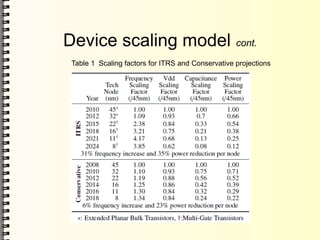
Device scaling model cont.
Table 1 Scaling factors for ITRS and Conservative projections
Single core scaling model (CorM)
● Pareto-optimal frontiers for area/performance
and power/performance are created using
over 150 processors.
Single core scaling model (CorM)
contd.
Figure 2(a) Power/performance frontier
at 45 nm[1]
Figure 2(b) Area/performance frontier
At 45 nm [1]
Multi-core scaling model (CmpM)
● There are 2 Multi-core scaling models
1) Amdahl’s Law Upper-bound model (CmpMU
)
2) Realistic model (CmpMR
)
Amdahl’s Law Upper-bound model
(CmpMU
)
● Amdahl's law is extended in such a way that
can describe symmetric, asymmetric,
dynamic and composed multi-core
topologies.
● CmpMU
model provides a strict upper bound
of parallel performance.
Amdahl’s Law Upper-bound model
contd.
Symmetric Asymmetric Dynamic Composed
CPU
multicore
Serial 1 ST Core 1 Large ST Core 1 Large ST
Core
1 Large ST
Core
Parallel N ST Core 1 Large ST Core +
N small ST Cores
N small ST
Cores
N small ST
Cores
GPU
multicore
Serial 1 MT Core
(1 Thread)
1 Large ST Core
(1 Thread)
1 Large ST
Core (1
Thread)
1 Large ST
Core(1 Thread)
Parallel N MT Core
(Multiple
threads)
1 Large ST Core
(1 thread) +
N small MT
cores(Multiple
threads)
N Small MT
Cores
(Multiple
threads)
N Small MT
Cores
(Multiple
threads)
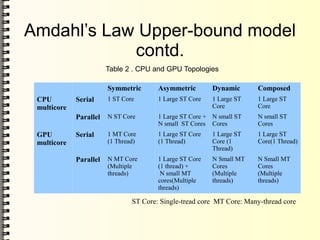
Table 2 . CPU and GPU Topologies
ST Core: Single-tread core MT Core: Many-thread core
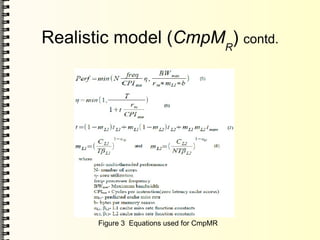
Realistic model (CmpMR
)
● Micro-architectural features, application
behaviours, physical constraints, multi-core
topologies are considered for this model.
Realistic model (CmpMR
) contd.
Figure 3 Equations used for CmpMR
Realistic model (CmpMR
) contd.
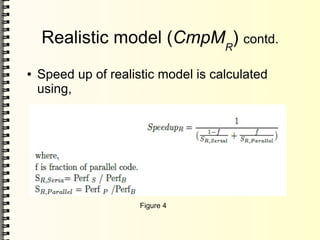
● Speed up of realistic model is calculated
using,
Figure 4
Realistic model (CmpMR
) contd.
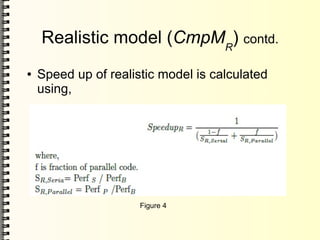
● Speed up of realistic model is calculated
using,
Figure 4
Model combinations
● DevM x CorM
● DevM x CorM x CmpM
Evaluation of model combinations
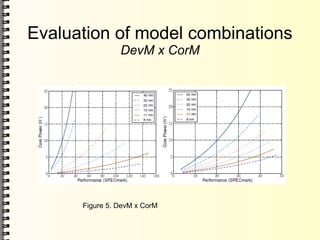
DevM x CorM
Figure 5. DevM x CorM
Evaluation of model combinations
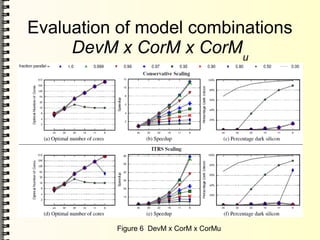
DevM x CorM x CorMu
Figure 6 DevM x CorM x CorMu
Results of combining models
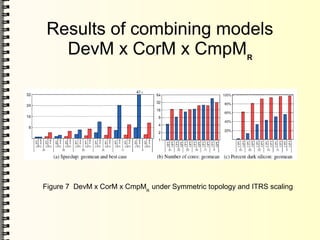
DevM x CorM x CmpMR
Figure 7 DevM x CorM x CmpMR
under Symmetric topology and ITRS scaling
Results of combining models contd.
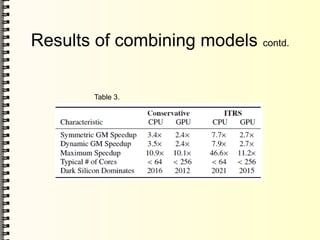
Table 3.
Conclusions
● Dark Silicon percentage increases with
scaling down of the tech node.
● ITRS projection is quite optimistic and it
shows
● 7.9x of speed up in 2024 with respect to
2008
● 32x of speed up is impossible.
References
[1] Hadi Esmaeilzadeh, Emily Blem, Renée St. Amant,
Karthikeyan Sankaralingam, Doug Burger. Dark Silicon and the
End of Multicore Scaling 2010
Questions
?
Thank you

Dark silicon

  • 1.
    Dark silicon andend of multi-core scaling By Chinthaka Henadeera Seminar of Dependable systems -SS 2012
  • 2.
    Presentation outline 1. Introduction 2.Motivation 3. Scaling models 3.1 Device scaling model 3.2 Single core scaling model 3.3 Multi-core scaling model 4. Model combinations 5. Evaluation of model combinations 6. Conclusions 7. References
  • 3.
    Introduction ● Transistors ofchips are doubled every 18 months according to the Moore's law. ● Moore's law is based on Dennard's scaling. ● Failure of Dennard's scaling has motivated chip designers towards multi-core chips in order to exploit the Moore's law continuously.
  • 4.
    Motivation ● Hot question “Canwe gain 32 times performance from multi-core processors in 2024 with respect to 2008 ?”
  • 5.
    Scaling models ● Tomodel the behaviour of future multicore processors , 3 scaling models are created and are combined. 1) Device scaling model (DevM) 2) Single core scaling model (CorM) 3) Multi-core scaling model (CmpM)
  • 6.
    Overview Figure. 1 Overviewof models and methodology [1]
  • 7.
    Device scaling model(DevM) ● To determine area, frequency and power of future tech nodes. ● Uses ITRS projections and conservative device scaling projections.
  • 8.
    Device scaling modelcont. Table 1 Scaling factors for ITRS and Conservative projections
  • 9.
    Single core scalingmodel (CorM) ● Pareto-optimal frontiers for area/performance and power/performance are created using over 150 processors.
  • 10.
    Single core scalingmodel (CorM) contd. Figure 2(a) Power/performance frontier at 45 nm[1] Figure 2(b) Area/performance frontier At 45 nm [1]
  • 11.
    Multi-core scaling model(CmpM) ● There are 2 Multi-core scaling models 1) Amdahl’s Law Upper-bound model (CmpMU ) 2) Realistic model (CmpMR )
  • 12.
    Amdahl’s Law Upper-boundmodel (CmpMU ) ● Amdahl's law is extended in such a way that can describe symmetric, asymmetric, dynamic and composed multi-core topologies. ● CmpMU model provides a strict upper bound of parallel performance.
  • 13.
    Amdahl’s Law Upper-boundmodel contd. Symmetric Asymmetric Dynamic Composed CPU multicore Serial 1 ST Core 1 Large ST Core 1 Large ST Core 1 Large ST Core Parallel N ST Core 1 Large ST Core + N small ST Cores N small ST Cores N small ST Cores GPU multicore Serial 1 MT Core (1 Thread) 1 Large ST Core (1 Thread) 1 Large ST Core (1 Thread) 1 Large ST Core(1 Thread) Parallel N MT Core (Multiple threads) 1 Large ST Core (1 thread) + N small MT cores(Multiple threads) N Small MT Cores (Multiple threads) N Small MT Cores (Multiple threads) Table 2 . CPU and GPU Topologies ST Core: Single-tread core MT Core: Many-thread core
  • 14.
    Realistic model (CmpMR ) ●Micro-architectural features, application behaviours, physical constraints, multi-core topologies are considered for this model.
  • 15.
    Realistic model (CmpMR )contd. Figure 3 Equations used for CmpMR
  • 16.
    Realistic model (CmpMR )contd. ● Speed up of realistic model is calculated using, Figure 4
  • 17.
    Realistic model (CmpMR )contd. ● Speed up of realistic model is calculated using, Figure 4
  • 18.
    Model combinations ● DevMx CorM ● DevM x CorM x CmpM
  • 19.
    Evaluation of modelcombinations DevM x CorM Figure 5. DevM x CorM
  • 20.
    Evaluation of modelcombinations DevM x CorM x CorMu Figure 6 DevM x CorM x CorMu
  • 21.
    Results of combiningmodels DevM x CorM x CmpMR Figure 7 DevM x CorM x CmpMR under Symmetric topology and ITRS scaling
  • 22.
    Results of combiningmodels contd. Table 3.
  • 23.
    Conclusions ● Dark Siliconpercentage increases with scaling down of the tech node. ● ITRS projection is quite optimistic and it shows ● 7.9x of speed up in 2024 with respect to 2008 ● 32x of speed up is impossible.
  • 24.
    References [1] Hadi Esmaeilzadeh,Emily Blem, Renée St. Amant, Karthikeyan Sankaralingam, Doug Burger. Dark Silicon and the End of Multicore Scaling 2010
  • 25.
  • 26.