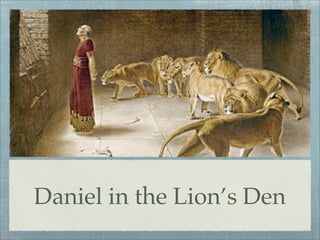
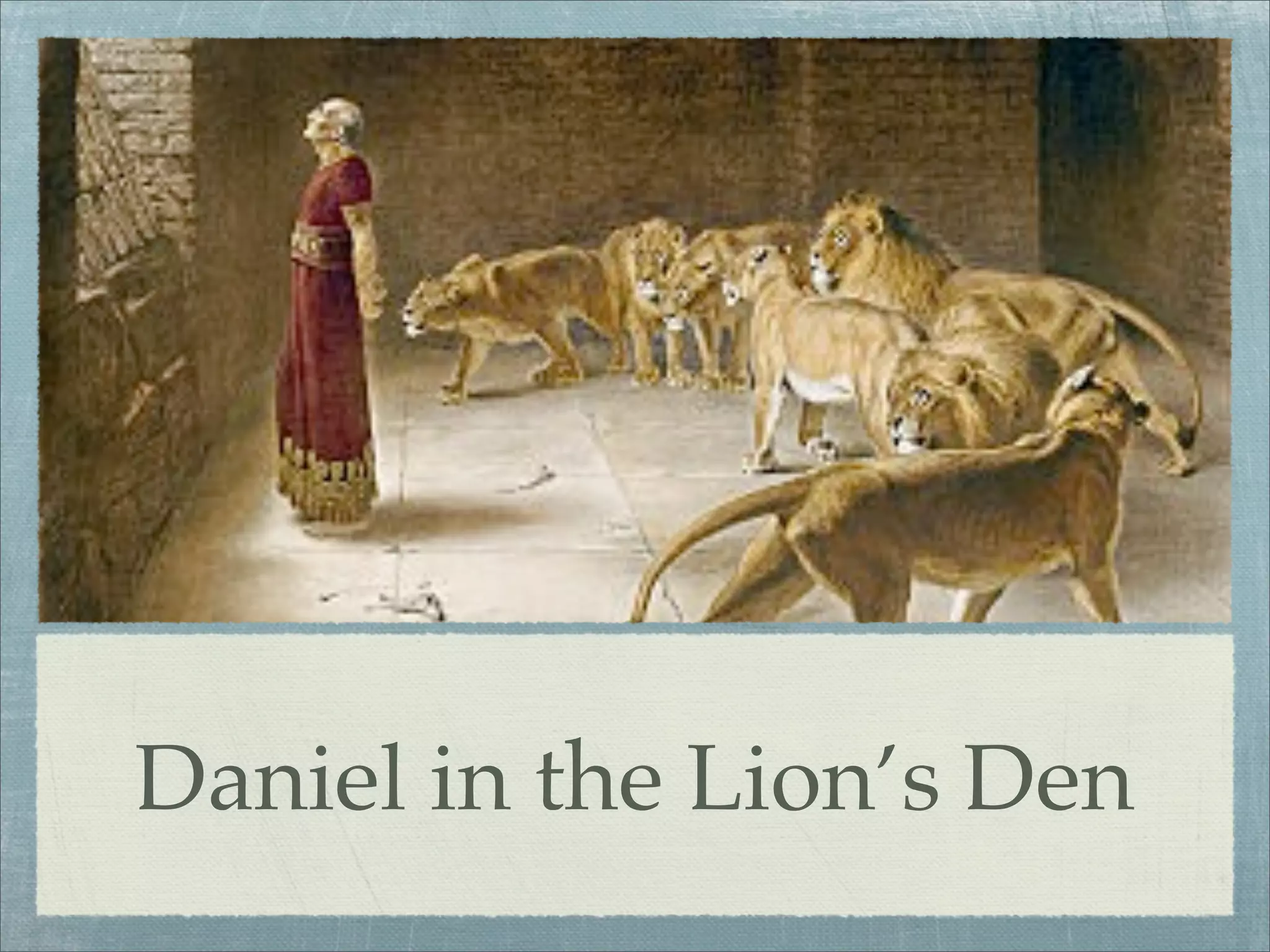
Daniel in the Lion’s Den
Daniel 6:1-3
Only by faithfulness in the little things can the soul be trained to
act with fidelity under larger responsibilities. God brought
Daniel and his fellows into connection with the great men of
Babylon, that these heathen men might become acquainted with
the principles of true religion. In the midst of a nation of
idolaters, Daniel was to represent the character of God. How did
he become fitted for a position of so great trust and honor? It was
his faithfulness in the little things that gave complexion to his
whole life. He honored God in the smallest duties, and the Lord
co-operated with him.
— Christ’s Object Lessons, p. 356
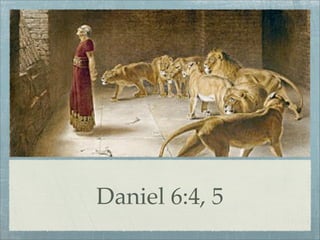
Daniel 6:4, 5
The keen eyes of jealousy were fixed upon Daniel day after
day; their watchings were sharpened by hatred; yet not a word
or act of his life could they make appear wrong. And still he
made no claim to sanctification; but he did that which was
infinitely better,—he lived a holy, sanctified life. The true test of
sanctification is the daily deportment.
The more blameless the life of Daniel, the greater was the
hatred excited against him by his enemies. They were filled with
madness, because they could find nothing in his moral character
or in the discharge of his duties, upon which to base a complaint
against him.
— Review and Herald, February 8, 1881
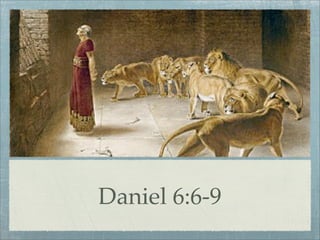
Daniel 6:6-9
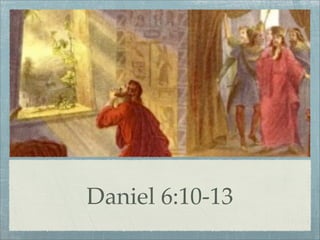
Daniel 6:10-13
Some may ask, Why did not Daniel lift his soul to God in
secret prayer? Would not the Lord, knowing the situation, have
excused his servant from kneeling openly before him? Or why
did he not kneel before God in some secret place, where his
enemies could not see him?
Daniel knew that the God of Israel must be honored before the
Babylonian nation. He knew that neither kings nor nobles had
any right to come between him and his duty to his God. He must
bravely maintain his religious principles before all men; for he
was God's witness. Therefore he prayed as was his wont
(custom), as if no decree had been made.
— Youth’s Instructor, November 1, 1900
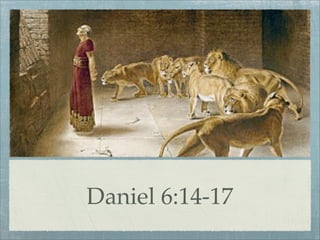
Daniel 6:14-17
Full of satanic exultation, Daniel's enemies returned to their
homes. They drank freely of wine, and congratulated themselves
on their success in putting out of the way one whom they could
not bribe to forsake the path of integrity.
— Youth’s Instructor, November 1, 1900
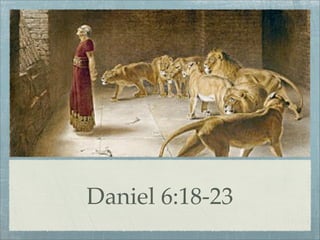
Daniel 6:18-23
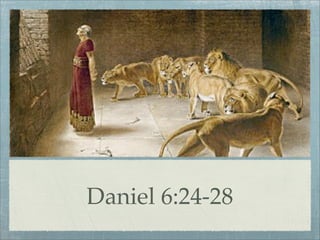
Daniel 6:24-28
End-time Application
1. The political leaders of Medo-Persia could find no fault or
error in Daniel — Daniel 6:4. “The life of Daniel is an inspired
illustration of what constitutes a sanctified character.” The
Sanctified Life, p. 23
End-time Application
1. The political leaders of Medo-Persia could find no fault or
error in Daniel — Daniel 6:4. “The life of Daniel is an inspired
illustration of what constitutes a sanctified character.” The
Sanctified Life, p. 23
Pilate could find no fault in Jesus (Luke 23:14), and the
144,000 are found to be without fault before the throne of God
(Revelation 14:5). See also Jude 24.
End-time Application
2. The political leaders realized the only way they could find
something wrong with Daniel would be to force him to
choose between following God’s law versus the laws of men.
Disobedience of man’s law would lead to death.
End-time Application
2. The political leaders realized the only way they could find
something wrong with Daniel would be to force him to
choose between following God’s law versus the laws of men.
Disobedience of man’s law would lead to death.
God’s last-day people will also be found without fault, and
the only way they can be condemned will be through civil
legislation (Sunday laws) contrary to God’s law punishable
by death. Like Daniel, they will be faithful unto death and
worship and honor the true God. See also Acts 5:29.
End-time Application
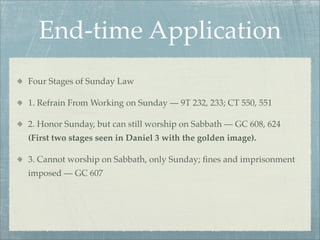
Four Stages of Sunday Law
End-time Application
Four Stages of Sunday Law
1. Refrain From Working on Sunday — 9T 232, 233; CT 550, 551
End-time Application
Four Stages of Sunday Law
1. Refrain From Working on Sunday — 9T 232, 233; CT 550, 551
2. Honor Sunday, but can still worship on Sabbath — GC 608, 624
(First two stages seen in Daniel 3 with the golden image).
End-time Application
Four Stages of Sunday Law
1. Refrain From Working on Sunday — 9T 232, 233; CT 550, 551
2. Honor Sunday, but can still worship on Sabbath — GC 608, 624
(First two stages seen in Daniel 3 with the golden image).
3. Cannot worship on Sabbath, only Sunday; fines and imprisonment
imposed — GC 607
End-time Application
Four Stages of Sunday Law
1. Refrain From Working on Sunday — 9T 232, 233; CT 550, 551
2. Honor Sunday, but can still worship on Sabbath — GC 608, 624
(First two stages seen in Daniel 3 with the golden image).
3. Cannot worship on Sabbath, only Sunday; fines and imprisonment
imposed — GC 607
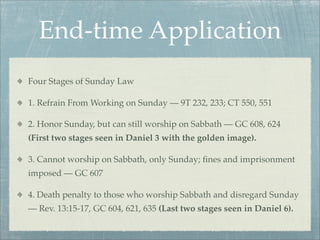
4. Death penalty to those who worship Sabbath and disregard Sunday
— Rev. 13:15-17, GC 604, 621, 635 (Last two stages seen in Daniel 6).
End-time Application
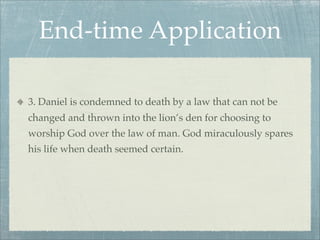
3. Daniel is condemned to death by a law that can not be
changed and thrown into the lion’s den for choosing to
worship God over the law of man. God miraculously spares
his life when death seemed certain.
End-time Application
3. Daniel is condemned to death by a law that can not be
changed and thrown into the lion’s den for choosing to
worship God over the law of man. God miraculously spares
his life when death seemed certain.
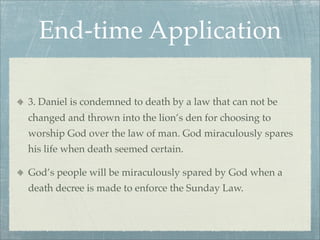
God’s people will be miraculously spared by God when a
death decree is made to enforce the Sunday Law.
When the protection of human laws shall be withdrawn
from those who honor the law of God, there will be, in
different lands, a simultaneous movement for their
destruction. As the time appointed in the decree draws near,
the people will conspire to root out the hated sect. It will be
determined to strike in one night a decisive blow, which
shall utterly silence the voice of dissent and reproof.
The people of God--some in prison cells, some hidden in
solitary retreats in the forests and the mountains--still plead
for divine protection, while in every quarter companies of
armed men, urged on by hosts of evil angels, are preparing
for the work of death. It is now, in the hour of utmost
extremity, that the God of Israel will interpose for the
deliverance of His chosen.
— The Great Controversy, p. 635
With shouts of triumph, jeering, and imprecation, throngs of evil
men are about to rush upon their prey, when, lo, a
dense blackness, deeper than the darkness of the night, falls
upon the earth. Then a rainbow, shining with the glory from the
throne of God, spans the heavens and seems to encircle each
praying company. The angry multitudes are suddenly arrested.
Their mocking cries die away. The objects of their murderous
rage are forgotten. With fearful forebodings they gaze upon the
symbol of God's covenant and long to be shielded from its
overpowering brightness.
— The Great Controversy, pp. 635, 636
End-time Application
4. Daniel was a servant of the living God who served God
continually (see Daniel 6:16, 20).
End-time Application
4. Daniel was a servant of the living God who served God
continually (see Daniel 6:16, 20).
Revelation 7:1-4 describes God’s last day servants of God
known as the 144,000. In Revelation 14, we find that the
144,000 are without fault as well. Daniel (servant of the living
God and found to be without fault) gives us an example of
how to be part of the 144,000.
End-time Application
Daniel 1 — Daniel and his three friends were faithful on the
issue of diet. Thus God was glorified.
End-time Application
Daniel 1 — Daniel and his three friends were faithful on the
issue of diet. Thus God was glorified.
Daniel 2 — Daniel interprets dream to Nebuchadnezzar. Thus
God was glorified.
End-time Application
Daniel 1 — Daniel and his three friends were faithful on the
issue of diet. Thus God was glorified.
Daniel 2 — Daniel interprets dream to Nebuchadnezzar. Thus
God was glorified.
Daniel 3 — Shadrach, Meshach, and Abednego refuse to bow
down to the image. Thus God was glorified.
End-time Application
Daniel 4 — Nebuchadnezzar acknowledges that God sets up
kings and removes them. Thus, God was glorified.
End-time Application
Daniel 4 — Nebuchadnezzar acknowledges that God sets up
kings and removes them. Thus, God was glorified.
Daniel 5 — Daniel interprets the handwriting on the wall and
shows that prophecy is being fulfilled as Babylon fell. Thus
God was glorified.
End-time Application
Daniel 4 — Nebuchadnezzar acknowledges that God sets up
kings and removes them. Thus, God was glorified.
Daniel 5 — Daniel interprets the handwriting on the wall and
shows that prophecy is being fulfilled as Babylon fell. Thus
God was glorified.
Daniel 6 — Daniel refuses to change His worship of God
based on a man-made law. Thus God was glorified.
End-time Application
Revelation 14:7 says to “Fear God and give glory to him for
the hour of his judgment is come.” We are to glorify God in
the hour of His judgment.

Daniel6 daniel in the lion's den

  • 1.
    Daniel in theLion’s Den
  • 2.
  • 3.
    Only by faithfulnessin the little things can the soul be trained to act with fidelity under larger responsibilities. God brought Daniel and his fellows into connection with the great men of Babylon, that these heathen men might become acquainted with the principles of true religion. In the midst of a nation of idolaters, Daniel was to represent the character of God. How did he become fitted for a position of so great trust and honor? It was his faithfulness in the little things that gave complexion to his whole life. He honored God in the smallest duties, and the Lord co-operated with him. — Christ’s Object Lessons, p. 356
  • 4.
  • 5.
    The keen eyesof jealousy were fixed upon Daniel day after day; their watchings were sharpened by hatred; yet not a word or act of his life could they make appear wrong. And still he made no claim to sanctification; but he did that which was infinitely better,—he lived a holy, sanctified life. The true test of sanctification is the daily deportment. The more blameless the life of Daniel, the greater was the hatred excited against him by his enemies. They were filled with madness, because they could find nothing in his moral character or in the discharge of his duties, upon which to base a complaint against him. — Review and Herald, February 8, 1881

  • 6.
  • 7.
  • 8.
    Some may ask,Why did not Daniel lift his soul to God in secret prayer? Would not the Lord, knowing the situation, have excused his servant from kneeling openly before him? Or why did he not kneel before God in some secret place, where his enemies could not see him? Daniel knew that the God of Israel must be honored before the Babylonian nation. He knew that neither kings nor nobles had any right to come between him and his duty to his God. He must bravely maintain his religious principles before all men; for he was God's witness. Therefore he prayed as was his wont (custom), as if no decree had been made. — Youth’s Instructor, November 1, 1900
  • 9.
  • 10.
    Full of satanicexultation, Daniel's enemies returned to their homes. They drank freely of wine, and congratulated themselves on their success in putting out of the way one whom they could not bribe to forsake the path of integrity. — Youth’s Instructor, November 1, 1900
  • 11.
  • 12.
  • 13.
  • 14.
    End-time Application 1. Thepolitical leaders of Medo-Persia could find no fault or error in Daniel — Daniel 6:4. “The life of Daniel is an inspired illustration of what constitutes a sanctified character.” The Sanctified Life, p. 23
  • 15.
    End-time Application 1. Thepolitical leaders of Medo-Persia could find no fault or error in Daniel — Daniel 6:4. “The life of Daniel is an inspired illustration of what constitutes a sanctified character.” The Sanctified Life, p. 23 Pilate could find no fault in Jesus (Luke 23:14), and the 144,000 are found to be without fault before the throne of God (Revelation 14:5). See also Jude 24.
  • 16.
  • 17.
    End-time Application 2. Thepolitical leaders realized the only way they could find something wrong with Daniel would be to force him to choose between following God’s law versus the laws of men. Disobedience of man’s law would lead to death.
  • 18.
    End-time Application 2. Thepolitical leaders realized the only way they could find something wrong with Daniel would be to force him to choose between following God’s law versus the laws of men. Disobedience of man’s law would lead to death. God’s last-day people will also be found without fault, and the only way they can be condemned will be through civil legislation (Sunday laws) contrary to God’s law punishable by death. Like Daniel, they will be faithful unto death and worship and honor the true God. See also Acts 5:29.
  • 19.
  • 20.
  • 21.
    End-time Application Four Stagesof Sunday Law 1. Refrain From Working on Sunday — 9T 232, 233; CT 550, 551
  • 22.
    End-time Application Four Stagesof Sunday Law 1. Refrain From Working on Sunday — 9T 232, 233; CT 550, 551 2. Honor Sunday, but can still worship on Sabbath — GC 608, 624 (First two stages seen in Daniel 3 with the golden image).
  • 23.
    End-time Application Four Stagesof Sunday Law 1. Refrain From Working on Sunday — 9T 232, 233; CT 550, 551 2. Honor Sunday, but can still worship on Sabbath — GC 608, 624 (First two stages seen in Daniel 3 with the golden image). 3. Cannot worship on Sabbath, only Sunday; fines and imprisonment imposed — GC 607
  • 24.
    End-time Application Four Stagesof Sunday Law 1. Refrain From Working on Sunday — 9T 232, 233; CT 550, 551 2. Honor Sunday, but can still worship on Sabbath — GC 608, 624 (First two stages seen in Daniel 3 with the golden image). 3. Cannot worship on Sabbath, only Sunday; fines and imprisonment imposed — GC 607 4. Death penalty to those who worship Sabbath and disregard Sunday — Rev. 13:15-17, GC 604, 621, 635 (Last two stages seen in Daniel 6).
  • 25.
  • 26.
    End-time Application 3. Danielis condemned to death by a law that can not be changed and thrown into the lion’s den for choosing to worship God over the law of man. God miraculously spares his life when death seemed certain.
  • 27.
    End-time Application 3. Danielis condemned to death by a law that can not be changed and thrown into the lion’s den for choosing to worship God over the law of man. God miraculously spares his life when death seemed certain. God’s people will be miraculously spared by God when a death decree is made to enforce the Sunday Law.
  • 28.
    When the protectionof human laws shall be withdrawn from those who honor the law of God, there will be, in different lands, a simultaneous movement for their destruction. As the time appointed in the decree draws near, the people will conspire to root out the hated sect. It will be determined to strike in one night a decisive blow, which shall utterly silence the voice of dissent and reproof. The people of God--some in prison cells, some hidden in solitary retreats in the forests and the mountains--still plead for divine protection, while in every quarter companies of armed men, urged on by hosts of evil angels, are preparing for the work of death. It is now, in the hour of utmost extremity, that the God of Israel will interpose for the deliverance of His chosen. — The Great Controversy, p. 635
  • 29.
    With shouts oftriumph, jeering, and imprecation, throngs of evil men are about to rush upon their prey, when, lo, a dense blackness, deeper than the darkness of the night, falls upon the earth. Then a rainbow, shining with the glory from the throne of God, spans the heavens and seems to encircle each praying company. The angry multitudes are suddenly arrested. Their mocking cries die away. The objects of their murderous rage are forgotten. With fearful forebodings they gaze upon the symbol of God's covenant and long to be shielded from its overpowering brightness. — The Great Controversy, pp. 635, 636
  • 30.
  • 31.
    End-time Application 4. Danielwas a servant of the living God who served God continually (see Daniel 6:16, 20).
  • 32.
    End-time Application 4. Danielwas a servant of the living God who served God continually (see Daniel 6:16, 20). Revelation 7:1-4 describes God’s last day servants of God known as the 144,000. In Revelation 14, we find that the 144,000 are without fault as well. Daniel (servant of the living God and found to be without fault) gives us an example of how to be part of the 144,000.
  • 33.
  • 34.
    End-time Application Daniel 1— Daniel and his three friends were faithful on the issue of diet. Thus God was glorified.
  • 35.
    End-time Application Daniel 1— Daniel and his three friends were faithful on the issue of diet. Thus God was glorified. Daniel 2 — Daniel interprets dream to Nebuchadnezzar. Thus God was glorified.
  • 36.
    End-time Application Daniel 1— Daniel and his three friends were faithful on the issue of diet. Thus God was glorified. Daniel 2 — Daniel interprets dream to Nebuchadnezzar. Thus God was glorified. Daniel 3 — Shadrach, Meshach, and Abednego refuse to bow down to the image. Thus God was glorified.
  • 37.
  • 38.
    End-time Application Daniel 4— Nebuchadnezzar acknowledges that God sets up kings and removes them. Thus, God was glorified.
  • 39.
    End-time Application Daniel 4— Nebuchadnezzar acknowledges that God sets up kings and removes them. Thus, God was glorified. Daniel 5 — Daniel interprets the handwriting on the wall and shows that prophecy is being fulfilled as Babylon fell. Thus God was glorified.
  • 40.
    End-time Application Daniel 4— Nebuchadnezzar acknowledges that God sets up kings and removes them. Thus, God was glorified. Daniel 5 — Daniel interprets the handwriting on the wall and shows that prophecy is being fulfilled as Babylon fell. Thus God was glorified. Daniel 6 — Daniel refuses to change His worship of God based on a man-made law. Thus God was glorified.
  • 41.
  • 42.
    End-time Application Revelation 14:7says to “Fear God and give glory to him for the hour of his judgment is come.” We are to glorify God in the hour of His judgment.