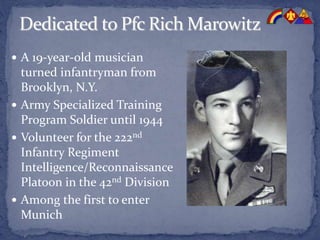
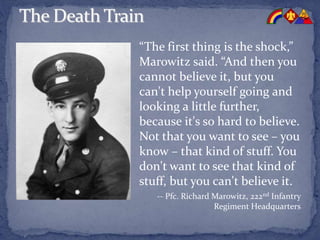
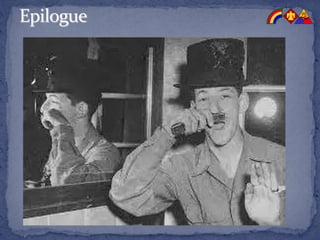
 A 19-year-old musician
turned infantryman from
Brooklyn, N.Y.
 Army Specialized Training
Program Soldier until 1944
 Volunteer for the 222nd
Infantry Regiment
Intelligence/Reconnaissance
Platoon in the 42nd Division
 Among the first to enter
Munich
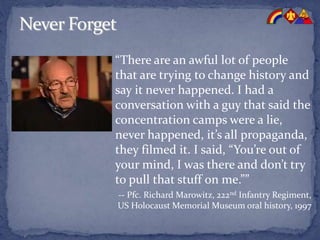
“There are an awful lot of people
that are trying to change history and
say it never happened. I had a
conversation with a guy that said the
concentration camps were a lie,
never happened, it’s all propaganda,
they filmed it. I said, “You’re out of
your mind, I was there and don’t try
to pull that stuff on me.””
-- Pfc. Richard Marowitz, 222nd Infantry Regiment,
US Holocaust Memorial Museum oral history, 1997
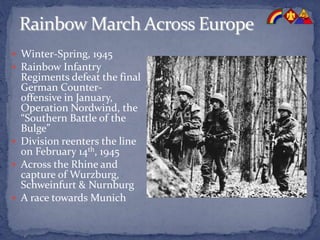
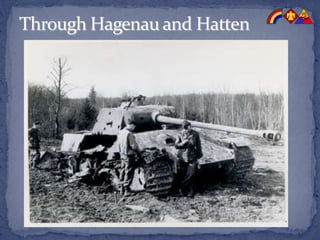
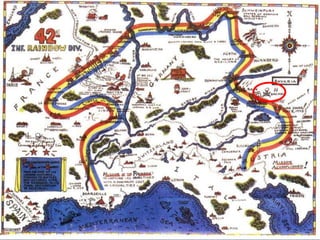
 Winter-Spring, 1945
 Rainbow Infantry
Regiments defeat the final
German Counter-
offensive in January,
Operation Nordwind, the
“Southern Battle of the
Bulge”
 Division reenters the line
on February 14th, 1945
 Across the Rhine and
capture of Wurzburg,
Schweinfurt & Nurnburg
 A race towards Munich
"Rheinhardt has died tonight. I
wanted to see him again, greet
him one last time, and so I went
looking for him, as he lay on
the road in front of the death
chamber - amongst the other
one hundred and fifty dead of
last night.
He was barely recognizable; his
face was swollen and contorted
in desperation. His death is not
only for us, his friends, a very
hard blow and painful loss, […]
And perhaps the worst thing in
the face of this death, the death
of all our friends, is: we do not
even have the time … to mourn
them"
-- Nico Rost: Goethe in Dachau
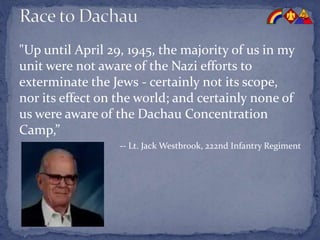
"Up until April 29, 1945, the majority of us in my
unit were not aware of the Nazi efforts to
exterminate the Jews - certainly not its scope,
nor its effect on the world; and certainly none of
us were aware of the Dachau Concentration
Camp,”
-- Lt. Jack Westbrook, 222nd Infantry Regiment
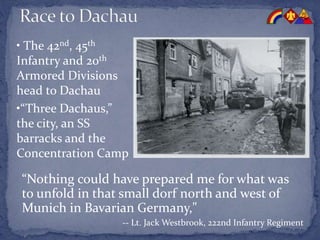
“Nothing could have prepared me for what was
to unfold in that small dorf north and west of
Munich in Bavarian Germany,"
-- Lt. Jack Westbrook, 222nd Infantry Regiment
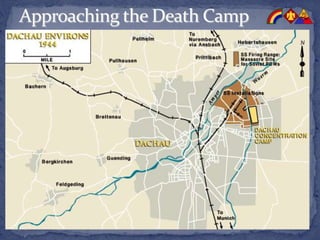
• The 42nd, 45th
Infantry and 20th
Armored Divisions
head to Dachau
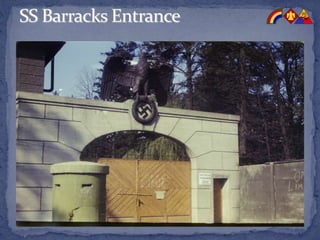
•“Three Dachaus,”
the city, an SS
barracks and the
Concentration Camp
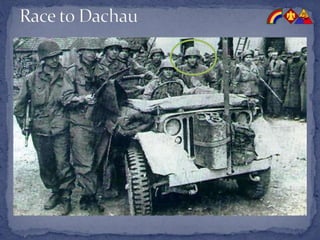
“The I&R (Intelligence and Reconnaissance)
platoon was in front. I was platoon leader, 3rd
platoon, Company F, 2nd Battalion, and our
battalion commander, (Lt. Col.) Downard,
was leading the way. We ran into little pockets
of resistance, and the I&R gave them
machine-gun bursts and we drove right
through them. The Germans just looked at us.
They couldn’t understand it. Why didn’t we
want to stop and fight?”
-- Sgt. Olin Hawkins, 222nd Infantry Regiment, 1994 oral history
recording
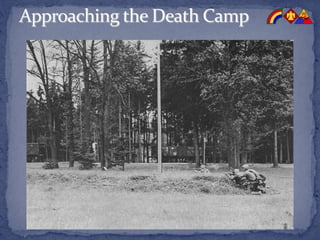
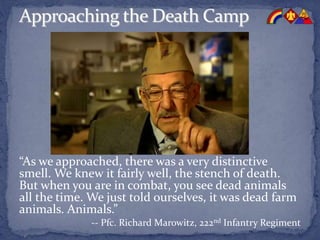
“As we approached, there was a very distinctive
smell. We knew it fairly well, the stench of death.
But when you are in combat, you see dead animals
all the time. We just told ourselves, it was dead farm
animals. Animals.”
-- Pfc. Richard Marowitz, 222nd Infantry Regiment
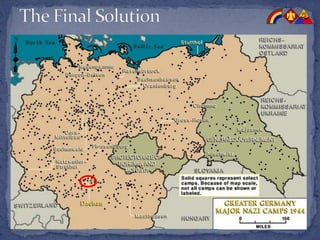
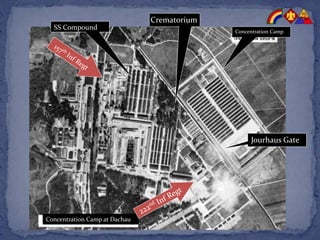
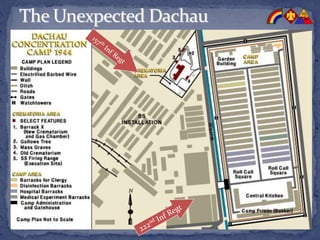
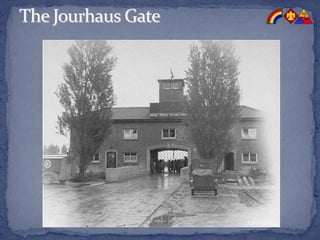
Concentration Camp at Dachau
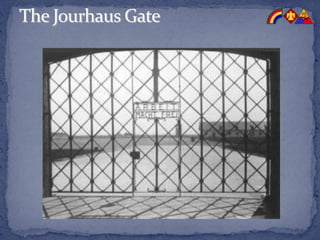
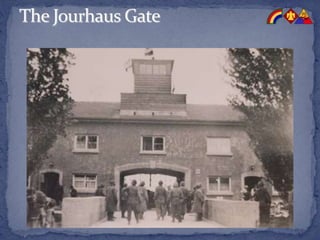
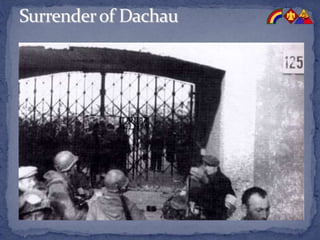
Jourhaus Gate
Crematorium
Concentration Camp
SS Compound
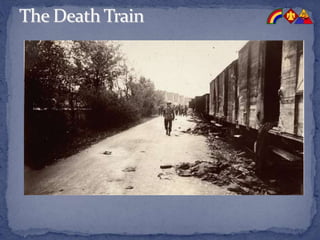
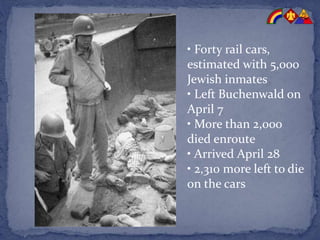
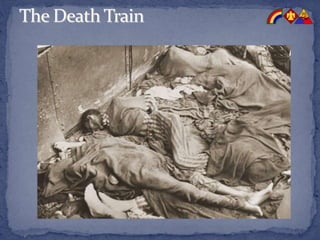
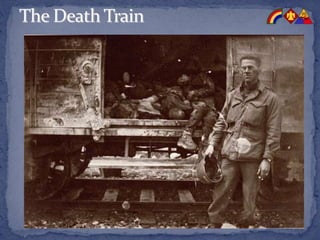
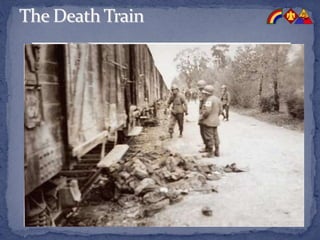
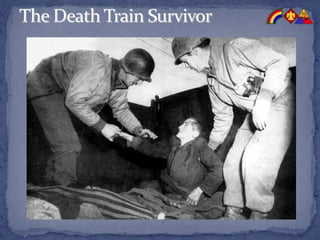
• Forty rail cars,
estimated with 5,000
Jewish inmates
• Left Buchenwald on
April 7
• More than 2,000
died enroute
• Arrived April 28
• 2,310 more left to die
on the cars
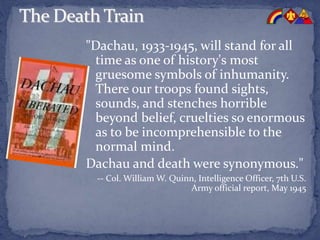
"Dachau, 1933-1945, will stand for all
time as one of history's most
gruesome symbols of inhumanity.
There our troops found sights,
sounds, and stenches horrible
beyond belief, cruelties so enormous
as to be incomprehensible to the
normal mind.
Dachau and death were synonymous."
-- Col. William W. Quinn, Intelligence Officer, 7th U.S.
Army official report, May 1945
“The first thing is the shock,”
Marowitz said. “And then you
cannot believe it, but you
can't help yourself going and
looking a little further,
because it's so hard to believe.
Not that you want to see – you
know – that kind of stuff. You
don't want to see that kind of
stuff, but you can't believe it.
-- Pfc. Richard Marowitz, 222nd Infantry
Regiment Headquarters
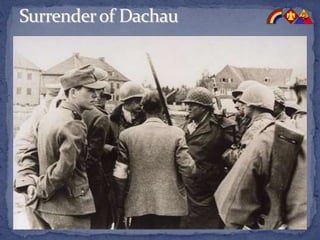
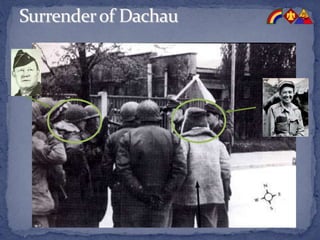
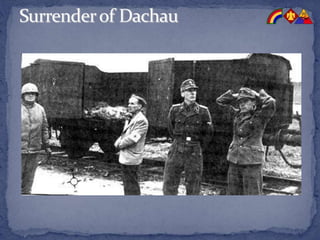
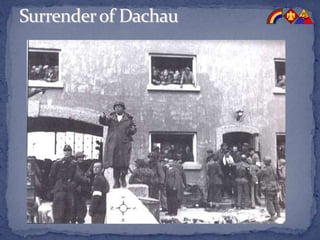
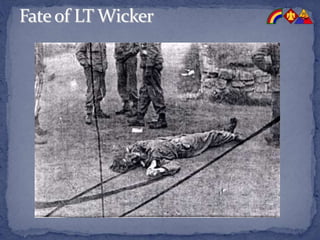
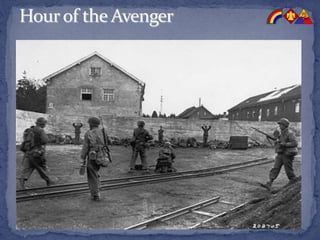
“As we approached the southwest corner,
three people came forward with a flag of
truce. They were a Swiss Red Cross
representative, Victor Maurer, and two
SS troopers who said they were the camp
commander [SS Lieutenant Heinrich
Wicker] and his assistant. They had
come here on the night of the 28th to
take over from the regular personnel, for
the purpose of surrendering the camp to
the advancing Americans.”
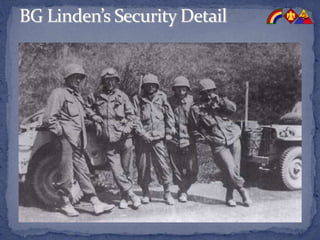
-- Brig. Gen. Henning Linden report to corps headquarters, May 2, 1945.
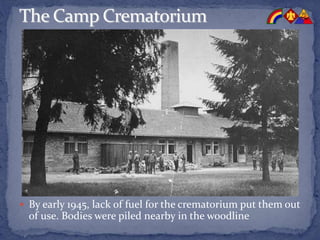
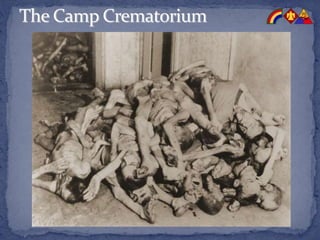
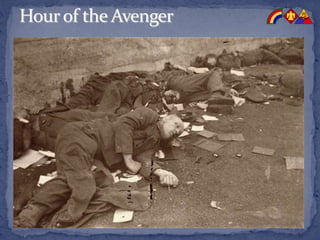
 By early 1945, lack of fuel for the crematorium put them out
of use. Bodies were piled nearby in the woodline
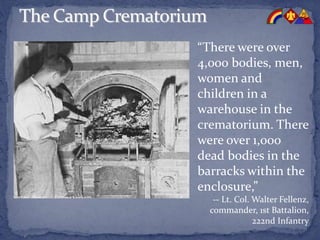
“There were over
4,000 bodies, men,
women and
children in a
warehouse in the
crematorium. There
were over 1,000
dead bodies in the
barracks within the
enclosure,”
-- Lt. Col. Walter Fellenz,
commander, 1st Battalion,
222nd Infantry
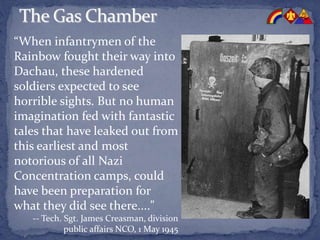
“When infantrymen of the
Rainbow fought their way into
Dachau, these hardened
soldiers expected to see
horrible sights. But no human
imagination fed with fantastic
tales that have leaked out from
this earliest and most
notorious of all Nazi
Concentration camps, could
have been preparation for
what they did see there...."
-- Tech. Sgt. James Creasman, division
public affairs NCO, 1 May 1945
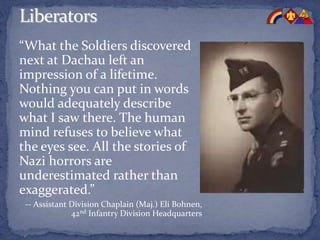
“What the Soldiers discovered
next at Dachau left an
impression of a lifetime.
Nothing you can put in words
would adequately describe
what I saw there. The human
mind refuses to believe what
the eyes see. All the stories of
Nazi horrors are
underestimated rather than
exaggerated.”
-- Assistant Division Chaplain (Maj.) Eli Bohnen,
42nd Infantry Division Headquarters
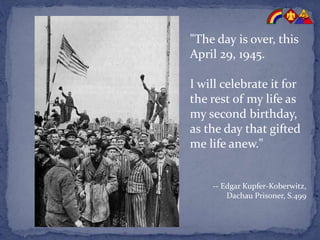
"The day is over, this
April 29, 1945.
I will celebrate it for
the rest of my life as
my second birthday,
as the day that gifted
me life anew."
-- Edgar Kupfer-Koberwitz,
Dachau Prisoner, S.499
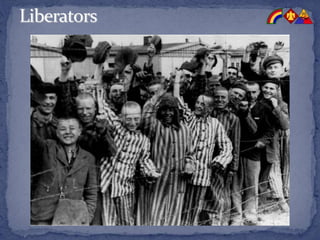
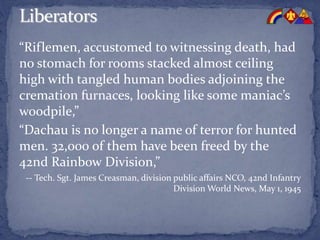
“Riflemen, accustomed to witnessing death, had
no stomach for rooms stacked almost ceiling
high with tangled human bodies adjoining the
cremation furnaces, looking like some maniac’s
woodpile,”
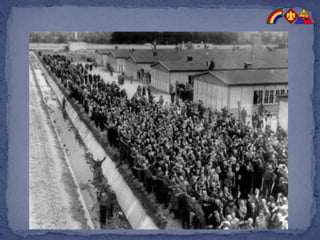
“Dachau is no longer a name of terror for hunted
men. 32,000 of them have been freed by the
42nd Rainbow Division,”
-- Tech. Sgt. James Creasman, division public affairs NCO, 42nd Infantry
Division World News, May 1, 1945
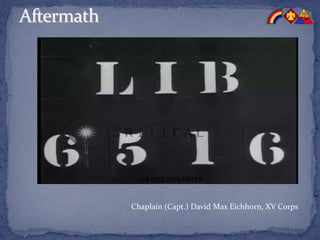
Chaplain (Capt.) David Max Eichhorn, XV Corps
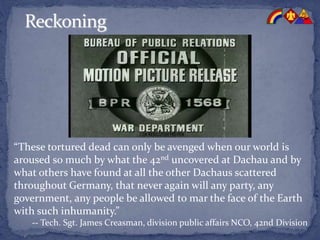
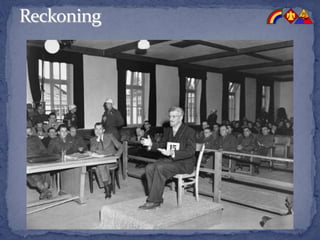
“These tortured dead can only be avenged when our world is
aroused so much by what the 42nd uncovered at Dachau and by
what others have found at all the other Dachaus scattered
throughout Germany, that never again will any party, any
government, any people be allowed to mar the face of the Earth
with such inhumanity.”
-- Tech. Sgt. James Creasman, division public affairs NCO, 42nd Division
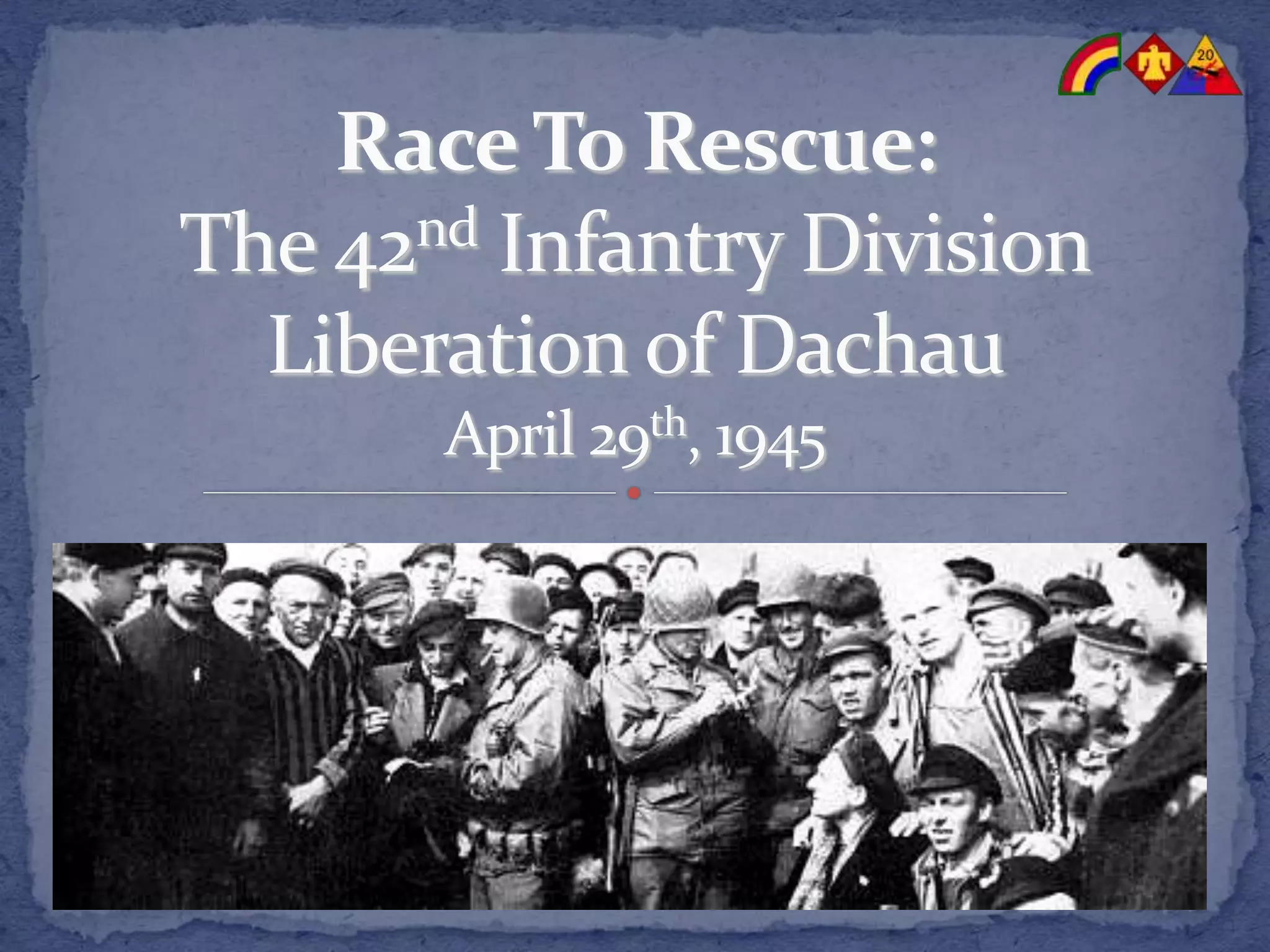
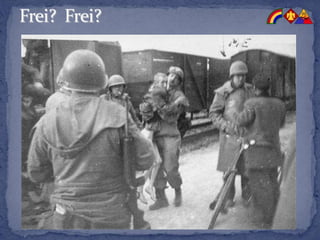
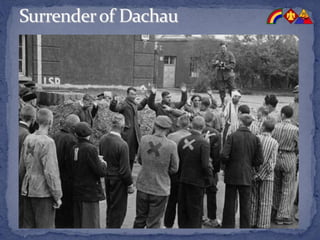
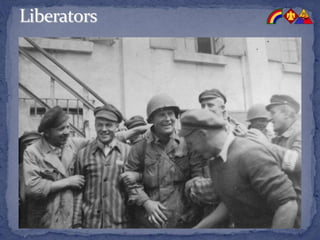
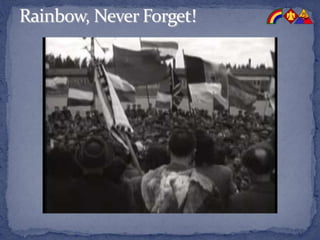
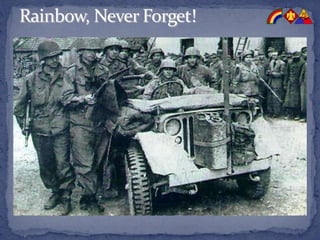
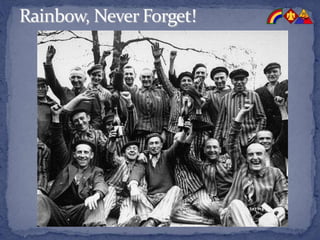
“The liberation
was a frenzied
scene: Inmates of
the camp hugged
and embraced the
American troops,
kissed the ground
before them and
carried them
shoulder high
around the place,”
-- Marguerite Higgins,
reporter, NY Herald
Tribune, May 1, 1945
Dachau Liberation 2022 presentation.pptx

Dachau Liberation 2022 presentation.pptx

  • 2.
     A 19-year-oldmusician turned infantryman from Brooklyn, N.Y.  Army Specialized Training Program Soldier until 1944  Volunteer for the 222nd Infantry Regiment Intelligence/Reconnaissance Platoon in the 42nd Division  Among the first to enter Munich
  • 3.
    “There are anawful lot of people that are trying to change history and say it never happened. I had a conversation with a guy that said the concentration camps were a lie, never happened, it’s all propaganda, they filmed it. I said, “You’re out of your mind, I was there and don’t try to pull that stuff on me.”” -- Pfc. Richard Marowitz, 222nd Infantry Regiment, US Holocaust Memorial Museum oral history, 1997
  • 4.
     Winter-Spring, 1945 Rainbow Infantry Regiments defeat the final German Counter- offensive in January, Operation Nordwind, the “Southern Battle of the Bulge”  Division reenters the line on February 14th, 1945  Across the Rhine and capture of Wurzburg, Schweinfurt & Nurnburg  A race towards Munich
  • 9.
    "Rheinhardt has diedtonight. I wanted to see him again, greet him one last time, and so I went looking for him, as he lay on the road in front of the death chamber - amongst the other one hundred and fifty dead of last night. He was barely recognizable; his face was swollen and contorted in desperation. His death is not only for us, his friends, a very hard blow and painful loss, […] And perhaps the worst thing in the face of this death, the death of all our friends, is: we do not even have the time … to mourn them" -- Nico Rost: Goethe in Dachau
  • 10.
    "Up until April29, 1945, the majority of us in my unit were not aware of the Nazi efforts to exterminate the Jews - certainly not its scope, nor its effect on the world; and certainly none of us were aware of the Dachau Concentration Camp,” -- Lt. Jack Westbrook, 222nd Infantry Regiment
  • 11.
    “Nothing could haveprepared me for what was to unfold in that small dorf north and west of Munich in Bavarian Germany," -- Lt. Jack Westbrook, 222nd Infantry Regiment • The 42nd, 45th Infantry and 20th Armored Divisions head to Dachau •“Three Dachaus,” the city, an SS barracks and the Concentration Camp
  • 13.
    “The I&R (Intelligenceand Reconnaissance) platoon was in front. I was platoon leader, 3rd platoon, Company F, 2nd Battalion, and our battalion commander, (Lt. Col.) Downard, was leading the way. We ran into little pockets of resistance, and the I&R gave them machine-gun bursts and we drove right through them. The Germans just looked at us. They couldn’t understand it. Why didn’t we want to stop and fight?” -- Sgt. Olin Hawkins, 222nd Infantry Regiment, 1994 oral history recording
  • 18.
    “As we approached,there was a very distinctive smell. We knew it fairly well, the stench of death. But when you are in combat, you see dead animals all the time. We just told ourselves, it was dead farm animals. Animals.” -- Pfc. Richard Marowitz, 222nd Infantry Regiment
  • 20.
    Concentration Camp atDachau Jourhaus Gate Crematorium Concentration Camp SS Compound
  • 25.
    • Forty railcars, estimated with 5,000 Jewish inmates • Left Buchenwald on April 7 • More than 2,000 died enroute • Arrived April 28 • 2,310 more left to die on the cars
  • 29.
    "Dachau, 1933-1945, willstand for all time as one of history's most gruesome symbols of inhumanity. There our troops found sights, sounds, and stenches horrible beyond belief, cruelties so enormous as to be incomprehensible to the normal mind. Dachau and death were synonymous." -- Col. William W. Quinn, Intelligence Officer, 7th U.S. Army official report, May 1945
  • 32.
    “The first thingis the shock,” Marowitz said. “And then you cannot believe it, but you can't help yourself going and looking a little further, because it's so hard to believe. Not that you want to see – you know – that kind of stuff. You don't want to see that kind of stuff, but you can't believe it. -- Pfc. Richard Marowitz, 222nd Infantry Regiment Headquarters
  • 35.
    “As we approachedthe southwest corner, three people came forward with a flag of truce. They were a Swiss Red Cross representative, Victor Maurer, and two SS troopers who said they were the camp commander [SS Lieutenant Heinrich Wicker] and his assistant. They had come here on the night of the 28th to take over from the regular personnel, for the purpose of surrendering the camp to the advancing Americans.” -- Brig. Gen. Henning Linden report to corps headquarters, May 2, 1945.
  • 47.
     By early1945, lack of fuel for the crematorium put them out of use. Bodies were piled nearby in the woodline
  • 48.
    “There were over 4,000bodies, men, women and children in a warehouse in the crematorium. There were over 1,000 dead bodies in the barracks within the enclosure,” -- Lt. Col. Walter Fellenz, commander, 1st Battalion, 222nd Infantry
  • 50.
    “When infantrymen ofthe Rainbow fought their way into Dachau, these hardened soldiers expected to see horrible sights. But no human imagination fed with fantastic tales that have leaked out from this earliest and most notorious of all Nazi Concentration camps, could have been preparation for what they did see there...." -- Tech. Sgt. James Creasman, division public affairs NCO, 1 May 1945
  • 52.
    “What the Soldiersdiscovered next at Dachau left an impression of a lifetime. Nothing you can put in words would adequately describe what I saw there. The human mind refuses to believe what the eyes see. All the stories of Nazi horrors are underestimated rather than exaggerated.” -- Assistant Division Chaplain (Maj.) Eli Bohnen, 42nd Infantry Division Headquarters
  • 56.
    "The day isover, this April 29, 1945. I will celebrate it for the rest of my life as my second birthday, as the day that gifted me life anew." -- Edgar Kupfer-Koberwitz, Dachau Prisoner, S.499
  • 58.
    “Riflemen, accustomed towitnessing death, had no stomach for rooms stacked almost ceiling high with tangled human bodies adjoining the cremation furnaces, looking like some maniac’s woodpile,” “Dachau is no longer a name of terror for hunted men. 32,000 of them have been freed by the 42nd Rainbow Division,” -- Tech. Sgt. James Creasman, division public affairs NCO, 42nd Infantry Division World News, May 1, 1945
  • 59.
    Chaplain (Capt.) DavidMax Eichhorn, XV Corps
  • 61.
    “These tortured deadcan only be avenged when our world is aroused so much by what the 42nd uncovered at Dachau and by what others have found at all the other Dachaus scattered throughout Germany, that never again will any party, any government, any people be allowed to mar the face of the Earth with such inhumanity.” -- Tech. Sgt. James Creasman, division public affairs NCO, 42nd Division
  • 63.
    “The liberation was afrenzied scene: Inmates of the camp hugged and embraced the American troops, kissed the ground before them and carried them shoulder high around the place,” -- Marguerite Higgins, reporter, NY Herald Tribune, May 1, 1945