Programme Overview
Digital and Technology Solutions
Dr Victoria Uren
Dr Harry Goldingay
v.uren@aston.ac.uk
goldinhj@aston.ac.uk
Outline
The Degree
Delivery
Support
Why Aston?
Digital & Technology Solutions
The Degree
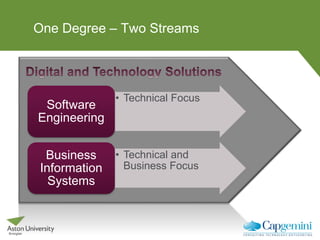
One Degree – Two Streams
• Technical Focus
Software
Engineering
• Technical and
Business Focus
Business
Information
Systems
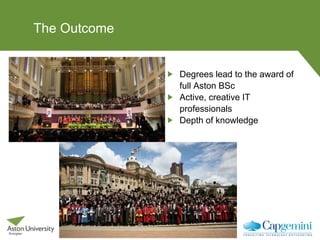
The Outcome
Degrees lead to the award of
full Aston BSc
Active, creative IT
professionals
Depth of knowledge
Core Content
Shared Start-up
Block Training: Java and OOP, software engineering,
database systems and web development
Software Engineering
How to think like a programmer: Problem Solving
Practical skills: Thorough grounding in OOP (through Java
Program Construction), Data Structures and Algorithms
Software Engineering
Business Information Systems
Understanding Data: Business Analytics and Data Mining
Managing Data: Advanced Database Systems
Making use of Financial Data: Introduction to Accounting
and Business Economics
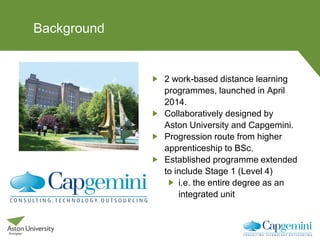
Background
2 work-based distance learning
programmes, launched in April
2014.
Collaboratively designed by
Aston University and Capgemini.
Progression route from higher
apprenticeship to BSc.
Established programme extended
to include Stage 1 (Level 4)
i.e. the entire degree as an
integrated unit
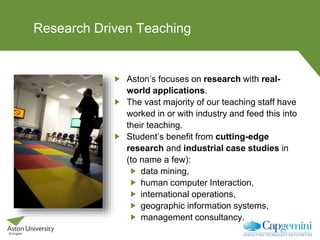
Research Driven Teaching
Aston’s focuses on research with real-
world applications.
The vast majority of our teaching staff have
worked in or with industry and feed this into
their teaching.
Student’s benefit from cutting-edge
research and industrial case studies in
(to name a few):
data mining,
human computer Interaction,
international operations,
geographic information systems,
management consultancy.
Relevance and Flexibility
Large portions of the course can be tailored to the student.
Up to 60 credits (25% of the course) of optional modules to
allow students to specialise.
Both streams have major group and individual projects
We are happy to work with employers to tailor projects to:
employers’ needs.
students’ working responsibilities.
Each student has a personal mentor to help:
us to fit coursework to students’ roles,
students to find opportunities to apply their learning in
practice.
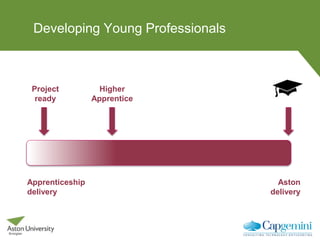
Developing Young Professionals
Apprenticeship
delivery
Aston
delivery
Project
ready
Higher
Apprentice
Digital & Technology Solutions
Delivery
Programme Structure
Two entry points: March and September
The programmes are divided into three stages
Each stage takes 18 months
Equivalent to one year of a standard degree
Students take a block of 2-4 modules every 6 months
Each block should take 400 learning hours
One third of these should be from on-the-job experience
Expected 10-hour per week time commitment from students
Delivery Philosophy
Flexible learning:
Combining work and study is tough!
Giving students flexibility to choose when they study is key
to making it work.
Continuous support:
Students should not be disadvantaged by distance learning.
Need regular communication and personal attention.
Online community:
Learning does not happen in isolation.
Discussion and collaboration give context and are
encouraged throughout.
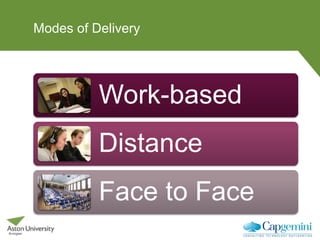
Modes of Delivery
Work-based
Distance
Face to Face
Work-based
Accelerated learning of core skills
Individual skills coaching to build employable, independent
learners
Tailored to fit different occupational specialisms
Reflective approach to professional development
Distance Learning
Majority of the course delivered through virtual learning
environment Blackboard.
Lectures recorded for students to watch (and re-watch)
asynchronously.
Supported by other self-study learning objects.
Labs/tutorials/seminars delivered through “virtual
classroom” Blackboard Collaborate.
Scheduled outside normal working hours (currently 8pm)
Often repeated to allow flexible scheduling
Backed by virtual office hours.
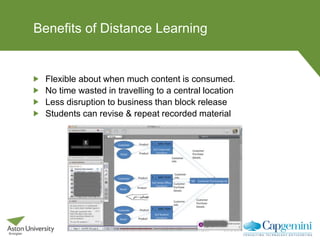
Benefits of Distance Learning
Flexible about when much content is consumed.
No time wasted in travelling to a central location
Less disruption to business than block release
Students can revise & repeat recorded material
Face to Face Learning
Distance learning works well for most things, but, some are
better in person, e.g.:
Student presentations/student-led seminars
Paper-based design
Getting to know your mentors/supervisors
Students have 4 days every 6 months of on-campus teaching
2 weekdays and 2 weekend days
Currently split between start and middle of a block
Digital & Technology Solutions
Support
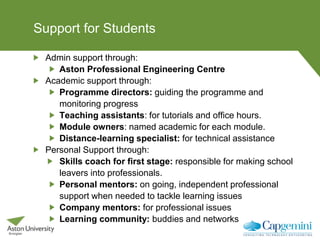
Support for Students
Admin support through:
Aston Professional Engineering Centre
Academic support through:
Programme directors: guiding the programme and
monitoring progress
Teaching assistants: for tutorials and office hours.
Module owners: named academic for each module.
Distance-learning specialist: for technical assistance
Personal Support through:
Skills coach for first stage: responsible for making school
leavers into professionals.
Personal mentors: on going, independent professional
support when needed to tackle learning issues
Company mentors: for professional issues
Learning community: buddies and networks
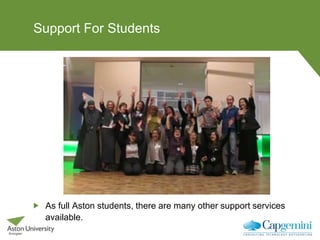
Support For Students
As full Aston students, there are many other support services
available.
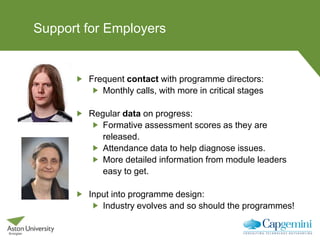
Support for Employers
Frequent contact with programme directors:
Monthly calls, with more in critical stages
Regular data on progress:
Formative assessment scores as they are
released.
Attendance data to help diagnose issues.
More detailed information from module leaders
easy to get.
Input into programme design:
Industry evolves and so should the programmes!
Digital & Technology Solutions
Why Aston?
Why Aston?
Aston has a track record of producing employable graduates
“You will struggle to find a university more keenly attuned to the
needs of business and industry.” – The Sunday Times University
Guide
…and of taking students from with non-traditional academic
backgrounds.
Willingness to work closely with employers
Satisfied students: 92% overall satisfaction in CS, 12th
nationally
Aston Business School
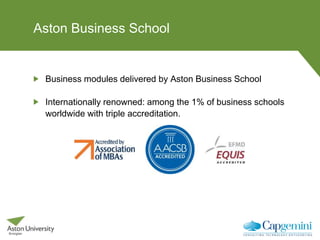
Business modules delivered by Aston Business School
Internationally renowned: among the 1% of business schools
worldwide with triple accreditation.
Advantages of an Existing Programme
We already have a viable cohort in-place:
More students means more flexibility of module choice
Depth and breadth of experience:
Interaction with other companies’ undergraduates adds
context
Assurance:
Based closely on existing programmes endorsed by e-skills
and the BCS.
Ready-to-go!
Summary
2 streams for IT-oriented junior talent
Software Engineering for those focusing on technical
computing.
Business Information Systems for those in more business
oriented roles.
Work-based blended learning:
Majority distance learning designed to suit those in work
Commitment to work with employers to ensure programmes
deliver the right skills.
Questions?
Contacts:
Dr. Harry Goldingay (Programme Director Computer Science)
Email: goldinhj@aston.ac.uk
Tel: 0121 204 3918
Prof. Ian Nabney (Head of Computer Science):
Email: i.t.nabney@aston.ac.uk
Tel: 0121 204 3645
Dr Victoria Uren (Programme Director Business School)
Email: v.uren@aston.ac.uk
Tel: 0121 204 3707

Degree Apprenticeships Launch to Employers

  • 1.
    Programme Overview Digital andTechnology Solutions Dr Victoria Uren Dr Harry Goldingay v.uren@aston.ac.uk goldinhj@aston.ac.uk
  • 2.
  • 3.
    Digital & TechnologySolutions The Degree
  • 4.
    One Degree –Two Streams • Technical Focus Software Engineering • Technical and Business Focus Business Information Systems
  • 5.
    The Outcome Degrees leadto the award of full Aston BSc Active, creative IT professionals Depth of knowledge
  • 6.
    Core Content Shared Start-up BlockTraining: Java and OOP, software engineering, database systems and web development Software Engineering How to think like a programmer: Problem Solving Practical skills: Thorough grounding in OOP (through Java Program Construction), Data Structures and Algorithms Software Engineering Business Information Systems Understanding Data: Business Analytics and Data Mining Managing Data: Advanced Database Systems Making use of Financial Data: Introduction to Accounting and Business Economics
  • 7.
    Background 2 work-based distancelearning programmes, launched in April 2014. Collaboratively designed by Aston University and Capgemini. Progression route from higher apprenticeship to BSc. Established programme extended to include Stage 1 (Level 4) i.e. the entire degree as an integrated unit
  • 8.
    Research Driven Teaching Aston’sfocuses on research with real- world applications. The vast majority of our teaching staff have worked in or with industry and feed this into their teaching. Student’s benefit from cutting-edge research and industrial case studies in (to name a few): data mining, human computer Interaction, international operations, geographic information systems, management consultancy.
  • 9.
    Relevance and Flexibility Largeportions of the course can be tailored to the student. Up to 60 credits (25% of the course) of optional modules to allow students to specialise. Both streams have major group and individual projects We are happy to work with employers to tailor projects to: employers’ needs. students’ working responsibilities. Each student has a personal mentor to help: us to fit coursework to students’ roles, students to find opportunities to apply their learning in practice.
  • 10.
  • 11.
    Digital & TechnologySolutions Delivery
  • 12.
    Programme Structure Two entrypoints: March and September The programmes are divided into three stages Each stage takes 18 months Equivalent to one year of a standard degree Students take a block of 2-4 modules every 6 months Each block should take 400 learning hours One third of these should be from on-the-job experience Expected 10-hour per week time commitment from students
  • 13.
    Delivery Philosophy Flexible learning: Combiningwork and study is tough! Giving students flexibility to choose when they study is key to making it work. Continuous support: Students should not be disadvantaged by distance learning. Need regular communication and personal attention. Online community: Learning does not happen in isolation. Discussion and collaboration give context and are encouraged throughout.
  • 14.
  • 15.
    Work-based Accelerated learning ofcore skills Individual skills coaching to build employable, independent learners Tailored to fit different occupational specialisms Reflective approach to professional development
  • 16.
    Distance Learning Majority ofthe course delivered through virtual learning environment Blackboard. Lectures recorded for students to watch (and re-watch) asynchronously. Supported by other self-study learning objects. Labs/tutorials/seminars delivered through “virtual classroom” Blackboard Collaborate. Scheduled outside normal working hours (currently 8pm) Often repeated to allow flexible scheduling Backed by virtual office hours.
  • 17.
    Benefits of DistanceLearning Flexible about when much content is consumed. No time wasted in travelling to a central location Less disruption to business than block release Students can revise & repeat recorded material
  • 18.
    Face to FaceLearning Distance learning works well for most things, but, some are better in person, e.g.: Student presentations/student-led seminars Paper-based design Getting to know your mentors/supervisors Students have 4 days every 6 months of on-campus teaching 2 weekdays and 2 weekend days Currently split between start and middle of a block
  • 19.
    Digital & TechnologySolutions Support
  • 20.
    Support for Students Adminsupport through: Aston Professional Engineering Centre Academic support through: Programme directors: guiding the programme and monitoring progress Teaching assistants: for tutorials and office hours. Module owners: named academic for each module. Distance-learning specialist: for technical assistance Personal Support through: Skills coach for first stage: responsible for making school leavers into professionals. Personal mentors: on going, independent professional support when needed to tackle learning issues Company mentors: for professional issues Learning community: buddies and networks
  • 21.
    Support For Students Asfull Aston students, there are many other support services available.
  • 22.
    Support for Employers Frequentcontact with programme directors: Monthly calls, with more in critical stages Regular data on progress: Formative assessment scores as they are released. Attendance data to help diagnose issues. More detailed information from module leaders easy to get. Input into programme design: Industry evolves and so should the programmes!
  • 23.
    Digital & TechnologySolutions Why Aston?
  • 24.
    Why Aston? Aston hasa track record of producing employable graduates “You will struggle to find a university more keenly attuned to the needs of business and industry.” – The Sunday Times University Guide …and of taking students from with non-traditional academic backgrounds. Willingness to work closely with employers Satisfied students: 92% overall satisfaction in CS, 12th nationally
  • 25.
    Aston Business School Businessmodules delivered by Aston Business School Internationally renowned: among the 1% of business schools worldwide with triple accreditation.
  • 26.
    Advantages of anExisting Programme We already have a viable cohort in-place: More students means more flexibility of module choice Depth and breadth of experience: Interaction with other companies’ undergraduates adds context Assurance: Based closely on existing programmes endorsed by e-skills and the BCS. Ready-to-go!
  • 27.
    Summary 2 streams forIT-oriented junior talent Software Engineering for those focusing on technical computing. Business Information Systems for those in more business oriented roles. Work-based blended learning: Majority distance learning designed to suit those in work Commitment to work with employers to ensure programmes deliver the right skills.
  • 28.
    Questions? Contacts: Dr. Harry Goldingay(Programme Director Computer Science) Email: goldinhj@aston.ac.uk Tel: 0121 204 3918 Prof. Ian Nabney (Head of Computer Science): Email: i.t.nabney@aston.ac.uk Tel: 0121 204 3645 Dr Victoria Uren (Programme Director Business School) Email: v.uren@aston.ac.uk Tel: 0121 204 3707